FOURTH SESSION. (continued 2)
Reading edition
THE TOLLS ASSESSED ON AGRICULTURE.
The effect of this policy on agriculture is not to be measured by the amount of express tolls paid on shipments made. That is a great burden, but it is inconsiderable as compared with its injury to the farmers and to the Nation by reason of the immense volume of potential traffic that does not move at all. Under the paternal governments of the Australasian colonies of Great Britain, agriculture is fostered by low railway rates and a carefully studied policy of encouragement to the small shipper. Packages of poultry, eggs, meats and other farm products are collected on the remote railway lines, brought to concentration points, refrigerated, shipped to the world’s markets, sold and remitted for to the great benefit of the remote farmers, who otherwise would have no way of marketing their little shipments. But here the trucker and poultryman and the fruit-grower are in most localities relegated by the railways to a third party—the express company—who seems to have no office but the exaction of tolls which the railway itself could not charge, but which it divides with the railway. This is unjust and is rapidly becoming intolerable. The farmer must be placed in such position that he can work up trade in the city and ship in small packages direct to the consumer at just rates. The head of one of our great railway systems has delivered several powerful addresses recently, in which he has asserted that the farmers, and not the railways, are to blame for the spread of from 30 to 75 per cent between the price received by the producer of food products and that paid by the consumer. He advises farmers to “cut out the middleman.” Good counsel, but let him follow his own advice. Let him, and let all railways cut out the express middlemen, the private car middlemen, the fast freight line middlemen, and the ordinary farmer will be placed in better position for taking his advice. These agencies have no place in a rational system of transportation. They are parasites, which suck blood and confer no benefit. Transportation by rail should be a simple transaction between the railway and the shipper, and with no third party whatsoever. Whatever there may be in the way of parcels transportation which does not properly belong to the railways should be assumed by the government in the form of a general parcels post.
With the way cleared to simple relations between shipper and railroad, the matter of rate-making in the interests of national development may be taken up, and the railroads enlisted in such policies as may be dictated by patriotism. In these the farmers are entitled to so much of special consideration as is commanded by the importance of agriculture as the basic industry of the world—no more, no less. In many schedules the railroads have favored agricultural development. These instances are those in which farming interests have been controlling in the matter of dividends. Perhaps we should expect nothing more of the purely individualistic philosophy of the past, but of the future we must demand much more.
RATES AND DEVELOPMENT.
Instances of the influence of railway policies on agriculture may be found in almost every country of the world. The beet sugar industry of Austria has been built up through the adjustment of railway rates. Huebner says of the German policy in this regard:
With the deliberate purpose of regulating industry and commerce through the powerful medium of freight rates, 63 per cent of the traffic is given rates generally about half as high as classified rates and seemingly unusually low as compared with rates enforced in neighboring countries. These rates are given to build up particular industries, to promote specified districts, to protect German railways against foreign competition, to overcome emergencies, to build up German sea-ports, to promote German export trade, and discourage the entry of specified imports.
We have been told over and over again that the acquisition of the railroads of Germany by the government has been dictated by consideration of military strategy; but the world is just awakening to the fact that it is rather industrial strategy which has impelled the Germans to government ownership. The time is coming when the German railways will be freed from the fixed charges of both bonds and stocks, and German agricultural products will go to market, with her manufactures, at rates based on actual cost of service. The fostering uses of properly adjusted rates as applied to remote agricultural districts in Australia and New Zealand have been known to the world for years. Protection to home industries through tariffs has failed to benefit our farmers in any direct way, and the policy of attempting longer to maintain such tariffs seems to be in process of abandonment; but Van Wagenen has pointed out that agriculture may be stimulated and fostered through railway rates, and given all the benefits which clearly accrue to protected industries through tariffs. It might be no more than fair to the farmers if some of the taxes exacted from them through tariffs in the interests of manufacturers, were returned to them in such freight rates as would develop their agriculture along the intensive lines made possible by nearness to market; but it might be unfair to ask privately-owned railways to do it.
The whole structure of rates as they now exist is devised to favor the long line to and from market, and made up with reference to the demands of certain trade centers, and certain powerful financial interests, some of which are closely allied to the ownership of the control of railways. A striking instance of this is to be found in the history of the rates on the border line between the Gulf trade basin, and the territory of the railways running to Chicago and the Atlantic ports. From Kansas and Oklahoma points the distance to tidewater on the Gulf is only from a quarter to a half the distance to the Atlantic. The farmers of that region, and of a great part of Nebraska, Colorado, and much other territory, are entitled to an outlet by way of the Gulf. It is nearer. It is over cheaper track. It is on easier grades. It should be in every way more economical. But when the battle between the old lines and the new began with the building of the roads to the Gulf, it was fought out, not along lines of what was best for the Nation, not along lines of what was best for the farmers whose stake in the controversy was the right to a fair price for their grain, but with sole reference to the interests of the railways themselves, and of the grain trade with which the railways have always maintained so intimate a friendship. Such agreements were made that grain would be as likely to go from Kansas City to the Atlantic as to the Gulf. In other words, the building of the Gulf lines was robbed of its benefits to the farmer. Rates were so adjusted, and still are, as to make the Gulf lines as bad for the farmer as the Atlantic lines, instead of making the old lines as good as the new should be. This is equivalent, as an economic futility, to the plan of handicapping the binder so as to restrict its work to the amount done by the same force in the old days of hand binding. Financially it may be wise—for the elevator trade, and the railway community of interest—but it is an economic crime as much as the breaking of the power looms by the old weavers. The present railway situation is full of such anomalies. One could spend days in their discussion. They are familiar to the shippers of the nation. They are apologized for by the wise men who write great tomes on transportation. But they must sometime be so corrected that trade will go on the railroad which can perform the transportation task most economically, without regard to the historic channels of traffic and the private interests concerned in the use thereof.
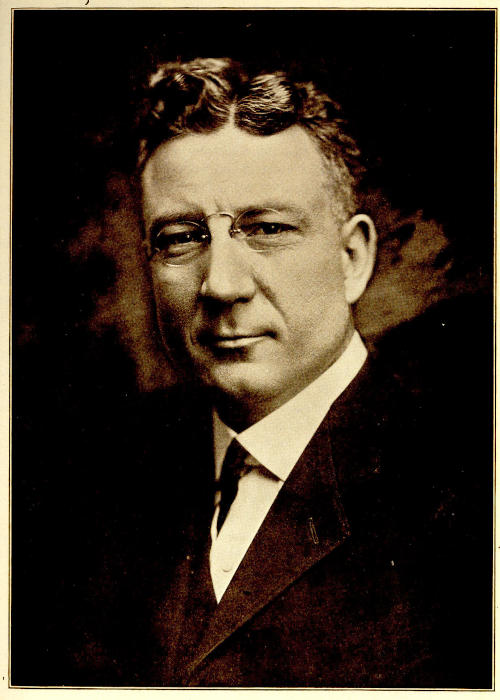
Darius A. Brown, Mayor of Kansas City
“TAPERING RATES.”
I have spoken of the difficulties which confront the people of the deep interior of the continent in working out their complete industrial development. By complete industrial development, I mean that full growth in industry which has come to such seaboard locations as Great Britain, the Netherlands, our Eastern seaboard, our lake regions and the like. One can scarcely conceive such complete development in Iowa, Nebraska, the Dakotas, or Oklahoma. And yet it is merely a question of transportation. The problem of the future relates to the question of the ability of land carriage of any kind to furnish it. If it cannot be accomplished by land carriage, the Nation will have recourse to waterways. New Rockford and her sister hamlets will reach the sea, either by the way of the railroads, or by the Missouri river. If the railways are to give New Rockford—and in her I typify all the interior—what it must have if it is to develope completely, they must find some way to compensate the place by means of rates for its remoteness from the sea.
This may be done by what is called “tapering rates”—that is, by rates which increase not with the distance, but on some basis which gives the remote point a less tariff per ton a mile than the nearby point. The railroads have made such rates always when the demands of profit called for them; and their policy has resulted in great benefit to the interior; but the diverse ownership of the different lines and restrictive laws, as well as the lack of a national policy in rate-making, conspire to prevent the full application of the principle. Congressman D. J. Lewis of Maryland has laid down the principle that rates along a line should increase with the square root of the distance, instead of with the distance. Thus, if the proper rate per hundredweight for twenty-five miles is ten cents, for 625 miles the rate should be not $2.50, which would be the increase directly with the distance, but twenty-five cents, the increase over ten cents according to the square root of the distance. The value of this formula may lie principally in the emphasis of the economic justice, as well as the necessity, of tapering rates for long hauls. As it is, rates taper from New York to Chicago, not according to the square root formula, but in a manner not very much at odds with it; but then they are increased by the fresh start from Chicago as a basing point. Under a national policy in rate-making, these rates would continue to taper to the point at which it would be more economical to ship in some other direction—to the Pacific, or to the Gulf.
The influence of tapering rates on the industrial development of a people may be seen strikingly manifested in Texas, which has long had a rate system peculiar to itself. This system is said to be the fruit of the statesmanship of Judge Reagan, and was devised expressly in the interests of a population deemed to be permanently agricultural. It is exactly the opposite of the general policy which has built up a few great cities at the expense of the rest of the country, and the best or worst example of which is perhaps the case of Chicago. Chicago is fed by livestock shipments which sweep past the very doors of packing houses quite as well equipped to slaughter the stock as any in the Windy City, and the livestock rates are only a sample of the system of tariffs that keep in Chicago’s hands the headship in commerce to which in the natural development of things she would not be entitled. Railroad rates keep the great centers great by decreeing that the primary products shall be sold there, and that the supplies of goods ready for consumption shall be bought there. This is done by depriving other trade centers of the natural advantages over Chicago, of their nearness to the farms, while leaving them handicapped by their remoteness from water transportation. And wherever a great city is found in the United States, the same sort of rate structure is found. The economic result is that long hauls are favored for the railroads, with greater profits to them perhaps; but the farmers are deprived of the benefits of the home markets which nearby large cities afford. The state of Iowa is Chicago’s back field; and Iowa’s population is shrinking. This fact alone is enough to condemn the rate system which permits it. And Iowa’s case is glaring merely because she is an almost purely agricultural state. The farm populations of the other states on Chicago’s back fields are shrinking, also. And while I do not think it fair to attribute all this to rate mal-adjustments, I feel sure that if the Texas system of rates had been in effect in the Chicago-St. Louis basin, the phenomenon of decreasing population would have been long postponed, and might never have appeared.
THE TEXAS SYSTEM OF RATES.
The Texas system, as perfected by the Texas State Railway Commission, is based on the theory that many medium sized towns and cities are to be preferred, for the agricultural welfare of the state, to one or two overgrown municipalities with rates made to stimulate their growths at the expense of the rest. This has been accomplished by the establishment of a maximum freight charge, above which there can be no increase, no matter what the distance—with the exception of certain remote points in the cases of which additions are made, not according to the entire length of haul, but according to their distance beyond the limits of the zone which is established about every shipping point. Thus merchandise taking the class rates pays a tariff from any shipping point according to distance, up to 245 miles, beyond which the rate for 245 miles is paid no matter what the distance. The maximum rate on cotton is reached at 160 miles from any station; on flour, grain and hay at 140 miles; on coal, 790 miles; on fruits, vegetables and melons, 180 miles, and thus for all shipments. The result is that the remote truck farmer is as close, so far as rates are concerned, to the city 500 miles away, as to the one 180 miles off—and the principle is applied to all producers, with variations as to distance. This gives him a wide choice in markets and rates, which equalizes conditions so far as rates can do so, between the interior and the coast. And it fosters the small and new city by enabling it to compete in jobbing and manufacturing with the large and old one. Thus, while such places as Galveston, Houston, Dallas, Fort Worth and Waco are among the most prosperous towns of their size in the country, they are constantly meeting the competition of that numerous class of smaller Texan cities the unsuspected presence of which in the interior is such a constant surprise to the traveler from the North. Business is decentralized to an extent nowhere else seen in the United States in an agricultural community. And decentralization, while opposed to the immediate interests of the railways, is clearly profitable to the farmers, better for the people in general, and in all probability will prove in the end better for the railways themselves. For after all, railroad prosperity must depend on national prosperity.
It may be said that the Texas system has been tried out on a small and a state scale only. On a state scale, truly, but not on a small scale by any means. From El Paso to Texarkana the distance is almost exactly that from New York to Chicago, and from Brownsville to Texline is as far as from Kansas City to Winnipeg. Moreover, Texas has most of the problems which confront the Nation itself in working out a national system of rate-making—a coast well settled and old in development with all the wealth and power that the conditions imply—a hinterland ranging in conditions from fine farming land like that of Iowa, through semi-arid to desert. The Texas rate system may not be the last word in rate-making, and probably is not; but it seems to work well, and is certainly worth study. As will be seen at a glance, it is a modification of the systems of tapering rates suggested above—in which rates taper to a point where a maximum is reached, and then cease to increase at all. It is also a modification of the zone system in effect on certain foreign railways, under which within certain territorial limits railway rates are flat, like postage. The economic basis for such rates lies in considerations of national welfare, coupled with the well-known transportation principle that the terminal charge which makes up so large a portion of most shipments, is the same for a long haul as a short one.
THE DECLINE OF NEW ENGLAND AGRICULTURE.
For purposes relating to the fostering of such interests as seemed necessary to the welfare of New England and New England’s tonnage, the railroads have themselves put in effect with reference to that section a system of rates which in some ways resembles the zone system of Europe, or the maximum distance tariff of Texas. Cut off by the tariff on imports from her natural hinterland, Canada, the decline of New England’s agriculture under the competition of the prairie lands would have brought to her a permanent industrial decline, had she not turned her attention to manufacturing. And even as to that, she was placed at a disadvantage as soon as the development of the Middle States and Middle West brought that great region to the manufacturing stage. For New England’s manufactures had to go to market through New York, and most of her raw materials had to be imported from the West and the South. The railways used their powers of rulership in the interests of this whole group of states, as they are constantly doing in the case of cities—they decreed prosperity to New England’s manufacturers through a rate system. They made of New England a flat-rate zone for raw materials, with the same rate to all points, and practically the same as the rate to New York. This applies to all raw materials coming from west of a line drawn from Buffalo to Pittsburg through Wheeling. For out-going shipments, they gave all New England points a flat uniform rate to all points west of a line drawn from Cleveland to the Ohio river. That the wage earners of New England might be favored in cost of living—a feature reflected in low wages—the food products from the West are given a rate practically the same as that to New York—and thus the ruin of the old New England agriculture, already probable, was made certain. Had it not been for these imperial measures, New England’s headship in manufacturing would have been lost, first to the Middle States, and then, perhaps, to the Middle West. The expedient differs from the Texas system in the fact that it is applied partially and in the interests of manufactures, with New York as a center, while the Texas system is applied for the purpose of decentralizing business by making every shipping point the center of its own flat-rate zone.
But the most striking illustration of the power of the railroads to foster or to blight industry, lies perhaps after all in the field of agriculture. And it so happens that it is also the instance of the application on the broadest scale of the zone principle in which all rates are the same to all points within certain territorial limits. I refer to the rate structure which has been built up for the transportation of the citrus and other fruits and vegetables of the Pacific coast and the Pacific Northwest to the markets of the eastern half of the continent. While the principle is applied with more or less completeness to shipments of deciduous fruits and truck, it is best studied in its relation to citrus fruits. Oranges and lemons go to all points east of Denver at a flat rate. From Cheyenne, Wyoming, to Eastport, Maine, the rate on citrus fruit is the same. The effect has been most beneficial to the agriculture of the Western quarter of the United States, to the people at large, and to the railways. Whether or not the rates are just, the principle upon which they are made is conducive to the development of agriculture and is, perhaps, essential to such development, when the industry is hampered by land carriage over great distances. And nothing need be said in addition to citing these instances of the determinative effects of our railway rates on the course of prosperity, in spite of the averages which seem to show the economic unimportance of rates.
SOIL DEPLETION.
Thus far, I have discussed the influence of railroad policies upon the farmer as a man engaged in one of the many industries which make up the sum of industrial activities. But there are certain respects in which the farmer represents the everlasting welfare of the race, and certain demands which he may legitimately make on the transportation agencies of the land which are based on every man’s heritage in the soil, and interest in its continued fertility. The depletion of the soil by cropping is largely accomplished through transportation, and its restoration to fertility must be accomplished, where such restoration is necessary, in large measure, through the same agencies.
The soil is a reservoir of plant food. Most of the dozen or so elements used by plants in building themselves up from the soil are found in it in such great abundance that we need take little care for their conservation. Only three—or possibly four—are so scarce as to call for anxiety. These three are nitrogen, potash and phosphorus.
Potash is ordinarily found in soils in such quantities as to render its application unnecessary and yet there exist localities in almost every state where a marked poverty exists in this element. Peaty soils are always deficient in potash, and as the swamps of the Nation are drained the potash problem will grow in importance. Commercial potash is mostly imported from Germany, where the government’s conservation measures have already brought its export into the field of somewhat vexing diplomacy. The German supply would seem adequate for the world’s demands for many centuries. The deposit underlies more than a million acres, and in the Strassfurt district, where it was discovered some fifty years ago, the total thickness of the potassium-bearing strata amounts to the astonishing depth of 5,000 feet. It is estimated that this wonderful supply at the present rate of mining will last 190,000 years. It should be remembered, however, that reclamation activities are likely more and more to be directed to swamps as the arid regions are brought under irrigation, and that the drain on the German potash deposits is likely to increase in a geometrical ratio. Our Government does well, therefore, to push diligently the search for potash deposits at home, which it is doing with some prospects of success. In any case, we are not dependent on the German deposits as an ultimate fact; for the waters of the sea are the source from which these great deposits originally came, and there seems no reason to doubt the ultimate feasibility of obtaining potash for all future time from that inexhaustible source, if the geological deposits fail or are denied us. But the matter of getting potash to the land, from whatever source it comes, is a railroad problem in most cases.
IMPORTING FERTILIZERS.
Since the guano deposits of the Pacific islands, and the nitrate deposits of Chili were opened to the agriculture of the world, the carriage of nitrogen to the soil has been a great transportation feature. For nitrogen is often the limiting element in the soil. It exists in the earth in small quantities only, and though all cultivated plants are bathed in a limitless sea of it in the atmosphere, they have not the power of using any except that which is fixed in the soil. They starve for nitrogen, while blown about by winds filled with it. Not all plants, however, are so helpless in the matter of taking nitrogen from the air. The plants grown as crops are utterly unable to help themselves to the plentiful atmospheric supply, but certain minute plants called bacteria have the power denied to those of higher organization, and it is certain that almost all of the fixed nitrogen in the earth’s crust, in the guano beds, in the nitrate deposits of Chili and elsewhere, has been taken from the air by these bacteria, aided perhaps by certain fungi which grow about the roots of plants like the oak, and by the negligible fixation of nitrogen by lightning. These bacteria are coöperators with certain plants of the bean family—clovers, alfalfa, vetches, sweet clover, beans, peas, velvet beans, cowpeas and the like. The microscopic plants grow on the roots of these legumes—and to some extent free, or associated with non-leguminous plants—on the basis of mutual aid. The bacteria reach out into the soil and fix nitrogen for the legumes, and the legumes furnish a host on which the bacteria live, just as we furnish a host for the bacteria of disease. And when a crop of any legume is plowed down into the soil, it is found to have added to the land nitrates to the value, sometimes, of more than twenty-five dollars per acre. Thus by setting in motion the forces of nature, the farmer may draw nitrogen from the very heavens above his farm, without money and without price. This is perhaps the most vital agricultural discovery of the ages.
But how, you may say, is the nitrogen supply a matter of concern to the railroads, if nitrates may be drawn from the air? Unfortunately, there is work for them to do in assisting the farmer to adapt conditions in his soil to the needs of these bacteria. For some reasons, the bacteria of the clovers and their leguminous cousins will not do well in a soil that is acid; and soils tend to become acid through cultivation. Acidity is the bane of the older farms of the United States. When acid phosphates are applied for the purpose of furnishing phosphorus to the crops, the very process of fertilization tends to produce acidity. Most of the prairie soils were originally alkaline, and finely adapted to the growth of the favoring bacteria of the legumes, but plants that thrive on acid soils—especially the sorrel—are appearing in the prairie states of the Mississippi Valley, and wherever they appear, clovers cease to thrive.
THE VALUE OF LIME.
Nature’s remedy for acidity in the soil is lime. The basis of the great alfalfa industry in the West and Southwest is the high percentage of lime in the arid soils, which have retained this precious element through that very dryness which, until irrigation redeemed it, made some of it a desert. Now lime is needed over a great part of the United States east of the Mississippi. Even where the soil is of limestone origin, it may have become acid by the dissolving of the lime out of the surface soil. In Wisconsin a great area of otherwise good land has been found to be acid, though a stratum of limestone lies only a few feet below the grass roots. The abandoned farms of New England need lime. The old farms of New York and Pennsylvania, and all the South, need lime. Wherever the legumes fail to arrive, lime is a prime need. Carbonate of lime is the basis of legume culture, and successful agriculture everywhere—in China, in Japan, in India, in the highly cultivated nations of Europe—is based on leguminous crops. The supply of nitrogen to these states of ours in which agriculture has languished must be restored through lime in the soil and rotations in which legumes shall have large part. And the supply of lime is essentially a transportation question.
Lime is one of the most plentiful of the elements necessary to agriculture. Its application to the land has in some periods achieved such bad repute that there is a maxim among farmers that lime makes the children rich but the grandchildren poor. The evils referred to, however, arise, I believe, from the application of caustic lime, and are not necessary to the use of lime. It has now been determined, I believe it is safe to say, that raw ground limestone is the best form of lime in which it can be given to the soil. It may be applied in any amount without injury. If raw ground limestone could be spread an inch deep over the farms east of the Mississippi (and in many localities west of it) it would bring about a condition which would soon swamp the railroads with tonnage; and while there are some favored soils to which it would do no good, it would nowhere do any harm. It would put the East on a parity with the alfalfa lands of the West in the matter of the production of legumes, and would bring hope to the discouraged farmers who strive against the obscure evils of increasing soil acidity.
Limestone occurs along the lines of every railway. It is almost as common and cheap as gravel. It can be ground cheaply, and cheaply shipped. It should be furnished to the farms at gravel prices. Burned lime is sold at almost prohibitive prices, and thousands of farmers who know their needs are deterred from satisfying them because of poverty. This is a problem which enlightened statesmanship should solve in the interests of the Nation, and one to the solution of which a railroad system operated in the interests of the national welfare would surely address itself.
PHOSPHORUS.
Phosphorus is the element which is perhaps most commonly lacking when a soil is infertile. A good soil should contain not less than 2,000 pounds of it in the top foot of ground. Many so-called exhausted soils are reduced to less than a sixth of this amount. A crop of corn of a hundred bushels to the acre takes from the soil of each acre twenty-three pounds of phosphorus; a fifty-bushel wheat crop takes sixteen pounds, a two-bale cotton crop takes thirty pounds, and other crops in like manner subtract from the phosphorus supply. Only about one per cent of the supply is available to the crop of any one year—that is, in their hunt for phosphorus the rootlets are unable to find more than one atom in a hundred. Thus we see that a good soil provided with 2,000 pounds of phosphorus to the acre within reach of the roots cannot produce a 100-bushel crop of corn. Such a crop must have twenty-three pounds of phosphorus, and the roots can find only twenty—and the next year the supply will be reduced to 1,980 pounds, and the roots will be able to find but nineteen and eight-tenths per cent of phosphorus for the dwindling crop. The 2,000 pounds of phosphorus would be quite adequate to the needs of the fifty-bushel wheat crop, but it would fall short by one-third of meeting the demands of the two-bale cotton crop. As so of all crops. They draw on the supply of a limiting element, and as successive croppings reduce this supply, the crop falls off until we have the four-bushel wheat crop, the ten-bushel corn crop, the third-of-a-bale cotton crop, which marks the ruin of the farmer—and the railway.
There is no way to supply phosphorus to the soil save by carrying it upon the land and applying it. It is not found, like nitrogen in the air. It may be brought back in manure and the bones of slaughtered animals, and the process of depletion retarded, but this game is inevitably a losing one like those gambling games in which there is always a percentage in favor of the house. The fertility flushed into the waters of the earth through sewers, the waste of manure, the leaching of soil by rains—all these are the percentages in favor of the house, and against the players. The players are we—the human race—and the house is the massed forces of nature. There seems to be no way to play this game of life without losing. If the earth ever becomes unable to sustain human life, there is good reason to believe that our doom will reach us through failure of the supply of phosphorus in the soil.
There is no phosphorus in the air, and in the waters the supply is negligible. It is an element, and until we discover the secret of the transmutation of elements we cannot make it. As it disappears from the soil there is no source of replenishment of the supply, except in the phosphate rocks of the earth. And while the failure of the soil to give its increase, and the depopulation of the earth through the exhaustion of this element of plant food may seem remote and speculative, the necessity of transporting the phosphate rocks from the quarries to the farms is an actual and present one. And it is a matter which lies within the relations between the railroads and the farmers.
PHOSPHATE RESOURCES.
Fortunately for the permanent agriculture of the United States, the largest known deposits of phosphorus in nature are within her boundaries. Guano, which is merely the manure accumulated on rainless islands where seabirds congregate, is of very limited importance in the long run, though for so long the source from which most of the world’s commercial phosphates were derived. The phosphate rocks of the world are, so far as known, preponderantly in the United States. All the phosphate rock now mined, I believe, comes from the three states of South Carolina, Florida and Tennessee—whence the rock is now shipped at a rate which will exhaust them about the year 1930. On three Pacific islands are known deposits of high grade rock of about the same amount as that still remaining unmined in these three states—about 60,000,000 tons in each case. These rocks contain from sixty to eighty per cent of calcium phosphate. As they fall off in output, and the need for phosphorus becomes more bitter, the farmers must use rock of lower and lower grade, and the task of transporting it will become proportionately greater.
Indeed, the task of transportation will begin to increase long before it becomes necessary to resort to the low grade rock. For far from the depleted lands, in Utah, Idaho and Wyoming, are the greatest high grade phosphate beds in the world—something like half a billion tons of rock practically in sight (according to Van Hise), and averaging over seventy per cent tricalcium phosphate. The existence of these great deposits, and of the low grade beds known to exist elsewhere, together with the probability that other beds will be discovered, justifies the highest optimism as to the future of agriculture—if transportation facilities can be afforded which will place the phosphates on the ground on terms tolerable to the farmers and profitable to them. This is a railway problem. As a mere matter of tonnage it is potentially greater than any other transportation item, save the one of supplying the fields with lime.
At present this sole supply of available phosphate rock is being carried off to Europe as fast as the mills can grind and the railways carry it to the ships. Nothing is being done to conserve the supply, so far as I am aware, in emulation of Germany’s statesmanship in conserving her potash beds. It would be unfair to blame the railways which only act as common carriers in these shipments. But it might not be too much to expect of the patriotism of the men who have these great interests in hand to ask them to reverse the policy which they have adopted as to many other commodities, and to make higher rates for export on phosphate rock than for home consumption. The real remedy for the drain of phosphorus lies, of course, with the Government. We are forbidden by the Constitution to stop shipments abroad by means of an export duty, but we have the right to stop exports entirely, or to limit them. Our ethical right to refuse to divide the phosphate treasures with the needy agriculture of the world may be open to question; but we might surely demand that the foreign deposits be worked first for the foreign demand. The shipment of our phosphates abroad, with the certainty confronting us that at some future time we shall have to re-import the same commodity, involves an economic waste to which the world should not be subjected. And the railroads ought, in their own interests, to adopt every policy legally open to them to keep the phosphate rock for the use of the farms within their own transportation territory.
RATES AND FERTILIZERS.
It has just been suggested that the railways might discriminate in their rates on fertilizers, in favor of the home market, and against the foreign. Most railway men are probably unaware of the extent to which they are contributing to the exhaustion of our soils by their discrimination against the American milling of American grains and in favor of the export of the whole grains instead of the milled product. For generations we have had a tariff on wheat, ostensibly for the protection of the American farmer; and all the time the railways have made rates for export wheat lower than for domestic milling. Flour is largely denied the benefits of water transportation on the lakes, in part because it must go to market over the docks which are to a greater and greater degree controlled by the railways, while the great elevator companies with their terminal houses standing at the water’s edge, and many of them provided with their own lines of boats, send wheat and other grains to tide water so cheaply as to make the shipment of flour a thing practically under the control of themselves and of the railways with which they have been traditionally closely affiliated in business interest. The result has been that, while there are mills enough in America to grind all our grain, most of our exports go unground.
This will be intolerable to public opinion when once enlightened upon the subject. The export of flour, of course, constitutes a drain of fertility; but the phosphorus content of the grain is largely concentrated in the bran and shorts. In the bran of every bushel of wheat exported goes phosphorus in its most readily available form of the value, at the ordinary rates paid by farmers for phosphates, of from twenty-five to thirty cents. A system of transportation based on considerations of national welfare would sedulously seek to retain that fertility for our depleted farms. Where grain is milled there grows up a large local use for bran, shorts and middlings—the by-products of milling. These are used in the feeding of dairy cattle and other live stock, furnishing what is needed in animal nutrition to balance the corn ration. Farms to which they are carried for feeding increase in fertility. The fertility of the prairie states has been sapped by fifty years of grain shipments. This era should be succeeded by the golden age of American milling. The wheat fields of Canada stand ready to send us fertility to replace that which we have shipped to Europe; and our transportation system should be used to the end that it should be retained here. The Hudson Bay basin would thus, during its period of soil exploitation, return to the Mississippi Valley what we have sent to the hungry soils of the old world.
RAILROADS AND POPULATION.
The existence of overgrown cities is to a large extent attributable to the policies of the railroads with reference to them. The Texas system has, I believe, shown the power of transportation influences to decentralize population, just as the history of Chicago, Kansas City, the Twin Cities, New York and almost every large city proves their power in the direction of centralization. As a farming factor, the large city is a drain on fertility. These great towns are flushing out through their sewers the goodness of the Nation’s farms. In the carriage of lime, phosphates, potash, cottonseed meal, bone meal, and of all the fertilizers of commerce, the railways as national tools of right living should be used to restore to the lands the fertility of which they have inevitably, in some instances, mistakenly in others, deprived them. But in considering the so-called commercial fertilizers, the coarser manures should not be forgotten. The enormous waste of manure about the great cities should be stopped. A German farmer of my acquaintance told me the other day that he had never sold a load of hay or straw from his farm in all his life. “Often,” said he, “I have had more than I needed, but I have held it over, even when the price was high and I needed money. It seemed to me as if that hay and straw didn’t belong to me, but to the farm.” Under the renting customs of many British and other European localities the tenant agrees that whenever he hauls hay or straw to market he will haul back to the farm an equal quantity of manure.
This custom is based on the highest wisdom. The German farmer was right—that hay and straw do not belong to the farmer, but to the farm. And whenever hay or straw, or any of the vegetable substances which are made into manure, are taken to the city, they should be considered as lent, not sold. Getting them out to the farms—not the identical farms, of course, but the farms—is a railway problem. And it should rest on the conscience of the people and of the railways, as did the similar problem on the conscience of my German friend.
I am aware that the railways of the country are not entirely oblivious to the wisdom of the policies here urged upon them. In some places they are making commendable efforts to get the manure of the cities out to the farms. In other instances, they are making what they probably regard as very low rates on fertilizers and lime. Just recently a railway in Virginia has made a rate of from one-half to three-fourths of a cent per ton mile on lime. But I do not find that they have anywhere made any such heroic efforts to cut down the cost of carriage of fertilizers and manures for the farms, as they have in the case of coal from the mines to the docks on Lake Erie, or grain from the elevators at the foot of the lake to New York, or ore from lake ports to Pittsburgh, or packing house products from Missouri river points to Chicago. In my opinion, true national welfare demands that the fertility of our farms be sustained at all costs, and that no freight is entitled to rates as low as ground phosphate rock, ground limestone, and manures.
THE GREATEST RAILWAY FOLLY.
The demands made here upon the railways may be regarded in some quarters as unwarranted. I am quite aware of their scope and character as innovations. They go deeper than the relations between the railroads and the farmers, and rise to the point of an outline for a national rate policy for our railways. In what I have said I have regarded the railways as public utilities in the strictest sense of the word. I have scarcely more than alluded to the rights of investors in railway properties, and I mention them now for the sole purpose of stating that in my opinion no demands will ever be made in the interests of the public welfare, or should be made, inimical to the rights of investors to a proper return on their investment made for the purpose of serving the transportation needs of the Nation. None of the things which I suggest are at variance with these principles. The railways may properly adopt the policy of hauling, or may properly be forced to haul certain public necessities at or for less than cost, so long as on the whole job of transportation they are allowed to earn legitimate profits. I do not believe that in the long run the profits on the fertilizer traffic should be made directly out of their haulage. I do believe that the time will come when no transportation folly will rank as greater in the eyes of our railway managers than that of allowing rolling stock to remain idle, while there is a chance to get loads of ground lime, ground phosphate rock or manure at almost any rate. I am not unaware of the various private interests which would demand and secure monopoly prices if the railways should transport these things at low rates or even gratis, if that were possible; but this is not the time for the discussion of these things. They must be dealt with by the statesmanship of the future. Institutions must be gradually moulded to the end that the agriculture of the Nation may be enabled to flourish; for on its agriculture and the status of its agricultural population rests in the last analysis the welfare of the Nation and its railroads. It may be urged that the present railway system of the land will not permit of the exercise of the beneficent functions outlined here. If that be so, it is no affair of mine. My task is to follow truth as I see it, wherever it may lead. If the railway system under which we happen to be doing business be at variance with the final demands of national welfare, there is ground for optimism in the historic fact that nothing changes more readily than railway systems. They have been almost revolutionized in the past decade—and these considerations of national welfare of which I am here privileged to speak will take many decades in coming to a final decision.
Mr. Quick closed by reading the following telegram from O. C. Barber of Akron, Ohio:
Regret exceedingly my inability to attend Conservation Congress. I note from several different programs there will be distinguished speakers on the question from all over the states. I hope as a result of the meeting something more than speeches will be accomplished in conservation of the equities of all American citizens. Things vital for their comfort have been transferred to corporate power by unjust legislation, without adequate legal restraint on corporate power compelling fair play and justice to all interested. A special interest should be elicited to compel a rate of freight on all fertilizers for land from which we all derive our sustenance. Not more than four-tenths of a cent per ton mile should be permitted for long hauls, nor five-tenths of a cent per ton mile for short hauls. Any well managed railroad could haul fertilizer for that price at a profit—referring to all kinds of fertilizer, lime, phosphate, rock, etc. If you would take such action as would accomplish this one thing, you would do more for the good of mankind than all the conservation efforts have accomplished to date. Wishing you great success, I am sincerely,
O. C. Barber.
President Wallace—I have appointed the following committee on nominations: C. E. Condra, E. G. Griggs, A. B. Farquhar and H. C. Wallace, and B. N. Baker, Chairman.
Get together and be ready to report nominations promptly tomorrow. Remember, we will have a very busy Congress. I want you to be here at 2 o’clock promptly, because we will commence at 2 o’clock if there is anybody here, and some of you will be. This afternoon, I am very sorry to say, we will not have the privilege of hearing Brother W. H. Page. I have a letter stating that sickness prevents his attendance. Instead of that we will take up the report from conservation committees, and as far as possible from the states. Let me urge you to cut your speeches down to five minutes, or I will shut every man off after five minutes, no matter who he is. Don’t tell us about your resources. We know about them. Tell us what you are doing. Make it specific and to the point, and then this Congress will hear you patiently, but they won’t hear you after that, and I won’t either. We must come down to business. This afternoon we are to have Professor Mumford on the subject of live stock and soil fertility, a matter of immense importance. The ladies will come in after that, and I hope you will all bring your wives and sisters and cousins and aunts. We will have an address on the “Farmer’s Wife,” who you have heard is the most important person on the farm and the one who bears the greatest burden—by Mrs. Ashby of Iowa, followed by Mrs. J. N. Lewis of Kansas. Tonight we are to have a great treat. Mrs. Moore of the General Federation of Women’s Clubs; then the “Church and the Open Country,” by Dr. Warren H. Wilson, New York City, superintendent of home missions of the Presbyterian Church, and then finally, to round up, an address by Dr. Harvey W. Wiley, Washington, D. C., Chief of the Bureau of Chemistry, United States Department of Agriculture, of whom you have all probably heard. That will be the closing address this evening. Be here promptly at 2 o’clock. The Congress will now stand adjourned until 2 o’clock.