WALTER HAMILTON, (continued 8)
Reading edition
From Gimcrackiana, or Fugitive pieces on Manchester Men and Manners. Manchester, 1833. (Attributed to John Stanley Gregson.)
An Imitation of Mr. Abraham Cowley. “The lazy Earth doth steam amain, And fumes and smokes beneath the rain: The Rivers, Brooks, and Rivulets are No less in smoke particular At nightfall: and the storm blast loud Is often wont to blow a cloud Around the mountain-tops, and they Do take delight in this same way; And send a fiery fume from out Their angry heights, and such a rout Of burnt-up ashes, that do strow Great cities in the plains below. The setting Sun is oft made dim With smoky mists that circle him. So all the world’s on smoking bent, And puffs and fumes to its content: Fill up the bowl then, fill it high, Fill all the gaping pipes, for why Should every creature smoke but I: Why, man of morals, tell me why?”
From “The Anatomy of Tobacco: or Smoking Methodised, Divided, and Considered after a new fashion.” By Leolinus Siluriensis. London. George Redway, 1884.
149 An Address to the Critics. Critics avaunt—tobacco is my theme, Tremble like hornets at the blasting steam; And you Court insects—flutter not too near Its light, nor buzz within its scorching sphere. Pollio, with flame like thine, my verse inspire, So shall the Muse, with smoke, elicit fire; Coxcombs prefer the tickling sting of snuff, Yet all their claim to wisdom is—a puff. Lord Fopling smokes not—for his teeth afraid; Sir Tawdry smokes not—for he wears brocade. Ladies, when pipes are brought, affect to swoon; They love no smoke, except the smoke of town. But courtiers hate the puffing tribe—no matter, Strange if they love the breath that cannot flatter. Its foes but show their ignorance, can he Who scorns the leaf of knowledge, love the tree? Citronia vows it has an odious stink, She will not smoke, ye gods, but she will drink; And chaste Prudella—blame her if you can— Says—pipes are used by that vile creature man. Yet crowds remain, who still its worth proclaim, For some for pleasure smoke, and some for fame— Fame, of our actions, universal spring, For which we drink, eat, sleep, smoke—everything. Smoking and Smokers. By W. A. Delamotte. 1845.
A Manilla Sonnet. Luscious leaf of fragrant savour, Mild cheroot of choicest flavour, Wafting incense to the sky, Like the gales of Araby, Let us press thee to our lips, As the bee the honey sips; Culling as our well-earned meed, Joys from thee—thou heavenly weed! Ere thy burnished lip we kiss, Let us thus enjoy the bliss, Lit by the promethean spark, Kindled from the congreve dark; In summer-house or country villa, There’s nothing like a good Manilla!
From A Pipe of Tobacco, by E. L. Blanchard. London. H. Beal. (No date.)
L’heureux Fumeur. Certain fumeur courtisait une veuve, Grâce à l’hymen, lorsqu’il fut dans ses lacs, Pour te donner, lui dit-il, une preuve De mon amour, je vais mettre en éclats Si tu le veux, ma pipe toute neuve; —Non, non; la pipe a pour toi trop d’appas; Je ne la crains que lorsque je suis grosse: L’odeur m’en plait quand je ne la suis pas; Tu peux fumer. Notre époux, dans la Beauce Comme héritier d’un oncle, avait des droits; Il part. Suivant des conseils maladroits, Dans un procès chicaneau vous l’enfourne; Ce n’est qu’après absence de vingt mois, Qu’à son logis un matin il retourne, Pipe à la bouche. Oh! qu’est ce que je vois? S’écria-t-il en rentrant; quoi! commode, Console içi! pendule, glace la? D’ou viennent done ces meubles à la mode? —D’un troc. Je vais te conter tout cela; Mais—mon mari—ta pipe m’incommode. Pons de Verdun.
An Encomium on Tobacco. Thrice happy Isles that stole the world’s delight And thus produce so rich a Margarite! It is the fountain whence all pleasure springs, A potion for imperial and mighty kings. He that is master of so rich a store May laugh at Crœsus and esteem him poor; And with his smoky sceptre in his fist, Securely flout the toiling Alchymist, Who daily labours with a vain expense In distillations of the Quintessence, Not knowing that this golden Herb alone Is the Philosopher’s admired Stone. It s a favour which the Gods doth please, If they do feed on smoke, as Lucian says. Therefore the cause that the bright sun doth rest At the low point of the declining West— When his oft wearied horses breathless pant— Is to refresh himself with this sweet Plant, Which wanton Thetis from the West doth bring, To joy her love after his toilsome ring: For ’tis a cordial for an inward smart, As is Dictamnum[27] to the wounded hart. It is the sponge that wipes out all our woe; ’Tis like the thorn that doth on Pelion grow, With which whoe’er his frost limbs anoints, Shall feel no cold in fat, or flesh, or joints. ’Tis like the river, which whoe’er doth taste, Forgets his present griefs and sorrows past, Music, which makes grim thoughts retire, And for a while cease their tormenting fire Music, which forces beasts to stand at gaze, And fills their senseless spirits with amaze— Compared to this is like delicious strings, Which sound but harshly while Apollo sings. The train with this infumed, all quarrel ends And fiercest foemen turn to faithful friends; The man that shall this smoky magic prove, Will need no philtres to obtain his love. Yet this sweet simple, by misordered use, Death or some dangerous sickness may produce. Should we not for our sustentation eat Because a surfeit comes from too much meat? Should we not thirst with mod’rate drink repress, Because a dropsy springs from such excess? So our fair Plant—that doth as needful stand As heaven, or fire, or air, or sea, or land; As moon, or stars that rule the gloomy night, Or sacred friendship or the sunny light— Her treasured virtue in herself enrolls, And leaves the evil to vainglorious souls. And yet, who dies with this celestial breath, Shall live immortal in a joyful death. All goods, all pleasures, it in one can link— ’Tis physic, clothing, music, meat, and drink. Gods would have revell’d at their feasts of Mirth With this pure distillation of the earth; The marrow of the world, star of the West, The Pearl whereby this lower Orb is blest; The joy of Mortals, Umpire of all strife, Delight of Nature, Mithridate of Life; The daintiest dish of a delicious feast, By taking which Man differs from a beast. Anonymous. Temp., James I.
From The Smoker’s Guide, Philosopher and Friend, by a veteran of Smokedom. London. Hardwicke and Bogue.
150
The Patriotic Smoker’s Lament. Tell me, shade of Walter Raleigh, Briton of the truest type, When that too-devoted valet Quenched your first-recorded pipe, Were you pondering the opinion, As you watched the airy coil, That the virtue of Virginian Might be bred in British soil? You transplanted the potato: ’Twas a more enduring gift Than the wisdom of a Plato To our poverty and thrift. That respected root has flourished Nobly for a nation’s need; But our brightest dreams are nourished Ever on a foreign weed. For the deepest meditation Of the philosophic scribe, For the poet’s inspiration, For the cynic’s polished gibe, We invoke narcotic nurses In their jargon from afar: I indite these modest verses, On a polyglot cigar. Leaf that lulls a Turkish Aga May a scholar’s soul renew, Fancy spring from Larranaga, History from honeydew. When the teacher and the tyro Spirit-manna fondly seek, ’Tis the cigarette from Cairo Or a compound from the Greek. But no British-born aroma Is fit incense to the Queen; Nature gives her best diploma To the alien nicotine. We are doomed to her ill-favour; For the plant that’s native grown Has a patriotic flavour Too exclusively our own. O my country, could your smoker Boast your “shag,” or even “twist,” Every man were mediocre Save the blest tobacconist! He will point immortal morals, Make all common praises mute, Who shall win our grateful laurels With a national cheeroot! The St. James’s Gazette.
Ode to the Weed. When happy quite and cosy grown, I feel for meditation ripe, I need companionship, and so I take a pipe. When from the irksome cares of life I pine to be removed far, They vex no longer if I light, A good cigar. I realize what Eden was, (Or some faint semblance of it get) When “she” is with me, and I light A cigarette. Ah me! how much the spirits bless Mankind. I fail when I begin To count thy many gifts to me Sweet “Nicotin.” I wonder oft as I enjoy Thy calm delights (and calm indeed), How they can call thy resting place By name “a weed.” O, may the world in all its ills, Ne’er have this greatest to confess, That is, that it should e’er become Tobaccoless. R. W. Essex.
Amourettes of a Smoker. I flirted first with cigarettes One windy, wild March day; But found their fire, like fair coquettes, Too soon consume away. And then I wooed the mild cheroot, As balmy as the south; Inserting, after much dispute, The big end in my mouth. Awhile I dallied with cigars, Havanna’s ripe brunettes; And wafted incense to the stars, In blue and spiral jets. Shag, bird’s-eye, twist, and negro-head This infant doth eschew; And cavendish he hath “cut” dead: But “Chacun â son goût.” One Christmas on an ottoman I sat, and some turkey A fair girl brought me in a can— Ister, a duck was she! I bought a pipe, with amber tip, Of Moses Abrahams; Alas! one day I let it slip— I’ll love no more mere-shams! Now, all my youthful amour o’er, I’m wed, and every day With smoking holocausts adore An idol made of clay. George Hill.
A Farewell to Tobacco. May the Babylonish curse Straight confound my stammering verse, If I can a passage see In this word-perplexity, Or a fit expression find, Or a language to my mind (Still the phrase is wide or scant), To take leave of thee, Great Plant! Or in any terms relate Half my love or half my hate: 151 For I hate yet love thee so, That, whichever thing I show, The plain truth will seem to be A constrain’d hyperbole, And the passion to proceed More from a mistress than a weed. Sooty retainer to the vine, Bacchus’ black servant, negro fine; Sorcerer, that makest us dote upon Thy begrimed complexion, And for thy pernicious sake, More and greater oaths to break Than reclaimed lovers take ’Gainst women: thou thy siege dost lay Much too in the female way, While thou suck’st the labouring breath Faster than kisses or than death. Thou in such a cloud dost bind us, That our worst foes cannot find us, And ill fortune, that would thwart us, Shoots at rovers, shooting at us; While each man, through thy heightening steam, Does like a smoking Etna seem, And all about us does express (Fancy and wit in richest dress) A Sicilian fruitfulness. Thou through such a mist dost show us, That our best friends do not know us, And, for those allowed features, Due to reasonable creatures, Liken’st us to fell chimeras— Monsters that, who see us, fear us; Worse than Cerberus or Geryon, Or, who first loved a cloud, Ixion. Bacchus we know, and we allow His tipsy rites. But what art thou, That but by reflex canst show What his deity can do, As the false Egyptian spell Aped the true Hebrew miracle? Some few vapours thou may’st raise, The weak brain may serve to amaze, But to the reins and nobler heart Canst nor life nor heat impart. Brother of Bacchus, later born, The old world was sure forlorn Wanting thee, that aidest more The god’s victories than before All his panthers, and the brawls Of his piping Bacchanals. These, as stale, we disallow, Or judge of thee meant: only thou His true Indian conquest art; And, for ivy round his dart The reformed god now weaves A finer thyrsus of thy leaves. Scent to match thy rich perfume Chemic art did ne’er presume Through her quaint alembic strain, None so sovereign to the brain. Nature that did in thee excel, Framed again no second smell. Roses, violets, but toys, For the smaller sort of boys, Or for greener damsels meant; Thou art the only manly scent. Stinking’st of the stinking kind, Filth of the mouth and fog of the mind, Africa, that brags her foison, Breeds no such prodigious poison, Henbane, nightshade, both together, Hemlock, aconite— Nay, rather, Plant divine, of rarest virtue; Blisters on the tongue would hurt you. ’Twas but in a sort I blamed thee, None e’er prosper’d who defamed thee: Irony all and feign’d abuse, Such as perplex’d lovers use At a need, when, in despair To paint forth their fairest fair, Or in part but to express That exceeding comeliness Which their fancies doth so strike, They borrow language of dislike; And, instead of Dearest Miss, Jewel, Honey, Sweetheart, Bliss, And those forms of old admiring, Call her Cockatrice and Siren, Basilisk, and all that’s evil, Witch, Hyena, Mermaid, Devil, Ethiop, Wench, and Blackamoor. Monkey, Ape, and twenty more: Friendly Traitress, Loving Foe,— Not that she is truly so, But no other way they know A contentment to express, Borders so upon excess, That they do not rightly wot Whether it be pain or not. Or as men, constrain’d to part, With what’s nearest to their heart, While their sorrow’s at the height, Lose discrimination quite, And their hasty wrath let fall, To appease their frantic gall, On the darling thing whatever Whence they feel it death to sever, Though it be, as they, perforce, Guiltless of the sad divorce. For I must (nor let it grieve thee, Friendliest of plants, that I must) leave thee. For thy sake, Tobacco, I, Would do anything but die, And but seek to extend my days Long enough to sing thy praise. But, as she who once hath been A king’s consort, is a queen Ever after, nor will bate Any tittle of her state Though a widow, or divorced, So I, from thy converse forced, The old name and style retain, A right Katherine of Spain: And a seat, too, ’mongst the joys Of the blest Tobacco Boys; Where, though I, by sour physician, Am debarr’d the full fruition Of thy favours, I may catch Some collateral sweets, and snatch Sidelong odours, that give life Like glances from a neighbour’s wife; And still live in the by-places And the suburbs of thy graces; And in thy borders take delight An unconquer’d Canaanite. Charles Lamb.
152
Lord Byron on Tobacco. Borne from a short frail pipe which yet had blown Its gentle odours over either zone, And, puff’d where’er winds rise or waters roll, Had wafted smoke from Portsmouth to the Pole, Opposed its vapour as the lightning flash’d, And reek’d, midst mountain-billows unabash’d, To Æolus a constant sacrifice, Thro’ every change of all the varying skies. And what was he who bore it? I may err, But deem him sailor or philosopher. Sublime Tobacco! which from East to West Cheers the tar’s labour or the Turkman’s rest; Which on the Moslem’s ottoman divides His hours, and rivals opium and his brides; Magnificent in Stamboul, but less grand, Though not less loved, in Wapping or the Strand; Divine in hookahs, glorious in a pipe, When tipp’d with amber, mellow, rich, and ripe; Like other charmers, wooing the caress, More dazzlingly when daring in full dress; Yet thy true lovers more admire by far Thy naked beauties—give me a cigar! The Island.
A Shield of Adamant. For lack o’ Tobacco, I’d die; For cigars O! my stars, How I cry! For a smoke is the shield Before which troubles yield— Enabling us cares to defy! E. H. S.
——:o:——
Epitaph On a young lady who desired that Tobacco might be planted over her grave. Let no cold marble o’er my body rise— But only earth above, and sunny skies. Thus would I lowly lie in peaceful rest, Nursing the Herb Divine from out my breast. Green let it grow above this clay of mine, Deriving strength from strength that I resign. So in the days to come, when I’m beyond This fickle life, will come my lovers fond, And gazing on the plant, their grief restrain In whispering, “Lo! dear Anna blooms again!”

POEMS ON THE PIPE.
Hail! social pipe—thou foe to care, Companion of my elbow chair; As forth thy curling fumes arise, They seem an evening sacrifice— An offering to my Maker’s praise, For all His benefits and grace. Dr. Garth.
Sonnet to a Pipe. (1690.) “Doux charme de ma solitude, Brulante pipe, ardent fourneau! Qui purges d’humeur mon cerveau, Et mon esprit d’inquiétude. Tabac! dont mon ame est ravie, Lorsque je te vois te perdre en l’air, Aussi promptement q’un éclair, Je vois l’image de ma vie; Tu remets dans mon souvenir, Ce qu’un jour je dois devenir, N’étant qu’une cendre animée; Et tout d’un coup je m’aperçoi, Que courant après ta fumée, Je passe de même que toi.”
Attributed to Esprit de Raymond, Comte de Modène.
Translation of the above. “Sweet smoking pipe, bright glowing stove, Companion still of my retreat, Thou dost my gloomy thoughts remove, And purge my brain with gentle heat. “Tobacco, charmer of my mind, When, like the meteor’s transient gleam Thy substance gone to air I find, I think, alas! my life the same. “What else but lighted dust am I? Thou show’st me what my fate will be; And when thy sinking ashes die, I learn that I must end like thee.”
To a Pipe of Tobacco. Come, lovely tube by friendship blest, Belov’d and honour’d by the wise, Come, fill’d with honest Weekly’s best, And kindled from the lofty skies. While round me clouds of incense roll, With guiltless joys you charm the sense, And nobler pleasures to the soul, In hints of moral truth, dispense. Soon as you feel th’ inlivening ray, To dust you hasten to return; And teach me that my earliest day, Began to give me to the urn. But tho’ thy grosser substance sink To dust, thy purer part aspires; This when I see, I joy to think That earth but half of me requires. Like thee myself am born to die, Made half to rise and half to fall. O! could I while my moments fly, The bliss you give me, give to all. From The Gentleman’s Magazine. July, 1746.
Choosing a Wife by a Pipe of Tobacco. Tube, I love thee as my life; By thee I mean to chuse a wife, Tube, thy colour let me find, In her skin and in her mind 153 Let her have a shape as fine; Let her breath be sweet as thine: Let her, when her lips I kiss, Burn like thee, to give me bliss: Let her in some smoke or other, All my failings kindly smother. Often when my thoughts are low, Send them where they ought to go. When to study I incline Let her aid be such as thine: Such as thine her charming pow’r, In the vacant social hour Let her live to give delight, Ever warm and ever bright: Let her deeds, whene’er she dies, Mount as incense to the skies. From The Gentleman’s Magazine. 1757.
Translation of a German Song. When my pipe burns bright and clear, The gods I need not envy here; And as the smoke fades in the wind, Our fleeting life it brings to mind. Noble weed! that comforts life, And art with calmest pleasures rife; Heaven grant thee sunshine and warm rain, And to thy planter health and gain. Through thee, friend of my solitude, With hope and patience I’m endued, Deep sinks thy power within my heart, And cares and sorrows all depart Then let non-smokers rail for ever; Shall their hard words true friends dissever? Pleasure’s too rare to cast away My pipe, for what the railers say! When love grows cool, thy fire still warms me. When friends are fled, thy presence charms me; If thou art full, though purse be bare, I smoke, and cast away all care!
The Pipe of Tobacco. Why should life in sorrow be spent, When pleasure points to the road Wherein each traveller with content May throw off the ponderous load? And instead, in ample measure, Gather fruits too long left ripe; What’s this world without its pleasure? What is pleasure but a pipe? Is it not tobacco dear, That from the brow fell grief can wipe? Yes! like them with jolly cheer, I find pleasure in a pipe. Some delight in envy ever, Others avaricious gripe; Would you know our greatest pleasure? ’Tis a glowing social pipe. Two verses omitted. (Printed by W. J. Shelmerdine, about 1794.) From Logan’s Pedlar’s Pack of Ballads.
La Pipe de Tabac. Contre les chagrins de la vie, On crie, “Et ab hoc et ab hac;” Moi, je me crois digne d’envie, Quand j’ai ma pipe et mon tabac. Aujourd’hui, changeant de folie, Et de boussole et d’almanach, Je préfère fille jolie, Même à la pipe de tabac. Le soldat bâille sous la tente, Le matelot sur le tillac; Bientot ils out l’âme contente, Avec la pipe de tabac. Si pourtant survient une belle A l’instant le cœur fait tictac, Et l’amant oublie auprès d’elle Jusqu’à la pipe de tabac. Je tiens cette maxime utile De ce fameux monsieur de Crac: En campagne, comme à la ville, Fêtons l’amour et le tabac. Quand ce grand homme allait en guerre, Il portait dans son petit sac, Le doux portrait de sa bergère, Avec la pipe de tabac. Pigault Lebrun. (1755-1835.)
Content and a Pipe. Contented I sit with my pint and my pipe, Puffing sorrow and care far away, And surely the brow of grief nothing can wipe Like smoking and moist’ning our clay; For, though liquor can banish man’s reason afar, ’Tis only a fool or a sot, Who with reason or sense would be ever at war, And don’t know when enough he has got. For, though at my simile many may joke, Man is but a pipe—and his life but smoke. Yes, a man and a pipe are much nearer akin Than has as yet been understood, For, until with breath they are both fill’d within, Pray tell me for what are they good? They, one and the other, composed are of clay, And, if rightly I tell nature’s plan, Take but the breath from them both quite away, The pipe dies and so does the man: For, though at my simile many may joke, Man is but a pipe—and his life but smoke. Thus I’m told by my pipe that to die is man’s lot, And, sooner or later, die he must; For when to the end of life’s journey he’s got, Like a pipe that’s smoked out—he is dust: So you, who would wish in your hearts to be gay. Encourage not strife, care, or sorrow, Make much of your pipe of tobacco to-day, For you may be smoked out to-morrow: For, though at my simile many may joke, Man is but a pipe—and his life but smoke. Anonymous.
154
La Femme et la Pipe. Plains-moi, Philippe, mon ami; Le sort me traite en ennemi. Un instant mon âme charmée Sut se caresser de fumée; Un instant m’enivra l’amour: Hélas! tout a fui sans rétour. Suis-je donc né pour le malheur, Philippe? J’ai perdu ma femme et j’ai cassé ma pipe. Ah! combien je regrette ma pipe! Ma femme était blanche de peau, Ma pipe était comme un corbeau; Elle était simple et pas bégueule; Je m’en servais en brûle-gueule: Avec elles deux je chauffais Mon lit, mes doigts et mon palais! Suis-je donc né pour le malheur, etc. * * * * * Quand, par un caprice à blâmer, Ma femme me faisait fumer, Moi, j’avais alors un principe; Je prenais ma blague et ma pipe, Et, las de fumer au moral, Je savourais mon caporal. Suis-je donc né, etc. Ma femme avait bien des appas, Et ma pipe n’en manquait pas. Que sa jupe était bien portée! Dieu! qu’elle etait bien culottée! J’embrassais l’une en musulman, Je fumais l’autre en Allemand. Suis-je donc né, etc. Conclusion Consolante. —Mon cher Fumard, pour ton chagrin Il est un baume; c’est du vin! La femme pour qui tu sanglotes, Souvent te tirait des carottes, Et grâce à la pipe, au tabac, Se desséchait ton estomac. —Tu crois! allons, verse-moi donc, Philippe, Verse-moi l’oubli de ma femme et ma pipe! Ah! pourtant je regrette ma pipe!
A Pot and a Pipe of Tobacco. Some praise taking snuff, And ’tis pleasant enough, To those who have got the right knack, oh! But give me, my boys, Those exquisite joys, A pot and a pipe of tobacco. When fume follows fume To the top of the room, In circles pursuing their track, O! How sweet to inhale The health-giving gale, Of a pipe of Virginia tobacco. Let soldiers, so bold, For fame, or for gold, Their enemies cut, slash, and hack, O! We have fire and smoke Though all but in joke, In a peaceable pipe of tobacco. Should a mistress unkind, Be inconstant in mind, And on your affections look black, O! Let her werritt and tiff ’Twill blow off in a whiff, If you take but a pipe of tobacco. The miserly elf Who, in hoarding his pelf, Keeps body and soul on the rack, O! Would he bless and be blest He might open his chest, By taking a pipe of tobacco. Life’s short, ’tis agreed So we’ll try from the weed, Of man a brief emblem to tack, O! When his spirit ascends, Die he must—and he ends In dust like a pipe of tobacco!
To an Old Pipe. Once your smoothly-polished face Nestled lightly in a case; ’Twas a jolly, cosy place, I surmise; And a zealous subject blew On your cheeks, until they grew To the fascinating hue Of her eyes. Near a rusty-hilted sword, Now upon my mantle-board, Where my curios are stored, You recline. You were pleasant company when By the scribbling of her pen I was sent the ways of men To repine. Tell me truly (you were there When she ceased that debonair Correspondence and affair)— I suppose That she laughed and smiled all day; Or did gentle teardrops stray Down her charming, retrousée, Little nose? Where the sunbeams, coyly chill, Fall upon the mantel-sill You perpetually will Silence woo; And I fear that she herself, By the little chubby elf, Will be laid upon the shelf, Just as you. De Witt Sterry.
The Cutty. When nobs come oot to walk aboot, And show their shapes to leddies; They’re ne’er without their grand cheroot, For that they think well bred is. 155 And when they meet—no in the street, But aiblins ower a meal like— Then oot they draw a meerschaum braw, An’ that looks real genteel like. Weel! there’s nae ban on ony man, Let him be braw or sootie; I’ll no debar their grand cigar, But I’ll haud to my cutty. * * * * * The winter’s blast, aft gey an fast, Blaws your genteel cigar oot; My cutty’s fire, with tap o’ wire, Burns no a grain the waur o’t. * * * * * So now I’ll ripe my cutty pipe, And bauldly face rude Boreas; And, as I fill, ower ilka ill, I’ll still haud on victorious.
These extracts are taken from A Pedlar’s Pack of Ballads and Songs. Edinburgh, W. Paterson. 1869.
My Clay Pipe. “Thou cheering friend of many a weary hour, I’ll sing thy virtues in my humble lay; Oft have I felt thy gentle, soothing power; I do not scorn thee, though thou art but clay. Far dearer thou to me than choicest work From the skill’d products of Italia’s land, Or rich chibouque of the enamour’d Turk, With endless tubes, and amber mouthpiece grand. Companion thou hast been for many a year; ’Tis I have colour’d thy once fair face black; I could not leave thee now without a tear, Thou, the last keepsake of my old friend Jack. He prized thee for thy shape—and then to hear How oft upon thy merits he hath spoken! Long may I smoke thee with my evening beer, My own loved pipe!—Confound it! it is broken!”
On the Pleasure of a Pipe. Charm of the solitude I love; My pleasing, my glowing stove! My head of rheum is purged by thee; My heart of vain anxiety. Tobacco! favourite of my soul! When round my head thy vapours roll; When lost in air they vanish too, An emblem of my life I view. I view, and, hence instructed, learn To what myself shall shortly turn: Myself, a kindled coal to-day, That wastes in smoke, and flees away. Swiftly as these—confusing thought— Alas! I vanish into naught. From Cope’s Tobacco Plant. December, 1871.
La Pipe. Je suis la pipe d’un auteur; On voit, à contempler ma mine D’Abyssinienne ou de Cafrine, Que mon maitre est un grand fumeur. Quand il est comblé de douleur, Je fume comme la chaumine Où se prépare la cuisine Pour le retour du laboureur. J’enlace et je berce son âme Dans le réseau mobile et bleu Qui monte de ma bouche en feu, Et je roule un puissant dictame Qui charme son cœur et guérit De ses fatiques son esprit. Charles Baudelaire.
Translation of the above. A Poet’s pipe am I; And my Abyssinian tint Is an unmistakable hint That he lays me not often by, When his soul is with grief o’erworn, I smoke like the cottage where They are cooking the evening fare For the labourer’s return. I enfold and cradle his soul In the vapour moving and blue That mounts from my fiery mouth; And there is power in my bowl To charm his spirit and soothe, And heal his weariness too. Richard Herne Shepherd.
My Darling Pipe. Pipe, my darling, Fate is snarling— Let her snarl. Thou art my love Thee do I love Best of all. In thy kisses, Truest blisses Ever dwell. Faithful ever, Pouting never— Ah! ’tis well, Pipe, my darling, Fate is snarling— Let her snarl
——:o:——
My After-Dinner Cloud. Some sombre evening, when I sit And feed in solitude at home, Perchance an ultra-bilious fit Paints all the world an orange chrome. 156 When Fear, and Care, and grim Despair, Flock round me in a ghostly crowd, One charm dispels them all in air;— I blow my after-dinner cloud. ’Tis melancholy to devour The gentle chop in loneliness. I look on six—my prandial hour— With dread not easy to express. And yet, for every penance done, Due compensation seems allow’d, My penance o’er, its price is won;— I blow my after-dinner cloud. My clay is not a Henry Clay— I like it better, on the whole; And when I fill it, I can say I drown my sorrows in the bowl. For most I love my lowly pipe When weary, sad, and leaden-brow’d: At such a time behold me ripe To blow my after-dinner cloud. As gracefully the smoke ascends In columns from the weed beneath, My friendly wizard, Fancy lends A vivid shape to every wreath. Strange memories of life or death, Up from the cradle to the shroud, Come forth as, with enchanter’s breath, I blow my after-dinner cloud. What wonder if it stills my care To quit the present for the past; And summon back the things that were, Which only thus in vapour last? What wonder if I envy not The rich, the giddy, and the proud, Contented in this quiet spot To blow my after-dinner cloud?
From Gillott and Goosequill. By Henry S. Leigh. London, British Publishing Company. 1871.
My Three Loves. When Life was all a summer day, And I was under twenty, Three loves were scattered in my way— And three at once are plenty. Three hearts, if offered with a grace, One thinks not of refusing. The task in this especial case Was only that of choosing. I knew not which to make my pet— My pipe, cigar, or cigarette. To cheer my night or glad my day My pipe was ever willing; The meerschaum or the lowly clay Alike repaid the filling. Grown men delight in blowing clouds, As boys in blowing bubbles, Our cares to puff away in crowds, And banish all our troubles. My pipe I nearly made my pet, Above cigar or cigarette. A tiny paper, tightly rolled About some Latakia, Contains within its magic fold A mighty panacea. Some thought of sorrow or of strife At ev’ry whiff will vanish; And all the scenery of life Turn picturesquely Spanish. But still I could not quite forget Cigar and pipe for cigarette. To yield an after-dinner puff O’er demi-tasse and brandy, No cigarettes are strong enough No pipes are ever handy. However fine may be the feed, It only moves my laughter Unless a dry delicious weed Appears a little after. A prime cigar I firmly set Above a pipe or cigarette. But, after all, I try in vain To fetter my opinion; Since each upon my giddy brain Has boasted a dominion. Comparisons I’ll not provoke, Lest all should be offended. Let this discussion end in smoke, As many more have ended. And each I’ll make a special pet; My pipe, cigar, and cigarette. Henry S. Leigh. The London Magazine. November, 1875.
——:o:——
Ode to my Pipe. My pipe to me, thro’ gloom and glee, Has been my faithful friend; I sit and smoke—not sit and soak, For that I can’t commend. Bird’s eye, returns, or shag that burns Most freely and most bright; This Indian weed, it is, indeed, My solace and delight. Some people say it steals away The brain, till all is bare, But they are foes, or chiefly those Who’ve got no brains to spare. Great Doctor Parr, bright learning’s star, A scholar rare and ripe, Would sit and puff, through smooth and rough, Enraptured with his pipe. My pipe I’ll fill, and smoke I will, Though all the world condemn; And if I die burnt black and dry, Pray, what is that to them? The Echo. February 16, 1889.
Who Scorns the Pipe. Who scorns the pipe? Show me the man, I do not mention “glasses,” He’s writhing under social ban The jink his soul compasses— Old friend Tobacco! 157 Ye carping souls, who, envious, doom The weed to dire perdition, Just take a whiff—dispel the gloom That clouds your mental vision— Of rare Tobacco!
——:o:——
Motto for a Tobacco Jar. Come! don’t refuse sweet Nicotina’s aid, But woo the goddess through a yard of clay; And soon you’ll own she is the fairest maid To stifle pain and drive old Care away. Nor deem it waste, what though to ash she burns, If for your outlay you get good Returns!
Some time since, in Cope’s Tobacco Plant, there was a competition for the best inscription for a Tobacco Jar. The first and second prizes were awarded to the following, and many others were printed:—
First. Inscription for a Tobacco Jar. Three hundred year ago or soe, Ane worthye knight and gentleman Did bring mee here, to charm and cheer Ye physical and mental man. God rest his soul, who filled ye bowl, And may our blessings find him; That hee not miss some share of bliss, Who left soe much behind him! Ye Smoke Jack (Bernard Barker). Second. Keep me at hand, and as my fumes arise You’ll find a jar the gates of Paradise.
THE CIGAR.
Some sigh for this and that; My wishes don’t go far; The world may wag at will, So I have my cigar. Some fret themselves to death With Whig and Tory jar, I don’t care which is in, So I have my cigar. Sir John requests my vote And so does Mr. Marr; I don’t care how it goes, So I have my cigar. Some want a German row, Some wish a Russian war, I care not—I’m at peace, So I have my cigar. I never see the Post, I seldom read the Star; The Globe I scarcely heed, So I have my cigar. They tell me that Bank stock Is sunk much under par; It’s all the same to me, So I have my cigar. Honours have come to men My juniors at the Bar; No matter I can wait, So I have my cigar. Ambition frets me not, A cab or glory’s car Are just the same to me, So I have my cigar. I worship no vain gods, But serve the household Lar, I’m sure to be at home, So I have my cigar. I do not seek for fame, A General with a scar; A private let me be, So I have my cigar. To have my choice among The toys of life’s bazaar, The deuce may take them all, So I have my cigar. Some minds are often tost By tempests like a tar; I always seem in port So I have my cigar. The ardent flame of love My bosom cannot char, I smoke, but do not burn, So I have my cigar. They tell me Nancy Low Has married Mr. Parr; The Jilt! but I can live, So I have my cigar. Thomas Hood.
The Cigar Song. The sky it was dark, and the way it was long, When I mounted his Majesty’s Mail; And I tried to chirrup a cheery song In the teeth of the wind and the hail;— But it wouldn’t do—so on night’s dark face I said there should glitter one star; And I took from snug sleep in its own cozy case, And lit up into life a cigar. And then, as its sweet breath came forth with good-will, The sky didn’t look half so gruff; ’Till I felt like a player or poet, who still Gets more happy at every puff. And said I to myself, since mere vapour thus soothes, Why should men their bliss ever mar? Life’s cold spots it warms, and its rough places smoothes, And each pleasure is but a cigar! But—like Hope, self-consuming before its own fire— It silently wasted away; And I was too happy to stop to inquire If there was such a thing as decay. 158 It was gone! and I could not another one light! But the lesson in love’s stronger far; Ere the embers of one flame have ceased to be bright, Light another—just like a cigar!
From The Chameleon, published anonymously by Longmans, Rees & Co., London, 1833 Ascribed to T. Atkinson.
The Smokers. Smoke, do you? Well, then, sir, you know How fast and firm these habits grow; You’ve often doubtless sworn to quit, And then forgot it till you’d lit A fresh cigar, and caught the smell Of that which pleases you so well. You’ve doubtless looked into your purse And counted cost with many a curse, And read of dread diseases caught By smoking oftener than you ought; And vowed at least that you’d curtail The cost and danger, but to fail. You buy two where ’twas six before— But go more often to the store; You storm and reason with yourself, And put your box back on the shelf, But, in whatever place you are, Your thoughts are with your shelved cigar. How weak this proves strong men to be! Free, yet in hopeless slavery! The thought is madness to the mind; We’ll burst these galling chains that bind! But, ere, my friend, we go too far, I’ll thank you for a fresh cigar. Columbus Dispatch.
To my Cigar. (Translated from the German of Friedrich Marc.) The warmth of thy glow, Well lighted cigar Makes happy thoughts flow, And drives sorrow afar. The stronger the wind blows The brighter thou burnest, The dreariest of life’s woes Less gloomy thou turnest. As I feel on my lip Thy unselfish kiss, Like thy flame colour’d tip, All is rosy-hued bliss. No longer does sorrow, Lay weight on my heart, And all fears of the morrow In joy dreams depart. Sweet cheerer of sadness Life’s own happy star! I greet thee with gladness My precious cigar!
His First Cigar. A small boy puffed at a big cigar His eyes bulged out and his cheeks sank in: He gulped rank fumes with his lips ajar, While muscles shook in his youthful chin. His gills were green, but he smole a smile; He sat high up on the farmyard stile, And cocked his hat o’er his glassy eye, Then wunk a wink at a cow near by. The earth swam round, but the stile stood still, The trees rose up and the kid crawled down He groaned aloud for he felt so ill, And knew that cigar had “done him brown.” His head was light, and his feet like lead, His cheeks grew white as a linen spread, While he weakly gasped, as he gazed afar, “If I live, this here’s my last cigar.”
My Last Cigar. The mighty Thebes, and Babylon the great, Imperial Rome, in turn, have bowed to fate; So this great world, and each particular star, Must all burn out, like you, my last cigar: A puff—a transient fire, that ends in smoke, And all that’s given to man—that bitter joke— Youth, Hope, and Love, three whiffs of passing zest Then come the ashes, and the long, long rest.
From Nicotiana, by Henry James Meller. London. Effingham Wilson. 1832.
Ode to my Cigar. Yes, social friend, I love thee well. In learned doctors’ spite; Thy clouds all other clouds dispel, And lap me in delight. What though they tell, with phizzes long, My years are sooner passed? I would reply, with reason strong. “They’re sweeter while they last.” And oft, mild friend, to me, thou art A monitor, though still; Thou speak’st a lesson to my heart, Beyond the preacher’s skill. Thou’rt like the man of worth who gives To goodness every day, The odour of whose virtues lives When he has passed away. When in the lonely evening hour, Attended but by thee, O’er history’s varied page I pore, Man’s fate in thine I see. Oft, as thy snowy column grows, Then breaks and falls away, I trace how mighty realms thus rose, Thus trembled to decay. Awhile, like thee, earth’s masters burn, And smoke and fume around, And then like thee to ashes turn And mingle with the ground. 159 Life’s but a leaf adroitly rolled, And time’s the wasting breath, That late or early we behold Gives all to dusky death. From beggar’s frieze to monarch’s robe One common doom is passed; Sweet nature’s work, the swelling globe, Must all burn out at last. And what is he who smokes thee now? A little moving heap, That soon like thee to fate must bow, With thee in dust must sleep. But though thy ashes downward go, Thy essence rolls on high; Thus, when my body must lie low, My soul shall cleave the sky. Charles Sprague. From The New York Tobacco Plant.
My First Cigar. As the years vanish, darling, Time, with the sponge of Fate, Wipes the events we cherish Cleanly from Memory’s slate; E’en the first pair of * * That I put on, I vow, I have forgot their colour, Their cut and their pattern now; When did the dawning whisker Sprout on my boyish face? When did my soaring treble Change to a manly bass? I have forgotten, darling, I have forgotten—but, ah! One memory ever will haunt me— The taste of my First Cigar! Not in fair Cuba, darling, Under a sun of gold; Or down in old Virginny Were those brown leaves enrolled, But from the English cabbage Sprang the enchanting weed In a Whitechapel cellar, Moulded and made, indeed; I cannot tell you, darling, How my heart thrill’d with glee, As down on the shiny counter Planked I my last two d., And the fair girl who served me, Lounging behind the bar, Handed across the beer-pulls A light for my First Cigar. Moments of dire upheaval, Darling, your boy has known, When salmon for supper unsettled Sadly his system’s tone, When at two a.m. on the doorstep He has stood, with a vacant smile, Two bob and a toothpick in pocket, And wearing a stranger’s tile,— And oft on the billowy ocean, His anguish has naught assuaged, When there was a run on the brandy, And the basins were all engaged,— But even these pangs, my darling, Are not to be held on a par With the writhe, and the rack, and the riot, That followed my First Cigar. Clo. Graves. From Hood’s Comic Annual, 1889.
Confession of a Cigar-Smoker. I owe to smoking, more or less, Through life the whole of my success; With my cigar I’m sage and wise— Without, I’m dull as cloudy skies. When smoking all my ideas soar, When not, they sink upon the floor. The greatest men have all been smokers, And so were all the greatest jokers. Then ye who’d bid adieu to care, Come here and smoke it into air!
——:o:——
THE CIGARETTE.
I sing the song of the cigarette, The nineteenth century dudelet’s pet; With its dainty white overcoat, Prithee, now, make a note, How your affections entangled get. The Machiavelian power I sing, Of the stealthy, insidious, treacherous thing. What odours unpleasant our nostrils fret! That subtle aroma we ne’er forget. But wherefore complain of it? Spite of the pain of it, We, too, indulge in our cigarette. The skeletonizing power I sing, Of the mind-paralyzing, perfidious thing. Shades of the past, that linger yet! Is there no land where laws beset Those who lay sense aside, Puffing slow suicide, Into themselves from a cigarette? Thither I’d fly, and for ever sing The praise of the land that is free from the thing. From the various gamins the slums beget To the gilded youth with the coronet, All of them play with it, Seemingly gay with it, Taking slow death through a cigarette. The invasive, intrusive, odoriferous thing Its power autocratic I sadly sing. What sinner without and beyond the pale Of civilization, began to inhale, Sealing his own sad fate, Telling us, oh, too late! Gibbering lunacy ends the tale. Husky my voice, I must cease to sing, I’m puffing, myself, at the poisonous thing. The Judge.
160
SNUFF: AN INSPIRATION.
The pungent, nose-refreshing weed, Which, whether pulverised it gain A speedy passage to the brain, Or, whether touched with fire, it rise In circling eddies to the skies, Does thought more quicken and refine Than all the breath of all the Nine. William Cowper.
Sganarelle, tenant une tabatière:—
“Quoi que puissent dire Aristote et toute la philosophie, il n’est rien d’égal au tabac; c’est la passion des honnêtes gens, et qui vit sans tabac n’est pas digne de vivre. Non seulement il réjouit et purge les cerveaux humains, mais encore il instruit les âmes à la vertu, et l’on apprend avec lui à devenir honnête homme. Ne voyez-vous pas bien, dès qu’on en prend, de quelle manière obligeante on en use avec tout le monde, et comme on est ravi d’en donner à droite et à gauche, par-tout où l’on se trouve? On n’attend pas même que l’on en demande, et l’on court au-devant du souhait des gens: tant il est vrai que le tabac inspire des sentiments d’honneur et de vertu à tous ceux qui en prennent.”
Moliere. Don Juan. (1665.)
Six reasons for taking Snuff. When strong perfumes and noisome scents, The suffering nose invade Snuff, best of Indian weeds, presents Its salutary aid. When vapours swim before the eyes, And cloud the dizzy brain, Snuff, to dispel the mist, applies Its quick enlivening grain. When pensively we sit or walk, Each social friend away, Snuff best supplies the want of talk, And cheers the lonely day. The hand, like alabaster fair, The diamond’s sparkling pride, Can ne’er so gracefully appear, If snuff should be denied. E’en Commerce, name of sweetest sound To every British ear, Must suffering droop, should snuff be found Unworthy of our care. For ev’ry pinch of snuff we take Helps trade in some degree; As smallest drops of water make The vast unbounded sea. Read’s Weekly Journal. February 21, 1761.
J’ai du bon Tabac. J’ai du bon tabac dans ma tabatière, J’ai du bon tabac, tu n’en auras pas. J’en ai du fin et du rapé, Ce n’est pour ton fichu nez. J’ai du bon tabac dans ma tabatière, J’ai du bon tabac, tu n’en auras pas. Ce refrain connu que chantait mon père, A ce seul couplet il était borné. Moi, je me suis déterminé A le grossir comme mon nez. J’ai du bon tabac dans ma tabatière, J’ai du bon tabac, tu n’en auras pas. Un noble heritier de gentilhommière, Recueille tout seul un fief blasonné, Il dit à son frère puîné Sois abbé, je suis ton aîné. J’ai du bon tabac dans ma tabatière, J’ai du bon tabac, tu n’en auras pas. Un vieil usurier, expert en affaire, Auquel par besoin on est amené, A l’emprunteur infortuné, Dit, après l’avoir ruiné: J’ai du bon tabac, dans ma tabatière, J’ai du bon tabac, tu n’en auras pas. Juges, avocats, entr’ouvrant leurs serres, Au pauvre plaideur par eux rançonné, Après avoir pateliné, Disent, le procès terminé: J’ai du bon tabac, dans ma tabatière, J’ai du bon tabac, tu n’en auras pas. D’un gros financier, la coquette flaire Le beau bijou d’or de diamants orné. Ce grigou, d’un air renfrogné, Lui dit: Malgré ton joli nez— J’ai du bon tabac dans ma tabatière, J’ai du bon tabac, tu n’en auras pas. Tel qui veut nier l’esprit de Voltaire, Est pour le sentir trop enchifrené. Cet esprit est trop raffiné, Et lui passe devant le nez. Voltaire a l’esprit dans sa tabatière, Et du bon tabac, tu n’en auras pas. Voilà huit couplets, cela ne fait guère, Pour un tel sujet bien assaisonné; Mais j’ai peur qu’un priseur mal né, Me chante, en me riant au nez: J’ai du bon tabac dans ma tabatière J’ai du bon tabac, tu n’en auras pas. Gabriel Charles de Latteignant (1697-1779.)
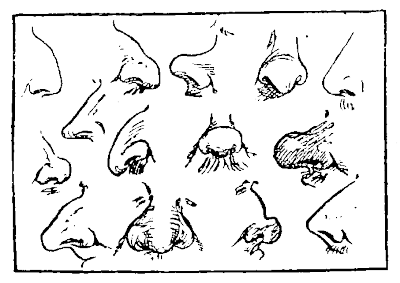
To my Nose. Knows he that never took a pinch, Nosey, the pleasure thence which flows? Knows he the titillating joys Which my nose knows? O nose! I am as proud of thee As any mountain of its snows; I gaze on thee, and feel that pride A Roman knows? Alfred Crowquill. The Comic Offering. 1834.
"161 PADDY DUNBAR.
At the request of numerous subscribers the following very humorous parody of Sir Walter Scott’s “Young Lochinvar” is here given, although somewhat out of its proper order. The parody, which is a favourite piece with reciters, has been kindly sent by Mr. C. H. Stephenson, of Southport.
PADDY DUNBAR.
Och, Paddy Dunbar is come out of the West, In all broad St. Giles his brogue was the best, And, save his shillelah, he weapon had none, He walked by himself, when he walked all alone; So daring in love, and so plucky in war, Och, a broth of a boy now, was Paddy Dunbar. He carried up bricks, and he carried up stone, And he carried up mortar, when bricks there was none; But ere he had rattled at Mulrooney’s gate, The bride had consinted, poor Paddy came late, And a fresh-water sailor, as niver smelt tar, Was to wed the swate Norah of Paddy Dunbar. So bowldly he marched into Mulrooney’s stall, ’Mongst mothers, and brothers, and cousins, and all; Then spake ould Mulrooney, his fist in his hand While the spalpeen of a bridegroom quite spacheless did stand, “Och, come ye in pace here; or come ye in war, Or to jig at our wedding, ye blaygard Dunbar?” “When I first coorted Norah, ye thought me too bould, Love warms us like toddy, but sooner grows cold; And now I am come, without malice or spleen, To jig at your wedding, and smoke my dhudeen; There are girls in St. Giles more pretty by far, Would gladly be married to Paddy Dunbar.” The bride filled a noggin, young Pat took it up, He tipped off the whisky, then threw down the cup; She looked down to sneeze, then looked up so sly, Wid a pipe in her mouth, and a patch on her eye; He took her red hand, ere her mother could bar, “Here goes for a jig now,” says Paddy Dunbar. So big was his form, and so red was her face, That nivir a stall such a couple did grace; While the mother did fret, and the father did fume, And the bridegroom lay drunk at the end of the room: And the bride-gossips whispered, “’twere better by far, To have matched our fair cousin with Paddy Dunbar.” One wink o’ the eye, and one word in the ear, When they reached the street door, and found the coast clear; So light to his shoulder swate Norah he flung, So swift o’er the gutter before him he sprung, “We are gone, she is mine, over post, rail, and bar, They’ll have long legs that catch us,” said Paddy Dunbar. There was rousing and growling in Mulrooney’s clan, The Murphys and Donovans up and they ran; There was racing and chasing, a deuce of a spree, But the illigant Norah no more did they see: So daring in love, and so plucky in war, Och, a broth of a boy now was Paddy Dunbar.
THE STAR.
Twinkle, twinkle, little star, How I wonder what you are! Up above the world so high, Like a diamond in the sky. When the blazing Sun is gone, When he nothing shines upon, Then you show your little light, Twinkle, twinkle, all the night. Then the traveller in the dark Thanks you for your tiny spark: He could not see which way to go, If you did not twinkle so. In the dark blue sky you keep, And often through my curtains peep, For you never shut your eye, Till the Sun is in the sky. As your bright and tiny spark Lights the traveller in the dark, Though I know not what you are, Twinkle, twinkle, little star. Ascribed to Miss Taylor.
Mica, Mica. Mica, mica, parva Stella; Miror, quænam sis tam bella! Splendens eminus in illo, Alba velut gemma, coelo. Quando fervens Sol discessit, Nec calore prata pascit, Mox ostendis lumen purum, Micans, micans, per obscurum. Tibi, noctu qui vagatur, Ob scintillulam gratatur; Ni micares tu, non sciret Quas per vias errans iret. Meum sæpe thalamum luce Specularis curiosa; Neque carpseris soporem, Donec venit Sol per auram. Henry Drury. From Arundines Cami. 1851.
To a London Church Bell. Tinkle, tinkle, horrid bell! How I hate your dismal knell! From your church’s tower so high Plaguing all the dwellers nigh. Ere the shades of night are gone, Ere the sun earth shines upon, You begin with morning light Tinkle, tinkle, till the night. And the toiling City clerk Hears you in his office dark; Less of headache he might know If you did not tinkle so. With your ceaseless clang you keep Many a sufferer from sleep, For you never silent lie While the sun is in the sky. 162 As your din from dawn to dark Worries both sick man and clerk, Proving oftentimes their knell, Cease to tinkle, horrid bell! (Prize parody.) M. Beach. One and All. November 6, 1880.
To the Temple Bar Memorial. Monument to Temple Bar, How I wonder why you are Stuck in Fleet by magnates high, Like a huge November guy! Though the ugly Bar is gone, You the site must rest upon, Just to show how little light Flickers in this Council bright. (?) Then the travellers in the dark, Curse you as their shins you bark, For they could tell which way to go If you did not hinder so. In the narrow street you keep, At solemn pace my cab doth creep ’Neath thy “all-fired” griffin’s eye, Leering there ’twixt earth and sky. As of light no tiny spark, Brightens all thy hist’ry dark, Oh! I know not why you are, Monument to Temple Bar. One and All. November 6, 1880.
There are five other parodies of the same original in the competition, but the two above are the most interesting.
The Revised Version.
“Twinkle, twinkle, little star,” the nursery rhyme so familiar to everybody, has been revised by a Committee of Eminent Scholars, with the following result:
Shine with irregular, intermitted light,[28] sparkle at intervals, diminutive, luminous, heavenly body.[29]
How I conjecture, with surprise, not unmixed with uncertainty,[30] what you are,
Located, apparently, at such a remote distance[31] from and at a height so vastly superior to this earth, the planet we inhabit.
Similar in general appearance and refractory powers to the precious primitive octahedron crystal of pure carbon,[32] set in the aërial region surrounding the earth.
Merry Folks Library.
Scintillate, scintillate, globule vivific, Fain would I fathom thy nature specific. Loftily poised in æther capacious, Strongly resembling a gem carbonaceous. When Torrid Phœbus refuses his presence, And ceases to lamp us with fierce incandescence, Then you illumine the regions supernal Scintillate, scintillate, semper nocturnal. Then the victim of hospiceless peregrination Gratefully hails your minute coruscation; He could not determine his journey’s direction But for your bright scintillating protection.
The Sprinkler. Sprinkle, sprinkle, water cart, How I wonder what thou art; Never can I find you nigh When the dust is deep and dry. When the clouded sun is set, And the streets with rain are wet, Then you wing your little flight, Sprinkle, sprinkle, left and right. When the crossings, Sunday clean, Full of well-dressed folks are seen, Men, amid their shrieks and oaths How you sprinkle all their clothes. And when bright my boots are “shined,” And my hands in kids confined, Rattling down the thirsty street How you soak my hands and feet. Some day, when this deed is done, I will draw my trusty gun, Then we’ll wonder where thou art Buckshot sprinkled water-cart.
To A Fallen “Star.” Twinkle! twinkle! Morning Star![33] How I wonder where you are! Not that you were ever high In the journalistic sky. But I wonder has John Bright Ceased to feed you with his light? Have you had your little day? Have you shone your last weak ray? If you have—why then I’m glad, For the light you gave was bad! If you’re snuffed out, Morning Star, Why I’m very pleased you are! Punch and Judy (London.) October 23, 1869.
To the New Star in Andrew Media. Twinkle, twinkle, little star, Up among the nebular; How I wonder all the same, Where you were before you came? 163 You are shining, are you not, When the blazing sun is sot? Tell me truly, is it right, To be on the blaze all night? I do not know who you are, Though your face seems famil-yar; Nameless little globe of fire— Twinkle, twinkle, little stire.
The Tinkling Tram. Tinkle, tinkle, Tramway Car! Well I’m conscious where you are. Down below my study high, Like a demon ever nigh. When the morning opens wet, When in fog the sun hath set, Then you sound to left, to right, Tinkle, tinkle, day and night! When to sleep my eyes incline, Then your bells kicks up its shine; Up the street and down the street, ’Mid the horse-hoofs’ maddening beat. No—detested demon car. I don’t “wonder what you are”; But too well aware am I, Tinkling horror, ever nigh! Punch’s Almanack for 1884.
The Public Prosecutor. The Public asks:— Twinkle, twinkle, Prosecutar, How we wonder what you are, Up above our heads so high, Conundrum in the legal sky. When a blazing wrong is done. To prosecute you are the one; Out should come your little light, In the clouds of legal night. Then the public, in the dark, Would thank you for your welcome, spark; Justice could not onward go, If you did not twinkle so. But behind a cloud you keep, Only popping out to peep. Legal star, you shut your eye, We, and Hawkins, wonder why. The P. P. answers:— My blessings, friend, are over-estimated; You ask me plainly, why I was created; I’ll tell you straight, and stop your flippant raillery: I was appointed—— The Public:—Well? The P. P.:—To draw my salary. The Referee. December 2, 1882.
Twinkle, twinkle little star I can tell you what you are; And your atmosphere, I hope, Analyse with spectroscope. Tin, I fancy; lead, I fear, Lurk within your atmosphere. Gold, by Jingo, better far! Twinkle, twinkle little star. Salve. Truth. October 15, 1885.
Wrinkles, wrinkles, solar star, I obtain of what you are, When unto the noonday sky, I the spectroscope apply; For the spectrum renders clear Gaps within your photosphere, Also sodium in the bar, Which your rays yield, solar star. Chessman. Truth. September 30, 1886.
(This latter had previously appeared in Harper’s Magazine.)
——:o:——
VERB SAP.
(To a Wandering Star.)
“I am willing to throw in my lot with that of my friend Huxley, and ‘to fight to the death’ against this wicked and cowardly surrender. A desperate gamester, miscalled a Statesman, has chosen to invoke ignorant foreign opinion against the instructed opinion of his own countrymen.”—Professor Tyndall’s last Letter to the Times.
Tyndall, Tyndall, learned star, How we wonder where you are! Fizzing up like penny pop, Coming down on Gladstone flop! “Desperate gamester!” Tyndall mine, Such invective is not fine. Have you not a card to trump, Rattling Randolph on the stump? * * * * * Difference exists no doubt; Let us calmly fight it out; But to call each other names Is the vulgarest of games. Honestly one view you hold; If to differ one makes bold, Is it fair, Sir, to infer, That he’s rascal, traitor, cur? Pooh! That’s Party’s puerile plan, Wisdom, Sir, should play the man. Drop these tart polemic pennings, Leave that sort of stuff to Jennings. Punch. July 23, 1887.
Lines to the Electric Light in the Reading Room of the British Museum. Twinkle, twinkle, little arc, Sickly, green, uncertain spark! Up above my head you swing, Ugly, strange, expensive thing. 164 When across the foggy air Streams the lightning’s blinding glare Does the Reader in the dark Bless your radiance, little arc? When you fade with modest blush, Scarce more bright than farthing rush, Would he see which way to go, If you always twinkled so? Cold, unlovely, shivering star, I’ve no notion what you are— How your wondrous “system” works, Who controls your jumps and jerks. Yours a splendour like the day— Bilious green and purple ray! No: where’er they worship you All the world is black or blue. Though your light at times surpass Homely oil or vulgar gas, Still—I close with this remark— I detest you, little arc! Slightly altered from Judy. June 6, 1888.
Boulanger. Twinkle, twinkle, little Star, How I wonder what you are! Still more what you mean to be, When you get back to Paree! Are you a Republican, Wedded to the Rights of man? Or an embryotic King? Emperor? Despot? Anything? When you’re President-elect, What new move may we expect? Will you show us what you are By a bloody Coup d’Etat? Here meanwhile in London town You will certainly go down; Social crowds will stare and cheer; Of expulsion there’s no fear! Twinkle, twinkle, Gallic Star! We’ve no notion what you are; Living low and flying high. Like a comet in the sky. Puck. May 1, 1889.
The political adventurer Boulanger, having done all he could to embarrass the French Government, and to create disturbances on the eve of the opening of the great Paris Exhibition, ignominiously fled to Belgium, when he found that his selfish and unpatriotic conduct was likely to bring upon him the punishment he deserved. Whilst in Brussels he issued a ridiculously theatrical manifesto, whereupon the Belgian Government hinted that his presence was undesirable in that country, and in April last he sought refuge in London. His reception was cool, and in a few days he was completely forgotten. Boulanger, who is fifty-two years of age, has none of the qualities necessary in a man who aspires to be a great political leader, and had he not been supported by the wealth and influence of the re-actionary parties in France, he would long since have sunk back into his native obscurity.
THE SPIDER AND THE FLY.
“Will you walk into my parlour?” said a spider to a fly, “’Tis the prettiest little parlour, sure, that ever you did spy; You’ve only got to pop your head within side of the door, You’ll see so many curious things you never saw before, Will you walk in pretty fly?” “My house is always open,” says the spider to the fly, “I’m glad to have the company of all I see go by;” “They go in, but don’t come out again—I’ve heard of you before;” “Oh yes, they do, I always let them out at my back door. Will you walk in, pretty fly?” “Will you grant me one sweet kiss, then!” says the spider to the fly; “To taste your charming lips, I’ve a cu-ri-os-i-ty!” Said the fly, “If once our lips did meet, a wager I would lay, Of ten to one, you would not after let them come away.” “Will you walk in, pretty fly?” “If you won’t kiss, will you shake hands?” says the spider to the fly, “Before you leave me to myself, with sorrow sad to sigh.” Says the fly—“there’s nothing handsome unto you belongs; I declare you should not touch me even with a pair of tongs.” “Will you walk in, pretty fly?” “What handsome wings you’ve got,” says the spider to the fly, “If I had got such a pair, I in the air would fly ’Tis useless all my wishing, and only idle talk, You can fly up in the air, while I’m obliged to walk. Will you walk in, pretty fly?” “For the last time, now, I ask you, will you walk in, Mr. Fly?” “No! if I do, may I be shot! I’m off! so now good by.” Then up he springs, but both his wings were in the web caught fast! The spider laughed, “ha, ha, my boy, I have you safe at last.” “Will you walk out, pretty fly?” “And pray how are you now?” says the spider to the fly! “You fools will never wisdom get, unless you dearly buy! ’Tis vanity that ever makes repentance come too late, And you who into cobwebs run, surely deserve your fate. Listen to me, listen to me, foolish fly.” MORAL. Now, all young men take warning by this foolish little fly: Pleasure is the spider, that to catch you fast will try; For, although you may think that my advice is quite a bore, You’re lost if you stand parleying outside of Pleasure’s door. Remember, oh, remember, the foolish little fly. Mary Howitt.
165
“Will you Migrate to New Zealand?” I. “Will you migrate to New Zealand?” its Colonists do cry, “’Tis the richest, healthiest country, that ever you did spy; The way to our Arcadia is o’er the pleasant sea, And endless the enchanting scenes we’ll show when there you be!” “Oh! no, no,” say the Englishmen, “to ask us in vain, For who goes o’er your longsome seas, can ne’er come back again.” II. “We’re sure you must be weary, lads, with toiling all the day, Luxuriate in our balmy clime,” the Colonists still say; “The fertile earth here laughs around, the skies are warm and fine, Oh! do but come, live here awhile, and share our oil and wine.” “Ah! no, no,” say the Englishmen, “we’ve often heard before, How many gammon’d simple folk, wreck on your earthquake-shore.” III. The cunning Colonists repeat—“Dear friends, what can we do To prove the immense solicitude we’ve always felt for you? We have within our ample bounds good store of all that’s nice, You’re very welcome all to come, and each to take his slice.” “Oh! no, no,” say the Englishmen, “kind sirs, that cannot be, We’ve heard what’s in your country, and we have no care to see.” IV. “Fine fellows,” say the Colonists, “you’re industrious and you’re steady, How powerful are your toil-task’d limbs, your minds so strong and ready! We have full many a splendid spot in our new-promis’d land, Such soil,—so water’d,—timber’d too, soliciting your hand.” “We thank you, liberal Colonists, for what you’re pleased to proffer, We’re busy now,—another day we’ll listen to your offer.” V. The Colonists are waiting still, they prowl about their beach, For well they guess some English dupes will come within their reach; So they conjure up some Siren song, and have it put in print, And rub their hands, and slap their thighs, at folks believing in’t: They fabricate long letters home—from settlers well-to-do, All season’d high with luring lies, so couched to seem quite true; “Here capital must multiply, wealth waits each working clan, Here is—Eutopia itself, aye,—Paradise for man.” VI. Alas! alas! how very soon some too-confiding men, Hearken to the seductive words said o’er and o’er again: With home—they discontented grow, fancy—a fairer land, Air-castles build in promis’d scenes, with wealth that courts the hand; Seas cross’d—the colony must now for ever hold them fast. Fresh Colonists are old one’s game, who pluck them great and small, Gloat o’er their brethren—victimized, sore struggling, one and all. VIII. And now, ye English, old and young, who may this story read, To tales from coves—of distant shores, I pray you ne’er give heed; Unto the crafty Colonist, close heart, and ear, and eye, And heed this version of the tale of “The Spider and the Fly.”
From Emigration Realised, a poem, &c., by S. C. C. (i.e. Chase), London. Saunders & Otley, 1855.
The Song of the Bank Director. “Will you walk into my parlour?” said the spider to the fly! “Tis the prettiest little parlour that ever you did spy. “You’ve only got to pop your head just inside of the door, “You’ll see so many curious things you never saw before” “Will you let me see your pocket?” said the spider to the fly! “To handle your bright gold I’ve a great curiosity.” Said the fly, “If once you’d hold of it, a wager I would lay “Of ten to one you very soon would take it all away.” “What handsome purse, what lots of cash!” quoth spider to the fly. “If I had so much money, some nice Bank shares I would buy. “Look here!” And here he ope’d a safe, and said, “Dear fly, just see “These lovely shares, big divs., and unlim’d liability.” “What lovely wings they’d make you! How much higher you could fly! “For the last time, now, I ask you, pretty creature, will you buy?” And the silly fly, intoxicated with his flattery, Bought lots of shares with unlimited liability. But when the time came for the dividends to be received, The poor fly found that he had been most woefully deceived. When he went into the parlour, quick the spider shut the door, And tightly round him spun his web, and hurled him on the floor— And laughed, “Ha! ha!” and said, “I’ll show you now, my pretty fly, “What comes of buying shares with unlim’d liability.” And first he plundered all his gold, and all he had beside, And then he crushed him utterly, and sucked him till he died. From Dizzi-Ben-Dizzi, 1878.
166 The Irish Spider and the English Fly. “Will you walk into my parlour?” said the Spider to the Fly. “We can talk without disturbance, and no Tories can espy. It is just across the Channel, you can very soon get there. And I’ve curious things to show you which I’m sure will make you stare.” “Excuse me,” said the Grand Old Fly, “your manner has a charm, But are you really sure, dear sir, you do not mean me harm?” Said the cunning Spider to the Fly, “Dear friend, what can I do To prove the warm affection I have always felt for you? I’ve eighty-six companions too so pleasant, kind, and nice, Who’ll welcome any friend of mine and help him in a trice.” “Forgive me,” said the Grand Old Fly, “because I make so bold, But about that Irish party there are awful stories told,” “Sweet creature,” said the Spider, “you’re witty and you’re wise, On you the universal world now turns its wondering eyes, I have an Irish looking-glass upon my parlour shelf— You’ll be surprised if in that glass you but behold yourself,” “I thank you, gentle sir, indeed for what you’ve pleased to say, And bidding you good morning now I’ll call another day.” The Spider waited for a time inside his Irish den, For well he knew the Grand Old Fly would soon come back again. He wove his subtle Home Rule web in a little corner sly And set his eighty-six confrères to watch the Grand Old Fly. Then wandered to his door again and merrily did say, “Come hither, hither, dearest Fly—a moment step this way.” There was no limit to the pride of that poor silly Fly. He listened to the Spider’s voice, which flattered him sky high; He buzzed about, he tossed his head, and near and nearer drew— Deceived by his own vanity he thought the Spider true. “No English Fly has soared so high,” said he, but now at last, Caught in the cunning Home Rule web, the Spider held him fast. Moonshine. June 5, 1886.
A Charitable Institution. (A Hint to some Hospitals nearer Home.) “Will you walk into our death-trap?” Say the surgeons so serene, “’Tis the neatest little death-trap That there ever yet has been; The beds are most inviting, The sheets are nice and white— And when you get between ’em You can bid the world good-night.” “We have wards to suit all parties,” Say the surgeons so serene, “But the one we’re recommending Is that special ward—eighteen. Kindly cut your little finger, And select your little bed— Then, before a week is over, You will certainly be dead.” “If you fracture say your elbow, And come here to get it dress’t— Well, your arm is amputated And you find eternal rest; For your blood is surely poisoned, And so deadly is the taint That you’re here, perchance, one morning, And, to-morrow, here you ain’t. “When some nasty broken chilblains Give you trouble with your toes, Oh! we take your leg, and presto! In a moment off it goes. It is getting on quite nicely, Is that amputated pin, When, as certain as the sunrise, Erysipelas sets in. “Then walk into our death-trap— Harry, Tommy Johnny, Bob— We have instruments in plenty And are always on the job; ’Tis the very surest death-trap That the world has ever seen, Make your wills and have a shake-down In our special ward—eighteen.” The Sydney Bulletin. August 7, 1886.
Harcourt and Chamberlain. “Will you walk into our parlour?” said the Spider to the Fly; “’Tis the cosiest little parlour, friend, that ever you did spy— The way into this parlour is quite wide, as you’re aware, And, oh! we’ll do such wondrous things when once we get you there! Then, won’t you, won’t you, won’t you, won’t you, Pretty little fly?” Now, as I’ve heard, this little fly was young, but wary, too, And so he thought, I’ll mind my eye—the thing may be a do! So “No, no!” said that little fly; “kind Sir, that cannot be, I’ve heard what’s in your parlour, and I do not wish to see.” That Spider he was portly, and that Spider he was bland, And he played the part of siren for an even Older Hand. Says he, “Oh, Fly, you must be tired of being on the shelf, Why don’t you just step in awhile, if but to rest yourself?” “Our parlour’s snugly furnished, for expense we never spare, We’ve such a nice Round Table; you shall have an easy chair. It seems incomplete without you as a sort of settled guest; Turn up solitary buzzing now; step in and take a rest.” That little Fly looked longingly. Thinks he, “I do feel tired, I’m fond of cosy parties, and I like to be admired. 167 Yet I have a slight suspicion that the thing may be a trap— I twig something in the corner—I distrust that fat old chap.” So “I’ll wait a little longer,” to the Spider said the Fly, As he spread his wings (with friend Col-lings), and fluttered towards the Skye. But whether he’ll come back again, and try that parlour yet, Is a thing on which a cautious man would hardly like to bet. Punch. March 19, 1887.
The Spider, by Sir W. Y. Harcourt.
The Fly, by Mr. Joseph Chamberlain.
“Will you walk a little faster?” said a whiting to a snail, “There’s a porpoise close behind us, and he’s treading on my tail. See how eagerly the lobsters and the turtles all advance! They are waiting on the shingle—will you come and join the dance? Will you, won’t you, will you, won’t you, will you join the dance? Will you, won’t you, will you, won’t you, won’t you join the dance.” * * * * * From Alice’s Adventures in Wonderland.
There was a parody in Will-o’-the-Wisp, March 20, 1869, entitled “The Abbess and the Maid” concerning a law suit which attracted much attention at the time, but is now forgotten. It commenced:—
“Will you walk into my convent?” said the abbess to the maid. “’Tis the prettiest little cloister ever nestled in the shade.”
Another long political parody in The London Figaro, August 7, 1886, commenced:—
“Will you come into our Chamber?” said the Marquis to “Grand Cross” “’Tis a finely gilded chamber” (so went on the Tory Boss.)
Another appeared in Punch, June 30, 1888, soon after Mr. W. E. Gladstone had given his vote in favour of Watkin’s scheme for the Channel Tunnel. Two verses may be quoted:—
The Watkin Spider and the Gladstone Fly. “Will you walk into my Tunnel?” said the Spider to the Fly, “’Tis the handiest little Tunnel that ever you did spy. You’ve only got to pop your head inside and peep, no more, And you’ll see a many curious things you never saw before. Will you, will you, will you, will you, walk in, Grand Old Fly?” Said the Spider to the Fly, “It’s most absurd, upon my soul, To see so big a nation scared about so small a hole. To share the scare that’s in the air is worthy, don’t you know, Not of a Grand Old Fly like you, but of a midge like Joe! Then won’t you, won’t you, won’t you, won’t you, plucky Grand Old Fly?” * * * * * Punch. June 30, 1888.
Pray come along to Hawarden, says the Grand Old Man so fly, (Or p’rhaps I should say spider), to convince you let me try. Home Rule’s the grandest principle since first the earth began, And to vote for C. S. Parnell and his friend, the Grand Old Man. Pop in the train at Euston and to Chester then run down, And don’t make speeches on the way (such conduct makes me frown,) If but a Post-card you will send to say when you’ll arrive, The Home Rule van shall meet you, and the Grand Old whip will drive.
* * * * *
This not very brilliant political parody will be found in an anonymous pamphlet entitled “Glad-Par-Stonell-Iana.” Waterlow & Sons, 1889.
——:o:——
NURSERY RHYMES.
Parodies on Nursery Rhymes and Children’s Songs, which were interrupted in order to introduce those relating to Smoking, can now be resumed, as a few good ones still remain to be quoted. When the late Mr. J. O. Halliwell (Halliwell-Phillipps) first brought out his collection of Nursery Rhymes, his friend James Robinson Planché, the dramatist, wrote some little humourous skits on them. These were merely meant for playful badinage, but a few lines may be quoted from them:—
Ride-a-cockhorse To Kennington-Cross; Come and see Planché, Who works like a horse Sucking his fingers, And roasting his toes; He would have you come Wherever he goes. Halliwell-Halliwell, My pretty man, Make me a book As fast as you can; Write it and print it, And mark it with P., And send it by Parcels Deliverye. Ding dong bell, Planché’s at Stockwell. What took him there? His wife, you may swear. When will he come back? As soon as he can—good lack.
——:o:——
The Prince of Wales was christened on January 25, 1842, for which occasion a very handsome cake was prepared, but it was remarked that it remained uncut, the Queen appearing unwilling to spoil this remarkable specimen of confectionary.
A Nursery Ballad, entitled “The Christening Cake,” was published on the occasion, (by Mr. John Lee, of 440, West Strand,) from which a few extracts may be quoted:—
When great Victoria ruled the land, She ruled it like a Queen; 168 She had a Princess and a Prince Not very far between. The Princess was a girl, you’ll guess, A pretty little thing; Yet parties all agreed in this— She never could be King. But ere the year its course had run, What universal joy! On Lord Mayor’s Day there came to light A glorious princely Boy! The Queen gazetted him next week, The caudle ran in pails; She girded on his little sword, And called him “Prince of Wales.” “The christening shall be superb, And worthy of our state.” So spoke the Queen to Albert, her Most true and royal mate. * * * * * The Banquet served, the brilliant throng Proceed their seats to take; The plate was grand, yet every eye Was fixed upon the Cake! The thistle, rose, and shamrock twined The Prince’s arms and crest; The Prussian Eagle, raised on high, To please the Royal Guest. In matchless beauty stood the cake, The glory of the day; And now each lady hoped to take A little bit away. Prince Albert raised a knife and fork, Victoria looked a frown! So, with a disappointed air, He laid the weapons down. She rose—and the distinguished guests Their last obeisance make! All murmuring, as they left the room, “She never cut the Cake!” The Queen and Prince, like other folks, Their party gone away, Sat for five minutes, chatting o’er The pleasures of the day. “When I’ve enjoyed a fete so much I really cannot tell; From early morn till now midnight, All things went off so well!” “Nay, dear Victoria, pardon me, You make a slight mistake; For every thing did not go off.” (He glanced towards the cake.) “Consider our expenses, love; Outgoings are so great, Receiving foreign Potentates With all this form and state. Our family increases fast, And cakes are very dear; The Prussian Eagle laid aside, We’ll keep it for next year!”
This ballad shows that the Queen had a reputation for parsimony as long ago as 1842, the moral it enforces is similar to that contained in the old Nursery Rhyme the ballad parodies, concerning the famous plum Pudding of King Arthur:—
“The King and Queen ate of the same, And all the Court beside; And what they could not eat that night, The Queen next morning fried.”
It is somewhat curious that Poets should so often select incidents in the lives of Royal personages as topics for their poems, considering how ephemeral is the interest they excite.
The above ballad was, of course, only a burlesque, and had no claim to longevity, but of all the serious adulatory poems written about the Queen, and her family, during the last fifty years how many have survived? With the exception of some few lines in Tennyson’s Dedications and Odes, the present generation knows nothing of them.
Where is Leigh Hunt’s poem on the birth of the Princess Royal? Where is Professor Aytoun’s Ode on the Marriage of the Prince of Wales? Where, oh, where is Mr. Lewis Morris’s Ode for the Opening of the Imperial Institute? Forgotten, all forgotten, and nearly as obsolete as the Birthday Odes of the Poets-Laureate Eusden, Warton, and Pye.
Who reads or remembers Martin F. Tupper’s Welcome to the Princess Alexandra?
“And thus they warbled, in the style of Tupper, Whose ode to our Princess is thought a fine Sample of metre Alexandra-ine— A poet arithmetical in fame, Who lisp’d in numbers, for the numbers came:”
The Joy Birds’ Ode. 100,000 welcomes![34] 100,000 welcomes!! And 100,000 more!!! Oh! happy birds of Eden, Sing like the Star of Sweden, Yes, yes, like Nilsson sing, birds, And make the island ring, birds, As no land rang before; And let the welkin roar, To welkin her to shore; Let miles of echo shout it, And sparkling fountains spout it, Let leagues of lightning flash it, And tons of thunder crash it; Let pouring rainfalls hail her name, And fiery earthquakes sound her fame, Till sky, and sea, and shore Join in a vast encore, 100,000 welcomes, And 100,000 more!
* * * * *
In justice to Mr. Tupper it must be admitted that these are not exactly his lines, but only a very fair parody of them taken from The Lays of the Saintly, by Mr. Walter Parke. (London, Vizetelly, 1882.)
——:o:——
DR. FELL.
I do not like thee, Dr. Fell, The reason why I cannot tell; But this alone, I know full well, I do not like thee, Dr. Fell.
This little nursery rhyme claims ancient lineage. In Thomas Forde’s “Virtus Rediviva,” 1661, in a collection of familiar letters, is the following passage:—
“There are some natures so Hetrogenious, that the 169 streightest, and most gordion knot of Wedlock is not able to twist, of which the Epigrammatist (Martial) speaks my mind better than I can myself:—
Non amo te Sabide, nec possum dicere quare, Hoc tantum possum dicere, non amo te.
>Take the English in the words of a gentleman to his wife:—
I love thee not, Nel, But why, I can’t tell; But this I can tell, I love thee not, Nel.”
The following is Clément Marot’s version as given in Chapsal’s ‘Modèles de Littérature Française,’ ii. p. 26:—
Jan, je ne t’aime point, beau sire: Ne sais quelle mouche me point, Ni pourquoi c’est je ne puis dire Sinon que je ne t’aime point.
Another version, by Roger de Bussy, Comte de Rabutin (ob. 1693), ran as follows:—
Je ne vous aime pas, Hylas, Je n’en saurois dire la cause; Je sais seulement une chose; C’est que je ne vous aime pas.
JOHN DRYDEN.
Born August 9, 1631. | Died May 1, 1700.
(Was Poet Laureate from 1670 till the accession of William III. in 1688, when he was superceded by a Protestant poet, Thomas Shadwell.)
In the year 1683, a musical society was formed in London for the celebration of St. Cecilia’s Day, and from that time a festival was held annually on November the 22nd in Stationers’ Hall, and an Ode, composed for the occasion, was sung. These festivals continued, with a few interruptions, down to the year 1744, and some were held at even a later date; but these celebrations must not be confounded with the performances given by the “Cecilian” Society, which was established in 1785.
A collection of the Odes, written for the Festival of St. Cecilia’s Day, was first formed by Mr. William Henry Husk, Librarian of the Sacred Harmonic Society, and published by Bell and Daldy in 1857, in “An Account of the Musical Celebrations on St. Cecilia’s Day. To which is appended a Collection of Odes on St. Cecilia’s Day.” It is unnecessary to enumerate them all here, but as Odes written by Nahum Tate, John Dryden, Thomas Shadwell, Samuel Wesley, Joseph Addison, William Congreve, Alexander Pope, and the burlesque Ode by Bonnell Thornton are included, the volume has considerable literary interest.
John Dryden wrote a song for the Festival of November, 1687, but his great Ode, “Alexander’s Feast; or, the Power of Music,” was written and performed in 1697. For this poem it is said Dryden received forty pounds, its success was so great that it was frequently performed at later festivals, and in 1736 “Alexander’s Feast” was set to music by Handel. The poem has been frequently parodied, it will therefore be convenient to give the original Ode, followed by the parodies, or such parts of them as are fit for re-publication, for it must be confessed that some of the earlier imitations are excessively coarse.
ALEXANDER’S FEAST.
’Twas at the royal feast, for Persia won, By Philip’s warlike son, Aloft in awful state, The god-like hero sate On his imperial throne. His valiant peers were placed around, Their brows with roses and with myrtles bound: (So should desert in arms be crown’d.) The lovely Thais, by his side, Sate like a blooming eastern bride, In flower of youth, and beauty’s pride. Chorus. Happy, happy, happy pair! None but the brave, None but the brave, None but the brave deserves the fair. Timotheus placed on high, Amid the tuneful choir, With flying fingers touched the lyre; With trembling notes ascend the sky, And heavenly joys inspire. The Song began from Jove, Who left his blissful seat above Such is the power of mighty love: A dragon’s fiery form belied the god; Sublime on radiant spheres he rode, When he to fair Olympia press’d, And while he sought her snowy Breast, Then round her slender waist he curl’d, And stamp’d an image of himself, a sovereign of the world. The listening crowd admire the lofty sound; “A present deity!” they shout around; “A present deity!” the vaulted roofs rebound. Chorus. With ravish’d ears The monarch hears, Assumes the God, Affects to nod, And seems to shake the spheres. The praise of Bacchus then the sweet musican sung, Of Bacchus, ever fair and ever young!— The jolly god in triumph comes! Sound the trumpets! beat the drums! Flush’d with a purple grace, He shows his honest face, Now give the hautboys breath! he comes! he comes! Bacchus ever fair and young, Drinking joys did first ordain: Chorus. Bacchus’ blessings are a treasure; Drinking is the soldier’s pleasure: Rich the treasure, Sweet the pleasure, Sweet is pleasure, after pain! Sooth’d with the sound, the king grew vain; Fought all his battles o’er again; And thrice he routed all his foes, and thrice he slew the slain! The master saw the madness rise; 170 His glowing cheeks, his ardent eyes; And while he heaven and earth defied— Changed his hand, and check’d his pride. He chose a mournful Muse, Soft Pity to infuse: He sang Darius great and good! By too severe a fate, Fallen! fallen! fallen! fallen! Fallen from his high estate And weltering in his blood! Deserted at his utmost need By those his former bounty fed, On the bare earth exposed he lies, With not a friend to close his eyes! With downcast look the joyless victor sate. Chorus. Revolving, in his alter’d soul, The various turns of fate below; And now, and then, a sigh he stole, And tears began to flow! The mighty master smil’d to see That love was in the next degree: ’Twas but a kindred sound to move: For pity melts the mind to love. Softly sweet, in Lydian measures. Soon he sooth’d his soul to pleasures War, he sung, is toil and trouble: Honor but an empty bubble; Never ending, still beginning, Fighting still, and still destroying, If the world be worth thy winning, Think, oh think it worth enjoying! Lovely Thais sits beside thee, Take the good the gods provide thee! The many rend the skies with loud applause, So Love was crown’d; but Music won the cause. Chorus. The prince, unable to conceal his pain, Gazed on the fair Who caused his care, And sigh’d and look’d, sigh’d and look’d, Sigh’d and look’d, and sigh’d again: At length, with love and wine at once oppress’d, The vanquish’d victor sank upon her breast! Now strike the golden lyre again! A louder yet, and yet a louder strain! Break his bands of sleep asunder, And rouse him, like a rattling peal of thunder. Hark! hark! the horrid sound Has raised up his head, As awaked from the dead; And, amazed, he stares around! “Revenge! revenge!” Timotheus cries— See the Furies arise! See the snakes that they rear, How they hiss in the air, And the sparkles that flash from their eyes! Behold a ghastly band, Each a torch in his hand! Those are Grecian ghosts that in battle were slain, And unburied remain Inglorious on the plain! Give the vengeance due, To the valient crew! Behold; how they toss their torches on high, How they point to the Persian abodes, And glittering temples of their hostile gods;— The princes applaud, with a furious joy! Chorus. And the king seized a flambeau, with zeal to destroy; Thais led the way, To light him to his prey! And, like another Helen, fired another Troy. Thus, long ago, Ere heaving bellows learned to blow, While organs yet were mute, Timotheus, to his breathing flute And sounding lyre, Could swell the soul to rage, or kindle soft desire. At last divine Cecilia came, Inventress of the vocal frame: The sweet enthusiast, from her sacred store, Enlarged the former narrow bounds, And added length to solemn sounds, With Nature’s mother-wit, and arts unknown before. Chorus. Let old Timotheus yield the prize, Or both divide the crown: He raised a mortal to the skies! She drew an angel down! John Dryden.
Shakespeare’s Feast. An Ode on the recent rehearsal in the Town Hall of Stratford. I. ’Twas at the solemn feast, for laurels won By William, old John Shakespeare’s son, Aloft in awful state The Mayor of Stratford sate, Rais’d on a wool-pack throne: His aldermen were plac’d around, Their brows with spreading antlers crown’d, (So city spouses should be found) The lovely May’ress by his side Sat like a plump High-German bride, Not less for fat renown’d, than pride. Happy, happy, happy May’r! None but the fat, None but the fat, None but the fat deserve the bouncing fair. II. The bard of Ferney, plac’d on high Amid the tuneful quire, With flying fingers touch’d the wooden lyre: The notes, tho’ lame, ascend as high As civic joys require. The song began from G—K’s toil, Who left his Litchfield’s native soil, (Such were his hopes of golden spoil) King Richard’s crooked form bely’d the man: Sublime on high-heel’d shoes he trod, When first he courted Lady Anne In Goodman’s Fields, till then an unfrequented road. As Hastings next round Pritchard’s waist he curl’d, Or shew’d, in Drugger’s rags, an idiot to the world. The list’ning crowd admire the lofty sound, A present Shakespeare, loud they shout around: A present Shakespeare, loud the rafter’d halls rebound. 171 With prick’d up ears His May’rship hears; Assumed the play’r, Affects to stare, And shakes the room about his ears. III. The praise of ven’son, then, the rapt enthusiast sung; Of ven’son, whether old or young: The jolly haunch in triumph comes; Sound the trumpets, beat the drums; Flush’d with a purple grace, It shews its currant-jelly face: Now give each feeder breath: it comes, it comes; Ven’son, ever fair and young, Drinking joys can best reveal; Fat of ven’son is a treasure, Eating is the glutton’s pleasure: Rich the treasure, Sweet the pleasure, Sweet as stuffing is with veal. * * * * * From The Court Miscellany. 1769.