WILLIAM GILBERT
Silvanus P. (Silvanus Phillips) Thompson translation
ON THE LOADSTONE, BK. I.
CHAP. I.
ANCIENT AND MODERN WRITINGS on the Loadstone, with certain matters of mention only, various opinions, & vanities.
t an early period, while philosophy lay as yet rude and uncultivated in the mists of error and ignorance, few were the virtues and properties of things that were known and clearly perceived: there was a bristling forest of plants and herbs, things metallick were hidden, and the knowledge of stones was unheeded. But no sooner had the talents and toils of many brought to light certain commodities necessary for the use and safety of men, and handed them on to others (while at the same time reason and experience had added a larger hope), than a thorough examination began to be made of forests and fields, hills and heights; of seas too, and the depths of the waters, of the bowels of the earth's body; and all things began to be looked into. And at length by good luck the magnet-stone was discovered in iron lodes, probably by smelters of iron or diggers of metals. This, on being handled by metal folk, quickly displayed that powerful and strong attraction for iron, a virtue not latent and obscure, but easily proved by all, and highly praised and commended. And in after time when it had emerged, as it were out of darkness and deep dungeons, and had become dignified of men on account of its strong and amazing attraction for iron, many philosophers as well as physicians of ancient days discoursed of it, in short celebrated, as it were, its memory only; as for instance Plato in the Io[2], Aristotle in the De Anima[3], in Book I. only, Theophrastus the Lesbian, Dioscorides, C. Plinius Secundus, and Julius Solinus[4]. As handed down by them the loadstone merely attracted iron, the rest of its virtues were all undiscovered. But that the story of the loadstone might not appear too bare and too brief, to this singular and sole known quality there were added certain figments and falsehoods, which in the earliest times, no less than nowadays, used to be put forth by raw smatterers and copyists to be swallowed of men. As for instance, that if a loadstone be anointed with garlick, or if a diamond be near, it does not attract iron[5]. Tales of this sort occur in Pliny, and in Ptolemy's Quadripartitum; and the errors have been sedulously propagated, and have gained ground (like ill weeds that grow apace) coming down even to our own day, through the writings of a host of men, who, to fill put their volumes to a proper bulk, write and copy out pages upon pages on this, that, and the other subject, of which they knew almost nothing for certain of their own experience. Such fables of the loadstone even Georgius Agricola himself, most distinguished in letters, relying on the writings of others, has embodied as actual history in his books De Natura Fossilium. Galen noted its medicinal power in the ninth book of his De Simplicium Medicamentorum Facultatibus, and its natural property of attracting iron in the first book of De Naturalibus Facultatibus; but he failed to recognize the cause, as Dioscorides before him, nor made further inquiry. But his commentator Matthiolus repeats the story of the garlick and the diamond, and moreover introduces Mahomet's shrine vaulted with loadstones[6], and writes that, by the exhibition of this (with the iron coffin hanging in the air) as a divine miracle, the public were imposed upon. But this is known by travellers to be false. Yet Pliny relates that Chinocrates the architect had commenced to roof over the temple of Arsinoe at Alexandria with magnet-stone[7], that her statue of iron placed therein might appear to hang in space. His own death, however, intervened, and also that of Ptolemy, who had ordered it to be made in honour of his sister. Very little was written by the ancients as to the causes of attraction of iron; by Lucretius and others there are some short notices; others only make slight and meagre mention of the attraction of iron: all of these are censured by Cardan for being so careless and negligent in a matter of such importance and in so wide a field of philosophizing; and for not supplying an ampler notion of it and a more perfect philosophy: and yet, beyond certain received opinions and ideas borrowed from others and ill-founded conjectures, he has not himself any more than they delivered to posterity in all his bulky works any contribution to the subject worthy of a philosopher. Of modern writers some set forth its virtue in medicine only, as [8]Antonius Musa Brasavolus, Baptista Montanus, Amatus Lusitanus, as before them Oribasius in his thirteenth chapter De Facultate Metallicorum, Aetius Amidenus, Avicenna, Serapio Mauritanus, Hali Abbas, Santes de Ardoynis, Petrus Apponensis, Marcellus[9], Arnaldus. Bare mention is made of certain points relating to the loadstone in very few words by Marbodeus Callus, Albertus, Matthæus Silvaticus, Hermolaus Barbarus, Camillus Leonhardus, Cornelius Agrippa, Fallopius, Johannes Langius, Cardinal Cusan, Hannibal Rosetius Calaber; by all of whom the subject is treated very negligently, while they merely repeat other people's fictions and ravings. Matthiolus compares the alluring powers of the loadstone which pass through iron materials, with the mischief of the torpedo, whose venom passes through bodies and spreads imperceptibly; Guilielmus Pateanus in his Ratio Purgantium Medicamentorum discusses the loadstone briefly and learnedly. Thomas Erastus[10], knowing little of magnetical nature, finds in the loadstone weak arguments against Paracelsus; Georgius Agricola, like Encelius[11] and other metallurgists, merely states the facts; Alexander Aphrodiseus in his Problemata considers the question of the loadstone inexplicable; Lucretius Carus, the poet of the Epicurean school, considers that an attraction is brought about in this way: that as from all things there is an efflux of very minute bodies, so from the iron atoms flow into the space emptied by the elements of the loadstone, between the iron and the loadstone, and that as soon as they have begun to stream towards the loadstone, the iron follows, its corpuscles being entangled. To much the same effect Johannes Costæus adduces a passage from Plutarch; Thomas Aquinas[12], writing briefly on the loadstone in Chapter VII. of his Physica, touches not amiss on its nature, and with his divine and clear intellect would have published much more, had he been conversant with magnetick experiments. Plato thinks the virtue divine. But when three or four hundred years afterwards, the magnetick movement to North and South was discovered or again recognized by men, many learned men attempted, each according to the bent of his own mind, either by wonder and praise, or by some sort of reasonings, to throw light upon a virtue so notable, and so needful for the use of mankind. Of more modern authors a great number have striven to show what is the cause of this direction and movement to North and South, and to understand this great miracle of nature, and to disclose it to others: but they have lost both their oil and their pains; for, not being practised in the subjects of nature, and being misled by certain false physical systems, they adopted as theirs, from books only, without magnetical experiments, certain inferences based on vain opinions, and many things that are not, dreaming old wives' tales. Marsilius Ficinus ruminates over the ancient opinions, and in order to show the reason of the direction seeks the cause in the heavenly constellation of the Bear, supposing the virtue of the Bear to prevail in the stone and to be transferred to the iron. Paracelsus asserted that there are stars, endowed with the power of the loadstone, which attract to themselves iron. Levinus Lemnius describes and praises the compass[13], and infers its antiquity on certain grounds; he does not divulge the hidden miracle which he propounds. In the kingdom of Naples the Amalfians were the first (so it is said) to construct the mariners' compass: and as Flavius Blondus says the Amalfians[14] boast, not without reason, that they were taught by a certain citizen, Johannes Goia, in the year thirteen hundred after the birth of Christ. That town is situated in the kingdom of Naples not far from Salerno, near the promontory of Minerva; and Charles V. bestowed that principality on Andrea Doria, that great Admiral, on account of his signal naval services. Indeed it is plain that no invention of man's device has ever done more for mankind than the compass: some notwithstanding consider that it was discovered by others previously and used in navigation, judging from ancient writings and certain arguments and conjectures. The knowledge of the little mariners' compass seems to have been brought into Italy by Paolo, the Venetian[15], who learned the art of the compass in the Chinas about the year MCCLX.; yet I do not wish the Amalfians to be deprived of an honour so great as that of having first made the construction common in the Mediterranean Sea. Goropius[16] attributes the discovery to the Cimbri or Teutons, forsooth because the names of the thirty-two winds inscribed on the compass are pronounced in the German tongue by all ship-masters, whether they be French, British, or Spaniards; but the Italians describe them in their own vernacular. Some think that Solomon, king of Judæa, was acquaint with the use of the mariners' compass, and made it known to his ship-masters in the long voyages when they brought back such a power of gold from the West Indies: whence also, from the Hebrew word Parvaim[17], Arias Montanus maintains that the gold-abounding regions of Peru are named But it is more likely to have come from the coast of lower Æthiopia, from the region of Cephala, as others relate. Yet that account seems to be less true, inasmuch as the Phœnicians, on the frontier of Judæa, who were most skilled in navigation in former ages (a people whose talents, work, and counsel Solomon made use of in constructing ships and in the actual expeditions, as well as in other operations), were ignorant of magnetick aid, the art of the mariners' compass: For had it been in use amongst them, without doubt the Greeks and also Italians and all barbarians would have understood a thing so necessary and made famous by common use; nor could matters of much repute, very easily known, and so highly requisite ever have perished in oblivion; but either the learning would have been handed down to posterity, or some memorial of it would be extant in writing. Sebastian Cabot was the first to discover that the magnetick iron varied[18]. Gonzalus Oviedus[19] is the first to write, as he does in the Historia, that in the south of the Azores it does not vary. Fernelius in his book De Abditis Rerum Causis says that in the loadstone there is a hidden and abstruse cause, elsewhere calling it celestial; and he brings forth nothing but the unknown by means of what is still more unknown. For clumsy, and meagre, and pointless is his inquiry into hidden causes. The ingenious Fracastorio, a distinguished philosopher, in seeking the reason for the direction of the loadstone, feigns Hyperborean magnetick mountains attracting magnetical things of iron: this view, which has found acceptance in part by others, is followed by many authors and finds a place not in their writings only, but in geographical tables, marine charts, and maps of the globe: dreaming, as they do, of magnetick poles and huge rocks, different from the poles of the earth. More than two hundred years earlier than Fracastorio there exists a little work, fairly learned for the time, going under the name of one Peter Peregrinus[20], which some consider to have originated from the views of Roger Bacon, the Englishman of Oxford: In which book causes for magnetick direction are sought from the poles of the heaven and from the heaven itself. From this Peter Peregrinus, Johannes Taisnier of Hainault[21] extracted materials for a little book, and published it as new. Cardan talks much of the rising of the star in the tail of the Greater Bear, and has attributed to its rising the cause of the variation: supposing that the variation is always the same, from the rising of the star. But the difference of the variation according to the change of position, and the changes which occur in many places, and are even irregular in southern regions, preclude the influence of one particular star at its northern rising. The College of Coimbra[22] seeks the cause in some part of the heaven near the pole: Scaliger in section CXXXI. of his Exercitationes on Cardan suggests a heavenly cause unknown to himself, and terrestrial loadstones nowhere yet discovered. A cause not due to those sideritic mountains named above, but to that power which fashioned them, namely that portion of the heaven which overhangs that northern point. This view is garnished with a wealth of words by that erudite man, and crowned with many marginal subtilities; but with reasonings not so subtile. Martin Cortes[23] considers that there is a place of attraction beyond the poles, which he judges to be the moving heavens. One Bessardus[24], a Frenchman, with no less folly notes the pole of the zodiack. Jacobus Severtius[25], of Paris, while quoting a few points, fashions new errors as to loadstones of different parts of the earth being different in direction: and also as to there being eastern and western parts of the loadstone. Robert Norman[26], an Englishman, fixes a point and region respective, not attractive; to which the magnetical iron is collimated, but is not itself attracted. Franciscus Maurolycus[27] treats of a few problems on the loadstone, taking the trite views of others, and avers that the variation is due to a certain magnetical island mentioned by Olaus Magnus[28]. Josephus Acosta[29], though quite ignorant about the loadstone, nevertheless pours forth vapid talk upon the loadstone. Livio Sanuto[30] in his Italian Geographia, discusses at length the question whether the prime magnetick meridian and the magnetick poles are in the heavens or in the earth; also about an instrument for finding the longitude: but through not understanding magnetical nature, he raises nothing but errors and mists in that so important notion. Fortunius Affaytatus[31] philosophizes foolishly enough on the attraction of iron, and its turning to the poles. Most recently, Baptista Porta[32], no ordinary philosopher, in his Magia Naturalis, has made the seventh book a custodian and distributor of the marvels of the loadstone; but little did he know or ever see of magnetick motions; and some things that he noted of the powers which it manifested, either learned by him from the Reverend Maestro Paolo, the Venetian[33], or evolved from his own vigils, were not so well discovered or observed; but abound in utterly false experiments, as will be clear in due place: still I deem him worthy of high praise for having attempted so great a subject (as he has done with sufficient success and no mean result in many other instances), and for having given occasion for further research. All these philosophizers of a previous age, philosophizing about attraction from a few vague and untrustworthy experiments, drawing their arguments from the hidden causes of things; and then, seeking for the causes of magnetick directions in a quarter of the heavens, in the poles, the stars, constellations, or in mountains, or rocks, space, atoms, attractive or respective points beyond the heavens, and other such unproven paradoxes, are whole horizons wrong, and wander about blindly. And as yet we have not set ourselves to overthrow by argument those errors and impotent reasonings of theirs, nor many other fables told about the loadstone, nor the superstitions of impostors and fabulists: for instance, Franciscus Rueus'[34] doubt whether the loadstone were not an imposture of evil spirits: or that, placed underneath the head of an unconscious woman while asleep, it drives her away from the bed if an adulteress: or that the loadstone is of use to thieves by its fume and sheen, being a stone born, as it were, to aid theft: or that it opens bars and locks, as Serapio[35] crazily writes: or that iron held up by a loadstone, when placed in the scales, added nothing to the weight of the loadstone, as though the gravity of the iron were absorbed by the force of the stone: or that, as Serapio and the Moors relate, in India there exist certain rocks of the sea abounding in loadstone, which draw out all the nails of the ships which are driven toward them, and so stop their sailing; which fable Olaus Magnus[36] does not omit, saying that there are mountains in the north of such great powers of attraction, that ships are built with wooden pegs, lest the iron nails should be drawn from the timber as they passed by amongst the magnetick crags. Nor this: that a white loadstone may be procured as a love potion: or as Hali Abbas[37] thoughtlessly reports, that if held in the hand it will cure gout and spasms: Or that it makes one acceptable and in favour with princes, or eloquent, as Pictorio[38] has sung; Or as Albertus Magnus[39] teaches, that there are two kinds of loadstones, one which points to the North, the other to the South: Or that iron is directed toward the Northern stars by an influence imparted by the polar stars, even as plants follow the sun, as Heliotrope does: Or that there is a magnet-stone situated under the tail of the Greater Bear, as Lucas Gauricus the Astrologer stated: He would even assign the loadstone, like the Sardonyx and onyx, to the planet Saturn, yet at the same time he assigns it with the adamant, Jasper, and Ruby, to Mars; so that it is ruled by two planets. The loadstone moreover is said by him to pertain to the sign Virgo; and he covers many such shameful pieces of folly with a veil of mathematical erudition. Such as that an image of a bear is engraved on a loadstone when the Moon faces towards the north, so that when hung by an iron wire it may conciliate the influence of the celestial Bear, as Gaudentius Merula[40] relates: Or that the loadstone drew iron and directed it to the north, because it is superior in rank to iron, at the Bear, as Ficinus writes, and Merula repeats: Or that by day it has a certain power of attracting iron, but by night the power is feeble, or rather null: Or that when weak and dulled the virtue is renewed by goats' blood, as Ruellius[41] writes: Or that Goats' blood sets a loadstone free from the venom of a diamond, so that the lost power is revived when bathed in goats' blood by reason of the discord between that blood and the diamond: Or that it removed sorcery from women, and put to flight demons, as Arnaldus de Villanova dreams: Or that it has the power to reconcile husbands to their wives, or to recall brides to their husbands, as Marbodeus Gallus[42], chorus-leader of vanities, teaches: Or that in a loadstone pickled in the salt of a sucking fish[43] there is power to pick up gold which has fallen into the deepest wells, according to the narratives of Cælius Calcagninus. With such idle tales and trumpery do plebeian philosophers delight themselves and satiate readers greedy for hidden things, and unlearned devourers of absurdities: But after the magnetick nature shall have been disclosed by the discourse that is to follow, and perfected by our labours and experiments, then will the hidden and abstruse causes of so great an effect stand out, sure, proven, displayed and demonstrated; and at the same time all darkness will disappear, and all error will be torn up by the roots and will lie unheeded; and the foundations of a grand magnetick philosophy which have been laid will appear anew, so that high intellects may be no further mocked by idle opinions. Some learned men there are who in the course of long voyages have observed the differences of magnetick variation: the most scholarly Thomas Hariot[44], Robert Hues, Edward Wright, Abraham Kendall, all Englishmen; Others there are who have invented and produced magnetical instruments, and ready methods of observation, indispensable for sailors and to those travelling afar: as William Borough[45] in his little book on the Variation of the Compass or Magneticall Needle, William Barlowe[46] in his Supply, Robert Norman in his Newe Attractive. And this is that Robert Norman[47] (a skilful seaman and ingenious artificer) who first discovered the declination of the magnetick needle. Many others I omit wittingly; modern Frenchmen, Germans, and Spaniards, who in books written for the most part in their native tongues either misuse the placets of others, and send them forth furbished with new titles and phrases as tricky traders do old wares with meretricious ornaments; or offer something not worthy of mention even: and these lay hands on some work filched from other authors and solicit some one as their patron, or go hunting after renown for themselves among the inexperienced and the young; who in all branches of learning are seen to hand on errors and occasionally add something false of their own.
CHAP. II.
Magnet Stone, of what kind it is, and its discovery.
oadstone, the stone which is commonly called the Magnet, derives its name either from the discoverer (though he was not Pliny's fabulous herdsman[48], quoted from Nicander, the nails of whose shoes and the tip of whose staff stuck fast in a magnetick field while he pastured his flocks), or from the region of Magnesia in Macedonia, rich in loadstones: Or else from the city Magnesia in Ionia in Afia Minor, near the river Mæander. Hence Lucretius says,
The Magnet's name the observing Grecians drew From the Magnetick region where it grew.
It is called Heraclean from the city Heraclea, or from the invincible Hercules, on account of the great strength and domination and power which there is in iron of subduing all things: it is also called siderite, as being of iron; being not unknown to the most ancient writers, to the Greeks, Hippocrates, and others, as also (I believe) to Jewish and Egyptian writers; For in the oldest mines of iron, the most famous in Asia, the loadstone was often dug out with its uterine brother, iron. And if the tales be true which are told of the people of the Chinas, they were not unacquainted in primitive times with magnetical experiments, for even amongst them the finest magnets of all are still found. The Egyptians, as Manetho relates, gave it the name Os Ori: calling the power which governs the turning of the sun Orus, as the Greeks call it Apollo. But later by Euripides, as narrated by Plato, it was designated under the name of Magnet. By Plato in the Io, Nicander of Colophon, Theophrastus, Dioscorides, Pliny, Solinus, Ptolemy, Galen, and other investigators of nature it was recognized and commended; such, however, is the variety of magnets and their points of unlikeness in hardness, softness, heaviness, lightness, density, firmness, and friability of substance: so great and manifold are the differences in colour and other qualities, that they have not handed down any adequate account of it, which therefore was laid aside or left imperfect by reason of the unfavourable character of the time; for in those times varieties of specimens and foreign products never before seen were not brought from such distant regions by traders and mariners as they have been lately, and now that all over the globe all kinds of merchandise, stones, woods, spices, herbs, metals, and ore in abundance are greedily sought after: neither was metallurgy so generally cultivated in a former age. There is a difference in vigour; as whether it is male or female: for it was thus that the ancients used often to distinguish many individuals of the same species. Pliny quotes from Sotacus five kinds; those from Æthiopia, Macedonia, Bœotia, the Troad, and Asia, which were especially known to the ancients: but we have posited as many kinds of loadstones as there are in the whole of nature regions of different kinds of soil. For in all climates, in every province, on every soil, the loadstone is either found, or else lies unknown on account of its rather deep site and inaccesible position; or by reason of its weaker and less obvious strength it is not recognized by us while we see and handle it. To the ancients the differences were those of colour[49], how they are red and black in Magnesia and Macedonia, in Bœotia red rather than black, in the Troad black, without strength: While in Magnesia in Asia they are white, not attracting iron, and resemble pumice-stone. A strong loadstone of the kind celebrated so often nowadays in experiments presents the appearance of unpolished iron, and is mostly found in iron mines: it is even wont to be discovered in an unbroken lode by itself: Loadstones of this sort are brought from East India, China, and Bengal, of the colour of iron, or of a dark blood or liver colour; and these are the finest, and are sometimes of great size, as though broken off a great rock, and of considerable weight; sometimes single stones, as it were, and entire: some of these, though of only one pound weight, can lift on high four ounces of iron or a half-pound or even a whole pound. Red ones are found in Arabia, as broad as a tile, not equal in weight to those brought from China, but strong and good: they are a little darker in the island of Elba in the Tuscan sea, and together with these also grow white ones, like some in Spain in the mines of Caravaca: but these are of lesser power. Black ones also are found, of lower strength, such as those of the iron mines in Norway and in sea-coast places near the strait of Denmark. Amongst the blue-black or dusky blue also some are strong and highly commended. Other loadstones are of a leaden colour, fissile and not-fissile, capable of being split like slates in layers. I have also some like gray marble of an ashen colour, and some speckled like gray marble, and these take the finest polish. In Germany there are some perforated like honeycombs, lighter than any others, and yet strong. Those are metallick which smelt into the best iron; others are not easily smelted, but are burned up. There are loadstones that are very heavy, as also others very light; some are very powerful in catching up pieces of iron, while others are weaker and of less capacity, others so feeble and barren that they with difficulty attract ever so tiny a piece of iron and cannot repel an opposite magnetick. Others are firm and tough, and do not readily yield to the artificer. Others are friable. Again, there are some dense and hard as emery, or loose-textured and soft as pumice; porous or solid; entire and uniform, or varied and corroded; now like iron for hardness, yea, sometimes harder than iron to cut or to file; others are as soft as clay. Not all magnets can be properly called stones; some rather represent rocks; while others exist rather as metallick lodes; others as clods and lumps of earth. Thus varied and unlike each other, they are all endowed, some more, some less, with the peculiar virtue. For they vary according to the nature of the soil, the different admixture of clods and humours, having respect to the nature of the region and to their subsidence in this last-formed crust of the earth, resulting from the confluence of many causes, and the perpetual alternations of growth and decline, and the mutations of bodies. Nor is this stone of such potency rare; and there is no region wherein it is not to be found in some sort. But if men were to search for it more diligently and at greater outlay, or were able, where difficulties are present, to mine it, it would come to hand everywhere, as we shall hereafter prove. In many countries have been found and opened mines of efficacious loadstones unknown to the ancient writers, as for instance in Germany, where none of them has ever asserted that loadstones were mined. Yet since the time when, within the memory of our fathers, metallurgy began to flourish there, loadstones strong and efficacious in power have been dug out in numerous places; as in the Black Forest beyond Helceburg; in Mount Misena not far from Schwartzenberg[50]; a fairly strong kind between Schneeberg and Annaberg in Joachimsthal, as was noticed by Cordus: also near the village of Pela in Franconia. In Bohemia it occurs in iron mines in the Lessa district and other places, as Georgious Agricola and several other men learned in metallurgy witness. In like manner in other countries in our time it is brought to light; for as the stone remarkable for its virtues is now famous throughout the whole world, so also everywhere every land produces it, and it is, so to speak, indigenous in all lands. In East India, in China, in Bengal near the river Indus it is common, and in certain maritime rocks: in Persia, Arabia, and the islands of the Red Sea; in many places in Æthiopia, as was formerly Zimiri, of which Pliny makes mention. In Asia Minor around Alexandria and the Troad; in Macedonia, Bœotia, in Italy, the island of Elba, Barbary; in Spain still in many mines as aforetime. In England quite lately a huge power of it was discovered in a mine belonging to Adrian Gilbert, gentleman[51]; also in Devonshire and the Forest of Dean; in Ireland, too, Norway, Denmark, Sweden, Lapland, Livonia, Prussia, Poland, Hungary. For although the terrestrial globe, owing to the varied humours and natures of the soil arising from the continual succession of growth and decay, is in the lapse of time efflorescing through all its ambit deeper into its surface, and is girt about with a varied and perishable covering, as it were with a veil; yet out of her womb ariseth in many places an offspring nigher to the more perfect body and makes its way to the light of day. But the weak and less vigorous loadstones, enfeebled by the flow of humours, are visible in every region, in every strath. It is easy to discover a vast quantity of them everywhere without penetrating mountains or great depths, or encountering the difficulties and hardships of miners; as we shall prove in the sequel. And these we shall take pains so to prepare by an easy operation that their languid and dormant virtue shall be made manifest. It is called by the Greeks[52] ἑράκλιος, as by Theophrastus, and μαγνῆτις; and μάγνης, as by Euripides, as quoted by Plato in the Io: by Orpheus[53] too μαγνῆοσα, and σιδερίτης as though of iron: by the Latins magnes, Herculeus; by the French aimant[54], corruptly from adamant; by the Spaniards piedramant: by the Italians calamita[55]; by the English loadstone and adamant stone[56], by the Germans magness[57] and siegelstein: Among English, French, and Spaniards it has its common name from adamant; perhaps because they were at one time misled by the name sideritis being common to both: the magnet is called σιδερίτης from its virtue of attracting iron: the adamant is called σιδερίτης from the brilliancy of polished iron. Aristotle designates it merely by the name of the stone:[58] Ἔοικε δὲ καὶ θαλῆς ἐξ ὧν ἀπομνημονεύουσι, κινητικόν τι τὴν ψυχὴν ὑπολαβεῖν, ἔιπερ τὸν λίθον ἔφη ψυχὴν ἔχειν, ὅτι τὸν σίδηρον κινεῖ: De Anima, Lib. I. The name of magnet is also applied to another stone differing from siderite, having the appearance of silver; it is like Amianth in its nature; and since it consists of laminæ (like specular stone)[59], it differs in form: in German Katzensilber and Talke[60].
CHAP. III.
The Loadstone has parts distinct in their natural power, & poles conspicuous for their property.
he stone itself manifests many qualities which, though known afore this, yet, not having been well investigated, are to be briefly indicated in the first place so that students may understand the powers of loadstone and iron, and not be troubled at the outset through ignorance of reasonings and proofs. In the heaven astronomers assign a pair of poles for each moving sphere: so also do we find in the terrestrial globe natural poles preeminent in virtue, being the points that remain constant in their position in respect to the diurnal rotation, one tending to the Bears and the seven stars; the other to the opposite quarter of the heaven. In like manner the loadstone has its poles, by nature northern and southern, being definite and determined points set in the stone, the primary boundaries of motions and effects, the limits and governors of the many actions and virtues. However, it must be understood that the strength of the stone does not emanate from a mathematical point, but from the parts themselves, and that while all those parts in the whole belong to the whole, the nearer they are to the poles of the stone the stronger are the forces they acquire and shed into other bodies: these poles are observant of the earth's poles, move toward them, and wait upon them. Magnetick poles can be found in every magnet, in the powerful and mighty (which Antiquity used to call the masculine) as well as in the weak, feeble and feminine; whether its figure is due to art or to chance, whether long, flat, square, three-cornered, polished; whether rough, broken, or unpolished; always the loadstone contains and shows its poles. * But since the spherical form, which is also the most perfect, agrees best with the earth, being a globe, and is most suitable for use and experiment, we accordingly wish our principal demonstrations by the stone to be made with a globe-shaped magnet as being more perfect and adapted for the purpose. Take, then, a powerful loadstone, solid, of a just size, uniform, hard, without flaw[61]; make of it a globe upon the turning tool used for rounding crystals and some other stones, or with other tools as the material and firmness of the stone requires, for sometimes it is difficult to be worked. The stone thus perpared is a true, homogeneous offspring of the earth and of the same shape with it: artificially possessed of the orbicular form which nature granted from the beginning to the common mother earth: and it is a physical corpuscle imbued with many virtues, by means of which many abstruse and neglected truths in philosophy buried in piteous darkness may more readily become known to men. This round stone is called by us a μικρόγη or Terrella[62]. To find, then, the poles conformable to the earth's, take the round stone in hand, and place upon the stone a needle or wire of iron: the ends of the iron move upon their own centre and suddenly stand still. Mark the stone with ochre or with chalk where the wire lies and sticks: move the middle or centre of the wire to another place, and so on to a third and a fourth, always marking on the stone along the length of the iron where it remains at rest: those lines show the meridian circles, or the circles like meridians on the stone, or terrella, all of which meet as will be manifest at the poles of the stone. By the circles thus continued the poles are made out, the Boreal as well as the southern, and in the middle space betwixt these a great circle may be drawn for an æquator, just as Astronomers describe them in the heavens and on their own globes, or as Geographers do on the terrestrial globe: for that line so drawn on this our terrella is of various uses in our demonstrations and experiments magnetical. Poles are also found in a round stone by a versorium, a piece of iron touched with a loadstone, and placed upon a needle or point firmly fixed on a foot so as to turn freely about in the following way:[63]
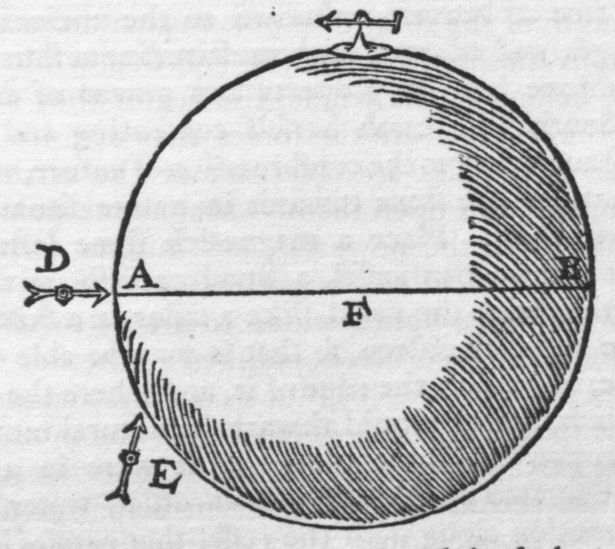
On the stone A B the versorium is placed in such a way that the versorium may remain in equilibrium: you will mark with chalk the course of the iron when at rest: Move the instrument to another spot, and again make note of the direction and aspect: do the same thing in several places, and from the concurrence of the lines of direction you will find one pole at the point A, the other at B. A versorium placed near the stone also indicates the true pole; when at right angles it eagerly beholds the stone and seeks the pole itself directly, and is turned in a straight line through the axis to the centre of the stone. For instance, the versorium D faces toward A and F, the pole and centre, whereas E does not exactly respect * either the pole A or the centre F[64]. A bit of rather fine iron wire, of the length of a barley-corn, is placed on the stone, and is moved over the regions and surface of the stone, until it rises to the perpendicular[65]: for it stands erect at the actual pole, whether Boreal or austral; the further from the pole, the more it inclines from the vertical. The poles thus found you shall mark with a sharp file or gimlet.
CHAP. IIII.
Which pole of the stone is the Boreal: & how it is distinguished from the austral.
ne pole of the earth turns toward the constellation of the Cynosure, and constantly regards a fixed point in the heaven (except so far as it changes by the fixed stars being shifted in longitude, which motion we recognize as existing in the earth, as we shall hereafter prove): While the other pole turns to the opposite face of heaven, unknown to the ancients, now visible on long voyages, and adorned with multitudinous stars: In the same way the loadstone has the property and power of directing itself North and South (the earth herself consenting and contributing force thereto) according to the conformation of nature, which arranges the movements of the stone towards its native situation. Which thing is proved thus: Place a magnetick stone (after finding the poles) in a round wooden vessel, a Bowl or dish, at the same time place it together with the vessel (like a sailor in a skiff) upon water in some large vessel or cistern, so that it may be able to float freely in the middle, nor touch the edge of it, and where the air is not disturbed by winds, which would thwart the natural movement of the stone. Hereupon the stone placed as it were in a ship, in the middle of the surface of the still and unruffled water, will at once put itself in motion along with the vessel that carries it, and revolve circularly, until its austral pole points to the north, and its boreal pole to the south. For it reverts from the contrary position to the poles: and although by the first too-vehement impulse it over-passes the poles; yet after returning again and again, it rests at length at the poles, or at the meridian (unless because of local reasons it is diverted some little from those points, or from the meridional line, by some sort of variation[66], the cause of which we will hereafter state). However often you move it away from its place, so often by virtue of nature's noble dower does it seek again those sure and determined goals; and this is so, not only if the poles have been disposed in the vessel evenly with the plane of the horizon, but also in the case of one pole, whether austral or boreal, being raised in the vessel ten, or twenty, or thirty, or fifty or eighty degrees, above * the plane of the horizon, or lowered beneath it: Still you shall see the boreal part of the stone seek the south, and the austral part seek the north; So much so that if the pole of the stone shall be only one degree distant from the Zenith and highest point of the heaven, in the case of a spherical stone, the whole stone revolves until the pole occupies its own site; though not in the absolutely direct line, it will yet tend toward those parts, and come to rest in the meridian of the directive action. With a like impulse too it is borne if the austral pole have been raised toward the upper quarters, the same as if the Boreal had been exalted above the Horizon. But it is always to be noted that, though there are various kinds of unlikeness in the stones, and one loadstone may far surpass another in virtue and efficiency; yet all hold to the same limits, and are borne toward the same points. Further it is to be remembered * that all who before our time wrote of the poles of the stone, and all the craftsmen and navigators, have been very greatly in error in considering the part of the stone which tended to the north as the north pole of the stone, and that which verged toward the south, the south pole, which we shall hereafter prove to be false. So badly hitherto hath the whole magnetick philosophy been cultivated, even as to its foundation principles.
CHAP. V.
Loadstone seems to attract Loadstone when in natural position: but repels it when in a contrary one, and brings it back to order.
irst of all we must declare, in familiar language, what are the apparent and common virtues of the stone; afterward numerous subtilities, hitherto abstruse and unknown, hidden in obscurity, are to be laid open, and the causes of all these (by the unlocking of nature's secrets) made evident, in their place, by fitting terms and devices. It is trite and commonplace that loadstone draws iron; in the same way too does loadstone attract loadstone. Place the stone which you have seen to have poles clearly distinguished, and marked austral and boreal, in its vessel so as to float; and let the poles be rightly arranged with respect to the plane of the horizon, or, at any rate not much raised or awry: hold in your hand another stone the poles of which are also known; in such a way that its austral pole may be toward the boreal pole of the one that is swimming, and near it, sideways: for the floating stone forthwith follows the other stone (provided it be within its force and dominion) and does not leave off nor forsake it until it adhæres; unless by withdrawing your hand, you cautiously avoid contact. In like manner if you set the boreal pole of the one you hold in your hand opposite the austral pole of the swimming stone, they rush together and follow each other in turn. For contrary poles allure contrary. If, however, you apply in the same way the northern to the northern, and the austral to the austral pole, the one stone puts the other to flight, and it turns aside as though a pilot were pulling at the helm and it makes sail in the opposite ward as one that ploughs the sea, and neither stands anywhere, nor halts, if the other is in pursuit. For stone disposeth stone; the one turns the other around, reduces it to range, and brings it back to harmony with itself. When, however, they come together and are conjoined according to the order of nature, they cohære firmly mutually. For instance, if you were to set the boreal pole of that stone which is in your hand before the tropic of Capricorn of a round floating loadstone (for it will be well to mark out on the round stone, that is the terrella, the mathematical circles as we do on a globe itself), or before any point between the æquator and the austral pole; at once the swimming stone revolves, and so arranges itself that its austral pole touches the other's boreal pole, and forms a close union with it. In the same way, again, at the other side of the æquator, with the opposite poles, you may produce similar results; and thus by this art and subtilty we exhibit attraction, repulsion, and circular motion for attaining a position of agreement and for declining hostile encounters. Moreover 'tis in one and the same stone that we are thus able to demonstrate all these things and also how the same part of one stone may on division become either boreal or austral. Let A D be an oblong stone, in which A is the northern, D the southern pole; cut this into two equal parts, then set part A in its vessel on the water[67], so as to float.
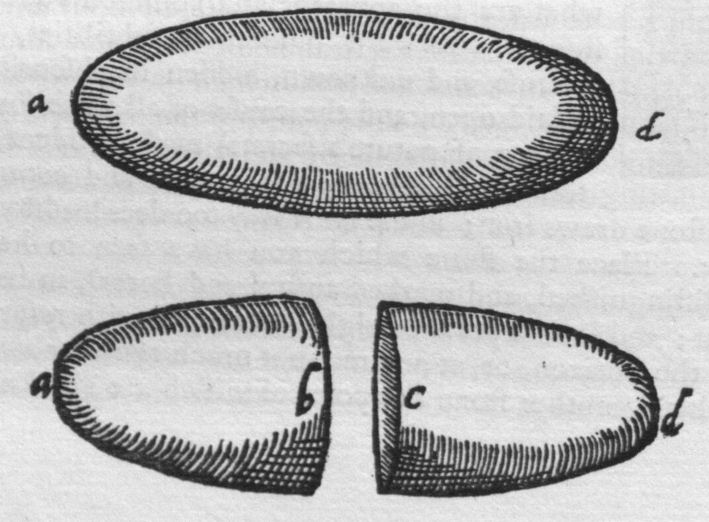
And you will then see[68] that A the northern point will turn to the south, as before; in like manner also the point D will move to the north, in the divided stone, as in the whole one. Whereas, of the parts B and C, which were before continuous, and are now divided, the one is southern B, the other northern C. B draws C, desirous to be united, and to be brought back into its pristine continuity: for these which are now two stones were formed out of one: and for this cause C of the one turning itself to B of the other, they mutually attract each other, and when freed from obstacles and relieved of their own weight, as upon the surface of water, they run together and are conjoined. But if you direct the part or point A to C in the other stone, the one repels or turns away from the other: for so were nature perverted, and the form of the stone perturbed, a form that strictly keeps the laws which it imposed upon bodies: hence, when all is not rightly ordered according to nature, comes the flight of one from the other's perverse position and from the discord, for nature does not allow of an unjust and inequitable peace, or compromise: but wages war and exerts force to make bodies acquiesce well and justly. Rightly arranged, therefore, these mutually attract each other; that is, both stones, the stronger as well as the weaker, run together, and with their whole forces tend to unity, a fact that is evident in all magnets, not in the Æthiopian only, as Pliny supposed. The Æthiopian magnets if they be powerful, like those brought from China, because all strong ones show the effect more quickly and more plainly, attract more strongly in the parts nearest the pole, and turn about until pole looks directly at pole. The pole of a stone more persistently attracts and more rapidly seizes the corresponding part (which they term the adverse part) of another stone; for instance, North pulls South; just so it also summons iron with more vehemence, and the iron cleaves to it more firmly whether it have been previously excited by the magnet, or is untouched. For thus, not without reason hath it been ordained by nature, that the parts nearer to the pole should more firmly attract: but that at the pole itself should be the seat, the throne, as it were, of a consummate and splendid virtue, to which magnetical bodies on being brought are more vehemently attracted, and from which they are with utmost difficulty dislodged. So the poles are the parts which more particularly spurn and thrust away things strange and alien perversely set beside them.
CHAP. VI.
Loadstone attracts the ore of iron, as well as iron proper, smelted and wrought.
rincipal and manifest among the virtues of the * magnet, so much and so anciently commended, is the attraction of iron; for Plato states that the magnet, so named by Euripides, allures iron, and that it not only draws iron rings but also indues the rings with power to do the same as the stone; to wit, draw other rings, so that sometimes a long chain of iron objects, nails or rings is formed, some hanging from others. The best iron (like that which is called acies from its use, or chalybs from the country of the Chalybes) is best and strongly drawn by a powerful loadstone; whereas the less good sort, which is impure, rusty, and not thoroughly purged from dross, and not wrought in second furnaces, is more feebly drawn; and yet more weakly when covered and defiled with thick, greasy, and sluggish humours. It also draws ores of iron, those that are rich and of iron colour; the poorer and not so productive ores it does not attract, except they be prepared with some art. A loadstone loses some attractive virtue, and, as it were, pines away with age, if exposed too long to the open air instead of being laid in a case with filings or scales of iron. Whence it should be buried in such materials; for there is nothing that plainly resists this exhaustless virtue which does not destroy the form of the body, or corrode it; not even if a thousand adamants were conjoined. Nor do I consider that there is any such thing as the Theamedes[69], or that it has a power opposite to that of the loadstone. Although Pliny, that eminent man and prince of compilers (for it is what others had seen and discovered, not always or mainly his own observations, that he has handed down to posterity) has copied from others the fable now made familiar by repetition: That in India there are two mountains near the river Indus; the nature of one being to hold fast all that is iron, for it consists of loadstone; the other's nature being to repel it, for it consists of the Theamedes. Thus if one had iron nails in one's boots, one could not tear away one's foot on the one mountain, nor stand still on the other. Albertus Magnus writes that a loadstone had been found in his day which with one part drew to itself iron, and repelled it with its other end; but Albertus observed the facts badly; for every loadstone attracts with one end iron that has been touched with a loadstone, and drives it away with the other; and draws iron that been touched with a loadstone more powerfully than iron that has not been so touched.
CHAP. VII.
What Iron is, and of what substance, and its uses.
or that now we have declared the origin and nature of the loadstone, we think it necessary first to add a history of iron and to indicate the hitherto unknown forces of iron, before this our discourse goes on to the explanation of magnetick difficulties and demonstrations, and to deal with the coitions and harmonies of loadstone with iron. Iron is by all reckoned in the class of metals, and is a metal livid in colour, very hard, glows red-hot before it melts, being most difficult of fusion, is beaten out under the hammer, and is very resonant. Chemists say that if a bed of fixed earthy sulphur be combined with fixed earthy quicksilver, and the two together are neither pure white but of a livid whiteness, if the sulphur prevail, iron is formed. For these stern masters of metals who by many inventions twisting them about, pound, calcine, dissolve, sublime, and precipitate, decide that this metal, both on account of the earthy sulphur and of the earthy mercury, is more truly a son of the earth than any other; they do not even think gold or silver, lead, tin, or copper itself so earthy; for that reason it is not smelted except in the hottest furnaces, with bellows; and when thus fused, on having again grown hard it is not melted again without heavy labour; but its slag with the utmost difficulty. It is the hardest of metals, subduing and breaking all things, by reason of the strong concretion of the more earthy matter. Wherefore we shall better understand what iron is, when we shall declare what are the causes and substance of metals, in a different way from those who before our time have considered them. Aristotle takes the material of the metals to be vapour. The chemists in chorus pronounce their actual elements to be sulphur and quicksilver. Gilgil Mauritanus gives it as ashes moistened with water. Georgius Agricola makes it out to be water and earth mixed; nor, to be sure, is there any difference between his opinion and the position taken by Mauritanus. But ours is that metals arise and effloresce at the summits of the earth's globe, being distinguished each by its own form, like some of the other substances dug out of it, and all bodies around us. The earth's globe does not consist of ashes or inert dust. Nor is fresh water an element, but a more simple consistency of evaporated fluids of the earth. Unctuous bodies, fresh water devoid of properties, quicksilver and sulphur, none of these are principia of metals: these latter, things are the results of a different nature, they are neither constant nor antecedent in the course of the generation of metals. The earth emits various humours, not begotten of water nor of dry earth, nor from mixtures of these, but from the substance of the earth itself: these humours are not distinguished by contrary qualities or substance, nor is the earth a simple substance, as the Peripateticks dream. The humours proceed from vapours sublimated from great depths; all waters are extracts and, as it were, exudations from the earth. Rightly then in some measure does Aristotle make out the matter of metals to be that exhalation which in continuance thickens in the lodes of certain soils: for the vapours are condensed in places which are less hot than the spot whence they issued, and by help of the nature of the soils and mountains, as in a womb, they are at fitting seasons congealed and changed into metals: but it is not they alone which form ores, but they flow into and enter a more solid material, and so form metals. So when this concreted matter has settled down in more temperate beds, it begins to take shape in those tepid places, just as seed in the warm womb, or as the embryo acquires growth: sometimes the vapour conjoins with suitable matter alone: hence some metals are occasionally though rarely dug up native, and come into existence perfect without smelting: but other vapours which are mixed with alien soils require smelting in the way that the ores of all metals are treated, which are rid of all their dross by the force of fires, and being fused flow out metallick, and are separated from earthy impurities but not from the true substance of the earth. But in so far as that it becomes gold, or silver, or copper, or any other of the existing metals, this does not happen from the quantity or proportion of material, nor from any forces of matter, as the Chemists fondly imagine; but when the beds and region concur fitly with the material, the metals assume forms from the universal nature by which they are perfected; in the same manner as all the other minerals, plants, and animals whatever: otherwise the species of metals would be vague and undefined, which are even now turned up in such scanty numbers that scarce ten kinds are known. Why, however, nature has been so stingy as regards the number of metals, or why there should be as many as are known to man, it is not easy to explain; though the simple-minded and raving Astrologers refer the metals each to its own planet. But there is no agreement of the metals with the planets, nor of the planets with the metals, either in numbers or in properties. For what connexion is there of iron with Mars? unless it be that from the former numerous instruments, particularly swords and engines of war, are fashioned. What has copper to do with Venus? or how does tin, or how does spelter correspond with Jupiter? They should rather be dedicated to Venus. But this is old wives' talk. Vapour is then a remote cause in the generation of the metals; the fluid condensed from vapours is a more proximate one, like the blood and semen in the generation of animals. But those vapours and juices from vapours pass for the most part into bodies and change them into marcasites and are carried into lodes (for we have numerous cases of wood so transmuted), the fitting matrices of bodies, where they are formed as metals. They enter most often into the truer and more homogeneal substance of the globe, and in the process of time a vein of iron results; loadstone is also produced, which is nought else than a noble kind of iron ore: and for this reason, and on account of its substance being singular, alien from all other metals, nature very rarely, if ever, mixes with iron any other metal, while the other metals are very often minutely mixed, and are produced together. Now when that vapour or those juices happen to meet, in fitting matrices, with efflorescences deformed from the earth's homogenic substance, and with divers precipitates (the forms working thereto), the remainder of the metals are generated (a specifick nature affecting the properties in that place). For the hidden primordial elements of metals and stones lie concealed in the earth, as those of herbs and plants do in its outer crust. For the soil dug out of a deep well, where would seem to be no suspicion of a conception of seed, when placed on a very high tower, produces, by the incubation of sun and sky, green herbage and unbidden weeds; and those of the kind which grow spontaneously in that region, for each region produces its own herbs and plants, also its own metals.
[70]Here corn exults, and there the grape is glad, Here trees and grass unbidden verdure add. So mark how Tmolus yields his saffrone store, But ivory is the gift of Indian shore; With incense soft the softer Shebans deal; The stark Chalybeans' element is steel: With acrid castor reek the Pontic wares, Epirus wins the palm of Elian mares.
But what the Chemists (as Geber, and others) call fixed earthy sulphur in iron is nothing else than the homogenic earth-substance concreted by its own humour, amalgamated with a double fluid: a metallick humour is inserted along with a small quantity of the substance of the earth not devoid of humour. Wherefore the common saying that in gold there is pure earth, but in iron mostly impure, is wrong; as though there were indeed such a thing as natural earth, and that the globe itself were (by some unknown process of refining) depurate. In iron, especially in the best iron, there is earth in its own nature true and genuine; in the other metals there is not so much earth as that in place of earth and precipitates there are consolidated and (so to speak) fixed salts, which are efflorescences of the globe, and which differ also greatly in firmness and consistency: In the mines their force rises up along with a twofold humour from the exhalations, they solidify in the underground spaces into metallic veins: so too they are also connate by virtue of their place and of the surrounding bodies, in natural matrices, and take on their specific forms. Of the various constitutions of loadstones and their diverse substances, colours, and virtues, mention has been made before: but, now having stated the cause and origin of metals, we have to examine ferruginous matter not as it is in the smelted metal, but as that from which the metal is refined. Quasi-pure iron is found of its proper colour and in its own lodes; still, not as it will presently be, nor as adapted for its various uses. It is sometimes dug up covered with white silex or with other stones. It is often the same in river sand, as in Noricum. A nearly pure ore of iron is now often dug up in Ireland, which the smiths, without the labours of furnaces, hammer out in the smithy into iron implements. In France iron is very commonly smelted out of a liver-coloured stone, in which are glittering scales; the same kind[71] without the scales is found in England, which also they use for craftsmen's ruddle[72]. In Sussex in England[73] is a rich dusky ore and also one of a pale ashen hue, both of which on being dried for a time, or kept in moderate fires, presently acquire a liver-colour; here also is found a dusky ore square-shaped with a black rind of greater hardness. An ore having the appearance of liver is often variously intermingled with other stones: as also with the perfect loadstone which yields the best of iron. There is also a rusty ore of iron, one of a leaden hue tending to black, one quite black, or black mixed with true cobalt: there is another sort mixed either with pyrites, or with sterile plumbago. One kind is also like jet, another like bloodstone. The emery used by armourers, and by glaziers for glass-cutting, called amongst the English Emerelstone, by the Germans Smeargel, is ferruginous; albeit iron is extracted from it with difficulty, yet it attracts the versorium. It is now and then found in deep iron and silver diggings. Thomas Erastus says he had heard from a certain learned man of iron ores, of the colour of iron, but quite soft and fatty, which can be smoothed with the fingers like butter, out of which excellent iron can be smelted: somewhat the same we have seen found in England, having the aspect of Spanish soap. Besides the numberless kinds of stony ores, iron is extracted from clay, from clayey earth, from ochre, from a rusty matter deposited from chalybeate waters; In England iron is copiously extracted in furnaces often from sandy and clayey stones which appear to contain iron not more than sand, marl, or any other clay soils contain it. Thus in Aristotle's book De Mirabilibus Auscultationibus[74], "There is said" (he states) "to be a peculiar formation of Chalybean and Misenian iron, for instance the sort collected from river gravel; some say that after being simply washed it is smelted in the furnace; others declare that it and the sediment which subsides after several washings are cast in and purified together by the fire; with the addition of the stone pyrimachus which is found there in abundance." Thus do numerous sorts of things contain in their various substances notably and abundantly this element of iron and earth. However, there are many stones, and very common ones, found in every soil, also earths, and various and mixed materials, which do not hold rich substances, but yet have their own iron elements, and yield them to skilfully-made fires, yet which are left aside by metallick men because they are less profitable; while other soils give some show of a ferruginous nature, yet (being very barren) are hardly ever smelted down into iron; and being neglected are not generally known. Manufactured irons differ very greatly amongst themselves. For one kind is tenacious in its nature, and this is the best; one is of medium quality: another is brittle, and this is the worst. Sometimes the iron, by reason of the excellency of the ore, is wrought into steel, as to-day in Noricum. From the finest iron, too, well wrought and purged from all dross, or by being plunged in water after heating, there issues what the Greeks call στόμωμα; the Latins acies; others aciarium, such as was at times called Syrian, Parthian, Noric, Comese, Spanish; elsewhere it is named from the water in which it is so often plunged, as at Como in Italy[75], Bambola and Tarazona in Spain. Acies fetches a much larger price than mere iron. And owing to its superiority it better accords with the loadstone, from which more powerful quality it is often smelted, and it acquires the virtues from it more quickly, retains them longer at their full, and in the best condition for magnetical experiments. After iron has been smelted in the first furnaces, it is afterward wrought by various arts in large worksteads or mills, the metal acquiring consistency when hammered with ponderous blows, and throwing off the dross. After the first smelting it is rather brittle and by no means perfect. Wherefore with us (English) when the larger military guns are cast, they purify the metal from dross more fully, so that they may be stronger to withstand the force of the firing; and they do this by making it pass again (in a fluid state) through a chink, by which process it sheds its recremental matter. Smiths render iron sheets tougher with certain liquids, and by blows of the hammer, and from them make shields and breastplates that defy the blows of battle-axes. Iron becomes harder through skill and proper tempering, but also by skill turns out in a softer condition and as pliable as lead. It is made hard by the action of certain waters into which while glowing it is plunged, as at Bambola and Tarazona in Spain: It grows soft again, either by the effect of fire alone, when without hammering and without water, it is left to cool by itself; or by that of grease into which it is plunged; or (that it may the better serve for various trades) it is tempered variously by being skilfully besmeared. Baptista Porta expounds this art in book 13 of his Magia Naturalis. Thus this ferric and telluric nature is included and taken up in various bodies of stones, ores, and earths; so too it differs in aspect, in form, and in efficiency. Art smelts it by various processes, improves it, and turns it, above all material substances, to the service of man in trades and appliances without end. One kind of iron is adapted for breastplates, another serves as a defence against shot, another protects against swords and curved blades (commonly called scimitars), another is used for making swords, another for horseshoes. From iron are made nails, hinges, bolts, saws, keys, grids, doors, folding-doors, spades, rods, pitchforks, hooks, barbs, tridents, pots, tripods, anvils, hammers, wedges, chains, hand-cuffs, fetters, hoes, mattocks, sickles, baskets, shovels, harrows, planes, rakes, ploughshares, forks, pans, dishes, ladles, spoons, spits, knives, daggers, swords, axes, darts, javelins, lances, spears, anchors, and much ship's gear. Besides these, balls, darts, pikes, breastplates, helmets, cuirasses, horseshoes, greaves, wire, strings of musical instruments, chairs, portcullises, bows, catapults, and (pests of human kind) cannon, muskets, and cannon-balls, with endless instruments unknown to the Latins: which things I have rehearsed in order that it may be understood how great is the use of iron, which surpasses a hundred times that of all the other metals; and is day by day being wrought by metal-workers whose stithies are found in almost every village. For this is the foremost of metals, subserving many and the greatest needs of man, and abounds in the earth above all other metals, and is predominant. Wherefore those Chemists are fools[76] who think that nature's will is to perfect all metals into gold; she might as well be making ready to change all stones to diamonds, since diamond surpasses all in splendour and hardness, because gold excels in splendour, gravity, and density, being invincible against all deterioration. Iron as dug up is therefore, like iron that has been smelted, a metal, differing a little indeed from the primary homogenic terrestrial body, owing to the metallick humour it has imbibed; yet not so alien as that it will not, after the manner of refined matter, admit largely of the magnetick forces, and may be associated with that prepotent form belonging to the earth, and yield to it a due submission.
CHAP. VIII.
In what countries and districts iron originates.
lenty of iron mines exist everywhere, both those of old time recorded in early ages by the most ancient writers, and the new and modern ones. The earliest and most important seem to me to be those of Asia. For in those countries which abound naturally in iron, governments and the arts flourished exceedingly, and things needful for the use of man were discovered and sought after. It is recorded to have been found about Andria, in the region of the Chalybes near the river Thermodon in Pontus; in the mountains of Palestine which face Arabia; in Carmania: in Africa there was a mine of iron in the Isle of Meroe; in Europe in the hills of Britain, as Strabo writes; in Hither Spain, in Cantabria. Among the Petrocorii and Cubi Biturges[77] (peoples of Gaul), there were worksteads in which iron used to be wrought. In greater Germany near Luna, as recorded by Ptolemy; Gothinian iron is mentioned by Cornelius Tacitus; Noric iron is celebrated in the verses of poets; and Cretan, and that of Eubœa; many other iron mines were passed over by these writers or unknown to them; and yet they were neither poor nor scanty, but most extensive. Pliny[78] says that Hither Spain and all the district from the Pyrenees is ferruginous, and on the part of maritime Cantabria washed by the Ocean (says the same writer) there is (incredible to relate) a precipitously high mountain wholly composed of this material. The most ancient mines were of iron rather than of gold, silver, copper or lead; since mainly this was sought because of the demand; and also because in every district and soil they were easy to find, not so deep-lying, and less beset by difficulties. If, however, I were to enumerate modern iron workings, and those of this age and over Europe only, I should have to write a large and bulky volume, and sheets of paper would run short quicker than the iron, and yet for one sheet they could furnish a thousand worksteads. For amongst minerals, no material is so ample; all metals, and all stones distinct from iron, are outdone by ferric and ferruginous matter. For you will not readily find any region, and scarcely any country district over the whole of Europe (if you search at all deeply), that does not either produce a rich and abundant vein of iron or some soil containing or slightly charged with ferruginous stuff; and that this is true any expert in the arts of metals and chemistry will easily find. Beside that which has ferruginous nature, and the metallick lode, there is another ferric substance which does not yield the metal in this way because its thin humour is burnt out by fierce fires, and it is changed into an iron slag like that which is separated from the metal in the first furnaces. And of this kind is all clay and argillaceous earth, such as that which apparently forms a large part of the whole of our island of Britain: all of which, if subjected very vehemently to intense heat, exhibits a ferric and metallick body, or passes into ferric vitreous matter, as can be easily seen in buildings in bricks baked from clay, which, when placed next the fires in the open kilns (which our folk call clamps)[79] and burned, present an iron vitrification, black at the other end. Moreover all those earths as prepared are drawn by the magnet, and like iron are attracted by it. So perpetual and ample is the iron offspring of the terrestrial globe. Georgius Agricola says that almost all mountainous regions are full of its ores, while as we know a rich iron lode is frequently dug in the open country and plains over nearly the whole of England and Ireland; in no other wise than as, says he, iron is dug out of the meadows at the town of Saga in pits driven to a two-foot depth. Nor are the West Indies without their iron lodes, as writers tell us; but the Spaniards, intent upon gold, neglect the toilsome work of iron-founding, and do not search for lodes and mines abounding in iron. It is probable that nature and the globe of the earth are not able to hide, and are evermore bringing to the light of day, a great mass of inborn matter, and are not invariably obstructed by the settling of mixtures and efflorescences at the earth's surface. It is not only in the common mother (the terrestrial globe) that iron is produced, but sometimes also in the air from the earth's exhalations, in the highest clouds. It rained iron in Lucania, the year in which M. Crassus was slain. The tale is told, too, that a mass of iron, like slag, fell from the air in the Nethorian forest, near Grina, and they narrate that the mass was many pounds in weight; so that it could neither be conveyed to that place, on account of its weight, nor be brought away by cart, the place being without roads. This happened before the civil war waged between the rival dukes in Saxony. A similar story, too, comes to us from Avicenna. It once rained iron in the Torinese[80], in various places (Julius Scaliger telling us that he had a piece of it in his house), about three years before that province was taken over by the king. In the year 1510 in the country bordering on the river Abdua (as Cardan writes[81] in his book De Rerum Varietate) there fell from the sky 1200 stones, one weighing 120 pounds, another 30 or 40 pounds, of a rusty iron colour and remarkably hard. These occurrences being rare are regarded as portents, like the showers of earth and stones mentioned in Roman history. But that it ever rained other metals is not recorded; for it has never been known to rain from the sky gold, silver, lead, tin, or spelter[82]. Copper, however, has been at some time noticed to fall from the sky, and this is not very unlike iron; and in fact cloud-born iron of this sort, or copper, are seen to be imperfectly metallick, incapable of being cast in any way, or wrought with facility. For the earth hath of her store plenty of iron in her highlands, and the globe contains the ferric and magnetick element in rich abundance. The exhalations forcibly derived from such material may well become concreted in the upper air by the help of more powerful causes, and hence some monstrous progeny of iron be begotten.
CHAP. IX.
Iron ore attracts iron ore.
rom various substances iron (like all the rest of the * metals) is extracted: such substances being stones, earth, and similar concretions which miners call veins because it is in veins[83], as it were, that they are generated. We have spoken above of the variety of these veins. If a properly coloured ore of iron and a rich one (as miners call it) is placed, as soon as mined, upon water in a bowl or any small vessel (as we have shown before in the case of a loadstone), it is attracted by a similar piece of ore brought near by hand, yet not so powerfully and quickly as one loadstone is drawn by another loadstone, but slowly and feebly. Ores of iron that are stony, cindery, dusky, red, and several more of other colours, do not attract one another mutually, nor are they attracted by the loadstone itself, even by a strong one, no more than wood, or lead, silver, or gold. Take those ores and burn, or rather roast them, in a moderate fire, so that they are not suddenly split up, or fly asunder, keeping up the fire ten or twelve hours, and gently increasing it, then let them grow cold, skill being shown in the direction in which they are placed: These ores thus prepared a loadstone will now draw, and they now show a mutual sympathy, and when skilfully arranged run together by their own forces.
CHAP. X.
*
Iron ore has poles, and acquires them, and settles itself toward the poles of the universe.
eplorable is man's ignorance in natural science, and modern philosophers, like those who dream in darkness, need to be aroused, and taught the uses of things and how to deal with them, and to be induced to leave the learning sought at leisure from books alone, and that is supported only by unrealities of arguments and by conjectures. For the knowledge of iron (than which nothing is in more common use), and that of many more substances around us, remains unlearned; iron, a rich ore of which, placed in a vessel upon water, by an innate property of its own directs itself, just like the loadstone, North and South, at which points it rests, and to which, if it be turned aside, it reverts by its own inherent vigour. But many ores, less perfect in their nature, which yet contain amid stone or earthy substances plenty of iron, have no such motion; but when prepared by skilful treatment in the fires, as shown in the foregoing chapter, they acquire a polar vigour (which we call verticity[84]); and not only the iron ores in request by miners, but even earth merely charged with ferruginous matter, and many rocks, do in like manner tend and lean toward those portions of the heavens, or more truly of the earth, if they be skilfully placed, until they reach the desired location, in which they eagerly repose.
CHAP. XI.
*
Wrought Iron, not excited by a loadstone, draws iron.
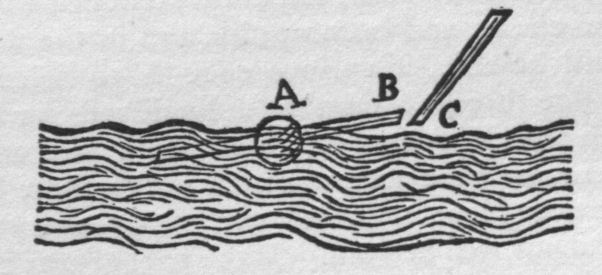
rom the ore, which is converted, or separated, partly into metal, partly into slag, by the intense heat of fires, iron is smelted in the first furnaces in a space of eight, ten, or twelve hours, and the metal flows away from the dross and useless matter, forming a large and long mass, which being subjected to a sharp hammering is cut into parts, out of which when reheated in the second hearth of the forge, and again placed on the anvil, the smiths fashion quadrangular lumps, or more specially bars which are bought by merchants and blacksmiths, from which in smithies usually it is the custom to fashion the various implements. This iron we term wrought, and its attraction by the loadstone is manifest to all. But we, by more carefully trying everything[85], have found out that iron merely, by itself alone, not excited by any loadstone, not charged by any alien forces, attracts other iron; though it does not so eagerly snatch and suddenly pluck at it as would a fairly strong loadstone; this you may know thus: A small piece of cork, the size of a hazel-nut, rounded, is traversed by an iron wire up to the middle of the wire: when set swimming on still water apply to one end of it, close (yet so as not to touch), the end of another iron wire; and wire draws wire, and one follows the other when slowly drawn back, and this goes on up to the proper boundaries. Let A be the cork with the iron wire, B one end of it raised a little above the surface of the water, C the end of the second wire, showing the way in which B is drawn by C. You may prove it in another way in a larger body. Let a long bright iron rod (such as is made for hangings and window curtains) be hung in balance by a slender silken cord: to one end of this as it rests in the air bring a small oblong mass of polished iron, with its proper end at the distance of half a digit. The balanced iron turns itself to the mass; do you with the same quickness draw back the mass in your hand in a circular path about the point of equilibrium of the suspension; the end of the balanced iron follows after it, and turns in an orbit.
CHAP. XII.
*
A long piece of Iron, even though not excited by a loadstone, settles itself toward North and South.
very good and perfect piece of iron, if drawn out in length, points North and South, just as the loadstone or iron rubbed with a magnetical body does; a thing that our famous philosophers have little understood, who have sweated in vain to set forth the magnetick virtues and the causes of the friendship of iron for the stone. You may experiment with either large or small iron works, and either in air or in water. A straight piece of iron six feet long of the thickness of your finger is suspended (in the way described in the foregoing chapter) in exact æquipoise by a strong and slender silken cord. But the cord should be cross-woven of several silk filaments, not twisted simply in one way; and it should be in a small chamber with all doors and windows closed, that the wind may not enter, nor the air of the room be in any way disturbed; for which reason it is not expedient that the trial should be made on windy days, or while a storm is brewing. For thus it freely follows its bent, and slowly moves until at length, as it rests, it points with its ends North and South, just as iron touched with a loadstone does in shadow-clocks, and in compasses, and in the mariners' compass. You will be able, if curious enough, to balance all at the same time by fine threads a number of small rods, or iron wires, or long pins with which women knit stockings; you will see that all of them at the same time are in accord, unless there be some error in this delicate operation: for unless you prepare everything fitly and skilfully, the labour will be void. Make trial of this thing in water also, which is done both more certainly and more easily. Let an iron wire two or three digits long, more or less, be passed through a round cork, so that it may just float upon water; and as soon as you have committed it to the waves, it turns upon its own centre, and one end tends to the North, the other to the South; the causes of which you will afterwards find in the laws of the direction. This too you should understand, and hold firmly in memory, that * as a strong loadstone, and iron touched with the same, do not invariably point exactly to the true pole but to the point of the variation; so does a weaker loadstone, and so does the iron, which directs itself by its own forces only, not by those impressed by the stone; and so every ore of iron, and all bodies naturally endowed with something of the iron nature, and prepared, turn to the same point of the horizon, according to the place of the variation in that particular region (if there be any variation therein), and there abide and rest.
CHAP. XIII.
*
Wrought iron has in itself certain parts Boreal and Austral: A magnetick vigour, verticity, and determinate vertices, or poles.
ron settles itself toward the North and South; not with one and the same point toward this pole or that: for one end of the piece of ore itself and one extremity also of a wrought-iron wire have a sure and constant destination to the North, the other to the South, whether the iron hang in the air, or float on water, be the iron large rods or thinner wires. Even if it be a little rod, or a wire ten or twenty or more ells in length; one end as a rule is Boreal, the other Austral. If you cut off part of that wire, and if the end of that divided part were Boreal, the other end (which was joined to it) will be Austral. Thus if you divide it into several parts, before making an experiment on the surface of water, you can recognize the vertex[86]. In all of them a Boreal end draws an Austral and repels a Boreal, and contrariwise, according to the laws magnetical. Yet herein wrought iron differs from the loadstone and from its own ore, inasmuch as in an iron ball of any size, such as those used for artillery or cannon, or bullets used for carbines or fowling-pieces, verticity is harder to acquire and is less apparent than in a piece of loadstone, or of ore itself, or than in a round loadstone. But in long and extended pieces of iron a power is at once discerned; the causes of which fact, and the methods by which it acquires its verticity and its poles without use of a loadstone, as well as the reasons for all the other obscure features of verticity, we shall set forth in describing the motion of direction.
CHAP. XIIII.
Concerning other powers of loadstone, and its medicinal properties.
ioscorides prescribes loadstone to be given with sweetened water, three scruples' weight, to expel gross humours. Galen writes that a like quantity of bloodstone avails. Others relate that loadstone perturbs the mind and makes folk melancholick, and mostly kills. Gartias ab Horto[87] thinks it not deleterious or injurious to health. The natives of East India tell us, he says, that loadstone taken in small doses preserves youth. On which account the aged king, Zeilam, is said to have ordered the pans in which his victuals were cooked to be made of loadstone. The person (says he) to whom this order was given told me so himself. There are many varieties of loadstone produced by differences in the mingling of earths, metals, and juices; hence they are altogether unlike in their virtues and effects, due to propinquities of places and of agnate bodies, and arising from the pits themselves as it were from the matrices being soul. One loadstone is therefore able to purge the stomach, and another to check purging, to cause by its fumes a serious shock to the mind, to produce a gnawing at the vitals, or to bring on a grave relapse; in case of which ills they exhibit gold and emerald, using an abominable imposture for lucre. Pure loadstone may, indeed, be not only harmless, but even able to correct an over-fluid and putrescent state of the bowels and bring them back to a better temperament; of this sort usually are the oriental magnets from China, and the denser ones from Bengal, which are neither misliking nor unpleasant to the actual senses. Plutarch and Claudius Ptolemy[88], and all the copyists since their time, think that a loadstone smeared with garlick does not allure iron. Hence some suspect that garlick is of avail against any deleterious power of the magnet: thus in philosophy many false and idle conjectures arise from fables and falsehoods. Some physicians[89] have that a loadstone has power to extract the iron of an arrow from the human body. But it is when whole that the loadstone draws, not when pulverized and formless, buried in plasters; for it does not attract by reason of its material, but is rather adapted for the healing of open wounds, by reason of exsiccation, closing up and drying the sore, an effect by which the arrow-heads would rather be retained in the wounds. Thus vainly and preposterously do the sciolists look for remedies while ignorant of the true causes of things. The application of a loadstone for all sorts of headaches no more cures them (as some make out) than would an iron helmet or a steel cap. To give it in a draught to dropsical persons is an error of the ancients, or an impudent tale of the copyists, though one kind of ore may be found which, like many more minerals, purges the stomach; but this is due to some defect of that ore and not to any magnetick property. Nicolaus puts a large quantity of loadstone into his divine plaster[90], just as the Augsburgers do into a black plaster[91] for fresh wounds and stabs; the virtue of which dries them up without smart, so that it proves an efficacious medicament. In like manner also Paracelsus to the same end mingles it in his plaster for stab wounds[92].
CHAP. XV.
The Medicinal Virtue of Iron.[93]
ot foreign to our present purpose will it be to treat briefly also of the medicinal virtue of iron: for it is a prime remedial for some diseases of the human body, and by its virtues, both those that are natural and those acquired by suitable preparation, it works marvellous changes in the human body, so that we may the more surely recognize its nature through its medicinal virtue and through certain manifest experiments. So that even those tyros in medicine who abuse this most famous medicament may learn to prescribe it with better judgment for the healing of the sick, and not, as too often they use it, to their harm. The best iron, Stomoma, or Chalybs, Acies, or Aciarium, is reduced to a fine powder by a file; the powder is steeped in the sharpest vinegar, and dried in the sun, and again soused in vinegar, and dried; afterwards it is washed in spring water or other suitable water, and dried; then for the second time it is pulverized and reduced on porphyry, passed through a very fine sieve, and put back for use. It is given chiefly in cases of laxity and over-humidity of the liver, in enlargement of the spleen, after due evacuations; for which reason it restores young girls when pallid, sickly, and lacking colour, to health and beauty; since it is very siccative, and is astringent without harm. But some who in every internal malady always talk of obstruction of the liver and spleen, think it beneficial in those cases because it removes obstructions, mainly trusting to the opinions of certain Arabians[94]: wherefore they administer it to the dropsical and to those suffering from tumour of the liver or from chronic jaundice, and to persons troubled with hypochondrical melancholia or any stomachic disorder, or add it to electuaries, without doubt to the grievous injury of many of their patients. Fallopius commends it prepared in his own way for tumours of the spleen, but is much mistaken; for loadstone is pre-eminently good for spleens relaxed with humour, and swollen; but it is so far from curing spleens thickened into a tumour that it mightily confirms the malady. For those drugs which are strong siccatives and absorb humour force the viscera when hardened into a tumour more completely into a quasi-stony body. There are some who roast iron in a closed oven with fierce firing, and burn it strongly, until it turns red, and they call this Saffron of Mars; which is a powerful siccative, and more quickly penetrates the intestines. Moreover they order violent exercise, that the drug may enter the viscera while heated and so reach the place affected; wherefore also it is reduced to a very fine flour; otherwise it only sticks in the stomach and in the chyle and does not penetrate to the intestines. As a dry and earthy medicament, then, it is shown by the most certain experiments to be, after proper evacuations, a remedy for diseases arising from humour (when the viscera are charged and overflowing with watery rheum). Prepared steel is a medicament proper for enlarged spleen. Iron waters too are effectual in reducing the spleen, although as a rule iron is of a frigid and astringent efficiency, not a laxative; but it effects this neither by heat nor by cold, but from its own dryness when mixed with a penetrative fluid: it thus disperses the humour, thickens the villi, hardens the tissues, and contracts them when lax; while the inherent heat in the member thus strengthened, being increased in power, dissipates what is left. Whereas if the liver be hardened and weakened by old age or a chronic obstruction, or the spleen be shrivelled and contracted to a schirrus, by which troubles the fleshy parts of the limbs grow flaccid, and water under the skin invades the body, in the case of these conditions the introduction of iron accelerates the fatal end, and considerably increases the malady. Amongst recent writers there are some who in cases of drought of the liver prescribe, as a much lauded and famous remedy, the electuary of iron slag, described by Rhazes[95] in his ninth book ad Almansorem, Chap. 63, or prepared filings of steel; an evil and deadly advice: which if they do not some time understand from our philosophy, at least everyday experience, and the decline and death of their patients, will convince them, even the sluggish and lazy. Whether iron be warm or cold is variously contended by many. By Manardus, Curtius, Fallopius and others, many reasons are adduced on both sides; each settles it according to his own sentiment. Some make it to be cold, saying that iron has the property of refrigerating, because Aristotle in his Meteorologica would put iron in the class of things which grow concreted in cold by emission of the whole of their Heat: Galen, too, says that iron has its consistency from cold; also that it is an earthy and dense body. Further that iron is astringent, also that Chalybeate water quenches thirst: and they adduce the cooling effect of thermal iron waters. Others, however, maintain that it is Warm, because of Hippocrates making out that waters are warm which burst forth from places where iron exists. Galen says that in all metals there is considerable substance, or essence, of fire. Paolo[96] affirms that iron waters are warm. Rhazes will have it that iron is warm and dry in the third degree. The Arabians think that it opens the spleen and liver; wherefore also that iron is warm. Montagnana recommends it in cold affections of the uterus and stomach. Thus do the smatterers cross swords together, and puzzle inquiring minds by their vague conjectures, and wrangle for trifles as for goats' wool, when they philosophize, wrongly allowing and accepting properties: but these matters will appear more plainly by and by when we begin to discuss the causes of things; the clouds being dispersed that have so darkened all Philosophy. Filings, scales, and slag of iron are, as Avicenna makes out, not wanting in deleterious power (haply when they are not well prepared or are taken in larger quantity than is fit), hence they cause violent pain in the bowels, roughness of the mouth and tongue, marasmus, and shrivelling of the limbs. But Avicenna wrongly[97] and old-womanishly makes out that the proper antidote to this iron poison is loadstone to the weight of a drachm taken as a draught in the juice of mercurialis or of Beet; for loadstone is of a twofold nature, usually malefiant and pernicious, nor does it resist iron, since it attracts it; nor when drunk in a draught in the form of powder does it avail to attract or repel, but rather inflicts the same evils.
CHAP. XVI.
That loadstone & iron ore are the same, but iron an extract from both, as other metals are from their own ores; & that all magnetick virtues, though weaker, exist in the ore itself & in smelted iron.
itherto we have declared the nature & powers of the loadstone, & also the properties & essence of iron; it now remains to show their mutual affinities, & kinship, so to speak, & how very closely conjoined these substances are. At the highest part of the terrestrial globe, or at its perishable surface & rind, as it were, these two bodies usually originate & are produced in one and the same matrix, as twins in one mine. Strong loadstones are dug up by themselves, weaker ones too have their own proper vein. Both are found in iron mines. Iron ore most often occurs alone, without strong loadstone (for the more perfect are rarely met with). Strong loadstone is a stone resembling iron; out of it is usually smelted the finest iron, which the Greeks call stomoma, the Latins acies, the Barbarians (not amiss) aciare, or aciarium. This same stone draws, repels, controls other loadstones, directs itself to the poles of the world, picks up smelted iron, and works many other wonders, some already set forth by us, but many more which we must demonstrate more fully. A weaker loadstone, however, will exhibit all these powers, but in a lesser degree; while iron ore, & also wrought iron (if they have been prepared) show their strength in all magnetick experiments not less than do feeble and weak * loadstones; & an inert piece of ore, & one possessed of no magnetick properties, & just thrown out[98] of the pit, when roasted in the fire & prepared with due art (by the elimination of humours & foreign excretions) awakes, and becomes in power & potency a magnet, * occasionally a stone or iron ore is mined, which attracts forthwith without being prepared: for native iron of the right colour attracts and governs iron magnetically. One form then belongs to the one mineral, one species, one self-same essence. For to me there seems to be a greater difference, & unlikeness, between the strongest loadstone, & a weak one which scarce can attract a single chip of iron; between one that is stout, strong, metallick, & one that is soft, friable, clayey; amidst such variety of colour, substance, quality, & weight; than there is on the one hand between the best ore, rich in iron, or iron that is metallick from the beginning, and on the other the most excellent loadstone. Usually, too, there are no marks to distinguish them, and even metallurgists cannot decide between them, because they agree together in all respects. Moreover we see that the best loadstone and the ore of iron are both as it were distressed by the same maladies & diseases, both run to old age in the same way & exhibit the same marks of it, are preserved & keep their properties by the same remedies & safeguards; & yet again the one increases the potency of the other, & by artfully devised adjuncts marvellously intensifies, & exalts it. For both are impaired by the more acrid juices as by poisons, & the aqua fortis of the Chemists inflicts on both the same wounds, and when exposed too long to harm from the atmosphere, they both alike pine away, so to speak, & grow old; each is preserved by being kept in the dust & scrapings of the other; & when a fit piece of steel or iron is adjoined above its pole, the loadstone's vigour is augmented through the firm union. The loadstone is laid up in iron filings, not that iron is its food; as though loadstone were alive and needed feeding, as Cardan philosophizes[99]; nor yet that so it is delivered from the inclemency of the weather (for which cause it as well as iron is laid up in bran by Scaliger; mistakenly, however, for they are not preserved well in this way, and keep for years their own fixed forms): nor yet, since they remain perfect by the mutual action of their powders, do their extremities waste away, but are cherished & preserved, like by like. For just as in their own places, in the mines, bodies like to each other endure for many ages entire and uncorrupt, when surrounded by bodies of the same stuff, as the lesser interior parts in a great mass: so loadstone and ore of iron, when inclosed in a mound of the same material, do not exhale their native humour, do not waste away, but retain their soundness. A loadstone lasts longer in filings of smelted iron, & a piece of iron ore excellently also in dust of loadstone; as also smelted iron in filings of loadstone & even in those of iron. Then both these allied bodies have a true & just form of one & the same species; a form which until this day was considered by all, owing to their outward unlikeness & the inequality of the potency that is the same innate in both, to be different & unlike in kind; the smatterers not understanding that the same powers, though differing in strength, exist in both alike. And in fact they both are true & intimate parts of the earth, & as such retain the prime natural properties of mutually attracting, of moving, & of disposing themselves toward the position of the world, and of the terrestrial globe; which properties they also impart to each other, and increase, confirm, receive, and retain each other's forces. The stronger fortifies the weaker, not as though aught were taken away from its own substance, or its proper vigour, nor because any corporeal substance is imparted, but the dormant virtue of the one is aroused by the other, without loss. For if with a single small stone you touch a thousand bits of iron for the use of mariners[100], that loadstone attracts iron no less strongly than before; with the same stone weighing one pound, any one will be able to suspend in the air a thousand pounds of iron. For if any one were to fix high up on the walls so many iron nails of so great a weight, & were to apply to them the same number of nails touched, according to the art, by a loadstone, they would all be seen to hang in the air through the force of one small stone. So this is not solely the action, labour, or outlay of the loadstone; but the iron, which is in a sense an extract from loadstone, and a fusion of loadstone into metal, & conceives vigour from it, & by proximity strengthens the magnetick faculties, doth itself, from whatever lode it may have come, raise its own inborn forces through the presence & contact of the stone, even when solid bodies intervene. Iron that has been touched, acts anew on another piece of iron by contact, & adapts it for magnetick movements, & this again a third. But if you rub with a loadstone any other metal, or wood, or bones, or glass, as they will not be moved toward any particular and determinate quarter of heaven, nor be attracted by any magnetick body, so they are able not to impart any magnetick property to other bodies or to iron itself by attrition, & by infection. Loadstone differs from iron ore, as also from some weaker magnets, in that when molten in the furnace into a ferric & metallick fused mass, it does not so readily flow & dissolve into metal; but is sometimes burnt to ashes in large furnaces; a result which it is reasonable to suppose arises from its having some kind of sulphureous matter mixed with it, or from its own excellence & simpler nature, or from the likeness & common form which it has with the common mother, the Great Magnet. For earths, and iron stones, magnets abounding in metal, are the more imbued & marred with excrementitious metallick humours, and earthy corruptions of substance, as numbers of loadstones are weaker from the mine; hence they are a little further remote from the common mother, & are degenerate, & when smelted in the furnace undergo fusion more easily, & give out a more certain metallick product, & a metal that is softer, not a tough steel. The majority of loadstones (if not unfairly burnt[101]) yield in the furnace a very excellent iron. But iron ore also agrees in all those primary qualities with loadstone; for both, being nearer and more closely akin to the earth above all bodies known to us, have in themselves a magnetick substance, & one that is more homogenic, true & cognate with the globe of the earth; less infested & spoiled by foreign blemish; less confused with the outgrowths of earth's surface, & less debased by corrupt products. And for this reason Aristotle in the fourth book of his Meteora seems not unfairly to separate iron from all the rest of the metals. Gold, he says, silver, copper, tin, lead, belong to water; but iron is of the earth. Galen, in the fourth chapter of De Facultatibus Simplicium Medicamentorum, says that iron is an earthy & dense body. Accordingly a strong loadstone is on our showing especially of the earth: the next place is occupied by iron ore or weaker loadstone; so the loadstone is by nature and origin[102]** of iron, and it and magnetick iron are both one in kind. Iron ore yields iron in furnaces; loadstone also pours forth iron in the furnaces, but of a much more excellent sort, that which is called steel or blade-edge; and the better sort of iron ore is a weak loadstone, the best loadstone being a most excellent ore of iron, in which, as is to be shown by us, the primary properties are grand and conspicuous. Weaker loadstone or iron ore is that in which these properties are more obscure, feeble, and are scarce perceptible to the senses.