WILLIAM GILBERT (continued 3)
Silvanus P. (Silvanus Phillips) Thompson translation
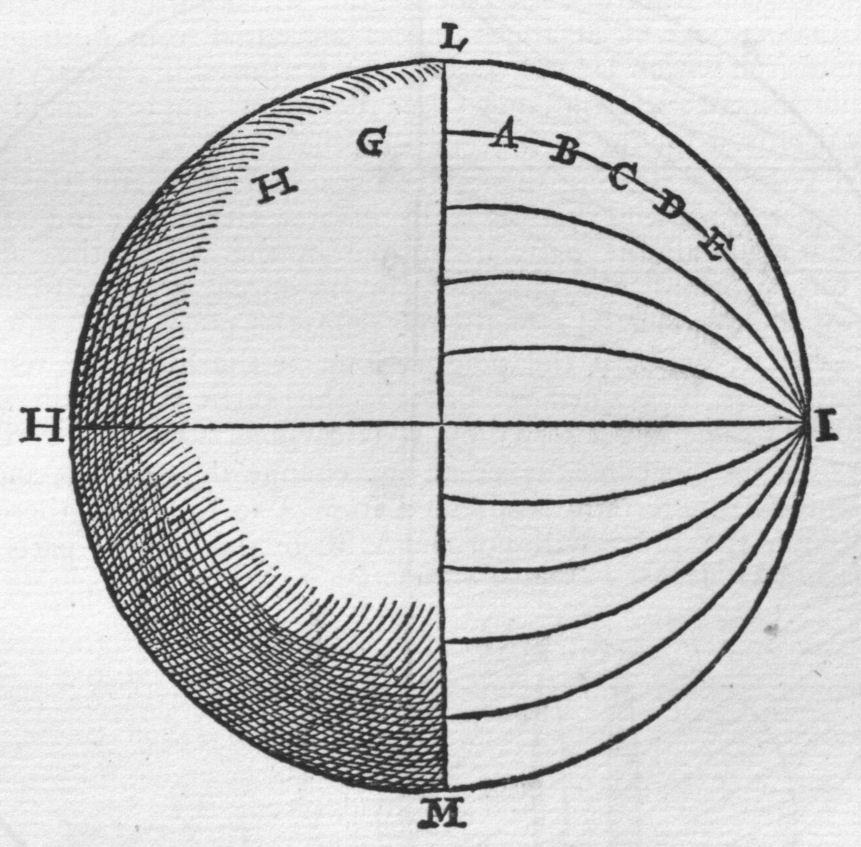
For so, by an infinite number of curves from every point of the equator dividing the sphere into two equal parts, and from every point of the surface from the æquator towards the North, and from the æquator towards the Southern pole, the whole force tends asunder toward the poles. So the verticity is from the æquinoctial circle towards the pole in each direction. Such is the power reposed in the undivided stone. From A vigour is sent to B, from A, B, to C, from A, B, C, to D, and from them likewise to E. In like manner from G to H, and so forth, as long as the whole is united. But if a piece A B be cut out (although it is near the æquator), yet it will be as strong in its magnetical actions as C D or D E, if torn away from the whole in equal quantity. For no part excels in special worth in the whole mass except by what is owing to the other adjoining parts by which an absolute and perfect whole is attained.
Diagram of Magnetic Vigour transmitted from the plane of the Æquator to the peripherery of the terella or of the earth
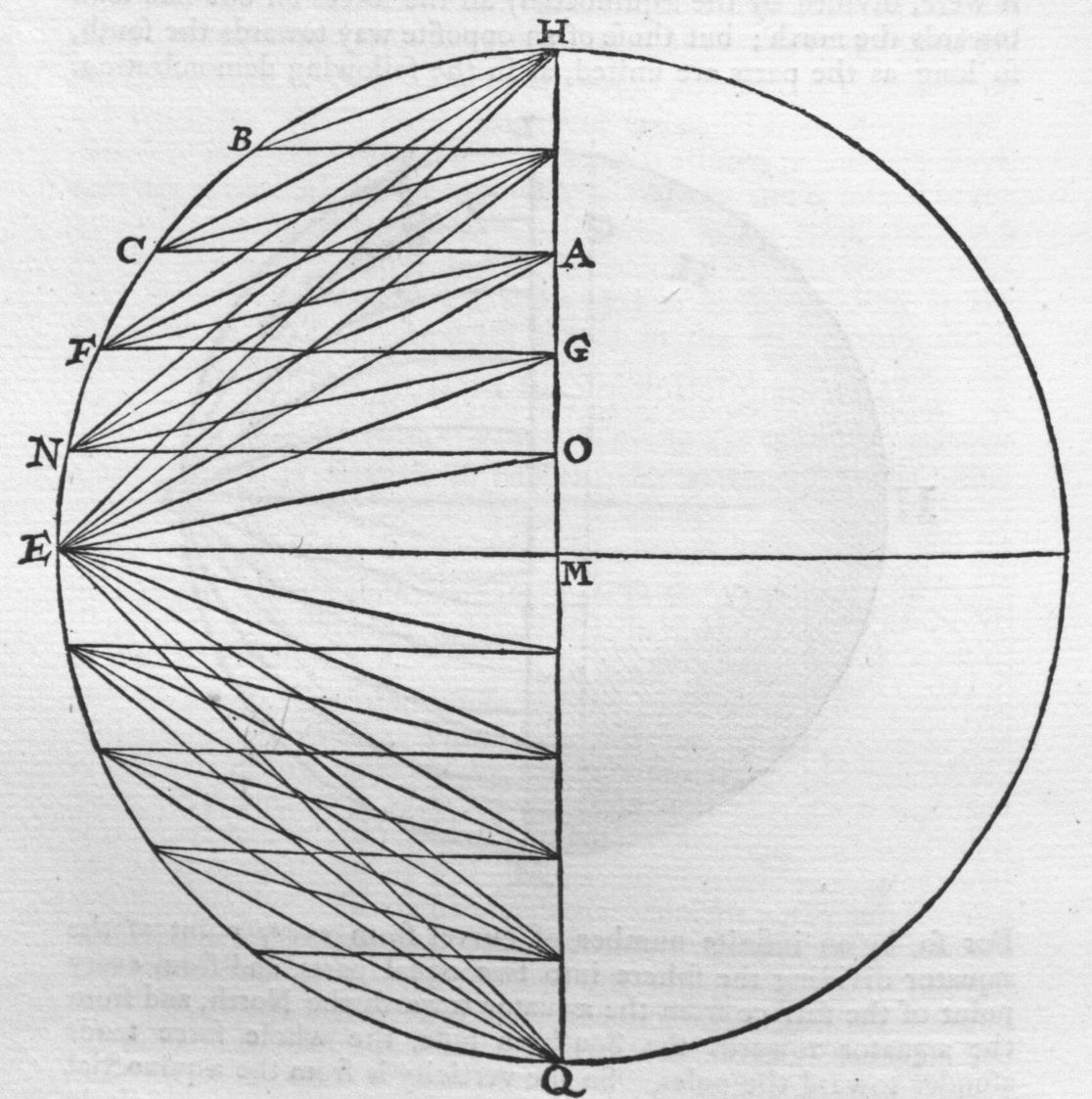
HEQ is a terrella, E a pole, M the centre, HMQ the æquinoctial plane. From every point of the æquinoctial plane vigour extends to the periphery, but by various methods; for from A the formal force is transmitted towards C, F, N, E, and to every point from C up to E, the pole; but not towards B; so neither from G towards C. The power of alluring is not strengthened in the part FHG from that which is in GMFE, but FGH increases the force in the eminence FE. So no force rises from the internal parts, from the lines parallel to the Axis above those parallels, but always inwards from the parallels to the pole. From every point of the plane of the equator force proceeds to the pole E, but the point F has its powers only from GH, and N from OH; but the pole E is strengthened from the whole plane HQ. Wherefore in it the mighty power excels (just as in a palace); but in the intermediate intervals (as in F) only so much force of alluring is exerted as the portion HG of the plane can contribute.
CHAP. VI.
How magnetick pieces of Iron and smaller loadstones conform themselves to a terrella & to the earth itself, and by them are disposed.
oition of those bodies which are divided, and do not naturally cohære, if they are free, occurs through another kind of motion. A terrella sends out in an orbe its powers in proportion to its vigour and quality. But when iron or any other magnetick of convenient magnitude comes within its orbe of virtue, it is allured; but the nearer it comes to the body, the more quickly it runs up to it. They move towards the magnet, not as * to a centre, nor towards its centre. For they only do this in the case of the poles themselves, when namely that which is being allured, and the pole of the loadstone, and its centre, are in the same straight line. But in the intervening spaces they tend obliquely, just as is evident in the following figure, in which it is shown how the influence is extended to the adjoining magneticks within the orbe; in the case of the poles straight out.
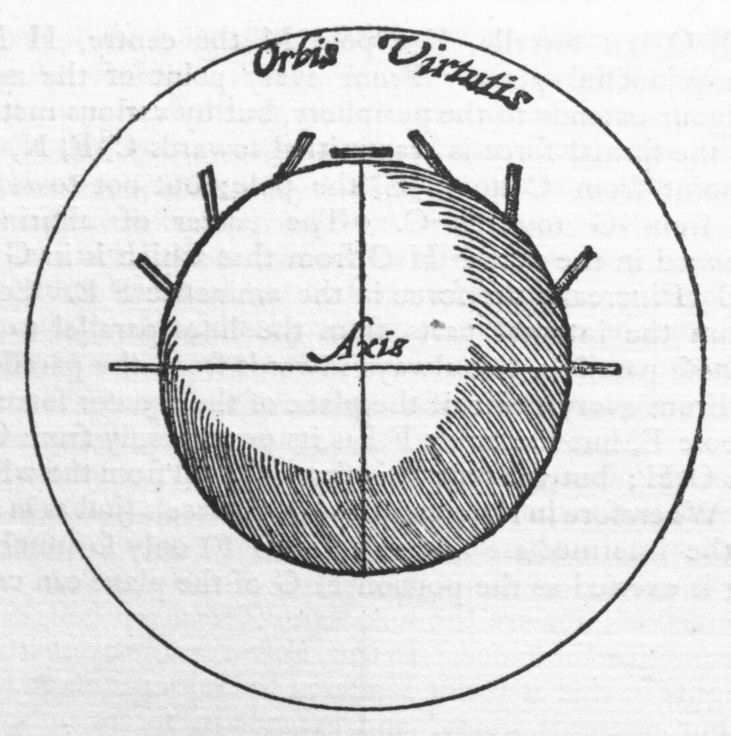
The nearer the parts are to the æquinoctial, the more obliquely are magneticals allured; but the parts nearer the poles appeal more directly, at the poles quite straight. The principle of the turning of all loadstones, of those which are round and those which are long, is the same, but in the case of the long ones the experiment is easier. For in whatever form they are the verticity exists, and there are poles; but on account of bad and unequal form, they are often hindered by certain evils. If the stone were long, the vertex is at the ends, not on the sides; it allures more strongly at the vertex. For the parts bring together stronger forces to the pole in right lines than oblique. So the stone and the earth conform their magnetick motions by their nature.
CHAP. VII.
On the Potency of the Magnetick Virtue, and on its nature capable of spreading out into an orbe.
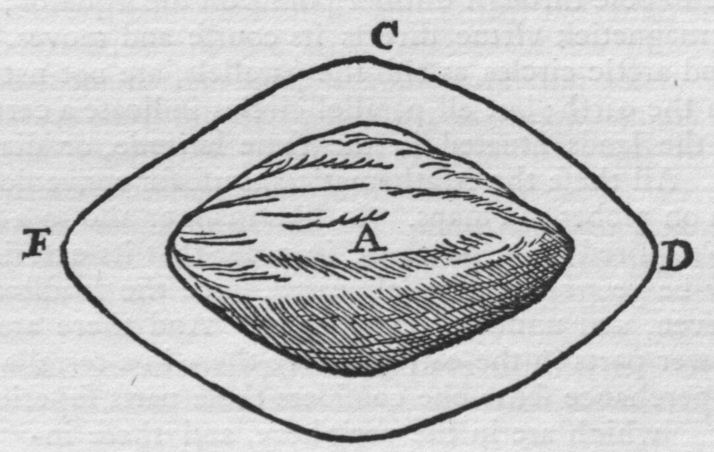
rom about a magnetical body the virtue magnetical is poured out on every side around in an orbe; around a terrella; in the case of other shapes of stones, more confusedly and unevenly. But yet there exists in nature no orbe or permanent or essential virtue spread through the air, but a magnet only excites magneticks at a convenient distance from it. And as light comes in an instant (as the opticians teach), so much more[165] quickly is the magnetick vigour present within the limits of its strength; and because its activity is much more subtile than light, and does not consent with a non-magnetick substance, it has no intercourse with air, water, or any non-magnetick; nor does it move a magnetick with any motion by forces rushing upon it, but being present in an instant, it invites friendly bodies. And as light strikes an object, so a loadstone strikes a magnetick body and excites it. And just as light does not remain in the air above vapours and effluvia, and is not reflected from those spaces, so neither is the magnetick ray held in air or water. The appearances of things are apprehended in an instant in mirrors and in the eye by means of light; so the magnetick virtue seizes upon magneticks. Without the more intangible and shining bodies, the appearances of things are not seized or reflected; so without magnetical objects the magnetick power is not perceived, nor are the forces thus conceived sent back again to the magnetick substance. In this, however, the magnetick power excels light, in that it is not hindered by any opaque or solid substance, but proceeds freely, and extends its forces on every side. In a terrella and globe-shaped loadstone the magnetick power is extended outside the body in an orbe; in a longer one, however, not in an orbe, but it is extended in an ambit conformably to the shape of the stone. As in the somewhat long stone A, the vigour is extended to the ambient limit F C D, equidistant on every side from the stone A.
CHAP. VIII.
On the geography of the Earth, and of the Terrella.
esiring that what follows may be better understood, we must now say something also about magnetick circles and limits. Astronomers, in order to understand and observe methodically the motion of the planets and the revolution of the heavens, and to describe with more accuracy the celestial attire of the fixed stars, settled upon certain circles and definite limits in the sky (which geographers also imitate), so that the varied face of the earth and the beauty of its districts might be delineated. But we, in a way differing from them, recognize those limits and circles, and have found very many fixed by nature, not merely conceived by the imagination, both in the earth and in our terrella. The earth they mark out[166] chiefly by means of the æquator and the poles; and those limits indeed have been arranged and marked out by nature. The meridians also indicate straight paths from pole to pole through distinct points on the æquator; by which way the magnetick virtue directs its course and moves. But the tropics and arctic circles, as also the parallels, are not natural limits placed on the earth; but all parallel circles indicate a certain agreement of the lands situated in the same latitude, or diametrically opposite. All these the Mathematicians use for convenience, painting them on globes and maps. In like manner also in a terrella all these are required; not, however, in order that its exterior appearance may be geographically delineated, since the loadstone may be perfect, even, and uniform on all sides. And there are no upper and lower parts in the earth, nor are there in a terrella; unless perchance some one considers those parts superior which are in the periphery, and those inferior which are situated more towards the centre.
CHAP. IX.
On the Æquinoctial Circle of the Earth and of a Terrella.
As conceived by astronomers the æquinoctial circle is equidistant from both poles, cutting the world in the middle, measures the motions of their primum mobile or tenth sphere, and is named the zone of the primum mobile. It is called æquinoctial, because when the sun stands in it (which must happen twice in the year) the days are equal to the nights. That circle is also spoken of as æquidialis, wherefore it is called by the Greeks ἰσημερινός. In like manner it is also properly called Æquator, because it divides the whole frame of the earth between the poles into equal parts. So also an æquator may be rightly assigned to a terrella, by which its power is naturally divided, and by the plane of which permeating through its centre, the whole globe is divided into equal parts both in quantity and strength (as if by a transverse septum) between verticities on both sides imbued with equal vigour.
CHAP. X.
Magnetick Meridians of the Earth.
eridians have been thought out by the geographer, by means of which he might both distinguish the longitude and measure the latitude of each region. But the magnetick meridians are infinite, running in the same direction also, through fixed and opposite limits on the æquator, and through the poles themselves. On them also the magnetick latitude is measured, and declinations are reckoned from them; and the fixed direction in them tends to the poles, unless it varies from some defect and the magnetick is disturbed from the right way. What is commonly called a magnetick meridian is not really magnetick, nor is it really a meridian, but it is understood to pass through the termini of the variation on the horizon. The variation is a depraved deviation from a meridian, nor is it fixed and constant in various places on any meridian.

CHAP. XI.
Parallels.
n parallel circles the same strength and equal power are perceived everywhere, when various magneticks are placed on one and the same parallel either on the earth or on a terrella. For they are distant from the poles by equal intervals and have equal tendencies of declination, and they are attracted and held, and they come together with like forces; just as those regions which are situated under the same parallel, even if they differ in longitude, yet we say possess the same quantity of daylight and a climate equally tempered.
CHAP. XII.
The Magnetick Horizon.
orizon is the name given to the great circle, separating the things which are seen from those which are not seen; so that a half part of the heaven always is open and easily seen by us, half is always hidden. This seems so to us on account of the great distance of the star-bearing orbe: yet the difference is as great as may arise from the ratio of the semi-diameter of the earth compared with the semi-diameter of the starry heaven, which difference is in fact not perceived by our senses. We maintain, however, that the magnetick horizon is a plane level throughout touching the earth or a terrella in the place of some one region, with which plane the semi-diameter, whether of the earth or of the terrella, produced to the place of the region, makes right angles on every side. Such a plane is to be considered in the earth itself and also in the terrella, for magnetick proofs and demonstrations. For we consider the bodies themselves only, not the general appearances of the world. Therefore not with the idea of outlook (which varies with the elevations of the lands), but taking it as a plane which makes equal angles with the perpendicular, we accept in magnetick demonstrations a sensible horizon or boundary, not that which is called by Astronomers the rational horizon.
CHAP. XIII.
On the Axis and Magnetick Poles.
et the line be called the axis which is drawn in the earth (as in a terrella) through the centre to the poles. They are called πόλοι by the Greeks from πολεῖν, to turn, and by the Latins they are also called Cardines or Vertices; because the world rotates and is perpetually carried around them. We are about to show, indeed, that the earth and a terrella are turned about them by a magnetick influence. One of them in the earth, which looks towards the Cynosure, is called Boreal and Arctic; the other one, opposite to this, is called Austral and Antarctic. Nor do these also exist on the earth or on a terrella for the sake of the turning merely; but they are also limits of direction and position, both as respects destined districts of the world, and also for correct turnings among themselves.
CHAP. XIIII.
Why at the Pole itself the Coition is stronger than in the other parts intermediate between the æquator and the pole; and on the proportion of forces of the coition in various parts of the earth and of the terrella.
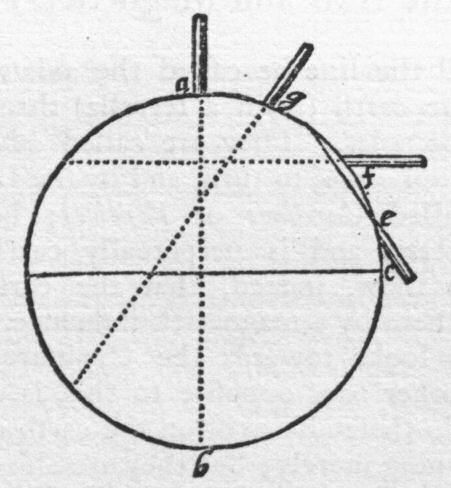
bservation has already been made that the highest power of alluring exists in the pole, and that it is weaker and more languid in the parts adjacent to the æquator. And as this is apparent in the declination, because that disponent and rotational virtue has an augmentation as one proceeds from the Æquator towards the poles: so also the coition of magneticks grows increasingly fresh by the same steps, and in the same proportion. For in the parts more remote from the poles the loadstone does not draw magneticks straight down towards its own viscera; but they tend obliquely and they allure obliquely. For as the smallest chords in a circle differ from the diameter, so much do the forces of attracting differ between themselves in different parts of the terrella. For since attraction is coition towards a body, but magneticks run together by their versatory tendency, it comes about that in the diameter drawn from pole to pole the body appeals directly, but in other places less directly. So the less the magnetick is turned toward the body, the less, and the more feebly, does it approach and adhære. Just as if A B were the poles and a bar of iron or a magnetick fragment C is allured at the part E; yet the end laid hold of does not tend towards the centre of the loadstone, but verges obliquely towards the pole; and a chord drawn from that end obliquely as the attracted body tends is short; therefore it has less vigour and likewise less inclination. But as a greater chord proceeds from a body at F, so its action is stronger; at G still longer; longest at A, the pole (for the diameter is the longest way) to which all the parts from all sides bring assistance, in which is constituted, as it were, the citadel and tribunal of the whole province, not from any worth of its own, but because a force resides in it contributed from all the other parts, just as all the soldiers bring help to their own commander. Wherefore also a slightly longer stone attracts more than a spherical one, since the length from pole to pole is extended, even if the stones are both from the same mine and of the same weight and size. The way from pole to pole is longer in a longer stone, and the forces brought together from other parts are not so scattered as in a round magnet and terrella, and in a narrow one they agree more and are better united, and a united stronger force excels and is preeminent. A much weaker office, however, does a plane or oblong stone perform, when the length is extended according to the leading of the parallels, and the pole stops neither on the apex nor in the circle and orbe, but is spread over the flat. Wherefore also it invites a friend wretchedly, and feebly retains him, so that it is esteemed as one of an abject and contemptible class, according to its less apt and less suitable figure.
CHAP. XV.
*
The Magnetick Virtue which is conceived in Iron is more apparent in an iron rod than in a piece of iron that is round, square, or of other figure.
uly was it said before that the longer magnet attracts the greater weight of iron[167]; so also in a longish piece of iron which has been touched the magnetick force conceived is stronger when the poles exist at the ends. For the magnetick forces which are driven from the whole in every part into the poles are not scattered but united in the narrow ends. In square and other angular figures the influence is dissipated, and does not proceed in straight lines or in convenient arcs. Suppose also an iron globe have the shape of the earth, yet for the same reasons it drags magnetick substances less; wherefore a small iron sphere, when excited, draws another piece of iron more sluggishly than an excited rod of equal weight.
CHAP. XVI.
Showing that Movements take place by the Magnetical Vigour though solid bodies lie between; and on the interposition of iron plates.
loat a piece of iron wire on the surface of water by transfixing it through a suitable cork; or set a versatory piece of iron on a pin or in a seaman's compass (a magnet being brought near or moved about underneath), it is put into a state of motion; neither the water, nor the vessel, nor the compass-box offering resistance in any way. Thick boards do not obstruct[168], nor earthen vessels nor marble vases, nor the metals themselves; nothing is so solid as to carry away or impede the forces excepting an iron plate. Everything which is interposed (even though it is very dense) does not carry away its influence or obstruct its path, or indeed in any way hinder, diminish, or retard it. But all the force is not suppressed by an iron plate, but it is in some measure diverted aside. For when the vigour passes into the middle of an iron plate within the orbe of the magnetick virtue or placed just opposite the pole of the stone, that virtue is scattered in very large measure towards its extremities; so that the edges of a small round * plate of suitable size allure iron wires on every side. This is also apparent in the case of a long iron wand, which, when it has been touched by a magnet in the middle, has a like verticity at either end. *
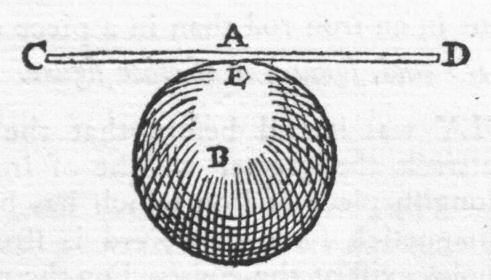
B is a loadstone, C D a long rod magnetized in the middle A; E being the Boreal pole; C is an Austral end or pole; in like manner also the end D is another Austral pole. But observe here the exactness with which a versorium touched by a pole, when a round plate is interposed, turns towards the same pole in the same * way as before the interposition, only weaker; the plate not standing in the way, because the vigour is diverted through the edges of the small plate, and passes out of its straight course, but yet the plate retains in the middle the same verticity, when it is in the neighbourhood of that pole, and close to it; wherefore the versorium tends towards the plate, having been touched by the same pole. If a loadstone is rather weak, a versorium hardly turns when a plate is put in between; for the vigour of the rather weak loadstone, being diffused through the extremities, passes less through the * middle. But if the plate has been touched in this way by a pole in the middle and has been removed from the stone outside its orbe of virtue, then you will see the point of the same versorium tend in the contrary direction and desert the centre of the small plate, which formerly it desired; for outside the orbe of virtue it has an opposite verticity, in the vicinity the same; for in the vicinity it is, as it were, a part of the loadstone, and has the same pole.
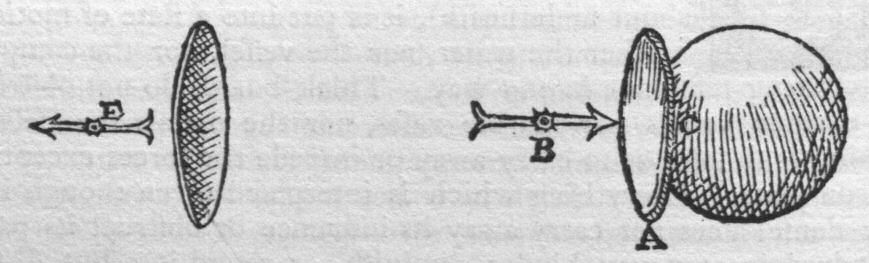
A is an iron plate near the pole, B a versorium which tends with its point towards the centre of the small plate, which has been touched by the pole of the loadstone C. But if the same small plate be placed outside the orbe of magnetick virtue, the point will not turn towards its centre, but the cross E of the same versorium does. But an iron globe interposed (if it is not too large) attracts the * point of the iron on the other side of the stone. For the verticity of that side is the same as that of the adjoining pole of the stone. And this turning of the cusp (that is, of the end touched by that pole) as well as of the cross-end, at a greater distance, takes place with an iron globe interposed, which would not happen at all if * the space were empty, because the magnetick virtue is passed on and continued through magnetick bodies.
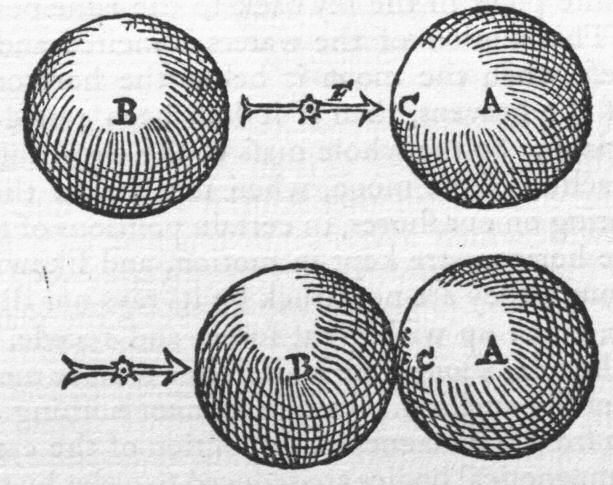
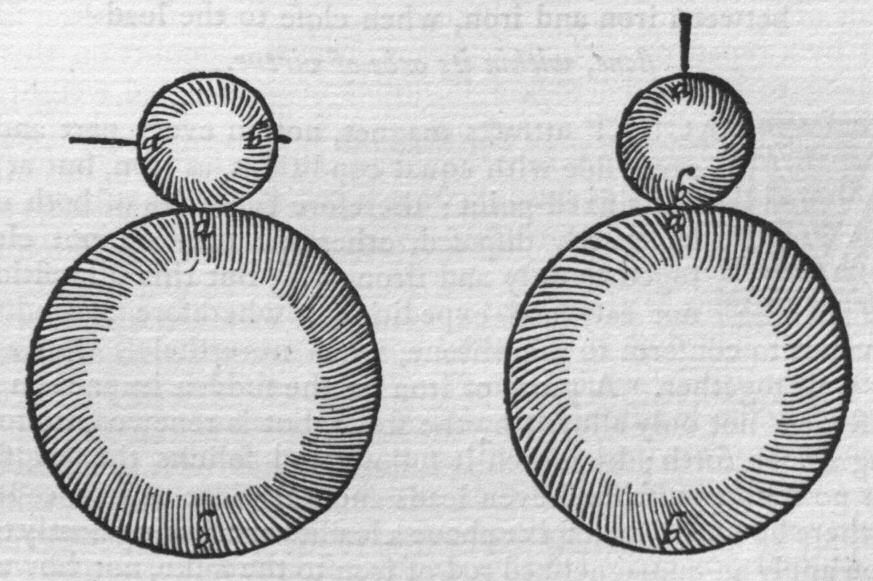
A is a terrella, B an iron globe; between the two bodies is F, a versorium whose point has been excited by the pole C. In the other figure A is a terrella, C its pole, B an iron globe; where the versorium tends towards C, the pole of the terrella, through the iron globe. So a versorium placed between a terrella and an iron globe vibrates more forcibly towards the pole of the terrella; because the loadstone sends an instantaneous verticity into the opposite globe. There is the same efficiency in the earth, produced from the same cause. For if a revolvable needle is shut up in a rather thick gold box (this metal indeed excels all others in density) or a glass or stone box, nevertheless that magnetick needle has its forces connected and united with the influences of the earth, and the iron will turn freely and readily (unhindered by its prison) to its desired points, North and South. * It even does this when shut up in iron caverns, if they are sufficiently spacious. Whatever bodies are produced among us, or are artificially forged from things which are produced, consist of matter of the terrestrial globe; nor do those bodies hinder the prime forces of nature which are derived from their primary form, nor can they resist them except by contrary forms. But no forms of mixed bodies are inimical to the primary implanted earth-nature, although some often do not agree[169] with one another. But in the case of all those substances which have a material cause for their inclining (as amber, jet, sulphur), their action is impeded by the interposition of a body (as paper, leaves, glass, or the like) when that way is impeded and obstructed, so that that which exhales[170] cannot reach the corpuscle to be allured. Terrestrial and magnetick coition and motion, when corporeal impediments are interposed, is demonstrated also by the efficiencies of other chief bodies due to their primary form. The moon (more than all the stars) agrees with internal parts of the earth on account of its nearness and similarity in form. The moon produces the movements of the waters and the tides of the sea; twice it fills up the shores and empties them whilst it moves from a certain definite point in the sky back to the same point in a daily revolution. This motion of the waters is incited and the seas rise and fall no less when the moon is below the horizon and in the lowest part of the heavens, than if it had been raised at a height above the horizon. So the whole mass of the earth interposed[171] does not resist the action of the moon, when it is below the earth; but the seas bordering on our shores, in certain positions of the sky when it is below the horizon, are kept in motion, and likewise stirred by its power (though they are not struck by its rays nor illuminated by its light), rise, come up with great force, and recede. But about the reason of the tides anon[172]; here let it suffice to have merely touched the threshold of the question. In like manner nothing on the earth can be hidden from the magnetick disposition of the earth or of the stone, and all magnetical bodies are reduced to order by the dominant form of the earth, and loadstone and iron show sympathy with a loadstone though solid bodies be interposed.
CHAP. XVII.
On the Iron Cap of a Loadstone, with which it is armed at the pole (for the sake of the virtue) and on the efficacy of the same.
onceive a small round plate, concave in shape, of the breadth of a digit to be applied to the convex polar surface of a loadstone and skilfully attached; or a piece of iron shaped like an acorn, rising from the base into an obtuse cone, hollowed out a little and fitted to the surface of the stone, to be tied to the loadstone. Let the iron be the best steel, smoothed, shining, and even. A loadstone with such an appliance, which before only bore four ounces of iron, will now raise twelve. But the greatest force of a combining or rather united nature is seen when two loadstones, armed with iron caps, are so joined by their concurrent (commonly called contrary) ends, that they mutually * attract and raise one another. In this way a weight of twenty ounces is raised, when either stone unarmed would only allure four ounces of iron. Iron unites to an armed loadstone more firmly than to a loadstone; and on that account raises greater weights, because the pieces of iron stick more pertinaciously to one that is armed. For by the near presence of the magnet they are cemented together, and since the armature[173] conceives a magnetick vigour from its presence and the other conjoined piece of iron is at the same time endued with vigour from the presence of the loadstone, they are firmly bound together. Therefore by the mutual contact of strong pieces of iron, the cohesion is strong. Which thing is also made clear and is exhibited by means of rods sticking together, Bk. 3, chap 4[174]; and also when the question of the concretion of iron dust into a united body was discussed. For this reason a piece of iron set near a loadstone draws away any suitable piece of iron from the loadstone, if only it touch the iron; otherwise it does not snatch it away, though in closest proximity. For magnetick pieces of iron within the orbe of virtue, or near a loadstone, do not rush together with a greater endeavour[175] than the iron and the magnet; but joined they are united more strongly and, as it were, cemented together, though the substance remain the same with the same forces acting.
CHAP. XVIII.
An armed Loadstone does not endow an excited piece of Iron with greater vigour than an unarmed.
uppose there are two pieces of iron, one of * which has been excited by an armed loadstone, the other by one unarmed; and let there be applied to one of them another piece of iron of a weight just proportional to its strength, it is manifest that the remaining one in like manner raises the same and no more. Magnetick versoria also touched by an armed loadstone turn with the same velocity and constancy towards the poles of the earth as those magnetized by the same loadstone unarmed.
CHAP. XIX.
Union with an armed Loadstone is stronger; hence greater weights are raised; but the coition is not stronger[176], but generally weaker.
n armed magnet raises a greater weight, as is manifest to all; but a piece of iron moves towards a stone at an equal, or rather greater, distance when it * is bare, without an iron cap. This must be tried with two pieces of iron of the same weight and figure at an equal distance, or with one and the same versorium, the test being made first with an armed, then with an unarmed loadstone, at equal distances.
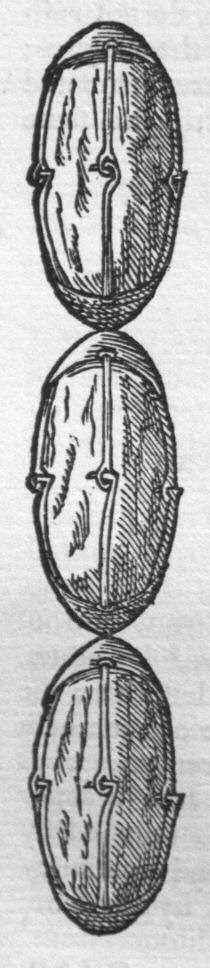
CHAP. XX.
*
An armed Loadstone raises an armed Loadstone, which also attracts a third; which likewise happens, though the virtue in the first be somewhat small.
agnets armed cohære firmly when duly joined, and accord into one; and though the first be rather weak, yet the second one adhæres to it not only by the strength of the first, but of the second, which mutually give helping hands; also to the second a third often adheres and in the case of robust stones, a fourth to the third.
CHAP. XXI.
*
If Paper or any other Medium be interposed, an armed loadstone raises no more than an unarmed one.
bservation has shown above that an armed loadstone does not attract at a greater distance than an unarmed one; yet raises iron in greater quantity, if it is joined to and made continuous with the iron. But if Paper be placed between, that intimate cohæsion of the metal is hindered, nor are the metals cemented together at the same time by the operation of the magnet.

CHAP. XXII.
*
That an armed Loadstone draws Iron no more than an unarmed one: And that an armed one is more strongly united to iron is shown by means of an armed loadstone and a polished cylinder of iron.
f a cylinder be lying on a level surface, of too great a weight for an unarmed loadstone to lift, and (a piece of paper being interposed) if the pole of an armed loadstone be joined to the middle of it; if the cylinder were drawn from there by the loadstone, it would follow rolling; but if no medium were interposed, the cylinder would be drawn along firmly united with the armed loadstone, and in no wise rolling. But if the same loadstone be unarmed, it will draw the cylinder rolling with the same speed as the armed loadstone with the paper between or when it was wrapped in paper.
Armed loadstones of diverse weights, of the same ore vigour * and form, cling and hang to pieces of iron of a convenient size and proportionate figure with an equal proportion of strength. The same is apparent in the case of unarmed stones. A suitable piece * of iron being applied to the lower part of a loadstone, which is * hanging from a magnetick body, excites its vigour, so that the loadstone hangs on more firmly. For a pendent loadstone clings more firmly to a magnetick body joined to it above with a hanging piece of iron added to it, than when lead or any other non-magnetick body is hung on.
A loadstone, whether armed or unarmed, * joined by its proper pole to the pole of another loadstone, armed or unarmed, makes the loadstone raise a greater weight by the opposite end[177]. A piece of iron also applied to the pole of a magnet produces the same result, namely, that the other pole will carry a greater weight of iron; just as a loadstone with a piece of iron superposed on it (as in this figure) holds up a piece of iron below, which it cannot hold, if the upper one be removed. * Magneticks in conjunction make one magnetick. Wherefore as the mass increases, the magnetick vigour is also augmented.
An armed loadstone, as well as an unarmed * one, runs more readily to a larger piece of iron and combines more firmly with a larger piece than with a lesser one.
CHAP. XXIII.
Magnetick Force causes motion towards unity, and binds firmly together bodies which are united.
agnetick fragments cohære within their strength well and harmoniously together. Pieces of iron in the presence of a loadstone (even if they are not * touching the loadstone) run together, seek one another anxiously and embrace one another, and when joined are as if they were cemented. Iron * filings or the same reduced to powder inserted in paper tubes, placed upon a stone meridionally or merely brought rather close to it, coalesce into one body, and so many parts suddenly are concreted * and combine; and the whole company of corpuscles thus conspiring together affects another piece of iron and attracts it, as if it constituted one integral rod of iron; and above the stone it is directed toward the North and South. But when they are removed a long * way from the stone, the particles (as if loosed again) are separated and move apart singly. In this way also the foundations of the world are connected and joined and cemented together magnetically. So let Ptolemy of Alexandria, and his followers, and those philosophers of ours, be the less terrified if the earth do move round in a circle, nor threaten its dissolution.
Iron filings, after being heated for a long time, are attracted by a loadstone, yet not so strongly or from so great a distance as when not heated. A loadstone loses some of its virtue by too great a heat; for its humour is set free, whence its peculiar nature is marred. Likewise also, if iron filings are well burnt in a reverberatory furnace and converted into saffron of Mars, they are not attracted by a loadstone; but if they are heated, but not thoroughly burnt, they do stick to a magnet, but less strongly than the filings themselves not acted upon by fire. For the saffron has become totally deformate, but the heated metal acquires a defect from the fire, and the forces in the enfeebled body are less excited by a loadstone; and, the nature of the iron being now ruined, it is not attracted by a loadstone.
CHAP. XXIIII.
A piece of Iron placed within the Orbe of a Loadstone hangs suspended in the air, if on account of some impediment it cannot approach it.
ithin the magnetick orbe a piece of iron moves towards the more powerful points of the stone, if it be not hindered by force or by the material of a body placed between them; either it falls down from above, or tends sideways or obliquely, or flies up above. But if the iron cannot reach the stone on account of some obstacle, it cleaves to it and remains there, but with a less firm and constant connection, since at greater intervals or distances the alliance is less amicable. Fracastorio, in the eighth chapter of his De Sympathia, says that a piece of iron is suspended in the air, so that it can be moved neither up nor down, if a loadstone be placed above which is able to draw the iron up just as much as the iron itself inclines downwards with equal force; for thus the iron would be supported in the air: which thing is absurd; because the force of a magnet is always the stronger the nearer it is. So that when a piece of iron is raised a very little from the earth by the force of the magnet, it needs must be drawn steadily on towards the magnet (if nothing else come in the way) and cleave to it. Baptista Porta suspends a piece of iron in the air[178] (a magnet being fixed above), and, by no very subtile process, the iron is detained by a slender thread from its lower part, so that it cannot rise up to the stone. The iron is raised upright by the magnet, although the magnet does not * touch the iron, but because it is in its vicinity; but when the whole iron on account of its greater nearness is moved by that which erected it, immediately it hurries with a swift motion to the magnet and cleaves to it. For by approaching the iron is more and more excited, and the coition grows stronger.
CHAP. XXV.
Exaltation of the power of the Magnet.
ne loadstone far surpasses another in power, since one draws iron of almost its own weight, another can hardly stir some shreds. Whatever things, whether animals or plants, are endowed with life need some sort of nourishment, by which their strength not only persists but grows firmer and more vigorous. But iron is not, as it seemed to Cardan and to Alexander Aphrodiseus, attracted by the loadstone in order that it may feed on shreds of it, nor does the loadstone take up vigour from iron filings as if by a repast on victuals. Since Porta had doubts on this and resolved to test it, he took a loadstone of ascertained weight, and buried it in iron filings of not unknown weight; and when he had left it there for many months, he found the stone of greater weight, the filings of less. But the difference was so slender that he was even then doubtful as to the truth. What was done by him does not convict the stone of voracity, nor does it show any nutrition; for minute portions of the filings are easily scattered in handling. So also a very fine dust is insensibly born on a loadstone in some very slight quantity, by which something might have been added to the weight of the loadstone but which is only a surface accretion and might even be wiped off with no great difficulty. Some think that a weak and sluggish stone can bring itself back into better condition, and that a very powerful one also might present it with the highest powers. Do they acquire strength like animals when they eat and are sated? Is the medicine prepared by addition or subtraction? Is there anything which can re-create this primary form or bestow it anew? And, certes, nothing can do this which is not magnetical. Magneticks can restore a certain soundness to magneticks (when not incurable); some can even exalt them beyond their proper strength; but when a body is at the height of perfection in its own nature, it is not capable of being strengthened further. So that that imposture of Paracelsus, who affirms that the force and virtue can be increased and transmuted tenfold, turns out to be the more infamous. The method of effecting this is as follows, viz., you make it semi-incandescent in a fire of charcoal (that is, you heat it very hot), so that it does not become red-hot, however, and immediately slake it, as much indeed as it can imbibe, in oil of saffron of Mars, made from the best Carynthian steel. "In this way you will be able so to strengthen a loadstone that it can draw a nail out of a wall and accomplish many other like wonderful things, which are not possible for a common loadstone." But a loadstone thus slaked in oil not only does not gain power, but suffers also a certain loss of its inborn strength. A loadstone is improved if polished and rubbed with steel. Buried in filings of the best iron or of pure steel, not rusty, it preserves its strength. Sometimes also a somewhat good and strong one gains some strength when it is rubbed on the pole of another, on the opposite part, and receives virtue. In all these experiments it is an advantage to observe the pole of the earth, and to adjust according to magnetick laws the stone which we wish to strengthen; which we shall set forth below. A somewhat powerful and fairly large loadstone increases the strength of a loadstone as it does of iron. A loadstone being placed over the boreal pole of a loadstone, * the boreal pole becomes stronger, and an iron rod (like an arrow) sticks to the boreal pole A, but not at all to the pole B. The pole A also, when it is at the top in a right line with the axis of both loadstones joined in accordance with magnetick laws, raises the rod to the perpendicular, which it cannot do if the large loadstone be removed, on account of its own weaker strength. But as a small iron globe, when placed above the pole of a terrella, raises the rod to the * perpendicular, so, when placed at the side, the rod is not directed towards the centre of the globe, but is raised obliquely and cleaves anywhere, because the pole in a round piece of iron is always the point which is joined most closely to the pole of the terrella and is not constant as in a smaller terrella. The parts of the earth, as of all magneticks, are in agreement and take delight in their mutual proximity; if placed in the highest power, they do not harm their inferiors, nor slight them; there is a mutual love among them all, a perennial good feeling. The weaker loadstones are re-created by the more powerful, and the less powerful cause no harm to the stronger. But a powerful one attracts and turns a somewhat strong one more than it does an impotent one. Because a strenuous one confers a stronger activity, and itself hastens, flies up to the other, and solicits it more keenly; therefore there is a more certain and a stronger co-action and cohærency.
CHAP. XXVI.
Why there should appear to be a greater love between iron and loadstone, than between loadstone and loadstone, or between iron and iron, when close to the loadstone, within its orbe of virtue.
agnet attracts magnet, not in every part and on every side with equal conditions, as iron, but at one and a fixed point; therefore the poles of both must be exactly disposed, otherwise they do not cleave together duly and strongly. But this disposition is not easy and expeditious; wherefore a loadstone seems not to conform to a loadstone, when nevertheless they agree very well together. A piece of iron by the sudden impression of a loadstone is not only allured by the stone, but is renewed, its forces being drawn forth; by which it follows and solicits the loadstone with no less impulse, and even leads another piece of iron captive. Let there be a small iron spike above a loadstone clinging firmly to it; if you apply an unmagnetized rod of iron to the spike, not, however, so that it touches the stone, you will see the spike when it has touched the iron, leaving the loadstone, follow the rod, try to grasp it by leaning toward it, and (if it should touch it) cleave firmly to it: for a piece of iron, when united and joined to another piece of iron placed within the orbe of virtue of the loadstone, draws it more strongly than does the loadstone itself. The natural magnetick virtue, confused and dormant in the iron, is aroused by the loadstone, is linked to the loadstone, and rejoices with it in its primary form; then smelted iron becomes a perfect magnetick, as robust as the loadstone itself. For as the one imparts and stirs, so the other conceives, and being stirred remains in virtue, and pours back the forces also by its own activity. But since iron is more like iron than loadstone, and the virtue in both pieces of iron is exalted by the proximity of the loadstone, so in the loadstone itself, in case of equal strength, likeness of substance prevails, and iron gives itself up rather to iron, and they are united by their very similar homogenic powers. Which thing happens not so much from a coition, as from a firmer unition; and a knob or snout of steel, fixed skilfully on the pole of the stone, raises greater weights of iron than the stone of itself could. When steel or iron is smelted from loadstone or iron ore, the slag and corrupt substances are separated from the better by the fusion of the material; whence (in very large measure) that iron contains the nature of the earth, purified from alien flaw and blemish, and more homogenic and perfect, though deformed by the fusion. And when that material indeed is provoked by a loadstone, it conceives the magnetick virtues, and within their orbe is raised in strength more than the weaker loadstone, which with us is often not free from some admixture of impurities.
CHAP. XXVII.
*
The Centre of the Magnetick Virtues in the earth is the centre of the earth; and in a terrella is the centre of the stone.
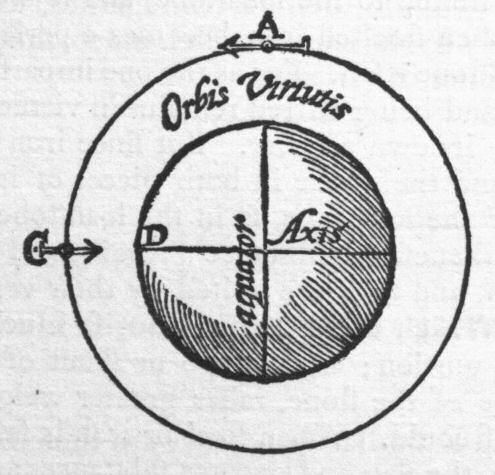
ays of magnetick virtue spread out in every direction in an orbe; the centre of this orbe is not at the pole (as Baptista Porta reckons, Chap. 22), but in the centre of the stone and of the terrella. So also the centre of the earth is the centre of the magnetick motions of the earth; though magneticks are not borne directly toward the centre by magnetical motion, except when they are attracted by the true pole. For since the formal power of the stone and of the earth does not promote anything but the unity and conformity of disjoined bodies, it comes about that everywhere at an equal distance from the centre or from the circumference, just as it seems to attract perpendicularly at one place, so at another it is able even to dispose and to turn, provided the stone is not uneven in virtue. For if at the distance C from the pole D the stone is able to allure a versorium, * at an equally long interval above the æquator at A that stone can also direct and turn the versorium. So the very centre and middle of the terrella is the centre of its virtue, and from this to the circumference of the orbe (at equal intervals on every side) its magnetick virtues are emitted.
CHAP. XXVIII.
A Loadstone attracts magneticks not only to a fixed point or pole, but to every part of a terrella save the æquinoctial zone.
oitions are always more powerful when poles are near poles, since in them by the concordancy of the whole there exists a stronger force; wherefore the one embraces the other more strongly. Places declining from the poles have attractive forces, but a little weaker and languid in the ratio of their distance; so that at length on the æquinoctial circle they are utterly enervated and evanescent. Neither do even the poles attract as mathematical points; nor do magneticks come into conjunction by their own poles, only on the poles of a loadstone. But coition is made on every part of the periphery, both Northern and Southern, by virtue emanating from the whole body; magneticks nevertheless incline languidly towards magneticks in the parts bordering on the æquator, but quickly in places nearer the pole. Wherefore not the poles, not the parts alone nearest to the pole allure and invite magneticks, but magneticks are disposed and turned round and combine with magneticks in proportion as the parts facing and adjoined unite their forces together, which are always of the same potency in the same parallel, unless they are distributed otherwise from causes of variation.
CHAP. XXIX.
On Variety of Strength due to Quantity or Mass.
uite similar in potency are those stones which are of the same mine, and not corrupted by adjacent ores or veins. Nevertheless that which excels in size shows greater powers, since it seizes greater weights and has a wider orbe of virtue. For a loadstone weighing one ounce does not lift a large nail as does one weighing a pound, nor does it rule so widely, nor extend its forces; and if from a loadstone of a pound weight a portion is taken away, something of its power will be seen to go also; for when a portion is abstracted the virtue is lessened. But if that part is properly applied and united to it, though it is not fastened * to nor grown into it, yet by the application it obtains its pristine power and its vigour returns. Sometimes, however, when a part is taken away, the virtue turns out to be stronger on account of the * bad shape of the stone, namely, when the vigour is scattered through inconvenient angles. In various species the ratio is various, for one stone of a drachm weight draws more than another of twenty pounds. Since in very many the influence is so effete that it can hardly be perceived, those weak stones are surpassed by prepared pieces of clay. But, it may be asked[179], if a stone of the same species and goodness weighing a drachm would seize upon a drachm of iron, would a stone of an ounce weight seize on an ounce, a pound on a pound, and so on? And this is indeed true; for it both strains and remits its strength proportionately, so that if a loadstone, one drachm of which would attract one drachm of iron, were in equal proportion applied either to a suitably large obelisk or to an immense pyramid of iron, it would lift it directly in such proportion and would draw it towards itself with no greater effort of its nature or trouble than a loadstone of a drachm weight embraces a drachm. But in all such experiments as this let the vigour of the magnets be equal; let there be also a just proportion in all of the shapes of the stones, and let the shape of the iron to be attracted be the same, and the goodness of the metal, and let the position of the poles of the loadstones be most exact. This is also no less true in the case of an armed loadstone than of an unarmed one. For the sake of experiment, let there be given a loadstone of eight ounces weight, which when armed lifts twelve ounces of iron; if you cut off from that loadstone a certain portion, which when it has been * reduced to the shape of the former whole one is then only of two ounces, such a loadstone armed lifts a piece of iron applied to it of three ounces, in proportion to the mass. In this experiment also the piece of iron of three ounces ought to have the same shape as the former one of twelve ounces; if that rose up into a cone, it is necessary that this also in the ratio of its mass should be given a pyramidal shape proportioned to the former.
CHAP. XXX.
The Shape and Mass of the Iron are of most importance in coition.
bservation has shown above that the shape and mass of the loadstone have great influence in magnetick coitions; likewise also the shape and mass of the iron bodies give back more powerful and steady forces. Oblong iron rods are both drawn more quickly to a loadstone and cleave to it with greater obstinacy than round or square pieces, for the same reasons which we have proven in the case of the loadstone. But, moreover, this is also worthy of observation, that a smaller piece of iron, to which is hung a weight of another material, so that it is altogether in weight equal to another large whole piece of iron of a right weight * (as regards the strength of the loadstone), is not lifted by the loadstone as the larger piece of iron would be. For a smaller piece of iron does not join with a loadstone so firmly, because it sends back less strength, and only that which is magnetick conceives strength; the foreign material hung on cannot acquire magnetick forces.
CHAP. XXXI.
On Long and Round Stones.
ieces of iron join more firmly with a long stone than with a round one, provided that the pole of the stone is at the extremity and end of its length; because, forsooth, in the case of a long stone, a magnetick is directed at the end straight towards the body in which the virtue proceeds in straighter lines and through the longer diameter. But a somewhat long stone has but little power on the side, much less indeed than a round one. It is demonstrable[180], indeed, that at A and B the coition is * stronger in a round stone than at C and D, at like distances from the pole.
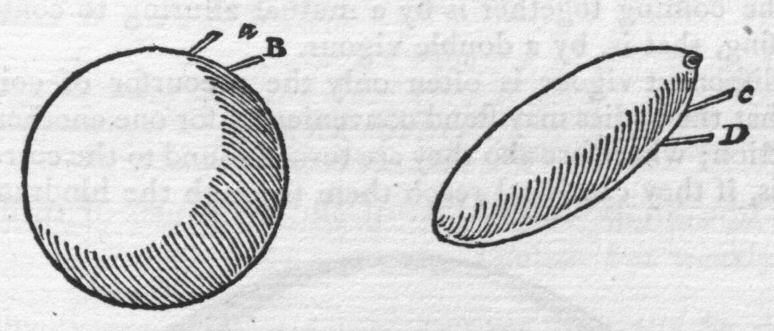
CHAP. XXXII.
Certain Problems and Magnetick Experiments about the Coition, and Separation, and regular Motion of bodies magnetical.
qual loadstones come together with equal incitation. *
Also magnetick bodies of iron, if alike in all respects, * come together when excited with similar incitation.
Furthermore, bodies of iron not excited by a * loadstone, if they are alike and not weighed down by their bulk, move towards one another with equal motion.
Two loadstones, disposed on the surface of some water in suitable skiffs, if they are drawn up suitably within their orbes of virtue, incite one another mutually to an embrace. So a proportionate * piece of iron in one skiff hurries with the same speed towards the loadstone as the loadstone itself in its boat strives towards the iron. From their own positions, indeed, they are so borne together, that they are joined and come to rest at length in the middle of the space. Two iron wires magnetically excited, floating in water by means of * suitable pieces of cork, strive to touch and mutually strike one another with their corresponding ends, and are conjoined.
Coition is firmer and swifter than repulsion and separation in * equal magnetick substances. That magnetick substances are more sluggishly repelled than they are attracted is manifest in all magnetical experiments in the case of stones floating on water in suitable skiffs; also in the case of iron wires or rods swimming (transfixed through corks) and well excited by a loadstone, and in the case of versoria. This comes about because, though there is one faculty of coition, another of conformation or disposition, repulsion and aversion is caused merely by something disposing; on the other hand, the coming together is by a mutual alluring to contact and a disposing, that is, by a double vigour.
A disponent vigour is often only the precursor of coition, in order that the bodies may stand conveniently for one another before conjunction; wherefore also they are turned round to the corresponding ends, if they can [not][181] reach them through the hindrances.
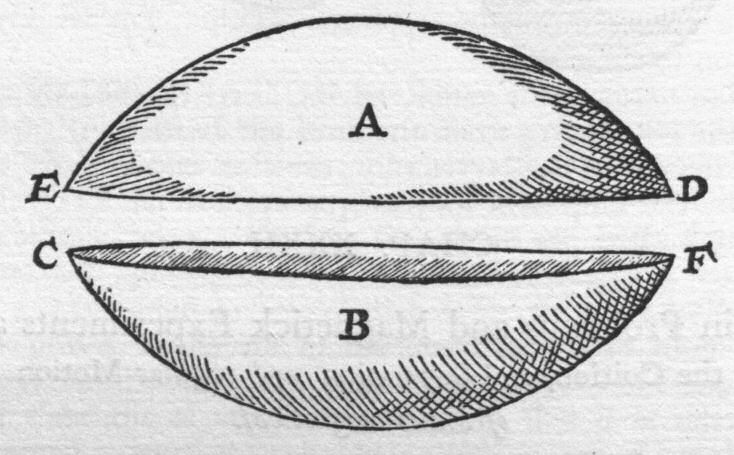
If a loadstone be divided through a meridian into two equal parts, the separate parts mutually repel one another, the poles being * placed directly opposite one another at a convenient and equal distance. They repel one another also with a greater velocity than when pole is put opposite pole incongruously. Just as the part B of the loadstone, placed almost opposite the part A, repels it floating in its skiff, because D turns away from F, and E from C; but if B is exactly joined with A again, they agree and become one body magnetical; but in proximity they raise enmities. But if one part of the stone is turned round, so that C faces D and F faces E, then A pursues B within its orbe until they are united.
The Southern parts of the stone avoid the Southern parts, and the Northern parts the Northern. Nevertheless, if by force you move up the Southern cusp of a piece of iron too near the Southern part of the stone, the cusp is seized and both are linked together in friendly embraces: because it immediately reverses the implanted verticity of the iron, and it is changed by the presence of the more powerful stone, which is more constant in its forces than the iron. For they come together according to their nature, if by reversal and mutation true conformity is produced, and just coition, as also regular direction. Loadstones of the same shape, size, and vigour, attract one another mutually with like efficacy, and in the opposite position repel one another mutually with a like vigour.
Iron rods not touched, though alike and equal, do yet often act * upon one another with different forces; because as the reasons of their acquired verticity, also of their stability and vigour, are different, so the more strongly they are excited, the more vigorously do they incite.
Pieces of iron excited by one and the same pole mutually repel * one another by those ends at which they were excited; then also the opposite ends to those in these iron pieces raise enmities one to another.
In versoria whose cusps have been rubbed, but not their cross-ends, * the crosses mutually repel one another, but weakly and in proportion to their length.
In like versoria the cusps, having been touched by the same * pole of the loadstone, attract the cross-ends with equal strength.
In a somewhat long versorium the cross-end is attracted rather * weakly by the cusp of a shorter iron versorium; the cross of the shorter more strongly by the cusp of the longer, because the cross of the longer versorium has a weak verticity, but the cusp has a stronger.
The cusp of a longer versorium drives away the cusp of a * shorter one more vehemently than the cusp of the shorter the cusp of the longer, if the one is free upon a pin, and the other is held in the hand; for though both were equally excited by the same loadstone, yet the longer one is stronger at its cusp on account of its greater mass.
The Southern end of an iron rod which is not excited attracts * the Northern, and the Northern the Southern; moreover, also the Southern parts repel the Southern, and the Northern the Northern.
If magnetick substances are divided or in any way broken in pieces, each part has a Northern and a Southern end.
A versorium is moved as far off by a loadstone when an obstacle * is put in the way, as through air and an open medium.
Rods rubbed upon the pole of a stone strive after the same pole * and follow it. Therefore Baptista Porta errs when he says, chapter 40[182], "If you put that part to it from which it received its force, it will not endure it, but drives it from it, and draws to it the contrary and opposite part."
The principles of turning round and inclining are the same in the case of loadstone to loadstone, of loadstone to iron, of iron also to iron.
When magnetick substances which have been separated by force and dissected into parts flow together into a true union and are suitably connected, the body becomes one, and one united virtue, nor have they diverse ends.
The separate parts assume two opposite poles, if the division has * not been made along a parallel: if the division has been made along a parallel, they are able to retain one pole in the same site as before.
Pieces of iron which have been rubbed and excited by a loadstone are more surely and swiftly seized by a loadstone at fitting ends than such as have not been rubbed.
If a spike is set up on the pole of a loadstone, a spike or style * of iron placed on the upper end is strongly cemented to it, and draws away the erect spike from the terrella when motion is made.
If to the lower end of the erect spike the end of another spike * is applied, it does not cohære with it, nor do they unite together.
As a rod of iron draws away a piece of iron from a terrella, so is it also with a minute loadstone and a lesser terrella, though weaker in strength.
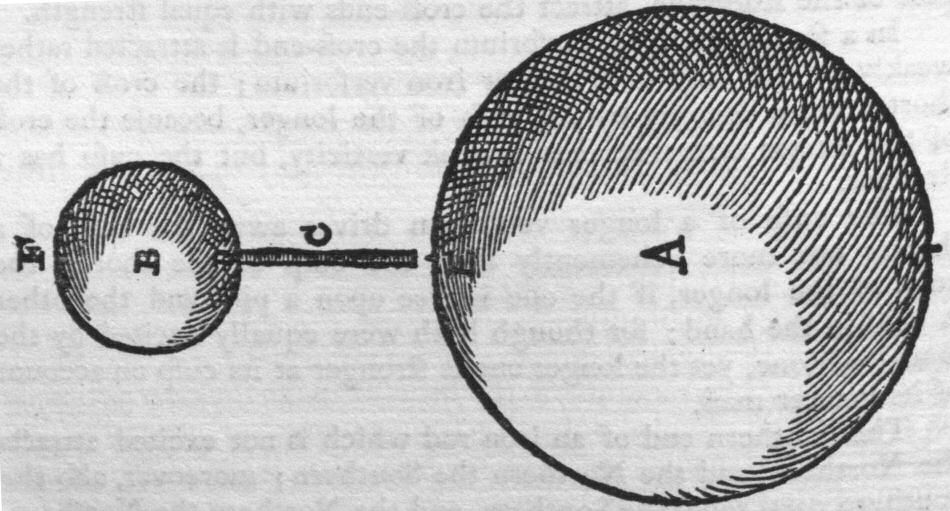
The piece of iron C comes into conjunction with the terrella A, and the vigour in it is magnetically exalted and excited, both in the adjoining end and in the other also which is turned away through its conjunction with the terrella. The end that is turned away also conceives vigour from the loadstone B; likewise the pole D of that loadstone is powerful on account of its suitable aspect and the nearness of the pole E of the terrella. Several causes therefore concur why the piece of iron C should cleave to the terrella B, to which it is joined more firmly than to the terrella A; the vigour excited in the rod, the vigour also excited in the stone B, and the strength implanted in B concur; therefore D is more firmly cemented magnetically with C than E with C.
But if you were to turn the vertex F round to the iron C, C would not adhære to F as formerly to D; for stones so arranged being within the orbe of virtue are placed contrary to natural order; wherefore F does not receive power from E.
Two loadstones or excited pieces of iron, duly cohæring, fly * asunder on the approach of another more powerful loadstone or magnetized piece of iron. Because the new-comer repels the other with its opposing face, and dominates it, and ends the relationship of the two which were formerly joined. So the forces of the other are lessened and succumb; but if it conveniently could, being diverted of its association with the weaker, and rolling round, it would turn about to the stronger. Wherefore also magnetick bodies suspended in the air fall when a loadstone is brought near them with an opposing face, not (as Baptista Porta teaches) because the faculty of both those which were joined before grows faint and torpid, for no face can be hostile to both the ends which cohære, but to one only; and when the stronger loadstone, coming fresh with opposing face, impels this further from it, it is put to flight by the friendly reception of the former.
CHAP. XXXIII.
On the Varying Ratio of Strength, and of the Motion of coition, within the orbe of virtue.
hould a very large weight, which at a very small distance is drawn towards a loadstone, be divided into ever so many equal parts, and should the radius of the orbe of magnetick attraction be divided into the same number of parts, the like named parts of the weight will correspond to the intermediate parts of the radius.
The orbe of virtue extends more widely than the orbe of motion of any magnetick; for the magnetick is affected at its extremity, even if it is not moved with local motion, which effect is produced by the loadstone being brought nearer. A small versorium also is turned when a good distance off, even if at the same distance it would not flow towards the loadstone, though free and disengaged from impediment.
The swiftness of the motion of a magnetick body to a loadstone is dependent on either the power of the loadstone, on its mass, on its shape, on the medium, or on its distance within the magnetick orbe.
A magnetick moves more quickly towards a more powerful * stone than towards a sluggish one in proportion to the strength, and [as appears] by a comparison of the loadstones together. A lesser mass of iron also is carried more quickly towards a loadstone, just as also one that is a little longer in shape. The swiftness of magnetick motion towards a loadstone is changed by reason of the medium; for bodies are moved more quickly in air than in water, and in clear air than in air that is thick and cloudy.
By reason of the distance, the motion is quicker in the case of bodies near together than when they are far off. At the limits of the orbe of virtue of a terrella a magnetick is moved feebly and slowly. At very short distances close to the terrella the moving impetus is greatest.
A loadstone which in the outmost part of its orbe of virtue * hardly moves a versorium when one foot removed from it, doth, if a long piece of iron is joined to it, attract and repel the versorium more strongly with its opposite poles when even three feet distant. The result is the same whether the loadstone is armed or unarmed. Let the iron be a suitable piece of the thickness of the little finger.
For the vigour of the loadstone excites verticity in the iron and proceeds in the iron and through the iron much further than it extends through the air.
The vigour proceeds even through several pieces of iron (joined * to one another end to end), not so regularly, however, as through one continuous solid.
Dust of steel placed upon paper rises up when a loadstone is moved near above it in a sort of steely hairiness; but if the loadstone is placed below, such a hairiness is likewise raised.
Steel dust (when the pole of a loadstone is placed near) is cemented * into one body; but when it desires coition with the loadstone, the mass is split and it rises in conglomerated parts.
But if there is a loadstone beneath the paper, the mass is split in the same way and many portions result, each of which consists of very many parts, and remains cemented together, as individual bodies. Whilst the lower parts of these pursue greedily the pole of the loadstone placed directly beneath, even they also are raised up as magnetick wholes, just as a small iron wire of the length of a grain or two grains of barley is raised up, both when the loadstone is moved near both beneath and above.
CHAP. XXXIIII.
Why a Loadstone should be stronger in its poles in a different ratio; as well in the Northern regions as in the Southern.
he extraordinary magnetick virtue of the earth is * remarkably demonstrated by the subtility of the following magnetical experiment. Let there be given a terrella of no contemptible power, or a long loadstone with equal cones as polar extremities; but in any other shape which is not exactly round error is easy, and the experiment difficult. In the Northern regions, raise the true North pole of the terrella above the horizon straight toward the zenith; it is demonstrable that it raises up a larger iron spike on its North pole, than the South pole of the same terrella is able to raise, when turned in the same way toward the highest point of the sky. The same thing is shown by a small terrella placed in the same way above a larger.
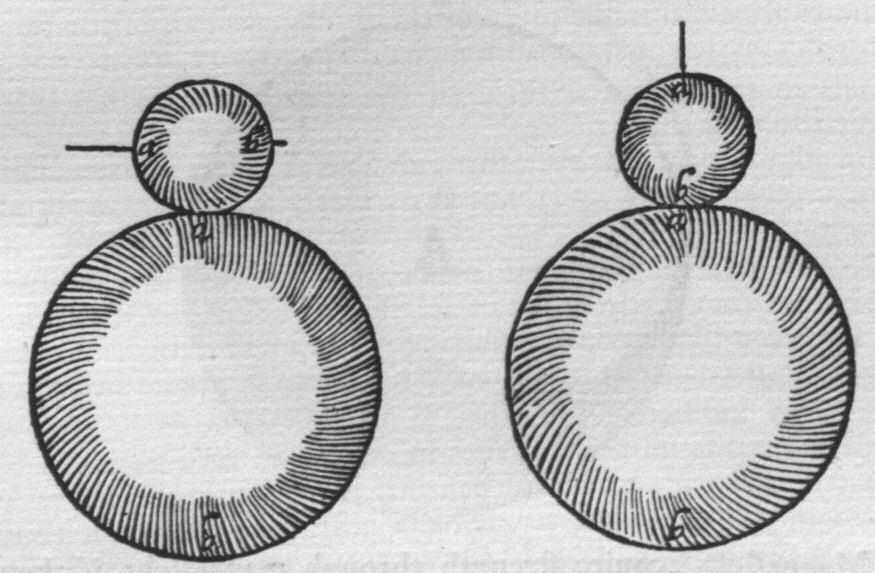
Let a b be the earth or a somewhat large terrella, also a b a smaller terrella. There is set up above the Northern pole of the smaller terrella a spike larger than the pole b of the smaller terrella can raise, if it is turned round to the higher parts. And the pole a of the smaller terrella has its strength from the larger, declining from the Zenith to the plane of the horizon or to the level. But now, if, * leaving the terrella disposed in the same way, you bring a piece of iron to the lower and Southern pole, it will attract and retain a greater weight than the Boreal pole could, if it were turned round to the lower parts. Which thing is demonstrated thus: let A be the earth or a terrella; E the Boreal pole or some place in some great latitude; B a rather large terrella above the earth or a smaller terrella on the top of a larger; D its Southern pole. It is manifest that D (the Southern pole) attracts a larger piece of iron, C, than F (the Boreal pole) will be able to, if it is turned round downward to the position D, toward the earth or the terrella in the Northern regions.
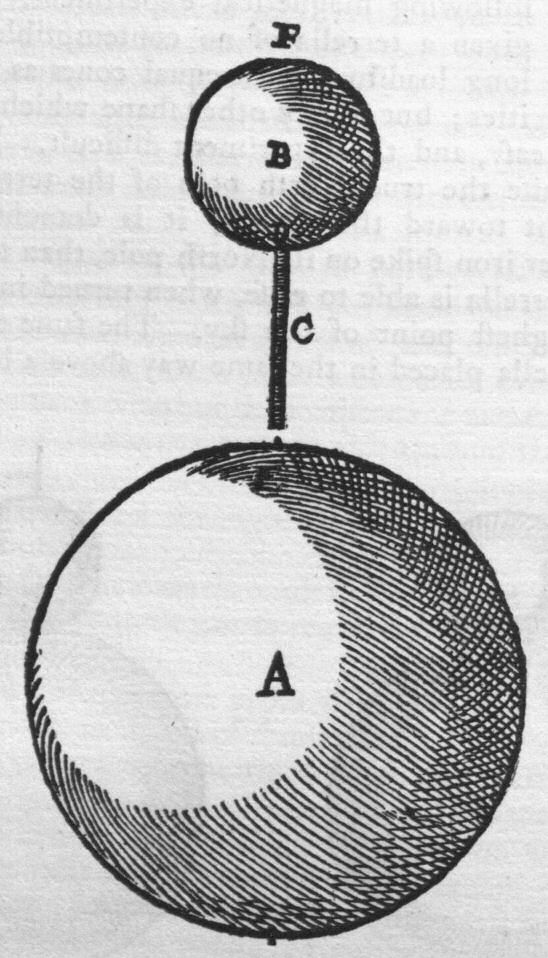
Magneticks acquire strength through magneticks, if they are properly placed according to their nature, in near neighbourhood and within the orbe of virtue. Wherefore when a terrella is placed on the earth or on a terrella, so that its Southern pole is turned round toward the Northern pole, its Northern pole, however, turned away from the Northern pole, the influence and strength of its poles are increased. And so the Northern pole of a terrella in such a position lifts up a larger spike than the Southern pole, if the Southern pole is turned away. Similarly the Southern pole in a proper and natural arrangement, acquiring strength from the earth or from a larger terrella, attracts and retains larger rods of iron. In * the other part of the terrestrial globe toward the South, as also in the Austral portion of a terrella, the reasoning is converse; for the Southern pole of the terrella being turned away is more robust, as also the Northern pole when turned round. The more a region on the earth is distant from the æquinoctial (as also in a larger terrella), the larger is the accession of strength perceived; near the æquator, indeed, the difference is small, but on the æquator itself null; at the poles finally it is greatest.
CHAP. XXXV.
On a Perpetual Motion Machine, mentioned by authors, by means of the attraction of a loadstone.
ardan writes[183] that out of iron and the Herculean stone can be made a perpetual motion machine; not that he himself had ever seen one, but only conceived the idea from an account by Antonius de Fantis[184], of Treves. Such a machine he describes, Book 9, De Rerum Varietate. But they have been little practised in magnetick experiments who forge such things as that. For no magnetick attraction can be greater (by any skill or by any kind of instrument) than the retention. Things which are joined and those which are approaching near are retained with a greater force than those which are enticed and set in motion, and are moved; and that coition is, as we have shown above, a motion of both, not an attraction of one. Such a machine Peter Peregrinus feigned many centuries before or else depicted one which he had received from others, and one which was much better fitted for the purpose. Johannes Taysnier published it also, spoiled by wretched figures, and copied out the whole theory of it word for word. O that the gods would at length bring to a miserable end such fictitious, crazy, deformed labours, with which the minds of the studious are blinded!
CHAP. XXXVI.
How a more robust Loadstone may be recognized.
ery powerful loadstones sometimes lift into the air a weight of iron equal to their own; a weak one barely attracts a slender wire. Those therefore are more robust which appeal to and retain larger bodies, if there is no defect in their form, or the pole of the stone is not suitably moved up. Moreover, when placed in a boat a keener influence turns its own poles round more quickly to the poles of the earth or the limits of variation on the horizon. One which performs its function more feebly indicates a defect and an effete nature. There must always be a similar preparation, a similar figure, and a like size; for in such as are very dissimilar and unlike, the experiment is doubtful. The method of testing the strength is the same also with a versorium in a place somewhat remote from a loadstone; for the one which is able to turn the versorium round at the greater distance, that one conquers and is held the more potent. Rightly also is the force of a loadstone weighed in a balance by B. Porta; a piece of loadstone is placed in one scale-pan, in the other just as much weight of something else, so that the scale-pans hang level. Soon a piece of iron lying on the table is adjusted so that it sticks to the loadstone placed in the scale, and they cling together most perfectly, according to their friendly points; into the other scale-pan sand is gradually thrown, and that until the scale in which the loadstone is placed is separated from the iron. Thus by weighing the weight of sand, the magnetick force becomes known. Similarly also it will be pleasing to try with another stone, in equilibrium, the weight of the sand being observed, and to find out the stronger by means of the weights of sand. Such is the experiment of Cardinal Cusan in his De Staticis[185], from whom it would seem that B. Porta learnt the experiment. The better loadstones turn themselves round more quickly toward the poles or points of variation; then they also lead along and turn round more quickly, according to the greater quantity and mass of wood, a boat and other stuff. In a declination instrument, the more powerful force of a loadstone is looked for and required. Those therefore are more lively when they get through their work readily, and pass through and come back again with speed, and swiftly at length settle at their own point. Languid and effete ones move more sluggishly[186], settle more tardily, adhære more uncertainly, and are easily disturbed from their possession.
CHAP. XXXVII.
Use of a Loadstone as it affects iron.
y magnetick coition we test iron ore in a blacksmith's forge. It is burnt, broken in pieces, washed and dried, in which way it lays down its alien humours; in the bits collected from the washing is placed a loadstone, which attracts the iron dust to itself; this, being brushed off with feathers, is received in a crucible, and the loadstone is again placed in the bits collected from the washing, and the dust wiped off, as long as any remains which it will attract to itself. This is then heated in the crucible along with sal nitri[187] until it is liquid, and from this a small mass of iron is cast. But if the loadstone draws the dust to itself quickly and readily, we conjecture that the iron ore is rich; if slowly, poor; if it seems altogether to reject it, there is very little iron in it or none at all. In like manner iron dust can be separated from another metal. Many tricks there are also, when iron is secretly applied to lighter bodies, and, being attracted by the motion of a loadstone which is kept out of sight, causes movements which are amazing to those who do not know the cause. Very many such indeed every ingenious mechanician will perform by sleight of hand, as if by incantations and jugglery[188].
CHAP. XXXVIII.
On Cases of Attraction in other Bodies.
ery often the herd of philosophizers and plagiarists repeat from the records of others in natural philosophy opinions and errors about the attractions of various bodies; as that Diamond attracts iron, and snatches it away from a magnet; that there are various kinds or magnets, some which attract gold, others silver, brass, lead; even some which attract flesh, water, fishes. The flame of sulphur is said to seek iron and stones; so white naphtha is said to attract fire. I have said above that inanimate natural bodies do not attract, and are not attracted by, others on the earth, excepting magnetically or electrically. Wherefore it is not true that there are magnets which attract gold or other metals; because a magnetick substance draws nothing but magnetick substances. Though Fracastorio says that he has shown a magnet drawing silver; if this were true, it must have happened on account of iron skilfully mixed with that silver or concealed in it, or else because nature (as she does sometimes, but rarely) had mixed iron with the silver; iron indeed is rarely mixed with silver by nature; silver with iron very rarely or never. Iron is mixed with silver by forgers of false coin or from the avarice of princes in the coining of money, as was the case with the denarius of Antony[189], provided that Pliny is recording a true incident. So Cardan (perhaps deceived by others) says that there is a certain kind of loadstone which draws silver; he adds a most foolish test of this: "If therefore" (he says) "a slender rod of silver be steeped in that in which a versatory needle has stood, it will turn toward silver (especially toward a large quantity) although it be buried; by this means anyone will be able easily to dig up concealed treasures." He adds that "it should be very good stone, such as he has not yet seen." Nor indeed will either he or anyone else ever see such a stone or such an experiment. Cardan brings forward an attraction of flesh, wrongly so named and very dissimilar from that of the loadstone; for his magnes creagus or flesh-magnet, from the experiment that it sticks to the lips, must be hooted out from the assembly of loadstones, or by all means from the family of things attractive. Lemnian earth, ruddle, and very many minerals do this, and yet they are fatuously said to attract. He will have it that there is another loadstone, as it were, a third species, into which, if a needle is driven and afterwards stuck into the body, it is not felt. But what has attraction to do with stupefaction, or stupor with a Philosopher's intellect, when he is discoursing about attraction? There are many stones, both found in nature and made by art, which have the power of stupefying. Sulphur flame is said by some to attract, because it consumes certain metals by its power of penetration. So white naphtha attracts flame, because it gives off and exhales an inflammable vapour, on which account it is kindled at some distance, just as the smoke of a recently extinguished candle takes fire again from another flame; for fire creeps to fire through an inflammable medium. Why the sucking fish Echineis or the Remora should stay ships has been variously treated by Philosophers, who are often accustomed to fit this fable (as many others) to their theories, before they find out whether the thing is so in nature. Therefore, in order that they may support and agree with the fatuities of the ancients, they put forward even the most fatuous ratiocinations and ridiculous problems, cliffs that attract, where the sucking fish tarry, and the necessity of some vacuum, I know not what, or how produced. Pliny and Julius Solinus make mention of a stone Chatochitis[190]. They say that it attracts flesh, and keeps hold of the hands, just as a loadstone does iron, and amber chaff. But that happens only from a stickiness and from glue contained in it, since it sticks more easily to the hands when they are warm. Sagda or Sagdo[191], of the colour of a sard, is a precious stone mentioned by Pliny, Solinus, Albertus, and Evax[192]; they describe its nature and relate, on the authority of others, that it specially attracts wood to itself. Some even babble that woods cannot be wrenched away except they are cut off. Some also narrate that a stone is found which grows pertinaciously into ships, in the same way as certain testacea on long voyages. But a stone does not draw because it sticks; and if it drew, it would certainly draw shreds electrically, Encelius saw in the hands of a sailor such a stone of feeble virtue, which would hardly attract even the smallest twigs; and in truth, not of the colour of the sard. So Diamond, Carbuncle, Crystal, and others do attract. I pass over other fabulous stones; Pantarbe, about which Philostratus writes that it draws other stones to itself; Amphitane also, which attracts gold. Pliny in his origin of glass will have it that a loadstone is an attractor of glass, as well as of iron. For in his method of preparing glass, when he has indicated its nature, he subjoins this about loadstone. "Soon (such is the astute and resourceful craft) it was not content to have mixed natron; loadstone also began to be added, since it was thought to attract to itself the liquor of glass (as it does iron)." Georgius Agricola writes that to the material of glass (sand and natron) one part also of loadstone is added. "Because that force is believed, in our times just as in former times, to attract the liquor of glass to itself, as it attracts iron to itself, purges it when drawn, and makes clear glass from green or muddy; but the fire afterwards burns up the loadstone." It is true indeed that some sort of magnes (as the magnesia of the glass-makers imbued with no magnetick virtues) is sometimes put in and mixed with the material of the glass; not, however, because it attracts glass. But when a loadstone is burnt, it does not lay hold of iron at all, nor is iron when red-hot allured by any loadstone; and loadstone also is burnt up by more powerful fires and loses its attractive potency. Nor is this a function of loadstone alone in the glass furnaces; but also of certain pyrites and of some easily combustible iron ores, which are the only ones used by our glass-makers, who make clear, bright glass. They are mixed with the sand, ashes, and natron (just as they are accustomed to make additions in the case of metallick ores whilst they are smelted), so that when the material slows down into glass, the green and muddy colour of the glass may be purged by the penetrating heat. For no other material becomes so hot, or bears the fire for such a convenient time, until the material of the glass is perfectly fluid, and is at the same time burnt up by that ardent fire. It happens, however, sometimes, that on account of the magnetick stone, the magnesia, or the ore, or the pyrites, the glass has a dusky colour, when they resist the fire too much and are not burnt up, or are put in in too great quantity. Wherefore manufacturers are seeking for a stone suitable for them, and are observing also more diligently the proportion of the mixture. Badly therefore did the unskilful philosophy of Pliny impose upon Georgius Agricola and the more recent writers, so that they thought the loadstone was wanted by glass-makers on account of its magnetick strength and attraction. But Scaliger in De Subtilitate ad Cardanum, in making diamond attract iron, when he is discussing magneticks, wanders far from the truth, unless it be that diamond attracts iron electrically, as it attracts wood, straws, and all other minute bodies when it is rubbed. Fallopius reckons that quicksilver draws metals by reason of an occult property, just as a loadstone iron, amber chaff. But when quicksilver enters metals, it is wrongly called attraction. For metals imbibe quicksilver, just as clay water; nor do they do this unless they are touching, for quicksilver does not allure gold or lead to itself from afar, but they remain motionless in their places.
CHAP. XXXIX.
On Bodies which mutually repel one another.
riters who have discoursed on the forces of bodies which attract others have also spoken about the powers of bodies which repel, but especially those who have instituted classes for natural objects on the basis of sympathy and antipathy. Wherefore it would seem necessary for us to speak also about the mutual strife of bodies, so that published errors should not creep further, and be received by all to the ruin of true philosophy. They say that, just as like things attract for the sake of preservation, so unlike and contrary things for the same purpose mutually repel and put one another to flight. This is evident in the reaction of many things, but it is most manifest in the case of plants and animals, which attract kindred and familiar things, and in like manner reject foreign and unsuitable things. But in other bodies there is not the same reason, so that when they are separated, they should come together by mutually attracting one another. Animals take food (as everything which grows), and draw it into their interior; they absorb the nourishment by certain parts and instruments (through the action and operation of the anima). They enjoy by natural instinct only the things set in front of them and near them, not things placed afar off; and this without any alien force or motion. Wherefore animals neither attract any bodies nor drive them away. Water does not repel oil (as some think) because the oil floats on water; nor does water repel mud, because the mud, if mixed in water, settles down in time. This is a separation of unlike bodies or such as are not perfectly mixed as respects the material; the separated bodies nevertheless remain joined without any natural strife. Wherefore a muddy sediment settles quietly on the bottom of vessels, and oil remains on the top of the water and is not sent further away. A drop of water remains intact on a dry surface, and is not expelled from the dry substance. Wrongly therefore do those who discourse on these matters infer an antipathy (that is, the force of repelling by contrary passions); for there is no repelling force in them; and repulsion comes[193] from action, not from passion. But their greek vocables please them too much. We, however, must inquire whether there is any body which drives anything else further off without material impetus, as a loadstone attracts. But a loadstone seems even to repel loadstone. For the pole of one loadstone repels the pole of another, which does not agree with it according to nature; by repelling, it turns it round in an orbit so that they may exactly agree according to their nature. But if a somewhat weak loadstone, floating freely on water, cannot readily be turned round on account of impediments, the whole loadstone is repelled and sent further away from the other. All electricks attract all things: they never repel or propel anything at all[194]. As to what is related about certain plants (as about the cucumber, which turns aside when oil is applied to it), there is a material change from the vicinity, not a hidden antipathy. But when they show a candle flame put against a cold solid substance (as iron) turn away to the side, and allege antipathy as the cause, they say nothing. The reason of this they will see clearer than the day, when we discourse on what heat is[195]. But Fracastorio's opinion that a loadstone can be found, which would drive iron away, on account of some opposing principle lurking in the iron, is foolish.
BOOK THIRD.
CHAP. I.
ON DIRECTION.
n referring to the earlier books it will be found shown that a loadstone has its poles, and that a piece of iron has also poles, and rotation, and a certain verticity; finally, that the loadstone and the iron direct their poles toward the poles of the earth. Now, however, we must make clear the causes of these things and their admirable workings, pointed out indeed before, but not proven. All those who have written before us about these rotations have left us their opinions so briefly, so meagrely, and with such hesitating judgment that they seem hardly likely ever to persuade anyone, or even to be able to satisfy themselves; and all their petty reasons are rejected by the more prudent as useless, uncertain, and absurd, being supported by no proofs or arguments; whence also magnetick science, being all the more neglected and not understood, has been in exile. The true austral pole of a loadstone, not the boreal (as all before us used to think), * if the loadstone is placed in its boat on the surface of water, turns to the North; in the case of a piece of iron also, whether it has been excited by a loadstone or not, the southern end moves toward the North. An oblong piece of iron of three or four digits' length[196], when skilfully rubbed with a loadstone, quickly turns north and south. Wherefore mechanicians, taking a piece of iron prepared in this way, balance it on a pin in a box, and fit it up with the requisites of a sun-dial; or they prepare the versorium out of two curved pieces of iron with their ends touching one another, so that the motion may be more constant. In this way the mariners' versorium is arranged, which is an instrument beneficial, useful, and auspicious to sailors for indicating, like a good genius, safety and the right way. But it must be understood on the threshold of this argument (before we proceed further) that these pointings of the loadstone or of iron are not perpetually made toward the true poles of the world, do not always seek those fixed and definite points, or remain on the line of the true meridian; but usually diverge some distance to the East or to the West. Sometimes also at certain places on land or sea they do indicate exactly the true poles. This discrepancy is called the Variation of the iron or of the loadstone; and since this is brought about by other causes, and is merely a certain disturbance and perversion of the true direction, we are directing our attention in this place to the true direction of the compass and of the magnetick iron (which would be equally toward the true poles and on the true meridian everywhere on the earth, unless other obstacles and an untoward pervertency hindered it). Of its variation and the cause of the perversion we shall treat in the next book. Those who wrote about the world and about natural philosophy a century ago, especially those remarkable elementary philosophers, and all those who trace their knowledge and training to them down to our own times, those men, I say, who represented the earth as always at rest and, as it were, a useless weight, placed in the centre of the universe at an equal distance from the sky on every side, and its nature to be simple, imbued only with the qualities of dryness and cold, sought diligently for the causes of all things and of all effects in the heavens, the stars, the planets, in fire, air, waters and substances of mixed natures. Never indeed did they recognize that the terrestrial globe had, besides dryness and cold, some special, effective, and predominant properties, strengthening, directing, and moving the globe itself through its whole mass and its very deepest vitals; nor did they ever inquire whether there were any such. For this reason the crowd of philosophizers, in order to discover the reasons of the magnetical motions, called up causes lying remote and far away. And one man seems to me beyond all others worthy of censure, Martin Cortes, who, since there was no cause which could satisfy him in the whole of nature, dreamed that there was a point of magnetical attraction beyond the heavens, which attracted iron. Peter Peregrinus thinks that the direction arises from the poles of the sky. Cardan thought that the turning of iron was caused by a star in the tail of the Great Bear; Bessard, the Frenchman, opines that a magnetick turns toward the pole of the zodiack. Marsilius Ficinus will have it that the loadstone follows its own Arctick pole; but that iron follows the loadstone, straws amber; whilst this perhaps follows the Antarctick pole—a most foolish dream. Others have recourse to I know not what magnetick rocks and mountains. Thus it is always customary with mortals, that they despise things near home, whilst foreign and distant things are dear and prized. But we study the earth itself and observe in it the cause of so great an effect. The earth, as the common mother, has these causes inclosed in her innermost parts; in accordance with her rule, position, condition, verticity, poles, æquator, horizons, meridians, centre, circumference, diameter, and the nature of the whole interior of her substance, must all magnetical motions be discussed. The earth has been ordered by the highest Artificer and by nature in such a way that it should have parts dissimilar in position, bounds of the whole and complete body, ennobled by certain functions, by which it might itself remain in a definite direction. For just as a loadstone, when it is floated on water in a suitable vessel, or is hung by slender threads in the air, by its implanted verticity conforms its poles to the poles of the common mother in accordance with magnetick laws; so if the earth were to deviate from its natural direction and its true position in the universe, or if its poles were to be drawn aside (if this were possible) toward the sun-rising or the sun-setting or toward any other points whatsoever in the visible firmament, they would return again to the north and south by magnetical motion, and would settle at the same points at which they are now fixed. The reason why the terrestrial globe seems to remain more steadily with the one pole toward those parts and directed toward the Cynosure, and why its pole diverges by 23 degrees 29 minutes, with a certain variation not sufficiently investigated as yet by Astronomers, from the poles of the ecliptick, depends on its virtue magnetical. The causes of the precession of the æquinoxes and the progression of the fixed stars, and of the change, moreover, in the declinations of the sun and of the tropicks, must be sought from magnetick influences; so that neither that absurd motion of trepidation of Thebit Bencora[197], which is at great variance with observations, nor the monstrous superstructures of other heavens, are any longer needed. A versatory iron turns to the position of the earth, and if disturbed ever so often returns always to the same points. For in the far regions of the north, in a latitude of 70 or 80 degrees (to which at the milder seasons of the year our sailors are accustomed to penetrate without injury from the cold); in the regions halfway between the poles; on the æquator in the torrid zone; and again in all the maritime places and lands of the south, in the highest latitude which has thus far been reached, always the iron magnetick finds its way, and points to the poles in the same manner (excepting for the difference of variation); on this side of the æquator (where we live), and on the other side to the south, less well known, but yet in some measure explored by sailors: and always the lily of the compass points toward the North. This we have had confirmed by the most eminent captains, and also by very many of the more intelligent sailors. These facts have been pointed out to me and confirmed by our most illustrious Sea-god, Francis Drake, and by another circumnavigator of the globe, Thomas Candish; our terrella also indicates the same thing. This is demonstrated in the case of the orbicular stone, whose poles are A and B; an iron wire CD, which is placed upon the stone, always points directly along the meridian toward the poles AB, whether the centre of the wire is on the central line or æquator of the stone, or on any other part situated between the æquator and the poles, as at H, G, F, E. So the cusp of a versorium on this side of the æquator points toward the north; * on the other side the cross is always directed toward the south; but the cusp or lily[198] does not, as some one has thought, turn toward the south beyond the æquator. Some inexperienced people indeed, who in distant parts beyond the æquator have seen the versorium sometimes become more sluggish and less prompt, thought that the distance from the arctick pole or from the magnetick rocks was the cause of this. But they are very much mistaken; for it is as powerful[199], and adjusts itself as quickly to the meridian or to the point of variation in the southern as in the northern parts of the earth. Yet sometimes the motion appears slower, namely, when the supporting pin by lapse of time and long voyaging has become somewhat blunt, or the magnetick iron parts have lost, by age or rust, some of their acquired vigour. This may also be shown experimentally by the versatory iron of a small sun-dial placed on a very short pin set perpendicular to the surface of the stone, for the iron when touched by a loadstone points toward the poles of the stone and leaves the poles of the earth; for the general and remoter cause is overcome by the particular and powerful cause which is so near at hand. Magnetick bodies have of themselves an inclination toward the position of the earth and are influenced by a terrella. Two equal stones of equal strength adjust themselves to a terrella in accordance with magnetick laws. The iron conceives vigour from the loadstone and is influenced by the magnetical motions. Wherefore true direction is the motion of a magnetick body in regard to the verticity of the earth, the natures of both agreeing and working together toward a natural position and unity. For indeed we have found out at length, by many experiments and in many ways, that there is a disposing nature, moving them together by reason of their various positions by one form that is common to both, and that in all magnetick substances there is attraction and repulsion. For both the stone[200] and the magnetick iron arrange themselves by inclination and declination, according to the common position of their nature and the earth. And the force of the earth by the virtue of the whole, by attracting toward the poles, and repelling, arranges all magneticks which are unfixed and loose. For in all cases all magneticks conform themselves to the globe of the earth in the same ways and by the same laws by which another loadstone or any magneticks do to a terrella.[201]