Cardan's error when he seeks the distance of the centre of the earth from the centre of the cosmos by the motion of the stone of Hercules; in his book 5, On Proportions.
Silvanus P. (Silvanus Phillips) Thompson translation
ne may very easily fall into mistakes and errors when one is searching into the hidden causes of things, in the absence of real experiments, and this is easily apparent from the crass error of Cardan; who deems himself to have discovered the distances of the centres of the cosmos and of the earth through a variation of the magnetick iron of 9 degrees. For he reckoned that everywhere on the earth the point of variation on the Horizon is always distant nine degrees from the true north, toward the east: and from thence he forms, by a most foolish error, his demonstrative ratio of the separate centres.
CHAP. XII.
On the finding of the amount of variation: how great is the arc of the Horizon from its arctick or antarctick intersection of the meridian, to the point respective of the magnetick needle.
irtually the true meridian is the chief foundation of the whole matter: when that is accurately known, it will be easy by a mariners' compass (if its construction and the mode of attachment of the magnetick iron works are known) or by some other larger horizontal versorium to exhibit the arc of variation on the Horizon. By means of a sufficiently large nautical variation compass (two equal altitudes of the sun being observed before and after midday), the variation becomes known from the shadow; the altitude of the sun is observed either by a staff or by a rather large quadrant.
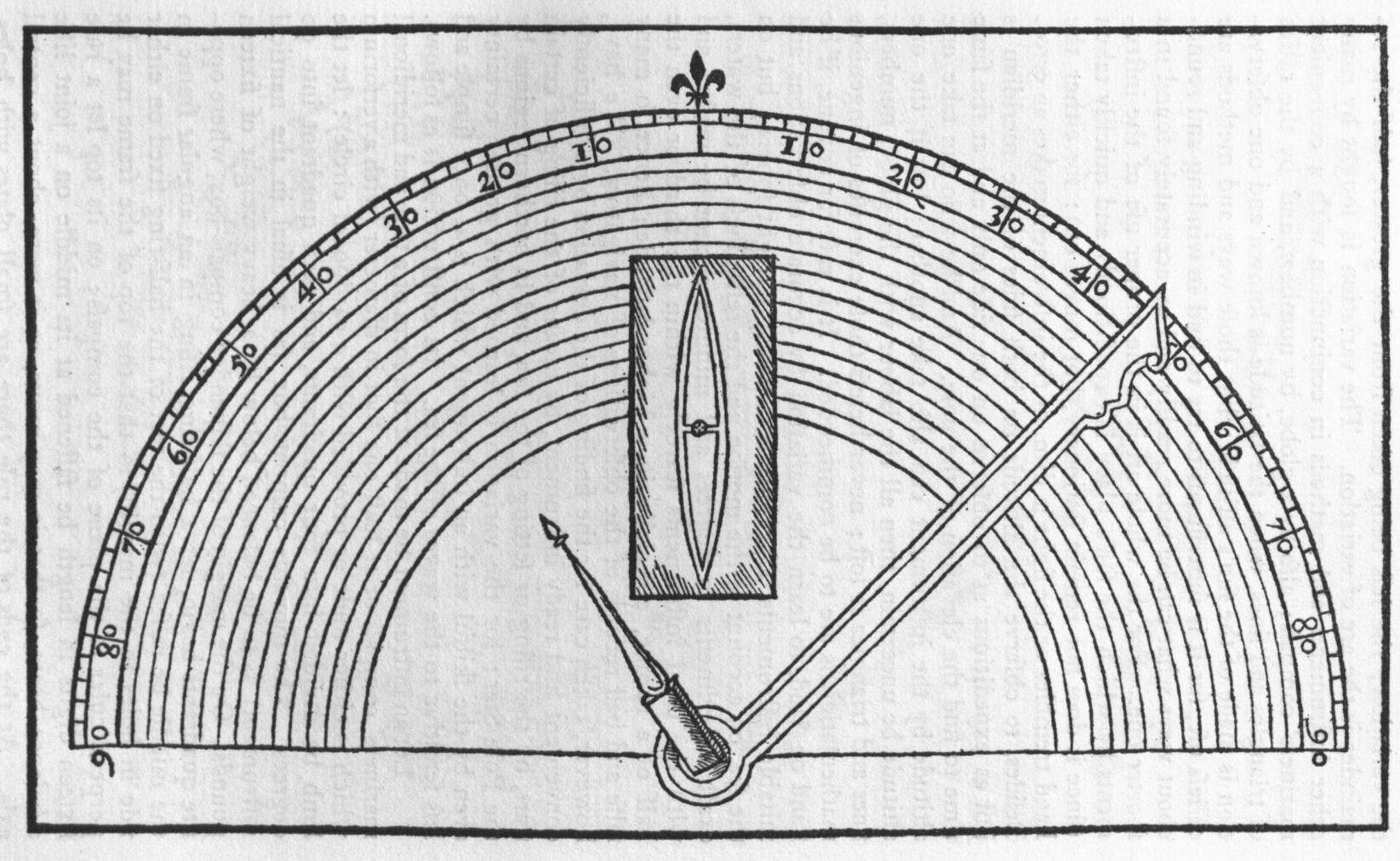
On land the variation is found in another way which is easier, and because of the larger size of the instrument, more accurate. Let a thick squared board be made of some suitable wood, the surface of which is two feet in length and sixteen inches in width: describe upon it some semicircles as in the following figure, only more in number. In the centre let a brass style be reared perpendicularly: let there be also a movable pointer reaching from the centre to the outmost semicircle, and a magnetick versorium in a cavity covered over with glass: then let the board be exactly adjusted to the level of the Horizon by the plane instrument with its perpendicular; and turn the lily of the instrument toward the north, so that the versorium may rest truly over the middle line of the cavity, which looks toward the point of variation on on the Horizon. Then at some convenient hour in the morning (eight or nine for instance) observe the apex of the shadow thrown by the style when it reaches the nearest semicircle and mark the place of the apex of this shadow with chalk or ink: then bring round the movable index to that mark, and observe the degree on the Horizon numbered from the lily, which the index shows. In the afternoon see when the end of the shadow shall again reach the periphery of the same semicircle, and, bringing the index to the apex of the shadow, seek for the degree on the other side of the lily. From the difference of the degrees becomes known the variation; the less being taken from the greater, half the remainder is the arc of variation. The variation is sought by many other instruments and methods in conjunction with a convenient mariners' compass; also by a globe, by numbers, and by the ratios of triangles and sines, when the latitude is known and one observation is made of the sun's altitude: but those ways and methods are of less use, for it is superfluous to try to find in winding and roundabout ways what can be more readily and as accurately found in a shorter one. For the whole art is in the proper use of the instruments by which the sun's place is expeditiously and quickly taken (since it does not remain stationary, but moves on): for either the hand trembles or the sight is dim, or the instrument makes an error. Besides, to observe the altitude on both sides of the meridian is just as expeditious as to observe on one side only and at the same time to find the elevation of the pole. And he who can take one altitude by the instrument can also take another; but if the one altitude be uncertain, then all the labour with the globe, numbers, sines and triangles is lost; nevertheless those exercises of ingenious mathematicians are to be commended. It is easy for anyone, if he stand on land, to learn the variation by accurate observations and suitable instruments, especially in a nearly upright sphere; but on the sea, on account of the motion and the restlessness of the waters, exact experiments in degrees and minutes cannot be made: and with the usual instruments scarcely within the third or even the halt of a rumbe, especially in a higher latitude; hence so many false and bad records of the observations of navigators. We have, however, taken care for the finding of the deviation by a sufficiently convenient and ready instrument, by means of the rising of certain stars, by the rising or setting of the sun, and in northern regions by the Pole Star: for the variation is learned with greater certainty even by the skilful with an instrument which is at once simple and less sensitive to the waves of the sea. Its construction is as follows.
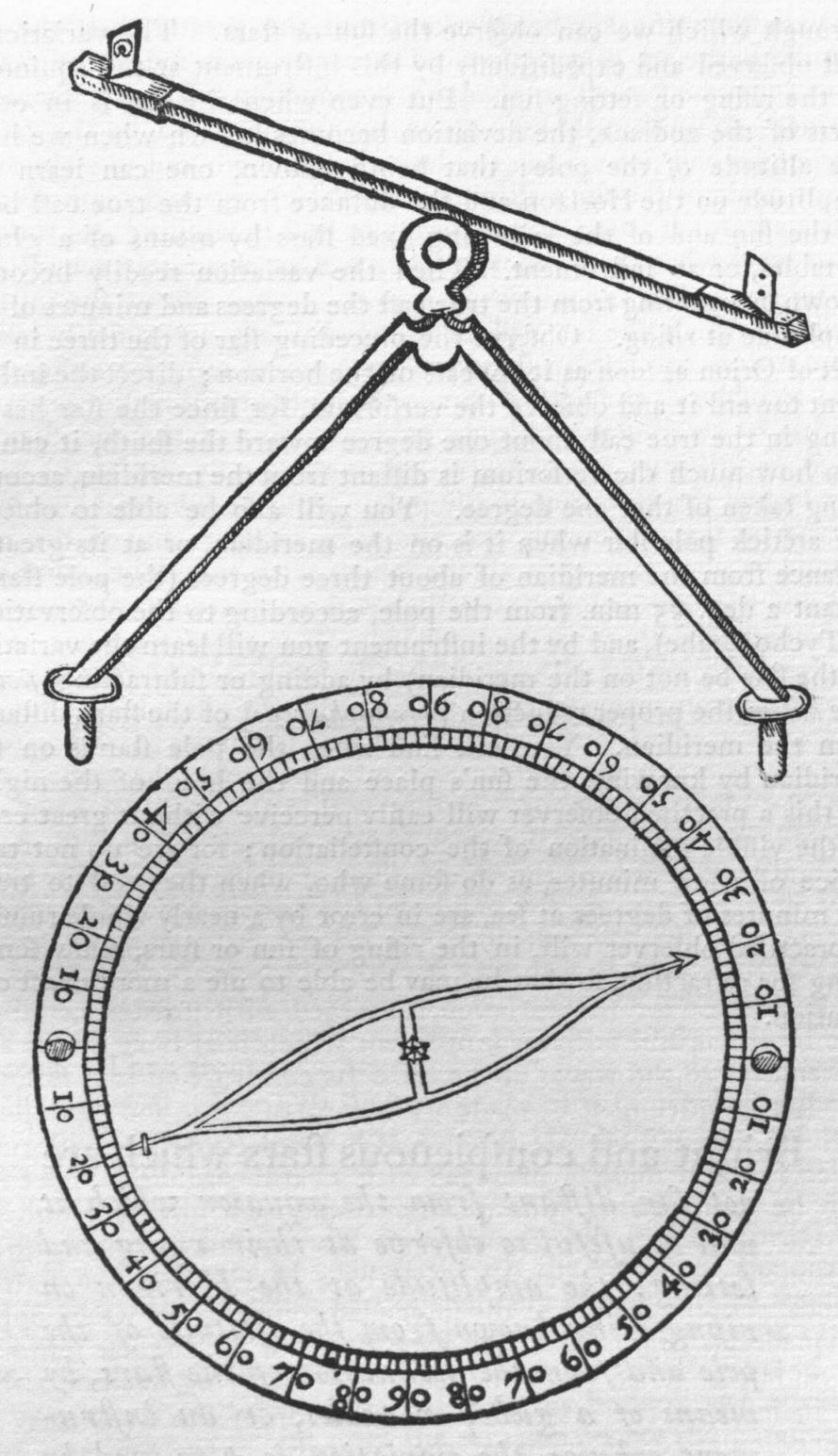
[228]Let an instrument be made of the form of a true and meridional mariners' compass of at least one foot in diameter (with a versorium which is either nude or provided with a cardboard circle): let the limb be divided into four quadrants, and each quadrant into 90 degrees. The movable compass-box (as is usual in the nautical instrument) is to be balanced below by a heavy weight of sixteen pounds. On the margin of the suspended compass-box, where opposite quadrants begin, let a half-ring rising in an angular frame in the middle be raised (with the feet of the half-ring fixed on either side in holes in the margin) so that the top of the frame may be perpendicular to the plane of the compass; on its top let a rule sixteen digits in length be fastened at its middle on a joint like a balance beam, so that it may move, as it were, about a central axis. At the ends of the rule there are small plates with holes, through which we can observe the sun or stars. The variation is best observed and expeditiously by this instrument at the equinoxes by the rising or setting sun. But even when the sun is in other parts of the zodiack, the deviation becomes known when we have the altitude of the pole: that being known, one can learn the amplitude on the Horizon and the distance from the true east both of the sun and of the following fixed stars by means of a globe, or tables, or an instrument. Then the variation readily becomes known by counting from the true east the degrees and minutes of the amplitude at rising. Observe the preceding star of the three in the Belt of Orion as soon as it appears on the horizon; direct the instrument toward it and observe the versorium, for since the star has its rising in the true east about one degree toward the south, it can be seen how much the versorium is distant from the meridian, account being taken of that one degree. You will also be able to observe the arctick pole star when it is on the meridian, or at its greatest distance from the meridian of about three degrees (the pole star is distant 2 deg. 55 min. from the pole, according to the observations of Tycho Brahe), and by the instrument you will learn the variation (if the star be not on the meridian) by adding or subtracting, secundum artem, the proper reduction [prostaphæresis][229] of the star's distance from the meridian. You will find when the pole star is on the meridian by knowing the sun's place and the hour of the night: for this a practised observer will easily perceive without great error by the visible inclination of the constellation: for we do not take notice of a few minutes, as do some who, when they toil to track the minutes of degrees at sea, are in error by a nearly whole rumbe. A practised observer will, in the rising of sun or stars, allow something for refraction, so that he may be able to use a more exact calculation.
Bright and conspicuous stars[230] which are not far distant from the equator which it will be useful to observe at their rising and setting: the amplitude at the Horizon on rising being known from the altitude of the pole and from the declination of the stars, by means of a globe, or tables, or an instrument whence the variation is perceived by technical calculation.
Right Ascension Declination
Oculus Tauri 62° 55' 15° 53' N
Sinister humerus Orionis 72° 24' 4° 5' N
Dexter humerus Orionis 83° 30' 6° 19' N
Præcedens in cingulo Orionis 77° 46' 1° 16' S
Canis major 97° 10' 15° 55' S
Canis minor 109° 41' 5° 55' N
Lucida Hydræ 137° 10' 5° 3' S
Caput Geminorum australe 110° 21' 28° 30' N
Caput boreale 107° 4' 32° 10' N
Cor Leonis 146° 8' 13° 47' N
Cauda Leonis 171° 38' 16° 30' N
Spica Virginis 195° 44' 8° 34' S
Arcturus 29° 13' 21° 54' N
Cor Aquilæ 291° 56' 7° 35' N
An instrument for finding the amplitude at rising on the horizon.
Describe the circumference of a circle and let it be divided into quadrants by two diameters intersecting each other at right angles at its centre. One of these will represent the æquinoctial circle, the other the axis of the world. Let each of these quadrants be divided (in the accustomed way) into 90 degrees; on every fifth or tenth of which at each end of each diameter and on each side let marks (showing the numbers) be inscribed on the two limbs or margins made for that purpose outside the circumference. Then from each degree straight lines are drawn parallel to the æquator. You will then prepare a rule or alhidade equal to the diameter of that circle and divided throughout into the same parts into which the diameter of the circle representing the axis of the world is divided. Let there be left a small appendage attached to the middle of the rule, by which the middle of the fiducial line itself of the rule may be connected with the centre of the circle: but to every fifth or tenth part of that rule let numbers be attached proceeding from the centre toward each side. This circle represents the plane of the meridian; its centre the actual point of east or west, i.e., the common intersection of the horizon and æquator; all those lines æquidistant from the æquator denote the parallels of the sun and stars; the fiducial line of the rule or alhidade represents the horizon; and its parts signify the degrees of the horizon, beginning from the point of setting or of rising.
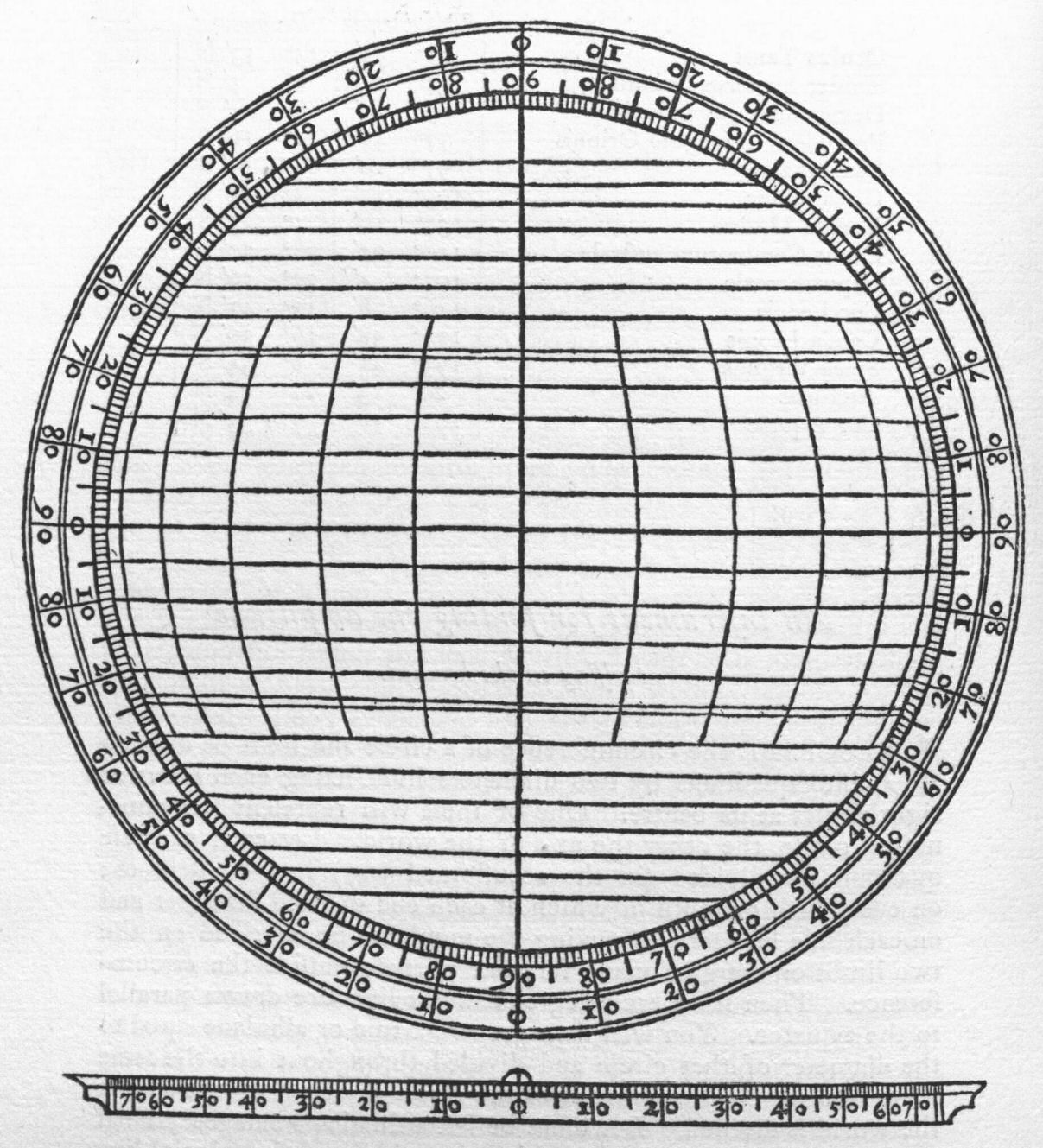
Therefore if the fiducial line of the rule be applied to the given latitude of the place reckoned from either end of that diameter which represents the axis of the world; and if further the given declination of the sun or of some star from the æquator (less than the complement of the latitude of the place) be found on the limb of the instrument; then the intersection of the parallel drawn from that point of the declination with the horizon, or with the fiducial line of the rule or alhidade, will indicate for the given latitude of the place the amplitude at rising of the given star or the sun.
CHAP. XIII.
The observations of variation by seamen vary, for the most part, and are uncertain: partly from error and inexperience, and the imperfections of the instruments; and partly from the sea being seldom so calm that the shadows or lights can remain quite steady on the instruments.
fter the variation of the compass had first been noticed, some more diligent navigators took pains to investigate in various ways the difference of aspect of the mariners' compass. Yet, to the great detriment of the nautical art, this has not been done so exactly as it ought to have been. For either being somewhat ignorant they have not understood any accurate method or they have used bad and absurd instruments, or else they merely follow some conjecture arising from an ill-formed opinion as to some prime meridian or magnetick pole; whilst others again transcribe from others, and parade these observations as their own; and they who, very unskilful themselves, first of all committed their observations to writing are, as by the prerogative of time, held in esteem by others, and their posterity does not think it safe to differ from them. Hence in long navigations, especially to the East Indies, the records by the Portuguese of the deviating compass are seen to be unskilful: for whoever reads their writings will easily understand that they are in error in very many things, and do not rightly understand the construction of the Portuguese compass (the lily of which diverges by half a rumbe from the needles toward the west), nor its use in taking the variation. Hence, while they show the variation of the compass in different places, it is uncertain whether they measure the deviation by a true meridional compass or by some other whose needles are displaced from the lily. The Portuguese (as is patent in their writings) make use of the Portuguese compass, whose magnetick needles are fixed aside from the lily by half of one rumbe toward the east. Moreover on the sea the observation of the variation is a matter of great difficulty, on account of the motion of the ship and the uncertainty of the deviation, even with the more skilful observers, if they use the best made instruments hitherto known and used. Hence there arise different opinions concerning the magnetick deviation: as, for instance, near the Island of St. Helena the Portuguese Rodriguez de Lagos measures half a rumbe. The Dutch in their nautical log fix it at a whole rumbe. Kendall, the expert Englishman, with a true meridional compass admits only a sixth part of a rumbe. A little to the East of Cape Agullias Diego Alfonso makes no variation, and shows by an Astrolabe that the compass remains in the true meridian. Rodriguez shows that the compass at Cape Agulhas has no variation if it is of Portuguese construction, in which the needles are inclined half a rumbe to the East. And there is the same confusion, negligence, and vanity in very many other instances.
CHAP. XIIII.
On the variation under the æquinoctial line, and near it.
n the North the magnetick needle varies because of the Boreal eminences of the continent; in the South because of the Austral; at the æquator, if the regions on both sides were equal, there would be no variation. But because this rarely happens some variation is often observed under the æquator; and even at some distance from the æquator of three or 4 degrees toward the North, there may be a variation arising from the south, if those very wide and influential southern continents be somewhat near on one side.
CHAP. XV.
The variation of the magnetick needle in the great Æthiopick and American sea, beyond the æquator.
iscourse hath already been had of the mode and reason of the variation in the great Atlantick Ocean: but when one has advanced beyond the æquator off the east coast of Brazil the magnetick needle turns aside toward the mainland, namely, with that end of it which points to the south; so that with that end of the versorium it deviates from the true meridian toward the west; which navigators observe at the other end and suppose a variation to occur toward the east. But throughout the whole way from the first promontory on the east of Brazil, by Cape St. Augustine and thence to Cape Frio, and further still to the mouth of the Strait of Magellan, the variation is always from the south toward the west with that end of the versorium which tends toward the antarctick pole. For it is always with the accordant end that it turns toward a continent. The variation, however, occurs not only on the coast itself, but at some distance from land, such as a space of fifty or sixty German miles or even more. But when at length one has progressed far from land, then the arc begins to diminish: for the magnetick needle turns aside the less toward what is too far off, and is turned aside the less from what is present and at hand, since it enjoys what is present. In the Island of St. Helena (the longitude of which is less than is commonly marked on charts and globes) the versorium varies by one degree or nearly two. The Portuguese and others taught by them, who navigate beyond the Cape of Good Hope to the Indies, set a course toward the Islands of Tristan d'Acunha, in order that they may enjoy more favourable winds; in the former part of their course the change of variation is not great; but after they have approached the islands the variation increases; and close to the islands it is greater than anywhere else in the whole course. For the end of the versorium tending to the south (in which lies the greatest source of the variation) is caught and allured toward the south-west by the great promontory of the southern land. But when they proceed onward toward the Cape of Good Hope the variation diminishes the more they approach it. But on the prime meridian in the latitude of 45 degrees, the versorium tends to the south-east: and one who navigates near the coast from Manicongo to the tropick, and a little beyond, will perceive that the versorium tends from the south to the east, although not much. At the promontory of Agulhas it preserves slightly the variation which it showed near the islands of d'Acunha, which nevertheless is very much diminished because of the greater remoteness from the cause of variation, and consequently there the southern end of the versorium does not yet face exactly to the pole.
CHAP. XVI.
On the variation in Nova Zembla.
ariations in parts near the pole are greater (as has been shown before) and also have sudden changes, as in former years the Dutch explorers observed not badly, even if those observations were not exact—which indeed is pardonable in them; for with the usual instruments it is with difficulty that the truth becomes known in such a high latitude (of about 80 degrees). Now, however, from the deviation of the compass the reason for there being an open course to the east by the Arctick Ocean appears manifest; for since the versorium has so ample a variation toward the north-west, it is demonstrable that a continent does not extend any great distance in the whole of that course toward the east. Therefore with the greater hope can the sea be attempted and explored toward the east for a passage to the Moluccas by the north-east than by the north-west.
CHAP. XVII.
Variation in the Pacifick Ocean.
assing the Strait of Magellan the deviation on the shore of Peru is toward the south-east, i.e., from the south toward the east. And a similar deflection would be continued along the whole coast of Peru as far as the æquator. In a higher latitude up to 45 deg. the variation is greater than near the æquator; and the deflection toward the south-east is in nearly the same proportion as was the deviation from the south toward the west on the eastern shore of South America. From the æquator toward the North there is little or no variation until one comes to New Galicia; and thence along the whole shore as far as Quivira the inclination is from the north toward the east.
CHAP. XVIII.
On the variation in the Mediterranean Sea.
icilian and Italian sailors think that in the Sicilian Sea and toward the east up to the meridian of the Peloponnesus (as Franciscus Maurolycus relates) the magnetick needle "græcizes," that is, turns from the pole toward what is called the greek wind or Boreas; that on the shore of the Peloponnesus it looks toward the true pole; but that when they have proceeded further east, then it "mistralizes," because it tends from the pole toward the mistral or north-west wind: which agrees with our rule for the variation. For as the Mediterranean Sea is extended toward the west from that meridian, so on the side toward the east the Mediterranean Sea lies open as far as Palestine; as toward North and East lie open the whole Archipelago and the neighbouring Black Sea. From the Peloponnesus toward the north pole the meridian passes through the largest and most elevated regions of all Europe; through Achaia, Macedonia, Hungary, Transylvania, Lithuania, Novogardia, Corelia and Biarmia.
CHAP. XIX.
The variation in the interior of large Continents.
ost of the great seas have great variations; in some parts, however, they have none, but the true directions are toward the pole. On continents, also, the magnetick needle often deviates from the meridian, as on the edge of the land and near the borders; but it is generally accustomed to deviate by a somewhat small arc. In the middle, however, of great regions there are no variations. Hence in the middle lands of Upper Europe, in the interior of Asia, and in the heart of Africa, of Peru, and in the regions of North or Mexican America, the versorium rests in the meridian.

CHAP. XX.
Variation in the Eastern Ocean.
ariation in the Eastern Ocean throughout the whole voyage to Goa and the Moluccas is observed by the Portuguese; but they err greatly in many things, following, as they do, the first observers who note down variations in certain places with ill-adapted instruments, and by no means accurate observations, or by some conjectures. As, for instance, in Brandöe Island, they make the versorium deviate by 22 degrees to the north-west. For in no region or place in the whole world, of not greater latitude, is there so great a deviation; and, in reality, there the deviation is slight. Also when they make out that at Mosambique the compass deviates by one rumbe to the north-west, it is false; even though they use (as they are accustomed to do) the Portuguese compass: for beyond all doubt on the shore of Mosambique the versorium inclines ¼ rumbe or even more to the south-west. Very wrongly also beyond the æquator in the course to Goa they make the little compass incline by 1½ rumbe to the west: whereas they should rather have said that in the first part of the course the Portuguese compass inclines by 1 rumbe: but that the true meridional compass inclines by ½ rumbe only. In order that the amount of variation in the Eastern Ocean may be accurately settled in most places by our rules, there is needed a more exact and truer survey of the southern land, which spreads out from the south to the æquinoctial more than is commonly described on maps and globes.
CHAP. XXI.
How the deviation of the versorium is augmented and diminished by reason of the distance of places.
n the middle of great and continent lands there is no variation. Nor, generally, in the middle of very great seas. On the margin of those lands and seas the variation is often ample, yet not so great as at a little further distance on the sea. As, for example, near Cape St. Augustine the compass varies; but at 50 miles from land toward the East it varies more; and 80 miles off it varies still more; and yet still more at a distance of 100 miles. But from a distance of 100 miles the diminutions of deviation are slower, when they are navigating toward the mainland, than at a distance of 80 miles, and at a distance of 80 miles than at 50: for the deviations change and are diminished rather more swiftly the more they approach and draw near land than when at a great distance off. As, for instance, navigating toward Newfoundland the change of variation is more rapid (that is, it decreases a degree in a smaller arc of the course on the parallel) when they are not far from land than when they are a hundred miles distant: but when travelling on land toward the interiors of regions the changes are slower in the first parts of the journey than when they come more into the interior.
The ratio of the arcs on a parallel circle, when a versorium is moved toward continents which extend to the pole, corresponds with the degrees of variation. Let A be the pole; B the eminences of the dominant lands; at C there is no variation caused by B, for it is too far away; at D the variation is very great because the versorium is allured or turned by the whole earth toward the eminent land B; and moreover it is not hindered, or restrained or brought back to the pole by the verticity of the earth; but, tending of its own nature to the pole, it is nevertheless deflected from it by reason of the site, or position, and convenient distance of the dominant and high lands.
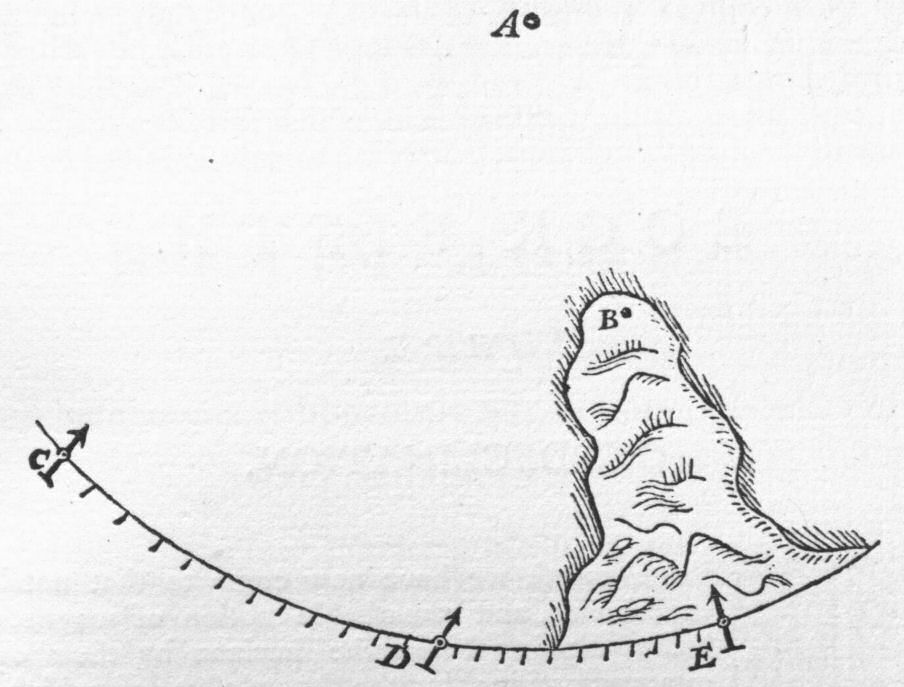
Now from C toward D the variation increases; the versorium, however, does not deviate so rapidly in the first spaces as near D: for more miles are traversed on the parallel circle C D, near C, in order that the versorium may deviate by one degree from the pole A, than near D. So also in order that the variation may be diminished from D toward E more miles are required near D than near E. Thus the deviations become equal in unequal courses, whether the variation be increasing or decreasing; and yet the variation decreases by lesser intervals than it increases. There intervene, however, many other causes which perturb this proportion.
BOOK FIFTH.
CHAP. I.
ON DECLINATION.
n due course we have now come to that notable experiment, and remarkable motion of magnetick bodies dipping below the horizon by their own rotatory nature; by the knowledge of which is revealed a unity, a concordancy, and a mutual agreement between the terrestrial globe and the loadstone (or the magnetick iron), which is wonderful in itself, and is made manifest by our teaching. This motion we have made known in many striking experiments, and have established its rules; and in the following pages we shall demonstrate the causes of it, in such a way that no sound, logical mind can ever rightly set at nought or disprove our chief magnetick principles. Direction, as also variation, is demonstrated in a horizontal plane, when a balanced magnetick needle comes to rest at some definite point; but declination is seen to be the motion of a needle, starting from that point of the horizon, first balanced on its own axis, then excited by a loadstone, one end or pole of it tending toward the centre of the earth. And we have found that it takes place in proportion to the latitude of each region. But that motion arises in truth, not from any motion from the horizon toward the centre of the earth, but from the turning of the whole magnetick body toward the whole of the earth, as we shall show hereafter. Nor does the iron dip from the horizontal in some oblique sphere, according to the number of degrees of elevation of the pole in the given region, or by an equal arc in the quadrant, as will appear hereafter.
Instrument of the Declination
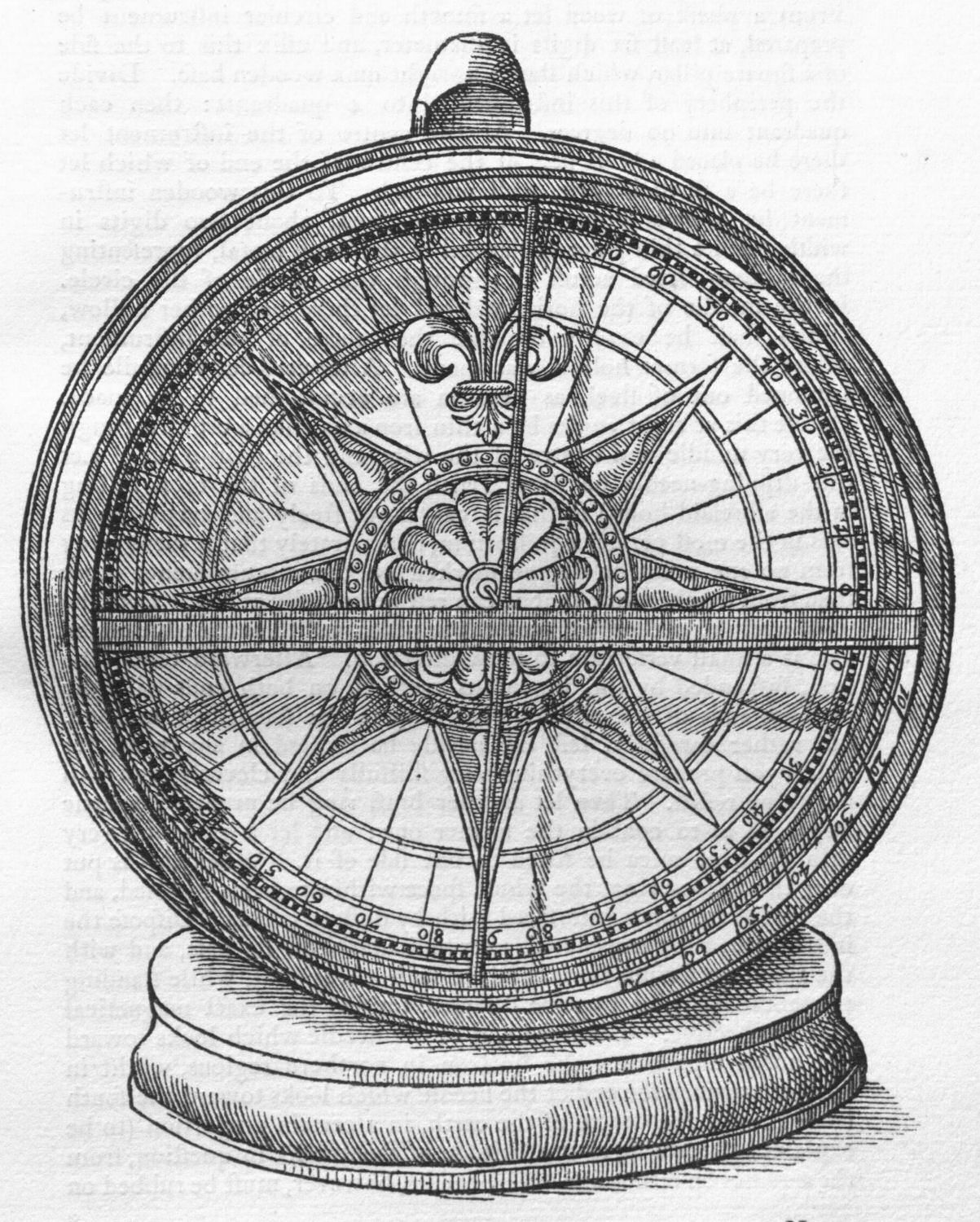
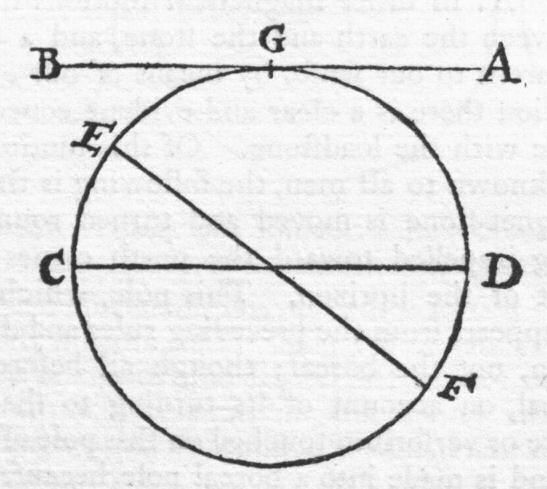
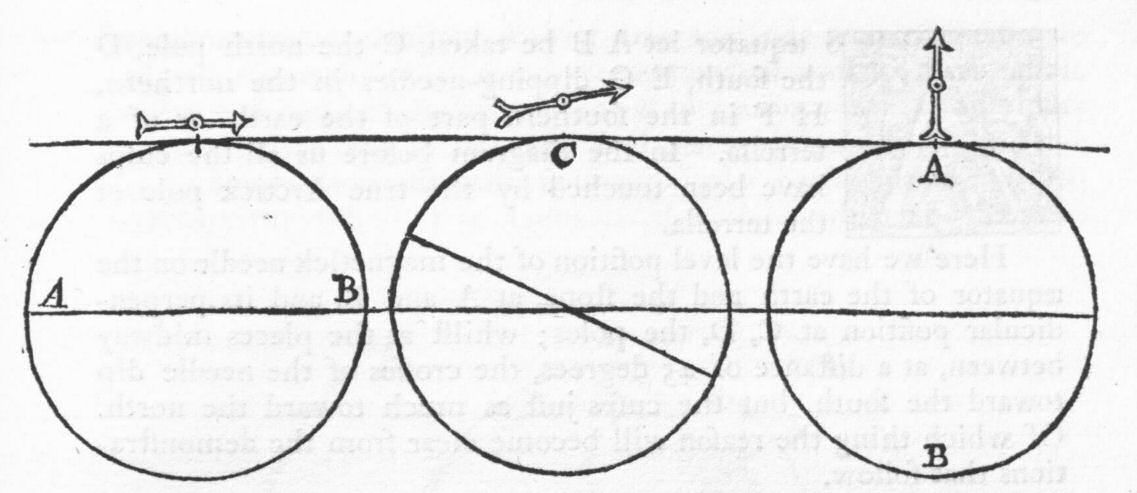
Now how much it dips at every horizon may be ascertained in the first place by a contrivance, which, however, is not so easily made as is that in dials for measuring time, in which the needle turns to the points of the horizon, or in the mariners' compass. From a plank of wood let a smooth and circular instrument be prepared, at least six digits in diameter, and affix this to the side of a square pillar, which stands upright on a wooden base. Divide the periphery of this instrument into 4 quadrants: then each quadrant into 90 degrees. At the centre of the instrument let there be placed a brass peg, at the centre of the end of which let there be a small hollow, well polished. To this wooden instrument let a brass circle or ring be fixed, about two digits in width, with a thin plate or flat rod of the same metal, representing the horizon, fixed across it, through the middle of the circle. In the middle of the horizontal rod let there be another hollow, which shall be exactly opposite the centre of the instrument, where the former hollow was made. Afterward let a needle be fashioned out of steel, as versoria are accustomed to be made. Divide this at right angles by a thin iron axis (like a cross) through the very middle and centre of the wire and the cross-piece. Let this dipping-needle be hung (with the ends of the cross resting in the aforesaid holes) so that it can move freely and evenly on its axis in the most perfect æquilibrium, so accurately that it turns away from no one point or degree marked on the circumference more than from another, but that it can rest quite easily at any. Let it be fixed upright to the front part of the pillar, whilst at the edge of the base is a small versorium to show direction. Afterward touch the iron, suspended by this ingenious method, on both ends with the opposite ends of a loadstone, according to the scientifick method, but rather carefully, lest the needle be twisted in any way; for unless you prepare everything very skilfully and cleverly, you will secure no result. Then let another brass ring be prepared, a little larger, so as to contain the former one; and let a glass or a very thin plate of mica be fitted to one side of it. When this is put over the former ring, the whole space within remains inclosed, and the versorium is not interfered with by dust or winds. Dispose the instrument, thus completed, perpendicularly on its base, and with the small versorium horizontal, in such a way that, while standing perpendicularly, it may be directed toward the exact magnetical point respective. Then the end of the needle which looks toward the north dips below the horizon in northern regions, whilst in southern regions the end of the needle which looks toward the south tends toward the centre of the earth, in a certain proportion (to be explained afterward) to the latitude of the district in question, from the æquator on either side. The needle, however, must be rubbed on a powerful loadstone; otherwise it does not dip to the true point, or else it goes past it, and does not always rest in it. A larger instrument may also be used, whose diameter may be 10 or 12 digits; but in such an instrument more care is needed to balance the versorium truly. Care must be taken that the needle be of steel; also that it be straight; likewise that both ends of the cross-piece be sharp and fixed at right angles to the needle, and that the cross-piece pass through the centre of the needle. As in other magnetical motions there is an exact agreement between the earth and the stone, and a correspondence manifestly apparent to our senses by means of our experiments; so in this declination there is a clear and evident concordance of the terrestrial globe with the loadstone. Of this motion, so important and so long unknown to all men, the following is the sure and true cause. A magnet-stone is moved and turned round until one of its poles being impelled toward the north comes to rest toward a definite point of the horizon. [231]This pole, which settles toward the north (as appears from the preceding rules and demonstrations), is the southern, not the boreal; though all before us deemed it to be the boreal, on account of its turning to that point of the horizon. A wire or versorium touched on this pole of the stone turns to the south, and is made into a boreal pole, because it was touched by the southern terminal of the stone. So if the cusp of a versorium be excited in a similar manner, it will be directed toward the southern pole of the earth, and will adjust itself also to it; but the cross (the other end) will be southern, and will turn to the north of the earth (the earth itself being the cause of its motion); for so direction is produced from the disposition of the stone or of the excited iron, and from the verticity of the earth. But declination takes place when a magnetick is turned round toward the body of the earth, with its southern end toward the north, at some latitude away from the æquator. For this is certain and constant, that exactly under the cœlestial æquator, or rather over the æquator of the terrestrial globe, there is no declination of a loadstone or of iron; but in whatever way the iron has been excited or rubbed, it settles in the declination instrument precisely along the plane of the horizon, if it were properly balanced before. Now this occurs thus because, when the magnetick body is at an equal distance from either pole, it dips toward neither by its own versatory nature, but remains evenly directed to the level of the horizon, as if it were resting on a pin or floating free and unhindered on water. But when the magnetick substance is at some latitude away from the æquator, or when either pole of the earth is raised (I do not say raised above the visible horizon, as the commonly imagined pole of the revolving universe in the sky, but above the horizon or its centre, or its proper diameter, æquidistant from the plane of the visible horizon, which is the true elevation of the terrestrial pole), then declination is apparent, and the iron inclines toward the body of the earth in its own meridian. Let A B, for example, be the visible horizon of a place; C D the horizontal through the earth, dividing it into equal parts; E F the axis of the earth; G the position of the place. It is manifest that the boreal pole E is elevated above the point C by as much as G is distant from the æquator. Wherefore, since at E the magnetick needle stands perpendicularly in its proper turning (as we have often shown before), so now at G there is a certain tendency to turn in proportion to the latitude (the magnetick dipping below the plane of the horizon), and the magnetick body intersects the horizon at unequal angles, and exhibits a declination below the horizon. For the same reason, if the declinatory needle be placed at G, its southern end, the one namely which is directed toward the North, dips below the plane of the visible horizon A B. And so there is the greatest difference between a right sphere[232] and a polar or parallel sphere, in which the pole is at the very Zenith. For in a right sphere the needle is parallel to the plane of the horizon; but when the cœlestial pole is vertically overhead, or when the pole of the earth is itself the place of the region, then the needle is perpendicular to the horizon. This is shown by a round stone. Let a small dipping-needle, of two digits length (rubbed with a magnet), be hung in the air like a balance, and let the stone be carefully placed under it; and first let the terrella be at right angles, as in a right sphere, and as in the first figure; for so the magnetick needle will remain in equilibrium. But in an oblique position of the terrella, as in an oblique sphere, and in the second figure, the needle dips obliquely at one end toward the near pole, but does not rest on the pole, nor is its dip ruled by the pole, but by the body and mass of the whole; for the dip in higher latitudes passes beyond the pole. But in the third position of the terrella the needle is perpendicular; because the pole of the stone is placed at the top, and the needle tending straight toward the body reaches to the pole. The cross in the preceding figures always turns toward the boreal pole of the terrella, having been touched by the boreal pole of the terrella; the cusp of the needle, having been touched by the southern pole of the stone, turns to the south. Thus one may see on a terrella the level, oblique, and perpendicular positions of a magnetick needle. *
CHAP. II.
Diagram of declinations of the magnetick needle, when excited, in the various portions of the sphere, and horizons of the earth, in which there is no variation of the declination.
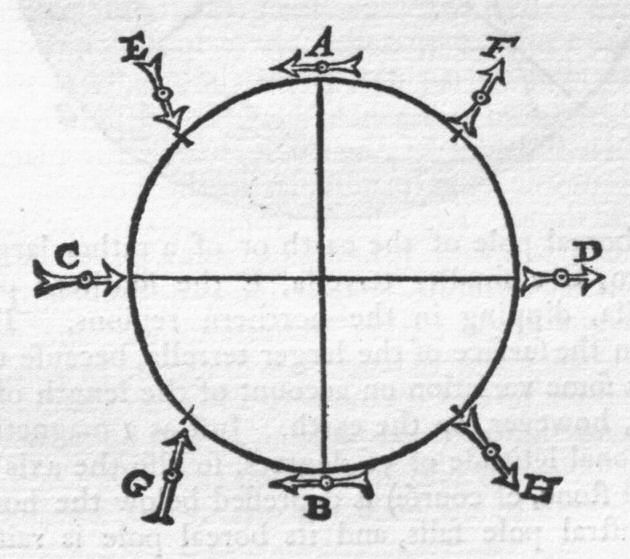
s æquator let A B be taken, C the north pole, D the south, E G dipping-needles in the northern, H F in the southern part of the earth or of a terrella. In the diagram before us all the cusps have been touched by the true Arctick pole of the terrella.
Here we have the level position of the magnetick needle on the æquator of the earth and the stone, at A and B, and its perpendicular position at C, D, the poles; whilst at the places midway between, at a distance of 45 degrees, the crosses of the needle dip toward the south, but the cusps just as much toward the north. Of which thing the reason will become clear from the demonstrations that follow.
* Diagram of the rotation and declination of a terrella conforming to the globe of the earth, for a latitude of 50 degrees north.
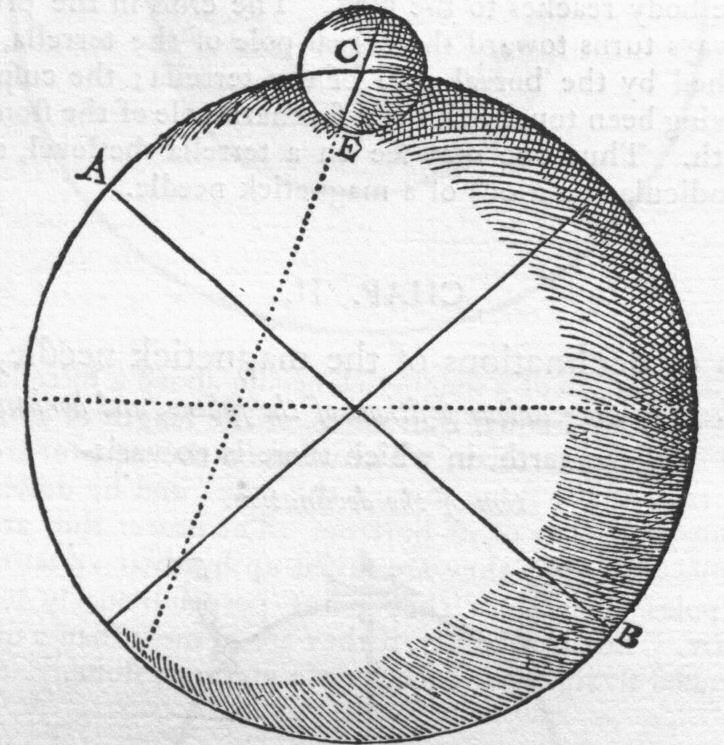
A is the boreal pole of the earth or of a rather large terrella, B the southern, C a smaller terrella, E the southern pole of the smaller terrella, dipping in the northern regions[233]. The centre C is placed on the surface of the larger terrella, because the smaller terrella shows some variation on account of the length of the axis; inappreciable, however, on the earth. Just as a magnetick needle dips in a regional latitude of 50 degrees, so also the axis of a stone (of a spherical stone, of course) is depressed below the horizon, and its natural austral pole falls, and its boreal pole is raised on the south toward the Zenith. In the same way also a circular disc of iron behaves, which has been carefully touched at opposite parts on its circumference; but the magnetical experiments are less clear on account of the feebler forces in round pieces of iron.
Variety in the declinations of iron spikes at various latitudes of a terrella.
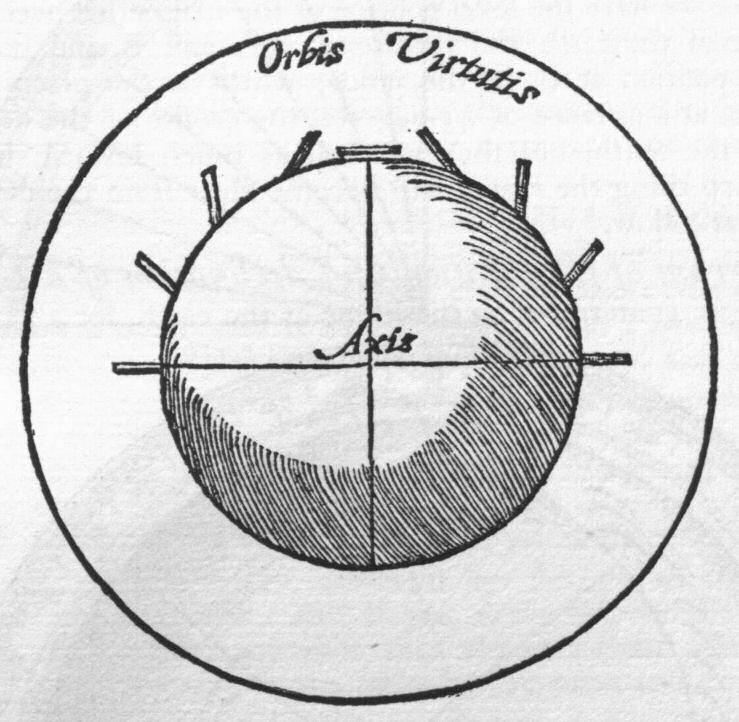
The declination of a magnetick needle above a terrella is shown by means of several equal iron wires, of the length of a barleycorn, arranged along a meridian. The wires on the æquator are directed by the virtue of the stone toward the poles, and lie down upon its body along the plane of its horizon. The nearer they are brought to the poles, the more they are raised up by their versatory nature. At the poles themselves they point perpendicularly toward the very centre. But iron spikes, if they are of more than a due length, are not raised straight up except on a vigorous stone.
CHAP. III.
*
An indicatory instrument, showing by the virtue of a stone the degrees of declination from the horizon of each several latitude.
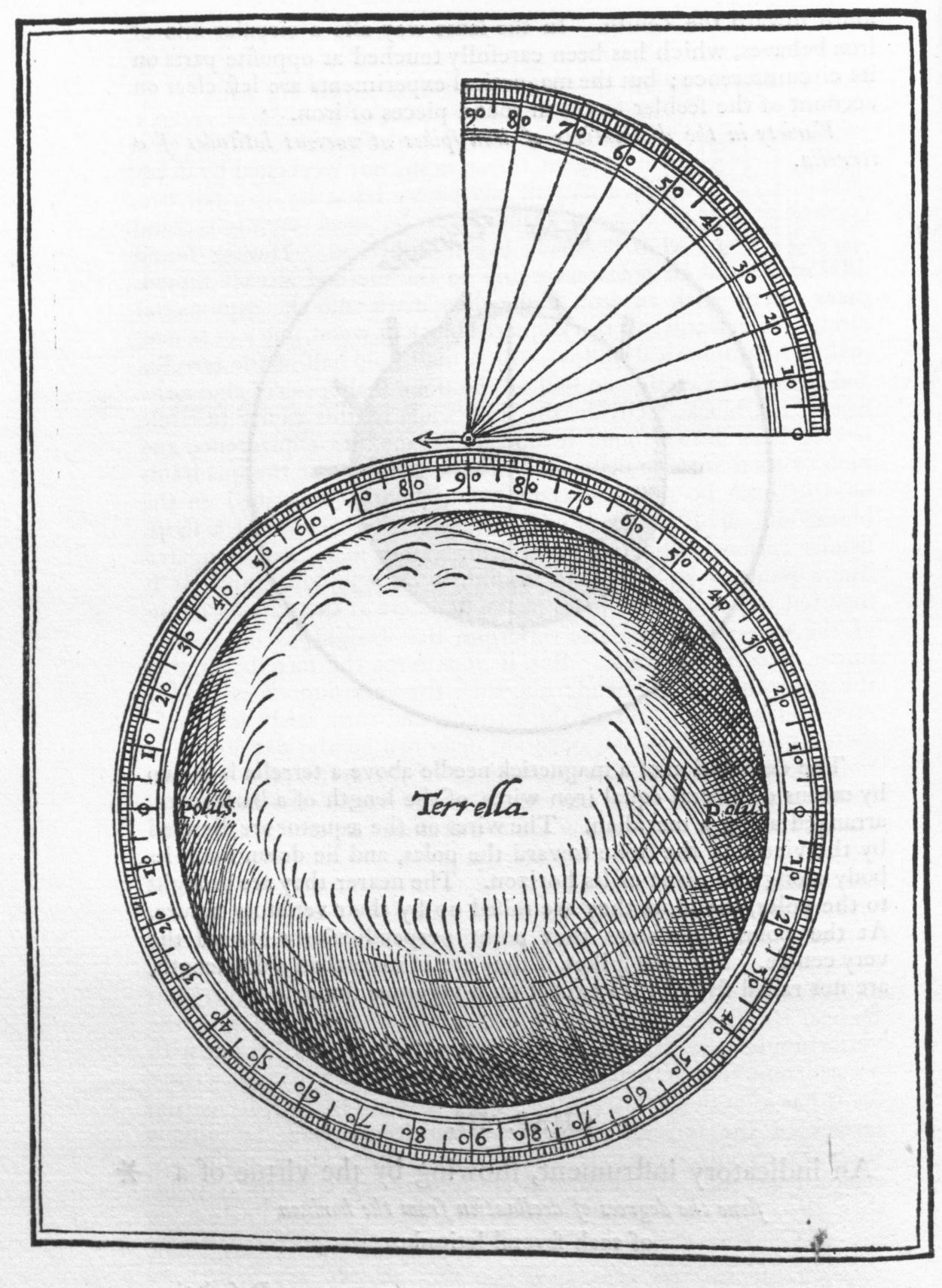
Description of the Instrument, and its use.
ake a terrella of the best strong loadstone, and homogeneous throughout, not weakened by decay or by a flaw in any parts; let it be of a fair size, so that its diameter is six or seven digits; and let it be made exactly spherical. Having found its poles according to the method already shown, mark them with an iron tool; then mark also the æquinoctial circle. Afterwards in a thick squared block of wood, one foot in size, make a hemispherical hollow, which shall hold half of the terrella, and such that exactly one half of the stone shall project above the face of the block. Divide the limb close to this cavity (a circle having been drawn round it for a meridian) into 4 quadrants, and each of these into 90 degrees. Let the terminus of the quadrants on the limb be near the centre of a quadrant described on the block, also divided into 90 degrees. At that centre let a short, slender versorium (its other end being rather sharp and elongated like a pointer) be placed in æquilibrio on a suitable pin. It is manifest that when the poles of the stone are at the starting points of the quadrants, then the versorium lies straight, as if in æquilibrio, over the terrella. But if you move the terrella, so that the pole on the left hand rises, then the versorium rises on the meridian in proportion to the latitude, and turns itself as a magnetick body; and on the quadrant described on the flat surface of the wood, the degree of its turning or of the declination is shown by the versorium. The rim of the cavity represents a meridional circle, to which corresponds some meridian circle of the terrella, since the poles on both sides are within the circumference of the rim itself. These things clearly always happen on the same plan on the earth itself when there is no variation; but when there is variation, either in the direction or in the declination (a disturbance, as it were, in the true turning, on account of causes to be explained later), then there is some difference. Let the quadrant be near the limb, or have its centre on the limb itself, and let the versorium be very short, so as not to touch the terrella, because with a versorium that is longer or more remote, there is some error; for it has a motion truly proportionate to the terrella only on the surface of the terrella. But if the quadrant, being far distant from the terrella, were moved within the orbe of virtue of the terrella toward the pole on some circle concentrick with the terrella, then the versorium would indicate the degrees of declination on the quadrant, in proportion to and symmetrically with that circle, not with the terrella.
CHAP. IIII.
Concerning the length of a versorium convenient for declination on a terrella.
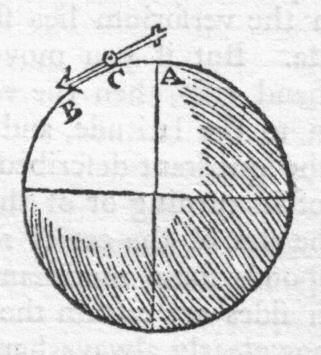
eclination being investigated on the earth itself by means of a declination instrument, we may use either a short or a very long versorium, if only the magnetick virtue of the stone that touches it is able to permeate through the whole of its middle and through all its length. For the greatest length of a versorium has no moment or perceptible proportion to the earth's semi-diameter. On a terrella, however, or in a plane near a meridian of a terrella, a short versorium is desirable, of the length, say, of a barleycorn; for longer ones (because they reach further) dip and turn toward the body of the terrella suddenly and irregularly in the first degrees of declination. For example, as soon as the long versorium is moved forward from the aequator A to C, it catches on the stone with its cusp (as if with a long extended wing), when the cusp reaches to the parts about B, which produce a greater rotation than at C. And the extremities of longer wires also and rods turn irregularly, just as iron wires and balls of iron and other orbicular loadstones are likewise turned about irregularly by a long non-orbicular loadstone. Just so magneticks or iron bodies on the surface of a terrella ought not to have too long an axis, but a very short one; so that they may make a declination on the terrella truly and naturally proportionate to that on the earth. A long versorium also close to a terrella with difficulty stands steady in a horizontal direction on a right sphere, and, beginning to waver, it dips immediately to one side, especially the end that was touched, or (if both were touched) the one which felt the stone last.
CHAP. V.
That declination does not arise from the attraction of the loadstone, but from a disposing and rotating influence.
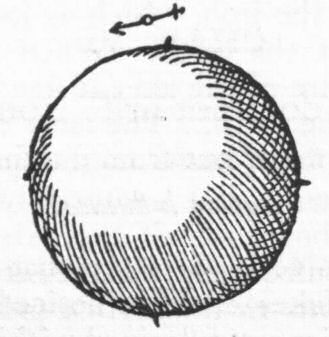
n the universe of nature that marvellous provision of its Maker should be noticed, whereby the principal bodies are restrained within certain habitations and fenced in, as it were (nature controlling them). For this reason the stars, though they move and advance, are not thrown into confusion. Magnetical rotations also arise from a disposing influence, whether in greater and dominating quantity, or in a smaller, and compliant quantity, even though it be very small. For the work is not accomplished by attraction, but by an incitation of each substance, by a motion of agreement toward fixed bounds, beyond which no advance is made. For if the versorium dipped by reason of an attractive force, then a terrella made from a very strong magnetick stone would cause the versorium to turn toward itself more than one made out of an average stone, and a piece of iron touched with a vigorous loadstone would dip more. This, however, never happens. Moreover, an iron snout placed on a meridian in any latitude does not raise a spike more toward the perpendicular than the stone itself, alone and unarmed; although when thus equipped, it plucks up and raises many greater weights[234]. But if a loadstone be sharper toward one pole, toward the other blunter, the sharp end or pole allures a magnetick needle more strongly, the blunt, thick end makes it rotate more strongly; but an orbicular stone * makes it rotate strongly and truly, in accordance with magnetick rules and its globular form. A long stone, on the other hand, extended from pole to pole, moves a versorium toward it irregularly; for in this case the pole of the versorium always looks down on the pole itself. Similarly also, if the loadstone have been made in the shape of a circle, and its poles are on the circumference, whilst the body of it is plane, not globular, if the plane be brought near a versorium, the versorium does not move with the regular magnetick rotation, as on a terrella; but it turns looking always toward the pole of the loadstone, which has its seat on the circumference of the plane. Moreover, if the stone caused the versorium to rotate by attracting it, then in the first degrees of latitude, it would attract the end of a short versorium toward the body itself of the terrella; yet it does not so attract it that they are brought into contact and unite; but the versorium rotates just so far as nature demands, as is clear from this example. * For the cusp of a versorium placed in a low latitude does not touch the stone or unite with it, but only inclines toward it. Moreover, when a magnetick body rotates in dipping, the pole of the versorium is not stayed or detained by the pole of the earth or terrella; but it rotates regularly, and does not stop at any point or bound, nor point straight to the pole toward which the centre of the versorium is advancing, unless on the pole itself, and once only between the pole and the æquator; but it dips as it advances, according as the change of position of its centre gives a reason for its inclination in accordance with rules magnetical. The declination of a magnetick needle in water also, as demonstrated in the following pages, is a fixed quantity[235]; the magnetick needle does not descend to the bottom of the vessel, but remains steady in the middle, rotated on its centre according to its due amount of declination. This would not happen, if the earth or its poles by their attraction drew down the end of the magnetick needle, so that it dipped in this way.
CHAP. VI.
On the proportion of declination to latitude[236], and the cause of it.
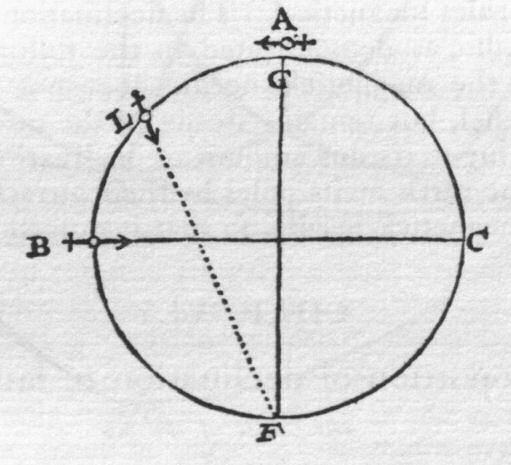
oncerning the making of an instrument for finding declination, the causes and manner of declination, and the different degrees of rotation in different places, the inclination of the stone, and concerning an instrument indicating by the influence of a stone the degree of declination from any horizon we have already spoken. Then we spoke about needles on the meridian of a stone, and their rotation shown for various latitudes by their rise toward the perpendicular. We must now, however, treat more fully of the causes of the degree of that inclination. Whilst a loadstone and a magnetick iron wire are moved along a meridian from the aequator toward the pole, they rotate toward a round loadstone, as also toward the earth with a circular movement. On a right horizon (just as also on the æquinoctial of the stone) the axis of the iron, which is its centre line, is a line parallel to the axis of the earth. When that axis reaches the pole, which is the centre of the axis, it stands in the same straight line with the axis of the earth. The same end of the iron which at the æquator looks south turns to the north. For it is not a motion of centre to centre, but a natural turning of a magnetick body to a magnetick body, and of the axis of the body to the axis; it is not in consequence of the attraction of the pole itself that the iron points to the earth's polar point. Under the æquator the magnetick needle remains in æquilibrio horizontally; but toward the pole on either side, in every latitude from the beginning of the first degree right up to the ninetieth, it dips. The magnetick needle does not, however, in proportion to any number of degrees or any arc of latitude fall below the horizon just that number of degrees or a similar arc, but a very different one: because this motion is not really a motion of declination, but is in reality a motion of rotation, and it observes an arc of rotation according to the arc of latitude. Therefore a magnetick body A, while it is advancing over the earth itself, or a little earth or terrella, from the æquinoctial G toward the pole B, rotates on its own centre, and halfway on the progress of its centre[237] from the æquator to the pole B it is pointing toward the æquator at F, midway between the two poles. Much more quickly, therefore, must the versorium rotate than its centre advances, in order that by rotating it may face straight toward the point F. Wherefore the motion of this rotation is rapid in the first degrees from the æquator, namely, from A to L; but more tardy in the later degrees from L to B, when facing from the æquator at F to C. But if the declination were equal to the latitude (i.e., always just as many degrees from the horizon, as the centre of the versorium has receded from the æquator), then the magnetick needle would be following some potency and peculiar virtue of the centre, as if it were a point operating by itself. But it pays regard to the whole, both its mass, and its outer limits; the forces of both uniting, as well of the magnetick versorium as of the earth. *
CHAP. VII.
Explanation of the diagram of the rotation of a magnetick needle.
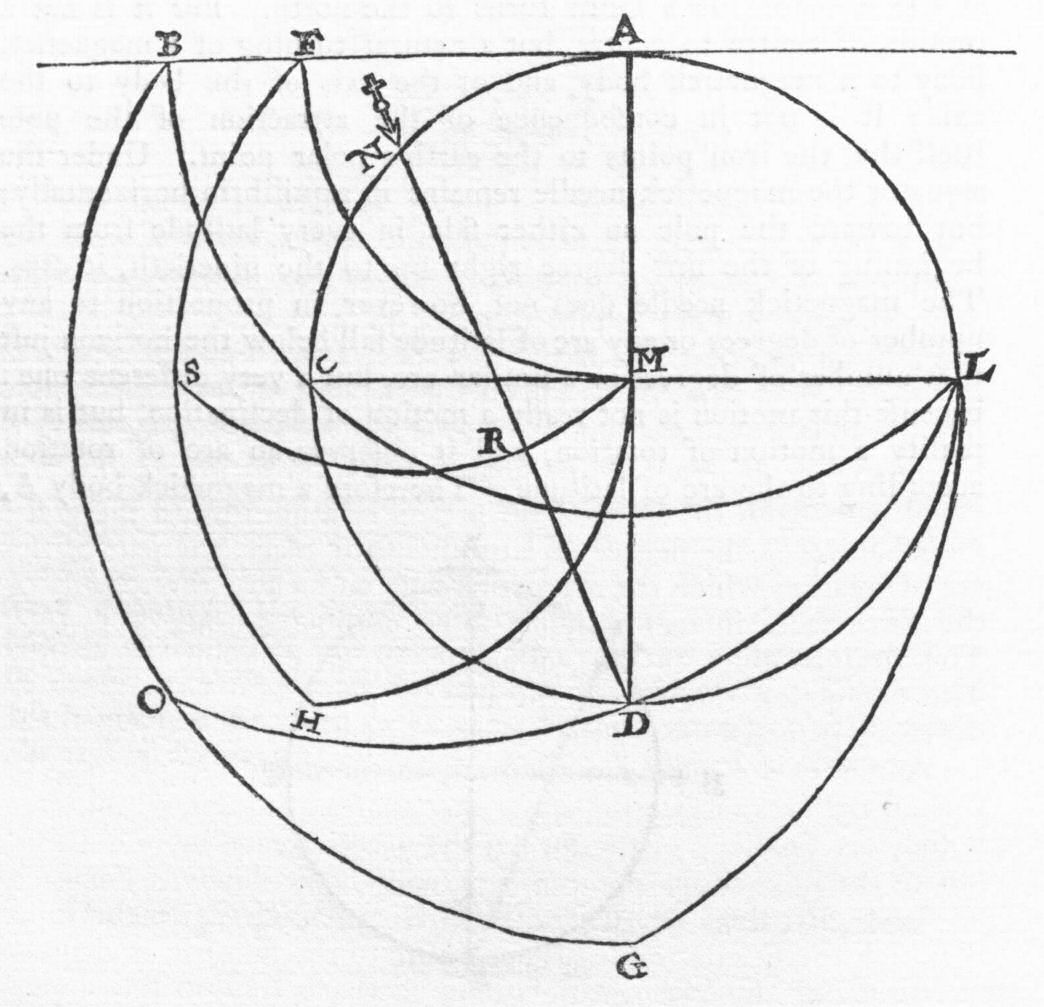
uppose A C D L to be the body of the earth or of a terrella, its centre M, Æquator A D, Axis C L, A B the Horizon, which changes according to the place. From the point F on a Horizon distant from the æquator A by the length of C M, the semi-diameter of the earth or terrella, an arc is described to H as the limit of the quadrants of declination; for all the quadrants of declination serving the parts from A to C begin from that arc, and terminate at M, the centre of the earth. The semi-diameter of this arc is a chord drawn from the æquator A to the pole C; and a line produced along the horizon from A to B, equal to that chord, gives the beginning of the arc of the limits of arcs of rotation and revolution, which is continued as far as G. For just as a quadrant of a circle about the centre of the earth (whose beginning is on the horizon, at a distance from the æquator equal to the earth's semi-diameter) is the limit of all quadrants of declination drawn from each several horizon to the centre; so a circle about the centre from B, the beginning of the first arc of rotation, to G is the limit of the arcs of rotation. The arcs of rotation and revolution of the magnetick needle are intermediate between the arcs of rotation B L and G L. The centre of the arc is the region itself or place in which the observation is being made; the beginning of the arc is taken from the circle which is the limit of rotations, and it stops at the opposite pole; as, for example, from O to L, in a latitude of 45 degrees. Let any arc of rotation be divided into 90 equal parts from the limit of the arcs of rotation toward the pole; for whatever is the degree of latitude of the place, the part of the arc of rotation which the magnetick pole on or near the terrella or the earth faces in its rotation is to be numbered similarly to this. The straight lines in the following larger diagram show this. The magnetick rotation at the middle point in a latitude of 45 degrees is directed toward the æquator, in which case also that arc is a quadrant of a circle from the limit to the pole; but previous to this all the arcs of rotation are greater than a quadrant, whilst after it they are smaller; in the former the needle rotates more quickly, but in the succeeding positions gradually more slowly. For each several region there is a special arc of rotation, in which the limit to which the needle rotates is according to the number of degrees of latitude of the place in question; so that a straight line drawn from the place to the point on that arc marked with the number of degrees of latitude shows the magnetick direction, and indicates the degree of declination at the intersection of the quadrant of declination which serves the given place. Take away the arc of the quadrant of declination drawn from the centre to the line of direction; that which is left is the arc of declination below the horizon. As, for example, in the rotation of the versorium N, whose line respective proceeds to D, from the quadrant of declination, S M, take away its arc R M; that which is left is the arc of declination: how much, that is, the needle dips in the latitude of 45 degrees.
CHAP. VIII.
Diagram of the rotation of a magnetick needle, indicating magnetical declination in all latitudes, and from the rotation and declination, the latitude itself.
n the more elaborate diagram a circle of rotations and a circle of declinations are adjusted to the body of the earth or terrella, with a first, a last, and a middle arc of rotation and declination. Now from each fifth division of the arc which limits all the arcs of rotation (and which are understood[238] as divided into 90 equal parts) arcs are drawn to the pole, and from every fifth degree of the arc limiting the quadrants of declination, quadrants are drawn to the centre; and at the same time a spiral line is drawn, indicating (by the help of a movable quadrant) the declination in every latitude. Straight lines showing the direction of the needle are drawn from those degrees which are marked on the meridian of the earth or a terrella to their proper arcs and the corresponding points on those arcs.
To ascertain the elevation of the pole or the latitude of a place anywhere in the world, by means of the following diagram, turned into a magnetick instrument, without the help of the cœlestial bodies, sun, planets, or fixed stars, in fog and darkness.
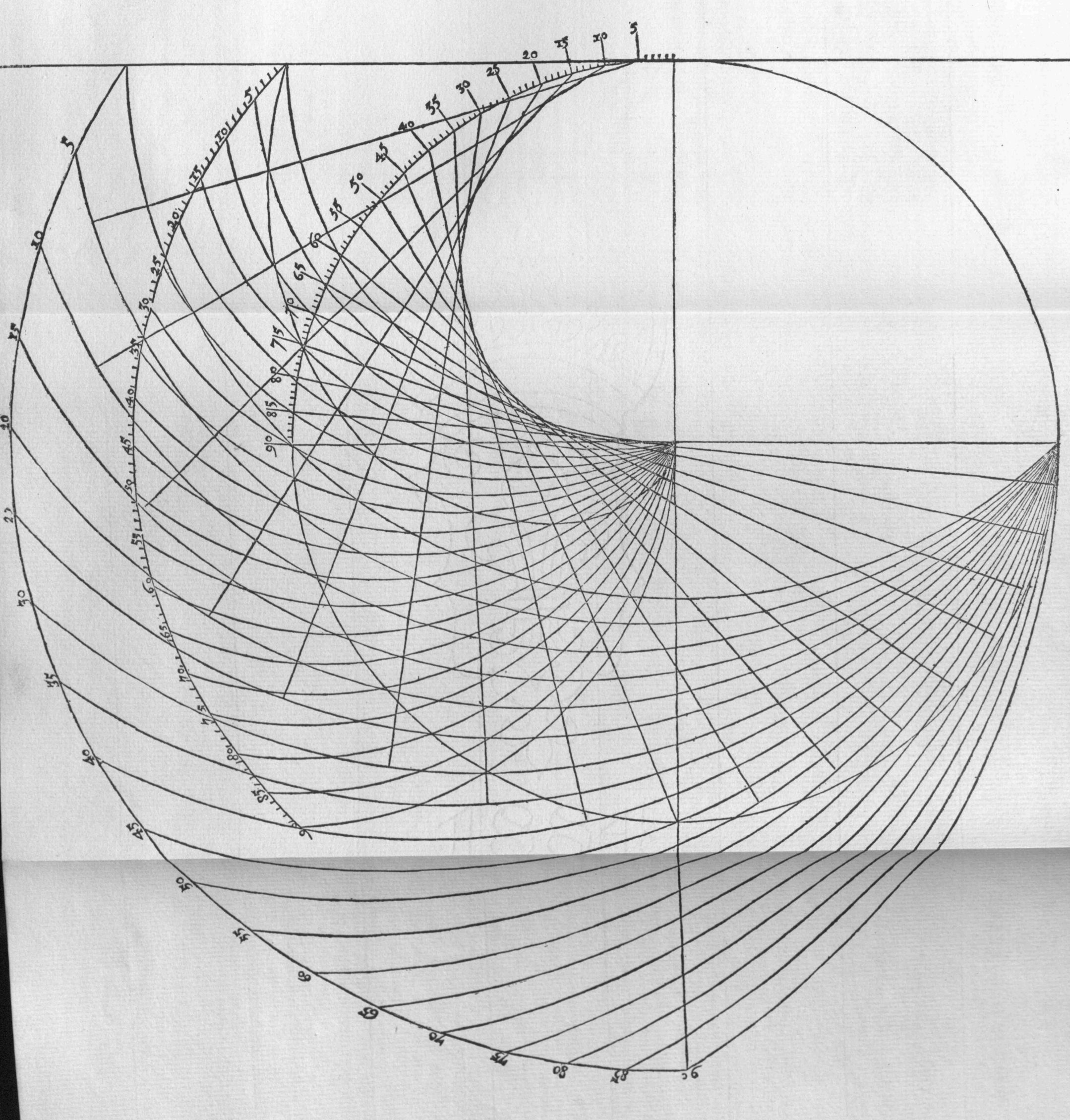
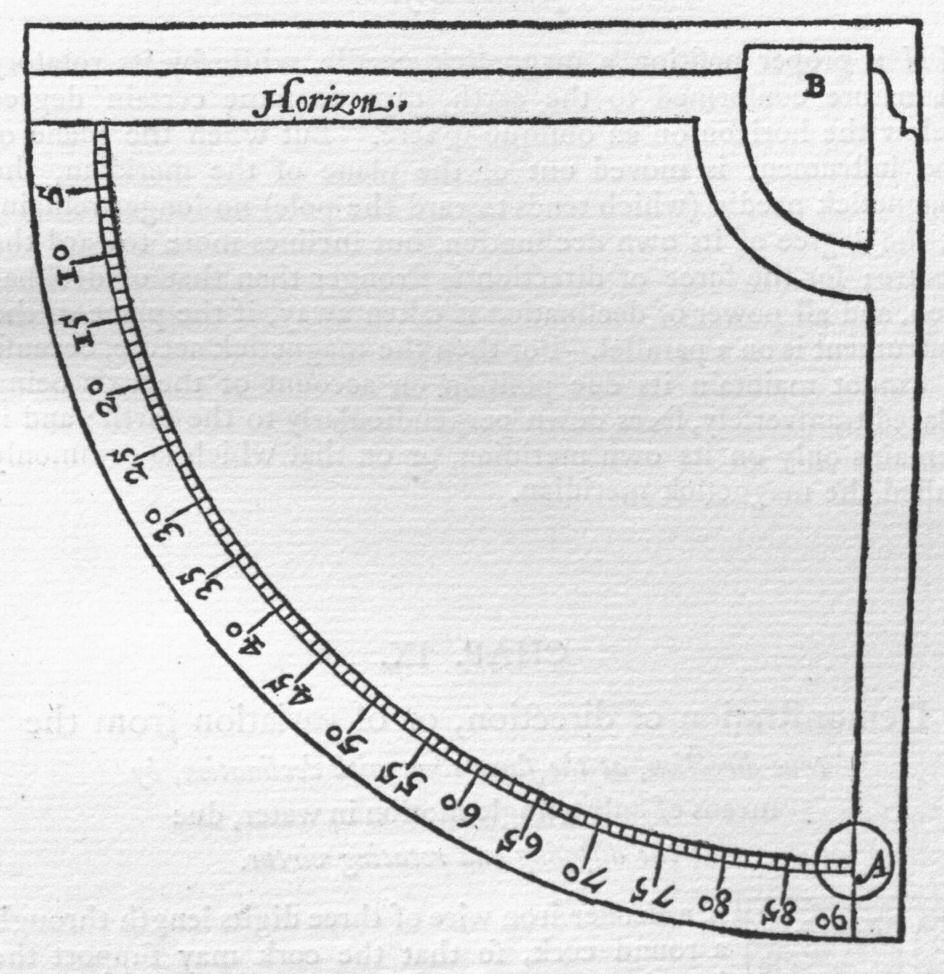
We may see how far from unproductive magnetick philosophy is, how agreeable, how helpful, how divine! Sailors when tossed about on the waves with continuous cloudy weather, and unable by means of the cœlestial luminaries to learn anything about the place or the region in which they are, with a very slight effort and with a small instrument are comforted, and learn the latitude of the place. With a declination instrument the degree of declination of the magnetick needle below the horizon is observed; that degree is noted on the inner arc of the quadrant, and the quadrant is turned round about the centre of the instrument until that degree on the quadrant touches the spiral line; then in the open space B at the centre of the quadrant the latitude of the region on the circumference of the globe is discerned by means of the fiducial line A B. Let the diagram be fixed on a suitable flat board, and let the centre of the corner A of the quadrant be fastened to the centre of it, so that the quadrant may rotate on that centre. But it must be understood that there is also in certain places a variation in the declination on account of causes already mentioned (though not a large one), which it will be an assistance also to allow for on a likely estimate; and it will be especially helpful to observe this variation in various places, as it seems to present greater difficulty than the variation in direction; but it is easily learnt with a declination instrument, when it dips more or less than the line in the diagram.
To observe magnetick declination at sea.
Set upon our variation instrument a declination instrument; a wooden disc being placed between the round movable compass and the declination instrument: but first remove the versorium, lest the versorium should interfere with the dipping needle. In this way (though the sea be rough) the compass box will remain upright at the level of the horizon. The stand of the declination instrument must be directed by means of the small versorium at its base, which is set to the point respective of the variation, on the great circle of which (commonly called the magnetick meridian), the plane of the upright box is arranged; thus the declinatorium (by its versatory nature) indicates the degree of declination.
In a declination instrument the magnetick needle, which in a meridional position dips, if turned along a parallel hangs perpendicularly.
In a proper position a magnetick needle, while by its rotatory nature conformed to the earth, dips to some certain degree below the horizon on an oblique sphere. But when the plane of the instrument is moved out of the plane of the meridian, the magnetick needle (which tends toward the pole) no longer remains at the degree of its own declination, but inclines more toward the centre; for the force of direction is stronger than that of declination, and all power of declination is taken away, if the plane of the instrument is on a parallel. For then the magnetick needle, because it cannot maintain its due position on account of the axis being placed transversely, faces down perpendicularly to the earth; and it remains only on its own meridian, or on that which is commonly called the magnetick meridian.
CHAP. IX.
Demonstration of direction, or of variation from the true direction, at the same time with declination, by means of only a single motion in water, due to the disposing and rotating virtue.
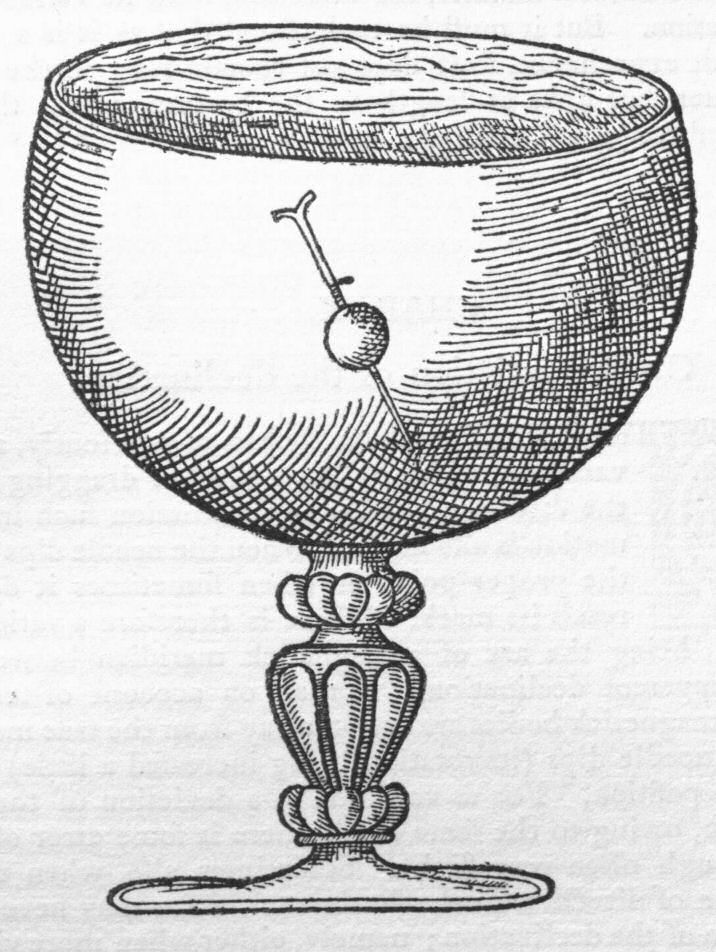
ix a slender iron wire of three digits length through * a round cork, so that the cork may support the iron in water. Let this water be in a good-sized glass vase or bowl. Pare the round cork little by little with a very sharp knife (so that it may remain round), until it will stay motionless one or two digits below the face of the water; and let the wire be evenly balanced. [239]Rub one end of the wire thus prepared on the boreal end of a loadstone and the other on the southern part of the stone (very skilfully, so that the cork may not be moved ever so little from its place) and again place it in the water; then the wire will dip with a circular motion on its own centre below the plane of the horizon, in proportion to the latitude of the region; and, even while dipping, will also show the point of variation (the true direction being perturbed). Let the loadstone (that with which the iron is rubbed) be a strong one, such as is needed in all experiments on magnetick declination. When the iron, thus put into the water and prepared by means of the loadstone, has settled in the dip, the lower end remains at the point of variation on the arc of a great circle or magnetick meridian passing through the Zenith or vertex, and the point of variation on the horizon, and the lowest point of the heavens, which they call the Nadir. This fact is shown by placing a rather long magnetick versorium on one side a little way from the vase. This is a demonstration of a more absolute conformity of a magnetick body with the earth's body as regards unity; in it is made apparent, in a natural manner, the direction, with its variation, and the declination. But it must be understood that as it is a curious and difficult experiment, so it does not remain long in the middle of the water, but sinks at length to the bottom, when the cork has imbibed too much moisture.
CHAP. X.
On the variation of the declination.
irection has been spoken of previously, and also * variation, which is like a kind of dragging aside of the direction. Now in declination such irregular motion is also noticed, when the needle dips beyond the proper point or when sometimes it does not reach its mark. There is therefore a variation of declination, being the arc of a magnetick meridian between the true and apparent declination. For as, on account of terrestrial elevations, magnetick bodies are drawn away from the true meridian, so also the needle dips (its rotation being increased a little) beyond its genuine position. For as variation is a deviation of the direction, so also, owing to the same cause, there is some error of declination, though often very slight. Sometimes, also, when there is no variation of direction in the horizontal, there may nevertheless be variation of the declination; namely, either when more vigorous parts of the earth crop out exactly meridionally, i.e. under the very meridian; or when those parts are less powerful than nature in general requires; or when the virtue is too much intensified in one part, or weakened in another, just as one may observe in the vast ocean. And this discrepant nature and varying effect may be easily seen in certain parts of almost any round loadstone. Inæquality of power is recognized in any part of a terrella by trial of the demonstration in chap. 2 of this book. But the effect is clearly demonstrated by the instrument for showing declination in chap. 3 of this book.
CHAP. XI.
On the essential magnetick activity sphærically effused.
iscourse hath often been held concerning the * poles of the earth and of the stone, and concerning the æquinoctial zone; whilst lately we have been speaking about the declining of magneticks toward the earth and toward the terrella, and the causes of it. But while by various and complicated devices we have laboured long and hard to arrive at the cause of this declination, we have by good fortune found out a new and admirable (beyond the marvels of all virtues magnetical) science of the orbes themselves. For such is the power of magnetick globes, that it is diffused and extended into orbes outside the body itself, the form being carried beyond the limits of the corporeal substance; and a mind diligently versed in this study of nature will find the definite causes of the motions and revolutions. The same powers of a terrella exist also within the whole orbe of its power; and these orbes at any distance from the body of the terrella have in themselves, in proportion to their diameter and the magnitude of their circumference, their own limits of influences, or points wherein magnetick bodies rotate; but they do not look toward the same part of the terrella or the same point at any distance from the same (unless they be on the axis of the orbes and of the terrella); but they always tend to those points of their own orbes, which are distant by similar arcs from the common axis of the orbes. As, for example, in the following diagram, we show the body of a terrella, with its poles and æquator; and also a versorium on three other concentrick orbes around the terrella at some distance from it. In these orbes (as in all those which we may imagine without end) the magnetick body or versorium conforms to its own orbe in which it is located, and to its diameter and poles and æquator, not to those of the terrella; and it is by them and according to the magnitude of their orbes that the magnetick body is governed, rotated, and directed, in any arc of that orbe, both while the centre of the magnetick body stands still, and also while it moves along. And yet we do not mean that the magnetick forms and orbes exist in air or water or in any medium that is not magnetical; as if the air or the water were susceptible of them, or were induced by them; for the forms are only effused and really subsist when magnetick substances are there; whence a magnetick body is laid hold of within the forces and limits of the orbes; and within the orbes magneticks dispose magneticks and incite them, as if the orbes of virtue were solid and material loadstones. For the magnetick force does not pass through the whole medium or really exist as in a continuous body; so the orbes are magnetick, and yet not real orbes nor existent by themselves.
Diagram of motions in magnetick orbes.
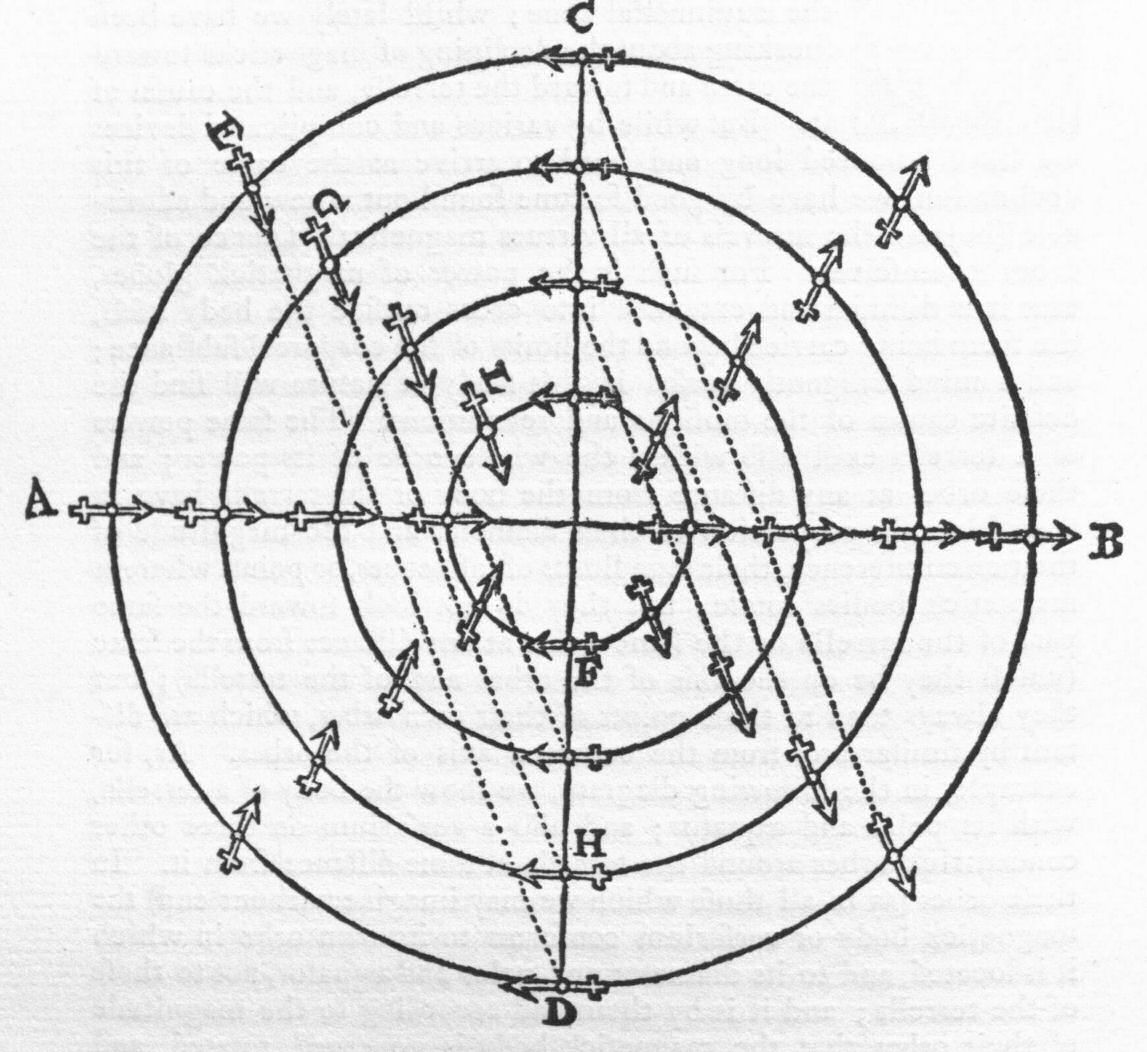
A B is the axis of the terrella and of the orbes, C D the æquator. On all the orbes, as on the terrella, at the equator the versorium arranges itself along the plane of the horizon; on the axis it everywhere looks perpendicularly toward the centre; in the intermediate spaces E looks toward D; and G looks toward H, not toward F, as the versorium L does on the surface of the terrella. But as is the relation of L to F on the surface of the terella, so is that of G to H on its orbe and of E to D on its orbe; also all the rotations on the orbes toward the termini of the orbes are such as they are on the surface of the terrella, or toward the termini of its surface. But if in the more remote orbes this fails somewhat at times, it happens on account of the sluggishness of the stone, or on account of the feebler forces due to the too great distance of the orbes from the terrella.
Demonstration.
Set upon the instrumental diagram described farther back [chap. 3] a plate or stiff circle of brass or tin, on which may be described the magnetick orbes, as in the diagram above; and in the middle let a hole be made according to the size of the terrella, so that the plate may lie evenly on the wood about the middle of the terrella on a meridional circle. Then let a small versorium of the length of a barley-corn be placed on any orbe; upon which, when it is moved to various positions on the same circle, it will always pay regard to the dimensions of that orbe, not to those of the stone; as is shown in the diagram of the effused magnetick forms.
While some assign occult and hidden virtues of substances, others a property of matter, as the causes of the wonderful magnetical effects; we have discovered the primary substantive form of globes, not from a conjectural shadow of the truth of reasons variously controverted; but we have laid hold of the true efficient cause, as from many other demonstrations, so also from this most certain diagram of magnetick forces effused by the form. Though this (the form) has not been brought under any of our senses, and on that account is the less perceived by the intellect, it now appears manifest and conspicuous even to the eyes through this essential activity which proceeds from it as light from a lamp. And here it must be noted that a magnetick needle, moved on the top of the earth or of a terrella or of the effused orbes, makes two complete rotations in one circuit of its centre, like some epicycle about its orbit.
CHAP. XII.
Magnetick force is animate, or imitates life; and in many things surpasses human life, while this is bound up in the organick body.
loadstone is a wonderful thing in very many experiments, and like a living creature. And one of its remarkable virtues is that which the ancients considered to be a living soul in the sky, in the globes and in the stars, in the sun and in the moon. For they suspected that such various motions could not arise without a divine and animate nature, immense bodies turned about in fixed times, and wonderful powers infused into other bodies; whereby the whole universe flourishes in most beautiful variety, through this primary form of the globes themselves. The ancients, as Thales, Heraclitus, Anaxagoras, Archelaus, Pythagoras, Empedocles, Parmenides, Plato, and all the Platonists, and not only the older Greeks, but the Egyptians and Chaldæans, seek for some universal life in the universe, and affirm that the whole universe is endowed with life. Aristotle affirms that not the whole universe is animate, but only the sky; but he maintains that its elements are inanimate; whilst the stars themselves are animate. We, however, find this life in globes only and in their homogenic parts; and though it is not the same in all globes (for it is much more eminent in the sun and in certain stars than in others of less nobility) yet in very many the lives of the globes agree in their powers. For each several homogenic part draws to its own globe in a similar manner, and has an inclination to the common direction of the whole in the universe; and the effused forms extend outward in all, and are carried out into an orbe, and have bounds of their own; hence the order and regularity of the motions and rotations of all the planets, and their courses, not wandering away, but fixed and determined. Wherefore Aristotle concedes life to the sphæres themselves and to the orbes of the heavens (which he feigns), because they are suitable and fitted for a circular motion and actions, and are carried along in fixed and definite courses. It is surely wonderful, why the globe of the earth alone with its emanations is condemned by him and his followers and cast into exile (as senseless and lifeless), and driven out of all the perfection of the excellent universe. It is treated as a small corpuscle in comparison with the whole, and in the numerous concourse of many thousands it is obscure, disregarded, and unhonoured. With it also they connect the kindred elements, in a like unhappiness, wretched and neglected. Let this therefore be looked upon as a monstrosity in the Aristotelian universe, in which everything is perfect, vigorous, animated; whilst the earth alone, an unhappy portion, is paltry, imperfect, dead, inanimate, and decadent. But on the other hand Hermes, Zoroaster, Orpheus, recognize a universal life. We, however, consider that the whole universe is animated, and that all the globes, all the stars, and also the noble earth have been governed since the beginning by their own appointed souls and have the motives of self-conservation. Nor are there wanting, either implanted in their homogenic nature or scattered through their homogenic substance, organs suitable for organic activity, although these are not fashioned of flesh and blood as animals, or composed of regular limbs, which are also hardly perceptible in certain plants and vegetables; since regular limbs are not necessary for all life. Nor can any organs be discerned or imagined by us in any of the stars, the sun, or the planets, which are specially operative in the universe; yet they live and imbue with life the small particles in the prominences on the earth. If there be anything of which men can boast, it is in fact life, intelligence; for the other animals are ennobled by life; God also (by whose nod all things are ruled) is a living soul. Who therefore will demand organs for the divine intelligences, which rise superior to every combination of organs and are not restrained by materialized organs? But in the several bodies of the stars the implanted force acts otherwise than in those divine existences which are supernaturally ordained; and in the stars, the sources of things, otherwise than in animals; in animals again otherwise than in plants. Miserable were the condition of the stars, abject the lot of the earth, if that wonderful dignity of life be denied to them, which is conceded to worms, ants, moths, plants, and toadstools; for thus worms, moths, grubs would be bodies more honoured and perfect in nature; for without life no body is excellent, valuable, or distinguished. But since living bodies arise and receive life from the earth and the sun, and grass grows on the earth apart from any seeds thrown down (as when soil is dug up from deep down in the earth, and put on some very high place or on a very high tower, in a sunny spot, not so long after various grasses spring up unbidden) it is not likely that they can produce what is not in them; but they awaken life, and therefore they are living. Therefore the bodies of the globes, as important parts of the universe, in order that they might be independent and that they might continue in that condition, had a need for souls to be united with them, without which there can be neither life, nor primary activity, nor motion, nor coalition, nor controlling power, nor harmony, nor endeavour, nor sympathy; and without which there would be no generation of anything, no alternations of the seasons, no propagation; but all things would be carried this way and that, and the whole universe would fall into wretchedest Chaos, the earth in short would be vacant, dead, and useless. But it is only on the superficies of the globes that the concourse of living and animated beings is clearly perceived, in the great and pleasing variety of which the great master-workman is well pleased. But those souls which are restrained within a kind of barrier and in prison cells, as it were, do not emit immaterial effused forms outside the limits of their bodies; and bodies are not moved by them without labour and waste. They are brought and carried away by a breath; and when this has calmed down or been suppressed by some untoward influence, their bodies lie like the dregs of the universe and as the refuse of the globes. But the globes themselves remain and continue from year to year, move, and advance, and complete their courses, without waste or weariness. The human soul uses reason, sees many things, inquires about many more; but even the best instructed receives by his external senses (as through a lattice) light and the beginnings of knowledge. Hence come so many errors and follies, by which our judgments and the actions of our lives are perverted; so that few or none order their actions rightly and justly. But the magnetick force of the earth and the formate life or living form of the globes, without perception, without error, without injury from ills and diseases, so present with us, has an implanted activity, vigorous through the whole material mass, fixed, constant, directive, executive, governing, consentient; by which the generation and death of all things are carried on upon the surface. For, without that motion, by which the daily revolution is performed, all earthly things around us would ever remain savage and neglected, and more than deserted and absolutely idle. But those motions in the sources of nature are not caused by thinking, by petty syllogisms, and theories, as human actions, which are wavering, imperfect, and undecided; but along with them reason, instruction, knowledge, discrimination have their origin, from which definite and determined actions arise, from the very foundations that have been laid and the very beginnings of the universe; which we, on account of the infirmity of our minds, cannot comprehend. Wherefore Thales, not without cause (as Aristotle relates in his book De Anima), held that the loadstone was animate, being a part and a choice offspring of its animate mother the earth.
BOOK SIXTH.
CHAP. I.
ON THE GLOBE OF THE EARTH, THE great magnet.
itherto our subject hath been the loadstone and things magnetical: how they conspire together, and are acted upon, how they conform themselves to the terrella and to the earth. Now must we consider separately the globe itself of the earth. Those experiments which have been proved by means of the terrella, how magnetick things conform themselves to the terrella, are all or at least the principal and most important of them, displayed by means of the earth's Body: And to the earth things magnetical are in all respects associate. First, as in the terrella the æquator, meridians, parallels, axis, poles are natural boundaries, as numerous experiments make plain: So also in the earth these boundaries are natural, not mathematical only (as all before us used to suppose). These boundaries the same experiments display and establish in both cases alike, in the earth no less than in the terrella. Just as on the periphery of a terrella a loadstone or a magnetick piece of iron is directed to its proper pole: so on the earth's surface are there turnings-about, peculiar, manifest, and constant on either side of the æquator. Iron is indued with verticity by being extended toward a pole of the earth, just as toward a pole of the terrella: By its being placed down also, and cooling toward the earth's pole after the pristine verticity has been annulled by fire, it acquires new verticity, conformable to its position earthward. Iron rods also, when placed some considerable time toward the poles, acquire verticity merely by regarding the earth; just as the same rods, if placed toward the pole of a loadstone, even without touching it, receive polar virtue. There is no magnetick body that in any way runs to the terrella which does not also wait upon the earth. As a loadstone is stronger at one end on one side or other[240] of its æquator: so is the same property displayed by a small terrella upon the surface of a larger terrella. According to the variety and artistick skill in the rubbing of the magnetick iron upon the terrella, so do the magnetick things perform their function more efficiently or more feebly. In motions toward the earth's body, as toward the terrella a variation is displayed due to the unlikeness, inequality, and imperfection of its eminences: So every variation of the versorium or mariners' compass, everywhere by land or by sea, which thing has so sorely disturbed men's minds, is discerned and recognized as due to the same causes. The magnetick dip (which is the wonderful turning of magnetick things to the body of the terrella) in systematick course, is seen in clearer light to be the same thing upon the earth. And that single experiment, by a wonderful indication, as with a finger, proclaims the grand magnetick nature of the earth to be innate and diffused through all her inward parts. A magnetick vigour exists then in the earth just as in the terrella, which is a part of the earth, homogenic in nature with it, but rounded by Art, so as to correspond with the earth's globous shape and in order that in the chief experiments it might accord with the globe of the earth.
CHAP. II.
The Magnetick axis of the Earth persists invariable.
s in the very first beginnings of the moving world, the earth's magnetick axis passed through the midst of the earth: so now it tends through the centre to the same points of the superficies; the circle and plane of the æquinoctial line also persisting. For not without the vastest overthrow of the terrene mass can these natural boundaries be changed, as it is easy to gather from magnetick demonstrations. Wherfore the opinion of Dominicus Maria of Ferrara, a most talented man, who was the teacher of Nicolas Copernicus, must be cancelled; a view which, according to certain observations of his own, is as follows.[241] "I," he says, "in former years while studying Ptolemy's Geographia discovered that the elevations of the North pole placed by him in the several regions, fall short of what they are in our time by one degree and ten minutes: which divergence can by no means be ascribed to an error of the tables: For it is not credible that the whole series in the book is equally wrong in the figures of the tables: Hence it is necessary to allow that the North pole has been tilted toward the vertical point. Accordingly a lengthy observation has already begun to disclose to us things hidden from our forefathers; not indeed through any sloth of theirs, but because they lacked the prolonged observation of their predecessors: For before Ptolemy very few places were observed with regard to the elevations of the pole, as he himself also bears witness at the beginning of his Cosmographia: (For, says he) Hipparchus alone hath handed down to us the latitudes of a few places, but a good many have noted those of distances; especially those which lie toward sunrise or sunset were received by some general tradition, not owing to any sloth on the part of authors themselves, but to the fact that there was as yet no practice of more exact mathematicks. 'Tis accordingly no wonder, if our predecessors did not mark this very slow motion: For in one thousand and seventy years it shows itself to be displaced scarce one degree toward the apex of dwellers upon the earth. The strait of Gibraltar shows this, where in Ptolemy's time the North pole appears elevated 36 degrees and a quarter from the Horizon: whereas now it is 37 and two-fifths. The like divergence is also shown at Leucopetra in Calabria, and at particular spots in Italy, namely those which have not changed from Ptolemy's time to our own. And so by reason of this movement, places now inhabited will some day become deserted, while those regions which are now parched at the torrid zone will, though long hence, be reduced to our temper of climate. Thus, as in a course of three hundred and ninety five thousands of years, is that very slow movement completed." Thus, according to these observations of Dominicus Maria, the North pole is at a higher elevation, and the latitudes of places are greater than formerly; whence he argues a change of latitudes. Now, however, Stadius, taking just the contrary view, proves by observations that the latitudes have decreased. For he says: "The latitude of Rome in Ptolemy's Geographia is 41 degrees ⅔: and that you may not suppose any error of reckoning to have crept in on the part of Ptolemy, on the day of the Æquinox in the city of Rome, the ninth part of the gnomon of the sun-dial is lacking in shadow, as Pliny relates and Vitruvius witnesseth in his ninth book." But the observation of moderns (according to Erasmus Rheinholdus) gives the same in our time as 41 degrees with a sixth: so that you are in doubt as to half of one degree in the centre of the world, whether you show it to have decreased by the earth's obliquity of motion. One may see then how from inexact observations men rashly conceive new and contradictory opinions and imagine absurd motions of the mechanism of the earth. For since Ptolemy only received certain latitudes from Hipparchus, and did not in very many places make the observations himself; it is likely that he himself, knowing the position of the places, formed his estimate of the latitude of cities from probable conjecture only, and then placed it in the maps. Thus one may see, in the case of our own Britain, that the latitudes of cities are wrong by two or three degrees, as experience teaches. Wherefore all the less should we from those mistakes infer a new motion, or let the noble magnetick nature of the earth be debased for an opinion so lightly conceived. Moreover, those mistakes crept the more readily into geography, from the fact that the magnetick virtue was utterly unknown to those geographers. Besides, observations of latitudes cannot be made sufficiently exactly, except by experts, using also finer instruments, and taking into account the refraction of the lights.
CHAP. III.
On the magnetick diurnal revolution of the Earth's globe, as a probable assertion against the time-honoured opinion of a Primum Mobile.
mong the ancients Heraclides of Pontus and Ecphantus, afterwards the Pythagoreans, as Nicetas of Syracuse and Aristarchus of Samos, and some others (as it seems), used to think that the earth moves, and that the stars set by the interposition of the earth and rose by her retirement. In fact they set the earth moving and make her revolve around her axis from west to east, like a wheel turning on its axle. Philolaus the Pythagorean[242] would have the earth to be one of the stars, and believed that it turned in an oblique circle around fire, just as the sun and moon have their own courses. He was a distinguished mathematician, and a most able investigator of nature. But after Philosophy became a subject treated of by very many and was popularized, theories adapted to the vulgar intelligence or based on sophistical subtility occupied the minds of most men, and prevailed like a torrent, the multitude consenting. Thereupon many valuable discoveries of the ancients were rejected, and were dismissed to perish in banishment; or at least by not being further cultivated and developed became obsolete. So that Copernicus[243] (among later discoverers, a man most deserving of literary honour) is the first who attempted to illustrate the φαινόμενα of moving bodies by new hypotheses: and these demonstrations of reasons others either follow or observe in order that they may more surely discover the phænomenal harmony of the movements; being men of the highest attainments in every kind of learning. Thus supposed and imaginary orbs of Ptolemy and others for finding the times and periods of the motions are not necessarily to be admitted to the physical inquiries of philosophers. It is then an ancient opinion and one that has come down from old times, but is now augmented by important considerations that the whole earth rotates with a daily revolution in the space of 24 hours. Well then, since we see the Sun and Moon and other planets and the glory of all the stars approach and retire within the space of one natural day, either the Earth herself must needs be set in motion with a diurnal movement from West to East, or the whole heaven and the rest of nature from East to West. But, in the first place, it is not likely that the highest heaven and all those visible splendours of the fixed stars are impelled along that most rapid and useless course. Besides, who is the Master who has ever made out that the stars which we call fixed are in one and the same sphere, or has established by reasoning that there are any real and, as it were, adamantine sphæres? No one has ever proved this as a fact; nor is there a doubt but that just as the planets are at unequal distances from the earth, [244]so are those vast and multitudinous lights separated from the Earth by varying and very remote altitudes; they are not set in any sphærick frame or firmament (as is feigned), nor in any vaulted body: accordingly the intervals of some are from their unfathomable distance matter of opinion rather than of verification; others do much exceed them and are very far remote, and these being located in the heaven at varying distances, either in the thinnest æther or in that most subtile quintessence, or in the void: how are they to remain in their position during such a mighty swirl of the vast orbe of such uncertain substance. There have been observed by astronomers 1022 stars; besides these, numberless others are visible, some indeed faint to our senses, in the case of others our sense is dim and they are hardly perceived and only by exceptionally keen eyes, and there is no one gifted with excellent sight who does not when the Moon is dark and the air at its rarest, discern numbers and numbers dim and wavering with minute lights on account of the great distance: hence it is credible both that these are many and that they are never all included in any range of vision. How immeasurable then must be the space which stretches to those remotest of fixed stars! How vast and immense the depth of that imaginary sphere! How far removed from the Earth must the most widely separated stars be and at a distance transcending all sight, all skill and thought! How monstrous then such a motion would be! It is evident then that all the heavenly bodies set as if in destined places are there formed into sphæres, that they tend to their own centres, and that round them there is a confluence of all their parts. And if they have motion, that motion will rather be that of each round its own centre, as that of the Earth is; or a forward movement of the centre in an orbit, as that of the Moon: there would not be circular motion in the case of a too numerous and scattered flock. Of these stars some situate near the Æquator would seem to be borne around at a very rapid rate, others nearer the pole to have a somewhat gentler motion, others, apparently motionless, to have a slight rotation. Yet no differences in point of light, mass or colours are apparent to us: for they are as brilliant, clear, glittering and duskish toward the poles, as they are near the Æquator and the Zodiack: those which remain set in those positions do not hang, and are neither fixed, nor bound to anything of the nature of a vault. All the more insane were the circumvolution of that fictitious Primum Mobile, which is higher, deeper, and still more immeasurable. Moreover, this inconceivable Primum Mobile ought to be material and of enormous depth, far surpassing all inferior nature in size: for nohow else could it conduct from East to West so many and such vast bodies of stars, and the universe even down to the Earth: and it requires us to accept in the government of the stars a universal power and a despotism perpetual and intensely irksome. That Primum Mobile bears no visible body, is nohow recognizable, is a fiction believed in by those people, accepted by the weak-minded folk, who wonder more at our terrestrial mass than at bodies so vast, so inconceivable, and so far separated from us. But there can be no movement of infinity and of an infinite body, and therefore no diurnal revolution of that vastest Primum Mobile. The Moon being neighbour to the Earth revolves in 27 days; Mercury and Venus have their own moderately slow motions; Mars finishes a period in two years, Jupiter in twelve years, Saturn in thirty. And those also who ascribe a motion to the fixed stars make out that it is completed in 36,000 years, according to Ptolemy, in 25,816 years, according to Copernicus' observations; so that the motion and the completion of the journey always become slower in the case of the greater circles. And would there then be a diurnal motion of that Primum Mobile which is so great and beyond them all immense and profound? 'Tis indeed a superstition and in the view of philosophy a fable now only to be believed by idiots, deserving more than ridicule from the learned: and yet in former ages, that motion, under the pressure of an importunate mob of philosophizers, was actually accepted as a basis of computations and of motions, by mathematicians. The motions of the bodies (namely planets) seem to take place eastward and following the order of the signs. The common run of mathematicians and philosophers also suppose that the fixed stars in the same manner advance with a very slow motion: and from ignorance of the truth they are forced to join to them a ninth sphære. Whereas now this first and unthinkable Primum Mobile, a fiction not comprehended by any judgment, not evidenced by any visible constellation, but devised of imagination only and mathematical hypothesis, unfortunately accepted and believed by philosophers, extended into the heaven and beyond all the stars, must needs with a contrary impulse turn about from East to West, in opposition to the inclination of all the rest of the Universe. Whatsoever in nature is moved naturally, the same is set in motion both by its own forces and by the consentient compact of other bodies. Such is the motion of parts to their whole, of all interdependent sphæres and stars in the universe: such is the circular impulse in the bodies of the planets, when they affect and incite one another's courses. But with regard to the Primum Mobile and its contrary and exceeding rapid movement, what are the bodies which incite it or propel it? What is the nature that conspires with it? Or what is that mad force beyond the Primum Mobile? Since it is in bodies themselves that acting force resides, not in spaces or intervals. But he who thinks that those bodies are at leisure and keeping holiday, while all the virtue of the universe appertains to the very orbits and sphæres, is on this point not less mad than he who, in some one else's house, thinks that the walls and floors and roof rule the family rather than the wife and thoughtful paterfamilias. Therefore not by the firmament are they borne along, or are moved, or have their position; much less are those confused crowds of stars whirled around by the Primum Mobile, nor are they torn away and huddled along by a contrary and extremely rapid movement. Ptolemy of Alexandria seems to be too timid and weak-minded in dreading the dissolution of this nether world, were the Earth to be moved round in a circle. Why does he not fear the ruin of the Universe, dissolution, confusion, conflagration, and infinite disasters celestial and super-celestial, from a motion transcending all thoughts, dreams, fables, and poetic licences, insurmountable, ineffable, and inconceivable? Wherefore we are carried along by a diurnal rotation of the earth (a motion for sure more congruous), and as a boat moves above the waters, so do we turn about with the earth, and yet seem to ourselves to be stationary, and at rest. Great and incredible it seems to some philosophers, by reason of inveterate prejudice, that the Earth's vast body should be swirled wholly round in the space of 24 hours. But it would be more incredible that the Moon should travel through her orbit, or complete an entire course in a space of 24 hours; more so the Sun or Mars; still more Jupiter and Saturn; more than marvellous would be the velocity in the case of the fixed stars and the firmament; what in the world they would have to wonder at in the case of their ninth sphere, let them imagine as they like. But to feign a Primum Mobile and to attribute to the thing thus feigned a motion to be completed in the space of 24 hours, and not to allow this motion to the Earth in the same interval of time, is absurd. For a great circle of the Earth is to the ambit of the Primum Mobile less than a furlong to the whole Earth. If the diurnal rotation of the Earth seem headlong, and not admissible in nature by reason of its rapidity, worse than insane will be the movement of the Primum Mobile both for itself and the whole universe, agreeing as it does with no other motion in any proportion or likeness. It seems to Ptolemy and the Peripateticks that nature must be disordered, and the framework and structure of this globe of ours be dissolved, by reason of so swift a terrestrial revolution. The Earth's diameter is 1718 German miles; the greatest elongation of the new Moon is 65, the least is 55 semi-diameters of the Earth: the greatest altitude of the half moon is 68, the least 52: yet it is probable that its sphære is still larger and deeper. The sun in its greatest eccentricity has a distance of 1142 semi-diameters of the Earth; Mars, Jupiter, Saturn, being slower in motion, are so proportionately further remote from the Earth. The distances of the firmament and of the fixed stars seem to the best mathematicians inconceivable. Leaving out the ninth sphære, if the convexity of the Primum Mobile be duly estimated in proportion to the rest of the sphæres, the vault of the Primum Mobile must in one hour run through as much space as is comprised in 3000 great circles of the Earth, for in the vault of the firmament it would complete more than 1800; but what iron solidity can be imagined so firm and tough as not to be disrupted and shattered to fragments by a fury so great and a velocity so ineffable. The Chaldæans indeed would have it that the heaven consists of light. In light, however, there is no so-great firmness, neither is there in Plotinus' fiery firmament, nor in the fluid or aqueous or supremely rare and transparent heaven of the divine Moses, which does not cut off from our sight the lights of the stars. We must accordingly reject the so deep-set error about this so mad and furious a celestial velocity, and the forced retardation of the rest of the heavens. Let theologians discard and wipe out with sponges those old women's tales of so rapid a spinning round of the heavens borrowed from certain inconsiderate philosophers. The sun is not propelled by the sphære of Mars (if a sphære there be) and by his motion, nor Mars by Jupiter, nor Jupiter by Saturn. The sphære, too, of the fixed stars, seems well enough regulated except so far as motions which are in the Earth are ascribed to the heavens, and bring about a certain change of phænomena. The superiors do not exercise a despotism over the inferiors; for the heaven of philosophers, as of theologians, must be gentle, happy, and tranquil, and not at all subject to changes: nor shall the force, fury, swiftness, and hurry of a Primum Mobile have dominion over it. That fury descends through all the celestial sphæres, and celestial bodies, invades the elements of our philosophers, sweeps fire along, rolls along the air, or at least draws the chief part of it, conducts the universal æther, and turns about fiery impressions (as if it were a solid and firm body, when in fact it is a most refined essence, neither resisting nor drawing), leads captive the superior. O marvellous constancy of the terrestrial globe, the only one unconquered; and yet one that is holden fast, or stationary, in its place by no bonds, no heaviness, by no contiguity with a grosser or firmer body, by no weights. The substance of the terrestrial globe withstands and sets itself against universal nature. Aristotle feigns for himself a system of philosophy founded on motions simple and compound, that the heavens revolve in a simple circle, its elements moving with a right motion, the parts of the earth seeking the earth in straight lines, falling on its surface at right angles, and tending together toward its centre, always, however, at rest therein; accordingly also the whole Earth remains immovable in its place, united and compacted together by its own weight. That cohæsion of parts and aggregation of matter exist in the Sun, in the Moon, in the planets, in the fixed stars, in fine in all those round bodies whose parts cohære together and tend each to their own centres; otherwise the heaven would fall, and that sublime ordering would be lost: yet these cœlestial bodies have a circular motion. Whence the Earth too may equally have her own motion: and this motion is not (as some deem it) unsuitable for the assembling or adverse to the generation of things. For since it is innate in the terrestrial globe, and natural to it; and since there is nothing external that can shock it, or hinder it by adverse motions, it goes round without any ill or danger, it advances without being forced, there is nothing that resists, nothing that by retiring gives way, but all is open. For while it revolves in a space void of bodies, or in the incorporeal æther, all the air, the exhalations of land and water, the clouds and pendent meteors, are impelled along with the globe circularly: that which is above the exhalations is void of bodies: the finest bodies and those which are least cohærent almost void are not impeded, are not dissolved, while passing through it. Wherefore also the whole terrestrial globe, with all its adjuncts, moves bodily along, calmly, meeting no resistance. Wherefore empty and superstitious is the fear that some weak minds have of a shock of bodies (like Lucius Lactantius, who, in the fashion of the unlettered rabble and of the most unreasonable men scoffs at an Antipodes and at the sphærick ordering of the Earth all round). So for these reasons, not only probable but manifest, does the diurnal rotation of the earth seem, since nature always acts through a few rather than through many; and it is more agreeable to reason that the Earth's one small body should make a diurnal rotation, than that the whole universe should be whirled around. I pass over the reasons of the Earth's remaining motions, for at present the only question is concerning its diurnal movement, according to which it moves round with respect to the Sun, and creates a natural day (which we call a nycthemeron[245]). And indeed Nature may be thought to have granted a motion very suitable to the Earth's shape, which (being sphærical) is revolved about the poles assigned it by Nature much more easily and fittingly than that the whole universe, whose limit is unknown and unknowable, should be whirled round; and than there could be imagined an orbit of the Primum Mobile, a thing not accepted by the ancients, which Aristotle even did not devise or accept as in any shape or form existing beyond the sphære of the fixed stars; which finally the sacred scriptures do not recognize any more than they do the revolution of the firmament.