WILLIAM GILBERT (continued 4)
Silvanus P. (Silvanus Phillips) Thompson translation
CHAP. II.
The Directive or Versorial Virtue (which we call verticity): what it is, how it exists in the loadstone; and in what way it is acquired when innate.
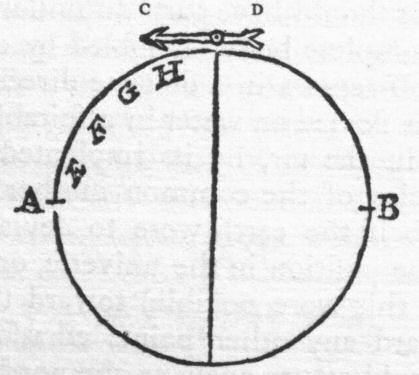
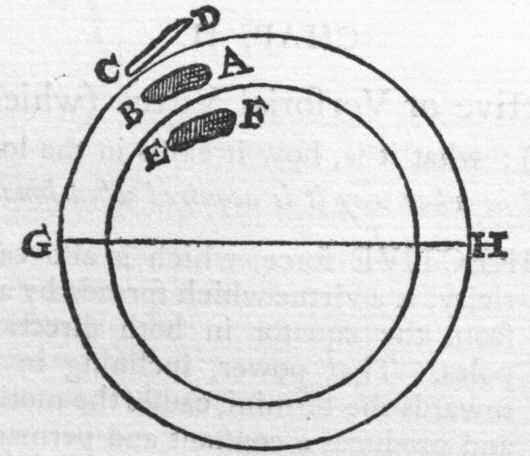
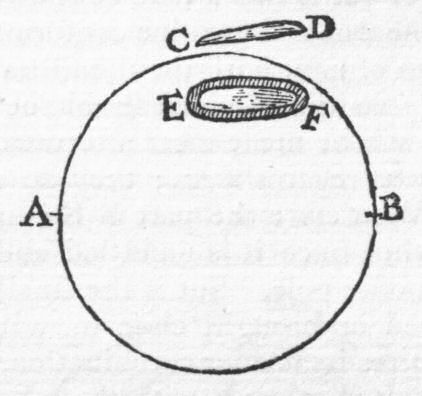
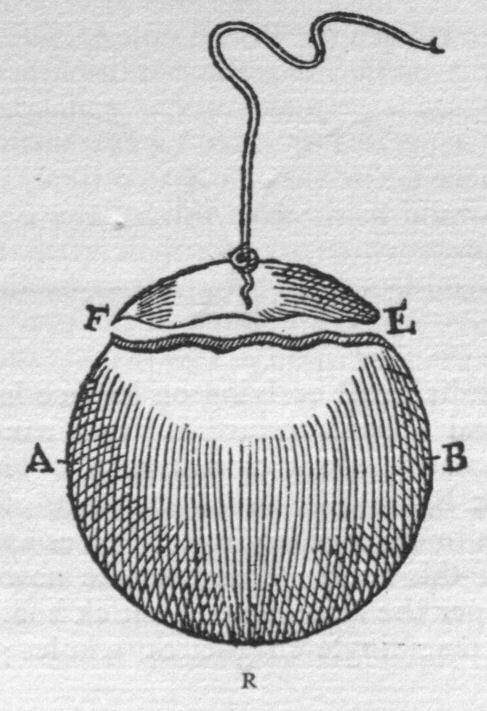
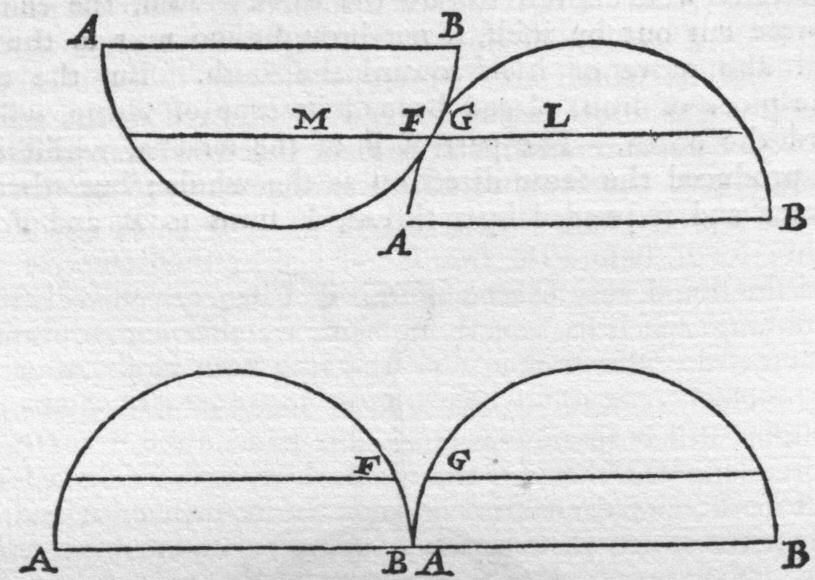
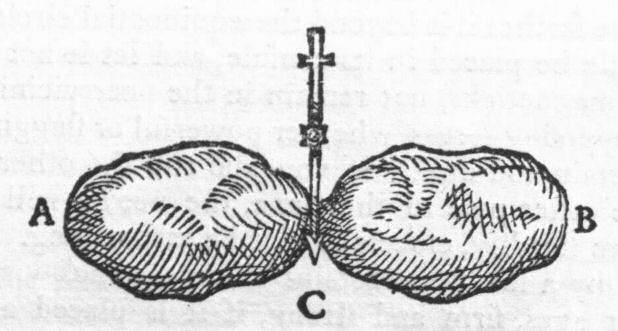
irective force, which is also called by us verticity, is a virtue which spreads by an innate vigour from the æquator in both directions toward the poles. That power, inclining in both directions towards the termini, causes the motion of direction, and produces a constant and permanent position in Nature, not only in the earth itself but also in all magneticks. Loadstone is found either in veins of its own or in iron mines, when the homogeneous substance of the earth, either having or assuming a primary form, is changed or concreted into a stony substance, which besides the primary qualities of its nature has various dissimilitudes and differences in different quarries and mines, as if from different matrices, and very many secondary qualities and varieties in its substance. A loadstone which is dug out in this breaking up of the earth's surface and of protuberances upon it, whether formed complete in itself (as sometimes in China) or in a larger vein, is fashioned by the earth and follows the nature of the whole. All the interior parts of the earth mutually conspire together in combination and produce direction toward north and south. But those magnetical bodies which come together in the uppermost parts of the earth are not true united parts of the whole, but appendages and parts joined on, imitating the nature of the whole; wherefore when floating free on water, they dispose themselves just in the same way as they are placed in the terrestrial system of nature. We had a large loadstone of twenty pounds * weight, dug up and cut out of its vein, after we had first observed and marked its ends; then after it was dug out, we placed it in a boat on water, so that it could turn freely; then immediately the face which had looked toward the north in the quarry began to turn to the north on the waves and at length settled toward that point. For that face which looked toward the north in the quarry is the southern, and is attracted by the northern parts of the earth, in the same way as pieces of iron which acquire their verticity from the earth. About this point we intend to speak afterwards[202] under change of verticity. But there is a different rotation of the internal parts of the earth, which are perfectly united to the earth and which are not separated from the true substance of the earth by the interposition of bodies as are loadstones in the upper portion of the earth, which is maimed, corrupt, and variable. Let A B be a piece of magnetick ore; between which and the uniform globe of the earth lie various soils or mixtures which separate the ore to a certain extent from the globe of the true earth. It is therefore influenced by the forces of the earth just in the same way as C D, a piece of iron, in the air. So the face B of some ore or of that piece of it is moved toward the Boreal pole G, just as the extremity C of the iron, not A or D. But the condition of the piece E F is different, which piece is produced in one connected mass with the whole, and is not separated from it by any earthy mixture. For if the part E F were taken out and floated freely in a boat by itself, it is not E that would be directed toward the Boreal pole, but F. So in those substances which acquire their verticity in the air, C is the southern part and is seen to be attracted by the Boreal pole G. In the case of others which are found in the upper unstable portion of the earth, B is the south, and in like manner inclines toward the Boreal pole. But if those pieces deep down which are produced along with the earth are dug up, they turn about on a different plan. For F turns toward the Boreal parts of the earth, because * is the southern part; E toward the south, because it is the northern. So of a magnetick body, C D, placed close to the earth, the end C turns toward the Boreal pole; of one that is adnate to it B A, B inclines to the North; of one that is innate in it, E F, E turns toward the southern pole; which is confirmed by the following demonstration, and comes about of necessity according to all magnetick laws. Let there be a terrella with poles A B; from its mass cut out a small part E F; if this be suspended by a fine thread above the hole or over some other place, E does not seek the pole A but the pole B, and F turns to A; very differently from a rod of iron C D; because C, touching some northern part of the terrella, being magnetically carried away makes a turn round to A, not to B. And yet here it should be observed, that if the pole A of * the terrella were moved toward the earth's south, the end E of the piece cut out by itself, if not brought too near to the stone, would also move of itself toward the south. But the end C of the piece of iron, placed beyond its orbe of virtue, will turn toward the north. The part E F of the terrella, whilst in the mass, produced the same direction as the whole; but when it is separated and suspended by a thread, E turns to B, and F to A. So parts having the same verticity with the whole, when separated, are impelled in the contrary direction; for contrary parts solicit contrary parts. Nor yet is this a true contrariety, but the highest concordancy, and the true and genuine conformation of bodies magnetical in the system of nature, if they shall have been divided and separated: for the parts thus divided should be raised some distance from the whole, as will be made clear afterwards. Magnetick substances seek a unity as regards form; they do not so much respect their own mass. Wherefore the part F E is not attracted into its former bed; but when once it is unsettled and at a distance, it is * solicited by the opposite pole. But if the small piece F E is placed back again in its bed or brought close to, without any substances intervening, it acquires its former combination, and, as a part of the whole once more united, accords with the whole and sticks readily in its former position; and E remains toward A, and F toward B, and they settle steadily in their mother's lap. The reasoning is the same when the stone is divided into equal parts through the poles. A spherical stone is divided into two equal parts along the axis A B; * whether therefore the surface A B is in the one part facing upward (as in the former diagram) or lying on its face in both parts (as in * the latter), the end A tends toward B. But it must also be understood that the point A is not carried with a definite aim always toward the point B, because in consequence of the division the verticity proceeds to other points, as to F G, as appears in the fourteenth chapter of this book. And L M are now the axes in each, and A B is no longer the axis; for magnetick bodies, as soon as they are divided, become single magnetick wholes; and they have vertices in accordance with their mass, new poles arising at each end in consequence of the division. Yet the axis and the poles always follow the leading of a meridian; because that force passes along the meridians of the stone from the æquator to the poles, by an everlasting rule, the inborn virtue of the substance agreeing thereto from the long and lasting position and the facing of a suitable substance toward the poles of the earth; by whose strength continued through many centuries it has been fashioned; toward fixed and determined parts of which it has remained since its origin firmly and constantly turned.
CHAP. III.
How Iron acquires Verticity through a Loadstone, and how that verticity is lost and changed.
riction between an oblong piece of iron and a loadstone imparts to the former magnetick virtues, which are not corporeal nor inherent and persistent in any body, as we showed in the discussion on coition. It is plain that the iron, when it has been rubbed hard with one end and applied to the stone for a pretty long time, receives no stony nature, acquires no weight; for if, before the iron is touched by the stone, you weigh * it in a small and very exact goldsmith's balance, you will see after the rubbing that it has exactly the same weight, neither diminished nor increased. But if you wipe the iron with cloths after it has been touched, or wash it in water, or scour it with sand or on a grindstone, still it in nowise lays aside its acquired strength. For the force is spread through the whole body and conceived in the inmost parts, and cannot in any way be washed or wiped away. Let an experiment then be made in fire, that untamed tyrant of nature. Take a piece of iron of the length of a palm and the thickness of a goosequill pen; let this iron be passed through a suitable round cork and placed on the surface of water, and observe the end which turns to the north; rub this particular end with the true southern end of a loadstone; the iron so rubbed turns toward the south. Remove the cork, and place the end * which was excited in the fire until the iron is just red-hot; when it is cooled, it will retain the strength of the loadstone and the verticity, though it will not be so prompt, whether because the force of the fire had not yet continued long enough to overcome all its strength, or because the whole iron was not heated to redness, for the virtue is diffused through the whole. Remove the cork a second time, and putting the whole iron in the fire, blow the fire with the bellows, so that it may be all aglow, and let it remain a little longer time red-hot; when cooled (so, however, that, whilst it is cooling, it does not rest in one position), place it again on the water with the cork, and you will see that it has lost the verticity * which it had acquired from the stone. From these experiments it is clear how difficult it is for the property of polarity implanted by the loadstone to be destroyed. But if a small loadstone had remained as long in the same fire, it would have lost its strength. Iron, because it does not so easily perish, and is not so easily burnt up as very many loadstones, retains its strength more stably, and when it is lost can recover it again from a loadstone; but a loadstone when burnt does not revive. But now that iron, which has * been deprived of its magnetick form, moves in a different way from any other piece of iron, for it has lost its polar nature; and whereas before the touch of the loadstone it may have had a motion toward the north, and after contact toward the south; now it turns to no definite and particular point; but afterwards, very slowly and after * a long time, it begins to turn in a doubtful fashion toward the poles of the earth (having acquired some power from the earth). I have said that the cause of direction was twofold, one implanted in the stone and iron, but the other in the earth, implanted by the disponent virtue; and for that reason (the distinction of poles and the verticity in the iron having now been destroyed) a slow and weak directive power is acquired anew from the verticity of the earth. We may see, therefore, with what difficulty and only by the application of hot fires and by long ignition of the iron heated to softness, the imparted magnetick virtue is eradicated. When this ignition has overcome the acquired polarity, and it has been now completely subdued and not awakened again, that iron is left unsettled and utterly incapable of direction. But we must further inquire how iron remains affected by verticity. It is manifest that it strongly affects and changes the nature of the iron, because the presence of a loadstone attracts the iron to itself with an altogether wonderful readiness. Nor is it only the part that is rubbed, but on account of the rubbing (on one end only) the whole iron is affected together, and gains by it a permanent though an unequal power. This is demonstrated as follows. Rub an iron wire on the end so * that it is excited, and it will turn towards the north; afterward cut off some portion of it; you will see that it still turns toward the north (as before), but more feebly. For it must be understood that the loadstone excites a steady verticity in the whole iron (if the rod be not too long) more vigorous throughout the whole mass in a shorter bar, and as long as the iron remains touching the loadstone a little stronger. But when the iron is separated from contact with it, then it becomes much weaker, especially in the end that was not touched. Just as a long rod, one end of which is placed in the fire and heated, grows exceedingly hot at that end, less so in the parts adjoining and in the middle, whilst at the other end it can be held in the hand, and that end is only warm; so the magnetical vigour diminishes from the excited end to the other end; but it is present there instantly, and does not enter after an interval of time nor successively, as the heat in the iron; for as soon as a piece of iron has been touched by a loadstone it is excited throughout its whole length. For the sake of experiment, let there be a rod of iron 4 or * 5 digits long, untouched by a loadstone; as soon as you touch one end only with a loadstone, the opposite end immediately, or in the twinkling of an eye, by the power that it has conceived, repels or attracts a versorium, if it be applied to it ever so quickly.
CHAP. IIII.
Why Iron touched by a Loadstone acquires an opposite verticity, and why iron touched by the true Northern side of a stone turns to the North of the earth, by the true Southern side to the South; and does not turn to the South when rubbed by the Northern point of the stone, and when by the Southern to the North, as all who have written on the loadstone have falsely supposed.
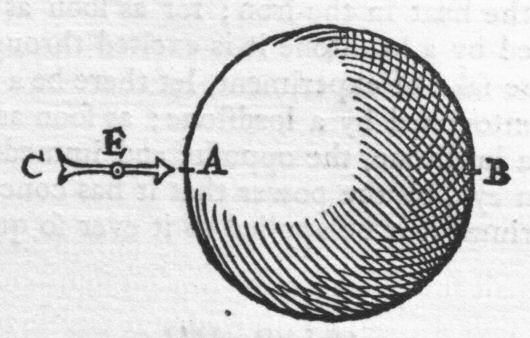
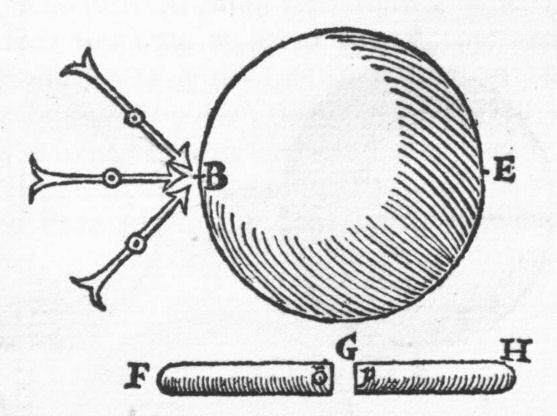
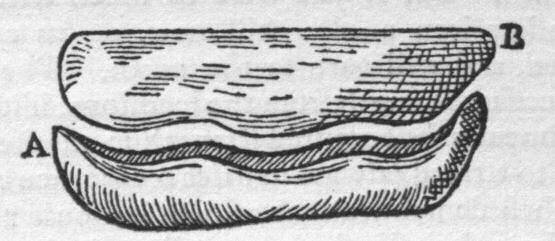
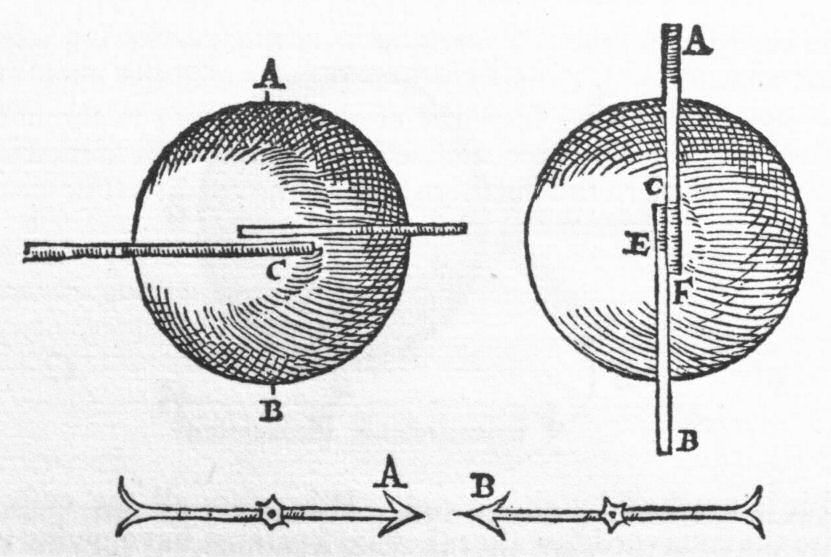
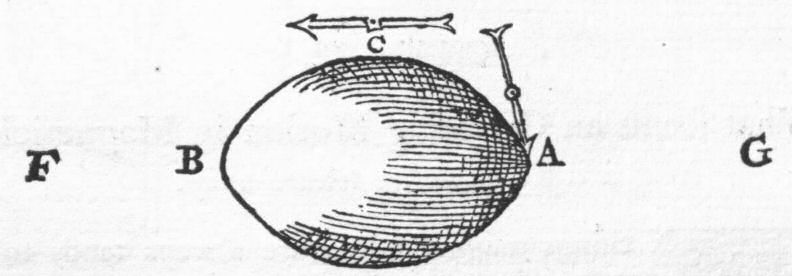
emonstration has already been given that the northern part of a loadstone does not attract the northern part of another stone, but the southern, and repels the northern part of another stone from its northern side when it is applied[203] to it. That general magnet, the terrestrial globe, disposes iron touched by a loadstone in the same way, and likewise magnetick iron stirs this same iron by its implanted strength, and excites motion and controls it. For whether the comparison and experiment has been made between loadstone and loadstone, or loadstone and iron, or iron and iron, or the earth and loadstone, or the earth and iron conformed * by the earth or strengthened by the power of a loadstone, the strength and inclinations of each must mutually harmonize and accord in the same way. But the reason must be sought, why a piece of iron when touched by a loadstone acquires a disposition to motion toward the opposite pole of the earth, and not toward that pole of the earth to which that pole of that loadstone turned by which it was excited. It has been pointed out that iron and loadstone are of one primary nature; when the iron is joined to the loadstone, they become, as it were, one body, and not only is the end of the iron changed, but the remaining parts also are affected along with it. A, the north pole of a loadstone, is placed against the cusp of a piece of iron; the cusp of the iron has now become the southern part of the iron, because it is touching the northern part of the stone; the cross-end of the iron has become the northern. For if that contiguous magnetick substance be separated from the pole of the terrella, or from the parts near the pole, the one end (or the end which, whilst the connection was kept up, was touching the northern part of the stone) is the southern, whilst the other is the northern. So also if a versorium excited by a loadstone be divided into ever so many parts (however small), those parts when separated will, it is clear, arrange themselves in the same disposition as that in which they were disposed before, when they were undivided. Wherefore whilst the cusp remains over the northern pole A, it is not the southern end, but is, as it were, part of a whole; but when it is taken away from the stone, it is the southern end, because when rubbed it tended toward the northern parts of the stone, and the cross (the other end of the versorium) is the northern end. The loadstone and the iron make one body; B is the south pole of the whole; C (that is, the cross) is the northern end of the whole; divide the iron also at E, and E will be the southern end with respect to the cross; and E will likewise be the northern end in respect to B. A is the true northern pole of the stone and is attracted by the southern pole of the earth. The end of the iron which is touched by the true boreal part of the stone becomes the southern end, and turns to A, the north [pole] of the stone, if it be near; or if it be some distance from the stone it turns to the north [pole] of the earth. So always iron which is touched (if it is free and unrestrained) tends to the opposite part of the earth from that part to which the loadstone that touched it tends. Nor does it * make any difference how it is rubbed, whether straight up or slanting in some way. For in any case the verticity flows into the iron, provided it is touched by either end. Wherefore all the cusps at B acquire the same verticity, after they are separated, but opposite to that pole of the stone; wherefore also they are united to the loadstone at the pole B; and all the crosses in the present figure have the opposite verticity to the pole E, and are moved and laid hold of by E when they are in a convenient position. It is exactly the same in the case of the long stone F H divided at G; F and H always move, both in the whole and in the divided stone, to opposite poles of the earth, and O and P mutually attract one another, the one of them being the northern, the other the southern. For, supposing H to have been the southern in the whole stone and F the northern, P will be the northern with respect to H in the divided stone, and O the southern with respect to F. So also F and H mutually incline to a connection, if they are turned a very little toward one another, and run together at length and join. But supposing the division of the stone to have been meridional (that is, according to the line of a meridian, not of any parallel circle), then they turn round, and A attracts B, and the end B is attracted to A and attracts A, until, being turned round, they are connected and cemented together; because magnetick attraction is not made along the parallels, but meridionally. For this reason pieces of iron placed on a terrella whose poles are A B, near the æquator along parallels, * do not combine or stick together firmly: But if applied to one another along a meridian they are immediately * joined firmly together, not only on and near the stone, but even at some distance within the force of the controlling orbe. Thus they are joined and cemented together at E, but not at C in the other figure. For the opposite ends C and F meet and adhære together in the case of the iron just in the same way as A and B before in the case of the stone. But they are opposite ends, because the pieces of iron proceed from the opposite sides and poles of the terrella; and C in reference to the northern pole A is southern, and F is boreal in reference to the * southern pole B. In like manner also they are cemented together, if the rod C (being not too long[204]) be moved further toward A, and F toward B, and they be joined together over the terrella, like A and B of the divided stone above. But now if the cusp A, * which has been touched by a loadstone, be the southern end, and you were to touch and rub with this the cusp of another iron needle B, which has not been touched, B will be northern, and will point to the south. But if you were to touch with the northern point B any other iron needle, still new, on its cusp, this again will be southern, and will turn to the north. The iron not only receives the necessary strength from the loadstone, if it be a good loadstone, but also imparts its acquired strength to another piece of iron, and the second to a third (always in strict accordance with magnetick laws). In all these demonstrations of ours it should always be borne in mind that the poles of a stone, as well as those of iron, whether touched or untouched, are always in fact and by nature opposite to the pole toward which they point and are so designated by us, as we have laid down above. For in them all it is always the northern * which tends to the south, either of the earth or of the stone, and the southern which tends to the north of the stone. Northern parts are attracted by the southern of the earth; so in the boat they tend toward the south. A piece of iron touched by the northern parts of a loadstone becomes south at the one end and tends always (if it is near and within the orbe of the loadstone) to the north of the stone, and if it be free and left to itself at some distance from the stone, it tends to the northern part of the earth. The northern pole A of a loadstone turns to G, the south of the earth; a versorium touched at its cusp by the part A follows A, because it has become southern. But the versorium C, placed farther away from the loadstone, turns its cusp to F, the north of the earth, because * the cusp has become southern by contact with the boreal part of the stone. So the ends touched by the northern part of the stone are made southern, or are excited with a southern polarity, and tend toward the north of the earth; those touched by the southern pole are made northern, or are excited with a northern force, and turn to the south of the earth.
CHAP. V.
On the Touching of pieces of Iron of divers shapes.
ars of iron, when touched by a loadstone, have one end north, the other south, and in the middle is the limit of verticity, like the æquinoctial circle on the globe of a terrella or on an iron globe. But when an iron ring is rubbed on one side on a * loadstone, then the one pole is on the place that was in contact, whilst the other is at the opposite point; and the magnetick power divides the ring into two parts by a natural distinction which, though not in shape, yet in power and effect is like an æquator. But if a thin straight rod be bent into a ring without any welding or union of the ends, and be touched in the middle by a loadstone, both ends will be of the same verticity. Let a ring be taken which is whole and continuous, and which has been * touched by a loadstone at one place, and let it be divided afterward at the opposite point and straightened out, both ends will also be * of the same verticity, no otherwise than a thin rod touched in the middle or a ring not cohærent at the joint.
CHAP. VI.
What seems an Opposing Motion in Magneticks is a proper motion toward unity.
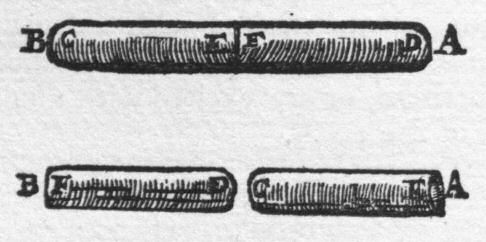
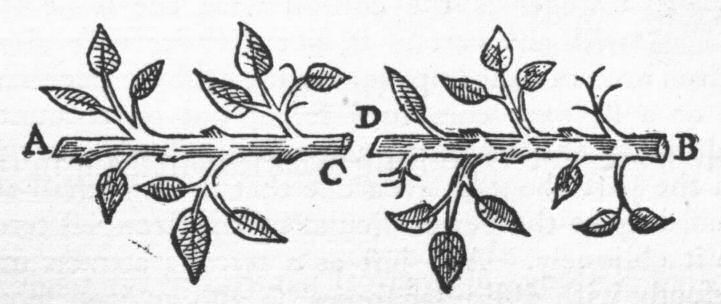
n things magnetical nature always tends to unity, not merely to confluence and agglomeration, but to harmony; in such a way that the rotational and disponent faculty should not be disturbed, as is variously shown in the following example. Let C D be an entire body of some magnetick substance, in which C tends to B, the north of the earth, and D to the south, A. Then[205] divide it in the middle in its æquator, and it will be E that is tending toward A, and F tending toward B. For just as in the undivided body, so in the divided, nature aims at these bodies being united; the end E again joins with F harmoniously and * eagerly and they stick together, but E is never joined to D, nor F to C; for then C must be turned contrary to nature toward A, the south, or D toward B, the north, which is foreign to them and incongruous. Separate the stone in the place where it is cut and turn D round to C; they harmonize and combine excellently. For D is tending to the south, as before, and C to the north; E and F, parts which were cognate in the ore, are now widely separated, for they do not move together on account of material affinity, but they take their motion and inclination from their form. So the ends, whether joined or divided, tend magnetically in the same way to the earth's poles in the first figure where there is one whole, or divided as in the second figure; and F E in the second figure is a perfect magnetick joined together into one body and C D, just as it was primarily produced in its ore, and F E in its boat, turn in this way to the poles of the earth and are conformed to them. * This harmony of the magnetick form is shown also in the forms of vegetables. Let A B be a twig from a branch of osier or other * tree which sprouts easily. Let A be the upper part, B the lower part toward the root; divide it at C D; I say that the end D, if grafted again to C by the primer's art, grows to it; just as also if B is grafted to A, they grow together and germinate. But D being grafted on A, or C on B, they are at variance, and never grow into one another, but one of them dies on account of the inverted and inharmonious arrangement, since the vegetative force, which moves in one way, is now impelled in opposite directions.
CHAP. VII.
A determined Verticity and a disponent Faculty are what arrange magneticks, not a force, attracting or pulling them together, nor merely strongish coition or unition.
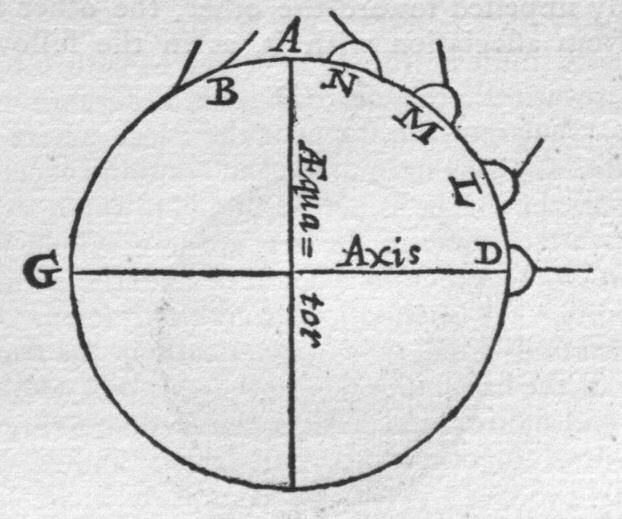
n the neighbourhood of the æquinoctial A there is no coition of the ends of a piece of iron with the terrella; at the poles there is the strongest. The greater the distance from the æquinoctial, the stronger is the coition with the stone itself, and with any part of it, not with its pole alone. Yet pieces of iron are not raised up on account of some peculiar attracting force or a stronger combined force, but on account of that common directing or conforming and rotating force; nor indeed is a spike in the part about B, even one that is very small and of no * weight[206], raised up to the perpendicular by the strongest terrella, but cleaves to it obliquely. Also just as a terrella attracts magnetick bodies variously with dissimilar forces, so also an iron snout placed on the stone obtains a different potency in proportion to the latitude, * just as a snout at L by its firmer connection resists a greater weight more stoutly than one at M, and at M than at N. But neither does the snout raise the spike to the perpendicular except at the poles, as is shown in the figure. A snout at L may hold and lift from the earth two ounces of iron in one piece; yet it is not strong enough to raise an iron wire of two grains weight to the perpendicular, which would happen if the verticity arose on account of a * stronger attraction, or rather coition or unition.
CHAP. VIII.
Of Discords between pieces of Iron upon the same pole of a loadstone, and how they can agree and stand joined together.
uppose two iron wires or a pair of needles stuck on the pole of a terrella; though they ought to stand perpendicularly, they mutually repel one another at the upper * end, and produce the appearance of a fork; and if one end be forcibly impelled toward the other, the other declines and bends away from association with it, as in the following figure. A and B, iron spikes, adhære obliquely[207] upon the pole on account of their nearness to one another; either alone would otherwise stand erect and perpendicular. For the extremities A B, being of the same verticity, mutually abhor and fly one another. For if C be the northern pole of the terrella, A and B are also northern ends; but the ends which are joined to and held at the pole C are both * southern. But if those spikes be a little longer (as, for example, of two digits length) and be joined by force, they adhære together and unite in a friendly style, and are not separated without force. For they are magnetically welded, and there are now no longer two distinct ends, but one end and one body; no less than a wire which is doubled and set up perpendicularly. But here is seen also another subtile point, that if those spikes were shorter, not as much as the * breadth of one digit, or even the length of a barleycorn, they are in no way willing to harmonize or to stand straight up at the same time, because naturally in shorter wires the verticity is stronger in the ends which are distant from the terrella and the magnetick discord more vehement than in long ones. Wherefore they in no way admit of an intimate association and connection.
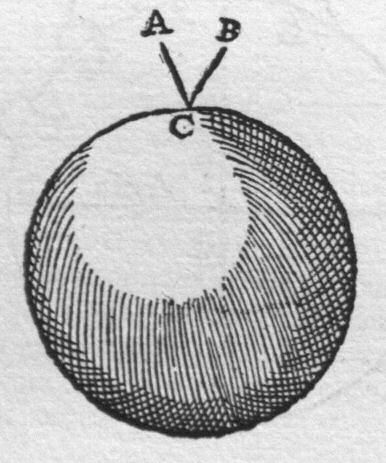
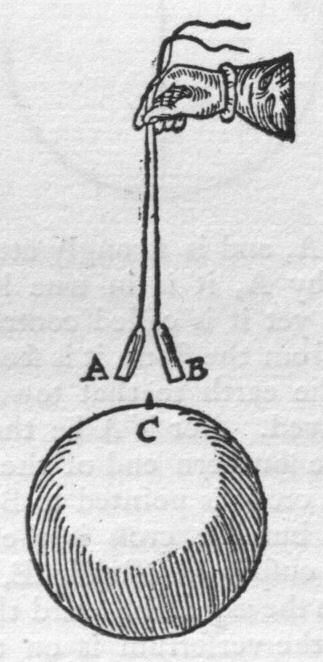
Likewise if those lighter pieces of iron or iron wires be suspended, hanging, as A and B, from a very fine silk thread, not twisted * but braided, distant from the stone the length of a single barleycorn, then the opposing ends, A and B, being situated within the orbe of virtue above the pole, keep a little away from one another for the same reason; except when they are very near the pole of the stone C, the stone then attracting them more strongly toward one end.
CHAP. IX.
Figures illustrating direction and showing varieties of rotations.
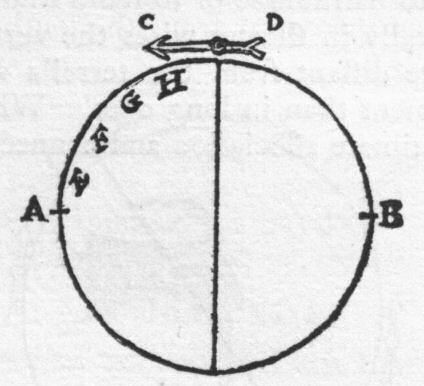
assing from the probable cause of motion toward fixed points (according to magnetick laws and principles), it remains for us to indicate those motions. Above a round loadstone (whose poles are A, B) let a versatory needle be placed whose cusp has been excited by the pole A; that cusp is certainly directed toward A, and is strongly attracted by A; because, having been touched by A, it is in true harmony with A, and combines with it; and yet it is called contrary, because when the versorium is separated from the stone, it is seen to be moved toward the opposite part of the earth to that toward which the pole A of the loadstone is moved. For if A be the northern pole of the terrella, the cusp is the southern end of the needle, of which the other end (namely, the cross) is pointed to B; so B is the southern pole of the loadstone, but the cross is the northern end of the versorium. So also the cusp is attracted by E, F, G, H, and by every * part of a meridian, from the æquator toward the pole, by the faculty disponent; and when the versorium is on the same parts of the meridian, the cusp is directed toward A. For it is not the point A that turns the versorium toward it, but the whole loadstone; as also the whole earth does, in the turning of loadstones to the earth.
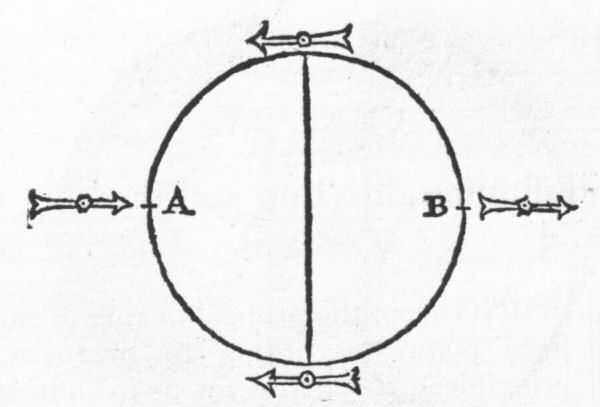
Figures illustrating magnetick directions in a right sphere[208] of stone, and in the right sphere of the earth, as well as the polar directions to the perpendicular of the poles. All these cusps have been touched by the pole A; all the cusps are turned toward A, excepting that one which is repelled by B.
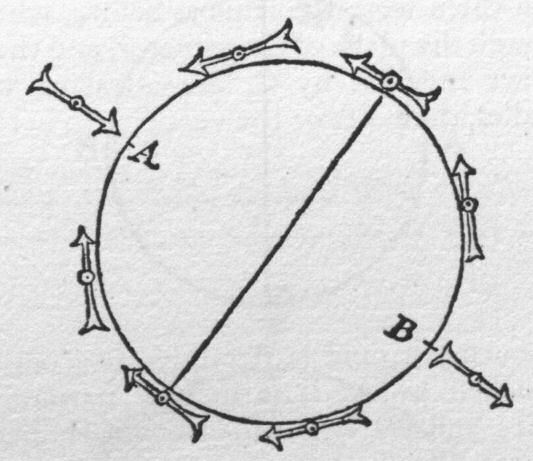
Figures illustrating horizontal directions above the body of a loadstone. All the cusps that have been made southern by rubbing on the boreal pole, or some place round the northern pole A, turn toward the pole A, and turn away from the southern pole B, toward which all the crosses look. I call the direction horizontal, because it is arranged along the plane of the horizon; for nautical and * horological instruments are so constructed that the iron hangs or is supported in æquilibrium on the point of a sharp pin, which prevents the dipping of the versorium, about which we intend to speak later. And in this way it is of the greatest use to man, indicating and distinguishing all the points of the horizon and the winds. Otherwise on every oblique sphere (whether of stone or the earth) versoria and all magnetick substances would have a dip by their own nature below the horizon; and at the poles the directions would be perpendicular, which appears in our discussion On Declination.
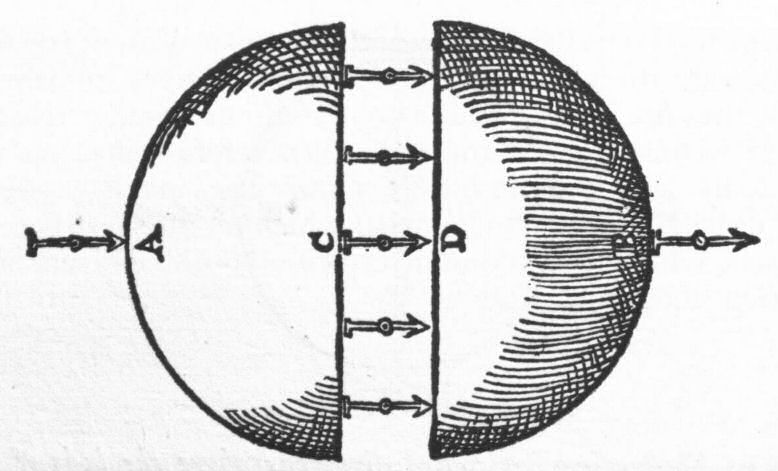
A round stone (or terrella) cut in two at the æquator; and all the cusps have been touched by the pole A. The points at the centre of the earth, and between the two parts of the terrella which has been cut in two through the plane of the æquator, are directed as in the present[209] diagram. This would also happen in the same way if the division of the stone were through the plane of a tropick, and the mutual separation of the divided parts and the interval between them were the same as before, when the loadstone was divided through the plane of the æquator, and the parts separated. For the cusps are repelled by C, are attracted by D; and the versoria are parallel, the poles or the verticity in both ends mutually requiring it.
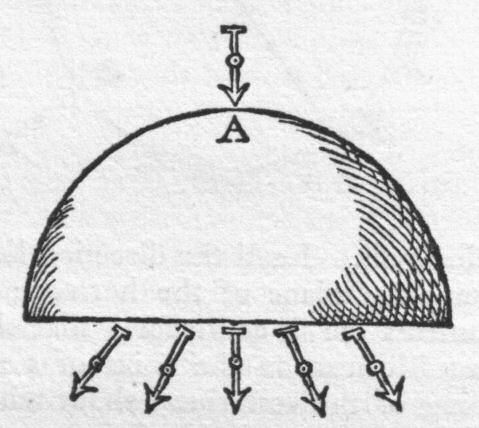
Half a terrella by itself and its directions, unlike the directions * of the two parts close to one another as shown in the figure above. All the cusps have been touched by A; all the crosses below except the middle one tend toward the loadstone, not straight, but obliquely; because the pole is in the middle of the plane which before was the plane of the æquator. All cusps touched by places distant from the pole move toward the pole (exactly the same as if they had been rubbed upon the pole itself), not toward the place where they were rubbed, wherever that may have been in the undivided stone in some latitude between the pole and the æquator. And for this reason there are only two distinctions of regions, northern and southern, in the terrella, just as in the general terrestrial globe, and there is no eastern nor western place; nor are there any eastern or western regions, rightly speaking; but they are names used in respect of one another toward the eastern or western part of the sky. Wherefore it does not appear that Ptolemy did rightly in his Quadripartitum, making eastern and western districts and provinces, with which he improperly connects the planets, whom the common crowd of philosophizers and the superstitious soothsayers follow.
CHAP. X.
On Mutation of Verticity and of Magnetick Properties, or on alteration in the power excited by a loadstone.
riction with a loadstone gives to a piece of iron a verticity strong enough; not, however, so stable that the iron may not by being rubbed on the opposite part (not only with a more powerful loadstone, but with the same) be changed and deprived of all its former verticity, and indued with a new and opposite one. Take a piece of iron wire and rub each end of the wire equally with one and the same pole of a loadstone, and let it be passed through a suitable cork and place it on water. Then truly one end of the wire will be directed toward that pole of the earth toward which that end of the stone will not turn. But which end of the iron wire will it be? That certainly which was rubbed last. Rub the other end of this again with the same pole, and immediately * that end will turn itself in the opposite direction. Again touch the former end of the iron wire only with the same pole of the loadstone as before; and that[210] end, having gained the command, immediately changes to the contrary side. So you will be able to change the property of the iron frequently, and that end of the wire rules which has been touched the last. Now then merely hold the boreal pole of the stone for some time near the boreal part of the wire which was last touched, so that it does not touch, but so that it is removed from it by one, two, or even three digits, if the stone have been pretty * strong; and again it will change its property and will turn round to the contrary side; which will also happen (albeit rather more feebly) even if the loadstone be removed to a distance of four digits. You will be able to do the same thing, moreover, with both the austral and the boreal part of the stone in all these experiments. Verticity may likewise be acquired and changed when thin plates of gold, * silver, and glass are interposed between the stone and the end of the iron or iron wire, if the stone were rather strong, even if the intermediate lamina is not touched either by the iron or the stone. And these changes of verticity take place in smelted iron. Indeed what the one pole of the stone implants and excites, the other disturbs and extinguishes, and confers a new force. For it does not require a stronger loadstone to take away the weaker and sluggish virtue and to implant the new one; nor is iron inebriated by the equal strength of loadstones, and made utterly uncertain and neutral, as Baptista Porta teaches; but by one and the same loadstone, or by loadstones endowed with equal power and might, its strength is, in accordance with magnetick rules, turned round and changed, excited, repaired, or disturbed. But a loadstone itself, by being rubbed on another, whether a larger or a more powerful stone, is not disturbed from its own property and verticity, nor does it turn round toward the opposite direction in its boat, or to the other pole opposite to that to which it inclines by its own nature and implanted verticity. For strength which is innate and has been implanted for a very long time abides more firmly, nor does it easily yield from its ancient holding; and that which has grown for a long time is not all of a sudden brought to nothing, without the destruction of the substance containing it. Nevertheless in a long interval of time a change * does take place; in one year, that is to say, or two, or sometimes in a few months; doubtless when a weaker loadstone remains lying by a stronger one contrary to the order of nature, namely, with the northern pole of one loadstone adjoined to the northern pole of another, or the southern to the southern. For so the weaker strength gradually declines with the lapse of time.
CHAP. XI.
On the Rubbing of a piece of Iron on a Loadstone in places midway between the poles, and upon the æquinoctial of a terrella.
elect a piece of iron wire of three digits length, not touched by a loadstone (but it will be better if its acquired verticity be rather weak or have been damaged in some way); touch it and rub it on the æquator of a terrella, exactly on the æquinoctial line in the direction of its length, on the one end, or the ends only, or in all its parts; place the wire touched in this * way on water in a cork fitted for it; it will swim about doubtfully on the waves without any acquired verticity, and the verticity previously implanted will be disturbed. If, however, it float by chance toward the poles, it will be checked a little by the poles of the earth, and will at length by the influence of the earth be indued with verticity.
CHAP. XII.
In what way Verticity exists in any Iron that has been smelted though not excited by a lodestone.
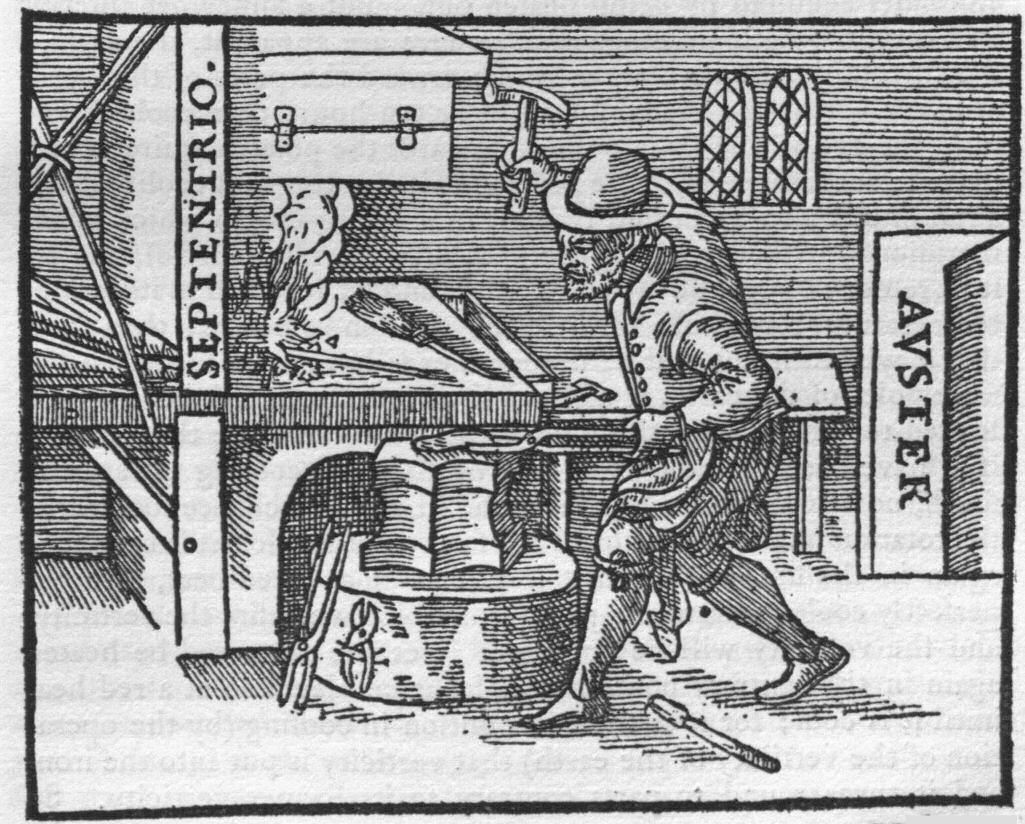
aving thus far[211] demonstrated natural and inborn causes and powers acquired by means of the stone, we will now examine the causes of magnetick virtues in smelted iron that has not been excited by a stone. Loadstone and iron furnish and exhibit to us wonderful subtilities. It has been repeatedly shown above that iron not excited by a stone turns north and south; further that it has verticity, that is, special and peculiar polar distinctions, just as a loadstone, or iron which has been rubbed upon a loadstone. This indeed seemed to us at first wonderful and incredible; the metal of iron from the mine is smelted in the furnace; it runs out of the furnace, and hardens into a great mass; this mass is divided in great worksteads, and is drawn into iron bars, from which smiths again construct many instruments and necessary pieces of iron-work. Thus the same mass is variously worked up and transformed into very many similitudes. What is it, then, which preserves its verticity, and whence is it derived? So take this first from the above[212] smithy. Let the blacksmith beat out upon his anvil a glowing mass of iron of two or three ounces weight into an iron spike of the length of a span of nine inches. Let the smith be standing with his face to the north, his back to the south, so that * the hot iron on being struck has a motion of extension to the north; and let him so complete his work with one or two heatings of the iron (if that be required); let him always, however, whilst he is striking the iron, direct and beat out the same point of it toward the north, and let him lay down that end toward the north. Let him in this way complete two, three, or more pieces of iron, nay, a hundred or four hundred; it is demonstrable that all those which are thus beaten out toward the north, and so placed whilst they are cooling, turn round on their centres; and floating pieces of iron (being transfixed, of course, through suitable corks) make a motion in the water, the determined end being toward the north. In the same way also pieces of iron acquire verticity from their direction whilst they are being beaten out and hammered or drawn out, * as iron wires are accustomed to do toward some point of the horizon between east and south or between south and west, or in the opposite direction. Those, however, which are pointed or drawn out rather toward the eastern or western point, conceive * hardly any verticity or a very undecided one. That verticity is especially acquired by being beaten out. But a somewhat inferior iron ore, in which no magnetick powers are apparent, if put in a * fire (its position being observed to be toward the poles of the world or of the earth) and heated for eight or ten hours, then cooled away from the fire, in the same position towards the poles, acquires a verticity in accordance with the position of its heating and cooling. Let a rod of cast iron be heated red-hot in a strong fire, in which it lies * meridionally (that is, along the path of a meridian circle), and let be removed from the fire and cooled, and let it return to its former temperature, remaining in the same position as before; then from this it will turn out that, if the same ends have been turned to the same poles of the earth, it will acquire verticity, and the end which looked toward the North on water with a cork before the heating, if it have been placed during the heating and cooling toward the fourth, now turns round to the south. But if perchance sometimes the rotation have been doubtful and somewhat feeble, let it be placed again in the fire, and when it is taken out at a red heat, let it be perfectly cooled toward the pole from which we desire the verticity, and the verticity will be acquired. Let the same rod be heated * in the contrary position, and let it be placed so at a red heat it is cool; for it is from its position in cooling (by the operation of the verticity of the earth) that verticity is put into the iron, and it turns round to parts contrary to its former verticity. So the end which formerly looked toward the north now turns to the south. In accordance with these reasonings and in these ways the boreal pole of the earth gives to the end of a piece of iron turned toward it a southern verticity, and that end is attracted by that pole. * And here it must be observed that this happens to iron not only when it is cooled in the plane of the horizon, but also at any angle to it almost up to the perpendicular toward the centre of the earth. So the heated iron conceives vigour and verticity from the earth more quickly in the course of its return to its normal state, and in its recovery, as it were (in the course of which it is transformed), than by its mere position alone. This is effected better and more * perfectly in winter and in colder air, when the metal returns more certainly to its natural temperature, than in summer and in warm regions. Let us see also what position alone and a direction toward the poles of the earth can effect by itself without fire and heat. Iron rods which have been placed and fixed for a long time, twenty * or more years, from south to north (as they not infrequently are fixed in buildings and across windows), those rods, I say, by that long lapse of time acquire verticity and turn round, whether hanging in the air, or floating (being placed on cork), to the pole toward which they were pointing, and magnetically attract and repel a balanced iron magnetick; for the long continued position of the body toward the poles is of much avail. This fact (although conspicuous by manifest experiments) is confirmed by an incident related in an Italian letter[213] at the end of a book of Maestro Filippo Costa, of Mantua, Sopra le Compositioni degli Antidoti written in Italian, which translated runs thus: "A druggist of Mantua showed me a piece of iron entirely changed into a magnet, drawing another piece of iron in such a way that it could be compared with a loadstone. Now this piece of iron, when it had for a long time held up a brick ornament on the top of the tower of the church of St. Augustine at Rimini, had been at length bent by the force of the winds, and remained so for a period of ten years. When the monks wished to bend it back to its former shape, and had handed it over to a blacksmith, a surgeon named Maestro Giulio Caesare discovered that it was like a magnet and attracted iron." This was caused by the turning of its extremities toward the poles for so long a time. And so what has been laid down before about change of verticity should be borne in mind; how in fact the poles of iron spikes are altered, when a loadstone is placed against them only with its pole and points toward them, even at a rather long distance. Clearly it is in the same way that that large magnet also (to wit, the earth itself) affects a piece of iron and changes its verticity. For, although the iron may not touch the pole of the earth, nor any magnetick part of the earth, yet verticity is acquired and changed; not because the poles of the earth and the point itself which is 39° distant from our city of London, changes the verticity at a distance of so many miles; but because the whole magnetick earth, that which projects to a considerable height, and to which the iron is near, and that which is situated between us and the pole, and the vigour existing within the orbe of its magnetick virtue (the nature of the whole conspiring thereto), produces the verticity. For the magnetick effluence of the earth rules everywhere within the orbe of its virtue, and transforms bodies; but those things which are more similar to it, and specially connected with it by nature, it rules and controls; as loadstone and iron. Wherefore in very many matters of business and actions it is clearly not superstitious and idle to observe the positions and conditions of lands, the points of the horizon and the places of the stars. For as when a babe is brought forth into the light from its mother's womb, and acquires respiration and certain animal activities, then the planets and celestial bodies[214], according to their position in the universe, and according to that configuration which they have with regard to the horizon and the earth, instil peculiar and individual qualities into the newly born; so that piece of iron, whilst it is being formed and lengthened out, is affected by the common cause (to wit, the earth); whilst it is returning also from its heated condition to its former temperature, it is imbued with a special verticity in accord with its position. Rather long pieces of iron sometimes have the same verticity * at each end; wherefore they have motions which are less certain and well ordered on account of their length and of the aforesaid processes, exactly as when an iron wire four feet long is rubbed at each end upon the same pole of a loadstone.
CHAP. XIII.
Why no other Body, excepting a magnetick, is imbued with verticity by being rubbed on a loadstone; and why no body is able to instil and excite that virtue, unless it be a magnetick.
igneous substances floating on water never by their own strength turn round toward the poles of the earth, save by chance. So wires of gold, silver, brass, tin, lead, or glass, pushed through corks and floating, have no sure direction; and for this reason they do not show poles or points of variation when rubbed with a loadstone. For those things which do not of themselves incline toward the poles and obey the earth are also not ruled by the touch of a loadstone; for the magnetick vigour has no entrance into their inward parts; neither is the magnetick form received by them, nor are their forms magnetically excited; nor, if it did enter, would it effect anything, because in those bodies (mixed up with various kinds of efflorescent humours and forms, corrupted from the original property of the earth) there are no primary qualities. But those prime qualities of iron are excited by the juxtaposition of a loadstone, just as brute animals or men, when they are awakened out of sleep, move and put forth their strength. Here one must marvel at a demonstrable error of B. Porta, who, while rightly opposing a very old falsehood about the diamond, in speaking of a power contrary to that of the loadstone, introduces another still worse opinion; that forsooth iron, when touched by a diamond, turns to the north. "If" (he says) "you rub a steel-Needle on a Diamond, and then put it in a Boat, or thrust it through a reed, or hang it up by a Thread, it will presently turn to the North, almost as well as if it had been touched with the Loadstone; but something more faintly. And, what is worth noting, the contrary part will turn the iron to the South: and when I had tried this in many steel-Needles, and put them all into the Water, I found, that they all stood equi-distant, pointing to the North." This indeed would * be contrary to our magnetick rules. For this reason we made an experiment with seventy excellent diamonds, in the presence of many witnesses, on a large number of spikes and wires, with the most careful precautions, floating (thrust, of course, through their corks) on the surface of water; never, however, could we observe this. He was deceived by the verticity acquired from the earth (as stated above) in the spike or wire of iron itself, and the iron itself turned aside to its own definite pole; and he, being ignorant of this, thought it was done by the diamond. But let the investigators of natural phenomena take heed that they are not the more deceived by their own badly observed experiments, and disturb the commonwealth of letters with their errors and stupidities. Diamond is sometimes designated by the name of Sideritis, not because it is made of iron or because it draws iron, but on account of its lustre, resembling flashing steel; with such a lustre do the choicest pieces of diamond shine; hence by very many writers many qualities are imputed to diamond which really belong to siderite loadstone.
CHAP. XIIII.
The Placing of a Loadstone above or below a magnetick body suspended in æquilibrium changes neither the power nor the verticity of the magnetick body.
uietly to pass this over would be improper, because a recent error arising from a defective observation of Baptista Porta must be overthrown; on which he (by an unfortunate repetition) even writes three chapters, namely, the 18th, the 31st, and the 42nd. For if a loadstone or a piece of magnetick iron, hanging in æquilibrium or floating on water, is attracted and disposed toward certain definite points, when you bring above it a piece of iron or another loadstone, it will not, if you afterward put the same[215] below it, turn round to the contrary parts; but the same ends of the iron or the loadstone will always be directed toward the same ends of the stone, even if the loadstone or the iron is suspended in any way in æquilibrium or is poised on a needle, so that it can turn round freely. He was deceived by the irregular shape of some stone, or because he did not arrange the experiment suitably. Wherefore he is led astray by a vain opinion, and thinks he may infer that, just as a stone has an arctic and antarctic pole, so also it has a western and an eastern, and an upper and a lower pole. So from foolish ideas conceived and admitted arise other fallacies.
CHAP. XV.
The Poles, Æquator, Centre in an entire Loadstone remain and continue steady; by diminution and separation of some part they vary and acquire other positions.
*
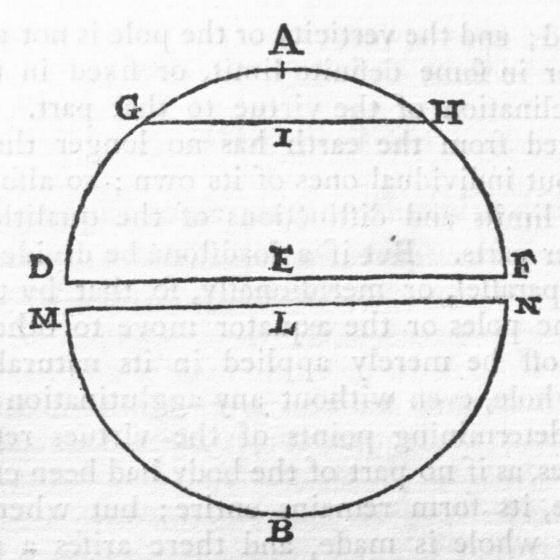
uppose A B to be a terrella, whose centre is E, and whose diameter (as also its æquinoctial circle) is D F. If you cut off a portion (through the arctic circle, for example), G H, it is demonstrable that the pole which was at A now has a position at I. But the centre and the æquinoctial recede toward B merely so that they are always in the middle of the mass that is left between the plane of the arctick circle G I H and the antarctick pole B. Therefore the segment of the terrella comprised between the plane of the former æquinoctial (that, of course, which was the æquator before cutting that part away) D E F and the newly acquired æquator M L N will always be equal to the half of that part which was cut off, G I H A. * But if the portions have been taken away from the side C D, the poles and axis will not be in the line A B, but in E F, and the axis would be changed in the same proportion as the æquator in the former figure. For those positions of forces and virtues, or rather limits of the virtues, which are derived from the whole form, are moved forward by change of quantity and shape; since all these limits arise from the conspiring together of the whole and of all the parts united; and the verticity or the pole is not a virtue innate in one part, or in some definite limit, or fixed in the substance; but it is an inclination of the virtue to that part. And just as a terrella separated from the earth has no longer the earth's poles and æquator, but individual ones of its own; so also if it again be divided, those limits and distinctions of the qualities and virtues pass on to other parts. But if a loadstone be divided in any way, either along a parallel, or meridionally, so that by the change of shape either the poles or the æquator move to other positions, if the part cut off be merely applied in its natural position and joined to the whole, even without any agglutination or cementing together, the determining points of the virtues return again to their former sites, as if no part of the body had been cut off. When a body is entire, its form remains entire; but when the body is lessened, a new whole is made, and there arises a new entirety, determined for every loadstone, however small, even for magnetick gravel, and for the finest sand.
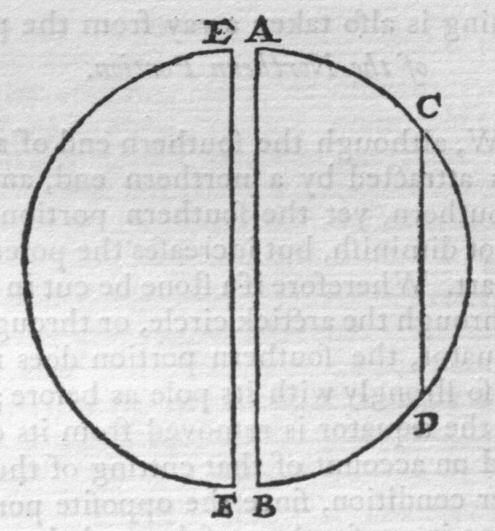
CHAP. XVI.
If the Southern Portion of a Stone be lessened, something is also taken away from the power of the Northern Portion.
ow although the southern end of a magnetick iron is attracted by a northern end, and repelled by a southern, yet the southern portion of a stone does not diminish, but increases the potency of the boreal part. Wherefore if a stone be cut in two and divided through the arctick circle, or through the tropick of Cancer or the æquator, the southern portion does not attract magnetick substances so strongly with its pole as before; because a new whole arises, and the æquator is removed from its old position and moves forward on account of that cutting of the stone. In the former condition, since the opposite portion of the stone increases the mass beyond the plane of the æquator, it strengthens also the verticity, and the potency, and the motion to unity.
CHAP. XVII.
On the Use and Excellence of Versoria: and how iron versoria used as pointers in sun-dials, and the fine needles of the mariners' compass, are to be rubbed, that they may acquire stronger verticity.
ersoria prepared by the loadstone subserve so many actions in human life that it will not be out of place to record a better method of touching them and exciting them magnetically, and a suitable manner of operating. Rich ores of iron and such as yield a greater proportion of metal are recognized by means of an iron needle suspended in æquilibrium and magnetically prepared; and magnetick stones, clays, and earths are distinguished, whether crude or prepared. An iron needle (the soul of the mariners' compass), the marvellous director in voyages and finger of God, one might almost say, indicates the course, and has pointed out the whole way around the earth (unknown for so many ages). The Spaniards (as also the English) have frequently circumnavigated (by an immense circuit) the whole globe by aid of the mariners' compass. Those who travel about through the world or who sit at home have sun-dials. A magnetick pointer follows and searches out the veins of ore in mines. By its aid mines are driven in taking cities; catapults and engines of war are aimed by night; it has been of service for the topography of places, for marking off the areas and position of buildings, and for excavating aqueducts for water under ground. On it depend instruments designed to investigate its own dip and variation.
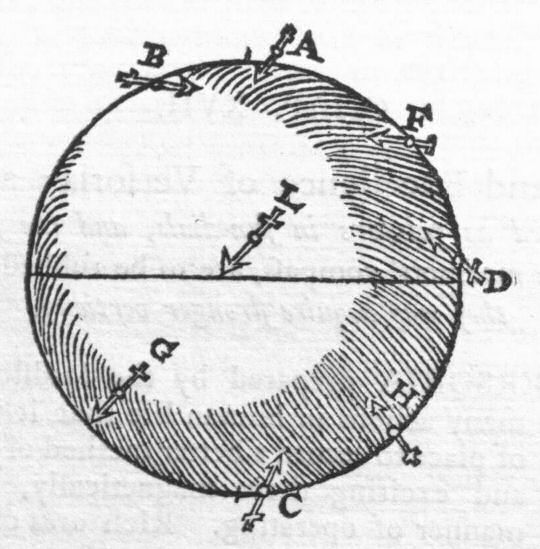
When iron is to be quickened by the stone, let it be clean and bright, disfigured by no rust or dirt, and of the best steel[216]. Let the stone itself be wiped dry, and let it not be damp with any moisture, but let it be filed gently with some smooth piece of iron. But the hitting of the stone with a hammer is of no advantage. By these means let their bare surfaces be joined, and let them be rubbed, so that they may come together more firmly; not so that the material substance of the stone being joined to the iron may cleave to it, but they are rubbed gently together with friction, and (useless parts being rubbed off) they are intimately united; whence a more notable virtue arises in the iron that is excited. A is the best way of touching a versorium when the cusp touches the pole and faces it; B is a moderately good way, when, though facing it, it is a little way distant from the pole; also in like manner C is only moderately good on account of the cusp being turned away from the pole; D, which is farther distant, is hardly so good; F, which is prepared crosswise along a parallel, is bad; of no virtue and entirely irresponsive and feeble is the magnetick index L, which is rubbed along the æquator; oblique and not pointing towards the pole as G, and oblique, not pointing toward but turned away from the pole as H, are bad. These have been placed so that they might indicate the distinct forces of a round stone. But mechanicians very often have a stone tending more to a cone shape, and more powerful on account of that shape since the pole, on which they rub their wires, is at the apex of the projecting part. Sometimes the stone has on the top and above its own pole an artificial acorn or snout made of steel for the sake of its power. Iron needles are rubbed on the top of this; wherefore they turn toward the same pole as if they had been prepared on that part of the stone with the acorn removed. Let the stone be large enough and strong; the needle, even if it be rather long, should be sufficiently thick, not very slender; with a moderate cusp, not too sharp, although the virtue is not in the cusp itself only, but in the whole piece of iron. A strong large stone is not unfit for rubbing all needles on, excepting that sometimes by its strength it occasions some dip and disturbance in the iron in the case of longer needles; so that one which, having been touched before, rested in equilibrium in the plane of the horizon, now when touched and excited dips at one end, as far as the upright pin on which it turns permits it. Wherefore in the case of longer versoria, the end which is going to be the Boreal, before it is rubbed, should be a little lighter, so that it may remain exactly in æquilibrio after it is touched. But a needle in this way prepared does its * work worse the farther it is beyond the æquinoctial circle. Let the prepared needle be placed in its capsule, and let it not be touched by any other magneticks, nor remain in the near vicinity of them, lest by their opposing forces, whether powerful or sluggish, it should become uncertain and dull. If you also rub the other end of the needle on the other pole of the stone, the needle will perform its functions more steadily, especially if it be rather long. A piece of iron touched by a loadstone retains the magnetick virtue, excited in it even for ages[217], firm and strong, if it is placed according to nature meridionally and not along a parallel, and is not injured by rust or any external injury from the surrounding medium. Porta wrongly seeks for a proportion between the loadstone and the iron: because, he says, a little piece of iron will not be capable of holding much virtue; for it is consumed by the great force of the loadstone. A piece of iron receives its own virtue fully, even if it be only of the weight of one scruple, whilst the mass of the loadstone is a thousand pounds. It is also useless to make the needle rather flat at the end that is touched, so that it may be better and more perfectly magnetick, and that it may best receive and hold certain magnetick particles; since hardly any part will stick on a sharp point; because he thought that it was by the adhesion of parts of the loadstone (as it were, hairs) that the influence is imparted and conserved, though those particles are merely rubbed off by the rubbing of the iron over the softer stone, and the iron none the less points toward the North and South, if after it is touched it be scoured with sand or emery powder, or with any other material, even if by long rubbing of this kind the external parts of it are lessened and worn away. When a needle is being rubbed, one should always leave off at the end; otherwise, if it is rubbed on the loadstone from the point toward the middle, less verticity is excited in the iron, sometimes none at all, or very little. For where the last contact is, there is the pole and goal of verticity. In order that a stronger verticity may be produced in the iron by rubbing on the loadstone, one * ought in northern lands to turn the true northern pole of the loadstone toward the highest part of the sky; on this pole that end of the needle is going to be rubbed, which shall afterwards turn toward the north of the earth; whilst it will be an advantage for the other end of the needle to be rubbed on the southern pole of the terrella turned toward the earth, and this being so excited will incline toward the south. In southern regions beyond the æquator the plan is just the contrary. The reason of this dissimilarity is demonstrated, Book II., chap, xxxiv., in which it is shown (by a manifest combination of a terrella and the earth) why the poles of a loadstone, for different reasons, are one stronger than the other. If a needle be touched between the mutually accordant * poles of two loadstones, equal in power, shape, and mass, no strength is acquired by the needle. A and B are two loadstones attracting one another, according to nature, at their dissimilar ends; C, the * point of a needle touched by both at once, is not excited (even if those loadstones be connected according to nature), if they are equal; but if they are not equal, virtue is acquired from the stronger. When a needle is being excited by a loadstone, begin in the middle, and draw the needle toward its end; at the end let the application be continued with a very gentle rubbing around the end for some time; that is to say, for one or two minutes; do not repeat the motion from the middle to the end (as is frequently done) for in this way the verticity is injured. Some delay is desirable, for although the power is imparted instantly, and the iron excited, yet from the vicinity of the loadstone and a suitable delay, a more steady verticity arises, and one that is more firmly durable in the iron. Although an armed stone raises a greater weight of iron than an unarmed one, yet a needle is not more strongly excited by an armed stone than by an unarmed one. Let there be two iron wires of the same length, wrought from the same wire; let one be excited by an armed end, the other by an unarmed end; it is manifest that the same needles have a beginning of motion or a sensible inclination at equal distances from the same armed and unarmed loadstone; this is ascertained by measuring with a longish reed. But objects which are more powerfully excited move more quickly; those which are less powerfully excited, more feebly, and not unless brought rather close; the experiment is made on water with equal corks.
BOOK FOURTH.
CHAP. I.
ON VARIATION.
irection has hitherto been spoken of as if in nature there were no variation; for in the preceding natural history we wished to omit and neglect this, inasmuch as in a terrestrial globe, perfect and in every sense complete, there would be none. Since, however, in fact, the earth's magnetick direction, owing to some fault and slip, deviates from its right course and from the meridian, we must extract and demonstrate the obscure and hidden cause of that variance which has troubled and sore racked in vain the minds of many. Those who before us have written on the magnetick movements have made no distinction between direction and variation, but consider the motion of magnetick iron to be uniform and simple. Now true direction is the motion of the magnetick body to the true meridian and its continuance therein with its appropriate ends towards the poles. But it very often happens at sea and on land that the magnetick iron does not point to the true pole, and that not only a versorium and magnetick pieces of iron, and the needle of a compass, or a mariners' compass, but also a terrella in its boat, as well as * iron ore, iron stones, and magnetick earths, properly prepared, are drawn aside and deviate towards some point of the Horizon very near to the meridian. For they with their poles frequently face termini away from the meridian. This variation (observed by means of instruments or a nautical variation compass) is therefore the arc of the horizon between the common point of intersecion of it with the true meridian, and the terminus of the deflecion on the horizon or projection of the deviating needle. That arc varies and differs with change of locality. To the terminus of the variation is commonly assigned a great circle, called the circle of variation, and also a magnetick meridian passing through the zenith and the point of variation on the horizon. In the northern regions of the earth this variation is either from the north toward the east or from the north toward the west: similarly in the southern regions it is from the south toward the east or toward the west. Wherefore one should observe in the northern regions of the earth * that end of the versorium or compass which turns toward the North; but in the southern regions the other end looking to the south—which seamen and sciolists for the most part do not understand, for in both regions they observe only the boreal lily of the compass (that which faces North). We have before said that all the motions of the magnet and iron, all its turning, its inclination, and its settlement, proceed from bodies themselves magnetical and from their common mother the earth, which is the source, the propagatrix, and the origin of all these qualities and properties. Accordingly the earth is the cause of this variation and inclination toward a different point of the horizon: but how and by what powers must be more fully investigated. And here we must at the outset reject that common opinion of recent writers concerning magnetick mountains, or any magnetick rock, or any phantasmal pole distant from the pole of the earth, by which the motion of the compass or versorium is controlled. This opinion, previously invented by others, Fracastorio himself adopted and developed; but it is entirely at variance with experience. For in that case in different places at sea and on land the point of variation would change toward the east or west in proportion and geometrical symmetry, and the versorium would always respect the magnetick pole: but experience teaches that there is no such definite pole or fixed terminus on the earth to account for the variation. For the arcs of * variation are changed variously and erratically, not only on different meridians but on the same meridian; and when, according to this opinion of the moderns, the deviation should be more and more toward the east, then suddenly, with a small change of locality, the deviation is from the north toward the west as in the northern regions near Nova Zembla. Moreover, in the southern regions, and at sea at a great distance from the æquator towards the antarctick pole, there are frequent and great variations, and not only in the northern regions, from the magnetick mountains. But the cogitations of others are still more vain and trifling, such as that of Cortes about a moving influence beyond all the heavens; that of Marsilius Ficinus about a star in the Bear; that of Peter Peregrinus about the pole of the world; that of Cardan, who derives it from the rising of a star in the tail of the Bear[218]; of Bessardus, the Frenchman, from the pole of the Zodiack; that of Livio Sanuto from some magnetick meridian; that of Franciscus Maurolycus from a magnetical island; that of Scaliger from the heavens and mountains; that of Robert Norman, the Englishman, from a point respective. Leaving therefore these opinions, which are at variance with common experience or by no means proved, let us seek the true cause of the variation. The great magnet or terrestrial globe directs iron (as I have said) toward the north and south; and excited iron quickly settles itself toward those termini. Since, however, the globe of the earth is defective and uneven on its surface and marred by its diverse composition, and since it has parts very high and convex (to the height of some miles), and those uniform neither in composition nor body, but opposite and dissimilar: it comes to pass that the whole of that force of the earth diverts magnetical bodies in its periphery toward the stronger and more prominent connected magnetick parts. Hence on the outermost surface of the earth magnetical bodies are slightly perverted from the true meridian. Moreover, since the surface of the globe is divided into high lands and deep seas, into great continental lands, into ocean and vastest seas, and since the force of all magnetical motions is derived from the constant and magnetick terrestrial nature which is more prevalent on the greater continent and not in the aquæous or fluid or unstable part; [219]it follows that in certain parts there would be a magnetick inclination from the true pole east or west away from any meridian (whether passing through seas or islands) toward a great land or continent rising higher, that is, obviously toward a stronger and more elevated magnetick part of the terrestrial globe. For since the diameter of the earth is more than 1,700 German miles, those large lands can rise from the centre of the earth more than four miles above the depth of the ocean bottom, and yet the earth will retain the form of a globe although somewhat uneven at the top. Wherefore a magnetical body is turned aside, so far as the true verticity, when disturbed, admits, and departs from its right (the whole earth moving it) toward a vast prominent mass of land as though toward what is stronger. But the variation does really take place, not so much because of the more prominent and imperfect terrestrial parts and continent lands as because of the inæquality of the magnetick globe, and because of the real earth, which stands out more under the continent lands than under the depths of the seas. We must see, therefore, how the apodixis of this theory can be sustained by more definite observations. Since throughout all the course from the coast of Guinea to Cape Verde, the Canary Isles, and the border of the kingdom of Morocco, and thence along the coasts of Spain, France, England, Belgium, Germany, Denmark, and Norway, there lie on the right hand and toward the east a continent and extensive connected regions, and on the left extensive seas and a vast ocean lie open far and wide, it is consonant with the theory (as has been carefully observed by many) that magnetical bodies should turn slightly to the East from the true pole toward the stronger and more remarkable elevations of the earth. But it is far otherwise on the eastern shores of northern America; for from Florida by Virginia and Norumbega to Cape Race and away to the north the versorium is turned toward the west. But in the middle spaces, so to speak, as in the more westerly Azores, it looks toward the true pole. That any magnetick body turns itself similarly to the same regions of the earth is not, however, because of that meridian or because of the concordancy of the meridian with any magnetick pole, as the crowd of philosophizers reckon, for it is not so throughout the whole of that meridian. For on the same meridian * near Brazil something very different occurs, as we will show further on. The variation (cæteris paribus) is always less near the æquator, greater in higher latitudes, with the limitation that it be not very near the pole itself. Hence the variation is greater on the coast of * Norway and Belgium than on the coast of Morocco or Guinea: greater also near Cape Race than in the harbours of Norumbega or of Virginia. On the coast of Guinea magnetick implements deviate by a third part of one rumbe to the East: in Cape Verde Islands by a half: on the coast of Morocco by two thirds: in England at the mouth of the Thames by a whole rumbe: and at London by nearly eleven degrees and one third. For indeed the moving magnetick virtue is stronger in a higher latitude; and the larger regions extending toward the poles dominate the more, as is easily apparent anywhere on a terrella. For as in the case of true Direction magnetick bodies tend toward the pole (namely, toward the stronger end, the whole earth causing the motion), so also do they incline a little toward the stronger and higher parts by the action of the whole along with the conjoint action of iron bodies.
CHAP. II.
That the variation is caused by the inæquality of the projecting parts of the earth.
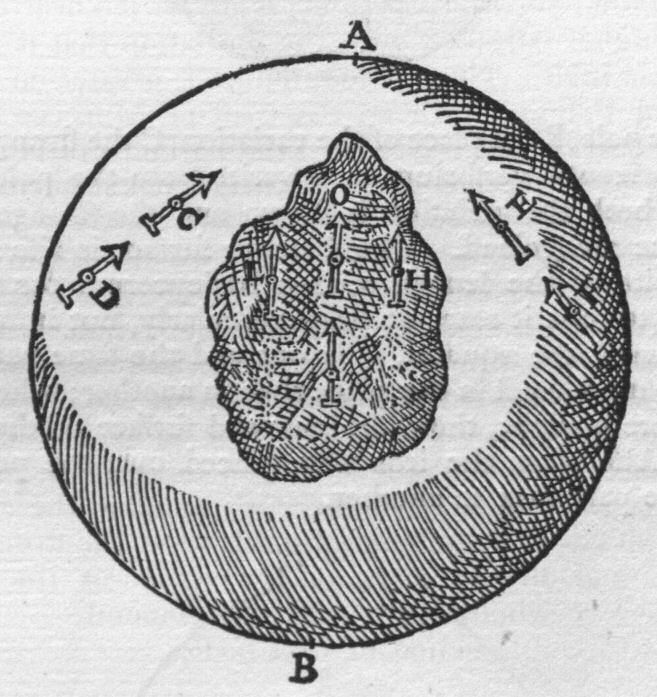
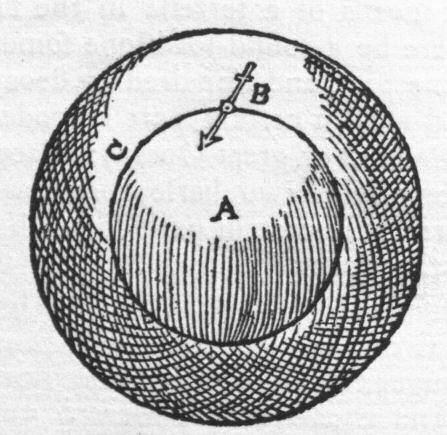
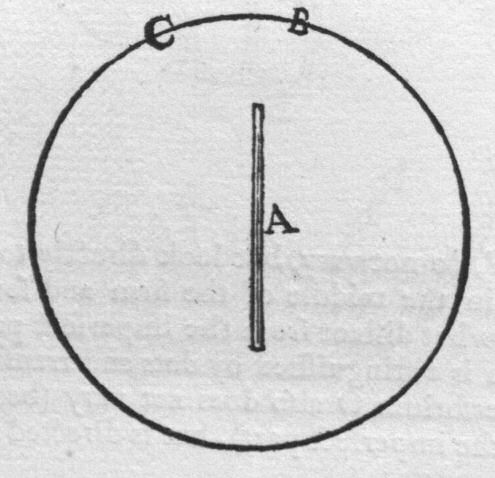
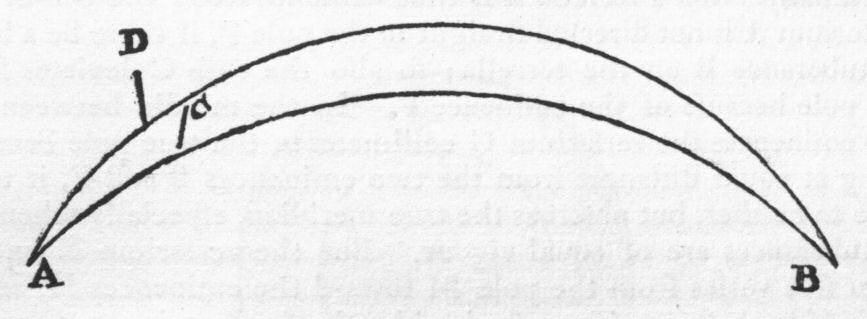
emonstration of this may manifestly be made * by means of a terrella in the following way: let there be a round loadstone somewhat imperfect in some part, and impaired by decay (such an one we had with a certain part corroded to resemble the Atlantick or great Ocean): place upon it some fine iron wire of the length of two barleycorns, as in the following figure. A B, a Terrella in certain parts somewhat imperfect and of unæqual virtue on the circumference. The versoria E, F, do not vary, but look directly to the pole A; for they are placed in the middle of the firm and sound part of the terrella and somewhat distant from the imperfect part: that part of the surface which is distinguished by dots and transverse lines is the weaker. The versorium O also does not vary (because it is placed in the middle of the imperfect part), but is directed toward the pole, just as near the western Azores on the earth. The versoria H and L do vary, for they incline toward the sounder parts very near them. As this is manifest in a terrella whose surface is sensibly rather imperfect, so also is it in others whole and perfect, when often one part of the stone has stronger external parts, which nevertheless do not disclose themselves manifestly to the senses. In such a terrella the demonstration of the variation and the discovery of the stronger parts is on this wise. * Let A be the pole, B the place of the variation, C the stronger regions; then the horizontal versorium at B varies from the pole A toward C: so that both the variation is shown and the stronger places of the loadstone recognized. The stronger surface is also found by a fine iron wire of the length of two barleycorns: for since at the pole of the terrella it rears up perpendicularly, but in other places inclines toward the æquator, if in one and the same parallel circle it should be more erect in one place than in another; where the wire is raised more upright, there the part and surface of the terrella is stronger. Also when the iron wire placed over the pole inclines more to one part than to another. * Let the experiment be made by means of a fine iron wire of three digits length placed over the pole A, so that its middle lies over the pole. Then one end is turned away from B toward C, and is not willing to lie quietly toward B; but on a terrella which is perfect[220] all round and even it rests on the pole directed toward any point of the æquator you please. Otherwise, let there be two * meridians meeting in the poles A B, let iron wires be reared just at the ends D and C of the equal arcs D A and C A; then the wire at D (the stronger region) will be more raised up than that at C, the weaker. And thus the sounder and stronger part of the loadstone is recognized, which otherwise would not be perceived by the touch. In a terrella which is perfect, and even, and similar in all its parts, there is, at equal distances from the pole, no variation[221]. Variation is shown by means of a terrella, a considerable part of which, forming a surface a little higher than the rest, does, although it be not decayed and broken, allure the versorium from the true * direction (the whole terrella co-operating).
A terrella uneven in surface.
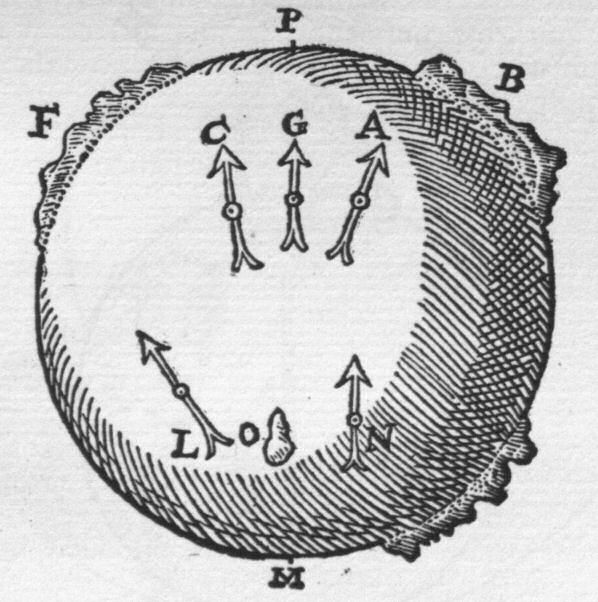
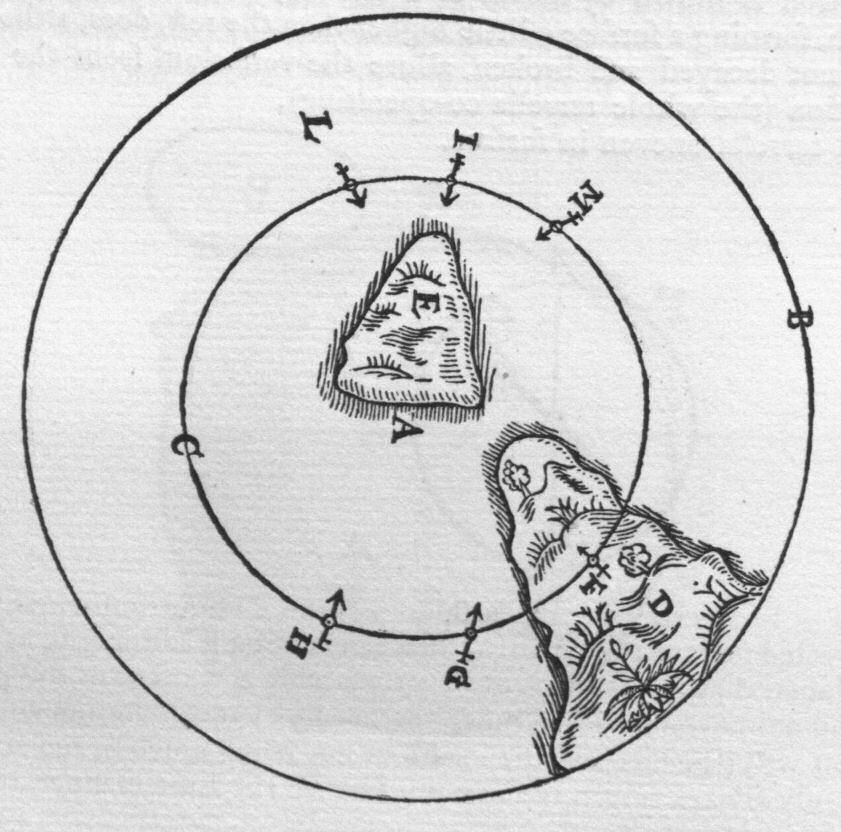
It is shown by a small spike placed over a terrella or by a small versorium; for they are turned by the terrella toward the mass that stands out and toward the large eminences. In the same way on the earth the verticity is perturbed by great continents, which are mostly elevated above the depths of the seas and make the versorium deviate sometimes from the right tracks (that is, from the true meridians). On a terrella it is thus demonstrated: the end of the versorium A is not directed straight to the pole P, if there be a large protuberance B on the terrella; so also the cusp C deviates from the pole because of the eminence F. In the middle between the two eminences the versorium G collimates to the true pole because, being at equal distances from the two eminences B and F, it turns aside to neither, but observes the true meridian, especially when the protuberances are of equal vigour. But the versorium N on the other side varies from the pole M toward the eminences H, and is not held back, stopped, or restrained by the small eminence O on the terrella (as it were, some island of land in the ocean). L, however, being unimpeded, is directed to the pole M. The variation is demonstrated in another way on a terrella, just as on the earth. Let A be the pole of the earth, B the equator, C the parallel circle of latitude of 30 degrees, D a great eminence spread out toward the pole, E another eminence spread out from the pole toward the æquator. It is manifest that in the middle of D the versorium F does not vary; while G is very greatly deflected: but H very little, because it is further removed from D. Similarly also the versorium I placed directly toward E does not deviate from the pole: but L and M turn themselves away from the pole A toward the eminence E.
CHAP. III.
The variation in any one place is constant.
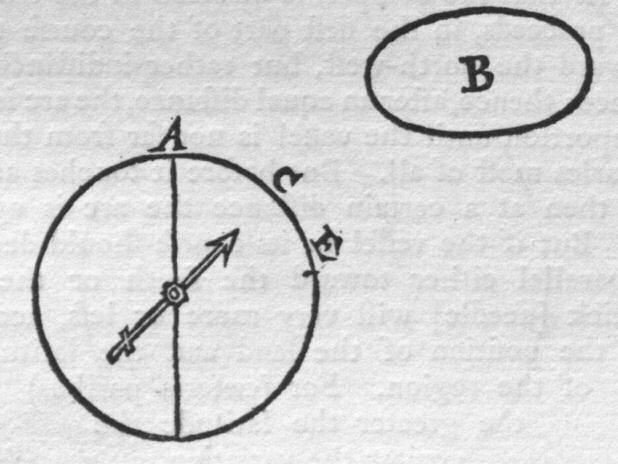
nless there should be a great dissolution of a continent and a subsidence of the land such as there was of the region Atlantis of which Plato and the ancients tell, the variation will continue perpetually immutable; the arc of the variation remains the same in the same place or region, whether it be at sea or on land, as in times past a magnetick body has declined toward the East or the West. The constancy of the variation and the pointing of the versorium to a definite point on the horizon in individual regions is demonstrated by a small versorium placed over a terrella the surface of which is uneven: for it always deviates from the meridian by an equal arc. It is also shown by the inclination of a versorium toward a second magnet; although in reality it is by the turning power of the whole, whether in the earth or in a terrella. Place upon a plane a versorium whose cusp is directed toward the north A: place beside it a loadstone, B, at such a distance that the versorium may turn aside toward B to the point C, and not beyond. Then move the needle of the versorium as often as you will (the box and the loadstone not being moved), and it will certainly always return to the point C. In the same manner, if you placed the stone so that it may be truly directed toward E, the cusp always reverts to E, and not to any other point of the compass. Accordingly, from the position of the land and from the distinctive nature of the highest parts of the earth (certain terrene and more magnetick eminences of the regions prevailing), the variation indeed becomes definite in one and the same place, but diverse and unæqual from a change of place, since the true and polar direction originating in the whole terrestrial globe is diverted somewhat toward certain stronger eminences on the broken surface.
CHAP. IIII.
The arc of variation is not changed equally in proportion to the distance of places.
n the open sea, when a vessel is borne by a favourable wind along the same parallel, if the variation be changed by one degree in the course of one hundred miles, the next hundred miles do not therefore lessen it by another degree; for the magnetick [needle] varies erratically as respects position, form, and vigour of the land, and also because of the distance. As, for example, when a course from the Scilly Isles to Newfoundland has proceeded so far that the compass is directed to the true pole, then, as the vessel proceeds, in the first part of the course the variation increases toward the north-west[222], but rather indistinctly and with small difference: thence, after an equal distance, the arc is increased in a greater proportion until the vessel is not far from the continent: for then it varies most of all. But before it touches actual land or enters port, then at a certain distance the arc is again slightly diminished. But if the vessel in its course should decline greatly from that parallel either toward the south or the north, the magnetick [needle] will vary more or less, according to the position of the land and the latitude * of the region. For (cæteris paribus) the greater the latitude the greater the variation.
CHAP. V.
An island in Ocean does not change the variation[223], as neither do mines of loadstone.
slands, although they be more magnetick than the sea, yet do not change the magnetick directions or variations. For since direction is a motion derived from the power of the whole earth, not from the attraction of any hill but from the disposing and turning power of the whole; so variation (which is a perturbation of the direction) is an aberration of the real turning power arising from the great inequalities of the earth, in consequence of which it, of itself, slightly diverts movable magneticks toward those which are the largest and the more powerful. The cause now shown may suffice to explain that which some so wonder at about the Island of Elba (and although this is productive of loadstone, yet the versorium (or mariners' compass) makes no special inclination toward it whenever vessels approach it in the Tyrrhenian sea); and the following causes are also to be considered, viz.: that the virtue of smaller magnetick bodies extends scarcely or not at all of itself beyond their own mines: for variation does not occur because of attraction, as they would have it who have imagined magnetick poles. Besides, magnetick mines are only agnate to the true earth, not innate: hence the whole globe does not regard them, and magneticks are not borne to them, as is demonstrated by the diagram of eminences.
CHAP. VI.
That variation and direction arise from the disponent power of the earth, and from the natural magnetick tendency to rotation, not from attraction, or from coition, or from other occult cause.
wing to the loadstone being supposed (amongst the crowd of philosophizers) to seize and drag, as it were, magnetick bodies; and since, in truth, sciolists have remarked no other forces than those so oft besung of attractive ones, they therefore deem every motion toward the north and south to be caused by some alluring and inviting quality. But the Englishman, Robert Norman, first strove to show that it is not caused by attraction: wherefore, as if tending toward hidden principles, he imagined a point respective[224], toward which the iron touched by a loadstone would ever turn, not a point attractive; but in this he erred greatly, although he effaced the former error about attraction. He, however, demonstrates his opinion in this way:
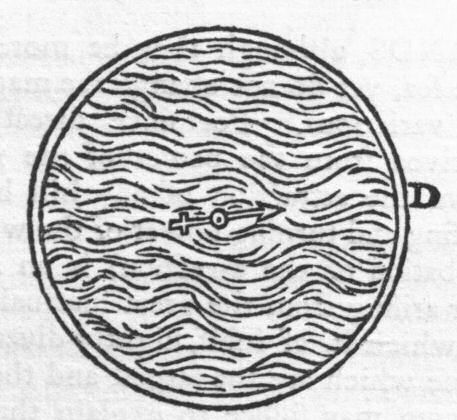
Let there be a round vessel filled with water: in the middle of the surface of the water place a slender iron wire on a perfectly round cork, so that it may just float in æquilibrium on the water; let the wire be previously touched by a magnet, so that it may more readily show the point of variation, the point D as it were: and let it remain on the surface for some time. It is demonstrable that the wire together with the cork is not moved to the side D of the vessel: which it would do if an attraction came to the iron wire by D: and the cork would be moved out of its place. This assertion of the Englishman, Robert Norman, is plausible and appears to do away with attraction because the iron remains on the water not moving about, as well in a direction toward the pole itself (if the direction be true) as in a variation or altered direction; and it is moved about its own centre without any transference to the edge of the vessel. But direction does not arise from attraction, but from the disposing and turning power which exists in the whole earth, not in the pole or in some other attracting part of the stone, or in any mass rising above the periphery of the true circle so that a variation should occur because of the attraction of that mass. Moreover, it is the directing power of the loadstone and iron and its natural power of turning around the centre which cause the motion of direction, and of conformation, in which is included also the motion of the dip. And the terrestrial pole does not attract as if the terrene force were implanted only in the pole, for the magnetick force exists in the whole, although it predominates and excels at the pole. Wherefore that the cork should rest quiescent in the middle and that the iron excited by a loadstone should not be moved toward the side of the vessel are agreeable to and in conformity with the magnetick nature, as is demonstrated by a terrella: for an iron spike placed on the stone at C clings on at C, and is not pulled * further away by the pole A, or by the parts near the pole: hence it persists at D, and takes a direction toward the pole A; nevertheless it clings on at D and dips also at D in virtue of that turning power by which it conforms itself to the terrella: of which we will say more in the part On Declination.