ITALIAN (continued 2)
Reading edition
In 1481 Botticelli was sent for by Pope Sixtus to assist Perugino and Ghirlandaio in painting frescoes in the newly erected Sistine Chapel; and when this work was completed Botticelli returned to Florence with an added lustre to his name. It was the fashionable thing for wealthy owners of villas to have frescoes painted in these country-houses; and among many orders that Botticelli filled was an important series of frescoes for Lorenzo Tornabuoni in the villa of the Tornabuoni family (now Villa Lemmi) at Rifredi representing scenes in reference to the marriage of Lorenzo Tornabuoni and Giovanna degli Albizzi in 1486 (see page 68). These frescoes, recently discovered under whitewash, are now in the Louvre.
The death of Lorenzo the Magnificent, the banishment of the Medici, and the rule of Savonarola changed Botticelli’s life and his style of painting. In this third period the painter of nymphs and goddesses paints his charming and wistful Madonnas with many suggestions of Venus and Simonetta and the grace and loveliness of the pagan world.
To the last period, when Botticelli had emerged from the Savonarola influence, the great painter produced Calumny (in the Uffizi) and the Nativity (in the National Gallery, London); and with these two works the career of Botticelli ends.
The theory that the Birth of Venus, Mars and Venus and the Primavera were painted for Lorenzo di Pier Francesco has been thoroughly examined and disproved by Col. G. F. Young in his splendid history of The Medici.
PORTRAIT OF A YOUNG MAN.
Sandro Botticelli Collection of
(1444–1510). Mr. Clarence H. Mackay.
Standing behind a balustrade and looking wistfully toward the observer, this handsome young Florentine appears at half-length with his head inclined towards the left.
How we should like to penetrate his secret and help him away from the melancholy mood that has overwhelmed him!
Although we see that he is a dreamer (and most probably a lute-player as his hands might seem to indicate), something has touched him very deeply—far too deeply to be classed as a momentary sorrow. We should also like to know his identity. It is unlikely that it will ever be revealed. But of one thing we can be well assured,—he is an aristocrat and a young gentleman of wealth, for he has all the air of savoir faire and sureness of his position. We might make a guess that he is one of the Medici family. Could it be Giuliano? Look again at the Madonna of the Magnificat, at Giuliano immediately below the bending Angel! The resemblance is quite surprising and grows stronger as we study the two faces, only in the Madonna of the Magnificat Giuliano is younger and is seen with the characteristic lock on his forehead.
His costume in this portrait shows up well from the black background: the coat is purplish brown edged with fur with white puffs at the shoulders; and a red cap contrasts well with his light-yellow hair.
This picture, a tempera painting on panel (15¾ × 11¾), was long in the Collection of Baron Arthur de Schickler in Martinvast, Normandy, where it was attributed to Masaccio.
“There can be no question,” Berenson thinks, “that this portrait is Botticelli’s own handiwork. The glamor it cast when I first saw it frightened me into doubts that were dispelled directly I could study the painting at my leisure. There is no one, using this formula and technique, but Sandro himself who has the sinuous line, the inevitable contours, the structural articulation, the firmness, convincingness, and delicacy of modelling this work possesses; nobody else who could produce a rhythm so subtly vibrant, or could give this limpid, radiant, and ethereal coloring.
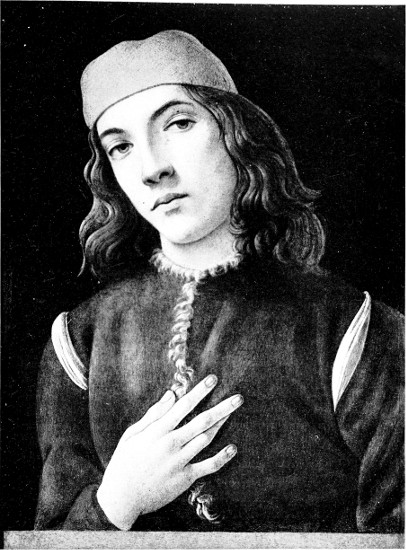
Collection of Mr. Clarence H. Mackay
PORTRAIT OF A YOUNG MAN
—Sandro Botticelli
“True, it is more Botticellian than any other Botticelli in existence. He must have uttered this completest note of his own music just before he was seized by the Savonarolian madness, from which he never recovered, just at the moment when he was most peculiarly and poignantly, and, if I may say so, most extravagantly, himself. The isolation of this head, too, exaggerates the impression. Perhaps if we found it as an Angel in a Magnificat, or a Madonna with the Pomegranate, in a Tobias or some Allegory, the other figures, the landscape and all the accessories would prevent our attention from concentrating on what is almost uncannily characteristic of the master’s style.”
Berenson also notes the important hand, which, by the way, is especially lighted as if to draw our attention to it most particularly.
“Perhaps the most interesting thing about this portrait,” he observes, “is the manifest competition of the hand with the face. The hand is studied just as carefully, drawn, and modelled with as much intention, as the face itself. Its action reveals the automatic nervous tension of an overstrung physique that the conscious mind, controlling the expression, tries to keep in order. It thus becomes, in a sense, the most important clue to understanding the character. If you think it away, the expression, of course, remains, but what makes it comprehensible disappears.”
It is this peculiar intelligence and sensitiveness of the hand that makes me suspect the musician.
MADONNA AND CHILD.
Sandro Botticelli Collection of
(1444–1510). Mr. Max Epstein.
This picture is the latest Botticelli to have been brought to this country for it arrived only in May, 1928. It was painted in Botticelli’s early period, about 1470 or 1472. The Holy Child is handsome, although robust, and His embrace of the Madonna is touchingly affectionate and human. In this picture the Madonna would seem to have had a vision of the coming tragedy and she is not yet resigned. She loves her Child too well. That her eyes are full of tears we can feel in those heavily drooping lids. Her face is full of pain. But even in her suffering and quiet anguish this Madonna is beautiful and graceful; and we cannot fail to see in her face some little resemblance to Botticelli’s Venus in the Primavera and Venus in her scallop-shell borne over the waves in the early morning in the Birth of Venus.
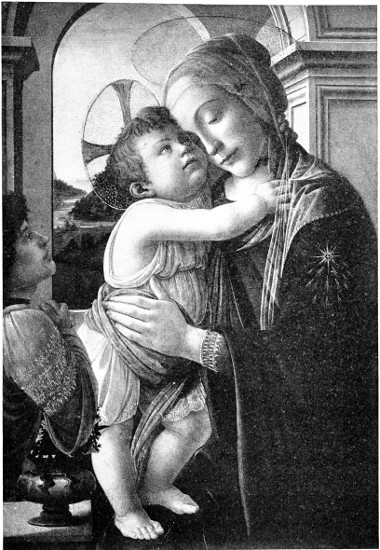
Collection of Mr. Max Epstein
MADONNA AND CHILD
—Sandro Botticelli
In this picture the Holy Child seems to have little or no consciousness of His Divinity. The Mother here is the enlightened one.
The picture is tempera on panel (35¾ × 23¼ inches) and came into possession of M. Féral in Paris in 1907. It has been accepted by Bode and Jashiro as a genuine and an early Botticelli.
The Madonna’s robe is deep blue with a lining of dull green, which shows at the left wrist and slightly down the front and on the left shoulder a star is embroidered. She wears a closely folded diaphanous veil and a red scarf, one end of which is gracefully thrown around the Holy Child. The sleeve of the dress has a band of golden embroidery at the wrist.
The cruciform nimbus of the Holy Child foretells His destiny. The nimbus of the Virgin is plain. The Angel wears a tunic of deep cream white ornamented with gold on the sleeves and a black band ornamented with gold at the throat. On the parapet stands a vase apparently of alabaster containing myrtle leaves and white star-shaped flowers, probably jasmine (see page 25). Through the open arch we see a gentle landscape, with a river winding around distant hills.
GIOVANNA TORNABUONI.
Domenico Ghirlandaio (1449–1494).
Collection of Mr. J. P. Morgan.
With this picture, which is considered “one of the finest Italian portraits in existence,” we step back into the period of the Renaissance and into the very presence of one of the most gifted and celebrated of the younger women of the Fifteenth Century.
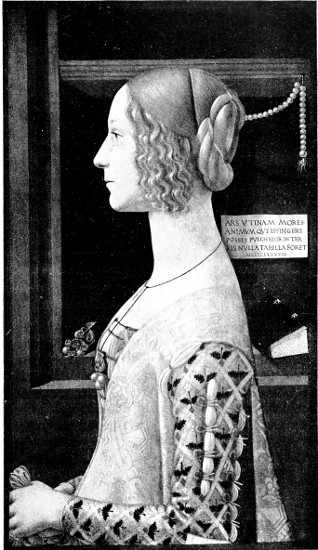
Collection of Mr. J. P. Morgan
GIOVANNA TORNABUONI
—Domenico Ghirlandaio
“Art coulds’t thou but portray character and the mind, then there would be no picture in the whole world more beautiful than this.”
Such is the translation of the legend inscribed in capital letters on the cartel:
“Ars ultinam mores animumque effingere posses Pulchrior in terris nulla tabella foret”
with the date MCCCCLXXXVIII.
The charms of Giovanna degli Albizzi, who was married to Lorenzo Tornabuoni in 1486, were sung by all the poets of Florence. Giovanna came of the noted Albizzi family, famous for wealth and rank and for leading the party of Nobles (Grandi) against the Medici, whom they considered upstarts and enemies of the aristocratic faction in Florence. By a former marriage, however, the Albizzi had become connected with the Medici, for the wife of Piero de’ Medici (il Gottoso) was Lucrezia Tornabuoni, one of the most accomplished women of the age and whose portrait by Botticelli hangs to-day in the Kaiser Friedrich Museum in Berlin. Giovanna’s husband, Lorenzo Tornabuoni (Lucrezia Tornabuoni’s nephew), was, therefore, the first cousin of Lorenzo and Giuliano de’ Medici.
Subsequent to the ownership by the Tornabuoni and Pandolfini families, the portrait represented here passed to a private Collection in Paris and thence to the late Mr. Henry Willett of Brighton, England; to the famous Collection of Mr. Rodolphe Kann of Paris and, finally, to that of Mr. J. P. Morgan.
The picture is painted on a wooden panel (29¾ × 19½ inches).
Standing in profile to the left and against an architectural background, the lady appears at half-length. She wears a rich dress of gold brocade of a handsome and decorative pattern with square neck, the sleeves of a different material, dark-red in color and having yellow diamond-shaped compartments bearing a floral design in the centre. A handsome pendant, consisting of a ruby with three pearls, hangs from a fine black silk cord around her neck. Her hair falls in light, wavy tresses over her temples and covers her ears. In the recess at the back is placed a cluster of precious stones. On the right is a Book of Hours, and above is looped a necklace of coral beads. All of these things undoubtedly have some particular and sentimental association for Giovanna. Giovanna died the same year this portrait was painted; in this year her father-in-law, Giovanni Tornabuoni, also uncle of Lorenzo de’ Medici, commissioned Ghirlandaio to decorate the walls of the choir of Sta. Maria Novella with the Lives of John the Baptist and the Virgin; and here again the portrait of Giovanna degli Albizzi appears. Let us turn to Mrs. Cartwright for a description of this remarkable series of frescoes:
“These twenty-one subjects have been much injured by damp and restoration and the hand of inferior assistants is plainly seen in many of the best preserved portions. But as a splendid illustration of Florentine life the whole series is of rare interest. On the one hand we have the public and official life of the Tornabuoni, their stately banquets and processions; on the other, we catch a glimpse of their private and domestic history. In the guests seated at Herod’s Feast, in the crowds who throng the temple court, we recognize the Tornabuoni and their kinsmen, the partners of the Medici bank, Gianfrancesco Ridolfi, Roderigo Sassetti, and Andrea de’ Medici. On one side we have a group of famous humanists—Angelo Poliziano, Marsilio Ficino, Cristoforo Landino, and Lorenzo’s tutor, Gentile de’ Becchi; on the other, we see the painter with his aged father and his brother, David, and brother-in-law, Sebastiano Mainardi, the assistants who helped in the decoration of the choir. Giovanna degli Albizzi, the fair maiden who on the 16th of June, 1486, became the bride of Lorenzo Tornabuoni, is here in her stiff brocades and rich jewels with her young sister-in-law, Lodovica, and many noble dames on their way to visit the mother and new-born babe. These frescoes, which were finally completed in 1490, filled the Tornabuoni family with delight and wonder, and Ghirlandaio was next employed to paint the chapel of their villa near Fiesole, which was unfortunately destroyed by floods in the next century.”
As in the case of so many Italian painters, the name by which Ghirlandaio is known is only a nickname: it means “Garland-maker,” and was given to him because his first reputation was derived from the beautiful gold and silver garlands and wreaths he made for the wealthy ladies of fashion. Ghirlandaio, son of Tommaso Bigordi, a silk merchant of Florence, was born in that city in 1449. He began his life as apprentice to a goldsmith—as so many superlative painters have done—and early showed talent for drawing and sketching. Before long he left the goldsmith and entered the studio of Alesso Baldovinetti (see page 48); and he undoubtedly owed much to this painter in his fondness for decorative effects. Ghirlandaio was tremendously industrious and always worked with the best artists of his time. At San Gimigniano in 1475 he worked with Pier Francesco Fiorentino and he assisted Botticelli in the Sistine Chapel in 1481. His own independent work was stupendous. Ghirlandaio devoted himself almost exclusively to sacred subjects and his frescoes are practically scenes of the Florentine world he knew so well. Whether he painted scenes from the life of St. Francis, or of the Virgin, or Herod, or St. Zenobius, the characters represented are members of the Medici, the Tornabuoni, the Sassetti, the Albizzi, and other important Florentine families. In fact, his attention to details and the careful way he rendered them, show that he had some knowledge of contemporary Flemish paintings; and consequently Ghirlandaio is regarded as chief of the Florentine realists. However, Ghirlandaio ranked in his day with Botticelli and Filippino Lippi, and he enjoyed the patronage and friendship of the Medici. Ghirlandaio’s most important frescoes are those in Sta. Maria Novella representing Lives of the Virgin and John the Baptist, commissioned by Giovanni Tornabuoni, described above, and those in Santa Trinità depicting the Life of St. Francis, ordered by Francesco Sassetti described on page 72.
Ghirlandaio died in 1494 of the Plague, comparatively young, but having accomplished a vast amount of work and having trained a number of painters, the most important of whom was Michelangelo. Ghirlandaio’s son, Ridolfo Ghirlandaio (1483–1561), became a painter and was an intimate friend of Raphael.
FRANCESCO SASSETTI AND HIS SON TEODORO.
Domenico Ghirlandaio Collection of
(1449–1494). Mr. Jules S. Bache.
Francesco Sassetti, a wealthy banker and Lorenzo de’ Medici’s agent at Lyons, is shown here slightly under life-size, wearing a purple skull cap and a red robe lined with fur and held at the waist by a black cord, from which hangs a pouch, or purse. His right hand rests upon the arm of the chair in which he is seated. His eyes look downward upon his son, who stands at his left, in profile, gazing upward into his father’s face. His hands are clasped and he is wearing a costume of silvery grey brocade trimmed with white fur, undersleeves of dark-green and slashed, and a scarlet cap. Through the window we have an interesting view of an inlet of the sea (or a large river) with mountains and buildings. On the top of the window-frame there is an inscription: “Franciscos Saxettvs Theodorus QVE.” The picture is an oil painting on panel (29½ × 20½ inches) and is supposed to have been executed in 1487–1489. Francesco Sassetti was born about 1420 and died in 1491. Teodoro was born on March 11, 1479, and is seen here at about the age of eight or nine, which fixes the date of the picture. It is interesting to note that Teodoro Sassetti was the grandfather of Filippo Sassetti, an early traveller in India (see Marencci, Lettere di Filippo Sassetta, Firenze, 1855).
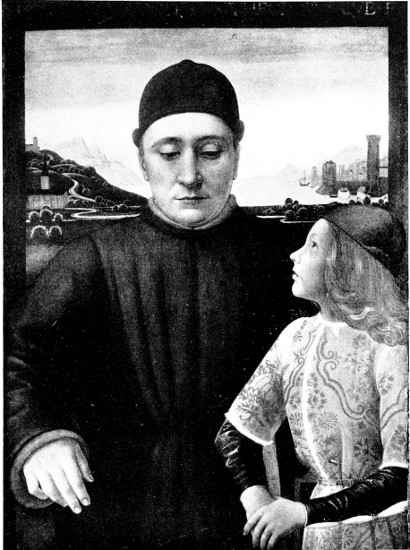
Collection of Mr. Jules S. Bache
FRANCESCO SASSETTI AND HIS SON TEODORO
—Domenico Ghirlandaio
This picture comes from the Benson Collection and was formerly owned by Mr. William Graham. Francesco Sassetti also appears in the frescoes depicting the Life of St. Francis, which Ghirlandaio painted in the Sassetti Chapel in the Trinità in Florence. Ghirlandaio introduced into this series other members of the Sassetti family, as well as many of his illustrious contemporaries and friends, including Lorenzo de’ Medici, Pope Honorius, Maso degli Albizzi, Palla Strozzi, and Angelo Acciaiuoli. In the fifth fresco, where St. Francis is bringing a dead child to life, Ghirlandaio has painted his own portrait. He is conspicuous in a red cap and resting his hand upon his hip.
THE UMBRIAN SCHOOL
The Umbrian School occupied the relative place in the Early Renaissance that the Sienese School held in the Middle Ages. At first, Umbrian painting was the offspring of Siena, but it fell under and developed under the influence of Florence. Florentine artists came to Umbria and Umbrian artists went to Florence, and gradually the Umbrian School, which had certain qualities of its own, developed and reached full flower in the beloved of all the world,—Raphael.
The word Umbrian is used rather loosely by critics to include many Tuscan painters who have to be gathered into this group, which dates from the end of the Fourteenth and beginning of the Fifteenth Century. One particular quality of the Umbrians was their essentially deep religious feeling.
“Whereas the devotion of Sienese art had been hieratic, aristocratic, and akin to the ideals of Mediæval Byzantium, that of Umbria became ecstatically human. The Renaissance trend towards bringing to earth the regal Christian gods of the Middle Ages was nowhere so strong as in Umbria; and it is not an exaggeration to say that we owe to the Umbrians our modern visual images of the Eternal, the Madonna, and the other important members of the Christian Pantheon. The piety and humility of the figures was deepened and dignified by a specially emphasized space-composition, both architectural and landscape. Landscape backgrounds were given unusual importance and delicate beauty. The Umbrian School thus became the most charming, the tenderest, and the most intimately human of Renaissance Italy.”—Mediæval and Renaissance Paintings (Fogg Art Museum, Cambridge, 1927).
The first great Umbrian painter was Gentile da Fabriano (1370?–1427), pupil of an earlier Umbrian painter, Allegretto Nuzi (active from 1346 to 1373), in turn a pupil of the Florentine Bernardo Daddi.
The next important Umbrian was Piero della Francesca or Pier dei Franceschi (1416?–1492), pupil of Domenico Veneziano of Florence, important in his own work and important as a master, forming Luca Signorelli, who in turn influenced Michelangelo. Piero della Francesca was also influenced by the Florentine, Paolo Uccello, whose scientific leanings towards perspective he shared. As a colorist, as a painter of light and atmosphere, and as a master of composition, Piero della Francesca ranks with the greatest Italian masters of the Early Renaissance.
By this time Perugia had become the most important centre of painting in Umbria. Among its conspicuous artists was Benedetto Bonfigli (1425–1496); Fiorenzo di Lorenzo (1440–1521), the supposed master of Perugino and Pintoricchio; Perugino, whose real name was Pietro Vannucci (1446–1523); Bernard Pintoricchio “the little painter” (1454–1513), whose real name was Bernard di Betto, or Biagio; and the great Raphael (1483–1520), son of the painter Giovanni Santi of Urbino; and with this painter of the world’s favorite Madonnas the Umbrian School practically ends.
MADONNA AND CHILD.
Gentile da Fabriano (1370–1427).
Collection of Mr. Henry Goldman.
No little suggestion of the Giotto Madonna (shown on page 27), appears in the Madonna and Child by Gentile da Fabriano, which, according to Colosanti, was painted in the best period of the artist, shortly before he produced the Adoration of the Kings, now in the Uffizi. In comparing it with the Giotto Madonna, we see that the arch has become slightly more pointed than the one in the Giotto picture and we find also a gold background; but in the Fabriano painting a graffito design of two winged Angels with flowing robes on either side is slightly visible. As in the Giotto picture the two nimbi are different; the Virgin’s nimbus having an Arabic inscription and the nimbus of the Holy Child having a Gothic foliage. The Virgin is seated on a cassone, or chest (a not unusual but hardly very comfortable seat in the Fourteenth Century), covered with a dark-brown cloth with floral figure behind which a tiled floor is seen. The Virgin wears a long tunic of claret-colored damask with gold border, on which appears the motto “Ave Maria Plena Dom—— Tecu—— Ben.” On the border around the neck the word “Mater” appears. The mantle is slit at the sides through which the arm protrudes in a long sleeve of rich gold brocade with the pomegranate pattern. A scarf of thin yellow woollen material, decorated with red and blue flowers and red fringe, is worn around her head and neck. The Holy Child has on a little dress, very neatly made and fitting very snugly, of dark-blue trimmed with a border of red and gold. He is standing with His left foot on His mother’s knee and is stepping forward with the other. He has raised His right hand as if to emphasize the words He is speaking and to which His mother is listening with rapt admiration. This movement of the Child takes something away from the solemnity of the picture and the Virgin’s maternal pride shows her to be more of this earth than the Giotto Madonna whose calm, impassive yet tender beauty, proclaims her to belong to a higher sphere than does the Fabriano.
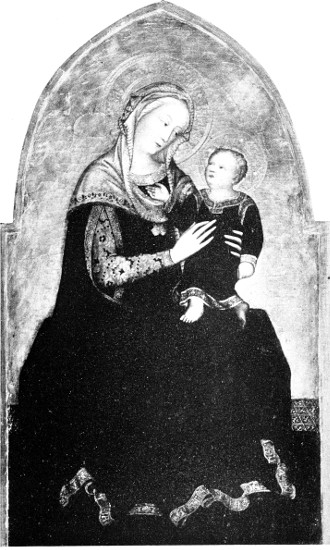
Collection of Mr. Henry Goldman
MADONNA AND CHILD
—Gentile da Fabriano
The picture, tempera on panel (38 × 22½ inches), belonged to the Alexander Baker Collection, London, and to the Collection of Madame E. J. Sartoris, Paris.
Gentile da Fabriano’s full name was Gentile di Nicola di Giovanni di Masso and he was born at Fabriano about 1370. He was a pupil of Allegretto Nuzi and possibly of Ottaviano Nelli. Vasari says, too, that he studied under Fra Angelico. He worked in Fabriano, Brescia, and Venice; and in 1422 he became a member of the Guild in Florence. Later he painted in Orvieto, Siena, and Rome, where Pope Martin V called him to paint in San Giovanni Laterano. Subsequently Gentile painted in Venice, Florence and other places, learning all that was new from other painters he met and everywhere attracting followers; but never forgetting his early Sienese inheritance in his love for beauty and for decoration.
Gentile da Fabriano became so much of a traveller and cosmopolitan that he has to be classed as an “Internationalist” as well as a Sienese painter. Gentile had a marvellous talent for presenting brilliant and beautiful pictures of the courtly life he saw around him and which was fast passing away for the styles and fashions of the approaching Renaissance. His Adoration of the Magi, now in the Accademia delle Belle Arti, Florence, is a gorgeous representation of a procession such as the painter had doubtless many times witnessed. It is while thinking of this brilliant Adoration of the Magi that Berenson exclaims: “Fair knights and lovely ladies, spurs of gold, jewelled brocade, crimson damasks, gorgeous trains on regal steeds ride under golden skies wherein bright suns flatter charmed mountain tops. All the faces are aglow with blitheness. Why are they so happy? Have they waked from nightmare hauntings of Purgatory and Hell? So it would seem; and they rejoice in the blood tickling their veins, in the cool breezes, in the smell of flowers. And what a love of flowers! Gentile fills with them even the nooks and crannies of the woodwork enframing his gorgeous Epiphany.”
Gentile died in 1427,—the one great Umbrian of the Middle Ages.
Michelangelo remarked of Gentile that his name was in perfect harmony with the tone of his works.
MADONNA AND CHILD WITH ANGELS.
Benedetto Bonfigli Collection of
(1425–1496). Mr. and Mrs. Otto H. Kahn.
We have here a very unusual background, reminding us of the Arabian desert,—tall, barren rocks; and against these the Virgin is seated. Her costume is very lovely, consisting of a red tunic cut square across the neck and finished with a broad band of gold embroidery, and a blue mantle lined with yellow. Over her blonde hair, which is arranged in the style favored by Italian ladies of fashion, waved and parted and falling down at the sides of the cheeks, a white veil is folded in intricate plaits and made to ripple gracefully down over the shoulders. Above this complicated head-dress is a golden nimbus. The Holy Child, resting on her lap, steadied by the Virgin’s hand and additionally supported by the graceful hand of the little Angel, is partly swathed in muslin. One of His little hands rests on His mother’s veil and the other reaches for a pomegranate,[10] which she is holding. The dress of the Angel is red bordered with ermine and the bottom of the tunic is edged with a deep gold band of Cufic lettering. The nimbi are tooled in gold and that of the Holy Child is cruciform. The strong wings of the Angels soar up boldly above their heads and make a perfect balance to the rocks behind the Virgin.
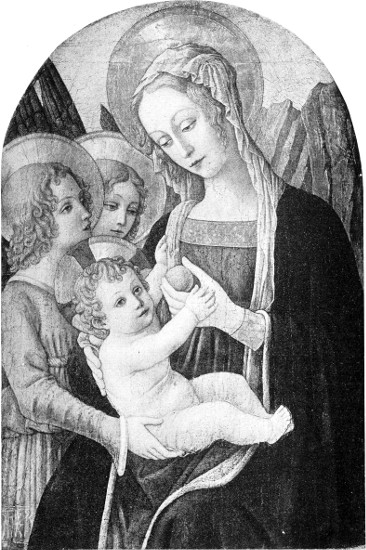
Collection of Mr. and Mrs. Otto H. Kahn
MADONNA AND CHILD WITH ANGELS
—Benedetto Bonfigli
The picture is tempera on wood (31½ × 21 inches).
Bonfigli is regarded as the founder of the School of Perugia which became so famous through Perugino, who perpetuates the name of the town.
Little is known of Benedetto Bonfigli, who was born about 1425, in Perugia, and was buried there in the Church of St. Domenico in 1496. Bonfigli shows in his work the influences of Piero della Francesca, Fra Angelico, Camillo Boccatis, and Benozzo Gozzoli. Bonfigli was in Rome in 1453 working for Pope Nicholas V, and in the following year he was back in Perugia painting a series of frescoes for the Capella dei Priori in the Palazzo del Consiglio depicting St. Louis of Toulouse and St. Ercolano, which were unfinished at the time of his death. Bonfigli painted processional banners and small pictures as well as frescoes. Many of Bonfigli’s works are now in the Gallery at Perugia.
“As an artist Bonfigli scarcely ranks as high as Niccolò da Foligno, his fellow-pupil under Benozzo Gozzoli. He was a much more dependent person, but being more imitative, with the models of Fra Angelico or Benozzo before him, he at times painted exquisite things and by nature he was gifted with that sense of the charming wherewith Perugia was later to take the world captive. Some of the freshest and loveliest of all angel faces may be seen in Bonfigli’s altar-pieces and standards. His color has almost always that tint of gold which never fades from Umbrian art.”[11]
MADONNA AND CHILD.
Perugino (1446–1523).
Collection of Mr. Clarence H. Mackay.
In red robe and blue mantle the Virgin appears seated three quarters to the left and supporting the Holy Child on her left knee with both hands. Her head is slightly inclined and the hair, parted above her forehead, is brushed plainly down either side and looped up rather curiously at the back and tied there by a narrow veil. The Holy Child looks away towards the left. Behind the figures is seen one of those delightful Umbrian landscapes made so famous by Perugino and Raphael.
This picture, an oil painting on panel (27¾ × 19½ inches), has an interesting pedigree. From the family of the Marquis of Villafranca it came into possession of the Marquis de la Romana from the Palace of Anglona, Madrid, and then belonged to the Collection of the Marquis de Villamajor, Madrid. The wife of the latter says:
“This painting of the Madonna and Child by Perugino has been for many generations in my husband’s family. It comes from the family of the Marquises de Villafranca who lived in Italy in the Sixteenth Century and of which several members were Viceroys of Naples (Alvarez de Toledo). The Marquis of Romana, having acquired the Palace of the Prince d’Anglona in Madrid, assembled all the pictures and works of art inherited from his ancestors which were in the Palaces of Valencia, Palma de Mallorque, and in Italy, thus forming a fine and important Collection in which were paintings by Goya, Cameron, Ribera, Velasquez, and many paintings of the Italian, Flemish, and French Schools. On the death of the Marquis de la Romana, his son, the Marquis de Villamajor, received a part of this Collection (which was divided between him and his brothers), and this Perugino comes from the Marquis de Villamajor’s heritage.”
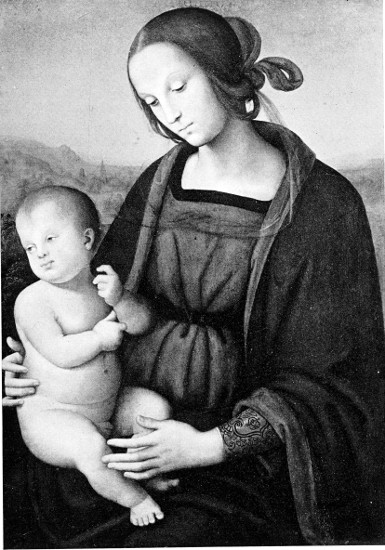
Collection of Mr. Clarence H. Mackay
MADONNA AND CHILD
—Perugino
Perugino was born at Città della Pieve, near Perugia, about 1446, and died (probably of the Plague), at Castello di Fontignano, also near Perugia, in 1523. His real name was Pietro Vannucci and he was also called Pier della Pieve; but he is known always and everywhere as Perugino from Perugia, where he spent his early life and learned his art. It is uncertain under whom he studied before he went to Florence, but he certainly assisted Piero della Francesca at Arezzo. At Florence, he worked in Verrocchio’s studio, having Leonardo da Vinci and Lorenzo di Credi for fellow-students. Then in 1475 he was commissioned to paint in the Palazzo Pubblico, Perugia. In 1481–1482 he was working in Rome in the Sistine Chapel with Botticelli, Ghirlandaio, Cosimo Rosselli, and Signorelli. Of his four frescoes here only one remains, Delivery of the Keys to St. Peter; the other three were destroyed to make room for Michelangelo’s Last Judgment. Perugino also painted in the Vatican and remained about ten years in Rome. Then he returned to Florence and had a studio there and also in Perugia. Besides, he travelled about a great deal to execute commissions in various cities. In 1490, for instance, he was in Rome again painting for Cardinal della Rovere an altar-piece now in the Villa Albani; in 1494 he was in Venice and Cremona; and in 1496 in Pavia, working for “Il Moro,” Duke of Milan. The three principal pictures of the beautiful altar-piece that Perugino painted for the Certosa, or Carthusian Convent near Pavia—The Virgin adoring the Infant Christ; Tobias and the Angel Raphael; and the Archangel Michael—are now in the National Gallery, London.
In 1495 Perugino was again working in Perugia; and it was then that Raphael, a boy of about twelve, became his pupil. At this time Perugino was the most celebrated of all the Umbrian painters. His best work was accomplished between 1490 and 1505. To this period belongs The Marriage of the Virgin, now in the Museum of Caen, Normandy, a picture that Raphael very closely followed, but eclipsed in beauty, in his Sposalizio, now in the Brera, Milan.
About 1590 Perugino painted his famous frescoes in the Sala di Cambio, Perugia, in which he introduced his own portrait; and in 1505 he painted The Triumph of Chastity for the Marchese Isabella of Mantua, which is now in the Louvre.
After another visit to Rome he worked principally in churches in the neighborhood of Perugia, the last of which is supposed to be The Nativity, painted for the Church of Fontignano (where he died), and which is now in the South Kensington Museum.
Perugino was one of the earliest of the Italians who mastered the use of oil, then a new medium. In his constant moving around and visiting so many important cities, Perugino had every opportunity of seeing what the other artists of his day were doing. However, although he worked with the latest materials, Perugino remained faithful to the style of art known as the Quattrocento, which before his death was being rapidly superseded by the Cinquecento, of which Leonardo da Vinci and Michelangelo were the chief exponents. Like Piero della Francesca he also advanced the science of perspective. For a time Perugino adopted the Florentine style, especially with regard to composition; but eventually he developed his own manner of grace, softness, delicacy, tenderness of color, great expression in faces and figures, and his unusually charming landscapes.
Berenson speaks particularly of Perugino’s “space composition:”[12] and in this art “Perugino surpassed all who ever came before him, and indeed all who came after him, excepting, however, his own pupil, Raphael, by whom even he was left far behind. Perugino had a feeling for beauty in women, charm in young men, and dignity in the old, seldom surpassed before or since. Then there is a well-ordered seemliness, a sanctuary aloofness in all his people which makes them things apart, untouched, and pure. Great reserve also does much for him. Violent action he doubtless avoided because he felt himself unequal to the task—indeed, so little did he ever master movement that his figures when walking dance on tiptoe and on their feet they never stand; but he as carefully kept away from unseemly expression of emotion. How refreshingly quiet are his Crucifixions and Entombments! The still air is soundless and the people wail no more; a sigh inaudible, a look of yearning, and that is all. How soothing must such paintings have been after the din and turmoil and slaughter of Perugia, the bloodiest town in Italy! Can it be wondered that men, women, and children ran to see them? Nor yet is life so free from sordid cares and meaningless broils that we can forego such balm for the soul as Perugino brings.”
THE NICCOLINI MADONNA.
Raphael Collection of
(1483–1520). Sir Joseph Duveen, Bart.
This picture came directly from the Niccolini Palace where it was purchased in 1780 by George Nassau, third Earl Cowper, who was at that time His Majesty’s Ambassador to the Court of Tuscany; and it was so prized that in order to get the picture out of Florence without any disturbance it had to be hidden in the lining of the Ambassador’s carriage. Another name for the picture is The Cowper Madonna of 1508. The picture now comes from the Collection of Lady Desborough, of Panshanger, Hertfordshire, who inherited it from her brother, Francis Thomas, seventh Earl Cowper.
The painting, an oil on panel (30½ × 22 inches), represents the Madonna seated in the open air in a dark, rose-red robe with long close-fitting undersleeves of yellow-green, ultramarine-blue mantle, and diaphanous veil. Around the neck of the dress and the hem of the mantle what appears to be a decorative band of golden embroidery is really the signature of the painter “M(D or CCCC)VIII. R. U. Pin,” meaning 1508 Raphael of Urbino Pinxit. And, by the way, is it not possible that Sir Joshua Reynolds got the idea from this picture of painting his name on the robe of Mrs. Siddons as the Tragic Muse? It will be remembered that Mrs. Siddons sat for that magnificent portrait in 1784. The Niccolini Madonna was bought by Earl Cowper in 1780 and, undoubtedly, Sir Joshua was very familiar with it. Moreover, at this date, Raphael’s masterpiece was also very fresh in the mind of the English picture-world.
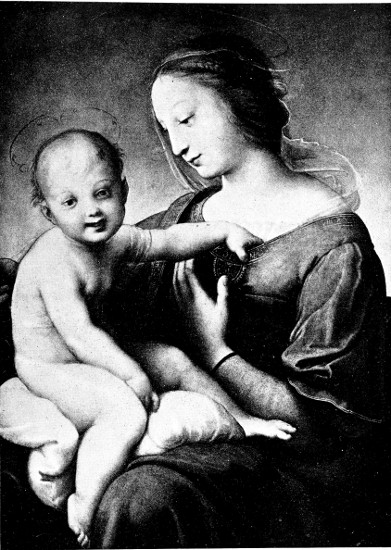
Collection of Sir Joseph Duveen, Bart.
THE NICCOLINI MADONNA
—Raphael
The Holy Child is seated on a white cushion in the Virgin’s lap gently supported by her hand, which also lightly holds an end of her floating veil. The suggestion of a light breeze rippling the veil is an exquisite thought. The nimbi of both Mother and Child are very delicate. The background consists of a blue sky.
It is very interesting to compare this picture with the other Cowper Madonna and on doing so we find that the same model was used for the Child, although the women are different. The hand of the Small Cowper Madonna is noticeably more refined than the hand in the Niccolini Madonna, yet, on the whole, the model used for the Niccolini Madonna seems to be of a slightly higher social status. In the latter, we find the plucked eyebrows and forehead which Raphael’s taste has softened by the hair, lightly blown about, like the veil, by the breeze.
The Niccolini Madonna was one of the last pictures painted by Raphael in Florence, as he went to Rome in 1508, the date given on this painting. It may be noted here that the Madonna del Granduca (which belonged to the Grand Duke Ferdinand III, who carried it with him wherever he went), was the first picture Raphael painted in Florence.
The Madonna del Cardellino (of the Goldfinch), in the Uffizi, and La Belle Jardinière (in the Louvre), also date from the Florentine period—painted when Raphael was about twenty-five,—which seems almost incredible.
THE SMALL COWPER MADONNA.
Raphael Collection of
(1483–1520). Mr. Joseph E. Widener.
This Madonna was painted in 1505, soon after the Granduca Madonna (now in the Pitti). It was purchased in Florence about 1780 by Lord Cowper and was one of the ornaments of his Collection at Panshanger.
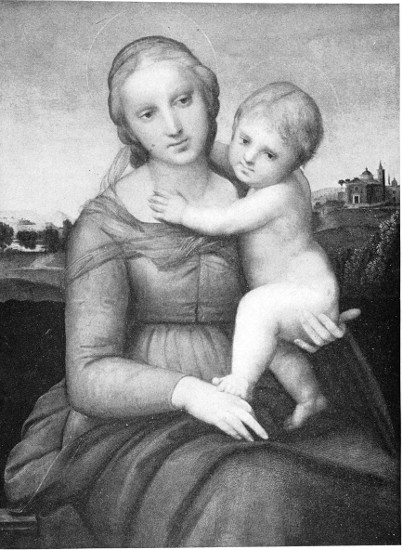
Collection of Mr. Joseph E. Widener
THE SMALL COWPER MADONNA
—Raphael
The Madonna is seated on a stone bench and wears a red dress and a mantle of blue lined with green. The Holy Child throws His arms lovingly around His mother’s neck and steadies Himself by planting His left foot against her right hand. The hair of both mother and Child are blonde and encircled by a thin golden nimbus. The eyes are, in both subjects, of a warm and deep brown. A lovely Umbrian landscape carries us many miles away to the left; and nearer the figures on the right, there appears a building, identified as San Bernardino, a Franciscan Convent near Urbino.
The picture is painted on wood (23 × 17 inches). The original drawing is in the Uffizi Gallery in Florence.
“And now we are face to face with the most famous and beloved name in modern art—Raphael Sanzio. Raphael was endowed with a visual imagination, which has never even been rivalled for range, sweep, and sanity. When it has been surpassed, it has been at single points and by artists of more concentrated genius. Thus gifted and coming at a time when form had, for its own sake, been recovered by the Naturalists and the essential artists, when the visual imagery, of at least the Italian world, had already suffered along certain lines, the transformation from the Mediæval into what ever since has been for all of us the modern, when the ideals of the Renaissance were for an ineffable instant standing complete, Raphael, filtering and rendering lucid and pure all that had passed through him to make him what he was, set himself the task of dowering the modern world with the images that to this day, despite the turbulent rebellion and morose secession of recent years, embody for the great number of cultivated men their spiritual ideals and their spiritual aspirations. ‘Belle comme une madonne de Raphael’ is, among the most artistic people in Europe, still the highest praise that can be given to female beauty. And, in sooth, where shall one find greater purity, more utter loveliness than in the Granduca Madonna, or a sublimer apparition of woman than appeared to St. Sixtus?
“When looking at the Granduca Madonna, has it ever occurred to you to note that the whole of her figure was not there? So perfect is the arrangement that the attention is entirely absorbed by the grouping of the heads, the balance of the Virgin’s draped arm and the Child’s body. You are not allowed to ask yourself how the figure ends. And observe how it holds its own, easily poised, in the panel which is just large enough to contain it without crowding, without suggesting room for aught besides.
“But great as is the pleasure in a single group perfectly filling a mere panel, it is far greater when a group dominates a landscape. Raphael tried several times to obtain this effect—as in the Madonna del Cardellino, or the Madonna del Prato, but he attained to supreme success once only—in the Belle Jardinière. Here you have the full negation of the plein-air treatment of the figure. The Madonna is under a domed sky, and she fills it completely, as subtly as in the Granduca panel, but here it is the whole out-of-doors, the universe, and a human being supereminent over it. What a scale is suggested! Surely the spiritual relation between man and his environment is here given in the only way man—unless he becomes barbarized by decay or non-humanized by science—will ever feel it. And not what man knows but what man feels, concerns art. All else is science.”
Raphael Santi—everybody’s Raphael,—best beloved of all painters, was born in Urbino in 1483, the day unknown. He was the son of Giovanni Santi, a painter, and was first taught by him. Then it is supposed that he studied under Evangelista di Pian di Meleto, with whom he painted an altar-piece and worked afterwards with Evangelista’s partner, Timoteo Viti. Next we find him assisting Perugino at Perugia and also Pintoricchio. In 1504 he went to Florence and fell under the influence of Leonardo da Vinci and Fra Bartolommeo. During his four years in Florence, Raphael painted a number of important works including the Terranuova Madonna (Berlin Museum); the Small Cowper Madonna and the Niccolini Madonna (on page 87 and page 85); the Madonna del Cardellino (Uffizi); the Madonna in the Meadow (Belvedere, Vienna); La Belle Jardinière (Louvre); and a number of portraits including the famous self-portrait (Uffizi). He was but twenty-five! Called to Rome in 1508 to decorate the Stanze in the Vatican this immense work occupied him until 1514. In the meantime, he was given the decoration of the Loggia, but while he made the designs, the actual painting of “Raphael’s Bible” was done by his pupils. In the pressure of all this stupendous work he found time to paint The Triumph of Galatea for Agostino Chigi in the Farnesina Palace, The Madonna della Seggiola (Pitti), the Portrait of Tommaso Inghirami and many portraits. In 1516 he painted Baldassare Castiglione (Louvre); in 1517 the Madonna di San Sisto, for the convent of San Sisto at Piacenza (Dresden Gallery) and the St. Cecilia (Bologna Gallery). In 1518 he began The Transfiguration, which was unfinished at the time of his death and which was placed beside his bier.
All this magnificent work which expresses such high creative power and such vast technical knowledge is the performance of a young man of twenty-seven! Had he painted but three pictures, La Belle Jardinière, the Madonna of the Chair, and the Sistine Madonna, Raphael’s place would have been with the greatest of the immortals. Taking his entire list of works into consideration Raphael, perhaps, comes nearer than any other painter to the term “inspired.”
AGONY IN THE GARDEN.
Raphael Collection of
(1483–1520). Mr. Clarence H. Mackay.
This panel (9½ × 11 inches), was one of four belonging to the Predella of the large altar-piece representing the Madonna Enthroned with Saints, painted by Raphael in 1505 for the Nuns of S. Antonio, Perugia. It is, therefore, one of Raphael’s early works.
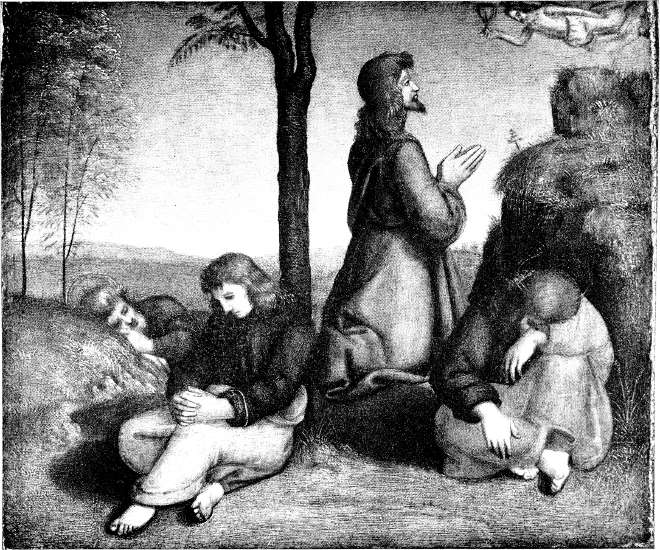
Collection of Mr. Clarence H. Mackay
AGONY IN THE GARDEN
—Raphael
The Saviour in a grey robe kneels in prayer at the right near a tree and towards him an Angel holding a chalice descends from the clouds. The other characters are sleeping: St. John the Evangelist in a green and red robe lies upon a grassy bank at the left; St. Peter reclines against a grassy mound at the right; and St. James, in a green and yellow robe, has propped himself against the tree in the centre. Trees and low-lying hills form the background. All four panels forming the Predella were purchased from the Nuns of St. Anthony in 1663 by Christina, Queen of Sweden. This particular panel—The Agony in the Garden—passed from the Queen of Sweden’s possession into that of Cardinal Azzolini, and thence into the Collection of Don Livio Odescalchi, whose heirs sold it to the Regent, the Duc d’Orleans. The Orleans Collection was sold in London in 1798 and The Agony in the Garden then went into the Bryant Collection. Lord Eldin bought it next and subsequently the poet, Samuel Rogers, at whose sale in 1856 the panel was purchased by the Baroness Burdett-Coutts. After the sale of the W. Burdett-Coutts Collection at Christie’s in 1917, the panel found its way to New York. The other three panels are: St. Anthony of Padua and St. Francis (now in the Dulwich Gallery); the Procession to Calvary (in the National Gallery, London); and a Pietà (in the Gardner Collection, Boston).
The altar-piece—The Madonna Enthroned with Saints—was presented to the Metropolitan Museum by the late Mr. J. Pierpont Morgan.
NORTH ITALIAN
The greatest painters of Northern Italy were Altichiero Altichieri (1330?–1395), Pisanello (1397–1455), Domenico Morone (1442–1503), Liberale (1451–1536), Girolamo dai Libri (1474–1503), and Paolo Veronese (1528–1588), in Verona; Andrea Mantegna (1431–1506), in Padua; and Cosimo Tura (1420?–1495), in Ferrara; Vincenzo Foppa (1427?–1515–16), Bramante da Milano (died about 1470), Bartolommeo Suardi, called Bramantino (1450?–1536), and Bernardino Luini (1475?–1531–2), in Milan; Lorenzo Costa (1460?–1535), and Francesco Francia (1450?–1517), in Bologna; Moretto da Brescia (1498–1554), and Giambattista Moroni (1520–5–1578), in Brescia; and Antonio Allegri, better known as Correggio (1494–1534), in Parma.
The towns of Northern Italy were more or less influenced by Florentine artists who worked in various towns and who naturally attracted pupils and local assistants. Painters travelled too, a great deal, wishing, as they do now, to see the famous works of painters both living and dead and of learning the newest and latest technique. Lords and dukes also attracted celebrated painters to their courts; and, if they liked them, bestowed lavish orders for portraits, for their relatives and friends; small devotional pictures for their own cabinets; wall-paintings for their villas; and altar-pieces and frescoes for their local churches or cathedrals.
Lodovico Sforza, Duke of Milan, sent to Lorenzo de’ Medici on two or three occasions to recommend painters from Florence for work that he wished to have done. The great intellectual and artistic activity of Lombardy at the end of the Fifteenth Century was largely owing to Lodovico Sforza, whose Court was one of the most brilliant of the day. “Here,” an enthusiastic contemporary exclaimed, “here the muses of poetry and the masters of sculpture reigned supreme; here came the most distinguished painters from distant regions; here, night and day, were heard sounds of such sweet singing and such delicious harmonies of music that they seemed to descend from heaven itself.”
New churches and palaces arose in Milan, Pavia, Como, Cremona, Piacenza, Lugano, and other places, and artists were necessary for decorating them. In 1496, Leonardo having all he could do, Lodovico wrote to Florence for a description of the best painters of the day. This is what he received; and it is very interesting as showing the estimation of the men mentioned while they were living:
“Sandro de Botticello—a most excellent master, both in panel and wall-painting. His figures have a manly air and are admirable in conception and proportion.
“Filippino di Frati Filippo—an excellent disciple of the above-named and a son of the rarest master of our times. His heads have a gentler and more suave air; but, we are inclined to think, less art.
“Il Perugino—a rare and singular artist, most excellent in wall-painting. His faces have an air of the most angelic sweetness.
“Domenico de Girlandaio—a good master in panels and a better one in wall-painting. His figures are good and he is an industrious and active master who produces much work.
“All of these masters have given proof of their excellence in the Chapel of Pope Sixtus, excepting Filippino, and also in the Spedaletto of the Magnificent Laurentio, and their merit is almost equal.[13]
The glimpse Leonardo da Vinci has given us of his life charms us across the long shadow of four centuries and more:
“The painter describes himself as living in a fine house, full of beautiful paintings and choice objects surrounded by musicians and poets. Here he sits at his work, handling a brush full of lovely color, never so happy as when he can paint listening to the sound of sweet melodies. The spacious atélier is full of scholars and apprentices employed in carrying out their master’s ideas, or making chemical experiments, but careless of the noise of tools and hammers, the fair-haired boy, Angelo, sings his golden song, and, Serafino, the wondrous improvisatore, chants his own verses to the sound of the lyre. Visitors come and go freely—Messer Jacopo of Ferrara, the architect, who was so dear to Leonardo as a brother, the courtly poet, Gaspare Visconti, and Vincenzo Calmeta, Duchess Beatrice’s secretary, or, it may be, the great Messer Galeaz himself, whose big jennet and Sicilian horse the master has been drawing as models for the great equestrian statue standing outside in the Corte Vecchia. There, among them all, the painter bends over his canvas seeking to perfect the glazes and scrumbles of his pearly tints, or trying to realize some dream of a face that haunts his fancy with its exquisite smile. He has, it is true, many labors—(a tanta faccenda!) as he wrote to the councillors of Piacenza—and at times he hardly knows which way to turn; but he is his own master, free to work as he will, now at one, now at another. He has no cares nor anxiety. He can dress as he pleases, wear rich apparel if he is so minded, or don the plain clothes and sober hues that he prefers. He has gold enough and to spare; he can help a poorer friend and educate a needy apprentice, or save his money for a rainy day; and, above all, he has plenty of books and leisure to meditate on philosophical treatises, or ponder over the scientific problems in which his soul delights. He can find time to jot down his thoughts on many things, to write his great treatise on painting, and to draw the wonderful interlaced patterns inscribed with the strange words which have puzzled so many generations of commentators. And he has friends, too, dear to his heart—Messer Jacopo and the wise Lorenzo da Pavia, that master of organs whose hands were as deft in fashioning lyres and viols as in drawing out sweet sounds—with whom he loved to commune of musical instruments and eternal harmonies, and the boy, Andrea Salai, with the beautiful, curling hair, whom he loved to dress up in green velvet mantles and shoes with rose-colored ribbons and silver buckles. ‘Such,’ he tells us ‘was I, Leonardo the Florentine, at the Court of the most illustrious Prince, Signor Lodovic.’”[14]
In such surroundings Leonardo da Vinci spent sixteen happy years, during which he exercised all his talents as architect, engineer, sculptor, musician, and painter, also designing ingenious settings for masques and tournaments and superintending decorations for weddings and for other festivities. Here, too, he painted the Last Supper in the refectory of the Dominican Friars of S. Maria delle Grazie, which “Il Moro” had taken under his special protection; the Virgin of the Rocks (now in the Louvre), originally for the Church of S. Francesco of Milan, and many portraits, including those of Ludovico Sforza and of his talented young wife, Beatrice d’Este. When the French entered Milan in 1499 Leonardo returned to Italy.
The presence of the supreme and superlative Leonardo in Milan for so long a time naturally stimulated art and artists of all kinds and even more particularly that of painting and painters. His style dominated the Milanese School of painters just as Richard Wagner dominated the musical composers of the Nineteenth Century; and we find, particularly in the case of Luini, some of the Master’s most engaging qualities appreciated and imitated (see page 110).
“It has often been asked,” Marcel Reymond notes in a finely thought-out criticism of the Milanese painters, “how it came to pass that Leonardo left no disciples in Florence when he created such a strong School in Milan. The first cause, in my opinion, should be sought for in the laws that presided over the formation and development of the Florentine School of painting. This School, created by fresco-painters accustomed to works of vast dimensions, did not care to tarry over the finesse of execution, or the enumeration of minute details; it simplified its vision, attaching itself particularly to the broad lines and only retaining of the forms what was essentially expressive in them. This character will be noticed at all periods of Florentine painting from Giotto, Masaccio, Ghirlandaio, and Andrea del Sarto. When the Florentine painters depart from this general conception, it is only by accident and almost always in consequence of foreign action, an action that will be sometimes that of Flemish painters, such as Van der Weyden, or Van der Goes, and sometimes that of the Florentine sculptors, who, at a given moment, about the middle of the Fifteenth Century, exercised so powerful an influence upon the painters who were their contemporaries. The action of Verrocchio in particular was such as to transform the style of the Florentine School of Painting and to give birth to the so entirely individual, and in certain respects so little Florentine, of Leonardo da Vinci.
“But the fact that this new style was outside the traditions of the Florentine School of Painting must have hindered its development, and in reality Leonardo had no disciple in Florence. With Fra Bartolommeo and Andrea del Sarto, it is the old character of the School that reappears to follow out its natural evolution through the whole course of the Sixteenth Century.
“In the North of Italy, on the contrary, the precision of line and observation of detail form a predominant character of those Schools of which Mantegna is the most illustrious representative. These Schools, therefore, found in Leonardo a teaching that responded to their ancient traditions; and we may thus understand how the seed planted by Leonardo in the soil of Milan struck such deep root and produced such beautiful flowers there.
“But however this may be and whatever may have been the causes of this admirable blossoming of Milanese Art in the early years of the Sixteenth Century, we may say that it represents in a highly learned form one of the researches that have the most occupied Italian genius,—I mean the seeking after beauty pursued in the harmonious accord between form and poetry.”
Francesco Squarcione (1394–1474), was a native of Padua, the son of a notary. Beginning life as a tailor and embroiderer, he chose to become a painter, but first he decided to travel. He made a tour through Italy and, it is said, visited Greece. It is in 1441 that his name first appears in the Paduan Guild of Painters. Squarcione achieved more reputation as a teacher than as a painter; and it seems that in executing what commissions came to him he either gave over his orders to his talented pupils, or had them, indeed, do most of the work under his name. It is now thought that it was Mantegna’s refusal to continue painting for Squarcione that led to the rupture between master and pupil and not Squarcione’s anger at Mantegna’s marrying Nicolosia Bellini, which has long been a favorite legend. Squarcione’s school, however, was the most famous of its time and brought him the title of “Father of Painters.” The list of his pupils runs to about a hundred and thirty-seven. One of the features of Squarcione’s workshop was his fine collection of fragments of statues which he used as models. It is also said on good authority that Squarcione was a dealer in antiquities.
In Padua also lived Jacopo Bellini, with whom Mantegna worked and whose daughter Nicolosia he married, a relation that made him, of course, brother-in-law to Giovanni and Gentile Bellini. For a number of years—presumably from 1444 to 1460—Jacopo Bellini had a workshop in Mantua and, here, himself a pupil of Gentile da Fabriano, he trained and worked with his two gifted sons and also Andrea Mantegna. This bottega became quite a rival of Squarcione’s. Indeed such a combination as the three Bellini artists and Andrea Mantegna would certainly offer a formidable competition to any rival, at any time, or in any place.
The founder of the Ferrarese School was Cosimo Tura (1420?–1495), also a pupil of Squarcione, the first Ferrarese painter of eminence; and, from 1451, in permanent service of the Dukes at Ferrara. Tura had certain affinities for Carlo Crivelli, Melozzo da Forli, and Andrea Mantegna.
At Bologna, in 1485, Lorenzo Costa (1460?–1535), a supposed pupil of Tura, established himself, thus forming one of the main links between the Schools of Ferrara and Bologna; and it was another pupil—also a fellow-worker of Costa, Francesco Francia (1450?–1517), who is the chief glory of the Bolognese School (see page 107).
In Verona, first comes the Mediæval painter, Altichiero Altichieri and next the greater Antonio (or Vittore) Pisano (1397–1455), called Pisanello, worker in medals, painter of portraits, and mural decorator (see page 99).
The School of Brescia is represented by Alessandro Bonvicino, called Moretto da Brescia (1498–1554), influenced by Titian and Raphael and considered the greatest provincial painter in Northern Italy of his time. Moretto is also famous for having formed Moroni, the great portrait-painter (1520–5–1578). Moretto and Moroni are regarded as ranking among the greatest portrait-painters of the Sixteenth Century. In mode and technique they closely follow the greatest Venetian Masters; but the Brecians have a more silvery and a much “cooler” tone than Titian and Tintoretto (see page 112).
We have now come to the High Renaissance, where Antonio Allegri, called Il Correggio, from his birthplace, a small town near Modena (1494–1534), is the dominating personality of the School of Parma. Francesco Bianchi (1457–1510), of Ferrara, is his traditional master; but he was influenced by Lorenzo Costa, Francesco Francia, and Andrea Mantegna. Correggio has been called “an isolated phenomenon in Italian art—we look in vain, after his earliest years of practice for any true affinity between him and other masters. In his treatment of light and shades and of atmosphere he contributed something new to Italian art.”
As the Sixteenth Century progressed the North Italians fell more and more under the spell of the Venetians. Dosso Dossi (1479–1541), for instance, a painter of Ferrara and a pupil of Lorenzo Costa, went to Venice and was charmed by Giorgione and Titian before he became court-painter of Alphonso I, Duke of Ferrara, and his wife, Lucrezia Borgia.
Northern Italy also claims Paolo Caliari, better known as Paolo Veronese (1528–1588), a native of Verona, whence his name; but classed with the Venetian School, as he spent the greater part of his life in Venice, gorgeously decorating its palaces, churches, and monasteries.
PORTRAIT OF A LADY.
Pisanello Collection of
(1397–1455). Mr. Clarence H. Mackay.
This is a particularly rare picture as it is one of only three portraits of this painter so far known, the other two being a female portrait in the Louvre and a male portrait in Bergamo. Berenson says of this portrait: “It is in the most mature and the most sumptuous manner of this greatest master of the fascinating epoch between Gothic and Renaissance. It has all the direct simplicity of that happy moment when art had recovered from the mannerisms of the late Gothic style and was still far from the modishness of the ripe Renaissance. How fascinating are its qualities of pure decoration!”
The lady is dressed in dark-blue velvet with a curious collar of white lawn and grey fur with another collar at its base of spangled embroidery and around the waist a narrow girdle to match. The dress is profusely decorated with gold filigree beads.
Gold pins are placed in her blonde hair, over which is a head-dress of curiously puffed and twisted material decorated by blue and gold sequins.
The background is black.
This portrait, painted in tempera on a panel (20¾ × 14¾), was purchased by M. Veil-Picard of Paris at the Villeroy Sale in Paris in 1922. Adolfo Venturi writes in L’Arte (April, 1925): “The Mackay portrait cut off below the waist, rises in the canvas with Gothic grace. Picturesqueness is the keynote. The relief, even in its slightest parts, has an ideal softness of planes. But in this picture Pisanello’s genius has attained its maximum of expression. Everything shows an advance on the Louvre picture—the eye sunk deep in its socket; the eyebrow like the valve of a shell molded over the round, while in the Louvre picture it is a mere silken strip; the ear, no longer a mere piece of cartilage, is downy velvet; above all, the superb decorative effect of the oval face between the strange volutes of the turban and the chains of perforated gold beads.
“In the other portraits the decorative effect is helped by the fantastic blossoms standing out against the dark background of the hedge, making a greater contrast with the background than with the face. In the Mackay portrait the background is equally dark throughout. The interest of the face itself is accentuated by the myriad gold lights in the gilded trefoils on the dress and in the golden beads of the chains (light as balls of silk) and in the nebulous phosphorescence of the little balls which adorn the neck of the dress and the dark enamel of the ivy on the turban of Oriental splendor. The effect, carefully prepared to isolate the face from the surrounding shadow, acquires an intensity of refinement. The contrast between the dark background and the phosphorescent dress is repeated in that between the dark blue material of the dress and in the high lights of this; the icy brilliance of the collar cuts into the softness of the fur with unexpected suddenness; and the ivory of the flesh contrasts sharply with the delicate softness of tone.
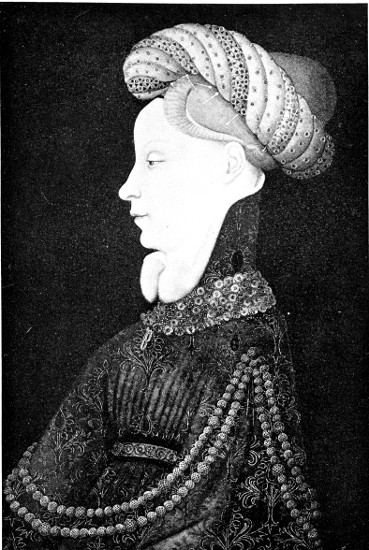
Collection of Mr. Clarence H. Mackay
PORTRAIT OF A LADY
—Pisanello
“The highest pictorial and decorative value in the art of Pisanello as a colorist is reached in this Mackay portrait, which represents, moreover, one of the most acute character-readings of the penetrating eye of the medallist. The proud carriage accentuated by the rigid cut of the high velvet collar; the clear-cut outlines of the profile; the ram’s horn head-dress; the splendid cap; the well-defined lips, from which one expects to hear the sibilant breath issue; above all, the keen glance directed downwards under the heavy-veiled eyelids render this a picture of frigid haughtiness. The fine lines of the mouth and the narrow opening of the eyes are executed with an extraordinary penetrating observation and the contour of the face is drawn with a delicacy that does all honor to this great master of the silhouette.
“The lines of the face are in complete harmony with the contours of the whole figure. The curves repeat themselves in the fantastic coiffure, in the fur border of the collar, in the lines of the arm and in the chains hanging from the shoulders. And, contrarily, these general sweeping curves of coiffure and costume lead up to the finely concentrated line of the profile which stands out sharply against a black background, as in Pisanello’s painting of Saint Eustace, in London (National Gallery). The artist has understood perfectly the value of contrast between the plastic and the decorative elements. The flat planes of the delicate ivory-like face are emphasized by the sculpturesque coiffure with its gold ornaments; and just where we would naturally look for an accentuation of the physical attributes—on the bust and arms—the artist has, through the broad curves of the chains and the spacing of the patterns of the dress, emphasized the decorative design. Finally, the color of this most decorative masterpiece is of the greatest charm. There are tiny lines recalling the delicate technique of a piece of Satsuma-ware on the surface of the ivory-tinted face that rises from a white collar resting on grey fur while a delightful blue predominates in the coiffure and the costume, which is enhanced with yellow and gold ornaments.
“The dress itself is of no little charm and belongs to a period when costume and figure were attuned to a harmonious whole as has seldom happened in the history of costume design. By plucking out the hair from her forehead and eyebrows this young woman has created a high-domed brow for herself and further emphasized the up-sweeping lines by high-arched eyebrows applied with cosmetic. What a burden that towering coiffure must have been and how uncomfortable the high collar and the girdle drawn tight beneath the breast! Nevertheless she suffers these discomforts in the name of fashion with dignity and equanimity.”
Pisanello (whose real name was Antonio Pisano), born about 1397 (some authorities say 1380 and some 1385), was a renowned painter of portraits and religious pictures of highly decorative character as well as a famous medallist. Pisanello was a follower of Altichiero and was also greatly influenced by Gentile da Fabriano. Of his early life little or nothing is known; but the rest of his days he spent wandering throughout Italy, now in Mantua, now in Verona, now in Venice, now in Rome, now in Naples, and now in Ferrara, cutting medals and painting portraits of distinguished personages. In 1439 he was in Mantua as an intimate friend of the Marchese Francesco Gonzaga, whom he followed at the capture of Verona. Therefore he had to come under the Tribunal of the Council of Ten at Venice in 1442. Pisanello’s career coincides almost precisely in date with Fra Angelico, Donatello, Ghiberti, and Brunelleschi. As a medallist Pisanello was unexcelled. In his paintings he shows the spirit of a miniaturist rather than that of a mural decorator. He shares with Gentile da Fabriano the charming quality of chivalric grace and attention to interesting detail. Pisanello must have been especially fond of animals, as his rarely beautiful drawings of them preserved in various galleries would seem to prove; and, moreover, he was fond of introducing them into his pictures. In the Vision of Saint Eustace, for instance (National Gallery, London), in addition to the stag bearing the cross upon his horns, there are various animals and birds as well as the fine horse with its gay trappings, on which the handsome Eustace is mounted.
“Altichiero had scarcely ceased covering wall-spaces with pomp and circumstance of Mediæval life,” writes Berenson, “when the task was taken up by his better-known Renaissance follower, Vittorio Pisanello. The larger part of this artist’s work, in fact all his decoration of great houses and public palaces, has perished. Even now, after earnest efforts to gather together the strewn limbs of his art, only six paintings of his can be discovered: two frescoes, two sacred subjects, and two portraits. His renown as a painter has, therefore, been eclipsed by his fame as a medallist. And, in truth, never, since the days when Greek craftsmen modelled coins for proud city states, has there been such a moulder of subtle reliefs in miniature. Yet Pisanello himself never signed his name without the addition of the word Pictor and it was as a painter that he received the stipends of princes and the adulation of poets.
“Although he was much more modern than his master, there was nothing in his paintings to startle princes and poets, or even less distinguished persons, whose education in art consisted then, no doubt, as it does now, in confirming a fondness for the kind of picture to which their eyes had grown accustomed during childhood and youth. Pisanello, although counting as one of the great geniuses of the Renaissance, by no means broke with the past. He went, it is true, as far beyond Altichiero as Altichiero had gone from his immediate precursors, but he betrays no essential difference of intention or spirit. In him art-evolution produced a painter most happily fitted to hold up an idealizing mirror to a parallel product of social evolution, the sunset of Chivalry. No wonder that he was employed along with the kindred Gentile da Fabriano by the rich and noble and that he was chosen to continue the courtly Umbrian’s tasks.”
ADORATION OF THE SHEPHERDS.
Andrea Mantegna Collection of
(1431–1506). Mr. Clarence H. Mackay.
It is more than likely this is the picture described in 1586 as “Presepe” (manger) in the Este Palace, Ferrara. At all events it is an early work.
The Virgin surrounded by cherubs is kneeling in adoration before the Holy Child, who is asleep on the bottom of her gown. Near her St. Joseph is seated, fast asleep. On the right two Shepherds are approaching and, behind them, a Man and a Woman are crossing a bridge. High up on the rocks, on the right, two Angels are watching over the scene. Behind the simple wooden building, which shelters the group, stretches a landscape.
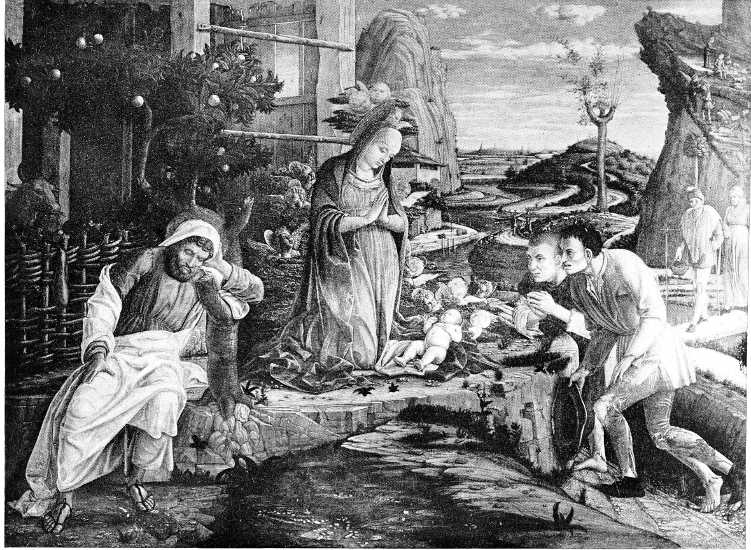
Collection of Mr. Clarence H. Mackay
ADORATION OF THE SHEPHERDS
—Andrea Mantegna
The panel transferred to canvas (15 × 21½ inches), was formerly in the Collection of Mr. C. A. Rouse-Boughton-Knight of Downton Castle, Ludlow, Herefordshire, England.
Andrea Mantegna was born in Vicenza in 1431. He was inscribed in the Guild at Padua as pupil and adopted son of Squarcione (see page 97) in 1441 and made the most extraordinary progress in his studies, perfectly fascinated with “the antique”. “At a little more than ten years of age,” Berenson writes, “Mantegna was adopted by a contractor named Squarcione. How much of a painter Squarcione was, we do not know, but we do know that he undertook designing and painting to be executed by people in his employ. He was also a dealer in antiquities and his shop was frequented by the distinguished people who passed through Padua, and by the Humanists teaching in the famous University. It happened to be a moment when in Italy Antiquity was a religion, nay, more, a mystical passion, causing wise men to brood over fragments of Roman statuary as if they were sacred relics, and to yearn for ecstatic union with the glorified past. To complete the spell, this glorified past happened to be the past of their own country.”
Another influence was Donatello, who was working in Padua in 1750 and after; and still another was Jacopo Bellini. After his marriage to Bellini’s daughter and his break with Squarcione, Mantegna went to Venice to have his contract with Squarcione cancelled in the Law Courts; and, returning to Padua, he continued his work on important frescoes. In 1460 Mantegna removed to the Court of Mantua at the invitation of the Marchese Lodovico Gonzaga and in addition to his painting he designed for pageants and festivals, and decorated villas and palaces, just as Leonardo da Vinci was destined to do a few years later for another Lodovico,—“Il Moro,” Regent and, later, Duke of Milan. Mantegna also at this period designed for goldsmiths. When Francesco Gonzaga succeeded his father, Mantegna remained at the Court of Mantua and became the supreme arbiter of the taste of the day. For Francesco’s wife, Isabella d’Este (sister of “Il Moro’s” wife, Beatrice d’Este) and for her mother, the Duchess of Ferrara, Mantegna painted some of his most famous pictures, such as the Triumph of Cæsar (now at Hampton Court Palace) and the Madonna and Child with Singing Cherubs (now in the Brera). On leaving for Rome in 1788 Mantegna was knighted. In Rome he decorated the Belvedere Chapel for Pope Innocent VIII. To his last period belong delicate and lovely mythological pieces, including the Parnassus (now in the Louvre) and the strong and decorative painting of Judith with the Head of Holofernes (now in the Widener Collection).
When Mantegna died in 1506, Lorenzo da Pavia (see page 95) wrote to Isabella d’Este: “The death of our Master Andrea causes me great sorrow, for in him a second Apelles has passed away; I do believe that the Lord God wishes to employ him for the creation of some beautiful work. I can never hope to meet a finer draughtsman nor a more original artist.”
Padua, Mantua, Venice,—all felt Mantegna’s influence.
VIRGIN AND CHILD WITH THE INFANT ST. JOHN AND ANGEL.
Francia Collection of
(1450?–1517). Mr. Clarence H. Mackay.
This picture came from the Collection of the Comtesse Edmond de Pourtales of Paris and shows the Virgin seated and holding the nude Infant Jesus on her right knee. She is wearing a crimson dress edged with gold embroidery and a blue mantle, also edged with gold embroidery, which is drawn over her head. Beneath this a white gauze veil covers her hair. The Holy Child has raised His right hand in benediction while in His left he holds a blue ball. The Angel on the right wears a rose-colored tunic and yellow mantle and is adorned with jewels. By his side and with one foot on a balustrade stands the Infant St. John, dressed in blue and carrying a slender cross over his left shoulder.
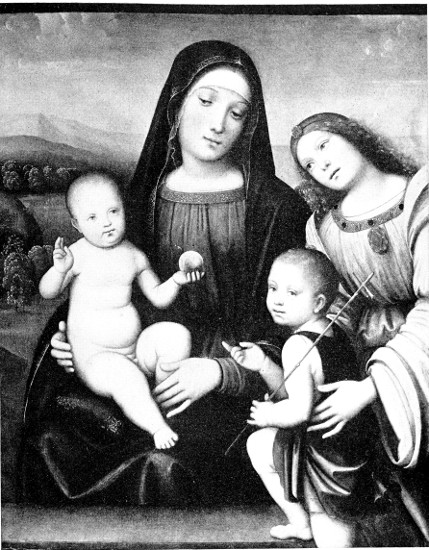
Collection of Mr. Clarence H. Mackay
VIRGIN AND CHILD WITH THE INFANT ST. JOHN AND ANGEL
—Francia
Of this panel (23½ × 19¾ inches), painted in oil, Berenson says: “If this most famous of the Bolognese artists ever painted a more delightful picture than the present one, it remains unknown to me. Perhaps its only rival in my affections would be the Munich picture of the Virgin in the Rose Garden where, however, it is not the faces but the pale roses against the flat green that give the work its special charm.”
Francesco Raibolini, who took the name Francia from a master-goldsmith to whom he was apprenticed, was born in Bologna in 1450, the son of a carpenter. He spent his early years working in metals and settings for jewels and became very expert in niello, gold and silver enamels, and designs for jewelry. He also acquired a reputation for his coins and medals, so much so indeed that Giovanni Bentivoglio II, who became his patron, appointed him his master of the mint. Moreover, in 1511 Francia was elected one of the Golfalonieri of the people; in 1512 re-elected to the mastership of the Goldsmith’s Guild; and in 1514 he became “Master of the Four Arts.” It is thought that he began to paint about 1483, when Lorenzo Costa came to Bologna and formed a friendship with Francia. Be this as it may, he worked with Costa on an altar-piece for the Church of the Misericordia and the influence of Costa is apparent in much of his work. Francia also painted with Costa in 1505–1507 the series of frescoes in the Chapel of St. Cecilia and the Madonna del Terremoto in the Palazzo Communale, Bologna. Francia painted Madonnas all his life; and in addition to these religious pictures, he painted a number of splendid portraits. He died in Bologna in 1517. One of his pupils was Timoteo Viti, who in turn was Raphael’s early teacher and imparted to him some of Francia’s quality, particularly in the general appearance of the Madonna and the full rounded contours of the figures. About 1500 Francia began to develop his own personal style.
PORTRAIT OF A LADY.
Bernardino Luini Collection of
(1475?–1531–2). Hon. Andrew W. Mellon.
The first thing we notice in this picture is a very peculiar head-dress—large and round and fleecy.
The figure is half-length, life-size, and faces us so that we gain a very good idea of the unknown lady, so boldly set forth from the background of a green curtain. She wears a dark-grey dress, a white embroidered chemisette and a jewelled cross hanging from a gold chain which she is fingering lightly. In her right hand is a pet marten. The hands, it should be noted, are beautifully drawn. This, an oil painting on panel (29 × 21½), came from the Benson Collection, having been previously in the Collection of Mr. F. R. Leyland.
Bernardino Luini was born at Luini, near the Lago Maggiore about 1475, and died in Milan in 1531 or 1532. Luini worked chiefly in the vicinity of Milan and painted a great many frescoes. He is said to have been a pupil of Borgognone; but whether that be true or not, most certainly Leonardo da Vinci was his real master. It was assuredly from the painter of the Mona Lisa that Luini learned how to paint a charming woman with refined features breaking into a radiant and enchanting smile. Luini painted many notable religious pictures, including admirable Madonnas, but his loveliest work is the portrait of a Milanese lady known as The Columbine, in The Hermitage Gallery, gazing at the flower she is holding in her hand, from which the picture takes its name.
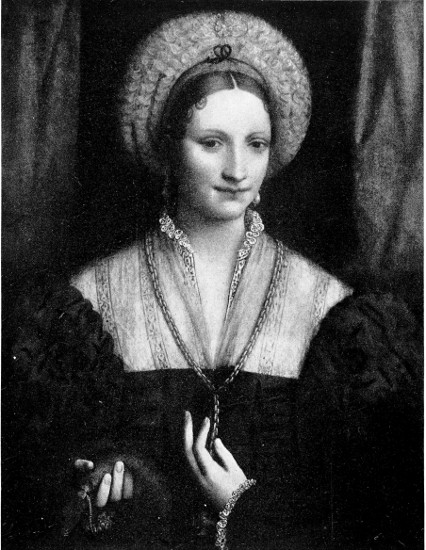
Collection of the Hon. Andrew W. Mellon
PORTRAIT OF A LADY
—Luini
“Luini’s female creations are so exquisite that for a long time people supposed that Leonardo alone was capable of conceiving them,” writes Marcel Reymond, “and permanently recording their loveliness; but now this injustice has come to an end and Luini’s art appears before us with sharply determined characteristics that prevent us from confounding it with Leonardo’s art; first of all, from the point of view of technique, it must be remembered that Leonardo works like a master born about 1450 and Luini like one born after 1470. With Luini the workmanship is less precise than with Leonardo, while the stroke is less restrained and the modelling freer.”
TITIAN’S SCHOOLMASTER.
Giambattista Moroni Collection of
(1520–5–1578). Mr. Joseph E. Widener.
In the National Gallery, London, there is a striking portrait of a Tailor—known as the Tagliapanni—standing behind his board, at half-length, with shears in his right hand and a piece of cloth in his left, looking inquiringly at the spectator. It is forceful, attractive, commands attention, and lives in the memory of all who have looked upon it. Moroni’s Tailor is one of the great portraits of the world. The merest glance at the picture represented here would tell you that it is by the same hand. The means of producing a striking effect are even simpler than in the London portrait.
The title is entirely fanciful, but it accords well with the subject, a pleasant, genial man with an intellectual countenance. He seems to be about sixty years of age and is dressed in black with white linen collar and a black cap. His beard is grey. He is sitting sideways in a chair that is often described to-day (and for no reason whatever) as a “Savonarola Chair,” resting his left arm on the arm of the chair and holding a book in his right. It would appear that he has just been interrupted in his reading—pleasantly, too, it would seem—and is keeping the page he has left off reading with one finger between the leaves. The hands are marvellously drawn and painted, as is also the ring on the left hand. Van Dyck admired this picture so much that he made a sketch of it in his Italian sketch-book (which is now at Chatsworth).
This portrait in oils on canvas (38 × 29½ inches) was long in the Borghese Gallery at Rome, and then at the beginning of the Nineteenth Century it was purchased by the Marquis of Stafford. From the Duke of Northumberland’s Collection, Stafford House, it passed to the present owner.
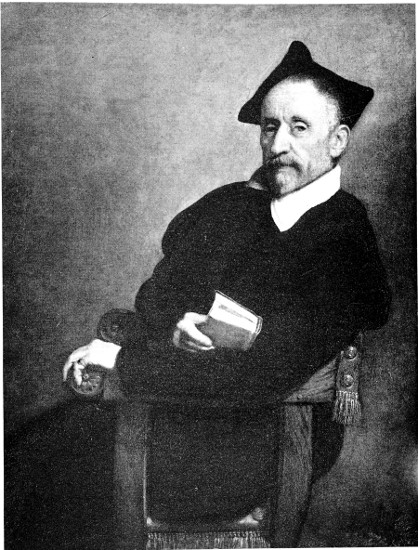
Collection of Mr. Joseph E. Widener
TITIAN’S SCHOOLMASTER
—Moroni
Moroni’s great fame, even in his own day, was as a portrait-painter; and it is said that when people from Bergamo and its vicinity went to Titian to have their portraits painted, he told them to go home and sit to their own countryman. Moroni was a pupil of Moretto at Brescia, was influenced by Lotto and Titian, and he, in his turn, influenced Van Dyck.
Moroni was born at Bondo in Bergamo between 1520 and 1525 and died at Bergamo in 1578.
VENETIAN
“It is evident,” wrote Taine, “that, while following a path of its own, Venetian Painting developed as in the rest of Italy. It issued here, as elsewhere, from missals and mosaics and was at first in sympathy with purely Christian emotion; then, by degrees, the feeling for beautiful human life introduced into the altar-frames vigorous and healthy bodies taken from contemporary types; and we wonder at the placid, expressions and religious physiognomies on the blooming faces in which the youthful blood circulates and sustains innate temperament. This is the confluence of two spirits and two ages: one, the Christian, which is fading away; the other, the Pagan, which is in the ascendant. In Venetian Art special traits are distinguished. The people are more closely copied from life and are less transformed by Classic or mystic sentiment, not so pure as at Perugia, not so noble as at Florence: they are addressed more to the senses than to the mind or the heart; they are more quickly recognized as men and give greater pleasure to the eye. Strong and lively tones color their muscles and their faces; living flesh is soft on their shoulders and on the thighs of little children; clear landscapes open into the distance to make the deeper tints of the figure stand out; saints gather around the Virgin in a variety of attitudes unknown to the other Primitive Schools with their uniform processions. At the height of its fervor and faith the national spirit, fond of diversity and joy, allows a smile to escape.”
Venice was slow in abandoning Byzantine tradition. Changes begin to be apparent in the Fourteenth Century. Walter Pater notes: “The beginnings of Venetian Painting link themselves to the last, stiff, half-barbaric splendors of Byzantine decoration and are but the introduction into the crust of marble and gold on the walls of the Duomo of Murano, or of St. Mark’s, of a little more of human expression. And throughout the course of its later development, always subordinate to architectural effect, the work of the Venetian School never escaped from the influence of its beginnings. Unassisted, and therefore, unperplexed by naturalism, religious mysticism, philosophical theories, it had no Giotto, no Fra Angelico, no Botticelli. Except from the stress of thought or sentiment, which taxed so severely the resources of the generations of Florentine artists, those earlier Venetian painters, down to Carpaccio and the Bellini, seem never for a moment to have been tempted even to lose sight of the scope of their art in its strictness, or to forget that painting must be before all things decorative, a thing for the eye, a space of color on the wall, only more dexterously blent than the marking of its precious stone, or the chance interchange of sun and shade upon it—this to begin and end with—whatever higher matter of thought, or poetry, or religious reverie, might play its part therein, between.”
During the Fifteenth Century Venice began to be influenced by painters from other cities, particularly by Gentile da Fabriano (see page 74) and Pisanello (see page 99), who were sent for to decorate the Doge’s Palace. Gentile da Fabriano represented all the latest “modernistic” ideas of his day. Among the Venetians who were most profoundly influenced by him was Jacopo Bellini (who later went to Padua). Jacopo, in spite of his contact with Squarcione and Andrea Mantegna (who married his daughter), remained “Gothic” in essentials. Jacopo Bellini had one of the largest bottegas in Venice; and this bottega was continued by his gifted sons, Giovanni and Gentile.
Jacopo was a talented painter who had worked in Florence as well as Padua, but who really belongs to Venice.
The great rivals of the Bellini painters were the Vivarini on the Island of Murano. The Vivarini, the first of whom was Antonio da Murano (active 1440–1476 or 1484), who played a great part in the development of the Venetian School and whose work consisted of enormous altar-pieces of many compartments set in Gothic framework of very ornate character and profusely adorned with gold; Bartolommeo Vivarini, Antonio’s younger brother (1431?–1499?), in whose work the influence of the Paduan School of Squarcione is marked and also that of Antonello da Messina; and Antonio’s son, Alvise Vivarini (1447–1504), a pupil of his father and uncle, who was working in 1474 with Giovanni Bellini in the Scuola di San Girolamo in Venice and whose portraits show the influence of Antonello da Messina.
Carlo Crivelli (1430?–1493?), if not a Venetian by birth, which is most probable, is classed as belonging to the Venetian School. Crivelli was a fellow-pupil of Bartolommeo Vivarini under Antonio da Murano (Vivarini), and Squarcione. Like Mantegna, Crivelli kept to tempera painting; Crivelli stands alone for his wonderful decorative qualities (see page 125 and page 128).
Antonello da Messina (1430–1479) was a contemporary of Crivelli and is particularly distinguished for introducing into Italy the Flemish system of painting with oils. In his pictures the influence of the Bellini is apparent (see page 124).
Giovanni Bellini (1428–30–1516), one of the greatest painters of the Fifteenth Century, was trained by his father, Jacopo Bellini. Next he followed in the footsteps of Squarcione and Andrea Mantegna; but he changed his style, as well as his technique, gradually abandoning tempera for the new practice in oils, which he was one of the first to master. In some respects Giovanni Bellini was influenced by his own pupil, Giorgione (see page 118). Gentile Bellini (1426–9–1507), was named, it is interesting to note, for Gentile da Fabriano, his father’s master and friend. Gentile, trained by his father, Jacopo, was called upon to paint the organ-shutters at St. Mark’s with colossal figures of St. Mark, St. Theodore, St. Jerome, and St. Francis; was knighted by Frederic III in 1469; and was employed to restore the frescoes of Gentile da Fabriano in the Hall of the Grand Council in the Doge’s Palace, a commission which carried with it the honor of painting the portrait of every new Doge. Sent for by the Sultan of Constantinople, Mohammed II, to paint his portrait, Gentile sailed for Constantinople in 1479 and returned in 1480 with the title of Bey. Gentile then joined his brother, Giovanni, who was working on the Fabriano frescoes. The Bellini brothers also painted on canvas a series of pictures portraying the legend of Frederic Barbarossa and Pope Alexander III, which perished in the fire of 1577. Gentile’s Procession of Corpus Christi of 1496 has been pronounced “the most important extant work of the Venetian School previous to the advent of Titian.”
The bottegas of the Bellini and Vivarini naturally produced a host of able painters, among whom were Marco Basaiti (active 1500–1521); Lazzaro Bastiani (active 1449–1512); Cima da Conegliano (1460?–1517?); and Jacopo Bassano (1510?–1592). Vittore Carpaccio (1450?–1526?), was a follower of Gentile Bellini; and the stories he told in paint, such as the series depicting the Life of Saint Ursula, belong to the great works of Venice.
Giorgione (1477–1510) is the next important name. Little or nothing is known of his life, except that he was born of humble parents at Castelfranco. By 1500 his reputation was established, for he was then painting important works. Among these was a picture for the Hall of Audience in the Doge’s Palace and some fresco decorations for the exterior of the Fondaco dei Tedeschi, the bank of the German merchants in Venice. Giorgione was a pupil and follower of the Bellini and had much influence upon Giovanni Bellini. Giorgione died of the Plague in his thirty-fourth year. Giorgione stands alone for his romantic and lyrical qualities and for his penetrating charm. He is notable, too, for having introduced music into his pictures, or rather persons who are playing upon instruments.
Apart from his delightful qualities Giorgione is of the greatest importance in the evolution of painting. Walter Pater writes: “Giorgione is the inventor of genre, of those easily movable pictures which serve for uses, neither of devotion nor of allegorical, or historical teaching—little groups of real men and women, amid congruous furniture or landscape—morsels of actual life, conversation, or music, or play, refined upon or idealized, till they come to seem like glimpses of life from afar. Those spaces of more cunningly blent color, obediently filling their place, hitherto, in a mere architectural scheme, Giorgione detaches from the wall; he frames them by the hands of some skillful carver, so that people may move them readily and take with them where they go, like a poem in manuscript, or a musical instrument, to be used, at will, as a means of self-education, stimulus or solace, coming like an animated presence, into one’s cabinet, to enrich the air as with some choice aroma, and, like persons, live with us, for a day or a lifetime. Of all art like this, art which has played so large a part in men’s culture since that time, Giorgione is the initiator.”
Titian, or rather Tiziano Vecello (1477?–1576), fellow-pupil of Giorgione, of Gentile and Giovanni Bellini and assistant to Giorgione in decorating the Fondaco dei Tedeschi (which established a new era in Italian painting), was the leading painter of his day (see page 140).
Bartolommeo Veneto, of Veneziano (1480–1555), pupil of Giovanni Bellini, became a famous portrait-painter. (See page 148.)
Tintoretto, the magnificent Venetian, was nicknamed “Il Furioso,” because of his great technical powers that include astonishing display of foreshortening and many curious effects in light and color, as well as in form. Ruskin says Tintoretto (or Tintoret, call him as you please) made “figures lovely in themselves, content that they should deserve not demand, your attention.”
Playing with a full orchestra of color and understanding how to produce the most luminous effects of light, the great Venetian filled Venice with marvellous pictures. Tintoretto was equal to the immense work he undertook and his noble brush never left anything that was unworthy of it. Tintoretto, whose real name was Jacopo Robusti (1518–1594), was apprenticed to Titian and was influenced by Titian, Palma Vecchio, Michelangelo, and Parmigiano (of the School of Palma and follower of Correggio).
“There is one only—the last and greatest of the Venetians of the Renaissance—who could sound all the notes of tragedy and pathos as well as notes of joy. Tintoretto, the supreme Venetian, the greatest exponent of the essential spirit of Venice, is the son of a wider kingdom than hers and of a greater age than the Renaissance. Unsurpassed as a designer and colorist, he is endowed throughout with the peculiar gifts of Venice; but during those years of passionate study, in which he was winning here and there the secrets of his art, hungry for knowledge, careless of gain, and bargaining only for material in which to realize his conceptions,—during those years in which he lived alone in continual meditation on some fresh labor, he was probing the deep and passionate things of humanity as no Venetian artist had ever probed them before. The streets and churches of the city seem to echo still to the steps of this genius at once so robust, so tender, so profound, and so joyous.”[15]
Paolo Veronese, or rather Paolo Caliari (1528–1588), a native of Verona, whence his name, is one of the most delightful of painters. J. Buisson considers Veronese of all the painters of Italy “the one whose work best serves to particularize the art of painting” and this able French critic goes on to say that “Veronese painted the Venetian Beautiful as the Greeks sculptured the Hellenic Beautiful” and that “Paul Veronese is of all the colorists, without a single exception, the one who has most unity. He is the most ethereal of the colorists. He is the painter of the air, both out-of-doors and in-doors. His values are impeccable and his shadows are at once transparent and full of color, without any artifice, such as Rubens’s exaggerated reflections, or the excessive sacrifices, which in Rembrandt are almost equivalent to a monotone in those parts that are lacking in light. His lights are broad and steady although modelled without any gleams, but of so shining a quality that they are positively radiant. Happy artist! He had the eye of the most perfect colorist ever known, able to perceive at the same time the different qualities of light and color and their variations in intensity and values and he possessed the gift to reveal them with marvellous art to ordinary mortals. Optics applied to his pictures show no law that he did not know and practice. Moreover, around his perfect visions of color are grouped other qualities, such as imagination, taste, rhythm, elegance, nobility, and magnificence in decoration. His hand is the equal of his eye. The rapidity of his brush may be compared only to that of Velasquez and to that of Rubens.”
This great period, Taine sums up as follows:
“The more we consider the ideal figures of Venetian Art, the more we feel the breath of an heroic age behind us. Those great, toga-draped, old men with the bald foreheads are the Patrician Kings of the Archipelago, Moorish Sultans, who, trailing their silken simars, received tribute and ordered executions. The superb women in sweeping robes, bedizened and jewelled, are Empress-daughters of the Republic, like that Caterina Cornaro from whom Venice received Cyprus. There are the muscles of fighters in the bronzed breasts of the sailors and captains; their bodies, reddened by the sun and the wind, have dashed against the athletic bodies of Janizaries; their turbans, their pelisses, their furs, their sword-hilts constellated with precious stones—all the magnificence of Asia is mingled on their bodies with the floating draperies of Classic times and the nudities of Pagan tradition.”
Sebastian del Piombo (1485?–1547), pupil of Giovanni Bellini and Giorgione, preferred oil to fresco and this led to a famous quarrel between him and Michelangelo. Palma Vecchio (1480–1528), standing first in the second rank of Bellini-Giorgione followers, is another important painter. Lorenzo Lotto (1480–1556), pupil of Alvise Vivarini, painted with Raphael in the Vatican in 1508–9 and naturally fell under Raphael’s spell. Lotto spent much time in Bergamo; was touched by Correggio’s spirit; and, after 1529, was affected by Titian.
Paris Bordone (1500–1571), a gorgeous colorist, pupil and follower of Giorgione and Titian (and slightly touched by Palma Vecchio), was famous for his portraits, mythological pictures, and for that masterpiece entitled The Fisherman Presenting the Ring of St. Mark to the Doge (now in the Accademia at Venice).
“These Venetian artists of the Renaissance,” says d’Annunzio, “create in a medium that is itself a joyous mystery—in color, the ornament of the world, in color which seems to be the striving of the spirit to become light. And the entirely new musical understanding they have of color acts in such a way that their creation transcends the narrow limits of the symbols it represents and assumes the lofty, revealing faculty of an infinite harmony.”
To the Eighteenth Century belongs Giovanni Battista Tiepolo (1696–1769), famous as a designer and colorist, influenced by Veronese, and a decorator of palaces and villas in Venice, Genoa, Milan, Würzburg, and Madrid, where he died. Tiepolo married Guardi’s sister in 1715.
Canaletto, or Giovanni Antonio da Canale (1697–1768), son of Bernardo da Canale, a scene-painter, is famous for his views of Venice and for being the teacher of Guardi.
Francesco Guardi (1712–1793), a native Venetian, but of Austrian stock, a follower of his master Canaletto, was also celebrated for his Venetian views (see page 153).
“Venice herself” writes Berenson, “had not grown less beautiful in her decline. Indeed, the building which occupies the very centre of the picture Venice leaves in the mind—the Salute—was not built until the Seventeenth Century. This was the picture that the Venetian himself loved to have painted for him and that the stranger wanted to carry away. Canale painted Venice with a feeling for space and atmosphere, with a mastery over the delicate effects of mist peculiar to the city, that make his view of the Salute, the Grand Canal, and the Piazzetta still seem more like Venice than all the pictures that have been painted since. Later in the century Canale was followed by Guardi, who executed smaller views with more of an eye for the picturesque, and for what may be called instantaneous effects, thus anticipating both the Romantic and the Impressionist painters of our own century.”