ENGLISH, EIGHTEENTH CENTURY (continued 2)
Reading edition
“It is obvious that the Eighth Discourse may have been delivered covertly to depreciate a picture which had been exhibited eight years before, but this is not likely; or it may be assumed that the painting was produced to demonstrate the futility of the President’s counsel. It is obvious that Gainsborough might, and probably did, find occasion to illustrate a principle which is apparently opposed to the dictum of Reynolds, without reference to the Eighth Discourse, or previous utterance of the P. R. A. Van Dyck repeatedly employed masses of blue in draperies, with results which are at least equal to those of the picture before us. The Children of Charles the First at Windsor is an example of the fact.[34] Leslie and every practical critic recognized that Gainsborough had evaded the full and just method of controverting the declaration of Sir Joshua rather than successfully assailed it.
“The picture before us is known to have been exhibited at the British Institution with a collection of Gainsborough’s works—the first formed independently of the artist and his wife—in 1814, under the title of Portrait of a Youth and again at the same place, in 1834, as ‘117, A Young Gentleman in a Landscape; the Picture known as The Boy in Blue.’ It was at Manchester in 1857; the International Exhibition in 1862; and at the Royal Academy in 1870. The last occasion evoked the discussion above alluded to, when the other Blue Boy became prominent. The question may be summed up by saying that probably the younger Buttall had a version of his own portrait, while the Prince had another.
“Reynolds, by the way of supporting his own dictum, produced A Yellow Boy in the ‘Portrait of Charles, Earl of Dalkeith’ with an owl and a dog, which was No. 132 at the Grosvenor Exhibition, in 1884. ‘A Portrait of a Lady,’ by Gainsborough, known as ‘The Blue Lady’ was at the British Institution in 1859; ‘The Pink Boy’ (Master Nicholls, grandson of Dr. Mead), by Gainsborough, was at the Academy in 1879, No. 39; it has recently been sold to a member of the Rothschild family. The Blue Boy is at once the complement and the antithesis of Mrs. Graham (born Cathcart), now in the Scottish National Gallery (Edinburgh).”
Turning now to M. H. Spielmann in British Portrait Painting:
“In the view expressed by the late F. G. Stephens and others—an opinion I am inclined to share—the portrait known as The Blue Boy, more properly Master Jonathan Buttall, belongs to the year 1770, or thereabouts, and not to a period ten years later, as is argued by those who desire, in the face of internal evidence, to apply to it a passage—usually cited incorrectly—in Sir Joshua Reynolds’s Eighth Discourse (delivered in 1778), against the use of masses of cold blue. The stricture could not possibly apply to this picture, which triumphs by virtue of its warm blue, as it does by nobility of pose (more suggestive of a prince, as we imagine a prince should be, than of the son of a wealthy ironmonger of Greek Street), by the well controlled power and dignity made manifest throughout and by the brilliant brush charged with fat paint. The finely posed head with its admirably expressed character of boyhood and a good deal of sturdy doggedness behind the intelligent eyes, is rendered a little more heavily than is Gainsborough’s wont; but that it is a masterpiece of portraiture, as it is of color, cannot be challenged. This portrait, which from its manner may be believed to have been painted eight years before the father’s death and not two years after it, is the first to show Gainsborough’s outstanding genius as a painter of independent thought and striking modernity. At the same time it should be pointed out an earlier Blue Boy by him exists in the portrait of his nephew, Edward Gardiner, painted in 1768.
“Here in Master Buttall is Gainsborough’s first great invention both in matter and manner, almost a challenge to Van Dyck’s reputation, but painted in a scheme of color Van Dyck never thought of, and would probably never have tried if he had. In handling it is Gainsborough’s first link with Watteau in its broken tints and fearless lightness of handling of the drapery, in its fascinating play of light and shade, its delightful silhouette and cast shadows. It is difficult to imagine how the composition could be bettered; the picture, by itself, had no others come from the same brush, would have immortalized the painter.”
Finally, Sir Walter Armstrong agrees, too, with the Stephens theory:
“Those who cling to the old traditions quote the style of The Blue Boy in support of the notion that it could not have been painted before 1779. I confess that, to me, it now seems, after much and close observation, to point the other way. The loaded impasto, the ruddy carnations, the tendency to brown and beyond it in the shadows, the preoccupation with force, seem all to belong to about the same period as the group at Knole and to be inconsistent with the feathery lightness, freedom, and gaiety which mark Gainsborough’s work towards the end of his life. The most significant comparison may be made with the National Gallery Mrs. Siddons. Here again blue, and a franker blue than that of the Master Buttall, is the dominant note. But the painting is more assured, the handling lighter and more prompt, the shadows more transparent, and the figure, as a whole, truer to its illumination. It would not be fair to dwell too much on the contrast between the flesh painting of The Blue Boy and that of the Mrs. Siddons, for I fancy the peculiar white bloom of the latter’s skin is due to the fact that she sat in her paint. But it must not be overlooked that even in the portraits of pretty women, that of Eliza Linley for instance, painted about 1770, there is a fullness of color we do not find ten years later. Taking everything into account, it seems to me that the old tradition of The Blue Boy must be given up, and that the Duke of Westminster’s picture, so far from being an answer to Reynolds, was one of the many things that provoked his dictum, Gainsborough replying, if he took the trouble to reply at all, with the Mrs. Siddons and those other portraits, painted in the last ten years of his life, in which blue, canary yellow, and other cool tints are made the centres of the color scheme.”
Buttall and Gainsborough continued their relations. Buttall was one of the “few friends Gainsborough respected and whom he desired should attend his funeral at Kew. Buttall outlived Gainsborough seventeen years and died in December, 1805, as the Morning Herald notes: “Died, on Friday last, at his house in Oxford Street, Jonathan Buttall, Esq., a gentleman whose amiable manners and good disposition will cause him to be ever regretted by his friends.”
GENERAL PHILIP HONYWOOD.
Thomas Gainsborough Collection of
(1727–1788). Mr. John Ringling.
When Gainsborough exhibited this portrait in London in 1765 it created quite a stir, as it was a departure from the style of any portrait by that artist; and when it was sent home to Mark Hall, the seat of the Honywood family in Essex, a new room had to be built in order to accommodate it, as the canvas measures nearly ten feet square (96¾ × 82¼).
This has the reputation of being the finest equestrian portrait ever painted by Gainsborough. Fulcher writes of it:
“Never was the amenity of landscape more happily displayed. Through a richly wooded scene wherein the sturdy oak and silvery-barked birch are conspicuous, the soldier, mounted on a bay horse, appears to be passing, wearing a scarlet dress which contrasts finely with the mass of surrounding foliage. Nothing can be easier than his attitude, as with one hand he curbs his charger and with the other holds his sword which seems to flash in the sun. The picturesque design of this portrait, its brilliant coloring, its bold yet careful execution, Gainsborough never surpassed. No wonder that George III wished to become the possessor of it and no wonder that Horace Walpole wrote of it in his catalogue ‘very good.’ Of the nine pictures which decorated the walls of Mark Hall grand staircase, three were by Gainsborough and included the remarkable portrait of General Honywood. It is the largest work by that master and has the reputation also of being the finest equestrian portrait ever painted by Gainsborough, competing only with Van Dyck’s Portrait of Charles I in the Prado Gallery, Madrid, with which it has more than once been compared.”
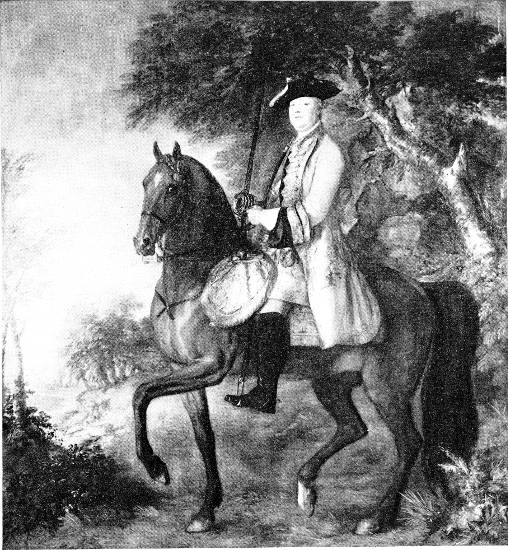
Collection of Mr. John Ringling
GENERAL PHILIP HONYWOOD
—Thomas Gainsborough
The landscape, it is interesting to say, is a part of the park at Mark Hall. General Philip Honywood of Mark Hall came of an old Kentish family deriving its origin from a place called Honewood or Hunewood in the parish of Postling in Kent, where they had held lands since the Norman Conquest. General Philip Honywood was born in 1710 and succeeded his nephew in 1758. He was a General of His Majesty’s forces, Colonel of the Third Royal Dragoon Guards, Governor of the Town and Citadel of Kinston-upon-Hull and was also member of Parliament for thirty-one years for the borough of Appleby in the County of Westmoreland. Philip Honywood was always familiarly called “the General” and he died in 1785.
Until 1878 this portrait remained in possession of the Honywood family at Mark Hall.
Sir Walter Armstrong in his Gainsborough writes:
“It represents the General riding across the canvas from left to right. He wears a scarlet uniform and carries his sword, unsheathed, in his right hand; he has no scabbard. The horse, a rich bay, is a little too long. The painter has not taken the precaution to draw him in before commencing the figure, and so the fore-quarters are separated from the hind by rather too much middle-piece. This mistake is still more conspicuous in the Colonel St. Leger at Hampton Court, where a quite unreasonable amount of horse shows behind the figure. Otherwise, the Honywood picture is as successful in design as it is in all other ways. The landscape is one of the finest backgrounds ever painted and reminds one of the backgrounds to some of those equestrian portraits by Velasquez which Gainsborough never saw. It is curious that Reynolds had sent a General on Horseback to the Exhibition of 1761. Many things point to the probability that Gainsborough made an annual visit to London during the exhibition and it is quite likely that the apparition of Sir Joshua’s ‘General’ suggested the treatment of his own.”
The Reynolds referred to above is the portrait of Lord Ligonier now in the National Gallery, London.
THE HARVEST WAGGON.
Thomas Gainsborough Collection of
(1727–1788). Sir Joseph Duveen, Bart.
This picture bears comparison with Gainsborough’s famous Market Cart in the National Gallery, London. Some critics even prefer it. It is painted in oils on canvas (48 × 59 inches) and represents a countryside and a scene very familiar to the painter. The country is rugged with a wheel track winding from the left foreground away into the distance towards the blue hills. On the left, there are massive boulders overgrown with shrubbery and trees with russet foliage overhanging the lane. The rustic dray-cart, laden with laughing country folk, is halted to enable a young girl to clamber up over the wheel and into the arms of a youth who bends forward to help her. The three horses stand placidly while the driver adjusts the collar of the leader. A panting dog capers by the cart and two sheep that have strayed from their flock are seen resting by the boulders. The rock in the foreground is signed with the initials “T. G.”
The Harvest Waggon gains particular interest because the two young girls—one seated in the waggon and one climbing up over the wheel—are Gainsborough’s daughters. The horses, too, are portraits—horses that belonged to John Wiltshire, the chief carrier of Bath, and the cart is one of Wiltshire’s “flying waggons.” In some accounts of John Wiltshire he is represented as an ordinary dray-man, who drove his own carts and made deliveries. This was not the case, however. John Wiltshire was a man of importance in Bath, having built up a large “carrying business” (which we would to-day call express), with a regular service of “flying waggons,” always going back and forth from his warehouses in Broad Street, Bath, to the White Swan at Holborn Bridge, London. Wiltshire was elected Mayor of Bath in 1772 and gave a great entertainment at the Town Hall to the gentry and fashionables, giving thereby “much offense to the people in trade” who were not invited. Some idea of the speed of these “flying waggons” may be had from Gainsborough’s letter to Garrick relative to the delivery of the latter’s portrait:
“The picture is to go to London by the Wiltshire fly-waggon on Wednesday next and I believe will arrive by Saturday morning.”
John Wiltshire, who came of a good old family that had attained the rank of squires, lived in a fine mansion at Shockerwick near Bath, which had belonged to his father. This was quite a place of rendez-vous for the notable personages who visited Bath. “There,” it was said, “Anstey had a beech tree, Gainsborough an elm, and Quin an arm-chair, while Fielding, Allen, and their hospitable host, Wiltshire, enjoyed the shades of its sylvan glades.”
Wiltshire was so devoted to Gainsborough and such an admirer of his paintings that he would never allow him to pay any bills for “carrying.” Yet he delivered all of Gainsborough’s finished pictures. After a time, upon Gainsborough’s insisting, Wiltshire replied: “When you think I have carried to the value of a little painting, I beg you will let me have one, sir; and I shall be more than paid.”
By degrees Wiltshire thus acquired his small, but very choice, collection of Gainsboroughs, which was sold at Shockerwick in 1867.
The Harvest Waggon was one of these; and the way the picture came to be painted was this. On one occasion Gainsborough asked Wiltshire to lend him a horse for a model. The generous Wiltshire saddled and bridled one of his horses and sent it to Gainsborough for a present. Gainsborough painted this horse and made, as Fulcher says, “a remarkably fine study of this animal.” Gainsborough now returned the compliment. He painted The Harvest Waggon and sent it to Wiltshire as a present. Wiltshire was overjoyed, for here was his own waggon; here were his own horses; and here were the artist’s own daughters!
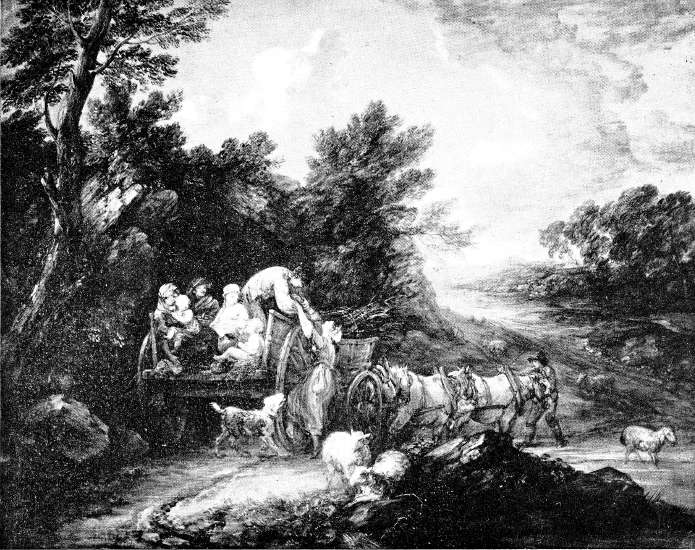
Collection of Sir Joseph Duveen, Bart.
THE HARVEST WAGGON
—Thomas Gainsborough
On giving The Harvest Waggon to Wiltshire, Gainsborough said it pleased him more than any picture he had ever painted.
From the Collections of Thomas Gibbons, Esq., Hanover Terrace, Regents Park, of the Rev. Benjamin Gibbons, Hanover Terrace, Regents Park, and of Sir Lionel Phillips, London, The Harvest Waggon passed into the Collection of the late Judge Elbert H. Gary. It attracted great attention at the Gary Sale in New York, April, 1928, when it was sold at the Plaza Hotel for $875,000, the highest figure that any picture has ever reached at auction.
JOHN WALTER TEMPEST.
George Romney Collection of
(1734–1802). Mr. and Mrs. Marshall Field.
It would be hard to find in all the range of portraiture, at any time and in any place, a work more charming, true, sincere, natural, and ingratiating than this adorable boy with his beloved horse. You can see at a glance that they love each other.
Everything about the picture is delightful: the coloring, the handsome, sweet, and dreamy boy with his unspeakable grace and gentleness, the fine horse, so contented, and the suave landscape—all make both a portrait and a picture that will live for all time. No changes in fashion can ever destroy its beauty and its appeal. Moreover, Romney has succeeded in suggesting here a young boy’s dreams and the friendship between a boy and a horse. The relation between the two, as they enjoy a pause in their jaunt through the woodland, is marvellously expressed. The relation of these figures to the landscape is such that we feel as if we, too, were in this lovely, English, sylvan spot. We seem to hear the plash of the tiny waterfall and the sound of the horse’s lips as he quenches his thirst. In just one moment more and the sweet, gentle, dreamy boy will pat his friend’s warm, brown neck, leap lightly on his back and off they will go merrily
“to seek fresh woods and pastures new.”
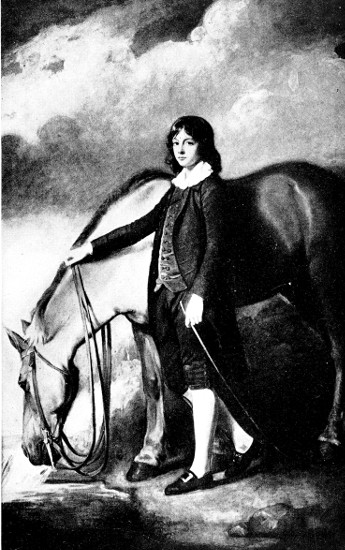
Collection of Mr. and Mrs. Marshall Field
JOHN WALTER TEMPEST
—George Romney
The picture is in oils on canvas (90 × 58 inches) and was painted in 1779–1780. In the Catalogue Raisonné of Romney’s works we read:
“Whole length, when a youth, standing, facing towards and looking to the front; long hair; purple dress, white turned-down collar, white stockings and black shoes with silver buckles; standing by his horse, which is drinking at a stream to the left; right hand holding the reins; left hand holding whip; trees in the distance.”
For several years this lovely picture was in the Collection of Asher Wertheimer, Esq., of London.
John Walter Tempest was the only son of John Tempest, Esq., of Sherburn, County Durham, and member of Parliament for Durham. He died in 1793 at Brighthelmstone, where he had gone for his health.
The German critic, August Grisebach, has a profound admiration for this portrait. Writing in Die Kunst für Alle (1908), he says:
“As a new representation of the half-grown boy Romney’s John Walter Tempest stands next to the Blue Boy. In place of the warm lighting of the brilliant silk of the correctly adorned boy in Van Dyck style and the aristocratic pose of the manufacturer’s son, is the simple cloth coat of subdued violet against the light-brown horse, so quiet and reserved in color and line, similar to an antique relief.”
The Strawberry Girl is reckoned among the most original of Sir Joshua Reynolds’s works. Surely John Walter Tempest is one of Romney’s most brilliant triumphs! Moreover, the picture is highly original.
For a great number of years George Romney in his house, No. 32 Cavendish Square, shared the patronage of the aristocracy with Reynolds and Gainsborough. Romney’s career was remarkable, for he had almost no training. Romney was born in 1734 at Beckside, near Dalton in Cumberland, the son of a cabinet-maker, who wrote his name Rumney. He, too, was destined for a cabinet-maker, but made the acquaintance in Kendal of a portrait-painter named Christopher Steele, who had studied with Carle Van Loo, and became his pupil and apprentice in 1755. Romney soon painted a number of portraits in Kendal and also a hand holding a letter for the town post-office, which attracted much attention.
Undoubtedly Romney acquired something of the French style through this teacher and we may regard him indirectly as a pupil of Van Loo. Certainly there is a quality in Romney that finds response in the French painters of the Eighteenth Century.
Lord Gower says in his Romney (London, 1904):
“Apparently the Count made use of his pupil to prepare and grind his colors and to carve frames for his portraits. Later these color-grindings must have been of great use to Romney, and the preparation and mode of laying on the oil colors may account for the excellence and permanency of his paintings, which have stood admirably and unfadingly the test of time and which are in most cases as fresh and brilliant, as clear and transparent, as when they left Romney’s studio nearly a century and a half ago. It is not without interest that one recalls how all the great Italian and Flemish Masters instructed their pupils in the preparation of the minutest detail in all things relating to their painting, from the preliminary grinding of the colors and the laying on of the groundwork of their subject, whether on paint or canvas; for not only were the great Italian and Flemish old painters past masters in all that appertained to the technicalities of their art, but honest and loyal in seeing no detail, however irksome, omitted which could give permanency and endurance to their creations; hence those marvels of color, paintings three and four centuries old which still glow with all the brilliancy of gems and flowers, as radiant as some noble stained-glass window in some glorious Gothic fane.”
In 1762, when he was but twenty-eight, Romney moved to London (leaving his wife, son, and daughter) and established himself in the great city. As a painter of excellent portraits at low prices Romney soon saved enough money for a visit to Paris, and hard work enabled him to close his studio and spend two years in Italy. Soon after his return in 1775, Romney removed from Gray’s Inn to No. 32 Cavendish Square, formerly occupied by the painter, Francis Cotes, (who had died in 1770). A portrait of the Duke of Richmond Reading launched Romney into fame and fortune. Thenceforward there was nothing to do but work. Romney became the fashion and ranked with Gainsborough and Reynolds; and, as his prices were considerably less than theirs, his studio was never empty of sitters. Romney’s Diaries show his amazing industry and a golden register of the nobility and gentry besides people of fashion and artistic distinction. The year 1777, for instance, shows six hundred sittings which Mr. Ward calculates as representing from a hundred and twenty to a hundred and fifty finished portraits. Romney’s charming style was now fully developed and some of his loveliest portraits date from this period: the Countess of Warwick and her Children; Lady Susan Lenox; Lady Derby (see page 401); Lady Albemarle; Lord Gower’s Children Dancing; John Walter Tempest; and Lady Craven, which inspired Horace Walpole to write:
“Full many an artist has on canvas fix’d All charms that Nature’s pencil ever mix’d— The Witchery of Eyes, the Grace that tips The inexpressible douceur of Lips Romney alone, in this fair image caught Each Charm’s Expression and each Feature’s thought. And shows how in their sweet assemblage sit Taste, Spirit, Softness, Sentiment, and Wit.”—H. W.
Therefore, it will be seen that Romney had been producing beautiful work before the advent of the beautiful Emma Hart, the future Lady Hamilton.
Romney left Cavendish Square in 1798, having bought a house at Hollybush Hill, Hampstead, from which he removed two years later to return to his wife and son at Kendal. He bought the estate of Whitestock, near Ulverstone, where his son finished the house he did not live to complete. Romney died in 1802, having been for two or three years in a state of complete imbecility.
“For the first half-century or more after his death his work was neglected. Hidden in private houses, the public never saw it; his biographies did not interest people; he had left no group of influential friends to hand down his memory. There was no such machinery of celebrity in his case as had existed so abundantly in Sir Joshua’s who lived not only by his pictures but by a multitude of lovely engravings and by the written and spoken word of colleagues, pupils, and friends. So Romney’s fame may almost be said to have died away during the dark ages between 1820 and 1850; and Christie’s Catalogues show that in those days he was ignored by collectors and by galleries, such as then existed. In the general revival of æsthetic intelligence which began about the middle of the century—a revival of which the Pre-Raphaelite movement, the eloquence of Ruskin, and the growth of a new class of wealthy amateurs were so many symptoms and conditions—Romney began to emerge once more. Never was there an artist who lived more wholly in his art. ‘In his painting-room,’ said his pupil, Robinson, ‘he seemed to have the highest enjoyment of life, and the more he painted the greater flow of spirits he acquired.’ It is true that, by one of the ironies of history, it was not primarily in portrait-painting that he was interested, but in those larger schemes and subjects to which, according to the classification of his time, he gave a higher place.”[35]
THE HON. MRS. DAVENPORT.
George Romney Collection of the
(1734–1802). Hon. Andrew W. Mellon.
The Hon. Mrs. Davenport (Charlotte Sneyd) is another of Romney’s superlative creations. She is the personification of a gentle English beauty, who might well have sat for the portrait of Tennyson’s “Queen of the Rosebud Garden of Girls” in Maud.
Mrs. Davenport, dressed in perfect taste, is posed against a lovely landscape background. Her gown is a delicate, yet glowing pink, and her cape is white velvet trimmed with white fur. She also wears a white scarf with brown ribbon and a white felt hat trimmed with brown and white ribbons. Her powdered hair is arranged in soft ringlets and a black velvet band around her neck affords a note of contrast to the general lightness of the color of the costume. A fashionable muff adds a chic touch. The face is remarkably sweet and intelligent, as well as beautiful, and the whole impression given by the portrait is of a charming, gentle, gracious, and lovable personality.
Charlotte Sneyd, born in 1756, was the daughter of Mr. Ralph Sneyd of Keele Hall, Newcastle-under-Lyme, Staffordshire, descended from an ancient family of Chester, one of whom had been knighted on the battlefield of Pinkie in 1547. Her mother was the daughter of Sir W. W. Bugot, fifth Baronet of Blithefield, and the grand-daughter of the first Earl of Dartmouth.
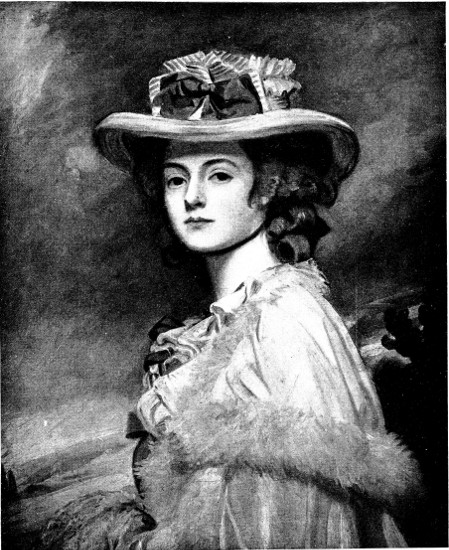
Collection of the Hon. Andrew W. Mellon
THE HON. MRS. DAVENPORT
—George Romney
Charlotte Sneyd was married in 1777 to Mr. Davies Davenport, High Sheriff of Cheshire in 1783, and M. P. from 1806 to 1830. His seats were Capesthorne, Crewe, and Calvely, Nantwich. Their youngest son took the extra surname of Bromley and owned Baginton Hall, Coventry. The Hon. Mrs. Davenport died in 1829. She was a cousin of Honora Sneyd, whose name has been associated with that series of portraits by Romney known as the “Serena” portraits. Honora was also famous for her engagement to the talented, charming, and ill-fated Major John André.
The picture, painted in oils on canvas (30 × 25 inches), came from the Collection of Brigadier-General Sir William Bromley-Davenport, K. C. B., Lord-Lieutenant of the County of Chester, Capesthorne Hall, Cheshire, England.
LADY DERBY.
George Romney Collection of
(1734–1802). Mr. Jules S. Bache.
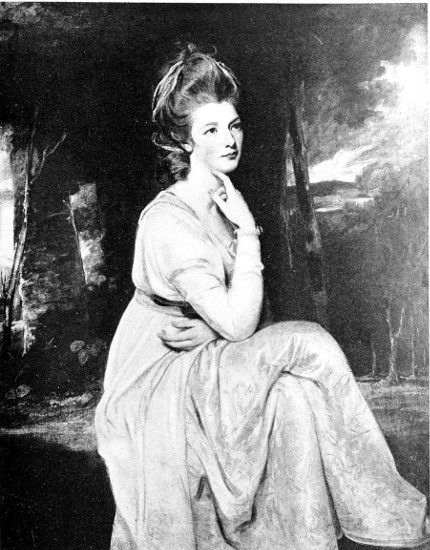
Of Elizabeth, Countess of Derby, Romney made one of his most beautiful portraits and one of the most beautiful portraits, moreover, of that great portrait period in which Romney worked. Everything about it is lovely. There is no color in the picture except Lady Derby’s golden hair and the green and brown tones of the distant landscape and of the tree behind her. The dress, a thin white India mull of exquisite fineness and transparency, is draped over a white brocade skirt, making a costume which is the quintessence of purity and lightness; and Romney has treated the white so perfectly that the picture seems to emit a celestial radiance. Lady Derby has the fresh English complexion of rose and white, and her golden hair is like sunshine and amber. The pose is so easy and natural that we may safely guess it was a characteristic one. Lady Derby seems unconscious of her charm; but she was certainly too beautiful not to know it.
Elizabeth, Countess of Derby, was the only daughter of James, sixth Duke of Hamilton and the famous Irish beauty, Elizabeth Gunning, who, with her sister, Maria, took London by storm when they removed there in 1751 from Dublin. The career of the Gunning sisters was extraordinary, for they had no money; but their handsome faces, fine figures, stylish dressing, and charming manners, soon brought them into notoriety. Crowds surged around them whenever they appeared: in the streets, in Hyde Park, at Ranelagh, at Vauxhall, at routs, at assemblies, or at the theatre. Horace Walpole said “it was extraordinary that two sisters should be so beautiful.” Maria Gunning married in 1752 the Earl of Coventry and also in the same year Elizabeth married surreptitiously James, sixth Duke of Hamilton “using the ring of the bed-curtain for her wedding ring.” On his death, six years later, she married John, fifth Duke of Argyll. Elizabeth, now Duchess of Argyll, was still as beautiful as ever and people ran after her as usual whenever she appeared in public. “One Sunday evening in June, 1759,” so Horace Walpole notes, “she was mobbed in Hyde Park. The King ordered that to prevent this for the future, she should have a guard; and on the next Sunday she made herself ridiculous by walking in the Park from eight to ten P. M. with two sergeants of the Guards in front with their halberds and twelve soldiers following her.” Elizabeth, Countess of Derby, with such a beautiful mother, had, therefore, the right to be a beauty. On June 12, 1774, “Lady Betty Hamilton” was married to Edward Smith Stanley, afterwards twelfth Earl of Derby, known as the “Cock-fighting Earl.” She soon tired of him and ran away with the Duke of Dorset, who had been working on the Derby estate for some time in the guise of a gardener in order to be near the beautiful Elizabeth and to perfect their plans for elopement. Who can look upon Romney’s portrait and blame him? Lord Derby married in 1797 the celebrated actress Miss Farren (see page 420). Elizabeth Hamilton died in 1797, aged forty-four.
Collection of Mr. Jules S. Bache
LADY DERBY
—George Romney
This portrait, oils on canvas (49½ × 39 inches), was painted in 1776–1778, after twelve sittings: Nov. 27, 1776; Jan. 31, Feb. 11, 14, 21, and March 19, 1777; Feb. 13, March 2, 9, 14, 23 and May 4, 1778. A mezzotint was made by John Dean in 1780.
After having been for many years in the Tennant Collection this chef-d’œuvre passed to Mr. Jules S. Bache.
A charming picture of Lady Elizabeth Hamilton, or “Lady Betty Hamilton,” as a child of five years, painted by Sir Joshua Reynolds, now hangs in the Widener Collection at Lynnewood Hall, Elkins Park, Pennsylvania. The little girl is seated on a bank facing the spectator and is shown at full length, wearing a pink dress over a large hoop, with low neck and short sleeves, and a spray of flowers at her neck. In her hands she holds a bouquet of bright flowers. This picture, painted in 1758, belonged to the Duke of Argyll and afterwards to the Earl of Normanton.
“The Eighteenth Century,” says Max Roldt, “has often been called the Age of Grace. If I were asked how this name could best be justified, I should point without a moment’s hesitation to the portraits by George Romney. Others painted graceful women in graceful dresses and graceful poses, but Romney personified Grace, made her his goddess; and it was her portrait which he painted over and over again under different lineaments and with various features. See his Lady Derby as she sits on a bank quietly dreaming under the trees; her legs are lightly crossed; her elbow rests on her knee so that her long, fine hand just touches her chin without actually supporting the pure oval of the head; with her white, muslin dress pulled up showing the underskirt of the broché satin of the same hue, is she not the very embodiment of grace?”
EMMA, LADY HAMILTON.
George Romney Collection of the late
(1734–1802). Mr. Henry E. Huntington.
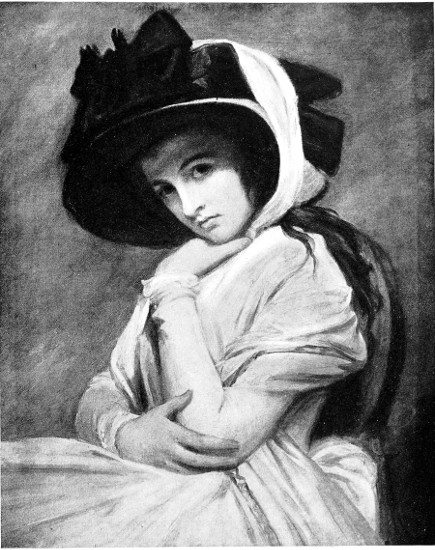
Who tied that white band over the big hat—Romney or Emma? It was certainly a very original idea!
“Three quarters in a straw hat called Emma, finished for Mr. Crawford,” is the way this picture is referred to in John Romney’s Memoirs; and in Romney’s own Ledger this note occurs: “Three quarters paid for by Mr. Crawford, 30 guineas, Sept. 15, 1792, and sent home to Mr. Crawford’s No. 48 Brook Street, July 21, 1792.”
At three-quarter, then, seated in a chair, dressed in white and wearing the conspicuous “straw hat,” trimmed with a broad band of ribbon tied into large bows, “Emma” looks at us rather pensively,—almost sadly. The pose is alluringly graceful and easy, but the swirling lines, when analysed, show the thought and art of a master. It is like a graceful melody of Mozart. Contour, beauty, and rhythm all are here!
Romney painted no fewer than thirty pictures of the “Divine Emma,” in character and with titles, and fourteen portraits, without titles; and, besides, he painted many replicas and variants of these portraits.
Emma Hart came into Romney’s life in 1782, taken to the painter’s studio in Cavendish Square one April morning by the Hon. Charles Francis Greville, second son of the Earl of Warwick, with whom she was then living. Romney was instantly struck by her extraordinary beauty, vivacity, and talent for posing. From this first picture, entitled Nature and representing Emma with a little black spaniel under arm, for which Greville paid twenty guineas, Romney produced portrait after portrait in various characters: Alope; Ariadne; Bacchante; In a Black Hat; Calypso (perhaps the same as Ariadne); Cassandra; Circe; Comedy; Comic Muse; Cybele; Daphne (perhaps the same as Bacchante); Contemplation; Emma in a Straw Hat (see page 405); Euphrosyne; Gipsy; Iphigenia; Joan of Arc; Kate (same as Ariadne); Magdalen; Medea; Meditation; with Miniature in Belt; Miranda; Lady Hamilton in Morning Dress; Nature; Nun; Pythian Priestess; Reading the Gazette; St. Cecilia; Sensibility; Serena; Servant’s Cap; Shepherdess; Sigismunda; Spinning-Wheel; Supplication; With Vesuvius in the Distance; Welsh Girl; Wood Nymph (same as Alope).
Portraits without titles are: Seated resting head on right hand, white dress; Bust to left showing hands, head leaning on right hand, forefinger on chin, bare neck and shoulders, blue and white drapery; Half-length, life-size, head facing, resting on crossed hands, light dress, colored scarf twisted around the head, arms bare to elbow, leaning on table; Head looking up to left; Head looking up to left (oval); Head to left with startled expression (sketch); Three-quarter length figure seated to left looking back over left shoulder, head resting on left hand, white dress and cap and colored sash; Half figure turned to right, white dress, white drapery around head (several versions); Head, shoulders, full face, low cut white dress, dark curly hair; Bust facing front, face looking down reading a book, white dress, brown background; Bust, life-size looking upward and smiling; White veil over head; Head and shoulders looking at spectator and smiling, dark red dress cut low, brown hair falling over shoulders, turban; Half figure directed to left looking at spectator, dark dress, white fichu, dark felt hat with broad brim and bunch of feathers, hair bound with blue ribbon, hands resting on lap, white lace cuffs.
Collection of the late Mr. Henry E. Huntington
EMMA, LADY HAMILTON
—George Romney
The story of Emma, Lady Hamilton, is a strange one. She was born on April 26, 1761, at Denhall, Chester, the only child of Henry Lyon, a blacksmith: no one knows why she took the name of Hart. While she was a child, her mother moved to Hawarden, entering the service of Mrs. Thomas, wife of the parish doctor, and Emma remained there until she was sixteen, earning her living as nursery-maid and waiting-woman. We find her in London in her eighteenth year employed in the celebrated Temple of Health, of which the notorious empiric, Dr. Graham, was the originator and proprietor, presiding there as the “lovely Hebe Vestina, Rosy Goddess of Health.” Here, at certain times of day, the “lovely Hebe” and the famous quack could be seen buried up to their necks in the mudbaths, Dr. Graham’s hair dressed according to the latest expression of the perruquier’s taste and Hebe with one of those towering head-dresses of the day, powdered and decorated with flowers, feathers, ropes of pearls, and gewgaws of many kinds.
Sir Walter Armstrong is of the opinion that Emma Hart sat for Gainsborough’s Musidora Bathing her Feet (in the National Gallery, London). “The features,” he says, “are those of Emma Lyon refined, the hair is hers, and the rest of the figure is what we find in several of Romney’s pictures.”
There is a very good reason that this might be so, for Gainsborough rented one part of Schomberg House, Pall Mall, and Dr. Graham rented the other. Consequently, Gainsborough had every opportunity of seeing the lovely Emma very frequently.
While presiding at Dr. Graham’s establishment, Emma attracted the attention of Sir Henry Featherstonehaugh of Up Park, Sussex, who persuaded her to leave the Temple and reside at Up Park. In the following year she placed herself under the protection of the Hon. Charles Greville.
In 1784 Sir Charles’s uncle, Sir William Hamilton, his Majesty’s Ambassador at Naples, came to London on a visit, a widower, a man of distinguished tastes, an art-connoisseur, a lover of music, and a descendant of a noble family. Sir William became fascinated with Emma and there was a clever transfer of Emma, not to the credit of either of these dashing “blades.” Ultimately Emma joined Sir William in Naples, where she was lodged at the British Embassy and treated with the distinction due royalty, having, moreover, her carriage, boat, livery, and other appurtenances of state. In a letter to the Hon. Charles, Emma says: “Sir William is very fond of me and very kind to me. The house is full of painters painting me. He has now got nine pictures of me and two a-painting. Marchant is cutting my head in stone, that is in cameo for a ring. There is another man modelling me in wax and another in clay. All the artists is come from Rome to study from me, so that Sir William as fitted up a room that is called the painting-room. Sir William is never a moment from me. He goes no where without me. He has no dinners but what I can be of the party. Nobody comes without they are civil to me.”
On Sept. 6, 1791, the infatuated Ambassador married Emma in Marylebone Church, the Marquis of Abercorn, Sir William’s kinsman, acting as best man. During the months preceding the wedding Emma sat almost daily to Romney.
On June 19, 1791, Romney wrote to William Hayley: “At present and the greatest part of this summer, I shall be engaged in painting pictures from the divine lady. I cannot give her any other epithet for I think her superior to all womankind. I have two pictures to paint of her for the Prince of Wales. She says she must see you before she leaves England, which will be in the beginning of September. She asked me if you would not write my life. I told her you had begun it; then she said she hoped you would have much to say of her in the life, as she prided herself on being my model.”
Romney also gave a party in Emma’s honor, on which occasion she displayed her remarkable talents. Romney wrote:
“She performed in my house last week, singing and acting before some of the nobility with most astonishing power. She is the talk of the whole town, and really surpasses everything, both in singing and acting, that ever appeared. Gallini offered her two thousand pounds a year and two benefits if she would engage with him, on which Sir William said pleasantly that he had engaged her for life.”
Directly after her marriage Lady Hamilton gave Romney a sitting. His Diary has these dates:
“Sept. 5 Mon. Mrs. Hart at 9.
Sept. 6 Tues. Lady Hamilton at 11.”
Sir William and Lady Hamilton left soon afterwards for Naples and Romney and Emma never met again.
Sir William Hamilton died in 1803; but from 1796 Emma had lived with and for Lord Nelson until his death in the Battle of Trafalgar. Emma died at Calais, Jan. 15, 1815.
The portrait shown here (30 × 25 inches), belonged to Tankerville Chamberlayne, Esq., and then passed into the Collection of Alfred C. de Rothschild, Esq.
England indirectly owes to Lady Hamilton one of Nelson’s great victories. When Nelson was in pursuit of the French, it was Lady Hamilton who obtained the order from the King of Naples for the fleet to enter port for provisions and water. Nelson thereupon entered the harbor of Syracuse, watered his fleet, and fought the victorious Battle of the Nile. A few months later Lady Hamilton and Nelson managed to rescue the Royal family of Naples by taking them through a subterranean passage and by boats to Nelson’s ship, the Vanguard. “The world owes it to Lady Hamilton,” says John Paget, “that the sister of Marie Antoinette did not share her horrible fate—that another head, as fair as that which fell into the basket of sawdust in front of the Tuileries on the 16th of October, 1793, did not roll on the scaffold at Naples in 1799. When we come to take the account as it stood between the world and Lady Hamilton when it finally closed in 1815, we find it strangely changed since 1791. The balance has turned. It is the world, it is humanity, that is the debtor.”
What a strange career! A woman of matchless beauty, artistic gifts of a high order, mental brilliance, generosity, charm, and kindness of heart, and, moreover, able to educate herself in the ways of society, admired, and courted by princes, artists, and men of powers, the intimate friend of the Queen of Naples, the beloved of Lord Nelson, the deity of Romney, enjoying at one time all that wealth and distinction could give and at the end forlorn, poor, and deserted, and dying in a foreign country—such was the life of Emma, Lady Hamilton!
How beautifully Humphrey Ward sums up the whole situation:
“We know that in later years many painters tried their skill upon her—Reynolds once, Madame Vigée Le Brun at least twice, Angelica Kauffman probably, and many an Italian painter and sculptor to whom she sat in Sir William’s painting-room at Naples. But none of these artists, not even Reynolds himself, in the well-known Bacchante, made of the most beautiful woman in the world anything that was distinctive, anything that was much removed from the commonplace. It is Romney alone who has preserved the life of those wonderful features, of that radiant hair, and of the multitudinous phases of expression through which this born actress, inspired by his suggestions, passed seemingly at will. Her name remains inseparably bound, though in very different ways, with the names of two great men—a hero and a painter. In the Chronique scandaleuse of a hundred years ago, Emma belongs to Nelson; in the history of art, she belongs to Romney.”
ANNE, LADY DE LA POLE.
George Romney Collection of the
(1734–1802). Hon. Alvan T. Fuller.
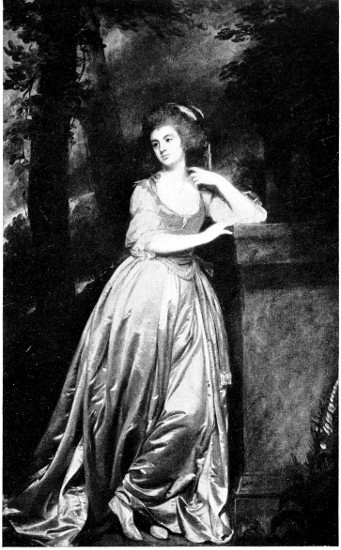
The portrait represented here of Anne, Lady de la Pole, oils on canvas (49 × 39½ inches), was painted in 1786 after the great Lady Hamilton period. The dress is of white satin with puffed sleeves of white mull and a sash of pale green with gold fringe. The slippers, of pale green, match the sash. The hair is powdered and draped with a white veil.
A critic notes that “the sheen of the white satin dress has since it was painted one hundred and forty years ago become slightly tinged with mauve thus completely harmonizing with the light color of the sash and shoes. The manipulation of the light on the right side of the picture gives a mellow autumnal atmosphere to the portrait of a dignified and beautiful woman.”
Collection of the Hon. Alvan T. Fuller
ANNE, LADY DE LA POLE
—George Romney
Anne, Lady de la Pole, was the only daughter of John Templer, Esq., of Stover House, Devon, and was married in January, 1781, to Sir John William Pole, sixth Baronet and son of Sir John Pole of Shute, Devon, whom he succeeded in 1766. Sir John assumed by “sign-manual” the name of de la Pole.
At the same time that he made this beautiful portrait, Romney also painted Sir John de la Pole, as a companion piece. Lady de la Pole died in 1832.
THE HON. MRS. GRANT OF KILGRASTON.
Sir Henry Raeburn Collection of
(1756–1823). Mr. C. Fisher.
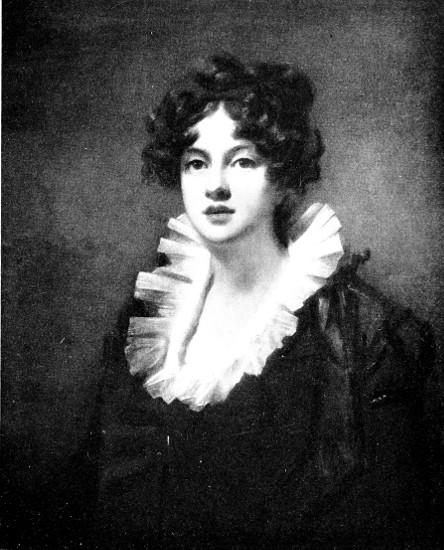
This picture comes from the Collection of Colonel Walter Brown of Renfrew and was formerly in the Collection of the Hon. Mr. Stuart Gray.
It is an oil on canvas (30 × 24 inches), depicting Mrs. Grant of Kilgraston, daughter of Francis, Lord Grey. The lady is turned three quarters to the left and wears a dark gown with deep loose frill of white around the neck. Her hair falls in careless curls over her brow. The background is plain.
Compared with Sir Joshua Reynolds’s some two thousand portraits, Raeburn’s some seven or eight hundred is small; but it is, after all, a goodly number.
“Raeburn,” in the words of his fellow-townsman, Robert Louis Stevenson, “was a born painter of portraits. He looked people shrewdly between the eyes, surprised their manners in their face and had possessed himself of what was essential in their character before they had been many minutes in his studio. What he was so swift to perceive he conveyed to the canvas almost in the moment of conception.”
Raeburn, born in Stockbridge, a suburb of Edinburgh, in 1756, became the leading Scottish portrait-painter, President of the Royal Society of Artists at Edinburgh, and a Royal Academician in 1815, presenting in 1821 his diploma picture The Boy with Rabbit. Raeburn was knighted by George IV in 1822.
Raeburn was almost entirely self-taught; and it seems strange that with practically no training, as the world understands this word, that he should have risen to the circle of great painters. Many of the greatest Italian painters of the Renaissance began life as goldsmiths. So did Raeburn. After a preliminary education at the famous Heriot’s Hospital in Edinburgh, he was apprenticed to a goldsmith in that city. Next he took up miniature-painting and passed on to oils, devoting himself to portraits. Success came quickly and early. At the age of twenty-two Raeburn was thoroughly established as the leading portrait-painter in Scotland and had married a wealthy widow of title. A visit to London and Rome in 1785–7 was the only break in his enviable life, passed in the greatest serenity replete with domestic happiness, social distinction, and artistic fertility. Practically an entire generation of the men and women of Scotland, most of them celebrities—sat to Raeburn in his studio.
As Raeburn’s portraits are neither signed nor dated and no very marked periods emphasize his style, it is difficult to assign accurate dates to any of his works unless some special year is attached to them. Moreover, no lists of the sitters and note-books are known. If he kept them they were destroyed. However, as Raeburn advanced in years he attained more and more command of technique, his appreciation of character became deeper, and his expression of it more complete.
Raeburn was appreciated by his contemporaries. When he showed some of his portraits to Sir Joshua Reynolds in London in 1785, Sir Joshua took him at once into favor and friendship; Sir Thomas Lawrence pronounced the portrait of The Macnab (the Highland Chieftain) the best representation of a human being he had ever seen; and Sir David Wilkie compared Raeburn to Velasquez. Writing to a brother artist from Madrid in 1828 Sir David remarks:
“There is much resemblance between Velasquez and the works of some of the chiefs of the English School; but of all Raeburn resembles him most, of whose square touch in heads, hands, and accessories, I see the very counterpart of the Spaniard.” Wilkie also wrote to Alexander Nasmyth from Spain: “There are some heads by Velasquez in Madrid, which, were they in Edinburgh, would be thought to be by Raeburn; and I have seen a portrait of Lord Glenlee, I think, by Raeburn, which would in Madrid be thought a near approach to Velasquez.”
Collection of Mr. C. Fisher
THE HON. MRS. GRANT OF KILGRASTON
—Sir Henry Raeburn
Dr. John Brown, one of Raeburn’s best friends, described his methods as follows: “Like Sir Joshua, Raeburn placed his sitters on a high platform, shortening the features and giving a pigeon-hole view of the nostrils. The notion is that people should be painted as if they were hanging like pictures on the wall, a Newgate notion, but it was Sir Joshua’s. Raeburn and I have had good-humored disputes about this. I appealed to Titian, Van Dyck, etc., for my authorities; they always painted people as if they were sitting opposite to them, not on a mountebank stage, or dangling on the wall. This great question we leave to be decided by those who know best. His manner of taking his likenesses explains the simplicity and power of his heads. Placing his sitter on the pedestal, he looked at him from the other end of a long room, gazing at him intently with his great dark eyes. Having got the idea of the man, what of him carried farthest and ‘told,’ he walked hastily up to the canvas, never looking at his sitter, and put down what he had fixed in his inner eye; he then withdrew again, took another gaze and recorded his results, and so on, making no measurements.”
It is pleasant to catch a glimpse of a painter from another painter. Farington writes in his Diary, Sept 21, 1801:
“I next went to Mr. Raeburn, the portrait-painter most esteemed here who lives in York Place, New-Town. The house is excellent and built by himself. His show room is lighted from the top. His painting-room commands a view of the Forth and the distant mountains. Here I found pictures of a much superior kind to those I saw at Mr. Nasmyth’s. Some of Mr. Raeburn’s portraits have an uncommonly true appearance of nature and are painted with much firmness, but there is great inequality in his works. That which strikes the eye is a kind of Camera Oscura effect and from those pictures which seem to be his best, I should conclude he has looked very much at nature, reflected in a camera. Raeburn and Nasmyth do not associate much with other artists and hold themselves very high. Raeburn scarcely indeed with any of the profession. The prices of Raeburn are 100 guineas for a whole length, 50 guineas half length, 30 guineas for a kit-cat and 25 guineas for a three-quarter portrait.”
QUINTON McADAM.
Sir Henry Raeburn Collection of
(1756–1823). Mr. A. W. Erickson.
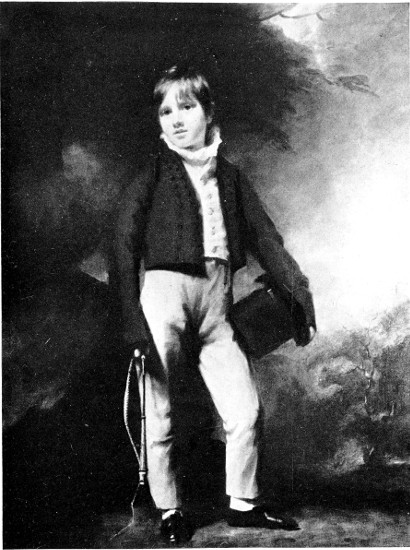
Raeburn was particularly happy in painting portraits of children, full of naturalness and charm and character; and it will be remembered that he chose for his contribution to the Royal Academy the lovely Boy with a Rabbit.
Collection of Mr. A. W. Erickson
QUINTON McADAM
—Sir Henry Raeburn
On a par with this masterpiece stands the portrait represented here of Quinton McAdam, a little boy twelve years old, the only son of Quinton McAdam of Craigengillan, Ayrshire, to whom Burns wrote an “Epistle” addressed to Mr. McAdam of Craigengillan. Quinton McAdam was born in Angus in 1805 and died in 1826 and this picture hung for over a hundred years at Camlarg, the dower-house of Craigengillan until it was purchased by the Agnews of London in 1926. The family still possess Raeburn’s receipt for payment for the picture.
The portrait is painted on canvas (61 × 47 inches), life-size, and represents the boy in light yellowish-brown trousers, dark jacket, and white, ruffled shirt. The light shines beautifully on his satiny, blonde hair. His eyes are violet blue.
MARY HORNECK.
(The Jessamy Bride.)
John Hoppner Collection of
(1758–1810). Mr. and Mrs. Charles P. Taft.
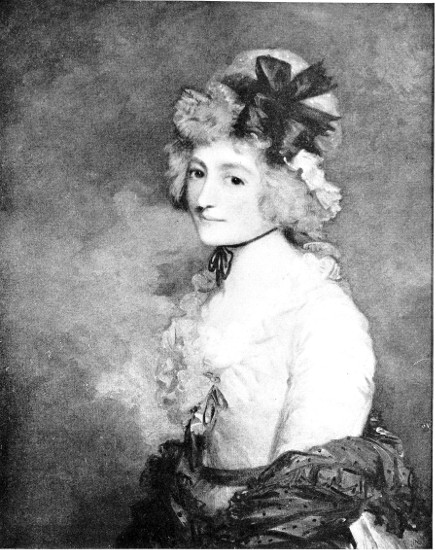
This canvas (29 × 24½ inches), a portrait of Mrs. Gwyn, better known as Mary Horneck, Oliver Goldsmith’s “Jessamy Bride,” remained in the possession of the Gwyn family until it was sold at Christie’s in 1889. Subsequently it passed into the Collection of Mr. Henry G. Marquand and thence into the home of Mr. and Mrs. Charles P. Taft in Cincinnati.
Collection of Mr. and Mrs. Charles P. Taft
MARY HORNECK “THE JESSAMY BRIDE”
—John Hoppner
The “Jessamy Bride” appears in a low-cut, white dress with blue sash and a white cap with a peacock-blue bow and tied under her chin with a narrow, black ribbon, or cord. A black spotted scarf is thrown around her waist and draped over her arms. The complexion is rosy, the eyes are brown, and the hair is powdered à la mode.
Mary Horneck was the daughter of Captain Kane William Horneck of the Royal Engineers and Hannah Mangles, known in her day as “the Plymouth Beauty.” Both were painted by Sir Joshua Reynolds. Captain Horneck died in 1755, leaving his widow in comfortable circumstances and she immediately removed with her three children, Charles, Mary, and Catherine, to London. About 1769 the Hornecks became acquainted with Oliver Goldsmith, who had three years before that date written The Deserted Village, which he dedicated to Sir Joshua Reynolds, then President of the Royal Academy. Goldsmith soon found appropriate names for the Horneck children. Mary was the “Jessamy Bride”; Catherine was “Little Comedy” and Charles was the “Captain in Lace.” They are all three mentioned in Goldsmith’s acceptance to a dinner given by Dr. Baker to the Hornecks and to which the Horneck girls sent an invitation to Goldsmith in rhyme. Goldsmith’s reply was as follows:
“Your mandate I got, You may all go to pot, Had your senses been right You’d have sent before night; As I hope to be saved, I put off being shaved; For I could not make bold While the matter was cold, To meddle in suds, Or to put on my duds; So tell Horneck and Nesbitt And Baker and his bit, And Kauffman beside And the Jessamy Bride, And the rest of the crew, The Reynoldses too, Little Comedy’s face, And the Captain in Lace— (By the bye, you may tell him I have something to sell him)— Tell each other to rue Yon Devonshire crew For sending so late To one of my state. But ’tis Reynold’s way From Wisdom to stray And Angelica’s[36] whim To be frolick like him; But alas! your good worships, how could they be wiser When both have been spoiled in to-day’s Advertiser?”
It was after Goldsmith’s death that Mary Horneck married Col. Gwyn of the 16th Dragoons, who eventually became an equerry to the King. On his appearance at Court, Fanny Burney noted that “Colonel Gwyn is reckoned a remarkably handsome man and he is husband of the beautiful eldest daughter of Mrs. Horneck.” Of Mary Horneck, now Mrs. Gwyn, Fanny Burney wrote in 1788, she was “as beautiful as the first day I saw her; all gentleness and softness;” and a year later, as “soft and pleasing and still as beautiful as an angel.”
Mrs. Gwyn became a Woman of the Bedchamber to Queen Charlotte and died in London in 1840, at the age of eighty-seven.
Catherine Horneck (“Little Comedy”) married in 1771 the artist, Henry William Bunbury. Their son, Charles John Bunbury was painted at the age of eight or nine, by Sir Joshua Reynolds.
John Hoppner born in Whitechapel, London, of German parents, in 1758, was a follower of Sir Joshua Reynolds. He exhibited at the Royal Academy and became a Court-Painter and a rival of Lawrence. Hoppner married in 1782 the daughter of Mrs. Wright, the American sculptress and maker of wax-works, who often sat to him as a model. Hoppner exhibited his first picture at the Royal Academy in 1780; and, through the patronage of the Prince of Wales, became a fashionable portrait-painter. After the death of Gainsborough and Reynolds, Hoppner and Lawrence commanded the field of art. Hoppner’s charming canvases, which are very characteristic of the period, are gaining in vogue day by day and bring very large prices.
ELIZA FARREN, COUNTESS OF DERBY.
Sir Thomas Lawrence Collection of
(1769–1830). Mr. J. P. Morgan.
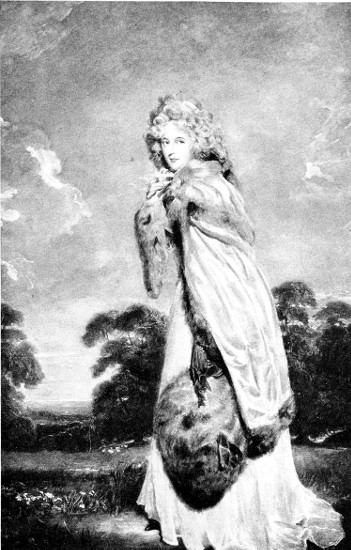
Lawrence was only a young man of twenty-one when he sent to the Royal Academy Exhibition of 1790 this portrait of Miss Farren, which was catalogued as The Portrait of an Actress.
The picture, oils on canvas (80 × 57 inches), shows the graceful young woman walking in a beautiful English park with a blue sky overhead, and who has paused for a moment. She wears an ivory-white, satin cloak trimmed with brown fur over a soft white muslin gown. Her gloved left hand is holding a large muff on which is a blue bow.
The picture was very much criticized. On hearing many adverse opinions, Miss Farren wrote to Lawrence:
“One says it is so thin in the figure that you might blow it away; another that it looks broke off in the middle; in short, you must make it a little fatter at all events diminish the bend you are so attached to, even if it makes the picture look ill, for the owner of it is quite distressed about it at present. I am shocked to tease you and dare say you wish me and the portrait in the fire; but as it was impossible to appease the cries of friends, I must beg you to excuse me.” The owner Miss Farren refers to was most probably Lord Derby.
At the death of Eliza, Countess of Derby, the portrait became the property of her daughter, Mary Margaret, wife of Thomas, second Earl of Wilton. From her descendant, Lord Wilton, the picture passed into the Collection of Mr. Ludwig Neumann of Manchester, and thence into possession of Mr. J. Pierpont Morgan, from whom it was inherited by his son.
Collection of Mr. J. P. Morgan
ELIZA FARREN, COUNTESS OF DERBY
—Sir Thomas Lawrence
This picture is very well known by the famous engraving by Bartolozzi, published in 1792, and re-issued in colors in 1797. On the death of Lady Derby in March, 1797, the Earl of Derby married, two months later, the subject of this portrait, to whom he had long been attentive. In the Farington Diary, under date of October 15, 1797, we read:
“Miss Farren (the actress afterwards Lady Derby) was bridesmaid to Lady Charlotte Stanley (Lord Derby’s daughter). Lord Derby’s attachment to Miss Farren is extraordinary. He sees her daily and always attends the play when she performs. When she came to Knowsley her mother was with her, so careful she is of appearances.”
And again on May 20, 1797: “Lady Gage told Hoppner that when Lady Derby (Miss Farren the actress recently married to Lord Derby) was presented, the Queen advanced to her, which is a great compliment.”
Eliza Farren, born in 1759, was the daughter of George Farren, a surgeon and an apothecary of Cork, who went on the stage and attained a little success. His wife and daughters also followed him and, consequently, Eliza was brought up in the theatre. She played juvenile parts in Bath, acting with her family, and often sang between the acts. At the age of fifteen she appeared in Liverpool as Rosetta in Love in a Village and soon afterwards as Lady Townly in The Provoked Husband. In 1777 she made her London début at the Haymarket as Miss Hardcastle in She Stoops to Conquer with great success and for many years she was the favorite actress of the Haymarket and of Drury Lane. When the charming Mrs. Abington left Drury Lane in 1782, Miss Farren was accepted as her successor. Miss Farren’s specialty was the fine and fashionable lady and her big part was Lady Townly. She was greatly admired in the rôles of Lady Fanciful in The Provoked Wife; Berinthia in the Trip to Scarborough; Belinda in All in the Wrong; Angelica in Love for Love; Elvira in The Spanish Friar and also in the Shakesperian parts of Juliet and Olivia in Twelfth Night.
Thomas Lawrence was born in Bristol in 1769 and spent his early years in Devizes, where his father was proprietor of the Black Bear Inn. Very early the boy showed remarkable talent for drawing portraits in crayons. He was so successful that he went to Bath, took a studio, and began his remarkable career which reached its climax when he became the foremost portrait-painter in England.
“In 1787 the wish of Lawrence’s heart was realized, and we find the young painter, then eighteen, established in rooms in what was then known as Leicester Fields—the present Leicester Square. He was accompanied to London by his father and on the thirteenth of September of that year he was admitted as a student of the Royal Academy. Armed with a letter of introduction from Prince Hoare, one of Lawrence’s Bath patrons, a member of the Dilettanti Society and Secretary for Foreign Correspondence to the Royal Academy, Lawrence obtained an interview with Sir Joshua Reynolds, and as a specimen of his ability and artistic skill he took to the President an oil-portrait of himself, painted in 1786. He was kindly received by the courtly old Sir Joshua, who praised his work and spoke most encouragingly to the young artist. “You have been looking at the Old Masters, I see,” he said, “but my advice is this: Study Nature! Study Nature!”
Three years later the young artist, who was extremely handsome and “romantic” in appearance, exhibited his picture of Miss Farren at the Royal Academy, which attracted much attention.
In 1791 Lawrence made a drawing of a much more beautiful subject, Emma, Lady Hamilton, from which a print was engraved.
“Hoppner who was ten years older than Lawrence,” writes Lord Ronald Sutherland Gower, “had been for some time the favorite painter of George, Prince of Wales, with the result that half the smart ladies of the town sat to him. But the King, who allowed the Queen’s and Princess Amelia’s portraits to be painted by Lawrence, became so much interested in him, that, on the death of Sir Joshua Reynolds in February, 1792, he decided that the young painter, then not twenty-three years of age and not yet a full member of the Academy, should be appointed to the post of Painter-in-Ordinary, an office that had been filled by the late President. ‘Never perhaps, in the country,’ writes Redgrave, in his account of Lawrence, ‘had a man so young, so uneducated, so untried in his art, advanced as it were per saltum to the honors and emoluments of the profession.’ The King’s favorite painter was the American, Benjamin West, Sir Joshua’s successor in the Presidential Chair, and Windsor was filled with his historical pictures, which, although once valuable, would not now fetch even a modest sum if they were sold at Christie’s.”
About 1790 Lawrence removed to Old Bond Street, installing himself in a handsome apartment with his friend, Farington, as his secretary.
Lawrence tried to paint imaginary and historical pictures, but it soon was evident that portraiture was his forte. The death of Opie in 1807 and of Hoppner in 1810, left him without a rival. On the death of Benjamin West in 1820, Lawrence was unanimously elected President of the Royal Academy. Fuseli, a little dissatisfied, exclaimed: “Well! well! since they must have a face-painter to reign over them, let them take Lawrence; he can at least paint eyes!” The period between 1820 and 1830 (when Lawrence died) is practically a “Lawrence Age.” Sir Thomas painted everybody of note from George IV and the Duke of Wellington to fashionable ladies of no particular distinction save their wealth. His full-length portrait of George IV in his Coronation robes was so frequently copied and given by the King to his friends that nearly every Royal Collection in Europe can show a replica.
The spirit of the age was certainly expressed in Lawrence’s portraits. We have only to look at such portraits as the Countess of Blessington (Wallace Gallery), Lady Peel (Frick Collection), Lady Dover and her Son, and La Duchesse de Berri to realize how true this is. These ladies look as if they had stepped from the pages of Akermann’s Repository.
It is always interesting to learn what an artist has to say about his own work. To Mrs. Jameson, Lawrence wrote the following:
“My thoughts have almost invariably been devoted to Sir Joshua, and, generally, to the Italian School—Raphael, Correggio, Titian, even Parmigiano. An admirer of the very finest works of Van Dyck, and acknowledging the consistent ability of his pencil, I have been less his votary than, perhaps, hundreds since his time, of distinguished taste and talent (Gainsborough, for instance), to whose judgment in other cases I should justly bend. Rubens has been infinitely more the object of my admiration; but, as you know, presents very little as example for portrait-painting.
“Sir Joshua continues to be more and more my delight and my surprise. Rembrandt has another and still higher place in my affection. In my men, then, I have thought of both, and of Titian and of Raphael, as the subjects approached their style. In women, of Sir Joshua, Raphael, Parmigiano, and Correggio. In children, of Sir Joshua and the two latter. In my portraits of Kemble and of Mrs. Siddons, of the highest Italian School.”
In 1825 the King of France gave Lawrence the Cross of the Legion d’honneur. Lawrence died in 1830, unmarried, a fashionable “man about town,” courted, admired, and not unlike Lord Byron, in some respects. Lord Gower says:
“That his fame underwent a marked decline during the half-century after his death in this country cannot be doubted; but within the last few years a reaction has set in, which is tending to place him again in the forefront of our greatest portrait-painters.
“Both as a man and as an artist Lawrence was impressionable, and in his work was entirely influenced by the spirit of his period, a period of affectation that frequently bordered upon vulgarity. If Lawrence’s art in portraiture had been genius instead of talent of the highest order, he would have created a public taste instead of slavishly following that set by the Court or Society of his day. As it was, his work was the ultimate expression of the curtain and column school of portraiture, and his success set a fashion that was followed for years afterwards by innumerable portrait-painters. These, in imitating the style, missed the spirit and perception by which Lawrence, trammelled as he was by the absurdities of dress and conventionality of attitude and surroundings, was enabled to place upon his canvases some suggestion of the actual identity of his sitters. And it was not until the advent of George Frederick Watts and the late Sir John Everett Millais that the effects of the imitation of the obvious points of Lawrence’s style finally disappeared from English portraiture.
“Lawrence’s chief defect was that he turned his art too much into a trade; he would have attained a far higher position had he contented himself with painting half the people he did, and his name would have stood on a higher pinnacle in the Temple of Fame. During the last twenty years of his life he painted but little more, as a rule, than the face of his sitter, the rest of the picture being completed by his pupils; or rather his assistants. This practice has, of course, lessened the value of his portraits.
“These are grave failings; but on the other side, his great merits are incontestable and weigh the scale in his favor. Where, except among the very greatest of those whose fame chiefly rests on their excellence in the art of portrait-painting—such giants as Titian, Rubens, Rembrandt, Velasquez, and Van Dyck, Reynolds, and Gainsborough—can finer work be shown them than in such astonishing likenesses as those of Lawrence when at his best; and the master must be judged by his master-works. His style, when once he had adopted it, had the great merit of being a style of its own, of much refinement and excellence in drawing; although his work was, perhaps, too smooth in technique and somewhat affected in feeling. His paintings have lasted, whereas those of many of his contemporaries are mere wrecks and shadows of their former selves; for he attempted no experiments in glazings and pigments, as was Sir Joshua’s wont, and his pictures are, as a rule, as fresh as when they were painted.
“I believe it only fair to place him immediately beneath our three greatest portrait-painters,—that immortal trio, Reynolds, Gainsborough, and Romney: at a time when Hoppner, Opie, and Raeburn were all working, this is high praise.”
PINKIE.
Sir Thomas Lawrence Collection of the late
(1769–1830). Mr. Henry E. Huntington.
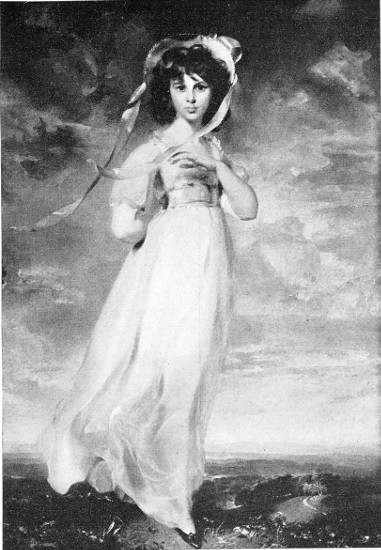
This radiant portrait is generally considered to be Lawrence’s masterpiece. How fresh, how sweet, how breezy it is! “Pinkie” stands on a high hill with a beautiful low-lying landscape of wooded hills spreading out and undulating towards the distant horizon. The sky is dappled with swiftly moving clouds and the morning breeze is blowing pretty freshly, for Pinkie’s light gown is rippling with it and the strings of her bonnet are fluttering and flapping rather violently. These ribbons are pink, matching the sash which holds the diaphanous, white gown in place. Pinkie’s eyes are brown, large, and lustrous and her brown hair is touzled by the wind; but she looks at us so sweetly and brightly that we love her at first sight. How daintily her little slippered foot is planted on the flower-sprinkled turf! Her airy, youthful, billowy figure suggests the idea of Spring beneath whose every footstep flowers instantly appear in full bloom.
Collection of the late Mr. Henry E. Huntington
PINKIE
—Sir Thomas Lawrence
How far she has come! Do we not see her home in the distance on the right, encircled by a crescent of leafy trees and with a wide driveway through the clearing?
“Pinkie’s” name was Sarah Moulton-Barrett, and she was the only daughter of Charles Moulton, Esq., and his wife Elizabeth Barrett Moulton. Pinkie was born March 22, 1783, and the lovely child died at the age of twelve, the year in which this portrait was painted. It is interesting to note that Pinkie was the aunt of the famous poet, Mrs. Elizabeth Barrett Browning, who was the daughter of Pinkie’s brother, Edward Moulton-Barrett of Coxhoe Hall, Durham, and Hope End, Hereford.
The portrait, oils on canvas (57½ × 39¾ inches), was painted in 1795 and was formerly in the Collection of Octavius Moulton-Barrett, Esq., Westover, Calbourne, Isle of Wight, and thence it passed to the Right Hon. Lord Michelham, K. C. V. O., London. A modern critic rapturously expresses what every one feels on looking at this enchanting picture:
“If ever canvas was instinct with life, this picture lives and breathes. If ever the vehicle of oil paint spread on canvas has caught the wind as it blows, the light that dances in a mischievous child’s eyes, the breath of life and joy in living, Lawrence, in this picture, achieved the miracle. You feel, as you look at it, that you could read small print by its light in the dead of night. The color of it is the color of sea-downs on a May morning; the joy of it is of the joy of the first warm day of Spring. And in the little girl’s graceful figure are comprised whatever things are lovely, whatever things are pure, to the minds of men.”