ITALIAN
Reading edition
Sienese
Florentine
Umbrian
North Italian
Venetian
SIENESE
There are no beginnings of art in Italy. The old civilizations of Etruria, Rome, and Byzantium never perished entirely; and upon their surviving traditions “Christian Art” was built. Old pictorial ideas and old decorative motives were absorbed, rearranged, and worked over again and again in conjunction with theological dogma until in the Thirteenth Century, largely owing to the beautiful character, ideals, and influence of St. Francis, to the intellectual teachings of Dante, and to the fervor aroused by the Crusades, “Christian Art” became a living movement, which inspired, among other important things, the creation of magnificent Cathedrals. When the architects, the carvers of wood and stone, and the makers of the jewel-like windows had finished their work, the best painters of the day were called on to produce altar-pieces that would stimulate religious devotion, charm the worshippers by beauty, and instruct the people (unaccustomed to books) by representation of saintly lives and scriptural stories.
Italian Painting in the Thirteenth and Fourteenth Centuries thus shows many of the old Byzantine traditions still lingering in the new “Christian,” or “Gothic Art.”
Siena and Florence were the chief early Italian Schools. Siena was at first the more important of the two and greatly influenced Florentine and also French Painting. The leading early artists of Siena were Guido da Siena, Duccio di Buoninsegna, Ugolino da Siena, Segna di Bonaventura, Simone Martini, Lippo Memmi, Pietro Lorenzetti, Ambrogio Lorenzetti, Lippo Vanni, Andrea Vanni, Bartolo di Fredi, Taddeo di Bartolo, and Stefano di Giovanni (Sassetta).
The next group includes Domenico di Bartolo, Lorenzo Vecchietta, Neroccio di Landi, Benvenuto di Giovanni, Girolamo di Benvenuto, and Matteo di Giovanni.
“To understand and appreciate the painting of Siena one should think of it as the culmination of the art of the Middle Ages rather than as a promise of anything modern. Therein lies the difference which caused so great a gulf between the art of Siena and that of contemporary Florence only forty miles away. Sienese Art may be regarded as the most perfect expression of the Byzantine ideal. It was hieratic and mystic. While Giotto was forecasting the development of modern art by studying nature and making his figures act like the real people whom he saw about him, Duccio and Simone Martini were sounding the Byzantine creed that the Christian saints were not human but divine, not vulgar but regal, not approachable but aloof. To the early Sienese, as to the Byzantine, the Raphaelesque conception of the Madonna as the most tender possible human mother would have been blasphemous bad taste.
“Although Sienese Art was founded on Byzantine and was in a sense the culmination of Byzantine, it was, nevertheless, a Gothic art. In other words it belonged to its period, but it selected certain elements of Gothic style for emphasis.
“In Florence Giotto was inspired by the plasticity of Gothic Art and its naturalism. In Siena Duccio and his followers developed the Gothic living line; and, later, the emotionalism of Gothic spirit. Thus both Florentines and Sienese were Gothic, but in a different way.
“Technically as well as spiritually, the Sienese approached the artistic abstractions of China and Japan. The analogies between Sienese and Oriental Art have been observed by practically every writer on the Sienese School. They have been tacitly attributed however, to accidental similarities in ideals and modes in Siena and the East. As yet no one has been bold enough to suggest an influence derived from actual contact with Eastern Art, but such contact is not beyond the bounds of possibility. In the Thirteenth and Fourteenth Centuries overland communication with the Near East and with China was common and secure. Merchants like the Polos, prelates like John of Monte Corsino, Andrew of Perugia and Friar Odoric of Friuli readily found the way to Cathay, as China was then called. Peking was made a Roman Catholic diocese and Pegolotti of the Bardi banking-house in Florence was moved to write a traveller’s itinerary, remarkably like a modern Baedeker, giving the most minute instructions as to inns, food, servants, and so forth, on the route from Constantinople to Peking. Moslems like Ibn Batuta travelled as widely as Christians, and Oriental travellers visited the Occident. Thus Bar Sauma, a Nestorian of Peking, visited the Pope in 1287 and passed through Tuscany on his way to Paris and Bordeaux two years after Duccio painted the Rucellai Madonna. Not only the Near East and China, but India, was opened to the European and we hear of the martyrdom of one Brother Peter of Siena at a place near Bombay. It was not until the end of the Fourteenth and the beginning of the Fifteenth Century that the conversion of the western Tartars to Islam, the advance of the Seljuk Turks, and the overthrow of the broad-minded hospitable Mongol dynasty in China closed the overland trade-routes. During the next hundred and fifty years while the sea-routes were being discovered Europe seems largely to have forgotten the existence of the Orient. Wild as the theory may sound, therefore, it is possible that actual contact with Oriental Art may account not only for the occasional Mongolian types and bits of Oriental armor to be observed in Sienese Art, but even for something of the spirit of the style.”—Mediæval and Renaissance Paintings (Fogg Art Museum, Cambridge, 1927).
ST. FRANCIS AND THE BEGGAR.
Sassetta Collection of
(1392–1450). Mr. Clarence H. Mackay.
On September 5, 1437, the Minorites of Siena ordered an altar-piece for the Church of San Francesco at Borgo San Sepolcro from Stefano di Giovanni, better known as Sassetta. The artist promised “to paint it with fine gold, ultramarine, and other good colors, to employ all the subtleties of his art, and to make it as beautiful as he could.” Also he promised to complete it in four years. Sassetta, however, made a wrong calculation; for the work occupied him seven, instead of four, years. It was finished on June 5, 1444, and placed above the high altar at Borgo San Sepolcro, where it remained until 1752, when the panels were dispersed. From contemporary documents nine panels were proved in recent years to have been among the decorations of this famous altar-piece; and these panels were shown at the Retrospective Exhibition of Sienese Art held in Siena in 1904.
Seven of these nine panels are now in the Collection of Mr. Clarence H. Mackay: St. Francis and the Poor Knight; St. Francis Renounces his Heritage; St. Francis and the Wolf of Gubbio; St. Francis before the Soldan; St. Francis before Pope Honorius III; St. Francis Receiving the Stigmata; and The Burial of St. Francis.
Another panel, The Marriage of St. Francis to Poverty, is in the Chantilly Museum and the central panel of the altar-piece, representing The Glory of St. Francis, is in the Collection of Mr. Bernard Berenson.
The panel representing St. Francis and the Wolf of Gubbio was long in possession of the Comte de Martel at the Château de Beaumont, near Blois, and the other six panels came from the Collection of the late M. Georges Chalandon, Paris.
It was obvious that for a church dedicated to St. Francis the story of his life should be told in paintings.
It is a little hard to realize that the frescoes by Giotto and his companions depicting the Life of St. Francis had been admired and worshipped for a hundred odd years before Sassetta was called upon by the Sienese Minorites to tell the story again. Sassetta produced an entirely new version with regard to composition, color, and spiritual interpretation.
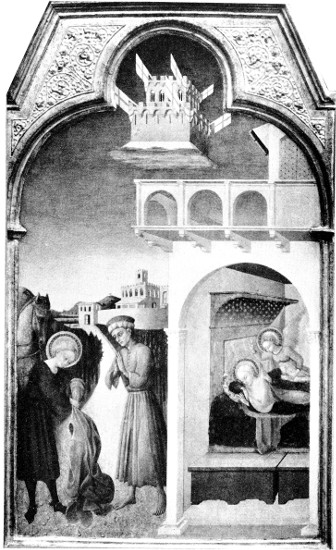
Collection of Mr. Clarence H. Mackay
ST. FRANCIS AND THE BEGGAR
—Sassetta
There is much to attract an artist in the story of St. Francis, for although his life is not one of much variety, it is full of striking episodes, which afford splendid pictorial opportunities. St. Francis, founder of the great Order of Friars Minor, or Franciscans, and called “the Poor Man of Assisi,” was born in Assisi in 1182, and died there in 1226. He was the son of a rich merchant, who, furious because his son lavished money on the starving poor of the vicinity, demanded that he should renounce his inheritance. This he did with a joyful spirit in public and before the Bishop of Assisi, thereafter devoting himself to the service of the poor. Disciples flocked to his little chapel, called the Portiuncula; and when the New Order celebrated its General Chapter in 1219, five thousand friars assembled there. The Order was approved by Pope Innocent III and by his successor, Pope Honorius III. Poverty was the leading characteristic of the Franciscans, or Begging Friars; individually and collectively they refused to own anything whatsoever.
St. Francis journeyed about doing good. His wanderings took him as far as Egypt and Palestine; and it was in the year 1224, on the desolate Mount Alvernia, that he received the Stigmata, or Impression on the flesh of Our Lord’s Five Sacred Wounds, in memory of which the Church instituted a special festival. St. Francis was canonized in 1228, two years after his death.
St. Francis and the Beggar, shown here, tells two episodes of the story. On the left and in the immediate foreground the young St. Francis, having dismounted from his horse, whose head (very finely drawn) appears above his shoulder, is in the act of giving his cloak to a poor beggar; and the latter, very dramatically expresses his delight, surprise, and gratitude. Beyond these figures a winding road, bordered with cypress trees, leads to a handsome villa, presumably the home of St. Francis, beyond which little hills appear on the horizon. The sky, very expansive, is silvery above these hills and grows gradually bluer and bluer until it reaches the top of the picture, or dome of the sky, where a strange castle is seen with banners of the Holy Cross floating from its battlements and turrets. This castle really belongs to the second episode represented on the right, which shows St. Francis sleeping in a little room. This heavenly castle is the vision he has in his dreams. It would appear that the Angel, standing over St. Francis and pointing to the mystical castle in the clouds, is inspiring this mystical dream. It is interesting to note here that Giotto made at Assisi two pictures of St. Francis and the Beggar and The Dream of St. Francis. Sassetta combined the two episodes into one picture.
“Even without documents,” says Berenson, “we should know that this Borgo San Sepulcro polyptych was painted by a contemporary of Masolino, Pisanello, Jacopo Bellini, and Antonio Vivarini. And that the master was a Sienese we should know not only from his pure, flat color and his devotion to line, but in other ways as well. At all events it is he, Stefano Sassetta, who has left us the most adequate rendering of the Franciscan soul that we possess in the entire range of painting.
“Sassetta was not only one of the few masters in Europe of imaginative design, but the most important painter at Siena during the second quarter of the Fifteenth Century, the channel through which Sienese Trecento traditions passed and became transformed into those of the Quattrocento, for nearly all the later painters of Siena were his offspring.”
Stefano di Giovanni was born at Siena in 1392. He was a pupil of Paolo di Giovanni Fei and was deeply influenced by the earlier Sienese painters, Duccio, Simone Martini, and the Lorenzetti brothers. In 1427 he was asked to furnish a design for the font in the Siena Baptistery and he painted the altar-piece of the Madonna Enthroned with Saints in the church, since known as the Osservanza, built for St. Bernardine on the site of his hermitage. Sassetta’s work for the Borgo San Sepulcro did much to popularize Sienese ideas in Umbria. Sassetta made many paintings in Siena and at Cortona, where he was influenced by Fra Angelico. In 1447 he was commissioned to complete the frescoes on the Porta Romana at Siena, begun by Taddeo di Bartolo; and he died in 1450 from exposure while working on this gate. Fifteen years later the frescoes were finished by Sano di Pietro, one of Sassetta’s many pupils and followers.
For a long time Sassetta was forgotten; but of late years there has been much interest in his works, which are of great pecuniary as well as artistic value.
MADONNA AND CHILD WITH SAINTS AND ANGELS.
Matteo di Giovanni Collection of
(1430?–1495). Mr. Clarence H. Mackay.
Among the most important pupils of the famous Sassetta was the painter and sculptor, Lorenzo Vecchietta, who in turn was the principal master of Matteo di Giovanni, the most celebrated Sienese painter of his time. Therefore we have direct artistic ancestry for Matteo di Giovanni through Vecchietta to Sassetta and to Duccio.
Matteo di Giovanni, also called Matteo da Siena, was the son of a tradesman who came from Siena to Borgo San Sepulcro, where Matteo was born about 1430. His first master is supposed to have been the Umbrian, Piero della Francesca (or Pier dei Franceschi). Removing to Siena, Matteo spent the rest of his days there. His life was uneventful, for he gave all his time to painting. His domestic life must have been somewhat exciting for he was twice married—the second time to a countess—and he had a large family. Matteo was particularly famous for his Madonnas, tender and wistful, with very decorative accessories.
The lovely Madonna and Child with Saints and Angels, represented here, shows this decorative quality of Matteo in its highest expression. The Sienese love for Oriental fabrics[1] appears in the rich attire of the Virgin. Here is no peasant woman in simple robe and mantle, but a lady of high degree, wearing a gown of handsome brocade with the significant pattern of the pomegranate. A white veil, soft and transparent, lightly covers her forehead and her mantle is gracefully drawn up over her head to form a hood. The Holy Child rests comfortably upon her left arm while her right hand, large and firm, gives Him additional support. A light drapery passes around the body of the Holy Child—the Sienese were Oriental enough in their discriminating taste to avoid uninteresting nudity and they also knew how to manage both heavy and light materials—who grasps the Virgin’s tunic with His right hand and has placed his left hand over that of His mother. The golden nimbus of the Virgin is inscribed “Ave (Maria) Gratia Plena.”
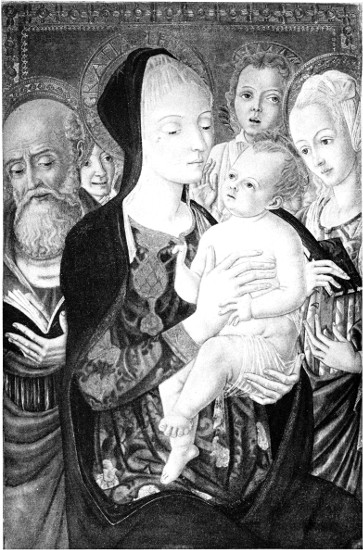
Collection of Mr. Clarence H. Mackay
MADONNA AND CHILD WITH SAINTS AND ANGELS
—Matteo di Giovanni
St. Catherine of Siena stands on the right, also wearing a handsome brocade gown and a white veil. She is holding a missal and a fragment of her wheel of torture. On the left we see St. Anthony, in monk’s habit, writing in a book. Behind this group two Angels are singing loudly and joyfully. The background and all the nimbi crowning the heads of the figures are of gold, made the richer by burnished ornamentation.
This picture, painted in tempera on a panel 29 × 20 inches, came from the Collection of Lord Ashburnham, Ashburnham Place, Battle, Surrey, England. Of it Berenson says: “It is not only his (Matteo di Giovanni) most typical and his most characteristic, but also his most impressive and beautiful work; it has every advantage of ivory flesh, golden tone, and gorgeous brocade; and with all these decorative qualities it possesses real humility.”
Among Matteo di Giovanni’s other important paintings are: the Madonna Enthroned (1470) in the Accademia; the Madonna della Neve (1477) and the Coronation of St. Barbara in St. Domenico, Siena; the Assumption of the Virgin in the National Gallery, London; and St. Jerome in his Cell, in the Fogg Art Museum, Cambridge, Massachusetts.
ADORATION OF THE MAGI.
Benvenuto di Giovanni Collection of
(1436–1518). Sir Joseph Duveen, Bart.
We have here a charming Sienese version of the ever-popular subject—the Adoration of the Magi. Everything about this picture is radiant, charming, and decorative. The groups in pyramidal form with masses at the base, made rich and beautiful by means of the wise lighting and graceful arrangement of draperies, balanced with lively animals on the right and left, rise higher and higher with more and more delicacy of treatment that suggests the technique of old ivory carving or the miniature painting of Mediæval manuscripts, until the peak is reached in the charming presentation of a lovely walled town with spires lifted heavenward.
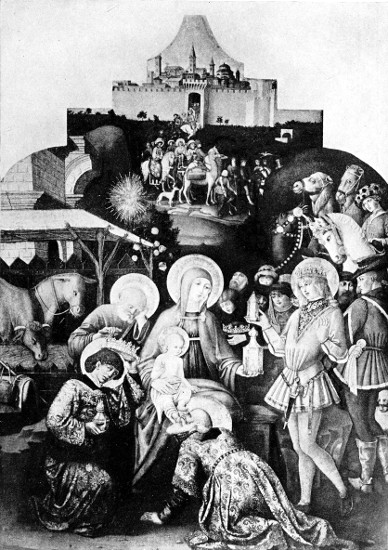
Collection of Sir Joseph Duveen, Bart.
ADORATION OF THE MAGI
—Benvenuto di Giovanni
The picture is full of movement, life, joy, and expression. The Holy Child is appreciative (which is an unusual feature) and the animals, too, are taking an enthusiastic part in the ceremony.
The tender and gentle Virgin, seated on a stone bench directly in front and wearing a red robe and a blue mantle, has the Holy Child comfortably placed on her knee. On her left hand she is holding one of the presents. The Holy Child, according to the Sienese fashion, is draped and the linen folded around Him is embroidered in gold. His expression is animated and very sweet and He is raising His little hand in blessing. The eldest of the Magi,[2] Melchior with white hair (what there is left of it) and white flowing beard, is kneeling before the Holy Child and kissing His right foot, wearing a rich golden mantle with a damask pattern in raised gold relief, held by a jewelled girdle. The second Magus, on the left, Balthasar, is clothed in a red brocade mantle embroidered in gold. He has a dark complexion and is removing his crown from his thick black hair and holds in his right hand a piece of gold plate. The third King, Caspar, on the right, is the most attractive figure in the picture,—a typical young prince and dandy of the period dressed in a pale tunic, cut with point in front showing a rich brocade undergarment, and plaited and slashed and bordered according to the latest Fifteenth Century fashions. The sleeves are slashed and ornamented with puffs and a rich girdle holds the dagger with hilt of gold. Lilac trunk-hose, red shoes, and a golden crown complete the costume. His face is delicate and charming and his wavy hair is blonde. He, too, is bringing a piece of gold plate. This radiant figure looks as if he might have stepped from the pages of the Romaunt of the Rose. St. Joseph, behind Balthasar, leans his head on his hand as if he were puzzled. Each one of these six important figures has a flat golden nimbus. Behind St. Joseph, on the left, the ox and the ass, by the intelligent gleam in their eyes, allow us to believe in the legend that animals are endowed with the power of speech on Christmas Eve. Over the roof of their open shed sparkles and scintillates the Star of the East and under the Star we note a bush laden with fruit,—a real Christmas tree! On the right, the group is that of the retinue of the three Kings—people on foot, wide-eyed and curious, and knights on horseback. A beautiful white horse arches his head majestically and surveys the scene; behind him are a very superior horse and a very superior camel, who gaze downward somewhat haughtily, while a third horse looks backward at these companions to see what they are thinking of it all!
As in many ancient paintings, the scene is enacted for us in two episodes. If we look ardently we see the three Magi on their approach to the shrine. We can identify Balthasar on the left; Caspar in the centre; and Melchior on the left of Caspar, followed by their retinue defiling through the gateway of the machicolated wall, behind which the town, with its towers and turrets, domes and roofs, stands out clearly and poetically from its golden horizon.
This painting, tempera on panel (70 × 53 inches), came from the Collection of Sir William Neville Abdy, Bart., Dorking, Surrey, and was exhibited in Paris at the Salle des Etats, Musée du Louvre, in 1885.
Benvenuto di Giovanni di Meo del Guata, also known as Benvenuto da Siena, was, like Matteo di Giovanni, a pupil of Vecchietta. He was born in Siena, September 13, 1436, the son of a mason. In 1453 he was painting in the Baptistery in Siena. He painted in Siena all his life and aided in designing the inlaid marble pavement in the Cathedral and he also decorated the cupola. Benvenuto di Giovanni cared little about the scientific experiments the contemporary Florentine painters were essaying, content to paint in the decorative and charming traditional Sienese manner, of flat and ornamental designs beautifully enriched with gold. It is very interesting to compare this painting with the pageants of Benozzo Gozzoli and Gentile da Fabriano. It holds its own, thereby, for its high decorative quality and peculiar charm.
FLORENTINE
It is not strange when Sienese Painting was at its height that its influence should have been felt in Florence, which is only about forty miles distant. The fame of Cimabue (1240?–1301), the founder of the Florentine School, indeed, rests chiefly on the Madonna in the Rucellai Chapel of S. Maria Novella, which modern criticism attributes to Duccio of Siena. Vasari was responsible for accrediting the Rucellai Madonna to Cimabue; and Vasari’s story that when finished “it was carried in solemn procession with the sound of trumpets and other festal demonstrations from Cimabue’s house to the church, Cimabue being highly rewarded and honored for it,” reads like an echo of the triumphal procession of Duccio’s great altar-piece—the Majestas—from the house of that painter to the Cathedral of Siena.
Cimabue, whose name was Cenni dei Pepe, transitional from Byzantine to Gothic, is particularly famed for being the discoverer and teacher of Giotto.
Giotto di Bordone (1276–1336), sculptor and architect as well as painter, is the dominating personality in Trecento Art, and the first Gothic painter of Florence. Giotto’s influence lasted for a hundred years or more (see page 25).
One of Giotto’s associates and followers was Bernardo Daddi, son of Daddo di Simone, a Florentine. The date of his birth is supposed to have been 1280. He died in 1348. About 1317 he was admitted to the Arte de Medici e Speziale, the Guild of Doctors and Apothecaries, from whom the painters obtained their pigments. According to the laws of the period no painter could pursue his art unless he took his degree in that confraternity. The early painters became independent of the Guild of Doctors and Apothecaries after the Guild of St. Luke[3] was formed—the special brotherhood of all painters, which spread to every country and to every town—and there is a tradition that Daddi was one of the founders of this Compagnia di San Luca, which would show that this Florentine Guild of St. Luke was organized as early as 1348.
Daddi painted the fresco over the San Giorgio Gate of Florence about 1330 and he also painted the frescoes of the Martyrdom of St. Stephen and St. Lawrence in Santa Croce. Daddi comes very close to Giotto (1276–1336), in dates and in style, although he shows great sympathy with the Sienese painters.
Giotto’s followers—the Giotteschi—worked from about 1330 to 1430 and include: Taddeo Gaddi, Andrea di Cione (better known as Orcagna), Giovanni da Milano, Agnolo Gaddi, Cennino Cennini, Andrea di Firenze, Antonio Veneziano, Spinello Aretino, and Lorenzo Monaco.
These painters prepared the way for greater changes by studying perspective and the human form and by gradually introducing Classic Architecture into their pictures in place of Gothic decoration.
In studying Fifteenth Century Art in Florence we are struck by the great number of goldsmiths and other workers in metal who became painters. There is a reason for this. The most important work in Florence for twenty-two years was the making of the four bronze doors for the Baptistery, the competition for which was won by Ghiberti in 1401. The undertaking was so vast that Ghiberti engaged, at one time or another, nearly all the most talented artists and artisans of Florence. Many painters and sculptors who acquired fame afterwards, such as Masaccio and Donatello for instance, received their early training under Ghiberti.
Of the last-mentioned painter Leonardo da Vinci wrote:
“After the days of Giotto, painting declined again, because everyone imitated the pictures that were already in existence; and this went on until Tommaso of Florence, nicknamed Masaccio, showed, by his perfect works, how artists who would take any teacher but Nature—the mistress of all masters—labor in vain.”
Tommaso Masaccio (1401–1429?) and Tommaso Masolino (1383–1447) worked together in the Brancacci Chapel. Masaccio was the son of a notary in the parish of Castel S. Giovanni in Val d’Arno, learned to draw and paint, joined the Guild of St. Luke in 1424, and became Masolino’s assistant for painting the frescoes in the new Chapel built by Felice Brancacci in the Carmine. When Masolino went to Hungary, Masaccio worked there alone.
Masaccio’s frescoes made an epoch in art, although the painter was little appreciated in his day. He left his work suddenly and went to Rome. Nothing more was ever heard of him. He is thought to have died in Rome in 1429. Almost immediately Masaccio’s work began to be valued and all the Florentines of the Fifteenth Century flocked to study these Brancacci frescoes. Masolino (1383–1447) was appointed in 1423 to paint frescoes in the new Brancacci Chapel in the Carmine and two years later went to Hungary. Returning home after several years, he painted frescoes in various cities (see page 28).
Gerardo, better known as “Starnina” (1354–1408), a pupil of Antonio Veneziano, spent nine years in Spain and on his return to Florence, achieved great fame by his frescoes in the Carmine. The name was taken from that of his father, Jacopo Starna. It is said that “Starnina” was the master of Masolino and Fra Angelico.
Fra Angelico (1387–1455), brings us to another transitional period,—this time from the Gothic to the Renaissance. Fra Angelico, or Fra Giovanni da Fiesole, the angelic and mystical painter and the most beloved of all the early artists, spent his life painting frescoes and altar-pieces for churches and cloisters. He was frequently called by the Pope to Rome, where he died (see page 32).
To this period belong Andrea del Castagno (1390?–1457), a vigorous and austere painter, and Paolo Uccello (1397–1475), named Paolo di Dono, but called Uccello because he kept in his house and painted so many birds. Uccello began life as a goldsmith and assistant to Ghiberti.
No survey of painting in Florence in the Fifteenth Century, however slight, would be complete without reference to the Medici. Art, like all other branches of learning, owed its splendid development to their intelligent sympathy and generous patronage. The Medici began this patronage early. Giovanni de Bicci (1360–1428), the founder of the family, was one of the judges who selected Ghiberti to make the Baptistery doors and Cosimo, “the Father of his Country” (1389–1464), was so liberal a patron of Fra Angelico, Fra Filippo Lippi, Benozzo Gozzoli, Paolo Uccello, Domenico Veneziano, and many others, that we may safely say the great flowering of Florentine Art is almost entirely due to his taste and encouragement.
The Florentine artists, too, were greatly stirred by the meeting of the Council of the Eastern and Western Churches, which was one of the most important gatherings ever held anywhere in the history of the world. This Council was invited by Cosimo to Florence and all the dignitaries and their suites were his personal guests, entertained by him in his various palaces and villas. Picturesque and bizarre these dignitaries were; and the painters had full opportunity to see them when they sat in the Duomo under Brunelleschi’s newly completed dome (then the Eighth Wonder of the World), or when they moved about the streets with their suites.
In his delightful book, The Medici, Col. G. F. Young has called particular attention to the importance of this great Council; how it led Cosimo to found the Platonic Academy; and how the Fall of Constantinople, fourteen years later, changed the world so utterly that no such meeting could ever take place again. In part he says:
“This great gathering of 1439 in Florence had its effect also on Art. We are often inclined to wonder where such painters as Fra Angelico, Benozzo Gozzoli, and Gentile da Fabriano got the idea of the gorgeous robes and strange-looking head-dresses which we see in their pictures of Eastern subjects. It was all taken direct from the life of Florence of this year. During that summer the inhabitants of Florence saw a perpetual succession of grand processions and imposing functions in which these visitors from the East appeared in every kind of magnificent and strange costume. Vespasiano da Bisticci and other writers of the time dilate upon their rich silken robes, heavy with gold, and their fantastic-looking head-dresses, regarded with deep interest by the learned on account of their ancient character. And the painters reproduce these before us in pictorial records, which are valuable to us on that very account, and because this was the last occasion on which these costumes were destined to appear.”
Piero il Gottoso (1416–1469), Cosimo’s son, “carried on” the traditions of the Medici, encouraging Art to such an extent that practically every great work produced in Florence in his time was made for, or inspired by, him. Piero il Gottoso and his cultured wife, Lucrezia Tornabuoni, recognizing Botticelli’s genius, took him into their home and made him one of the family. All of Botticelli’s early works, therefore, belong to the period he spent under the patronage of Piero de’ Medici. Yet, of course, Botticelli is recognized as the particular painter of Lorenzo the Magnificent (1449–1492), son of Piero, and a friend and boyhood companion.
“As had been the case with his father, Piero, the leading artists of the day did most of their work for him, and nearly every work of eminence in painting or sculpture belonging to Lorenzo’s time remaining in Florence, was commissioned by him. Verrocchio did almost all his work for him; that sculptor’s graceful tomb in San Lorenzo over Lorenzo’s father and uncle, his bronze David, and his fountain of The Boy with a Dolphin were all executed for Lorenzo. Botticelli he made his family painter as well as friend and all the pictures of Botticelli’s second period were painted for him. It was Lorenzo who caused Ghirlandaio’s frescoes in Sta. Maria Novella and Santa Trinità to be painted; and it was he who selected and sent Leonardo da Vinci to Milan to become ‘Il Moro’s’ great painter. Among others he also gave commissions to Filippino Lippi, Signorelli, Baldovinetti, Benedetto da Majano, Andrea del Castagno and the Pollaiuoli. The Medici Palace became, Symonds says, ‘a museum at that period unique in Europe, considering the number and value of its art-treasures;’ and these he made available to all young artists for purposes of study. There being at that time no school for sculpture, Lorenzo formed one in his garden near San Marco, collected there casts from many antique statues, placed the school in charge of Donatello’s pupil, Bertoldo, and invited all young sculptors to study there. Among those who did so were Lorenzo di Credi, Michelangelo, and many others afterwards famous.”—Col. G. F. Young, The Medici (London, 1909).
The roll-call is large and marvellous; and when we think of the troubles of the time,—the quarrels, the conspiracies, the dangers of murder, and the constant visitations of the Plague, we almost comprehend refuge in the cloister rather than such extraordinary activity in Art and Learning. Let us look at the greatest names.
Domenico Veneziano (1400–1461), a native of Venice, as his name plainly shows, but employed by Piero il Gottoso, classed in his day with Fra Angelico and Fra Filippo Lippi, a delightful musician, playing on the lute and singing well, and said by Vasari, to have introduced into Florence the Flemish method of using oils. Veneziano taught Piero della Francesca, the Umbrian painter. Then there is Fra Angelico, already mentioned, and there is Fra Filippo Lippi (1406?–1469), a monk, but not a saint like Fra Angelico,—wild and adventurous yet a superlative painter, whose reputation continues to increase and whose Madonnas, usually with the face of Lucrezia Buti, are justly admired (see page 42).
Francesco Pesellino (1422–1457), whose real name was Francesco di Stefano, pupil of his grandfather, Giuliano, and a follower of Fra Filippo Lippi, famous for his decorative qualities and his animals, rare and valued to-day. Another painter of decorative taste, charming and refined, is Alesso Baldovinetti (1425–1499), a follower of Domenico Veneziano and teacher of Ghirlandaio (see page 48).
Then come the famous brothers, workers in gold, silver, and bronze, painters of heroic frescoes, and celebrated as draughtsmen—Antonio Pollaiuolo (1432–1498) and Piero Pollaiuolo (1443–1496), sons, too, of a goldsmith, all three busy, at various times, on the Ghiberti doors (see page 51).
Then there is Pier Francesco Fiorentino, an Umbrian, born in Borgo San Sepolcro about 1430, pupil of Domenico Veneziano, and said to have assisted Ghirlandaio at S. Giminiano in 1475. Next comes Andrea Verrocchio (1435–1488), goldsmith and sculptor, pupil and assistant to Donatello. Andrea di Cione’s nickname of “Verrocchio” (true eye) is self-explanatory. Verrocchio was also an accomplished musician. He was employed by the Medici all his life; and he trained in his workshop, Leonardo da Vinci, Perugino, and Lorenzo di Credi. Verrocchio also planned many of the splendid pageants, for which Florence was so famous, and designed the artistic helmets worn by young Lorenzo and Giuliano at their tournaments. When Lorenzo became head of the Medici he continued the family patronage to Verrocchio. Cosimo Rosselli (1439–1507), followed Paolo Uccello and Alesso Baldovinetti.
Sandro Botticelli (1444–1510), who belongs to both Piero and Lorenzo de’ Medici, was a pupil of Fra Filippo Lippi and was influenced by Antonio Pollaiuolo before he blossomed forth in his full individuality. For many centuries Botticelli has charmed the world, his prestige ever growing greater (see page 55).
Botticelli leads us into another group. Here is Domenico del Ghirlandaio (1449–1494), “the garland-maker,” first a goldsmith, then a pupil of Alesso Baldovinetti and much influenced by Botticelli and Verrocchio. Into his decorative scenes this painter introduced portraits of distinguished Florentines (see page 70).
Then we have one of the world’s greatest geniuses, Leonardo da Vinci (1452–1519), painter, sculptor, architect, decorator, designer of pageants and masques, musician, and engineer, and, moreover, a personage of charm and many social gifts. Leonardo was apprenticed to Verrocchio and patronized by Lorenzo de’ Medici, who sent him in 1482 to Ludovico Sforza, Duke of Milan (see page 93).
Filippino Lippi (1457–1504), son of Fra Filippo Lippi and the nun, Lucrezia Buti (see page 44), a pupil of Botticelli, achieved a fine reputation as a painter and as a man. Lorenzo di Credi (1457–1537), fellow-pupil with Perugino and Leonardo da Vinci in Verrocchio’s studio, esteemed for his execution and careful finish, was an especial favorite with Verrocchio.
Piero di Cosimo, or Piero di Lorenzo (1462–1521?), called Cosimo after his master, Cosimo Rosselli, assisted the latter in decorating the Sistine Chapel in 1480. Piero di Cosimo is famed for his mythological pictures and for a portrait of Simonetta Vespucci (see page 59), now in the Chantilly Museum.
Fra Bartolommeo (1472–1517), whose name was Baccio della Porta, an apprentice of Cosimo Rosselli, became an ardent follower of Savonarola. It was, therefore, a natural step for him to become a Dominican monk in 1500; but he continued to paint and had for a partner Mariotto Albertinelli (1474–1515), a pupil of Cosimo Rosselli and Piero di Cosimo.
Michelangelo (1475–1564), painter, sculptor, architect, poet, and military engineer, was born at Castel Caprese, where his father, Ludovico Buonarroti, was governor of the Castle. Apprenticed to Ghirlandaio, he also worked in the Medici Gardens and became a favorite with Lorenzo. After Lorenzo’s death in 1492, he worked for his son, Piero. Michelangelo’s commanding work, however, was done in Rome, where he went in 1508 to paint the ceiling of the Sistine Chapel. In 1547 Michelangelo succeeded Antonio di San Gallo as architect of St. Peter’s.
Raphael Santi (1484–1520) has to be included among the Florentine painters for he worked in Florence during 1504–1508, when he fell under the influence of Leonardo da Vinci and Fra Bartolommeo and painted several important pictures, including the Madonna del Gran Duca (now in the Pitti) and the Madonna del Cardellino (now in the Uffizi). (See page 86.)
Leonardo da Vinci, Fra Bartolommeo, and Michelangelo influenced Andrea del Sarto (1486–1531), pupil of Piero di Cosimo. His real name was Andrea d’Agnolo and because of his facile technique was called “Andrea senza errori”. Francis I had Andrea come to Fontainebleau in 1518; but he soon went home to Florence and died of the Plague.
Franciabigio (1482–1525), son of Christoforo Bigio, partner of Andrea del Sarto and pupil of Albertinelli and Piero di Cosimo, noted for his religious pictures and portraits, and Bronzino (1502–1572), poet and painter (whose name was Angelo Allori), pupil of Jacopo da Pontormo, and famous for his portraits of the Medici family, bring us to the last quarter of the Sixteenth Century.
The great days of painting were over; and they had been great days!
MADONNA AND CHILD.
Giotto di Bordone Collection of
(1276–1336). Mr. Henry Goldman.
Framed by a slightly pointed arch, not sufficiently removed from the old Romanesque curves to be full Gothic, and projected upon a background of gold, appears this graceful Madonna, so unusual in type and of such amazing beauty. Her face, with its almond-shaped eyes (not set obliquely however) and its sweet flower-like mouth, has a Chinese quality that bestows a great charm. On the face there is also an Oriental radiation of gentleness, resignation, and spiritual experience. While looking at us this lovely Madonna—who might answer as well for the Chinese goddess Kuan Yin—seems to be trying to draw us into a contemplation of the Infinite. The dress, too, is unusual. All that we see is a blue mantle lined with silk, shaded in green, white, and pink, decorated by a gold border with an Arabic inscription. This mantle is carried over the head to form a hood and one end is very gracefully thrown across the left arm. On the right shoulder a conventionalized flower is embroidered in gold, reminding us of the star that the Sienese Madonnas usually carry. A white drapery, also having an Arabic border, is folded around the Holy Child, who grasps His mother’s forefinger with His left hand, while with His right He tries to take from her a white rose[4] that she is holding upward. Each head is encircled by a nimbus: that of the Virgin is very large and very decorative with an interlaced pattern of Oriental design; and that of the Holy Child has a foliage design reminiscent of Byzantine ornament. On both sides of the Virgin’s face a pink veil is visible.
This picture, painted on a panel (34 × 25 inches), came from the Collection of M. Eugène Max of Paris.
Many legends have gathered around the name of the great Florentine, doubly famed as painter of marvellous frescoes and as the architect of the Campanile in Florence that is still called by his name. The story of how Giotto, the little shepherd boy tending his father’s flocks on the Apennines, was discovered drawing a sheep on a rock by Cimabue and taken by him to Florence and trained, ultimately becoming the greatest painter of his time and founder of a School, was told by Ghiberti and Leonardo da Vinci many years before Vasari’s day.
Giotto di Bordone is supposed to have been born at Colle di Vespignano, about twenty miles from Florence, in 1266 and he died in Florence in 1337. He was a pupil of Cimabue but surpassed him. About 1300 he was in Rome making the mosaics in the portico of St. Peter’s, a polyptych, and some frescoes in the choir. In 1303–1306 Giotto painted the frescoes in the Arena Chapel in Padua; at Assisi he painted the scenes from the Life of St. Francis in the Upper Church and also some of the frescoes in the Magdalen Chapel in the Lower Church. After 1316 he decorated the Bardi and the Peruzzi Chapels in S. Croce in Florence.
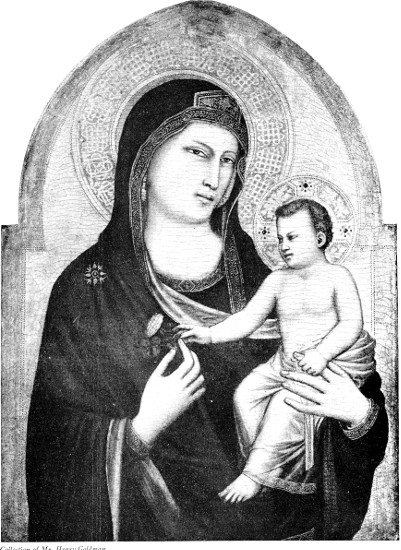
Collection of Mr. Henry Goldman
MADONNA AND CHILD
—Giotto di Bordone
“From the first,” says Mrs. Cartwright, “Giotto adopted a clear, pale tone of coloring, which forms a marked contrast to the dark and heavy tints in use among Byzantine artists, and produces the effects of water-color, while that of the older painters more nearly resembles oils. The technique which he used, both for tempera and fresco-painting, and which remained in use among Florentine artists for the next hundred and fifty years, was in reality founded on the old Greek method which had been practiced during many centuries, although the improvements which he introduced were sufficient to justify the Giottesque artist, Cennino Cennini, in saying that Giotto changed painting from the Greek to the Latin manner and brought in modern art. Yet more striking were the innovations which he introduced in his types, the almond-shaped eyes, long noses, and oval countenances with square, heavy jaws which he substituted for the staring eyes and round faces of Byzantine artists. The few and simple lines of his draperies give a majestic effect to his figures and at the same time sufficiently indicate the structure of the human form beneath; so that in spite of his ignorance of anatomy and modelling, the result is remarkably good.”
Giotto was working in Naples for King Robert in 1333 when he was sent for by the Signoria of Florence and appointed Chief Architect of the State and Master of the Cathedral Works, succeeding Arnolfo del Cambio, who had died in 1310. All work had stopped since that date; but now the authorities had decided to erect a bell-tower and they announced: “For this purpose we have chosen Giotto di Bordone, painter, the great and dear master, since neither in the city, nor in the whole world, is there any other to be found as well fitted for this and similar tasks.” The whole achievement of Giotto’s life was summed up more than a hundred years later when Lorenzo the Magnificent commanded Angelo Poliziano to write a Latin inscription for a bust of Giotto he was placing on Giotto’s tomb in the Duomo:
“Lo, I am he by whom dead Painting was restored to life, to whose right hand all was possible, by whom Art became one with Nature. No one ever painted more or better. Do you wonder at yon fair Tower which holds the sacred bells? Know it was I who bade her first rise towards the stars. For I am Giotto—what need is there to tell of my work? Long as verse lives, my name shall endure!”
THE ANNUNCIATION.
Masolino (1383–1447).
Collection of Mr. Henry Goldman
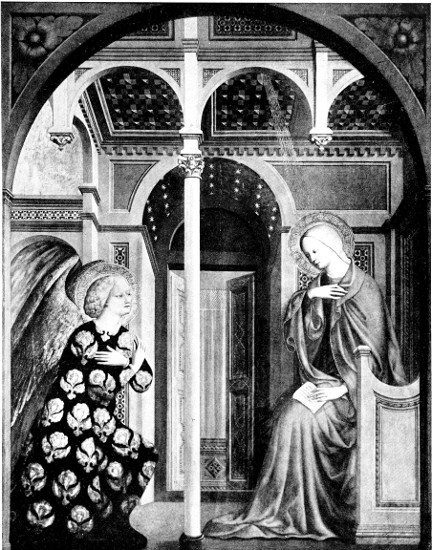
We have here a very interesting and important example of interior decoration. The Renaissance has arrived as well as the Announcing Gabriel! The round arch of grey stone (the spandrels of which contain rosettes) frames a sumptuous room divided by a slender Corinthian column. The walls and the cassette ceiling are inlaid with mosaic of different colors and the archway leading into another room—the Virgin’s bedroom—has a blue sky sprinkled with gold stars. In the centre of the background richly decorated doors lead into the adjoining room. The general hues of the wall and ceiling are grey, green, and red. The Virgin is seated on the right upon a tall and not very comfortable Italian settee. She has on a light blue mantle which falls around her in graceful folds. Her parted light hair is surrounded by a golden nimbus of decorative design. She holds an open prayer-book with one hand and with the other makes a gesture of submission and humility as she listens to the message of the Angel. Whether she sees Gabriel or not, she evidently hears what he has to tell her. The Angel, too, expresses reverence with hands crossed upon his breast. He wears a rich claret-colored, velvet brocade embossed with gold flowers and above his fair hair, which is tightly curled, shines a golden nimbus decorated with flower-like rosettes. His wings seem not to have quite quieted down from the flight from Heaven to earth.[5] Of this picture (painted on a panel 58¼ × 45¼ inches), which came from the Collection of Lord Wemyss at Gosford House, Longniddry, Haddingtonshire, Scotland, Berenson says:
“The decorative effect is so strong and so enchanting that like the rest of Masolino’s art it scarcely finds precedence in Florence or even in Italy. The suavity, the grace, the splendor, although paralleled in Gentile da Fabriano and in Sassetta, would seem inspired rather by the ecstatic mood of Parisian painting toward 1400 with its figures of angelic candor and skies of heavenly radiance than by Tuscan models.”
Collection of Mr. Henry Goldman
THE ANNUNCIATION
—Masolino
Masolino, the son of a house painter, was born in Panicale in 1383. His real name was Tommaso di Cristoforo di Fino, and he was familiarly called Masolino da Panicale. According to Vasari he was a pupil of “Starnina” and worked under Ghiberti. He was admitted into the Florentine Guild of Painters in 1423. In that year he was commissioned to paint the frescoes in the new chapel of the Carmine, built by Felice Brancacci, and he took for his assistant, Masaccio, who went on with the work when Masolino was sent to Hungary in 1425 to decorate a church at Stuhlweissenburg.
When Masolino returned to Florence—after several years—he found that great changes had taken place in art, for the painters had been busy with the new problems of perspective and light and shade and the substitution of Classic for Gothic architecture and decoration. Masolino availed himself of the new ideas, but could not quite forget his Giottesque traditions. He painted frescoes in Rome, Naples, and Lombardy.
“Masolino,” Vasari wrote, “was a man of rare intelligence and his paintings are executed with great love and diligence. I have often examined his works and find his style to be essentially different from the styles of those before him. He gave majesty to his figures and introduced finely designed folds in his draperies. He began to understand light and shade and to give his forms relief and succeeded in some very difficult foreshortenings. He also gave greater sweetness of expression to his women heads and gayer costumes to his young men, and his perspective is tolerably correct. But, above all, he excelled in fresco-painting. This he did so well, and with such delicately blending colors, that his flesh tones have the utmost softness imaginable; and if he could have drawn more perfectly, he would deserve to be numbered among the best artists.”
GABRIEL, THE ANNOUNCING ANGEL.
Fra Angelico Collection of
(1387–1455). Mr. Edsel B. Ford.
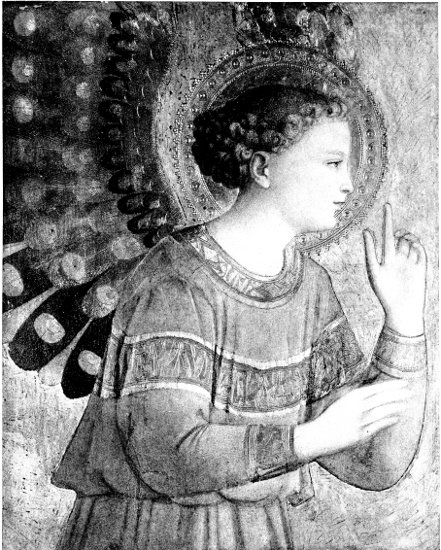
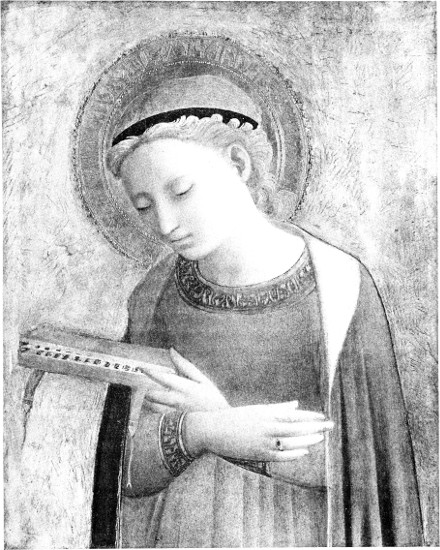
This panel and the one succeeding it, The Virgin Receiving the Divine Message, originally formed a diptych. In treatment and expression they resemble the figures in Fra Angelico’s Annunciation in the Oratorio del Gesù at Cortona.
Collection of Mr. Edsel B. Ford
GABRIEL, THE ANNOUNCING ANGEL
—Fra Angelico
The Archangel, according to Dante’s expression, has brought the long-desired tidings and he stands on a background of gold with wings still extended like those of a dove, just alighted from the heavens, looking into Mary’s face very earnestly, and pointing upward to emphasize to her that he comes from the spheres above. This Gabriel is one of the most beautiful of Fra Angelico’s most beautiful angels, his wings being of an extraordinary elegance of contour and a peculiar loveliness of color—rose, violet, green, and yellow, scintillating in iridescent play. His crimson robe, shading into high lights and fainter tones, is richly, although very simply, decorated with bands of gold embroidery in the Byzantine style. The hair is blonde and beautifully curled and the head stands out in fine relief from the golden glory. Notice the beauty of the ear and the distinguished line of the neck, the calm, deep, unattached gaze of the eye, the refined and sensitive nose, the pure and lovely mouth, and the graceful, strong, and very psychic hands. This figure perfectly fits Ruskin’s tribute to Fra Angelico in Modern Painters:
“The art of Fra Angelico, both in drawing and color, is perfect, and his work may be recognized at any distance by its rainbow play and brilliancy, like a piece of opal among common marbles. In order to effect clearer distinction between heavenly beings and those of this world, he represents the former as clothed in draperies of the purest color, crowned with glories of burnished gold and entirely shadowless; the flames on their foreheads waving brighter as they move; the sparkles streaming from their purple wings like the glitter of the sun upon the sea; while they listen in the pauses of alternate song for the prolonging of the trumpet blast and the answering of psalm and harp and cymbal, throughout the endless deep and from all the star-shores of Heaven. This mode of treatment, combined as it is with exquisite choice of gesture and disposition of drapery, gives perhaps the best idea of spiritual beings which the human mind is capable of forming.”
THE VIRGIN RECEIVING THE DIVINE MESSAGE.
Fra Angelico Collection of
(1387–1455). Mr. Edsel B. Ford.
In an attitude of divine submission, devout humility, and serene grace, the Virgin Mary is listening to the words of the Angel Gabriel. Her brow is almost as clear and pure as that of Gabriel himself and her features are beautiful, especially those heavy-lidded eyes. Her blonde hair is exquisitely arranged, confined by a band of black velvet and encircled by a nimbus, of which she is apparently unconscious. Mary wears a crimson robe with bands of gold around the neck and sleeves, over which is a blue mantle lined with yellow. Her hands are capable, exquisite, and very high bred; and in the left one she holds, with rare grace, a red book.
Collection of Mr. Edsel B. Ford
THE VIRGIN RECEIVING THE DIVINE MESSAGE
—Fra Angelico
Like the companion panel, Gabriel, the Announcing Angel, the background is gold. The dimensions of each are 14½ × 10 inches. Both pictures were long in the Collection of the Duke of Hamilton at Hamilton Palace; and afterwards were in the Collection of Mr. John Edward Taylor and in that of Mr. Carl W. Hamilton. In an unpublished letter regarding these works Mr. Berenson writes:
“They are among the sweetest, purest, and most candid of Fra Angelico’s paintings. I could not easily point to others which better justify the surname of ‘The Angelic’ given to this artist, who was so great that he was child-like. These panels date from about 1425, that is to say from the best year of Fra Angelico’s maturity. They show his best self, emancipated from the cramping traditions he was heir to, but not yet showing sign of spiritual fatigue leading finally to his painting a little by rote. In coloring they are exquisite; and for pictures five centuries old, they are almost miraculously well preserved.”
Vasari’s words show how deeply Fra Angelico was appreciated by men who lived closer to his time than we:
“This truly angelic father spent his whole life in the service of God and his fellow-creatures. He was a man of simple habits and most saintly in all his ways. He kept himself from all worldliness and was so good a friend to the poor that I think his soul must be already in Heaven. He worked continually at his art, but would never paint anything but sacred subjects. He might have been a wealthy man, but he did not care for money and used to say that true riches consist in being content with little. He might have enjoyed high dignities both in his convent and in the world, but he cared nothing for these things, saying that he who would practice painting has need of quiet and should be free from worldly cares; and that he who would do the work of Christ must live continually with Him. He was never known to be impatient with the Brothers,—a thing to me almost incredible! When people asked him for a picture he always replied that, with the Prior’s approval, he would try and satisfy their wishes. He never corrected or retouched his works, but left them as he first painted them, saying that such was the will of God. He never took his pencil up without a prayer and could not paint a Crucifixion without the tears running down his cheeks. And the saints that he painted are more like saints in face and expression than those of any other master. And since it seemed that saints and angels of beauty so divine could only be painted by the hand of an angel, he was always called Fra Angelico.”
Fra Angelico was born in 1387 in a little hamlet called Vicchio, in the province of Mugello in Tuscany, about twenty miles from Florence. His surname is unknown—if indeed he had one—for his father, who lived in a cottage belonging to the lord of the Castle of Vicchio, was simply known as Pietro of Mugello. Guido was the name his father gave him but he changed this to Fra Giovanni, when he became a monk of the Dominican Order at Fiesole in 1406. It is supposed that he had been thoroughly trained as a painter, because he immediately began to paint frescoes for the monks; and it is also supposed that “Starnina” was his master. Owing to religious troubles, the Dominican monks were driven from Fiesole to Foligno and thence to Cortona, where the earliest extant works—movable altar-pieces—of Fra Angelico are preserved. In 1418 the Dominicans returned to Fiesole, where Fra Angelico, or rather Fra Giovanni, lived for the next few years and where he painted many of his most famous altar-pieces.
In 1434 Cosimo de’ Medici was recalled from banishment and he immediately had the Convent of San Marco rebuilt for the Dominican monks of Fiesole. When the new building was ready in 1436 he commissioned Fra Angelico to decorate the walls. In a cell which Cosimo de’ Medici had reserved for his own personal retreat from worldly cares, he had Fra Angelico paint a large Adoration of the Magi, for he desired to have “this example of Eastern kings laying down their crowns at the manger of Bethlehem always before his eyes as a reminder for his own guidance as a ruler.”
While Fra Angelico was busy on a series of small panels depicting the Life of Christ for a credenza in which the altar-plate was kept and which had been ordered by Piero de’ Medici (Cosimo’s son), Pope Eugenius IV called him to Rome, to paint a chapel in St. Peter’s. Three of the remaining panels of the credenza were painted by Alesso Baldovinetti.
After completing the chapel in St. Peter’s, Fra Angelico was invited to paint in the Cathedral at Orvieto; and, on finishing the work there, he returned to Rome to spend three years decorating the Pope’s Oratory in the Vatican. In 1450 he was back in Florence, and he began the new year of 1451 as Prior of his old monastery at Fiesole. Again he went to Rome and died there in the House of his Order at Santa Maria sopra Minerva on March 18, 1455. He was buried in the monastery church by the high altar and not far from the tomb of St. Catherine of Siena. Pope Nicholas V wrote for him a Latin epitaph, the last line of which reads: “That city which is the flower of Etruria bore me, Giovanni.”
The paintings of Fra Angelico are noted for their fine composition, beautiful coloring, and variety and expression in the heads and faces of his persons and Angels. Fra Angelico’s Angels are particularly beautiful; and it is reasonable to infer that it is because of these Angels so many of his works have been preserved. No other painter of the Fifteenth Century has been treated with so much reverence as Fra Angelico. The consequence is that there are somewhere between two and three hundred of his compositions in existence. The greater number are still in Florence. Every large gallery, however, possesses one or more. Among the most famous ones that all the world knows and loves are The Virgin and Child surrounded by Twelve Angels, ten of whom are playing musical instruments (now in the Uffizi); Christ with the Banner of Resurrection (in the National Gallery, London); and The Coronation of the Virgin (in the Louvre), of which Gautier said the figures represented “visible souls rather than bodies—thoughts of human form enveloped in chaste draperies of white, rose, and blue, sown with stars and embroidered, clothed as might be the happy spirits who rejoice in the eternal light of Paradise.” Fra Angelico’s greatest frescoes are in the Convent of San Marco at Florence and in the Vatican at Rome.
Fra Angelico is classed variously as a “Primitive,” a “Gothic,” an “International,” and an “Early Renaissance” painter. The fact is he stands between the old and the new. His position in Art is very definitively described by Berenson:
“Yet simple though he was as a person, simple and one-sided as was his message, as a product he was singularly complex. He was the typical painter of the transition from Mediæval to Renaissance. The sources of his feeling are in the Middle Ages, but he enjoys his feelings in a way which is almost modern; and almost modern also are his means of expression. Moreover, he was not only the first Italian to paint a landscape that can be identified (a view of Lake Trasimene from Cortona) but the first to communicate a sense of the pleasantness of Nature.”
As a tribute to his spiritual qualities let us listen to Mrs. Cartwright’s eulogy:
“All the mystic thought of the Mediæval world, the passionate love of God and man that beat in the heart of St. Francis, the yearnings of Dante’s soul after a higher and more perfect order, the poetic dreams of the monks who sang of the Celestial Country are embodied in the art of Angelico. The depth and sincerity of his own religious feeling lent wings to his imagination and the exquisite purity of his soul breathes in every line of his painting: it is his own sweet and gentle fancy that brings down these enchanted visions of Paradise.”
ST. COSIMAS AND ST. DAMIANUS.
Fra Angelico Collection of
(1387–1455). Mr. Albert Keller.
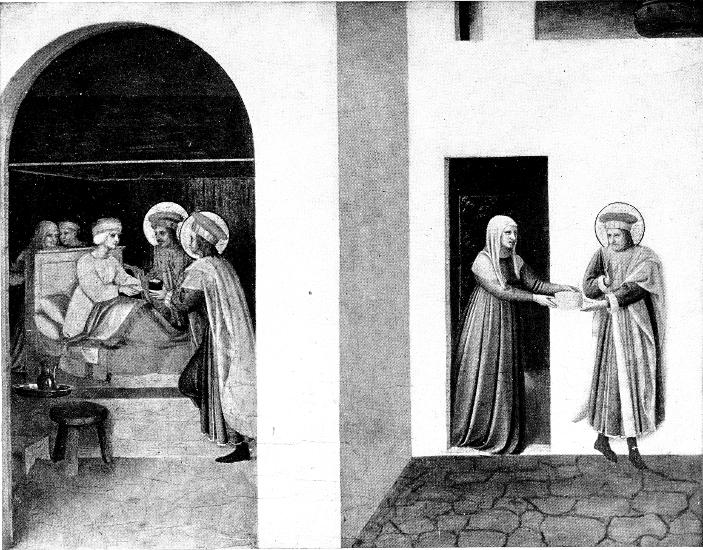
About the year 1436 Cosimo commissioned Fra Angelico to paint the altar-piece for the Church of San Marco in Florence (see page 37). Underneath the group of the Virgin and Child Fra Angelico painted for the predella nine beautiful panels representing the legendary history of Cosimas and Damianus, the patron saints of the Medici family. The panel, shown here, tempera on wood (14¼ × 18 inches), which comes from the collection of Mr. F. Böhler of Munich, is one of these nine pictures. The companion pictures of this S. Marco altar-piece are now in Dublin, Florence, Munich, and Paris.
This composition, divided into two episodes in one building, represents the traditional benevolence of the two Saints, Cosimas and Damianus. In the scene at the left, enacted within a room, which we view through a large, rounded, door-like opening, St. Cosimas and St. Damianus, with golden nimbi, are administering to a sick man sitting up in a bed which is elevated on a daïs. The two Saints, in the blue robe, red mantle, and red and white biretta of the physicians, are standing on either side of the bed, offering nutriment to the invalid and giving their benediction. Kneeling behind the bed-head are a man and a woman, the latter wearing a red mantle and white hood, the former a turban-like cap. Over the bed stretches a deep, square, brown canopy with an olive-green curtain all around it. On the daïs rests a tray with an ewer, and beside it on the floor, we see a round stool with three legs, and a foot-stool.
The scene on the right, takes place in a cobbled court-yard of a white house, and here we see one of the Saints, in his physician’s gown, colored as in the first scene, who has just handed to an aged woman a loaf of bread, receiving no payment but raising his right hand in benediction. The woman, dressed in a mauve gown and white veil, is cleverly and gracefully posed within a small doorway, and behind her is a room with an open door still farther back, through which flowering shrubs are seen; and in this inner room a ray of light glints on the floor. High on the top of the wall a large terra-cotta flower-vase is silhouetted against a blue sky, and at the left of this there is a narrow slit window.
Collection of Mr. Albert Keller
ST. COSIMAS AND ST. DAMIANUS
—Fra Angelico
“Cosimas and Damianus were two brothers, Arabians by birth, but they dwelt in Ægæ, a city of Cilicia. Their father having died while they were yet children, their pious mother, Theodora, brought them up with all diligence, and in the practice of every Christian virtue. Their charity was so great, that they not only lived in the greatest abstinence, distributing their goods to the infirm and poor, but they studied medicine and surgery, so that they might be able to prescribe for the sick, and relieve the sufferings of the wounded and infirm; and the blessing of God being on all their endeavors, they became the most learned and the most perfect physicians that the world had ever seen. They ministered to all who applied to them, whether rich or poor. Even to suffering animals they did not deny their aid, and they constantly refused all payment or recompense, exercising their art only for charity and for the love of God; and thus they spent their days. At length those wicked Emperors, Diocletian and Maximian, came to the throne, in whose time so many saints perished. Among them were the physicians, Cosimas and Damianus, who, professing themselves Christians, were seized by Lycias, the proconsul of Arabia and cast into prison. At first they were thrown into the sea, but an Angel saved them; and then they were cast into fire, but the fire refused to consume them; and then they were bound on two crosses and stoned, but of the stones flung at them, none reached them, but fell on those who threw them and many were killed. So the proconsul, believing that they were enchanters, commanded that they should be beheaded, which was done.” This Oriental legend, which is of great antiquity, was transplanted into Western Europe in the first ages of Christianity. The Emperor Justinian, having recovered, as he supposed, from a dangerous illness, by the intercession of these saints, erected a superb church in their honor. Among the Greeks Cosimas and Damianus succeeded to the worship and attributes of Æsculapius; and from their disinterested refusal of all pay or reward they are distinguished by the honorable title of Anargyres, which signifies moneyless, or without fees.
MADONNA DELLA STELLA.
Fra Filippo Lippi Collection of
(1406?–1469). Mr. Carl W. Hamilton.
This picture came directly from the Monastery of the Carmine Brethren in Florence to the present owner. It is painted in tempera on a panel 32⅝ × 25¼ inches. The Madonna, with head half turned towards the right, is standing at half length and holding the Holy Child very lovingly in her arms. She wears a dark-green, hooded mantle, with wide gold border and fastened across the breast with two narrow straps of gold embroidery. Under this is seen a bright crimson robe falling in tight, formal plaits from the neck. The sleeve of the right arm shows a gold embroidered band at the wrist. On the right shoulder of the mantle is embroidered a golden star (reminiscent of the Sienese decoration), from which the picture takes the name of Madonna della Stella. The head-dress, which permits a little of the blonde hair to be seen, is of a soft, white muslin, which is delicately folded and carried around the base of the long, slender neck. Above the head-dress is a very large golden nimbus with lines radiating from the centre. The Holy Child is firmly supported by both arms of the Virgin and rests His left foot on her right arm, while His right leg hangs down behind her wrist. The Holy Child is swathed in a drapery of purple hue and His head is also encircled by a golden halo. With His left hand He grasps the folds of His mother’s head-dress, where it falls upon her neck, and with His right He supports His chin in a very mature and contemplative way. The background is composed of a loosely hanging gold brocade of decorative pattern. The extravagant use of gold produces a warm and lustrous gleam and glow and the deep colors stand out from the background with great richness and beauty.
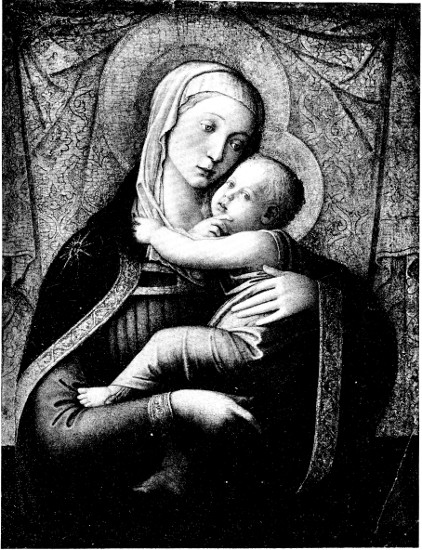
Collection of Mr. Carl W. Hamilton
MADONNA DELLA STELLA
—Fra Filippo Lippi
It is generally accepted that Lucrezia Buti, the young nun whom Fra Filippo Lippi stole from the Convent of Santa Margherita, served as the model for this Madonna and that the Infant Jesus is none other than Fra Filippino Lippi, the future painter. Comparison with the tondo in the Pitti Palace, representing the Madonna with Saints, in which Lucrezia Buti is known to appear, shows the same oval face, slender neck, expressive eyes, dilated nostrils, full lips, slightly dimpled chin, and wistful glance.
Fra Filippo Lippi is one of the strangest personalities in the history of art. He became a Carmelite monk from circumstance rather than choice; and nobody was ever less fitted to belong to Holy Orders than this gay, adventure-loving Florentine. “Lippi was very fond of good company,” Vasari notes, “and led a free and joyous life.” Fra Filippo Lippi presents a strange contrast to the saintly Fra Angelico, who was his contemporary and fellow-worker. Filippo Lippi, son of a butcher, was born in or about 1406, in a street behind the Carmine Church in Florence; and, being left an orphan, was cared for by an aunt, who took him at the age of eight to the Convent of Sta. Maria del Carmine and gave him to the Friars to rear. The Friars soon discovered the boy’s extraordinary talent for drawing, and, fortunately, encouraged it, sending him to study under Lorenzo Monaco.
At this time Masaccio was at work in the Brancacci Chapel of the Carmine Church, and young Lippi used to watch him with profound interest and delight. In 1421 Filippo Lippi became a Carmelite monk; but he was permitted to continue his painting and he executed many frescoes for church and cloister. In ten years’ time he left the monastery to give his whole life to his art. However, he always signed his pictures “Frater Philippus.” Though not a copyist, by any means, Fra Filippo Lippi shows in his works how much he admired and how much he learned from Masaccio, Masolino, Domenico Veneziano, and Fra Angelico.
Adventures of many kinds filled his life; for instance, there is a story that he was captured by Moorish pirates one day while sailing for pleasure, and taken to Barbary as a slave and that because he drew his master’s portrait so cleverly, he was given his freedom a year or so later. This—if it happened at all—happened in 1431–1434. About the last-named date Fra Filippo Lippi was employed by Cosimo de’ Medici, who took a great fancy to the lively Friar and was most indulgent to his pranks and misdemeanors, excusing everything he did because of his genius and his attractive personality. Fra Filippo Lippi decorated many churches, palaces, and villas for his patron. Among the first works that Lippi painted for the Medici Palace (now the Riccardi) were the Annunciation and St. John the Baptist with Six Other Saints (both in the National Gallery, London). Lippi’s most important picture in Florence is his Coronation of the Virgin.
“Lippi’s character, however, only affects his credit as a painter by accounting for the kind of success he achieved. He had, as was to be expected, no ears for the message which Donatello was at this time teaching, and consequently his pictures on religious subjects have an exceedingly mundane character. Nevertheless, the sweet seriousness of his Madonnas falls in no way short of those of Fra Angelico, and the faces of his children are full of a quaint, mischievous character which is delightful, while in both drawing and coloring he shows the immense advance which had now taken place in Painting. And it is here that Lippi’s true claim to fame lies. Masaccio, the only man who up to that time had found out the true methods of the art of Painting, had died too soon to be able to make known his discovery, except to the few who could visit Florence and the Brancacci Chapel. It was left for Lippi, the rough boy whom he had taught, to show the world Masaccio’s discovery. And Lippi did so. Vasari says: ‘Taught as he had been by Masaccio, he was a faithful follower of Masaccio’s style;’ and he adds that he followed the latter’s methods so faithfully, that it appeared that the spirit of Masaccio had entered Lippi’s body. Thus what Masaccio had done for the art of Painting is chiefly to be seen by a comparison of Lippi’s pictures with those of Masaccio’s immediate predecessors, the Giotteschi. Lippi’s principal picture in Florence is his Coronation of the Virgin painted for Cosimo and now in the Accademia delle Belle Arti; but his best work is considered to be his frescoes in the Cathedral at Prato painted between 1456 and 1465.
“It was not an easy thing to get any work out of Lippi. There is an amusing story of how, when he was painting this picture for Cosimo, the latter being at last in despair (owing to Lippi’s lazy ways) of ever seeing the picture finished, had him locked up in the room in the Medici Palace where it was being painted, declaring that he should not be let out until the work was done. Whereupon Lippi tied his bedclothes into a rope, let himself down from the window into the street and disappeared into the slums of Florence, not to be found again for many days.”[6]
Lippi’s drunkenness and his unscrupulous behavior brought him many times before the magistrates and on one occasion he was flogged for embezzlement. However, the Medici family always came to the rescue and helped him out.
In 1452 he was made Chaplain of San Niccolò de Fieri, Florence, and in 1456 Chaplain of Santa Margherita, Prato, and here again it was Cosimo de’ Medici, who obtained these posts for him. At Prato he painted some of his finest pictures. Requested by the Abbess of Sta. Margherita to paint a picture for the Chapel, the gay Friar, who was now over fifty, fell in love with a young nun of twenty-one, Lucrezia Buti, who had taken the vows two years previously. At the Festival of the Holy Girdle in 1456, Fra Filippo Lippi managed to carry off the pretty nun and take her to his house in the vicinity. The next year Filippino Lippi was born, who appears in the arms of Lucrezia Buti in the Madonna della Stella represented here. Two years later Lucrezia Buti re-entered the Convent; but she soon tired of it and returned to Fra Filippo Lippi. A charge of abduction was then brought against the painter, who again appealed to Cosimo de’ Medici; and, through the latter’s influence, Pope Pius II absolved monk and nun from their religious vows and declared them lawfully married.
“I laughed heartily when I heard of Fra Filippo’s escapade,” Giovanni de’ Medici, Cosimo’s younger son, remarked; and that remark shows exactly how the Medici felt towards Fra Filippo Lippi. They adored him as an artist and they did not take him seriously as a man.
About 1465 Fra Filippo Lippi left Prato and went to Spoleto, taking Lucrezia and his two children (there was now a daughter); and there, still under the patronage of the Medici, the energetic painter-monk produced a splendid series of frescoes depicting one of his favorite subjects, the Coronation of the Virgin. Fra Filippo was working on the Duomo at Spoleto when he died in 1469. Fra Filippo Lippi gains additional fame for having been the first master of Botticelli. His contemporaries—without dissent—regarded Fra Filippo Lippi as the “rarest master of the time.” Fra Filippo Lippi was one of the first to use the tondo form.
“His dreams were all of the earth and his thoughts never soared beyond the gladness and beauty of the natural world. He paints the merry, curly-headed boys whom he met in the streets of Florence as cherubs, takes his mistress as a model for his Madonnas, and peoples the court of heaven with fair maidens in rich attire and dainty head-gear. A thorough-going realist at heart, his naturalism differed wholly from that of his contemporaries, Paolo Uccello, or Andrea del Castagno. He never troubled his head with scientific problems, or new technical methods. The old tempera painting was good enough for him and he carried this form of art to the highest perfection, while at the same time he profited by all the advance which Masaccio and his followers had made, and gave a marked impulse to the new realism by the strong human element which he introduced in his works. His genial delight in all bright and pleasant things, in the daisies and the springtime, in rich ornament and glowing color, in splendid architecture and sunny landscapes, in lovely women and round baby faces, fitted him in especial manner to be the herald of that fuller and larger life which was dawning on the men and women of the Renaissance.”[7]
Fra Filippo Lippi’s son, Filippino Lippi (1457–1504), inherited his father’s talent and was trained by Botticelli. It was Lorenzo de’ Medici, who recommended to the Friars of the Carmine that they should employ Fra Filippo Lippi’s son to finish Masaccio’s frescoes in the Brancacci Chapel. Filippino did this to everyone’s satisfaction and in The Trial of St. Peter and St. Paul he introduced portraits of Antonio Pollaiuolo, Botticelli, and himself. Filippino achieved an enormous reputation and was beloved for his modesty and gentleness of character. As in the case of his father, the next generation of the Medici continued their patronage to a Lippi.
MADONNA AND CHILD.
Alesso Baldovinetti Collection of
(1425–1499). Mr. Clarence H. Mackay.
In the charming picture represented here, on canvas transferred from panel (29 × 21 inches), which was formerly in the possession of Arnoldo Corsi in Florence and afterwards in the Collection of Mr. William Solomon in New York, the Madonna, seen at three-quarter length, is seated in a chair. She is turned slightly to the left and wears a red tunic edged with gold and a blue mantle. Over the white veil, which covers her temples and hides her ears, is folded a golden-brown head-dress that descends to her shoulders. Her head is encircled by a gold nimbus. She is gazing at the Holy Child in her lap with downcast eyes and pensive expression. The Holy Child, who is nude, wears a red coral necklace, from which a “charm” hangs. Around His head is a very decorative cruciform nimbus. In His right hand He holds a narrow piece of white drapery and He raises His left hand in a benediction in the Greek manner. The landscape in the background recedes gently towards a distant range of hills, showing scanty vegetation beneath a light-blue sky. Bernhard Berenson has pronounced this a very characteristic work of Baldovinetti’s middle years, painted before the pictures now in the Uffizi.
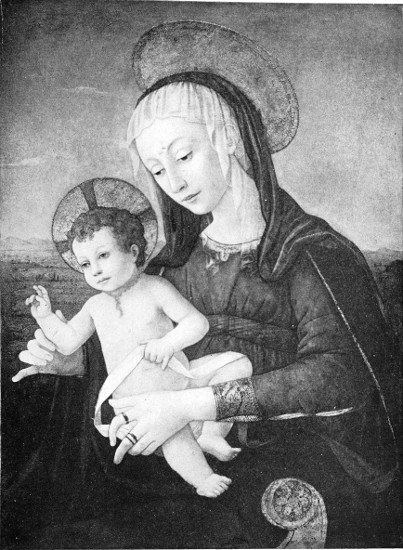
Collection of Mr. Clarence H. Mackay
MADONNA AND CHILD
—Alesso Baldovinetti
Alesso Baldovinetti, born in Florence in 1425, was a pupil of Domenico Veneziano and became a member of the Painters Guild in 1448, when he was twenty-three. His entry-book, a copy of which is preserved in the Archives of S. Maria Nuova, containing his accounts and orders, begins with the date 1449. One of his first commissions was to finish some panels begun by Fra Angelico for a credenza in the Medici Chapel of the Annunziata (see page 37), and some paintings on the doors of the vestry of Santa Annunziata (now in the Museum of San Marco), which also completed a series begun by Fra Angelico. Thenceforward he painted frescoes and altar-pieces, including an altar-piece representing the Annunciation for the Chapel of the Medici villa at Caffagiuolo (now in the Uffizi) and the fresco representing the Birth of Christ in Santa Annunziata (1460–1462). In 1470–1473 he was busy on the altar-piece in the San Ambrogio and the Trinita (now in the Accademia). Of the frescoes of Santa Trinità, on which he worked until 1497, only a small portion remains. Other unquestionable works by Baldovinetti are the Madonna and Saints (in the Uffizi) and a few pictures in private collections.
Baldovinetti also painted a great number of panels for private altars and he frequently turned from religious subjects to decorate marriage-chests and other sumptuous furniture. He also worked in mosaics, made cartoons for stained glass, and produced designs for intarsia,—all of which developed his delightful, decorative qualities.
Baldovinetti’s entire life seems to have been absorbed in painting. He married late. After the death of his wife, he entered the hospital of S. Paolo of the Third Order of St. Francis and bequeathed what few possessions he had to this house of charity. After his death in Florence in 1499, a large chest that belonged to him was opened; but the monks, instead of seeing the hoped-for gold, only found a book on mosaic-work and some drawings. “No one was really surprised,” says Vasari, who tells the story, “for Baldovinetti was so kind and courteous that he shared everything he possessed with his friends. Alesso was a very diligent artist, who tried to copy minutely every detail in Mother Nature. He loved painting landscapes exactly as they are, and you see in his pictures rivers, bridges, rocks, plants, fruit-trees, roads, fields, towns, castles, and an infinite number of similar objects. In his Nativity you can count the separate straws and knots in the thatched roof of the hut and you see the stones in the ruined house behind, worn away by rain, and the thick root of ivy growing up the wall is painted with so much accuracy that the green leaves are differently shaded on either side; and among the shepherds he introduced a snake crawling in the most natural manner along the wall.”
PORTRAIT OF A YOUNG LADY.
Piero Pollaiuolo Collection of
(1443–1496). Mr. Nils B. Hersloff.
In profile to the right, with features clear-cut and strongly outlined against a light-green background, appears a young Florentine lady, whose dress and bearing proclaim her to be a patrician. She has not been as yet identified; but doubtless she was one of those elegant and gay Florentines whom we meet with in song and story. We are very safe to guess that she was a friend of the Medici and Tornabuoni group and played her part in the brilliant life of the period. Her dress, pink brocade with a floral pattern, is edged with white around the neck. Her hair is fancifully plaited with pale blue ribbons and partly covered with a head-dress of thin white gauze, which falls over the right ear on to her neck; and her hair is also decorated with a jewel set in pearls. According to the fashion of the time, her forehead and the nape of her neck are shaven; for the long line of the neck was considered of the greatest importance. It was also important to hold the head properly; and this young lady has certainly acquired the correct and noble carriage of the head.
An unpublished letter of Berenson exclaims enthusiastically: “This profile portrait of a Young Lady by Piero Pollaiuolo I believe to be one of the most delightful of the series of female profiles which, from Paolo Uccello and Domenico Veneziano down to Botticelli and Amico di Sandro, glorifies the art of Florence during the Fifteenth Century. Few of them have survived to our own time. With the exception of one in the Poldi Collection at Milan, this is the most satisfactory of them all; for besides representing an extraordinarily attractive personality of the highest Florentine society of the time (as, indeed is confirmed by the dress and the jewels), it is a work of art of exquisite draughtsmanship, subtle modelling, and delicate, pure color.”
The painting in tempera is on a panel, 18 × 13 inches, and came from several important Collections,—that of the Conte Isolani Bologna; Baron Lazzaroni, Rome; and the late Mr. William Solomon, New York.
Mr. Berenson notes the fine draughtsmanship in this picture. Unusual drawing is to be expected from the brothers Pollaiuolo. Benvenuto Cellini called Antonio “the best draughtsman of his day in Florence” and tells us that all the goldsmiths worked from his designs; and, as Antonio trained his youngest brother, Piero, we cannot be surprised at the simple, direct, and commanding lines and these telling effects produced by such economical methods.
The real name of the talented brothers was Benci. Their father, Jacopo d’Antonio Benci, was nicknamed by his friends, Pollaiuolo, because his father kept a poulterer shop. Jacopo was a goldsmith and was employed by Lorenzo Ghiberti; and it is said that he made a remarkable quail on one of the Baptistery Gates.
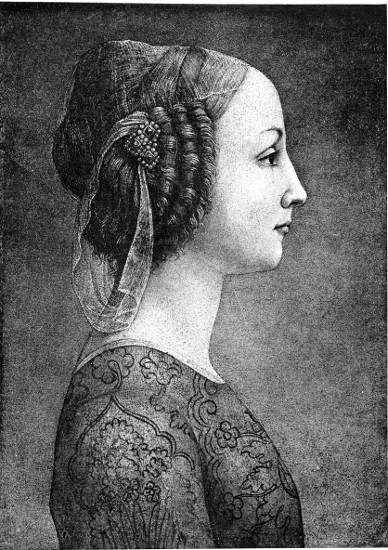
Collection of Mr. Nils B. Hersloff
PORTRAIT OF A YOUNG LADY
—Piero Pollaiuolo
Antonio (1432–1498) was apprenticed to Bartoluccio Ghiberti, a goldsmith, and soon achieved fame in Florence as a worker in jewelry and niello. Lorenzo Ghiberti called him to work on the Baptistery “Gates of Paradise” and the Bronze Doors. In 1459 he started to work independently and became renowned as a painter, sculptor, and master goldsmith. His bottega near the Ponte Vecchio was the most popular workshop in Florence; and here he remained until he went to Rome in 1484. Piero Pollaiuolo helped Antonio in his work and was also very versatile. Engravings, drawings, niello, sculpture, and painting, besides a vast amount of gold-work, silver-work, and bronze-work prove these men to be as industrious as they were talented. They also followed Alesso Baldovinetti in trying out new oil glazes and varnishes. In 1460 the Pollaiuoli painted in the Medici Palace, and about the same time executed the six life-sized Virtues for the Tribunal of the Mercatanzia. In 1471 Piero painted a portrait of Galeazzo Sforza, Duke of Milan, who was visiting Florence; and this portrait, which hung for many years in the Medici Palace, is now in the Uffizi. Piero’s fresco of St. Christopher, painted at San Miniato outside the gates, is considered by most authorities to be the same St. Christopher now preserved in the Metropolitan Museum, New York. Piero also painted a very fine Annunciation (now in the Berlin Gallery), which has a view of Florence and the Val d’Arno through the open windows and which is remarkable for its Renaissance architecture; for the profusion of pearls and other jewels adorning the Virgin’s chair and the robes of the Angels; and for three Cherubs playing the lute, viol, and organ.
In 1489 Antonio was called to Rome by Pope Innocent VIII to make the bronze tomb of Sixtus IV, and a monument for himself in St. Peter’s. He was joined by Piero. The Pollaiuoli never saw Florence again; for, on account of the raging Plague, no travellers were allowed to come within twenty miles of Florence. Piero died in 1496 and Antonio in 1498; and at the request of the latter he was buried in the same tomb with Piero in the church of S. Pietro in Vincula.
The Pollaiuoli were closely associated with Botticelli, Leonardo da Vinci, Ghiberti, and Verrocchio.
GIULIANO DE’ MEDICI.
Sandro Botticelli Collection of
(1444–1510). Mr. and Mrs. Otto H. Kahn.
This proud, intellectual, refined, and cold face is painted almost in profile; but, notwithstanding that we see only a part of the face, we seem to see it all. Never did painter achieve a more complete presentation of personality and of character. Moreover, Botticelli has painted the whole of Florentine Society in this portrait. And with what amazingly simple means! There is practically no costume,—a black doublet, giving a glimpse of a red tunic below, and a severe white linen band doing duty for a collar. Even the background is neutral!
The simplicity of presentation and the economy of line are almost Japanese in their severity. The skillful handling is almost Oriental, too. Nothing seems to have been done here for effect,—yet what effect is here! There is almost no color; and the hair, too, which falls to the neck, is black. If we did not know that Giuliano de’ Medici was a dashing young Florentine of high mettle and full of the zest of life, we might easily mistake him for a priest.
The picture, painted on wood (21 × 13½ inches), gives us the impression of a life-size portrait. It was formerly in the Collection of Conte Procolo Isolani, in Bologna.
Giuliano de’ Medici was one of the most romantic characters in history; and the tragedy that cut the thread of his life at the age of twenty-five adds no little to the romantic appeal he makes to us to-day. Yet even at this age, he had so perfected himself in all the accomplishments that belonged to a gentleman of the Fifteenth Century that he stands as the very type of the elegant young man of his period. Giuliano was, like his brother, Lorenzo, proficient in the arts, a lover of pictures, music, and poetry; he wrote charming love-songs and other lyrical verse; he was intellectual and witty and talked extremely well; and he was a brilliant jouster and a well-trained all-round athlete and devoted to the chase. For all these things the Florentines admired him; but they loved him for his character, his high-mindedness, and his courtesy. He adored his brother; and Lorenzo, who was far from handsome, had no jealousy for the admiration that his younger brother inspired. The terrible murder of this public idol at High Mass in the Cathedral first shocked and then grieved the entire community. The grief manifested at the great public funeral in the church of the Medici family, San Lorenzo, was violent and sincere, for Giuliano de’ Medici was the beloved of both high and low.
In his book, The Medici, Col. Young writes:
“Giuliano de’ Medici, the youngest of the five children of Piero il Gottoso and Lucrezia Tornabuoni, was, unlike his brother Lorenzo, exceedingly good-looking; he was gifted with considerable abilities, and for his many endearing qualities was greatly beloved, not only in his own family but also by the people of Florence. Before his early death he had already shown on several occasions that he possessed plenty of political capacity and could give valuable advice to his brother.
“The relations which existed between these two brothers is one of the pleasantest things in the history of the Medici. At that epoch jealousy between brothers placed in such a position as Lorenzo and Giuliano were was the normal state of things. That it was entirely absent in their case speaks well for both of them.
“Giuliano was twenty-five at the time of his death. He left an illegitimate son, born just at that time. Lorenzo took the child and brought him up with his own sons; and this child became in the next generation the well-known Giulio de’ Medici, afterwards Clement VIII.”
Alessandro di Mariano Filipepi was born in Florence in 1444, the son of a prosperous tanner who had four sons, the eldest of whom, Giovanni, was called “Bottecello” from the sign of a barrel which hung over his shop, and which name was given to all the other members of the family. Sandro Botticelli, like so many other Florentine painters began life as a goldsmith. Then he was apprenticed to Fra Filippo Lippi, who was, of course, able to hand on to him the old Giottesque tradition. Botticelli next fell under the influence of the Pollaiuoli, with whom he worked. It was not long, however, before the young painter began to exhibit his originality.
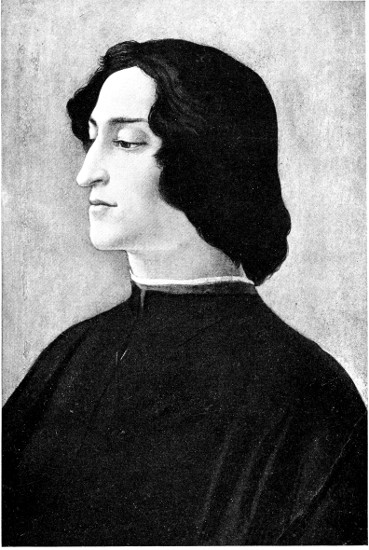
Collection of Mr. and Mrs. Otto H. Kahn
GIULIANO DE’ MEDICI
—Sandro Botticelli
Soon after returning from Prato, where he had gone to help Fra Filippo Lippi with the frescoes in the Cathedral, he was immediately employed by Piero il Gottoso, who with his wife, Lucrezia Tornabuoni, recognized the genius and peculiar charm of the young painter, and took him into the Casa Medici almost like a son. Botticelli was at this time about twenty-one, only five years older than Lorenzo, the eldest son. Consequently, Botticelli was on the most intimate terms with Lorenzo and Giuliano.
All the pictures of this period except Fortitude were painted for Piero, who bestowed large rewards on the painter. The Madonna of the Magnificat, one of his most beautiful pictures (now in the Uffizi) was painted in 1465 (when Lorenzo and Giuliano were about sixteen and twelve); and it must have been done especially to please Lucrezia Tornabuoni, for her two sons are represented as Angels kneeling before the Madonna and holding the inkstand and the book. Giuliano is the one facing us with the conspicuous lock of hair on his forehead, while Lorenzo, of darker complexion, is in profile and in full light.
The Adoration of the Magi, painted in 1467 for Sta. Maria Novella (now in the Uffizi) is also a Medici family group surrounded by their protégés in art and letters. Cosimo, “Pater Patriæ” (then dead), is kneeling before the Holy Child; Giovanni, brother of Piero il Gottoso (then dead), stands at the left in a red and black costume; Piero il Gottoso is kneeling in the centre with back to the spectator; Giuliano, in a robe of white and gold, is kneeling at the latter’s right and Lorenzo, aged seventeen, stands at his left, holding a sword. The last figure, standing on the right, is Botticelli himself. Botticelli’s portrait of Lucrezia Tornabuoni is in the Kaiser Friedrich Museum, Berlin.
When Lorenzo, destined to become known as the “Magnificent,” became, on the death of his father, head of the Medici and ruler of Florence, he continued the Medici patronage to Botticelli.
“It was a period when the exuberant vitality of the Renaissance was at its height; and the first nine years of his rule, when he was from twenty to twenty-nine and his brother, Giuliano, from sixteen to twenty-five, was a time in Florence of constant festivities of music, art, and poetry, of joy and laughter and all the bright side of life. It was the fashion of the day to import into all amusements an imitation of the Classic times of ancient Greece, and the Florence of that time appears set before us as a city ‘with youth at the prow and pleasure at the helm’ and full of all the life, joy, and pleasure of the old pagan ideal of Greece set in a Fifteenth Century dress. Besides all his duties in regard to State affairs and labors in the founding of institutions to advance Learning, not to mention his own literary work, Lorenzo with his brother led these festivities organizing pageants and other spectacles of the most costly description (permeated with classical learning and poetical allusions) for the popular amusement.”[8]
These entertainments took the form of masques, tableaux, and tournaments. Young Lorenzo, too, gathered at his villa in Fiesole and even more particularly in that of Careggi the literati of the day and read classical authors with these scholars, particularly commemorating once a year the birthday of Plato. In 1469 Lorenzo held a magnificent tournament for his own glorification and in 1475 an even more elaborate one in honor of Giuliano in the Piazza Sta. Croce, with the beautiful Simonetta Cattaneo, who had lately been married at the age of sixteen, to Marco Vespucci, as the Queen of Beauty. Giuliano, now just twenty-two, wore a suit of silver armor and Verrocchio designed his helmet, and Lorenzo’s also.
Botticelli, of course, witnessed this tournament and did for it in painting what Politian did in his poem, La Giostra di Giuliano de’ Medici. The Primavera or Return of Spring (now in the Accademia, Florence), the Birth of Venus (in the Uffizi) and Mars and Venus (in the National Gallery, London), were all three painted for Lorenzo. All the elaborate imagery of Politian’s verse is reproduced in Botticelli’s painting representing the Birth of Venus in allusion to the Queen of Beauty, Simonetta, of Giuliano’s Tournament. In the second picture, Mars and Venus, Botticelli again follows Politian’s poem.
“And then having devoted one picture to the tournament’s Queen of Beauty, and one to the victor in its mimic warfare, Botticelli makes his third picture (the most important of the three) relate to Lorenzo and his part in all this, gathering up in one view the whole subject of these pastimes. This Botticelli does with great talent and in a manner all his own. He takes for his text the celebrated standard which had been borne in front of Lorenzo at both his and Giuliano’s tournaments, with its motto of Le temps revient, its device of the bay-tree, which had appeared dead, again putting forth its leaves, and its allusion to the new era of youth and joy which Lorenzo had inaugurated, and had likened to the Return of Spring after the gloomy months of winter. Making the leading thought of his picture the theme on Lorenzo’s standard, Botticelli paints for him the Return of Spring (the Primavera), perhaps the most widely admired of all Botticelli’s pictures.
“And so Botticelli depicts for us a scene of light-hearted, youthful joy, representing the return of spring, and by his great talent contrives that the entire picture shall speak of Lorenzo and breathe the very spirit of the poems in which the latter had sung of the joys of May-time in Tuscany. Shielded from rough winds and scorching sun by a grove of orange trees, backed by the ever-present laurel (always representing Lorenzo from the play on the Latin form of his name, Laurentinus), Queen Venus (Simonetta) stands presiding over the return of spring to Tuscany; the Graces dance before her; from out a laurel grove at her side the three spring months, March, April and May (or it may be Zephyr, Fertility and Flora), come bringing flowers of every hue; Mercury (Giuliano) scatters the clouds of winter; and the little blind God of Love aims his arrows recklessly around.
“These pictures relating to Giuliano’s tournament could not have been painted until some time afterwards, as in any case they could not have been so until Politian’s poem had appeared; and they may have been executed at any time during Lorenzo’s life. If painted, as is most probable, subsequently to Giuliano’s death in 1578, they would remind Lorenzo of a time of bygone joys; and would be all the more prized by him on that account.”[9]
A few months after Giuliano’s grand tournament the beautiful Simonetta was lying dead and three years later Giuliano was foully murdered, victim of the Pazzi conspiracy.