ENGLISH, EIGHTEENTH CENTURY
Reading edition
ENGLISH, EIGHTEENTH CENTURY
When Théophile Gautier saw Gainsborough’s portrait of Mr. and Mrs. Hallet, now known as The Morning Walk, he said that he felt “a strange retrospective sensation, so intense is the illusion it produces of the spirit of the Eighteenth Century. We really fancy we see the young couple,” he adds, “walking arm-in-arm along a garden avenue.”
It is this “strange retrospective sensation” that we feel when we look upon the canvases of Gainsborough, Reynolds, and Romney.
The Eighteenth Century was one of those periods in the world’s history when Society reached its peak, when Society was the goal of all things and of every one, and when it was dominated by taste, elegance, gaiety, lightness, brightness, wit, beauty, and charm. There was charm in everything—in art, in music, in literature, in conversation, and in dress. There was a chic and dainty grace with which the Eighteenth Century belle wore her large hat, tied her sash, and pointed the toe of her high-heeled satin slipper on the polished floor of the ball-room, or the greensward of the garden or lawn; and there was a corresponding chic and dashing elegance with which the Eighteenth Century beau made his bow, tapped his snuff-box, or handed the “ladies of St. James’s” in and out of their sedan-chairs.
This sparkling, iridescent age, with its taste, grace, and wit can never come again—for our world has travelled far along another path—but if the Eighteenth Century cannot return to us, we can return to it by means of its literature, its music, and its art.
At such a period, when the social world was of exceptional brilliance, it is only natural that the art of portraiture should have flourished with unparalleled lustre.
Three great geniuses arose in England to bring this special branch of painting up to a pitch that had never been reached there before.
It is true that Holbein’s portraits are magnificent, stately, and true to life, and that they present wonderful portrayals of character; but Holbein was painting in a world of drastic change, of adventure, of political agitation, when nearly everyone whom he painted had the fear of the axe descending upon his neck. It is true that Van Dyck painted people of elegance and distinguished manner—the portrait of Robert Rich, Earl of Warwick on page 189 would alone prove this—and gives us a glimpse into a charming world.
But Reynolds, Gainsborough, and Romney were the first to paint Society—that brilliant, witty, provocative, frivolous, graceful, charming, chic, and altogether delightful Society of the Eighteenth Century.
The Eighteenth Century! How we delight in it!
We are not too far away to feel at home in it; and, moreover, much of our beautiful Georgian architecture survives in this country with Chippendale, Sheraton, and Heppelwhite furniture and Spode, Wedgwood, Chelsea, Lowestoft and various china, with other relics besides, to show us that our Colonial forefathers lived in style and elegance. The latest fashions in household furnishings and dress travelled here from London even quicker than they travelled to the English provinces.
To lift the curtain upon the Eighteenth Century is like lifting the cover from a Chinese jar of pot-pourri; and just as that subtle yet pungent scent of rose-leaves, lavender, sweet spices, and musk float from it, so visions appear before another sense. Our inherited memories bring before us pictures of brocade gowns or “hoops,” flowered silk overdresses, high-heeled satin slippers with glittering buckles, ruffles of Mechlin lace, “chicken-skin” fans gay with Watteau or Lancret or Pater pictures, rustling silks, shimmering satins, nodding feathers, cinnamon coats, Ramilies tie-wigs, lace-solitaires, wrist-ruffles, cocked-hats, swords, and snuff-boxes.
We seem to stand in lovely gardens, bright with roses and hollyhocks, larkspur, foxglove, amaranth, love-in-a-mist, bleeding-hearts, and gilliflowers, noting the moving shadow on the sundial and watching the stately peacocks behind the well-clipped hedges of box and holly; or we follow the fashionable world to Ranelagh or Vauxhall, where we look with fascinated gaze on the beautiful women in hoops of brocade or lutestring silk, much painted, powdered and patched, glancing archly beneath their coquettish “gipsy hats” at their gallant escorts, who know so well how to lead them through the steps of a minuet or a gavotte to the rococo tunes of Rameau, Dr. Arne, or Couperin with their quirls and pretty runs and trills and long pauses for stately bows.
That world is so fascinating to us that we fancy we, too, could wear without embarrassment the elaborate costume and that we, too, would feel much at home with Horace Walpole and his friends at Strawberry Hill. We, too, might be able to prepare minced chicken in a chafing-dish, just as satisfactorily as the Miss Berrys; and we like to fancy that we could take part in their airy conversation of charm, banter, and light mockery. At any rate, if we should not be able to succeed in entertaining Horace Walpole, we are very certain that Sir Horace could entertain us!
All the Society people of London of this time seem very friendly to us and we are strangely “at home” with the portraits of Gainsborough, Sir Joshua, and Romney.
When we look upon Diana, Lady Crosbie, Lady Betty Delmé, Georgiana, Duchess of Devonshire, Maria Walpole, Duchess of Gloucester, Lady Derby, and The Hon. Mrs. Davenport do we not feel that we have known and talked to these people in the flesh? Their eyes meet ours and our thoughts meet theirs,—and we are not strangers to one another.
And when we look upon Gainsborough’s Mall does it not bring back memories of the time when we, ourselves, walked there with all the gay throng of a bright morning?
Lord Gower said very aptly:
“Gainsborough created a new school by making a lady’s petticoat a thing of beauty. He could even throw a halo upon a ribbon or a scarf.”
That is true; but Lord Gower forgot the fact that the lady had by her taste and her high-bred elegance conferred distinction on her clothes by the fitness with which she selected them and by the manner in which she wore them.
Thrice in England have pairs of geniuses appeared at the same time, inviting comparison and attracting partisans—Keats and Shelley; Thackeray and Dickens; and Reynolds and Gainsborough.
There should be no partisans. The more we love and admire Keats, the better we are able to admire and love Shelley; the more we appreciate and delight in Dickens, the more we are able to appreciate and delight in Thackeray; and the more we comprehend and enjoy Sir Joshua, the more we are able to comprehend and enjoy Gainsborough.
Although they were rivals—and quite bitter ones at times—the two supreme English painters of the Eighteenth Century admired each other prodigiously.
“Damn him! how various he is!” Gainsborough exclaimed of Reynolds; and Sir Joshua remarked to Sir George Beaumont of Gainsborough; “I cannot imagine how he manages to produce his effects.”
“What is it then that gives Romney his hold upon this generation and will continue to give him a hold so long as a love of art endures among us?” Humphrey Ward asks; and then he answers his own question as follows:
“In part, of course, it is because he shares with Reynolds and Gainsborough the good fortune of having kept alive for us a society of which the fascination is enduring—that limited and privileged society of the Eighteenth Century which has realized such a perfect art of living and with which we can clasp hands across the gap as we cannot with the men and women of Charles the Second’s time, or even of Queen Anne’s. Much more is it because of temperament and training. Romney was an artist in love with loveliness; because he found it in the women and children of his time and stamped it on countless canvases.
“To our problem-haunted painters of to-day it may be seen that his sense of form was ‘generic and superficial’; they may condemn him because he did not try to penetrate deep into character and because he simplified too much, like the Greek sculptors. The lover of mere human beauty will care little for such objections, provided that a portrait gives him the essentials of a beautiful face.
‘The witchery of eyes, the grace that tips The inexpressible douceur of the lips’—
and has blended them with the aristocratic dignity of the Lady Sligo, or with the melting sweetness of many of the sketches of Emma. This is what he finds in every first-rate Romney; and he finds much more. He finds pure and unfaded color, the fruit of the painter’s knowledge and of a self-restraint which forbade him to search for complex effects through rash experiments. He finds a quality of painting which, though it wants the subtlety and preciousness that Gainsborough reached instinctively and Sir Joshua by effort, is a quality to which nobody but a master can attain. To be convinced of this we have only to look closely at the brush-work of the eyes in any of the National Gallery Romneys, or the draperies in such pictures as the Lady Warwick and Children or the Lady Derby.
“When all is said, Romney remains one of the greatest painters of the Eighteenth Century and one of the glories of the English name.”
We are apt to think that it was easier to conquer a reputation in the Eighteenth Century than it is to-day and that Sir Joshua Reynolds, Gainsborough, Romney, Hoppner, and Raeburn stepped easily into their commanding positions. Let us remember that Horace Walpole mentions the fact that there were two thousand portrait-painters in London in his time!
The story of English Painting previous to the Eighteenth Century is interesting and very different from that of any nation on the Continent.
The Wars of the Roses, which lasted thirty years (1455–1485), coincide with the great developments of Painting in Italy and Flanders. During this period, while York and Lancaster were, like the Lion and the Unicorn, fighting for the Crown, no attention could be paid to the painting of pictures. Up to this period England had had a notable past in portraiture, fresco-painting, and, even more particularly, in the art of illumination and miniature-painting. In the decoration of manuscripts from about 1250 to 1350 the Anglo-Norman painters stood first in this branch of art. The old monastic artists had great traditions to follow and superb models to draw upon, such as the Book of Kells (dating from the Eighth or Ninth Century); and the Winchester School of the Tenth Century stood very high before the advent of the Normans in 1066.
Our own country to-day can show many examples of this splendid work in private collections. After William Caxton set up his printing-press at Westminster in 1471, there was little more need for the laboriously written manuscripts with their exquisite miniature-painting and illumination.
Oliver Cromwell’s Roundhead bandits and other Puritans with their wholesale demolishing and slashing of all art and everything beautiful together with the Great Fire of London in 1666 destroyed all the paintings that could have told us just what had been accomplished in England at the time when Fra Angelico, Fra Lippo Lippi, and Botticelli were creating masterpieces in Italy and when Roger van der Weyden and Memling were painting gloriously in the great realm of the Dukes of Burgundy. Such works as the Romaunt de la Rose and other Anglo-Norman manuscripts give us a hint of what Painting in England must have been; for, of course, English, or Anglo-Norman Painting, in Plantagenet days must have been—as in other countries—an enlarged version of the brightly colored miniatures touched up with gold-leaf in the manuscripts.
Henry VIII seems to have been the first English King who was a patron of art in the modern sense. But there was no English artist of power to be patronized. The German Hans Holbein (see page 240) was made Court-Painter. Holbein painted all the great personages in Tudor England and his influence lasted long after his death. Miniature-portraits were also popular. The greatest artist in this line was Nicholas Hilliard (1547–1619), a native of Exeter, trained as a goldsmith, a follower of Holbein, and appointed goldsmith, carver, and portrait-painter to Queen Elizabeth (whose portrait he painted many times). Later he was portrait-painter to James I. It was Hilliard, too, who engraved the Great Seal of England in 1587. Hilliard’s pupil, Isaac Oliver (1556–1617?), also a pupil of Federigo Zuccaro, was unsurpassed as a miniature-painter and taught his son Peter (1601–1660), who was famous for his drawings and water-colors as well as for his miniatures. Samuel Cooper (1609–1672), achieved a great reputation as a miniaturist portrait-painter and painted Charles II, Henrietta Maria, all the celebrities of the Court, and also John Milton and Oliver Cromwell. Collectors appreciate his works to-day.
Holbein left no School and there was no one to succeed him. Consequently when Antonio Moro (see page 257), came to England from Spain in 1553 to paint Mary Tudor, he stayed in London for some time painting celebrities.
In Queen Elizabeth’s time another foreign portrait-painter, Federigo Zuccaro (or Zucchero) arrived from Italy with a great reputation, having worked for Pope Gregory XIII and the Cardinal of Lorraine, and also in Antwerp and Amsterdam. Zuccaro painted Queen Elizabeth, Sir Francis Walsingham, Sir Walter Raleigh, the Earl of Leicester, and many other English notables.
Another foreigner, Daniel Mytens (1590?–1656), arrived in the reign of James I, became his Court-Painter and continued in the post in the reign of Charles I, until Van Dyck’s popularity sent him back to Holland. Mytens painted in the style of Rubens and Van Dyck. Hampton Court Palace contains many full length portraits by him. A portrait by Mytens of Jeffrey Hudson (see page 191), holding a dog by a leash, hangs in Buckingham Palace.
However, in the reign of Charles I, Anthony Van Dyck (see page 181) dominated Painting just as Holbein had in the reign of Henry VIII. For years after his death every painter tried to follow Van Dyck’s style; but they all missed his distinction, not having his genius to start with.
Civil war and Puritanism killed art completely. Consequently when “Charlie came over the water” and the “King Enjoyed his Own Again,” there was nobody in the kingdom able to paint an acceptable portrait. Again a foreigner met the need. This time it was Peter Lely (1618–1680), who was a Dutchman, born in Westphalia, Germany, the son of Pieter van der Faes, a captain of infantry, who had changed his name to Lely. In 1640 young Lely was in England, painting landscapes and trying to imitate Van Dyck in portraiture. The marriage of Princess Mary to William, Prince of Orange gave Lely his first opportunity and he painted the Royal couple with Charles II, who made him a knight and baronet in 1679. Sir Peter only enjoyed his honors a year, for he died in 1680. Sir Peter Lely painted a great number of portraits, including the “Court Beauties,” which now hang in Hampton Court Palace.
The Court-Painter of Queen Mary II and Queen Anne was another foreigner, Godfrey Kneller (1646–1723), a native of Lübeck, a pupil of Ferdinand Bol, Carlo Maratti, and Bernini, with painting experiences in Rome and Venice. Kneller painted portraits of Charles II, Louis XIV, James II, William III, Queen Mary, Queen Anne, and George I. For Queen Mary II he painted the “Beauties” at Hampton Court, in a certain sense a continuation of Sir Peter Lely’s “Beauties.” Kneller was knighted in 1692 and made a baronet in 1715.
Sir Godfrey painted the members of the Kit-Cat Club and every person of distinction in England. In 1705 he settled near Twickenham. Pope wrote an epitaph for Kneller’s monument in Westminster Abbey.
William Hogarth (1697–1764) who now enters the lists, is the first really English painter. Hogarth was a native of London and an engraver as well as a painter. Hogarth became Sergeant-Painter to the King in 1757. He first attracted attention by his prints for Butler’s Hudibras in 1726 and at this time began to paint in oils. In 1731 he painted The Harlot’s Progress and followed this with Southwark Fair and The Rake’s Progress which gave him great fame as a satirist. In 1745 he painted his own Portrait and the Marriage à la Mode (six scenes). The vigor and personality of his portraits, the beautiful coloring of his palette, and the atmosphere of the Eighteenth Century make Hogarth one of the great names in art. England was a long time producing an artist; but when he came he was a very great one.
Hogarth was so pre-eminently a chronicler of the fashions and follies of his time that we are apt to forget his beautiful use of color, and Hogarth’s technique is so solid and so sure that his colors are as fresh to-day as when they were painted.
Hogarth did not believe in his powers of portraiture; but the world does not agree with him. The portrait of Lavinia Fenton as Polly Peachum in the Beggar’s Opera, (National Gallery, London) ranks as one of the great portraits of the world. And there are others: David Garrick and his Wife in Windsor Castle; his own Portrait (National Gallery, London); Archbishop Herring (Lambeth Palace); Peg Woffington; and many others.
Hogarth’s book The Analysis of Beauty had the following origin. In his own portrait painted in 1745 he drew on a palette in one corner of the picture a serpentine line with the words: “The line of beauty and grace.” So much discussion ensued that Hogarth wrote the book to explain what he meant and to establish a standard of beauty.
The Eighteenth Century saw the great period of English Painting expressed in Sir Joshua Reynolds (1723–1792); Thomas Gainsborough (1727–1788); and George Romney (1734–1802). Others of importance were Richard Wilson (1714–1782), famous for his landscapes in many of which ruins were introduced; Francis Cotes (1725–1770), famous portrait-painter; and, lapping over into the Nineteenth Century, Sir William Beechey (1753–1839), who became portrait-painter to the Queen; John Hoppner (1758?–1810), portrait-painter (see page 416); John Opie (1761–1807), historical portrait-painter; Sir Thomas Lawrence (1769–1830); Sir Henry Raeburn (1756–1823); Joseph Mallord William Turner (1775–1851); John Constable (1776–1837); John Wilkie (1785–1841); and John Crome, known as “Old Crome” (1793–1842).
LADY BETTY DELMÉ.
Sir Joshua Reynolds Collection of
(1723–1792). Mr. and Mrs. Herbert L. Satterlee.
This, one of Sir Joshua’s finest group pictures (93 × 57 inches), was painted in 1777, a year in which the artist made many notable portraits including that of Diana, Viscountess Crosbie (see page 345). Lady Betty Delmé is seated at the base of an old beech-tree on her estate between London and Portsmouth, her arm around her children. The little Scotch terrier seems much interested in his master. The whole is a wonderful study in amber and russet tones. The picture came to Mrs. Satterlee from her father, the late Mr. J. P. Morgan.
Joshua Reynolds was born in Plympton Earl Plymouth, July 16, 1723, the son of the Rev. Samuel Reynolds, headmaster of the grammar school. Early showing great talent for drawing, young Joshua was apprenticed in 1740 to Thomas Hudson, the portrait-painter, in London. Three years later he returned home and established himself as a portrait-painter at Plymouth Dock, where he met William Gandy, a painter, who had no little influence upon his style. In 1744 Reynolds was back in London and in 1749 back in Devonshire, this time settling in Devonport. In this year he met at Mount Edgcumbe young Commodore Keppel (afterwards Admiral), whose portrait he painted and with whom he formed a great friendship. Accepting Keppel’s invitation to sail with him on the Centurion for a Mediterranean trip, Reynolds eventually reached Rome, where he spent two years. While studying in the Vatican he caught a severe cold which resulted in a life-long deafness. Returning home in 1753, Reynolds took rooms in St. Martin’s Lane, then the headquarters of art, and people began to flock to his studio. He then removed to Newport Street and in 1760 established himself in Leicester Fields (now Leicester Square), which for thirty years was the rendez-vous for the artistic, literary, and distinguished world of London. In 1768 Reynolds was unanimously elected first President of the just-established Royal Academy and in 1769 was knighted by George III. In 1784 Sir Joshua succeeded Allan Ramsay as Painter-in-Ordinary to the King. In 1789 his eyesight began to fail and he soon had to relinquish his art. Sir Joshua died in 1792 and was buried in St. Paul’s Cathedral with great pomp. In addition to his enormous list of paintings Sir Joshua designed the windows for New College, Oxford, and Oxford gave him the degree of D. C. L. Sir Joshua’s famous Discourses on Art were delivered between 1769 and 1790 at the Academy “to encourage a solid and vigorous course of study.”
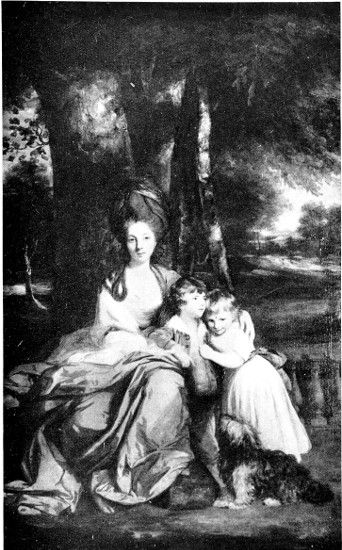
Collection of Mr. and Mrs. Herbert L. Satterlee
LADY BETTY DELMÉ
—Sir Joshua Reynolds
When we think of the thousands of pictures that Sir Joshua painted—all of them fine and many of them great—we stand amazed at the capacity of the artist who produced them. They were all creations! The five portraits of little Isabella Gordon known as Angels’ Heads (National Gallery, London), which in lightness, delicacy, and iridescence have been compared to the petals of a flower and the melting softness of the rainbow; Mrs. Siddons as the Tragic Muse; the Strawberry Girl; the Age of Innocence; Nelly O’Brien; Kitty Fisher; Penelope Boothby; Mrs. Abington; Lord Ligonier; The Graces Decorating a Terminal figure of Hymen; Diana, Lady Crosbie; Mrs. Hardinge; Lady Cockburn and her Children;—all belong to the first rank of original and artistic achievement.
“Reynolds,” Sir Walter Armstrong writes, “arrived at results scarcely to be distinguished from those of genius, and did so entirely by the action of an original mind and a profound taste upon accumulated materials. His path towards excellence was conscious, discriminative, judicial. Every step he took was the result of a deliberate choice. He felt no heats driving him into particular expression in his own despite. Just as by fairness of mind he produced the effect of sympathy among his friends, so by unerring judgment he produces the effect of creation on us who value his art. He appears to me the supreme, if not the only, modern instance of a painter reaching greatness along a path, every step of which was trodden deliberately, with a full consciousness of why it was taken and whither it was leading, and with the power unimpaired to turn back or to change the goal at any moment. Superficially the art of Sir Joshua resembled that of Raphael as little as it well could; mentally the processes of the two men were curiously alike. Both possessed taste to such a degree that it became genius; and both were endowed, for the service of their taste, with a mental industry which is rare.”
It is unfortunate that Sir Joshua experimented so deeply with his pigments and glazes so that we can see none of his pictures in their pristine beauty and brilliance. That he was a rare colorist we would know from Mrs. Siddons as the Tragic Muse and the Angels’ Heads—the former rich and gorgeous and the latter iridescent and delicate—showing the two extremes.
Here is Sir Joshua’s palette given in the Farington Diary under date of August 14, 1806:
“Marchi (Sir Joshua Reynolds’s assistant) I called on before dinner to desire him to call upon J. Taylor to give his opinion of a picture said to be a portrait of Garrick by Sir J. Reynolds. I desired Marchi to state to me what colors Sir Joshua Reynolds had placed upon his palette and the order in which they were laid. He named them as follows. He used a handle palette as it is called: White; Naples Yellow; Yellow oker; Vermillion; light red; lake; black. Asphaltum he used occasionally, but that he had it in a galley-pot. His vehicles were: Mastick varnish and drying oil made into Macgilp in a pot. Nut oil which he used with his white in a pot. Mastick varnish only, which he sometimes used alone; and Marchi observed that it caused his colors to crack and fly off. Wax (white virgin wax) he had in a tin pot which he melted at the fire when he proposed to use it. This vehicle Marchi observed caused his colors to scale off from the canvas in flakes.”
To mention the sitters who came to Leicester Fields and the company that gathered there every evening when Sir Joshua was not dining out would be to list the entire society of London in the Eighteenth Century.
“In these days we are apt to forget that to many of Sir Joshua’s contemporaries, with the stricter notions of social precedency in vogue a century ago,” Sir Walter Armstrong notes, “the painter’s station in London society must have seemed almost an outrage, especially as it had been won without any kind of pretence or undue submission to those who were then called the great. Fond as he was of the best that Society could give, he lived his life in his own way, invited whom he chose to his table, leaving his guests to shake down among themselves as best they could, and, so far as we can discover, paying little heed to prejudices on the matter of birth, and still less to those which had to do with politics or conventional morality.”
Lord Ronald Sutherland Gower has made this very interesting comparison of Romney and Reynolds:
“The mighty events which were in progress around him—the war with the American Colonies, and the supervening naval war with France and Spain—ran their course without personally affecting him, whereas Reynolds was in constant touch with the men who were most vigorously opposing Lord North’s policy, with Burke and Charles Fox; and it was his own intimate friend of nearly thirty years standing, Admiral Keppel, whose trial in this very year 1778, formed the central battle-ground between the Court and the popular party. In all these things Reynolds was intimately concerned, as he was in the lighter events of social life, with his constant dinner-parties at Leicester Fields, his still more constant attendance at the tables of the great and the assemblies of Mrs. Montagu and Mrs. Ord, his outings to Streatham, and his mild flirtation with ‘Little Burney.’ But Romney lived remote, as remote in his shyness and isolation as Gainsborough lived in his fondness for a Bohemian world—the world of artists that painted and played and left war to the soldiers and politics to the politician. It is true that a couple of years afterwards politics were brought pretty closely home to both of them, as they were, nolentibus volentibus, to all the householders in London. The Keppel riots in 1778, celebrating the acquittal of the popular Admiral, were festive and pleasant enough; noblemen and gentlemen went out with the crowd; young Pitt, it is said, helped to break Lord North’s windows; and young Rogers, the banker-poet, to unhinge the gates of the Admiralty. This was very well and very pleasant; but two years later the mob improved upon their lesson, and in the Lord George Gordon Riots London was ablaze.”
THE STRAWBERRY GIRL.
Sir Joshua Reynolds Collection of
(1723–1792). Mrs. Francis F. Prentiss.
James Northcote in his Life of Sir Joshua Reynolds notes: “The picture of a little Strawberry Girl was painted about this time (1775?) and he considered it one of his best works, observing that no man ever could produce more than about half a dozen really original works in his life; “and this picture,” he added, “is one of mine.”
This little girl is about three years old and is shown at three-quarter length with a handkerchief folded around her head after the fashion of a turban, the curls escaping from her forehead. She wears a lightcolored dress with a pinafore caught over her arm. At her neck is a ribbon bow. Her hands are demurely folded at the waist and over her right arm hangs a cone-shaped strawberry “pottle.” The background is composed of large rocks and trees at the right.
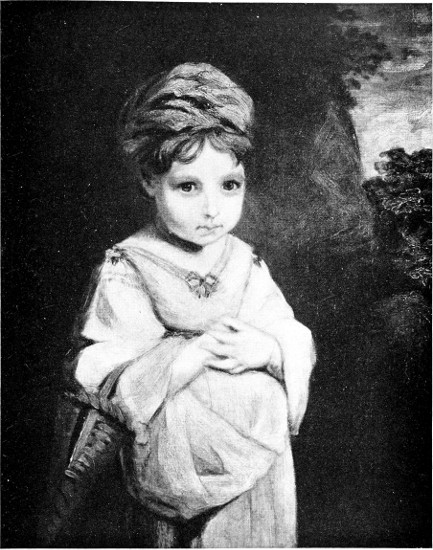
Collection of Mrs. Francis F. Prentiss
THE STRAWBERRY GIRL
—Sir Joshua Reynolds
The picture is painted in oils on canvas (29 × 24 inches) and is a replica of the original in the Wallace Collection, London.
Leslie and Taylor voiced so well the impression that every one has when looking at this fascinating work that what they said bears quoting:
“The Strawberry Girl with her pottle on her arm, creeping timidly along and glancing round her with large, black eyes, might be Little Red Riding Hood hearing the first rustle of the wolf in the wayside bushes, could we substitute a red hood for the odd turban-like head-dress with which the painter has crowned his little maiden, and which even Sir Joshua’s taste can barely make becoming, and hang on her arm the basket of butter and eggs for her sick grandmother instead of the strawberry pottle which gives her a name.”
The model for The Strawberry Girl was Miss Theophila Palmer, Sir Joshua’s favorite niece, who lived with him and looked after him until her marriage. Her name Theophila was divided into two pet names. “The” and “Offie,” upon which Sir Joshua once wrote a playful-verse:
When I’m drinking my tea, I am thinking of The, When I’m drinking my coffee, I’m thinking of Offie, So, whether I’m drinking my tea or my coffee, I always am thinking of thee, my The-Offie.
In the Farington Diary (Vol. IV), by Joseph Farington (London, 1924), we also learn that Miss Theophila Palmer was the “My dear Offy” of Sir Joshua’s letter, dated Jan. 30, 1781, in which he wished that she and Mr. Robert Lovell Gwatkin of Kellrow, Truro, Cornwall, her future husband, “may be as happy as both deserve—and you will be the happiest couple in England. So God Bless you!”
Fanny Burney, in a description of a reception at Sir Joshua Reynolds’s house in Leicester Square, refers to young Gwatkin, the Cornish Squire, “making sheep’s eyes at Offy, whose uncle, Sir Joshua was very fond of her.” “I never was,” he wrote to Offy, “a great friend to the efficacy of precept, nor a great professor of love and affection, and, therefore, I have never told you how much I loved you for fear you should grow saucy upon it.”
The well-known picture of Simplicity is of Theophila Gwatkin, daughter of Mr. and Mrs. Robert L. Gwatkin and this little girl was also known affectionately as The.
DIANA, VISCOUNTESS CROSBIE.
Sir Joshua Reynolds Collection of the late
(1723–1792). Mr. Henry E. Huntington.
Sir Joshua Reynolds pronounced the Strawberry Girl one of his most original creations. The portrait of Diana Lady Crosbie certainly ranks as another. All critics are united in considering it one of the finest productions of the master’s brush. Who but Sir Joshua would ever have thought of such a pose?
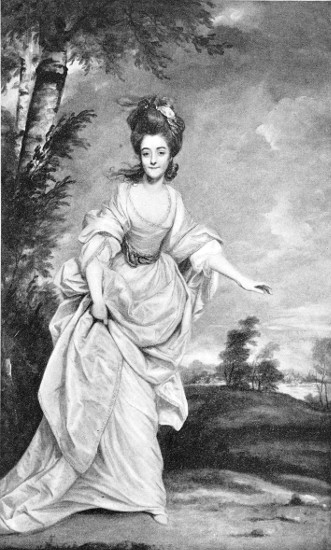
Collection of the late Mr. Henry E. Huntington
DIANA, VISCOUNTESS CROSBIE
—Sir Joshua Reynolds
The Honorable Miss Diana Sackville, daughter of Lord George Sackville, aged twenty-one, was engaged to be married to Viscount Crosbie (son and heir of the first Earl of Glandore) and was visiting his seat, Ardfert Abbey, Kerry, Ireland. Lord Crosbie sent for Sir Joshua Reynolds to come and paint the portrait of Lady Diana; and the story goes that soon after arriving Sir Joshua caught sight of Lady Diana running across the lawn. He was so fascinated by her lightness and grace that he begged permission to paint her as he had first seen her.
Consequently, we have Lady Diana surprised in the act, as it were, of tripping over the park, holding up her dress with her right hand and extending her left in graceful attitude. The dress is white silk, bound at the waist by a gold sash, and beneath the folds of the dress, so exquisitely painted, the tip of a small slipper is seen. The picture was painted in September, 1777, and two months later Lady Diana was married to Lord Crosbie. In 1781, when her husband succeeded to the title, Lady Crosbie became, of course, Countess of Glandore. She died in 1814. For painting this portrait Sir Joshua received £78.15.
The picture, oils on canvas (93 × 58 inches), left the Crosbie home only within recent years to occupy a place of honor in Sir Charles Tennant’s drawing-room in London. From the Tennant Collection it went directly to California. The picture has been engraved several times and the best known engravings are by W. Dickinson (1779); James Scott (1863); and R. S. Clouston (1890); and “proofs before letters” of these plates bring very high prices in the auction-rooms.
“Here is a miracle of vivacity,” says Spielmann, “so natural, so alive, that you almost forget that you are in front of a picture as you look at this lady who moves across the canvas with outstretched hand to greet you as you approach. Rarely have animation and movement been so completely realized on canvas. The design is finely sustained by the mellow, golden tone of the white dress and the telling note of the golden scarf, all seen against a convincing landscape that seems entirely novel in Reynolds’s open-air portraits.”
MRS. SIDDONS AS THE TRAGIC MUSE.
Sir Joshua Reynolds Collection of the late
(1723–1792). Mr. Henry E. Huntington.
This gorgeous portrait, oils on canvas (93 × 56 inches), was painted in 1785, when the famous actress was twenty-eight, in the full bloom of her beauty and fruition of her talents; and it is rightly described by Mrs. Jameson as “the apotheosis of her genius and beauty.” It is painted in the “grand style” with rich coloring of amber and purple, the Tragic Muse seated on a throne among the clouds with her head lifted as if listening to some inspiring voices and her hand raised as if to command silence. A coronet of pearls adorns her hair, and heavy ropes of pearls are wound around her neck and are knotted loosely in front. Over her lap is thrown a drapery, on the hem of which Sir Joshua painted his name.
The poetic and dramatic conception of the picture show how much Sir Joshua admired Michelangelo’s Prophets and Sibyls in the Sistine Chapel.
In this magnificent work Sir Joshua certainly realized his theories regarding the “grand style” as expressed in his Fourth Discourse to his pupils: “To give a general air of grandeur at first view all trifling or artificial play of little lights, or an attention to a variety of tints, is to be avoided; a quietness and simplicity must reign over the whole work; to which a breadth of uniform and simple color will very much contribute.”
In the theatrical annals of England the Kemble family rank with the later Trees and Terrys; and Mrs. Siddons was a Kemble. Sarah Siddons, the eldest daughter of Roger Kemble, actor and theatrical manager, was born in 1755 in Brecon, Wales, where her father was managing a troupe of players. She was the sister of Charles Kemble, the famous comedian and manager of the Covent Garden Theatre, and aunt of Fanny Kemble, the noted actress. At an early age, Sarah played small parts in her father’s company and when she was eighteen was married to a young actor named Siddons, also in the Kemble company. Soon afterward Mr. and Mrs. Siddons appeared in The Clandestine Marriage in the provinces. Sarah Siddons soon attracted Garrick’s attention and he gave her an engagement at Drury Lane; but she was not a success. She then went to Bath, where she became a favorite and established her reputation. In 1783 she reappeared at Drury Lane and this time she took London by storm. Then she went to Dublin, where more triumphs added to her confidence as well as to her fame; and, when she returned to London, it was to Covent Garden, where her brother, John Philip Kemble, was manager. Mrs. Siddons shone especially in tragedy and achieved, perhaps, her greatest success as Lady Macbeth. When Byron saw her in this rôle he wrote: “It was something transcending nature; one would say that a being of a superior order had descended from a high sphere to inspire fear and admiration at the same time.”
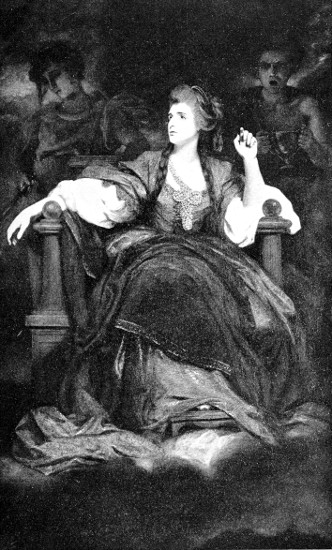
Collection of the late Mr. Henry E. Huntington
MRS. SIDDONS AS THE TRAGIC MUSE
—Sir Joshua Reynolds
Mrs. Siddons’s great parts were Lady Macbeth, Portia, Constance, Isabella, Jane Shore, Almeira, Lady Ann, Calista, Belvedera, and Mrs. Beverly. In 1812 she retired from the stage with a large fortune and died in 1831. Thomas Campbell wrote her life in 1834.
All the portrait-painters of the day had Mrs. Siddons sit to them. The most famous pictures, however, were Reynolds’s Tragic Muse; Gainsborough’s beautiful one in an afternoon costume of light blue, striped silk, black hat, yellow scarf and muff, in the National Gallery, London; and two by Lawrence, also in the National Gallery, London.
“It was probably after his return from his tour of the Low Countries that Mrs. Siddons, now in the very flush of her popularity, sat to him. She had not yet acted in Shakespeare, unless her first appearance as Isabella (Measure for Measure) and as Constance (King John) with her brother, John Kemble (for whom her success had procured a leading engagement at Drury Lane), preceded her first sittings, which is possible, though not probable. Her fame has been won in such parts as Isabella (in The Mourning Bride), Euphrasia (in The Grecian Daughter), Jane Shore, Calista, Belvedera, Zara, and Mrs. Beverly. The Royal Family, little as they loved tragedy, had already distinguished her by every mark of favor. Her house was besieged by the noble and fashionable. The managers of Drury Lane had gladly supplemented her modest salary of ten pounds a week by a double benefit; and in June she had left London—after a series of successes which almost eclipsed the still recent fame of Garrick—for Ireland and a short round of provincial performances. Mr. Russell, author of the History of Modern Europe, had sung her praises under the title of The Tragic Muse, before she left London. His verses are forgotten, but they may have suggested to Reynolds the subject of his picture. It could not have been prompted, as Boaden imagines, by an allusion in the epilogue to Tancred and Sigismunda, as her first appearance in that tragedy was on the 24th of April, 1784, when the picture was already in its place on the walls of the Exhibition-Room. The conception of this noble work was no doubt suggested by Michelangelo’s Isaiah. Mrs. Siddons told Mr. Phillips that it was the production of pure accident. Sir Joshua had begun the head and figure in a different view; but while he was occupied in the preparation of some color she changed her position to look at a picture hanging on the wall of the room. When he again looked at her and saw the action she had assumed, he requested her not to move; and thus arose the beautiful and expressive figure we now see in the picture.”[24]
Yet there is still another story, which is told by Mrs. Jameson. Mrs. Siddons used to describe Sir Joshua as taking her by the hand and leading her up to his platform with the words: “Ascend your undisputed throne; bestow on me some idea of the Tragic Muse.” On which, Mrs. Siddons said: “I walked up the steps and instantly seated myself in the attitude in which the Tragic Muse now appears.” It is most likely that both stories are true. Sir Joshua’s leading the Queen of the London Stage to her throne on his painting-platform with his courtly compliment was thoroughly in character and that he also encouraged The Tragic Muse to act her part and create expression as well as take a dramatic pose, is also most in keeping with the exciting moment. Sir Joshua undoubtedly foresaw that he had the opportunity of producing his greatest masterpiece.
Mrs. Siddons also related that when Sir Joshua was putting the last touches to the work he said: “I cannot resist the opportunity for going down to posterity on the edge of your garment,” upon which he painted his name and the date 1784 on the hem of the robe.
However, Sir Joshua had already done this ten years before in the portrait of Lady Cockburn and her Children, in the National Gallery, London, where the name and date make a decorative finish to Lady Cockburn’s amber-colored robe trimmed with white fur thrown across her lap and that famous picture was begun in 1773 and finished in 1775.
The Tragic Muse was greatly admired when it first appeared. The Public Advertiser, April 28, 1784, said:
“It is impossible to be too lavish in its praise; it is, indeed, a most sublime and masterly performance and undoubtedly one of the very best that ever was produced by Sir Joshua. He seems to have conceived and executed it with enthusiasm. Mrs. Siddons is drawn in the character of The Tragic Muse, the composition is in a grand style, the figure possesses great dignity, and that fine expression of countenance for which the original is preëminent and almost unrivalled. Sir Joshua has been said to paint the mind; and perhaps there never was a more striking instance of it than in this performance. The accompanying genii ready to administer the dagger or the bowl have also great expression, and in the effect of the tout ensemble there is a grandeur and a solemnity suited to the subject and highly worthy of universal admiration.”
It is illuminating, too, to dip into the Farington Diary (London, 1925), and note in 1801:
“Opie thinks the Mrs. Siddons by Sir Joshua the finest picture he knows. Opie thinks the picture of Mrs. Siddons much superior to any of the Titians which were brought by Day from Rome.
“Bourgeois mentioned that Sir Joshua had said the principle to work upon is to fix a high light and a lowest depth to which all other lights and dark parts should be subordinate.”
In 1808 we read:
“Lawrence spoke with the highest admiration of Sir Joshua Reynolds’s portrait of Lord Heathfield now at the European Museum, having been sent there by Boydell to be sold for 350 guineas. He said this picture and the portrait of Mrs. Siddons by Sir Joshua are the top of his Art.” And again in the same year: “We looked at the picture of Mrs. Siddons by Sir Joshua Reynolds. Lawrence said, it was his best picture. I said, it was a high refinement of Rembrandt. Mr. Smith[25] said he gave £320 for it, which was not half what Calonne paid. It cost the latter £800.”
On the authority of Lord Ronald Sutherland Gower in Sir Joshua Reynolds (London, 1902), we learn:
“There is another version of The Tragic Muse in the Dulwich Gallery. This was sold by Reynolds to M. Desenfans for seven hundred guineas in 1790 and the date on the hem of her garment is 1789, from which it appears that he completed this five years after the Grosvenor House picture. Both of these may be regarded as the authentic work of the master. There is a replica also of The Tragic Muse at Langley Park, near Stowe, which is said to have been given by Reynolds to Mr. Harvey in exchange for a painting by Snyders of a Boar Hunt; and another was in the possession of Mrs. Combe in Edinburgh. I think there is no doubt that these replicas are by the hands of Reynolds’s assistants.”
Mrs. Siddons in the Dulwich Gallery (canvas 93 × 57 inches) described as follows:
“She sits on a throne in front view and looks up towards the right; the right arm and the left elbow rest on the throne; with the hand raised as if listening to some inspiring voice; a coronet on the back of her hair; wearing an amber brown dress, with rows of pearls round her neck; across her lap is a robe, on the hem of which Sir Joshua has inscribed his name. Paid for, February 1790, Mrs. Siddons, sold to Mr. Desenfans £735.”
The picture was purchased from Sir Joshua in 1790 by Noel Desenfans and by him bequeathed to Sir Francis Bourgeois, R. A., by whom it was left to Dulwich College. It hangs in the picture gallery there. It is interesting to note that the date on the hem of the robe is 1789—five years after the Duke of Westminster’s picture! Some critics think that Sir Joshua also painted this replica himself.
Leslie and Taylor mention in their Life of Reynolds that they failed to find any note relative to Score’s making a copy of The Tragic Muse; but they draw attention, on the contrary, to the following extract from Northcote’s Life of Reynolds:
“The picture of a little Strawberry Girl with a kind of turban on her head was painted about this time (1772) and he considered it one of his best works, observing that no man ever could produce more than about half a dozen really original works in his life; ‘and this picture,’ he added, ‘is one of them.’ The picture was exhibited (1773) and repeated several times; not so much for the sake of profit as for that of improvement, for he always advised as a good mode of study, that a painter should have two pictures in hand of precisely the same subject and design and should work on them alternately; by which means, if chance produced a lucky hit, as it often does, then instead of working on the same piece, and by that means destroy that beauty which chance had given, he should go to the other and improve upon that. Then return again to the first picture, which he might work upon without any fear of obliterating the excellence which chance had given it, having transposed it to the other. Thus his desire of excellence enabled him to combat with every sort of difficulty or labor.
“The compilers’ theory, then, is: after the sketch of Mrs. Siddons’s portrait was laid in, he took up a fresh canvas, made a replica and worked on both alternately until ‘the lucky hit’ was produced and that appeared to Sir Joshua in the picture finished and exhibited in the Royal Academy, 1784. Notwithstanding the glowing eulogiums passed upon it, a purchaser was not found for it until 1788, when it was sold to M. de Calonne. Sir Joshua did not record the sale in his ledger, or note-book, and it only transpired when Skinner and Dyke sold at their rooms, Spring Gardens, 1795, the English pictures of the Calonne Collection and specified in the Catalogue that M. de Calonne paid Sir Joshua 800 guineas for the portrait of Mrs. Siddons in the character of the Tragic Muse.
“At this time M. Desenfans was Consul-general in Great Britain for the Kingdom of Poland, a writer of marked ability, a recognized authority on art, an extensive picture-dealer, employed by the King of Poland to purchase high-class Old Masters to complete his Collection and who kept up an acquaintance with Sir Joshua, notwithstanding the trick he played of selling him, through Cribb, his frame-maker, the copy of a Claude, specially made by Marchi for the purpose as an original. The compiler’s surmise is, then, that he knew Sir Joshua had the unfinished replica on hand, and came to an understanding with him to complete it in its present form, ‘signed and dated 1789 on the edge of the robe.’ This investigation leads to three inferences; first, that Sir Joshua would not condescend, for any consideration, to sign and date a copy of The Tragic Muse made by Score; secondly, that an astute man of business, such as Desanfans was, would not give £735 for a copy; thirdly, that The Dulwich picture must now be regarded in the same light as the Westminster one—both from the hand of Reynolds; but which was first commenced cannot be ascertained.”
GEORGIANA, DUCHESS OF DEVONSHIRE.
Sir Joshua Reynolds Collection of the late
(1723–1792). Mr. Henry E. Huntington.
It is interesting to compare this picture by Sir Joshua with Gainsborough’s Duchess of Devonshire (see page 373), which is probably the earlier of the two. This picture, oils on canvas (94 × 57 inches), was exhibited at the Royal Academy in 1776 as No. 233. The Duchess had not long been married when this picture was painted, as her marriage took place in 1774. There is something in the pose that suggests the portrait of Diana, Lady Crosbie, which was painted later. The Duchess is represented full-length facing the left, in the act of descending a flight of stone steps, her right hand placed on the balustrade and her left holding her dress very gracefully. The dress is cream-colored cut low in the neck and fashioned with full sleeves. The skirt is gracefully cut and abounds in plaits and draperies. A gauzy scarf is wound around her right arm and floats below. The hair is dressed very fashionably with a long and round curl pinned tightly at the back of the neck and reaching the shoulder, and above the braid which forms a coronal the hair mounts higher and is ornamented by pearls and grey and red feathers. Vines are growing gracefully around the balustrade, beyond which and through the near-by trees we see an open vista of the park with a statue at the left. Presumably this is Chatsworth, the seat of the Duke of Devonshire.
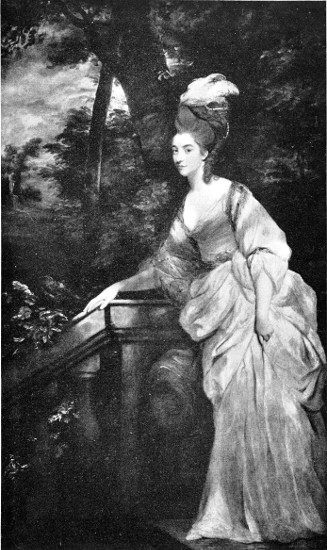
Collection of the late Mr. Henry E. Huntington
GEORGIANA, DUCHESS OF DEVONSHIRE
—Sir Joshua Reynolds
The picture was in the Collection of Earl Spencer, K. G., at Althorp, Nottinghamshire, before it was taken to California.
THE COTTAGE DOOR.
Thomas Gainsborough Collection of the late
(1727–1788). Mr. Henry E. Huntington.
The little group is assembled in front of a thatched cottage, beside which a gnarled and withered tree rises scarred and seared by the storms of many years. Overhanging the roof a large tree droops its feathery Gainsborough foliage and, on the left, half of another feathery Gainsborough tree is waving in the summer breeze. By this tree, and farther back as well, a stream is seen falling in a little cascade beneath a rustic bridge. Luxuriant weeds grow in the foreground and by the side of the cottage, the door of which is open and beside which a peasant’s family is grouped. The mother, in yellowish brown skirt and white bodice, has a suggestion (save for the costume) of the beautiful ladies that sat to Gainsborough. In her arms is a baby. On her right, is a little boy, scantily dressed, who is eating something; in front of her are two children, one holding a bowl and the other dipping from it with a spoon; a fifth child, with one hand on his head and the finger of his left hand in his mouth, looks forward shyly; and the sixth is seated on the ground by his side. “Old pimply-nosed Rembrandt,” as Gainsborough called him, never lighted a scene more beautifully, nor more marvellously than this.
The picture, oils on canvas (57 × 46 inches), is one of Gainsborough’s most mature works and dates from about 1776–1778.
Bought by T. Harvey of Catton, Norfolk, in 1786, it passed to Mr. Coppin of Norwich in 1807. Then it became the property of Sir John Leicester, Bart., created Lord de Tabley in 1826; and at the Sale of the effects of the latter it was bought by Earl Grosvenor, created Marquess of Westminster in 1831. In 1921 The Cottage Door was sold by the second Duke of Westminster to Mr. Henry E. Huntington.
“There is no painter of English birth more widely appreciated than Gainsborough whose art touches every observer, great and simple, learned and unlearned. As we look at his pictures, said Constable, we find tears in our eyes and know not what brings them. A thread of romance runs through the whole of Gainsborough’s career, from his marriage to a beautiful and well-dowered bride, whose origin is shrouded in mystery, down to the pathetic termination of the long years of jealous rivalry with Reynolds. And romance and mystery are inseparably connected with his pictures—with the portraits of that Duchess of Devonshire, whom tradition has brought us to regard as typical of English beauty, with that masterpiece at Edinburgh, the portrait of Mrs. Graham, hidden from sight for fifty years on account of one of the tenderest of love stories; and with the famous Blue Boy, the secret of whose history still remains undiscovered.”[26]
“Old pimply-nosed Rembrandt and myself were both born in a mill,” Gainsborough used to say, because his father, John Gainsborough, was a manufacturer of woollens in Sudbury. Thomas was born there in 1727. At twelve he was said to be a “confirmed painter.” His first portrait seems to have been a great success. Some one had been stealing pears from the Gainsborough orchard and one day, when young Thomas was sketching there he saw a man’s face peering over the fence. Instantly he made a quick sketch and took it into the house. By means of this sketch the culprit was identified. Gainsborough then enlarged the sketch, painted an oil portrait, mounted it on a board, and stuck “Tom Peartree” up to the delight of all the neighbors and confusion of strangers. This picture was lent to the Gainsborough Exhibition held at the Grosvenor Gallery in 1885 and is now in the Elizabethan Mansion in Christchurch Park, Ipswich.
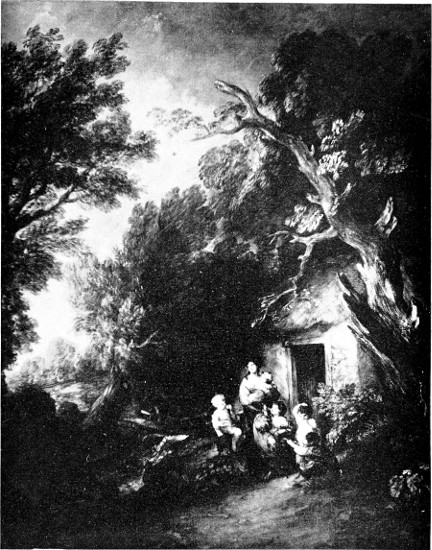
Collection of the late Mr. Henry E. Huntington
THE COTTAGE DOOR
—Thomas Gainsborough
In 1741 Gainsborough went to London and, after studying under Hubert Gravelot and Francis Hayman, took a studio in Hatton Garden and tried to start as a portrait and landscape-painter. A year of failure decided the young artist to return home. In a short time he married Margaret Burr (supposed to be a natural daughter of the Duke of Bedford) and removed to Ipswich. Here he painted chiefly landscapes. About 1760 he settled in Bath and immediately became the fashion. Fourteen years later Gainsborough removed to London, where his success continued and he became the rival of Reynolds. Gainsborough had already in 1768 been nominated by George III one of the thirty-six Academicians on the foundation of the Academy and he exhibited almost yearly at the Royal Academy from 1769 to 1788, when there was a misunderstanding about the hanging of his pictures. Gainsborough died in 1788, closing one of the most remarkable careers in art, for this great painter was almost entirely self-taught. Reynolds called attention to this remarkable fact in his Fourteenth Discourse, in which he cites Gainsborough as an example of an artist who has arrived “at great fame without the assistance of an academical education, or any of those preparatory studies which have so often been recommended.”
Yet his genius was such that he attained the greatest eminence in his day and his place in art to-day is in the small circle of the very great ones.
Ruskin did not exaggerate in the least when he wrote: “Gainsborough’s power of color is capable of taking rank beside that of Rubens; he is the purest colorist of the English School; with him, in fact, the art of painting did in great part die and exists not now in Europe. In management and quality of single and particular tint, in the purely technical part of painting, Turner is a child to Gainsborough. His hand is as light as the sweep of a cloud, as swift as the flash of a sunbeam. He never loses sight of his picture as a whole. In a word Gainsborough is an immortal painter.”
Gainsborough painted about seven hundred portraits and two hundred landscapes. Strange as it may seem, he preferred to paint landscapes. At least he told George III this. And he told his friend Jackson in a letter “I’m sick of Portraits and wish very much to take my viol-da-gamba and walk off to some sweet village where I can paint landskips and enjoy the fag-end of life in quietness and ease.”
This seems strange coming from one of the greatest of all portrait-painters.
To read the list of Gainsborough’s portraits is to run through the Social Register of London and Bath. Gainsborough painted “everybody that was anybody.” The great personalities of the day wanted their portraits “limned” by both Reynolds and Gainsborough, often adding Romney and Hoppner as well. The fourteen years that he lived in Bath Gainsborough’s painting-room was almost as much of a rendez-vous as the Pump Room and his sitters ranged from the most aristocratic and wealthy, such as Earl Spencer, his wife, and little daughter, the future Duchess of Devonshire, to statesmen, like Pitt, and actors like Garrick and Quin. The latter sat three times to Gainsborough. The following little piece of amusing acting usually took place. Quin, suffering from gout, would hobble to the painting-room and tapping at the door would ask “Is Old Grumpus in?” Gainsborough would reply “Come in”; and, placing a chair for his friend and a stool to rest his foot upon, would put on a grave, doctorial look and, resting his chin on his maul-stick, would inquire in the Bath phrase: “Well, how is toe?”
Quin evidently was a critic: “Sometimes, Tom Gainsborough,” he said, “a picture in your rigmarole style appears to my optics the veriest daub,—then, the devil’s in you, I think you a Van Dyck!” And Gainsborough would tell Quin that “nothing could equal the devilism of portrait-painting.”
“Indeed, he told me,” Angelo relates, “at his house in Pall Mall, that he was sure the perplexities of rendering something like a human resemblance from human blocks was a trial of patience that would have tempted holy St. Anthony to cut his own throat with his palette-knife.”
Gainsborough was devoted to music, played several instruments and was a great friend of the oboe-player in the Queen’s Band, John Christian Fischer, who married his daughter Margaret; of John Christian Bach, son of the great John Sebastian Bach; and of Bach’s associate, Charles Frederick Abel, the celebrated virtuoso on the viol-da-gamba, whose portrait Gainsborough painted with his instrument by his side, and which is now in the Huntington Gallery.
Gainsborough’s portrait by Zoffany in the National Portrait Gallery, London, presents a handsome and rather dashing man of about thirty-five with classic features and large, fine eyes with penetrating glance and an intelligent, interior light. Had he not been a painter he might have easily become a beau, or a gallant officer of the Major André type, or of that impudent young dog, Jack Absolute, who captivated Miss Lydia Languish in The Rivals.
It was the same in London as it had been in Bath. Gainsborough became the fashion. He barely had time to fill all the orders that came thick and fast and he enjoyed society and still more his cronies, and, to judge from numerous anecdotes, was not averse to wild companions; but for all that he was generous, sympathetic, outgoing, and much beloved by his friends.
As an instance of his ready wit on one occasion, when he was in court regarding a picture the councillor tried to embarrass him. “I observe,” he said, “you lay great stress on a painter’s eye. What do you mean by that expression!” “A painter’s eye,” replied Gainsborough, without a moment’s hesitation, “is to him what a lawyer’s tongue is to you!”
Gainsborough was sprightly, humorous, and lively in conversation and indeed, in society, to use the word of the period, something of a “rattle.”
Whenever he appeared, either at a morning lounge at Christie’s amidst the enlightened and polite, or at My Lady’s midnight rout surrounded by bowing beaux and curtseying belles, his gaiety enlivened every group. He knew everybody and everybody knew him; he was, however, most at home with the worthies of the auction-room. For some years Garrick was frequently his companion at Christie’s, where the amusement caused by the humor common to both never failed to give an additional zest to the proceedings. Mr. Christie often declared that “the presence of this choice pair added fifteen per cent to his commission on a sale.”
And this was a “choice pair,”—Garrick and Gainsborough!
“We know as little about Gainsborough’s tools and methods of painting as we do of his pigments, but if his daughter’s memory may be trusted, her father worked with paint so thin and liquid that his palette ran over unless he kept it on the level. It is generally agreed that he used very long brushes, and Nollekens Smith who saw him at work, says: ‘I was much surprised to see him sometimes paint portraits with pencils on sticks full six feet in length and his method of using them was this: he placed himself and his canvas at a right angle to the sitter, so that he stood still and touched the features of his pictures exactly at the same distance at which he viewed the sitter.’ The anonymous biographer of the Morning Chronicle who knew the painter excuses his supposed want of finish by saying that he worked with a very long and broad brush. Another contemporary, John Williams (Pasquin), in a biographical note declares that Gainsborough always prided himself upon using longer and broader tools than other men and upon standing farther away from his canvas when at work. That he always stood to paint we know from Thicknesse, but it is obvious that all his work could not have been done with broad tools of hog-hair. Probably he used camel-hair brushes sometimes, as did Gainsborough Dupont, who inherited his uncle’s implements and colors and in painting followed his manner exactly. Dupont left behind him, in addition to a great quantity of hogtools, ‘twelve bundles of camel’s hair pencils.’ Fulcher says that when Gainsborough’s sitters left him it was his custom to close the shutter, in which was a small circular aperture, the only access for light and by this subdued illumination work on his picture and get rid of superfluous detail. No authority is given for this statement, but there can be little doubt that Gainsborough loved to subdue the light in his painting-room. Williams says that it was sometimes subdued to such an extent that objects were barely visible.”[27]
And Osias Humphrey, R. A., tells us a little more, drawing from his memories of Bath,... “Exact resemblances in his portraits was Mr. Gainsborough’s constant aim, to which he invariably adhered. These pictures, as well as his landscapes, were frequently wrought by candle-light and generally with great force and likeness. But his painting-room—even by day a kind of darkened twilight—had scarcely any light and I have seen him, whilst his subjects have been sitting to him when neither they nor the pictures were scarcely discernible.” We also learn that Gainsborough let in more light when the picture reached its finishing stages.
THE MALL IN ST. JAMES’S PARK.
Thomas Gainsborough Collection of the late
(1727–1788). Mr. Henry Clay Frick.
Horace Walpole characterized this delightful picture as airier than a Watteau and “all in motion and flutter like a lady’s fan.” It is one of Gainsborough’s latest works, painted in 1786, and one of his masterpieces, oils on canvas (57¾ × 47½ inches). The picture was among those in the painter’s studio at the time of his death. After a few changes of ownership, it passed into the Collection of George Frost, an artist and fellow-townsman of Gainsborough, and then to Sir Audley Dallas Neeld, Bart., Grittleton House, near Chippenham, Wiltshire.
The Mall is a perfect epitome of London society in the Eighteenth Century—the London of Austin Dobson.
“The Mall from the days of the Stuarts until the closing years of the Eighteenth Century was the field upon which fashion, and feminine fashion especially, chose to disport itself. Twice a day social London donned its best apparel and took a turn under the trees, once at midday and again, in summer, in its evening clothes after the early dinner. Here fashion met its friends, exchanged its repartees, made appointments for evening rendez-vous at Ranelagh or Vauxhall, ate fruit or bought flowers from Betty’s girl out of St. James’s Street, or drank syllabubs from the red cow’s milk which was one of the attractions of the London parks. Nothing in the external aspect of London more struck the intelligent foreigner than the amenities of the promenade in the Mall. One of these gentlemen concluded an eloquent pæan on the beauty of the lady promenaders, by recording with rapture that of a morning the very ground glistened with the pins which they had dropped. The Mall, indeed, was the very shrine of flounce and furbelow until somewhere about 1795, when fashion unaccountably moved northward to the walk in the Green Park at the back of Arlington Street, and from there later to Hyde Park and Kensington Gardens.
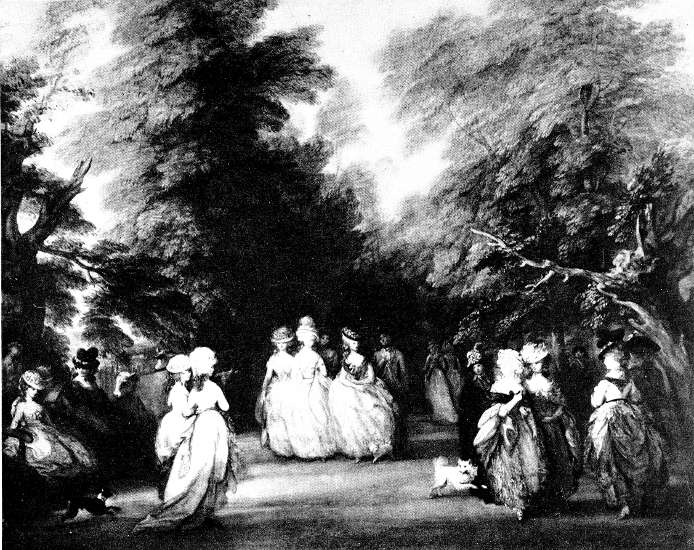
Collection of the Mr. Henry Clay Frick
THE MALL
—Thomas Gainsborough
“The very spirit of this life is preserved in Gainsborough’s picture, one of the few canvases in which he represents figures in motion; singular also among his work is that it contains a score or so of figures. There is a central group of four ladies with an attendant cavalier advancing towards the spectator, a pair on the right, two pairs on the left passing each other, others again seated on the right. The accidental episodic quality of such a subject is perfectly conveyed—the transient glance of a passing woman, the turn of the neck appropriate to that attitude, the ground dotted with an occasional dog. Technically it represents Gainsborough at his highest, where the solemn tones of his earlier manner have disappeared, and the very painting itself seems to echo his delight in the mastery of heightened, luminous color.”[28]
MARIA WALPOLE, DUCHESS OF GLOUCESTER.
Thomas Gainsborough Collection of
(1727–1788). Mr. and Mrs. Charles P. Taft.
The subject of this portrait was famous under three names: her maiden name of Maria Walpole; as Lady Waldegrave; and as the Duchess of Gloucester. She was very beautiful (no one could compete with her but the Gunning sisters); she was very witty and brilliant; and, moreover, she was noted for her rich qualities of heart and character. Her uncle, Horace Walpole, was devoted to her.
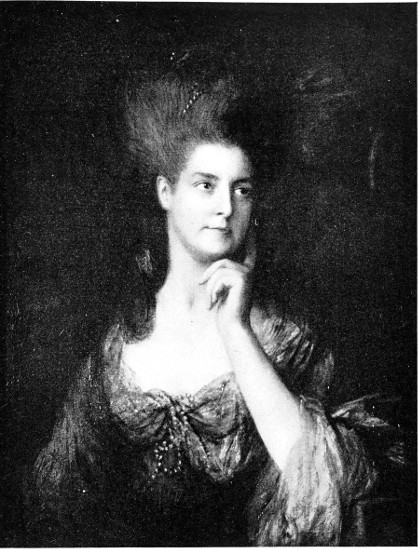
Collection of Mr. and Mrs. Charles P. Taft
MARIA WALPOLE, DUCHESS OF GLOUCESTER
—Thomas Gainsborough
Maria Walpole began life under a cloud, but this was soon dispelled and the rest was all sunshine. The Hon. Edward Walpole, second son of Sir Robert, was her father and her mother was a milliner’s apprentice at Bath. Maria was baptized July 10, 1738, at St. James’s, Westminster, and was made legitimate by His Majesty’s warrant. Recognized as a Walpole, everything was done for her. The old London Town and Country Magazine gives us this very good idea of her preparation for life: “Maria’s education was suited to the rank of life in which she has ever figured; and the advantages she derived from it were entirely noticed by every man of taste and discernment who was happy enough to be in her company.”
Horace Walpole brought about her first marriage to the Right Honorable James, Second Earl of Waldegrave, K. G., in 1759; and he wrote to Sir Horace Mann:
“I have married, that is, I am marrying my niece, Maria, my brother’s second daughter, to Lord Waldegrave. What say you? A month ago I was told he liked her—does he? I jumbled them together and he has already proposed. For character and credit he is the first match in England—for beauty I think she is. She has not a fault in her face and person and the detail is charming. A warm complexion tending to brown, fine eyes, brown hair, fine teeth, and infinite wit and variety.”
In another letter Sir Horace wrote: “The second daughter of my brother is beauty itself. Her face, bloom, eyes, hair, teeth, and person all are perfect. You may imagine how charming she is when her only fault, if one must find one, is that her face is rather too round. She has a great deal of wit and vivacity with perfect modesty.”
To George Montagu on May 16, he wrote:
“Well! Maria was married yesterday. Don’t we manage well? The original day was not once put off; lawyers and milliners were all ready canonically. It was as sensible a wedding as ever was. There was neither form nor indecency, both which generally meet on such occasions. They were married at my brother’s in Pall Mall just before dinner by Mr. Keppel;[29] the company, my brother, his son, Mrs. Keppel and Charlotte,[30] Lady Elizabeth Keppel, Lady Betty Waldegrave and I. We dined there. The Earl and new Countess got into the post-chaise at eight o’clock and went to Navestock (Lord Waldegrave’s seat near Brentwood, Essex) alone, where they stay till Saturday night; on Sunday she is to be presented. Maria was in a white and silver nightgown[31] with a hat very much pulled over her face; what one could see of it was handsomer than ever; a cold maiden blush gave her the sweetest delicacy in the world.”
Maria was a friend of the Countess of Coventry, who had attained fame as the beautiful Maria Gunning and used to walk with her in the Park and they must have been a very striking pair, for after the Countess of Coventry’s death, Lady Waldegrave was considered the handsomest woman in England. A month after Maria’s marriage Sir Horace noted in a letter: “My Lady Coventry and my niece Walpole have been mobbed in the park.”
There were three daughters of this marriage—Laura, Maria, and Horatia—remembered to-day especially for the group portrait Sir Joshua Reynolds painted of them and which belonged to Sir Horace Walpole in 1782.
Lord Waldegrave died in 1763; and on Sept 6, 1766, Maria, now Dowager Countess of Waldegrave, was married privately to H. R. H. William Henry, Duke of Gloucester and Edinburgh, seven years her junior. The marriage was performed in her own house in Pall Mall by her own chaplain and she thus became the sister-in-law of George III. The secret was kept for some time and the King banished his brother from Court, but after two years the Duke was taken back into Royal favor and the Duchess bore her honors with such grace and dignity that she became very popular at Court.
The portrait represented here, oils on canvas (35½ × 27½ inches), was painted about 1779, or before.
“We hear,” the Public Advertiser printed on May 4, 1772, “that the gentlemen upon the Committee for managing the Royal Academy have been guilty of a scandalous meanness to a capital artist by secreting a whole-length picture of an English Countess for fear their Majesties should see it; and this only upon a full conviction that it was the best finished picture sent in this year to the Exhibition.” Again in 1775 a society reporter for the Morning Chronicle gathered up this piece of gossip: “The Duke and Duchess of Gloucester are often going to a famous painter’s in Pall Mall; and it is reported that he is now doing both their pictures, which are intended to be presented to a great lady.”
The picture is nearly three-quarter length and represents the Duchess in a gold-tinted dress with hair dressed high and powdered and wearing lovely pearls. Her head is posed upon her left hand and the arm rests upon a pedestal that is barely visible. There is good reason for thinking this portrait was originally full-length and that it has been cut down. It is interesting to compare this portrait of the Duchess of Gloucester with The Hon. Mrs. Graham in the National Gallery, Edinburgh, who is painted, full length, and is resting her arm, likewise, on a pedestal.
“The introduction of a parapet, or indeed, of any kind of architectural setting in a portrait of kit-cat size is most unusual. The left arm resting on the parapet and the large scale on which the head is here painted, confirm our view that our canvas was originally, as Fulcher claims, a whole length. This canvas to-day is almost exactly kit-cat size. It may well have been cut down to meet the requirements of hanging. Half a century ago such a practice was not unknown, especially in the English Royal Collections. It will be remembered that the lower portions of the canvas of Gainsborough’s Eldest Princesses was very inceremoniously cut away in the early part of the Nineteenth Century.
“A kit-cat, strictly speaking, is a canvas for a portrait less than a half-length, but including the hands, and measuring 36 by 28 inches. It is so called from the portraits of the members of the Club at Barn Elms, who seem to have originally met in the pie-house kept in Shire Lane, London, by one Kit (i.e. Christopher) Cat. These portraits are now in the Baker Collection at Bayfordbury, near Hertford.”[32]
In June 1904 The London Times stated that “The Duke of Cambridge’s pictures, which are now hung on Christie’s walls, form the largest collection of portraits of the reigning house that has ever been offered for sale. All, in fact, represent George III and his family, with their husbands and wives. By far the finest is Gainsborough’s Maria Walpole, Countess of Waldegrave and Duchess of Gloucester, Horace Walpole’s beautiful niece.”
These art-treasures, as well as Gloucester House, had been inherited by the Late Duke of Cambridge from his aunt, the second and last Duchess of Gloucester, who died in 1857.
The sale of this picture created a sensation. Again referring to the London Times (June 13, 1904), we read: “The honors of the day distinctly fell to Gainsborough, whose beautiful portrait of Maria Walpole has established a record price for this artist’s pictures at auction. Bidding was started on Saturday at 5000 guineas and in rather more than half a dozen bids reached 12,000 guineas, at which it was knocked down to Messrs. Agnew & Sons. The price, therefore, quite eclipses the 10,000 guineas paid in 1876 for the famous stolen Duchess of Devonshire, which remained the record price for a Gainsborough until Saturday.”
In the following November, the Majestic brought the $60,000-Gainsborough to New York.
This portrait, when exhibited at the Royal Academy in 1799, was described by Sir Horace Walpole as “very good and like.”
Maria Walpole died in 1807, two years after the Duke of Gloucester, leaving one son and two daughters. Of her other portraits Lionel Cust in The Royal Collection of Paintings, Vol. I, 1905, says:
“The beautiful Countess of Waldegrave was one of Sir Joshua Reynolds’s favorite sitters. She sat to him in 1759, after her marriage, for the full-length portrait in peeress’s robes, which belongs to the present Earl Waldegrave, and again in 1761 and 1762, for the well-known portrait in a turban and for the Madonna-like group with her child, which was bequeathed by Frances, Countess Waldegrave, to the Duc d’Aumale, and is now in the Condé Collection at Chantilly. She sat again to Reynolds in 1764, as a widow in mourning for her husband, and more than once again during her widowhood. She sat to him in October, 1767, when really Duchess of Gloucester, for a portrait to be given to her father, Sir Edward Walpole.
“After the marriage had been revealed to the world, the Duchess sat to Reynolds in 1771, for the full-length seated portrait now at Buckingham Palace. This was exhibited at the Royal Academy in 1774. This portrait descended to her daughter, H. R. H. Princess Sophia Matilda of Gloucester, who at her death in November, 1844, bequeathed the portrait to H. R. H. Prince Albert, the late Prince Consort.
“The Duchess of Gloucester sat for the last time to Reynolds in 1779, for a group of herself and her daughter, Princess Sophia Matilda.”
GEORGIANA, DUCHESS OF DEVONSHIRE.
Thomas Gainsborough Collection of
(1727–1788). Mr. and Mrs. Herbert L. Satterlee.
She stands here—proud, elegant, disdainful, stylish, aristocratic, beautiful, and altogether charming, in her dashing, large, black hat worn at a debonnaire angle, white dress, and light petticoat and light blue sash, looking at us with the most marvellous eyes ever put upon canvas and a mouth that matches them in such naturalness that we expect the Duchess to smile at any moment. Her eyes have such fire and sparkle that they pierce right through us. It is hard to believe that we are looking upon a painted portrait—it must be the Duchess herself who gives us that alert, penetrating, fiery, and mocking glance.
This picture has had a most romantic history. It is the famous “Lost Duchess,” stolen in London, and found after twenty-five years in America.
The Duchess, in some unknown way, fell into the hands of a Mrs. Maginnis, an old schoolmistress, who had it cut down to fit the space over the chimney-piece in her sitting-room and burned up the cut-off piece. Mr. Bentley, a dealer bought the picture from Mrs. Maginnis for £56 and then sold it to Mr. Wynn Ellis, a wealthy City merchant, who sent this Portrait of a Lady to be engraved by Messrs. Henry Graves & Co. This firm, having already engraved the Clifden Duchess of Devonshire, at once identified the subject. When the Wynn Ellis Sale took place at Christie’s, June 6, 1876, this portrait created a great deal of excitement. It was catalogued as follows:
“T. Gainsborough, R. A. The Duchess of Devonshire, in a white dress and blue silk petticoat and sash, large black hat and feathers, 59½ × 45 inches.”
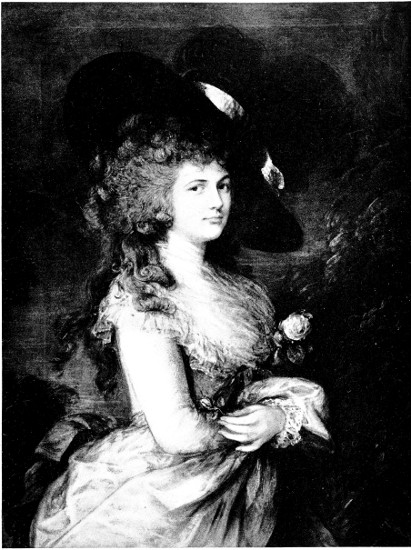
Collection of Mr. and Mrs. Herbert L. Satterlee
GEORGIANA, DUCHESS OF DEVONSHIRE
—Thomas Gainsborough
As this portrait of the Duchess was the first “star” that ever rose in an auction-sale, it is worth while putting forward here the contemporary account of an event which has passed into history. The London Times records:
“The sale of the modern pictures belonging to the Wynn Ellis Collection on Saturday last created such a sensation as has never been experienced in the picture world of London. Throughout the week the pictures had attracted a considerable number of visitors, but on the day preceding the sale the interest came to a climax and crowds filled the rooms of Messrs. Christie, Manson, & Woods. Anyone passing the neighborhood of St. James’s Square might well have supposed that some great lady was holding a reception and this, in fact, was pretty much what was going on within the Gallery in King Street. All the world had come to see a beautiful Duchess, created by Gainsborough; and so far as we could observe, they all came, saw, and were conquered by her fascinating beauty.
“When the portrait was placed before the crowded audience a burst of applause showed the universal admiration of the picture. The biddings commenced at one of 1000 guineas, which was immediately met with one of 3000 guineas from Mr. Agnew; and, amid a silence of quite breathless attention, the bids followed in quick succession until 10,000 guineas was announced. Mr. Agnew then called 10,100 guineas and won the battle in this most extraordinary contest. The audience densely packed on raised seats round and on the floor of the house, stamped, clapped, and bravoed.”
And now comes the story!
Twenty days after this sale, on the night of May 26, 1876, the galleries of Messrs. Agnew were entered, the canvas was cut from the stretching frame, and the Duchess was carried off!
Where?
By whom?
The picture was already too well-known to be saleable and to make it still better known photographs of the picture were immediately placed in every shop-window in London. The subject became of universal interest: pictures of the Duchess were printed on every article of merchandise possible; and fashion decreed that once again the Duchess’s huge hat should be the proper thing to wear. For many years afterwards the “Gainsborough Hat” and the “Picture Hat” continued to be worn in country towns across the Atlantic, far away from London, by persons who had never heard of the beautiful Duchess of Devonshire.
Sensation No. 2.
In March, 1901, the newspapers all over the world announced that the “Lost Duchess” had been found!
Mr. Morland Agnew, after various negotiations, was handed a parcel in the Auditorium Hotel in Chicago which proved to be the Gainsborough canvas. The discovery had been made by the New York Pinkerton Detective Agency, who found the thief, one Adam Worth alias Henry Richmond, son of a German Jew, who had settled in Cambridge, Massachusetts, and who was one of the most famous and clever criminals ever known.
A few days after its return the picture was purchased by Mr. J. P. Morgan at a price beyond £30,000.
Many years before, in 1762–3, Gainsborough had painted in his studio at Bath the Duchess of Devonshire when she was little Georgiana Spencer, aged six, in a white dress, pink ribbons, and dainty cap. At the same period Gainsborough painted portraits of her parents, Earl and Countess Spencer of Althorp, the one of the Countess ranking very high among Gainsborough’s works of the Bath period. The Countess, Margaret Georgiana, daughter of the Hon. Stephen Poyntz, was a very beautiful and extremely wealthy woman and the Earl also possessed enormous wealth and became famed for the magnificent Collection he made at Althorp. The marriage of this couple in 1755 created a sensation and was much talked of in the gossipy letters and memoirs of the day. One eye-witness related: “The bride followed in a new sedan-chair lined with white satin, a black page walking before and three footmen behind, all in the most superb liveries. The diamonds worn by the newly married pair were given to Mr. Spencer by Sarah, Duchess of Marlborough, and were worth £100,000. The shoe-buckles of the bridegroom alone were worth £30,000.”
Lady Harvey related that the wedding-party went from London to Althorp “in three coaches with six horses and two hundred horsemen. The villages through which they passed were in great alarm, some of the people shutting themselves up in their houses, and others coming out with pitchforks, spits, and spades, crying out ‘The invasion has come’, believing that the Pretender and the King of France were both come together; and great relief was experienced when the formidable cavalcade had passed without setting fire to the habitation, or murdering the inhabitants.”
The year after this marriage Mrs. Delany, Horace Walpole’s friend, met “Mrs. Spencer, one of the finest figures I ever saw, in white and silver with all her jewels and scarlet decorations; her modest, unaffected air gives a lustre to all her finery that would be very tinsel without it.”
Is it any wonder that with such parentage Georgiana Spencer should have had brains, beauty, charm, and perfect equipment in every way for that world of society which was her inheritance?
Georgiana was born on June 9, 1757, and was married at the age of seventeen to the fifth Duke of Devonshire, regarded as the “first match” in England. “Georgiana was a lively girl,” said Walpole, “natural and full of grace.” Immediately the Duchess became “the irresistible queen of ton” and the most conspicuous leader of society whenever and wherever she appeared. She dazzled every gathering by her beauty; astonished everyone with her elegant and extravagant dress; and charmed everybody by her wit and her grace. The Duchess was always among the gay butterflies who masqueraded at the Pantheon, promenaded at Ranelagh, danced at assemblies, or played for high-stakes at fashionable gaming-tables. To think of London society in the late Eighteenth Century without the Duchess of Devonshire, is impossible.
Walpole writes that she “effaces all without being a beauty; but her youthful figure, flowing good nature, sense, and lively modesty and modest familiarity make her a phenomenon.”
The Duchess had a clever mind and she delighted in the society of persons of talent. Fox, Sheridan, and Selwyn were among her special friends. The story of her campaigning for Fox with Fox’s sister, Lady Duncannon, and even selling “a kiss for a vote” is told by many pens and by pencils as well, for the Duchess afforded fine material for the caricaturists. The Duchess was much pleased, it is said, by the compliment paid to her during the Fox campaign by an Irishman, who exclaimed: “Sure I could light me pipe at her eyes!” And Gainsborough managed to fix this flaming glance in the famous Satterlee portrait.
Coarse satire attacked the Duchess of Devonshire as it attacks all who enter the political arena; but, on the other hand, there are many tributes from contemporary pens to her sweetness of disposition and to her noble and generous qualities of heart.
In 1806 upon hearing of her death at Devonshire House, Piccadilly, (just lately demolished), the Prince of Wales exclaimed: “We have lost the best-loved woman in England” and Charles James Fox replied: “We have lost the kindest heart in England.”
The Duchess of Devonshire occasionally wrote verse. Her Passage of the Mountain of St. Gothard, dedicated to her children (she had a son and two daughters), was published with a French translation in 1802; an Italian translation was printed in 1803; and a German translation in 1805. This poem gave occasion to Coleridge’s ode with the lines:
“O lady nursed in pomp and pleasure Whence learned you that heroic measure?”
Gainsborough could not have made this or any other portrait of the Duchess of Devonshire until after 1782, because, in that year, Bate published in the Morning Herald, the following lines:
“O Gainsboro! thou whose genius soars so high, Wild as an eagle in an unknown sky, To Devon turn!—thy pencil there shall find A subject equal to thy happy mind! Amidst thy fairest scenes, thy brightest dyes, Like young Aurora let the Beauty rise.”
Another portrait of the Duchess of Devonshire by Gainsborough is also in this country, owned by the Hon. Andrew W. Mellon. It represents a whole length life-size figure leaning against a pedestal and came from the Collection of the late Earl Spencer at Althorp, Nottinghamshire.
THE BLUE BOY.
Thomas Gainsborough Collection of the late
(1727–1788). Mr. Henry E. Huntington.
The Blue Boy is without doubt the most famous picture in the world. When it passed from the Duke of Westminster’s Collection in Grosvenor House, London, by private sale to the late Mr. Henry E. Huntington, the event created a sensation in the art-world, which soon extended to the general public. No painting was ever exploited so widely in the press and when exhibited at the Duveen Galleries in New York, before starting on its journey to California, the Blue Boy attracted unusual crowds.
Before it bade farewell to London the famous picture was exhibited at the National Gallery and the following extract from a letter of Sir Charles J. Holmes, Director of the National Gallery, dated January 24, 1922, to Sir Joseph Duveen, gives an idea of how the portrait is regarded in England:
“My dear Duveen: I saw the last, for the time being anyhow, of the Blue Boy this afternoon at ten minutes past four and feel bound to write these lines to thank you and Mrs. Huntington for the pleasure which the sight of it has given to more than 90,000 people during the last three weeks. It is indeed a most brilliant thing, outshining in its present condition all our English pictures at Trafalgar Square and when the natural mellowing of the varnish during the next two or three years has taken place its perfections will be enhanced. And though its passing from us has been the cause of universal regret, that regret has not been tinged with bitterness. It is generally recognized that while in the process of recovering from the War, the Nation could not have paid the price which its fortunate owner was able to afford.”
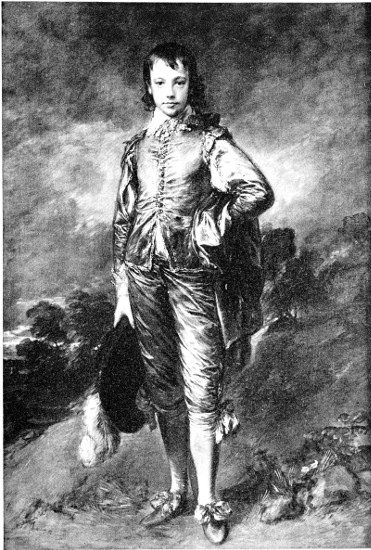
Collection of the late Mr. Henry E. Huntington
THE BLUE BOY
—Thomas Gainsborough
The picture, an oil painting on canvas, is large (5 feet, 10 inches × 4 feet) and represents a young boy, Master Jonathan Buttall of London, life-size, dressed in a blue suit, holding a broad-rimmed hat in his right hand and very conspicuously standing forth from a landscape background with a dark, cloudy sky.
The following notes from the Farington Diary, recently published, bring us into relation with the two early sales.
Under date of Dec. 15, 1796, we find:
“Buttall’s sale. I went to Gainsborough’s picture of a Boy in a Blue Vandyke Dress sold for 35 guineas. Several of his drawings were sold in pairs. Some went so high as 8 guineas and a half the pair.”
“May 25, 1802. I painted till four o’clock and then went to Nesbitt’s sale in Grafton Street, where I met Hoppner, who had purchased the Boy in Blue Dress by Gainsborough, which was Buttal’s, for 65 guineas. At Buttalls sale it was sold for 35 to Mr. Nesbitt.”
The picture is in marvellous condition. When Lord Ronald Sutherland-Gower saw it in the Duke of Westminster’s Collection before it came to America, he exclaimed:
“The Blue Boy at Grosvenor House has all the glamor and charm of a portrait of a fairy prince.”
These few words explain the spell that the picture seems to cast upon every one who sees it, for whenever The Blue Boy has been exhibited crowds have stood enraptured before it.
Regarding Mr. Nesbitt’s connection with the picture we have the following story from the Rev. J. T. Trimmer, Vicar of Marston-on-Dove, Derbyshire:
“Many years ago there resided at Heston a Mr. Nesbitt, a person of substance and a companion of George, Prince of Wales. He once possessed Gainsborough’s Blue Boy and in the following way. He was dining with the Prince. ‘Nesbitt,’ said the Prince, ‘that picture, (pointing to the Blue Boy) shall be yours.’ At first he thought the Prince must be joking, but, finding he was decidedly serious, Nesbitt, who was a beau of the first water, made all suitable acknowledgments for H. R. H.’s generosity and next morning the Blue Boy arrived, followed in due time by a bill for £300, which he had the satisfaction of paying. I heard Mr. Nesbitt many years ago tell the story at my father’s table.”
From Mr. Nesbitt the Blue Boy came into possession of John Hoppner, the artist, who sold it to Earl Grosvenor. Then, of course, The Blue Boy passed as an heirloom to his successor, the Duke of Westminster. For many years The Blue Boy hung in Grosvenor House, London, in the same room with Sir Joshua Reynolds’s Mrs. Siddons as the Tragic Muse, the two most famous portraits of the two most famous English painters. And it is one of the romances of art that these two portraits should have crossed the Atlantic and to be again united, as it were, this time in a California mansion.
Gainsborough had doubtless some reason for painting this portrait; but it is not the reason usually given,—namely that it was done in refutation of a theory expressed by Sir Joshua Reynolds in 1778. Apart from the reasons now accepted to disprove this theory, the picture is too joyously painted for a controversial and academic tour de force.
One of Gainsborough’s latest biographers, Mr. William T. Whitley,[33] discovered the following in a number of The European Magazine (August 1798), which would seem to give the real reason for the genesis of Gainsborough’s famous portrait:
Mr. Gainsborough
“One of the finest pictures this great artist ever painted, and which might be put upon a par with any portrait that ever was executed, is that of a boy in a blue Vandyke dress, which is now in the possession of a tradesman in Greek Street. Gainsborough had seen a portrait of a boy by Titian for the first time, and, having found a model that pleased him, he set to work with all the enthusiasm of his genius. ‘I am proud,’ he said, ‘of being of the same profession with Titian, and was resolved to attempt something like him.’”
So much has been written about this portrait and the copies that have been made of it that great confusion has resulted, and the constant repetition of the same story by writers has tended to obscure rather than to clarify the subject. However, the theory now accepted is that the portrait of The Blue Boy first appeared in public at the Royal Academy in 1770, sent there by Gainsborough himself,—a theory supported by a letter written by Mary Moser, R. A. to Fuseli, then in Rome, in which she said: “It is only telling you what you know already of the Exhibition of 1770, to say that Gainsborough is beyond himself in a Vandyke habit.” Another argument in favor of this date is found in a conversation with an old artist, John Taylor, recorded by J. T. Smith in his Book for a Rainy Day.
The person, chiefly, if not wholly, responsible for the first suggestion of the theory that Gainsborough painted the picture to disprove Sir Joshua Reynolds’s pronouncement regarding color seems to have been John Burnet, the engraver of some of Wilkie’s pictures and a writer on art. The legend began to be circulated in 1817, when Burnet published his Practical Treatise on Painting, where, after challenging the rules laid down by Sir Joshua, he says: “I believe Gainsborough painted the portrait of a boy dressed in blue, now in the possession of Lord Grosvenor, to show the fallacy of this doctrine.”
That seems to be all there is to it; and, once started, the story became widespread and was handed on from pen to pen and from lip to lip, until nearly everybody believes it.
Let us turn, however, to some of the authorities. First to F. G. Stephens:
“Master Jonathan Buttall was the son of Mr. Jonathan Buttall, an ironmonger in an extensive way of business, living at 31 Greek Street (at the corner of King Street), Soho, between 1728 (if not before) and 1768, when he died. According to the Book for a Rainy Day, he was ‘an immensely rich man.’ The younger Buttall continued in the business of his father until 1796, when his effects were sold by Sharpe and Coxe, the well-known auctioneers. These effects included premises in Soho and the City, a share in Drury Lane Theatre, many drawings by Gainsborough, and pictures by the same hand and others, wine, and musical instruments. It has been asserted that a Blue Boy (for there can hardly be a doubt that more than one version of the work exists) was sold on this occasion.
“A story has been credited that The Blue Boy was produced by Gainsborough to refute a dictum of Sir Joshua Reynolds, delivered in his Eighth Discourse to the Students of the Royal Academy, December 10, 1778: ‘It ought, in my opinion to be indispensably observed, that the masses of light in a picture be always of a warm, mellow color, yellow, red, or a yellowish-white; and that the blue, the grey, or the green colors be kept almost entirely out of these masses, and be used only to support and set off these warm colors; and for this purpose, a small proportion of cold colors will be sufficient. Let this conduct be reversed; let the light be cold and the surrounding colors warm, as we often see in the works of the Roman and Florentine painters, and it will be out of the power of Art, even in the hands of Rubens or Titian, to make a picture splendid and harmonious.’