ITALIAN (continued 3)
Reading edition
To the Eighteenth Century also belongs Pietro Longhi (1702–1785?), influenced by Guardi, but called “The Goldini of painters,” because of his bright comedies of manners, somewhat in the genre of Watteau, Pater, and Lancret.
“Longhi painted for the picture-loving Venetians,” says Berenson, “their own lives in all their ordinary domestic and fashionable phases. In the hair-dressing scenes we hear the gossip of the periwigged barber; in the dressmaking scenes the chatter of the maid; in the dancing-school, the pleasant music of the violin. There is no tragic note anywhere. Everybody dresses, dances, makes bows, takes coffee, as if there were nothing else in the world that wanted doing. A tone of high courtesy, of great refinement, coupled with an all-pervading cheerfulness, distinguishes Longhi’s pictures from the works of Hogarth, at once so brutal and so full of presage of change.”
MADONNA AND CHILD.
Antonello da Messina Collection of
(1430–1479). Mr. Clarence H. Mackay.
The Virgin, slightly under life-size, stands behind a stone parapet, three-quarter face to left, apparently in a reverie with half-closed eyelids. She wears a red and gold brocade gown and a blue mantle carried up over her head and falling in a straight line, but for one small plait, to her left arm. The Holy Child is seated upon a green cushion on the parapet and is wrapped in a brick-red shawl. With His left arm around His mother’s neck and right hand in her bosom, He gazes straight ahead. The flesh-tones are pale with clear, light-brown shadows and the rose-leaf lips and cylindrical fingers with filbert-shaped nails are to be noticed and admired.
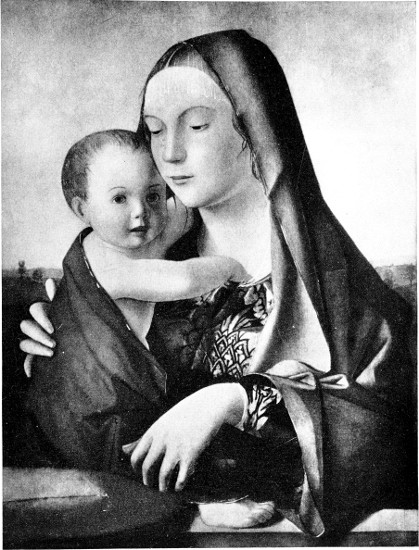
Collection of Mr. Clarence H. Mackay
MADONNA AND CHILD
—Antonello da Messina
This oil painting on panel (23 × 16 inches), comes from the Benson Collection. Antonello da Messina, also known as Antonello di Giovanni degli Antoni, holds a very important place in the development of Painting, because it is owing to him that the Flemish system of painting in oil was adopted in Italy, although Italian painters had been previously acquainted with the process, for they knew the works of the Van Eycks and Roger van der Weyden. It is supposed that Antonello, who was born in Messina in 1430, visited Flanders. It is certain, however, that Antonello was travelling in Italy in 1457–1460 and he may have met Roger van der Weyden, who visited Italy in 1450. Antonello da Messina was certainly in Venice in 1475–1476. He died in 1479, leaving a son, Jacobello, or Jacopo degli Antoni, and a nephew, Antonello di Saliba, both of whom were painters. It seems that Antonello da Messina and the Bellini exchanged many ideas and were of great mutual benefit. It is supposed that Antonello da Messina encouraged Giovanni Bellini to try painting in oils. St. Jerome in his Study in the National Gallery, London, shows the new character that Antonello brought into the Italian painting of his day.
MADONNA AND CHILD.
Carlo Crivelli Collection of
(1430?–1493?). Mr. A. W. Erickson.
Before analysing this delightful picture, let us read an appreciation of a most fascinating and not too well-understood painter by Cosmo Monkhouse: “Carlo Crivelli is a Venetian artist of whom we know little but what can be gathered from pictures. He is supposed to have been born about 1430 and his dated works range from 1468 to 1493. He was a Venetian by birth and from his mode it would appear certain that he studied under Squarcione at Padua and probably also under Vivarini at Venice. But he perfected a style and one marked by so many peculiarities that despite all affinities which may be traced with other masters he stands out clear and distinct by himself.
“In the first place, he is unique as a colorist. He belongs, indeed, to the old mosaic and illumination school of color, not to the school of ‘great schemes,’ in which the masses are blent into one great harmony. The masses, or patches, of color are isolated and produce a pleasant variegation without fusion. His color is thin, also, as of a superficial tinting, not affecting the substance. His flesh is hard and opaque, his flowers leathery, his fruit, though finely drawn and beautifully colored, of a stony texture, his draperies anything but soft. It is only in hard smooth things, like pottery and glass, that you get the true consistency as well as the true color. Yet his color is exquisite of its kind, brilliant and transparent like enamel, and the different tints in themselves are lovely and varied. Such reds and greens and lilacs and salmon-pinks and a hundred other combinations of the primaries are scarcely to be matched in the work of any other artist. Nor has anyone been more skillful in the use of gold in connection with color.
“There is scarcely any need to call attention to Crivelli’s special gift as a designer of decoration. Almost every square inch of his canvas attests the inexhaustible richness of his invention—an invention fed no doubt from the rich products of Oriental looms of which Venice was the emporium.
“Crivelli wrought only for the Church and appears to have spent most of his life at Ascoli, but neither restriction of subject and feeling, nor provincial residence, could fetter his genius. There is, indeed, no artist of more striking individuality than Carlo Crivelli, no one who had more complete mastery over his means of expression, or attained more nearly to his ideal. This ideal was not the ‘beau ideal’—that is to say, the perfection of physical beauty—it was an ideal of character, the embodiment of the essential qualities of his subject. One cannot help regarding Crivelli as a man of knowledge and intellect, of charming manners, refined almost to fastidiousness, delighting in all things dainty and beautiful, a lover of animals and of his kind.”
This picture, an oil painting on panel (38 × 17 inches), came from the Benson Collection, having been previously in the Collection of Mr. G. H. Marland (sold in 1863), and in the Collection of Mr. William Graham (sold in 1886). The Virgin, a small full-length figure, is seated on a red and white marble throne, wearing a pale-red robe and a gold brocade mantle lined with green carried up over the head, which is adorned with a white veil. The Holy Child, standing on her lap, has on a gold dress and a white sash. Behind these two figures there is a hanging of pale-red, watered silk and behind the throne again there is a gold hanging with the pomegranate pattern. The Holy Child turns to the right in the act of blessing. On the step of the throne, which has a conspicuous crack, two pears[16] are lying; and they have attracted a fly. The step is inscribed: “Carolvs Crivellvs Venetvs Pinsit, 1472.”
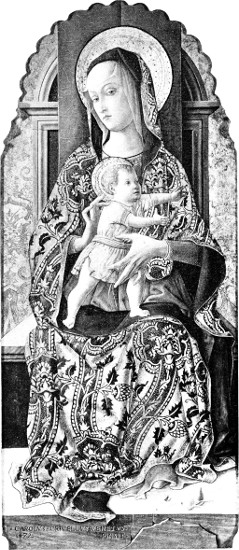
Collection of Mr. A. W. Erickson
MADONNA AND CHILD
—Crivelli
“The effect is archaic and almost Byzantine,” G. McNeil Rushforth writes in his Carlo Crivelli (London, 1900), “but its merits are very great.” “Though on a comparatively small scale the decorative effect is superb. The Child’s head is heavy and inferior to that of the Virgin, but the action is lively and realistic. The great charm, however, of the picture is the Virgin. Her features are not beautiful and the drawing of the hands might be criticized. But if ever grace and dignity were conceived and executed by Crivelli, they are here. Preëminently does this Virgin possess all that we understand by distinction. Taken separately, the turn of the head and the action of the fingers might be called affected. But they do not offend as parts of the whole, so perfectly has the artist defined the ideal that was before his mind. A curious feature in the picture is the treatment of the drapery. The folds of the brocaded mantle are more elaborate than anything which Crivelli had yet attempted, and they are expressed by clear-cut lines without any shadow.”
MADONNA AND CHILD.
Carlo Crivelli Collection of
(1430?–1493?). Mr. Philip Lehman.
This beautiful picture belongs to Crivelli’s greatest period, when the artist had reached the height of his powers, had attained perfect command of the problems of composition, and had gained the technique to represent those materials he delighted in,—such as brocades, marbles, and garlands of fruit, which he always combined with such decorative beauty. Roger Fry says of this picture: “It has, in a supreme degree, the delicacy and the almost metallic incisiveness of Crivelli’s contour as well as the firmness and brilliance of his painting. The Madonna supporting the Child upon her right arm, is seated in one of those sumptuous Renaissance thrones, which Crivelli loved to elaborate with every conceivable ingenuity of invention. Though the forms are intended to be Classic, it is evident from the proportions of the mouldings and something in the character of the detail that Crivelli is still essentially an old Venetian artist, one who uses Classical conventions with a Gothic exuberance.
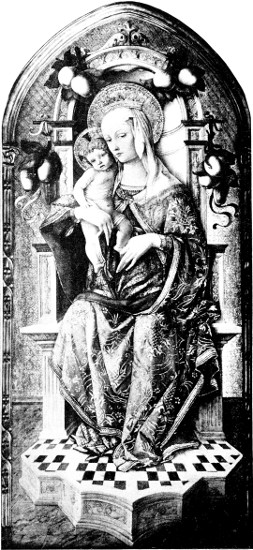
Collection of Mr. Philip Lehman
MADONNA AND CHILD
—Crivelli
“This is a work of Crivelli’s prime. Indeed, it would be hard to name another design in which he shows quite such mastery as he does here. There is hardly another work in which the sequence of lines is so suave, its flow so uninterrupted, or in which the movements of the figures harmonize so perfectly. It is already almost a cinque-cento work as regards the amplitude of its forms and the breadth of its divisions. One notes, for instance, that the fruits hanging on the throne are even more enlarged and more massed than usual, so that the quantities of relief support and carry out the relief of the figures in a remarkable manner. Much of the earlier intensity of feeling has undoubtedly gone. This has none of the strange, brooding pathos of the early Madonnas, nor has it the sharp individual accent of their faces. The works with which it appears to be most akin are the Vatican Madonna and the Triptych in the Brera, both of 1482.”
THE VIRGIN AND CHILD WITH ST. LUCY, ST. CATHERINE, ST. PETER AND ST. JOHN THE BAPTIST.
Giovanni Bellini Collection of
(1428–30–1516). Mr. Jules S. Bache.
This is the type of group picture known as a “Holy Conversation” and represents the Virgin and Child with Saints. It seems to have been painted when Bellini was between seventy-two and seventy-seven years of age and between the years 1500 and 1505.
The figures are three-quarter length and under life-size and the picture, which is an oil painting on canvas, measures 38 × 60 inches. The Virgin is seated in the centre with a dark-grey curtain behind her and a marble balustrade in front of her. She wears a rose-colored tunic and a blue mantle lined with a changeable green and yellow silk. The Holy Child leans back against her right arm. On her right stands St. Catherine with a rope of pearls twisted in her hair and St. Lucy, on her left, wearing a myrtle wreath and holding a tall standing-cup of Venetian glass. St. John the Baptist, wearing a green mantle, stands on the right, looking downward with bended head; and St. Peter, in orange-brown cloak with book and key, stands on the left. A very decorative effect is derived from the palm-branches, which curve upwards into the top corners of the picture. A range of distant hills appears in the background and on the cartellino on the balustrade is the signature in script, “Ioannes Bellinus.”
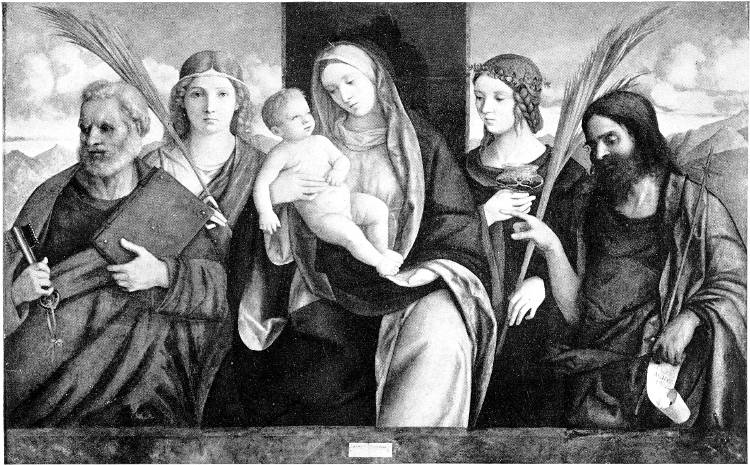
Collection of Mr. Jules S. Bache
THE VIRGIN AND CHILD WITH ST. LUCY, ST. CATHERINE, ST. PETER AND ST. JOHN THE BAPTIST
—Giovanni Bellini
Authority for dating the picture is derived from the fact that the features of St. Lucy reappear in the San Zaccaria altar-piece, which is dated 1505, and the features of St. John the Baptist occur in the Baptism of Christ in Santa Corona, Vicenza, supposed to have been begun in 1500.
The picture came from the Benson Collection, having been formerly in the Wynn Ellis Collection and in the Collection of Mr. William Graham.
The date of Giovanni Bellini’s birth is not known. He was working with his brother, Gentile, in his father’s studio in Padua and was painting in Venice in 1464, where he produced two pictures for the Scuola di San Girolamo. In 1475 he met Antonello da Messina, who came to Venice, and seems to have adopted then his method of painting in oil. In 1479, when Gentile Bellini went to Constantinople, Giovanni was appointed to carry on his work in the Doge’s Palace; and when Gentile returned the two brothers worked together. Giovanni was essentially a religious painter and his Madonnas stand among the finest ever created. Most of his portraits are lost; but one, the Doge Loredano (in the National Gallery, London), ranks as one of the finest of all known portraits. This dates from 1501, painted when Giovanni was over eighty! Giovanni died in 1516.
THE VIRGIN AND CHILD.
Giovanni Bellini Collection of
(1428–30–1516). Mr. and Mrs. Nicholas F. Brady.
The Madonna at half-length turned towards the left, supports the Holy Child with both arms as He reclines in her lap against her right knee, which is raised. She is dressed in a blue mantle arranged to form a hood, with embroidered border. A graceful white veil, also embroidered, covers the head and falls below the neck.
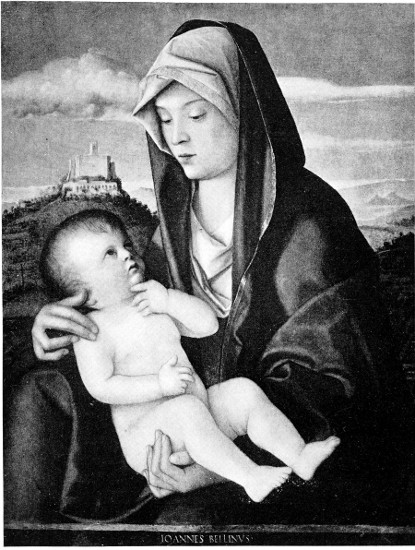
Collection of Mr. and Mrs. Nicholas F. Brady
THE VIRGIN AND CHILD
—Giovanni Bellini
The Holy Child gazes upward into his mother’s face and she, with eyes slightly veiled by drooping lids, looks tenderly downward towards him. The background is hilly, with a castle on the left. The picture, oil on a panel (28¾ × 23¾) is signed “Joannes Bellinus.”
This Bellini Madonna comes from the Collection of the Grand Dukes of Oldenburg, Oldenburg Castle, near Bremen, Germany, and was also formerly in the Collection of Count Montija in Madrid. Much has been written about Bellini’s Madonnas. They differ greatly from those painted by the Florentines; and the following sympathetic note tells us why:
“If we turn to the religious art of Venice, we shall be struck by a lack of anything like mystic rapture, or absorption in the sufferings of Christ. We have but two examples in Venice of Bellini’s portrayal of the facts of Christ’s mature life, but he has treated the theme of the Madonna and Child with a unique profundity. The mystery of life seems to be shadowed in the face of the Madonna; his saints and apostles, so striking in their individuality, so virile in their piety, have a significance beyond their perfect act of worship. No Venetian religious painter before Tintoretto equalled Bellini in solemnity and depth of conception; but in all we find the same pervading calm, the same absence of tumult, or the disturbing elements of pain or agony.”[17] Is it not the quietness of Bellini’s Madonnas that give them their peculiar charm?
MADONNA AND CHILD.
Giovanni Bellini Collection of
(1428–30–1516). Mr. Philip Lehman.
This picture came from the Collection of Prince Potenziani, of Rieti, Italy, and represents the Virgin standing behind a parapet and supporting the Holy Child who is standing upon it. Her mantle and tunic are decorated with a border of embroidery and over the mantle falls her heavy white veil which might be described as a hood, showing a little of her wavy hair. The face of the Virgin is a perfect oval, her eyes are set far apart, her nose is long and aquiline, and her mouth a little discontented. Her arm and wrist are beautifully modelled and so is the thumb of her right hand. This hand is noticeably wide. The left hand does not seem to match the right; it is coarser. The Holy Child is leaning against His mother’s left shoulder and looking out of the picture. He wears a little tunic over a white shirt with sleeves and a wide, blue sash with a striped pattern. A close-fitting cap is tied with ribbons under His chin. His right hand is lifted in blessing and His left is clasping the fingers of His mother’s right hand. On the right of the parapet a crystal ball is lying and on the left a capsicum-pod, and behind the Madonna’s head hangs a heavy swag of capsicum. The landscape in the background is noticeably fine. On the left, a road winds through trees to the gates of a city with high Gothic towers; on the right, a river flows past hills crowned with castles. Clouds fill the sky. The nimbi are quite unusual. This is evidently an early work and not a little of Mantegna’s influence is apparent in it.
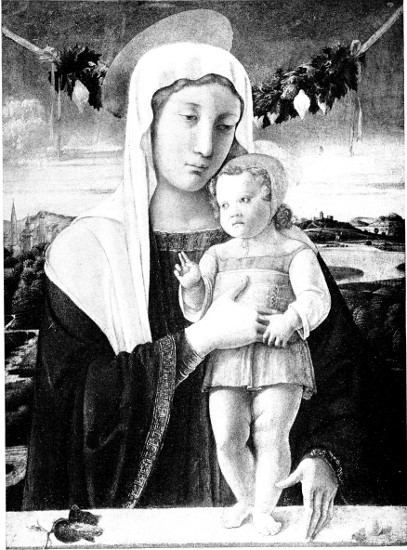
Collection of Mr. Philip Lehman
MADONNA AND CHILD
—Giovanni Bellini
THE FEAST OF THE GODS.
(Il Baccanale.)
Giovanni Bellini Collection of
(1428–30–1516). Mr. Joseph E. Widener.
“In the year 1514”—this is Vasari’s narrative—“Duke Alfonso of Ferrara had caused a little chamber to be decorated and had commissioned Dosso, the painter of Ferrara, to execute in certain compartments stories of Æneas, Mars, and Venus and, in a grotto, Vulcan with two smiths at the forge; and he desired that there should also be there pictures by the hand of Gian Bellini. Bellini painted on another wall a vat of red wine with some Bacchanale around it and Satyrs, musicians and other men and women all drunk with wine, and near them a nude and very beautiful Silenus riding on his ass, with figures about him that have their hands full of fruits and grapes; which work was in truth executed and colored with great diligence, inasmuch that it is one of the most beautiful pictures that Gian Bellini ever painted, although in the manner of the draperies there is a certain sharpness after the German manner (nothing, indeed, of any account) because he imitated a picture by the Fleming,[18] Albrecht Dürer, which had been brought in those days to Venice and placed in the Church of S. Bartolommeo, a rare work and full of most beautiful figures painted in oils. On that vat Gian Bellini wrote these words: ‘Joannes Bellinus Venetus P. 1514.’ That work he was not able to finish completely, because he was old, and Tiziano, as the most excellent of all the others, was sent for to the end that he might finish it.”
Titian’s work is to be found in the landscape-background,—which is an exact view of Titian’s own Cadore. This landscape, with its valley and rocky hill surmounted by a castle with towers, bathed in warm, luminous light, was the finest that had ever been painted up to that time. Bellini only lived two years after painting The Feast of the Gods. In 1515 he painted the so-called Venus of the Belvedere and he died in the following year.
“So easy is the passage from Bellini’s art to Titian’s, that the transition creates no contrast. The tone throughout is harmonized, and the art of the Fifteenth and Sixteenth Centuries meets and mingles in perfect fellowship,” Crowe and Cavalcaselle note.
This picture, an oil painting on canvas (67 × 74 inches) came from the Collection of the Duke of Northumberland at Alnwick Castle, England, having been previously in the Collection of Cardinal Pietro Aldobrandini and in that of Cardinal Ludovico Ludovisi, Rome.
These two villas, upon whose walls The Feast of the Gods hung for so many years, are very celebrated. The Villa Aldobrandini is one of the most notable residences near Rome. It is situated on the slope of a mountain overlooking Frascati and was built by Cardinal Pietro Aldobrandini, who entrusted its decoration to the most eminent artists of his day, such as Jacopo della Porta, Domenichino, Giuseppe Gesari, and Giovanni Fontana. Here, too, were gathered the most precious relics of ancient art, while the gardens, adorned with vases, statues, colonnades, and sparkling fountains, made the exterior a place of marvellous beauty and charm. The view of mountains and sea suggested the name of Belvedere. The Villa belongs to-day to the Borghese family, who inherited it from the Aldobrandini.
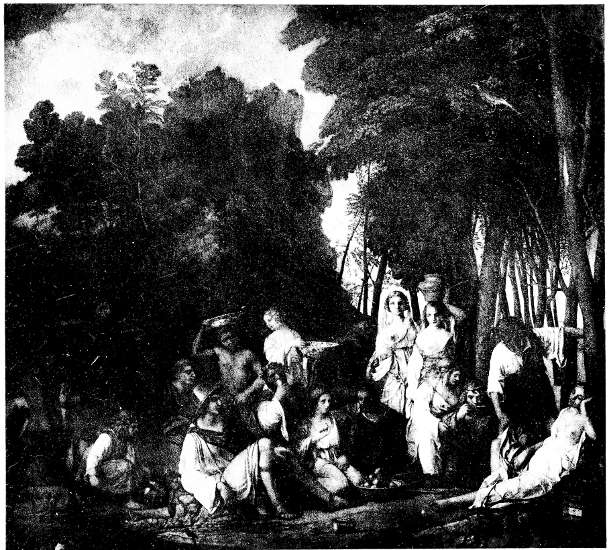
Collection of Mr. Joseph E. Widener
FEAST OF THE GODS
—Giovanni Bellini
The Villa Ludovisi, frequently called the Piombino Palace, is situated on the site of the ancient gardens of Sallust. This palace was erected in 1622 by Cardinal Ludovico Ludovisi, nephew of Pope Gregory XV, who selected Domenichino for his architect and the famous Le Nôtre for his landscape-gardener. The property passed by inheritance to the Princess of Piombino (Buonocampagni-Ludovisi).
Art-lovers know the name in connection with the colossal and magnificent head of the Juno Ludovisi (Fifth Century, B. C.); and it will be remembered that the Juno Ludovisi and other antiques from the Villa Ludovisi formed the Museo Buonocompagni.
THE VIRGIN AND CHILD.
Titian Collection of
(1477?–1576). Mr. Jules S. Bache.
The Virgin, in profile, seated on a stone seat, has auburn hair—“Titian hair”—which is relieved against a dark-green curtain. Her robe is pale rose-color with slashes of white and her mantle of cobalt blue like the landscape, “which resembles the sea at midday.” She also wears a white veil. She is looking with great tenderness at the Holy Child, lying at full length on her lap and smiling at her.
The composition is most beautiful and the introduction of the trees gives perpendicular lines which contrast delightfully with the general horizontal effects.
Lionel Cust calls it a picture of great charm, as indeed it is, and says: “The Virgin leans tenderly over the Child lying upon her knees. This composition is treated in the same manner as the picture at Bergamo, the Virgin and Child with St. Bridgit and St. Ulphus, in the Prado at Madrid, and a few others. In all of these works the sentiment is that of Giorgione, even though the execution is of the hand of Titian; and one could not think of attaching another name than his to this picture and to that at Madrid. It will be noticed also that the two tree-trunks, so much in evidence at the back of the picture, constitute a leit-motiv, which Giorgione first employed and which Titian imitated.”
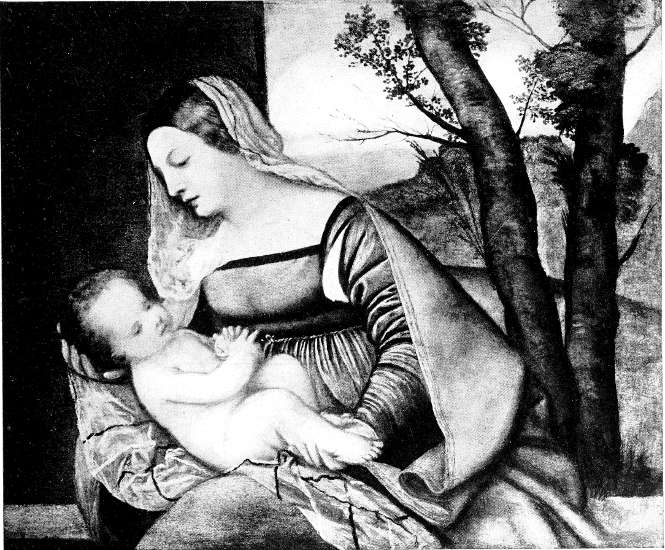
Collection of Mr. Jules S. Bache
THE VIRGIN AND CHILD
—Titian
Herbert F. Cook in his Giorgione (London, 1907), gives this painting to Giorgione, sustaining the claim by the following: “The marble parapet is a feature in Giorgione’s work, but not in Titian’s. But the most convincing evidence to those who know the master lies in the composition, which forms an almost equilateral triangle, revealing Giorgione’s supreme sense of beauty in line. The splendid curves made by the drapery, the pose of the Child, so as to obtain the same unbroken sweep of line, reveal the painter of the Dresden Venus. The painting of the Child’s hand over the Madonna’s is precisely as in the Madrid picture, where, moreover, the pose of the Child is singularly alike. The folds of drapery on the sleeve recur in the same picture, the landscape with the small figure seated beneath the tree is such as can be found in any Giorgione background. The oval of the face and the delicacy of the features are thoroughly characteristic, as is the spirit of calm reverie and tender simplicity which Giorgione has breathed into his figures.”
Whether by Titian, or by Giorgione, or by both, the painting is a gem. If by Giorgione, it would be even more valuable, as this master is so rare.
The painting, oil on panel (18 × 22 inches), came from the Benson Collection and was formerly at Burghley House, Stamford, Northamptonshire, having been acquired in Italy between 1690 and 1700 by the Earl of Exeter.
Tiziano Vecellio was born about 1477 at Pieve di Cadore, the son of Gregorio Vecelli, and was taken to Venice at the age of ten and apprenticed to a mosaic-worker. After this he studied in Giovanni Bellini’s bottega, where he had for a fellow-pupil, Giorgione, with whom he was associated in decorating the Fondaco dei Tedeschi. Titian visited Padua, Rome, and, in 1516, Ferrara. Commissions of all kinds followed rapidly and Titian became the most famous painter of his time. He lived in splendid style and his long life was filled with magnificent painting and magnificent results. Titian died of the Plague in 1576.
In his long life, crowned with every kind of success, Titian painted with superlative skill every sort of subject. Titian was one of the greatest masters the world has ever known.
“In attempting to picture Titian,” writes Taine, “we imagine a happy man, the happiest and the healthiest of his species, Heaven having bestowed upon him nothing but favors and felicities: the first among his rivals; visited in his house by the Kings of France and Poland; a favorite of the Emperor, of Philip II, of the Doges, of Pope Paul III, of all the Italian princes; created a knight and a count of the Empire; overwhelmed with orders; liberally paid, pensioned, and worthily enjoying his good fortune. He kept house in great state, dressed himself splendidly, and entertained at his table cardinals, lords, the greatest artists and the ablest writers of his day. Beauty, taste, cultivation, and talent play and reflect back upon him, as if from a mirror the brightness of his own genius. His brother, his son, Orazio, his two cousins, Cesare and Fabrizio, and his relative, Marco di Tiziano, were all excellent painters. His daughter, Lavinia, dressed as Flora, with a basket of fruit on her head, supplied him with a model of fresh complexion and ample form. His talent flows on like a great river in its bed, nothing disturbs its course, and its own increase is sufficient. Like Leonardo and Michelangelo, Titian sees nothing outside of his art.”
CATERINA CORNARO, QUEEN OF CYPRUS.
Titian Collection of
(1477–1576). Mr. John Ringling.
Proud and handsome this famous Queen and beauty looks down upon us from the centuries. She is wearing a dress of gold and green striped velvet with a pink camelia at her neck and one of those fashionable, tall, sugar-loaf head-dresses—called in France the hennin—with jewelled band around the rim and a floating veil. Very beautifully are her pearls painted; and, fastened by a chain to a bracelet on her left wrist, is a pet chameleon.
This portrait, oils on canvas (43 × 38 inches), came from the Ricardi Palace, Florence, and from the Collection of R. S. Holford, Esq., Dorchester House.
Caterina Cornaro, “La Reine de Chypre,” famous in song and story, was the daughter of Marco Cornaro, a noble Venetian and descendant of the Doge of the same name, and Florence, daughter of Niccolò Crispo, Duca dell’ Archipelago. Caterina was born in Venice in 1454, educated at the Convent of San Benedetto in Padua, and reared in all the wealth and elegance of the time. At an early age she was married to the King of Cyprus, Jerusalem, and Armenia (Jacques de Lusignan), who chose her from sixty-two of the most beautiful women of Venice. The Senate, having adopted Caterina Cornaro as a daughter of the Republic, gave her a dowry of a hundred thousand golden ducats and agreed to defend the Kingdom of Cyprus against all enemies.
The wedding took place by proxy in Venice in 1472 and was celebrated with great magnificence. The Doge, himself, Cristoforo Moro, called for the bride at her palace in the Bucentaur and accompanied her to the Venetian ship in which she embarked with a regal suite for her new home. After experiencing several accidents at sea, the beautiful Venetian lady arrived in Cyprus, where her rare beauty and charming manners captivated the entire population. Within two years her husband died and Caterina then reigned over Cyprus for fourteen years, subject, however, to the strict surveillance of Venice. At last, wearied by restrictions and intrigues, the Queen of Cyprus in 1489 returned to Venice with her beloved brother, Giorgio Cornaro, and made a solemn transfer of all her claims in Cyprus to the Doge.
Caterina then went to Frattalonga, situated at the foot of the Asolani mountains, to meet the Emperor Maximilian, who was on his way home from Milan to Vienna; and the place pleased her so much that she obtained from the Doge, Agostino Barbarigo, the investiture of Asolo and its district. A few months later—in October 1489—Caterina returned to Asolo with a suite of four thousand persons and established a Court in the Castle, where she lived for twenty-one years, protected by troops granted to her by the Republic of Venice. In this beautiful residence Caterina was said to have held three Courts—that of the Muses; that of Love; and that of her own, which was of great magnificence. The leading spirit there was the celebrated poet, Pietro Bembo, (in later years Cardinal Bembo), who wrote his famous dialogues of love, Gli Asolani, here in 1490, for the superb marriage festivities of one of Caterina’s maids-of-honor. Every illustrious personage of the period visited the Court at Asolo.
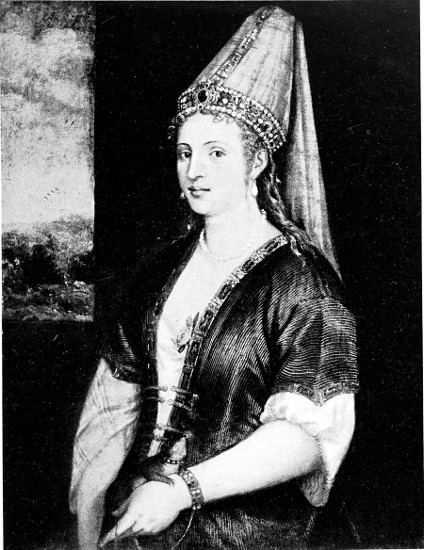
Collection of Mr. John Ringling
CATERINA CORNARO
QUEEN OF CYPRUS
—Titian
During the wars occasioned by the League of Cambrai (1508), Caterina returned for safety to Venice and died there in 1510, in the palace of her brother, Giorgio, who was then procurator of St. Mark’s.
Titian painted several other portraits of Caterina Cornaro, of which the one in the Uffizi is the most famous, representing the Queen of Cyprus with her golden crown studded with large pearls and an over-dress or coat of rich green brocade.
GIORGIO CORNARO WITH FALCON.
Titian Collection of
(1489–1576). Mr. A. W. Erickson.
We have here a famous Venetian statesman and general of the Sixteenth Century, beloved brother of Caterina Cornaro, Queen of Cyprus (see page 143), representing him probably in the habit he liked best of all—that of a sportsman with his pet falcon. Here he stands, three quarters to the right, in a slate-colored hunting coat with brown fur collar and with a black belt at the waist from which hangs a sword, bound with a crimson sash. His curly hair and beard are chestnut color and his eyes are very bright. His head is raised and he looks intently at his falcon perched upon his left gloved hand, with hood, bill and jacket attached, and with his right hand grasps the bird’s breast.
From the left hand corner the head of a white, liver-spotted hound looks up. The background is dark. The painting, an oil on canvas (43 × 38 inches) was formerly in the Collections of the Carignan branch of the Royal House of Piedmont; Louis François de Bourbon, Prince de Conti; the Earl of Carlisle, Castle Howard, Yorkshire, England; and Dr. Edward Simon, Berlin. Crowe and Cavalcaselle in their Life and Times of Titian (London, 1881) say of this work: “Titian never produced a finer picture than which now adorns the gallery of Castle Howard. This beautiful work is modelled with all the richness of tone and smoothness of surface which distinguishes polished flesh. The attitude is natural, the complexion warm and embrowned by the sun; and every part is blended with the utmost finish without producing want of flexibility.”
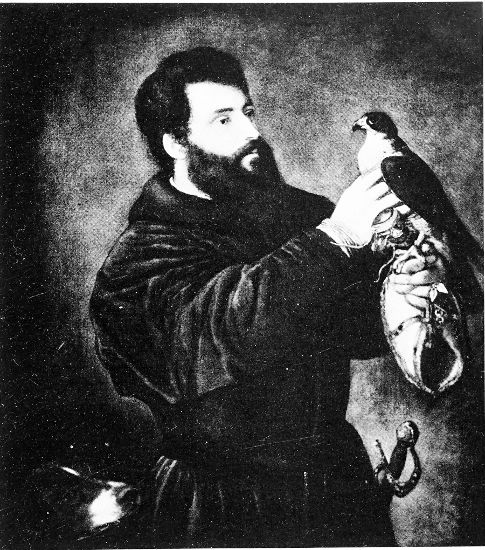
Collection of Mr. A. W. Erickson
GIORGIO CORNARO WITH FALCON
—Titian
Giorgio Cornaro succeeded his father, Marco Cornaro in 1479, he being about twenty-five. Italian historians are fond of attributing the Victory of Cadore to Giorgio Cornaro, who lived until 1527, having played an important part all his life in Venetian politics.
MAXIMILIAN SFORZA, DUKE OF MILAN.
Bartolommeo Veneto Collection of
(1480–1555). Mr. Henry Goldman.
This portrait, oil on panel (30⅞ × 23¼ inches), was formerly in the Palazzo Sforza and later hung in the Casa Perego, Milan, until the entire Casa Perego Collection was bought in the early Nineteenth Century by Senator Crespi of Rome, in whose gallery it remained until the Crespi Collection was sold. It is doubly interesting as a work of art and as the representation of an important character in Italian history. Bernhard Berenson calls it “one of the most manly portraits and one of the most beautiful paintings of the Italian Renaissance.”
The half-length figure is seen almost full front, but the head is turned slightly to the left. All the Italian Renaissance seems to be expressed in this proud, distinguished person and in his rich dress, which consists of a coat of green velvet trimmed with bands of gold, a finely embroidered white shirt, black waistcoat with horizontal gold stripes and a rich fur collar, which he clasps with his right hand on the index finger of which is a handsome ring. His dark hair falls to the shoulders and is surmounted by a black velvet cap, on the side of which is a gold and enamelled medal showing an allegorical female figure with the date 1512, of the kind that all the fashionable gentlemen were wearing at that period. A red curtain falls behind the figure and on the wall hangs a picture in which are introduced figures from Dürer’s famous woodcut, The Knight and the Lansquenet. In front of the sitter is a narrow ledge, or balustrade, with a card in the centre, which originally carried the signature of Bartolommeo Veneto.
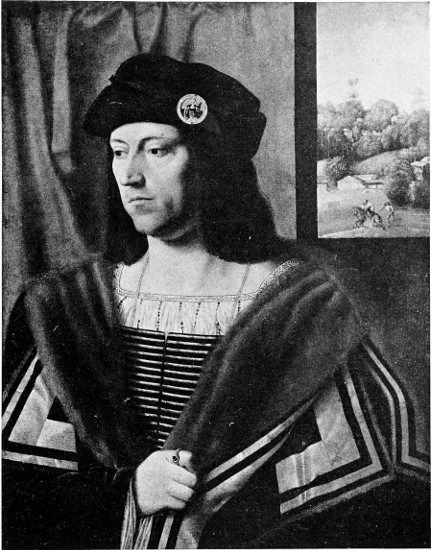
MAXIMILIAN SFORZA
—Bartolommeo Veneto
Maximilian Sforza was the son of Ludovico Sforza, “Il Moro,” Duke of Milan, the most illustrious prince of Italy, and Beatrice d’Este, one of the most fascinating and brilliant women of the Italian Renaissance. Maximilian was born on January 25, 1493, in the Castello of Milan, and was named Ercole out of compliment to his grandfather, Duke Ercole of Ferrara. He was brought up in the most brilliant of Courts and his education and training were of the very best. His mother was devoted to him and constantly mentions him in her letters. Ercole appears in the great altar-piece attributed to Zenale, now in the Brera, kneeling by the side of his father. The portrait of this little child must be a good one, for we see the same face grown older in the Veneto portrait before us. On the altar-piece, just mentioned, Ercole’s younger brother kneels by the side of Beatrice d’Este. It was during a visit of the Emperor Maximilian to Ludovico and his wife in 1496 that Ercole received his new name. The Emperor, again charmed by Beatrice, took great interest in her two sons and requested that the elder should be called Maximilian.
But the brilliant days passed and sorrows came. The beautiful, gifted mother died in January, 1497, and the French invaded Milan. Ludovico determined to seek safety in flight and sent his two sons to Germany under the care of his brother, Cardinal Ascanio Sforza, Cardinal Sanseverino, and their kinswoman, Camilla Sforza. “A truly piteous and heart-breaking sight it was,” wrote an eye-witness, “to see these poor children embrace their beloved father, whose face was wet with their tears.” Twenty mules laden with baggage and a large chariot drawn by eight horses and containing Ludovico’s precious jewels and 240,000 gold ducats followed in the train of the young princes. These young gentlemen never saw their father again, for “Il Moro” was captured, taken to Paris, and imprisoned in the castle of Loches, where he died in 1508.
An Italian writer, Marino Sanuto, exclaimed on the terrible fate of Ludovico: “Only think, reader, what grief and shame so great and glorious a lord, who had been held to be the wisest of monarchs and ablest of rulers, must have felt at losing so splendid a state in these few days, without a single stroke of the sword. Let those who are in high places take warning, considering the miserable fall of this lord, who was held by many to be the greatest prince in the world, and let them remember that when Fortune sets you on the top of her wheel, she may at any moment bring you to the ground.”
The rest of the story is well told in Mrs. Cartwright’s Beatrice d’Este (London, 1889):
“Meanwhile Beatrice’s sons grew up at Innsbrück, under the care of their cousin, the Empress Bianca. It was a melancholy life for these young princes, born in the purple and reared in all the luxury and culture of Milan. And when their cousin, Bianca, died in 1510, they lost their best friend. But a sudden and unexpected turn of the tide brought them once more to the front. That warlike pontiff, Julius II, who, as Cardinal della Rovere, had been one of the chief instruments in bringing the French into Italy, entered into a league with Maximilian to expel them and reinstate the son of the hated Moro on the throne of Milan. They succeeded so well that in 1512, four years after Ludovico’s death at Loches, young Maximilian Sforza entered Milan in triumph amidst the enthusiastic applause of the people. Once more he rode up to the gates of the Castello, where he was born, and took up his abode there as reigning duke. But his rule over Lombardy was short. A handsome, gentle youth, without either his father’s talents or his mother’s high spirit, Maximilian was destined to become a passive tool in the hands of stronger and more powerful men. His weakness and incapacity soon became apparent, and when, three years later, the new French King, Francis I, invaded the Milanese and defeated the Italian army at Marignano, the young duke signed an act of abdication and consented to spend the rest of his life in France. There he lived in honorable captivity, content with a pension allowed him by King Francis and with the promise of a Cardinal’s hat held out to him by the Pope, until he died in May, 1530.”
Bartolommeo Veneto (or Bartolommeo Veneziano), born in 1480, was a pupil of Giovanni Bellini, whose influence is apparent in Veneto’s early pictures. In 1506–1508 Veneto was painting for Lucrezia Borgia in Ferrara and after that he was engaged at the Court of Milan, where he painted this portrait of Maximilian Sforza. The picture bears the date 1512, which was the year the young Duke returned to Milan.
Bartolommeo Veneto was famous for his portraits. He lived for sometime in Lombardy and, like all the painters of the time and place, fell under the influence of Leonardo da Vinci. As the last trace of him appears on a portrait in the Uffizi, dated 1555, it is supposed that Veneto died in that year.
A SCENE ALONG THE ADRIATIC COAST.
Francesco Guardi Collection of
(1712–1793). Mrs. Charles B. Alexander.
Guardi, a pupil of Canaletto, devoted himself to the study of his native city, Venice, where he was born in 1712 and where he painted steadily until his death in 1793. Guardi ranks with Canaletto and Turner as one of the three greatest painters of the “Dream City” as Charles Dickens called Venice. In Guardi’s long list of pictures we have a perfect history in paint of the “Queen of the Adriatic” during the Eighteenth Century. There are innumerable views of the Grand Canal; of both the exterior and the interior of San Marco; of San Giorgio, the Salute, San Zaccaria, and other churches; of the Fondaco dei Tedeschi (the German banking-house); the Doges Palace; the Piazza and the Piazzetta; scenes on the outlying islands; views on the Lagoons; and pictures of processions of the Doges and of festivals of the church. The picture presented here shows a scene outside of Venice, but not far away; and it is a beautiful and characteristic work of Guardi, both as to composition and color. The painting came from the Collection of the Baron Maurice de Rothschild of Paris to its present owner, Mrs. Charles B. Alexander of New York.
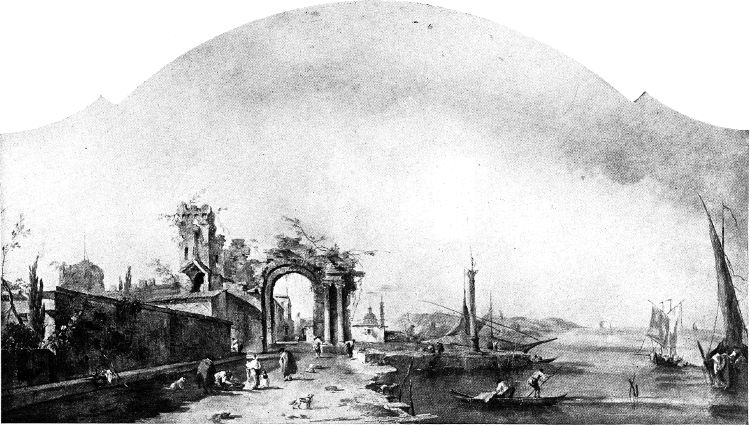
Collection of Mrs. Charles B. Alexander
A SCENE ALONG THE ADRIATIC COAST
—Francesco Guardi