THE OLDEN TIME
Reading edition
Antiquity! the olden time! the hoary, venerable past! there is something sacred and soul subduing in the very sound of the words. Like the dying echo of the last tones of the departed, it is full of hallowed memories, and cherished associations, that haunt the inner chambers of the imagination, and linger with a mournful tenderness about the better feelings of the heart.
But what have we to do with Antiquity! They of the old World, who were grey with time and tottering with decay when, but yesterday, they saw us spring into being, laugh at our sometime boast of Antiquity; and well they may, for it is hardly as well substantiated as that of the simple boy who conceived himself the oldest person in the world, because he could not remember when he was born. Yet even we, in the New World, we, of its second or third generation, whose fathers were present at its birth and baptism, even we begin to talk gravely of the olden time, and to sigh and look sad over the melancholy grandeur of the past!
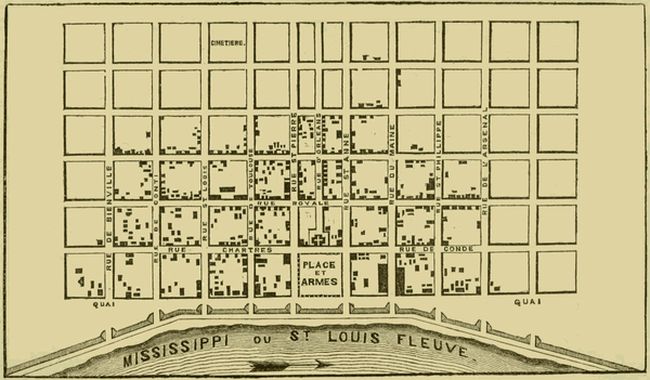
New Orleans in 1728.
Well, be it so. In these stirring times, an age is shorter, and sooner achieved, than in those of "thesluggish eld." Time is measured by events, and not by revolutions of the sun—by the progress of the mind, not by the slow sifting sands of the hour glass, and the amazing precocity of these latter days makes many ages out of a single century.
But what a vandal spirit is innovation! what a ruthless destroyer is this boasted modern improvement! It sweeps over the land with the energy of a new creation, demolishing and scattering whatever lies in its way, for the mere pleasure of reproducing it in a new and better form. It removes the ancient land marks, obliterates the last traces of ancient power and grandeur, levels mountains, fills up valleys, turns the courses of rivers, and makes all things bend to its iron will.
It works such rapid and magical changes in its headlong career, that few of us are able to point out what has been, or to predict with certainty what will be to morrow. Let us cherish then, with deeper veneration, the few relics that remain of the days of our fathers. Let us reverence Antiquity such as it is. Let the street commissioner, and the improver of old estates—
Spare that ancient house, Touch not a single brick—
It is almost alone in its sombre dignity, in the midst of younger and gayer edifices, that have swept New Orleans as it was, into the shade of oblivion. Antiquity—I mean, if I may be allowed the Irish figure of speech—modern Antiquity, her countenance grave with sorrow, with here and there a furrow upon her yet ample brow, protests against the desecration of all that was dear and sacred. Standing on the verge of annihilation, with "one foot in the grave," and conscious that her days are numbered, her dissolution nigh at hand, she commands, she implores us to save one memento of the past, one legible souvenir of "the days of auld lang syne." And here it is.
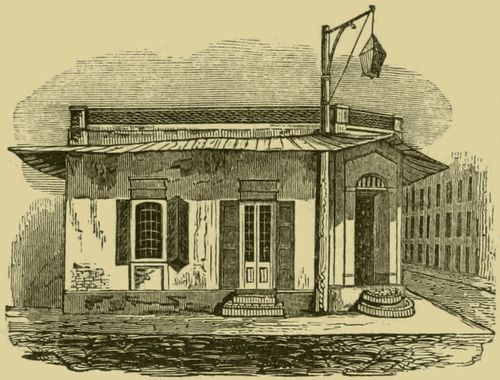
THE OLD SPANISH BUILDING
At the corner of Royal and St. Anne streets, is delineated in the above engraving as it now stands—and long may it remain as a memorial of other times.
Thirty years ago—which, comparatively would take us back three centuries in any European city—thirty years ago, one might have seen from that spot, then the centre of the city, long perspective street-scenes of a similar character. Innovation has now done her work—has absolutely trodden the city of the last century under her feet.
The Casa Blanca, at the corner of Bienville and Old Levee Streets, has also escaped the general demolition. It was once the courtly residence of Bienville, the first governor of Louisiana—the seat of power, and the centre of wealth, beauty and fashion in the province. It is still on its old foundation, standing "alone in its glory," and the spirit of innovation has so far respected its ancient uses, that it is still a treasury of wealth, and a conservatory of the sweetness of our favored clime—a store house of sugar and molasses!
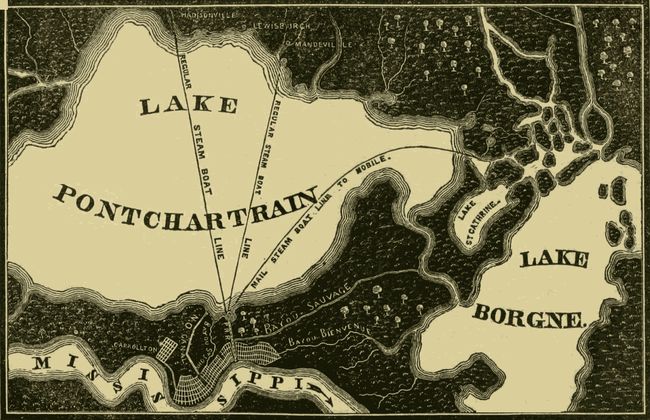
Environs of New Orleans.