HOSPITALS
Reading edition
No city in the United States is so well provided with establishments of this kind as New Orleans. Here, the only passport required for admission to the best attendance, is sickness, or an injury. No cold formalities are thrown in the way of the suffering patient. Indeed, it has become a subject of complaint, that access is so easy, and the position so agreeable, that the improvident and the indolent take undue advantage of its benefits.
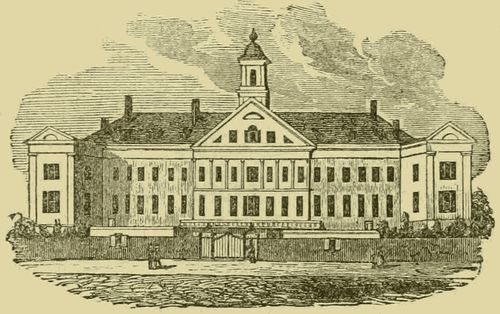
THE CHARITY HOSPITAL
The first hospital for indigent persons erected in the city of New Orleans, appears to have been built on the site formed by the west side of Rampart street, between Toulouse and St. Peter streets. It was blown down in 1779; and, being of wood, was entirely destroyed.
In 1784, Dr. N. Y. Roxas commenced one of brick on the same position, which he completed at an expense of $114,000 in 1786, and called it the New Charity Hospital of St. Charles. He endowed it with a perpetual revenue of $1500 per annum, by appropriating the rents of the stores at the corner of St. Peter and Levee streets. It continued under the patronage and direction of the family, until March 1811, when it was relinquished to the city by authority of the legislature, the edifice having been previously consumed by fire. It was now subjected to a council of administration, appointed by the governor and city council—(the first six, the latter three.) Since 1813 the council has been appointed by the governor and senate. It consists of eight members, and the governor. Its support has been derived from several sources. A most liberal legacy was left it by that public benefactor Julien Poydras, of real estate, valued at $35,000. Several smaller sums have been received from other benevolent individuals. It has also received aid from the state, directly and indirectly. Pennsylvania made a liberal grant of $10,000, in 18—.
In 1812, the council of administration sold to the state the square now occupied by the state house, with the buildings, for $125,000, and purchased the present site, and built their large and commodious structure at the foot of Common street, at an expense of $150,000, containing sufficient room to accommodate four or five hundred patients. This is the building particularly referred to in the heading of this article. Besides being under the charge of the ablest of the medical faculty, the institution has the assistance of the Sisters of Charity, as nurses to the sick, who cannot be excelled in kindness and careful attention.
The edifice itself is very imposing, from its immense size. It is substantially built with brick. Suitable supplementary out-buildings for lunatics, and lying-in apartments, are on the same grounds; and the whole is encompassed by a permanent brick wall.
To show the great usefulness of this establishment, it is only necessary to state that, during 1844, there were five thousand eight hundred and forty-six patients admitted, seven hundred and thirteen of whom died, and five thousand and fifty-nine were dismissed. Of this number, only one thousand three hundred and sixteen were natives of the United States, and four thousand five hundred and thirty foreigners. This year the yellow fever was not epidemic.
The following table, taken from the New Orleans Medical Journal, shows the number of cases of yellow fever admitted into this hospital from Jan. 1, 1822, to Jan. 1, 1844, with the dates of the first and last cases each year, with the discharges and deaths, constituting a term of twenty-two years.
TABLE.
Year.First Case.Last Case.Adm'd.Dis'g'd.Died.
1822Sept. 3.Dec. 31.34998239
1823Sept. 11. 1 1
1824Aug. 4.Nov. 13.16759108
1825June 23.Dec. 19.944059
1826May 18.Nov. 18.26195
1827July 17.Dec. 5.372263109
1828June 19.Dec. 10.290160130
1829May 23.Nov. 29.435220215
1830July 24.Nov. 29.256139117
1831June 9.Oct. 7.312
1832Aug. 15.Oct. 25.26818
1833July 17.Nov. 17.422212210
1834Aug. 28.Nov. 22.1505595
1835Aug. 24.Nov. 27.505221284
1836Aug. 24.Oct. 25.615
1837July 13.Nov. 28.998556442
1838Aug. 25.Nov. 1.22517
1839July 23.Nov. 17.1086634452
1840July 9. 3 3
1841Aug. 2.Dec. 8.1113520594
1842Aug. 4.Nov. 26.410214211
1843July 10.Dec. 31.1053609487
Total Number,778740343803
A discrepancy of50 4034
7837 7837
"This discrepancy between the number of admittances, discharges, and deaths," say the editors, "arises from the fact that a good many cases of yellow fever occur, after the patients are admitted into the hospital for other diseases—and some remain to be treated for other diseases, long after having been cured of yellow fever; and, it may be, that some cases are not noted upon the hospital books at all." The proportion of deaths is accounted for by the exposed state of the patient before admission. In private practice they do not average one death to ten.
The absence of quarantine regulations in New Orleans, is often remarked by strangers. Acts of legislation have been passed at different times, establishing laws for the protection of the city, which proved of but little service, owing, it is generally admitted, to their not being carried out as it is now known they should have been to test their efficacy, consequently they soon fell into disuse.
Much able, and it would seem unanswerable argument has been employed, to prove that this scourge of tropical climates is not contagious; yet, Dr. Carpenter, an eminent and learned member of the medical profession of this city, with great research, has tracked it through all its secret channels of communication, by which at different periods it has been introduced.
The recent able essay of Dr. Hort, read before the Physico-Medical Society of this city, and the proceedings and resolutions of that body, had in reference to it, with equal conclusiveness show it to be endemic, or of local origin, and not an imported or contagious disease.
When such eminent "doctors disagree" what shall the unlearned and uninitiated do?—we are surely in a dilemma, and hardly know on which horn to hang our own humble judgment—but it would really appear that with a sanitary system, commending itself to the more cautious views of the Atlantic cities, an advantage would be gained, that would far more than balance any diminished trade of our neighbors in the Gulf. Are there not also, many hundreds of active, intelligent, business making citizens, who now fly to the North on the first approach of the sickly season, who, with such guards faithfully maintained about them, would remain through the summer? and are there not thousands more in various parts of the country, who, inspired with confidence by the existence and maintenance of a system of measures which they deem essential to the preservation of the health and lives of the citizens, would throng to our metropolis as the most inviting field of enterprise, and thus multiply our numbers and enlarge our business far more rapidly than it can, or will be done under the present system?
If in making these suggestions it should be supposed that we have "defined our position," we shall shelter ourselves under "the generally received opinion," "the prevailing fears of the community"—and the prudential measures of other cities.
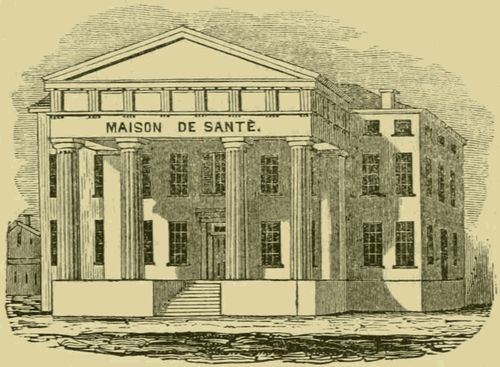
MAISON DE SANTE
This noble edifice, emphatically the house of the stranger, was built in 1839, and opened in August of the same year. The full and complete success of the enterprise is written in the grateful memories of the thousands of patients who have resorted to it in the hour of sickness and danger. The prices required secure to every sick person more than the attention and comforts of the house of his childhood. Not a doubt need to cross his mind but that all which science, and the most devoted care can effect, will be done for him; he only goes there to get well, if it be possible in the nature of his case. The names of the attending physicians, Doctors Stone, Kennedy and Carpenter, are a sufficient guaranty for the respectability of this establishment.
CIRCUS STREET INFIRMARY
This institution, situated between Poydras and Perdido streets, was established by Doctors Campbell and Mackie, in July, 1841. It is neatly furnished, and offers all the comforts and advantages of a private house to the invalid. No contagious diseases are admitted, and kind and skilful nurses are furnished.
THE FRANKLIN INFIRMARY
Is situated in the Fauxbourg Franklin, in Champs Elysees street, fronting the Pontchartrain rail-road, and about two miles from the city. It is a private hospital, founded by Dr. C. A. Luzemburg. The building, although not large, is accommodated with several out houses, and the grounds are spacious and pleasant.
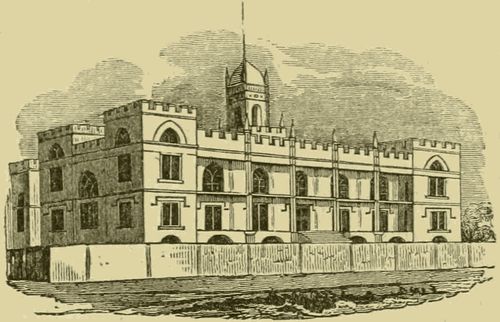
THE UNITED STATES MARINE HOSPITAL
Situated at Macdonough, opposite New Orleans, occupies a square, measuring three hundred and fifty feet each way, which is enclosed by a good substantial fence, intended, eventually, to give place to an iron railing. The edifice measures, in front, one hundred and sixty feet, by seventy eight deep—from the rear of which two adjuncts extend fifty feet further back, leaving sufficient room between them for a spacious court, immediately behind the centre of the main building.
The whole is laid off into three stories. It is fifty feet from the ground to the eaves, and one hundred and thirty-five to the top of the flag-staff, which surmounts the belvidere. It is built in the Gothic style; and was designed by Mondele and Reynolds, who were the original contractors. It was commenced in 1834, but for want of the necessary appropriations by the government, the work was suspended, and has gone so much to ruin, that it will require $20,000 to repair the damage.
James H. Caldwell, Esq., has contracted for the completion of this work. The building, when finished and furnished for receiving patients, will cost $130,000. It will accommodate two hundred and sixty nine persons. The grounds, tastefully laid out, are to be embellished with shrubbery. As seen from the Mississippi, or from a distance, this structure presents a very majestic appearance. It stands in a healthy position, elevated and dry; and from its great height, commands a complete view of the river, city, surrounding country, and a whole forest of masts—affording to poor Jack at once a delightful and a busy prospect, that must have a great tendency to cheer the hours of his convalescence.