CHARITABLE INSTITUTIONS
Reading edition
There is probably no city in the United States that has so many benevolent institutions as New Orleans, in proportion to its population. Certainly it has not an equal in those voluntary contributions, which are sometimes required to answer the immediate calls of distress. Here are assembled a mixed multitude, composed of almost every nation and tongue, from the frozen to the torrid zone, and, whether it be the sympathy of strangers, or the influence of the sunny south, their purses open and their hearts respond, like those of brothers, to the demands of charity. To illustrate these assertions and to carry out the plan of this work, a description of the most prominent of these establishments is annexed.
THE FEMALE ORPHAN ASYLUM
Stands at the intersection of Camp and Phytanee streets, on an angular lot, widening to the rear on Erato street. It has a northerly front on the junction of the two first named streets, and occupies all the grounds that are contained in this irregular space—the rear, however, being reserved as a site for a church, to be erected at some future period. The land was a liberal donation from Madame Foucher, and her brother, Francis Soulet. Previous to the erection of this building, the establishment was conducted in rented tenements, under the direction of the Sisters of Charity; in whose hands it still continues to present a praiseworthy example of neatness and parental care. It commenced in 1836 with six children; and, in 1839, with great exertions, it accommodated ninety.
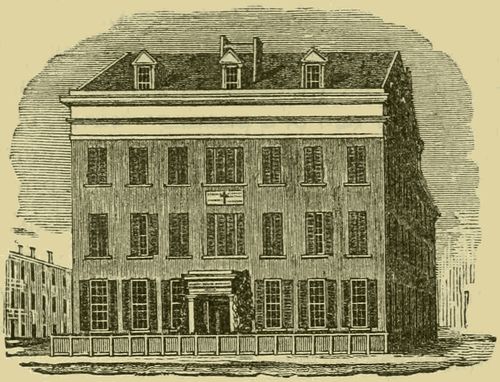
The history of this charity seems to trespass on the region of romance. In its struggle, it received an important impulse from the suggestions of a benevolent lady, Mrs. Pogue. In conversation with a female friend of similar feelings, she remarked, "if a fair could be organized for its benefit, and the opulent induced to patronise it, money might be raised to erect the necessary buildings." That friend told the Bishop; who, taking up the hint, announced it from the pulpit. This led to the call of a meeting—where, instead of a small assemblage, the rooms were crowded with the wealth and beauty of the city. It resulted in the collection of over sixteen thousand dollars! Thus, to almost a chance expression from the kind heart of woman, New Orleans is mainly indebted for the prosperity of one of the noblest of her humane institutions.
From this moment, the Asylum assumed a firm standing. A suitable house was at once commenced. The second municipality gave a thousand dollars, and the legislature at different periods, twelve thousand dollars. In 1840 the whole was completed, and the children, to the number of about one hundred, took possession. Since that time they have averaged one hundred and forty-five annually. They receive the rudiments of a good education. At a suitable age they are apprenticed to persons of character and responsibility; and a vigilance is continued, that guaranties to them the kind treatment, which their isolated position seems to demand.
The edifice, built by D. Hayden, cost over forty-two thousand dollars. Though conducted with the utmost prudence, the institution is some twenty-five hundred dollars in debt. In a capital like this, where so many of the citizens have princely revenues, and with them a princely liberality, there is little doubt that arrangements will soon be made to relieve it of this embarrassment. It has now about one hundred and sixty children, of whom over thirty are in the nursery.
THE MALE ORPHAN ASYLUM
The Society for the Relief of Destitute Orphan Boys have their establishment in Lafayette. It went into operation in 1824, and was incorporated the year after. By a calculation of the first sixteen years, it appears that an average of thirty-five have annually participated in its benefits. Although its title would seem to imply, that orphans only are admitted, yet the board are authorized to receive any boy, whose destitute condition requires their protection.
THE POYDRAS FEMALE ORPHAN ASYLUM
This is one of the oldest establishments of the kind in New Orleans. It was endowed by Julien Poydras, and possesses an immense revenue from valuable improved real estate. They occupy on Julia, from St. Charles to Carondelet streets, and extend back about two-thirds of an immense square. It has for several years had an average of one hundred and twenty children. The excellent system and regulations, in regard both to instruction and health, will not be disparaged by comparison with the best institutions in the world. Possessing so much property and such beautiful grounds, it is to be regretted that more spacious and comfortable buildings are not erected for the accommodation of the inmates.
THE CATHOLIC MALE ORPHAN ASYLUM
This institution is supported by an association, and by private donations. The establishment occupies a large building fronting the river, and a few squares above the New Convent. About one hundred and seventy children receive the benefits of this charity.
LES DAMES DE LA PROVIDENCE
This association was formed in 1839. It consists of about one hundred ladies, who each contribute a certain sum monthly as a charitable fund. Its object is to render aid to the sick, the poor and the infirm. The institution was put into operation by the benevolent French ladies of New Orleans; and, were its resources equal to the kind feelings of its members, it would be rendered a means of alleviating much distress among the sick and destitute.
THE SAMARITAN CHARITABLE ASSOCIATION
This institution was founded during the epidemic of 1837, for the purpose of alleviating the wants of the poor and the sick. They established an office at that period, where some of the members, day and night, were always in readiness to attend the bed-side of disease, and to administer aid to the indigent. The late mayor, and many of the most wealthy citizens are members; and, in time of need, the association is liberally endowed by the spontaneous donations of the generous public.
THE FIREMEN'S CHARITABLE ASSOCIATION
Was incorporated in 1835, and managed by a board of directors chosen from each company, subject to certain restrictions. The officers, (a president, vice president, secretary and treasurer,) are elected by the board from members of the association, on the first Monday of January, of each year. The object of this society is the relief of its members, who are incapacitated from attending to business from sickness or misfortunes not arising from improper causes. It makes provision also for the benefit of their families—particularly widows and orphans. This is a very laudable association, and every way deserving of the excellent fire department from which it originated.
YOUNG MEN'S HOWARD ASSOCIATION
This benevolent institution was established in 1837; and its object is the relief of the indigent and sick. Its resources depend entirely upon public contributions—and appeals for aid have always been responded to with alacrity. During the prevalence of the epidemic of 1841, this society collected and distributed over five thousand dollars among the sufferers on that dreadful occasion. It is a noble charity that waits not for calls upon its benevolence; but its members seek for worthy objects in the hidden recesses of misery, and soothe and administer to their wants, with a brotherly solicitude that does honor to the name they have assumed.
THE HEBREW BENEVOLENT SOCIETY
Although but a short time in existence, has accomplished much good; diffusing charity, not in mere accordance with sectional prejudices, but in that catholic spirit of genuine benevolence, which freely dispenses its benefits alike upon Jew and Christian, and recognizes but one brotherhood in the family of man.
THE MILNE ORPHAN ASYLUM
This institution was endowed in 1839, by Alexander Milne, a liberal Scotch gentleman, from whom it takes its name. It was established for the education and protection of helpless orphan children of both sexes.