MANUFACTURES
Reading edition
In New Orleans, have, until recently been but little known. There are now however, several actively employed and well patronised branches of the manufacturing business; which, if not calculated to compete with those in other markets, answer a very good purpose for its own.
THE IRON FOUNDRY
Of Messrs. Leeds & Co. produces every variety of machinery, that steamboats and manufactories require for extensive operations. It has been established many years, at the corner of Foucher and Delord streets, occupies nearly a whole square, and is on as extensive a scale as any in the country. The business-like and prompt system practiced by the conductors, is known to all who require their aid upon the whole line of the Mississippi and its tributaries.
STEAM PLANING MILL
Upon Carondelet Walk, has been in successful operation over four years. Lumber is landed from Carondelet Canal, which passes in front of the building.
STEAM SAW MILLS
Of these there are two; one located in the third municipality, the other five miles below the city, and both upon the banks of the river. They can furnish lumber of almost any description in abundance.
ROPE WALKS
There are several of these, in different parts of the city, where cordage may be manufactured, to any extent, demanded by the business of the place.
Besides these there are several Flour Mills, a Paper Mill, Sugar Refinery, Cotton Factories, &c., all in successful operation.
THE COTTON PRESSES
This is the place of all others, for these extensive buildings, which, generally, occupy a square, and sometimes more. They are numerous and extensive establishments. A brief description of two of the most prominent, will serve for the whole, as they very much resemble each other in their construction.
THE LEVEE COTTON PRESS
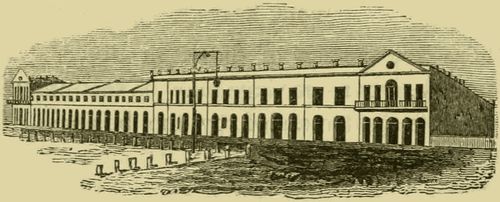
Erected by a company under that name, was completed in 1832, at a cost of $500,000. No architectural effect was aimed at in the façade, which is, however, neat and plain. This establishment can press about 200,000 bales per annum.
THE ORLEANS COTTON PRESS
This vast establishment fronts on the Mississippi, running back on Roffignac and New Levee streets. The ground occupied is six hundred and thirty-two by three hundred and eight feet, and is nearly covered by the buildings. The whole was built according to designs made by Charles F. Zimpel, begun in 1833, and completed in 1835, at a cost, including the site, of $753,558. The front on the river, although having no pretensions to architectural effect, is still, from its location and extent, quite impressive. This press can store twenty-five thousand bales of cotton; and compresses, on an average, one hundred and fifty thousand bales per annum; but its capacity is much greater.
BANKS
LOUISIANA STATE BANK
This building was erected in 1822, at a cost, including the ground, of $55,000. The plan was from Latrobe, and Benjamin Fox the architect. It stands on the corner of Royal and Bienville streets, and presents rather a plain but neat external appearance. It is most substantially built; the lower story is heavily arched, and the banking apartments are completely fire-proof. Capital, $2,000,000.
THE MECHANICS' AND TRADERS' BANK
Is situated on Canal street, occupying only an ordinary house, compared to some others, and requires no particular description. Capital, $2,000,000.
THE CITY BANK
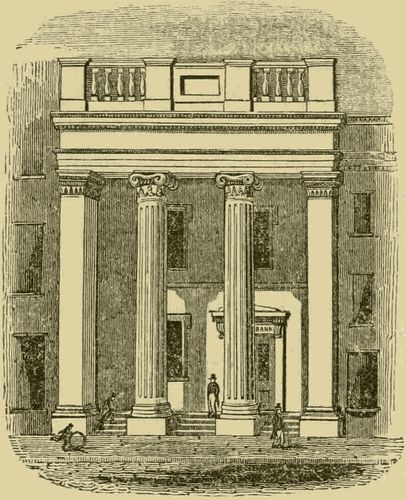
Is a building of the Ionic order, situated in Camp, near Canal street, and designed by W. L. Atkinson, architect. Its construction was commenced in 1837, and finished in 1838, under the superintendence of J. Gallier, at a cost of about $50,000. The banking room is admired for its elegant simplicity. Capital, $2,000,000.
THE GAS BANK
This building, in St. Charles street, between Canal and Common streets, is so closely squeezed in among others, that it has little opportunity to show off the beauty it possesses. It was erected in 1839, under the superintendence of Sidel & Stewart, at an expense of about $25,000, ground $25,000, making $50,000, and is every way well calculated for a banking house. The original capital was $4,000,000, but it was reduced to $180,000, and by request of the stockholders, the banking privileges have been withdrawn by an act of the Legislature of 1845.
THE CANAL BANK
Has its entrance in the centre of the front on Magazine street, of a substantial granite building which stands on that and the corner of Gravier street. That portion of the edifice is very tastefully arranged after the designs of Dakin, the architect. It was erected in 1845. The residue of the structure is used for stores. Capital, $4,000,000.
THE BANK OF LOUISIANA
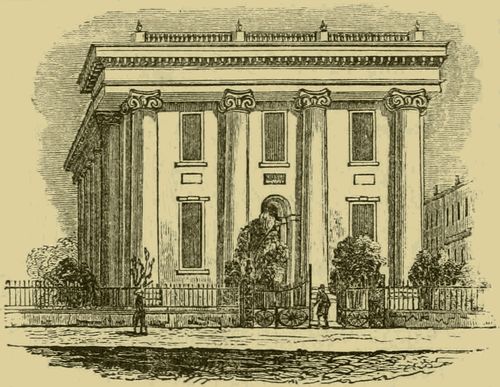
Is a fine Ionic building at the south-west corner of Royal and Conti streets, surrounded by a handsome court. The whole edifice is well arranged, the banking room in particular, is admired for its good architectural effect, being 60 feet square, and of a proportionate height, with a fine gallery above. It was commenced by Bickle, Hamlet and Fox, builders, in 1826, and finished the following year, at a cost of $80,000. Capital, $4,000,000.
BANKS' ARCADE
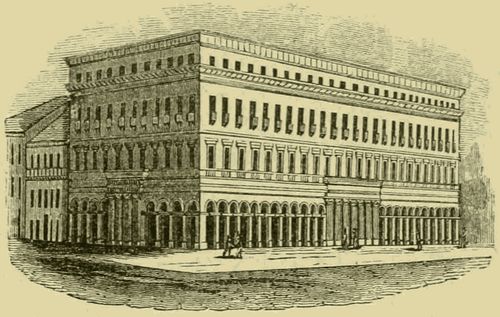
Occupies the front of a square on Magazine street, between Gravier and Natchez streets, having a main entrance, from each of those last named, to the Arcade, which divides the building through the whole length—being three stories high, and covered in with glass, to exclude rain and admit the light. In the lower and second stories, are offices of almost all descriptions—and the third is appropriated mostly to sleeping rooms.
The bar room, opening on Magazine street, is 100 by 60 feet, and 35 in height. It is handsomely embellished, has a gallery surrounding the upper story, and is a popular place for public meetings. It will accommodate 5,000 people on such occasions. This building stands in the centre of business, and, consequently, is a place of great resort for merchants and others. Erected by Thomas Banks in 1833, Charles Zimple, architect.
CITY EXCHANGE
This magnificent edifice, which is one of the greatest ornaments of the city, fronts on three streets—about 300 feet on St. Louis, and 120 each on Royal and Chartres street—the building being intended by the projectors to combine the convenience of a city exchange, hotel, bank, large ball rooms, and private stores.
The principal façade, on St. Louis street, may be generally described as being composed of the Tuscan and Doric orders. The main entrance is formed by six columns of the composite Doric order. Through this portico, access is had to the vestibule of the Exchange, a handsome, though simple hall, 127 by 40 feet. This room is appropriated to general business, and constantly open during waking hours. You pass through this into one of the most beautiful rotundas in America, which is devoted exclusively to business, and is open from noon to three o'clock P. M. This fine room is surrounded by arcades and galleries, always open to the public, (Sundays excepted,) and its general appearance cannot fail to impress upon the mind a most favorable idea of its grandeur and beauty. The dome is most tastefully laid off in compartments, within which the magic pencils of Canova and Pinoli have portrayed allegorical scenes and the busts of eminent Americans, in rich fresco—a style of painting comparatively new in the United States. The floors of the gallery which engird the rotunda, and the winding stairs leading to them, are of iron.
By a side entrance on St. Louis street, access is obtained to the second story; the front of which, on this street, is occupied by a suite of ball rooms and their dependencies. The great ball room is magnificent in its size and decorations. The building also has a capacious entrance on Royal street, as a hotel that can accommodate 200 persons. At the corner of Chartres street are the public baths. In the spring of 1840 this building was nearly burnt down—but, in less than two years, it was completely restored to its original splendor.
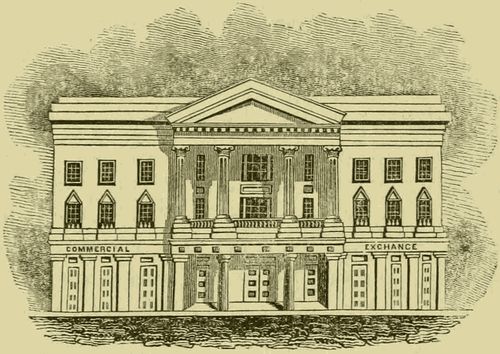
THE COMMERCIAL EXCHANGE
This edifice is now being erected upon the south west corner of St. Charles and Perdido streets, fronting one hundred and three feet upon the former, and running one hundred upon the latter. The main part of the building is to be constructed of brick and stuccoed; the upper portion is purely Corinthian the lower entirely Tuscan. The principal entrance on St. Charles street, is by a portico supported by two Ionic pillars, and the same number of pilastres, composed of granite. The vestibule is eleven feet deep, which admits visitors by three separate doors into the exchange saloon, the most spacious apartment of the kind in the United States; it being seventy by one hundred feet, and twenty seven to the ceiling, which is supported by twelve well arranged and substantial pillars. At the rear of this public room are two others, intended for the accommodation of auctioneers, leaving only sufficient space on the left for the necessary offices and access to the second floor.
The structure shows three stories in front—on the second of which is the news room, expressly arranged for the occupation of the New Orleans Reading Room. This apartment is fifty-five by eighty-three feet, and thirty-seven to the ceiling; and is lighted by thirty-six windows. A portico, with a recess of eleven feet, occupies the immediate front, supporting the pediment by two Corinthian pillars, and an equal number of pilastres. Two rooms are set apart in connection with this establishment, one for the accommodation of captains of vessels, and one for that of sugar-brokers. On each side of the news-room are ranges of offices, to which admission is obtained by corridors on the inner side. Immediately over these, the third floor is arranged in the same manner. The intention of the company, under whose auspices this exchange is building, is, to furnish to the mercantile community a place solely for the transaction of business, similar to Lloyd's of London. There are to be no liquors sold on the premises. Mr. Gallier is the architect, and builder, and the building and land cost $90,000.
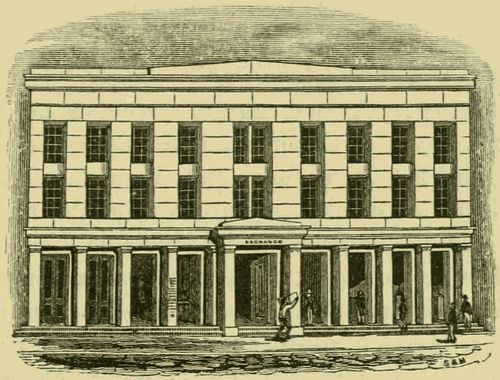
THE MERCHANTS' EXCHANGE
Fronting on Royal street and Exchange Place, was erected by a joint stock company in 1835-6, from the designs and under the superintendence of Mr. Dakin, architect. Both fronts are of marble, in a plain and bold style. The cost of the erection was $100,000.
THE MERCHANTS' READING ROOM
Entrance from Royal street and Exchange Place. This reading room occupied a spacious apartment in the second story of the Merchants' Exchange, and is under the patronage and control of the company interested in that building. It is generally supplied with most of the newspapers of the country, and has received a patronage quite equal to the extent of its accommodations.
THE NEW ORLEANS READING ROOMS
Occupy the second story of a spacious building on the corner of Common and St. Charles streets, opposite the Exchange and Verandah hotels. This is an enterprise started upon the plan of Galignani's, in Paris, and Lloyd's, in London—professing to supply the earliest commercial and general information. The fixtures are arranged with a degree of neatness and convenience that is extremely gratifying to the stranger, who has a spare hour to devote to reading. Here he can peruse the latest papers, not only from almost every section of the United States, but English, French, German, Mexican, Irish, Scotch, and Colonial, together with all the periodicals, to his heart's content. The merchant can see the prices current from nearly every part of the world; arrivals and departures of vessels and of travellers—sales of the great staples and merchandise and their prices, and many such matters of interest to the business man.
THE PUBLIC SCHOOLS
In each parish, have heretofore been placed under the management of a board of five administrators, who reported annually to the secretary of state the condition of those under their direction. This system has been adhered to, till very recently, in the first and third municipalities. In the second a change took place in 1841, which has proved to be so complete a revolution, is attended with such important results to this large portion of the city, and so extended its influence even to the neighboring parishes, that it is referred to with a degree of pleasure which can only be surpassed by our pride in its success.
In accordance with an act of the legislature, approved the 14th of February, 1841, authorizing the municipalities of New Orleans to establish public schools, the authorities of the second municipality set themselves at work with a will. They selected twelve of their fellow-citizens as a board of directors for public schools, together with a standing committee on public education, to whom were granted almost unlimited powers.
Zealous of acquitting themselves with honor, they at once looked to the fountain head, to New England, where the best schools in the country existed, and secured the aid of Mr. J. A. Shaw, who was perfectly conversant with all the improvements, and placed this efficient gentleman at the head of the department as superintendent. From a despairing beginning, in less than one year, the prospect seemed to be most cheering. Commencing with only thirteen children of each sex, it increased, in two years, to ten hundred and sixty-one in actual attendance—and nearly double that number enrolled.
Thus far these schools occupied rooms under the Methodist church in Poydras street, and a new building, called the Washington school, on Magazine, at the corner of Basin street; but since that, the undertaking has been continually extending, until it was found necessary to erect another structure, the Franklin school, on St. Charles street—all of which are now scarcely sufficient to answer the increasing demand for admission.
That, which at first was tested as an experiment, has proved to be a successful enterprise, producing an example which promises to have a beneficial influence over the southern method of education. It found strong opposition and prejudice to contend against, but these have subsided—and the children of the rich and the poor are seated side by side, sharing advantages and striving intellectually—the only distinction recognized among them—"teaching one, as well as informing the other, that adventitious wealth confers no superiority over the fortunate competitor, when engaged in a contest of the mind."
The third municipality school is under the charge of Mr. Geo. W. Harby. All the branches of a good education are taught here in the English, French and Spanish languages. Although this school is under excellent discipline, and has all the advantages of a classical and gentlemanly teacher, it still has labored under the old régime, and could have educated double the number that have attended it. That nothing stands still is as applicable to the intellectual as to the physical world. Already the spirit of improvement, that has done so much for the second municipality, is busy in the first and third—and though slowly, it is as sure, eventually, to push its way into them as water is to find its own level. Beside the public schools, there are many private seminaries of a high order, and conducted by teachers of ability, where the wealthy, who have objections to those above designated, may send their children for instruction.
The education of youth is of the utmost importance to a country—especially to one like this, that should be governed by the intelligence of its citizens. The portals to learning should be thrown wide open, equally to all—for upon knowledge is based the beautiful temple of liberty. Tear away this foundation and the fair edifice must fall. Cherish and support it, and freedom will become as permanent as our rocks, as ever-lasting as our hills.
PUBLIC SCHOOL LYCEUM AND SOCIETY LIBRARY
The intention of this undertaking, is to establish a library for the benefit of the juvenile class of the second municipality, by the voluntary subscriptions and contributions of the scholars attached to the public schools, and by private donations. To advance this important object, the common council passed an ordinance organizing the establishment, regulating and directing its proceedings, and tendering liberal advantages to encourage success in its operations. When $5000 are subscribed they are pledged to furnish rooms to accommodate the library—and, as soon as it amounts to $15,000, to purchase ground and erect suitable buildings. It also provides that, at a certain period, a chemical and philosophical apparatus shall be purchased, and lectures delivered once a week, during eight months of the year, by the most competent men in the country, on astronomy, geology, chemistry, natural and moral philosophy, navigation, book-keeping, engineering, civil architecture and design, and such other useful branches as may be determined by the directors—who are the same as those of the public schools, with the mayor, recorder and aldermen as ex-officio members. The scholar paying twenty-five cents a month, or three dollars a year, for three years, is constituted a life member, and for ever after may have access to this excellent institution. Such has been the success of this undertaking that a building will soon be provided, and very little time will transpire before it will realize all the advantages that its beginning promised. To Samuel J. Peters, Esq., particularly, is this city indebted for introducing and maturing this measure—and for generous presents, to many other citizens and strangers, who have not permitted their names to come before the world.
The growing popularity of the "People's Lyceum," and of the "Young Men's Literary Association," is noticed with no ordinary feelings of gratification. These, commenced and continued by the young, fostered and cherished by all—have become a cheering sight to the eye of the christian, the patriot, and the philanthropist. Established upon judicious principles, tending to give a wholesome direction and salutary stimulus to the mind of their members, the moral influence may be deemed of incalculable consequence to this growing metropolis. History and science are the leading objects of their inquiry, facilitated and encouraged by the delivery of lectures, affording not only instruction but recreation—creating a taste for the rapid acquirement of knowledge—giving a new impulse to the intellectual powers, and to the advancement of literature—all nobly contributing to the refinement and happiness of mankind. These, and others in the course of being established under the auspices of our most eloquent and learned literati, the city may class among the brightest of her jewels.
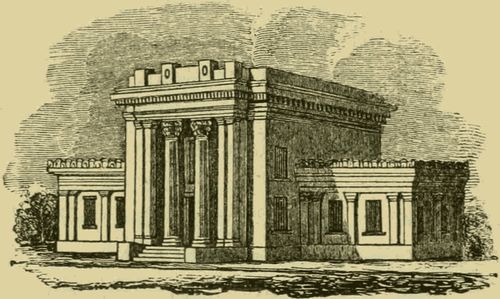
MEDICAL COLLEGE OF LOUISIANA
This building is erected on a fine lot of ground, on the corner of Common and Philippa streets, granted to the college by a recent act of the legislature. It was designed by, and completed under the direction of Mr. Dakin, architect, whose reputation is a guaranty for its taste and elegance. The location is retired, and yet near all the public buildings and thoroughfares. The faculty of this institution are gentlemen of superior qualifications, enthusiastic in their zeal to give it the first place among the kindred establishments of the country. The advantages of New Orleans, for acquiring a practical knowledge of medicine and surgery, are superior to any city in the United States, especially for the study of all diseases peculiar to a southern climate. The facilities for prosecuting the study of anatomy and surgery are unrivalled. The school is well furnished with models, plates, casts, and every thing necessary for illustrations. The requisitions for graduation are those adopted by the best colleges. With these advantages presented to southern students, they will see the benefits resulting from an institution built up among them, conducted by gentlemen acquainted by experience with the wants of the country.
THE NATIONAL GALLERY OF PAINTINGS
This establishment occupies rooms, expressly built for its accommodation, at 13 St. Charles street, and was opened in 1844, under the personal inspection of the proprietor, Mr. G. Cooke, who is himself an artist of taste, and well known among the profession. The principal object was, to form a rallying point for the exhibition of the works of celebrated artists, both of foreign and American origin, and to dispose of such as might please the fancy of the public, at a certain fixed price. Here, visitors will have an opportunity of selecting copies and originals from a quarter that may be relied upon, works both of the old masters, and of the best of the modern schools.
The proprietor is under obligations to a number of the gentlemen of this city, connoisseurs of painting, for the exhibition of some of the most prominent pieces. From R. D. Shepherd, Esq., he has a picture by Rothmel, representing De Soto discovering the Mississippi. If this artist should leave no other work, his reputation, as a genius of no ordinary ability, will remain as durable as the canvas on which he has portrayed the Spaniard and the "Father of Waters."
From James Robb, Esq., whose magnificent collection of modern paintings is better known in other cities than our own, the gallery has received its richest treasures, and most valuable contributions. The chef d'œuvre is from the pencil of a native artist now at Rome, Leutze; and illustrates this sentence in our Lord's prayer—"deliver us from evil." To speak of this gem in terms equal to its merits, would place it immeasurably above the estimation of the age in which we live. Aware that it may be considered presumption to compare living genius with the justly venerated names of the immortal dead, whose works, on account of their antiquity and intrinsic worth, are doubly valued—yet, at the risk of losing our little reputation in such matters, we venture the assertion that this picture of Leutze's will compare with the most beautiful of the Italian school, and is excelled by none in America, not excepting those of our lamented and talented Alston. This picture alone would make any gallery in Europe attractive, and the public are greatly indebted to Mr. Robb for the opportunity he has afforded them of seeing not only this, but many other brilliant productions.
Here, also, is a landscape of no ordinary excellence, by Boddington, an English artist, who has most successfully represented one of his native scenes, in a style of handling peculiarly true and free. Here may be seen four of Doughty's best landscapes, and several fine specimens from the pencils of Cole and Chapman. The portrait of Col. David Crocket, as large as life, in his forest costume, by Chapman, and two large altar pieces, copied from celebrated works in the Vatican—The Entombing of Christ, after Corregio—and The Crucifixion of St. Peter, after Guido—comprise a portion of the more recent additions to the gallery.
Among the most attractive performances, are The Wreck of the Medusa, The Roman Forum, and a Sketch of Rome—from the pencil of the proprietor. The first of these is very much admired—but, to the classical visitor, the last two are far more fascinating; calling up, as they do, with all their endearing associations, our happy school-day remembrances.
Much more might be said respecting this establishment, but the brevity of these pages will not permit an indulgence of our wishes in a more minute detail.
It is probably the general impression of strangers, suggested by the limited number and extent of the public galleries of paintings in this city, that there is, among us, an entire deficiency of a proper taste for the fine arts. And we may, ourselves, inadvertently have contributed to such an impression, by representing our citizens as exclusively absorbed in commercial pursuits. It must be received, however, with many abatements. We have our artists, and not a few of them, who are highly talented, and deservedly patronised.
There are choice collections of paintings in the possession of several private gentlemen, other than those already alluded to; among which are many valuable productions, not only of the modern but ancient masters, purchased at enormous prices.
Among others, those owned by our highly esteemed fellow-citizens, Glendy Burke, H. R. W. Hill, and Joseph M. Kennedy, Esqs., are well worth a visit of the connoisseur and admirer of fine specimens of the arts, to which the known courtesy of the proprietors will cheerfully afford ready access. The only original painting of the famous Wilkie in this country, is in the splendid collection of Mr. Burke.
Several fine specimens of original statues are in the possession of James Dick, and John Hagan, Esqs., which are not excelled by any collection in this country.
THE PRESS
"What is it but a map of busy life, Its fluctuations, and its vast concerns?"
The diurnal press of this country, is not only a mighty political engine, but one of the utmost importance in a commercial and literary point of view. Its increase, within a few years past, like its extending liberty, is without a parallel, and almost beyond belief. Junius, in his peculiar manner, observes, that "they who conceive that our newspapers are no restraint upon bad men, or impediment to the execution of bad measures, know nothing of this country." The force of this remark applies nowhere better than to the Press of the United States.
Every enlightened American, who loves the constitution of his country, and correctly estimates its lofty principles, will lend his aid to preserve these invaluable privileges from the violation of power on the one hand, and the equally injurious outrages of popular licentiousness on the other.
The press of this city comes in for a portion of the credit that is attached to that of the country—more particularly for its elaborate commercial details and general literature. To embody the spirit of the age; to relieve the grave by the gay; and to embellish the useful by the amusing, is its daily task. The choicest of home and foreign literature is found in the leading issues from the New Orleans press. It is equally interesting to the merchant and the general reader; and it preserves, above all its cotemporaries of other cities, a self-respect that does infinite credit to the gentlemen to whose hands the important trust is confided.
There are eight daily papers published in New Orleans—three of which may be rated as of the "mammoth" size; the other five are smaller, but of sufficient dimensions to furnish the ordinary news of the day. They are as follows:
The Louisiana Courier is the only evening paper of the city, and is published in French and English. This is the pioneer, before referred to in this work, under the name of "La Moniteur." The Bee, also in French and English, and the Commercial Bulletin, in English, make up the three mammoth sheets. The Picayune, the Tropic, the Jeffersonian Republican, the Native American, and the New Orleans Times, are all in English. The New Orleans Price Current is a very useful publication, issued twice a week.
In addition to these, the Catholics and Protestants each have their weekly Journals, and the Medical faculty their bi-monthly Periodicals, edited by the most prominent members of the profession, and devoted to Medicine, and Collateral Sciences. They are intended to bring forth the industry and talents of the profession in the South, and to furnish the most recent information of its progress generally.
The subject of Organic Chemistry is that to which, at the present day, the eyes of all thinking members of the profession are directed, and upon which their hope of progress mainly depends,—the relations of chemical action to the functions of organized matter, the application of chemistry to physiology and pathology, are to be treated of as fully as present knowledge extends.
Such contributions to the noble science, in which these gentlemen have long been successful laborers, cannot fail to be properly estimated throughout the scientific world.