PART II. Readings and Recitations from the Most Celebrated Authors
Reading edition
COMPRISING
THRILLING BATTLE SCENES AND VICTORIES; BEAUTIFUL DESCRIPTIONS; SOUL-STIRRING DEEDS OF HEROISM; WITTY AND HUMOROUS SELECTIONS; PATHETIC PIECES; FAMOUS ORATIONS; RECITATIONS FOR CHILDREN; READINGS WITH ACCOMPANIMENTS OF MUSIC; DRILLS; LESSON TALKS, ETC.

HOW TO READ AND RECITE.
Good readers and reciters are extremely rare, and it is because sufficient time and study are not devoted to the art of elocution. Not one educated man in ten can read a paragraph in a newspaper so effectively that to listen to him is a pleasure, and not a pain.
Many persons are unable so to express the words as to convey their meaning. They pervert the sense of the sentence by emphasizing in the wrong place, or deprive it of all sense by a monotonous gabble, giving no emphasis to any words they utter. They neglect the “stops,” as they are called; they make harsh music with their voices; they hiss, or croak, or splutter, or mutter—everything but speak the words set down for them as they would have talked them to you in conversation.
Why should this be? Why should correct reading be rare, pleasant reading rarer still, and good reading found only in one person in ten thousand? Let me urge you with all earnestness to become an accomplished reader and reciter. This is something to be coveted, and it is worth your while to acquire it, though it cost you much time and labor. Attend to the rules here furnished.
Cultivation of the Voice.
Accustom yourself to reading and reciting aloud. Some of our greatest orators have made it a practice to do this in the open air, throwing out the voice with full volume, calling with prolonged vowel sounds to some object in the distance, and thus strengthening the throat and lungs. Every day you should practice breathings; by which I mean that you should take in a full breath, expand the lungs to their full capacity, and then emit the breath slowly, and again suddenly with explosive force. A good, flexible voice is the first thing to be considered.
Distinct Enunciation.
When you hear a person read or speak you are always pleased if the full quantity is given to each syllable of every word. Only in this way can the correct meaning of the sentence be conveyed. People who are partially deaf will tell you that they are not always able to hear those who speak the loudest, but those who speak the most distinctly. Do not recite to persons who are nearest to you, but rather glance at those who are farthest away, and measure the amount of volume required to make them hear.
Emphasis.
Some word or words in every sentence are more important, and require greater emphasis than others. You must get at the exact meaning of the sentence, and be governed by this. The finest effects can be produced by making words emphatic where the meaning demands it. Look well to this.
Pauses.
Avoid a sing-song, monotonous style of delivery. Break the flow where it is required; you will always notice how skillfully a trained elocutionist observes the proper pauses. Have such command of yourself that you do not need to hurry on with your recitation at the same pace from beginning to end. The pause enables the hearer to take in the meaning of the words, and is therefore always to be observed.
Gestures.
Speak with your whole body, not merely with your tongue and lips. It is permissible to even stamp with your foot when the sense calls for it. Speak with your eyes, with your facial expression, with your fingers, with your clenched fist, with your arm, with the pose of your body, with all the varying attitudes needful to express what you have to say with the greatest effect.
Stand, as a rule, with one foot slightly in advance of the other, the weight of the body resting upon the foot farther back. Do not be tied to one position; hold yourself at liberty to change your position and move about. Do not hold your elbows close to your body, as if your arms were strapped to your sides. Make the gesture in point of time slightly in advance of the word or words it is to illustrate.
The Magnetic Speaker.
It has always been said that the poet is born, but the orator is made. This is not wholly correct, for the more magnetism you were born with, the better speaker you will become. Still, the indefinable thing called magnetism is something that can be cultivated; at least you can learn how to show it, and permit it to exert its wonderful influence over your hearers.
Put yourself into your recitations in such a way that the thoughts and sentiments you express shall, for the time being, be your own. Every nerve and muscle of your body, every thought and emotion of your mind, in short, your whole being should be enlisted. You should become transformed, taking on the character required by the reading or recitation, and making it your own.
Persons who can thus lose themselves in what they are saying, and throw into their recitations all the force and magnetism of which they are capable, are sure to meet with success.
Self-Command.
Young persons naturally feel embarrassed when they face an audience. Some of our greatest orators have known what this is, and were compelled to labor hard to overcome it. Practice alone will give you confidence, unless you possess it already, and this is true of only a few young persons.
Do your utmost to control yourself. Let your will come into play; strong will, governing every emotion of the mind and movement of the body, is absolutely essential. Do not be brazen, but self-confident.
Typical Gestures to be Used in Reading and Reciting.
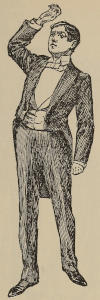
Fig. 1.—Malediction.
Traitors! I would call down the wrath of Heaven on them.
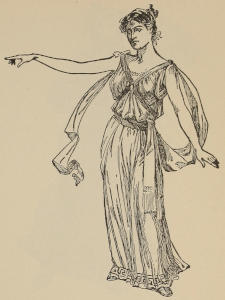
Fig. 2.—Designating.
Scorn points his slow, unmoving finger.
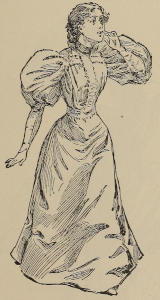
Fig. 3.—Silence.
There was silence deep as death, And the boldest held his breath.
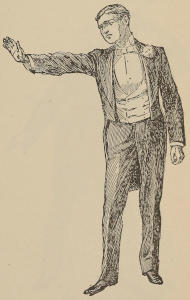
Fig. 4.—Repulsion.
Back to thy punishment, false fugitive, And to thy speed add wings!
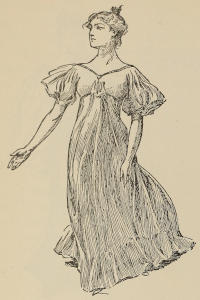
Fig. 5.—Declaring.
I speak the truth, and dare to speak it.
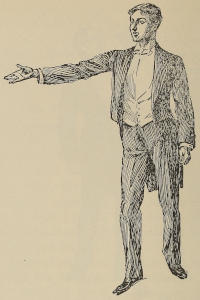
Fig. 6.—Announcing.
We proclaim the liberty that God gave when He gave us life.
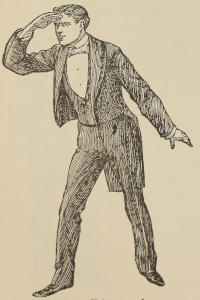
Fig. 7.—Discerning.
A sail, ho! A dim speck on the horizon.
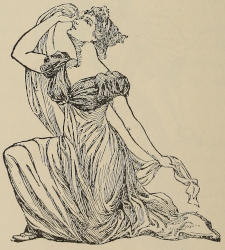
Fig. 8.—Invocation.
Angels and ministers of grace, defend us!

Fig. 9.—Presenting or Receiving.
Welcome the coming, speed the going guest.
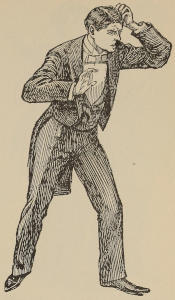
Fig. 10.—Horror.
Methought I heard a voice cry, “Sleep no more! Macbeth, does murder sleep?”
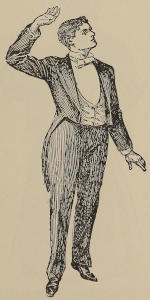
Fig. 11.—Exaltation.
Washington is in the clear upper sky.
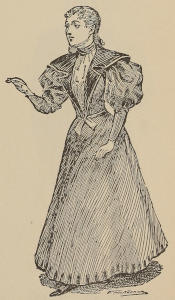
Fig. 12—Secrecy.
Be mute, be secret as the grave.
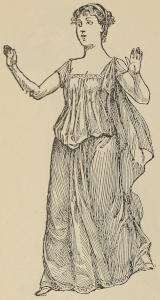
Fig. 13.—Wonderment.
While the dance was the merriest, the door opened and there stood the parson!
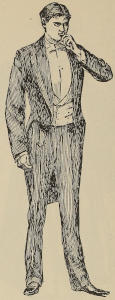
Fig. 14.—Indecision.
Shall I take back my promise? ’Twill but expose me to contempt.
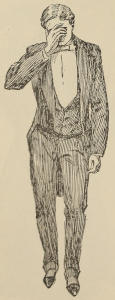
Fig. 15.—Grief.
O, that by weeping I could heal my sorrow!
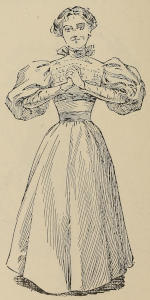
Fig. 16.—Gladness.
No pen, no tongue can summon power To tell the transports of that hour.
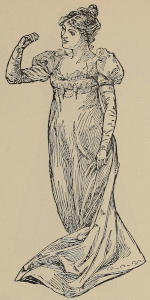
Fig. 17.—Signalling.
There stood Count Wagstaff, beckoning.
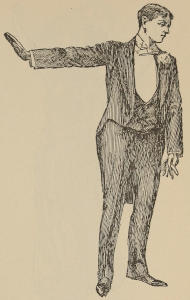
Fig. 18.—Tender Rejection.
It has come at last; I must say, No.
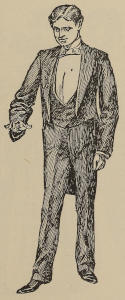
Fig. 19.—Protecting—Soothing.
Boy! Harold! safely rest, Enjoy the honey-dew of slumber.
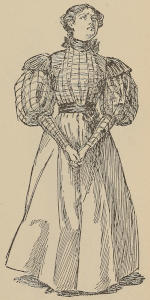
Fig. 20.—Anguish.
My cup with agony is filled, From nettles sharp as death distilled.
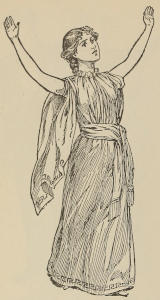
Fig. 21.—Awe—Appeal.
Spirits of the just made perfect, from your empyrean heights look down!
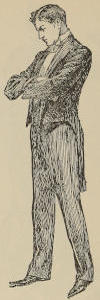
Fig. 22.—Meditation.
A lonely man, wending his slow way along and lost in deepest thought.
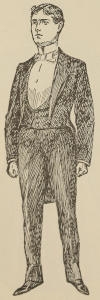
Fig. 23.—Defiance.
Defy the devil; consider he is the enemy of mankind.
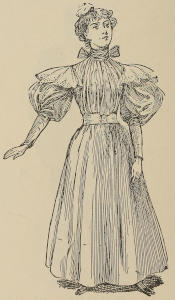
Fig. 24.—Denying—Rejecting.
Yes, if this were my last breath I would deny these infamous charges.
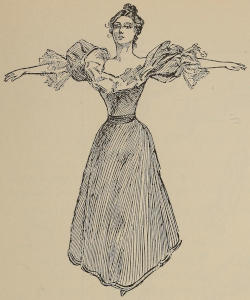
Fig. 25.—Dispersion.
Spain’s proud Armada was scattered to the winds.
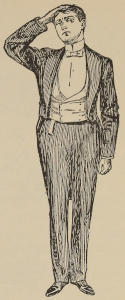
Fig. 26.—Remorse.
A thoughtless, wicked deed; it stings sharper than a serpent’s tooth.
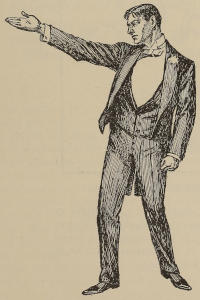
Fig. 27.—Accusation.
And Nathan said to David, Thou art the man.
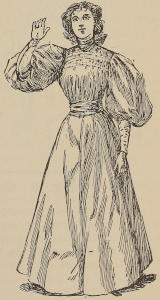
Fig. 28.—Revealing.
The way she kept it was, of course, To tell it all and make it worse.
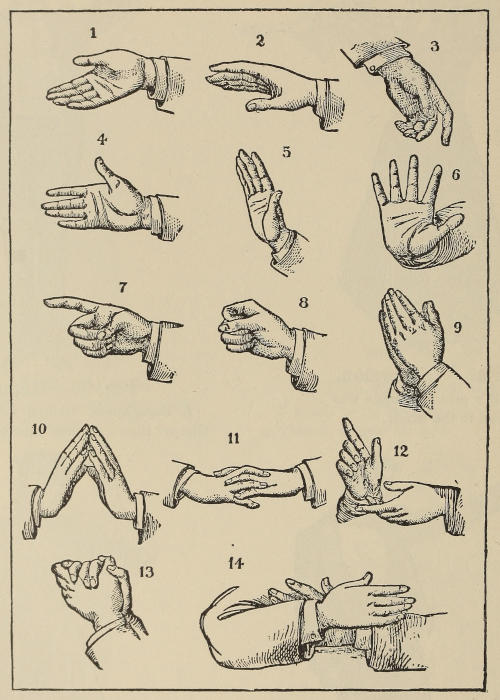
Fig. 29.—Correct Positions of the Hands.
1. Simple affirmation. 2. Emphatic declaration. 3. Apathy or prostration. 4. Energetic appeal. 5. Negation or denial. 6. Violent repulsion. 7. Indexing or cautioning. 8. Determination or anger. 9. Supplication. 10. Gentle entreaty. 11. Carelessness. 12. Argumentation. 13. Earnest entreaty. 14. Resignation.
Recitations with Lesson Talks.
SHOWING BY EXAMPLES HOW TO READ AND RECITE.

THE SONG OF OUR SOLDIERS AT SANTIAGO.
When the destruction of Admiral Cervera’s fleet became known before Santiago, the American soldiers cheered wildly, and, with one accord, through miles of trenches, began singing “The Star Spangled Banner.” You should preface the recitation with the foregoing statement.
Singing “The Star Spangled Banner” In the very jaws of death! Singing our glorious anthem, Some with their latest breath! The strains of that solemn music Through the spirit will ever roll, Thrilling with martial ardor The depths of each patriot soul. 2. Hearing the hum of the bullets! Eager to charge the foe! Biding the call to battle, Where crimson heart streams flow! Thinking of home and dear ones, Of mother, of child, of wife, They sang “The Star Spangled Banner” On that field of deadly strife. 3. They sang with the voices of heroes, In the face of the Spanish guns, As they leaned on their loaded rifles, With the courage that never runs, They sang to our glorious emblem, Upraised on that war-worn sod, As the saints in the old arena Sang a song of praise to God. David Graham Adee.
LESSON TALK.
This selection is inspiring. It is brimful of the glow of patriotism. To deliver it, therefore, in a dull, listless, indifferent manner would suppress the natural sentiment of the piece and rob it of the effect it would otherwise produce. Be alive; not wooden and nerveless. If you were standing in a crowd and a brass band should come along and strike up the “Star Spangled Banner,” you would instantly see the change that would come over the assembled throng. Every heart would be moved, every face would be filled with expression, every nerve would seem to tingle.
When you are to deliver a selection of this kind, come before your audience with your body straightened to its full height, your shoulders thrown back, and your head erect. For the time being you are a patriot, and are saying some grand things about the Stars and Stripes and about our brave heroes who have carried “Old Glory” to victory on so many battlefields.
Your manner must indicate that you appreciate their heroism, that you are ready to extol it, and that you expect your hearers to share the emotions of your own breast. You should know what tones of voice your are to employ in expressing most effectively the sentiments of the piece, what gestures should be used and what words are to be emphasized.
1. Taking now the first verse, you should let the tones of your voice out full and clear on the first line, lowering your voice on the second line; then letting your voice ring out again on the third line, and again subduing it on the fourth. Here is a fine opportunity for contrast between strong tones and tones subdued and suggestive of death. It would not be amiss to give the words “their latest breath” in a whisper. Prolong the sound on the word “roll.” The word “thrilling” should be expressed with energetic impulse, and the voice lowered, yet round and full, on the last line.
2. With hands elevated as high as the shoulders and palms turned outward, expressive of wonder and almost alarm, deliver the first line of the second verse. Suddenly change to confidence and courage in the next three lines. Express nothing here that could suggest timidity, but rather the opposite.
“Thinking of home and dear ones, Of mother, of child, of wife,”
should be spoken in a thoughtful mood, with head dropped on breast; then lift it as you speak the two lines that follow, the last of which refers to the field of battle and should be designated, as in Figure 2 of Typical Gestures, found in the preceding pages.
3. At the beginning of verse three, elevate your voice and prolong the tones. The words “never runs” are emphatic; put stress on them. On the fifth and sixth lines of this verse use the gesture for Exaltation, Figure 11 of Typical Gestures—arm lifted as high as the head and palm opened upward, giving the arm at the same time a circular motion. The last two lines should be delivered with hands clasped, palm to palm, in front of the breast, and eyes turned upward.

THE VICTOR OF MARENGO.
Napoleon was sitting in his tent; before him lay a map of Italy. He took four pins and stuck them up; measured, moved the pins, and measured again. “Now,” said he, “that is right; I will capture him there!” “Who, sir?” said an officer. “Milas, the old fox of Austria. He will retire from Genoa, pass Turin, and fall back on Alexandria. I shall cross the Po, meet him on the plains of Laconia, and conquer him there,” and the finger of the child of destiny pointed to Marengo.
2. Two months later the memorable campaign of 1800 began. The 20th of May saw Napoleon on the heights of St. Bernard. The 22d, Lannes, with the army of Genoa, held Padua. So far, all had been well with Napoleon. He had compelled the Austrians to take the position he desired; reduced the army from one hundred and twenty thousand to forty thousand men; dispatched Murat to the right, and June 14th moved forward to consummate his masterly plan.
3. But God threatened to overthrow his scheme! A little rain had fallen in the Alps, and the Po could not be crossed in time. The battle was begun. Milas, pushed to the wall, resolved to cut his way out; and Napoleon reached the field to see Lannes beaten—Champeaux dead—Desaix still charging old Milas, with his Austrian phalanx at Marengo, till the consular guard gave way, and the well-planned victory was a terrible defeat. Just as the day was lost, Desaix, the boy General, sweeping across the field at the head of his cavalry, halted on the eminence where stood Napoleon.
4. There was in the corps a drummer-boy, a gamin whom Desaix had picked up in the streets of Paris. He had followed the victorious eagle of France in the campaigns of Egypt and Germany. As the columns halted, Napoleon shouted to him: “Beat a retreat!” The boy did not stir. “Gamin, beat a retreat!” The boy stopped, grasped his drum-sticks, and said: “Sir, I do not know how to beat a retreat; Desaix never taught me that; but I can beat a charge,—Oh! I can beat a charge that will make the dead fall into line. I beat that charge at the Pyramid: I beat that charge at Mount Tabor: I beat it again at the bridge of Lodi. May I beat it here?”
5. Napoleon turned to Desaix, and said: “We are beaten; what shall we do?” “Do? Beat them! It is only three o’clock, and there is time enough to win a victory yet. Up! the charge! beat the old charge of Mount Tabor and Lodi!” A moment later the corps, following the sword-gleam of Desaix, and keeping step with the furious roll of the gamin’s drum, swept down on the host of Austrians. They drove the first line back on the second—both on the third, and there they died. Desaix fell at the first volley, but the line never faltered, and as the smoke cleared away the gamin was seen in front of his line marching right on, and still beating the furious charge.
6. Over the dead and wounded, over breastworks and fallen foe, over cannon belching forth their fire of death, he led the way to victory, and the fifteen days in Italy were ended. To-day men point to Marengo in wonder. They admire the power and foresight that so skillfully handled the battle but they forget that a General only thirty years of age made a victory of a defeat. They forget that a gamin of Paris put to shame “the child of destiny.”
LESSON TALK.
A story or a narrative like this should be read in a more easy, conversational manner than is demanded for selections more tragic or oratorical. Yet a great variety of expression can be introduced into this piece, and without it, the reading will be tame.
1. In the first part of this verse spread your hands forward, then outward with the palms downward, to indicate the map of Italy which is lying before the great general. In a tone of triumph, accompanied with firmness and decision, Napoleon says, “I will capture him there.” Use the gesture for defiance, Figure 23, in Typical Gestures. Your body must be immediately relaxed as you ask the question, “Who, sir?” Let the answer be given with utterance somewhat rapid, still indicating firmness and decision.
2. This verse is easy narrative and should be recited as you would tell it to a friend in conversation. The words “masterly plan” in the last line are emphatic.
3. In the first line of this verse use the gesture shown in Figure 24 of Typical Gestures, indicating that Napoleon’s scheme was rejected by God and brought to nought. The style of narrative here is very concise and the sentences should follow one another in quick succession. “Milas, pushed to the wall,” should be expressed by Figure 4 of Typical Gestures. When you come to the words “the well-planned victory was a terrible defeat,” stretch forth your right arm as in Figure 6 of Typical Gestures, dropping it to your side heavily on the last word. Point to the boy general sweeping across the field and to the eminence where Napoleon stood. Champeaux is pronounced Shon-po; Desaix is pronounced De-say.
4. Here you drop again into easy narrative until you come to the words, “Beat a retreat!” These are to be shouted as if you were the officer on the battlefield giving the command. Put intense expression into the boy’s appeal, as he states that he does not know how to beat a retreat, and pleads to be permitted to beat a charge. There is opportunity here for grand effect as you deliver these lines.
5 and 6. Use the gesture for Defiance on the words, “Up! the charge!” You are ordering an advance, resolved to win the victory. The remainder of this verse and the following is narrative and demands quite a different rendering from the words of command in other parts of the selection. If you recite it in such a way as to express the full meaning it will captivate your hearers.
THE WEDDING FEE.
One morning, fifty years ago— When apple-trees were white with snow Of fragrant blossoms, and the air Was spellbound with the perfume rare— Upon a farm horse, large and lean, And lazy with its double load, A sun-brown youth and maid were seen Jogging along the winding road 2. Blue were the arches of the skies, But bluer were that maiden’s eyes! The dewdrops on the grass were bright, But brighter was the loving light That sparkled ’neath each long-fringed lid, Where those bright eyes of blue were hid; Adown the shoulders, brown and bare, Rolled the soft waves of golden hair. 3. So on they ride, until among The new born leaves with dew-drops hung, The parsonage, arrayed in white, Peers out—a more than welcome sight. Then with a cloud upon his face, “What shall we do?” he turned to say, “Should he refuse to take his pay From what is in the pillow case?” 4. And glancing down his eyes surveyed The pillow case before him laid, Whose contents reaching to its hem, Might purchase endless joys for them. The maiden answers: “Let us wait; To borrow trouble where’s the need?” Then at the parson’s squeaking gate Halted the more than willing steed. 5. Down from his horse the bridegroom sprung; The latchless gate behind him swung. The knocker of that startled door, Struck as it never was before, Brought the whole household, pale with fright, And there with blushes on his cheek, So bashful he could hardly speak, The parson met their wondering sight. 6. The groom goes in, his errand tells, And as the parson nods, he leans Far out across the window-sill and yells— “Come in. He says he’ll take the beans!” Oh! how she jumped! With one glad bound She and the bean-bag reached the ground. 7. Then, clasping with each dimpled arm The precious products of the farm, She bears it through the open door, And down upon the parlor floor Dumps the best beans vines ever bore. 8. Ah! happy were their songs that day, When man and wife they rode away; But happier this chorus still Which echoed through those woodland scenes: “God bless the priest of Whittensville! God bless the man who took the beans.”
LESSON TALK.
The quiet humor of this piece stands in strong contrast to selections of a tragic character, and if it is recited in an easy pleasant way, it is sure to be appreciated by all who hear it. Adapt your voice and manner, therefore, to the style of narrative.
1. With the right hand extended designate the farm horse, large and lean. Drawl out the word lazy in the next line, and continue this slow utterance to the end of the verse.
2. The sentiment changes in the next verse and requires more animation. In the first line make the gesture shown in Figure 21 of Typical Gestures, in the beginning of Part II. of this volume. Become more animated as you describe the maiden’s eyes and the soft waves of her golden hair.
3. The young couple reach the parsonage and your manner should suggest theirs; they have come on very important business. Express the embarrassment of the young man as he asks the question: “What shall we do?” etc. Give a half look of surprise as you refer to the contents of the pillow-case.
4. In a half tone of rebuke the maiden answers, “Let us wait,” saying encouragingly that there is no need to borrow trouble. She evidently believes the parson will be quite willing to take the fee.
5. Let your utterance become more rapid as you picture the bridegroom springing from the horse. With uplifted, clenched hand knock on the door, and then portray the half fright of the parson as he answers the knock.
6. Here is an opportunity for a genuine touch of humor. Cry out as the young man would to the maiden by the gate, “Come in; he says he’ll take the beans!” She jumps to the ground. Make the gesture of Figure 16 in Typical Gestures.
7. Act out the effort of carrying the pillow-case through the open door and throwing it upon the parlor floor. Do not let your facial expression be too serious. You should know how to smile without looking silly.
8. Here again in the first line make the gesture in Figure 16, and with elevated pitch and joyous expression picture the young couple as they ride away. With fervent tones and uplifted hands recite the last two lines of the piece. A good recital for a parlor entertainment.
THE STATUE IN CLAY.
“Make me a statue,” said the King, “Of marble white as snow; It must be pure enough to stand Before my throne, at my right hand; The niche is waiting. Go!” 2. The sculptor heard the King’s command And went upon his way; He had no marble, but he meant, With willing mind and high intent, To mould his thoughts in clay. 3. Day after day he wrought in clay, But knew not what he wrought; He sought the help of heart and brain, But could not make the riddle plain; It lay beyond his thought. 4. To-day the statue seemed to grow, To-morrow it stood still, The third day all went well again; Thus year by year, in joy and pain, He served his master’s will. 5. At last his life-long work was done; It was a fateful day; He took the statue to the King, And trembled like a guilty thing, Because it was but clay. 6. “Where is my statue?” asked the King, “Here, Lord,” the Sculptor said: “But I commanded marble.” “True, I had not that, what could I do But mould in clay instead?” 7. “Thou shalt not unrewarded go Since thou hast done thy best, Thy statue shall acceptance win, It shall be as it should have been, For I will do the rest.” 8. He touched the statue, and it changed. The clay falls off, and lo! The marble shape before him stands, The perfect work of heavenly hands, An angel, pure as snow.

LESSON TALK.
The beautiful lesson taught in this selection is apparent to every one. In reciting it you have, therefore, the advantage of presenting a reading that commends itself to all hearers, the sentiment of which is admirable. The piece will speak for itself, and there is a vast difference between a reading of this description and one that has nothing specially to commend it.
And here let me say something concerning your choice of recitations. First of all, they should be adapted to your range of capacity. It is simply grotesque for one to whom only tragedy is natural to attempt to recite humorous pieces. On the other hand, it is a great mistake for one who is expert in nothing but humorous selections to attempt to recite tragedy.
The error with many readers lies in attempting to do that for which they are not naturally fitted. The selections in this volume are so diversified that you ought to be able to find what is especially suited to your ability.
Nothing is inserted here simply because it is good poetry or good prose. There are thousands of readings and recitations, so called, that do not afford the elocutionist any opportunity to display his powers. They are a dull monotony from beginning to end. They fill the pages of the book, but nobody wants them. Every recitation in this volume has been chosen because it has some special merit and is adapted to call out the powers of the reader.
1. Taking now the recitation before us you have in the first verse the King’s command, which you should deliver in a tone of authority, extending the right hand on the fourth line.
And this affords me an opportunity to say that your gestures should never be thrust forward or sideways in an angular manner, but with something approaching a curve. Do not make gestures as though you were a prize-fighter and were thrusting at an imaginary foe. Remember that the line of beauty is always the curve.
2. This verse is narrative and requires a different expression from the one preceding it. Extend your right hand on the second line in which it is stated that the sculptor went upon his way, curving your arm outward and then letting it fall gently by your side.
3. In this verse the sculptor is in perplexity. He is trying to study out the riddle, and to express this you should use Figure 22 of Typical Gestures.
4 and 5. These verses are also narrative, the only thing to be noted being the trembling timidity of the sculptor in the last part of the 5th verse. This should be indicated by the tones of your voice and general manner.
6. This is dialogue, and while the inflexions required are those of ordinary conversation, do not let your manner be too tame.
7. Make the announcement contained in this verse with evident satisfaction. The last line is emphatic and should be spoken with full volume.
8. Make a pause after the word statue in the first line and recite the remainder of this line in a tone of surprise. In the second line make the gesture in Figure 13 of Typical Gestures. Let your facial expression indicate satisfaction.
THE PUZZLED BOY.
“Well—whose boy am I, any way? I fell down cellar yesterday, And gave my head an awful bump (If you had only seen the lump!) And Mamma called me when I cried, And hugged me close up to her side, And said: ‘I’ll kiss and make it well, Mamma’s own boy; how hard he fell.’ 2. “When Papa took me out to play Where all the men were making hay, He put me on old Dobbin’s back; And when they gave the whip a crack, And off he threw me, Papa said, (When I got up and rubbed my head, And shut my lips, and winked my eyes) ‘Papa’s brave boy. He never cries!’ 3. “And when I go to Grandma’s—well, You’d be surprised if I could tell Of all the pies and ginger-cakes And doughnuts that she always makes, And all the jam and tarts and such, And never says, ‘Don’t take too much; Because,’ she says, ‘he must enjoy His visit, for he’s Grandma’s boy!’ 4. “And Grandpa says: ‘I’ll give him soon A little pony for his own, He’ll learn to ride it well, I know, Because he’s Grandpa’s boy. Ho! ho!’ And plenty other people say; ‘Well, how are you, my boy, to-day?’ Now, can you tell me, if you try, How many little boys am I?”

LESSON TALK.
This selection is in a lighter vein than the others that have gone before. It is adapted to a boy eight or ten years old. While the humor is not of a boisterous character, the piece is very pleasing when recited by a boy who knows how to take in the situation and can put on a look of natural surprise.
Recitations by little people are always interesting to older persons. The young should be taught to recite in public. While this need not make them bold, it does give them confidence, which is very desirable for them to have.
Moreover, it helps them to become graceful in manner if they are properly trained, and takes away the awkwardness which makes many young persons appear to a disadvantage. Added to all this the cultivation of the memory derived from learning recitations, and learning them so thoroughly that they cannot be forgotten through any temporary embarrassment, and you will readily see that the noble art of elocution is an essential part of every young person’s education.
The selection before us is not a difficult one to recite. In the first verse emphasis should be placed on the word “am,” and the question should be asked in a tone of surprise. Put your hand to your head in speaking of that “awful bump.”
In the next verse lift your right hand with a sudden motion and use any gesture with which you can best indicate the cracking of the whip. When you come to the words “off he threw me,” use the gesture in Figure 24 of Typical Gestures. Emphasize the word “he” in the last line.
In verse three open your eyes in half wonder and put on an expressive smile as you speak of grandma’s pies, cakes, doughnuts, tarts, etc. Make it plain that you enjoy your visit to grandma’s.
With elevated voice and accents of delight refer to the gift of the little pony in the last verse. Speak the first “ho!” rather quickly; then prolong the sound on the second “ho!” In the last line the words “am I?” are emphatic. You are puzzled to know how many little boys you are. Pause a moment and look as if expecting an answer.
Recitations with Music.
Nothing renders a recitation more acceptable to any audience than snatches of music, some of the words being sung, if the reader has a voice for singing. The change from reciting to singing should be made easily, and you should be fully confident that you can carry through the part to be expressed by the notes of music, and sing the words effectively.
This will require practice, but will repay you for the time spent in preparation. Selections for song and recital combined are here presented, which cannot fail to captivate your audience if they are skillfully rendered.

TWICKENHAM FERRY.
The words to be sung, or that should receive the prolonged sound indicated by the notes, are printed in italics. Remember you are calling to some one in the distance.

“O-hoi ye-ho, Ho-ye-ho, Who’s for the ferry? The briars in bud, the sun is going down, And I’ll row ye so quick and I’ll row ye so steady, And ’tis but a penny to Twickenham Town.” The ferryman’s slim and the ferryman’s young, And he’s just a soft twang in the turn of his tongue, And he’s fresh as a pippin and brown as a berry, And ’tis but a penny to Twickenham Town. O-hoi ye-ho, Ho-ye-ho, Ho-ye-ho, Ho. 2. “O-hoi ye-ho, Ho-ye-ho, I’m for the ferry, The briars in bud, the sun going down, And it’s late as it is, and I haven’t a penny, And how shall I get me to Twickenham Town?” She’d a rose in her bonnet, and oh! she look’d sweet As the little pink flower that grows in the wheat, With her cheeks like a rose and her lips like a cherry, “And sure and you’re welcome to Twickenham Town.” O-hoi ye-ho, Ho-ye-ho, Ho-ye-ho, Ho. 3. O-hoi ye-ho, Ho, you’re too late for the ferry, The briars in bud, the sun going down, And he’s not rowing quick and he’s not rowing steady, You’d think ’twas a journey to Twickenham Town. “O hoi, and O ho,” you may call as you will, The moon is a rising on Peterham Hill, And with love like a rose in the stern of the wherry, There’s danger in crossing to Twickenham Town. O-hoi ye-ho, Ho-ye-ho, Ho-ye-ho, Ho.

GRANDMOTHER’S CHAIR.
The words to be sung are printed in italics.
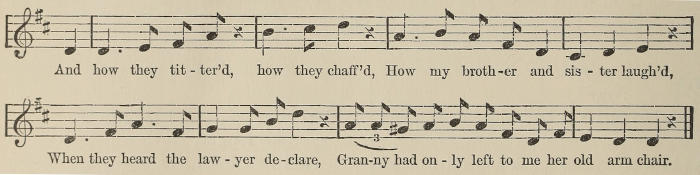
My grandmother she, at the age of eighty-three, One day in May was taken ill and died; And after she was dead, the will of course was read, By a lawyer as we all stood by his side. Five hundred dollars to my brother did she leave, The same unto my sister, I declare; But when it came to me, the lawyer said, “I see She has left to you her old arm chair.” And how they tittered, how they chaffed, How my brother and sister laughed, When they heard the lawyer declare Granny had only left to me her old arm chair. I thought it hardly fair, still I said I did not care, And in the evening took the chair away; The neighbors they me chaffed, my brother at me laughed, And said it will be useful, John, some day: When you settle down in life, find some girl to be your wife, You’ll find it very handy, I declare; On a cold and frosty night, when the fire is burning bright, You can then sit in your old arm chair. What my brother said was true, for in a year or two, Strange to say, I settled down in married life; I first a girl did court, and then the ring I bought, Took her to the church, and when she was my wife, The girl and I were just as happy as could be, For when my work was over, I declare, I ne’er abroad would roam, but each night would stay at home, And be seated in my old arm chair. One night the chair fell down; when I picked it up I found The seat had fallen out upon the floor; And there to my surprise I saw before my eyes, Ten thousand dollars tucked away, or more. When my brother heard of this, the fellow, I confess, Went nearly mad with rage, and tore his hair; But I only laughed at him, then said unto him, “Jem, Don’t you wish you had the old arm chair?” John Read.
[Repeat words with music.]

PUT YOUR SHOULDER TO THE WHEEL.
The words to be sung are in italics.
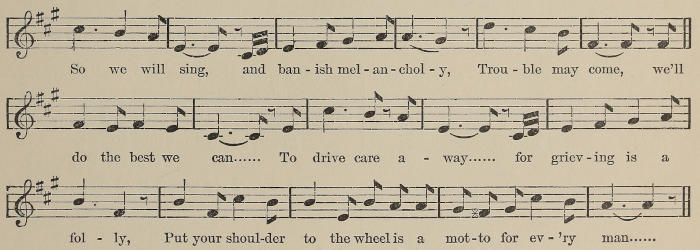
Some people you’ve met in your time, no doubt, Who never look happy or gay; I’ll tell you the way to get jolly and stout, If you’ll listen awhile to my lay. I’ve come here to tell you a bit of my mind, And please with the same, if I can; Advice is my song, you will certainly find, And a motto for every man. So we will sing, and banish melancholy; Trouble may come, we’ll do the best we can To drive care away, for grieving is a folly; Put your shoulder to the wheel is a motto for ev’ry man. We cannot all fight in this battle of life, The weak must go to the wall; So do to each other the thing that is right, For there’s room in this world for us all. “Credit refuse,” if you’ve money to pay, You’ll find it the wiser plan; And “a dollar laid by for a rainy day,” Is a motto for every man. A coward gives in at the first repulse; A brave man struggles again, With a resolute eye and a bounding pulse, To battle his way amongst men; For he knows he has only one chance in his time To better himself, if he can; “So make your hay while the sun doth shine,” That’s a motto for every man. Harry Clifton.
[Repeat the part to be sung.]
A BRIGHTER DAY IS COMING.
The words in italics are to be sung.
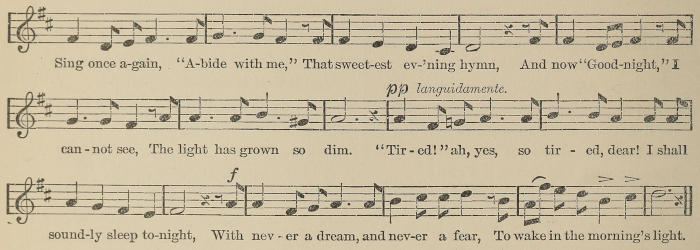
“Tired,” ah, yes, so tired, dear, the day has been very long, But shadowy gloaming draweth near, ’tis time for the even song. I’m ready to go to rest at last, ready to say, “Good night;” The sunset glory darkens fast, to-morrow will bring me light. Sing once again, “Abide with me” that sweetest evening hymn, And now “Good night,” I cannot see, the light has grown so dim. “Tired” ah, yes, so tired, dear, I shall soundly sleep to-night, With never a dream, and never a fear, to wake in the morning’s light. It has seemed so long since morning tide, and I have been left so lone, Young, smiling faces thronged my side when the early sunlight shone, But they grew tired long ago, and I saw them sink to rest, With folded hands and brows of snow, on the green earth’s mother breast. Helen Burnside.
[Repeat the words with music.]

KATY’S LOVE LETTER.
Sing the words printed in italics.

Och, girls dear, did you ever hear, I wrote my love a letter. And although he cannot read, sure I thought ’twas all the better; For why should he be puzzled with hard spelling in the matter, When the meaning was so plain that I love him faithfully? I love him faithfully, And he knows it, oh, he knows it, without one word from me. I wrote it, and I folded it, and put a seal upon it; ’Twas a seal almost as big as the crown of my best bonnet; For I would not have the Postmaster make his remarks upon it, As I said inside the letter that I loved him faithfully, I love him faithfully, And he knows it, oh, he knows it! without one word from me. My heart was full, but when I wrote, I dared not put the half in, The neighbors know I love him, and they’re mighty fond of chaffing; And I dared not write his name outside, for fear they would be laughing, So I wrote, “From little Kate to one whom she loves faithfully.” I love him faithfully, And he knows it, oh, he knows it! without one word from me. Now, girls, would you believe it, that Postman, so consaited, No answer will he bring me, so long as I have waited; But maybe there isn’t one for the raison that I stated, That my love can neither read nor write, but he loves me faithfully. He loves me faithfully, And I know where’er my love is, that he is true to me. Lady Dufferin.
DOST THOU LOVE ME, SISTER RUTH?
A COMIC DUET.
The persons who present this recital should appear in Quaker costume and stand near each other, face to face. It can be made very amusing. The change from reciting to singing adds greatly to the effect. Sing the words in italics, and make appropriate gestures.
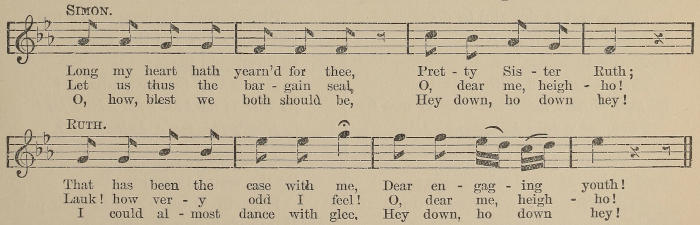
1. Simon.—Dost thou love me, Sister Ruth? Say, say, say! Ruth.—As I fain would speak the truth, Yea, yea, yea. Simon.—Long my heart hath yearned for thee, Pretty Sister Ruth; Ruth.—That has been the case with me, Dear engaging youth. 2. Simon.—Wilt thou promise to be mine, Maiden fair? Ruth.—Take my hand, my heart is thine, There, there, there. [Salutes her.] Simon.—Let us thus the bargain seal. O, dear me, heigh-ho! Ruth.—Lauk! how very odd I feel! O, dear me, heigh-ho! 3. Simon.—Love like ours can never cloy, Humph! humph! humph! Ruth.—While no jealous fears annoy, Humph! humph! humph! Simon.—O, how blessed we both should be, Hey down, ho down, hey! Ruth.—I could almost dance with glee, Hey down, ho down, hey! John Parry.
TWO LITTLE ROGUES.
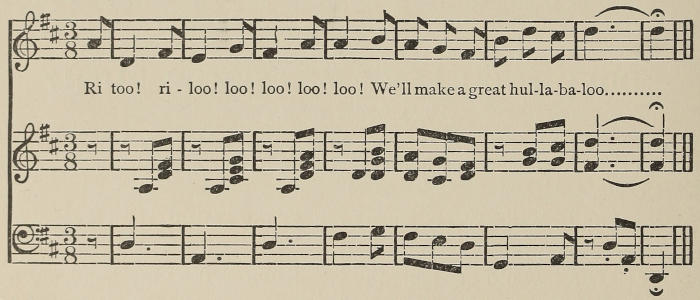
Says Sammy to Dick, “Come, hurry! come quick! And we’ll do, and we’ll do, and we’ll do! Our mammy’s away, She’s gone for to stay, And we’ll make a great hullabaloo! Ri too! ri loo! loo! loo! loo! loo! We’ll make a great hullabaloo!” Says Dick to Sam, “All weddy I am To do, and to do, and to do, But how doesth it go? I so ’ittle to know, That, what be a hullabawoo? Ri too! ri loo! woo! woo! woo! woo! Thay, what be a hullabawoo?” “Oh, slammings and bangings, And whingings and whangings; And very bad mischief we’ll do! We’ll clatter and shout, And knock things about, And that’s what’s a hullabaloo! Ri too! ri loo! loo! loo! loo! loo! And that’s what’s a hullabaloo! “Slide down the front stairs! Tip over the chairs! Now into the pantry break through! Pull down all the tin-ware, And pretty things in there! All aboard for a hullabaloo! Ri too! ri loo! loo! loo! loo! loo! All aboard for a hullabaloo! “Now roll up the table, Far up as you are able, Chairs, sofa, big easy-chair too! Put the lamps and the vases In funny old places. How’s this for a hullabaloo? Ri too! ri loo! loo! loo! loo! loo! How’s this for a hullabaloo? “Let the dishes and pans Be the womans and mans; Everybody keep still in their pew; Mammy’s gown I’ll get next, And preach you a text. Dick! hush with your hullabaloo! Ri too! ri loo! loo! loo! loo! loo! Dicky! hush with your hullabaloo!” As the preacher in gown Climbed up and looked down, His queer congregation to view, Said Dicky to Sammy, “Oh, dere comes our mammy! She’ll ’pank for dis hullubawoo! Ri too! ri loo! woo! woo! woo! woo! She’ll ’pank for dis hullabawoo! “O mammy! O mammy!” Cried Dicky and Sammy, “We’ll never again, certain true!” But with firm step she trod To take down the rod— Oh, then came a hullabaloo! Bo hoo! bo hoo! woo! woo! woo! woo! Oh, then came a hullabaloo! Mrs. A. M. Diaz.
ARKANSAW PETE’S ADVENTURE;
Arkansaw Pete, a frontier-backwoodsman, who sings the solo. Chorus, three lively city gentlemen.
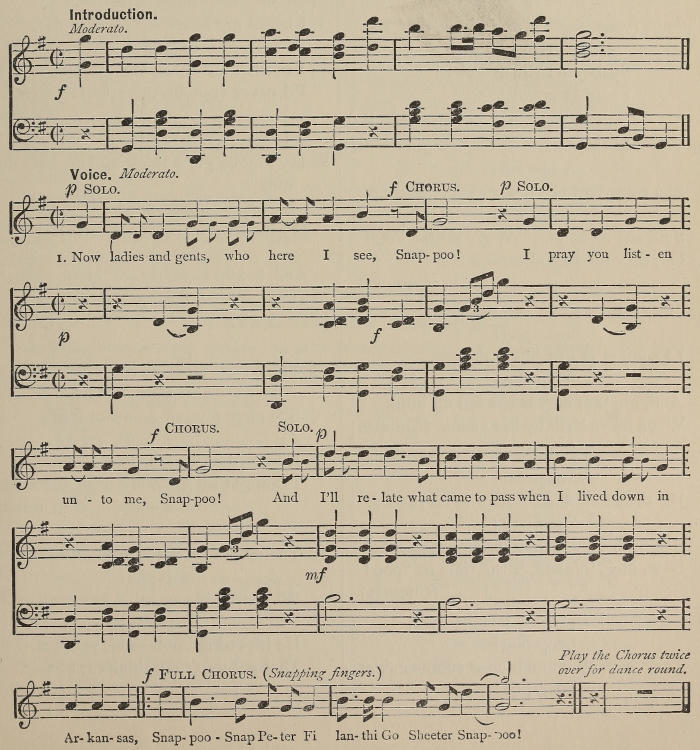
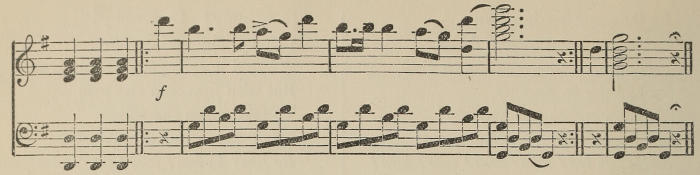
1. Now ladies and gents, who here I see, Snap-poo! I pray you listen unto me, Snap-poo! And I’ll relate what came to pass when I lived down in Ar-kan-sas, Snap-poo! Snap-Peter! Fi-lan-thi-go-shee-ter! Snap-poo! 2. While riding home one Saturday night, Snap-poo! I passed Miss Smith’s and thought I’d light, Snap-poo! So I hitch’d my hoss and in did go, Just for to spend an hour or so. Chorus (marching up and down, and snapping fingers at Pete). Snap-poo! Snap-Peter! Fi-lan-thi-go-shee-ter! Snap-poo! (Repeat chorus.) 3. When to the door I had safely got, Snap-poo! She came and pok’d her sweet head out, Snap-poo! Said she right out, “Why, Mister Pete! Oh, do walk in and have a seat!” (Chorus.) 4. With easy step and a jolly heart, Snap-poo! I bounded in just like a dart, Snap-poo! And, oh, you may bet, I felt all hunk When into a chair by her I sunk. (Chorus.) 5. Our chairs got closer as we two rock’d, Snap-poo! My throat swell’d up till I most chok’d, Snap-poo! At length they struck, and came to a stop— Now, now, thinks I,’s the time to “pop!” (Chorus.) 6. I tried to look in her love-lit eyes, Snap-poo! They were clear and blue as summer skies, Snap-poo! Not a word could I speak—alas! poor Pete! Though she look’d good enough to eat. (Chorus.) 7. I look’d at her, and she look’d at me, Snap-poo! I heard my heart say pee-dee-dee, Snap-poo! I twisted my chair, and cross’d my feet— I’d never seen anything half so sweet. (Chorus.) 8. My tongue grew thick, and my eyes stuck out, Snap-poo! My hands flew nervously about, Snap-poo! And, before I could their motion check, They grabb’d that gal right ’round the neck! (Chorus.) 9. She haul’d away with her pretty fist, Snap-poo! She gave my jaw an awful twist, Snap-poo! It seem’d an hour before I spoke— I thought by gum, my head was broke! (Chorus.) 10. The racket we made brought her ma-ma, Snap-poo! Who straightway call’d her great pa-pa, Snap-poo! He kicked me out—and, you bet, I fled That gal won’t do, thinks I, to wed! (Chorus.)
Patriotic Recitations.
THE BEAT OF THE DRUM AT DAYBREAK.
Speak the words in italics with full, earnest tones of command. Then change easily to a manner suited to animated description. An excellent selection for one who can make these changes effectively.
The morning is cheery, my boys, arouse! The dew shines bright on the chestnut boughs, And the sleepy mist on the river lies, Though the east is flushing with crimson dyes. Awake! awake! awake! O’er field and wood and brake, With glories newly born, Comes on the blushing morn. Awake! awake! You have dreamed of your homes and your friends all night; You have basked in your sweethearts’ smiles so bright: Come, part with them all for a while again— Be lovers in dreams; when awake, be men. Turn out! turn out! turn out! You have dreamed full long I know, Turn out! turn out! turn out! The east is all aglow. Turn out! turn out! From every valley and hill there come The clamoring voices of fife and drum; And out on the fresh, cool morning air The soldiers are swarming everywhere. Fall in! fall in! fall in! Every man in his place. Fall in! fall in! fall in! Each with a cheerful face. Fall in! fall in! Michael O’Connor.
THE CAVALRY CHARGE.
Admirably suited to rapid utterance, vivid description and full tones on an elevated key. Hurrah in the last lines as you would if you saw the enemy routed on the field of battle.
With bray of the trumpet And roll of the drum, And keen ring of bugles, The cavalry come, Sharp clank the steel scabbards, The bridle-chains ring, And foam from red nostrils The wild chargers fling. Tramp! tramp! o’er the green sward That quivers below, Scarce held by the curb-bit, The fierce horses go! And the grim-visaged colonel, With ear-rending shout, Peals forth to the squadrons, The order—“Trot out.” One hand on the sabre, And one on the rein, The troopers move forward In line on the plain. As rings the word “Gallop!” The steel scabbards clank, And each rowel is pressed To a horse’s hot flank: And swift is their rush As the wild torrent’s flow, When it pours from the crag On the valley below. “Charge!” thunders the leader. Like shaft from the bow Each mad horse is hurled On the wavering foe. A thousand bright sabres Are gleaming in air; A thousand dark horses Are dashed on the square. Resistless and reckless Of aught may betide, Like demons, not mortals, The wild troopers ride. Cut right! and cut left! For the parry who needs? The bayonets shiver Like wind-shattered reeds! Vain—vain the red volley That bursts from the square— The random-shot bullets Are wasted in air. Triumphant, remorseless, Unerring as death,— No sabre that’s stainless Returns to its sheath. The wounds that are dealt By that murderous steel Will never yield case For the surgeons to heal Hurrah! they are broken— Hurrah! boys, they fly— None linger save those Who but linger to die.
THE GREAT NAVAL BATTLE OF SANTIAGO.
Hold your body erect, but not awkwardly stiff, let every nerve be tense, your voice full and round, and let your manner indicate that you have a grand story to relate, as you recite Admiral Schley’s thrilling description of the great naval battle at Santiago. You are depicting the scene as though you were there and yourself won the brilliant victory.
One hour before the Spaniards appeared my quartermaster on the Brooklyn reported to me that Cervera’s fleet was coaling up. This was just what I expected, and we prepared everything for a hot reception. Away over the hills great clouds of smoke could be faintly seen rising up to the sky. A little later and the smoke began to move towards the mouth of the harbor. The black cloud wound in and out along the narrow channel, and every eye on board the vessels in our fleet strained with expectation.
The sailor boys were silent for a full hour and the grim old vessels lay back like tigers waiting to pounce upon their prey. Suddenly the whole Spanish fleet shot out of the mouth of the channel. It was the grandest spectacle I ever witnessed. The flames were pouring out of the funnels, and as it left the channel the fleet opened fire with every gun on board. Their guns were worked as rapidly as possible, and shells were raining around like hail.
It was a grand charge. My first impression was that of a lot of maddened bulls, goaded to desperation, dashing at their tormentors. The storm of projectiles and shells was the hottest imaginable. I wondered where they all came from. Just as the vessels swung around the Brooklyn opened up with three shells, and almost simultaneously the rest of the fleet fired. Our volley was a terrible shock to the Spaniards, and so surprised them that they must have been badly rattled.
When our fleet swung around and gave chase, we not only had to face the fire from the vessels, but were bothered by a cross-fire from the forts on either side, which opened on our fleet as soon as the Spaniards shot out of the harbor. The engagement lasted three hours, but I hardly knew what time was. I remember crashing holes through the Spanish Admiral’s flagship, the Maria Teresa, and giving chase to the Colon.
I was on the bridge of the Brooklyn during the whole engagement, and at times the smoke was so dense that I could not see three yards ahead of me. The shells from the enemy’s fleet were whistling around and bursting everywhere, except where they could do some damage. I seemed to be the only thing on the vessel not protected by heavy armor, and oh! how I would have liked to get behind some of that armor!
I don’t know how I kept my head, but I do know that I surprised myself by seeing and knowing all that was going on, and I could hear my voice giving orders to do just what my head thought was right, while my heart was trying to get beneath the shelter of the armored deck. How do I account for such a victory with so little loss? That would mean how do I account for the rain of Spanish shell not doing more execution? They fought nobly and desperately, but they were not a match for our Yankee officers and sailors.
I was proud of the boys in our fleet during that engagement. They knew just what their guns could do, and not one shot was wasted. Their conduct was wonderful. It was inspiring. It was magnificent. Men who can stand behind big guns and face a black storm of shells and projectiles as coolly as though nothing was occurring; men who could laugh because a shell had missed hitting them; men who could bet one another on shots and lay odds in the midst of the horrible crashing; men who could not realize that they were in danger—such men are wonders, and we have a whole navy of wonders.
Admiral W. S. Schley.

HOBSON’S DARING DEED.
Let your tones of voice be strong and bold, not boisterous, and give to the most spirited lines full force. You are depicting a daring deed, and it must not be done in a weak, timid, hesitating way, but with strong utterance and emphasis. The sinking of the steam collier Merrimac was a famous exploit.
Thunder peal and roar and rattle of the ships in line of battle, Rumbling noise of steel volcanoes hurling metal from the shore, Drowned the sound of quiet speaking and the creaking, creaking, creaking Of the steering-gear that turned her toward the narrow harbor door. On the hulk was calm and quiet, deeper for the shoreward riot; Dumb they watched the fountain streaming; mute they heard the waters hiss, Till one laughed and murmured, “Surely it was worth while rising early For a fireworks exhibition of such character as this.” Down the channel the propeller drove her as they tried to shell her From the dizzy heights of Morro and Socapa parapet; She was torn and she was battered, and her upper works were shattered By the bursting of the missiles that in air above her met. Parallels of belching cannon marked the winding course she ran on, And they flashed through morning darkness like a giant’s flaming teeth; Waters steaming, boiling, churning; rows of muzzles at each turning; Mines like geysers spouting after and before her and beneath. Not a man was there who faltered; not a theory was altered Of the detailed plan agreed on—not a doubt was there expressed; This was not a time for changing, deviating, re-arranging; Let the great God help the wounded, and their courage save the rest. And they won. But greater glory than the winning is the story Of the foeman’s friendly greeting of that valiant captive band; Speech of his they understood not, talk to him in words they could not; But their courage spoke a language that all men might understand.
GENERAL WHEELER AT SANTIAGO.
“Fighting Joe,” as he was familiarly called, was one of the most conspicuous and heroic figures in the battles fought around Santiago. Recite this tribute to the hero with feeling, and show by looks, tone and gestures that you appreciate the patriotism and valor of the famous commander of cavalry.
Into the thick of the fight he went, pallid and sick and wan, Borne in an ambulance to the front, a ghostly wisp of a man; But the fighting soul of a fighting man, approved in the long ago, Went to the front in that ambulance, and the body of Fighting Joe. Out from the front they were coming back, smitten of Spanish shells— Wounded boys from the Vermont Hills and the Alabama dells; “Put them into this ambulance; I’ll ride to the front,” he said, And he climbed to the saddle and rode right on, that little old ex-Confed. From end to end of the long blue ranks rose up the ringing cheers, And many a powder-blackened face was furrowed with sudden tears, As with flashing eyes and gleaming sword, and hair and beard of snow, Into the hell of shot and shell rode little old Fighting Joe! Sick with fever and racked with pain, he could not stay away, For he heard the song of the yester-years in the deep-mouthed cannon’s bay— He heard in the calling song of the guns there was work for him to do, Where his country’s best blood splashed and flowed ’round the old Red, White and Blue. Fevered body and hero heart! This Union’s heart to you Beats out in love and reverence—and to each dear boy in blue Who stood or fell ’mid the shot and shell, and cheered in the face of the foe, As, wan and white, to the heart of the fight rode little old Fighting Joe! James Lindsay Gordon.
THE FLAG GOES BY.
Hats off! Along the street there comes A blare of bugles, a ruffle of drums, A flash of color beneath the sky: Hats off! The flag is passing by! Blue and crimson and white it shines Over the steel-tipped, ordered lines, Hats off! The colors before us fly! But more than the flag is passing by, Sea-fights and land-fights grim and great Fought to make and to save the state; Cheers of victory on dying lips; Weary marches and sinking ships; Days of plenty and years of peace March of a strong land’s swift increase; Equal justice, right and law, Stately honor and reverend awe; Sign of a nation great and strong, To ward her people from foreign wrong; Pride and glory and honor, all Live in the colors to stand or fall. Hats off!

IN MANILA BAY.
A graphic description of the great naval battle of Manila and Admiral Dewey’s overwhelming victory. Unless this recital is delivered in an animated, exultant manner, and with great oratorical force, the grand power of the description will be weakened, if not entirely lost. Put your whole soul into it.
On the broad Manila Bay The Spanish cruisers lay, In the shelter of their forts upon the shore; And they dared their foes to sail Through the crashing iron hail Which the guns from decks and battlements would pour. All the harbor ways were missed, And along the channel blind Slept the wild torpedoes, dreaming dreams of wrath. Yea! the fiery hates of hell Lay beneath the ocean’s swell, Like a thousand demons ambushed in the path. Breasting fierce Pacific gales, Lo! a little squadron sails, And the Stars and Stripes are floating from its spars. It is friendless and alone, Aids and allies it has none, But a dauntless chorus sings its dauntless tars: “We’re ten thousand miles from home; Ocean’s wastes and wave and foam Shut us from the land we love so far away. We have ne’er a friendly port For retreat as last resort, But we’ll beard the ships of Spain in their own bay. “They have mines beneath the sea, They have forts upon their lee, They have everything to aid them in the fray; But we’ll brave their hidden mines, And we’ll face their blazing lines; Yes! We’ll beard the ships of Spain in their own bay. “If we’re worsted in the fight, We shall perish in the right— No hand will wipe the dews of death away. The wounded none will tend, For we’ve not a single friend; But we’ll beard the ships of Spain in their own bay. “No ironclads we sail, Only cruisers light and frail, With no armor plates to turn the shells away. All the battleships now steer In another hemisphere, But we’ll beard the ships of Spain in their own bay. “Ho! Remember now the Maine! Up! And smite the ships of Spain! Let them not forget for years this first of May! Though hell blaze up from beneath, Forward through the cannon’s breath, When Dewey leads into Manila Bay.” There, half-way round the world, Swift and straight the shots were hurled, And a handful of bold sailors won the day. Never since earth was begun Has a braver deed been done Than when Dewey sailed into Manila Bay. God made for him a path Through the mad torpedoes’ wrath, From their slumbers never wakened into play. When dawn smote the east with gold, Spaniards started to behold Dewey and his gallant fleet within their bay. Then from forts and warships first Iron maledictions burst, And the guns with tongues of flame began to pray; Like demons out of hell The batteries roar and yell, While Dewey answers back across the bay. O Gods! it was a sight, Till the smoke, as black as night, Hid the fire-belching ships from light of day. When it lifted from the tide, Smitten low was Spanish pride, And Dewey was the master of their bay. Where the awful conflict roared, And red blood in torrents poured, There the Stars and Stripes are waving high to-day. Dewey! Hero strong and grand! Shout his name through every land! For he sunk the ships of Spain in their own bay. Charles Wadsworth, Jr.
MY SOLDIER BOY.
When night comes on, when morning breaks, they rise, Those earnest prayers by faithful lips oft said, And pierce the blue which shrouds the inner skies: “God guard my boy; God grant he is not dead!” “My soldier boy—where is he camped to-night?” “God guard him waking, sleeping or in fight!” Far, far away where tropic suns cast down Their scorching rays, where sultry damp airs rise And haunting breath of sickness holds its own, A homesick boy, sore wounded, suffering lies. “Mother! Mother!” is his ceaseless cry. “Come, mother, come, and see me ere I die!” Where is war’s glory? Ask the trumpet’s blare, The marching columns run to bitter strife; Ask of the raw recruit who knows as yet Naught of its horrors, naught of its loss of life; Ask not the mother; weeping for her son, She knows the heart-aches following victories won.
THE YANKEES IN BATTLE.
For courage and dash there is no parallel in history to this action of the Spanish Admiral. He came, as he knew, to absolute destruction. There was one single hope. That was that the Spanish ship Cristobal Colon would steam faster than the American ship Brooklyn. The spectacle of two torpedo-boat destroyers, paper shells at best, deliberately steaming out in broad daylight in the face of the fire of battleships can only be described in one way. It was Spanish, and it was ordered by the Spanish General Blanco. The same may be said of the entire movement.
In contrast to the Spanish fashion was the cool, deliberate Yankee work. The American squadron was without sentiment apparently. The ships went at their Spanish opponents and literally tore them to pieces. Admiral Cervera was taken aboard the Iowa from the Gloucester, which had rescued him, and he was received with a full Admiral’s guard. The crew of the Iowa crowded aft over the turrets, half naked and black with powder, as Cervera stepped over the side bareheaded. The crew cheered vociferously. The Admiral submitted to the fortunes of war with a grace that proclaimed him a thoroughbred.
The officers of the Spanish ship Vizcaya said they simply could not hold their crews at the guns on account of the rapid fire poured upon them. The decks were flooded with water from the fire hose, and the blood from the wounded made this a dark red. Fragments of bodies floated in this along the gun deck. Every instant the crack of exploding shells told of new havoc.
The torpedo boat Ericsson was sent by the flagship to the help of the Iowa in the rescue of the Vizcaya’s crew. Her men saw a terrible sight. The flames, leaping out from the huge shot holes in the Vizcaya’s sides, licked up the decks, sizzling the flesh of the wounded who were lying there shrieking for help. Between the frequent explosions there came awful cries and groans from the men pinned in below. This carnage was chiefly due to the rapidity of the American fire.
From two 6-pounders 400 shells were fired in fifty minutes. Up in the tops the marines banged away with 1-pounders, too excited to step back to duck as the shells whistled over them. One gunner of a secondary battery under a 12-inch gun was blinded by smoke and saltpetre from the turret, and his crew were driven off, but sticking a wet handkerchief over his face, with holes cut for his eyes, he stuck to his gun.
Finally, as the 6-pounders were so close to the 8-inch turret as to make it impossible to stay there with safety, the men were ordered away before the big gun was fired, but they refused to leave. When the 3-inch gun was fired, the concussion blew two men of the smaller gun’s crew ten feet from their guns and threw them to the deck as deaf as posts. Back they went again, however, and were again blown away, and finally had to be dragged away from their stations. Such bravery and such dogged determination under the heavy fire were of frequent occurrence on all the ships engaged.
Captain R. D. Evans.
THE BANNER BETSEY MADE.
The first American flag, including the thirteen stars and stripes, was made by Mrs. Betsey Ross, a Quaker lady of Philadelphia. Recite these lines in an easy, conversational manner, yet with animation. In this and similar recitations never let your voice sink down into your throat, as if you were just ready to faint away. Your delivery should never be dull, least of all in patriotic pieces.
We have nicknamed it “Old Glory” As it floats upon the breeze, Rich in legend, song and story On the land and on the seas; Far above the shining river, Over mountain, glen and glade With a fame that lives forever Streams the banner Betsey made. Once it went from her, its maker, To the glory of the wars, Once the modest little Quaker Deftly studded it with stars; And her fingers, swiftly flying Through the sunshine and the shade, Welded colors bright, undying, In the banner Betsey made. When at last her needle rested And her cherished work was done Went the banner, love invested, To the camps of Washington; And the glorious continentals In the morning light arrayed Stood in ragged regimentals ’Neath the banner Betsey made. How they cheered it and its maker, They the gallant sons of Mars, How they blessed the little Quaker And her flag of stripes and stars; ’Neath its folds, the foemen scorning, Glinted bayonets and blade, And the breezes of the morning Kissed the banner Betsey made. Years have passed, but still in glory With a pride we love to see, Laureled with a nation’s glory Waves the emblem of the free; From the rugged pines of Northland To the deep’ning everglade, In the sunny heart of Southland Floats the banner Betsey made. A protector all have found it And beneath it stands no slave, Freemen brave have died around it On the land and on the wave; In the foremost front of battle Borne by heroes not afraid, ’Mid the musket’s rapid rattle, Soared the banner Betsey made. Now she sleeps whose fingers flying With a heart to freedom true Mingled colors bright, undying— Fashioned stars and field of blue; It will lack for no defenders When the nation’s foes invade, For our country rose to splendor ’Neath the banner Betsey made. T. C. Harbaugh.
OUR FLAG.
Now can the world once more the glory see Of this our flag, emblem of liberty. Now can the tyrant quake with direst fear As o’er his land our banners shall appear. No selfish aim shall lead our flag astray, No base desire shall point our banner’s way; Each star has told a tale of noble deed, Each stripe shall mean from strife a nation free. Our glorious past when first with thirteen stars On field of blue with white and bright red bars, Our flag led on in battle’s fierce array, And freed the land from mighty Britain’s sway. And since this time when first it was unfurled, Our flag has proved the noblest in the world. From Cuba’s shore out to Manila Bay Its mighty folds protecting fly to-day. Beneath this flag with patriotic pride For freedom’s cause great men have gladly died Our noblest sons beneath its folds so free In conflict died for Cuba’s liberty. Float on, dear flag, our nation’s greatest joy, Thy starry folds no despot shall destroy; Stretch out thy arms till war forever cease, And all the world is universal peace. Chas. F. Alsop.
THAT STARRY FLAG OF OURS.
Unfurl the starry banner, Till with loving eyes we view The stars and stripes we honor And the folds of azure blue ’Tis the pride of all our nation And the emblem of its powers— The gem of all creation Is that starry flag of ours. Then raise aloft “Old Glory,” And its colors bright surround, In battle fierce and gory, Or in peace with honor bound. Let it float from spire and steeple, And from house-tops, masts and towers, For the banner of the people Is that starry flag of ours. Now, behold it, bright and peerless, In the light of freedom’s sky; See its colors floating, fearless As the eagle soaring high. And amid the cannon’s rattle And the bullets’ deadly showers, Ten million men will battle For that starry flag of ours.
THE NEGRO SOLDIER.
In reciting this piece give stress and emphasis to the words, “the Tenth at La Quasina.” You are praising the valor of this regiment, and should not do it in a doubtful or hesitating manner.
We used to think the negro didn’t count for very much— Light-fingered in the melon patch, and chicken yard, and such; Much mixed in point of morals and absurd in point of dress, The butt of droll cartoonists and the target of the press; But we’ve got to reconstruct our views on color, more or less, Now we know about the Tenth at La Quasina! When a rain of shot was falling, with a song upon his lips, In the horror where such gallant lives went out in death’s eclipse, Face to face with Spanish bullets, on the slope of San Juan, The negro soldier showed himself another type of man; Read the story of his courage, coldly, carelessly, who can— The story of the Tenth at La Quasina! We have heaped the Cuban soil above their bodies, black and white— The strangely sorted comrades of that grand and glorious fight— And many a fair-skinned volunteer goes whole and sound to-day For the succor of the colored troops, the battle records say, And the feud is done forever, of the blue coat and the gray— All honor to the Tenth at La Quasina! B. M. Channing.
DEEDS OF VALOR AT SANTIAGO.
To be delivered with full, ringing tones. You are an exultant patriot, picturing the glorious deeds of our American army. This selection affords opportunity for very effective gestures.
Who cries that the days of daring are those that are faded far, That never a light burns planet-bright to be hailed as the hero’s star? Let the deeds of the dead be laureled, the brave of the elder years, But a song, we say, for the men of to-day who have proved themselves their peers! High in the vault of the tropic sky is the garish eye of the sun, And down with its crown of guns a-frown looks the hill-top to be won; There is the trench where the Spaniard lurks, his hold and his hiding-place, And he who would cross the space between must meet death face to face. The black mouths belch and thunder, and the shrapnel shrieks and flies; Where are the fain and the fearless, the lads with the dauntless eyes? Will the moment find them wanting! Nay, but with valor stirred! Like the leashed hound on the coursing-ground they wait but the warning word. “Charge!” and the line moves forward, moves with a shout and a swing, While sharper far than the cactus-thorn is the spiteful bullet’s sting. Now they are out in the open, and now they are breasting the slope, While into the eyes of death they gaze as into the eyes of hope. Never they wait nor waver, but on they clamber and on, With “Up with the flag of the stripes and stars, and down with the flag of the Don!” What should they bear through the shot-rent air but rout to the ranks of Spain, For the blood that throbs in their hearts is the blood of the boys of Anthony Wayne! See, they have taken the trenches! Where are the foemen? Gone! And now “Old Glory” waves in the breeze from the heights of San Juan! And so, while the dead are laureled, the brave of the elder years, A song, we say, for the men of to-day who have proved themselves their peers! Clinton Scollard.
A RACE FOR DEAR LIFE.
The battleships Brooklyn, Oregon and Texas pushed ahead after the Spanish ships Colon and Almirante Oquendo, which were now running the race of their lives along the coast. When Admiral Cervera’s flagship, the Almirante Oquendo, suddenly headed in shore, she had the Brooklyn and Oregon abeam and the Texas astern. The Brooklyn and Oregon pushed on after the Cristobal Colon, which was making fine time, and which looked as if she might escape, leaving the Texas to finish the Almirante Oquendo. This work did not take long. The Spanish ship was already burning. Just as the Texas got abeam of her she was shaken by a loud and mighty explosion.
The crew of the Texas started to cheer. “Don’t cheer, because the poor devils are dying!” called Captain Philip, and the Texas left the Almirante Oquendo to her fate to join in the chase of the Cristobal Colon.
That ship, in desperation, was ploughing the waters at a rate that caused the fast Brooklyn trouble. The Oregon made great speed for a battleship, and the Texas made the effort of her life. Never since her trial trip had she made such time. The Brooklyn might have proved a match to the Cristobal Colon in speed, but was not supposed to be her match in strength.
It would never do to allow even one of the Spanish ships to get away. Straight into the west the strongest chase of modern times took place. The Brooklyn headed the pursuers. She stood well out from the shore in order to try to cut off the Cristobal Colon at a point jutting out into the sea far ahead. The Oregon kept a middle course about a mile from the cruiser. The Desperate Don ran close along the shore, and now and then he threw a shell of defiance. The old Texas kept well up in the chase under forced draught for over two hours.
The fleet Spaniard led the Americans a merry chase, but she had no chance. The Brooklyn gradually forged ahead, so that the escape of the Cristobal Colon was cut off. The Oregon was abeam of the Colon then, and the gallant Don gave it up. He headed for the shore, and five minutes later down came the Spanish flag. None of our ships were then within a mile of her, but her escape was cut off. The Texas, Oregon and Brooklyn closed in on her, and stopped their engines a few hundred yards away.
With the capture of the Cristobal Colon the battle was ended, and there was great rejoicing on all our ships. Meantime the New York, with Admiral Sampson on board, and the Vixen were coming up on the run. Commodore Schley signalled to Admiral Sampson: “We have won a great victory.”
PATRIOTISM OF AMERICAN WOMEN.
The maid who binds her warrior’s sash With smile that well her pain dissembles, The while beneath her drooping lash One starry tear-drop hangs and trembles, Though heaven alone records the tear, And fame shall never know her story, Her heart has shed a drop as dear As e’er bedewed the field of glory! The wife who girds her husband’s sword, Mid little ones who weep or wonder, And bravely speaks the cheering word, What though her heart be rent asunder, Doomed nightly in her dreams to hear The bolts of death around him rattle, Hath shed as sacred blood as e’er Was poured upon the field of battle! The mother who conceals her grief While to her breast her son she presses, Then breathes a few brave words and brief, Kissing the patriot brow she blesses, With no one but her secret God To know the pain that weighs upon her Sheds holy blood as e’er the sod Received on Freedom’s field of honor! Thomas Buchanan Read.
OUR COUNTRY’S CALL.
There is a strain of gladness, a tone of rejoicing in this selection, which requires a spirited delivery and full volume of voice. Patriotic emotions should always be expressed in an exultant, joyous manner by voice, attitude and gestures.
The clouds grew dark as the people paused, A people of peace and toil, And there came a cry from all the sky: “Come, children of mart and soil, Your mother needs you—hear her voice; Though she has not a son to spare, She has spoken the word that ye all have heard, Come, answer ye everywhere!” They need no urging to stir them on. They yearn for no battle cry; At the word that their country calls for men They throw down hammer and scythe and pen, And are ready to serve and die! From the North, from the South, from East, from West, Hear the thrill of the rumbling drum! Under one flag they march along, With their voices swelling a single song, Here they come, they come, they come! List! the North men cheer the men from the South And the South returns the cheer; There is no question of East or West, For hearts are a-tune in every breast, ’Tis a nation answering here. It is elbow to elbow and knee to knee, One land for each and for all, And the veterans’ eyes see their children rise To answer their country’s call. They have not forgotten—God grant not so! (Ah, we know of the graves on the hill.) But these eager feet make the old hearts beat, And the old eyes dim and fill! The Past sweeps out, and the Present comes— A Present that all have wrought! And the sons of these sires, at the same campfires, Cheer one flag where their fathers fought! Yes, we know of the graves on the Southern hills That are filled with the Blue and the Gray. We know how they fought and how they died, We honor them both there side by side, And they’re brothers again to-day. Brothers again—thank God on high! (Here’s a hand-clasp all around.) The sons of one race now take their place On one common and holy ground. Richard Barry.
THE STORY OF SEVENTY-SIX.
What heroes from the woodland sprung, When, through the fresh awakened land, The thrilling cry of freedom rung, And to the work of warfare strung The yeoman’s iron hand! Hills flung the cry to hills around, And ocean-mart replied to mart, And streams, whose springs were yet unfound, Pealed far away the startling sound Into the forest’s heart. Then marched the brave from rocky steep, From mountain river swift and cold; The borders of the stormy deep, The vales where gathered waters sleep, Sent up the strong and bold— As if the very earth again Grew quick with God’s creating breath, And, from the sods of grove and glen, Rose ranks of lion-hearted men To battle to the death. The wife, whose babe first smiled that day, The fair fond bride of yestereve, And aged sire and matron gray, Saw the loved warriors haste away, And deemed it sin to grieve. Already had the strife begun; Already blood on Concord’s plain Along the springing grass had run, And blood had flowed at Lexington, Like brooks of April rain. That death-stain on the vernal sward Hallowed to freedom all the shore; In fragments fell the yoke abhorred— The footstep of a foreign lord Profaned the soil no more. W. C. Bryant.
THE ROLL CALL.
Speak the names of persons in this recitation, exactly as you would if you were the orderly calling the roll, or the private in the ranks who is answering. The general character of the selection is pathetic; recite it with subdued and tender force.
“Corporal Green!” the orderly cried; “Here!” was the answer, loud and clear, From the lips of a soldier who stood near, And “Here!” was the word the next replied. “Cyrus Drew!”—then a silence fell— This time no answer followed the call; Only his rear man had seen him fall, Killed or wounded he could not tell. There they stood in the falling light, These men of battle, with grave, dark looks, As plain to be read as open books, While slowly gathered the shades of night. The fern on the hill-side was splashed with blood, And down in the corn where the poppies grew, Were redder stains than the poppies knew; And crimson dyed was the river’s flood. For the foe had crossed from the other side, That day in the face of a murderous fire, That swept them down in its terrible ire; And their life-blood went to color the tide. “Herbert Kline!” At the call, there came Two stalwart soldiers into the line, Bearing between them this Herbert Kline, Wounded and bleeding to answer his name. “Ezra Kerr!”—and a voice answered “Here!” “Hiram Kerr!”—but no man replied. They were brothers, these two, the sad wind sighed, And a shudder crept through the cornfield near. “Ephraim Deane!”—then a soldier spoke; “Deane carried our Regiment’s colors,” he said; “Where our Ensign was shot, I left him dead, Just after the enemy wavered and broke. “Close to the roadside his body lies. I paused a moment and gave him a drink. He murmured his mother’s name I think, And death came with it and closed his eyes.” ’Twas a victory; yes, but it cost us dear— For that company’s roll, when called at night, Of a hundred men who went into the fight The number was few that answered “Here!”
THE BATTLE-FIELD.
This striking poem is an American classic. Two lines alone, if there were no others, are enough to give it immortal fame:
“Truth crushed to earth, shall rise again; The eternal years of God are hers.”
Once this soft turf, this rivulet’s sands, Were trampled by a hurrying crowd, And fiery hearts and armed hands Encountered in the battle cloud. Ah! never shall the land forget How gushed the life-blood of her brave, Gushed, warm with hope and courage yet, Upon the soil they sought to save. Now all is calm, and fresh, and still, Alone the chirp of flitting bird, And talk of children on the hill, And bell of wandering kine are heard. Soon rested those who fought; but thou Who mightiest in the harder strife For truths which men receive not now, Thy warfare only ends with life. A friendless warfare! lingering long Through weary day and weary year. A wild and many-weaponed throng Hang on thy front, and flank, and rear. Yet nerve thy spirit to the proof, And blench not at thy chosen lot. The timid good may stand aloof, The sage may front—yet faint thou not. Nor heed the shaft too surely cast, The foul and hissing bolt of scorn; For with thy side shall dwell, at last, The victory of endurance born. Truth, crushed to earth, shall rise again; The eternal years of God are hers; But Error, wounded, writes with pain, And dies among his worshippers. Yea, though thou lie upon the dust, When they who helped thee flee in fear, Die full of hope and manly trust, Like those who fell in battle here. Another hand thy sword shall wield, Another hand the standard wave, Till from the trumpet’s mouth is pealed The blast of triumph o’er thy grave. W. C. Bryant.
THE SINKING OF THE MERRIMAC.
The sinking of the ship Merrimac at the mouth of Santiago harbor, by Lieutenant Hobson, was one of the most daring exploits on record. It is here told in his own words. Although this selection is simple narrative, you should recite it in a spirited manner, with strong tones of voice, and show by your demeanor and expression that you are relating an event worthy of admiration.
The figures printed in the text refer you to the corresponding numbers in “Typical Gestures,” near the beginning of Part II. of this volume. Use other gestures that are appropriate, not in a stiff awkward way, but gracefully, making them appear, not forced, but natural.
I did not miss the entrance to the harbor, I turned east until I got my bearings and then made6 for it, straight in. Then came the firing. It was grand,11 flashing out first from one side of the harbor and then from the other, from those big guns2 on the hills, the Spanish ship Vizcaya, lying inside the harbor, joining in.
Troops from Santiago had rushed down when the news of the Merrimac’s coming was telegraphed and soon lined the foot of the cliff, firing wildly across and killing each other with the cross fire. The Merrimac’s steering gear broke as she got to Estrella Point. Only three of the torpedoes on her side exploded when I touched the button. A huge submarine mine caught her full amidships, hurling the water high in the air and tearing25 a great rent in the Merrimac’s side.
Her stern ran upon Estrella Point. Chiefly owing to the work done by the mine she began to sink slowly. At that time she was across the channel, but before she settled the tide drifted her around. We were all aft, lying on the deck. Shells13 and bullets whistled around. Six-inch shells from the Vizcaya came tearing into the Merrimac, crashing into wood and iron and passing clear through while the plunging shots from the fort broke through her decks.
“Not a man3 must move,” I said, and it was only owing to the splendid discipline of the men that we all were not killed, as the shells rained over us and minutes became hours of suspense. The men’s mouths grew parched, but we must lie there till daylight, I told them. Now and again one or the other of the men lying with his face glued to the deck and wondering whether the next shell would not come our way would say: “Hadn’t3 we better drop off now, sir?” but I said: “Wait12 till daylight.”
It would have been impossible to get the catamaran or raft anywhere but to the shore, where the soldiers stood shooting, and I hoped that by daylight we might be recognized and saved. The grand old Merrimac kept sinking. I wanted to go forward and see the damage done there, where nearly all the fire was directed, but one man said that if I rose it would draw all the fire on the rest. So I lay motionless. It was splendid11 the way these men behaved. The fire6 of the soldiers, the batteries and the Vizcaya was awful.
When the water came up on the Merrimac’s decks the raft floated amid the wreckage, but she was still made fast to the boom, and we caught hold23 of the edge and clung on, our heads only being above water. One man thought we were safer right6 there; it was quite light; the firing had ceased, except that on the launch which followed to rescue us, and I feared20 Ensign Powell and his men had been killed.
A Spanish launch2 came toward the Merrimac. We agreed to capture her and run. Just as she came close the Spaniards saw us, and a half-dozen marines jumped up and pointed2 their rifles at our heads. “Is there any officer in that boat to receive a surrender of prisoners of war?” I shouted. An old man leaned out under the awning and held out6 his hand. It was the Spanish Admiral Cervera.
THE STARS AND STRIPES.
The following glowing tributes to our American Flag afford excellent selections for any patriotic occasion. They make suitable recitations for children at celebrations on the Fourth of July, Washington’s birthday, etc.
NOTHING BUT FLAGS.
Nothing but flags! but simple flags! Tattered and torn, and hanging in rags; And we walk beneath them with careless tread, Nor think of the hosts of the mighty dead Who have marched beneath them in days gone by With a burning cheek and a kindling eye, And have bathed their folds with their young life’s tide, And dying blessed them, and blessing died.
OUR BANNER.
Hail to our banner brave All o’er the land and wave To-day unfurled. No folds to us so fair Thrown on the summer air; None with thee compare In all the world. W. P. Tilden.
STAINED BY THE BLOOD OF HEROES.
Around the globe, through every clime, Where commerce wafts or man hath trod, It floats aloft, unstained with crime, But hallowed by heroic blood.
THE TATTERED ENSIGN.
We seek not strife, but when our outraged laws Cry for protection in so just a cause, Ay, tear her tattered ensign down! Long has it waved on high, And many an eye has danced to see That banner in the sky. Nail to the mast her holy flag, Set every threadbare sail, And give her to the God of storms, The lightning and the gale! Oliver Wendell Holmes.
THE FLAG OF OUR UNION.
The union of lakes, the union of lands, The union of States none can sever; The union of hearts, the union of hands, And the flag of our Union forever. George P. Morris.
FLAG OF THE FREE.
When freedom from her mountain height Unfurled her standard to the air, She tore the azure robe of night And set the stars of glory there. She mingled with its gorgeous dyes The milky baldric of the skies, And striped its pure, celestial white With streakings of the morning light. Flag of the free hearts’ hope and home! By angel hands to valor given! Thy stars have lit the welkin dome, And all thy hues were born in heaven. Forever float that standard sheet, Where breathes the foe, but falls before us, With freedom’s soil beneath our feet, And freedom’s banner streaming o’er us. Joseph Rodman Drake.
STAND BY THE FLAG.
Stand by the flag! on land and ocean billow; By it your fathers stood, unmoved and true; Living, defended; dying, from their pillow, With their last blessing, passed it on to you. The lines that divide us are written in water, The love that unite us is cut deep as rock. Thus by friendship’s ties united, We will change the bloody past Into golden links of union, Blending all in love at last. Thus beneath the one broad banner, Flag of the true, the brave, the free, We will build anew the Union, Fortress of our Liberty.
FREEDOM’S STANDARD.
God bless our star-gemmed banner; Shake its folds out to the breeze; From church, from fort, from house-top, Over the city, on the seas; The die is cast, the storm at last Has broken in its might; Unfurl the starry banner, And may God defend the right. Then bless our banner, God of hosts! Watch o’er each starry fold; ’Tis Freedom’s standard, tried and proved On many a field of old; And Thou, who long has blessed us, Now bless us yet again, And crown our cause with victory, And keep our flag from stain.
RODNEY’S RIDE.
On the third day of July, 1776, Cæsar Rodney rode on horseback from St. James’s Neck, below Dover, Delaware, to Philadelphia, in a driving rain storm, for the purpose of voting for the Declaration of Independence.
This is an excellent reading for quick changes of voice and manner. To render it well will prove that you have genuine dramatic ability. You should study this selection carefully and practice it until you are the complete master of it. It requires a great deal of life and spirit, with changes of voice from the low tone to the loud call. For the most part your utterance should be rapid, yet distinct.
In that soft mid-land where the breezes bear The North and South on the genial air, Through the county of Kent, on affairs of State, Rode Cæsar Rodney, the delegate. Burly and big, and bold and bluff, In his three-cornered hat and coat of snuff, A foe to King George and the English State, Was Cæsar Rodney, the delegate. Into Dover village he rode apace, And his kinsfolk knew from his anxious face, It was matter grave that brought him there, To the counties three upon the Delaware. “Money and men we must have,” he said, “Or the Congress fails and our cause is dead, Give us both and the King shall not work his will, We are men, since the blood of Bunker Hill.” Comes a rider swift on a panting bay; “Ho, Rodney, ho! you must save the day, For the Congress halts at a deed so great, And your vote alone may decide its fate.” Answered Rodney then: “I will ride with speed; It is Liberty’s stress; it is Freedom’s need.” “When stands it?” “To-night.” “Not a moment to spare, But ride like the wind from the Delaware.” “Ho, saddle the black! I’ve but half a day, And the Congress sits eighty miles away— But I’ll be in time, if God grants me grace, To shake my fist in King George’s face.” He is up; he is off! and the black horse flies On the northward road ere the “God-speed” dies, It is gallop and spur, as the leagues they clear, And the clustering mile-stones move a-rear. It is two of the clock; and the fleet hoofs fling The Fieldsboro’ dust with a clang and a cling, It is three; and he gallops with slack rein where The road winds down to the Delaware. Four; and he spurs into New Castle town, From his panting steed he gets him down— “A fresh one quick! and not a moment’s wait!” And off speeds Rodney, the delegate. It is five; and the beams of the western sun Tinge the spires of Wilmington, gold and dun; Six; and the dust of Chester street Flies back in a cloud from his courser’s feet. It is seven; the horse-boat, broad of beam, At the Schuylkill ferry crawls over the stream— And at seven fifteen by the Rittenhouse clock, He flings his rein to the tavern jock. The Congress is met; the debate’s begun, And Liberty lags for the vote of one— When into the hall, not a moment late, Walks Cæsar Rodney, the delegate. Not a moment late! and that half day’s ride Forwards the world with a mighty stride; For the act was passed; ere the midnight stroke O’er the Quaker City its echoes woke. At Tyranny’s feet was the gauntlet flung; “We are free!” all the bells through the colonies rung, And the sons of the free may recall with pride, The day of Delegate Rodney’s ride.
A SPOOL OF THREAD.
The last battle of the Civil War was at Brazos, Texas, May 13, 1865, resulting in the surrender of the Texan army. Recite this in a conversational tone, as you would tell any story.
Well, yes, I’ve lived in Texas, since the spring of ’61; And I’ll relate the story, though I fear, sir, when ’tis done, ’Twill be little worth your hearing, it was such a simple thing, Unheralded in verses that the grander poets sing. There had come a guest unbidden, at the opening of the year, To find a lodgment in our hearts, and the tenant’s name was fear; For secession’s drawing mandate was a call for men and arms, And each recurring eventide but brought us fresh alarms. They had notified the General that he must yield to fate, And all the muniments of war surrender to the State, But he sent from San Antonio an order to the sea To convey on board the steamer all the fort’s artillery. Right royal was his purpose, but the foe divined his plan, And the wily Texans set a guard to intercept the man Detailed to bear the message; they placed their watch with care That neither scout nor citizen should pass it unaware. Well, this was rather awkward, sir, as doubtless you will say, But the Major who was chief of staff resolved to have his way, Despite the watchful provost guard; so he asked his wife to send, With a little box of knick-knacks, a letter to her friend; And the missive held one sentence I remember to this day: “The thread is for your neighbor, Mr. French, across the way.” He dispatched a youthful courier. Of course, as you will know, The Texans searched him thoroughly and ordered him to show The contents of the letter. They read it o’er and o’er, But failed to find the message they had hindered once before. So it reached the English lady, and she wondered at the word, But gave the thread to Major French, explaining that she heard He wished a spool of cotton. And great was his surprise At such a trifle sent, unasked, through leagues of hostile spies. “There’s some hidden purpose, doubtless, in the curious gift,” he said. Then he tore away the label, and inside the spool of thread Was Major Nichols’ order, bidding him convey to sea All the arms and ammunition from Fort Duncan’s battery. “Down to Brazon speed your horses,” thus the Major’s letter ran, “Shift equipments and munitions, and embark them if you can.” Yes, the transfer was effected, for the ships lay close at hand, Ere the Texans guessed their purpose they had vanished from the land. Do I know it for a fact, sir? ’Tis no story that I’ve read— I was but a boy in war time, and I carried him the thread. Sophie E. Eastman.