PART II. Readings and Recitations from the Most Celebrated Authors (continued 7)
Reading edition
There was a bed-room, kitty-cat, and a dinner-room, and a kitchen, and a parlor, and they all had carpets on.
And there was the sweetest dolly in the parlor, all dressed up in blue silk! Oh, dear! And a penano, to play real little tunes on, and a rocking-chair, and—O kitty-cat! I can’t begin to tell you half about it.
I can’t about the bed-room, either, and the dinner-room.
But the kitchen was the very bestest of all. There was a stove—a teeny tonty mite of a one, kitty-cat,—with dishes just zactly like mamma’s, only littler, of course, and fry-pans and everything; and spoons to stir with, and a rolling-pin, and two little cutters-out, and the darlingest baker-sheet ever you saw!
And the first thing that little girl did was to make some teenty mites of cookies, ’cause her mamma let her; and if you’ll come right down stairs, kitty-cat, I’ll give you one.
’Cause I was that little girl, kitty-cat, all the time.

A LITTLE ROGUE.
Grandma was nodding, I rather think; Harry was sly and quick as a wink; He climbed in the back of her great arm-chair, And nestled himself very snugly there; Grandma’s dark locks were mingled with white, And quick this fact came to his sight; A sharp twinge soon she felt at her hair, And woke with a start, to find Harry there. “Why, what are you doing, my child?” she said; He answered, “I’se pulling a basting fread?”


MATTIE’S WANTS AND WISHES.
I wants a piece of cal’co To make my doll a dess; I doesn’t want a big piece; A yard’ll do, I guess. I wish you’d fred my needle, And find my fimble, too— I has such heaps o’ sewin’ I don’t know what to do. I wants my Maud a bonnet; She hasn’t none at all; And Fred must have a jacket; His ozzer one’s too small. I wants to go to grandma’s; You promised me I might. I know she’d like to see me; I wants to go to-night. She lets me wipe the dishes, And see in grandpa’s watch— I wish I’d free, four pennies To buy some butter-scotch. My Hepsy tored her apron A tum’lin’ down the stair, And Cæsar’s lost his pantloons. And needs anozzer pair. I wants some newer mittens— I wish you’d knit me some, ’Cause most my fingers freezes, They leaks so in the fum. I wored ’em out last summer, A pullin’ George’s sled; I wish you wouldn’t laugh so— It hurts me in my head. I wish I had a cookie; I’m hungry’s I can be. If you hasn’t pretty large ones, You’d better bring me free. I wish I had a p’ano— Won’t you buy me one to keep? O, dear! I feels so tired, I wants to go to sleep. Grace Gordon.

WON’T AND WILL.
Sha’n’t and Won’t were two little brothers, Angry, and sullen, and gruff; Try and Will are dear little sisters, One can scarcely love them enough. Sha’n’t and Won’t looked down on their noses, Their faces were dismal to see; Try and Will are brighter than roses In June, and as blithe as a bee. Sha’n’t and Won’t are backward and stupid, Little, indeed, did they know; Try and Will learn something new daily, And seldom are heedless or slow. Sha’n’t and Won’t loved nothing, no, nothing, So much as to have their own way; Try and Will give up to their elders, And try to please others at play. Sha’n’t and Won’t came to terrible trouble: Their story is awful to tell; Try and Will are in the schoolroom, Learning to read and spell.

WILLIE’S BREECHES.
The boy’s garments should suit the description contained in the piece. In reciting the last two lines he should point to his head, stretch out his hands to show them, look down at his feet, and then catch hold of his pants and spread them out on the sides, putting on at the same time a look of pride.
I’m just a little boy, you know, And hardly can remember, When people ask how old I am, To tell ’em four last ’vember. And yet for all I am so small, I made so many stitches For mamma’s fingers, that she put Her little boy in breeches. You may be sure that I was glad; I marched right up and kissed her, Then gave my bibs and petticoats, And all, to baby sister. I never whine, now I’m so fine, And don’t get into messes; For mamma says, if I am bad, She’ll put me back in dresses! There’s buttons up and down my legs, And buttons on my jacket; I’d count ’em all, but baby makes Just now, an awful racket. She’s sitting there, behind the chair, With blocks, and dolls, and kitty, A playing “go to gran’ma’s house,” Alone, ’n that’s a pity. I think I’ll go and help her some, I’m sure it would amuse me; So I won’t bother any more To talk—if you’ll excuse me. But first I’ll stand before the glass, From top to toe it reaches; Now look! there’s head, and hands, and feet, But all the rest is breeches! Etta G. Salsbury.

LITTLE DORA’S SOLILOQUY.
I tan’t see what our baby boy is dood for anyway: He don’t know how to walk or talk, he don’t know how to play; He tears up ev’ry single zing he posser-bil-ly tan, An’ even tried to break, one day, my mamma’s bestest fan. He’s al’ays tumblin’ ’bout ze floor, an’ gives us awful scares, An’ when he goes to bed at night, he never says his prayers. On Sunday, too, he musses up my go-to-meetin’ clothes, An’ once I foun’ him hard at work a-pinc’in’ Dolly’s nose; An’ ze uzzer day zat naughty boy (now what you s’pose you zink?) Upset a dreat big bottle of my papa’s writin’ ink; An’, ’stead of kyin’ dood an’ hard, as course he ought to done, He laughed and kicked his head ’most off, as zough he zought ’twas fun. He even tries to reach up high, an’ pull zings off ze shelf, An’ he’s al’ays wantin’ you, of course, jus’ when you wants you’self. I rather dess, I really do, from how he pulls my turls, Zey all was made a-purpose for to ’noy us little dirls; An’ I wish zere wasn’t no such zing as naughty baby boys Why—why, zat’s him a-kyin’ now; he makes a drefful noise, I dess I better run and see, for if he has—boo-hoo!— Felled down ze stairs and killed his-self, whatever s-s-s’all I do!

THE SQUIRREL’S LESSON.
Two little squirrels, out in the sun, One gathered nuts, and the other had none; “Time enough yet,” his constant refrain; “Summer is still just on the wane.” Listen, my child, while I tell you his fate: He roused him at last, but he roused him too late; Down fell the snow from a pitiless cloud, And gave little squirrel a spotless white shroud. Two little boys in a school-room were placed, One always perfect, the other disgraced; “Time though yet for my learning,” he said; “I will climb, by and by, from the foot to the head.” Listen, my darling; their locks are turned gray; One as a Governor sitteth to-day; The other, a pauper, looks out at the door Of the almshouse, and idles his days as of yore. Two kinds of people we meet every day; One is at work, the other at play, Living uncared for, dying unknown— The busiest hive hath ever a drone.
LITTLE KITTY.
Once there was a little kitty, Whiter than snow; In the barn she used to frolic, Long time ago; In the barn a little mousie Ran to and fro; For she heard the kitty coming, Long time ago. Two black eyes had little kitty, Black as a sloe; And they spied the little mousie, Long time ago. Nine pearl teeth had little kitty, All in a row; And they bit the little mousie, Long time ago. When the teeth bit little mousie, Little mousie cried, “Oh!” But she got away from kitty, Long time ago. Kitty White so shyly comes, To catch the mousie Gray; But mousie hears her softly step And quickly runs away.

LABOR SONG.
This is a charming exercise for boys and girls. Each should be dressed in the costume of the character to be represented, and, as far as possible, should go through the motions called for by the part. The properties can all be placed on the stage before the performance begins. Each character comes in alone, those who have already entered remaining until the close. All unite in singing the chorus, after each performer has spoken or sung (according to choice) the part he or she is to act. Music suitable for this selection is herewith furnished. Come in promptly and avoid long pauses.
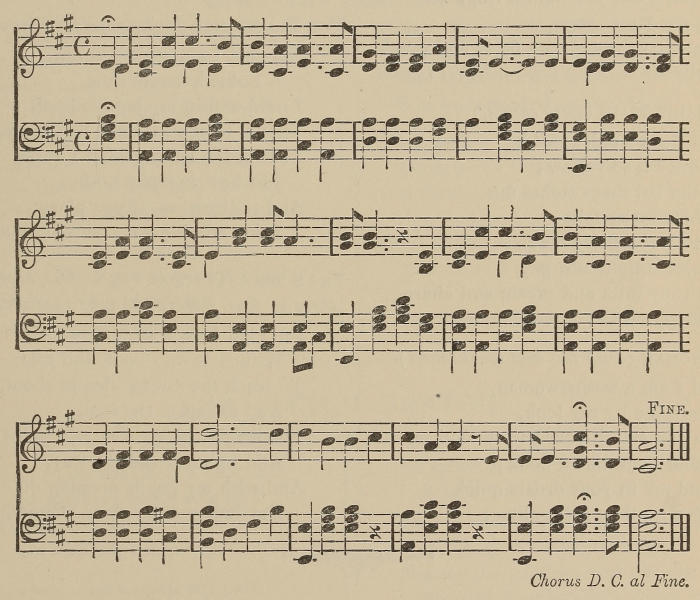
The Farmer (with scythe and dressed like a farmer.) I’m glad I am a husbandman, My acres broad to till, And in the Autumn of the year My many barns to fill. How happy is the farmer’s life, ’Tis one of peace and joy, To reap and sow, and plow and mow, And thus the time employ. Chorus. How happy is the laborer, For when the day is o’er, The evening shadows gather round, That he may work no more; How happy is the laborer, His heart is light and gay, And merrily his song rings out, Throughout the livelong day. The Farmer’s Wife (kneading bread). I’m glad I am a farmer’s wife, The wheaten bread to knead, And when the men come home from work Their hungry mouths to feed. I keep my house in perfect trim, I sweep and dust and bake, And when the busy day is done, Sweet is the rest I take.—Chorus. The Farmer’s Girl (with broom and milk pail) I’m glad I am a farmer’s girl, I love the farmer’s life, And if I ever wed at all, I’ll be a farmer’s wife. My milking pails make music sweet, I’m happy all the day, Work gives my cheek the glow of health, And drives dull care away.—Chorus. The Farmer’s Boy (with rake). I’m glad I am a farmer’s boy, To plant and rake and hoe— I get upon old Dobbin’s back, And don’t I make him go? I shout and make the welkin ring, I sing my merry song, And, roaming through the fields and woods, I’m jolly all day long. [Boy whistles Chorus. Dairy Maid (with churn.) I’m glad I am a dairy maid, My butter is so yellow; I know the lad that catches me Will be a lucky fellow. I’m glad I am a dairy maid, My heart is light and gay, And with my milk and cream and churn, I’m happy all the day.—Chorus. Washerwoman (with tub and washboard). I’m glad I am a washerwoman, Ye know me by my look, I’ll wash and starch your snowy clothes, And fold them like a book; Then sind me in your orders quick For I’ve no time for fooling; (Spoken). I’ll do thim to the best of my ability, Ontirely sure.—Chorus. The Shoemaker (shoe, last and hammer). I’m glad I am a shoemaker, With hammer, last and shoe; Without the slippers that I make, What would the ladies do? I cut the leather, fit the last— To me, my work is play— From morn to night, with heart so light, I sing and peg away.—Chorus. The Blacksmith (with anvil and hammer). I’m glad I am a blacksmith, A noble horse to shoe, I hold within my lap his hoof, And whack the shoe-nail through; I swing the hammer and I know Just how to make a hit, And indigestion, if you please, Don’t trouble me a bit.—Chorus. The School-Teacher (with slate, hook and rule; three or four children to take part of scholars). I’m glad I am a school-teacher, With slate and book and rule, To teach the young idea to shoot, And extirpate the fool. The heights of knowledge I point out, And upward lead the way, And with my pupils pressing on, I’m happy every day.—Chorus.

WHAT BABY SAID.
I am here. And if this is what they call the world, I don’t think much of it. It’s a very flannelly world and smells of paregoric awfully. It’s a dreadful light world, too, and makes me blink, I tell you. And I don’t know what to do with my hands; I think I’ll dig my fists in my eyes. No, I won’t. I’ll scratch at the corner of my blanket and chew it up, and then I’ll holler; whatever happens, I’ll holler. And the more paregoric they give me, the louder I’ll yell. That old nurse puts the spoon in the corner of my mouth, sidewise like, and keeps tasting my milk herself all the while. She spilt snuff in it last night, and when I hollered she trotted me. That comes of being a two-days-old baby. Never mind; when I’m a man, I’ll pay her back good.
There’s a pin sticking in me now, and if I say a word about it, I’ll be trotted or fed; and I would rather have catnip-tea. I heard folks say, “Hush! don’t wake up Emeline’s baby;” and I suppose that pretty, white-faced woman on the pillow is Emeline.
No, I was mistaken; for a chap was in here just now and wanted to see Bob’s baby and looked at me and said I was a funny little toad, and looked just like Bob. He smelt of cigars. I wonder who else I belong to! Yes, there’s another one—that’s “Gamma.” “It was Gamma’s baby, so it was.” I declare, I don’t know who I belong to; but I’ll holler, and maybe I’ll find out. There comes snuffy with catnip tea. I’m going to sleep. I wonder why my hands won’t go where I want them to!
ONE LITTLE ACT.
I saw a man, with tottering steps, Come down a graveled walk, one day; The honored frost of many years Upon his scattered thin locks lay. With trembling hands he strove to raise The latch that held the little gate, When rosy lips looked up and smiled,— A silvery child-voice said, “Please wait.” A little girl oped wide the gate, And held it till he passed quite through, Then closed it, raising to his face Her modest eyes of winsome blue. “May Heaven bless you, little one,” The old man said, with tear-wet eyes; “Such deeds of kindness to the old Will be rewarded in the skies.” ’Twas such a little thing to do— A moment’s time it took—no more; And then the dancing, graceful feet Had vanished through the school-room door. And yet I’m sure the angels smiled, And penned it down in words of gold; ’Tis such a blessed thing to see The young so thoughtful of the old.
THE LITTLE ORATOR.
Lines written for Edward Everett, when a child.
Pray, how should I, a little lad, In speaking make a figure? You’re only joking, I’m afraid— Do wait till I am bigger. But, since you wish to hear my part, And urge me to begin it, I’ll strive for praise, with all my heart, Though small the hope to win it. I’ll tell a tale how Farmer John A little roan colt bred, sir, And every night and every morn He watered and he fed, sir. Said Neighbor Joe to Farmer John, “Aren’t you a silly dolt, sir, To spend such time and care upon A little useless colt, sir?” Said Farmer John to Neighbor Joe, “I bring my little roan up, Not for the good he now can do, But will do when he’s grown up.” The moral you can well espy, To keep the tale from spoiling; The little colt, you think, is I— I know it by your smiling. And now, my friends, please to excuse My lisping and my stammers; I, for this once, have done my best, And so—I’ll make my manners. Thaddeus Mason Harris.

A GENTLEMAN.
I knew him for a gentleman By signs that never fail; His coat was rough and rather worn, His cheeks were thin and pale— A lad who had his way to make, With little time for play; I knew him for a gentleman By certain signs to-day. He met his mother on the street; Off came his little cap. My door was shut; he waited there Until I heard his rap. He took the bundle from my hand, And when I dropped my pen, He sprang to pick it up for me— This gentleman of ten. He does not push and crowd along; His voice is gently pitched; He does not fling his books about As if he were bewitched, He stands aside to let you pass; He always shuts the door; He runs on errands willingly To forge and mill and store. He thinks of you before himself, He serves you if he can; For, in whatever company, The manners make the man. At ten or forty, ’tis the same; The manner tells the tale, And I discern the gentleman By signs that never fail. Margaret E. Sangster.
BABIES AND KITTENS.
There were two kittens, a black and a gray, And grandma said with a frown: “It never will do to keep them both, The black one we had better drown.” “Don’t cry, my dear,” to tiny Bess, “One kitten is enough to keep, Now run to nurse, for ’tis growing late And time you were fast asleep.” The morning dawned, and rosy and sweet, Came little Bess from her nap, The nurse said, “Go in mamma’s room, And look in grandma’s lap.” “Come here,” said grandma, with a smile, From the rocking-chair, where she sat, “God has sent you two little sisters, What do you think of that?” Bess looked at the babies a moment, With their wee heads, yellow and brown, And then to grandma soberly said: “Which one are you going to drown?” L. M. Hadley.
A DISSATISFIED CHICKEN.
There was a little chicken that was shut up in a shell, He thought to himself, “I’m sure I cannot tell What I am walled in here for—a shocking coop I find, Unfitted for a chicken with an enterprising mind.” He went out in the barnyard one lovely morn in May, Each hen he found spring-cleaning in the only proper way; “This yard is much too narrow—a shocking coop I find, Unfitted for a chicken with an enterprising mind.” He crept up to the gateway and slipped betwixt a crack, The world stretched wide before him, and just as widely back; “This world is much too narrow—a shocking coop I find, Unfitted for a chicken with an enterprising mind. “I should like to have ideals, I should like to tread the stars, To get the unattainable, and free my soul from bars; I should like to leave this dark earth, and some other dwelling find More fitted for a chicken with an enterprising mind. “There’s a place where ducks and pleasure boats go sailing to and fro, There’s one world on the surface and another world below.” The little waves crept nearer and, on the brink inclined, They swallowed up the chicken with an enterprising mind. A. G. Waters.
THE LITTLE TORMENT.
My name’s Jack. I’m eight years old. I’ve a sister Arathusa, and she calls me a little torment. I’ll tell you why: You know Arathusa has got a beau, and he comes to see her every night, and they turn the gas ’way, ’way down ’till you can’t hardly see. I like to stay in the room with the gas on full blaze, but Arathusa skites me out of the room every night.
I checked her once, you better believe. You know she went to the door to let Alphonso in, and I crawled under the sofa. Then they came in, and it got awful dark, and they sat down on the sofa, and I couldn’t hear nothing but smack! smack! smack! Then I reached out and jerked Arathusa’s foot. Then she jumped and said, “Oh, mercy, what’s that?” and Alphonso said she was a “timid little creature.” “Oh, Alphonso, I’m happy by your side, but when I think of your going away it almost breaks my heart.”
Then I snickered right out, I couldn’t help it, and Arathusa got up, went and peeked through the keyhole and said, “I do believe that’s Jack, nasty little torment, he’s always where he isn’t wanted.” Do you know this made me mad, and I crawled out from under the sofa and stood up before her and said, “You think you are smart because you have got a beau. I guess I know what you’ve been doing; you’ve been sitting on Alphonso’s lap, and letting him kiss you like you let Bill Jones kiss you. You ought to be ashamed of yourself. If it hadn’t been for that old false front of yours, Pa would have let me have a bicycle like Tom Clifford’s. You needn’t be grinding them false teeth of yours at me, I ain’t a-going out of here. I ain’t so green as I look. I guess I know a thing or two. I don’t care if you are 28 years old, you ain’t no boss of me!”
THE REASON WHY.
A Boston master said, one day, “Boys, tell me, if you can, I pray, Why Washington’s birthday should shine In to-day’s history, more than mine?” At once such stillness in the hall You might have heard a feather fall; Exclaims a boy not three feet high, “Because he never told a lie!”
A CHILD’S REASONING.
She was ironing dolly’s new gown, Maid Marian, four years old, With her brows puckered down In a painstaking frown Under her tresses of gold. ’Twas Sunday, and nurse coming in Exclaimed in a tone of surprise: “Don’t you know it’s a sin Any work to begin On the day that the Lord sanctifies?” Then, lifting her face like a rose, Thus answered this wise little tot: “Now, don’t you suppose The good Lord He knows This little iron ain’t hot?”
A SWELL DINNER.
A plain, grave man once grew quite celebrated; Dame Grundy met him with her blandest smile, And Mrs. Shoddy, finding him much feted, Gave him a dinner in her swellest style. Her dining-table was a blaze of glory; Soft light from many colored candles fell Upon the young, the middle aged, and hoary— On beauty and on those who “made up” well. Her china was a miracle of beauty— No service like it ever had been sold, And, being unsmuggled, with the price and duty, Was nearly worth its weight in gold. The flowers were wonderful—I think that maybe Only another world has flowers more fair; Each rose was big enough to brain a baby, And there were several bushels of them there. The serving was the acme of perfection; Waiters were many, silent, deft, and fleet; Their manners seemed a reverent affection And oh! what stacks of things there were to eat! And yet the man, for all this honor singled, Would have exchanged it with the greatest joy For one plain meal of pork and cabbage mingled, Cooked by his mother when he was a boy.
LITTLE JACK.
He wore a pair of tattered pants, A ragged roundabout, And through the torn crown of his hat A lock of hair stuck out; He had no shoes upon his feet, No shirt upon his back; His home was on the friendless street, His name was “Little Jack.” One day a toddling baby-boy With head of curly hair Escaped his loving mother’s eyes, Who, busy with her care, Forgot the little one, that crept Upon the railroad near To play with the bright pebbles there, Without a thought of fear. But see! around the curve there comes A swiftly flying train— It rattles, roars! the whistle shrieks With all its might and main; The mother sees her child, but stands Transfixed with sudden fright! The baby clasps his little hands And laughs with low delight. Look! look! a tattered figure flies Adown the railroad track! His hat is gone, his feet are bare! ’Tis ragged “Little Jack!” He grasps the child, and from the track The babe is safely tossed— A slip! a cry! the train rolls by— Brave “Little Jack” is lost. They found his mangled body there, Just where he slipped and fell, And strong men wept who never cared For him when he was well. If there be starry crowns in heaven For little ones to wear, The star in “Little Jack’s” shall shine As bright as any there! Eugene J. Hall.
A STORY OF AN APPLE.
Little Tommy and Peter and Archy and Bob Were walking one day, when they found An apple; ’twas mellow and rosy and red, And lying alone on the ground. Said Tommy: “I’ll have it.” Said Peter: “’Tis mine.” Said Archy: “I’ve got it; so there!” Said Bobby: “Now let us divide in four parts, And each of us boys have a share.” “No, no!” shouted Tommy, “I’ll have it myself.” Said Peter: “I want it, I say.” Said Archy: “I’ve got it, and I’ll have it all; I won’t give a morsel away.” Then Tommy, he snatched it, and Peter, he fought, (’Tis sad and distressing to tell!) And Archy held on with his might and his main, Till out of his fingers it fell. Away from the quarrelsome urchins it flew, And then down a green little hill That apple it rolled, and it rolled, and it rolled As if it would never be still. A lazy old brindle was nipping the grass And switching her tail at the flies, When all of a sudden the apple rolled down And stopped just in front of her eyes. She gave but a bite and a swallow or two— That apple was seen nevermore! “I wish,” whimpered Archy and Peter and Tom, “We’d kept it and cut it in four.” Sydney Dayre.
IDLE BEN.
Idle Ben was a naughty boy; (If you please, this story’s true;) He caused his teachers great annoy, And his worthy parents, too. Idle Ben, in a boastful way, To his anxious parents told, That, while he was young, he thought he’d play, And he’d learn when he grew old. “Ah, Ben!” said his mother, and dropped a tear, “You’ll be sorry for this by-and-by.” Says Ben, “To me, that’s not very clear, But at any rate I’ll try.” So Idle Ben, he refused to learn, Thinking that he could wait; But, when he had his living to earn, He found it was just too late. Little girls, little boys, don’t delay your work; Some day you’ll be women and men: Whenever your task you’re inclined to shirk, Take warning by Idle Ben.
BABY ALICE’S RAIN.
The drouth had been long—oh, very long— The whole long month of blithesome May; The rain-clouds seemed to have wandered wrong, From the pinched, brown land so far away: Leaves fell; and the blue-birds hushed their song, As field and forest grew dim and gray. Then one night the clouds had gathered: the wind Came in from the east; but it needed trust To believe that the soft rain lurked behind, To cool the fierce heat and to lay the dust: So soon we forget that God is kind! So easily cease to hope and to trust! But it rained at morning: oh, welcome fall Of the drops from heaven, that had such need! Those drops that have fallen alike on all, Of the kindly thought and the cruel deed, Since the plant of life was so tiny and small When the Mighty Hand had just dropped the seed. Did we wonder, to see it come at last— This coveted blessing?—wee Alice did not, As quick to the window all dimpled she passed, Springing up in glee from her little cot, And bearing a love so holy and vast In such limited space—dear baby tot! “Look, mamma! look, papa!—oh yes, it yanes! “I tought dere ood be some ’ittle showers! “Detoration Day—Dod take such pains! “Don’t ’u see Dod’s waterin’ de soldiers’ f’owers?” Oh, lips of the children!—there’s something remains Yet, of Eden’s prime, in this world of ours. John Hay Furness.
GIVE US LITTLE BOYS A CHANCE.
Here we are! don’t leave us out, Just because we’re little boys! Though we’re not so bold and stout, In the world we’ll make a noise. You are many a year ahead, But we’ll step by step advance; All the world’s before you spread— Give us little boys a chance! Never slight us in our play; You were once as small as we; We’ll be big, like you, some day, Then perhaps our power you’ll see. We will meet you, when we’re grown With a brave and fearless glance; Don’t think all this world’s your own— Give us little boys a chance! Little hands will soon be strong For the work that they must do; Little lips will sing their song When these early days are through. So, you big folks, if we’re small, On our toes you needn’t dance; There is room enough for all— Give us little boys a chance!
PUSS IN THE OVEN.
While sitting at our breakfast rather late One winter’s morn a little after eight, We heard a noise; But from the shuffling of feet and legs, Of drinking coffee and of eating eggs, We girls and boys Thought little of it, but looked at one another; Fred looked at Polly—Polly at her brother. Just then we heard a feeble cry, so wee, Where could it come from—and what could it be? “It’s puss,” cried one, “she must be in the ‘aery.’” And so we went with footsteps soft and wary. But, no; Puss in the aery was not found, And once again we heard the plaintive sound, “M-e-o-w, M-e-w,” What could we do? We looked again and Clara searched the house; Was pussy in the coal-hole, with a mouse? “M-e-w, M-e-o-w,” Much louder now. “She’s in the cupboard,” so, we search the shelves, But find no pussy. Have some fairy elves Been imitating puss? But once again Poor pussy gives a cry as if in pain; The drawers are searched; in every little nook Where puss could hide we take a hasty look. “M-e-w, M-e-o-w,” Still louder now, We all look frightened, so while one declares That pussy’s hidden underneath the stairs; And while we stood upon the kitchen rug, Wondering where pussy was so nice and snug, The oven door was opened just a bit To warm some toast, when out jumped little Kit! And as she shook her furry brindled form, She seemed to say, “My bed was rather warm.”

WHAT WAS IT?
Guess what he had in his pocket. Marbles and tops and sundry toys Such as always belong to boys, A bitter apple, a leathern ball?— Not at all. What did he have in his pocket? A bubble-pipe, and a rusty screw, A brassy watch-key, broken in two. A fish-hook in a tangle of string?— No such thing. What did he have in his pocket? Ginger-bread crumbs, a whistle he made, Buttons, a knife with a broken blade, A nail or two and a rubber gun?— Neither one. What did he have in his pocket? Before he knew it slyly crept Under the treasures carefully kept, And away they all of them quickly stole— ’Twas a hole! Sidney Dayre.
THE COBBLER’S SECRET.
A waggish cobbler once in Rome, Put forth this proclamation, That he was willing to disclose For due consideration, A secret which the cobbling world Could ill afford to lose; The way to make in one short day A hundred pairs of shoes. From every quarter soon there came A crowd of eager fellows; Tanners, cobblers, bootmen, shoemen, Jolly leather sellers, All redolent of beef and smoke, And cobbler’s wax and hides; Each fellow paid his thirty pence And called it cheap besides. Silence! The cobbler enters And casts around his eyes, Then curls his lips—the rogue!—then frowns And looks most wondrous wise; “My friends,” he says, “’tis simple quite, The plan that I propose; And every man of you, I think, Might learn it if he chose. A good sharp knife is all you need In carrying out my plan; So easy is it none can fail Let him be child or man, To make a hundred pairs of shoes, Just go back to your shops, And take a hundred pairs of boots And cut off all their tops!”
A SAD CASE.
I’m a poor little kitty, And alas! when born, so pretty, That the morning I was found, Instead of being drowned, I was saved to be the toy Of a dreadful baby-boy, Who pinches and who pokes me, Holds me by my throat and chokes me, And when I could vainly try From his cruel clutch to fly, Grabs my tail, and pulls so hard That some day, upon my word! I am sure ’twill broken be, And then everybody’ll see Such a looking Kitty! That baby has no pity! Thinks I’m “only a kitty”— I won’t stand it, nor would you! ’Tis no use to cry out m-e-w! Listen! Some day I shall scratch, And he’ll find he’s met his match; That within my little paws There are ever so many claws! And it won’t be very long, If this sort of thing goes on, Till there’ll be a kitten row Such as has not been till now; Then, my lad, there will be found, Left upon that battle-ground, Such a looking Baby! Clara D. Bates.
THE HEIR APPARENT.
A small boy who can adopt the air and demeanor of the “afflicted parent” will make this soliloquy very amusing.
A Baby! Yes—a baby—a real, definite, unquestionable baby! What of it? do you ask. Well, that’s queer. Don’t know what a baby is? I’m sorry for you. My advice is—go and get one.
Heigho! I’m weighted down with my responsibility. Solferino in color—no hair on its head—kicks—yowls—mews—whines-sneezes—squints—makes up mouths—it’s a singular circumstance—that baby is, and—but never mind.
Cross? I guess that’s a beginning of the truth, so far as it’s concerned, but, why did it happen along just at the moment when muslin, linen and white flannel were the highest they had been since Adam built a hen-house for Mrs. Eve’s chickens? when the doctors charge two dollars a squint, four dollars a grunt, and, on account of the scarcity in the country, take what is left in a man’s pocket, no discount for cash, and send bill for balance, Jan. 1st? Queer, isn’t it? (A pause.)
A queer little thing is that baby; a speck of a nose like a wart, head as bald as a squash, and no place to hitch a waterfall; a mouth just situated to come the gum-game and chew milk. Oh! you should hear her sing. I have stuffed my fur cap down its throat, given it the smoothing-iron to play with; but that little red lump that looks as if it couldn’t hold blood enough to keep a musketo from fainting, persists to swallow its fists, and the other day they dropped down its throat, to the crook in its elbows. That stopped its music, and I was happy for one and a half minutes.
It is a pleasant thing to have a baby in the house—one of your achy kind. Think of the pleasures of a father in his night costume, trembling in the midnight hour, with his warm feet upon a square yard of oilcloth, dropping paregoric in a teaspoon, by moonlight, the nurse thumping at the door, and the wife of your bosom crying “hurray,” and the baby yelling till the fresco drops from the ceiling. It’s a nice time to think of dress coats, pants, ties, and white kids.
Its mother says the darling is troubled with—oh, don’t mention it. I have got to get up in the cold and shiver while the milk warms—it uses the bottle. I tried to stop its growth the other night; it was no go. I rocked so hard that I missed stays, and sent it slap clear across the room, upsetting the flower-stand. It didn’t make any noise then! Oh, no! I was a happy man. Oh, yes. (A pause.) That baby’s mother says only wait until it gets bleached (it’s been vaccinated) and old enough to crawl about and feed on pins. Yes, I’m going to wait. Won’t it be delightful?
John, run for the doctor; it’s fallen into the slop pail; it’s choking with a peach-skin; or it has fallen down stairs; or has swallowed the tack-hammer; or shows signs of the mumps, croup, whooping cough, small pox, cholera infantum, or some other curious thing to let the doctor take the money laid by for my winter’s donation to the poor.
Shampooing, curling my hair, wearing nice clothes, going to parties? Oh, no more of that! No—more—of—that. A baby—oh! I’m an old fellow now. Adieu, vain world!
AN EGG A CHICKEN.
“An egg a chicken! Don’t tell me! For didn’t I break an egg to see? There was nothing inside but a yellow ball, With a bit of mucillage round it all— Neither beak nor bill, Nor toe nor quill, Not even a feather To hold it together; Not a sign of life could any one see. An egg a chicken? You can’t fool me! “An egg a chicken! Didn’t I pick Up the very shell that had held the chick— So they said?—and didn’t I work half a day To pack him in where he couldn’t stay? Let me try as I please, With squeeze upon squeeze, There is scarce space to meet His head and his feet. No room for any of the rest of him—so That egg never held that chicken I know.” Mamma heard the logic of her little man, Felt his trouble, and helped him, as mothers can! Took an egg from the nest—it was smooth and round: “Now, my boy, can you tell me what makes this sound?” Faint and low, tap, tap; Soft and slow, rap, rap; Sharp and quick, Like a prisoner’s pick. “Hear it peep, inside there!” cried Tom, with a shout; “How did it get in, and how can it get out?” Tom was eager to help—he could break the shell. Mamma smiled and said, “All’s well that ends well. Be patient awhile yet my boy.” Click, click, And out popped the bill of a dear little chick. No room had it lacked. Though snug it was packed, There it was, all complete, From its head to its feet. The softest of down and the brightest of eyes, And so big—why, the shell wasn’t half its size. Tom gave a long whistle, “Mamma, now I see That an egg is a chicken—though the how beats me, An egg isn’t a chicken, that I know and declare; Yet an egg isn’t a chicken—see the proof of it there. Nobody can tell How it came in that shell; Once out all in vain Would I pack it again. I think ’tis a miracle, mamma mine, As much as that of the water and wine.”
ONE OF GOD’S LITTLE HEROES.
The patter of feet was on the stair, As the Editor turned in his sanctum chair, And said—for weary the day had been— “Don’t let another intruder in.” But scarce had he uttered the words, before A face peered in at the half-closed door, And a child sobbed out—“Sir, mother said I should come and tell you that Dan is dead.” “And pray who is ‘Dan’?” The streaming eyes Looked questioning up, with a strange surprise: “Not know him?—Why, sir, all day he sold The papers you print, through wet and cold. “The newsboys say that they could not tell The reason his stock went off so well: I knew!—with a voice so weak and low, Could any one bear to say him ‘No?’ “And the money he made, whatever it be, He carried straight home to mother and me: No matter about his rags, he said, If only he kept us clothed and fed. “And he did it, sir—trudging through rain and cold, Nor stopped till the last of his sheets was sold; But he’s dead—he’s dead! and we miss him so! And mother—she thought you might like to know!” In the paper, next morning, as “leader,” ran A paragraph thus: “The newsboy Dan, One of God’s little heroes, who Did nobly the duty he had to do— For mother and sister earning bread, By patient endurance and toil—is dead.” Margaret J. Preston.
WHAT THE COWS WERE DOING.
Little Rosie, walking slowly Past the verdant meadow, sees Many cows, and some are standing, Others lying ’neath the trees. In the road stands little Rosie, Caring not for dust or mud, While her eyes are bent upon them As they calmly chew their cud. Great surprise her face expresses, For awhile her lips are dumb; Then she cries out, “Mamma! Mamma! All the cows are chewing gum!”
MAMMA’S HELP.
“Yes, Bridget has gone to the city, And papa is sick, as you see, And mamma has no one to help her But two-year old Lawrence and me. “You’d like to know what I am good for, ’Cept to make work and tumble things down; I guess there aren’t no little girlies At your house at home, Dr. Brown. “I’ve brushed all the crumbs from the table, And dusted the sofa and chairs, I’ve polished the hearthstone and fender, And swept off the area stairs. “I’ve wiped all the silver and china, And just dropped one piece on the floor, Yes, Doctor, it broke in the middle, But I ’spect it was cracked before. “And the steps that I saved precious mamma! You’d be s’prised, Doctor Brown, if you knew. She says if it wasn’t for Bessie She couldn’t exist the day through! “It’s ‘Bessie, bring papa some water!’ And ‘Bessie dear, run to the door!’ And ‘Bessie love, pick up the playthings The baby has dropped on the floor!’ “Yes, Doctor, I’m ’siderably tired, I’ve been on my feet all the day; Good-bye! well, perhaps I will help you When your old Bridget ‘goes off to stay!’”
HOW TWO BIRDIES KEPT HOUSE.
The morning was sunshiny, lovely, and clear, And two little wrens were both hovering near, Chirping and warbling with wonderful zest, Looking for some place to build them a nest. They searched the veranda, examined the trees, But never a place could they find that would please; Till Mabel, whose eyes were as blue as the sky, And very observing, their trouble did spy. Then, quick as the thought darted through her wee head, “I’ll help you, dear birdies,” she lispingly said; “You just wait a minute, I’ll give you my shoe; ’Twill make you a nice nest—as good as if new.” With much toil and trouble she undid the knot, Took off the small shoe, and picked out a spot Behind a large pillar: there tucked it away; And soon she forgot it in innocent play. But the wrens chirped, “Why, here’s a nest ready-made, In the very best place, too, and quite in the shade!” They went to work quickly, without more ado, To keep house like the woman “that lived in a shoe.” When evening shades came, at the close of the day, And dear little Mable was tired of play, She thought of the birdies, and went off alone, To see, if she could, what the birdies had done, With heads under their wings the wrens were asleep; Side by side, in the shoe, they were cuddled down deep, Then, clapping her hands, Mable said, “Keep my shoe; My new ones I’ll wear, and this one’s for you.”
WHY HE WOULDN’T DIE.
Listen, my boy, and you shall know A thing that happened a long time ago, When I was a boy not as large as you, And the youngest of all the children, too. I laugh even now as I think it o’er, And the more I think I laugh the more. ’Twas the chilly eve of an autumn day; We were all in the kitchen, cheery and gay; The fire burned bright on the old brick hearth, And its cheerful light gave zest to our mirth. My elder sister, addressing me, “To-morrow’s Thanksgiving, you know,” said she; “We must kill the chickens to-night, you see. Now light the lantern and come with me; I will wring their necks until they are dead, And have them all dressed ere we go to bed.” My sister, unused to sights of blood, And, pale with excitement, trembling stood; But summoning courage, she laid her plans, And seized the old rooster with both her hands, And, with triumph written all over her face, Her victim bore to the open space. Then she wrung and wrung with might and main, And wrung and twisted and wrung again, ’Till, sure that the spark of life had fled, She threw him down on the ground for dead. But the rooster would not consent to die, And be made up into chicken-pie, So he sprang away with a cackle and bound, Almost as soon as he touched the ground, And hiding away from the candle’s light, Escaped the slaughter of that dark night. My sister, thus brought to sudden stand, And looking at what she held in her hand, Soon saw why the rooster was not dead— She had wrung off his tail instead of his head!
THE SICK DOLLY.
It needs a cute little girl who can make appropriate gestures to recite this piece.
My dolly is very sick! I don’t know what to do; Her little forehead it scowls quite horrid, Her lips are turning blue. She’s got a dreadful pain, I know it from her face; I’ll fetch a pellet and make her smell it, From mamma’s medicine-case. There, there, my child, lie still; That’s sure to do you good. Now don’t be ugly, I’ll wrap you snugly All in your scarlet hood. I know what made her sick! She’s had too much to eat! A piece of cheese, six blackberries And a little bit of meat! That’s too much for a doll, (Hush, Baby dear, don’t cry!) All those blackberries, besides stewed cherries, And huckleberry pie. I ought to be ashamed (That’s just what mamma said) To let my dolly commit such folly, And get a pain in her head. Some gruel would do her good; What fun ’twill be to make it! Just flour and water, and then, my daughter, You’ll have to wake and take it! I’d like to be a cook! How nice the gruel does smell! Oh, there it goes all over her nose! Now dolly has got well.
DAYS OF THE WEEK.
For seven little boys and girls. Teacher or some large boy or girl should speak.
The days of the week once talking together About their housekeeping, their friends and the weather, Agreed in their talk it would be a nice thing For all to march, and dance, and sing; So they all stood up in a very straight row, And this is the way they decided to go: (Let seven children stand up, and as day of week is called, take places, each one equipped with the things the speaker mentions.) First came little Sunday, so sweet and good, With a book in her hand, at the head she stood. Monday skipped in with soap and a tub, Scrubbing away with a rub-a-dub-dub; With board and iron comes Tuesday bright, Talking to Monday in great delight. Then Wednesday—the dear little cook—came in, Riding cock horse on his rolling-pin. Thursday followed, with broom and brush, Her hair in a towel, and she in a rush. Friday appeared, gayly tripping along; He scoured the knives and then he was gone. Saturday last, with a great big tub, Into which we all jump for a very good rub. (The children march and sing to the tune of “Good Morning, Merry Sunshine.”) Children of the week are we, Happy, busy, full of glee. Often do we come this way, And you meet us every day. Hand in hand we trip along, Singing, as we go, a song. Each one may a duty bring, Though it be a little thing. (All bow, and, taking up the articles, retire from the stage in order, Sunday, Monday etc.) Mary Ely Page.
POPPING CORN.
And there they sat, a popping corn, John Styles and Susan Cutter— John Styles as fat as any ox And Susan fat as butter. And there they sat and shelled the corn, And raked and stirred the fire, And talked of different kinds of care And hitched their chairs up nigher. Then Susan she the popper shook, Then John he shook the popper, Till both their faces grew as red As saucepans made of copper. And then they shelled, and popped and ate, All kinds of fun a-poking, While he haw-hawed at her remarks, And she laughed at his joking. And still they popped, and still they ate— John’s mouth was like a hopper— And stirred the fire and sprinkled salt, And shook and shook the popper. The clock struck nine—the clock struck ten, And still the corn kept popping; It struck eleven, and then struck twelve, And still no signs of stopping. And John he ate, and Sue she thought— The corn did pop and patter— Till John cried out, “The corn’s afire! Why, Susan, what’s the matter?” Said she, “John Styles, it’s one o’clock; You’ll die of indigestion; I’m sick of all this popping corn— Why don’t you pop the question?”
HOW THE FARMER WORKS.
For Several Boys.
This is the way the happy farmer(1) Plows his piece of ground, That from the little seeds he sows A large crop may abound. This is the way he sows the seed,(2) Dropping with careful hand, In all the furrows well prepared Upon the fertile land. This is the way he cuts the grain(3) When bending with its weight; And thus he bundles it in sheaves,(4) Working long and late. And then the grain he threshes thus,(5) And stores away to keep; And thus he stands contentedly(6) And views the plenteous heap.
1. Arms extended forward as though holding a plow. 2. A motion as of taking seed out of a bag or basket, and scattering with the right hand. 3. Motion as of cutting with a scythe. 4. Arms curved and extended forward. 5. Hands as though grasping a flail. Strike with some force. 6. Erect position arms folded, or hands on the hips.
THE BIRDS’ PICNIC.
The birds gave a picnic, the morning was fine, They all came in couples, to chat and to dine; Miss Robin, Miss Wren and the two Misses Jay, Were dressed in a manner decidedly gay. And Bluebird, who looks like a handful of sky, Dropped in with her spouse as the morning wore by; The yellow-birds, too, wee bundles of sun, With brave chickadees, came along to the fun. Miss Phœbe was there, in her prim suit of brown; In fact, all the birds in the fair leafy town. The neighbors, of course, were politely invited; Not even the ants and the crickets were slighted. The grasshoppers came, some in gray, some in green, And covered with dust, hardly fit to be seen: Miss Miller flew in, with her gown white as milk; And Lady Bug flourished a new crimson silk. The bees turned out lively, the young and the old, And proud as could be, in their spencers of gold. But Miss Caterpillar, how funny of her, She hurried along in her mantle of fur. There were big bugs in plenty, and gnats great and small— A very hard matter to mention them all. And what did they do? Why, they sported and sang, Till all the green wood with their melody rang. Whoe’er gave a picnic so grand and so gay? They hadn’t a shower, I’m happy to say. And when the sun fell, like a cherry-ripe red, The fire-flies lighted them all home to bed.
A VERY SMART DOG.
For a boy eight or ten years old.
I have a pretty little dog, he’s just about so high,(1) And sometimes you would think he knew as much as you(2) or I;(3) When e’er a letter I would write, he jumps around in glee,(4) For then he knows that he can take it to the mail for me,(5) I hold a stick out in my hands,(6) o’er it he jumps in joy— He shoulders(7) arms as soberly as any soldier boy— He jumps on table, box(8) or chair, which e’er I tell him to. I think he is the smartest dog—now, really do not you? My little dog will sit up straight(9) and open wide his eyes, And hold his pretty paws just so,(10) and look so very wise. If e’er to him I crossly speak(11) I very soon regret, And just as soon my little dog my anger will forget. He says bow-wow-wow-wow-wow-wow, No word but this alone, And yet he is the smartest dog that ever I have known.
At place marked 1 hold right hand out, palm downwards, as if measuring height. At place marked 2, point to audience. At 3, the reciter points to himself. At 4, downward motion of hand. At 5, point to right. At 6, hold out both hands, as if holding stick. At 7, double up right arm, with hand in front of shoulder. At 8, point to left. At 9, hold head up very straight. At 10, cross hands on breast. At 11, hold out right hand, with finger pointed, as if in command.
OPPORTUNITY.
ADDRESSED TO THE BOYS OF AMERICA.
A judgeship is vacant, the ermine awaits The shoulder of youth, brave, honest and true, Some one will be standing by fame’s open gates, I wonder, my boys, will it be one of you? The president’s chair of a great railroad maze, Is empty to-day, for death claimed his due, The directors are choosing a man for his place, I wonder, my boys—Will it be one of you? A pulpit is waiting for some one to fill, Of eloquent men there are only a few, The man who can fill it must have power to thrill; The best will be chosen—Will it be one of you? The great men about us will pass to their rest, The places be filled by the boys who pursue The search for the highest, the noblest—the best, I wonder who’ll fill them; I hope ’twill be you.
THE LITTLE LEAVES’ JOURNEY.
A motion exercise for six little girls.
Some little leaves one autumn day From maple(1) branches high, Looked down(2) upon the lovely world And upward(3) at the sky; Then each one sighed, “Had I(4) but wings, (5)Away, away I’d fly.” At last the wind(6) aweary grew Of hearing them complain, He(7) shook the sturdy maple boughs With all his might and main; He shook(8) the little leaflets all, And down(9) they fell like rain. They huddled(10) close in little heaps To keep all snug and warm, When Nature(11) came, a tender nurse, With bed(12) clothes on her arm; She tucked(13) them ’neath soft snowy folds And hid(14) them from the storm.
1. Motion upward with right hand. 2. Look downward. 3. Look upward. 4. Wave hands back and forth. 5. Extend right arm. 6. Close eyes, faces expressive of weariness. 7. Double the hands up, moving them quickly backwards and forwards. 8. Same as 7. 9. Move hands downward. 10. Put palms of hands together. 11. Look toward right. 12. Extend right arm, looking at same. 13. Downward motion with right hand. 14. Motion toward the north.
THE BROOM DRILL.
Marches and drills by the little folks are always very attractive and entertaining. The preparation for these benefits young people by requiring them to move the body quickly and gracefully, assuming an erect attitude, then other positions at the word of command. Such exercises also aid in forming a habit of strict attention.
The Broom Drill is one of the most entertaining, and can readily be learned. It should be practiced until it can be performed promptly and without any mistakes. Twelve or sixteen girls—in fact, any even number, according to the size of the stage—may take part in it.
All should be dressed alike, in blouse waist of Turkey red chintz, sleeves and collar trimmed with white braid; skirt made of white cheese cloth, trimmed above the hem with band of red chintz, four or five inches wide; a red cap completes the costume.
During the marching there should be music, and the notes of the piano should be struck sharply. Any good march will answer for the music. The following exercises conform very nearly to the “Manual of Arms” used in the army. The cuts will be found very serviceable in showing the different positions.
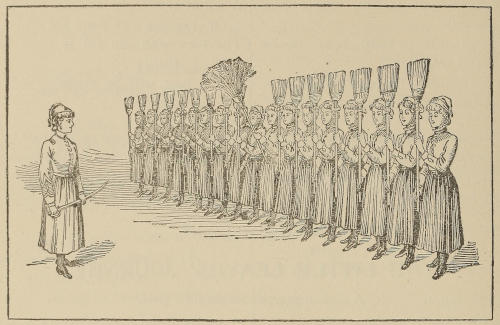
Standing in rank near the front side of the stage, the teacher gives the command to “present arms,” “carry arms,” “trail arms,” etc. Each command consists of two words: the first is to indicate what the pupil is to do, and on the second word the movement is made, all acting in concert.
The following exercises are suitable for this drill, and always prove very entertaining to the audience.
Carry—Arms!—The broom is held in the right hand, handle upward, with the hand clasping the handle where it joins the brush. The left hand hangs at the side. (Fig. 1.)
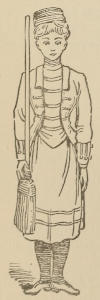
Fig. 1.
Present—Arms!—Place the broom with the right hand in front of the centre of the body, clasping the handle with the left hand above the right. Hold the broom perfectly perpendicular. (Fig. 2.)
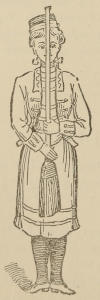
Fig. 2.
Order—Arms!—Let go the handle with the left hand, and carry the broom to the side with the right hand; then drop the broom to the floor. (Fig. 3.)
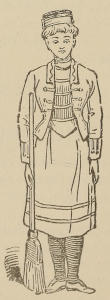
Fig. 3.
In place—Rest!—Grasp the handle with both hands, the left above the right, and place both hands in front of the lower part of the breast. (Fig. 4.)
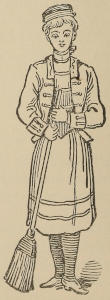
Fig. 4.
Trail—Arms!—Grasp the handle with the right hand and incline it forward, the broom behind, resting on the floor. (Fig. 5.)
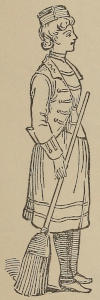
Fig. 5.
Attention—Charge!—Half face to the right, carrying the heel six inches to the rear and three inches to the right of the left, turning the toes of both feet slightly inward; at the same time drop the stick into the left hand, elbow against the body, point of stick at the height of the chin; right hand grasping the stick just above the brush and supporting it firmly against the right hip. (Fig. 6.)
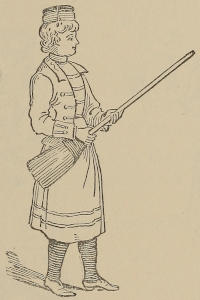
Fig. 6.
Port—Arms!—Raise and throw the broom diagonally across the body; grasp it smartly with both hands, the right, palm down at the base of the stick; the left, palm up, thumb clasping stick; handle sloping to the left and crossing opposite the middle of left shoulder; right forearm horizontal; forearms and handle near the body. (Fig. 7.)
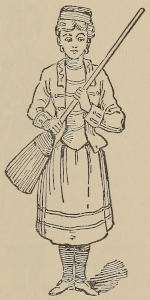
Fig. 7.
Secure—Arms!—Advance the broom slightly with the right hand, turn the handle to the front with the left hand. At the same time change the position of the right hand, placing it further up the handle, drop the handle to the front, placing the broom where joined with the handle, under the right arm. (Fig. 8.)
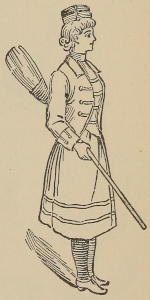
Fig. 8.
Reverse—Arms!—Lift the broom vertically with the right hand, clasp the stick with the left hand; then, with the right hand grasp the handle near the brush. Reverse the broom, the handle dropping to the front, the broom passing between the breast and right forearm. Press the handle under the arm with the left hand until the right elbow can hold it in place against the body; pass left hand behind the back and clasp the stick. (Fig. 9.)
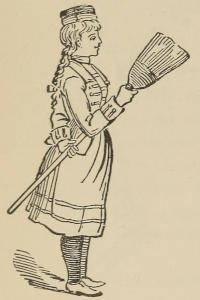
Fig. 9.
Inspection—Arms!—This is executed from the “carry arms” position. Lift the broom quickly with the right hand, bringing it in front of the centre of the body; then grasp the handle with the left hand, placed near the chin, and hold it. (Fig. 10.)
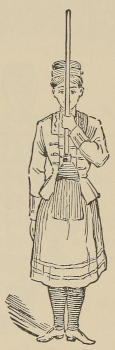
Fig. 10.
MOVEMENTS OF ATTACK AND DEFENSE.
These can be executed only with open ranks, the pupils being placed seven or eight feet apart. To so place them, the teacher will give the order—
Right (or Left) open Ranks—March!—The pupils face to the right or left, according to the order given, except the one at the extreme end of the line. The others march, the last of the file halting at every four or five steps from the one in the rear, until all are the same distance apart. They then face front. To close the rank, turn to the right or left and march toward the pupil standing at the end until halted by the one ahead. Then face front.
Attention—Guard!—At the command guard, half face to the right, carry back and place the right foot about twice its length to the rear and nearly the same distance to the right, the feet at little less than a right angle, the right toe pointing squarely to the right, both knees bent slightly, weight of the body held equally on both legs; at the same time throw the end of the stick to the front, at the height of the chin, grasping it lightly with both hands, the right just above the brush, the left a few inches higher; the right hand in line with the left hip and both arms held free from the body and without constraint. (Fig. 11.)
Being at the Guard—Advance!—Move the left foot quickly forward, twice its length; follow with the right foot the same distance.
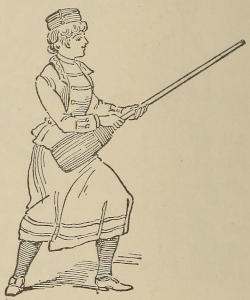
Fig. 11.
Retire!—Move the right foot quickly to the rear, twice its length; follow with the left foot the same distance.
Front—Pass!—Advance the right foot quickly, fifteen inches in front of the left, keeping right toe squarely to the right; advance the left foot to its relative position in front.
Rear—Pass!—Carry the left foot quickly fifteen inches to the rear of the right; place the right foot in its relative position in rear, keeping the right toe squarely to the right.
Right—Volt!—Face to the right, turning on the ball of the left foot, at the same time carry the right foot quickly to its position in rear.
Left—Volt!—Face to the left, turning on the ball of the left foot, at the same time carry the right foot quickly to its position in rear.
Right rear and left rear volts are similarly executed, facing about on the ball of the left foot.
Quarte—Parry!—Hold the broom in front of the left shoulder with the right hand, handle upward, the fingers of the left hand on the handle, the left elbow touching the right wrist. (Fig. 12.)
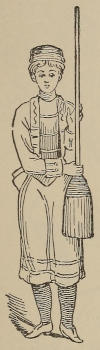
Fig. 12.
Seconde—Parry!—Move the point of the broom-handle quickly to the left, describing a semi-circle from left to right, the left elbow in front of the body, the flat of the broom under the right forearm, the right elbow two or three inches higher than the right shoulder. (Fig. 13.)
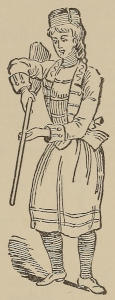
Fig. 13.
Prime—Parry.—Carry the broom to the left, covering the left shoulder, the handle downward, the left forearm behind the handle, the right arm in front of and above the eyes. (Fig. 14.)
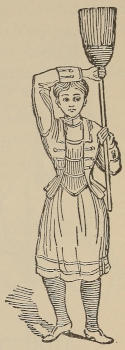
Fig. 14.
THRUSTS.
To Thrust in Tierce.—Straighten the right leg, extend both arms, keeping point of handle at height of the breast, broom at right side of head. (Fig. 15.)
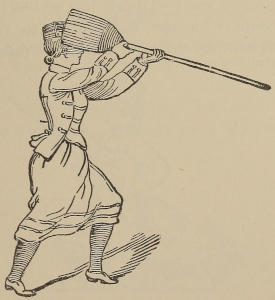
Fig. 15.
Thrust in Quarte.—The same as tierce, but with the broom on the left side of the head.
LUNGES.
The lunges are the same as the thrusts, except that the left foot is extended farther in front. (Fig. 16.)
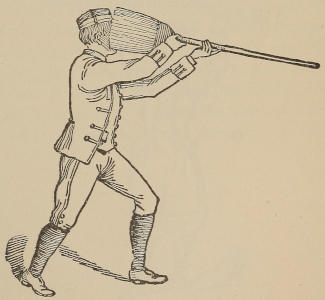
Fig. 16.
Broom to Front—One!—Raise handle nearly straight up and down, drop it into the hollow of the right shoulder.—Two!—Strike quickly by pushing the broom forward, the handle always resting on the right shoulder. (Fig. 17.)
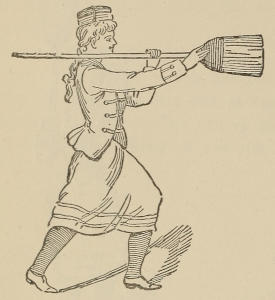
Fig. 17.
Right Short—Thrust!—One!—Hold the broom with the right hand to the rear, left hand by the right breast, the point of the handle opposite the centre of the body.—Two!—Thrust forward. (Fig. 18.)
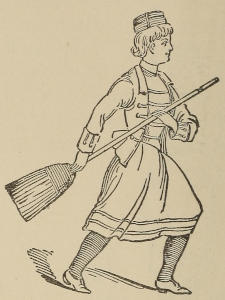
Fig. 18.
High Prime—Parry!—Raise the broom with both hands in front of and higher than the head. Hold the handle firmly with the right hand, the broom being to the right; turn the knuckles of the left hand to the front, and let other end of broom handle rest on the thumb and forefinger. (Fig. 19.)
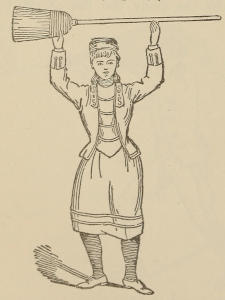
Fig. 19.
To Guard when Kneeling.—Bring the toe of the left foot square in front, plant the right foot to the rear, kneel on the right knee, bending the left, hold the broom at an angle of 45 degrees, pointing directly to the front, the right hand pressed firmly against the side, the left hand holding the point of handle upward. (Fig. 20.)
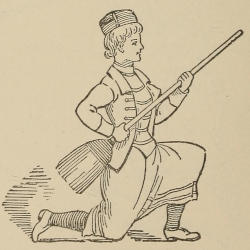
Fig. 20.
THE MARCH.
There should be music while the pupils are coming upon the stage and leaving. Any spirited march will answer.
Girls enter from right and left sides of stage at the back, eight on each side, and march in single files according to the diagram furnished below.
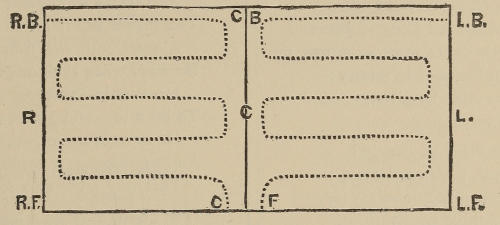
When they meet at C F, separate and march to L F and R F, then up sides of stage to back, then across back to C B. When they meet at C B, form couples and march in twos forward on centre line. At C F first couple turn to R F, second to L F, third to R F, fourth to L F, etc. March up sides to back, and when couples meet at C B march in fours to C F. First four turn to R F, second four to L F, etc. March up sides to back.
When the fours meet at C B, form eights and march toward front and halt for drill. During the march they “carry brooms” in the right hand, the stick resting against the right shoulder and nearly vertical, the arm hanging at nearly its full length near the body, the hand grasping the handle of the broom just above the sweep (the brush part), which rests flat against the side of skirt. The thumb and forefinger must be in front.
Recitations for the Sunday-school.
It is so difficult to obtain really good selections to be recited at Sunday-school anniversaries and similar occasions, that those here presented will be much appreciated. They have the merit of containing good sentiments and are therefore appropriate. The best lessons for young and old are often conveyed in simple language.

LITTLE SERVANTS.
Oh, what can little hands do To please the King of heaven? The little hands some work may try To help the poor in misery;— Such grace to mine be given. Oh, what can little lips do To please the King of heaven? The little lips can praise and pray, And gentle words of kindness say:— Such grace to mine be given. Oh, what can little eyes do To please the King of heaven? The little eyes can upward look, Can learn to read God’s holy book;— Such grace to mine be given. Oh, what can little hearts do To please the King of heaven? The hearts, if God his Spirit send, Can love and trust the children’s Friend;— Such grace to mine be given. When hearts, eyes, lips and hands unite To please the King of heaven, And serve the Saviour with delight, They are most precious in his sight;— Such grace to mine be given.
WILLIE AND THE BIRDS.
A little black-eyed boy of five Thus spake to his mamma: “Do look at all the pretty birds; How beautiful they are! How smooth and glossy are their wings; How beautiful their hue; Besides, mamma, I really think That they are pious, too!” “Why so, my dear?” the mother said, And scarce suppressed a smile; The answer showed a thoughtful head, A heart quite free from guile: “Because, when each one bows his head, His tiny bill to wet, To lift a thankful glance above He never does forget; And so, mamma, it seems to me That very pious they must be.” Dear child, I would a lesson learn From this sweet thought of thine, And heavenward, with a glad heart, turn These earth-bound eyes of mine; Perfected praise, indeed is given, By babes below, to God in heaven,
A CHILD’S PRAYER.
Lord, teach a little child to pray, And oh! accept my prayer; Thou canst hear all the words I say, For Thou art everywhere. A little sparrow cannot fall Unnoticed, Lord by Thee; And though I am so young and small, Thou dost take care of me. Teach me to do whate’er is right, And when I sin, forgive; And make it still my chief delight To serve Thee while I live.
GOD LOVES ME.
God cares for every little child That on this great earth liveth; He gives them homes and food and clothes, And more than these God giveth;— He gives them all their loving friends; He gives each child its mother; He gives them all the happiness Of loving one another. He makes the earth all beautiful; He gives us eyes to see; And touch and hearing, taste and smell, He gives them all to me. And, better still, he gives his word, Which tells how God’s dear Son Gathered the children in his arms And loves them—every one. What can a little child give God? From his bright heavens above The great God smiles, and reaches down To take his children’s love.
THE UNFINISHED PRAYER.
This beautiful poem is admirably adapted for a church entertainment when spoken by a little girl.
“Now I lay”—say it, darling; “Lay me,” lisped the tiny lips Of my daughter, kneeling, bending O’er her folded finger tips. “Down to sleep”—“to sleep,” she murmured And the curly head dropped low; “I pray the Lord”—I gently added, “You can say it all, I know.” “Pray the Lord”—the words came faintly, Fainter still—“my soul to keep;” When the tired head fairly nodded, And the child was fast asleep. But the dewy eyes half opened, When I clasped her to my breast, And the dear voice softly whispered, “Mamma, God knows all the rest.”
DEEDS OF KINDNESS.
Suppose the little cowslip Should hang its little cup, And say, “I’m such a tiny flower, I’d better not grow up.” How many a weary traveler Would miss its fragrant smell! How many a little child would grieve To lose it from the dell! Suppose the glistening dew-drops Upon the grass should say, “What can a little dew-drop do? I’d better roll away.” The blade on which it rested, Before the day was done, Without a drop to moisten it Would wither in the sun. Suppose the little breezes, Upon a summer’s day, Should think themselves too small to cool The traveler on his way; Who would not miss the smallest And softest ones that blow, And think they made a great mistake If they were talking so? How many deeds of kindness A little child may do, Although it has so little strength, And little wisdom too! It needs a loving spirit, Much more than strength, to prove How many things a child may do For others by its love.
A LOT OF DON’TS.
I believe, if there is one word that grown-up folks are more fond of using to us little folks, than any other word in the big dictionary, it is the word D-o-n-t.
It is all the time “Don’t do this,” and “Don’t do that,” and “Don’t do the other,” until I am sometimes afraid there will be nothing left that we can do.
Why, for years and years and years, ever since I was a tiny little tot, this word “Don’t” has been my torment. It’s “Lizzie, don’t make a noise, you disturb me,” and “Lizzie, don’t eat so much candy, it will make you sick,” and “Lizzie, don’t be so idle,” and “Don’t talk so much,” and “Don’t soil your clothes,” and “Don’t” everything else. One day I thought I’d count how many times I was told not to do things! Just think! I counted twenty-three “don’ts,” and I think I missed two or three little ones besides.
But now it is my turn. I have got a chance to talk, and I’m going to tell some of the big people when to Don’t! That is what my piece is about. First, I shall tell the papas and mammas—Don’t scold the children, just because you have been at a party the night before, and so feel cross and tired. Second, Don’t fret and make wrinkles in your faces over things that cannot be helped. I think fretting spoils big folks just as much as it does us little people. Third, Don’t forget where you put your scissors, and then say you s’pose the children have taken them. Oh! I could tell you ever so many “don’ts,” but I think I’ll only say one more, and that is—Don’t think I mean to be saucy, because all these don’ts are in my piece, and I had to say them.
E. C. Rook.
LITTLE WILLIE AND THE APPLE.
Little Willie stood under an apple tree old, The fruit was all shining with crimson and gold, Hanging temptingly low—how he longed for a bite, Though he knew if he took one it wouldn’t be right. Said he, “I don’t see why my father should say, ‘Don’t touch the old apple tree, Willie, to-day;’ I shouldn’t have thought, now they’re hanging so low, When I asked for just one, he would answer me, ‘No.’ “He would never find out if I took but just one, And they do look so good, shining out in the sun, There are hundreds and hundreds, and he wouldn’t miss So paltry a little red apple as this.” He stretched forth his hand, but a low mournful strain Came wandering dreamily over his brain; In his bosom a beautiful harp had long laid, Which the angel of conscience quite frequently played:— And he sang, “Little Willie, beware, O beware! Your father is gone, but your Maker is there. How sad you would feel, if you heard the Lord say, ‘This dear little boy stole an apple to-day.’” Then Willie turned round, and, as still as a mouse, Crept slowly and carefully into the house. In his own little chamber he knelt down to pray That the Lord would forgive him, and please not to say, “Little Willie almost stole an apple to-day.”
THE CHILD’S PRAYER.
The curtains drawn across the light Made darkness in the room, And in our watching eyes and hearts Fear wrought an answering gloom. Grief-wrung, we heard from lips we loved The moanings of distress, And vainly strove to stifle pain With helpless tenderness. We scarcely marked the three-years boy Who stood beside the bed, From whose wet cheeks and quivering lips The frightened dimples fled. Till all at once, with eager hope, A thrill in every word, Our darling cried, “I guess I’ll speak About it to the Lord!” He sank upon his bended knee, And clasped his hands in prayer, While, like a glory, from his brow Streamed back his golden hair. “O Lord!” he said, “dear grandma’s sick; We don’t know what to do! If I could only make her well, I’m sure I would. Won’t you?” He rose; o’er all his childish face A subtle radiance shone, As one who on the mount of faith Had talked with God alone. We gazed each in the other’s eyes, We almost held our breath Before the fearless confidence That shamed our tardy faith. But, when our yearning glances sought The sufferer’s face again, A look of growing ease and rest Replaced the lines of pain. Quick as his trusting prayer to raise, Its answer to discern, The child climbed up to reach her lips, Which kissed him in return. “Grandma”—the ringing accents struck A new, triumphant chord— “I knew you would be better soon, Because I asked the Lord!” Mary A. P. Humphrey.
“MAYN’T I BE A BOY?”
“Mayn’t I be a boy?” said our Mary, The tears in her great eyes blue; “I’m only a wee little lassie— There’s nothing a woman can do. “’Tis so; I heard Cousin John say so— He’s home from a great college, too— He said so just now in the parlor; ‘There’s nothing a woman can do.’” “My wee little lassie, my darling,” Said I, putting back her soft hair, “I want you, my dear little maiden, To smooth away all mother’s care. “Who is it, when pa comes home weary, That runs for his slippers and gown? What eyes does he watch for at morning, Looking out from their lashes of brown? “And can you do nothing, my darling, What was it that pa said last night? ‘My own little sunbeam is coming, I know, for the room is so bright.’ “And there is a secret, my Mary— Perhaps you will learn it some day— The hand that is willing and loving Will do the most work on the way. “And the work that is sweetest and dearest— The great work that so many ne’er do— The work of making folks happy Can be done by a lassie like you.”
GIVE YOUR BEST.
See the rivers flowing Downward to the sea, Pouring all their treasures Bountiful and free! Yet, to help their giving, Hidden springs arise; Or, if need be, showers Feed them from the skies. Watch the princely flowers Their rich fragrance spread; Load the air with perfumes From their beauty shed; Yet their lavish spending Leaves them not in dearth, With fresh life replenished By their mother earth. Give thy heart’s best treasures; From fair Nature learn; Give thy love, and ask not, Wait not, a return. And the more thou spendest From thy little store, With a double bounty God will give thee more. Adelaide A. Proctor.
THE BIRDS.
For six children and an older scholar, who takes the part of teacher, and recites the “Response.” Stand in a row and step forward as you recite your lines.
HUMMING-BIRD. I wish I were a humming-bird, A tiny little thing, With feathers light and airy, And a brilliant rainbow wing; Fleet as a sound, I’d fly, I’d fly, Away from fear and harm, Over the flowers and through the air, Inhaling heavenly balm. LARK. I’d rather be a lark to rise, When the sleep of night is done; And higher, higher through the skies Soar to the morning sun; And clearer, sweeter, as I rise, With rapture I would sing, While diadems from heaven’s own light Would sparkle on my wings. NIGHTINGALE. I’d like to be a nightingale; She sings the sweetest song; The daylight gone, her voice is heard In tune the whole night long. The stars look down from heaven’s dome, The pale moon rolls along; And maybe angels live up there, And listen to her song. EAGLE. Of all the birds that sing so sweet, Or roam the air so free, With pinions firm, and proud, and strong, The eagle I would be; On some high mount whose rugged peaks Beyond the clouds do rest, There, in the blaze of day, I’d find My shelter and my rest. DOVE. The humming-bird’s a pretty thing. The lark flies very high, The eagle’s very proud and strong, The nightingale sings lullaby; But, as I want a nature That every one can love, And would be gentle, mild, and sweet, I think I’ll be a dove. CHICKADEE. I’ll tell you what I want to be— A little, merry, chickadee; In the storm and in the snow When the cold winds fiercely blow, Not to mind the wintry blast, Nor how long the storm may last, Active, merry, blithe and free, This’s the bird I’d like to be. RESPONSE. I do not want to be a bird, And really had not you Much rather be like all the birds, And yet be children too? The humming-bird, from bloom to bloom Inhales the heavenly balm; So we from all may gather good, And still reject the harm. And, like the lark, our minds arise, By inspirations given, To bathe our souls, as she her wings, In the pure light of heaven. The nightingale sings all the night, In sweet, harmonious lays; So, in the night of sorrow, we Should sing our Maker’s praise. The eagle, firm, and proud, and strong, On his own strength relying, Soars through the storm, the lightning’s glare And thunders bold defying. Till far above the clouds and storm, High on some mountain crest, He finds the sun’s clear light at last, And there he goes to rest. Be ours a spirit firm and true, Bold in the cause of right, Ever steadily onward moving, And upward to the light; But still as gentle as the dove, As loving and as true; Every word and act be kindness, All life’s journey through; Always thankful, happy, free; Though life’s tempests fiercely blow; Cheerful as a chickadee Flying through the wintry snow. Myra A. Shattuck.
“COME UNTO ME.”
As children once to Christ were brought That he might bless them there, So now we little children ought To seek the Lord by prayer. And as so many years ago Poor babes his pity drew, I’m sure he will not let me go Without a blessing too. Then while, this favor to implore, My little hands are spread, Do thou thy sacred blessing pour, Dear Jesus, on my head.
THERE IS A TEETOTALER.
This piece should be spoken by a spirited boy, and as he goes upon the stage, some one should cry out, “There’s a teetotaler!”
Yes, sir, here is a teetotaler, from the crown of his head to the tips of his toes. I’ve got on teetotal boots, too, that never will walk in the way of a drunkard. The other day a man asked me about our White Ribbon Army. He wanted to know what use there is in making so many promises. I told him the use was in keeping the promises more than in making them.
The boys which belong to our Army have something to do besides loafing at the corners of the streets, and smoking the stumps of cigars they pick out of the gutters. It makes me sick to think of it!
Some boys are dreadfully afraid of losing their liberty, so they won’t sign our pledge. I saw four or five of them the other day. They had been off, somewhere, having what they call a jolly time; and they were so drunk they couldn’t walk straight. They lifted their feet higher than a sober boy would to go upstairs, and I watched them till one fell down and bumped his nose.
Thinks I to myself, there’s liberty for you, but it’s just such liberty as I don’t want. I would rather walk straight than crooked, I would rather stand up than fall down, and I would rather go to a party with my sisters, and some other pretty girls, than hide away with a lot of rough fellows, to guzzle beer and whisky.
There are plenty of other reasons why I am a teetotaler. When I grow up, I would rather be a man than a walking wine-cask or rum-barrel; I would rather live in a good house than a poor one, and I would rather be loved and respected than despised and hated.
Now, if these are not reasons enough for being a teetotaler, I will give you some more the next time we meet.
AN APPEAL FOR BENEFICENCE.
For a small boy.
The boy that spoke first to-night said you were all welcome. I shan’t take it back. You are welcome. You’re welcome to see and hear; but you’re just twice as welcome to give. We love to look at you, and we’re willing you should look at us. We’re glad to have you hear us; but we want to hear you. You haven’t any speeches ready? All right! We don’t want to hear those. We can make those ourselves—as you’ve seen.
What we do want to hear is the rustling of Greenbacks and the clinking of Silver, as the ushers pass the boxes round. That’s a kind of music that we appreciate, for it gets us our library-books, our papers, our banners, and everything else that a Sunday-School needs; and then it’s a kind of music that we can’t make ourselves, and everybody prizes what he can’t do himself. We do our best now. This school has given ⸺ dollars for benevolent objects, during the past year. Isn’t such a school worth helping? We mean to do better by-and-by, when we get hold of the money-bags. Just now, you must do the giving.
ADDRESS OF WELCOME TO A NEW PASTOR.
To be spoken by a small girl.
Dear Pastor:—The old folks have asked you to come and be their pastor, and we children want to know if you won’t come and be ours too. I am sure little folks need a pastor just as much as big ones do. I think they do more, because big folks ought to be able to take care of themselves.
We think the Sunday-school belongs especially to us, as we are allowed to say more there than we are in church, so we would like you to come into the Sunday-school and work with us there, and we will gladly pay you with our love and sunny smiles. (We can’t give you our pennies because they have to go across the ocean to the poor heathen.) If you could only come around through our classes every week and help us just a little by a word of good cheer, I am sure we would feel that you belonged to us and we to you.
I know pastors have an awful lot to do, and they say it is real hard work to preach, but if you could say just a little less to the old folks, and a little more to the young folks, we will help you build up the church and make it a big success. So, I hope, dear pastor, you will let us call you our own, and when you come among us you may be sure we will love you and welcome you as the children’s friend.
ADDRESS OF WELCOME TO A NEW SUPERINTENDENT.
To be spoken by a small boy.
Dear Mr. Blank:—I am sent out here to-day to tell you how glad we are that you are to be our new superintendent. I welcome you in the name of the school, and do it most heartily. Boys know a good thing when they see it—if they didn’t Farmer Jones wouldn’t have to put up sticky fly-paper on his peach trees—just to catch flies, of course. So, when we were told that you had been chosen for our new superintendent, we said “that’s all right.”
There must be an engineer to every train if it is to be run properly, at the same time a great deal depends on the train and how it is made up. Now, I believe there is good stuff in our Sunday-school. We would make a good train if guided by a good engineer. We can’t run ourselves and keep on the track, that’s sure. We are quite certain, to begin with, that we are on the right track, and we know that Mr. Blank can keep us there. To get to the end of our journey safely, though, will depend much on how well our train hangs together. This, boys and girls, is our part, and we must do our best.
We know that love will make the wheels go round and charity will bind us together, tighter than any cord. We hope our engineer will be proud of his train.
OPENING ADDRESS FOR A SUNDAY-SCHOOL EXHIBITION.
I have always been told that children should be seen and not heard, but this is children’s night and we are going to be seen and heard too.
We are very glad to welcome the old folks. There are so many here their presence would lead us to think they believe boys and girls can do something after all. Their eyes are on us, and I hope, children, that you have brought your best behavior with you, because this is a good time and place to use it. Perhaps I may be allowed to suggest that you keep your eye on the old folks, just to see that they conduct themselves properly.
Boys and girls, we have a great deal to say that is worth hearing, and I hope you will speak out loud and prompt so that our audience will not miss any of the good things. We want to make this the best exhibition we have ever given, so that when our elders go home they will have a better impression of us than they ever had before.
CLOSING ADDRESS FOR A SUNDAY-SCHOOL EXHIBITION.
When I found that our superintendent had put me last on the programme, I felt, as boys often do, that it would be much nicer to be first, but he said it was a good plan to keep the best wine till the last, so I feel all right about it. I know, too, that you will not question the superintendent’s good taste. I mean about me, not the wine. He wants me to say we are all very much obliged to you for coming, and we hope you have had a much bigger treat than you expected.
These exhibitions mean work for the boys and girls, as well as for the teachers, but work does everybody good, especially boys who love base-ball better than Sunday-school. I hope our efforts have been a credit to ourselves and to the Sunday-school, of which we are all so proud.
PRESENTATION ADDRESS TO A PASTOR.
For a young lady.
Dear Pastor:—It is our delight at this season of gifts and good will, to present to you a slight token of the esteem in which you are held by your Sunday School. To say we all love you is to repeat what you must already know.
“Out of the fullness of the heart the mouth speaketh,” but words do not always answer our purpose. We like to put them into some tangible form, and so to-night we present you with this ⸺ which comes as an expression of our sincere love and good wishes.
We ask you to accept this, not for its intrinsic value, but as a gift from loyal scholars, who recognize and appreciate your constant and untiring efforts to minister to their needs in every way and at all times.
Do not thank us, dear Pastor. We are discharging but a mite of the indebtedness we owe you, and you will only add to that debt if you persist in returning thanks to us. You know how Church people abhor debts, and we are trying to put into practice some of your preaching. We hope the token will be a constant reminder, if that were necessary, of our unceasing interest in you and your work.
A PRESENTATION ADDRESS TO A TEACHER.
Dear Teacher:—We take this occasion to acknowledge publicly our deep and sincere appreciation of the faithful service you have rendered us. It is our desire to tender you some tangible expression of the sincere feeling we have for you and to impress upon you the love and good will felt by every pupil.
I, therefore, present you this ⸺ asking you to associate it forever with the names and faces of the donors. Through your kind and prayerful aid many of us have been led into the way of truth, and will, therefore, gratefully remember you as long as we live.
A PRESENTATION ADDRESS TO A SUPERINTENDENT.
For a young man.
Mr. Superintendent:—We are going to make you a present to-night, and I for one think you deserve it.
Our School has the reputation of being a live one, and it is a good deal because there is a live man at the head of it. In the past year that you have been with us, your patience must have been sorely tried, for while most of the children are naturally good, some are naturally unruly. The young men and young women from whom we expect the best conduct are often, strange to say, more attentive to each other than to their lessons. But having been first a boy yourself, and perhaps later a beau, you have not had the heart to be too severe on those who are still young pupils in the school of experience.
By your untiring efforts you have brought the Sunday School up to a standard of unusual excellence. For its free and vigorous life, we are largely indebted to you. As a token of that fact please accept this gift. We wish its intrinsic value were twice as great. But if it conveys, even in a slight degree, the esteem in which you are held by all our scholars, young and old, it will serve the purpose for which it was procured.
ADDRESS OF WELCOME AFTER ILLNESS.
To be spoken by a young lady.
Dear Mr. Blank:—I feel unable to fully express to you our joy at seeing you once more in your place in the Sunday School. It has been hard for us to be deprived of your presence, for you had made yourself invaluable to us, but added to the personal loss we felt at your absence was the greater sorrow that you had been called upon to pass through so much physical suffering.
But, we know that God’s hand is always leading us, and the same wise purpose that causes the shadows to fall, also makes the sun to shine, and “the darker the shadow, the brighter the sunshine.” When, for a time, it was feared that you might not be restored to us, we felt we could not have it so, but our prayers were heard, and our thanks are deep and sincere that you are again in our midst. We pray that you may long be permitted to glorify Him who is the great physician, in the work to which you are returned.
ADDRESS OF WELCOME AFTER ABSENCE.
To be spoken by a young man.
Dear Pastor:—I want to speak in behalf of the younger members of your flock and add our hearty welcome to that already voiced by our elders. We congratulate you on your safe return, and rejoice with you that change and rest have reinvigorated your physical health. As you come, bringing the fresh fruits of added experience and observation, you will find us all eager to benefit by what has enriched your store.
Welcome home, then, to all that has suffered by your absence. The Church with its manifold offices has often felt the need of your strength and wisdom. Welcome to the Sunday-school where your words of help and counsel have guided us many times, and where your presence has been most uplifting.
Welcome to the homes and hearts of the young and old alike. There is not a fireside in our midst that has not been cheered by your frequent and timely visits. In the seasons of joy and sorrow which must come to all homes alike, there has been no one to whom we could turn and be so sure of loving sympathy as yourself.