ZOOLOGY. No. XXI.
Reading edition
Having been requested by the authors of the preceding narrative to describe the Zoological subjects collected during their journey, we think it right, in the first place, to notice the difficulties attending their acquisition and preservation. The European traveller, who is transported with equal comfort over the rugged heights of Mont Cenis, or along the level plains of Holland, can have little conception of the privations and distresses which attend the wanderer in the desert. The most feeble and timid may encounter the first task without fatigue or fear; but the robur et æs triplex of a strong constitution, persevering patience, and undaunted courage, must fortify his resolution who directs his daring course through the sands of the Sahara.
Having arrived at the farthest point of their route, our travellers were occupied no less than five months in their return to Tripoli, pursuing their “weary way” almost wholly through deserts, and suffering severely by sickness and all sorts of privations. Their means, too, of skinning and preserving the animals they procured were of the slightest kind; the only cutting instrument they possessed being a penknife belonging to Major Denham, and a little arsenical soap, left from the stores of the late Mr. Ritchie, their sole antidote to protect the skins from moth and corruption. Such, however, was their ardour in the pursuit of Zoological subjects, that in spite of all the difficulties and drawbacks that beset them, they succeeded in collecting and bringing home upwards of a hundred specimens, and some of them in exceedingly good condition and of peculiar interest; though we regret to say, that less than a third of that number is all that have come into our hands, many of the subjects having fallen into utter decay.
Classis. Mammalia. Auct.
Ordo. Carnassiers. Cuv.
Tribus. Carnivores. Cuv.
Stirps. Digitigrades. Cuv.
Genus. Fennecus. Lacep.
Species 1.—Fennecus Cerdo.
Fennec. Bruce, vii. 231. (8vo). pl. 28.
Animal Anonyme. Buff. Supp. iii. 128. pl. 19. (1776).
Zerda. Penn. Quad. pag. 248. pl. 28.
Canis Cerdo. Gmel. Linn.
Fennecus Brucii. Desm. Mamm. pl. 108. f. 4.
Canis Megalotis. Griff. An. King.
This beautiful and extraordinary animal, or at least one of this genus, was first made known to European naturalists by Bruce, who received it from his drogoman, whilst consul general at Algiers. It was brought from Biscara by a Turkish soldier, from whom the janizary bought it, and who said it was not uncommon at that place, but was more frequently met with in the date territories of Beni Mezzab and Werglah, where these animals are hunted for their skins, which are afterwards sold at Mecca, and thence exported to India. Bruce kept his animal alive for several months, and took a drawing of it in water colours, of the natural size; a copy of which, on transparent paper, was clandestinely made by his servant. On leaving Algiers, Bruce gave the animal to Captain Cleveland, of the Royal Navy, who made a present of it to Mr. Brander, the Swedish consul. Mr. Brander, according to Sparman, as quoted by Bruce, gave an account of the animal in “some Swedish Transactions,” but refused to let the figure be published, the drawing having been unfairly obtained. Bruce asserts that this animal is described in many Arabian books, under the name of El Fennec, by which, he adds, that it is known all over Africa; he conceives the appellation to be derived from the Greek word φοινιξ, a palm, or date tree.
Drawn by Major Denham. Engraved by E. Finden. FENNECUS CERDO. Published Feb. 1826, by John Murray, London.
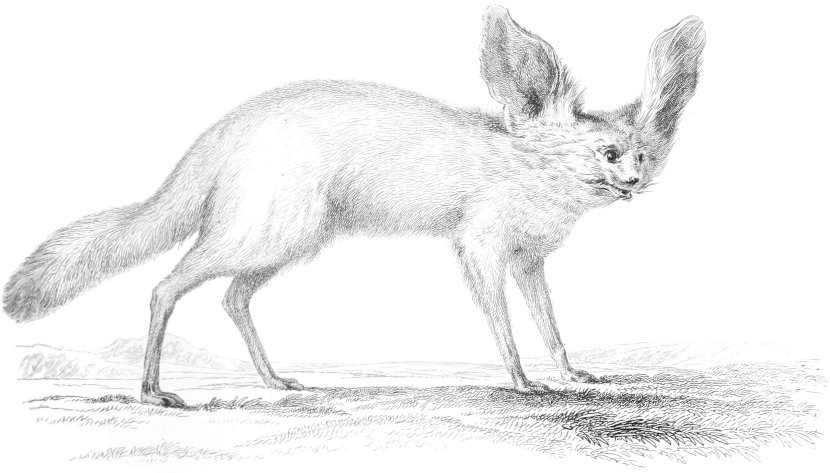
After Bruce left Algiers, he met with two other Fennecs, one of which had been brought by the caravan of Fezzan to the Island of Gerba, from whence it was carried to Tunis, where Bruce saw it; the other he bought at Sennaar, but where it came from he knew not; though it seems probable that it was a native of the date villages in the desert of Selima. These animals exactly resembled the one first seen at Algiers, and were known by the name of Fennec, and by no other.
The favourite food of Bruce’s Fennec was dates, or any sweet fruit; but it was also very fond of eggs: when hungry it would eat bread, especially with honey or sugar. His attention was immediately attracted if a bird flew near him, and he would watch it with an eagerness that could hardly be diverted from its object; but he was dreadfully afraid of a cat, and endeavoured to hide himself the moment he saw an animal of that species, though he showed no symptoms of preparing for any defence. Bruce never heard that he had any voice. During the day he was inclined to sleep, but became restless and exceedingly unquiet as night came on.
Bruce describes his Fennec as about ten inches long; the tail, five inches and a quarter, near an inch of it on the tip, black; from the point of the fore-shoulder to that of the fore-toe, two inches and seven-eighths; from the occiput to the point of the nose, two inches and a half. The ears were erect, and three inches and three-eighths long, with a plait or fold at the bottom on the outside; the interior borders of the ears were thickly covered with soft white hair, but the middle part was bare, and of a pink or rose colour; the breadth of the ears was one inch and one eighth, and the interior cavity very large. The pupil of the eye was large and black; the iris, deep blue. It had thick and strong whiskers; the nose was sharp at the tip, black and polished. The upper jaw was projecting; the number of cutting teeth in each jaw, six, those in the under jaw the smallest; canine teeth, two in each jaw, long, large, and exceedingly pointed; the number of molar teeth, four on each side, above and below. The legs were small; feet very broad, with four toes, armed with crooked, black, and sharp claws on each; those on the fore-feet more crooked and sharp than those behind. The colour of the body was dirty white, bordering on cream-colour; the hair on the belly rather whiter, softer and longer than on the rest of the body. His look was sly and wily. Bruce adds that the Fennec builds his nest on trees, and does not burrow in the earth.
Illiger, in his generic description of Megalotis, states the number of molar teeth on each side of the upper jaw to be six, but gives no account of those in the lower; nor does it appear on what authority he describes the teeth at all, or where he inspected his type. In other respects, his description agrees pretty closely with that given by Bruce.
Sparman[82] took the Fennec to be of the species he has called Zerda, a little animal found in the sands of Cambeda, near the Cape of Good Hope; and Pennant and Gmelin have called Bruce’s animal, after Sparman, Canis cerdo; Brander considered it as a species of fox; Blumenbach rather as belonging to the Viverræ. Illiger quotes Lacépède as having made a distinct genus of it, Fennecus[83], and has himself placed it as one, under the name of Megalotis, in the order Falculata, in the same family with, and immediately preceding the genera Canis and Hyena.
M. Geoffroy Saint Hilaire, assuming Bruce’s account to be imperfect and inaccurate, supposes that the Fennec is neither more nor less than a Galago; but M. Desmarest differs from him in opinion, and places it in a situation analogous to that assigned it by Illiger, at the end of the Digitigrades, in the order Carnassiers. Cuvier merely takes the following short notice of this animal in a note, “Le Fennec de Bruce que Gmelin a nommé Canis cerdo, et Illiger Megalotis, est trop peu connu pour pouvoir être classé. C’est un petit animal d’Afrique, dont les oreilles égalent presque le corps en grandeur, et qui grimpe aux arbres, mais on n’en a descrit ni les dents ni les doigts.” (Reg. Anim. I. 151. note). This eminent zoologist appears from the above to hold our countryman’s veracity, or at least his accuracy of observation, and fidelity of description, in the same low estimation as M. Geoffroy Saint Hilaire; or he would hardly have talked of the ears of the Fennec being nearly as large as its body[84], or have asserted that neither the teeth nor toes have been described. But the illustrious foreigners of whom we have, in no offensive tone we hope, just spoken, are not the only persons who have hesitated to place implicit confidence in all that Bruce has given to the world: his own countrymen have shown at least an equal disposition to set him down as a dealer in the marvellous. Time, however, and better experience, are gradually doing the Abyssinian traveller that justice which his cotemporaries were but too ready to deny him.
M. Desmarest considers all the characters which Bruce has given of the Fennec as correct, “not conceiving it possible, that he could have assumed the far too severe tone he adopted in speaking of Sparman and Brander, if he had not been perfectly sure of his facts.”
Mr. Griffith has given the figures of two animals, both, as he conceives, belonging to this genus; one of them came from the Cape of Good Hope, and is now in the Museum at Paris; it is named by Cuvier Canis megalotis, and is described by Desmarest in his Mammalogie, (Ency. Meth. Supp. p. 538): Major Smith has called it Megalotis Lalandii, to distinguish it from Bruce’s Fennec. The other animal is from the interior of Nubia, and is preserved in the Museum at Frankfort. Both the figures are from the accurate and spirited pencil of Major Hamilton Smith. The first animal is as large as the common fox, and decidedly different from Bruce’s Fennec; the second, Major Smith considers to be Bruce’s animal.
In the fifth volume of the Bulletin des Sciences, sect. 2. p. 262., is an extract from a memoir of M. Leuckart, (Isis, 2 Cahier, 1825), on the Canis cerdo, or Zerda of naturalists, in which it is stated that M. M. Temminck and Leuckart saw the animal in the Frankfort Museum, which had been previously drawn by Major Smith, and recognized it for the true Zerda; and the former gentleman, in the prospectus of his Monographies de Mammalogie, announced it as belonging to the genus Canis, and not to that of Galago. M. Leuckart coincides in opinion with M. Temminck, and conceives that the genus Megalotis, or Fennecus, must be suppressed, “the animal very obviously belonging to the genus Canis, and even to the subgenus Vulpes.” He adds, “that it most resembles the C. corsac; the number of teeth and their form are precisely the same as those of the fox, which it also greatly resembles in its feet, number of toes, and form of tail. The principal difference between the fox and the Zerda consists in the great length of the ears of the latter and its very small size.”
The singular controversy, not even yet decided, that has arisen respecting this little animal, has induced us to preface our description of the individual before us, by this sketch of its history.
Fennecus. Dentium formula.—Dentes primores 6—66—6, laniarii 1—11—1, molares 6—67—7?
F. supra rufescenti-albus, subtus pallidior; maculâ suboculari rufâ; caudæ maculâ sub-basali nigrescenti-brunneâ, apice nigro.
Dimensions. Inches.
Length of the head from the extremity of the nose to the occiput, 3⅜
Breadth between the eyes, 0⅞
Length of ears, 3⅛
Breadth of do. at the widest part, 2
Breadth of the cranium between the ears, 1⅝
Length from the occiput to the insertion of the tail, 9½
Tail, 6
[85]Height before, from the ground to the top of the back, above the shoulder, 6⅝
[85]Height behind, to the top of the back above the loins, 7½
Breadth of the extremity of the nose, 0⁵⁄₁₆
Length of the middle claws of the fore feet, 0⁷⁄₁₆
Exterior do. do. 0½
Middle and exterior claws of the hind feet, 0½
The general colour is white, slightly inclining to straw-yellow; above, from the occiput to the insertion of the tail it is light rufous brown, delicately pencilled with fine black lines, from thinly scattered hairs tipped with black; the exterior of the thighs is lighter rufous brown; the chin, throat, belly, and interior of the thighs and legs are white, or cream colour. The nose is pointed, and black at the extremity; above, it is covered with very short, whitish hair inclining to rufous, with a small irregular rufous spot on each side beneath the eyes; the whiskers are black, rather short and scanty; the back of the head is pale rufous brown. The ears are very large, erect, and pointed, and covered externally with short, pale, rufous-brown hair; internally, they are thickly fringed on the margins with long greyish-white hairs, especially in front; the rest of the ears, internally, is bare; externally, they are folded or plaited at the base. The tail is very full, cylindrical, of a rufous-brown colour, and pencilled with fine black lines like the back; its colour is rather deeper above than on the under part, and there is a small dark brown spot, at about an inch below its insertion on the upper side; the ends of the hairs at the extremity of the tail are black, forming a black tip about three quarters of an inch long. The anterior feet are pentadactylous, the posterior tetradactylous, and both are covered to the claws with moderately long whitish hairs, slightly inclining to straw-yellow; the claws are of a yellowish-white, or light horn-colour, moderately hooked, very much compressed, and very sharp; those on the hinder toes are most compressed, longest, and least arched. The fur is very soft and fine; that on the back, from the forehead to the insertion of the tail, as well as that on the upper part of the shoulder before, and nearly the whole of the hinder thigh, is formed of tri-coloured hairs, the base of which is of a dark lead colour, the middle white, and the extremity light rufous brown.
The teeth of our animal are much worn, apparently by age; the incisors in the upper jaw are nearly even, the second pair rather broader than the rest; of those in the lower jaw, the outer pair are considerably the largest.
The imperfect state of the teeth, and the difficulty of examining them accurately without having the skull detached, forbids us to be confident as to the number of grinders in either jaw. From the most careful inspection, however, that we could make in the actual state of the specimen, we are inclined to believe that the system of dentition closely, if not exactly, resembles that of the dog. In the present state of uncertainty, whilst opinions of the highest authority are so discordant as to the genus to which this animal should be referred, we do not feel ourselves at liberty to disturb the arrangement adopted by Lacépède, Illiger, and Desmarest, but leave the ultimate decision of the question to future naturalists, who may possess more unequivocal data for its solution. One thing, indeed, is pretty obvious, namely, that if Major Denham’s animal be not the identical species described by Bruce, it certainly belongs to the same genus; for as it does not appear that Bruce himself ever possessed a detached skull of the Fennec, it is very easy to imagine that he could not accurately ascertain the number of molar teeth in the head of a living animal of such vivacity and quickness, and which was so impatient of being handled, that he could not obtain a correct measurement of its ears, or even count the number of paps on its belly. With such an animal it is not unlikely, moreover, that the two last tubercular grinders should escape the notice of any one attempting to examine the mouth under circumstances so disadvantageous, those teeth being in some measure concealed by the large projecting carnivorous tooth immediately before them. That it cannot be a Galago, as M. Geoffroy Saint Hilaire imagines, is sufficiently evident; and M. Desmarest has given no less than six distinct, and, we think, conclusive reasons against that opinion, through which, however, we must not follow him at present. The subject has already grown under our hands to a far greater bulk than we intended, and we conclude it by taking leave to question the validity of M. Geoffroy Saint Hilaire’s argument respecting the general veracity of Mr. Bruce, and consequently to enter our protest against his Fennec being classed with the Quadrumana.
We retain, provisionally, the generic name of Fennecus, first proposed by Lacépède, and the specific one of Cerdo, adopted by Gmelin; but should the animal ultimately prove to be a different species from Canis cerdo, M. Desmarest’s specific appellation of Brucii may with propriety be assigned to it.
Genus. Ryzæna. Ill.
Species 2.—Ryzæna tetradactyla.
Viverra tetradactyla. Gmel. I. 85.
Suricate. Buff. xiii. t. 8.
This animal was found on the banks of the rivers in the neighbourhood of Lake Tchad.
Tribus. Plantigrades. Cuv.
Genus. Gulo. Storr.
Species 3.—Gulo capensis.
Gulo Capensis. Desm. Mamm. p. 176.
Viverra mellivora. Gmel. I. 91.
Ratel. Sparman.
Ratel weesel. Penn. Quad. II. 66.
The natives, from whom Major Denham had all the following particulars, informed him, that during the rutting season the Ratel is very fierce, not hesitating to attack a man. Each male has two or three females, whom he scarcely suffers to be a moment out of his sight; if either of them escape his jealous vigilance, and leave him for a short time, she is sure to receive severe chastisement at her return. This animal is very easily killed; a single blow on the nose, which seems peculiarly sensible of the slightest injury, instantly despatches him.
Ordo. Quadrumanes. Cuv.
Genus. Cercopithecus. Briss.
Species 4.—Cercopithecus ruber.
Cercopithecus ruber. Geoff. Ann. du Mus. xix. 96.
Simia rubra. Gmel. I. 34.
Le Patas. Buff. xiv. pl. 25 and 26.
Red Monkey. Penn. Quad. I. 208.
Ordo. Ruminans. Cuv.
Genus. Camelopardalis. Gmel.
Species 5.—Camelopardalis Giraffa.
Camelopardalis Giraffa. Gmel. I. 181.
Cervus Camelopardalis. Linn. I. 92.
Giraffe. Buff. XIII. p. 1.
Camelopard. Penn. Quad. I. 65.
The Giraffes were found on the south-eastern side of Lake Tchad, generally in parties of from two to five or six. They are tolerably numerous, but not very common. The motion of these animals is not elegant; their pace is a short canter, in which they seem to drag their hind legs after them, in an awkward fashion: their speed, however, is such as to keep a horse at a pretty smart gallop. The skin brought home by Major Denham is that of a young animal, not above a year and a half or two years old; the colours are very much lighter than on the skin of an adult animal. In its wild state, the Giraffe carries its head remarkably erect; a character which, Major Denham remarks, is not faithfully preserved in any figure he has seen of this animal.
Genus. Antilope. Pall.
Species 6.—Antilope Senegalensis.
Antilope Senegalensis. Desm. Mamm. p. 457.
Le Koba. Buff. xii. pl. 32. f. 2.
Senegal Antelope. Penn. Quad. I. 103.
Only the head and horns of this animal were brought home by Major Denham; it was found on the plains of central Africa. The natives call this species Korrigum.
Species 7—Antilope bezoartica.
Antilope gazella. Gmel. I. 190.
Capra bezoartica. Linn. I. 96.
Algazelle. Buff. xii. pl. 33. f. 1, 2.
Algazel Antelope. Penn. Quad. I. 77.
Linnæus’s description of Capra bezoartica speaks of the horns as being “entirely annulated;” but Brisson, to whom Linnæus refers, says they are annulated nearly to the end. In our specimens, a considerable extent from the apex is without the rings. This difference may probably arise from age. In other respects, the horns before us perfectly answer the description of those of Linnæus’s Capra bezoartica. M. Gmelin seems to have made some confusion between the Capra Gazella and C. bezoartica of Linnæus. He has changed the specific name of Gazella into that of oryx, and he has made Linnæus’s bezoartica the Gazella of himself.
Only two horns of this species, and those apparently not fellows, were sent home. This animal was found on the south side of the River Shary, in central Africa.
Species 8.—Antilope cervicapra.
Antilope cervicapra. Pall.
Capra cervicapra. Linn. I. 96.
Antilope. Buff. xii. pl. 35 and 36.
Common Antelope. Penn. Quad. I. 89.
We have only the horns of this animal. Its African name is El Buger Abiad, or the White Cow.
Genus. Bos. Linn.
Species 9.—Bos taurus.
Bos taurus. Linn. t. I. 98.
Major Denham brought home a pair of horns of enormous size, belonging evidently, from their form, texture, and mode of insertion, to a variety of the common Ox, of which he states that two kinds exist in central Africa, one with a hump before, and very small horns; the other altogether of a larger size, also with a hump, and immense horns.
The circumference of one of the horns before us, at the largest part near the base, is twenty-three inches and a quarter; its length, following the line of curvature, three feet, six inches and a half. It has two curves; and weighs six pounds and seven ounces. Internally it is extremely cellular, or rather cavernous.
Species 10.—Bos bubalis.
Bos bubalis. Linn. I. 99.
Le Buffle. Buff. xi. pl. 25.
Buffalo. Penn. Quad. I. 28.
We possess the head, with the horns. The name by which the native Africans call this animal is Zamouse.
Ordo. Pachydermes. Cuv.
Genus. Rhinoceros. Linn.
Species 11.—Rhinoceros bicornis.
Rhinoceros bicornis. Gmel. I. 57.
Rhinoceros unicornis. var. β. bicornis. Linn. I. 104.
Rhinoceros Africanus. Cuv.
Rhinoceros d’Afrique. Buff. Supp. vi. pl. 6.
Two-horned Rhinoceros. Penn. Quad. i. 150. pl. 29.
Here again we have the horns only. The local name of this animal is Gargatan.
Ordo. Rongeurs. Cuv.
Genus. Sciurus. Linn.
Species 12.—Sciurus Dschinschicus.
Sciurus Dschinschicus. Gmel. I. 151.
Sciurus albovittatus. Desm. Mamm. p. 338.
Our species agrees exactly with M. Desmarest’s account of his S. albovittatus, except that the tail is rather more decidedly distich than that of the individual he describes; but the dried state of the skin before us prevents our ascertaining its form very minutely. M. Desmarest refers to pl. 89 of Sonnerat’s Voyage, vol. ii. for a figure of his Ecurieul de Gingi, which he quotes as a variety of this species; on looking into Sonnerat, we do not find any figure at all of this animal referred to by that author. Plate 89 is a figure of the Maquis à Bourres.
Genus. Hystrix. Linn.
Species 13.—Hystrix cristata.
Hystrix cristata. Linn. I. 74.
Porc-épic. Buff. xii. pl. 51.
Crested Porcupine. Penn. Quad.
Classis. Aves. Auct.
Ordo. Raptores. Ill.
Fam. Vulturidæ. Vigors. in Linn. Trans.
Genus. Vultur. Auct.
Species 1.—Vultur fulvus.
Vultur fulvus. Briss. I. 462, sp. 7.
Gyps vulgaris. Sav. Ois. d’Egypte.
Le Percnoptere. Pl. Enl. 426.
Vautour Griffon. Temm. Manuel d’Orn. p. 5.
Alpine Vulture. Var. B. Lath. Gen. Hist. I. p. 17.
This species was observed by Major Denham in the neighbourhood of all the large towns through which he passed. It was attracted by the offal, and refuse of every description, which the inhabitants were accustomed to throw out for its use. For the services which these birds thus performed, they met with protection in return from the natives, who did not permit them to be destroyed.
Fam. Falconidæ. Leach.
Subfam. Accipitrina. V. in Linn. Trans.
Genus. Astur. Auct.
Species 2.—Astur musicus.
Falco musicus. Daud. Orn. II. 116, sp. lxxxviii.
Le Faucon chanteur. Le Vaill. Ois. d’Afr. I. 117, pl. 27.
Chanting Falcon. Lath. Gen. Hist. I. p. 178.
This beautiful Hawk was met with occasionally in most parts of central Africa, but not in any abundance. It was the only species of the family which the officers of the expedition were enabled to preserve and bring home.
Ordo. Insessores. V. in Linn. Trans.
Tribus. Fissirostres. Cuv.
Fam. Todidæ. V. in Linn. Trans.
Genus. Eurystomus. Vieill.
Species 3.—Eurystomus Madagascariensis.
Coracias Madagascariensis. Gmel. I. 379.
Le Rolle de Madagascar. Pl. Enl. 501.
Madagascar Roller. Lath. Gen. Hist. III. p. 79.
Fam. Halcyonidæ. V. in Linn. Trans.
Genus. Halcyon. Swains.
Species 4.—Halcyon erythrogaster.
Alcedo erythrogaster. Temm.
Alcedo Senegalensis, var. γ. Lath. Ind. Orn. 249.
Martin Pecheur du Senegal. Pl. Enl. 356, fig. inf.
The birds of this species were met with in abundance in those situations near rivers which form the usual resort of the species of this family. They were more particularly observed in the tamarind trees.
Tribus. Conirostres. Cuv
Fam. Corvidæ. Leach.
Genus. Coracias. Linn.
Species 5.—Coracias Senegalensis.
Coracias Senegalensis. Gmel. I. 379.
Rollier du Senegal. Pl. Enl. 326.
Swallow-tailed Indian Roller. Edw. t. 327.
Senegal Roller. Lath. Gen. Hist. III. p. 75.
These splendid Rollers were very abundant in the thick underwoods throughout central Africa.
Tribus. Scansores. Auct.
Fam. Psittacidæ. Leach.
Genus. Psittacus. Auct.
Species 6.—Psittacus erythacus.
Psittacus erythacus. Linn. i. 144.
Perroquet cendrée de Guinée. Pl. Enl. 311.
Ash-coloured Parrot. Alb. i. t. 12.
Several specimens of this species were brought over alive to this country, which are now honoured with a place in His Majesty’s collection.
Genus. Palæornis. V. in Zool. Journ.
Species 7—Palæornis torquatus.
Palæornis torquatus. V. in Zool. Journ. vol. II. p. 50.
Psittaca torquata. Briss. IV. 323.
La perruche à collier. Pl. Enl. 551.
Perruche à collier rose. Le Vaill. Hist. des Perr. pl. 22, 23.
This species, whose chief habitat is said to be in India, which is the main resort of the group to which it belongs, appears to have a very wide geographical distribution. It has been found on the coast of Senegal, as well as by the officers of the present expedition in central Africa. The specimen before us is very much mutilated, but enough of the bird remains to enable us to identify the species.
Ordo. Rasores. Ill.
Fam. Tetraonidæ. Leach.
Genus. Pterocles. Temm.
Species 8.—Pterocles exustus.
Pterocles exustus. Temm. Pl. Col. ♂ 354. ♀ 360.
These birds were found in great numbers in the neighbourhood of Bornou. They frequented the low sand hills which were scantily covered with shrubs. Like most of the family, they were found to be excellent eating.
Genus. Francolinus. Steph.
Species 9.—Francolinus Clappertoni.
Franc. supra brunneus fulvo-variegatus; subtus fulvo-albidus, maculis longitudinalibus brunneis aspersus; strigâ superciliari subocularique, gulâ, genisque albis, his brunneo-lineatis.
Pileus brunneus, ad frontem nigrescens. Striga nigra interrupta extendit a rictu ad genas. Genarum plumæ, anteriores lineis gracilibus, posteriores maculis ovalibus brunneis in medio notatæ. Colli, pectoris, abdominisque plumæ in medio brunneæ marginibus fulvo-albidis, rhachibus pallidis. Dorsi superioris, scapularium, tectricumque plumæ pallido-fulvo marginatæ partimque fasciatæ. Dorsi inferioris uropygiique plumæ pallidè brunneæ in medio fusco-brunneo leviter notatæ. Remiges exteriores pogonio externo ad basin fulvo-fasciato, pogonio interno ad basin brunneo, versus apicem rufo-fulvo; interiores utrinque fulvo-fasciatæ. Ptila inferiora in medio brunnea, fulvo ad margines notata. Pteromata inferiora in medio fusca, marginibus fulvis. Femorum plumæ fulvæ in medio brunneæ. Rectrices brunneæ fasciis plurimis fulvis undulatæ. Rostrum superné nigrum, infra ad basin rubro tinctum. Pedes, ad frontem nigri, poné rubescentes: tarsis bicalcaratis, calcare superiore obtuso, inferiore acuto. Longitudo corporis, 14 unc.; alæ a carpo ad remigem 5tam, 7⅕; caudæ, 3⅘; rostri, 1¹⁄₂₈; tarsi, 2³⁄₁₀.
This species of Francolin, which appears to us to be hitherto undescribed, was met with in tolerable abundance. It frequented sand hills, covered with low shrubs; and was very difficult to be procured in consequence of the great speed with which it ran. We have named the species after Captain Clapperton, R. N. the intrepid and intelligent companion of Major Denham.
Fam. Struthionidæ. V. in Linn. Trans.
Genus. Struthio. Auct.
Species 10.—Struthio camelus.
Struthio camelus. Linn. I. 265.
L’Autruche. Pl. Enl. 457. ♀
The Black Ostrich. Brown’s Illust. of Zool. pl. 16.
Major Denham succeeded in bringing alive to this country four of these noble birds, which are at present in His Majesty’s menagerie at Windsor.
Genus. Otis. Linn.
Species 11.—Otis Denhami.
O. fusco-brunneo et pallido-fulvo undulatim punctulata, capite brunnescenti-nigro, superciliis genis gulâque albidis, collo rufo, pectore cinereo; pteromatibus remigibus rectricibusque nigris, istis albo-maculatis, his albo-fasciatis; corpore subtus rufescenti-albo.
Capitis pileus parsque superior nuchæ brunnescenti-nigri. Regionis auricularis plumæ elongatæ, decompositæ, cinerascenti-albæ. Colli inferioris plumæ frontales elongatæ. Dorsi, uropygii, scapularium, ptilorumque plumæ fusco-brunneæ, pallido-fusco undulatim punctulatæ. Pteromata nigra maculis albis grandibus irregulariter notata. Tectrices inferiores albæ ad marginem alarum fusco-variegatæ. Rectrices nigræ; duæ exteriores pogonio interno fasciis duabus albis, externo tribus, notatæ; cæteræ tribus fasciis ejusdem coloris utrinque notatæ, fasciâ sub-apicali nigro sparsâ: duæ mediæ ad apicem fusco-brunneæ, pallido-fusco undulatim punctulatæ. Irides flavæ. Rostrum corneum. Pedes nigri. Longitudo corporis, 3 ped. 9 unc.; caudæ, 1 pes, 4 unc.; rostri, ad frontem, 3¾ unc., ad rictum, 4½ unc.; tarsi, 7 unc.; digiti medii, ungue incluso, 2¾ unc.; exterioris, 1⁷⁄₀ unc.
African Bustard? Lath. Gen. Hist. Vol. VIII. p. 361.
We have hitherto seen no description that exactly accords with the bird before us. The African Bustard described by Dr. Latham, in the second edition of his “Synopsis,” lately published under the title of “A General History of Birds,” appears to be the most allied to it. But the head of that bird is described as being bare; and such a marked difference prevents us from referring our bird to that species, with which it generally agrees in other points, without some note of doubt. Our specimen is unfortunately very defective: in the quill feathers, and fore parts of the neck, more particularly. These latter are described by Major Denham as singularly beautiful, being elongated and swelling out into a kind of ruff. We are happy to have the opportunity of distinguishing this bird by the name of the enterprising traveller to whose zeal we are indebted for the species itself, and many other valuable acquisitions to science.
This species was met with, in the rainy season, near the larger towns, but not in any great abundance. It frequented moist places, where the herbage was pure and fresh. In such places it was taken in snares by the natives, who used it for food. It was almost invariably met with singly, Major Denham never having observed a pair together more than once. It is singular, also, that it was always found in company with Gazelles whenever a Bustard was observed, it was certain that the Gazelles were not far distant. Major Denham describes the eye of this bird as large and brilliant. In like manner as is recorded of the Gazelle, with which this bird seems to have so close a sympathy, the Arabs are accustomed to compare the eyes of their most beautiful women to those of the Oubara[86].
Ordo. Grallatores. Ill.
Fam. Gruidæ. V. in Linn. Trans.
Genus. Balearica. Briss.
Species 12. Balearica pavonina.
Ardea pavonina. Linn. I. 233.
Balearica. Briss. v. 511.
Oiseau royal. ♀ Id. Ib. pl. 41.
L’oiseau royal. ♂ Pl. Enl. 265.
Crowned African Crane. Edw. t. 192.
Crowned Heron. Lath. Gen. Hist. IX. p. 26.
These birds were found in the neighbourhood of the smaller lakes. They were generally observed in flocks of six or eight. A single pair was sometimes met with, but a single bird scarcely ever.
Genus. Platalea. Linn.
Species 13.—Platalea leucorodia.
Platalea leucorodia. Linn. I. 231.
La Spatule. Pl. Enl. 405.
Spatule blanche. Temm. Manuel d’Orn. p. 595.
White Spoonbill. Penn. Brit. Zool. App. t. 9.
These birds were found in the smaller lakes, and in grounds which were overflowed. They were met with in tolerable plenty.
Fam. Ardeidæ. Leach.
Genus. Ardea. Auct.
Species 14.—Ardea Coromandelensis.
Ardea Coromandelensis. Steph, in Sharts Gen. Zool. XI. p. 577.
Ardea russata. Temm. Manuel d’Orn. p. 506.
Ardea affinis? Horsf. Linn. Trans. Vol. XIII. p. 189.
Ardea comata. var. β. Lath. Ind. Orn. 687.
Crabier de la côté de Coromandel. Pl. Enl. 910.
This bird was shot in the neighbourhood of Alph, a town situated in the middle of a swamp, described at page 233 of these travels. They were seen in some abundance in that neighbourhood, and were noticed by Major Denham as remarkable for their beauty and gracefulness.
Species 15.—Ardea melanocephala.
Ard. cinerea; capite cristato, colli parte posteriore lateribusque, regione interhumerali, remigibus, rectricibusque nigris, gulâ collique parte anteriore albis.
Colli inferioris plumæ elongatæ cinerascentes. Dorsi pars anterior inter humeros nigra, posterior saturatè cinerea. Ptila pallidè cinerea. Tectrices inferiores albæ. Rostrum nigrum, mandibulâ inferiore flavescente, apicem versus nigro marginatâ. Pedes nigri. Longitudo corporis, 2 ped. 9 unc.; alæ, 15 unc.; rostri, 4; tarsi, 6.
We feel much hesitation in characterizing the bird before us as a distinct species. In a family like the present, where there is so much variation both in age and sex in the same species, it is almost impossible to decide upon the identity or distinction of species, unless by actual observation of the birds themselves in their native haunts, and in their different ages and states of plumage. On the whole, however, it is perhaps the most eligible plan to keep those species separate which show evident marks of distinction; leaving it to more accurate observation to ascertain whether they may be identical with described species, and differing merely by age, sex, or the variations of plumage according to the different seasons of the year.
The bird before us might, at first sight, be supposed to be the common Ardea cinerea, Linn. But that bird, as far as we have observed, never possesses the entirely black head which distinguishes the specimen before us; nor has it the black on the hind part of the neck, nor on the back between the shoulders. The younger bird of our common species has those parts cinereous which are black in the adult: and the crest and lower feathers of the neck are never so much elongated as in the old bird. The strength of the black markings in Major Denham’s species, moreover, and the developement of the crest, neck, and scapular feathers, prevent us from concluding it to be an immature bird. If we allow it to be adult, it is decidedly distinct from the adult of A. cinerea. We know no other allied species to which we might consider it referable.
These birds were found in great abundance in all the lakes and marshes throughout the route of our travellers. They were met with in company with numberless other species of the family, specimens of which our officers were prevented from preserving, or bringing home, in consequence of the difficulties attending the expedition, to which we have before alluded.
Genus. Scopus. Briss.
Species 16.—Scopus umbretta.
Scopus umbretta. Gmel. I. 618.
L’Ombrette du Senegal. Pl. Enl. 796.
The Umbre. Brown’s Illust. of Zool. pl. 35.
Tufted Umbre. Lath. Gen. Hist. Vol. IX. p. 23.
Major Denham informs us, that this bird was very rarely seen. The few he observed were met with in the Mimosa trees.
Genus. Ibis. Lacep.
Species 17—Ibis Æthiopicus.
Tantalus Æthiopicus. Lath. Ind. Orn. 706.
Ibis religiosa. Cuv. Regne Anim. I. 483.
Abou Hannez. Bruce’s Trav. Append. pl. p. 172.
This bird, which is of exceeding interest as being one of the two species of Ibis which were the objects of sacred worship among the Egyptians, was met with by Major Denham on the west borders of the Lake Tchad. He observed them in flocks, and in considerable numbers. Hitherto they have been sparingly seen by travellers, and few specimens have reached our collections.
Genus. Ciconia. Briss.
Species 18.—Ciconia Marabou.
Ciconia Argala. Temm. Pl. Col. 301.
This bird was met with rather plentifully in the neighbourhood of large towns, in company with the Vultures, to the manners of which we have already referred, page 195. Like them, they were protected by the natives, in consideration of the services they performed in clearing away all the offensive substances which were thrown out to them from the towns. In India, we find that the corresponding species, Ardea Argala, Lath., is held in equal estimation for similar services. Major Denham mentions his having frequently been a witness of their voracious and omnivorous habits.
M. Temminck first figured and characterized this African species as distinct from that of India. He has given it the name of Argala, while for the Indian bird, which had already received that name from Dr. Latham, he proposes the name of Marabou. We have ventured to reverse the order of these names; and while we retain for the Indian species the original name conferred on it by Dr. Latham, which, it is to be recollected, is an Indian word, we have assigned the African species the title of Marabou, which, it is equally to be observed, is a word peculiar to Africa.
The specimen brought home by the present expedition appears to be a young bird, and answers to the description given of the young of this species by M. Temminck. The colours are nearly black in the bird before us, which are grey in the adult bird figured by that gentleman. Major Denham mentions his having noticed some birds nearly allied to this species, which were larger, and different in colour, and which he conceived to be distinct. They probably were the adult birds of this species.
Ordo. Natatores. Ill.
Fam. Anatidæ. Leach.
Subfam. Anserina. V. in Zool. Journ.
Genus. Plectropterus. Leach.
Species 19.—Plectropterus Gambensis.
Plectropterus Gambensis. Steph. in Shaw’s Zool. XII. Part 2. p. 7. pl. 36.
Anas Gambensis. Linn. I. 195.
Spur-winged Goose. Lath. Gen. Hist. X. 241.
This bird was found in flocks of great numbers on all the lakes. The flesh was very coarse, and of a fishy taste, and afforded very bad eating.
Species 20.—Plectropterus melanonotus.
Plectropterus melanotos. Steph. in Shaw’s Zool. XII. Part 2. p. 8.
Anser melanonotus. Forst. Zool. Ind. p. 21. t. 11.
Anas melanonotus. Lath. Ind. Orn. 839.
Oye de la côté de Coromandel. Pl. Enl. 937.
Black-backed Goose. Penn. Ind. Zool. p. 12. t. 11.
This species, of which fine specimens of the male and female are preserved in the collection, was met with on the lake Tchad. It was not seen in any abundance, and was found in company with other species of the family. The protuberance on the bill of the male is much more enlarged and prominent than is represented in the “Planches Enluminées.”
Subfam. Anatina. V. in Zool. Journ.
Genus. Anas. Auct.
Species 21.—Anas viduata.
Anas viduata. Linn. I. 205.
Canard du Maragnan. Pl. Enl. 808.
Spanish Duck. Penn. Gen. of Birds, p. 65. t. 13.
This species was very common, both on Lake Tchad and on all the smaller lakes. It was excellent eating. Mr. Pennant has described the species as an inhabitant of America and Africa. Linnæus says only, that it is found in the lakes of Carthagena; those, it is supposed, of New Spain. Our bird accords very accurately with his description of the species, and also with the figure quoted above from the “Planches Enluminées.” We have every reason to conclude with Mr. Pennant, that the species inhabits both the Old and New Continent. The bend of the wing exhibits the rudiments of a spur.
Fam. Pelecanidæ. Leach
Genus. Onocrotalus. Briss.
Species 22.—Onocrotalus Brissonii.
Pelicanus Onocrotalus. Linn. I. 215.
Le Pelican. Pl. Enl. 87.
White Pelican. Edw. t. 92.
This well known species has been described to us by Major Denham as very abundant on the borders of Lake Tchad. The genus Onocrotalus was first instituted by M. Brisson; but, according to his custom, he left the present species without any specific name. M. Cuvier, in his “Regne Animal,” acknowledges the genus; but neither has he specifically distinguished the bird. We feel much pleasure in now assigning it a name, in memory of the first characterizer of the group; an ornithologist, whose works cannot be studied without the highest advantage, but whose labours have never as yet been sufficiently appreciated.
Genus. Phalacrocorax. Briss.
Species 23.—Phalacrocorax pygmæus.
Pelecanus pygmæus. Pall. Reise. II. 712. t. G.
Dwarf Shag. Lath. Gen. Hist. X. 431.
Cormoran pygmée, jun. Temm. Man. d’Orn. p. 901.
This bird, which agrees very accurately with M. Temminck’s description of the young of his Cormoran pygmée, was met with by Major Denham on one of the smaller lakes in central Africa. He describes the species as very rarely occurring.
Genus. Plotus. Linn.
Species 24.—Plotus melanogaster.
Plotus melanogaster. Gmel. I. 580.
Anhinga melanogaster. Forst. Zool. Ind. p. 22. t. 12.
Anhinga de Cayenne. Pl. Enl. 959.
Black-bellied Anhinga. Penn. Ind. Zool. p. 13. t. 12.
Black-bellied Darter. Lath. Gen. Hist. X. 451.
This bird was seen but once or twice during the course of the expedition. It was met with on one of the smaller lakes. It seems to have a very extensive geographical distribution, being found in the New World, in the islands of Java and Ceylon, and now in the interior of Africa.
There are remnants of several other species of birds in the collection, consisting chiefly of bills, legs, and wings. Among them we can trace the apparent remains of the Ciconia alba, Briss.; Ardea garzetta, Linn.; different species of the genus Lamprotornis, Temm.; with various others, of which we regret that we cannot venture to give any description. The foregoing twenty-four species are all that we can undertake to determine upon with accuracy.
Classis. Reptilia. Auct.
Ordo. Sauriens. Cuv.
Tribus. Lacertiens. Cuv.
Genus. Monitor. Cuv.
Species 1.—Monitor Niloticus.
Lacerta Nilotica. Linn. I. 360.
Varanus Dracæna. Merr. Syst. Amph. p. 59.
Tupinambis Niloticus. Daud. Rept. III. 51.
Monitor du Nile, ou Ouaran. Cuv. Reg. Anim. II. 25.
Tribus. Cameleoniens. Cuv.
Genus. Chamæleo. Lacép.
Species 2.—Chamæleo vulgaris.
Chamæleo vulgaris. Daud. Rept. IV. 181.
Chamæleo carinatus. Merr. Syst. Amph. p. 162.
Lacerta chamæleon. Linn. I. 364.
FOOTNOTES: