Chapter VII · JOURNEY TO THE EASTERN SHORES OF THE LAKE TCHAD.
Reading edition
March 7, 1824.—The courier which I had sent to Kano, with a supply of necessaries for my countrymen, on Mr. Toole’s arrival, returned to Kouka, bringing a confirmation of the report which had before reached me, of the death of Dr. Oudney, at a place called Murmur, near Katagum, on the 12th of January.
I had left the sheikh in full march to drive back the Begharmis, and he now took up a position near Angala, within five miles of the enemy, who had commenced plundering in their rear, and were moving off all they could gather to the south side of the river: their force, also, it was said, increased daily, and the alarm of the people, both here and at Angornou, lest the enemy should be victorious, was excessive. We were able to muster about seven guns, and three pair of pistols—had plenty of powder and ball; and as our huts were inclosed within a wall, we had determined on defending ourselves to the last. Our determination was no sooner known than I had messages from the wives of all the sheikh’s chiefs who were my friends, saying that they should come to me, if the Begharmis came, as I had guns and plenty of powder; so that I might have had as numerous, and almost as formidable, an army as the sheikh himself, for, from what I had seen of both sexes in Bornou, I believe, in my heart, the women would have fought better than their husbands. The enemy came on several times, and offered battle; but as the sheikh could not get them in the situation he wished for, he refused the combat.
On the 28th, however, the struggle commenced. The Begharmis became bold in consequence of the sheikh’s apparent unwillingness to fight, and they at length ventured to attack him in the plain to the south-east of Angala, on the edge of which he had halted. The kafila, which had departed for Soudan, had deprived him of at least thirty of his Arabs; and the few that remained, with some forty Musgow slaves, who had been trained to the firelock, being his great dependence, he placed them on his flanks. No sooner had the Begharmis cleared the wood, than the sheikh, hoisting his green flag in the centre, and surrounded by his Kanemboo spearmen, moved rapidly on: the two guns in front, which Hillman had mounted, with the Arabs and musketeers, right and left of them. The Begharmis, also, came on with great coolness in a solid mass, five thousand strong, with two hundred chiefs at their head: they made directly for the centre, where the sheikh had raised the standard of the Prophet, but were repulsed by a discharge from his artillery: they now fell upon Barca Gana’s flank, which was attacked with such determined bravery, that all, except himself and a chosen band, gave way: and here fell my friend and preserver Maramy, who, while in the act of drawing his spear from the body of one of their chiefs, received a thrust in his own, which went quite through him. The Bornouese horse, who, on occasions of this kind, when the road is opened for them, are most active, now took up the pursuit of the routed Begharmis: the Arabs, also, mounted and joined them; and of the two hundred chiefs of Begharmi one only is said to have escaped alive. Seven sons of the sultan were amongst the killed, and seventeen hundred of less note; whilst great numbers were put to death by the people of the towns to which they fled, who now, as if by magic, all became the stanch friends of the sheikh. The water of the little stream, Gambalarum, near which the battle was fought, also lent its aid in destroying these invaders; and many were drowned in attempting its passage: but above all, “The guns! the guns! the guns! Oh, wonderful! how they made the dogs skip!—Oh, the guns!” were words in every body’s mouth. My friend, the sheikh, however, thought there was a little too much of this, for on the second day, he said, “True, the guns are wonderful, ’tis true!—but I lifted my hands, and said, Sidi absolam, sidi abdel garda! and from that moment the victory was yours.” It is said that, on the morning of the battle, the sheikh appeared at the door of his tent, with the English double-barrelled gun in his hand, and his English sword slung over his shoulders, clothed in the dress of a simple trooper, saying it was his intention to fight on foot, at the head of his Kanemboos;—that he expected all the Arabs to follow his example, and encourage the slaves, who were but young in the use of the firelock: that if it pleased God to grant their enemies the victory, flight was out of the question; they had nothing left but to die before their wives and children were torn from them, and escape so appalling a sight.
April 4.—Nothing could exceed the joy of the people at having obtained the victory: the men walked about all day in their new tobes, and the women danced, sang, and beat the drum, all night. My hut was thronged with visitors, all recounting their own feats, and bewailing their friends—sending the Begharmis to the devil, and asking for presents on their return, all in the same breath. I had a private interview with the sheikh, and offered him my hearty congratulations: he was as kind and friendly as ever, talked a good deal about the signal manner in which the Kaffirs had been delivered into his hands, and mentioned most feelingly the death of my poor companion Mr. Toole, whom he was very partial to—asked if his mother and father were living, and turning to Tirab, who was near him, said, “How could they send him so far off?”
The plunder was said to have amounted to four hundred and eighty horses, and nearly two hundred women, with two eunuchs, and the baggage of the princes, which was carried on bullocks and asses. Fifty of their women were sirias[48] of great beauty, belonging to the sultan’s sons, and these were all given up to the sheikh. But while all these rejoicings were going on without, the climate was at work within. Omar, an Arab who had lived several years in the service of the consul at Tripoli, and had accompanied Mr. Toole, at his recommendation, a hearty lively fellow, was so severely attacked by the fever, that in seven days we laid him in the earth. Columbus, who had been ill ever since he caught the fever from Mr. Toole, again took to his bed, and seemed to be more debilitated than ever.
April 15.—Although my funds did not exceed eight hundred dollars, yet I determined to see and talk to the sheikh on the subject of an eastern journey[49]. “It is not in my power to send you to the eastward,” said he, “or you should not want my assistance. You have seen enough yourself of the dispositions of the inhabitants of the countries towards me, and their power, to know that this is true. It has pleased God to grant me a victory now, which may lead to quieter times; even the pilgrims have not for years gone by the Lake Fittre to Hadge. I am as anxious as you are, and with more reason, to open a road with Egypt from hence: I cannot, nor can my people, now go to Mecca, without passing through the bashaw of Tripoli’s territories, and there are reasons which make that disagreeable. Why not try it from Egypt, where you have many friends, and return from this way by Fezzan?—that would be easier.” The sheikh has a most singular manner of delivery, and I scarcely ever met with any person who expressed himself so clearly, and with so few words. I replied, “that if I could not proceed in the way I wished, I should return, and either take his advice about Egypt, or wait till better times: that the King of England, upon hearing from me of his kindness, his willingness to assist us, and his friendship, would send some other Englishmen, with proofs of his good will, who would claim his assistance in getting to Sennaar.” “God keep you from evil!” said he; “but tell your great king to send you again: here you are known, and loved by the people; and know them, and their language: we all will wish to see you again—what shall we do with a stranger?”
The sheikh sent this day for Columbus: “You have lived greatly,” said he, “amongst Mussulmans; why do not you say, La il la ilallah: shed, shed, and paradise is open to you?” Columbus, who knew Turks perfectly, replied, “If it is written, so it will be:” “True,” said the sheikh, “but death is near. I, however, still think you love Mussulmans, and are a believer in your heart: true, the time may not be yet come;—pray God it may come, and quickly, both for you and Sahaby Khaleel (meaning me). I have sent to speak to you, and I think you will tell me the truth:—what is this wish of Khaleel’s to go to Egypt? I think he is my friend, and I think the English are my friends; but a man’s head is always his best friend. I fear they wish to overthrow the Mussulman power altogether.” The reply of Columbus was, “As far as I know they want to do no such thing: they wish to see, and to describe the country, with its inhabitants; and if the English are the first to do so, they will pride themselves greatly in consequence.” “And is that all?” replied the sheikh; “Oh! wonderful: no one would believe it,—no one does here but myself, but I do, because they say so, and they are not liars.”
April 30.—Every thing had been in preparation for a ghrazzie, upon an extensive scale: its destination was a secret; but I inquired of the sheikh, and added, that I hoped he would allow me to accompany him. To this he consented; and, in the evening, sent me word that they should pass the river at Showy, and proceed north-east towards Fittre, for the purpose of annihilating, if possible, the Shouaas La Sala of Amanook, who were in that direction, and allies of the sultan of Begharmi. Amanook was a determined warrior, as well as a terrible fighi. In his escape, after the late fight, his horse had fallen with him, and some followers of Maffatai came upon him; they were about to finish him, when he discovered himself, and by a promise of one thousand bullocks was allowed to escape, one of the men giving him a horse: this horse also knocked up previous to reaching the river, and Amanook saved himself by creeping into the warren of some wild hogs (foul disgrace to a believer!) when after remaining a night and a day, he ventured out, and escaped by swimming across.
The story got to the sheikh’s ears, and the Maffatai Sultan was sent for. These worthies having quarrelled in the division of the spoil, one of them betrayed the rest: and all of them were hanged accordingly, even he who informed; and the sultan, having been kept in a state of great alarm for several days, was at length released, on the payment to the sheikh of twenty bullock loads of tobes, nearly one thousand dollars, for having such people in his kingdom.
On the 4th of May we left Kouka for Angornou, for the purpose of proceeding on the ghrazzie. Rhamadan had now begun two days, and strong objections were made by the Kanemboos and Shouaas to proceeding: they had been nearly two months in the field already, and they were most anxious to prepare for the sowing season, which was now approaching; the difficulty, however, of fasting from sunrise to sunset, while on a campaign at this hot season, for the thermometer was 102° and 104° each day, and the sin of breaking the Rhamadan, by doing otherwise, were made the grounds of objection, and could not fail of having their weight with the sheikh. On the 8th, therefore, we all returned, and the expedition was put off for a month.
From this time, until the 19th instant, we were in a state of great tranquillity: every body was suffering from the severity of the Rhamadan, which was unusually oppressive this year—the days were thirteen hours long, and the heat excessive.
On the 19th instant I had news of Mr. Tyrwhit’s arrival at the river Yeou, and on the 20th I went out to meet him at the resting place, called Dowergoo. This gentleman His Majesty’s Government had kindly sent out to strengthen our party, without knowing how fatally the climate had weakened us: he was the bearer of presents to the sheikh, in acknowledgment of the kind reception we had experienced, and was also accompanied by the sheikh’s children, so long detained at Mourzuk by the intrigues and contrivances of the late bey, Mustapha, the sultan of Fezzan.
On the 22d instant we delivered the presents from his Majesty in full form, consisting of two swords, of very beautiful workmanship, two pair of pistols, a dagger, and two gold watches: the delight, nay ecstasy, with which these well-selected specimens of our manufactories were received by El Kanemy, was apparent in every feature of his intelligent countenance, and in the quick glances of his sparkling and penetrating eye. The dagger, and the watch with the seconds movement, were the articles which struck him most forcibly; and when I mentioned, that, agreeably to his request, a parcel of rockets had also been forwarded, he exclaimed, “What, besides all these riches! there are no friends like these! they are all truth; and I see, by the Book, that if the Prophet had lived only a short time longer, they would have been all Moslem!”
June 1.—The Rhamadan was now over, and we had, in the place of fasting and complainings, feastings and rejoicings: the oftener in the twenty-four hours a man could afford to eat meat, the greater person he was considered. The heat had been very oppressive, and the people complained dreadfully, as the sheikh admitted of no excuse for breaking the Rhamadan: any man who was caught suffering his thirst to get the better of him, or visiting his wives between sunrise and sunset, was sentenced to four hundred stripes with a whip made of the skin of the hippopotamus—a dreadful punishment. An hour or two before the sun went down, sometimes more than a dozen of the class to whom labour rendered the deprivation of liquid for so many hours far more insufferable, would lay themselves near the well, and have buckets of water thrown over them, the only relief that could be allowed, and which appeared greatly to revive them, even when almost fainting with thirst. With the feast of the Aid, however, finished all their sufferings, and also the recollection of them; for the wrestlings now took place in front of the sheikh’s house, as before, and the evening dances at the gates of the town were crowded with many picturesque groups. I had, several times during the fast, paid the sheikh a visit by his desire, soon after sunrise, the only time in the day, at this season, that he is visible: our meeting was always in his garden, which a few pomegranate and lime trees made really here a refreshing spot, which was not a little increased by the troughs of water which reached from the well all round this miserable, though royal, nursery-ground, and refreshed the roots of the languid and drooping trees. Our conversation chiefly related to the war with Tunis, which he seemed to think of great importance, and added, that, friends as we were with all Mussulmans, our taking up the cause of their enemies seemed very unaccountable. I endeavoured to explain it to him, that we were enemies to cruelty and blood-shedding, let who would be the perpetrators; that we as often prevented Greeks from massacring Turks, and always released prisoners of either faith, whenever our cruisers found them confined in the ships of their enemies. I do not know that I should have succeeded in satisfying him entirely of our disinterested conduct, had it not been for Shrief Hashashy, a very respectable Moor, who, having been robbed of every thing on the road from Soudan, was now recovering himself a little by the sheikh’s liberality to the distressed: he was present, and certainly helped me out greatly. “Will my lord listen to me?” said he: “what the rais has just told my lord, I can vouch for the truth of. My lord knows, that the brother of my heart, my youngest brother, Ab’deen, trades to Smyrna and Suez: he fell into the hands of these worst of kaffirs, and with twenty others, Moslem, was taken out of a Greek vessel, with their hands bound ready for execution, by an English captain, who fed and clothed them, and landed them at Smyrna. In short, the English, as I have heard, and believe, made war for twenty years, for no other purpose but to obtain peace.” “Wonderful!” said the sheikh; “but where is the profit of all this?” “That, my lord must inquire of themselves: their wars cannot bring them profit, but, on the contrary, must cost them great sums.” “But what will they do with Tunis?” said the sheikh, turning to me; “they have many large-mouthed guns, and plenty of gunpowder:—can three or four ships force them to do as you wish?—No charms will have any effect, believe me, for they have a fighi of great power and knowledge.” “Probably so,” returned I; “we seldom fight with such weapons—indeed it is probable there will be no fighting at all. If these four ships prevent all intercourse between them and the other nations with whom they trade, will they not be glad to listen to reason for the sake of obtaining peace, and a renewal of their trade and free intercourse?” “True, true,” said the sheikh, “most true; you are a thinking people.”
June 4.—This afternoon, I was sent for to the palace in a most violent hurry, as one of the young princes had swallowed a fish-bone, or a piece of wood, and was choking. I hurried on my bornouse, and made the best haste I could; and although the distance was not above five hundred yards, the sand, which is always nearly up to the ancles in the streets, prevented the possibility of moving very quick; and the Aga Gana, and Mady Sala, two of the sheikh’s negro chamberlains, who had been sent for me, soon got some way in advance: they made signs, and called out to me, in great distress, to come on; which I answered with, the perspiration flowing down my cheeks, “Softly! softly!” This answer, it seems, did not accord with their impatience, which was in proportion to that their master had displayed in despatching them for me; without a word, therefore, they both came running back to me, seized me in their arms, and in about three minutes placed me on the steps leading to the sheikh’s terrace. Had they desired any of the four slaves by whom they were each of them followed to have done this, I certainly should have been inclined to rebel; but when these lords of the bedchamber themselves condescended to bear me in their arms, which they did with great gentleness, I took it, as I have no doubt it was meant, in good part.
I found the young prince with something or other in his throat, which would neither come up nor go down. I at first thought of covering a pistol ramrod with rag, and introducing that, but I afterwards determined to try some large pills of wax candle, of which I was first obliged to swallow three myself, to show the little fellow how; and at last, by dipping them in honey, I did get him to gulp a couple, when, to my great joy, the obstruction was removed, and the sheikh highly delighted. I had already acquired the name of tibeeb (doctor), but this operation raised my fame exceedingly.
While I was waiting in the palace, in consequence of this accident, a punishment took place, probably only equalled in severity by that of the knout in Russia, and which, as is often the case in that country, caused the death of the culprit before the morning. In this instance the unfortunate man had been found, by the spies of the kadi (who are always on the alert), slumbering in his amours, and was now to pay the penalty of his carelessness. In the middle of the day, during the Rhamadan, he had been seen asleep in his hut, and the wife of another man (a merchant), who had been some time absent in Soudan, stretched by his side; they were therefore, without any hesitation, presumed guilty of having broken the Rhamadan. He was sentenced to receive four hundred stripes, and his partner half that number. Her head was first shaved, her dress and ear-rings, arm-lets, leg-lets, &c. were given to the informer; she was taken up by four men, with only a cloth round her middle, by means of which she was suspended, in a manner not to be described, while a powerful negro inflicted the full number of lashes she was condemned to receive. This took place inside the court-yard of the palace: she was afterwards carried home senseless. The man received his punishment in the dender, or square, suspended in the same manner, but with eight men, instead of four, to support him: an immense whip, of one thick thong cut off from the skin of the hippopotamus, was first shown to him, which he was obliged to kiss, and acknowledge the justness of his sentence. The fatah was then said aloud, and two powerful slaves of the sheikh inflicted the stripes, relieving each other every thirty or forty strokes: they strike on the back, while the end of the whip, which has a knob or head, winds round, and falls on the breast or upper stomach: this it is that renders these punishments fatal. After the first two hundred, blood flowed from him upwards and downwards, and in a few hours after he had taken the whole four hundred, he was a corpse. The agas, kashellas, and the kadis, attend on these occasions. I was assured the man did not breathe even a sigh audibly. Another punishment succeeded this, which, as it was for a minor offence, namely, stealing ten camels and selling them, was trifling, as they only gave him one hundred stripes, and with a far less terrific weapon.
June 16.—Every thing was now prepared for the expedition to the eastern side of the Tchad, and Mr. Tyrwhitt determined on accompanying me.
On the 17th of June we reached Angornou, and from thence the sheikh despatched the ghrazzie, with Barca Gana, the chief, Ali Gana, the second, and Tirab, the third in command. At an interview which I had this morning, he called them all towards him, and said, “This is the duty of you all, take care of these strangers: they wish to go round by Kanem, which must be done, if possible: let them have twenty horsemen, or more, if necessary.”
A LOGGUN LADY. FUNHA OF MAFFATAI. ABDALLAH OF MANDARA. From Drawings by Major Denham. Engraved by E. Finden. Published Feb. 1826, by John Murray, London.
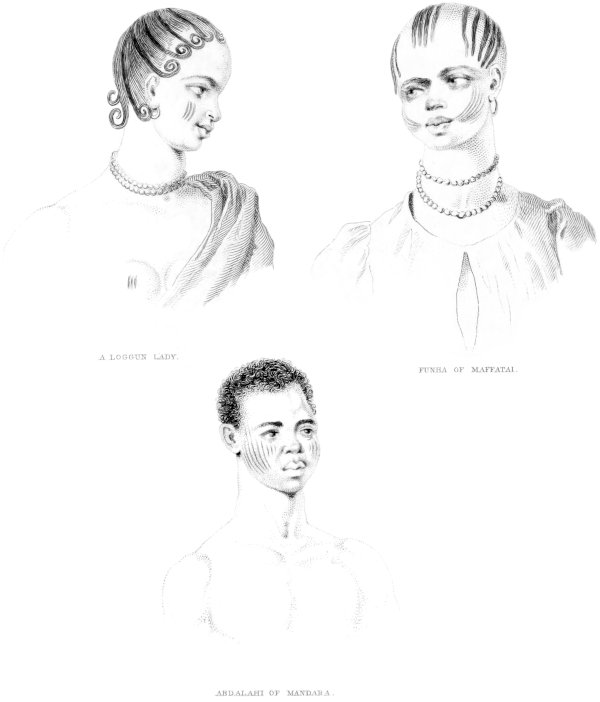
On entering the town of Angala, on the 19th, Bellal, who had accompanied Mr. Toole and myself on the excursion to Loggun, again pointed out the place where we had deposited my unfortunate friend. I went to the spot to see that it was not disturbed; and a peaceful depository it had proved for his remains: every thing remained just as I had left it, even to the branches which covered his grave, and I was fearful, by exciting observations, to risk their disturbance.
On the 20th we reached Maffatai, and took possession once more of my old quarters in Birmah’s house. The host, however, was from home, getting his gussub into the ground; his eldest wife did the honours: she also gave me a little more of her company than before, and told me, very good-naturedly, that she could do many things now, that she could not when the lord was at home. Nothing, indeed, could exceed the kindness with which my hostess, who was called Ittha, did all she could to show how welcome a visitor I was. “Birmah,” she said, “must stay and get in the corn, but she hoped I should not miss him.” During the first day she came repeatedly with her sister Funha, a negress with an expression of countenance more pleasing than I had ever before seen, of about eighteen, who, Ittha said, was most anxious to see me, from what she had told her formerly. Luckily, she added, Funha had divorced her husband only two days before, or she could not have had that pleasure. Ittha, with all the familiarity of an old acquaintance, uncovered my hands, arms, and breast, to show to her sister my extraordinary whiteness. It seemed to surprise her greatly; but nevertheless I was pleased to observe that it did not appear to excite either much alarm or disgust: but what certainly seemed to both the greatest wonder, was the sight and touch of my head, which had just been shaved; it was literally passed from the hands of one to the other, with so many remarks, that some minutes elapsed ere I could be allowed to replace my turban. When, at length, they left me, Ittha exclaimed, pressing my hand with both hers, that I was fit to be a sultan, mai, mai, wolla! and that Funha should shampoo me, and try to bring on sleep, as I must be tired and fatigued by the heat of the sun. This, however, was not all: towards evening, more than a dozen of Ittha’s friends, the principal ladies of the town, came, in consequence of the liberty she enjoyed while the goodman was away, to have a look at the bulfulk (white man), each bringing me something—a few onions, a little rice, or a bowl of milk, as a present. Funha performed all the duties imposed on her to perfection. I had a supper of pounded rice, milk, and honey, with something like bread made into cakes: and verily I began to think, like Ittha herself, that I not only deserved to be a sultan, but that I had really commenced my reign.
We moved to Showy, and crossing the Gurdya by a slanting ford, came more to the eastward than before, and by a nearer route. I was here greatly amused with seeing a party of girls skipping in a long rope, just as we do in England, and the fear of losing my dignity alone prevented my speedily joining them. They performed well; but then it must be recollected that they were totally unincumbered with drapery or any covering whatever, although good-sized young ladies of twelve or thirteen years old. The inhabitants of Showy are a most indolent happy people: half the night is passed in fishing, which is their sole support; and towards evening, each day, the sound of the drum calls them to the open space in the centre of their huts, when the men form themselves into circles, and dance in a most uncouth though joyous manner. The women all assemble at a certain part of the circle, sitting on the ground with their faces covered, and salute the most active with loud screams of approbation.
D. Denham. J. & C. Walker Sculp. Hager Teous called by the Natives the Foot Stool of Noah. (Large-size) Published by J. Murray, Albemarle Street London. March 1826.
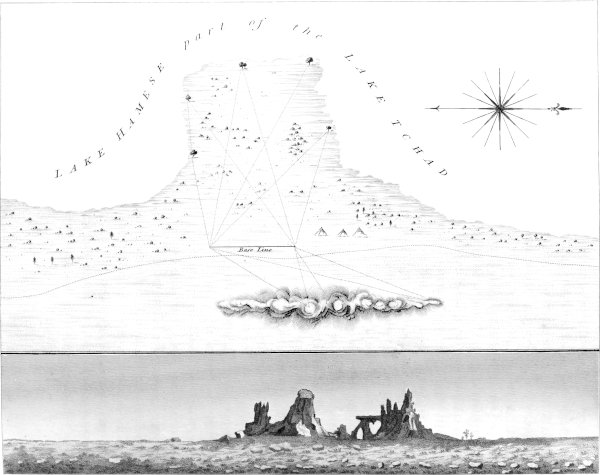
June 24.—We crossed the Shary with but little less water than we had found six months before, and passing the day on the east bank, we moved again in the evening: we saw twelve crocodiles basking on the banks. A large party of Shouaas were passing on rafts, swimming their sheep and bullocks, which they drive over in flocks, one being first forced into the river, and dragged over by a line run through the cartilage of the nose. Women often perform this duty, showing great strength and agility in swimming and curbing these powerful animals. We made nine miles, passed quantities of ghrwka (castor-nut tree), and at noon arrived at lake Hamese, which is part of the Tchad, and halted at some Shouaa huts of the Beni Hassan tribe, at a place called Zeabra. In continuation of our course, we halted, in the afternoon, at Berbeeta, where we encountered a terrible storm, and were sadly bitten by mosquitoes.
A little to the northward of the road, and at the head of the lake Hamese, are some very curious rocks of red granite standing in an immense plain, at a great distance from any mountains of a corresponding structure: one is of a conical form, and distant about three hundred yards from the others, which are connected. The space between Kou Abdallah, the name of the first, and the other three is covered with loose fragments of rock of different sizes, and it is natural to suppose they were all formerly united: the three are called Hager Teous by the Bornouese, and by the Shouaa Bete Nibbe Mohammed. I had dismounted for the purpose of approaching nearer to the base of the single rock, over the broken fragments by which it was surrounded, principally for the purpose of procuring some specimens, when those who were waiting in the plain exclaimed, “A lion! a lion! a lion!” I began to look around me with great anxiety, and quickly perceived a large female panther, big with young, bursting from the shade of the loose fragments just before me, and, frightened at the cries of the negroes, was running up the rock. These are the most dangerous animals that are here met with, although they never attack when several persons are together; my being in advance was what alarmed the rest. The animal, however, passed quietly away.
June 26.—We still kept near the swamps which surround the Tchad, and halting as usual for two hours in the heat of the day, by sunset we had made nineteen miles, winding, and arrived at the huts of the Biddomassy Shouaa, where Barca Gana was encamped.
June 27.—Proceeded fifteen miles, and found the Dugganah Shouaa were about three miles before us, with Malem Chadely, and a small body of the sheikh’s people who had preceded us. We forded to-day eight waters, branches of the lake, some up to the body of the horse; while the camels took a more circuitous route, and passed beyond the waters on perfectly dry ground. Amanook’s people, we found, had fled.
June 28.—Although on our arriving at the camp of the Dugganah a long parley was held, and a number of questions asked of sheikh Hamed, as to Amanook’s numbers, and his hiding-place, yet the first object of the expedition did not appear until just before daylight this morning, when the whole body mounted, and in fifteen minutes were moving towards Kanem Mendoo, one day from Maou, the capital; from whence the Waday’s had driven the sheikh’s friends. Mendoo had thrown off the sheikh’s government, and Edershi Gebere, nephew of the Fugboo, that had been put to death by the order of Mustapha L’Achmar the sultan of Fezzan, now ruled as khalifa. The sheikh’s object had been to catch him by surprise; and for this reason Amanook and La Sala were always held out as the sole destination of the army. Mendoo was nearly in my road, and it was therefore necessary that it should be cleared first of these rebels. Barca Gana sent in the night for Bellal, and desired him to acquaint me with his intention, and that as he should merely halt to sully (pray) and water the horses, from his starting until the sun should be three fathoms high on the following day, when he should surround Mendoo; that the sheikh wished me to remain where I then was until his return, which would be in four days, when he trusted I should be able to proceed in safety. I should have preferred going on, and leaving Mendoo to him, have passed on round the Tchad; but he would not hear of such an arrangement, and as I was kept in ignorance of this plan until the whole army was actually in motion, I had no alternative. Not a camel went with them, and all the baggage and siriahs were left in the camp. Bellal now became the chief, and with the assistance of the Shouaas and Arabs, the camp was intrenched, trees were cut down, and a sort of abbattis quickly formed for our protection. Our situation was, however, one of jeopardy and inconvenience, as nothing but their ignorance of our movements could save us from an attack from Amanook’s people, to whom we should have been a fine booty and an easy prey. From our vicinity to the Tchad, the swarms of flies in the day, and mosquitoes at night, were so great, that we were obliged to resort to our old remedy of lighting fires, and living in the smoke, in order to obtain a little peace.
June 29.—The Dugganah chief, Tahr, came to my tent to-day, attended by about twenty people, who all sat down behind him bareheaded, while he had on a dark blue cotton cap. He had a fine, serious, expressive countenance, large features, and a long bushy beard: these are the particular characteristics of these Shouaas—they differ from the Shouaas to the west, who have mixed more with the natives. Tahr might have sat for the picture of one of the patriarchs; and an able artist would have produced a beautiful head from such a study. Their mode of salutation is by closing their hands gently several times—as we applaud—and then extending the palms of both flat towards you, exclaiming, “L’affia?—Are you well and happy?”
Tahr, with his followers, after looking at me with an earnestness that was distressing to me for a considerable time, at last gained confidence enough to ask some questions, commencing, as usual, with “What brought you here? they say your country is a moon from Tripoli.” I replied, “to see by whom the country was inhabited; and whether it had lakes, and rivers, and mountains like our own.” “And have you been three years from your home? Are not your eyes dimmed with straining to the north, where all your thoughts must ever be? Oh! you are men, men, indeed! Why, if my eyes do not see the wife and children of my heart for ten days, when they should be closed in sleep they are flowing with tears.”
I had bought a sheep for a dollar, a coin with which he was not conversant; and he asked if it was true that they came out of the earth? The explanation pleased him. “You are not Jews?” said he. “No,” said I. “Christians, then?” “Even so,” replied I. “I have read of you: you are better than Jews,” said he. “Are Jews white, like you?” “No,” replied I; “rather more like yourself, very dark.” “Really;” said the sheikh: “Why, are they not quite white? They are a bad people.” After staying a full hour, he took my hand, and said, “I see you are a sultan: I never saw any body like you. The sight of you is as pleasing to my eyes, as your words are to my ear. My heart says you are my friend. May you die at your own tents, and in the arms of your wives and family.” “Amen,” said I; and they all took their leave.
June 30.—Tahr paid me another visit to-day. The Dugganahs were formerly Waday, and were strong enough to have great influence with the sultan; but by quarrelling among themselves, they lost their influence, and became subject to the Waday sultans. They generally passed one part of the year in the Bahr-al-Ghazal, and the other part by lake Fittre: in these two spots had been the regular frigues, or camps, for several generations. Sheikh Hamed his father, the present chief, who had more than one hundred children, found that another tribe of Dugganah had been intriguing with the sultan of Waday against him, and that he was to be plundered, and his brethren to share in the spoil. On learning this, he fled with his flocks and his wives, offered himself to the sheikh, El Kanemy, and had since lived in his dominions. The account he gave of the Tchad was this—it formerly emptied itself into the Bahr-el-Ghazal by a stream, the dry bed of which still remained, now filled with large trees and full of pasture: it was situated between the N’Gussum and Kangarah, inhabited by Waday Kanemboos. “I could take you there,” said he, “in a day; but not now—spears are now shining in the hands of the sons of Adam, and every man fears his neighbour.” He had heard his grandfather, when he was a boy, say, “that it there gradually wasted itself in an immense swamp, or, indeed, lake[50]: the whole of that was now dried up. They all thought,” he said, “the overflowings of the Tchad were decreasing, though almost imperceptibly. From hence to Fittre was four days: there was no water, and but two wells on the road. Fittre,” he said, “was large; but not like the Tchad. His infancy had been passed on its borders. He had often heard Fittre called the Darfoor water and Shilluk. Fittre had a stream running out of it—was not like the Tchad, which every body knew was now a still water; a river also came from the south-west, which formed lake Fittre; and this and the Nile were one: he believed this was also the Shary; but he knew nothing to the westward: it, however, came from the Kerdy country, called Bosso, and slaves had been brought to Fittre by it, who had their teeth all pointed and their ears cut quite close to their heads.” Tahr wished to purchase our water skins, “for,” said he, “we can get none like them; and either to Fittre, or Waday, we pass a high country, and find but few wells.” The Biddoomah sometimes pay them a visit; and although generally professing friendship, always steal something. The last time, they sold them a woman and a boy; which by Barca Gana’s people were recognized as the same they, the Biddomahs, had stolen from the neighbourhood of Angornou six months before: they were of course restored without payment. The hyænas were here so numerous, and so bold, as to break over the fence of bushes in the middle of a thunder-storm, and carry off a sheep from within five yards of my tent. We had news that Barca Gana had found Mendoo deserted, and was disappointed in catching the khalifa.
The Shouaas live entirely in tents of leather, or rather of rudely dressed hides, and huts of rushes, changing but from necessity, on the approach of an enemy, or want of pasturage for their numerous flocks: they seldom fight except in their own defence. The chiefs never leave their homes, but send bullocks to the markets at Maffatai and Mekhari, and bring gussub in return: their principal food, however, is the milk of camels, in which they are rich, and also that of cows and sheep; this they will drink and take no other nourishment for months together. Their camps are circular, and are called dowera[51], or frigue, with two entrances for the cattle to enter at and be driven out. They have the greatest contempt for, and hatred of, the negro nations, and yet are always tributary to either one black sultan or another: there is no example of their ever having peopled a town, or established themselves in a permanent home.
Sketch of the Lake Tchad. D. Denham. J. & C. Walker Sculpt. (Large-size) Published as the Act directs Feby. 1826, by John Murray Albemarle Street London.
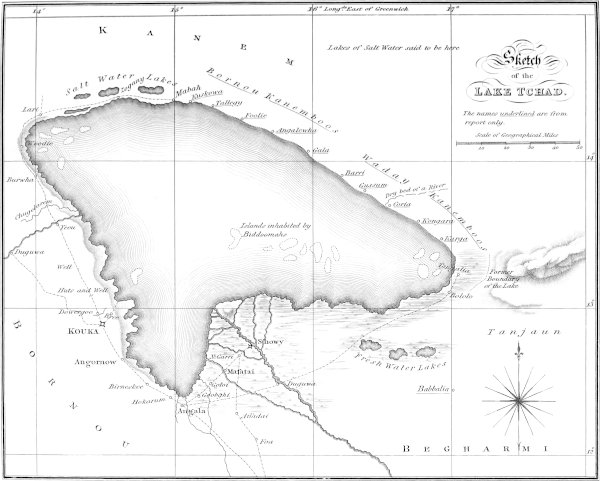
For several days we were kept in the greatest suspense. No news arrived from the army. Reports varied: it was said Barca Gana had pushed on to Maou and Waday; again, that he was gone to the islands. We had thunder and rain, with distressing heat, and flies, and mosquitoes to torture. Bellal would not go on, and I would not go back: we were consuming daily our store of rice, with eight days before us to Woodie, through a country without supplies.
July 6.—On the evening of yesterday, Barca Gana, with the chiefs, and about half their force, returned; the remainder had been obliged to halt on the road, to refresh their horses. He had pushed on to Maou after Edirshe Gebere, a Shouaa chief of Korata Mendooby. Fugboo Kochamy, as he was called, was the fourth khalifa whom the sheikh had placed at Maou (his three predecessors having been strangled by the Waday people); he was first cousin to Edirshe, who, affecting friendship for him, lulled his suspicions, and one night attacked him in his capital. Kochamy made a gallant defence; he killed nine of them with his spear, but was at length overcome, and died, with eleven others of the sheikh’s allies. Fugboo Jemamy, his brother, alone escaped: to assist Jemamy was the object of Barca Gana. Edirshe had news of their movements, notwithstanding they went nearly fifty miles in a day and night, and appeared first at Mendoo, and then at Maou, on the day after they left us. Edirshe had fled with all his cattle and women: they found them about ten miles from Maou, entrenched within a circular camp, with all their cattle, women, and children, strongly defended with stakes; their bowmen were all distributed between the stakes, and in front of the entrenchment: they saluted their enemies with shrill cries on their approach, and the sheikh’s people, after looking at them for a day and a night, without any provisions for either men or horses, dared not attack them. Disappointed, therefore, in their hopes of plunder and revenge, the whole returned here, their horses and men nearly in a state of starvation.
July 10.—We were all anxiety this day. Barca Gana was nearly one thousand strong, and about four hundred Dugganahs joined him, besides furnishing him with nearly one hundred horses. Amanook was one of the sheikh’s most troublesome remaining enemies; the sheikh had, on various occasions, and lastly, when he joined the Begharmis in their attack on Bornou, very severely crippled him, and destroyed more than half his force: the design now was to annihilate the remainder, and secure, if possible, the person of this inveterate foe, who kept alive the hostile feeling both on the Begharmi and Waday side. Amanook, however, was not to be taken by surprise, and he gave the sheikh’s troops such a proof of what might be done by a handful of men, bold of soul, and determined to defend an advantageous situation, that they will not easily forget. Just before sunset a Fezzanneer, who had lately entered into the sheikh’s service, returned to the camp, giving an account of Barca Gana’s complete discomfiture, and Bellal and myself immediately mounted our horses in order to learn the particulars. The Tchad[52], which in this part forms itself into innumerable still waters, or lakes of various extents, and consequently leaves many detached spaces of land or islands, always afforded the La Sala Shouaas, and the Biddomah, natural defences, which their enemies had ever found it extremely difficult to conquer. In one of these situations, these very La Salas, with Amanook at their head, kept the sultan of Fezzan, with two thousand Arabs, and all the sheikh’s army, several days in check, and killed between thirty and forty of the Arabs before they surrendered. On this occasion Amanook had taken possession of one of these islands, which, to attack with horsemen alone, in front of an opposing enemy, was the height of imprudence. A narrow pass led between two lakes to a third, behind which Amanook had posted himself with all his cattle, and his people, male and female: the lake, in front of him, was neither deep nor wide, but full of holes, and had a muddy deceitful bottom on the side from whence the attack was made.
The sight of the bleating flocks, and lowing herds, was too much for the ravenous troops of the sheikh, irritated by their recent disappointment; and notwithstanding the declaration of Barca Gana, that he wished to halt on the opposite side of the water, and send for spearmen on foot, with shields, who would lead the attack, the junior chiefs all exclaimed, “What! be so near them as this, and not eat them? No, no! let us on! This night these flocks and women will be ours.” This cry the sheikh’s Shouaas also joined in, ever loud in talk, but rearmost in the fight, as the sequel proved. The attack commenced: the Arabs, of whom there were about eighty, led the way with the Dugganah. On arriving in the middle of the lake the horses sank up to their saddle-bows, most of them were out of their depth, and others floundered in the mud: the ammunition of the riders became wet, their guns useless, many even missed the first fire, and they were unhorsed in this situation. As they approached the shore, the La Sala hurled at them, with unerring aim, a volley of their light spears, a very formidable missile, which they followed up by a charge of their strongest and best horse, trained and accustomed to the water; while, at the same time, another body, having crossed the lake higher up, came by the narrow pass, and cut off the retreat of all those who had advanced into the lake. The Shouaas, on the first appearance of resistance, had, as usual, gone to the right about, and left those, under whose cover they meant to plunder, to fight it out by themselves: the slaughter now became very desperate amongst the sheikh’s people. Barca Gana, although attacking against his own judgment, was of the foremost, and received a severe spear wound in his back, which pierced through four tobes, and an iron chain armour, while attacked by five chiefs, who seemed determined on finishing him; one of whom he thrust completely through with his long spear. By crowding around him, and by helping him quickly to a fresh horse, his own people and chiefs saved him, and thirty of them remained either killed or in the hands of the La Sala: but few of those who were wounded in the water, or whose horses failed them there, escaped. We found Barca Gana, with the other chiefs, seated near the second water; he was in great pain from his wound, and the whole army dreadfully disheartened: they had not more than forty followers in all. We vainly waited until sunset, in the hopes of the missing making their appearance, but we were disappointed, and returned to the camp. By this desertion of the sheikh’s Shouaas, the Dugganahs suffered severely: anxious to show their sincerity to the sheikh, they had gone on boldly, and their loss exceeded one hundred; eighteen of the Arabs were also missing. The night was passed in a state of great anxiety, from the fear of an attack on our camp; and the sense of our unjoyous situation was constantly awakened by the melancholy dirges which the Dugganah women were singing over their dead husbands, really so musically piteous, that it was almost impossible not to sympathize in their affliction.
The Dugganah, from being the humblest of allies, now became rather dictatorial, and told the general very plainly that they could fight better without him than with him: they refused him both bullocks and sheep, and said they must keep them to pay the ransom of their people.
Amanook, who it seems had no idea of following up his victory by an attack on our camp, which he might have done successfully, and carried off all the chiefs, siriahs, and camels, sent word this evening that he would now treat with nobody but the sheikh himself; that he had declared to the general, before he attacked him, that he feared no one but God, the Prophet, and the sheikh, and wished for peace: “They would not listen to me,” said he, “but attempted to take by force what was their master’s before; for all we had was the sheikh’s, and is still. By God’s help my people overcame them, but that is nothing; I am to the sheikh, in point of strength, as an egg is to a stone: if he wishes peace, and will no more molest me in my wilds, peace be with us—I will give up his people, his horses, and his arms, that have fallen into my hands; if not, I will keep them all, and may be add to their number. We are not easily beaten: by the head of the Prophet, I can and will, if I am forced, turn fish, and fly to the centre of the water; and if the sheikh comes himself against me, I will bring Waday against him.”
July 8.—The chiefs all refused to withdraw their forces on this offer of Amanook: they sent word that he was not to be depended on, so often had he deceived them. Nothing but an unconditional return of all the spoil would satisfy them. In a long conversation which I had with Barca Gana, whose wound was now fast healing from the dressing of burnt fat and sulphur, which I had applied, he assured me that they should not make another attempt on this bold chieftain: he, however, advised my returning to Kouka. “The excursion,” said he, “you wish to make was always dangerous, it is now impracticable; we must wait for the sheikh’s appearance before we can do any thing, and I think, from the advanced state of the season, as the rains have now begun to fall, you will find that the sheikh will not come, and that we shall all return.”
By being ten days encamped[53] close to the frigue of the Dugganah Shouaas, we had a better opportunity of observing these curious people: they were a superior class to any I had met with; they were rich in cattle, and in camels, and seemed to live in plenty, and patriarchal simplicity. The sheikh had greatly encouraged their taking refuge with him on their disagreement with Waday, and had promised them protection, tribute free, provided they were faithful. Both the men and women were comely, particularly the latter, who, when they found that we paid for what we wanted in little bits of coarse karem (amber), with which I had provided myself, brought us, night and morning, frothy bowls of milk, which formed by far the best part of our repasts. There is something so curious and singularly interesting and expressive in the Shouaa manners and language, that I am at a loss how to describe it. A girl sits down by your tent with a bowl of milk, a dark blue cotton wrapper tied round her waist, and a mantila of the same thrown over her head, with which she hides her face, yet leaves all her bust naked; she says, “A happy day to you! Your friend has brought you milk: you gave her something so handsome yesterday, she has not forgotten it. Oh! how her eyes ache to see all you have got in that wooden house,” pointing to a trunk. “We have no fears now; we know you are good; and our eyes, which before could not look at you, now search after you always: they bid us beware of you, at first, for you were bad, very bad; but we know better now. How it pains us that you are so white!”
As we had not more than four days’ provision, I determined on returning after another interview with Barca Gana: we left Tangalia, and returned to the spot where we had left the Biddomassy, and had scarcely pitched our tents when a storm came on, which lasted till midnight: but bad as it was, it was preferable to the stings of the musquitoes and flies which succeeded it. Notwithstanding we had fires inside the tent, which nearly stifled us, no sleep was to be obtained.
On the 11th we arrived at Showy, after a very tedious march, and losing our way for three hours: the woods are, indeed, most intricate and difficult; and as all the Shouaas had moved up towards Barca Gana, we could get no guides. We saw five giraffees (cameleopards) to-day, to my great delight; they were the first I had seen alive, and notwithstanding my fatigue and the heat, Bellal and myself chased them for half an hour: we kept within about twenty yards of them. They have a very extraordinary appearance from their being so low behind, and move awkwardly, dragging, as it were, their hinder legs after them: they are not swift, and unlike any figure of them I ever met with. Passing the Shary was attended with very great difficulty; the stream was extremely rapid, and our horses and camels were carried away from the sides of the canoe, to which they were lashed: we lost a camel by this passage; these animals have a great dislike to water, and after swimming a stream are often seized with illness, and are carried off in a few hours.
July 12.—Left Showy, and once more found ourselves at Maffatai. The rest, and fish bazeen, with which we were here regaled, with the deep shade of Burmah’s spacious mansion, greatly recovered us. The skin of my face all came off, and I slept nearly the whole day after our arrival: the sun, rain, flies, and musquitoes, altogether had fatigued me more than any former journey.
On the 15th we pursued our route homeward by a new course, and halted close to the Gambalarum, on the ground the Begharmis had escaped over, after their rencontre with the sheikh: the ground was strewed with skeletons.
July 16.—After a long and fatiguing march we reached some Felatah huts, about sunset. The water, after crossing Maffatai, is all sad muddy stuff; and the nearer you approach Angornou, the blacker the soil is, and the worse it becomes. We to-day crossed the Molee, a small stream which runs to the Tchad. The whole of this road, indeed the whole country from Angala, is an inclined plane towards the Great Lake, and during the rains it is impassable: they were now every where sowing their grain, and in many places they were reaping the Indian corn. Since leaving Maffatai, we had nothing besides a little rice, to which I added a duck or two, which I made it part of my business to search after, and shoot.
July 17.—We this day reached Angornou, very much fatigued with our journey; we had a drenching night of it, and crept into our friend Abdi Nibbe’s hut, with great joy: the worst of these storms were that they spoiled the only meal we could get time to cook in the twenty-four hours; and our tents, which rarely withstood the blasts, on falling, exposed all our stores as well as ourselves to the pelting of the storm.
On my arrival again at Kouka I found that Captain Clapperton, with a small kafila, had returned from Soudan: it was nearly eight months since we had separated, and although it was midday I went immediately to the hut where he was lodged; but so satisfied was I that the sun-burnt sickly person that lay extended on the floor, rolled in a dark blue shirt, was not my companion, that I was about to leave the place, when he convinced me of my error, by calling me by my name: the alteration in him was certainly most striking. Our meeting was a melancholy one: he had buried his companion, and I had also closed the eyes of my younger and more robust colleague, Mr. Toole. Notwithstanding the state of weakness in which I found Captain Clapperton, he yet spoke of returning to Soudan after the rains.
July 28.—I had now determined on proceeding by Woodie to Kanem, and approaching as near as possible to Tangalia, the spot where I had left Barca Gana, when I had passed by the southern extremity of the lake; and if I succeeded, and returned before the departure of the kafila after the Aid Kebir, I fostered a hope of retracing my steps across the desert, with all the satisfaction of a man who had accomplished to the full the duties that had been assigned him. Yagah Menamah, the chief eunuch of the sheikh’s favourite wife, came to me soon after daylight, and presented me with two kansara, or fly-flappers, made of the tail of the camelopard; and in her name said that she had burnt salt for my departure, praying that neither the devil nor any of his imps might be able to play me any malicious tricks on my journey. The sheikh had consented to Mr. Tyrwhitt’s remaining as consul: and on my inquiring whether he would protect one or two English merchants, if they came to his country—“Certainly: why not?” said he, “and assist them to the extent of my power; but they must be small traders, or the journey will never pay them.” He expressed his wish to write to the king, and added, “whatever I can do in Soudan, remember I am ready. I have influence there certainly, which may increase, and probably shortly extend to Nyffé. As to yourself, I shall write to beg the king will send you here, with any English whom he may wish to visit Bornou. You are known, and might now go any where in Bornou without fear. Even the Shouaas on the frontiers, and the Duggenah, all know Rais Khaleel: but this has not been done hastily; you have been nearly eighteen months amongst us, and you remember when you could not go to Angornou without inconvenience. I then thought you would never be as much at liberty here as you are. Time and yourself may be thanked for this, not me; for I could not, by any orders I might have given, have done for you what your mixing freely with the people, and gaining their good will, has brought about—and yet you are a Christian!”
July 30.—This morning the sheikh sent to Mr. Clapperton, Mr. Hillman, and myself, as a present, a very fine camel, a horse, and two water-skins, two leopard skins, and two dressed-leather sacks. In the course of the morning another cargo was brought to me, consisting of eight elephants’ tusks, with the horns of three other animals. The horns were, first, the maremah, a long horn similar to one I had seen at Kabshary—the animal has two, bending backwards at the point; kirkadan, a two-horned animal; another animal, with one long horn and a second shorter just above it, nearly between the eyes of the animal, was described to me as having, on the sheikh’s late expedition to Gulphi, carried a man and horse, spiked on his horn, more than one hundred yards, when, frightened by the cries of the people, he dropped them, and made his escape: the man was unhurt, but the horse died.
Aug. 6.—This was the Aide Kebir, the principal feast of the Mussulmans during the year, in commemoration of God’s staying the hand of Abraham in the place Jehovah-jireh, when about to sacrifice his son Isaac: all who can muster a sheep or a goat kill it on this day, after prayers. The sheikh sent the day before, to know if we kept the feast; and when we met, repeated his question. I replied, that we believed the interposition of the Divine Power in saving Isaac to be a signal proof of God’s mercy and love to all his creatures; “for remember,” said I, “he is the God of many, not of Mussulmans alone; and that our father Abraham’s great and implicit faith in the existence of that mercy, was what obtained for him all the blessings God promised him.”
He sent us two very fine sheep, and we killed and feasted with the rest. Early in the morning, the sheikh, with his sons and all his court, mounted, according to custom, to welcome the Aid, by praying outside the town, and firing and skirmishing on their return: the assembly was not so large as on former occasions, in consequence of the absence of the chiefs in Kanem; indeed every thing went off extremely flat, owing to the defeat of the sheikh’s people. Contrary to custom, no presents were made by him, and no dresses were distributed to the slaves: instead of the glossy new tobes which on former occasions shone on the persons of the footmen who ran by the side of his horse, they were now clothed with torn, discoloured ones, and every thing wore the appearance of gloom and disgrace. On these days, the custom is also for the women to assemble, dressed in all their finery, in the street, before the doors of their huts, and scream a salutation to the passing chiefs: it was one of the best parts of the ceremony, but this year it was omitted. The sheikh, whose unamiable trait was, as I have before observed, visiting the weaknesses of the female part of his subjects with too great severity, had, during my absence, given an order which would have disgraced the most absolute despot that ever sat on a throne: the gates of his town were kept shut at daylight one morning, and his emissaries despatched, who bound and brought before him sixty women who had a bad reputation; five were sentenced to be hanged in the public market, and four to be flogged; which latter punishment was inflicted with such severity, that two expired under the lash. Those who were doomed to death, after being dragged, with their heads shaved, round the market on a public day, with a rope round their necks, were then strangled, and thrown, by twos, into a hole previously prepared, in the most barbarous manner. This diabolical act, for it deserves no better name, armed all tongues against him. The Bornouese, who are a humane and forgiving people, shuddered at so much cruelty: and so much influence had the ladies in general with their husbands, that more than a hundred families quitted Kouka, (to which place they were before daily flocking), to take up their abodes in other towns where this rigour did not exist. In Kouka, they declared there was no living, where only to be suspected was sufficient to be doomed to a cruel and ignominious death; and where malicious spies converted “trifles light as air, into confirmation strong.” Those who remained, though the women of his particular attendants, refused flatly to scream him a welcome, and the procession passed through the streets in silence.
Aug. 7.—I was now on the eve of departing for Kanem, to proceed by Woodie to the north-east of the lake. Mr. Clapperton had been ill with sore legs and an attack of dysentery, but was better. Mohammed Bousgayey, an Arab, who left this place with Doctor Oudney and Mr. Clapperton, came to my hut: he had gone on from Kano, with four or five Arabs, to Yeouri and to Nyffé, and had stayed some time at a place called Gusgey on the Quolla, two days west-south-west nearly, from Yeouri. The Quolla he described to be here as wide as to the market outside the walls and back, which must have been nearly two miles: they were all kaffirs, he said, but not bad people. The sultan Mahmoud had several hundred guns, and powder, which were brought from the bahr kebir (great water), and arrack (rum), in plenty; which was brought in large glass bottles. At eight days distance only from Yeouri, large boats came to a place called Yearban, but it is not on the bahr kebir. Katungah is the great port, which is at some distance: to both of these places people he called Americans came; they were white, and Christians: they always demand gum arabic and male slaves, for which they will pay as high as sixty and seventy dollars each. Sultan Mahmoud produced to him two books, which he said were like mine; and told him, that a man, whose beard was white, had lived nearly three years with no money; that he wished to go, but had no means, and that he died. Bousgayey said the sultan had offered him the book; which he refused, as he did not know what he could do with it; but that now he was going back, and should bring it.
In the afternoon we went to pay our respects to the sheikh, in honour of the feast. He received us but coolly: and I was scarcely seated on the sand, when I saw near me a little shrief from Marocco, named Hassein, who, though once or twice our friend, I was always in fear of, being aware both of his cunning and his influence. Almost the first question of the sheikh’s was, as to the distance of our country from India: and when told it was four months by sea, he said, “What could induce you to go so far from home—to find it out, and fight with the people?” We replied, “that we had plenty of ships, and were great lovers of discovery; that the French and the Dutch had been there before us; and we were always jealous of our neighbours doing more than ourselves.” “And now it is all yours,” said he, “and governed by your laws!” Our reply was, “that we only kept possession of the part near the sea—that their own laws were in full force—but that even Mussulmans often preferred the English laws to their own.” “Wonderful!” said he, “and you went at first with only a few ships, as friends?” “We are friends now,” said I, “and by trade have not only made ourselves rich, but the natives also.” “By God!” said the Marroquin, “they eat the whole country—they are no friends: these are the words of truth.” We had then a few remarks (not good-natured ones) as to the right of dictating to Algiers and the other Barbary powers. Algiers we described as unfaithful to their word, and little better than pirates.
Sketch by Major Denham. Engraved by E. Finden. LANCERS OF THE SULTAN OF BEGHARMI. Published Feb. 1826, by John Murray, London.
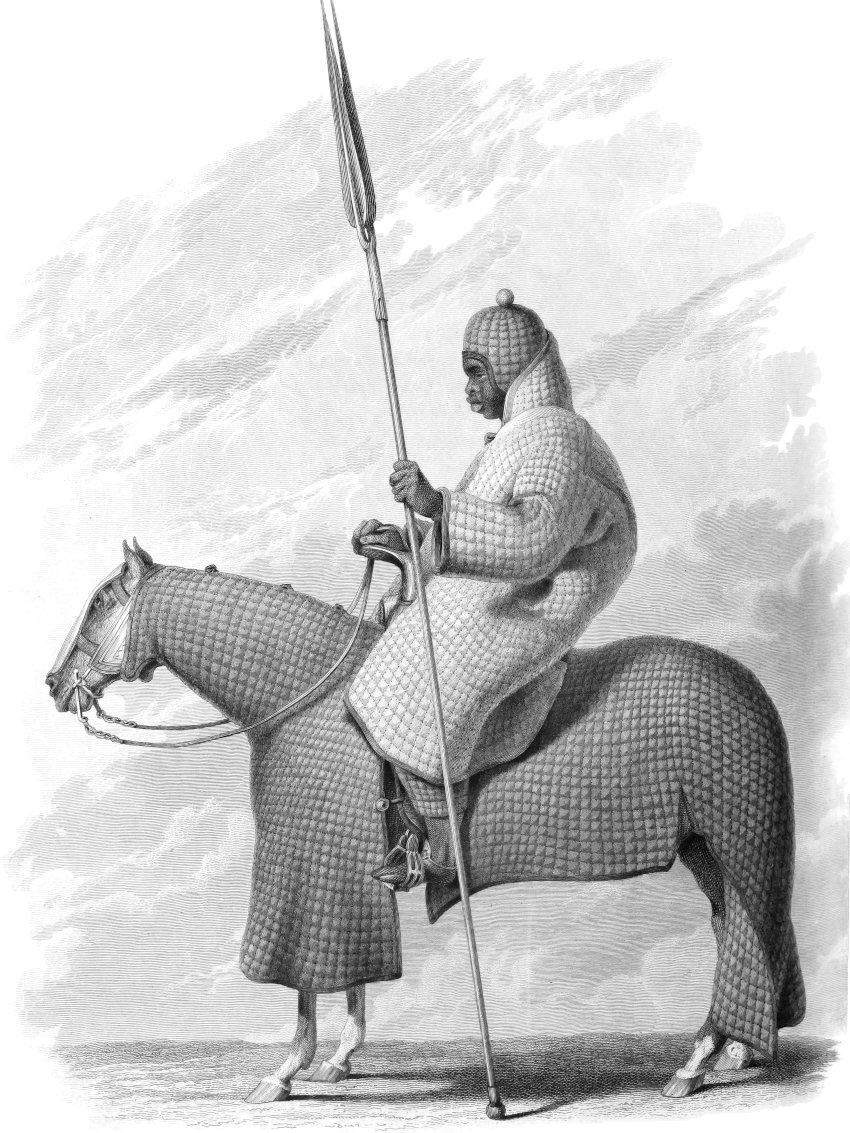
Aug. 11.—Soon after daylight, Karouash, with Hadgi Mustapha, the chief of the Shouaas, and the sheikh’s two nephews, Hassein and Kanemy, came to our huts. Hadgi Mustapha had been one of the original four hundred who commenced the liberation of Bornou from the Felatahs. They were attended by more than a dozen slaves, bearing presents for us, for King George, and the consul at Tripoli. I had applied for a lebida[54], after seeing those taken from the Begharmis: the sheikh now sent a man, clothed in a yellow wadded jacket, with a scarlet cap, and mounted on the horse taken from the Begharmis, on which the sultan’s eldest son rode. He was one of the finest horses I had seen; and covered with a scarlet cloth, also wadded. “Every thing,” Hadgi Mustapha said, “except the man, is to be taken to your great king.” He also brought me twelve very beautiful tobes, of every manufacture, from Nyffé to Loggun and Waday, four parrots, and a box of zibet. For the consul he also sent six tobes, and a small box of zibet, worth thirty or forty dollars, with two parrots.
August 13.—The long expected kafila arrived from Soudan, which was a signal for our departure: they had been fifty days on the road from Kano, in consequence of the waters; and had they been delayed much longer, the season would have been so far advanced as to have prevented the departure of all those merchants that had many slaves: going, as they do, poor creatures, nearly naked, the cold of Fezzan, in the winter season, kills them by hundreds. With the Soudan kafila came Khalifa, a Moor and a fighi; he had been at Saralo, as he called Sierra Leone, and desired to be brought to me, as he knew English. He certainly knew enough to convince me of his truth, when he asserted that he had met my countrymen. “Gun, cap, and water!” he kept continually saying: and my Bornou friends were not a little surprised when I told them it was the language of my country. He spoke greatly of some person he called the Doctor[55], whom he had seen at Bammakoo and Bunjalow, a good looking man, with a red beard, and long projecting nose, with bad front teeth. He gave away many things, wrote a great deal, and was much liked by all the people. Two persons were with the Doctor, whom he believed were French, and had come from Ender; one was called Gentleman, and the other Fausta, or Forster; “but they held their heads down, and did not talk to the people like the Doctor,” said Khalifa. “The Doctor,” he said, “wanted to go to Sego, but the sultan would not allow him to come to his country, and would not even look at the presents he sent him, as he feared they had charms which would kill him, either by the sight or smell. He, however, sent him slaves, and horses, which he, the Doctor, also returned, saying that he wanted nothing but to see the country and the rivers. The sultan of Sego replied, he had heard that his (the doctor’s) king had water all round his country, and he might go and look at that. Khalifa said the Sego people were Kaffirs, and knew not God, therefore were afraid of Christians; but the Moors knew them, and liked them. When the present king of Sego’s father was alive, he, Khalifa, then a boy, remembered Christians going to D’Jennie and Timboctoo, and hearing that the Tuaricks killed them in their boat near Nyffé[56].”
On Monday, the 20th of the Mohamedan month del Khadi, and the 16th of August, we took our final leave of Kouka, and not without many feelings of regret, so accustomed had we become, particularly myself, to the people. In the morning I had taken leave of the sheikh in his garden, when he had given me a letter to the king, and a list of requests: he was all kindness, and said he had only one wish, which was that I might find all my friends well, and once more return to them. He gave me his hand at parting, which excited an involuntary exclamation of astonishment from the six eunuchs and Karouash, who were the only persons present.
I preceded the kafila for the following reason: I had, ever since my return from Tangalia, determined to attempt the east side of the Tchad, by Lari, previous to returning home. Many had been the objections, many the reports of danger from the Waday people and Amanook, who had now boldly forsaken the lake, and was encamped at no great distance from Barca Gana, to whom he twice paid a night visit, and had been beaten back. I, however, told the sheikh I could take no present, or promise to the execution of any commission, unless this duty was accomplished, or at least until I had done my utmost, and that I would take care not to go into danger. Bellal, my old companion, was once more appointed to attend me, and we moved with two camels, lightly laden; for the more train, always the more trouble and the more expense. All my friends then in Kouka mounted to escort me from the town: the women assembled outside the gate, and screamed an adieu; and I am persuaded our regrets were mutual.
About midnight, while we were all asleep at Dowergoo, a despatch came to say, that the skin of a camelopard had been brought to Kouka, which the sheikh had procured for me. Columbus, therefore, returned to prepare it for preservation, while we moved on to N’Gortooah: he came up again in the evening, and reported, that though small, it was a fine specimen. On Wednesday we slept at Kaleeluwha, and on the 23d came once more on the Yeou, now a considerable stream, full of water, and running towards the Tchad, at the rate of three miles an hour[57]. My feelings on seeing this river for a second time were very different to what they had been when I first looked on its waters. We then had an escort of two hundred men, and yet could not feel ourselves in perfect safety one hundred yards from our tents. Now I had only one attendant—the people about me were all natives, and I wandered about the banks of the river with perfect freedom, and slept with my tent door open, in as great security as I could have done in any part of England, had I been obliged so to travel. Other feelings also obtruded themselves; I was about to return home, to see once more dear friends, and a dear country, after an absence of nearly three years, on a duty full of perils and difficulties: two out of four of my companions had fallen victims to climate and disease, while those who remained were suffering, in no small degree, sickness and debility from the same causes: I was in health, and notwithstanding the many very trying situations, in which we had all been placed, some of them of great vexation and distress, yet had we been eminently successful.
In the afternoon Bellal accompanied me down the river, about nine miles, where, increasing in width to about one hundred yards, it flows into the Tchad, with a strong and deep current of water. On its banks are five considerable villages of Kanemboos, called Ittaquoi, Belagana, Afaden, Yeougana, and Boso. At Belagana, the sheikh has a large inclosure of huts, within a wall, where he generally has from five hundred to eight hundred slaves of both sexes, under the charge of four eunuchs, who are employed in preparing cotton, and spinning the linen (gubbok), of which the tobes are made.
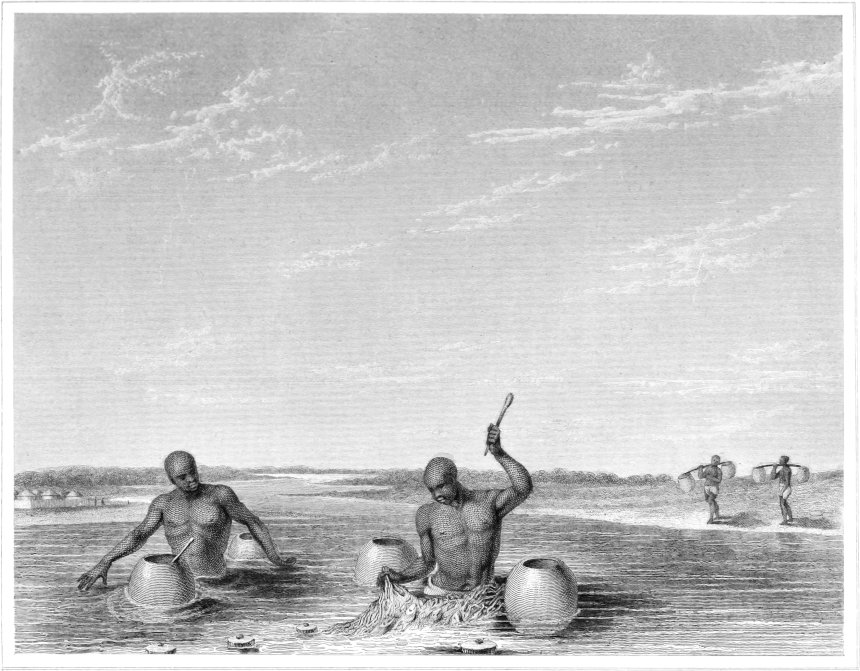
The manner of fishing in the Yeou, a very considerable source of commerce to the inhabitants of its banks, must not be omitted: dried fish from the Yeou is carried to all the towns to the south-west, quite as far as the hills; and at this season they are usually taken in great numbers. The Bornouese make very good nets of a twine spun from a perennial plant called kalimboa: the implements for fishing are ingenious, though simple: two large gourds are nicely balanced, and then fixed on a large stem of bamboo, at the extreme ends; the fisherman launches this on the river, and places himself astride between the gourds, and thus he floats with the stream, and throws his net. He has also floats of cane, and weights, of small leathern bags of sand: he beats up against the stream, paddling with his hands and feet, previous to drawing the net, which, as it rises from the water, he lays before him as he sits; and with a sort of mace, which he carries for the purpose, the fish are stunned by a single blow. His drag finished, the fish are taken out, and thrown into the gourds, which are open at the top, to receive the produce of his labour. These wells being filled, he steers for the shore, unloads, and again returns to the sport.
25th.—At Woodie I met Barca Gana, Ali Gana, and Tirab, with their forces, on their return from Kanem: they had been out, some of them five months, had made the complete tour of the lake, and were in a sad plight, with scarcely thirty horses left, having literally fought their way: Amanook had twice attacked them, and had sent off all his flocks and women to Begharmi, but had not gone himself, and they were so reduced as not to be able to do any thing to prevent him. They were so badly off for every thing, that they were obliged to come down on Kanem for supplies: the people refused them any assistance, and after being half starved, they were obliged to make a running fight of it, and get home as well as they could. The Kanem people were all in a state of mutiny, and the Dugganah had gone off towards Waday. This was sorry news; Bellal wanted to turn back. I saw Barca Gana, who said, “It is dangerous, but I think you may go on if you wish it. I would give you eighteen men, but you are better without them: they expect the sheikh, and going with Bellal, wanting but little, and paying for that, for the crops have failed them, you will have little to fear; but you cannot go beyond the Bornou Kanemboos with less than one hundred men.”
From a Sketch by Major Denham. Engraved by E. Finden. MANNER OF FISHING IN THE RIVER YEOU. Published June 1826, by John Murray, London.
With this advice I determined on going on, and after halting the whole of Sunday, on the 27th I proceeded. Barca Gana had, on his return, bivouacked in the wadey where once the Bahr-al-Ghazal ran from the Tchad; the valley is now filled with trees and grass. This was the fourth time Barca Gana had raised his tents in the same place[58], as the sheikh had before informed me. This valley runs between Kangara and N’Gussum, less than twenty miles from Tangalia. We were overtaken by so dreadful a storm, that we halted, and pitched the tent on a high sand-hill within five miles of N’Gygami. Near this hill we had a beautiful view of the open lake, with several floating islands, when the storm cleared away. The Biddomahs are constantly landing hereabouts; and we met some poor people who had been robbed of their whole flock of goats, with their daughter, only the day before—indeed no single travellers can pass this road. Towards evening, we saw their canoes in the offing; and below us, in the low grounds, three Biddomahs making for the lake:—they saw us, and quickened their pace. For safety we all slept outside the huts of N’Gygami: this ground is the highest part of the borders of the lake, and here deep water commences immediately off the shore, while, in some parts, miles of marsh are to be waded through previous to arriving at the lake. Tuesday, we made Lari, where we were to find a Malem fighi, whom the sheikh had ordered to proceed with us.
Aug. 29.—Moved from Lari. Here we found four men, with a chief whom Barca Gana had left at Kuskoua, returning, as the people would give them no provisions. It was near sunset when we reached Zogany, thirty miles; the country was quite a flat, covered with a plant resembling a heath which I had seen nowhere else; and in many parts I observed incrustations of trona. This heath is called kanuskin: the camels eat it; and in the neighbourhood of trona it is generally found.
Aug. 30.—After a night of intolerable misery to us all, from flies and mosquitoes, so bad as to knock up two of our blacks, we mounted and advanced; and leaving our tents, for Bellal would not carry them on, we proceeded to Garouah and Mabah;—which are full of people, and though annually pillaged by Tuaricks and Tibboo Arabs, yet still they will not quit their native soil. The character of the country here, which is different to the south or west sides of the lake, extends to Gala, where the land is again varied, and a little higher: for many miles on this side we had one continued marsh and swamp. I was at the northernmost part of the lake, and pursuing a course first to the west, and then to the eastward of south, for five or six miles, nearly up to the body of the horse in water, and with reeds and high grass overtopping our heads, I at last got a sight of the open lake. We disturbed hippopotami, buffaloes, enormous fish, and innumerable hosts of insects. At the commencement of the water it had a taste of trona, which, as we advanced, became gradually sweeter: indeed, all the people say, when you ask if this water you drink so strong of trona is the lake? La! la! inki kora kora kitchi engobboo tilboo baco. (No! no! the water of the great lake is very sweet, no trona).
Completely fatigued, we returned to the village of Chirgoa, near which our tents were pitched: this was a most distressing day, and we had been on our horses nearly thirteen hours. Garouah is twelve miles from Zogany, and Mabah twenty. We were some way in advance of the latter, but to Kuskoua I could not induce my guide to venture; and so many proofs had I seen, not only of his bravery, but his desire to satisfy my curiosity, that I could not doubt his fears were just. Notwithstanding our fatigue, no rest could we obtain, and another night was passed in a state of suffering and distress that defies description: the buzz from the insects was like the singing of birds; the men and horses groaned with anguish; we absolutely could not eat our paste and fat, from the agony we experienced in uncovering our heads. We at last hit upon an expedient that gave us a little relief: as they came at intervals, in swarms, we thought they might also be driven off in the same quantities; and we found, by occasionally lighting a line of fires with wet grass, to windward of our tents, that the smoke carried off millions, and left us a little at ease. I do not think our animals could have borne such another night; their legs and necks were covered with blood, and they could scarcely stand, from the state of irritation in which they had been kept for so many hours.
On Friday we returned to Lari by the lower road, where there are frequent large detached pieces of water, strongly impregnated with trona. On the road, to-day, we fell in with a tribe of the Biddomah, who had, during the last three months, taken up their abode on the sheikh’s land, and asked for what was instantly granted them, permission to remain. Internal wars cause these fallings off of one tribe from another, which the sheikh encourages: only one of their chiefs could ever be induced to proceed so far as Kouka. The sheikh takes no notice, and suffers them to do as they please: he sent them tobes, and a fighi, and desired they would learn to pray: and they are now beginning, as my guide said, to have the fear of God. They were the most savage beings I had seen in the shape of men, except the Musgowy; and we had sat some time under a tree before they would come near us. The men, until they are married, wear their hair, and collect as many beads and ornaments as they can, which they wear round their necks; their hair is long and plaited, or twisted in knots; they have ear-rings also: and this collection of beads and metal is always given to the wife on their marriage. The upper part of the face is very flat, and the eye sunk; they have large mouths, and long necks; a sulky, reserved look about them, any thing but agreeable: they have no style of salutation like other negroes, who greet strangers over and over again, sitting down by them:—these stand up, leaning on a spear, and look steadfastly at you without speaking. I gave a little boy some white beads, which were directly tied round his neck, I suppose as the commencement of his marriage portion. They, however, at length, produced some sour milk; and some of them came round my horse when I mounted, and nodded their heads at me when I rode off, which I returned, much to their amusement.
When we arrived at Lari, which was comparatively free from flies, the horses lay down, and, stretching themselves out, fell asleep in a way, and with an expression of enjoyment, I never saw animals do before, and did not look for their nose-bags until after midnight. We here found that one of Barca Gana’s people had the night before lost his horse, which had been stolen by the Biddomahs we saw on the look out.
Kanem, the most persecuted and unfortunate of negro countries, was daily becoming more miserable; they were pillaged alternately by the Fezzaneers, the Tuaricks, and the Waday people. Between the latter and the sheikh they hung for protection, and from neither could they obtain what they sought: the country was becoming abandoned, and the villages deserted, part taking refuge in Waday, and part in the sheikh’s dominions: the land communication between Bornou and Kanem was too difficult and distant, either by the south or north, for the sheikh to render them any effectual support. An army almost every year went to Kanem for this purpose, but they usually returned with the loss of horses, camels, and men, and were seldom able much to annoy their enemies, the Wadays. This year his expedition had been upon a larger scale, and his losses were greater than on any former occasion.
In consequence of the waters, which fill the rivers at this season, the ford across the Shary had become impassable, and they were therefore obliged to return home through Kanem. Not the least assistance would any of the towns give them, except Gala, and a more wretched state I never saw men in: some of the chiefs on foot, without horses; and those who were mounted, bestriding sorry animals, with torn appointments: they all said, fighting without the sheikh was useless, as he alone could lead them to victory.
Drawn by Major Denham. Engraved by E. Finden. ENCAMPMENT NEAR WOODIE. AND PART OF THE LAKE TCHAD. Published Feb. 1826, by John Murray, London.
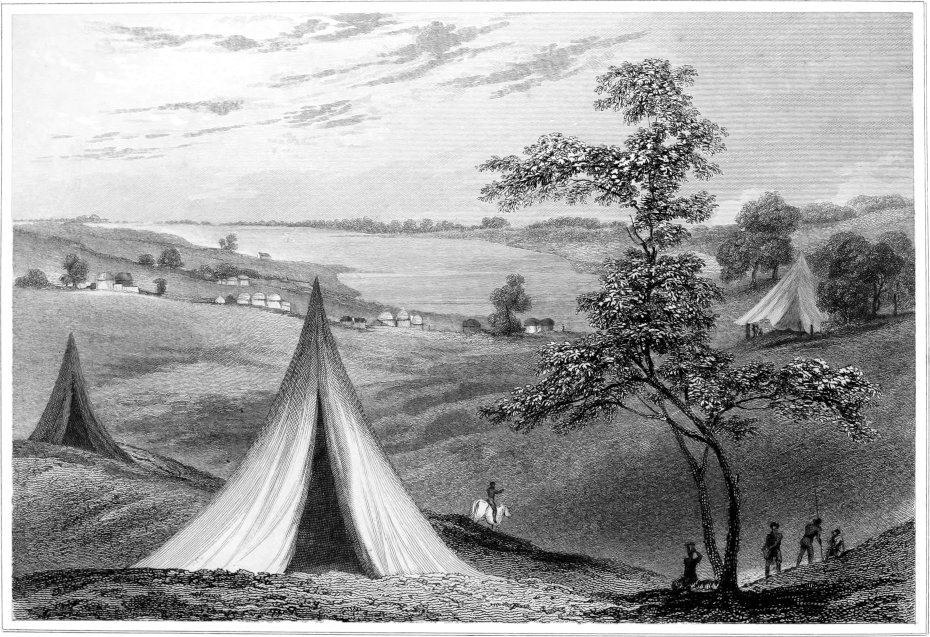
Sept. 3.—I had now been six days at Woodie, waiting the arrival of my companions with our camels, and the kafila of merchants whom we were to accompany to Fezzan. Woodie is no very pleasant place of sojourn, as the Biddomah have a sort of agreement with the kaid to be allowed to plunder all strangers and travellers, provided the property of the inhabitants is respected. We were, however, told to be on our guard, and not without reason. Our tents were pitched near each other, and a look-out kept up the whole night, notwithstanding which they paid us a visit, during a storm of thunder and rain, and from the entrance of Bellal’s tent, only eight paces from my own, stole both his horses. Although six or seven negroes were sleeping quite close to them, they got completely off, and had an hour’s start before even the loss was discovered. Bellal pursued them, with about a dozen people, quite to the lake, tracing their footsteps in the sand, which was not difficult after the rain; but finding here that they had embarked, the pursuit was given up.
At length, however, on Tuesday the 14th, we had assembled our kafila, and we moved on towards the desert: on the 22d of September, in the afternoon, we halted half way to the well of Beere Kashifery.
Sept. 23.—We made the well soon after mid-day; and fortunately for us we brought some water with us, for the power of our friend Mina Tahr here began to appear. This well was guarded, and we were told, that until the sheikh Mina appeared, not a drop was to be drawn. It required some exertion of patience and forbearance, in a sultry oppressive day, with the thermometer at 110° in the tent, to be obliged to drink muddy water from goat skins, when a well of the best water between Kouka and Bilma was under our feet: but we were inured to hardships and contradictions, and submitted, I hope, like good Christians. Towards evening the Tahr appeared on the hills to the north-west, attended by his troop: he seemed vastly glad to see us; said “the well was ours—that our water-skins should be filled, and camels watered, before any body, and for nothing; and then,” said he, “sultan George the Great must be obliged to Mina Tahr, the wandering chief of Gunda, and that will give more pleasure to Tahr’s heart than payment: and who knows,” said he, “but when sultan George hears this, he may send me a sword?”
Sept. 24.—In consequence of the number of camels to be watered, and the large flocks of the Tibboo, it was not until the evening that our animals could drink; and even then we were almost obliged to take possession of the well by force. Our old Maraboot was struck by a spear, as well as our servants; and it was not until after I had mounted a horse and repaired to the well myself, accompanied by the Tahr, that we could complete this most important business of the day.
In the evening Tahr came for his present. I gave him a tobe from Soudan, a red cap, and a turkodie: the tobes and cap he looked at, and said, “Ah! this is very well for me; I am one, but my wives are three:—what shall I do with one turkodie?” Tahr now began a speech: he was greatly distressed that he had nothing to send sultan George. “By the head of Mustapha!” said he, “I consider him as much my master as the bashaw;—ay and more—for you say he sent you to see me, which is more than the bashaw ever did. I can send him a tiger-skin, and I will write him a letter—for Tahr’s enemies are never quiet, and he has no time to kill ostriches now. The well Beere Kashifery, whose waters are here like gold, and better than gold, and all that Kashella Tahr and the Gunda Tibboos have to give, shall always be, as long as he or his children govern, at the service of sultan George Inglesi.” He now asked for water, and began washing the ink from a paper which had previously been ornamented with a charm, drinking the dirty water, and rubbing it over his head and neck: when this was finished, he laid the paper in the sun; and I was a little amused when I found, that it was on this dirty scrap that he intended writing to king George.
Sept. 25.—In the afternoon of this day we left Beere Kashifery, taking a very hearty leave of Tahr. In order to save my camels, who had seventeen skins of water to carry in addition to their loads, as we were to be four days on our road to Aghadem, I hired a maherhy to carry two heavy boxes to Bilma, for seven dollars. The moon, which was in its first quarter, assisted us after sunset, but we were obliged to move on for at least two hours after she had sunk quietly to rest. We halted for a few hours, at a spot called Geogo Balwy (honey spot), and a little after midnight proceeded on our dreary way. There was great difference of opinion as to our route, which, probably, by following our own back bearings, we might have found better ourselves: but we were not yet quite so bold in the desert as on the main; and I insisted on the Mina Hamedee, the guide whom the sheikh had given us, being allowed his own way, and my confidence was not misplaced. By daylight on Sunday we discovered the foot-marks of the camels and slaves of Hadge-Boo-Said, a Fezzan merchant, who had absolutely been in the right track, but had turned back, and gone southerly. Numbers now exclaimed that we were wrong: there appeared, however, no sort of timidity about our guide; he looked confident, and bore the abuse that was levelled at him on all sides, with great coolness: and there was a sort of conscious ability about him that determined me to rely completely on his judgment alone. No man is ever afraid of doing what he knows he can do well; and in most cases a sense of power gives confidence: so it proved with my Tibboo. We continued travelling another night and day in these most dreary wastes, with nothing but the wide expanse of sand and sky to gaze upon.
On Monday the 27th of September, a little before noon, we observed something in the distance, which had the appearance of a body of men moving towards us; but from the effect of the mirage assuming different shapes, and sometimes appearing twelve or fifteen feet above the surface of the desert, the Arabs declared it to be a Tuarick party on the forage, and all our followers loaded and prepared for action. On their approach, however, we found to our great joy that it was a kafila from Fezzan: they had been as much alarmed at us as we at them, and were all formed, in front of their camels several hundred yards, in extended order, as the Arabs always fight: they gave us some Fezzan dates, which were a great luxury; and some of the traders who were short of water exchanged a jar of butter, worth at least two dollars, for every full skin they could so purchase. They told us the road was perfectly safe, although their fears of falling in with the Tuaricks had detained them seventy-two days on the journey from Mourzuk.
It is scarcely possible to convey an idea of the sensations of all parties on a meeting of this nature on the desert. The Arabs were equally alive to these feelings as ourselves; and, in their usual wild expressive manner, sang, for days after such a rencontre, ballads descriptive of the event[59].
We halted at noon, at a place called Gassooma-foma. In the afternoon we moved again; and the guides told me that the road was so difficult that, until the moon fell, we should make the best of our way, and then rest. On these occasions we pitched no tents, but laid the boxes together; and, either with a little boiled kouskosou, or still oftener without, soon forgot our fatigues in sleep. When we saw the black ridge that extends along the wadey of Aghadem, the negroes, female slaves, and followers, set up screams of joy, and began dancing and singing with all their might. It was almost noon when we got to the well, and several slaves, belonging to an old Shouaa who was going to Hage, were speechless from want of water; yet they ran several miles to reach the well, like things distracted, with their mouths open, and eyes starting from their heads.