Chapter I · FROM MOURZUK TO KOUKA IN BORNOU. (continued 2)
Reading edition
We bivouacked near a small parcel of huts, called Nyagami, in a beautiful spot, so thick of wood, that we could scarcely find a clear place for our encampment. While the tents were fixing, an alarm was given of wild boars: one of our party followed the scent, and, on his return, said he had seen a lion, and near him seven gazelles. I could not, however, find from the natives, that lions were ever seen here: numerous other animals appeared to abound, and that confirmed the opinion.
Feb. 7.—We moved for Woodie about eight, accompanied by two Arabs of Boo-Saif. I left the kafila, and proceeded a little to the westward, making a parallel movement with the camels. Birds of the most beautiful plumage were perched on every tree. Guinea fowls were in flocks of eighty or one hundred; and several monkeys chattered at us so impudently, that, separating one from the rest, we chased him for nearly half an hour: he did not run very fast, or straight forward, but was constantly doubling and turning, with his head over his shoulder, to see who was close to him. He was a handsome fellow, of a light brown colour, and black about the muzzle. About noon we came on a village of huts, called Barrah; and although only three in number, the natives flew in all directions. On our approaching the town, we beckoned to them, and got off our horses, for the purpose of giving them confidence, and sat down under the shade of a large tamarind tree. An old negro, who spoke a little Arabic, was the first who ventured to approach: seeing that he was not ill-treated, the others soon followed his example. I begged a little leban (sour milk), a most refreshing beverage after a hot ride, but none was to be found, until they were assured that I should pay for it; and at the sight of the dollar they all jumped and skipped like so many monkeys. Some biscuit, which I carried in my saddle-cloth pocket, and now began to eat, created much astonishment, and the first to whom I gave some, refused to eat it. One, rather bolder than the rest, put a small piece into his mouth, and pronounced it good, with such extravagant gestures, that my visitors all became so clamorous, that my stock was speedily demolished. I refused for a long time the man who had been suspicious at first, to the great amusement of the rest, who seemed to like the joke amazingly.
I had promised the Arabs to share with them a sheep, provided they did not help themselves, and now made signs of my wish to purchase one. Two men went off to bring, as they said, a fat one. After a short time had elapsed, during which they had been delighted with the opening and shutting of my pocket-knife, a very miserable sheep was brought to me, which they seriously endeavoured to make me understand was a very fine one. The Arabs declared it to be good for nothing; and, therefore, though unwilling to be displeased, I quickly returned my dollar to my pocket, and made a motion towards my horse. The whole tribe, to my great astonishment, shouted out, and began to push about the vender of the sheep, and dance round me. Another very fine fat sheep was now brought forward from behind the crowd: offering the other first seemed a trick, in order to try whether I should find out the lean from the fat one; and although much sagacity was not required for this, it appeared to have raised me very much in their estimation.
The little nest of thatched huts in which they lived was most beautifully situated on a rising spot, in the midst of a rich and luxuriant, though not thick forest, about three miles to the north-east of Woodie; and the wells, which stand in a dell, thickly planted with palms (the first we had seen on this side of the desert), had troughs for more than a hundred and fifty cattle to drink at. One of the old men accompanied us, while his son carried the carcass of the sheep to Woodie, for which service he was rewarded by two coral beads, and a little snuff.
Close to the town we found the tents. Our party had made about fourteen miles, without leaving the banks of the lake at any great distance. Two elephants were seen swimming in the lake this day; and one, belonging to a drove at a distance, absolutely remained just before the kafila. Hillman had gone on in front on his mule, suffering sadly from weakness and fatigue, and had laid himself down in what appeared a delightful shade, to await the arrival of the camels, not expecting to see an elephant. He was absolutely reposing within a dozen yards of a very large one, without being aware of it; and on an Arab’s striking the animal with a spear, he roared out and moved off. Poor Hillman’s alarm was extreme.
Feb. 8.—On walking to the shores of the lake this morning, soon after sunrise, I was surprised to see how the water had encroached since the day before. More than two miles of the wood was entirely overflowed—the cotton plantations were covered with water. Were the lands cleared of wood, which would not be a laborious task, as the trees are mostly tulloh, and not large, almost any thing might be produced.
Feb. 9.—The courier had been sent off a second time, after being re-clothed and re-mounted, to receive the sheikh’s orders, and we were not to proceed beyond Woodie until his pleasure was known. So jealous and so suspicious are these negro princes of the encroachment of the Arabs, that divers were the speculations as to whether the sheikh would, or would not, allow them to proceed with us nearer his capital.
A weekly fsug, or market, was held about a mile from the town; and the women flocking from the neighbouring negro villages, mounted on bullocks, who have a thong of hide passed through the cartilage of the nose when young, and are managed with great ease, had a curious appearance: a skin is spread on the animal’s back, upon which, after hanging the different articles they take for sale, they mount themselves; milk, sour and sweet, a little honey, fowls, gussub, gafooly, are amongst their wares, fat and meloheea (ochra), a green herb, which, with bazeen, all negroes eat voraciously, and indeed Christians too, as I afterwards found out. The men brought oxen, sheep, goats, and slaves: the latter were few in number, and in miserable condition.
Woodie is a capital, or as they say, Blad Kebir, and is governed by a sheikh, who is a eunuch, and a man of considerable importance: they appear to have all the necessaries of life in abundance, and are the most indolent people I ever met with. The women spin a little cotton, and weave it into a coarse cloth of about six inches’ width; the men either lie idling in their huts all day, or in the shade of a building, formed by four supporters and a thatched roof, which stands in an open space amongst the huts: this is also the court of justice and place of prayers. The men are considerably above the common stature, and of an athletic make; but have an expression of features particularly dull and heavy. The town stands about one mile west of the Tchad, four short days’ march from Bornou. Game of all descriptions comes to within a stone’s-throw of their doors, and the lake abounds with fish and water-fowl; yet have they so little exertion, that a few fish was almost the only produce of their labour which was offered for sale.
The women, like the Tibboo, have a square piece of blue or white cloth, tied over one shoulder, which forms their whole covering: their hair is however curiously and laboriously trained, and I observed that no one of tender years had any thing like a perfect head of hair. From childhood the head is shaved, leaving only the top covered; the hair from hence falls down quite round from the forehead to the pole of the neck, and is then formed into one solid plait, which in front lying quite flat just over the eyes, and behind being turned up with a little curl, has just the appearance of an old-fashioned coachman’s wig in England: some of them are, however, very pretty.
Feb. 10.—I this morning went to the eastward, in order to see the extent of the forest, and also, if possible, to get a sight of the herd, of upwards of one hundred and fifty elephants, which some of the Arabs had seen the day before while their camels were feeding. I was not disappointed. I found them about six miles from the town, in the grounds annually overflowed by the waters of the lake, where the coarse grass is twice the height of a man: they seemed to cover the face of the country, and, I should think, exceeded the number I had expected to see. When the waters flow over these their pasturages, they are forced by hunger to approach the towns, and spread devastation throughout their march; whole plantations, the hopes of the inhabitants for the next year, are sometimes destroyed in a single night. Nothing, however, more ferocious than large antelopes, with a fox and wild hog or two, was to be seen, besides elephants, although I beat every thicket. We had followed about half a dozen of these antelopes for more than three hours, who merely changed their place without ever getting out of sight, but never allowed us to get near enough to hazard a shot. When quite fatigued, I determined on making for some distant huts, and begging a little milk, sweet or sour. No knowing landlady of a country inn ever scanned the character of her customer more than did this untaught, though cunning negro, whom we found there. He first denied that he had any, notwithstanding the bowls were full scarcely ten paces behind him; and then asked, what I had got to pay for it? I had really nothing; and after offering my pocket-handkerchief, which was returned to me as not worth any thing, I was about to depart, though ten long miles from the tents, thirsty as I was, when the Arab pointed to a needle, which was sticking in my jacket: for this and a white bead which the Arab produced, we had a bowl of fine milk and a basket of nuts, which refreshed us much; and we returned home by the lake, where I shot two birds—one a very fine crane, and the other of the woodpecker species, and saw a flock of at least five hundred pelicans, but could not get near enough to fire at them.
The whole surface of the country for the last eighteen days had been covered with a grass which produced a calyx so full of prickles as to annoy us almost to misery: these prickles were of the finest and most penetrating sharpness that can be imagined; they attached to every part of our dress; and so small were the points, that it was impossible to extract them without their breaking and leaving a part behind: if we walked, at every step we were obliged to clear them from our feet—mats, blankets, trowsers, were filled with these irritating annoyances, so that there was no getting rid of them, by day or night; in short, no part of the body was free from them. The seed from this grass is called kashcia, and is eaten[21].
Feb. 11.—Two of the sheikh’s officers arrived last night, with letters, and a present of goroo nuts of Soudan: they have a pleasant bitter taste, and are much esteemed by all the Tripoli people. After eating these nuts, water has a grateful flavour, be it ever so bad: the Arabs call them the coffee of the black country. These letters pressed Boo Khaloom to continue his march towards Kouka, with all his people—a very great proof of his confidence in the peaceable disposition of our chief. The men were clothed with a bornouse each, a turban, and a red cap; and after giving us fifteen bullocks, six sheep, and seventeen kail of gussub, returned home, promising that fresh supplies should be prepared for his people at Yeou, two days’ march nearer Bornou. It was nearly dark when we reached a town called Burwha. We had travelled at a considerable distance from the lake after the first four miles of our journey, which here sweeps off greatly to the east.
Burwha is a walled town, and the first negro one we had seen: it may be called in this country a place of some strength; in proof of which the inhabitants have always defied the Tuarick marauders, who never entered the town: the walls may be about thirteen or fourteen feet high, and have a dry ditch, which runs quite round them. The town probably covers an extent equal to three square miles, and contains five or six thousand inhabitants. There is a covered-way, from which the defenders lance their spears at the besiegers, and instantly conceal themselves: there are but two gates, which are nearly east and west; and these being the most vulnerable parts for an enemy to attack, are defended by mounds of earth thrown up on each side, and carried out at least twenty yards in front of the gate, and have nearly perpendicular faces. These advanced posts are always thickly manned, and they conceive them to be a great defence to their walls: they cannot, however, calculate upon their being abandoned, as an enemy once in possession of them would so completely command the town, that from thence every part of it may be seen. Nevertheless, Burwha is a strong place, considering the means of attack which the Arabs have; and we were much struck with its appearance.
Feb. 12.—I rode through the town early this morning, previous to our move. All the principal huts had their little inclosure, with a cow or two, some goats and fowls; and I saw a very fine fish, apparently roasted, or broiled, carried into one of them, on which I could have breakfasted with great pleasure. Gussub, in large baskets, and in the straw, was every where to be seen, and the women were spinning at the doors of most of the huts.
I rode nearly the whole of this day with Min Ali Tahar, the Gundowy Tibboo sheikh, who was accompanying us to Bornou: he had some little difference with the sheikh, of whom he was perfectly independent, and Boo Khaloom, ever politic, undertook to make up the misunderstanding; thereby not only showing his influence, but securing, in a manner, the future friendship of Tahar, whose district was always considered as the most dangerous part of the Tibboo country on the road to Mourzuk. Tahar was a sharp, intelligent fellow, spoke a little Arabic, and had often asked me many questions about my country, and my sultan; but to-day he was more inquisitive than usual.—“Rais Khaleel,” said he, “what would your sultan do to Min Ali, if he was to go to England? Would he kill me, or keep me there a prisoner? I should like to be there for about a month.” I answered, “Certainly neither one nor the other: he would be much more inclined to make you a handsome present, and send you back again.” Min Ali. “Oh! I should take him something; but what could I give him? nothing but the skins of a dozen ostriches, some elephants’ teeth, and a lion’s skin.” Ans. “The value of the present could be of no importance to my sultan; he would look at the intention: befriend his people—remember the Inglezi that you have seen; and should any more ever find their way to your tents, give them milk and sheep, and put them in the road they are going: promise me to do this, and I can almost promise you, that my sultan shall send you a sword, such a one as Hateeta had on my return, without your going to England, or giving him any thing.” Min Ali. “Is he such a man? Barak Allah! What’s his name?” “George.” “George! Health to George; much of it! Salam Ali: George Yassur. Tell him, Min Ali Tahar wishes him all health and happiness; that he is a Tibboo who can command a thousand spears, and fears no man. Is he liberal? Is his heart large? Gulba Kebir. Does he give presents to his people?” “Very much so, indeed; some of his people think him too generous.” Min Ali. “By the head of my father! Raas el Booe! they are wrong; the sultan of a great people should have a large heart, or he is unworthy of them. Who will succeed him when he dies?” “His brother.” “What is his name?” “Frederick.” “Barak Allah! I hope he will be like George, matlook, liberal. Salem Ali! Frederick. Health to Frederick! How many wives have they?” “No Englishman has more than one,” said I. “A gieb! a gieb! Wonderful! wonderful! why they should have a hundred.” “No! no! we think that a sin,” replied I. “Wallah! really (literally, by G—!) why I have four now; and I have had more than sixty. Her I like best, however, always says, one would be more lawful: she may be right. You say she is. You are a great people. I see you are a great people, and know every thing. I, a Tibboo, am little better than a gazelle.”
The road to-day was thickly scattered with trees—saw flocks of red cattle, and killed a wild hog. The hyænas came so close to the tents last night, that a camel, which lay about a hundred yards from the enclosure, was found nearly half-eaten. A lion first made a meal on the poor animal; when the hyænas came down upon what he had left. We had fires the whole night; and notwithstanding the continued howlings which these animals kept up until daylight, our rest was but little disturbed.—Halted near a water, called Chugelarem. We had now about eleven miles to make, previous to arriving at Yeou.
13th.—Chugelarem, though said to be a branch of the Tchad, was merely a still water, increased considerably by the overflowings of that lake in the wet season: the bottom was muddy, and nowhere deeper than two feet. The camels, horses, and followers of the kafila, waded through it without being much above their knees: it takes a zigzag direction, going first to the east, then to the north, and then to the east again.
We proceeded south, passing several very neat negro villages; and after about eleven miles, came to a very considerable stream, called the Yeou, in some parts more than fifty yards wide, with a fine hard sandy bottom, and banks nearly perpendicular, and with a strong current running three miles and a half in an hour to the eastward. As I expected, every one of the Arabs said this was the Nile, and that it ran into the great water the Tchad. A town of the same name stands on the south side of the river, which the inhabitants were unanimous in saying came from Soudan. It is at times double the width, and considerably deeper, and two canoes now lay upon the sand, in which the goods and passengers of kafilas passing in the wet season are conveyed across. The camels and horses swim with their heads made fast to the canoes. These canoes were of the rudest manufacture, and were formed of planks, rudely shaped by a small hatchet, and strongly fastened together by cords passed through holes bored in them, and a wisp of straw between, which they say effectually keeps out the water: they have high poops like the Grecian boats, and would hold twenty or thirty persons. The air from a running stream of clear water, and the freshness it imparted to all around, was such a relief after a march through sandy deserts, that both man and beast were in a manner renovated by its effects. The men, and even the women, bathed and washed, and the negroes swam all the horses. We here received ten bullocks by the sheikh’s order, to make up the fifteen which he had directed to be given to Boo Khaloom, and the remainder of the seventeen kail (loads) of gussub which was to accompany them.
Feb. 14.—Visited Yeou, which is a neat town of huts, walled, but not above half the size of Burwha, and proceeded fourteen miles, when we came to a well. Here we should have remained with our tired camels and horses; but the numerous negro parties, with from two to twelve laden oxen, all said another well was grieb (near). Boo Khaloom, therefore, determined on proceeding to the next maten, or halting-place: some of the group were picturesque in the extreme; the women all laden with some purchase at the market, and the naked black children mounted on the tops of the loaded bullocks; and after twelve additional miles, an hour and a half after sunset, we came to a halt, but without arriving at the well. The branches of the trees hung so much over the road, and impeded the movements of the camels so greatly, that it was past ten o’clock at night before some of them came up.
Feb. 15.—We found the well, kalielwa, just off the road, nearly four miles nearer Bornou, and we were to push the camels on as far as possible, in order that the day after we might enter Kouka, the residence of the sheikh, in Arab form, and at an early hour. The road branched off in two directions: the one to the west led towards Kouka. Soon after this we came to a well and small town, and after sunset another; near the latter of which a Fezzaneer in the service of the sheikh met us, with a request that we would pitch our tents near a dead water called Dowergoo, a few miles further on, and remain the next day, as the huts that had been preparing were not ready. About eight we came to this piece of still water, abounding with wild fowl, having a village near it, called Gurdawa.
Feb. 16.—Halted. Our visitors here were not very numerous, although we were not above one hour’s journey from the sheikh’s residence, Kouka. Various were the reports as to the opinion the sheikh formed of the force which accompanied Boo-Khaloom: all agreed, however, that we were to be received at some distance from the town, by a considerable body of troops; both as a compliment to the bashaw, and to show his representative how well prepared he was against any attempt of those who chose to be his enemies.
One of the Arabs brought to me this day a Balearic crane; it measured thirteen feet from wing to wing.
Feb. 17.—This was to us a momentous day, and it seemed to be equally so to our conductors. Notwithstanding all the difficulties that had presented themselves at the various stages of our journey, we were at last within a few short miles of our destination; were about to become acquainted with a people who had never seen, or scarcely heard of, a European; and to tread on ground, the knowledge and true situation of which had hitherto been wholly unknown. These ideas of course excited no common sensations; and could scarcely be unaccompanied by strong hopes of our labours being beneficial to the race amongst whom we were shortly to mix; of our laying the first stone of a work which might lead to their civilization, if not their emancipation from all their prejudices and ignorance, and probably, at the same time, open a field of commerce to our own country, which might increase its wealth and prosperity. Our accounts had been so contradictory of the state of this country, that no opinion could be formed as to the real condition or the numbers of its inhabitants. We had been told that the sheikh’s soldiers were a few ragged negroes armed with spears, who lived upon the plunder of the Black Kaffir countries, by which he was surrounded, and which he was enabled to subdue by the assistance of a few Arabs who were in his service; and, again, we had been assured that his forces were not only numerous, but to a certain degree well trained. The degree of credit which might be attached to these reports was nearly balanced in the scales of probability; and we advanced towards the town of Kouka in a most interesting state of uncertainty, whether we should find its chief at the head of thousands, or be received by him under a tree, surrounded by a few naked slaves.
These doubts, however, were quickly removed. I had ridden on a short distance in front of Boo-Khaloom, with his train of Arabs, all mounted, and dressed out in their best apparel; and, from the thickness of the trees, soon lost sight of them, fancying that the road could not be mistaken. I rode still onwards, and on approaching a spot less thickly planted, was not a little surprised to see in front of me a body of several thousand cavalry drawn up in line, and extending right and left quite as far as I could see; and, checking my horse, I awaited the arrival of my party, under the shade of a wide-spreading acacia. The Bornou troops remained quite steady, without noise or confusion; and a few horsemen, who were moving about in front giving directions, were the only persons out of the ranks. On the Arabs appearing in sight, a shout, or yell, was given by the sheikh’s people, which rent the air: a blast was blown from their rude instruments of music equally loud, and they moved on to meet Boo-Khaloom and his Arabs. There was an appearance of tact and management in their movements which astonished me: three separate small bodies, from the centre and each flank, kept charging rapidly towards us, to within a few feet of our horses’ heads, without checking the speed of their own until the moment of their halt, while the whole body moved onwards. These parties were mounted on small but very perfect horses, who stopped, and wheeled from their utmost speed with great precision and expertness, shaking their spears over their heads, exclaiming, “Barca! barca! Alla hiakkum cha, alla cheraga!—Blessing! blessing! Sons of your country! Sons of your country!” and returning quickly to the front of the body, in order to repeat the charge. While all this was going on, they closed in their right and left flanks, and surrounded the little body of Arab warriors so completely, as to give the compliment of welcoming them very much the appearance of a declaration of their contempt for their weakness. I am quite sure this was premeditated; we were all so closely pressed as to be nearly smothered, and in some danger from the crowding of the horses and clashing of the spears. Moving on was impossible; and we therefore came to a full stop: our chief was much enraged, but it was all to no purpose, he was only answered by shrieks of “Welcome!” and spears most unpleasantly rattled over our heads expressive of the same feeling. This annoyance was not however of long duration; Barca Gana, the sheikh’s first general, a negro of a noble aspect, clothed in a figured silk tobe, and mounted on a beautiful Mandara horse, made his appearance; and, after a little delay, the rear was cleared of those who had pressed in upon us, and we moved on, although but very slowly, from the frequent impediment thrown in our way by these wild equestrians.
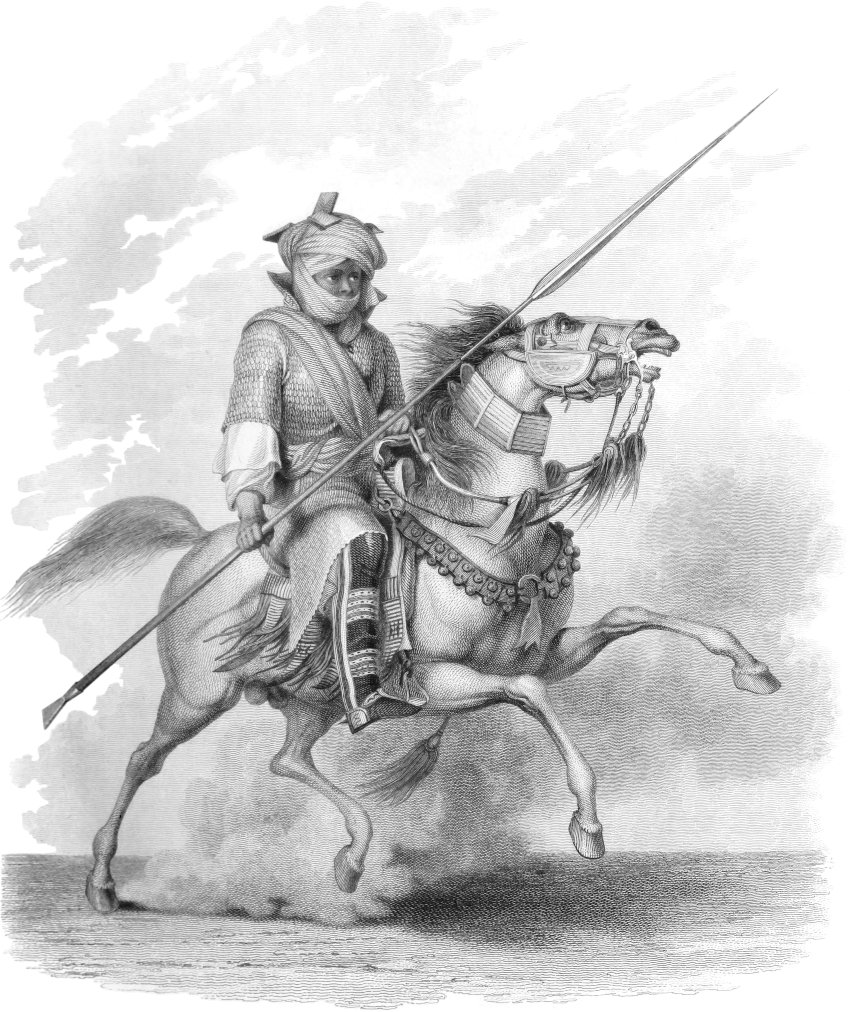
The sheikh’s negroes, as they were called, meaning the black chiefs and favourites, all raised to that rank by some deed of bravery, were habited in coats of mail composed of iron chain, which covered them from the throat to the knees, dividing behind, and coming on each side of the horse: some of them had helmets, or rather skullcaps, of the same metal, with chin-pieces, all sufficiently strong to ward off the shock of a spear. Their horses’ heads were also defended by plates of iron, brass, and silver, just leaving sufficient room for the eyes of the animal.
At length, on arriving at the gate of the town, ourselves, Boo-Khaloom, and about a dozen of his followers, were alone allowed to enter the gates; and we proceeded along a wide street completely lined with spearmen on foot, with cavalry in front of them, to the door of the sheikh’s residence. Here the horsemen were formed up three deep, and we came to a stand: some of the chief attendants came out, and after a great many “Barca’s! Barca’s!” retired, when others performed the same ceremony. We were now again left sitting on our horses in the sun: Boo-Khaloom began to lose all patience, and swore by the bashaw’s head, that he would return to the tents if he was not immediately admitted: he got, however, no satisfaction but a motion of the hand from one of the chiefs, meaning “wait patiently;” and I whispered to him the necessity of obeying as we were hemmed in on all sides, and to retire without permission would have been as difficult as to advance. Barca Gana now appeared, and made a sign that Boo-Khaloom should dismount: we were about to follow his example, when an intimation that Boo-Khaloom was alone to be admitted again fixed us to our saddles. Another half hour at least passed without any news from the interior of the building; when the gates opened, and the four Englishmen only were called for, and we advanced to the skiffa (entrance). Here we were stopped most unceremoniously by the black guards in waiting, and were allowed, one by one only, to ascend a staircase; at the top of which we were again brought to a stand by crossed spears, and the open flat hand of a negro laid upon our breast. Boo-Khaloom came from the inner chamber, and asked “If we were prepared to salute the sheikh as we did the bashaw?” We replied “Certainly:” which was merely an inclination of the head, and laying the right hand on the heart. He advised our laying our hands also on our heads, but we replied, “the thing was impossible! we had but one manner of salutation for any body, except our own sovereign.”
From a Sketch by Major Denham. Engraved by E. Finden. BODY GUARD OF THE SHEIKH OF BORNOU. Published Feb. 1826, by John Murray, London.
Another parley now took place, but in a minute or two he returned, and we were ushered into the presence of this Sheikh of Spears. We found him in a small dark room, sitting on a carpet, plainly dressed in a blue tobe of Soudan and a shawl turban. Two negroes were on each side of him, armed with pistols, and on his carpet lay a brace of these instruments. Fire-arms were hanging in different parts of the room, presents from the bashaw and Mustapha L’Achmar, the sultan of Fezzan, which are here considered as invaluable. His personal appearance was prepossessing, apparently not more than forty-five or forty-six, with an expressive countenance, and a benevolent smile. We delivered our letter from the bashaw; and after he had read it, he inquired “what was our object in coming?” We answered, “to see the country merely, and to give an account of its inhabitants, produce, and appearance; as our sultan was desirous of knowing every part of the globe.” His reply was, “that we were welcome! and whatever he could show us would give him pleasure: that he had ordered huts to be built for us in the town; and that we might then go, accompanied by one of his people, to see them; and that when we were recovered from the fatigue of our long journey, he would be happy to see us.” With this we took our leave.
Our huts were little round mud buildings, placed within a wall, at no great distance from the residence of the sheikh: the inclosure was quadrangular, and had several divisions formed by partitions of straw mats, where nests of huts were built, and occupied by the stranger merchants who accompanied the kafila: one of these divisions was assigned to us, and we crept into the shade of our earthy dwellings, not a little fatigued with our entré and presentation.
FOOTNOTES: