Chapter VII · JOURNEY TO THE EASTERN SHORES OF THE LAKE TCHAD. (continued 2)
Reading edition
On the 2d of October we left Aghadem, and by the help of a blessed moon we were enabled to travel until near midnight, without losing our way. A very sharp storm of wind from the east obliged us to halt; and we had scarcely time to shelter ourselves with the skins and boxes, before it came on with most disagreeable force: this detained us until daylight, when we rose from between the hillocks of sand that had formed on each side of us in the night.
We had the satisfaction throughout our journey to find, that, young as we were at desert travelling, yet we got on as well, if not better, than our companions; and though children of the soil, they always looked to us, instead of us to them, both for safety and protection, as well as for the direction of the route. It was noon on Thursday the 7th, when we made Zow, an oasis situated under some high black sandstone hills, where there is good water and ahgul in abundance for the camels, who had scarcely broken their fast since leaving Dibla. Zow is most appropriately named “difficult,” from the road which leads to it—a frightful sandy waste of moveable sand hills, exceeding fifty miles. Some little girls, and children of the kafila, panting with thirst, augmented by fever and illness, were scarcely able to creep along the deep sand: the whip shaken over the head urged them on—for in justice it must be said, the Arabs use it but rarely in any other way—and not to urge them on would be still more cruel, for the resolution and courage of these poor things would never carry them through; they would lie down, and if sleep once overcame them, so as to be left behind, death would be inevitable.
Oct. 11.—We arrived at Bilma. Without the supply of dates, which are procured here, kafilas would often suffer extreme hunger, so scarce are provisions, and so difficult is the transport: all followers from hence agree to have one meal per day of dates, and one of flour and fat; while, previous to arriving at Bilma, they are obliged to have two of flour and fat. Slaves of poor merchants will for twenty days together be fed by a handful of dates, night and morning, and they generally thrive well on this nourishing food.
Oct. 15.—We laid in a stock of dates for the next fourteen days, and man and beast were nearly subsisted upon them: a camel-load is worth from four to five dollars; they will, however, take camels’ flesh eagerly instead of money, or Soudan goods at one hundred per cent. profit. Our tents were surrounded by daylight with women and men; the former to sell us their commodities, and the latter to look on.
Oct. 17.—We had another day of rest, and were pretty tranquil. The women came in throngs to our tents, and were willing to sell us corn and dates, for either dollars or Soudan tobes, at one hundred and fifty per cent. profit: two lean goats they asked me four dollars for; and for a sheep, six. A great deal of bustle was made about the settlement of the dispute with the Mesurata Arabs, and the Tibboo: “The Book” was to be referred to, but Hadge Mohammed Abedeen, the brother of the kadi at Mourzuk, would not open the leaves until the relations of the deceased swore to rest satisfied with his decision. This preliminary being arranged on Monday morning, the parties all assembled: the kadi, Hadge Ben Hamet, and Ben Taleb, the chief merchants of our kafila, were present: they found, by the Koran, that if any man lifts his hand higher than his shoulder, in a menacing attitude, though he should not be armed, the adversary is not to wait the falling of the blow, but may strike even to death. The law was, of course, in favour of the Arab, as he proved the Tibboo’s having his hand, armed with a spear, raised above his head, when he shot him dead. On this being declared, the Arabs ran about, throwing their guns over their heads, shouting and, what we should call crowing, to such a degree, that I fully expected the Tibboos would be aggravated to renew hostilities.
Oct. 25.—From hence we were to proceed by a different route to that by which we went to Bornou: crossing, therefore, another part of the range, we moved until night, and halted in what appeared to us a beautiful oasis, under a ridge of dark sand hills. This spot of dingy fertility extended several miles to the west, and afforded us water, grass, and wood, for that and the two following days, which were to be passed in deserts. A few miserable inhabitants had fixed themselves here, for the sake of a small crop of dates, yielded by a few palms: they were all anxious to exchange the produce of their valley for a blue or a white shirt of the coarsest kind,—a luxury they were the more in want of from possessing no other clothing. This is by far the best road; soft sand gravel, instead of rough broken stones; and the kafilas prefer it on account of the wells. The oasis is called Seggedem. From hence, eight days’ distance, is a Tibboo town, and by this road kafilas sometimes pass to Ghraat.
Oct. 26.—We left Seggedem after a blowing night, which either overset the tents, or buried them several feet in the sand. Towards evening we rested, and starting again at daylight, made the wells of Izhya by noon next day.
From El Wahr to Meshroo are three very fatiguing days without water, or a single vestige of verdure. We were not able to reach the well, and halted short of the Beeban el Meshroo, the pass leading to the well, nearly four miles. On Sunday, the 8th of November, we arrived at the well,—watered our weary camels, and our more weary men, and again pursued our route until night, when we pitched westward of the well of Omhah; and after one more dreary day, at night (Nov. 9th) we slept under the palm trees which surround Tegerhy, the most miserable inhabited spot in Fezzan, nay, in the world, I might almost say, and yet we hailed it with inexpressible joy, after the pitiless deserts we had passed.
The fatigue and difficulty of a journey to Bornou is not to be compared with a return to Fezzan: the nine days from Izhya to Tegerhy, without either forage or wood, is distressing beyond description, to both camels and men, at the end of such a journey as this. The camels, already worn out by the heavy sand-hills, have the stony desert to pass; the sharp points bruise their feet, and they totter, and fall under their heavy loads: the people, too, suffer severely from the scanty portion of provisions, mostly dates, that can be brought on by these tired animals,—and altogether it is nine days of great distress and difficulty. There is something about El Wahr surpassing dreariness itself: the rocks are dark sandstone, of the most gloomy and barren appearance; the wind whistles through the narrow fissures, which disdain to afford nourishment even to a single blade of wild grass; and as the traveller creeps under the lowering crags, to take shelter for the night, stumbling at each step over the skeleton of some starved human being, and searching for level spots on the hard rock, on which to lay his wearied body, he may fancy himself wandering in the wilds of desolation and despair.
On the day of our making El Wahr, and the two following days, camels in numbers dropped and died, or were quickly killed, and the meat brought on by the hungry slaves. Kafilas are obliged to rely on the chance of Tibboos and Arabs from Mourzuk hearing of their having passed the desert, and bringing them supplies; should these fail, many poor creatures must fall a sacrifice for the salvation of the rest. These bringers of supplies usually sell their dates and corn to eager buyers, at about four times the price they could obtain for them in Fezzan; besides which, the merchants gladly hire their unburthened camels to quicken their passage to a better country.
A Tibboo trader, who was returning to his own country from Fezzan, gave me a gratifying proof of the confidence he was willing to place in the word of an Englishman. It was nearly night, and I was in front of the camels: he had dates to sell, and mine were expended, but I told him that my money was in my trunk, and that my camels were too tired for me to unload them: “God bless you!” said he, “why, I wish you would buy all I have, camels and all: I know who the English are! Are they not almost Mislem, and people of one word? Measure the dates, and go on:—pay the kaid at Mourzuk.”
We here voraciously bought up a few bad onions, to give a little flavour to our insipid meal of flour and water; and soon after, the kaid brought me a sheep, the only one in the town, which we cut up and divided, so that we had a sumptuous meal about nine o’clock in the evening.
On Sunday the 14th of November, by easy journeys we reached Gatrone, which, before so miserable in our eyes, now really seemed a little Paradise; and the food which the old hadge who governs there sent us, of the same kind we before thought so unpalatable on our outward voyage, now seemed delicious. I literally got up at daylight to feast on a mess of hot broth and fresh bread, most highly peppered, and made as good a meal as ever I did in my life.
At Gatrone, as well as at Tegerhy, our tents were pitched in a palm grove, the trees shading us during the day from the sun-beams, and at night from the easterly winds: the gentle moaning of the breeze through its slowly-waving branches was to us a most pleasing novelty; and the noble, nutritious, and productive palm, seemed in our eyes fully to merit the beautiful lines of Abulfeda:
“The stately date, whose pliant head, crowned with pendent clusters, languidly reclines like that of a beautiful woman overcome with sleep.”—Abulfeda Descr. Egypt, a Michaelis, p. 6.
To do them justice, the Fezzan people seemed as glad we were come back, as we were ourselves. “To go and come back from the black country! Oh, wonderful!—you English have large hearts!—God bless you!—the poor doctor to die too, so far from home!—Health to your head! it was written he was to die, and you to come back.—God is great!—and the young Rais Ali too! (Mr. Toole)—Ah! that was written also:—but he was a nice man—so sweet spoken. Now you are going home: well, good fortune attend you! How all your friends will come out to meet you with fine clothes—and how much gunpowder they will fire away!”
At the mosque of Sidi Bouchier the usual prayer was offered for our safe arrival in our own country; and on the 21st of November, Sunday, we made our entry into Mourzuk, and took possession of our old habitation.
Nov. 21.—All welcomed our return: we had bowls of bazeen and kouskosou night and morning, and visitors from daylight until long after sunset, notwithstanding we had no tea, coffee, or sugar, to regale them with, as on our former residence amongst them. The new sultan, Sidi Hassein, who succeeded Mustapha, had only arrived the day before us; and as he had entered in mourning on account of the death of the bashaw’s wife, the Lilla Gibellia[60], no rejoicings were allowed on the occasion: he however sent us two fat sheep, a large pot of olives, and two sacks of wheat; we had therefore a little rejoicing of our own. The two Lizaris, Mohammed and Yusuf, Captain Lyon’s friends, were amongst the foremost to pay us attention, as well as old Hadge Mahmoud, who exclaimed continually, “Thank God, you are come back!—who would have thought it!—how great and good God is, to protect such kaffirs as you are! Well! well! notwithstanding all this, I love you all, though I believe it is haram (sin).”
Though many degrees nearer our own fair and blue-eyed beauties in complexion, when moderately cleansed and washed, yet no people ever lost more by comparison than did the white ladies of Mourzuk, with the black ones of Bornou and Soudan. That the latter were “black, devilish black,” there is no denying; but their beautiful forms, expressive eyes, pearly teeth, and excessive cleanliness, rendered them far more pleasing than the dirty half-casts we were now amongst. A single blue wrapper (though scarcely covering) gave full liberty to their straight and well-grown limbs, not a little strengthened, perhaps, by four or five daily immersions in cold water; while the ladies of Mourzuk, wrapped in a woollen blanket, with an under one of the same texture, seldom changed night or day, until it drops off, or that they may be washed for their wedding; hair clotted, and besmeared with sand, brown powder of cloves, and other drugs, in order to give them the popular smell; their silver ear-rings, and coral ornaments, all blackened by the perspiration flowing from their anointed locks, are really such a bundle of filth, that it is not without alarm that you see them approach towards you, or disturb their garments in your apartments.
The bashaw was said to have had an engagement with the Arabs, who were in rebellion against him, and to have defeated them; after which they had fled all to the Gibel, which had been long the rendezvous of the disaffected; we therefore determined on our immediate departure, after having sold the six remaining camels, out of twenty-four, which I had brought with me from Kouka, for twenty-one dollars—sore backed miserables that they were! The Maherhies, though handsomer and more fleet, do not bear fatigue like the Salamy or Tripoli camels.
On the 12th of December we were ready for our departure, and on the 13th we took our leave, the sultan having given us an order, or teskera, on all the towns of Fezzan, for every thing we might stand in need of. The cold of Mourzuk had pinched us all terribly; and notwithstanding we used an additional blanket, both day and night, one of us had colds, and swelled necks, another ague, and a third, pains in the limbs—all, I believe, principally from the chillness of the air; yet the thermometer, at sunrise, was not lower than 42° and 43°.
On the 18th we reached Sebha, and found our old friend, sheikh Abdallah-ben-Shibel, whose hospitality we had before experienced; with abundance of kouskousou and meat, with highly peppered broth, prepared for us. The daughter of my friend Abdallah, who was now married, and a mother, and to whom I had two years before given a very simple medicine but once, which she was convinced had cured her of the jaundice, sent me two very pretty straw fans for the flies; they were made of the date leaf, in diamonds, coloured red, black, and yellow; the red is produced by foor, or madder root; the yellow with dried onion leaves, steeped in water; and the black by nil, or indigo.
At Sebha, Timinhint, and Zeghren, we were fed with the best produce of their cuisine. Omul Hena, by whom I was so much smitten on my first visit to this place, was now, after a disappointment by the death of her betrothed, with whom she had read the fatah just before my last visit, only a wife of three days old. The best dish, however, out of twenty which the town furnished, came from her; it was brought separately, inclosed in a new basket of date leaves, which I was desired to keep; and her old slave who brought it inquired, “Whether I did not mean to go to her father’s house, and salaam, salute, her mother?” I replied, “Certainly;” and just after dark the same slave came to accompany me. We found the old lady sitting over a handful of fire, with eyes still more sore, and person still more neglected, than when I last saw her. She however hugged me most cordially, for there was nobody present but ourselves: the fire was blown up, and a bright flame produced, over which we sat down, while she kept saying, or rather singing, “Ash harlek? Ash ya barick-che fennick?”—“How are you? How do you find yourself? How is it with you?” in the patois of the country, first saying something in Ertana, which I did not understand, to the old slave; and I was just regretting that I should go away without seeing Omul-hena, while a sort of smile rested on the pallid features of my hostess, when in rushed the subject of our conversation. I scarcely knew her at first, by the dim light of the palm wood fire; she however threw off her mantle, and, kissing my shoulder (an Arab mode of salutation), shook my hand, while large tears rolled down her fine features. She said “she was determined to see me, although her father had refused.” The mother, it seems, had determined on gratifying her.
Omul-hena was now seventeen: she was handsomer than any thing I had seen in Fezzan, and had on all her wedding ornaments: indeed, I should have been a good deal agitated at her apparent great regard, had she not almost instantly exclaimed, “Well! you must make haste; give me what you have brought me! You know I am a woman now, and you must give me something a great deal richer than you did before: besides, I am Sidi Gunana’s son’s wife, who is a great man; and when he asks me what the Christian gave me, let me be able to show him something very handsome.” “What!” said I, “does Sidi Gunana know then of your coming?” “To be sure,” said Omul-hena, “and sent me: his father is a Maraboot, and told him you English were people with great hearts and plenty of money, so I might come.” “Well, then,” said I, “if that is the case, you can be in no hurry.” She did not think so; and my little present was no sooner given, than she hurried away, saying she would return directly, but not keeping her word. Well done, simplicity! thought I: well done unsophisticated nature! no town-bred coquette could have played her part better.
After a day’s halt, on the 22d we moved to Omhul Abeed, distant only a few miles, where water and wood are collected for the desert between that place and Sockna, which usually, at this season, when the days are short and nights cold, occupies five or six days.
Dec. 25.—On our fourth Christmas day in Africa, we came in the evening to Temesheen, where, after the rains, a slight sprinkling of wormwood, and a few other wild plants were to be seen, known only to the Arabs, and which is all the produce that the most refreshing showers can draw from this unproductive soil. We had here determined on having our Christmas dinner, and we slaughtered a sheep we had brought with us, for the purpose; but night came on, before we could get up the tents, with a bleak north-wester; and as the day had been a long and fatiguing one, our people were too tired to kill and prepare the feast. My companions, however, were both something better: Hillman had had no ague for two days; and we assembled in my tent, shut up the door, and with, I trust, grateful and hopeful hearts, toasted in brandy punch our dear friends at home, who we consoled ourselves with the idea, were, comparatively, almost within hail.
The next day, before we had loaded our camels, a pelting rain came on, with a beating cold wind from the north-west, which pinched us severely; however, we started; but scarcely had we entered the wadey, at the approach to which we had passed the night, than the slaves kindled fires under the trees, round which, indeed, we all took shelter: they, however, poor creatures, complained bitterly; and as the camels had not eaten any thing for three days previous, we determined on suffering them to enjoy such pasturage as the wadey afforded, while we slaughtered our sheep, and kept the feast.
Every thing was so cold and damp, that the poor slaves, who accompanied our kafila, half-clothed as they were, crowded round the fires in preference to sleeping: they were, however, always gay and lively on the march, when the warm sun and exercise had given a little circulation to their blood; the Arabs, to do them justice, fed them to their hearts’ content, and, even to this, we usually added something.
Arrived at Sockna, I was lodged in the house of Hadge Mohammed Boofarce, a place with four whitewashed walls and date beams; but by the help of a brass pan, and a hole in the ground, I managed to keep a pretty good fire, without much smoke. I had neither host nor hostess. The house was in the charge of one Begharmi slave, who had been twenty-four years in bondage: he was pleased greatly when he found that I had been near his home, and the names of some of the towns made him clap his hands with pleasure; but when I asked him whether he should like to return, he had sense enough to answer, “No! no! I am better where I am. I have no home now but this; and what will my master’s children do without me? He is dead; and his son is dead: and who will take care of the garden for his wives and daughters, if Moussa goes?—No! he is a slave still, and so much the better for him; his country is far off, and full of enemies. Here he has a house, and plenty to eat, thank God! and two months ago they gave him a wife, and kept his wedding for eight days.” The siriah of a Sockna merchant, who had gone to Soudan, leaving her pregnant, had, by becoming a mother, gained her freedom, and taking Moussa for a husband, they were put in charge of his mistress’s unoccupied house for a residence.
Jan. 5.—We left Sockna, passed El Hammam on the 6th, slept in Wadey Orfilly, and on the morning after, Mr. Clapperton and myself separated, as I wished to return by Ghirza, while he was rather desirous of keeping the old road by Bonjem. A continuation of wadeys furnished us at this time of the year with food for camels and horses; and, close under low hills of magnesian limestone, at Jernaam, we filled our water-skins for five days’ march.
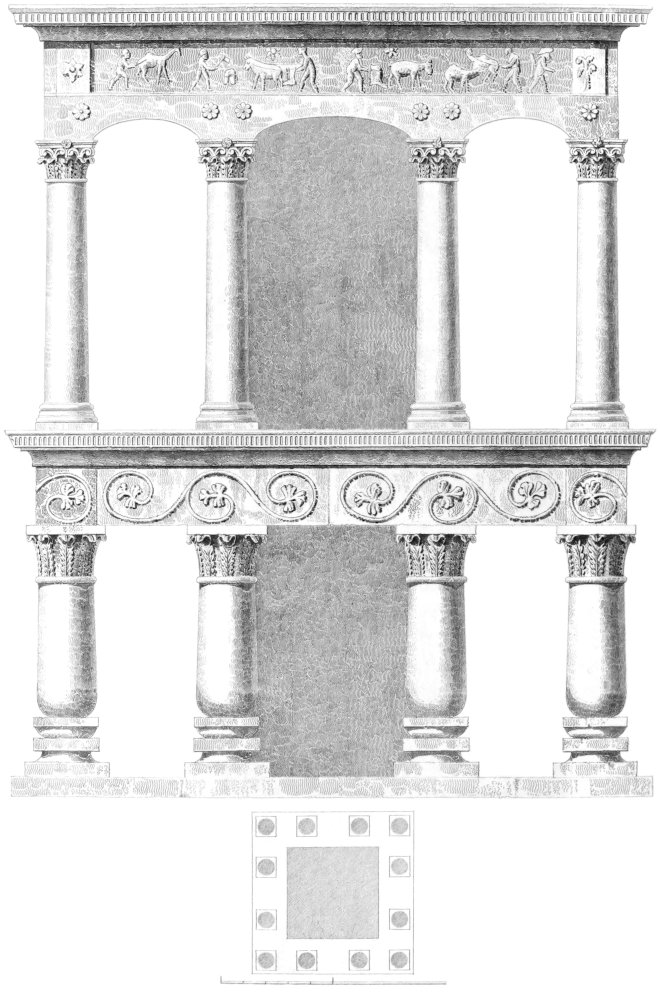
From a Sketch by Major Denham. Engraved by E. Finden. GHIRZA. SOUTH FACE OF BUILDING. No. 1. Published Feb. 1826, by John Murray, London.
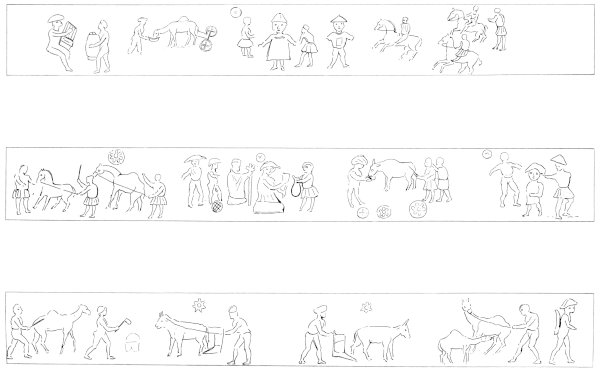
From a Sketch by Major Denham. Etched by E. Finden. GHIRZA. FRIEZE ON THE WEST, EAST, & SOUTH FACES OF THE BUILDING. No. 1. (Large-size) Published Feb. 1826, by John Murray, London.
Jan. 11.—A cold morning, with the thermometer at 42°, delayed us till nine o’clock before we could make a start. We passed two wadeys before coming to that where we were to halt: near one of these, called Gidud, were heaps of stones, denoting the resting-place of two Arabs, who had died in a skirmish, about two months before, and some characters, which to me were hieroglyphics, were marked out distinctly in the gravel near their graves; and upon inquiry, I found they told the tale of death, and the tribes to which they belonged. At sunset we halted at Bidud.
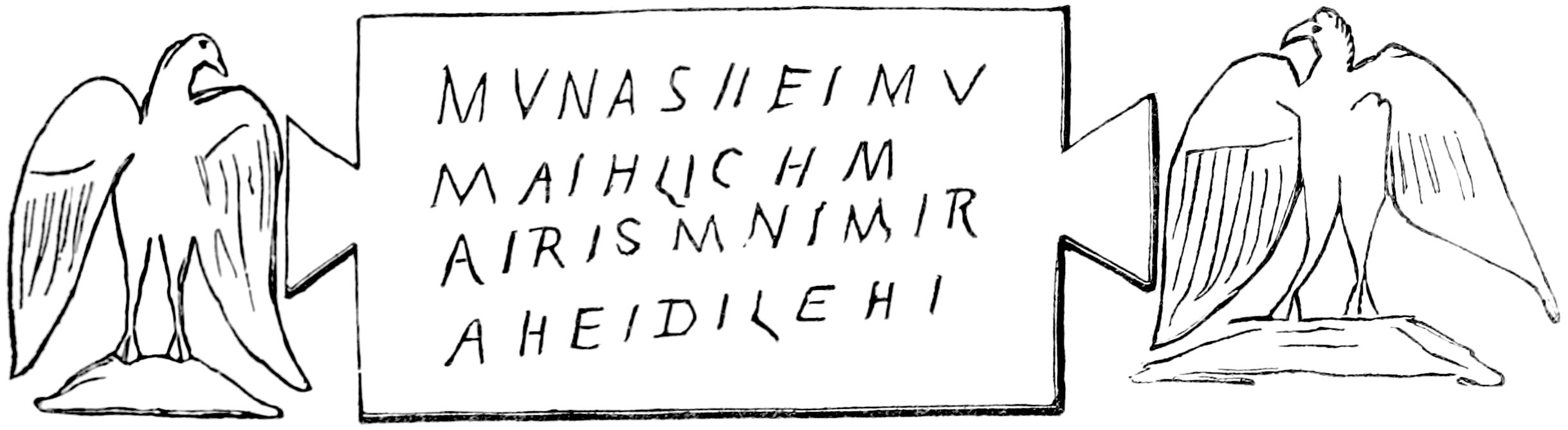
Nothing particular, till our arrival at Ghirza on the 13th. We found here the remains of some buildings, said to be Roman, situated about three miles west-south-west of the well, and which appeared to me extremely interesting: there must have been several towns, or probably one large city, which extended over some miles of country, and the remains of four large buildings, which appear to have been monuments or mausoleums, though two of them are nearly razed to the earth. Those which I thought interesting and capable of representation, I sketched: the architecture was rude, though various: capitals, shafts, cornices, and entablatures, lay scattered about; some of curious, if not admirable, workmanship.
No. 1.

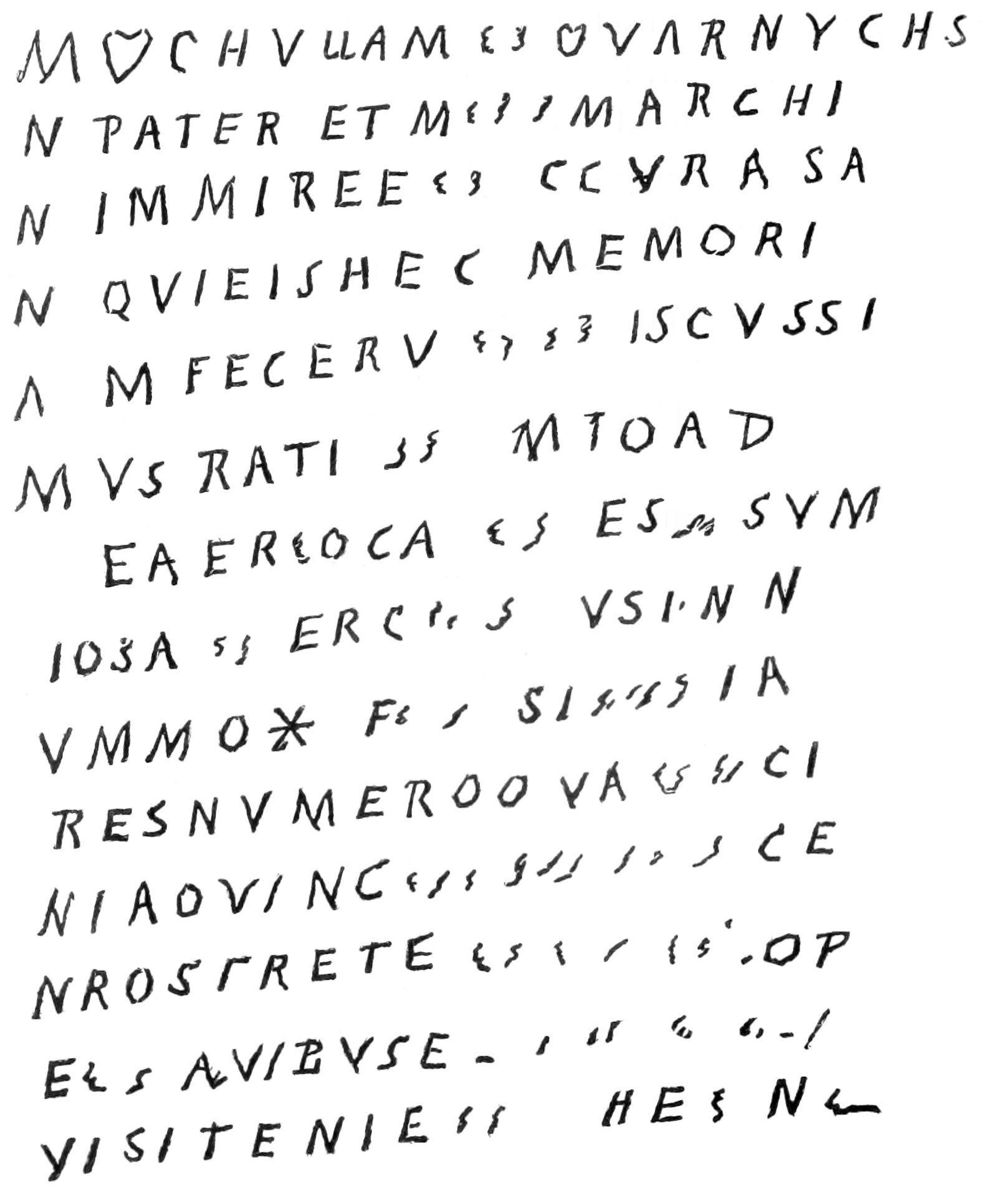
No. 2.

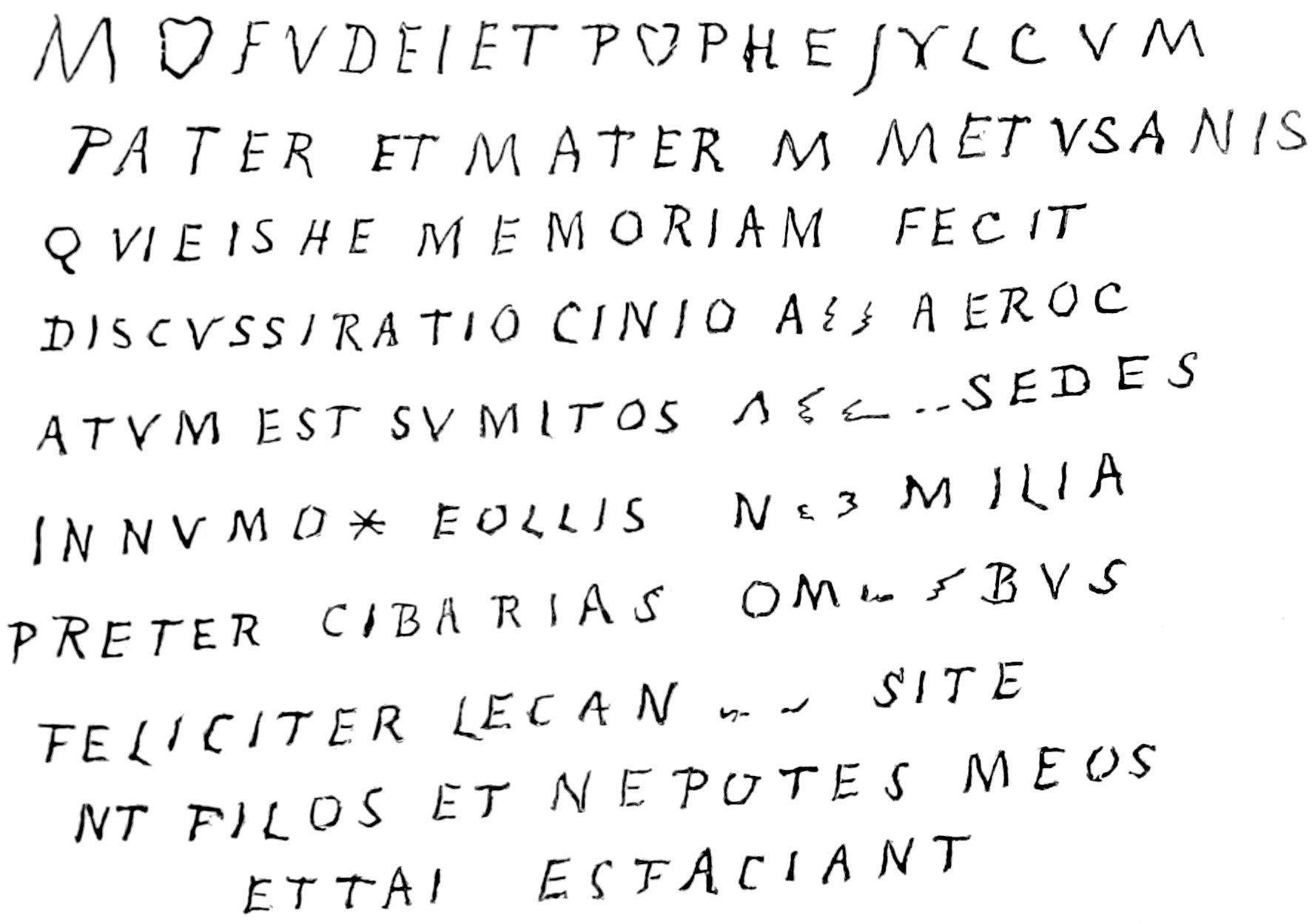
No. 3.
No. 4.
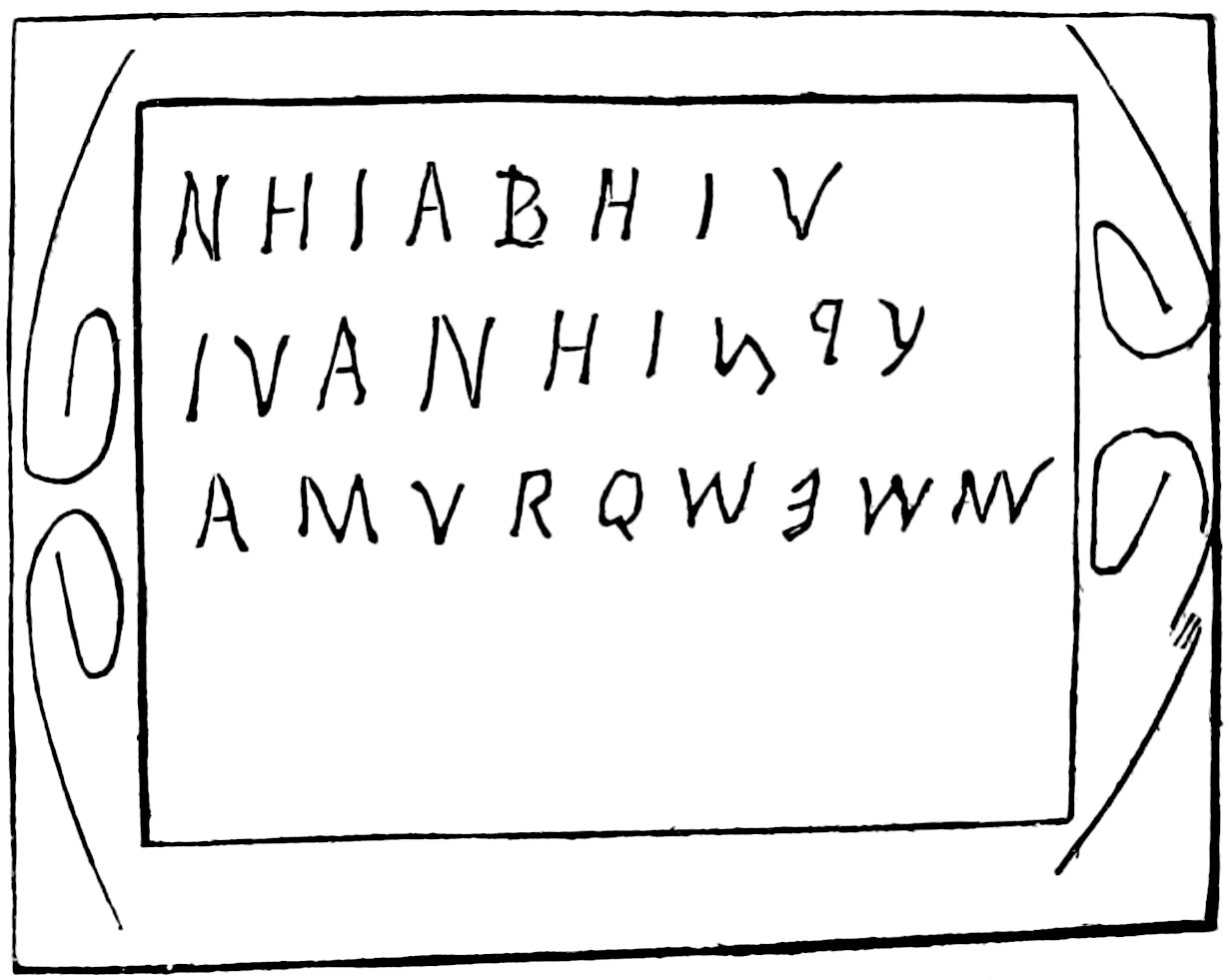
The inscription[61], No. 1, was on a tablet fixed on the east face of the building, of which the elevation gives the south side. The entrance to all the buildings was from the east, and by fourteen steps to the base of the upper range of pillars, now totally destroyed. The other inscriptions were found on the loose fragments which lay scattered around.
Jan. 17.—Moved along Shidaf, a beautiful wadey, extending ten miles between limestone rocky hills, through which we passed. After this we came to Hanafs, and halted fifteen miles to the east, where we found some other ruins, of a character similar to those of Ghirza: two inscriptions were perceivable, but perfectly unintelligible, and obscured by time.
On the 20th we once more saw Benioleed, and on the 24th, passed Melghra, and the plain of Tinsowa. Melghra was the place where we had taken leave of Mr. Carstensen, the late Danish consul-general at Tripoli, and many of our friends, who accompanied us thus far on our departure for the interior; and our return to the same spot was attended by the most pleasing recollections. Our friend, the English consul, we also expected would have given us the meeting, as he had despatched an Arab, who had encountered us the night before, with the information that he was about to leave Tripoli a second time to welcome our arrival.
On the day after, we reached a well, within ten miles of Tripoli; and previous to arriving there, were met by two chaoushes of the bashaw, with one of the consul’s servants: we found the consul’s tents, but he had been obliged to return on business to the city; and the satisfaction with which we devoured some anchovy toasts, and washed them down with huge draughts of Marsala wine, in glass tumblers—luxuries we had so long indeed been strangers to—was quite indescribable. We slept soundly after our feast, and on the 26th of January, a few miles from our resting-place, were met by the consul and his eldest son, whose satisfaction at our safe return seemed equal to our own. We entered Tripoli the same day, where a house had been provided for us. The consul sent out sheep, bread, and fruit, to treat all our fellow-travellers; and cooking, and eating, and singing, and feasting, were kept up by both slaves and Arabs, until morning revealed to their happy eyes, and well filled bellies, the “roseate east,” as a poet would say.
We had now no other duties to perform, except the providing for our embarkation, with all our live animals, birds, and other specimens of natural history, and settling with our faithful native attendants, some of whom had left Tripoli with us, and returned in our service: they had strong claims on our liberality, and had served us with astonishing fidelity in many situations of great peril; and if either here or in any foregoing part of this journal it may be thought that I have spoken too favourably of the natives we were thrown amongst, I can only answer, that I have described them as I found them, hospitable, kind-hearted, honest, and liberal: to the latest hour of my life I shall remember them with affectionate regard; and many are the untutored children of nature in central Africa, who possess feelings and principles that would do honour to the most civilized Christian. A determination to be pleased, if possible, is the wisest preparatory resolution that a traveller can make on quitting his native shores, and the closer he adheres to it the better: few are the situations from which some consolation cannot be derived with this determination; and savage, indeed, must be that race of human beings from whom amusement, if not interesting information, cannot be collected.
Our long absence from civilized society appeared to have an effect on our manner of speaking, of which, though we were unconscious ourselves, occasioned the remarks of our friends: even in common conversation, our tone was so loud as almost to alarm those we addressed; and it was some weeks before we could moderate our voices so as to bring them in harmony with the confined space in which we were now exercising them.
Having made arrangements with the Captain of an Imperial brig, which we found in the harbour of Tripoli, to convey us to Leghorn, I applied, through the consul-general, to the bashaw for his seal to the freedom of a Mandara boy, whose liberation from slavery I had paid for some months before: the only legal way in which a Christian can give freedom to a slave in a Mohammedan country. The bashaw immediately complied with my request[62]; and, on Colonel Warrington’s suggesting that the boy was anxious to accompany me to England, he replied, with great good humour, “Let him go, then; the English can do no wrong.” Indeed, on every occasion, this prince endeavoured to convince us how rejoiced he was at our success and safe return. He desired Colonel Warrington to give him a fête, which request our hospitable and liberal consul complied with, to the great satisfaction of the bashaw. The streets, leading from the castle to the consulate, were illuminated, and arched over with the branches of orange and lemon trees, thick with fruit. The bashaw arrived at nine in the evening, accompanied by the whole of his court in their splendid full dresses, and, seated on a sort of throne, erected for him, under a canopy, gazed on the quadrilles and waltzes, danced by the families of the European consuls, who were invited to meet him, with the greatest pleasure. He took the English and the Spanish consul-generals’ wives into the supper-room, with great affability: and calling Captain Clapperton and myself towards him, assured us he welcomed our return as heartily as our own king and master in England could do. No act of the bashaw’s could show greater confidence in the English, or more publicly demonstrate his regard and friendship, than a visit of this nature.
Very shortly after this fête we embarked for Leghorn, and after experiencing heavy and successive gales, from the north-west, which obliged us to put into Elba, we arrived in twenty-eight days. Our quarantine, though twenty-five days, quickly passed over. The miseries of the Lazaretto were sadly complained of by our imprisoned brethren; but the luxury of a house over our heads, refreshing Tuscan breezes, and what appeared to us the perfect cookery of the little taverna, attached to the Lazaretto, not to mention the bed, out of which for two days we could scarcely persuade ourselves to stir, made the time pass quickly and happily. On the 1st of May we arrived at Florence, where we received the kindest attention and assistance from Lord Burghersh. Our animals and baggage we had sent home by sea, from Leghorn, in charge of William Hillman, our only surviving companion. Captain Clapperton and myself crossed the Alps, and on the 1st of June following, we reported our arrival in England to Earl Bathurst, under whose auspices the mission had been sent out.
FOOTNOTES: