Chapter III · EXPEDITION TO MANDARA. (continued 2)
Reading edition
Of the extent of this chain, or rather these groups of mountains, I can form no idea, except from the information of the Mandara people. I have met with a man who (by the way) wanted to persuade me that he was a son of Hornemann by his slave, although, from his appearance, he must have been born ten years before that unfortunate traveller entered this country. He said he had been twenty days south of Mandara, to a country called Adamowa, which he described as being situated in the centre of a plain surrounded by mountains ten times higher than any we could see; that he went first to Mona or Monana, which was five days, and then to Bogo, which was seven more; and here, for one Soudan tobe, the sultan gave him four slaves. After eight days’ travelling from this latter country, he arrived at Adamowa. These people, he says (that is, the Kerdies on the hills; for Adamowa itself is occupied by Felatahs), eat the flesh of horses, mules, and asses, or of any wild animal that they kill: nobody but the sultans and their children are clothed; all the rest of the nation go naked; the men sometimes wear a skin round the loins, but the women nothing. This man, who was called Kaid-Moussa-ben-Yusuf (Hornemann’s name), spoke to me of several extensive lakes which he had seen in this journey, and also described with great clearness a river running between two very high ridges of the mountains, which he crossed previous to arriving at Adamowa. This river he declared to run from the west, and to be the same as the Quolla or Quana at Nyffe, Kora, and at Raka, but not the same as the river at Kano, which had nothing to do with the Shary, and which ran into the Tchad; but the main body of the water ran on to the south of Begharmi, was then called the D’Ago, and went eastward to the Nile. Kaid-Moussa was a very intelligent fellow, had visited Nyffe, Raka, Waday, and Darfur; by which latter place also, he said this river passed. He was most particularly clear in all his accounts, and his statement agreed in some points with the information a Shouaa named Dreess-boo-Raas-ben-aboo-Deleel had given me; therefore I was the more inclined to pay attention to it. To the south of this river, the population is entirely Kerdy, until the Great Desert. This desert is passed several times in the year by kafilas with white people, not Christians, who bring goods from the great sea: some of these reach Adamowa. He himself saw white loaf sugar, such as the merchants brought here from Tripoli to the sheikh, and a gun or two, with metal pots and pans, and arrack (rum). The inhabitants were unanimous in declaring these mountains to extend southward for two months’ journey; and in describing them, Yusuf called them “kou kora, kora, kantaga,”—mountains large, large, moon mountains. And from the increased love of enterprise apparent in our rising generation, we may one day hope to be as well acquainted with the true character of these stupendous mountains as with the lofty peaks of the Andes.
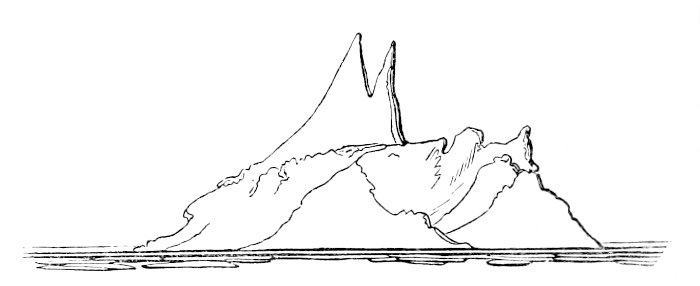
The extreme southern peak which I could discern was that called Mendify, which rose into the air with singular boldness. It was said to be a distance from Musfeia of two long days’ journey,—say thirty-five miles. At that distance, it had all the character of an alpine peak, of a most patriarchal height. I could perceive with a glass other mountains extending from its sides, the forms of which bore a tranquil character, compared with the arid and steep peaks which overlooked them. It resembled very much in appearance “Les Arguilles,” as they appear looking at them from the Mer-de-Glace. The following outline may serve to show their shape and character.
Iron is found in abundance in all the Mandara hills; but no other metal, that I was informed of. All the houses or huts at Mandara have outer doors to the court, which are made of pieces of wood, hasped together with iron. They make hinges, small bars, and a sort of hoe used to weed the corn, and send them for sale to the Bornou towns. The iron they use is mostly brought from the west near Karowa. I went to the house of a blacksmith, for the purpose of seeing some of the metal in its natural state, and found four men with a very rude forge, formed by a hole in the sand: the bellows were two kid skins, with an iron tube fixed in each, which tubes were conveyed underneath the fire. The wind was produced by a man blowing these skins, which were open at the top to let in the air. Their hammers were two pieces of iron, weighing about two pounds each, and a coarse piece of the same metal for an anvil; and considering their implements, they worked with some tact. I regretted much that I had not an English hammer to give them. Large masses of the iron, as nature produces it, were lying about; and they appeared to me as so many rusty earthy masses.
In appearance, the people of Mandara differ from the Bornouese, or Kanoury (as they call themselves); and the difference is all in favour of the former. The men are intelligent and lively, with high though flat foreheads, large sparkling eyes, wiry curled hair, noses inclining to the aquiline, and features altogether less flattened than the Bornouese. The women are proverbial for their good looks,—I cannot say beauty. I must allow them, however, all their acknowledged celebrity of form: they are certainly singularly gifted with the Hottentot protuberance; their hands and feet are delightfully small; and as these are all esteemed qualifications in the eye of a Turk, Mandara slaves will always obtain an advanced price. Certainly I never saw so much of them as when sporting in their native wilds, with not so much covering on as one of Eve’s fig-leaves. A man who took me to be a Moorish merchant led me to his house, in order to show me the best looking slaves in Mandara. He had three, all under sixteen, yet quite women; for these are precocious climes; and certainly, for negresses, they were the most pleasing and perfectly formed I had ever seen. They had simply a piece of blue striped linen round their loins, yet they knew not their nakedness. Many of these beauties are to be seen at Kouka and Angornou: they are never, however, exposed in the fsug, but sold in the houses of the merchants. So much depends on the magnitude of those attractions for which their southern sisters are so celebrated, that I have known a man about to make a purchase of one out of three, regardless of the charms of feature, turn their faces from him, and looking at them behind, just above the hips, as we dress a line of soldiers, make choice of her whose person most projected beyond that of her companions.
The day before the Rhamadan, which commenced on the 13th instant (May), I had an interview with the sheikh, who mentioned his intended departure for Munga; and after some conversation, it was agreed that I should proceed to Old Bornou or Birnie; and after seeing that part of the country, the ruins of the town of Gambarou, and the river of that name, which is said to come from Soudan; that I should follow its course, and join him at a place called Kabshary on the same river, to which he was about to proceed by a different route. The whole population was in confusion at the departure of this ghrazzie, and nearly all the people of Kouka, with the exception of the kadi, were to accompany the sheikh. Previously, however, to his departure, he had determined on sending off a courier to Tripoli, with an account of Boo Khaloom’s death, and we availed ourselves of the opportunity by writing to England. On the 17th of May the courier departed; and on the 18th the sheikh began his march, and bivouacked at Dowergoo.
FOOTNOTES: