Volume 1 — VIII. (continued 2)
Reading edition
The last portion of the ascent is so steep, and so difficult, that all superfluous baggage was left behind, and we took with us only what was absolutely indispensable. Thus far we had seen occasional traces of elephants, sometimes so fresh, that they could not have been more than an hour old. According to a report of Major Skinner, the unmistakable marks of one of these animals was remarked in the year 1840 quite close to the rock which bears the sacred footprint! At the steepest points, iron ladders have been made fast, by which the visitor has to scramble up. There were, also, innumerable chains fastened to the rock, of every description and variety of link, which swung to and fro by dozens on either hand, some eaten away with age and rust, some forged quite lately, it being considered a meritorious work to provide such as a protection against the occurrence of accidents. By 6 p. m., we at last reached the summit, and were rewarded with a panoramic view of indescribable magnificence. The mists were almost entirely dispersed, and in the clear, calm, evening light, the eye wandered at pleasure over the vast, almost limitless, panorama at our feet, as far as the sea, barely visible in the grey distance. Bounding our view from north-west to east, the mountain ranges rose by three distinct terraces of hills, each behind the other, and in regular gradations, till they culminated in the highest peak on the island, the Pedro-talla-galla, which overtops Adam's peak by nearly 1000 feet,[95] but presents no pre-eminent peak, similar to that on which we now stood. The remainder of the horizon was filled with low mountains, which gradually became more and more flat as they approached the coast. The followers of three religions,—Buddhists, Brahmins, and Mahometans, stand face to face with each other on this space of barely a few steps, in order to bow before these visible emblems, in sincere devotion to the invisible Deity. The highest surface, which is nearly level, is of an irregular oval form, and is about 60 or 70 feet in length, by from 36 to 40 feet in breadth, and is inclosed within a wall 5 feet in height, with two entrances on the west and south, while the north-east corner is shut out by an artificially rounded rock, easily surmounted, however, by any one who ascends it. In the middle of this enclosure stands a block of rock some 10 or 11 feet high, which, on the extreme top, has a depression, the divine Sri-pada, or Holy Footstep. The adoration consists chiefly of offerings of flowers which are brought up hither, and presented with innumerable genuflections, invocations, and exclamations of "Sadoo," which corresponds to the Christian Amen. The impressed foot-print is ascribed by the Buddhists to the last incarnation of Buddha, the gentle hermit Gautama; while it is regarded by the Brahmins as the footstep of Siva, and by the Mahometans as that of Adam, as being the spot on which the progenitor of the human race stood so long, doing penance after his expulsion from Paradise, until the Almighty pardoned him.
This depression, in which only the most unbridled imagination can see any resemblance to the human foot, is about 5 feet in length by 2½ in breadth, and is set, as it were, in a level stratum of mortar, several inches in height, by six in breadth, shaped to resemble the outline of the human foot. At its anterior extremity, it presents a straight line, on which the five toes are artificially formed by several tolerably thick, narrow crevices, filled with mortar, and about 8 or 9 inches in length, which jut inwards, the great toe being on the right or east side, and thus indicating that it is a representation of the left foot. At the heel end the setting of mortar is somewhat narrowed and rounded off. Over the whole affair a wooden temple with balustrades open on all sides, has been erected, which is fastened by iron chains to the rock, and to beams of rhododendron fastened on the N.W. side, outside the wall, to prevent its being swept away by the storms which, on this lofty, exposed peak, occasionally rage with great vehemence. These cables, as also several of the poles by which the temple was supported, were thickly hung with carved figures of Buddha enveloped in linen cloth, which, originally the votive offerings of pilgrims, and bleached by long exposure, fluttered in the breeze. On the front of the temple is erected a penthouse roof, shading a bench beneath, on which several of our porters, who regarded our impious presence, and still more impious admeasurements of the holy footprint, with a horror which they flattered themselves was unobserved, deposited their offerings of flowers, and humbly bent the knee. On the west side, under two small distinct roofs, were two bells, and quite apart, on the rock itself, and somewhat in the background, a smaller temple. Between the block of rock and the inner half of the enclosure, a small house has been erected, 12 feet long by 6 feet broad, which is used as a shelter at night by the priests who are on duty during the pilgrimage season,[96] in which we too took up our quarters. Suddenly, from the depths below there arose, through the unbroken silence of the night, a confused murmur, in which the sounds of human voices were plainly recognizable. The singularity of such a phenomenon produced a certain degree of excitement among our superstitious spectre-dreading followers, inasmuch as it had never happened that strangers undertook the ascent of the peak at night, seeing it gives trouble enough to reach the summit by daylight. By degrees we perceived a number of torches borne by natives, who, with loud and long-continued cheers, set about slowly ascending the ladders. To the inquiries of our followers they made no reply; and we had, in a word, to wait a considerable interval, until, indeed, the leading torch-bearer had reached the summit, ere we were enlightened as to the object of this mysterious nocturnal visit. How great, and let us add, agreeable was our surprise at finding ourselves suddenly surrounded by a choice array of wines, with food of various sorts, which the overflowing hospitality of Mr. Mooyart had dispatched after us to the summit of Adam's Peak, together with his card, the whole being conveyed in huge baskets by the supposed spectres! A cheerful fire speedily blazed up, at which our tea and provisions were cooked, and, as may well be supposed, while, enjoying our delicate fare, we thankfully toasted the kind and thoughtful donor.
Deep silence once more fell on all around, no cry of any wild beast reached us at this elevation, no hum of insect broke upon the awful stillness. Our coolies lay cowering together around the drooping blaze, seeking some shelter against the night air. One division stowed themselves away in a second sleeping-house for priests, which had been run up some twenty paces distant, in which we also were in the end fain to seek shelter from the ever-increasing keenness of the air, the temperature of which fell to 54°.5 Fahr., where, with our wrappers drawn close around us, and stretched at full length on the bare rock, we awaited the approach of morning.
The first faint glimmer of dawn invited us once more to the open air, in order to contemplate the wonderful aspect of Nature at this elevation. We had, after leaving Ratnapoora, taken barometrical and thermometrical observations, with the view of determining the elevation at nine different stations, which had been, wherever practicable, selected in such manner, that by means of them the various limits of certain classes of vegetation were indicated, which in many instances are marked out with extraordinary distinctness upon the perpendicular side of the peak. These series of observations, which were at the same time supplemented by investigations as to the temperature of the soil and of various springs, will be compared with the results of previous scientific visitors to the summit of Adam's Peak, and published in another form. The geology of the isolated pinnacle of Adam's Peak, so far as the dense covering of primeval forests permitted us to observe, is uncommonly simple and uniform. The chief directions of the lofty chain of mountains in Southern Ceylon, separated from each other by level plateau-like depressions, is from S.S.E. to N.N.W., corresponding likewise with the chief directions of the strata of gneiss, of which these mountains are composed. The gneiss is uniformly of a species not often met with, studded with garnets, and between its strata are inserted single beds of hornblende-gneiss and splinters of pure hornblende, as also granulite-gneiss and pure granulite. The steep, final cone of the rock consists of a granulitic gneiss of varying texture from coarse to fine, and abounding in garnets. Everywhere, even up to the highest summit, the gneiss is decomposed on the surface into laterit-like products. The huge blocks of brown ironstone, however, which are found near the summit, in the hollow path by which it is customary to ascend, owe their origin to the decomposition of the hornblende.
After these interesting observations, admeasurements, and investigations, made at the summit of the most remarkable peak in the world, had been brought to a conclusion, we set out on our return to Gilli-Mali, which we reached late at night. Here we found, at the abode of our hospitable entertainer, Mr. Braybrooke, a fresh guest, who likewise intended to ascend Adam's Peak the following day. This was the well-known Count Medem, a Russian gentleman, who has frequently traversed both the old and new worlds, and was now about making a second visit to China.[97] The next day saw us at Ratnapoora, from which point we continued our return journey on the waters of the Kalu-Gunga, or Black River, as far as Caltura.
Our boat consisted of two trunks of trees hollowed out and fastened together, upon which was erected a semicircular tilt, covered with the leaves of the Fan Palm (Borassus Flabelliformis), under which one might sit or lie at pleasure, sheltered from the sun. As the mail-car that runs daily from Colombo to Caltura was already full, we were compelled, in order to pursue our journey to Galle, to make use of the native waggon, or bullock-bandy. This is a two-wheeled cart drawn by oxen, and covered with a semicircular tilt of palm-leaves, beneath which there was room for two persons to lie at full-length packed closely together. The oxen, of a breed that have humps and erect horns, are small, and walk with a quick, short tramp, while their entire bodies are tattooed with Cingalese characters and ornaments. The horns are usually adorned with metal tips, and frequently are dyed, the one red, the other green. The cross-piece of the pole is fastened to the neck instead of the customary yoke, and the cord for guiding the animal passes through the nose. The driver either strides along between the two oxen, or sits with his back to them on the pole. The rate of progression by this national conveyance is so slow, that the mail-car which left Colombo the day after overtook us long ere we reached our destination, and it was with some difficulty we reached Galle in time for the overland steamer which was to bring us to Madras."
PLATE VI.—TRACK FROM POINT DE GALLE TO MADRAS. Larger.
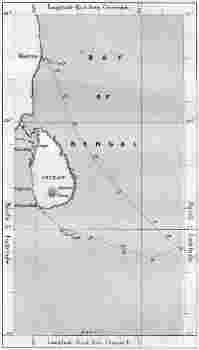
At 6 a. m. of the 16th January, the Novara set sail from the roads of Point de Galle with light breezes off the land, and steered southerly in order to avoid the Basses or Baxos, a much-dreaded rocky shoal, traditionally alleged to be the remains of the island of Giri, swallowed up by the sea, and which, owing to the very strong current, require the utmost care to be observed, in order to avoid drifting right upon them.[98]
The evening before our departure, the Consul for Hamburg had requested from the Commander of the Expedition the favour of a free passage to Madras, on board our frigate, for a native of Berlin, named Neupert. This man had come to Ceylon a long time previously with a company of rope-dancers, and had at first made a good deal of money as an acrobat and juggler, despite the dangerous competition of the Indian practitioners, but had afterwards lost his all, and had been for some weeks in a pitiable plight. The request was at once acceded to, and Neupert came on board during the night. His luggage did not encumber him much. However, although the greatest part of his effects had disappeared in Galle, he fortunately had kept his various apparatus; and, by way of showing his gratitude for the free passage that had been accorded to him, professed his willingness, in the course of the voyage, to give us some specimens of his skill on deck. Accordingly, one fine afternoon, he gave us an entertainment out on the open ocean, which not alone hugely pleased the sturdy tars grouped together on the forecastle, but ultimately, in consequence of a collection set on foot for the unfortunate Berlin acrobat, procured him enough ready money to enable him to pass the first week after his arrival at Madras free from anxiety, besides supplying him with a fresh outfit.
Within a few days after our departure from Galle, several severe cases occurred of hemeralopia, chiefly among members of the ship's band. Every evening, as darkness set in, these men lost all power of distinguishing objects, and had to be led about like blind men. In Vienna, we had been advised by various physicians there, with a view to the confirmation or refutation of the popular belief, to try the use of boiled ox-liver;[99] and, as one of the oxen shipped at Ceylon had been slaughtered, we were in a position to make the desired experiment, which, it must be confessed, proved eminently successful. This time, moreover, several of those thus afflicted were treated with cooked pig's-liver, which was given them to eat, while the steam rising from the dish was applied to their eyes. But we had, on our return voyage, the most convincing proof of the efficacy of the liver of animals of the ox tribe in cases of night-blindness, when above twenty of those afflicted, after frequent relapses during the voyage from Valparaiso to Gibraltar, were treated in the last-named port with ox-liver, and dismissed permanently cured.[100]
The voyage from Ceylon to Madras was, on the whole, monotonous and void of interest, with the exception of one single event, which no one on board is likely to forget for the remainder of his life. About 3.30 p. m. of the 2nd January, 1858, there suddenly resounded from the hold, the astounding cry of "Fire! fire!" Everyone rushed, in the utmost excitement, on deck. It turned out that a by no means insignificant quantity of pure alcohol, which was stowed away in the hold for the preservation of specimens of natural history, had, from some unknown cause, caught fire. Forthwith the pumps were manned, the sails clewed up, all the portholes closed, so as to cut off the slightest draught, and all the hammocks of the crew trundled, pêle-mêle on deck anyhow, out of the quarter-nettings, in which they are stowed away during the day, there to be dipped in sea-water, and in that wringing-wet condition applied, partly in extinguishing the flames, partly in preventing the fire from spreading. In less than a quarter of an hour the worst danger was over, and our wonted quiet restored, despite the first terrible excitement. On a more searching investigation, several of the tin carboys in the hold, filled with spirits of wine, and kept between layers of sand in iron chests, were found to have been corroded till the liquor had oozed through, while the air, having free access to the sand, had become strongly impregnated with gas. This atmosphere, impregnated as it was with alcoholic fumes, took fire on one of the sailors carelessly entering the hold with a badly-fastened lantern, and in a moment the light flames which speedily enveloped the man in such a confined space, at once gave the alarm. The full carboys remained uninjured by the fire. Had such a catastrophe happened, and the whole quantity of spirit (about 40 gallons) taken fire, considering the immense quantities of combustible matter we had on board, among the rest a ton-and-a-half of gunpowder, the upshot must have been of a far less agreeable nature. The extraordinary lightning-like activity displayed by the entire ship's company on this occasion was something wonderful. Each man seemed to have got wings. There was the most laudable emulation displayed by all hands in seeking to save the lives of themselves and others from such a terrible doom.
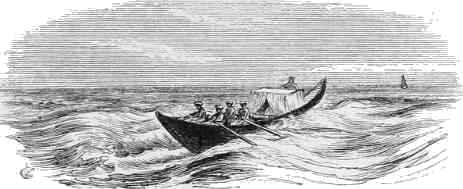
On the 30th January, at 7.30 p. m., we anchored in Madras Roads, so dreaded for their insecurity, about three nautical miles from the shore, and in 9 fathoms (56 feet English). Even in the calmest weather there is a tremendous surf on this coast, and from October to December, in which strong gales blow from the N.E., it is all but unapproachable. For this reason, so soon as the wind increases so as to endanger the ships in the roads, a flag is hoisted on a staff at the Master Attendant's office, that they may put to sea at once. On the second signal, all ships must quit the Roads for fear of being dashed through the surf upon the beach.
From the city we heard a running fire of musketry and some salutes with cannon, which, considering the prevalence of warlike rumours and movements in the then circumstances of India, made us conjecture that the natives of the Coromandel coast were also in insurrection against the English. However, we learned afterwards that the musketry and salvoes proceeded from the troops stationed near the drilling-ground, who were receiving their general on his return from parade with a salute. The following day (Sunday, the 31st January, 1858) the European community of Madras fell into a precisely similar error in consequence of our salute, which they, being at that hour assembled at worship, mistook for a much less peaceful and agreeable intimation, so that the majority, dreading an outbreak, hurried to their houses in deep anxiety.
MASULI BOAT AT MADRAS.
VIEW OF MADRAS (AND PROPOSED PIER).