Volume 1 — V. (continued 2)
Reading edition
Unfortunately it is not practicable with a single ship to ascertain whether the veering of the wind follows an exact curve, as we can only say what is the direction at the spot where the observation has been made, and it is impossible to determine what it may be at other points. But it is at all events certain that the shifts of wind are amenable to the same general laws as hurricanes. A number of ships sent out for the special purpose of this branch of investigation, could render immense services to science and navigation, and achieve most interesting results.
We availed ourselves of these general laws to traverse the ocean as speedily as possible, in order to reach early our next anchorage, and in so doing we experienced altogether three well-marked cycles of wind at short intervals. We cannot afford space to prosecute all the interesting consequences that result from these phenomena of nature, such investigations being more properly reserved for the meteorological section of the scientific portion of this work. Here, however, the facilities for observation of a sea-faring life have been directed towards an object of inquiry, which must prove of immense utility in navigation and commerce. And, perhaps, even landsmen may not find it uninteresting, that even that proverbially fickle element, air, obeys certain fixed laws, a more accurate acquaintance with which must be of the utmost importance to the denizen of terra firma, as well as those "that go down to the sea in ships, that do business in great waters."
On this passage from the American to the African coasts, we were continually accompanied by our winged friends, the sea-birds, which, notwithstanding the unkind treatment they received at the hands of the zoological sportsmen, followed us with the utmost pertinacity, probably attracted by the numerous fragments of provisions thrown overboard.
The Cape pigeons (Procellaria sp.), those prettily-marked sea-birds, about the size of doves, the albatrosses, (Diomedea sp.) the largest of the ocean feathered tribe, with their quiet majestic flight, stormy petrels of all sorts and sizes, from the smallest swallow to the largest of its kind; all these winged inhabitants of the sea's surface followed the frigate in motley groups, and seemed never to weary in their active search for food.
Sometimes they alighted, rested on the surface of the water, and were left far behind; but they collected again with great rapidity as soon as anything eatable appeared, and overtook the frigate in a swift flight from the remotest point of the horizon. This singular attachment to ships very probably arises from their being accustomed to follow whalers, from which such a large quantity of garbage is thrown overboard, very much affected by these aërial parasites, whence they learn to expect from all vessels their favourite food.
They possess a remarkable capacity for remembering the exact time when they are likely to receive a large quantity of eatables from on board. Every day, about noon, the vicinity of the ship became animated, and towards one o'clock, after the crew had finished dinner, these lively creatures were close behind, and even fought for the pieces of tow with which the coppers had been cleansed. The boldest amongst them was the Cape pigeon, which pounced, with the utmost avidity, upon the dainty morsels thrown overboard, raising a loud scream, swimming round its prey, diving for sinking fragments, or snatching from each other those they had secured. Then came the black and brown-spotted and white albatrosses. As soon as one of these colossal birds appeared on the scene of strife, the uproar of the screaming pigeons at once became still; they kept themselves at a respectful distance from the voracious albatross, which quietly consumed its lion's share. In a few moments, yet greater numbers of these assembled, of which the black ones (Phœbetria fuliginosa), like the large petrels, are extremely shy, and rarely approach the ship within gun-shot. The other large-sized petrels acted similarly, the brown spectacled-petrel, so named from two singular-looking black rings round the eyes, being the most numerous. Along with these were several small Mother Carey's Chickens, and flights of other winged creatures swarming over the sea. The darker the sky, the more agitated the sea, the more actively do the Cape pigeons tumble and toss behind the ship; it appears that in rough stormy weather they see less distinctly and find food with difficulty, in consequence of which they are in a famished state. Only under these circumstances, and when the ship is moving slowly, can they be caught with a line. To angle for birds may appear rather odd to the reader, and yet it is common enough in the Southern Ocean, amusing the sailor, and providing the zoologist with means of obtaining these birds alive. For this purpose, however, circumstances must be comparatively favourable; that is to say, the weather must be rough, the sea agitated, and the ship making but little headway. When the sky is serene, and the sea calm, even the Cape pigeons do not think it worth their while to throw a glance at the bait; and if the ship is moving fast, they have not speed enough to catch it, because they only swim, and the ship outspeeds them. The line, moreover, must be of tolerable length, so as, in the event of any bird evincing a desire to snap, to allow as much to be paid out as is necessary to leave the bait precisely in the same spot, without towing it through the water. It sometimes also occurs, particularly after sunset, that these birds, continually following in the wake of the ship, do not see the line, strike against it, and entangle themselves so that they may be easily drawn on board. The scream of the storm-pigeon when caught, makes it betray its fate even before those on board have an idea that it has been captured.
For the albatross, it is of course necessary to use a stronger hook, which it is best to attach to a copper wire, because this being thinner than line, is not so readily perceived. In order that the whole apparatus may swim on the surface of the water, a few cork floats are also made fast.
When an albatross has hooked itself, the full strength of a man is requisite to draw it on board, for the bird, in its despair, dives and keeps its wings spread under water, so that the resistance is very considerable, and frequently even the strongest lines are broken. This cannot be wondered at when their size is considered, as they measure from 10 to 14 feet across the extended wings, while their weight amounts to from 10 to 18 lbs.
Arrived on deck, none of these sea-birds are able to fly away; they move very clumsily on their webbed feet, and can only rise after a slanting spring, which, however, they cannot accomplish on firm ground; if in the water these birds want to rise into the air whilst swimming, they flutter their outspread wings for a little, and use their webbed feet in a kind of rowing motion, in order to acquire the requisite impetus. The albatross defends itself with its bill, which is often four to five inches long, and care must be taken to avoid being wounded in catching them. We also remarked that the Cape pigeons, in their rage at being captured, vomited up a slimy greasy substance.
The latter bird was of course new to us, and afforded us much amusement. Many were knocked over with the fowling-piece, especially when, in their inquisitiveness, they came too near the boats, which, as often as our rate of progress admitted, were launched with the view of adding to our collection of objects of natural history.
In shooting an albatross large shot must be used, as, at a distance of 15 or 20 feet, small shot do not penetrate the feathers and the down of the bird. What is most remarkable as regards these birds is the numerous parasites that live upon their bodies. It is most extraordinary how certain of these birds (as for instance, the Puffins and Procellariæ) are infested by insects, their plumage sometimes swarming with small specimens of Crustaceæ.
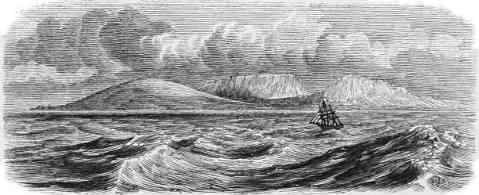
On the 26th of September, the famous Table Mountain of the Cape was visible, after we had, the evening previous, at a distance of fourteen miles, sighted the lighthouse of Table Bay.
The twenty-six days of our voyage hither had flown quickly past, and we were still able vividly to recall the impressions made by Brazil, and the scenes we had gone through in mid-ocean, as the southernmost point of Africa came in sight with its characteristic hills, and our eyes and our thoughts were directed to another quarter of the globe. On the one hand, excited with the prospect of new scenery, and on the other, anxious to complete our elaborate observations upon Brazil, so as to be able to send them home from the Cape, we found ourselves in a frame of mind which kept us alternately hard at the desk, or drove us on deck to admire the remarkable outline of Cape Colony. We did not, at the present season, think it advisable to run right into the bay, so as to anchor near Cape Town, but resolved to double the Cape, and proceed to Simon's Bay, the usual anchorage for ships-of-war. We were, however, sadly disappointed in the hope of soon reaching it, as the south-east wind freshened so much that on the 27th it had become a gale, which forced us out to sea again. The world-known swell off the Cape began under the ever-increasing wind to run high, and we were soon involved in one of those famous Cape storms which justified the Portuguese in calling the promontory of South Africa, "Cabo Tormentoso," or the Cape of Storm.[51]
The wind and spray roared and lashed through the rigging: higher and higher rose the huge mountains of water, with their white crests, that tossed the ship like a plaything from side to side. The waves foamed in through the port-holes on the gun-deck, while masts, cordage, timbers, every part of the ship groaned and creaked, a perfect medley of sights and sounds, including woful destruction of crockery, and the heavy rolling of erratic cannon-shot that had broken loose from the rack, and were rushing about the deck—above all which was heard the shrill whistle of the pipe of the boatswain's mate. The scene fairly baffled all powers of description, and must have been eminently impressive for those who for the first time experienced what is meant by "a gale at sea," especially at night, when the moon, struggling through the flying vapours, lit up the appalling scene with a livid supernatural tint.
On the afternoon of the 28th the gale reached its highest point, and raged fearfully for some hours. The frigate proved herself, in this turbulence of the waters, to be thoroughly seaworthy. At the same time the sun shone brilliantly, the sky was clear and beautiful, and only here and there some feathery clouds were to be seen. There was a curious sense of dualism in this serenity of the sky, in contrast with the fury and agitation of the waves. Gradually the wind chopped round towards the east, which gave some hope that the gale would abate, but, nevertheless, the ship was tossed about worse than ever.
The waves, like gigantic ridges, mounted, according to measurement, to the height of from 30 to 35 feet above the mean level of the sea, and occasioned that terrible rolling of the ship, and those fearful lurches, which, once experienced, are not readily forgotten.
Hitherto the altitude of a wave has been generally measured merely by the eye, so that the result depended too much on the accuracy of individual observation to admit of its being exactly ascertained; and it is for this reason that the statements relative to the maximum height of the ocean wave are so various that they cannot be considered reliable, for whilst some observers estimate them to be from 60 to 70 feet, others reckon them only at from 30 to 40 feet.
On board the Novara the following method of admeasurement was adopted: we first determined, by a chronometer, the time that a wave takes to pass from one end of the ship to the other, whereby the velocity of the progressive motion of the wave could be calculated in relation to the ship's course and speed, regard being had to the direction and velocity of the ship against it. With this velocity ascertained, we were in a position to determine and fix the average distance between two consecutive waves. Lastly, the height of the wave was ascertained from the angle at which the frigate rose and fell in the line of its keel, by the influence of each successive wave and by means of the ascertained distance from the trough of the sea to the crest of the wave. Though this method, likewise, has many difficulties and deficiencies, yet it appears well suited to make correct comparisons between the different waves; and, under certain favourable conditions, it yields so accurate a result, that at any rate it is to be preferred to mere guess-work, besides that the experiment itself is susceptible of many improvements. It seems safe to assume that waves scarcely ever attain an elevation of more than 40 or 45 feet.
The gale had driven us a long distance out, and only after great trouble did we again near the land. On the 1st of October the Cape came once more in sight; we tacked, in order to get into the wide gulf termed False Bay, by which in some respects the peninsula of the Cape is formed, being separated only by a low sandy plain from the Atlantic. Whittle's rock renders tacking in its neighbourhood in so far more difficult, as the existing charts of the bay are not sufficiently exact to be implicitly relied on. Buoys have often been fixed in that quarter, but every new gale carried them away again; so that the position of the rock is not indicated. An English pilot now came on board, who brought papers, and intelligence that a number of letters were waiting for us. Our impatience became stronger when towards evening the light breeze entirely ceased, and we thereby were forced to bring up at a distance of a mile and a half from the actual anchorage. About the same time an officer arrived from the British line-of-battle-ship Boscawen, under the flag of Rear-Admiral Grey, in order to serve as a guide should no pilot have boarded us.
On the 2nd of October, at 7 a. m., the anchor was let go in Simon's Bay, a spacious but gloomy-looking sheet of water. Here ships ride much more secure than in Table Bay, from which, in a stiff westerly or north-westerly breeze, vessels are often forced to run out to sea to avoid being driven on shore. The communication with the land is thus sometimes interrupted for days. From Simon's Bay to Table Bay, round the Cape the distance is forty miles, whilst by land the journey to the capital of the colony is, with good horses, performed in three hours.
CABO TORMENTOSO.
CAPE TOWN.