Volume 1 — VI. (continued 2)
Reading edition
We lay a southerly course in order to strike the regular Westerly winds, which we might hope to fall in with in the neighbourhood of 40° S., and already we again saw our old friends, the albatross, the cape pigeon, and the stormy petrel, in innumerable quantities.
By the evening of the 28th we had attained our limit in the South-west, but the West winds had not yet made their appearance, so that we had to contend till 1st November with baffling light winds alternating with calms. At length in 37° 30′ S. and 18° 4′ E., we encountered Westerly breezes, which, ere long, freshened, veered to the southward, and compelled us to shorten sail. We were at this time not quite as yet in the zone of West winds, but had to do with variable winds; which, however, as the prevailing winds must be west or south, could generally be made available to enable us to lay our course for St. Paul. Although in the month corresponding to May in the southern hemisphere, we found ourselves shivering with cold, the thermometer barely reached 18° Cent. (64°·4 Fah.) during the day in the open air, and our bodies, accustomed of late to a milder temperature, felt as though it were twice more rigorous than it actually was, in consequence of the wind coming from the ice-bound antarctic regions.
On the afternoon of 4th November, a great excitement arose on board; a violent shower filled the lifeboats with water, and a large black object was observed swimming in the sea. Fortunately, it was not a man, though it proved to be a great favourite that had fallen overboard. Bessy, an ape, had got loose from her chain, and while being chased, fell in her eagerness into the sea, which fortunately was tolerably smooth. The droll little brute had quickly made itself such a favourite with the crew from its comical attractive ways, that its sudden fall overboard awoke universal sympathy. A boat was lowered, and Bessy rescued, who speedily recovered from her fright, and although dripping wet, proceeded to consume an orange that was handed her with an expression of entire satisfaction.
On reaching 40° S., 31° E., the West winds became more steady, with a perceptible increase of motion, giving an average of 33 feet as the height of the waves, while the frigate rolled heavily. Sometimes several "Rollers" would follow one after the other, which made the ship heel over from 20° to 25° on either side. At each roll, streams of water poured in upon the gun-deck. The cannon-shot kept up a deafening dance from one side to the other, while stools, tables, chests, and in short everything that could move, were unmistakably "lively." The temperature of the air during the night fell to 41° Fahrenheit, and was felt yet more keenly in squalls accompanied by rain, which made our life on board anything but agreeable, although the certainty that we were proceeding favourably with the so-called "Fair" Westerly winds indemnified us in some degree for the discomfort.
On 14th November, in 40° 44′ S., 60° 8′ E., we availed ourselves of a dead calm and smooth sea to try a cast of Brooke's Patent Deep-sea Lead.
While at Rio, we had been supplied, through the kindness of Don José de Barnabé, Commander of the Royal Spanish Frigate Bilbao, with a large quantity of lead-line, after an unsuccessful attempt to purchase it there. Unfortunately, however, the line had become somewhat decomposed by moisture, and gave way at 6,170 fathoms (37,020 English feet) while still running out, so that on this occasion also, we could only tell that bottom had not been reached with the portion of the line paid out.
The times occupied by the line in running out were as follows:—
1st1000fathoms15minutes36seconds.
2nd""26"59"
3rd""34"20"
4th""43"25"
5th""61"5"
6th""75"55"
And the last170"11"40"
____ ______ ______
Total6,170"4 hours 29 minutes.
To the apparatus two 30-lbs. shot were attached, and the first 100 fathoms of line were doubled. By this observation we satisfied ourselves that such soundings are only successful when none but the best materials are employed, and, moreover, that the line becomes deteriorated in an extraordinary degree by long stowage on boardship, so that it is better in long voyages not to take such large supplies of line, but to adopt most stringent measures to prevent its being weakened by damp. Very probably a light coating of tar over the line would tend to keep it in good preservation, and it also seems advisable proportionately to strengthen the first 500 or 1000 fathoms.
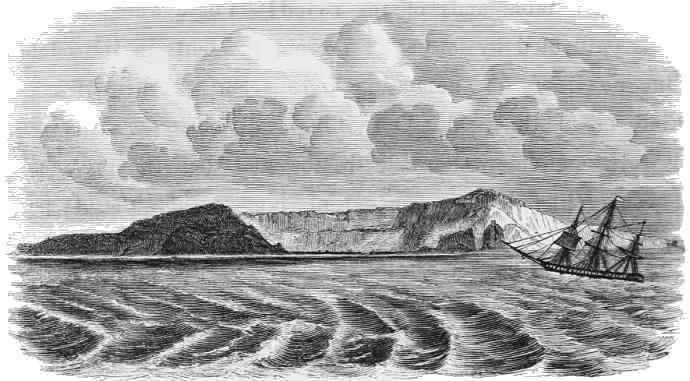
On the 18th November the look-out man descried from the main topgallant mast-head the Island of St. Paul, the goal of our wishes, the object which had so long occupied our thoughts, and on which our scientific capabilities were to be called into enviable activity. The necessary arrangements were completed for facilitating astronomical observations, the instruments and other necessaries taken out and got in readiness to be conveyed to the island, and the various stations and duties of the different members specified, so as to admit of the observations being completed in the shortest possible time.
On the 19th November, at daybreak, we found ourselves close in with St. Paul's Island, while on our port-side the outline of New Amsterdam was visible in the shape of two lofty peaks on the horizon. As the wind blew from the N.W., we kept the ship's course past the north promontory of the island, and ranged along the eastern side to the selected anchoring ground. As we doubled the northernmost point, the conical-shaped Nine-Pin Rock came into view, while the high and precipitous margin of the island in the N.E. with the entrance into the crater became visible. How great, however, was our astonishment, when we observed some neatly laid-out terraces, of a fresher green hue than were observed in the upper table-lands of the island! These were evidently spots cultivated by former or present residents in the island. But no traces of habitation were seen, whether of mankind or of the seal. Only flights of albatrosses, bryons, ospreys, and sea-swallows, with now and then the protracted screams (like human groans) of immense flights of penguins, those singular-looking sea-birds, which awaken so deep an interest alike for their striking appearance as by their mode of life.
An examination of the rock of the island showed layers of black lava, alternating with yellow and red tufa, which seemed stratified regularly from the rim of the crater to the extreme circumference of the island. "Thirty fathoms, and no bottom," sung the wearied leadsman; and presently, "Thirty fathoms,"—and a few minutes before 9 a. m. the anchor rattled out, on the 24th day after we left Simon's Bay, after retracing our steps Eastward some 3000 miles. Our anchorage, as we afterwards became aware, was not the best possible, as we ought to have lain closer in to the island. But when one anchors nearer the land in a less depth of water, one is by no means more protected from storms sweeping in from seawards, to which the entire eastern half of the island lies exposed. Only on the west side does the island, with the steep margin of the crater some 700 or 800 feet high, afford any protection against the west winds, which, however, seldom blow here.
ARRIVAL AT ST. PAUL.
VIEW OF ST. PAUL.