Volume 1 — VII. (continued 2)
Reading edition
Fortunately, this gigantic conflagration must have done far more good than harm to this desolate island, covered as it was for the most part with reeds, since, without destroying any of the vegetation that could be of service to man, it will greatly facilitate examination by future voyagers, and adapt it for settlement by fishers and others, who at present seem to leave it utterly abandoned.
Towards 6 p. m., as it was already getting dark, our two boats set out on their return to the frigate, from which in the course of the day they had been distant about fifteen miles. However a fresh Northerly breeze having sprung up we were able to make sail, and at 7.30 p. m. once more reached the frigate, when we were received with a storm of questions, principally turning upon the mysterious far-visible conflagration,—which had been kindled by a couple of humble Vienna lucifers! During our visit to the island a variety of observations were also made on board the frigate, to obtain the position of Amsterdam, as also to determine the elevation of the most prominent peaks of the island, and the outline of the shore. The results of these gave the following: latitude 37° 58′ 30″ S.; longitude, 77° 34,' 44″ E. of Greenwich; elevation of the highest summit (nearly corresponding with previous observations), 2891 English feet; of the second highest, 2651 feet; the length of the South coast, as measured from the frigate, 32,359 feet; of the Western shore, 5507 feet.
There was still some faint hope that we might visit the island next day. However, during the night the wind sprung up, the weather became variable, and we saw ourselves compelled to renounce our cherished desire to investigate the island thoroughly, the rather that, owing to the unpropitious weather during the last few weeks, the stay of the Novara in these latitudes had been prolonged so considerably beyond the period fixed, that no more time could be spared, if it were desirous to avoid sacrificing the objects of the Expedition with reference to other and more important departments of scientific enquiry, by engaging in them at a season in all probability highly unfavourable for the purpose.
Consequently our observations in Amsterdam remained most imperfect; although the geologist of the expedition was enabled to clear up the uncertainty hitherto prevailing as to the geological structure of the island, and to determine upon scientific data, that Amsterdam is an extinct volcanic cone, of precisely the same character, and belonging to the same order of volcanic formation as the sister island of St. Paul; that it probably contains on itself all the usual indications of its volcanic origin, and that its upheaval probably took place at the same period. On the other hand, the naturalist regretted to see slip the opportunity so rarely vouchsafed, of instituting a comparison between the respective vegetations of these islands, and of making evident how, simultaneously with the advance of a more luxuriant, and more multiform vegetable organization, there also appears an entirely new race of animals, and how closely allied in the economy of nature is the existence of individual specimens with certain fixed pre-existent types. In any case St. Paul, which we enjoyed an opportunity of examining in the utmost detail, is, of the two islands, the most important to the commerce of the world, not merely as a finger-post on the most frequented deep-sea route in the Indian Ocean, but also as a haven of refuge for ships and crews. Already the crater-basin of St. Paul has served in case of need as a desirable asylum for ships that are half unseaworthy. Not many years since an English man-of-war steamer came to St. Paul, after a severe storm in the Indian Ocean, during which her engine broke down, and her rudder was knocked away, after which she, for twelve days, was steered by a temporary rudder. The vessel, after discharging the heaviest part of her equipment, was easily brought into the interior of the crater-basin, and was there hove down for several months on the Northern barrier, undergoing repairs.
On the 8th December, about 4 a. m., only a dark cloud of smoke in the distant cloudless horizon indicated the position of Amsterdam. The island itself, properly speaking, was actually out of sight, for a fresh N.W. breeze had driven us merrily along during the night. The last hope was now dissipated of being able to obtain a view of the North side of Amsterdam. We were now rapidly approaching the region of the S.E. Trades. The breeze freshened and crept gradually to the West, thence to the South, and finally to the Eastward. This veering of the wind proved to be a fore-runner of the Trades, which we got into on 14th December, in S. latitude 28° 1′, E. longitude 85°.
On that day a merchantman hove in sight, which, with favouring breezes and all sail set, soon bore down on us. She came down without any flag, and stood right across our bows at so short a distance that we could plainly read her name—the Bunker's Hill, of Boston—on her stern. Thereupon we ran up our flag; and, as it is as gross a breach of the code of maritime politeness for a ship to pass across the bows of another in the open ocean without saluting, as for a man on land to brush quickly across another's path without apologizing, a blank shot was fired at this unmannerly American. To this manifestation etiquette lays it down that, as the hoisting of her flag by a man-of-war is a direct challenge for any merchantman that may be in sight to hoist its flag, any neglect of these universally recognized rules must involuntarily give rise to suspicions. After we had fired the blank shot, the American, by a telegraph of flag-signals, enquired the latitude and longitude, which in merchant ships in the open sea is pretty frequently resorted to, in order to know where precisely they are, as they are not able to make such frequent observations as ships of war. Before anything else, however, it was necessary to settle the question of saluting; and this the obstinate Yankee, in spite of the warning signal, seemed resolved not to notice, although he well knew the seriousness of his position, as was abundantly evident in the celerity with which several ladies and gentlemen, whom we could discern on deck, flew to seek shelter below! A second report, accompanied by a ball over his stern, at last brought this pertinacious captain to his senses, and the whistling of the shot had the desired effect. The "Stars and Stripes" were run up, upon which we signalled the required latitude and longitude. Probably it was but a petulant explosion of a silly national vanity, as also the consciousness of commanding a handsome crack "clipper," that could speedily run out of gun-shot, which led to this premeditated and persistent violation of one of the most ordinary rules of politeness. Indeed, even the vessels of the North American navy itself are frequently compelled in the open sea to treat their fellow-countrymen in a similar manner; and the captain of the war-steamer Minnesota, looking after the North American interests in China, was obliged, as we learned afterwards at Shanghai, to enforce a compliance with established sea usages on one of his seafaring compatriots, by dint of cannon-shot, in accordance with the undoubted practice of all maritime nations.
The south-east Trade, which we had hoped would drive us on our destined course, was not so strong or so steady as we had expected, chiefly perhaps in consequence of the influence exercised by the Australian continent, the temperature of which during this, the summer season of the Southern Hemisphere, is raised to an extraordinary degree by its sandy surface, that when the air has become thus warmed, it ascends and becomes more rarefied in its lower strata, in consequence of which its elasticity becomes so great as to drive back the surrounding colder atmosphere, and only admit it to contact with the heated air at its most remote limits. This occurs the more readily, that the heated air, after it has risen to the more rarefied tracts, expands on all sides, and at a certain distance from the lower level, begins to add to the pressure of the atmosphere. In this self-acting zone of increased atmospheric pressure, the winds, however, are naturally more faint, and, to observers who happen to be on the exterior of this zone, always appear to take their rise from the further side. For this reason, probably, we fell in with easterly breezes, so long as we had the Northern portion of Australia to the eastward of us.
At any rate, the equilibrium of the air seemed to be disturbed, as we could plainly perceive from the weather and the confused sea. At last on 18th December, the heavens seemed somewhat more propitious, though the wind still continued easterly; indeed occasionally blew from the north, and frequent squalls of rain poured pitilessly down upon us. The more, however, we increased our distance from the Australian continent, that is, from all land to the eastward, the more steadily blew the south east Trade. And so we kept standing steadily forwards, till at last, on the 24th December, in 6° 4′ S. Lat., and 82° 34′ E. Long., we reached the eastern boundaries of the Trades and got into that of calms.
The heat, which thus far had spared us, began now to be most oppressive, and was felt all the more owing to the air being extraordinarily damp and dense. Frequently in the afternoon a passing shower of rain, which would sometimes completely flood the deck, would cool the air for a few fleeting moments. Occasionally indeed we had westerly and more rarely north-westerly breezes, but these were never of long duration, and were incessantly broken by rains and squalls.
And at this same season, at which in our distant Fatherland, palace and hut are decked out with unwonted attention, when golden fruits and elegant presents glitter from the green fir-branches of the Christmas Tree, all lit up with the neat little wax-tapers, when man's heart seems to overflow with cheerfulness and love of his fellow-creatures,—at this season we were languishing far from our dear ones, tormented with the intense heat, scarcely able to realize to ourselves, that at home it must now be snow and frost, while keen Boreas is whirling the snowflakes aloft, and howling a grim accompaniment the while! However, we promised ourselves the satisfaction of enjoying these pleasures at our own firesides, whereupon our recollections of home and dear friends imparted to our minds a wholesome stimulus, arising from the soul-inspiring conviction, that we too were present in their minds and hearts at this hallowed season. Nay, several of the officers of the Novara Expedition were surprised when far at sea, in the very midst of the Indian Ocean, with Christmas gifts, which thoughtful friends had many months before entrusted to the care of discreet fellow-voyagers.
After constantly struggling against calms and contrary winds, exactly at the first stroke of the New Year, at midnight of 31st December-1st January, we reached the Equator, which we were now crossing for the second time, and began the year 1858 in the Northern Hemisphere.
On this New Year's Day we had nearly had a great disaster. A lad who was coming down the shrouds fell overboard. The sea was perfectly calm and smooth, but already on the morning of this very day we had seen many sharks, those dreaded foes of man in the domain of ocean, so that the life of the unfortunate youth seemed seriously imperilled. The same instant in which the youth fell, saw a life-buoy thrown over, a boat prepared for lowering, and all usual appliances for a rescue made available. But although an excellent swimmer, he seemed to lose all presence of mind, probably through fear, and must undoubtedly have been drowned, had not the boatswain's mate, and two other sailors, leaped into the water and made all haste to his assistance. Meanwhile the boat had been got into the water, by which rescued and rescuers were got safe on board again.
A few months later, the boatswain's mate, for his gallant conduct on this occasion, received, by the express orders of His Majesty, the silver cross of merit, while the sailors were advanced one grade.
The current, which runs northward along the coast of Australia, but turns off to the westward about the tenth degree of South latitude, so as to pass southward of Ceylon, directly along the Equator to the Coast of Africa, carried us far to the westward, in consequence of which we had overcast, uncertain weather, with, for the most part, calms or light breezes. As we found ourselves approaching the fourth degree of Northern latitude, a rather fresh N.E. wind sprung up, probably the trade wind of the Northern Hemisphere, which, however, as we neared Ceylon, again died away to a calm.
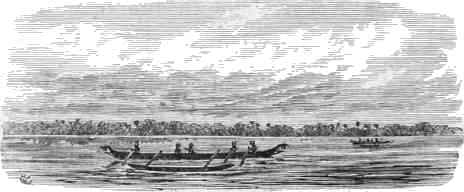
At the same time, in lat. 5° 32′ N., 79° 5′ E., we fell in with a current running more than two miles an hour. We had, as it turned out, got to the westward of the roadstead of Point de Galle, in Ceylon, and found some little difficulty in making headway against the current. On 7th January, toward 3.30 p. m., land was made to the eastward, and an hour later, a Cingalese canoe was perceived making for the frigate under sail. It was the pilot boat, whose crew, having been informed by a Hamburg brig that a large ship was in sight, had put to sea to meet us.
At the first sight of this little canoe, it was hardly possible to refrain from amazement at the courage and hardihood with which the half-naked Cingalese boatmen could put off some 30 or 40 miles to sea in such a tiny, narrow boat, that barely gives them room to sit lengthwise. Two cross-bars, or outriggers, projecting on one side, where they are fastened externally to a rather massive beam, which swims parallel with the boat, gave this canoe, apparently so fragile, such stability and seaworthiness, that it is at all times not less safe than a boat of European construction.[76]
The natives steer with short paddles, and continue an incredibly long time at this most exhausting work, as we must conceive it to be. And yet they are to appearance a feeble race, except that the muscular system of the upper part of the body is remarkably developed.
The dress of these people is remarkably simple, and usually consists only of a piece of coloured linen cloth or calico, which, worn short like a woman's petticoat, is thrown single-fold round the loins.
The pilot, though he could only make himself intelligible in broken English, speedily came to a good understanding, and offered to sell us bananas, pine-apples, and cocoa-nuts, as also Ceylon jewels, the latter of which he carried on his person, secured in a parti-coloured cotton belt. This reminded us that we were nearing the shores of the country in which costly stones are found, but precisely on that account, as was natural, our speculative pilot found but a poor market for his wares.
Off the coast we caught a shark 7 feet long, and 135 lbs. weight—a rather juvenile specimen—whose teeth, which we examined, were already strong and sharp enough to seize a man, and strip the flesh off him. Also a number of large dolphins and other fish, sported in the dead water under the frigate's stern, and provided plentiful employment for the harpoon and the rod. Presently we found ourselves within six miles of the land, when a large number of pirogues forthwith came swarming about us, all of a construction similar to the pilot boat, and each manned by four half-naked bronze natives. These offered fruits for sale, especially magnificent, gigantic clusters of banana. On one such cluster we counted, arranged in five rows, one over the other, not less than 175 bananas.
On the 8th January, we anchored in the unpicturesque haven of Point de Galle, surrounded by groves of cocoa-nut palms, directly opposite the lighthouse tower, and in a fine quartz sand bottom of 16½ fathoms (103 feet English). All large ships, that only intend remaining a short time, anchor in the open roadstead, the entrance into the inner harbour being rather difficult, owing to numerous coral reefs. In the roads also lay the English frigate Shannon, from which, in the absence of her captain, the first lieutenant immediately came on board the Novara, and in the handsomest manner put his services at our disposal.
As the only Austrian Consul on the island was resident in Colombo, M. Sonnenkalb, the Consul for Hamburg, had the courtesy to receive us with the most hospitable of welcomes, and proceeded to do us the honours of the place.
On the 10th we hauled the frigate into the small inner harbour, in order to facilitate the shipping of stores. The entrance is rather winding, owing to the numerous shoals, and it is with some little difficulty that one can find a comfortable, commodious berth among such a crowd of shipping. We only saluted the flag of the dominant nationality—a customary courtesy—and were replied to by the batteries on shore. An officer of the frigate was then dispatched to announce our arrival to the governor of the station—a major in the English army. This gentleman seemed not to think it incumbent on him to put himself in the least out of his way for us. Indeed, we even experienced some little difficulty in procuring a sufficient supply of drinking water for shipment as stores; but we must at the same time add, in justice to the representatives of England in distant countries, that during our entire voyage this was the one solitary instance in which English military official men did not display that universal readiness to oblige, which, to their credit, is so conspicuously and so kindly displayed by them in their intercourse with foreign nations.
CINGALESE CANOE.
VIEW OF ADAM'S PEAK FROM COLOMBO.