Front matter (continued 3)
Reading edition
A visit to a government tobacco factory left me with the impression that, from the point of view of management, mechanical equipment, and perhaps also labour conditions, the plant would compare not unfavourably with some large tobacco manufactories in our own Southern States; but as to the product of this factory, the best of which I sampled, I can pretend to no enthusiasm. Japanese tobacco goes well enough in the little native pipes, but it does not make good cigarettes or cigars, and even the cigarettes made of blended tobaccos, or from pure Virginia or Egyptian leaves, would hardly satisfy a critical taste. Cigars made in Japan are uniformly poor, like the government-made cigars of France, but whereas in France it is possible to buy a good imported Havana, I found none for sale in Japan. One reason for this is that the duty on cigars is 355 per cent., so that only a millionaire can afford good Havanas.
Whether because the enormous luncheon at the Maple Club left me in a stupor, or because my mind could not adjust itself quickly to appreciation of an unfamiliar and extremely curious art, I did not find myself enchanted by the shrill falsetto singing of the geisha musicians, or the strange sounds they evoked from the samisen, fife and drums, as they accompanied the dancers.
The native Japanese music, with its crude five-tone scale, is demonstrably inferior to that of Western peoples. To the foreign ear it is unmelodious, even barbarous, and yet I must say for it that the more I heard it the more I felt in it a kind of weird appeal—an appeal not to the ear but to the imagination. Even now, when I am far away from Japan, a note or two struck on a guitar, a mandolin, or a ukulele, in imitation of the samisen, conjures up vivid pictures in my mind. I see a narrow geisha street, with a musician seated in an upper window, or I get a vision of a geisha dancer arrayed in brilliant silks, posturing, fan in hand, against a background of gold screens, in the exquisitely chaste simplicity of a Japanese teahouse room. The sound that evokes the picture is not harmonious, but the picture itself is harmonious beyond expression.
One thing that sometimes makes the stranger in Japan slow to appreciate the dancing of geisha, is the very fact that it is called dancing; for the term suggests to us a picture of Pavlowa poised like a swiftly flying bird, or Genée looking like a bisque doll and spinning on one toe. Dancing, to us, means, first of all, rhythm. We look for rhythm in a geisha dance, and failing to find it—at least in the sense in which we understand the meaning of the word—we are baffled. It is only one more case of preconception as a barrier to just appreciation.
Many travellers, and at least one author who has written a book on Japan, have made the mistake of confusing geisha with prostitutes. This is a gigantic error. The error is kept alive by ricksha coolies who, understanding that it is a common mistake of foreigners, often use the term "geisha house" as meaning an establishment of altogether different character. A geisha house is in fact simply a house in which geisha live under the charge of the master or mistress to whom they are bound by contract or indenture. Geisha are booked through exchanges and meet their patrons at restaurants or teahouses. When not on duty they are private citizens, and it would be considered the height of vulgarity for a man to call upon a geisha at the geisha house, however innocent the purpose of his call.
A further reason for the erroneous idea of what a geisha is, lies in the fact that Western civilization has no equivalent class. Geisha correspond more nearly to cabaret entertainers than to any other class we have, yet even here there is no real parallel. It is not customary in Japan—except in foreign-style hotels—to dine in public. If a man be alone in a hotel he dines by himself in his room, save that the little nesans who serve him will try to make themselves agreeable and that the proprietor may do the same. Or if a man gives a luncheon or a dinner party at a restaurant he will have a private room. Therefore, under the Japanese system, there is never a general assemblage of persons, strangers to one another, who may be entertained as a body while they are dining. Thus the geisha is a private entertainer, and in order that the most desirable geisha may be secured it is customary to make arrangements for a luncheon or dinner several days in advance. This is usually done through the proprietor of the restaurant, who is told the names of the geisha the host desires to summon, and who notifies them through the local geisha exchange.
Men who frequently lunch and dine out naturally become acquainted with many geisha, and have their preferences; and if a host knows that one of his guests particularly likes a certain geisha he will generally try to arrange to have her at his party.
There are three classes of geisha. Those of the best class frequently have good incomes. They are often given large presents by their wealthy patrons, and many of them are the mistresses of men of means, who sometimes take them off on week-end outings and spend a great deal of money on them.
However this may be, a geisha of the first class is a creature of exquisite refinement of manner, and there is about her not the faintest suggestion of coarseness. She will be friendly, even pleasantly familiar, but never, in public, is she guilty of the slightest impropriety. I have been to many gay parties in Japan, but I have never seen a geisha or her patron behave in a way that would shock the most fastidious American lady. Naturally the situation is somewhat different among low-class Japanese and the geisha they patronize. There are vulgar geisha to entertain vulgar men. But even a low-class geisha, if sent for in an emergency to entertain a man of taste, will often be sufficiently clever to adjust herself to the situation.
During the meal the geisha will sit before or beside the gentleman she is designated to entertain, chatting with him, amusing him and serving him with saké. Afterward she will join the other geisha in giving an entertainment, the part she takes in this depending upon her special talent, which may be for singing, playing, or dancing. Pretty young geisha are most often dancers, while those who are older are generally musicians. Also there are some geisha who are merely bright and pleasing and who succeed without other accomplishments. The host, making up a party, selects his geisha with these various requirements in mind, so that his whole company of geisha will be well balanced.
Foreigners are generally most taken with the little dancing girls, or maiko, who are mere children, and who with their sweet, bright, happy little faces, and their bewitchingly brilliant flowered-silk costumes, are altogether fascinating. Once at a party in a great house in Tokyo I saw a score of these little creatures scampering down a broad flight of stairs, making a picture that was like nothing so much as a mass of autumn leaves blown by a high wind.
These children are in effect apprentices who are being schooled in the geisha's arts. Often they are in this occupation because their parents have sold them into it as a means of raising money. With the older geisha it is frequently the same. The Japanese teaching of filial piety makes it incumbent upon a daughter to become a geisha, or even a prostitute, to relieve the financial distress of her parents. In either case she goes under contract for a term of years—usually three.
A girl who is refined, pretty, and talented can raise a sum in the neighbourhood of a thousand dollars by becoming a geisha, but if she is not sufficiently talented or attractive to be a geisha, her next resource is the "nightless city." The opening to women of professional and commercial opportunities should tend to improve this situation.
I am told that geisha and the little dancing girls are generally kindly treated by the geisha-masters, and the gaiety they exhibit leads me to conclude that this is true. The little dancers, in particular, want but slight encouragement to become as playful as kittens.
CHAPTER XII
I Entertain at a Teahouse—Folk Dances—The Sense of Form—The Organization of Society—Jitsuko Helps me Give a Party—Pretty Kokinoyou—Geisha Games—Rivalries of Geisha—The Cherry Dance at Kyoto—Theatre Settings—Unmercenary Geisha—Teahouse Romances—Restaurants, Cheap and Costly—Reflections on Reform
"'Tis pleasing to be schooled in a strange tongue By foreign lips and eyes...." —Byron
The way to see geisha and maiko to the best advantage is at small parties where the guests are well acquainted and formality can be to some extent cast off. I was much pleased when I learned enough of the ways of teahouses and geisha to be able to give such a party.
My first essay as host at a Japanese dinner was not, however, entirely independent, since I had the help of a Japanese friend. It occurred at the charming Maruya teahouse, in the ancient town of Nara.
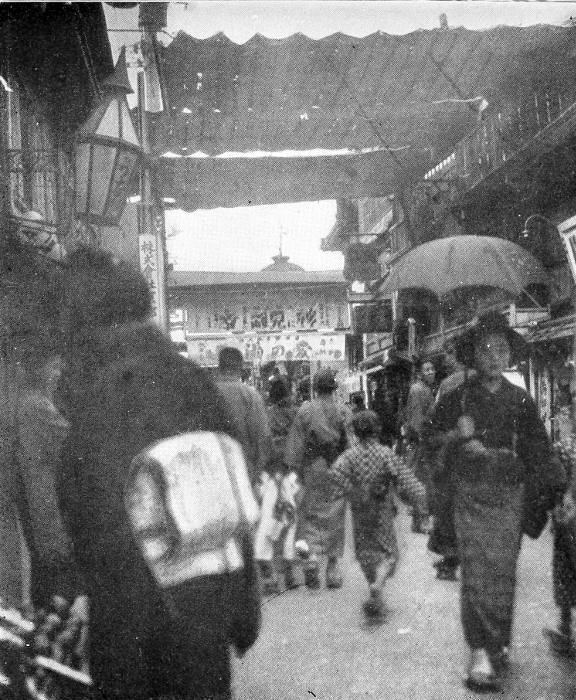
The theatre street in Kyoto is one of the most interesting highways in the world
It was at the Maruya that I first began to feel some real understanding and appreciation of geisha dancing, and I think the thing that assisted me most was the fact that the little maiko executed several Japanese folk dances, the action of which, unlike that of most geisha dances, was to a large extent self-explanatory. One of these dances represented clam-digging. In it the dancers held small trays which in pantomime they used as shovels, going through the motion of digging the clams out of the sand and throwing them into a basket. The dance was accompanied by a song, as was also another folk dance in which two of the maiko enacted the rôles of lovers who were obliged to part because the mother of the girl was forcing her to marry a rich man. I was interested to notice in this dance that the gesture to indicate weeping—the holding of one hand in front of the eyes at a distance of two or three inches from them—is not taken from life, but is copied from the gesture of dolls in the marionette theatre. That is the gesture for a man. When a woman weeps she holds her sleeve-tab before her eyes, for it is a tradition that women dry their tears with their sleeves. When in Japanese poetry moist sleeves are spoken of, the figure of speech signifies that a woman has been weeping.
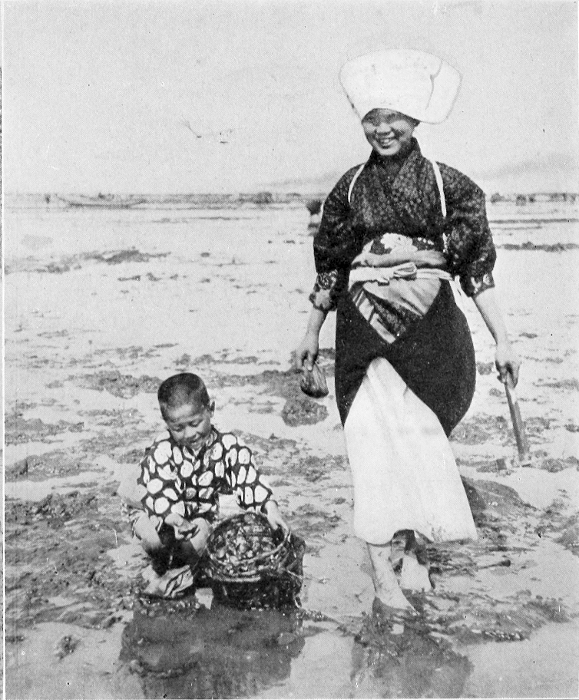
Digging clams at low-tide in Tokyo Bay
The girls who executed the last-mentioned folk dance were respectively thirteen and fifteen years old, and they were evidently much amused by the passionate utterances they were obliged to deliver. The one who played the part of the youth—a fetching little creature with a roguish face—was unable at times to restrain her mirth as she recited the tragic and romantic lines, and her rendition of them was punctuated by little explosions of giggling, which though they cannot be said to have heightened the dramatic effect of the sad story, her audience found most contagious. Then with a great effort she would pull herself together and try to live down the mirthful outburst, lowering her voice, to imitate that of a man, and assuming a tragic demeanor which, in a creature so sweet and childish, habited in silken robes that made her like a butterfly, was even more amusing.
People who follow the arts, or have a feeling for them, seldom fail to appreciate geisha dancing after they have seen enough of it to get an understanding of what it is. This, I think, is because they generally have a sense of form, and as geisha dancing is a sort of animated tableau vivant, a sense of form is the one thing most essential to an appreciation of it.
Indeed I will go further and proclaim my belief that, to a visitor who would really understand Japan, a sense of form is a vital necessity.
Japan is all form. In Japanese art even colour takes second place. Nor does the Japanese feeling for form by any means stop where art ends. It permeates the entire fabric of Japanese life. The formal courtesy of old French society was as nothing to the formal courtesy of the Japanese. The whole life of the average Japanese is so regulated by form that his existence seems to progress according to a sort of geometrical pattern. The very nation itself is organized in such a way as to suggest a compact artistic composition. Not only every class, but every family and individual has an exact place in the structure. A friend of mine who knows Japan as but few foreigners do, goes so far as to say that the shades of difference between individuals are so finely drawn that no two persons in Japan are of exactly the same social rank, and that the precise position of every man in the country can be established according to the codes of Japanese formalism. Though this may be an exaggeration it expresses what I believe to be essentially a truth. I visualize the social and political structure of Japan as a great pyramid in which the blocks are families. At the bottom are the submerged classes—among them, down in the mud of the foundation, the eta or pariah class. Then come layers of families representing the voteless masses, among which the merchant class was in feudal times considered the lowest. Next come the little taxpayers who vote, and these pile up and up to the place where the more exalted classes are superimposed upon them—for in Japan it may be said that there is practically no middle class. I am told that there are now about a million families who are descended from samurai. This is where the aristocracy begins. So the pyramid ascends. Layers of lower officials; layers of higher officials, layers of ex-officials, high and low; layers of those having decorations from the Government; layers of army and navy families, and so on to where, very near the summit, are placed the Genro, or elder statesmen. Above them is a massive block representing the Imperial Family, and at the very peak, is the Emperor, Head of all Heads of Families.
My party in Nara having given me confidence, I gave a luncheon at the delightful Kanetanaka teahouse which overlooks a canal in the Kyobashi district of Tokyo.
I cannot claim much credit for the fact that this party was a success, since Jitsuko, the English speaking geisha I met at my first Japanese luncheon, was there to help me. Jitsuko's English, I must own, was not perfect. Nor would I have had it so, for I enjoyed teaching her, and learning from her.
"Naughty boy!" was one expression that I taught her, and I showed her how to accompany the phrase with an admonitory shake of the finger, with results which altogether charmed the American gentlemen at my luncheon.
One of these gentlemen, a new arrival in Japan and consequently entirely unfamiliar with Japanese fare, asked Jitsuko about a certain dish that was set before him.
"What is this?" he demanded, looking at it doubtfully.
"That fried ears," said Jitsuko.
"Fried ears!" he cried. "Not really?"
"Yes."
But it was not fried ears. Jitsuko had the usual trouble with her l's and r's. She had meant to say "fried eels."
Besides Jitsuko I had at my luncheon six of the lovely little maiko. One of them, an intelligent child called Shinobu—"tiptoes"—was picking up a little English. She sent for ink and a brush and wrote out for me the names of her companions. Later I had the names translated, getting the meaning of them in English—for geisha generally take fanciful names. They were: Kokinoyou—"little alligator" 1 Akika—"scent of autumn"; Komon—"little gate"; Shintama—"new ball"; and Kimi-chiyo, whose name was not translated for me, but who was the prettiest little dancing girl I saw in all Japan.
Though the Japanese idea of female loveliness does not generally accord with ours, I think Kimi-chiyo was an exception and was as lovely in native eyes as in those of an American, for she seemed very popular, and was at almost every Japanese-style party I attended in Tokyo. Moreover, though she could not have been older than sixteen, she carried herself with the placid confidence of an established belle. I have met many a lady twice or three times her age who had not her aplomb.
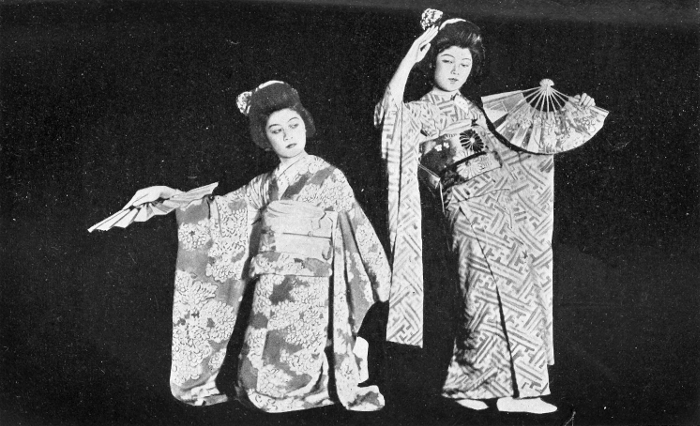
The little dancing girl at the right, Kimi-chiyo, was at almost every Japanese-style party I attended in Tokyo. She carried herself with the placid confidence of an established belle
After luncheon the maiko danced for us while Jitsuko and another geisha played. Then, as my guest of honour had not yet acquired a taste for geisha dancing, the programme was changed and Jitsuko set the little maiko to playing games. First they showed us how to play their great game of ken, but though we learned it we could not compete with them in playing it. They were too quick for us. We pitched quoits with them—and were beaten. We played bottle-and-cup—and were beaten. And finally they introduced us to a Japanese version of "Going to Jerusalem," which they play with cushions instead of chairs, with the samisen for music. Of course they beat us at that. Who can sink down upon a cushion with the agility of a little Japanese girl? All in all, the Americans were beaten at every point—and thoroughly enjoyed the beating.
I could tell a story about the president of one of the greatest corporations in America. He was at my luncheon. He is a very dignified and formidable man, and is considered able. But he can't play ken worth a cent. Kimi-chiyo herself said so. She told Jitsuko and Jitsuko told me.
"In America he is a great man," I said.
"He is very slow at ken," Kimi-chiyo insisted, unimpressed.
"In business he is not slow," I told her.
"Perhaps. But any one who is really clever will be quick at ken."
I decided to avoid the game of ken in future. It shows one up.
Between the geisha of the various great cities there exists a gentle rivalry. Kyoto, for example, concedes a certain vivacity to the geisha of the five or six leading districts of Tokyo, but it insists that the Kyoto geisha have unrivalled complexions, and that the famous Gion geisha of Kyoto are more perfect in their grace and charm than any others in Japan. This they account for by the fact that the Gion geisha have a long and distinguished history, and that there is a geisha school in Kyoto, whereas the Tokyo geisha have no school but are trained by older geisha under the supervision of the master of the individual geisha-house to which they are attached. Similarly the Tokyo geisha consider those of Kyoto rather "slow," and regard the Yokohama geisha as distinctly inferior. Once I asked a Tokyo geisha to give a dance of which I had heard, but she replied with something like a shrug that the dance in question was given by the Yokohama geisha, wherefore, she and her associates did not perform it.
So far as I know there is not to be seen in Tokyo or Yokohama any large geisha show, resembling a theatrical entertainment, such as one may see in Kyoto in cherry-blossom season, or at the Embujo Theatre in Osaka every May. These exhibitions are delightful things to see, the Cherry Dance of Kyoto, in particular, being famous throughout Japan. The buildings in which they are held are impressive. The one in Kyoto was built especially for the Cherry Dance, and the interior of it, while in a general way like a large theatre, is modelled after the style of an old Japanese palace. The geisha dancers and musicians are splendidly trained and the costumes are magnificent.
Rapid changes of scene are made in these theatres by means unfamiliar to American theatre-goers. As in our playhouses, flies and drops are sometimes hoisted upward when a scene is being changed, but quite as frequently they sink down through slots in the stage floor. Also, in the dimness of a "dark change" one sees whole settings going through extraordinary contortions, folding up in ways unknown in our theatres, or turning inside-out, or upside-down. One feels that their stage is generally equipped with less perfect mechanical and lighting devices than ours, but that a great deal of ingenuity is shown in the actual building of scenery. One of the most astonishing things I ever saw in any theatre was the sudden disappearance of a back-drop at the Embujo in Osaka. The bottom of this drop began all at once to contract; then the whole funnel-shaped mass shot down through a small aperture in the floor, like a silk handkerchief passing swiftly through a ring.
The most perfect illusion of depth and distance I ever saw on a stage was in one scene of the Kyoto Cherry Dance. From the front of the house the scene appeared to go back and back incredibly. Nor could I make out where the back-drop met the stage, so skilfully was the painted picture blended with the built-up scenery. When the performance was over I inspected this setting and found that the scenic artist had achieved his result by a most elaborately complete contraction of the lines of perspective, not only in the painted scenery but in objects on the stage. A row of tables running from the footlights to the rear of the stage had been built in diminishing scale, and rows of Japanese lanterns, apparently exactly alike, became in reality smaller and smaller as they reached back from the proscenium, so that the whole perspective was exaggerated. The stage of this theatre was not in fact so deep as that of the New York Hippodrome or the Century Theatre.
At the geisha dance in Osaka I asked what pay the hundred or more geisha musicians and dancers received, and was told that they are not paid at all. There are two reasons for this. First, it is regarded as the duty of all geisha to celebrate the spring with music and dancing; and second, they consider it an honour to be selected for these festivals, since only the most skilful members of their sisterhood are chosen.
Geisha, you see, are not entirely mercenary. When two or three of them go off for a little outing together, or when they shop, they spend money freely; and there are stories of geisha who pay their own fees in order to meet their impecunious lovers at teahouses.
In Japanese romances the geisha is a favourite figure. A popular theme for stories concerning her is that of her love affair with a student whose family disown him because of his infatuation. The geisha sweetheart then supports him while he completes his education. He graduates brilliantly, securing an important appointment under the government, and rewards the girl's devotion by making her his bride. Or if the story be tragic—and the Japanese have a strong taste for tragedy—the student's family is endeavouring to force him into a brilliant match, wherefore the self-sacrificing geisha, whom he really loves, takes her own life, so that she may not stand in the way of his success.
There was a time a generation or two ago when Japanese aristocrats occasionally took geisha for their wives, much as young English noblemen used to marry chorus girls. But those things have changed in Japan and it is a long time since a man of position has made such a match. The plain truth is that, however justly or unjustly, the geisha class is not respected. They are victims of the curious law which operates the world over to make us always a little bit contemptuous of those whose occupation it is to amuse us. Moreover, geisha are not as a rule highly educated, and it is said that this fact makes it difficult for them to adjust themselves to an elevated place in the social scale.
Thus it comes about that, when geisha marry, their husbands are as a rule business men or merchants on a modest scale.
Yuki our treasured maid, had a friend who became a geisha, but who retired from the profession through the matrimonial portal.
"She smart girl," said Yuki. "She too head to be geisha."
"Why did she become one, then?" I asked.
"Her family have great trouble. Her father need fifteen hundred yen right off. Must have. So she be geisha. But after while she meet rich man in teahouse, and he pay for her, so she don't have to be geisha any more, and they get married."
Some excellent people I met in Japan—Americans imbued with the spirit of reform—objected strongly to the geisha system, contending that it is a barrier to happy domesticity. They felt that so long as there are geisha in Japan the average Japanese husband will have them at his parties, and will continue his present practice of leaving his wife at home when he goes out for a good time. I suppose this is true. Undoubtedly, to the Japanese wife, the geisha is the "other woman." And as is so often the case with the "other woman," in whatever land you find her, the geisha has certain strategic advantages over the wife. Like good wives everywhere, the Japanese wife is concerned with humdrum things—the children, housekeeping, the family finances—the things which often irritate and bore a husband if harped upon. But the circumstances in which a husband meets a geisha are genial and gay. Her business is to make him forget his cares and enjoy himself.
The expense of the geisha system is also urged against it. To dine at a first-class teahouse, with geisha, costs as much as, or more than, to dine elaborately at the most expensive New York hotels. It is well for strangers in Japan to understand this, since they often jump to the conclusion that the Japanese teahouse, which looks so simple—so delightfully simple!—by comparison with the gold and marble grandeur of a great American hotel dining room, must necessarily be cheaper. I remember a case in which some Americans, newly arrived in Tokyo, were entertained in the native manner by a Japanese gentleman, and felt that they were returning the courtesy in royal style when they invited him to dine with them at their hotel. Yet in point of fact their hotel dinner-party cost less than half as much per plate as his Japanese dinner had cost. While one does not value courtesy by what it costs, it is important not to undervalue it on any basis whatsoever.
There is, of course, a great variation in the cost of meals in teahouses and restaurants, and the fact that those which are inexpensive look exactly like those which are expensive helps to confuse the stranger. A great deal may be saved if one does without geisha. Also there are very agreeable restaurants in which the guest may cook his own food in a pan over a brazier which is brought into the dining room.
This chafing-dish style of cooking is said to have been introduced by a missionary who became tired of Japanese food and formed the habit of preparing his own meals as he travelled about. Now, however, it has come to be considered typically Japanese.
There are two names for cooking in this simple fashion. The word torinabe is derived from tori, a bird, and nabe, a pot or kettle; and gyunabe from a combination of the word for a pot with gyu, which means a cow, or beef. The Suyehiro restaurants, having three branches in Tokyo, are famous for torinabe, as well as for an affectation of elegant simplicity and crudity in chinaware. A good place for the gyunabe is the Mikawaya restaurant in the Yotsuya section, not far from the palace of the Crown Prince.
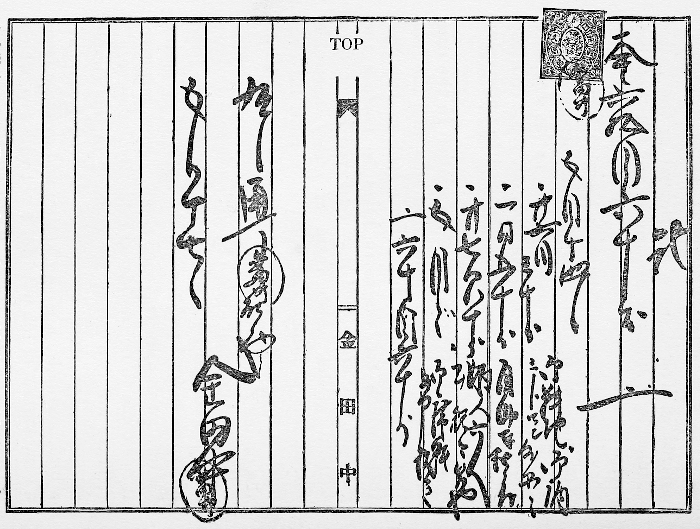
A bill from the Kanetanaka teahouse, with items of ¥ 26.30 for food, saké, etc., and ¥ 27.80 for "six saké-servers (geisha) tips to geisha and their attendants."
To be more specific about prices, I gave an excellent luncheon of this kind for four, at one of the Suyehiro restaurants, at a cost of about four dollars and a half, whereas a luncheon for the same number of persons, with geisha, at a fashionable teahouse, which looked just about like the other restaurant, cost thirty dollars, and a dinner for eight with geisha, came to fifty-three. All tips are however included on the teahouse bill. One does not pay at the time, but receives the bill later, regular patrons of a teahouse usually settling their accounts quarterly.
Adversaries of the geisha system informed me with the air of imparting scandal, that one sixth of all the money spent in Japan goes to geisha and things connected with geisha, presumably meaning restaurants, teahouses, saké and the like.
"A reformer," says Don Marquis, the Sage of Nassau Street, "is a dog in the manger who won't sin himself and won't let any one else sin comfortably." That is a terrible thing to say. I wouldn't say such a thing. It is always better in such cases to quote some one else. But I will say this much: If I were a reformer I should begin work at home—not in Japan. I should join the great movement, already so well started, for making the United States the purest and dullest country in the world. I should work with those who are attempting to accomplish this result entirely by legislation. But instead of trying, as they are now trying, to bring about the desired end by means of quantities of little pious laws covering quantities of little impious subjects, I should work for a blanket law covering everything—one great, sweeping law requiring all American citizens to be absolutely pure and good, not only in action but in thought. I assume that, if such a law were passed, everybody would abide by it, but in order to make it easier for them to do so I should abolish restaurants, theatres, motion pictures, dancing, baseball, talking-machines, art, literature, tobacco, candy, and soda-water. I should put dictographs in every home and have the police listen in on all conversations. Light-heartedness I should make a misdemeanor, and frivolity a crime.
Then, when our whole country had reached a state of perfection that was absolutely morbid, I should consider my work here done, and should move to Japan. But I should not stop being a reformer. Assuredly no! I should start at once to improve things over there. Take for instance this report that one sixth of all the money spent goes to geisha and such things. I should try first of all to remedy that situation. One sixth of the national expenditure represents a vast amount of money. Think of its being spent on good times! Such a lot of money! Still it isn't quite enough. A quarter or a third would be better than a sixth. It would make things perfect. Not being a Japanese wife, I should advocate that.
I see but one serious objection to this plan. Should Japan become any more attractive than it now is, the Japanese might feel forced to pass exclusion laws. If they were to do so I hope they would not discriminate against people of any one race. I hope they would bar out everybody—not Americans alone. Because if they were to bar us out and at the same time allow the riffraff of Europe to come in, that might hurt our feelings. It isn't so hard to hurt our feelings, either. We are a proud and sensitive race, you know. Yes, indeed! It is largely because we are so proud and sensitive that we treat the Japanese with such scant courtesy. That's the way pride and sensitiveness sometimes work. Of course the Japanese are proud and sensitive, too. But we can't be bothered about that. We haven't the time. We are too busy being proud and sensitive ourselves.
CHAPTER XIII
Commercialized Vice—The Yoshiwara—An Establishment Therein—Famous Old Geisha—A "Male Geisha"—The Stately Shogi—They Show Us Courtesy—The Merits of the Shogi—Kyoto's Shimabara—The Shogi in Romance—The Tale of the Fair Yoshino
Some Americans are horrified because commercialized vice is officially recognized in Japan. The thought is unpleasant. But I am by no means sure that, since this form of vice does exist everywhere in the world, the policy of recognizing and regulating it is not the best policy.
The Japanese work, apparently, upon the theory that, as this evil cannot be stamped out of existence, the next best thing is to stamp it as far as possible out of the public consciousness. This is done by segregating the women called shogi in certain specified districts, and keeping them off the city streets.
Whatever may be urged for or against this system it enables me to say of Japan what I am not able to say of my own country or any other country I have visited: namely, that in Japan I never saw a street-walker.
The Tokyo district called the Yoshiwara is entered by a wide road spanned by an arch. Within, the streets look much like other Japanese streets, save that they are brightly lighted and that some of the buildings are large and rather ornate. First we went to a teahouse of the Yoshiwara, and I was readily able to perceive that the geisha in this teahouse were of a lower grade than those I had hitherto seen. Their faces were less intelligent, and they lacked the perfect grace and charm of their more successful sisters.
From the sounds about us it was apparent that a Yoshiwara teahouse is a place for drinking and more or less wild merrymaking.
Proceeding down the street from this teahouse we passed through orderly crowds and presently came to the district's most elaborate establishment. It was a large three-story building of white glazed brick, with an inner courtyard containing a pretty garden. To enter this place was like entering a very fine Japanese hotel.
In the corridor hung a row of lacquered sticks each bearing a number in the Chinese character. There were, I think, about thirty of these sticks, and each represented a shogi. The number-one shogi was the most sought-after; number two ranked next, and so on. We were shown by the proprietress and some maids to a large matted room on the second floor, where saké, cakes and fruit were served to us. Then there appeared three geisha of a most unusual kind. They were women fifty-five or sixty years of age, rather large, with faces genial, amusing, and respectable. These I was told were geisha with a great local reputation for boisterous wit. My Japanese friends were thereafter kept in a continual state of mirth, and though I could not understand what the old geisha were saying, their droll manner was so infectious that I, too, was amused. Presently they were joined by a man with the face of a comedian. He was described to me as a "male geisha." That is, he was an entertainer. He sang, told comic stories and showed real ability as a mimic.
This entertainment lasted for the better part of an hour. Then the mistress of the house came in with the air of one having something important to reveal. At a word from her the entertainers drew back and seated themselves on cushions at one side of the room. There was an impressive silence. Slowly, a sliding screen door of black lacquer and gold paper slipped back, moved by an unseen hand. We watched the open doorway.
Presently appeared the figure of a woman. She did not look in our direction, but moved out into the room as if it had been a stage and she an actress. Her step was slow and stately, and she was arrayed in a brilliant robe of red satin, heavily quilted, and embroidered with large elaborate designs. This was the number-one shogi. Her costume and bearing were magnificent, but her face was expressionless and not at all beautiful.
When she was well within the room the number-two shogi, dressed in the same style, moved in behind her, and followed with the same stately tread. In procession they walked across the room, turned slowly, trailed the hems of their wadded kimonos back across the matting, and made an exit by the door at which they had entered. Then the door slipped shut.
The chatter began once more, but after a few minutes we were again silenced. For the second time the door opened and the two women appeared. They were now arrayed in purple kimonos, quilted and embroidered like the first. Again they made a dignified progress across the room and back; again they disappeared.
That was the end of the inspection. By now we should, in theory, have been entranced with one or the other of the shogi we had seen. It was time to go. But as the Japanese gentleman whom I had asked to bring me to this place was a man of consequence, an especial courtesy was shown us ere we departed. In ordinary circumstances we should not have seen the two women again, but now they unbent so far as to come in and kneel upon the floor beside us—for we had checked our shoes at the entrance, and were seated Japanese-fashion upon silk cushions.
My Japanese friends attempted to chat with the shogi, but evidently the latter did not shine in the arts of conversation. The talk was grave and unmistakably perfunctory, and after a little while the two arose, bowed profoundly, with a sort of grandeur, and trailed their wondrous robes out of the room. It was like seeing in the life a pair of courtesans from a colour-print by Utamaro. As they went I wondered whether, in the beginning, they had striven to be geisha instead of shogi, but had been forced to the Yoshiwara by reason of their lack of talent for music and conversation.
Before we left I was shown some of the other rooms of this huge house, including those of several of the women. The woodwork was like light brown satin and the matting glistened almost as though it were lacquered. There were some kakemono and fine painted screens with old-gold backgrounds, and in the women's rooms were cabinets and dressing-stands lacquered red and gold. The dressing-stands were of a height to suit one squatting on the floor. It was as though the top section of one of our dressing tables were set upon the floor—a mirror with small drawers at either side.
The mistress and her maids accompanied us to the street door when we departed. They made profound obeisances, and the mistress declared her appreciation of the great honour we had paid her by visiting her establishment. My Japanese friends replied in kind. The whole affair was conducted with a fine sense of ceremony.
As for the three elderly geisha, they took another way of complimenting us. Instead of making ceremonious speeches they continued to be gay and amusing, but they did something which, when geisha do it, is considered a mark of high respect. They left the place with us, accompanying us as far as the gate of the Yoshiwara. One of them, a jolly old creature, with a fine, strong humorous face, linked arms with me as we walked along, and conversed with me in English. Perhaps the word "conversed" implies too much. Her entire English vocabulary consisted of the words: "All right," but she repeated the expression frequently and with changing intonations which gave a sort of variety.
It was a strange evening, and the strangest part of it was the absence of vulgarity. I had seen nothing that the most fastidious woman could not have seen.
As to what treatment is accorded the shogi themselves I cannot say. Certainly they did not have the air of being happy. Almost all of them are there because of poverty, and it is said that all live in the hope that some man will become fond of them and buy them out of the life of the joroya. This I believe occasionally happens. It should be added that, under the Japanese law, contracts by which women sell themselves, or are sold by others into this life, are not valid. It may further be added that all authorities on Japan seem to be in accord with Chamberlain who says that "the fallen women of Japan are, as a class, much less vicious than their representatives in Western lands, being neither drunken nor foul-mouthed." They also have a high reputation for honesty.
The name Yoshiwara is not a generic term, though strangers sometimes use it as if it were, speaking of "a Yoshiwara." Similar districts in other cities are known by other names—as, for example, the historic Shimabara, in Kyoto, which dates back about four centuries.
Like the Yoshiwara, the Shimabara has been moved from time to time, with a view to keeping it away from the heart of the city. History records that Hideyoshi caused the district to be uprooted and transplanted, and Ieyasu, the first Tokugawa shogun, did the same, on the ground that it was too near the palace and the business centre.
I find some odd items in a book giving the history of the Shimabara. It is said that in the old days only ronin—samurai acknowledging no overlord—were given charters to operate resorts in the Shimabara, and that court gentlemen visiting this quarter were required to wear white garments. There is also the story of a city official who used to meet now and then upon the streets of Kyoto a beautiful woman riding in a palanquin. It was his custom to salute her respectfully, for he thought her a court lady. But one day, upon inquiry, he learned that she was a courtesan, whereupon he became indignant, and caused the Shimabara quarter to be again removed, placing it still farther away from the city's heart.
There is some evidence that in feudal Japan the most admired courtesans were persons of more consequence than those of to-day. In olden times, for example, the Shimabara women were considered to rank above geisha, whereas now the situation is decidedly the reverse.
The stories of certain famous women of the ancient Shimabara are still remembered, and are favourites with writers of romances. One quaint tale tells of a beautiful girl named Tokuko, the daughter of a ronin. When her father and her mother died, leaving her penniless, she went into the Shimabara. Here, because of her grace, she became known as Uki-fune "floating ship." But she wrote a poem about the cherry blossoms at Mt. Yoshino, in Yamato Province, a place which for more than ten centuries has been noted for these blooms, and her poem was so much admired that she herself came to be called Yoshino.
A rich man's son fell in love with this girl and married her, but when his father learned what had been her occupation he disowned the youth. The young couple were however courageous. In a tiny cottage they lived a happy and romantic life.
One day it happened that the father, caught in a heavy rainstorm, asked shelter in a little house at the roadside. Here he found a beautiful young woman playing exquisitely upon the harp-like musical instrument called the koto. She welcomed him charmingly, made him comfortable, served him tea. When the storm had passed the old man thanked her for her hospitality and departed. But he had been so struck with her beauty and grace that he made inquiries about her.
"Ah," exclaimed the one of whom he asked, "she is none other than Yoshino, wife of your disinherited son!"
Upon hearing this the father relented. He sent for the young couple, took them to live in his own mansion, and directed the daughter-in-law to resume her original name, Tokuko—which means "virtue."
However, I have noticed that in Japan and all other lands, romantic stories making heroines of courtesans have to be dated pretty far back. The living courtesan is but rarely regarded as a romantic figure. She is like a piece of common glass.
But a piece of common glass, buried long enough in certain kinds of soil, acquires iridescence. This iridescence is not actually in the glass, but exists in a patine which gradually adheres to it. Under a little handling it will flake off.
I suspect that it is much the same with famous courtesans the world over. When, after having been buried for a hundred years or so, they are, so to speak, dug up by novelists and playwrights, there adheres to them a beautiful iridescent patine.
It is best, perhaps, to refrain from scratching the patine lest we find out what is really underneath.
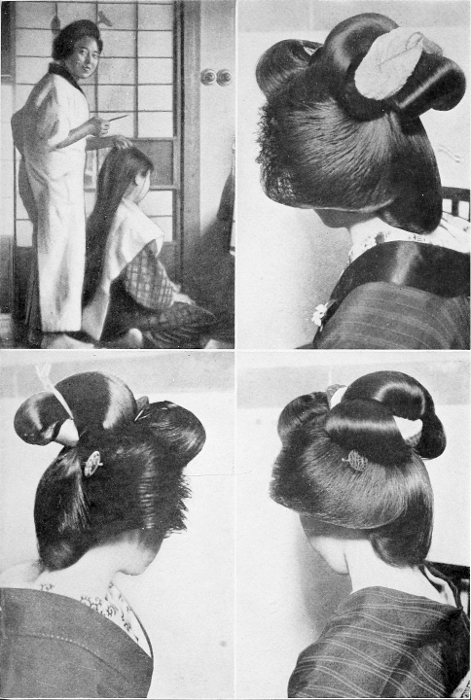
It takes two hours to do a geisha's hair, but the coiffure, once accomplished, lasts several days
CHAPTER XIV
Japan and Italy—The Sense of Beauty—Poetry—Japanese Poems by an American Woman—A Poem on a Kimono—Garden Ornaments—Garden Parties and Gifts—The Four Periods of Landscape Gardening—The Volcanic Principle in Gardens
It is interesting to observe that the two races in which highly specialized artistic feeling is almost universal have, despite their antipodal positions on the globe, many common problems and one common blessing. Both Japan and Italy are poor and overpopulated, both are handicapped by a shortage of arable land and natural resources, both lack an adequate supply of food and raw materials for manufacturing, both are mountainous, both are afflicted by earthquakes; but both are endowed with the peculiar, passionate beauty of landscape which is nature's compensation to volcanic countries—a beauty suggesting that of some vivid and ungoverned woman, brilliant, erratic, fascinating, dangerous.
Where Nature shows herself a great temperamental artist, her children are likely to be artists, too. As almost all Italians have a highly developed sense of melody, so almost all Japanese possess in a remarkable degree the artist's sense of form.
One day in Tokio I fell to discussing these matters with a venerable art collector, wearing silks and sandals.
"What," he asked me, "are the most striking examples of artistic feeling that you have noticed in Japan?"
I told him of two things that I had seen, each in itself unimportant. One was a well-wheel. The well was in a yard beside a lovely little farmhouse, one story high, with walls of clay and timber, and with a thick thatched roof, upon the ridge of which a row of purple iris grew. There was a dainty bamboo fence around the farmyard, with flowering shrubs behind it, and a cherry tree in blossom. The well-house was thatched, and the pulley-wheel beneath the thatch seemed to focus the entire composition. With us such a wheel would have been a thing of rough cast-iron, merely something for a rope to run over; but this wheel had been fondly imagined before it was created. Its spokes were not straight and ugly, but branched near the rim, curving gracefully into it in such a way as to form the outlines of a cherry-blossom. It was a work of art.
My other item was a little copper kettle. I saw it in a penitentiary. It belonged to a prisoner, and every prisoner in that portion of the institution had one like it. The striking thing about it was that it was an extremely graceful little kettle, embellished in relief with a beautiful design. It, too, was a work of art, and there was to me something pathetic in the evidence it gave that even in this grim place the claims of beauty were not entirely ignored.
These trifling observations seemed to please my friend, the art collector.
"But," said he, "I think our national love of the beautiful is perhaps most strongly exhibited in our feeling for outdoor beauty—our pilgrimages to spots famous for their scenery, our delight in the cherry-blossom season, the wistaria season, the chrysanthemum season, and by no means least in our gardens."
Undoubtedly he was right. The feeling for nature among his countrymen is general, mystical, poetic. Almost all Japanese write poetry. The poems of many emperors, empresses, and statesmen are widely known; and among the most celebrated Japanese poems those to Nature in her various aspects are by far the most numerous.
Let me here digress briefly to mention the interesting custom of O Uta Hajime, or Opening of Imperial Poems, a court function dating from the ninth century.
Each December the Imperial Household announces subjects for poems which may be submitted anonymously to the Imperial Bureau of Poems, in connection with the celebration of the New Year. The poems are examined by the bureau's experts, who select the best, to be read to the Imperial Family.
The choice for the year 1921 was made from seventeen thousand poems sent from all parts of the Empire, and when announcement was made of the names of those whose poems were read at the Court, it was discovered that, among them was an American lady, Frances Hawkes Burnett, wife of Col. Charles Burnett, military attaché of the American Embassy at Tokyo. Mrs. Burnett thus attains the unique distinction of being the only foreign woman ever to have won Imperial approval with a poem in the Japanese language.
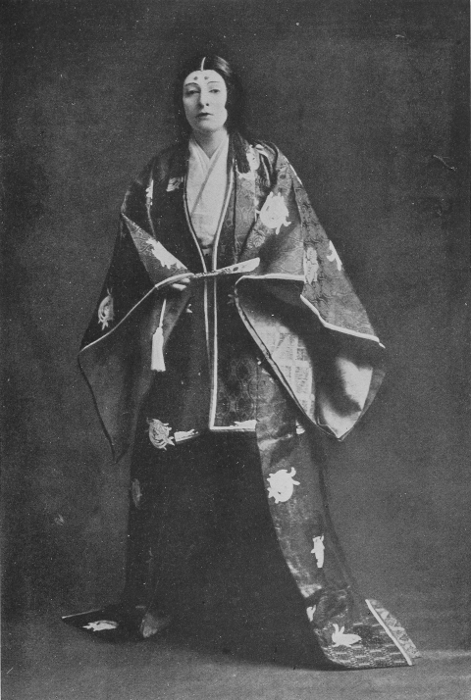
Mrs. Charles Burnett in a 15th-Century Japanese Court costume. Mrs. Burnett's poems written in Japanese have received Imperial recognition
It is interesting, in this connection, to remark that the lady is a grand-niece of the late Dr. Francis Lister Hawkes, of New York, who accompanied Commodore Perry to Japan, and was Perry's collaborator in the writing of the official record of the voyage, published under the title, "The Narrative of the Expedition of an American Squadron."
But to return to my friend the art collector.
"Speaking of poetry and the love of Nature," said he, "have you noticed the kimono of our host's daughter?"
(We were strolling in a lovely private garden as we talked.)
I had noticed it. It was a beautiful costume of soft black silk, the hem, in front, adorned with a design of cherry-blossoms and an inscription in the always decorative Chinese character.
"Do you know what the inscription is?" he asked.
I did not.
"It is a poem of her own," he explained; and presently, when in our stroll we caught up with the young lady, he made me a literal translation, which might be done over into English verse as follows:
Farewell, O Capital! I grieve Thy lovely cherry-blooms to leave. But now to Kioto must I fare To view the cherry-blossoms there.
We fell to talking of Japanese gardens.
"You must see some of our fine gardens," he said, "before you leave Japan."
I mentioned some I had already seen—the gardens of the Crown Prince, the Prime Minister, Marquis Okuma, Viscount Shibusawa, Baron Furukawa, and others.
"But do you understand our theory of the garden?"
I told him what little I then knew: that flowers are not essential to a garden in Japan; that, where used, they are generally set apart in beds, and removed when they have ceased to bloom; that because of the skill of the Japanese in transplanting large trees a garden of ancient appearance may be made in few years; that boundaries are artfully planted out, so that some houses, standing on a few acres of ground in great cities, appear to be surrounded by forests; that small garden lakes are sometimes so arranged as to suggest that they are only arms of large bodies of water concealed from view by wooded headlands; and that optical illusions are often employed to make gardens seem much larger than they are, this being accomplished by a cunning scaling down in the size of the more remote hillocks, trees, and shrubs, increasing the perspective.
Also, I had seen examples of the kare sensui school of landscape gardening—waterless lakes and streams, their beds delineated in sand, gravel, and selected pebbles, and their banks set off by great water-worn stones brought from elsewhere, and by trees and shrubs carefully trained to droop toward the imaginary water—water the more completely suggested by stepping-stones and arched bridges reaching out to little islands, with stone lanterns standing among dwarf pines.
I knew, too, of the fondness of the Japanese for minor buildings in their gardens. Thus in the garden of Viscount Shibusawa, there is an ancient Korean teahouse of very striking architecture; in that of Dr. Takuma Dan, General Manager of the vast Mitsui interests, a farmhouse several centuries old; in that of Baron Okura, a famous museum of Chinese and Japanese antiquities and art works; and in the gardens of Baron Furukawa and Baron Sumitomo, smaller private museums. Tucked away in the corner of one garden near Kobe I had even seen a little factory in which the finest wireless cloisonné was being made, the owner of that garden having a deep interest in this art and using the productions of his artist-workmen to give as presents to his friends. And of course in many gardens I had seen houses built especially for the cha-no-yu, or Tea Ceremony.
Moreover, I had been to garden parties at some of which luncheons were served under marquees of bamboo and striped canvas, while at others were offered entertainments consisting of geisha-dancing and juggling. At such parties souvenirs are always given—fans and kakemono painted by artists on the premises, or bits of pottery which, after being painted, are glazed and fired, and still warm from the kiln, presented to the guests.
"Yes, yes," said my venerable friend, "you have seen a good deal; but as to the history and theory of our gardens, what do you know?"
"Very little," I admitted, and asked him to enlighten me.
Japanese landscape gardening began twelve hundred years ago, when the Emperor Shomu, in residence at Nara, sent for a Chinese monk who was famed for his artistry and ordered him to beautify the ancient capital. This the monk accomplished chiefly by cutting out avenues among the lofty trees which to this day make Nara not only a place of supreme loveliness, but one rich in the aroma of antiquity. Thus came the first period of landscape gardening in Nippon, the Tempyo period.
Five and a half centuries ago the second period began when, in the terrain surrounding the Kinkakuji Temple at Kyoto, gardens containing lakes, rocks, and gold-pavilioned islands were constructed in resemblance to the natural scenery near the mouth of the Yangtse River in China.
The third period is best represented by the gardens of the arsenal in Tokyo. These were made three hundred years ago by a Chinese master named Shunsui, who was brought to Japan for the purpose by the Lord of Mito, brother of the shogun who at that time ruled Japan. In order to get water for this park a canal thirty miles long was constructed, and this same canal later supplied water to the city of Yedo, as Tokyo was then called.
The current period is the fourth, and it is the aim of the present-day masters to combine in their work all the fine points of the preceding periods. This development is largely due to the ease of modern transportation, which has enabled the landscape gardeners of our time to travel widely and become familiar with the best work of their distinguished predecessors and the finest natural scenery. For instance, the Shiobara region, in northern Japan, a district famous for its lovely little corners, has been the inspiration for many modern gardens.
"And now," said my learned friend as we paused in a little shelter of bamboo and thatch, overlooking the corner of a lake bordered with curiously formed rocks and flowering shrubs, "I will tell you the great secret of this art; for of course you understand that with us landscape gardening is definitely placed as one of the fine arts." He paused for a moment, then continued: "The one sound principle for making a garden wherever water is used is what may be called the volcanic principle. That is to say, the artist in landscape gardening should go for his themes to places of volcanic origin; for in such places the greatest natural beauty is found.
"And why? First of all, you have hills of interesting contours, made by eruptions. Then you have mountain lakes which form in the beds of extinct volcanoes. Our famous Lake Chuzenji, above Nikko, for example. From these lakes the water overflows, making splendid falls, like those of Kegon, which empty out of Lake Chuzenji. Below the falls you have a torrent rushing down a rocky valley, like the River Daiya, which flows from the Kegon Falls past Nikko, where it is spanned by the famous red-lacquered bridge. There is the basis for your entire garden composition.
"But you must also remember that volcanic outpourings make rich soil. This soil, thrown into the air by volcanic explosions, settles in the crevices of rocks. Pines take root in it. But in some places the pocket of soil is small; wherefore the roots of the pine cannot spread, and the tree becomes a dwarf, gnarled and picturesque. Again, on the hillsides the rich soil makes great trees grow, with rich shrubbery and verdure beneath them. The torrent completes the landscape effect by sculpturing the rocks into fascinating forms. In that combination you have every element required. Reproduce it in miniature, and your garden is made."
CHAPTER XV
I Acquire Vanity—I Meet a Wise Man—The Distaste for Boasting—Imperial Traditions—The First Ambassadors and Consequent Embarrassments—Trappings of Rank—I Display My Knowledge—And Come a Cropper—The Beauties of Calm
The garden theory of my friend the art collector, so Japanese in its completeness, charmed and satisfied me.
"Now," I thought to myself, "I know."
Thenceforward I looked at gardens not with the unenlightened enthusiasm of the casual amateur, but with a critic's eye. Here and there I would make a mental reservation, saying to myself that the man who made this garden had missed something in one respect or another; that the one great principle, the volcanic principle, had not been fully carried out.
So time went on until presently I found myself in Kyoto, the cultivated city of Japan, seated at a table (upon which were glasses and a bottle) beside one of the most interesting Japanese I had met, a man of ripe age and experience and of a philosophical turn of mind. He loved the history, the legends and the psychology of his native land, and enjoyed sifting them through the interpretative screen of his own intelligence.
I listened to him with eager interest.
"To boast," said he, "is, according to our point of view, one of the cardinal sins. We so detest boasting that we go to the other extreme, depreciating anything or anybody connected with ourselves. Thus, when some one says to me, 'Your brother has amassed a fortune; he must be a man of great ability,' I will reply: 'He is not so very able. Perhaps he is only lucky.' As a matter of fact, it happens that my brother is a man of exceptional ability. But I must not say so; it is not good form for me to praise his qualities.
"In speaking of our wives and children we do the same. We say, 'my poor wife,' or, 'my insignificant wife,' although she may fulfil our ideal of everything a woman should be.
"Also the reverse of this proposition is true. We sometimes signify our disapproval or dislike of some one by speaking of him in terms of too high praise.
"Among ourselves we fully understand these things. It is merely a code we follow. But I fear that this practice sometimes causes foreigners to misunderstand us. Being themselves accustomed to speak literally, they are inclined to take us so. Also, they are not likely to realize that we are most critical of those for whom we have profound regard. Why should we waste our time or our critical consideration upon persons who mean nothing to us or whom we dislike?
"Yet, after all," he continued, with a little twinkle in his eye, "human nature is much the same the world over. There was an American here in Kyoto once who used to forbid his wife and sister to smoke cigarettes, but I observed that he was quick to pass his cigarette-case to other ladies."
He drifted on to a further discussion of differences between the point of view of Japan and that of the Occident.
"For twenty-five centuries," said he, "our emperors never lived behind a fortification. There was no need of it. The present imperial palace at Tokyo is, to be sure, protected by a moat and great stone walls, but that was originally built for shoguns, and was taken over by the Imperial House only at the time of the Restoration.
"Our old Japanese idea is that the Emperor is the father of his people. There is a certain reverence, yet a certain democracy, too, in our feeling on this subject. We who have the old ideas regret that the Emperor now appears in a military or naval uniform. It is too much like the European way, too much like abandoning the feeling that he is the head of the family. For a uniform seems to make him only a part of the army or the navy.
"But we had to modify our customs to suit those of other nations. Ambassadors began to come from foreign lands. The Emperor did not wish to see them, but was obliged to do so because they represented great powers to whom we could not say no.
"At first, when the Emperor received ambassadors, he wore his ancient imperial robes and was seated upon cushions, Japanese fashion. But the ambassadors were arrayed in brilliant uniforms covered with decorations, and in accordance with their home customs they stood in the imperial presence. They would stand before a European king or an American president. Therefore it seemed to them respectful to stand before our Emperor.
"But, according to our customs, that is the worst thing that can happen. We must always be lower than the Emperor; we must not even look from a second-story window when he drives by. The Emperor's audience-room was so constructed that he sat in an elevated place at the head of a flight of steps. But even so, one never entered his presence standing fully erect. The idea of deference was visibly indicated by a stooping position, and as one ascended the steps toward the Imperial Person, one bent over more and more, until, on reaching the plane on which the Emperor was seated, one knelt, with bowed head, so as still to be below him.
"A foreigner, on the other hand, wishing to show proper respect to an exalted personage, would make a bow from the waist and then assume a stiffly erect attitude, almost like a soldier standing at attention. Can you imagine an Occidental admiral or general, with his tight uniform, heavy braid, and sword, approaching any one upon his hands and knees? It would be foreign to his nature and training, not to say ruinous to his costume. 2
"Moreover, the important foreigners who came to Japan at the beginning of the period of transition were gorgeous with gold lace and jewelled decorations. Up to that time we had no decorations and no modern uniforms and trappings of rank. Even our Emperor, in his magnificent robes, was not adorned with gold braid, and no jewels flashed from his breast.
"Naturally, then, we had to change. We created new orders of nobility; decorations were devised, uniforms were designed, all according to the European plan. In the old days we had shogun, daimyo, and samurai. Now we have princes of the blood, princes not of the blood, marquises, counts, viscounts, and barons. We have decorations to shine with foreign decorations. We have field-marshals and admirals to meet the foreign field-marshals and admirals."
He sighed, and looked through the open window to the garden shimmering in moonlight.
"Sometimes," he said, reflectively, "it seems to me that the only place where the spirit of Old Japan can feel at home is when it wanders through our ancient gardens. They are unchanged."
He paused, still gazing through the open window, then went on:
"That is another thing I must talk to you about. We Japanese have a profound feeling about gardens. The structure of a garden is a matter of the first importance. You must see some of our gardens."
"I have done so already," I replied. "I have taken pains to visit many of them, and I——"
"But," he interrupted, "I am not speaking entirely of vision in the sense of sight. One must have understanding of these things. I am talking of the basic principles upon which every garden should be made."
"That is just what I am talking about," I returned, enthusiastically. "It happens that I have made quite a study of your theory of gardens."
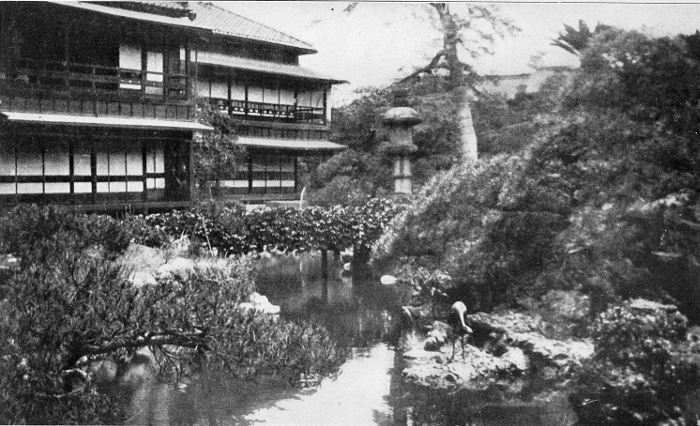
A tea-house garden, Tokyo.—"The artist in landscape gardening should go for his themes to places of volcanic origin."
I must own that I did not speak without a certain complacency. I had the comfortable feeling that always comes to one who hears a subject broached and feels himself well equipped to discuss it.
"That is very gratifying," said the philosopher, politely.
It was indeed very gratifying. My memory was good. I casually mentioned the four periods of Japanese landscape gardening, making easy references to the Emperor Shomu, the scenery near the mouth of the Yangtse River, and the Chinese master Shunsui. Then I began to file my bill of particulars.
"Of course," I said, "the one great secret of the art is to apply the volcanic principle. One should go for themes to places of volcanic origin—places like Lake Chuzenji and Nikko, places where lakes, formed in the beds of extinct volcanoes, overflow, making beautiful waterfalls and torrents which rush through rocky valleys. There, of course, is the basis for your entire garden composition."
He sat staring at me. His eyes shone. Evidently I was making a deep impression on him.
"Of course," I resumed, "volcanic explosions throw rich soil into——"
"Stop!" he cried, half rising from his chair. "Who gave you those theories? Where did you learn all this?"
"In Tokyo," I answered proudly, "I happened to meet——"
"Never mind whom you met," he broke in, his voice trembling with intensity. "These things you have been saying are terrible—terrible! Such ideas are ruining art and beauty in Japan. A garden of that kind is an abomination."
I sat stunned while he stood over me.
"The thing above all others to keep away from," he continued, vehemently, "is anything volcanic. That should be apparent to any one—any one! The very cause of volcanic structure is violence. It is the embodiment of turmoil, unrest." He made a wild gesture with his arms. "A volcano blows up, it explodes—bang! It throws everything about helter-skelter. It is horrible. That is a garden for a madhouse or the palace of a narikin—a new millionaire."
"But don't you think——"
"If one thing is more essential than another in a garden," he went on, ignoring my effort to interrupt, "it is peace, tranquillity, an atmosphere conducive to meditation. Fancy a cultivated gentleman, a philosopher, trying to meditate among volcanoes, waterfalls, and roaring torrents! A garden should have no waterfalls. Water, if it is there at all, should flow as placidly as philosophic thought. There should be no fish darting about, no noisy splashing fountains, no gaudy peonies, or other striking and distracting things. The purpose of a garden should not be display. Its proper purpose is not to excite the beholder, but to fill him with a rich contentment. A garden should be a bathing-place for the soul. And one no more wishes to plunge the soul than the body into a roaring torrent. No; there is in life already too much stress and turmoil. The soul cries out for repose. One must lave it in a crystal pool, healing and refreshing."
He paused, short of breath.
"But don't you think——"
"Say no more! It is late. I must go home."
I walked with him to the garden gate. A new moon hanging in a sky of blue and silver was reflected in a still pool, its margins soft with the dark, cloud-like forms of shrubbery. Near the gate some calla lilies stood like graceful, silent ghosts. The night air was fragrant with the scent of rich, damp soil and growing things.
"But don't you think," I pleaded as I opened the gate to let him pass, "that there is, after all, something poetic in the volcanic conception of a garden?"
"No, no," he cried. "Poetic? No. Good night. Good night. I do not understand this new Japan. There is no repose any more. It is all volcanoes, all exploding. It is the beauties of calm that we are losing. Calm! Yes, that is it, calm! calm! calm!"
His agitated voice, shouting, "Calm! calm! calm!" came back to me as like a typhoon he whirled off into the darkness, leaving me in the sweet quiet of the garden—to meditate.
PART III
CHAPTER XVI
The "Connecticut Yankee" in Old Japan—Commodore Perry—The Elder Statesmen—Marquis Okuma—Self-made Men—Viscount Shibusawa—The Power of the Daimyo—Samurai Privileges, Including That of Suicide—Education in Old Japan—Jigoro Kano and Jiudo—The Farewell Letter of a Patriot—Kodokwan and Butokukai—The Old Military Virtues—General Nogi—His Death With Countess Nogi
Despite the convulsions, overturnings, and transitions through which so many nations have lately been passing, Japan still holds the world's record for swift and stupendous change. The thing that happened to Japan staggers the imagination. History affords no parallel. The nearest parallel is to be found in the fiction of a great imaginative writer. An American or a European going to Japan at approximately the time of the Imperial Restoration of 1868, found himself, in effect, dropped back through the centuries after the manner of Mark Twain's "Connecticut Yankee"; and the Japanese who lived through the transition which then began, met an experience like that pictured in Mark Twain's fantasy as having befallen the people of King Arthur's Court when modern knowledge was suddenly visited upon them.
The true story of Japan, however, surpasses in its wonder the invention of Mark Twain; for whereas the facts of history compelled the author of "A Connecticut Yankee in King Arthur's Court" to let ancient Britain backslide into her semi-barbarism after the disappearance of the Connecticut Yankee, Japan not only changed completely but held her gains and continued to progress.
The beginning of the period of transition is customarily dated from the year 1853, when Commodore Perry first arrived, or from 1854, when he negotiated his treaty; but though that treaty did open the door through which the spirit of change was soon to enter, the actual modernizing of the nation did not start until 1868, when Yoshinobu Tokugawa, fifteenth of his line, and last shogun to govern Japan, relinquished his power to the Emperor.
Men able to remember the events of the Restoration are about as rare in Japan as are those who, in this country, remember the impeachment of Andrew Johnson, which occurred in the same year; and men who played important parts in the Restoration are of course rarer still—as rare, say, as Americans who played important parts in the Civil War. As for Japanese who can recall Perry's visit, they would correspond in years to those who, with us, can recollect the beginning of the struggle for Free Soil in Kansas. In neither land, alas, is there more than a handful of such old folk left.
It so happens, however, that in Japan several very remarkable men have survived to great age.
The three most powerful figures in politics at the time of my visit were the octogenarian noblemen known as the Genro, or Elder Statesmen: Field Marshal Prince Yamagata, Marquis Matsukata, and Marquis Okuma. Prince Yamagata, as a soldier, took an active part in the civil warfare attending the Restoration. Both he and Marquis Okuma were born in 1838—that is to say seven years before Texas was admitted to the Union as the twenty-eighth state. Marquis Matsukata was born in 1840.
Of these venerable statesmen, Prince Yamagata and Marquis Matsukata figured, I found, as great unseen influences; but Marquis Okuma, while perhaps not actually more active than his colleagues of the Genro, appeared frequently before the public, and was more of a popular idol, being often referred to as Japan's "Grand Old Man." In politics he had long been known as a great fighter and an artful tactician; also he was sympathetically regarded by reason of his having been, many years ago, the victim of a bomb outrage in which he lost a leg.
I knew of his having been thus crippled, but through some trick of memory failed to recall the fact when, one day, I found myself a member of a small party of Americans received by the Marquis at his house. We were with him for something more than an hour; perhaps two hours. During that time he stood and made an address, moved about the room, and even stepped out to the garden, yet I was not once reminded of his physical handicap. I have never seen a person so seriously maimed who, in his movements, revealed it so little. And that at eighty-three years of age!
I should have guessed him twenty years younger. Lean, tall, wiry, alert, with close-cropped white hair and snapping black eyes, he appeared to be at the very apex of his powers.
That he was versatile I knew. All three of the Genro have at various times been Prime Minister, and have held other high offices under the Government, but Marquis Okuma's positions have been extremely varied, calling for the display of a wide range of knowledge and of talents. I was told that he had organized the Nationalist Party, published a magazine, edited a number of important literary and historical works, founded and presided over Waseda University, and had long been famed as a horticulturist.
It was a curious thing to hear him speak in a language I could not understand, yet to feel so strongly his gift for swaying men with oratory.
The experience reminded me of that of a newspaper man I know, who accompanied William Jennings Bryan on one of his political speech-making tours long ago.
"I was a dyed-in-the-wool Republican," he told me, in recounting the experience, "and did not believe in Bryan or his measures, yet I continually found myself carried away by his oratory. While he was speaking he made me believe in things I didn't believe in. I would want to applaud and cheer him like the rest of the audience.
"Afterwards I would go back to the train and sober up. I wanted to kick myself for letting him twist me around his finger like that. But the next time I heard him the same thing would happen. It wasn't what he said; it was his voice and phrasing and his magnetism."
I have no doubt that a Japanese unacquainted with English would sense Bryan's elocutionary power precisely as I did that of Marquis Okuma; indeed I am not sure that a foreigner, unfamiliar with the language of the orator, is not in a sense the auditor who can best measure his power.
Marquis Okuma's features indicated extraordinary pugnacity, yet I should say that his pugnacity was under perfect control. He could exhibit both passion and icy coolness, and I believe he could turn on either at will, as one turns on hot or cold water. If he was William Jennings Bryan he was also Henry Cabot Lodge.
It is worth remarking that these Elder Statesmen are without exception self-made men. None of them was born with a title; all were members of modest samurai families; all rose through ability.
In this respect, as in many others, comparisons between the governmental system of Imperial Japan and that of Imperial Germany that was, do not hold. Japan is not governed by a hereditary ruling class. The government service is open to all men, under a system of competitive examinations, and promotion does not go by family or favour, but is in almost all cases a recognition of ability exhibited in minor offices. Young men in the consular service are in line for ambassadorships and may reasonably hope, if they exhibit great talents, ultimately to reach the highest offices.
It would seem, moreover, that in Japan as in some other lands, aristocratic and wealthy families do not, as a rule, produce the strongest men. Thus I was informed that, of the entire cabinet of Prime Minister Hara, but one member was a man of noble family, that one having been Count Oki, Minister of Justice. And even Count Oki was only of the second generation of nobility.
In the business world the same rule applies. The titled business men of Japan have risen, practically without exception, from humble beginnings. I was told that one of them, whom I met, had begun life as a pedlar, and was proud of it. Looking up another business genius in the national "Who's Who," I find the following statement, which may be assumed to have been furnished by the gentleman to whom it refers:
Arrived in Tokyo in '71, with empty purse; proceeded to Yokohama, supporting himself by hawking cheap viands.
If the honorary title, "Grand Old Man of Japan," had not already been conferred, and I had been invited to make nominations, I should have gone outside the realm of politics and cast my vote for Viscount Eiichi Shibusawa.
Had the Viscount been, at the time of the Restoration, a member of one of the great clans responsible for the return of the reins of government to Imperial hands, his career might have resembled more closely the careers of the three old nobles of the Genro. But whereas Prince Yamagata, Marquis Matsukata, and Marquis Okuma were respectively men of Choshu, Satsuma, and Saga—clans that cast their lot with the coalition that returned the Emperor to power—Viscount Shibusawa was on the other side, having been a retainer of the last shogun.
The spoils went, naturally enough, to the victors. Strong men belonging to the clans which had supported the Imperial House became the strong men of the centralized government. Even to-day, when clans, as such, no longer exist, the old clan sentiment survives, with the result that men of Satsuma and Choshu origin are most influential in politics. The militaristic tendency sometimes noticed in the action of the Japanese Government is said to be largely due to this fact, for the clan of Satsuma was in the old days notorious for its warlike inclinations, and there is evidence to show that those inclinations have, to some extent survived. Naval officers are to-day drawn largely from old Satsuma families, while Choshu furnishes many officers to the army.
At twenty-seven years of age, Viscount Shibusawa had by his ability become vice-minister of the Shogun's treasury. Naturally, then, after the fall of the shogunate, he went in for finance. He founded the First Bank of Japan—literally the first modern bank started there—and, prospering greatly became a man of large affairs. Repeatedly he was offered the portfolio of Finance under the Government, but always refused it. A few years ago he retired from active business, and as has already been mentioned, gave his time thereafter to all manner of good works.
When I met him he was nearing his eighty-second birthday. He distinctly remembered Perry's arrival in Japan and the events that followed. I wished to get the story of a representative man who had seen these things, and therefore asked him to grant me an interview. This he was so kind as to do, allowing me the better part of two days—for interviewing through an interpreter, even though he be the best of interpreters, is slow work.
We talked in a pretty brick bungalow in the Viscount's garden. Outside the door was an English rose-garden, with bushes trained to the shape of trees.
Prior to that time I had always seen the Viscount wearing a frock coat or a dress suit, but here at home, on a day free from formalities, he was clad in the silken robes that Japanese gentlemen put on for comfort—though they might well put them on for elegance, too.
Short, stocky, energetic, with a strong neck and large round head, the face seamed with deep wrinkles, he was one of the most extraordinary-looking men I had ever met. He radiated force, courage, honesty. I knew a Sioux chief, long ago, who had a face like that, even to the colour, and to the deep wrinkles of humour about the mouth and eyes. Nor, in either case, did the promise of those wrinkles fail.
When, having likened Viscount Shibusawa to an Indian chief, I also liken him to a barrel-bodied, square-jawed, weather-beaten old British squire of the perfect John Bull type, I may overtax the reader's imagination; yet there was in him as much of the one as of the other.
He was born in the country, coming of a good but not aristocratic family. The Japan of his youth and early manhood was divided into some two hundred and fifty or three hundred feudal districts, each ruled by a daimyo, or chieftain, having his castles, his court, his concubines, his retainers—among the latter soldiers in armour, equipped with swords, spears or bows and arrows, and wearing hideous masks calculated to terrify the foe.
These chiefs had absolute power over the people and lands in their domains. They could make laws, issue paper money, levy taxes, impose labour and punishment on the people, or arbitrarily take from them property or life itself.
It was a land without railroads, without steam power, without window-glass; a land in which nobles journeyed by the highroads in magnificent processions, surrounded by their soldiers, mounted and afoot, their lacquered palanquins, their coolie bearers; a land in which, when great lords passed, humble citizens fell to their knees and touched their foreheads to the ground; a land of duels, feuds, vendettas, clan wars; a land in which the samurai, or gentry, alone were allowed to wear swords, and in which one of the privileges most highly prized by the samurai was that of dying by his own hand, if condemned to death, instead of by the hand of the executioner. Involved with the privilege of hara-kiri, or seppuku, was a property right. The property of a man beheaded by the executioner was confiscated, whereas one committing hara-kiri could leave his estate to his family.
The education of young men varied in those times according to rank. Youths of the aristocracy were instructed in the Chinese classics, which in Japan take the place of Latin and Greek with us. Medicine and astronomy were also taught. The sons of lesser samurai received a training calculated to fit them for practical affairs. All those entitled to wear swords studied swordsmanship, and the process by which they learned it was sometimes severe, for it was the custom of masters to attack the pupil suddenly from behind, or even when he was asleep at night, on the theory that he should be ready at all times to defend himself. A samurai found killed with his sword completely sheathed was disgraced. At least two inches of the blade must show in proof that the dead man had attempted a defence. Jiu-jutsu was also taught to many samurai youths, and in this, as in swordsmanship, it was the practice of instructors to make surprise attacks upon their pupils.
Viscount Shibusawa's recollections of old days, as he recounted them to me, will make a separate chapter, but before that chapter is begun, let me mention several points of samurai tradition—among them jiu-jutsu, and the more advanced art or science of jiudo, developed by my friend Mr. Jigoro Kano.
As after the Restoration the craze for all things American and European spread through Japan, the old arts of jiu-jutsu, which for more than three centuries had been practised by samurai, fell into disuse. Before that time there had been many different schools of jiu-jutsu, teaching a variety of systems, but as the old masters of the art became superannuated no followers were arising to take their places.
In 1878, when Mr. Kano took up the study of jiu-jutsu, he saw that, through lack of interest, many of the fine points of the art were likely to be lost. In order to preserve as much of it as he could, he went to great pains to make himself proficient, not merely in one system of jiu-jutsu, but in several systems as taught by the several great masters then alive.
His first interest in jiu-jutsu arose through the fact that he had been a weak child and wished to make himself a strong man. I was reminded of Theodore Roosevelt's sickly childhood when Mr. Kano told me that; and it is interesting to recall that it was President Roosevelt who first caused jiu-jutsu to be widely talked of in the United States, and that he studied it, while in the White House, under one of Mr. Kano's pupils. Also I was interested to hear from Mr. Kano that, as a young man, he gave an exhibition of jiu-jutsu before General Grant, at Viscount Shibusawa's house in Tokyo.
Far from being a professional athlete, Mr. Kano is a gentleman of samurai family, a graduate of the Literary College of the Imperial University, a linguist, a traveller, an educator of high reputation, the holder of several decorations. Among other offices he has been head master of the Peers' School in Tokyo.
As the reader is doubtless aware, the theory of jiu-jutsu was to defeat the adversary, not by pitting force against force, but by yielding before the opponent's onslaughts in such a way as to turn his strength against him.
Jiudo, which means "the way or doctrine of yielding," is a combination, created by Mr. Kano, of all systems of jiu-jutsu interwoven with a plan of mental, moral, and physical training, calculated to elevate the art above any mere consideration of combat alone—although that side is by no means neglected.
Innumerable stories, exciting or amusing, might be told of the heroic adventures of celebrated jiudoists, but I know of nothing which sheds more light upon Mr. Kano's teachings, in their moral aspect, than does a letter written to him by Commander Yuasa of the Japanese Navy, a former pupil of the Kodokwan, the school of jiudo established by Mr. Kano in Tokyo. The letter was written by Commander Yuasa when he was about to take the steamer Sagami Maru and sink her at the harbour entrance in the third blockading expedition at Port Arthur. The following are extracts from it:
We shall do all that human power can, and leave the rest to Heaven. Thus we can calmly ride to certain death. I am happy to say that among the members of this forlorn hope are three of your former pupils: Commander Hirose, Lieutenant Commander Honda, and myself. May this fact redound to the credit of the Kodokwan.
Though I greatly regret that while living I could not do justice to the kindness you have shown me, still please accept as an expression of my gratitude the fact that I lay down my life for the sake of our country, as you have so kindly taught us, in time of peace, to be ready to do.
The writer of this letter was lost, as was also Commander Hirose, one of the brother officers he mentions. The other, Lieutenant Commander Honda, was wounded by a shell, but was rescued and lived to tell the tale.
Foreigners visiting Japan and wishing to see jiudo demonstrated, are welcome at the Kodokwan, where, if notice is given, an interpreter is provided. There are now some twenty thousand practitioners of jiudo who look to the Kodokwan as headquarters and to Mr. Kano as their master.
Another place where jiudo may be witnessed is at the Butokukai—Association for the Inculcation of the Military Virtues—in Kyoto. The latter is a private organization, like an athletic club, with a fine temple-like building, and many branch establishments throughout the country. It has some two hundred thousand members, of which several thousands are active.
The primary idea of this organization is to keep alive certain old Japanese military arts, such as jiudo, archery, fencing, the use of lances and spears, and the employment of the curious lance-like naginata, which, with its curved blade and long handle, was used only by women.
Contests between men armed with dummy swords and women using wooden naginata are sometimes to be witnessed at the Butokukai, and are extremely interesting as recalling the days when the women of Old Japan fought beside their men, using the naginata as an offensive weapon, and a short dagger, worn in the fold of the obi, as a defensive weapon corresponding to the shorter of the two swords that men used to wear.
Samurai women were taught to defend themselves with the dagger, and to use it for suicide if in fear of defeat and dishonour. Families in which the samurai tradition is sedulously maintained still make it a custom to present their daughters, at the time of marriage, with daggers of this type, though such weapons are now recognized merely as emblems of a spirit to be preserved.
The great modern samurai hero of Japan was General Count Nogi, the hero of Port Arthur, in memory of whom a shrine was recently dedicated in Tokyo.
This shrine stands in the grounds behind the simple house in Tokyo where Count and Countess Nogi lived, and where they died together by their own hands. Nogi is canonized in Japan, and his house is held a sacred place, and is visited by thousands of persons each year.
The theory upon which self-destruction is practised according to the old samurai tradition, and is widely approved in certain circumstances, is one of the things that baffles the Occidental mind.
I therefore asked Viscount Kentaro Kaneko, who knew General Nogi, to tell me the story of his death, and to explain to me how he came to commit seppuku.
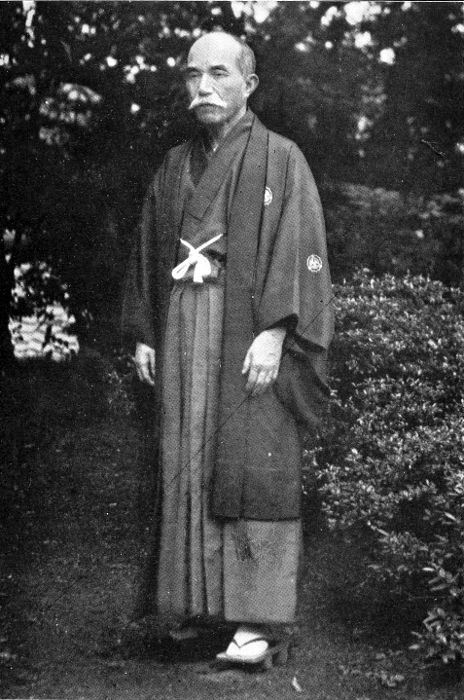
Viscount Kentaro Kaneko (Harvard '78), Privy Councilor to the Emperor, President of the America-Japan Society of Tokyo, and friend of President Roosevelt
"When Nogi was given command at Port Arthur," said the Viscount, "his two sons were officers under him. He told his wife to prepare three coffins, and to hold no funeral services until all three were ready to be buried together.
"In the assault on Port Arthur some thirty thousand Japanese soldiers gave up their lives. This sacrifice of life was at first much criticized in Japan, but public sentiment changed in face of the fact that the General lost both his sons. He returned to Japan a victor, it is true, but a most unhappy man. Always in his mind were thoughts of the families of the thirty thousand brave young men it had been necessary to sacrifice. He did not want to be acclaimed in the streets, but to be let alone. He went about in an old uniform and tried to be as inconspicuous as possible.
"One day at an audience with the Emperor Meiji, Nogi said to him as he was leaving, something to the effect that he should never see him again.
"The Emperor, gathering that Nogi was contemplating seppuku, called him back.
"'Nogi,' he said, 'I still have need of you. I want your life.'
"So the General did not carry out his plan at that time, but lived on, as the Emperor had ordered him to do, becoming president of the school at which the sons of nobles are educated.
"All through the years, however, he was haunted by the memory of the thirty thousand soldiers he had been compelled to send to their death.
"When the Emperor Meiji died, Nogi was one of the guard of honour, made up of peers, who in rotation watched at the Imperial bier for forty days and forty nights.
"Then came the state funeral. On the day of the funeral Nogi wrote a poem which declared in effect, 'I shall follow in the footsteps of Your Majesty.' This poem he showed to Prince Yamagata, who took it to mean merely that Nogi would be in the procession following the Imperial remains to the grave.
"But when the guns announced the departure of the funeral cortège from the palace, Nogi was not there. Like the samurai of old, he desired to follow his dead master into the beyond. At the sound of the guns he took his short sword and committed seppuku, while in the next room Countess Nogi, his devoted wife, dressed all in white, cut the arteries of her neck. Thus the two died together, for the sake of the Emperor and the thirty thousand soldiers who had sacrificed their lives."
At no point is the outlook of the Oriental more completely at odds with that of the Occidental, than in the view it takes of suicide.
Whereas with us suicide is condemned as cowardly, being resorted to as a means of escape from the hardships of life, there will oftentimes be something highly heroic in a Japanese suicide. Unhappiness, it is true, does drive some Japanese to self-destruction, but in many other cases the suicide represents something more in the nature of a self-inflicted punishment for failure of some kind. Thus it is with the schoolboys who sometimes kill themselves because they have failed in their examinations. Likewise, while in Japan I heard of two railroad gatemen who had, by failing to close their gate when a train was coming, been responsible for the death of a man travelling in a ricksha. A few days after this accident both these gatemen suicided by throwing themselves beneath a train. For their neglect they paid voluntarily with their lives.
"And," said the Viscount, "we had in the old days another sort of suicide, examples of which sometimes occur even to this day. When a man believed profoundly in something, and was unable to attract attention to the thing in which he believed, he would sometimes commit seppuku as a means of drawing notice to it. He would leave a paper setting forth his beliefs, and people would give it attention, feeling that if a man was willing to die in order to emphasize a point, his message was worth considering."
The Viscount paused. Then rather reflectively he added: "It is as though he were to underscore his protest—in red."
CHAPTER XVII
The Old-time Anti-Foreign Sentiment—Prince Yoshinobu Tokugawa—Emperor and Shogun—Prince Yoshinobu becomes Shogun—His Highness, Akitaké, Goes to France—Humorous Episodes—The Defeat of Prince Yoshinobu's Army—Various Explanations—The Restoration of the Emperor—Prince Yoshinobu's Retirement—The Viscount's Theory—Prince Keikyu Tokugawa—A Roosevelt Anecdote—Swords and Watchchain
"I was a boy of fourteen," said Viscount Shibusawa "when your Commodore Perry came to Japan. At that time, and for a considerable period afterwards, I was 'anti-foreigner'—that is, I was opposed to the abandonment of our old Japanese isolation, and to the opening of relations with foreign powers.