Front matter (continued 5)
Reading edition
I was considerably entertained in Japan; my sightseeing was oftentimes facilitated by Japanese friends; but the significant fact is that no one ever tried to prevent my seeing anything I wished to. And I wished to see everything, good and bad. I visited the lowest slums, a penitentiary, a poorhouse, a hospital, and some factories. I asked questions. Sometimes they were embarrassing questions—about militarism in Japan, about Shantung, about Korea and Formosa, about Manchuria and Siberia. And though I do not expect any Japanese-hater to believe me, I wish to declare here, in justice to the Japanese, that they gave me the information I asked, even though to do so sometimes pained them.
I saw and learned things creditable to Japan and things discreditable, just as in other lands one sees and learns things in both categories. I found the Japanese neither angels nor devils. They are human beings like the rest of us, having their virtues and their defects.
I came away liking and respecting them as a people. This fact I proclaim with the full knowledge that those who do not like them will accept it, not as a sign of any merit in the Japanese, but as proof of my incompetence, or worse.
"But you have not been to China," some of my friends say. "You would like the Chinese better than the Japanese."
That may be true or it may not. I am inclined to believe that there is, on the surface, more natural sympathy and understanding between Americans and Chinamen than between Americans and Japanese. The Chinaman is more easily comprehensible to us. Also he is meek. We can talk down to him. He will do as we tell him to. He is not a contender—as the Japanese very definitely is—and is therefore easier to get along with. As an individual he has many qualities to recommend him, though neither patriotism nor cleanliness seems to be among them.
If I ever go to China I shall hope and expect not to fall into the mental grooves which lead travellers in the Orient generally to feel that if they like a Chinaman they cannot like a Japanese, and vice versa. I hereby reserve the right to like both.
China appears to be an amiable, flaccid, sleepy giant who has long allowed himself to be bullied, victimized, and robbed. Japan, on the other hand, is a small, well-knit, pugnacious individual, well able to look after himself, and profoundly engaged in doing so. Naturally the two do not get on well together, and equally naturally the impotent giant comes off the worse. One is, to that extent, sorry for him, but one can hardly respect him as one would were he to rise up and assert himself. One may, on the other hand, wish the little Japanese less obstreperous, but one is bound to respect him for his prowess. Physically and materially he has earned for himself the undisputed leadership of the Far East. There remains, however, the question whether he is spiritually great enough to become, as well, a moral leader. In that question is bound up the future of the Orient. Some signs are hopeful, some are not. The answer is locked in the vaults of time to come.
It is not surprising that the Japanese are proud of the leadership they have already attained. Being relatively new members of the hair-pulling, hobnailed family we call the Family of Nations, and having rapidly become important members, they are inclined to harp more than necessary upon this importance, so novel and so gratifying to them. They like to talk about it. They delight in proclaiming themselves a "first-class power." They rejoice exceedingly in their alliance with Great Britain, not because the alliance itself has any very real importance (in view of the attitude of Australia and Canada toward Japan, and of Britain's regard for American sentiment, it cannot have), but because of the flattering association. Japan likes to be seen walking with the big fellows. In this she reminds one somewhat of a youth in all the pride and self-consciousness of his first pair of "long pants."
Now there is this to be remembered about a youth in his first "long pants": he requires careful handling. If you treat him like a child, either patronizing or ignoring him, you will offend him mortally, and not impossibly drive him to some furious action in assertion of his manhood. But if, on the other hand, you are misled by his appearance of maturity, and expect of him all that you would expect of a thoroughly ripened man, then you are very likely to find yourself disappointed.
There is but one course to be pursued with a youth in this intermediate stage. He must be managed with tact, firmness, and patience. In dealing with the young, many adults fail to understand this, and in dealing with a nation in a corresponding state of evolution, other nations are as a rule even stupider than adult individuals.
Britain, wisest of all the world in international affairs, has not made this mistake in her relations with Japan. The alliance is one proof of it. The visit of the Crown Prince of Japan to England in the spring of 1921, is another. Nor was the tact of Britain in this situation ever better displayed than in King George's speech, when, toasting the Imperial guest, he said:
"Because he is our friend we are not afraid for him to see our troubles. We know his sympathy is with us and that he will understand."
Would that the United States might draw the simple lesson from these two short sentences spoken by England's king. Would that we might learn to take that amiable tone. Would that Americans might understand how instantly the Japanese—yes, and all other nations—respond to such approaches.
The problem of maintaining friendly relations with this neighbour on the other side of the Pacific is not, in truth, nearly so difficult as many of our other problems. It has been rendered difficult chiefly by our own incredible bungling.
Among men a bungler is oftentimes feared and disliked exactly as if he were malevolent, and among nations the situation is the same. No nation, however strong, can afford to give offence unnecessarily to other great powers; and the United States can least of all afford to irritate needlessly those powers with which her front yard and her back yard are shared: namely, Britain and Japan. Yet we are constantly annoying these two nations without accomplishing any counterbalancing good purpose.
Britain, feeling, as we do, the tie of consanguinity, and having, moreover, a shrewd eye to her own interest, forgives us, or at least appears to. But in the case of Japan we are dealing with a very different situation. There is no blood relationship to ease the strain; nor is there always in Tokyo the calm, phlegmatic, self-interested statesmanship of London. Tokyo is sometimes temperamental.
If we continue to bungle we shall ultimately gain the lasting ill-will of Japan, and if we do that we shall almost certainly find ourselves looking out of our back window not merely at a frowning Nippon, but at a coalition between Japan, Russia, and Germany—a coalition into which we ourselves, by our attitude, shall have driven Japan.
It is for us to decide whether we wish to encourage such an alliance.
With Mr. Hughes in the State Department we have, it appears, good reason to be hopeful, but Mr. Hughes has not as yet had time to accomplish much of an improvement in American-Japanese relations. If he does so he will be the first American statesman to have made headway in the matter since Roosevelt was in the White House and Elihu Root in the State Department; for not since their time has there been evident in our dealings with Japan a definite and understanding policy. The failure of our diplomacy is all too plainly reflected in the steady diminution of the good feeling which then existed.
Though he never visited Japan, Roosevelt, with his amazing understanding of people, managed to sense the Japanese perfectly. He knew their virtues and their failings. He realized precisely the state they had attained in their evolution from mediævalism to modernity. He knew their samurai loyalty and pride, their sensitiveness, their love of courtesy.
"Speak softly and carry a big stick," he used to say. In those words is summed up a large part of his foreign policy. He knew when to send a bearskin to the Emperor, and when to send a fleet.
Even when he sent that fleet of sixteen battleships, the visit paid was one of courtesy. And courtesy, as I have tried to show, is never, never lost upon Japan.
PART IV
CHAPTER XXII
The Missing Lunch—The Japanese Chauffeur—The Little Train—Japanese Railroads—The Railway Lunch—The Railway Teapot—Reflections on Some American Ways—Are the Japanese Honest?—A Story of Viscount Shibusawa—Travelling Customs—An Eavesdropping Episode
Neither the box of lunch nor the automobile to take us to the station was ready, though both had been ordered the previous night. We waited until twenty minutes before train time; then made a dash for the station in a taxi which happened along providentially—something taxis seldom do in Tokyo.
The drive took us several miles across the city. Through a picturesque and incoherent jumble of street traffic, over canals, past the huge concrete amphitheatre in which wrestling bouts are held, across a steel bridge spanning the Sumida River, through a maze of muddy streets lined with open-fronted shops partially protected from the hot sun by curtains of indigo cotton bearing advertisements in large white Chinese characters, we flew precariously, facing collisions half a dozen times yet magically escaping them as one always does behind a Japanese chauffeur. It is said that the Japanese chauffeur is not, as a rule, a good mechanic. As to that I cannot say, but I assure you he can drive. At an incredible speed he will whirl you through the dense slow-moving crowds of a street festival or around the hairpin curves of a muddy mountain pass with one wheel following the slippery margin of a precipice, but he will never hurt so much as a hair of your head, unless, perchance, it hurts your hair to stand on end.
The Ryogoku Station, where we found our friends awaiting us, is a modest frame structure, terminus of an unimportant railway line serving the farming and fishing villages of the Boso Peninsula—which depends from the mainland in such a way as to form the barrier between Tokyo Bay and the Pacific.
The train seemed to have been awaiting us. It started as soon as we had boarded it, and was presently rocking along through open country at twenty-five or thirty miles an hour. There was something of solemn playfulness about that little train. The cars were no heavier than street cars and the locomotive would have made hard work of drawing a pair of Pullmans, yet in its present rôle it gave a pompous performance, hissing, whistling, and snorting as importantly as if it had been the engine of a great express. The little guards, too, joined gravely in the game, calling out the names of country stations as majestically as if each were a metropolis. And the very landscape took its place in the whimsy, for our toy train ran over it as over a flat rug patterned with little green rice fields.
The Japanese Government, which so woefully mishandles its telephones and cables, does better with its railroads. They are fairly well run. Trains are almost invariably on time, and the cars are not uncomfortable, although the narrower gauge of the Japanese roads makes them necessarily smaller than our cars.
The ordinary Japanese sleeping-car is divided into halves. One half is like an American Pullman sleeper, very much scaled down in size, while the other half resembles a European wagon-lit in miniature, with a narrow aisle at one side and compartments in which the berths are arranged transversely to the train.
As in Europe, there are three classes of day coaches. Except where trains are overcrowded, as they often are, one may travel quite as comfortably second-class as first. Coaches of all three classes are like street cars with long seats running from end to end at either side. Usually the car is divided in the middle by a partition, the theory being that one end is for smokers; but in practice the Japanese, who are inveterate users of tobacco, seem to smoke when and where they please while travelling.
Express trains carry dining cars which are like small reproductions of ours. Some of these diners serve Japanese-style meals, some European, and some both.
Much thought has evidently been given to making travel easy for English-speaking people. Each car of every train carries a sign giving, in English, the train's destination; time-tables printed in English are easily obtained, railroad tickets are printed in both languages, and the name of each town is trebly set forth on railroad station signs, being displayed in English, in Chinese characters, and in kana.
As in the United States, station porters wear red caps but they have the European trick of passing baggage in and out of the car windows, so that the doorways are not blocked with it when passengers wish to get on and off. Also at stations of any consequence there are boys wearing green caps, who peddle newspapers, tea, and lunches.
The Japanese railway lunch is an institution as highly organized as the English railway lunch. On the platforms of all large stations you can purchase almost any sort of lunch you desire, neatly wrapped in paper napkins and packed in an immaculate wooden box. On each box the date is stamped, so that the traveller may be sure that everything is fresh. You may get a box containing liberal portions of roast chicken and Kamakura ham, with salad and hard-boiled eggs and a dainty bamboo knife and fork; or if you wish a light repast, a box of assorted sandwiches, thin and moist as sandwiches should always be but so seldom are. Or, again, you may get a variety of Japanese dishes, similarly packed.
On this trip I selected a box of that delicacy known as tai-meshi, and was not sorry that my order for lunch had been overlooked at the hotel. Tai-meshi consists of a palatable combination of rice and shredded sea-bream cooked in a sauce containing saké which obliterates the fishy taste of the sea-bream. The box cost me the equivalent of seventeen cents, chop-sticks included. From the green-cap boy who sold it to me I also purchased, for five cents, an earthenware pot containing tea, and a small cup, and when I had drunk the tea I learned that I could have the pot refilled with hot water at practically any station, for a couple of cents more.
Just as your English traveller leaves the railway lunch basket in the train when he is done with it, your Japanese traveller leaves the teapot and cup. Drinking the philosopher's beverage I found myself wondering whether such a system would be successful in the United States. I concluded that it would not. Some of the lunch-baskets and teapots would get back to their rightful owners, but many would disappear. There is a certain type of American, and he is numerous, who has a constitutional aversion to conforming to a nice, orderly custom of this kind. He has too much—let us call it initiative—for that. If he thought the lunch-basket and teapot worth taking home he would take them home; nor would he be deterred by the mere fact that they were not his, having only been rented to him. His subconscious sense of the importance of his own "personality" would lift him over any little obstacle of that kind. Without thinking matters out he would feel that because he had used them they were his. What he had used no one else should use—even though its usefulness to him was past. Wherefore, if he thought the basket and the teapot not worth taking, he would stamp his "personality" upon them. He might take the basket apart to see how it was made, or he might draw out his penknife and cut holes in it. Then he would consider what to do with the teapot. Finding that it fitted nicely in the palm of his hand, and sensing by touch its brittleness, he would want to use it as a missile. If he prided himself on the accuracy of his pitching he would throw it at a telegraph pole, but if he felt quite certain that he could not hit a pole he would wait for a large rock pile or a factory wall, and would hurl it against that with all his might, to make the largest possible explosion.
People often ask me whether the Japanese are honest. Doubt on this subject is, I believe, largely due to the old story that Chinese tellers are employed in Japanese banks—all Chinamen being trustworthy and all Japanese the reverse. I know of no better example of the vitality of a lie than is afforded by the survival of this one. It is a triple lie. Japanese banks do not have Chinese tellers. The Japanese as a race are no more dishonest than other people. The leading bankers of Japan, many of whom I have met, are men of the highest character and the greatest enlightenment, and would be so recognized in any land. Nor is this merely my opinion. It is the opinion I have heard expressed by several of the greatest bankers and manufacturers in the United States—men who have done business with Japanese bankers and who know them thoroughly.
It is true that trademarks and patented articles manufactured in other countries have been stolen by some Japanese manufacturers and merchants, and that this abominable practice is to some extent kept up even to-day. But conditions in this respect are improving as business morality grows. Nor should it be forgotten that the present standard of international commercial ethics, which so strongly reprehends such thefts, is comparatively a new thing throughout the entire world. It must, however, be admitted that Japan is not, in this particular, fully abreast of the other great nations.
As for the average of probity among the people at large I can say this—that if I were obliged to risk leaving a valuable possession in a public place, on the chance of its being found by an honest person and returned to me, I should prefer to take the risk in Japan, than in most other countries. Certainly, I should prefer to take it there than in the United States—unless I could specify certain rural sections of the United States, where I should feel that my chances were better than in the neighbourhood of New York.
The Japanese are respecters of property, private and public. One may visit the historic buildings of Japan without seeing a single evidence of vandalism. I was immensely struck by this. It was so unlike home! More than once, over there, I thought of a visit I paid, some years ago, to Monticello, the beautiful old mansion built near Charlottesville, Virginia, by Thomas Jefferson, and of what the caretaker told me. All visitors, he said, had to be watched. Otherwise vines would be torn from the walls of the house, bricks chipped, and marble statuary broken. They had even found it necessary to build an iron fence around Jefferson's grave to protect the monument from American patriots who would like to take home little pieces of it.
The custom of visiting historic places and the graves of historic figures is much more common in Japan than in America. Many of Japan's most famous monuments are entirely unprotected, but instead of knocking them to pieces to get souvenirs the pilgrim will burn a little incense before them, and perhaps leave his visiting card on the spirit of the departed. Or he may write a poem.
Dr. John H. Finley has told me a story which well illustrates the delicate and reverential attitude of the Japanese in such matters.
When Baron—now Viscount—Shibusawa came to the United States several years ago, a banquet was given in his honour in New York by the Japan Society, of which Doctor Finley was then president.
At the banquet Doctor Finley remarked to the guest of honour that he heard he had sent an emissary with a wreath to be laid upon the grave of Townsend Harris, first American Minister to Japan, who is buried in Brooklyn.
"No," said Baron Shibusawa, "that is not exactly what occurred. I did not send the wreath. I took it myself and laid it on the grave. And I wrote two poems in memory of Townsend Harris and hung them in the branches of a Japanese maple tree overhanging his resting-place."
But let us get back to our little railroad train.
The men among our Japanese fellow travellers were sitting on the seats with their feet on the floor, as we do, but the women and children had slipped off their clogs and were squatting in the seats with their backs to the aisle, looking out of the windows or dozing with their heads resting upon their hands, or against the window-frame. One elderly lady was lying at full length on the seat, asleep, with her bare feet resting on the cushions.
The Japanese are much less fearful than we of the interest of fellow passengers, and indeed, so far as concerns strangers of their own race, they are justified in this, for Japanese travellers pay little or no attention to one another. In foreigners they are more interested. A Japanese who can speak English will frequently start a conversation with the traveller from abroad, and will almost invariably endeavour to be helpful. Rustics stare at the stranger with a sort of dumb interest, just as American rustics might stare at a Japanese; and young Japanese louts sometimes snicker when they see a foreigner, and comment upon him, just as young American louts might do on seeing a Japanese passing by—especially if he was wearing his national costume.
"Pipe the Jap," a New York street-corner loafer might exclaim; while similarly an ill-bred youth of Tokyo, Kobe or Yokohama might remark: "Keto," which means "hairy foreigner." The term keto is not intended to be complimentary, yet no more real harm is meant by its user them would be meant by an American smart-aleck who should speak of "chinks," "kykes" or "micks." Such terms merely exemplify the instinctive hostility of small-minded men the world over, for all who are not exactly like themselves.
Some Japanese country folk who sat opposite us on our journey to the Boso Peninsula were clearly much interested in us—particularly in the ladies of our party, and as so few foreigners understand the Japanese language, they felt safe in talking us over amongst themselves.
"What a strange little thing to wear on one's head!" said the husband, to the wife referring to a neat little turban worn by one of our ladies.
"Yes," said the wife, "and I don't see how she can walk in those shoes with their tall, thin little heels. Aren't they funny!"
These remarks and others revealing their interested speculations as to which women of our party were married to which men, were translated to us by the friend who had organized the excursion. Being a good deal of a wag, he let them talk about us until the subject seemed to be exhausted. Then he addressed a casual question, in Japanese, to the husband across the way. I have seldom seen a man look more disconcerted than that one did just then. He answered the question, but that was the last word we heard him speak. Though an hour passed before he and his wife got off the train, and though they had until then talked volubly together, the complete silence which came over them was not broken by so much as a monosyllable until they reached the station platform. There, however, we saw that they had begun to talk again, and with gestures showing not a little agitation. I had a feeling that each was blaming the other for the whole affair. Relations between husband and wife are, in some respects at least, a good deal more alike in all countries than is commonly supposed.
CHAPTER XXIII
Katsuura and the Basha—A Noble Coast—Scenes on a Country Road—The Fishers—A Temple and Tame Fish—We Arrive at an Inn—I See a Bath—I Take One—Bathing Customs—The Attentive Nesan—In the Tub
A journey of about three and a half hours brought us to the seacoast town of Katsuura, the terminus of the little railway line. The industry of Katsuura is fishing, and there is a kind of dried fish put up there which has quite a reputation. Almost every town in Japan has some specialty of its own, whether an edible or something else—something for the traveller to purchase and take home as a souvenir. Many of the best Japanese colour-prints were originally made for this purpose—souvenirs of cities and towns, celebrated inns, famous actors, and notorious courtesans.
Leaving the train we got into a basha—a primitive one-horse bus with tiny wheels—and took a highway leading south along the shore. The day was brilliant and our road, skirting the edge of the lofty coastal hills half way between their green serried peaks and the yellow beach on which the surf played below, was white and dusty in the hot sun. On level stretches and down-grades we rode in the basha, but we always got out and walked up hills to spare the venerable horse. Nor will travellers who have ever followed such a system be surprised that, of the twenty miles we covered on our way to Kamogawa, fully fifteen seemed to be up-hill miles.
This shore continually reminded me of other shores—Brittany, in the region of Dinard and Cancale, and the cliffs between Sorrento and Amalfi. But here the contours were more tender. Many a beach I saw, with tiny houses strewn along the margin of the sand, fishing boats drawn up in rows, and swarthy men and women bustling about among the nets and baskets, which made me think of the Marina at Capri. Even the air was that of Capri in the springtime. But here there was no song.
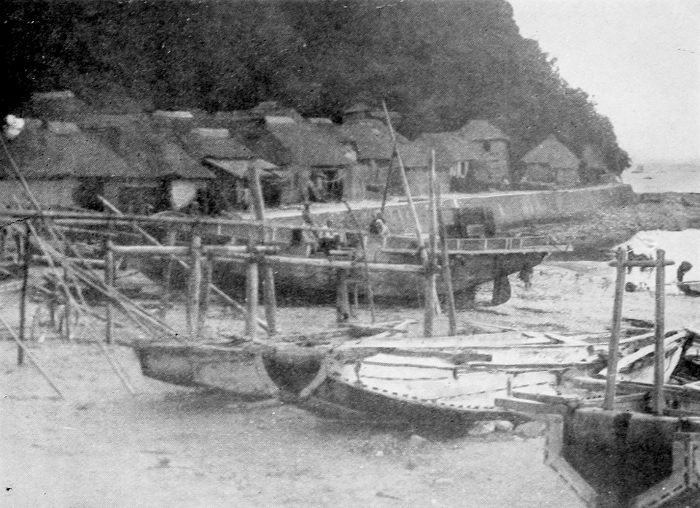
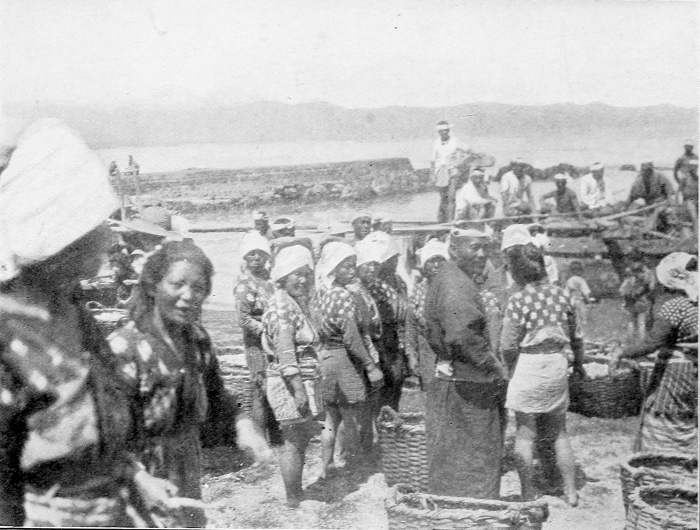
Tai-no-ura—Tiny houses strewn about the margin of the sand, fishing boats drawn up in rows, and swarthy men and women bustling about among the nets and baskets
A succession of lofty promontories jutting aggressively toward the sea gave interest to the road. Sometimes they turned its course, forcing it to swing out around them; in other cases tunnels penetrated the barrier hills, and we would find ourselves trudging along beside the basha, through damp echoing darkness, with our eyes fixed on a distant point of light, marking the exit, ahead.
It was a much-travelled road. We were continually meeting other bashas creaking slowly through the white dust, or drawn up before inns and teahouses where passengers were pausing for refreshment. During the entire afternoon we met not a single automobile, and when, after an hour or two, a Japanese lady, beautifully dressed and sheltered from the sun by a large parasol, flashed past in a shining ricksha propelled by two coolies, she made a picture strangely sophisticated, elegantly exotic, against the background of that dusty country highway so full of humble folk.
All the women of this region were hard at work. Some were labouring beside their husbands in the mud and water of the paddy fields, others were occupied upon the beach, piling up kelp and carrying it back to huge wooden tubs in which it was being boiled to get the juice from which iodine is extracted, still others were transporting baskets of fresh shiny fish from the newly landed boats to the village markets, or were drawing heavy carts laden with fish-baskets from one village to another. For this coast is the greatest fishing district of all Japan.
On the streets of every village we saw fish being handled—large, brilliant fish laid out in rows on straw mats, preparatory to shipment, huge tubs of smaller fish, and great baskets of silver sardines. Nor was our awareness of piscatorial activities due only to the organs of sight. Now and then a gust of information reached the olfactory organs disclosing with a frankness that was unmistakable, the proximity of a pile of rotted herring, which is used to fertilize the fields.
Winding down a hill through a grove of ancient trees, with the sea glistening between the trunks on one side of the way, we came upon a weathered temple, and, rounding it from the rear, found a tiny village clustered at its base, in as sweet a little cove as one could wish to see—low, brown houses nestling among rocks and gnarled pines, a crescent of yellow beach with fishing boats drawn up beyond the reach of the tide, and children playing among them looking like nude bronzes come to life.
This place, known as Tai-no-ura—Sea-bream Coast—small and remote as it is, has a fame which extends throughout Japan. For it was the abiding place of the thirteenth-century fisherman-priest Nichiren, who, though he antedated Martin Luther by about two and a half centuries, is sometimes called the Martin Luther of Japanese Buddhism. The Nichiren sect is to this day powerful, having more than five thousand temples and a million and a half adherents. Its scriptures are known as the Hokkekyo, and I find a certain quaint interest in the fact that, because this word suggests the call of the Japanese nightingale, the feathered songster is known by a name which means "scripture-reading bird."
The old weathered temple, which we visited, is known as the Tanjo-ji, or Nativity Temple, and is said to have been established in 1286, but to me the most appealing thing about this district is the respect which to this day is accorded Nichiren's prohibition against the catching of fish along this sacred shore. The fishermen of Tai-no-ura go far out before casting their nets, and this has been the case for so long that the fish have come to understand that they are safe inshore, and will rise to the surface if one knocks upon the gunwale of a boat.
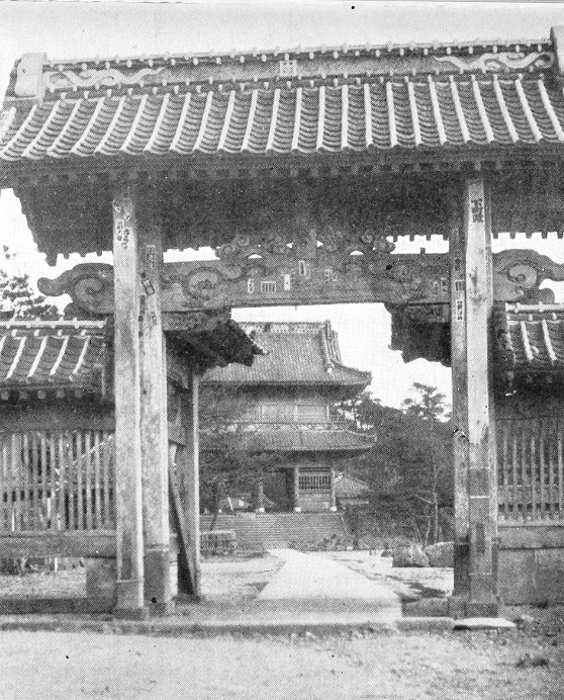
The gates of the Tanjo-ji temple, dedicated to Nichiren, "the Martin Luther of Japan"
I should have liked to linger at this place, but the afternoon was waning and we had still half a dozen miles or more to go.
Sunset was suspended like a rosy fluid in the air when our basha drove down the main street of Kamogawa and stopped before the door of the inn.
To an American, accustomed to the casual reception accorded hotel guests in his native land, the experience of arriving at a well-conducted Japanese inn is almost sensational. The wheels of our vehicle had hardly ceased to turn when a flock of servitors came running out to welcome and to aid us. A pair of coolies whisked our bags into the portico, and as we followed we were escorted by the gray-haired proprietress and a bevy of nesans, all of them beaming at us and bowing profoundly from the waist.
While I sat on the doorstep removing my shoes, two coolies came from the rear of the building bearing between them a pole from which two huge buckets of hot water were suspended. Pushing back a sliding paper door they entered an adjoining room. A moment later I heard a great splashing, as of water being poured, and looking after them saw that they were emptying their buckets into a large stationary tub built of wood. Nor was I the only witness to the preparation of the bath. Two Japanese women and three children stood by, waiting to use it. And they were all ready to get in.
There was something superbly matter-of-fact about this whole performance which gave me a sudden flash of understanding. All the explaining in the world could not have told me so much about the Japanese point of view on matters of this kind as came through witnessing this picture.
Adam and Eve were not progenitors of these people nor was the apple a fruit indigenous to Japan.
The other members of our party were preparing to bathe in the sea before dinner, but I desired a hot bath and had asked for it as soon as I arrived. While in my room preparing I found myself wondering whether I was about to have an experience in mixed bathing, and if so how well my philosophy would stand the strain.
But the peculiar notions of foreigners concerning privacy in the bath were, it appeared, not unknown to the proprietress of the inn. When I descended the stairs arrayed in the short cotton kimono provided by the establishment, I was not shown to the large bathroom near the entrance, but was taken in tow by a little nesan, who indicated to me that I was to put on wooden clogs—a row of which stood by the door—and follow her across the street to the annex.
The bath was ready. Entering the room with me the nesan slipped the door shut and in a businesslike manner which could be interpreted in but one way, began looping back her sleeve-ends with cord.
"She intends to scrub you!" shrieked all that was conventional within me. "Put her out!"
"But don't you like to be scrubbed?" demanded the inner philosopher.
"Her being a woman makes me self-conscious," I replied to my other self.
"It shouldn't. Your being a man doesn't make her self-conscious. What was it we were saying a little while ago about false modesty?"
"As nearly as I can remember," replied Convention, evasively, "we agreed that Americans are full of false modesty."
Whereupon I turned to the little nesan and with a gesture in the direction of the door exclaimed, "Scat!"
Understanding the meaning of the motion if not the word, she obediently scatted, closing the door behind her. She did not go far, however. Through the paper I could hear her whispering with another nesan in the corridor. I went to the door with the purpose of fastening it, but there was no catch with which to do so. This left me with a certain feeling of insecurity as I bathed.
A well-ordered Japanese bathroom, such as this one was, has a false floor of wood with drains beneath it, so that one may splatter about with the utmost abandon. One does one's actual washing outside the tub, rinsing off with warm water dipped in a pail from a covered tank at one end of the tub. Not until the cleansing process has been completed does one enter the water to soak and get warm. Bathtubs in hotels and prosperous homes are large, and the size of them makes the preparation of a bath a laborious business; for running hot water is a luxury as yet practically unknown in Japan, the water for a bath being heated either in the kitchen, or by means of a little charcoal stove attached to the outside of the tub. To heat the bath by the latter system, which is the one generally used, takes an hour or two; wherefore it is obviously impracticable to prepare a separate bath for each member of the household. In a private house one tub of water generally does for all.
Foreigners newly arrived in Japan are unpleasantly impressed by this system of bathing, and in a Japanese inn they generally make a great point of having first chance at the bath.
Though I do not expect to convince the reader that what I say is so, I must bear testimony to the truth that it is the idea rather than the fact of the Japanese bath which is at first unpleasant. You must understand that the Japanese are physically the cleanest race of people in the world; that, as I have already said, they bathe fully before entering the tub; that the tubbing is less a part of the cleansing process than a means for getting warm; and finally that the water in a tub which has been used by several persons looks as fresh as when first drawn.
I once asked a cosmopolitan Japanese whether he did not prefer our system of bathing. He replied that he did not. "I don't think your way is quite so clean as ours," he explained. "Not unless you take two baths, one after the other, as I always do when I am in Europe or America. I wash in the first bath. Then I draw a fresh tub to rinse off in."
Just as this gentleman prefers his native style of bathing I prefer mine; yet I should not object to succeeding him in the bath. Nor am I alone in liking the deep spaciousness of the large-size Japanese bathtub. An American gentleman who was in Japan when I was is having a Japanese bathroom built into his house near New York.
With the bath of the proletariat the system is the same, but the tub is smaller and less convenient. It consists of what is practically nothing more nor less than a large barrel with a small charcoal stove attached to one side. Often it stands out-of-doors.
On emerging from the hot water I found myself without a towel. I went to the door, opened it sufficiently to put my head out through the aperture and summoned the nesan who stood near by.
"Towel," I said.
She smiled and shook her head, uncomprehending.
I opened the door a little wider, thrust out one arm and made rubbing motions on it.
"Hai!" she exclaimed, brightly, and went scampering off.
As it was chilly in the room I returned to the hot tub to wait. There I remained for some minutes. Then it occurred to me that, understanding my desire for privacy in the bath, the nesan might be waiting outside with my towel, so I got out again with the intention of looking into the hall.
Just as I emerged, however, the door opened and in she came.
"Scat!" I cried. Whereupon she handed me two towels and fled.
It was well that she did bring two, for the native towel consists of a strip of thin cotton cloth hardly larger than a table napkin. The Japanese do not pretend to dry themselves thoroughly with these towels, but, as I have elsewhere mentioned, wring them out in hot water and use them as a mop, after which they go out and let the air finish the work.
I dried myself as best I could, slipped into the cotton kimono, and returned to the main building of the inn.
In the corridor I encountered my friend the linguist.
"I want to take a photograph of that bathtub," I told him.
"It won't explain itself in a photograph," he returned, "unless there's somebody in it."
I knew what he meant. An American or European, accustomed to the style of bathtub that stands upon the floor, would naturally assume from a picture of this one that it was similarly set. But that was not so. It extended perhaps two feet below the level of the floor; there was a step half-way down the inside to aid one in getting in or out; it was so deep that a short person standing in it would be immersed almost to the shoulders.
"You get in it, then, will you?"
"You ought to have a Japanese."
"But that's out of the question."
"No, it isn't."
Nor was it. By the time I got my kodak and put in a roll of film he had a subject for me.
It was the little nesan to whom I had said "scat!" Nor could a grande dame in an opera box have exhibited more aplomb than she did when I photographed her.
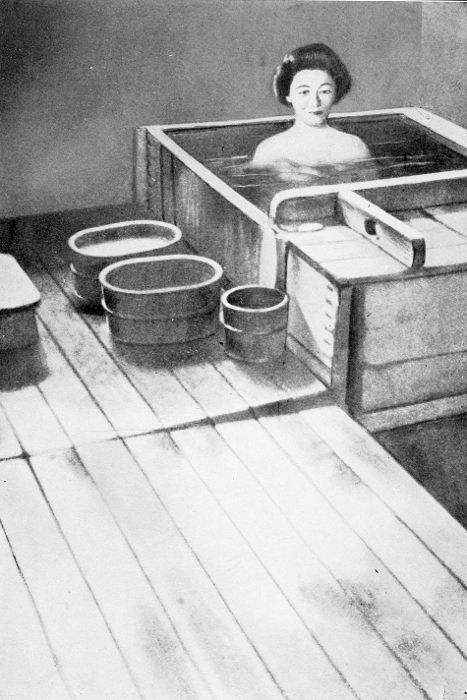
Nor could a grande dame in an opera box have exhibited more aplomb than she did when I photographed her
CHAPTER XXIV
A Walk in a Kimono—Dinner at the Inn—Sweet Servitors—An Evening's Enchantment—The Disadvantages of Ramma—My Neighbours Retire—A Japanese Bed—Breakfast—"Bear's Milk"—The Village of Nabuto—An Island and a Cave—The Abelone Divers—A Sail with Fishermen
"Let's take a walk before dinner," said the linguist when our photographic enterprise had been accomplished.
"All right. I'll go and dress."
"Come as you are."
"After a hot bath I might take cold in this thin kimono."
"No. That's a curious thing about hot baths in Japan. The reaction from them is much like that we get at home from cold ones."
"But, dressed this way, won't we look queer?" I surveyed the lower hem of my kimono which hung only a little below my knees.
"It's the costume of the country."
"But it's awfully short on us. It seems to me we ought to put on underwear at least."
"Nonsense. A man doesn't know what comfort is until he has strolled out in a kimono after a bath."
Our costumes were identical. We looked equally absurd. I consented.
My one difficulty on that stroll was with my clogs. I could not walk as fast as my companion, nor did I dare to lift my feet from the ground lest the clogs should fall off. And yet I can see that if one is brought up on clogs there is much to be said in their favour. They are durable and cheap. They neither suffocate nor cramp the foot.
Once I spoke to a Japanese friend of the merits of the clog, but though he admitted that his clog-wearing countrymen had no trouble with their feet, he thought clogs, on the whole, a bad thing. "The movement for good roads in Japan," he said, "started when people began to wear shoes. Those who wear clogs do not object to bad pavements, and we shall never get good ones until clogs are discarded by the majority."
We had not walked a block before I perceived that my companion had not overstated the case for the kimono as a costume for a stroll on a balmy evening. It does not bind one anywhere, but leaves one's arms and legs delightfully free. Moreover the air penetrates to the body, and the feeling of it after a very hot bath is as refreshing as an alcohol rub.
The streets were full of people many of them fishermen dressed much as we were. But though reason told me that in our kimonos we were less conspicuous than we should have been in our customary attire, I could not rid myself of the feeling that we were masqueraders, and that if people were to recognize us through the darkness for foreigners, we should have a crowd following us. Wherefore, though our promenade proved absolutely uneventful, I was upon the whole relieved when, after having gone the length of the main street and back, we re-entered the hotel.
Our dinner that night was purely Japanese; the nesans brought the usual little foot-high lacquer tables laden with covered bowls of porcelain and lacquer; we sat upon silken cushions on the matting in the linguist's room and struggled bravely with our chop-sticks.
The room was on the second floor. Through the open shoji we could look across a tiny garden into other rooms, open like ours to the soft evening air, and we could see the nesans gliding back and forth between these rooms and the kitchen, moving along the polished wooden floor of the gallery with their characteristic pigeon-toed shuffle.
In an American hotel our little party would have been served by one waiter; here we were attended by three nesans, one of whom squatted on the matting beside the rice bucket, ready to help us when we held out our bowls for more (for we had rice with our soup, our fish, and our tea), while the other two brought things from the kitchen, below stairs. And no matter how many times they had been in the room before, they always dropped to their knees, on entering, and bent their foreheads nearly to the floor in respectful salutation, ere they served the new course.
This courtesy, so natural to them, made me feel very, very far from home, for in it seemed to be crystallized the romantic charm of the antipodes. The whole environment, moreover, enhanced my feeling. The exquisite simplicity of our room, and of the other rooms across the garden; the soft lights shining through the rice paper of shoji here and there; the silhouettes, so Japanese, which passed across them; the shimmering of the dark green leaves of small trees whose upper branches reached a little bit above the floor level; the tinkling note of a samisen played in some remote part of the building; the almond eyes and massed ebony hair of our gentle little servitors, their butterfly costumes, the strange, soft rattle of their language, the curious unfamiliar flavours of the viands; all these combined to make me feel as one transported into an enchantment, vivid and fantastic as a painting by Rackham or Dulac.
And yet, fascinated as I was with all this magic loveliness, I felt a gentle melancholy. For the shoji at the rear of the room were pushed back like the others, and from the beach on which they opened there came to me through the darkness an insistent note of definite and almost terrible reality: the murmur of that ocean, black, restless, turbulent, ominous, unimaginably vast, by which I was cut off from home.
My own room was next to that of the linguist, but the room beyond mine was occupied by a Japanese couple. The rooms were divided by walls consisting of opaque paper screens, sliding in grooves, and even these frail partitions were incomplete, for, as in all Japanese houses, there were ramma, or grills, over the tops of the screens. The purpose of these ramma is to give ventilation at night, when the building is solidly encased in wooden shutters; but though it is true that they do permit some air to circulate, it is equally true that they permit the circulation of sound and light. Herein lies the foreigner's chief objection to the Japanese style of house—it is utterly without privacy.
I endeavoured to be quiet as I made ready for bed, and I am sure my Japanese neighbours likewise tried, but their whisperings and the little rustling sounds they made as they moved about, enhanced rather than diminished my consciousness of their proximity.
After I had put out my light my room continued for some time to be illuminated by the glow which came through the ramma on both sides. Presently the linguist's light went out, but that from the room of my other neighbours persisted, keeping me awake. This was the first time that I acutely missed chairs as an adjunct to Japanese life; if I had a chair I could hang a kimono over it to make a screen for my eyes. At last, however, I heard a little click, which was immediately followed by darkness. Then a sound of soft steps. Then a comfortable sigh. Then silence.
It was my first night in a Japanese bed. The bed consisted of two thin floss-silk mattresses, laid one above the other on the matting, and partly covered with what seemed to be a towel. It was all very clean. The pillow was a cylinder of cotton about six inches in diameter, stuffed with some substance as heavy and as crackling as pine needles, but odourless. I think the stuffing was of rice-husks. My nightgown was a cotton kimono like the one in which I had gone walking, and my coverlet was the usual bed-covering of Japan—a quilted satin robe, very long, with armholes and spacious sleeves: a cross between a comforter and a kimono. I did not use the sleeves, but pulled it over as one would if sleeping under an overcoat.
In all but one respect it was a comfortable bed. The thing that troubled me was the hard round pillow. I moved it about; I tried to flatten it; I tried my hand under it, and over it, between it and my face.
"I shall never be able to sleep on such a pillow!" I thought, irritably. And the next thing I knew it was morning and time to get up.
This inn, being exceptionally well appointed, provided separate wash-rooms for men and women. We trooped down and bathed. Then we breakfasted. The breakfast was much like the dinner of the night before—rice, soup, fish, and tea.
"If any one feels the need of coffee," said the linguist, "we may be able to get it, but the chances are it won't be very good. I've got a can of condensed milk here, too." He held up the can. I noticed that it was called "Bear Brand" Milk, and that the label bore the picture of a bear.
"Don't they have fresh milk at these inns?" someone asked.
"A few of them have it now," he replied, "but it is only in the last few years that the people of this locality have learned to use milk at all."
This reminded him of a story which he told us.
On one of his walking trips he had stopped at an inn which boasted of having been patronized by an Imperial Prince. The friend who accompanied the linguist on that trip wanted coffee for breakfast, and the innkeeper managed to supply it. The linguist had a can of "Bear Brand" Milk in his haversack, but he did not wish to open it if milk could be produced at the inn.
"Can you get me some milk?" he asked the nesan.
"What kind of milk?" she inquired.
Perceiving that she knew nothing of our custom of using milk in tea and coffee, he amused himself by replying:
"Whale's milk."
The nesan went downstairs and presently returned to say that there was no whale's milk to be had.
"This inn has been patronized by an Imperial Prince," exclaimed the linguist, affecting astonishment, "yet you have no whale's milk?"
The nesan admitted that such was the case.
"Then," said he, "bring me elephant's milk. I'll try to make it do."
Again she departed.
"The proprietor is very sorry," she reported when she came back, "but he has just run out of elephant's milk."
"Let me see the proprietor."
When the latter appeared he was most apologetic. There had been an unprecedented demand for elephant's milk in the last few days, he explained, and his supply had been exhausted. He expected to have some more shortly, but the express was slow.
"Very well," said the linguist, "I suppose I'll have to get along as best I can on bear's milk." Whereupon he opened the "Bear Brand" can and poured some of its contents into his coffee, while the hotel proprietor and the nesan looked on with bulging eyes.
"You ought to be ashamed of yourself," I told him when he had finished the story.
"The joke rebounded on me," he said. "After that I became a personage in the inn, and I had to tip correspondingly when I left—for according to the old custom of the country the size of the tip in a hotel is not in proportion to the service received, but in proportion to the rank of the tipper. And besides, the proprietor was very curious to know how they milked the bears. I had a devil of a time explaining that."
After breakfast we set out on foot for the village of Nabuto, several miles farther along the shore. The road, winding around the rampart hills, was as beautiful as that we had travelled the day before, and as full of interesting figures and intimate glimpses of the life of these amiable industrious fisher-folk.
Nabuto proved to be a tiny settlement at the tip of a rocky promontory, sheltered from direct assaults of the sea by a small, pinnacled island known as Niemon Island because it belongs, and has for eight centuries belonged, to a family of that name, residing there.
An old sea-wife, looking like a figure from one of Winslow Homer's paintings, summoned the ferryman with a blast upon a conch shell, and a few minutes later we stepped from his skiff to a natural platform of granite at the island's edge. As we landed we were assimilated by a guide who began by indicating certain circular holes in the granite which, he declared, had been made by the hoofs of Yoritomo's horse. For legend has it that, when pursued, this mediæval military hero used Niemon Island as a hiding place. Nor are the horse's hoof-prints the only evidence supporting this tale. One may see the cave in which the great Yoritomo concealed himself.
Thither, by a rough, ascending path, the guide led us. It was a small, damp cave. If Yoritomo lived there long he must have feared his enemies more than he feared rheumatism. Within was a small shrine dedicated to the ancient warrior, and hanging near it was a cord by which a bell could be rung to notify the spirit of the departed that callers had arrived. The guide signified to us that Yoritomo's spirit would be profoundly gratified if we put a few coppers into the box in front of his shrine. Having contributed we were allowed to ring the bell.
The ledge outside commanded a view of leagues and leagues of amethyst sea into which jutted a succession of green bastioned promontories. Below us, at the base of the cliff, where the long swells were crashing in rhythmic succession, several small skiffs were tossing dangerously near the margin of the foam. These, said the guide, were the boats of abalone fishers—for the Niemon family, besides receiving tourists, and selling them trinkets, picture postcards, and flasks of Osaka whiskey, is in the business of canning abalone meat. I have attempted to eat abalone. Considering that it is a mollusc leading an absolutely sedentary life, it has astounding muscular development. A man who can masticate it ought to be able also to masticate the can in which it comes.
Each skiff contained two men; an oarsman and a diver. The former would nurse his light craft close to where the seas were breaking on the island's rocky wall, while the latter, standing and swaying with the rise and fall of the boat, peered eagerly into the blue depths. Then, suddenly, with the swiftness of a thrown knife, the brown body would cut the water and disappear. One waited. One waited long enough to become a little anxious. But when it seemed that human lungs could not have held a breath for such a length of time, a head of wet black hair would pop out of the water and the glistening body of the diver would slip over the gunwale with the sinuous ease of a swimming seal. A moment later he would be standing again in the bow of the boat, a figure beautifully poised, gazing with the rapt eyes of a seer into the swaying, streaky mysteries of the under-water world.
Out here the fresh sea breeze wove like a cool woof across the warp of rays from a hot noonday sun. Ashore there was no breeze. I was beginning to dread the baking dusty miles of highway leading back to Kamogawa. Then someone suggested that we sail there, and the linguist sent the guide to see about a boat.
The vessel he secured was a two-masted fishing boat with a brave viking prow and long sleek lines. It was a piratical-looking craft and the appearance of the crew was even more so. They were like the Malay pirates in boys' books of adventure: almost naked, and tanned and weathered to a dark copper colour. Two of them wore short white shirts, open in front and terminating at the waist, but the others were innocent of such sophisticated haberdashery, the entire costume of each consisting of a pair of towels—one at the loins, the other wound around the head.
All too soon they landed us upon the beach at the back of the hotel.
"Now," said the linguist, as we waded up through the deep sand, "we'll pack our bags, get lunch, and be off."
And precisely that we did.
The whole staff of the inn assembled to see us depart. The proprietress gave us little presents. There was much bowing. Then the basha creaked away.
CHAPTER XXV
I Take Gen's Photograph—The Pay of Fisher-Folk—Where All the World Works—We Help Gen Pull Her Cart—And Surprise Some Wayfarers—The Road Grows Long—Fairy Débutantes
In an exceptionally picturesque fishing village a few miles on, I paused to take some photographs. On a platform outside an old house overhanging the gray sea-wall at the margin of the beach, three women were unloading baskets of fish from a heavy handcart. One of them was fully sixty years of age, another I judged to be thirty, but the third was a girl not over twenty, a sturdy brown lass with eyes like those of a wild deer, and a ready smile which showed a set of glorious white teeth. She was as pretty a peasant girl as I had seen in Japan, wherefore through my bi-lingual friend, I asked permission to take her picture.
From the amount of talking my friend did, and the laughter with which, on both sides, it was accompanied, I judged that the request, as it reached her, was festooned with gallantries. At all events she readily consented to be photographed—as a pretty girl generally will—and when the shutter had snapped she asked that I send her a print. This I agreed to do if she would write her name and address in my notebook. She did so in kana, which, being translated by my invaluable companion, revealed her name as Gen Tajima.
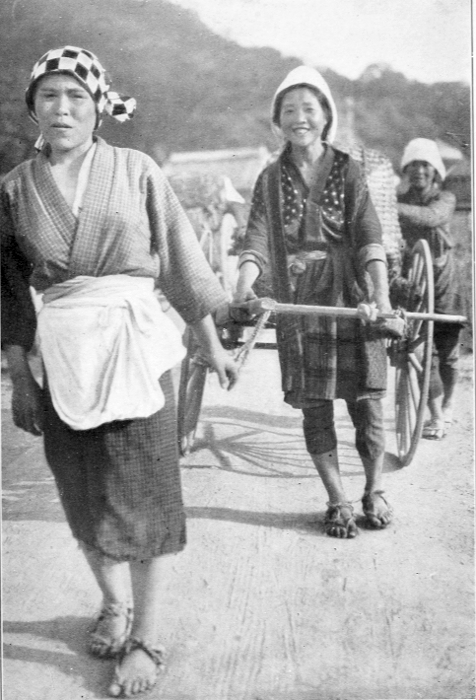
Pretty Gen was between the shafts, the other girl was pulling at a rope, and the grandmother was at the rear, pushing
Asked if all three of them were of the same family, the women replied that they were merely neighbours. They resided in the village of Amatsu-machi, several miles farther along the road that we were travelling, and it was their daily business to draw the cart from Amatsu-machi to this place, laden with baskets of fish to be salted and shipped. Their pay for this labour amounted to the equivalent of twenty-five cents a day in our money.
"I suppose you are all of you married?" asked my friend.
The old woman replied that she was; the other two laughed and declared that they were not. But they soon betrayed each other. "Don't you believe what she says!" they warned us gaily. "She is married. I'm the one who is looking for a match." Then, having had their little joke, each owned to a husband and children. Their husbands were fishermen, and earned, they said, two yen a day—about a dollar.
"You work hard?" asked my friend.
"Of course."
"Why 'of course'?"
"Everybody down here works hard."
"Even those who don't have to?"
"Yes. Even people with a lot of money work hard. Here any one who did not work would be laughed at."
They were typical Japanese women of the fisher class, happy, innocent, industrious. They interested me profoundly. But there was a long trip ahead of us and it was necessary to push on. We bade them farewell, got into the basha, and drove away.
But we had not seen the last of them. When we had driven a quarter of a mile or so, they came running up behind us with their cart. Pretty Gen was between the shafts, the other girl was pulling at a rope tied to one side, and the grandmother was at the rear, pushing. They ran pigeon-toed, like Indians, and what with the commotion caused by their rope sandals and the wheels, left a cloud of dust behind them.
Full of merriment they closed in upon us. One of them called to us in Japanese.
"What did she say?" I asked.
My friend translated:
"She says that because we are strangers they will escort us."
"Come on," I said, jumping out of the basha. "Let's help them pull the cart."
He joined me at once. We took up our places, naturally, at either side of Gen.
She was full of questions. Where were we from? How long did it take to come all the way from America? What was America like? Didn't the American people like the Japanese people? Her brother was a sailor. He had made a voyage to America and said it was a very fine place, and that everyone was rich. It wasn't like that in Japan. Here almost everyone was poor. It was hard to earn enough to live on, now that food cost so much.
Finding that there were now too many willing hands at the cart, we discharged the grandmother and the other woman, placing them in our seats in the basha.
"It is a pity you can't ride, too," my friend said to Gen, "but it is better for you to stay here and see that we don't steal the cart."
To which the old woman leaning out of the back seat of the basha remarked that she thought us much more likely to steal the cart if Gen went with it.
This caused much hilarity. Gen, I think, was a little embarrassed, but she enjoyed it all the same.
"As things are," she said, smiling and looking at the road, "I am well satisfied to walk."
The chatter was so lively that I had a good deal of difficulty in finding out all that was being said; it was no small task for my companion to keep up his end of the conversation against all three of them, and at the same time translate for me. I began to find myself left out.
Moreover, I had not anticipated that we should attract so much attention. The mere fact that we were aliens made us conspicuous in this part of the country, and the sight of two foreign men helping a peasant girl pull a cart, while the girl's usual companions rode ahead in the comparative magnificence of a basha, caused people in the villages through which we passed not only to stare in amazement, but to call their friends to come and witness the unheard-of spectacle.
I remember an old woman bent under a great load of straw which she was carrying on her back, who, when she glanced up and saw us, looked as if she were going to fall over, and I shall never forget the quizzical, puzzled, fixed gaze of a middle-aged coolie, with a load of wood on his back and a little pipe in his mouth, who, on sight of us, hurriedly seated himself on the bank at the roadside to pass us in review. He was a fine type. I dropped my hold upon the shaft, unslung my kodak, and embalmed his features on a film.
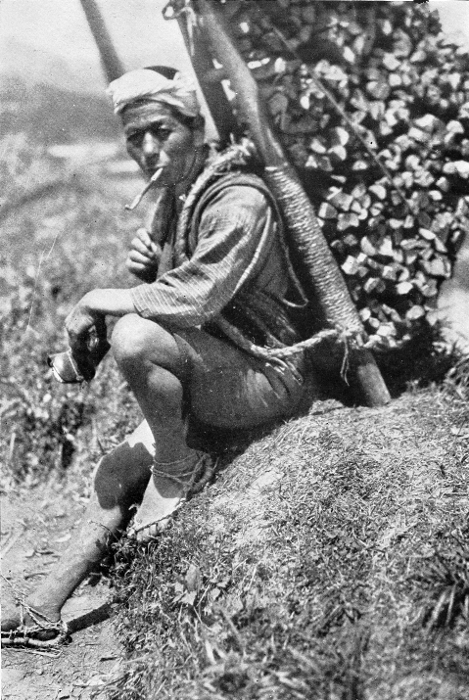
The middle-aged coolie hurriedly seated himself on the bank to pass us in review
"Come on back here!" called my companion. "Gen and I need you with our cart."
Gen and I!... Our cart, indeed! Who first thought of helping Gen with her cart, I should like to know!
Without enthusiasm I returned and took hold of the shaft again. The cart was getting heavier. He and Gen weren't pulling as they should. They were too busy talking—that was the trouble with them!
"Say, how far is it to this town where these people live?" I demanded of him.
"I guess it's not very much farther," my friend interrupted his conversation with Gen to reply.
"I should hope not! We've pulled this infernal cart about five miles already."
"If you don't like it," he answered, "why don't you get back in the basha?"
"How am I going to do that, when that old woman is in my place?"
"Tell her you want to ride. Tell her to come back here and get on the job again."
I looked up at her. It was quite out of the question to do such a thing. Much as I should have enjoyed my seat in the basha, she was enjoying it more. She and the younger woman were having a magnificent time, chattering, giggling, hailing every acquaintance they passed. And when other peasants who knew them gazed, astonished, they would burst into roars of mirth. All of which gave our progress more than ever the aspect of a circus parade in which, it began to seem to me, I figured as the clown.
Left to my own thoughts I endeavoured to meet the situation philosophically. If I had been foolish to get myself into this cart-pulling adventure my folly was of a kind common to my sex. Other men without number had made even greater fools of themselves. And, whereas in a little while this incident would be ended, some men got into scrapes that lasted all their lives. It was pleasant to reflect on that.
I began to see an allegory in the episode. In miniature it was like the story of a hasty marriage.... A man travelling the road of life in the comfortable basha of bachelorhood sees a pretty girl. Bright eyes, white teeth shown in a smile, and out he jumps.
"Let me help you pull the cart!" he cries, without giving a thought to the future. So he takes hold, and as likely as not she eases off and lets him do most of the pulling.
He wants companionship, but when he begins to look for it, what does he discover? He discovers that she doesn't know a word of his language, nor he a word of hers. He has sold his birthright for a mess of pulchritude.
The road is long, the hills steep, the cart heavy. Presently appears another man and offers to help—some smart-aleck who can talk her kind of talk. And, of course, this linguistic ass begins prattling a lot of nonsense to her and turns her head. The more she listens to him the more inflated he becomes. That's what happens to some men if a pretty girl shows them a little attention! Does he stop for a minute to consider that his advantage is purely one of language? Not at all! The idiot thinks himself fascinating.
So much for that.
But now imagine another picture. Take those two men out of a situation in which one has manifestly an unfair advantage, and place them on an equal footing in a totally different environment. Take them, let us say, to an American city, place them in a ballroom, bring in a lot of beautiful débutantes—hundreds of them, all in pretty little evening gowns and satin slippers—start up the band. Then see what happens!
One of these men is a bookworm. He knows a lot about languages. He can speak Japanese. (You see I am being perfectly fair to him.) But the other, though he cannot speak Japanese, is—you understand this is purely an imaginary case—a handsome, dashing, debonair fellow. While one has been learning Japanese the other has learned a few effective steps. In the intricate mazes of the dance he seems to float godlike through the air.
All right! Now I ask you, which one of these two men is going to be a success with all those débutantes? Is Japanese going to advance a man very far with an American débutante? In all fairness I say No! A débutante is too clever—too clever with her feet—to be misled by mere linguistic talent. True worth is the thing that counts with her. She looks for solid merit in a man. In other words: What kind of a dancer is he?
Is not the conclusion obvious? In the environment I have pictured one of those two men will be left practically alone, while the other will find himself constantly surrounded by a bevy of dainty, beautiful——
"This is Amatsu-machi," I heard my companion say.
With a start I came back to Japan.
"They're leaving us at the crossroads," said he.
The basha drew up. The two women got out. They thanked us prettily. Then amid many "Sayonaras" we drove off, while they stood and watched us, smiling and waving until we passed from their sight around a bend in the road.
"They have lovely natures, these Japanese women," the linguist presently remarked.
"If you'll look over a lot of American débutantes," I replied, "you'll find that they are just about as——"
"You don't understand," he interrupted. "I'm not talking about mere prettiness—though you'd hardly say that girl Gen wasn't pretty. I'm talking about spiritual quality. Couldn't you tell, just by looking at her, that she was sweet right straight through?"
"I guess she's all right," I answered in an off-hand tone.
That did not half satisfy him. But though he kept at me for a long time, trying to make me say something more enthusiastic, I would not be coerced. He was too much puffed up as it was.
I had another reason, too, for withholding from that pretty peasant girl the fullest praise. I must be faithful to the débutantes who, from far away, had come floating like a swarm of fairies to console me as I tugged Gen Tajima's lumbering cart along a dusty road upon the seacoast of Japan.
CHAPTER XXVI
The Handkerchief as a Travelling Bag—Bags and Bottles—Computing Time—The Mystic Animals of the Zodiac—Superstitions Regarding Them—Temple Fortune-Telling—An Ekisha—The Ema—Yuki Tells of a Wonderful Cure
The national travelling bag of the Japanese is a large, strong handkerchief of silk or cotton, in which the articles carried on a journey are tied up. The elasticity of this container, which is called a furoshiki, is its great advantage. It is as large or as small as its contents require, and when it is empty you do not have to lug it about by hand, like an empty suitcase, but merely put it in your pocket.
The trouble with our style of suitcases and bags is that they are heavy, bulky, and not adaptable. On one occasion they are overcrowded, on another we carry them half empty. My own bags remind me of the way I used to feel about wine bottles in the cheery days when one could afford to regard such things with a somewhat critical eye. I always felt that wine bottles were either too large or too small. Pints held a little too much for one, yet not enough for two; and quarts held rather more than was required by three, yet left four dissatisfied. Let us, however, drop this subject. De mortuis....
I was often struck with the fact that though the Japanese woman seems to be more heavily dressed than the foreign woman, and though her coiffure is generally more elaborate, she carries so much less baggage when she travels. In our Yuki's furoshiki there was always room for my cigars, cigarettes, books, and kodak films. Her own things seemed to take no space at all.
There are several reasons for this. A Japanese woman carries no hair-brush and wears her comb in her hair. Nor do the Japanese generally take nightclothes with them on a journey, for a clean cotton kimono, in which to sleep, is supplied by all Japanese hotels. More than once, when I saw Yuki starting off with us for a two- or three-days' trip with baggage consisting of a furoshiki tied to about the size of two ordinary novels, I thought of Johnnie Poe's famous "fifty-three pieces of baggage—a deck of cards and a tooth-brush."
A favourite theme for the decoration of the furoshiki embodies the signs of the Chinese zodiac, consisting of twelve animals. The Chinese calendar was adopted centuries ago by the Japanese, and they still take account of it, though they now generally use our Gregorian calendar for computing time. But even so, their era is not the Christian Era, but dates from the beginning of the reign of Jimmu Tenno the Divine, whom the Japanese count as the first of their Imperial line, and who is said to have ascended the throne, 660 B.C. Thus our current year, 1921, is the year 2581 in Japan. Time is also measured arbitrarily by the reigns of emperors, the present year being Taisho 10, or the tenth year of the reign of the present Emperor.
The Chinese zodiac, however, figures largely in Japanese superstition. As there are twelve animals, the years are counted off in cycles of twelve; and the same animals are also associated with days and hours, in cycles of twelve. The attributes of the astrological animal governing the year of one's birth are supposed to attach to one.
"My mother is a cow," a Japanese lady explained to me. "My husband is a snake and I am a rabbit."
The lore of these animals is complicated. I have only a smattering of it, but what I know will suffice to show the general tendency of such superstition.
It is considered good fortune to be born in the year of the horse because the horse is strong and energetic. 1920 was the year of the monkey. It is unlucky to marry in monkey year because the word saru, which means "monkey," also means "to go back," the suggestion being that the bride will go back to her former home, or in other words be divorced. A woman born in the year of the rabbit will be prolific. (The lady who said, "I'm a rabbit," though very young, was the mother of four.)
Similarly the animals, in their cycle, bring good luck or ill luck in connection with events occurring on certain days. It is unlucky to take to one's bed with a sickness on the day of the cow, because the cow is slow to get up. It is lucky to begin a journey on the day of the tiger, because the tiger, though he travels a thousand miles, always returns to the point from which he started; but for the same reason it is unlucky for a girl to marry on this day, because she, like the tiger, may return to the place from which she started: her father's house. And the day of the tiger is a bad one for funerals, because the tiger drags its prey with it, suggesting that another funeral will soon follow. The significance attaching to each animal according to the Japanese idea is not always apparent, without explanation, to the stranger. For instance, though I know it is considered lucky for a bride to cut her kimonos on the day of the rooster, I do not know why. Nor do I know why it is considered particularly lucky to have, in one family, three persons born under the same sign.
Superstition of all kinds plays a large part in the daily life of the Japanese masses, and persons of intelligence often patronize fortune tellers, among whom are the Buddhist priests in certain temples.
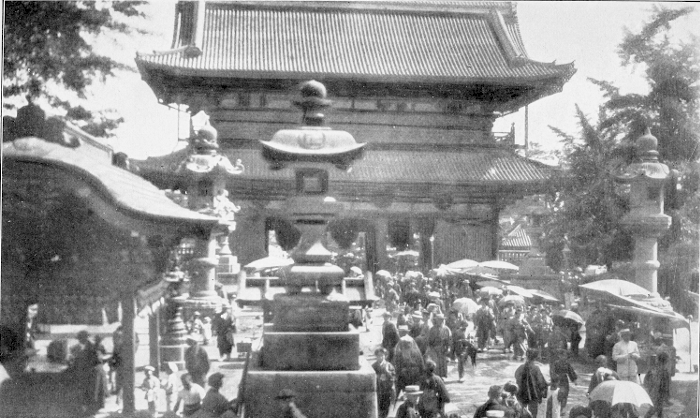
At Asakusa, the great popular temple of Tokyo, the fortune-telling business is so brisk that two or three priests are busy at it all the time
At Asakusa, the great popular temple of Tokyo, the fortune-telling business is so brisk that two or three priests are busy at it all the time. The system is simple. The diviner shakes a lot of numbered sticks in a box, draws one out, and takes a paper from a little drawer which bears a number corresponding with that on the stick. Your fortune is written on the paper, in multigraph. I paid two cents for mine, and when it was translated to me I felt that I had paid too much.
Yuki, when she saw that I was disposed to take the matter lightly, seemed a little disappointed, and when later several of us decided to give the necromancers one more fling, she herself escorted us to the establishment called Hokokudo, at number 3 Chome, the Ginza, where father, son, and grandson successively have told fortunes for the past hundred and twenty years. Here we paid one yen each for our fortunes, but though the ekisha took more time to the job, examining our hands and faces, rattling his divining rods and making patterns with his Chinese wooden blocks, he didn't do much better than the priest had done for two cents. Yuki was impressed when he predicted a sea voyage for me, but the prophecy did not seem to me to constitute a remarkable example of divination.
The visit to the ekisha was however, an experience. The little house was picturesque, and it was interesting to see the stream of Japanese coming in, one after another, intent on learning what the future held in store for them. Also, while Yuki's fortune was being told I got a good photograph of the ekisha examining her hand through his magnifying glass.
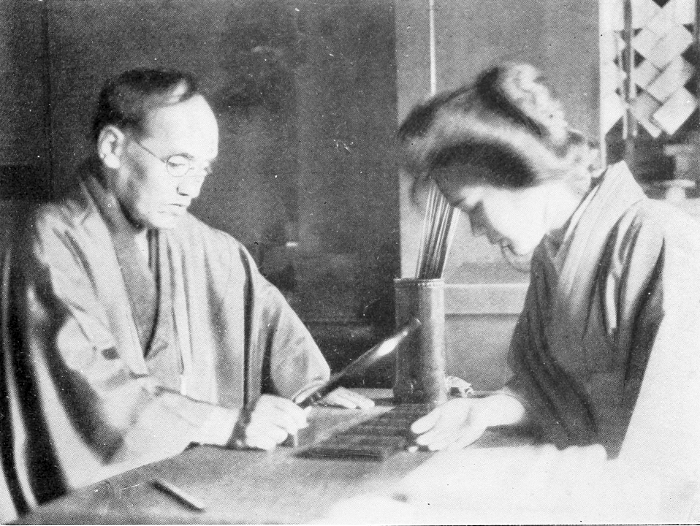
While Yuki's fortune was being told I photographed her
Another superstition is exampled in the ema, votive offerings in the form of little paintings on wood, which are put up at Shinto shrines by those in need of help of one kind or another. For almost any sort of affliction an ema of suitable design may be found, though the meaning of the grotesque design is seldom apparent to the foreigner.
While in Japan I collected a number of these curious little objects and investigated their significance. Among them was one which Yuki recognized as an appeal for relief from eye trouble.
"That very good ema," she told me. "I use one like that once when I have sore eyes."
"Did it cure you, Yuki?"
"Yes—in two weeks. I put it up at shrine and I promise the god I no drink tea for two weeks. In two weeks my eyes all right again."
"And you are sure the ema did it?"
"Yes, sir, I sure."
"You didn't do anything else for your eyes?"
"No, it just like I say. I put up ema for god and not drink tea. Then I wait two weeks."
"Did your eyes hurt you during the two weeks?"
"Oh, yes. They hurt so much I have to wash them two three times a day with boric acid, while I wait for ema to make cure. But when end of two weeks comes they not sore any more. That ema work very good."
CHAPTER XXVII
Our Difficulties with the Language—The Questionable Humour of Broken Speech—"Do You Striking This Man for That?"—"Companies, Scholars, and Other Households"—Curious Correspondence—Japanese Puns—Strange Laughter—The Grotesque in Art—Japanese Colour-Prints—Famous Print Collections—Monet's Discovery of Prints at Zaandam—Japanese Prints and French Impressionism
The complete dissimilarity between the Japanese language and our own, referred to in an earlier chapter, of course adds greatly to the difficulty of communication in all its various forms.
In Tokyo and other cities I attended many luncheons and dinners organized for the purpose of discussing relations between the United States and Japan, and promoting a friendly understanding between the two nations, but though Japanese statesmen and men of affairs spoke at these gatherings in fluent and even polished English, I never met with one American who was equipped to return the compliment in kind. The Americans, even those who had lived for years in Japan, always spoke in English, whereafter a Japanese interpreter who had taken notes on the speech would arise and render a translation.
The linguistic chasm dividing the two peoples is not, however, entirely a black abyss. If one wall is dark, the other catches the sun. Practically all Japanese students now study English in their schools, our language being considered next in importance to their own. And though, as I have said, many of them have perfectly mastered English despite the enormous difficulties it presents to them, there are many others whose English is imperfect, and whose "Japanned English," as some one has called it, achieves effects the unconscious grotesqueness of which startles and fascinates Americans and Englishmen.
To be honest, I have been in some doubt as to whether I should touch upon this theme or not; for it has always seemed to me that humour based upon the efforts of an individual to express himself in a language not his own was meretricious humour, inasmuch as it makes fun of an attempt to do a creditable thing. It is a kind of humour which is enjoyed in some measure by the French and the British but which is relished infinitely more by us than by any other people in the world, as witness entertainments in our theatres, and stories in our magazines, depending for comedy upon dialect: German, French, Italian, Irish, Jewish, Cockney, Negro, or even the several purely American dialects characteristic of various parts of the country.
This dubious taste of ours doubtless springs, to some extent at least, from the polyglot nature of our population; but whatever its origin it is a bad thing for us in one important respect. We find the English dialect of foreigners so funny that we ourselves fear to attempt foreign tongues, lest we make ourselves ridiculous. Wherefore we are the poorest linguists in the world.
Even after the foregoing apology—for that, frankly, is what it is—I should still hesitate to present examples of "Japanned English" had I not discovered that Professor Basil Hall Chamberlain, perhaps the greatest of modern authorities on Japan, a man whose writings reveal an impeccable nicety of taste, had already done so in his most valuable book, "Things Japanese."
One of the examples given by Professor Chamberlain is quoted from a work entitled: "The Practical Use of Conversation for Police Authorities," which assumes to teach the Japanese policeman how to converse in English. The following is an imaginary conversation intended to guide the officer in parley with a British bluejacket:
What countryman are you?
I am a sailor belonged to the Golden Eagle, the English man-of-war.
Why do you strike this jinricksha-man?
He told me impolitely.
What does he told you impolitely?
He insulted me saying loudly, "the Sailor the Sailor" when I am passing here.
Do you striking this man for that?
Yes.
But do not strike him for it is forbidden.
I strike him no more.
One curious aspect of the matter is that so much of this weird English creeps into print, appearing in guidebooks, advertisements, and on the labels of goods of various kinds manufactured in Japan.
Thus in the barber shop of the ship, going over, I found a bottle containing a toilet preparation called "Fulay," the label of which bore the following legend:
"Fulay" is manufactures under chemical method and long years experience with pure and refined materials. It is, therefore, only the article in the circle as ladies and gents daily toilet.
And on a jar of paste I found this label, which will be better understood if the tendency of the Japanese to confuse the letters l and r is kept in mind:
This paste is of a pureness cleanliness and of a strong cohesion, so that it does not putrefy even when the paste grass is left open. Though written down on paper or the like immediately after pasting, the character is never spread. This paste has an especial fragrance therefore all of pasted things after using this are always kept from the frys and all sorts of bacteria, and prevents the infectious diseases. This paste is an indispensable one for the banks, companies, scholars and other households. Please notice for "Kuchi's Yamato-Nori" as there are similar things.
The circular of one firm, advertising "a large assortment of ladies' blushes," might have been misinterpreted as having some scandalous suggestion, had it not gone on to discuss the ivory backs and high-grade bristles with which the "blushes" were equipped.
Another circular was that of a butcher who catered to foreigners in Tokyo. After stating that his meats were sold at "a fixed plice" this worthy merchant mentioned the various kinds of beef he could supply. There were, "rosu beef, rampu beef, pig beef, soup beef, and beard beef"—which being interpreted signified roast beef, rump beef, pork, soup meat and poultry—the word "beard" being intended for "bird."
In the admirable hotel at Nara I saw the following notice posted in a corridor:
REMARQUE
Parents are requested kindly to send their children to the Hotel Garden for when weather is fine. When it is bad weather I will offer the children the small dining-room, except meal hours, as playing room for them, therefore please don't let them run round upstairs and downstairs at all. Please kindly have the children after dinner in a manner quiet and repose.
Manager, Nara Hotel.
From a friend, an official of a large company, I got a number of letters revealing the peculiarities of "English as she is wrote"—at least as she is sometimes wrote—in Japan. All these letters are authentic, having come to him in connection with his business.
The first one, written by a clerk to the office manager, refers to an admirable Japanese custom which in itself is worthy of brief mention.
Throughout Japan there is housecleaning twice a year under police supervision. Certain districts have certain days on which the cleaning must be done. The shoji are removed, the furniture is carried out, and the mats are taken up and beaten. The streets are full of activity and dust when this is going on, and there is a pile of rubbish in front of every residence. Meanwhile police officers pass up and down, wearing gauze masks over their noses and mouths to protect them from the dust, and at the end they inspect each house to see that the work has been properly done, after which they affix an official stamp over the door.
Wherefore wrote the clerk to the office manager:
Mr. S——:
Excuse my absent of this morning. All of my neighbourhood have got instruction to clean out nest.
Sida.
A more serious dilemma is revealed in the following:
To General Manager.
Dear Sir,
My wife gave birth this noon and as it happened nearly a month ahead than I expected, I much rather find myself in painful situation, having not yet prepared for this sudden ocurrence.
Up to this day, unfortunate enough, I am destined most unfavourably for the monetary circumstance, and consequently have no saving against worldly concerns, I am forced to ask you for a loan of ¥ 25.00 to get rid of the burden befallen on me by the birth.
I know it is the meanest of all to ask one's help for monetary affair but as I am being unable to find any better way than to solicit you, I have at last come to a conclusion to trouble you but against my will. I deem it much more shamefull to advertise my poor condition around my relatives or acquaintances no matter wheater it will be fruitfull or fruitless.
Yours obediently, Y——.
The subjoined was received from one of the company's agents in another city:
Dear Sir,
We have the honour to thank you for your having bestowed us a Remington typewriter which has just arrived via railway express. We will treat her very kindly and she will give us her best service in return. Thus we can work to our mutual satisfaction and benefit.
Thanking you for your kindness we beg to remain,
Yours very truly, O—— I——.
The porter in a Japanese office not infrequently sleeps on the premises. But he must have the necessary equipment, as the following letter from an agent to a principal reveals:
Dear Sir,
In accordance to your esteemed conversation of other day for lodging the servant at this office, we consider we must provide to him the bed or sleeping tools. Please inform us that you could approve the expense to purchase this tool.
Awaiting your esteemed reply we are, dear sir,
Yours faithfully, T—— A——.
The next letter is from a man who wished to establish business relations with my friend's company:
Dear Sir,
I am a trader at Kokura city in Kyushu, always treating the various machines or steels and the architectural using goods.
I have known of your great names at Tokyo. Therefore I want to open the connection with each other so affectionately. Accordingly I beg to see your company's inside scene so clearly, please send me the catalogue and plice-list of good samples of your company. I am a baby on our commercial society, because you will lead me to the machinery society I think.
I trusted,
Yours affectionately, I am, K—— M——.
One thing which sometimes makes these letters startling is the fact that they are couched in English which is perfectly correct save in one or two particulars. Thus the errors or strange usages pop out at one unexpectedly, adding an element of surprise, as in the case of a man who wrote to my friend applying for work:
Dear Sir,
I beg leave to inquire whether you can make use of my services as a salesman and correspondent in your firm. I have had considerable experiences as a apparatus, and can furnish references and insurance against risk.
Awaiting your reply, I am
Yours respectfully, K—— S——.
I have often been asked whether the Japanese possess the gift of humour.
They do—though humour does not occupy a place so important in their daily life as it does in ours.
A light touch in conversation is uncommon with them, and those who have it do not generally exhibit it except to their intimates. Yet they are great punsters, and some of their puns are very clever. A case in point is the slang term narikin which they have recently adopted to describe the flashy new-rich type which has come into being since the war.
To understand the derivation of this word, and its witty connotation, you must know that in their game of chess, called shogi, a humble pawn advanced to the adversary's third row is, by a process resembling queening, converted into a powerful, free-moving piece called kin. The word nari means "to become"; hence nari-kin means literally "to become kin"—which gives us, when applied to a flamboyant profiteer, a droll picture of a poor little pawn suddenly exalted to power and magnificence. The pun, which adds greatly to the value of this term, comes with the word kin. Kin is not only a chessman; it also means "gold." Which naturally contributes further piquancy in the application to a nouveau riche.
Moreover, through a play on the word narikin there has been evolved a second slang term: narihin—hin meaning "poor"—"to become poor." And alas, this term as well as the other is useful in Japan to-day. War speculation has made some fortunes, but it has wiped out others.
My friend O——, a truly lovable fellow, once spent the better part of an afternoon explaining a lot of Japanese puns to me, and I was hardly more pleased by the jests themselves than by my friend's infectious little chuckles over them. At parting we made an engagement for the evening, but about dinner time O—— returned to say that he could not spend the evening with me.
"I have just heard that my best friend died last night," he said, "It is very unexpected. I must go to his house." So speaking he emitted what appeared to me to be precisely the same little chuckle he had uttered over the puns.
The suppression of one's feeling is a primary canon of Japanese etiquette. To show unhappiness is to make others unhappy; wherefore, when one suffers, it is good form to laugh or smile. The foreigner who comprehends this doctrine must, if he be a man of any delicacy of feeling, respect it. But if he does not grasp the underlying principle he is likely to misjudge the Japanese and consider their laughter, in some circumstances, hard-hearted, apologetic, or inane.
The supreme proof of Japanese humour is to be found in the grotesqueries and whimsicalities of Japanese Art. You see it revealed everywhere—in the shape of a gnarled, stunted pine, carefully trained to a pleasing deformity; in the images of cats left in various parts of Japan by Hidari Jingoro, the great left-handed wood-carver of the sixteenth century; in the famous trio of monkeys adorning the stable of the Ieyasu Shrine at Nikko—those which neither hear, see, nor speak evil; in a thousand earthenware figures of ragged, pot-bellied Hotei, one of the Seven Gods of Luck, sitting, gross and contented in a small boat, waiting for some one to bring his abdominal belt; in the countless representations of the Buddhist god Daruma, that delightful egg-shaped comedian who will run out his tongue and his eyes for you, or, if not that, will refuse to stay down when you roll him over; in figurines without number, of ivory or wood; in sword-guards embellished with fantastic conceits; in those carved ivory buttons called netsuké, treasured by collectors; and perhaps most often in Japanese colour-prints.
The hundred years between 1730 and 1830 was the golden age of wood-engraving in Japan.
During the lifetime of this art it was regarded as distinctly plebeian. Many of the fine prints were made to be used as advertisements or souvenirs. Some, it is true, were issued in limited editions, and these cost more than the commoner ones, but generally they were sold for a few cents.
Unfortunately, before the art-lovers of Japan perceived that the finest of these prints were masterpieces representing wood-engraving at its highest perfection, the best prints had got out of Japan and gone to Paris, London, Boston, New York, Chicago, and other foreign cities, whence the Japanese have lately been buying them back at enormous prices.
From a friend of mine in Tokyo, himself the owner of a very valuable collection, I learned that the collection of 7,500 prints assembled by M. Vever, of Paris, has long been considered by connoisseurs the finest in the world. This collection was recently purchased intact by Mr. Kojiro Matsukata, of Kobe, president of the Kawasaki shipbuilding firm. It is said that Mr. Matsukata paid half a million dollars for it. My Tokyo friend tells me that the collection belonging to Messrs. William S., and John T. Spalding, of Boston, is probably next in importance to the Matsukata collection, and that it is difficult to say whether the Boston Museum collection or the British Museum collection takes third place. For primitive prints, the Clarence Buckingham collection, housed in the Chicago Art Institute, is also very important.
How does it happen that it was in Europe that Japanese prints first came to be highly appreciated as works of art?
Octave Mirbeau, in his delightful book of automobiling adventures, "La 628-E8" (which, I believe, has never been brought out in English) tells the story.
The great impressionist, Claude Monet, went to Holland to paint. Some groceries sent home to him from a little shop were wrapped in a Japanese print—the first one Monet had ever seen.
"You can imagine," writes Mirbeau, "his emotion before that marvellous art.... His astonishment and joy were such that he could not speak, but could only give vent to cries of delight.
"And it was in Zaandam that this miracle came to pass—Zaandam with its canals, its boats at the quay unloading cargoes of Norwegian wood, its huddled flotillas of barks, its little streets of water, its tiny red cabins, its green houses—Zaandam, the most Japanese spot in all the Dutch landscape....