Front matter (continued 2)
Reading edition
"Ah, the Occidental Mind! How curiously it works!"
CHAPTER VI
Interlocking Ideas—Customs and Symbolism—Simplicity versus Complexity—Flower Arrangement—Teaism—The Egg-Shaped God—The Feudal Era—Ceremonial Tea—Household Decoration—Keys to Japan—The Seven Blind Men
When I had been several weeks in Japan, striving continually to gain some comprehension of the people and their ways, I began to feel a little bit discouraged. Never had I been so fascinated by a foreign land. Never in so short a time had I seen and heard so much that was new and strange and charming. Yet never had my observations been so fragmentary, so puzzling. My notebooks made me think of travelling-bags packed with unrelated articles of clothing. With the stockings belonging to one theme I had, as it were, packed the shoes of another. Here was a full dress coat; here a pair of overalls. Nothing was complete and no two things seemed to match. I could help to dress an army of ideas, but I wondered if I could fully clothe one.
I kept asking questions, but frequently the answers led me far afield, and were incomplete and unsatisfactory.
After a time, however, I began to understand why a Japanese so often fails to give a simple and direct answer to a simple and direct question about things Japanese. It is because, in many instances, no such answer is possible. Nor is this impossibility due to any mental kink in the Japanese of whom the question is asked. It is due to the fact that the thing asked about is not a simple, self-contained unit, but is a minute part of some great mass of thought or custom which must be in a general way understood before any single detail of it can be understood. It is as though you were to ask a question about a coloured pebble only to find yourself thereby involved with cosmos.
Japan is a land of customs. Her customs are based on principles which are rooted in traditions, which in turn frequently rest upon foundations of history, religion, superstition, or perhaps a mythology involving all three. Thus it often seems that every little word and act of a Japanese can be accounted for in some curious, complex yet essentially logical manner—that every thought in the Japanese mind has, so to speak, a genealogy, which, like the genealogy of the Japanese Imperial Family, reaches back into the mists of antiquity. Symbolism, moreover, plays an immense part in the daily life of Japan, and this fact enormously complicates matters for the foreigner who aspires to understand the country and the people. These are some of the reasons why in an article recently written for a magazine, I called Japan "The Isles of Complexities."
Yet when I mentioned the title of that article to an American friend who has lived for many years in Japan, he wrote me that he considered it a misnomer.
"I should call Japan 'The Isles of Simplicities,'" he declared, "just because life there is so different from life in our own artificial civilization. I am speaking particularly of our false modesty as compared with the more natural ideas of the Japanese concerning natural functions and unnatural emotions—or emotions unnaturally excited. If you will get down to fundamentals I think you will find that we are the complex people and they the simple people. Can you, for instance, project yourself into the mind of a Martian visiting this earth for the first time, taking a trip through the dance-halls, cabarets, and midnight frolics of New York and Chicago, then going to Japan and seeing the class of entertainment there provided for natives and foreigners alike? Let such an unprejudiced outsider watch the street scenes of Japan, note the frank customs of the people, including those revealed in the community baths, and I think he would say the Japanese are essentially simple as compared with us, that they are purer in thought and action, and (though I know I am inviting contradiction) that they have on the average a higher sense of real morality."
My friend makes out a good case and I agree with much that he says, but he is thinking along one line while I am thinking along another. He is thinking of the outward simplicities of Japanese life, while I am thinking of its inward complexities, especially with regard to the relation of one fact to another—I might almost say of every fact to every other fact.
Let me illustrate:
That grouping of flowers in a bamboo vase, which you find so satisfying, is not the result of any fancy of the moment, but is the product of an elaborate art, dating back at least five centuries. Flower Arrangement is a part of the curriculum of girls' schools and is one of the accomplishments of every lady. Hundreds of books have been written on the art and there are thousands of professional teachers of it. It has, you are informed, a philosophy of its own. Confucianism is invoked. The Universe is represented by three sprays of different height—an effect often found also in plantings in Japanese gardens. The tallest spray, standing in the middle, symbolizes Heaven; the shortest, Earth; the intermediate, Man. There may be five, seven or nine sprays, but the principle of Heaven, Earth and Man must be preserved. There must never be an even number of sprays, and four is a number to be avoided above all others, since shi, the Japanese word for "four", also means "death."
Significance likewise attaches to the species of blooms and branches used. The plum blossom, which is sent to brides, symbolizes purity, and also, because it flowers when snow is on the ground, stands for courage in adversity.
But just when you begin to flatter yourself that you have acquired some understanding of Flower Arrangement you meet some one who does not follow the tenets of the particular school of Flower Arrangement you have heard about—which, let us say, is the popular Ikenobo school—but believes in the teachings of the Enshiu school, the Koriu school, or the Nagéire—"thrown in"—school. Or perhaps he favours the kindred art called Morimono—"things-piled-up"—which deals with compositions of fruit and vegetables; or the Morihana school, which applies the "things-piled-up" principle to flowers; or that other kindred art which teaches the making of "tray landscapes"—pictures drawn on the flat surface of a tray in pebbles and various kinds of sand.
The essential point in all Flower Arrangement is that there shall be form and balance, yet that the composition shall not be perfectly symmetrical, as perfect symmetry is not found in nature. In order to attain the desired effects the flower-stalks and branches used are carefully bent and twisted, and this work is done with such delicacy and dexterity as to conceal the fact that their forms have been altered by artificial means. I have seen a Flower Master make waterlilies stand upright on their stalks by forcing water up through the stalks with a syringe. He then set them on one of those flat metal flower-holders we have lately been learning to use in this country, so arranging them in a shallow bowl that there was an open space between the stems, which he said was "for the fish to swim through"—though the fish was in this case purely a creature of his imagination.
Many methods of making flowers draw water are also taught. Especially in the case of chrysanthemums, the ends of the stalks are burned; the end of a hardwood branch is often crushed so that it admits water more freely; certain flowers are put in hot water; others are dipped in a solution of strong tea and pepper.
The origin of Flower Arrangement is traced by Okakura to a time when ancient Buddhist saints "gathered the flowers strewn by the storm and, in their infinite solicitude for all living things, placed them in vessels of water." We are told that Soami, a painter of the Ashikaga period, was an adept, and that Juko the Tea Master was his pupil. Flower Arrangement thus became a recognized art in the fifteenth century, albeit not an independent art, since it was at first a branch of Teaism.
Teaism? They tell you you cannot understand Flower Arrangement unless you also understand Teaism. What is Teaism?
Here is unfolded to you a further range for study. You knew, of course, that the first thing which happens when you pay a call in Japan, be it a business or social call, is the arrival of a cup of clear Japan tea, and that the second and third things which happen are the arrival of the second and third cups. You knew that the tea of Japan is green tea, and that it is taken without cream or sugar from cups having no handles. You knew, perhaps, that such tea is made with hot—not boiling—water. But were you aware that tea is in its highest sense not a beverage, but a creed, a ritual, a philosophy?
The discovery of the brew is said to have been made by the Chinese Emperor Chinnung, in the year 2737 B.C., but the mythology of Buddhism traces the creation of the tea-bush itself to the diverting god Daruma—that amusing egg-shaped fellow often represented in a child's toy which, when pushed over, persists in rolling back to an upright position, thereby symbolizing unflagging aspiration. "Down seven times—up eight times," the Japanese say of Daruma.
Having meditated day and night for weeks, Daruma fell asleep. On awakening he was so vexed with his drowsy eyelids that he cut them off and flung them to the ground, where they sprouted into plants from the leaves of which a sleep-destroying beverage might be made.
The seeds of the tea-plant were brought to Japan from China in the year 805 A.D., but the initiation of the habit of tea-drinking is generally dated from the time, about four centuries later, when the priest Eisai, of the Zen sect of Buddhists—a favourite sect among artists and tea-drinkers to this day—wrote a treatise on "The Salutary Influence of Tea-Drinking," which he presented, along with a cup of tea, to one of the early shoguns, who was ill. Thus tea was first taken as a medicine "to regulate the five viscera and expel evil spirits."
Not long after this we find the drinking of tea becoming a pastime of the nobility, and by degrees we see the development of aesthetic practices in connection with it. Art objects were displayed when people met for tea; sumptuous tea-parties were given by daimyos, and one writer tells us that there came a period of decadence in the Feudal Era when warriors would lay down the sword in favour of the teapot, and die cup in hand when their castles were taken by their enemies.
Let me digress here to speak briefly of the Feudal Era, the most interesting era of Japanese history. It lasted from the twelfth to the middle of the nineteenth century—that is, throughout the period during which Japan was ruled not by its Emperors, but by several successive families of shoguns, or as for reasons given later they were sometimes called, tycoons. Though the shoguns usurped Imperial power it is a noteworthy fact that they did not usurp the throne itself nor attempt to destroy the Imperial family, but were content to keep the successive emperors in a state of impotence. Under the shoguns were the daimyos, powerful feudal lords acting in effect as provincial governors; and each daimyo had his samurai, or fighting men, holding rank in several grades. There was also a class of samurai known as ronin who acknowledged no lord as their master, but were independent fighters and trouble-makers. I give this outline because these various terms confused me at first. There was but one shogun at a time; the daimyos numbered between two and three hundred, and it has been estimated that there were some two million samurai. With a very few exceptions—among them rich farmers and swordmakers—no one below the rank of samurai could wear a sword. The sword-wearing class was the ruling class, and ordinary workers were regarded as of little consequence. A samurai could strike down with his sword any plebeian who jostled him by accident, or who as much as looked at him in a manner which he found distasteful.
The rank of samurai corresponded with that of knights in feudal Europe, and Japanese families who are descended from samurai are proud of the fact, precisely as some European families, and indeed some American families, are proud of having sprung from knightly forbears.
But to return to our tea. A Zen priest named Shuko is said to have originated the idea of associating with the habit of tea-drinking the cultivation of "the four virtues"—urbanity, purity, courtesy, and imperturbability—and this conception, originating about the middle of the fifteenth century, is to this day a tradition of the Tea Ceremony, or cha-no-yu.
The great soldiers Nobunaga and Hideyoshi, chief figures of the latter half of the sixteenth century, were addicts of the Tea Ceremony. It was Hideyoshi who caused the Tea Master, Sen-no-Rikyu, to consider the various schools of Ceremonial Tea which had developed, and codify them.
The keynote of the ceremony prescribed by Sen-no-Rikyu was "simplicity" of a most elaborate kind. There must be a special teahouse in the garden—though in recent times a special tearoom in the house is considered adequate. The teahouse was required to be small. Its exact dimensions were given, down even to the height of the doorway, which was so low as to compel guests to enter with bowed heads. The house must be simple in the extreme, yet built of the choicest woods. The character of the tea equipment was specified, as was the nature of the decorations.
This was where Flower Arrangement originally came in. A kakemono—one of those Oriental paintings mounted on a vertical panel of silk arranged to roll up on a cylindrical piece of wood and ivory attached to its lower margin—must hang in the shallow alcove which is the place of honour in every Japanese room; and beneath the kakemono must be displayed an object of art or an arrangement of flowers having a certain relationship to the painting.
For example, if the painting be that of a lion the suitable flower to be displayed beneath it is the peony, because the lion is the king of beasts and the peony the king of flowers. This is merely one simple instance of an artistic association of ideas, infinite in number and sometimes complicated in character. Yet these decorative affinities are understood not only by the highly educated Japanese, but by a large proportion of the people—for the feeling for art is, I believe, distributed more widely amongst the people of Japan than amongst those of any other nation. The Japanese do not jam their homes with furniture and decorations as we so often do, but exhibit their art treasures a few at a time, keeping most of them put away. It is said that Japanese rooms look bare to the average foreigner. To me, however, their rooms do not look bare, but have an air of exquisite refinement seldom found in an American or English room.
Some Americans who have learned to appreciate the Japanese idea of decoration, and who imitate it superficially, nevertheless achieve assemblages of art objects which, because of the lack of relationship between them, offend the trained Japanese eye precisely as a discord offends a trained musical ear. As Chamberlain points out, the Japanese have few mere "patterns." They don't make "fancy figures" merely for the sake of covering up a surface. Their decoration means something—as indeed decoration has in its highest periods in all countries.
There have been many Tea Masters since Sen-no-Rikyu, and the names of not a few of them are remembered to this day with veneration. The chief treasure of a friend of mine in Tokyo is a little teahouse, standing in his garden, which belonged some three hundred years ago to Kobori-Enshiu, Tea Master to the third Tokugawa shogun. If you would know how such associations are valued in Japan, go to an auction when some piece of Ceremonial Tea equipment, once the property of a famous Tea Master, is coming up for sale.
Ceremonial Tea has practically nothing to do with ordinary tea-drinking. The very tea used for the purpose is not like other tea. It comes in the form of fine green powder which is placed in a special sort of bowl in a special sort of way, whereafter water of exactly the right temperature and quantity is added, and the mixture is whipped to a creamy froth with a tiny bamboo brush, manipulated in a special manner. Great stress is laid upon the frame of mind brought into the tearoom, as well as on the etiquette and technique governing every detail connected with the making and drinking of the tea. The bowl is passed and received according to exact rules, and there is profound bowing back and forth. First it circulates as a loving-cup amongst the guests; later a special bowl is served to each in turn. On accepting the bowl the guest revolves it gently in both hands; then with as much of the calm dignity of a Zen Buddhist as he is able to exhibit, he raises it and takes a large sip. Removing the bowl from his lips he pauses meditatively; then repeats the process. Etiquette demands that when three large sips have been taken there shall remain in the bowl enough tea to make a small sip. In disposing of this final draught great gusto must be shown. The head is thrown back in indication of eagerness to drain the last drop, and the tea is drawn into the mouth with a sucking sound which advertises the delight of the drinker.
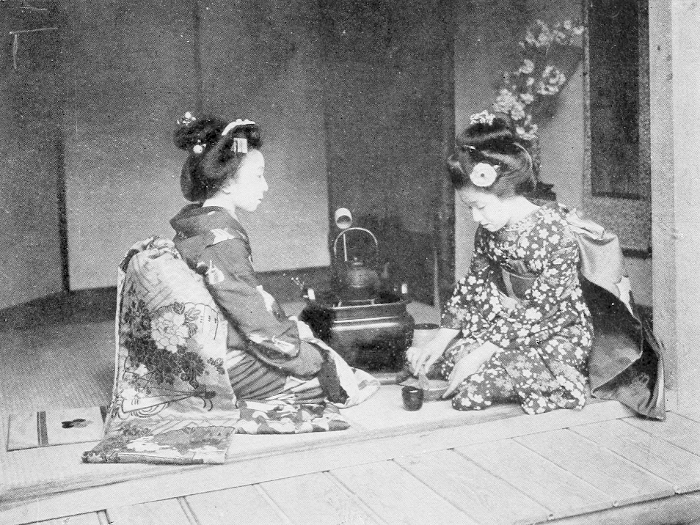
Nor is the potency of Ceremonial Tea diminished by the fact that it is served by a lovely little Japanese hand
The second night afterward he may be able to sleep. Ceremonial Tea is potent. Nor is its potency diminished by the fact that the hand which makes and serves it is a characteristically exquisite little Japanese hand, set off by the long soft sleeve of a flowered silk kimono.
Obviously you cannot understand Japan without understanding the Japanese woman—the nation's crowning glory. But as Lafcadio Hearn tells you, she is not to be understood without an understanding of the organization of Japanese society, which in turn, is not to be understood without a comprehension of Shintoism, the State religion.
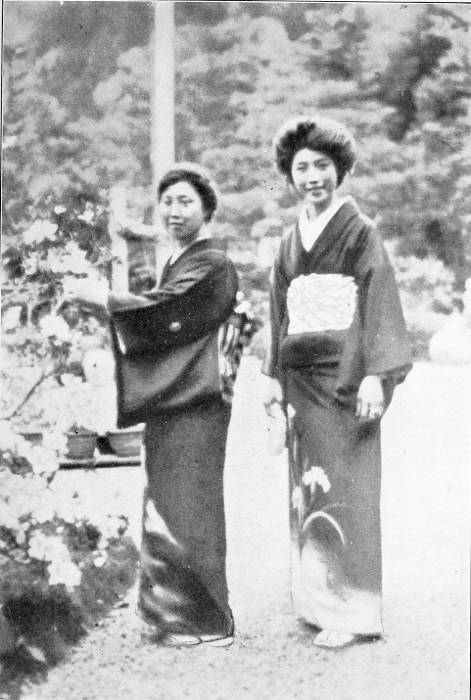
You cannot understand Japan without understanding the Japanese woman, who is the nation's crowning glory
Everyone has a prescription for understanding Japan. One friend told me I could never understand it until I had grasped the attitude of the people toward the Imperial House. But that is only another way of saying that Shintoism must be understood. Many, naturally, speak of Buddhism. Others mention the feudal system, with its clan loyalty, as the touchstone, and still others assured me that a knowledge of the Tea Ceremony and the No drama were essential.
"Fujiyama is the key-note of Japan," wrote Kipling. "When you understand the one you are in position to learn something about the other." Sir Charles Eliot, long before he became British Ambassador at Tokyo, wrote that it is hopeless to attempt to understand Japan without first recognizing "the peculiar spirituality of the Japanese"; but there are not wanting others to deny the existence of any such spirituality as Sir Charles describes, and who, instead, harp upon the alleged Prussianism of Japan as explaining everything.
Doctor Nitobé, the gifted Japanese author, who, like Okakura, writes delightfully in English, gives us as the key to Japan the doctrine of bushido, or "military knight ways"; but again there are students of Japan who affirm that the system of practical ethics attributed by the doctor's patriotic pen to the samurai of old, would astound those doughty warriors could they hear of it. The book "Bushido," declare these critics, is less a key to Japan than to Doctor Nitobé.
Is not the interdependence of facts, of which I spoke earlier, illustrated in the trend of this chapter, all of which, remember, grew out of a discussion of a bunch of flowers in a bamboo vase? Do you see why I called Japan "The Isles of Complexities"? And do you see that I might also call it "The Isles of Contradictions"?
Perhaps you will not be surprised, then, at my confession that after having spent several weeks in Japan I found myself fascinated but also puzzled. Why, I asked myself, had I so gaily set forth under an agreement to write about Japan? Why hadn't I made it a mere pleasure trip? For it is one thing to see and be satisfied with seeing, and quite another to attempt interpretation.
It has often been said that if a man stays in Japan six or eight weeks he can write a book about it; that if he stays a year or two he may write a single article for a magazine; but that if he stays several years he will be afraid to write at all.
"To get the Japanese background," one friend told me, "you ought to have a month or two in Korea, and at least a year in China. Then you should come back and rent a house and live in Japanese fashion for a while."
"Say about two hundred years?" I suggested.
My friend smiled.
"One hundred and fifty years might do," he said, "if you made every minute count."
Then, perhaps because he read in my face the signs of my discouragement, he reminded me of an old fable:
Seven blind men went to "see" an elephant. One of them, bumping into the great beast's side, said, "Here is a creature resembling a wall." Another, feeling the trunk, likened the elephant to a serpent; another, touching a tusk, announced that the animal resembled a spear; and still another, grasping an ear, compared the elephant to a large leaf. The one who got hold of the tail likened it to a rope, while he who embraced a leg thought of a tree, and he who crawled over the back declared that an elephant resembled a hill.
There in a paragraph you have Japan and her interpreters.
PART II
CHAPTER VII
The Lyric Impulse—A Man-Made Product—The Remoteness of Woman Suffrage—Efforts Toward Progress—Divorce—Marriage and the Go-Between—The Rising Generation—Japanese-American Duality—Leprosy
Lafcadio Hearn tells us that training in the Tea Ceremony "is held to be a training in politeness, in self-control, in delicacy—a discipline in deportment"; but Jakichi Inouye, a searching and sincere Japanese writer, goes even further, declaring that "the calm, sedate gracefulness of the Japanese lady of culture is the result of the study of the Tea Ceremony...."
My one quarrel with Mr. Inouye is over that statement. To say that the study of the Tea Ceremony assists young ladies to attain poise is safe enough; but to say that the fine bearing of the Japanese lady is the result of studying the Tea Ceremony seems to me to be going altogether too far.
The bearing of the Japanese lady is a thing too exquisite to have been produced by the practice of any artificial social ritual. Such a bearing is not, in my opinion, to be classed as a mere accomplishment, though it may have been so a thousand years ago. Rather it is the reflection of an incomparably lovely spirit, the flower of countless generations of such spirits, reaching back through ages of tradition, centuries of self-abnegation. It is the crowning product and proof, not of any Tea Ceremony, but of the disciplined civilization of Old Japan.
Whenever I find my thoughts reverting to the Japanese woman, I feel stirring within me a tendency to lyricism. Let Lafcadio Hearn, whose wife was a Japanese lady, speak for me. "Before this ethical creation," he writes, "criticism should hold its breath; for there is here no single fault save the fault of a moral charm unsuited to any world of selfishness and struggle.... Perhaps no such type of woman will appear again in this world for a hundred thousand years: the conditions of industrial civilization will not admit of her existence."
The fact that the Japanese woman is in no small degree a man-made product does not fill me with admiration for Japanese men, as would some insentient product of their art. For whereas the artist has a right to carve what he will in wood or ivory or lacquer, to mould what he will in wax or clay or bronze, I doubt his moral right to use the human soul as a medium for his craftsmanship in making an ornament for his own home, however exquisite that ornament may be.
I am well aware that in this case the end may be said to justify the means, but I am enough of an individualist to believe in our American system, even though I must admit that it has not produced so sweet and delicate an average of womanhood as has the Japanese system. Women as we produce them exhibit a much wider range of types than may be found in Japan, and though a vulgar American woman, be she rich or poor, attains a degree of vulgarity such as is not even faintly approximated in Japan, we also know that we produce types of women as fine as the world can show. And while I cannot speak with absolute certainty of the intellectual attainments of Japanese women, I am inclined to think that our more liberal attitude toward the sex, the greater freedom of companionship between American women and men, and the growth of the American woman's interest and share in public matters may tend to make her, at her best, a more completely satisfying comrade—not because her brains are necessarily better brains than those of the women of Japan, or of other countries, but because she has been encouraged to exercise them in a larger way.
From my point of view, however, the basic question here is not the question of which system produces the highest specimens of womanhood, but that of the inherent right of the individual to develop, let the results be what they may.
The Japanese woman is not allowed this freedom, since it is obviously to the interest of the Japanese man to keep her as she is. Lately there has been some agitation in Japan for what is called "universal suffrage," but it must not be supposed that by that term woman suffrage is meant. The proposal involves only the extension of the ballot to all males, as against the present system which requires that a man shall pay taxes above a certain amount in order to have a vote. Woman suffrage is not even in sight. When I was in Japan a few progressive women were asking, not for the vote, but for the abrogation of the rule which denied their sex the right to attend political meetings. They were successful. The rule was recently abrogated. A movement had also been started by some advanced women led by Mrs. Raicho Hiratsuka, for laws compelling men who wish to marry to obtain medical certificates declaring them mentally sound and free from diseases of a kind likely to be communicated to a wife. I heard that seventy out of three hundred girls employed by the railway administration in Kyoto had organized an association to aid in the advancement of the measures proposed, vowing never to marry unless their would-be husbands complied with the requirements for which Mrs. Raicho Hiratsuka and her associates were endeavouring to obtain legal recognition.
Another matter that wants mending is the legal status of married women. So far as I know there has been made no serious effort to improve the present situation. Under Japanese law a woman, upon contracting marriage, is debarred from civil rights, having practically the standing of a minor. A wife cannot transfer her own real estate, bring an action at law, or even accept or reject a legacy or a gift, without the consent of her husband. Laws not dissimilar to these exist, I believe, in some of the more backward states of our own Union. According to the law of Japan a widow cannot succeed her husband as head of the family if she has a child who can take the succession. In matters of inheritance an elder sister gives place to a younger son, even to an illegitimate son recognized by the father.
A husband may divorce a wife for adultery, but a wife cannot divorce a husband for this cause—or rather, she can do so only when he has offended with a married woman whose husband has therefore brought action for divorce. Thus it will be seen that a husband may even take a concubine to live in his home, along with his wife and children, without giving ground for divorce. Concubinage, I am told, is still to some extent practised in Japan, though popular opinion is against it. In one respect, however, the Japanese divorce laws are more enlightened than our own. A husband and a wife who agree in desiring a divorce may easily obtain it by stating the fact to the court.
Somehow or other I came to the subject of divorce before that of marriage. The Orient and the Occident are nowhere farther apart than in their views and customs as to the mating of men and women. In Japan marriages for love rarely occur, though it is said that the tendency of young people to marry to suit themselves is growing. Young Japanese girls, I am told, often look with envy upon women of other nations, where marriage for love is the general rule. Probably they suppose that such matches are invariably happy; that the love is always real love, and that it endures for ever. No doubt our system, viewed from afar, looks as rosy to a Japanese girl as their system looks appalling to an American girl. Yet each has certain merits. The Japanese system does not suggest romance, it is true; but is romance, after all, the most essential stone in the foundation for a happy married life? Romantic notions figure too largely in some of our matches, and too little in some of theirs. And while the mature judgment of older people is with them the determining factor in the making of a match, it is too often with us no factor at all.
Marriages in Japan are generally brought about by older married couples who act as go-betweens. There is a popular saying that everyone should act as a go-between at least three times. The go-between, knowing a young man and a young woman whom he regards as suitable to each other, proposes the match confidentially to the parents of both. If preliminary reports are mutually satisfactory to the two families, a meeting of the young couple and their parents and relatives is arranged on neutral ground. Any intimation of the real purpose of this meeting is tactfully avoided at the time, though the purpose of it is, of course, fully understood by all concerned. Under this arrangement either family may, without giving offence, drop the matter after the first meeting, but if the results of the preliminary inspection are satisfactory to both sides, the parents meet again and definitely arrange the match, which is made binding by an exchange of presents.
Chamberlain says that while, in theory, the betrothal may not be concluded if either young person objects, in practice the two are in the hands of their parents, and that "the girl, in particular, is nobody in the matter."
This generalization was doubtless accurate a few years ago, and may be accurate to-day in remote parts of Japan where Western ideas have not crept in, but among the educated classes in large cities a distinct change has come over the rising generation. There is as great a gap between the older and the younger generations in Japan as in the United States, and as with us, the older people over there complain that youth is getting altogether out of hand, while youth complains that its aspirations are not understood by parents and grandparents. This does not mean that Japanese young men and young women run practically wild, as so many of our young people now are doing, but merely that the slight personal freedom they are demanding represents in Japan as great a novelty as is exhibited in the United States by the change from moderate parental control to no control at all.
Yet the cults and traditions of Old Japan are vastly powerful, and though they may yield a little here and there, they will not soon be broken down. This fact is made apparent in the quick reversion to type of Japanese men and women who have lived for years in the United States, and who, when in the United States, seem to have become quite like Americans. Meet them in Japan and you see that their Occidentalism was only skin-deep. While among us they gracefully adapted themselves to our ways, and doubtless enjoyed them, but always in the back of their minds was the knowledge that they were Japanese and that they would ultimately return to Japan, there to become a part of the finely adjusted mechanism of Japanese homogeneity. I know many such men and women and find them very interesting. They have passed through an extraordinary mental and spiritual experience, generally without being confused by it. Instead of mixing their Japanese and American selves, they acquire a perfect duality. They can sit on either side of the fence, as it were, and look over calmly and interpretatively at the other side.
I discussed this subject with one young matron who spent the first twenty years of her life in the United States, and who, when she moved to Japan, spoke her native tongue with an American accent.
"My brothers and sisters and I went to American boarding schools," she said. "We dressed like Americans, had American boy and girl friends, went to house-parties, and grew up outwardly, just as they were growing up. But always we were taught by our parents to understand that this was not to go on for ever.
"When I came to Japan and married I saw that the best thing to do was to show people that I was as Japanese as any of them. If I had kept up my foreign ways it would have been resented. So I became completely Japanese, and for a number of years did not even meet Americans who came here. Then when I had made clear my attitude and felt I was established, I began to see Americans again and entertain them."
In another case a young Japanese in an American university used to tell his college friends that when he went back to Japan he would show his emancipation from old Japanese tradition by marrying as he pleased. Soon after reaching home, however, he was married by his parents to a bride he hardly knew. He speaks fluent English, I am told, and has an American side which he can show at will, but the inner man is essentially as Japanese as though he had never been away. And rightly so, of course. The Japanese who throws himself as an impediment against the movement of the great machine of national conventions is not likely to break so much as a single tooth in the smallest of its wheels, but will surely break himself.
But to return to the subject of marriages:
Having arranged the match, the go-between naturally takes pride in its success. He befriends the young couple; if they are unhappy he mediates between them, endeavouring to settle their difficulties; and if their unhappiness continues, and divorce is spoken of, it becomes his duty to exhaust every resource to prevent their acting rashly.
Before arranging the match, however, the go-between takes precautions to provide against such dangers as may be foreseen. He must, for example, make discreet investigations as to the health of both families for several generations back, to insure against hereditary taints, among which the most dreaded is leprosy.
The Japan Year Book, in most cases a useful reference work, is curiously silent on the subject of leprosy, though several pages are devoted to tuberculosis and other diseases. It was reported recently that a million Japanese have tuberculosis, but leprosy, though less contagious and consequently much less frequent, is more feared. An authority has told me that there are probably two million lepers in the world and that the only countries free from the disease are England and Scotland, from which it has been eradicated by segregation. It is estimated that New York City has one hundred lepers, and that there are cases of it in most, if not all states in the Union. Yet according to the government report only three states—California, Louisiana, and Massachusetts—make provision for the segregation and care of sufferers from this most terrible of diseases. Some people give the number of lepers in Japan as under twenty thousand. The Home Office sets the figure at sixty-four thousand. Specialists, however, say that even the latter figure is far too low, and that the actual number is nearer one hundred thousand.
The first leprosarium in Japan was started twenty-eight years ago by Roman Catholic missionaries. A few years later a second leper hospital was founded by Miss H. Riddell, an Englishwoman who has been probably the greatest single influence in bettering conditions for the Japanese lepers. Miss Riddell's leprosarium at Kumamoto, south Japan, was, I believe, used by the Japanese Government as a model for the State leprosariums of which there are now five. Other such institutions are operated by missionaries and private individuals, but the work must be greatly extended if it is hoped to check the spread of the disease, to say nothing of stamping it out.
A Japanese friend of mine who has frequently acted as go-between in arranging matches for employees of a large company of which he is an official, tells me that girls in families tainted with leprosy are often exceptionally beautiful, and that they frequently have very white skins. In certain parts of Japan where leprosy is common there are, he tells me, rich families having beautiful daughters for whom it is impossible to find husbands in the neighbourhood because of rumours that the dread disease is in their blood. Such families occasionally move to the great cities where they seek to find husbands for their daughters through matrimonial agents or by personal advertisements in newspapers. The custom of advertising for a husband or a wife has of late years grown considerably, and as has happened in this country, rascalities are sometimes discovered behind such advertisements, wherefore the police keep an eye on matrimonial agencies.
One reason why accurate statistics on leprosy are hard to get, not only in Japan, but in all countries, is that families in which a case occurs will often go to great lengths to conceal it. In Japan this is particularly true because there a leper cannot marry, and leprosy is cause for divorce not only in the case of the individual actually afflicted, but in that of the victim's blood relations including those as far removed as second cousins.
No wonder the go-between feels a sense of responsibility!
CHAPTER VIII
Wedding Gifts—A Wife's Duties—Adopted Son-Husbands—Women in Business and Professional Life—Actresses—The "New Woman"—Kissing as a Business Custom—Film Censorship—"Oi, Kora!"—Women of Old Japan—The Change is Coming
Though the Japanese system of arranged marriages is sometimes likened to the French system, the two are quite different. In France the great point is the bride's dowry, but the Japanese bride is not necessarily expected to bring a dowry of money. Her wedding present from her parents consists as a rule of furniture and clothing which they give according to their purse.
The ceremonies connected with a Japanese wedding are extremely interesting, but are too elaborate to be gone into here. There is no wedding trip. The bride moves at once to the home of her husband's parents, unless she has married a younger son sufficiently prosperous and enterprising to set up a home of his own. The rule is that the eldest son continues to live under the parental roof after his marriage. Along with her name and residence the bride transfers her allegiance absolutely to the husband's family. Particular stress is laid upon her duty to her husband's mother.
This fact is recognized in a textbook issued by the Imperial Department of Education for use in the higher girls' schools, which says:
Absence of harmony is often witnessed between a husband's mother and her daughter-in-law, and this is often traceable to the latter's disobedience and undutifulness. The mother-in-law may be too conservative to get on smoothly with the young daughter-in-law trained in new ideas, but dutifulness, patience, and sincerity on the latter's part will bring on peace and harmony.... If, on the contrary, the daughter-in-law, while tolerant of her own weaknesses, is critical toward her husband's mother and complains of her heartlessness, she will only betray her own unworthiness. These points should always be kept in mind by young girls.
Young Japanese heiresses are doubly fortunate since their affluence provides, among other comforts, a means of escaping the dreaded mother-in-law. Instead of moving to her husband's home, an heiress will often bring her husband to the shelter of her own paternal roof, where by adoption he becomes a son of her family, taking the family name. One hears that the bed of roses sought by some of these muko-yoshi, or adopted son-husbands, does not prove always to be free from thorns, and there is a Japanese proverb which advises: "If you have left so much as a pound of bad rice, don't become a muko-yoshi." The muko-yoshi is not, however, always married to an heiress. Poor families having daughters, but no sons, will often take in a muko-yoshi to perpetuate the family line under the ancestral roof.
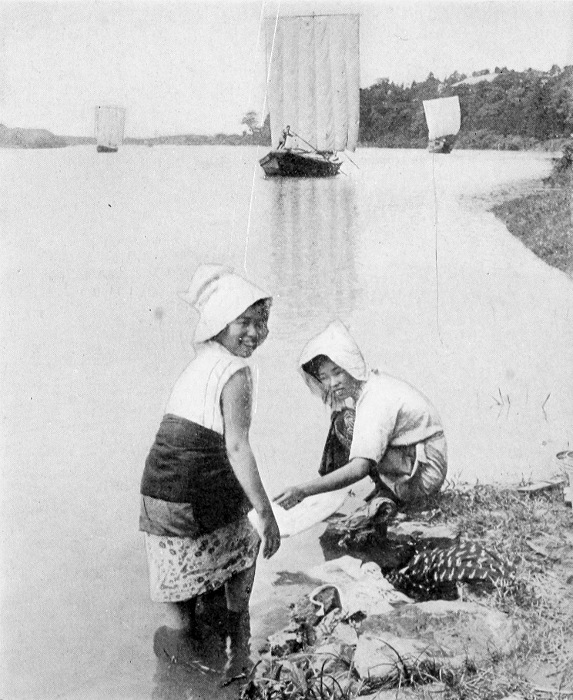
A laundry on the river's brim
When all is said, there is no question that the condition of Japanese women is slowly improving, although the woman movement there is still in the academic stage. Little by little the example of women in America and England is making itself felt, and the educational opportunities open to women are gradually increasing. The average college for women is not, to be sure, comparable with the ordinary college for men, but there is said to be one university of really high standing which is open to women, and a number of other co-educational institutions are listed as fairly good. Waseda College is now opening its doors for the first time to women as well as men, and though women cannot graduate from Tokyo Imperial University, I am informed that they are permitted to attend lectures there.
Women are going more and more into business and professional life. Great numbers of them are now employed in the government postal and railway offices, in the offices of prefectures and municipalities, and, of course, in the telephone service, as well as by private companies of all kinds. Employers report steady improvement in the standard of intelligence and capability among their woman employees. Women, they say, do their work well and are usually content with small salaries. In seeking positions they generally declare that they wish to occupy themselves profitably between the time of leaving high school and that of marrying.
Eliminating, for the time being, the geisha, who because of her curious occupation will be separately discussed, and who does not in any case fit into a discussion of woman's progress, since she is in some measure a barrier to it, we find that the medical profession is probably the most profitable field for woman workers. There are some seven or eight hundred woman doctors in Japan, of whom almost half are graduates of the Tokyo School for Women, founded by a woman physician, Dr. Y. Yoshioka.
Trained nursing is also a popular occupation, and many girls have lately been leaving office and telephone work to take it up, chiefly for the reason that trained nurses receive from $1 to $1.25 per day, which is considered good pay.
Until ten or a dozen years ago there were no actresses in Japan, female rôles invariably having been played by men, but the octogenarian Baron Shibusawa (lately created Viscount), who has done so much toward liberalizing the thought of Japan in many lines, founded a school for actresses, with the result that there is now a place for them, and that a few have come to be well known, although none is as yet so popular as are the best-known actors. Actors hold in Japan a social position similar to that held by Occidental players a century or more ago. They are distinctly a lower caste, and while they are admired for their art, and are adored by young girls as matinée idols are with us, they are considered as belonging to a social stratum in which geisha and wrestlers figure.
There are now perhaps a dozen or more women working as reporters and special writers on the various Tokyo newspapers. Miss Osawa, who started work on the Jiji Shimpo twenty-one years ago, is, I believe, the dean of Japanese woman journalists.
There are more than twenty well-known monthly magazines for women, many of them edited by women and largely contributed to by woman writers. Authorship is a traditional occupation for women in Japan, women's names being among the greatest in the nation's ancient literature—in which connection it is interesting to note the fact that some of the old-time authoresses were courtesans.
One hears a good deal of talk of the "new woman" in Japan, and perhaps the surest indication that she is coming into being is the fact that supposedly humorous postcards are sold on the Tokyo streets, in which the new woman is shown in various dictatorial attitudes before a cringing husband. Once, at a dinner I attended in Osaka, a woman who runs a business training school for girls, arose and made a short speech. I noticed that while she spoke not a few of the men smiled pityingly. From this item American women old enough to recall the early days of the woman movement in this country will have no difficulty in estimating the distance that the Japanese woman has yet to go.
Japanese ladies who have the time and the inclination for charitable activity accomplish a great deal. The W. C. T. U. is active in Japan, Mrs. Yajima, its president, a lady who, in 1920, at the age of eighty-eight, went to England for the International W. C. T. U. Convention, being perhaps the leader among progressive women of the land. The Red Cross has a large membership, and the Y. W. C. A., like the Y. M. C. A., has a firmly fixed and useful place, carrying on a wide variety of activities. Among these are classes to teach young girls the ways of the business world which is so rapidly opening to them. As an indication of the need for such instruction, a lady who works in the Y. W. C. A. in Tokyo told me of a case in which a Japanese girl who came for instruction reported that she was in the habit of kissing her foreign employer good morning and good night, in the belief—a belief we must suppose to have been inculcated by him—that such was the general business custom.
It is often said that the Japanese never kiss. Bowing is the national form of salutation, though those accustomed to meet foreigners shake hands with them. The fact as to kissing is that one never sees it, even between mother and child, and that this is interpreted as signifying that kissing is unknown. That is not the case. I own an old print by Utamaro which shows a man and a woman kissing with the greatest zeal. The Japanese simply do not kiss indiscriminately or in public places.
The feeling against demonstrations of affection in public is so strong that when American motion pictures were first taken to Japan, audiences would hoot at those tender passages so much enjoyed by some persons in this country. For several years past, however, all such representations have been cut from American films intended for exhibition over there. This work is done by an American who lives in Japan, and who has made up what is probably one of the strangest films in the world by assembling all the cuts into one awful reel of lust and osculation, in which figure most of the widely known American movie stars. This film he sometimes runs off privately for his friends, and it is said to leave those who witness it in a frame of mind to vote kissing a capital offence.
In a rather pitiful list of ten requests made by a Japanese wife to her husband, and exhibited as a poster at the Girls' Industrial School of Tokyo, was the appeal: "Please stop saying 'Oi, kora,' when you call me."
Oi, the expression used by most Japanese husbands when they call their wives, is about equivalent to our "Hallo!" or "Hey!" Sometimes a husband will call his wife by name, but one more often hears "Oi," or "Oi, oi," even among persons of position. Oi is more familiar than rude. A man would say it to his close friend. But a woman would never say it to her husband. Kora is really objectionable, being an exclamation addressed only to inferiors. Naturally, then, wives do not like it, whether they make bold to declare the fact or not. For a wife may not even call her husband by his first name, but must address him as anata, which is a respectful form for "you."
It has been declared that the peasant woman who works beside her husband in the fields or fishing villages, or who helps him push a cart, or navigate a boat on the rivers and canals, is the happiest woman in Japan, being a real companion to him. However, that may be, there is much room for improvement in the attitude of the average middle-class Japanese toward his wife. He gets into automobiles and railroad trains ahead of her and has the air of ignoring her in public.
It should be said, though, that the attitude of such husbands does not necessarily mean that they do not care for their wives. Rather it means that they are old-fashioned—that the ancient notion of woman's position, based on the teachings of Buddhism and Confucianism, has clung to them. But most of all, I think, it reveals their fear of being thought ridiculous. For if a man showed his wife what we should call ordinary civility, the old-school Japanese thought him henpecked.
Strangely enough the position occupied by women in the days of Japan's early antiquity was much higher than it has since become. In olden times women took part in war, had a voice in politics, and in other ways held their own with men. In the eighth century successive Empresses occupied the Imperial throne, and the influence of certain able women was strongly felt at court; two centuries later we find a great era of literary women many of whose names are famous to this day.
But soon after the introduction of Buddhism and Confucianism all this was changed. The Buddhist doctrine called women creatures of sin, treacherous and cruel; and says Confucius: "When a boy is born let him play with jewels; when a girl is born let her play with tiles." So it came about that woman's position declined until it was possible for a famous moralist to write a treatise on the Duty of Woman, containing such maxims as these:
A woman should look upon her husband as if he were Heaven itself, and never weary of thinking how she may yield to him, and thus escape celestial castigation. Let her never dream of jealousy. If her husband be dissolute she must expostulate with him but never either nurse or vent her anger. Should her husband become angry she should obey him with fear and trembling and not set herself up against him in anger and frowardness.
An endless quantity of such quotations may be taken from the writings of moral teachers, and in them is indicated the debt of the women of Japan to Chinese doctrines. In view of which it seems strange indeed to visit a Buddhist temple and there be shown coils of thick black rope which was used in the erection of the building, and which was made entirely from the hair of devout women who sacrificed their prized tresses for this purpose, being too poor to give aught else.
Thus, while the Occident was teaching men to be chivalrous toward women, the Orient was teaching women to be, as one might put it, chivalrous toward men. But in both cases the modern tendency is toward change. The growth of woman's economic independence in this country, making her man's competitor, tends to make man less polite in his general casual contacts with her. Having elected to be his equal she must take her chances with him in the subway rush and in the scramble for street-car seats.
Fifty years hence, Japan will perhaps have reached this pass, but the present rudeness of men to women is not that of equals to equals, but of superiors to inferiors; that is the thing that must be changed.
And it will be changed. Slowly, very slowly, the attitude of the Japanese man toward the Japanese woman is improving. I found that evening classes were being held at the Y. W. C. A. in Tokyo for the purpose of teaching young husbands and wives how to enjoy social life together, and there is no doubt that in fashionable society the better type of modern young husband treats his wife with much more consideration and courtesy, and makes much more a companion of her, than was customary or even possible under the old régime. Twenty-five years ago it was well enough for a man to walk on the street with a geisha, but the man who walked in public with his wife was jeered at, and might even find himself a target for missiles. Though that is no longer the case, the tradition that man should assume a superior air still to some extent survives among the masses, so that for a husband to treat his wife with perfect courtesy before strangers requires, singular though it may seem, real moral courage.
CHAPTER IX
Baseball in Japan—The National Sport—Wrestling and Shintoism—Fans—Wrestlers' Earnings—The National Game Building—Formalities Before the Matches—The Super-Champions—Peculiarities of Japanese Wrestling—Days Off
Though the grip of the American national game upon Japan is sufficiently strong to have brought a Japanese university team to this country and to have taken one or two American university teams to Japan for return games, there is as yet no professional baseball in Nippon, and the kind of wrestling known as sumo still maintains its ancient prestige as the national sport.
Having been in Tokyo at the time of an election and again during the annual spring wrestling season, I could not but be struck by the fact that the street crowds watching the bulletin boards for the results of the physical contests were larger and more enthusiastic than the crowds which assembled to learn the results of the political struggle.
The average Japanese knows, I believe, about as much and about as little of domestic politics as the average American. He has a loose idea of the structure of the government and of political machinery; he follows political leaders rather than causes, and like us he is prone to read rich meanings into the glib banalities of politicians.
Wrestling he understands much better. He knows all its fine points. His enthusiasms on this subject are informed enthusiasms, and unlike the baseball fan, he inherits them from a long line of ancestors—for compared with wrestling, baseball is a brand-new sport. When the Greeks and Romans wrestled, the Japanese were wrestling, too. In the ninth century the Japanese throne was wrestled for. A Mikado died and left two sons, and these, instead of going to war against each other, left their claims to be settled by a wrestling match.
The sport is, furthermore, associated, in a manner more or less diaphanous, with Shintoism. Certain Shinto traditions are connected with it, and the matches used to be held in the grounds of Shinto temples—as indeed amateur matches often are today in country districts.
For many years past it has been customary to hold wrestling meets in Tokyo twice yearly, in January and May. Prior to the construction of the Kokugikwan, or National Game Building, the large steel and concrete structure in which the meets are now held, they occurred in the grounds of the Eko-in temple. January is a cold month in Tokyo and even May is often chilly, wherefore, the audience was none too comfortable at these open-air matches. Moreover, Japan is a rainy land; the old open-air matches had frequently to be declared off because of bad weather; sometimes it took twenty days to run off a ten-day meet. But the Kokugikwan has put an end to these difficulties. The modern Japanese wrestling fan keeps warm and dry, with the result that the sport now has more devotees than ever.
During the wrestling season Tokyo is profoundly excited. Men of large affairs have a way of disappearing mysteriously from their offices. Officials of banks and large corporations are vaguely reported to be "out of town for a few days." Prince Tokugawa, President of the House of Peers, suddenly becomes a difficult gentleman to find—unless, perchance, you happen to know where to look for him. So, too, with many a man of smaller consequence. If he can afford it—often whether he can afford it or not—he drops his work and vanishes. But he does not always vanish; for if his enthusiasm for wrestling verges on dementia he may adorn himself in an eccentric manner and make himself conspicuous in the auditorium by his antics and his cries. Thus certain wrestling fans of Tokyo have come to be considered privileged characters—as, for instance, the one who always appears at the great matches in a coat of scarlet silk, which his father wore before him, and whose habit it is to prance down the aisle before the wrestlers as they march in solemn procession to the ring.
When I inquired about tickets for one of the days of the great meet I was strongly reminded of our World Series baseball games. It seemed that tickets were not to be had. Eventually, however, I managed to secure them in the way such things are secured the world over—by means of "pull." I found a friend who had a sporting friend who knew a wrestler who could get seats.
The attitude of the sporting Japanese gentleman toward wrestlers resembles that of the sporting American or Englishman toward pugilists and jockeys. It is chic to know them, but not as equals. One is very genial with them and at the same time a little patronizing, whereas they are expected to assume a slightly deferential manner. Perhaps the attitude of the Japanese sporting gentleman toward his favourite wrestlers is rather more like that of the Spanish sporting gentleman toward bullfighters, for in both countries it is customary for the wealthy patron to give expensive presents to the hero. But whereas in Spain handsome jewelry is sometimes thrown to the bull-fighters in the ring, it is the custom in Japan for the fan to throw his hat, coat, pocketbook, cigarette case, or whatnot to the popular idol, who later sends the trophy back to the owner, receiving in exchange a valuable gift—frequently a gift of money.
Hence, though the actual pay of wrestlers is small, perquisites make the profession profitable to those fairly successful in it, and poor parents, having a son of unusually large proportions, are likely to look with resignation upon the Japanese theory that great size is generally accompanied by stupidity, and to rejoice in the dimensions of their offspring because of a fond hope that he may become a champion wrestler and grow rich.
My friend the Japanese sporting gentleman (who, by the way, was a graduate of the University of Michigan) did more than obtain tickets for me. He called with his automobile and took me to the amphitheatre.
"Our mode of wrestling is not at all like yours," he said, "and I want to explain it to you."
It was about eleven in the morning when, after traversing several streets strung with rows of Japanese lanterns, and filled with hurrying throngs, we reached the great circular concrete building into which an eager crowd was pouring through many portals—an audience which, though made up for the most part of men, contained not a few women and some children. Many, though by no means all of the women were geisha, for wrestlers have about the same rank as geisha in the social scale, and they are often the heroes as well as the intimates of the fair entertainers.
As we approached the amphitheatre the thought came to me that there is a curious sameness in the atmosphere surrounding great sporting events the world over, however little the various sports themselves may resemble one another. To approach this great building in Tokyo during wrestling week is quite like approaching the Plaza de Toros in Madrid, or the building in which jai alai is played in Havana, or the Polo Grounds in New York, or the Yale Bowl, or the Harvard Stadium.
The Kokugikwan is a circular building roofed with glass and seating fourteen or fifteen thousand persons. At the centre is a mound of earth with a flat top on which the ring is marked with a border of woven straw. Over the ring is a kiosk supported by four heavy posts which are respectively red, green, black, and white in colour, and are considered to symbolize the four corners of the earth. The kiosk has a roof somewhat resembling that of a temple and is embellished with curtains of purple-and-white silk which hang down a few feet below the eaves.
The main floor of the amphitheatre is banked up toward the back. The seats at the ringside are reserved for the participant wrestlers; behind these are some tiers of chairs which are presumably occupied by the most frantic fans, and behind the chairs comes a great area of boxes, each seating from four to six persons. These boxes, like those of a typical Japanese theatre, do not contain chairs, but are floored with thick straw mats on which are cushions for the occupants to squat on. The only division between the boxes is a railing about a foot high. Above the main floor are two galleries running all the way around the building. The Imperial box is in the first gallery. People in the galleries sit in chairs, in front of which are narrow shelf-like tables from which luncheon may be eaten—for wrestling matches, like the old-style theatrical performances, last practically all day.
During the first part of the morning, bouts between numerous minor wrestlers are run off, but at about eleven the building fills up, for everyone wishes to see the two groups of champions march in. One group represents East Japan, the other West Japan; each group contains about twenty men, and their seats are at the eastern and western sides of the ring, respectively. This representation of East and West is not literal, but is the traditional division. A man from an Eastern province may be champion of the West, and vice versa.
Gross-looking creatures, naked to the waist, they enter in single file, each wearing a long velvet apron, elaborately embroidered and tasselled. These aprons, which are given to them by their patrons, are removed before the contests, a loin-cloth and short skirt of fringe being worn beneath them.
Marching into the ring the champions form a circle and go through a series of set exercises, clapping their hands in unison, raising their legs high and stamping their feet violently upon the ground to exhibit their muscular flexibility. After these exercises they march out again.
Next enter the supreme champions of the Eastern group and of the Western group—the two great wrestlers of Japan—popular idols who, by reason of having remained undefeated throughout three or more successive wrestling meets, are entitled to wear not only the elaborate velvet apron, but a very thick white rope wound several times about their waists and knotted in a certain way.
Each of these super-champions is attended on his march to the ring by two other wrestlers. The one who precedes him is known as the tsuyu harai, or dew-brusher. In theory, he clears the way, brushing dew from imaginary grass before the feet of the mighty one. The attendant who brings up the rear is the tachi mochi, or sword-bearer; for according to old Japanese custom no wrestler except a super-champion was allowed to wear a sword, and though the sword is now only a symbol, the custom still survives, and the sword of the super-champion must be carried in behind him.
To one accustomed to the sort of wrestling practised in the Western world, many of these champions do not look like athletes, since they are, as a rule, so fat that their paunches bulge like balconies over the tops of their aprons and loin cloths, and their arms and thighs tremble like jelly when they walk. Under the Japanese method of wrestling, however, each match is quickly settled, wherefore endurance is not so important as great weight and power in the first moment of attack. It is for this reason that fat wrestlers are usually the most successful. Some of them have weighed as much as three hundred and fifty pounds. But now and then there comes along a super-champion like Tachiyama, who is not very fat, and who conquers by strength, speed, and reach rather than by mere weight.
When the super-champions have exhibited themselves, the two groups of lesser champions return and occupy their seats around the ring. The four referees—retired wrestlers—take seats on cushions, one at each corner of the kiosk, and the umpire, wearing beautiful flowing silks and a strange little pointed hat like that of a Buddhist priest, enters the ring and, holding up the lacquered wooden fan, which is his badge of office, announces in impressive tones the names of the two men who are about to meet.
The adversaries then enter the ring and go through the same old series of stampings and flexings. Each takes a handful of salt from a box at his side of the ring, puts a little in his mouth and throws the rest upon the ground before him. This is supposed to have a purifying effect, not in the antiseptic sense, but in some occult way. Salt is often used thus in Japan.
Having completed these preliminaries the two men take their positions facing each other, braced upon all fours. But this apparent readiness by no means indicates that the contest is commencing. Instead of immediately attacking, they will often remain thus poised for minutes, sharply watching each other. Then one of them will get up and take a drink, or will go for some more salt and throw it in the ring. Also one or the other will often make a false start, attacking when his adversary is not ready to accept combat; whereafter the two resume their crouching attitudes, toes braced, hands on the ground. This sort of thing may continue for ten or twenty minutes, to the accompaniment of howls from the fans, who shout the names of their favourites and bellow Japanese equivalents for such Americanisms as "Go to it!" and "Atta Boy!"
But whereas the period of preparation may often be measured in fractions of an hour, the actual struggle usually consumes but a few seconds. The men spring at each other like a pair of savage fighting dogs and the contest is settled before you know it. There is none of that straining to get a certain hold, or to break one, which is so characteristic of our style of wrestling, and you never see the contestants writhing in deadly embrace upon the floor. The vanquished need not necessarily be thrown at all, though often he is. If any portion of his body, other than the soles of his feet, touches the ground, or if (whether he be thrown or not) any portion of his body touches the ground outside the ring, that means defeat. In case both men fall, or are forced from the ring together, the one who first makes contact with the ground, or first leaves the ring, is vanquished.
Often a man is beaten by being bent over until he is forced to support himself on one hand, and there have been cases in which decisions were rendered merely because one man's head was bent down until his top-knot touched the floor. A wrestler will sometimes win in one hard push, backing his opponent out of the ring; but in this there is always the danger that the one being pushed will at the last moment step aside, causing the adversary's own momentum to carry him beyond the boundary, thus applying an underlying principle of jiu-jutsu,—or jiudo, as it is called in its improved form—in which a man's own strength is used to defeat him. Frequently, however, there will be a spectacular throw; and sometimes, when this occurs, the ringside seats, so coveted at wrestling and boxing matches in this country, are not highly desirable. I have seen huge wrestlers hurled through the air to land sprawling on their comrades in their seats.
When a close decision has to be made the umpire confers with the referees, and at such times the audience and the two opposing groups of wrestlers are vociferous in support of the contestant they favour.
To the credit of the Japanese be it said, however, that they do not yell: "Kill the umpire!" when displeased by a decision rendered in connection with their national sport; that they do not throw bottles at the umpire, and that it never becomes necessary to give police protection to an umpire whose judgment has not accorded with that of the crowd. The Japanese, you see, have not adopted every detail of Western civilization.
I must have seen twenty-five or thirty bouts that day. But though I was interested I cannot pretend to find in Japanese wrestling the qualities of a really great sport. Skill their wrestlers have, but there is no call for stamina. Their style of wrestling seems to me to let off where ours begins.
Japanese life runs at lower pressure than our life. There is not the nervous rush about it. Matters move at a more comfortable pace, and people seem to have more patience. An American crowd would become restless over the interminable preliminaries of each Japanese wrestling bout, and would find the bout itself unsatisfactory because of its brevity and the lack of sustained effort. The Japanese, on the other hand, seem always to be willing to wait for something to happen. One notices this in innumerable ways. Motion pictures made in Japan are likely to be, from our point of view, intolerably slow in their action. So also with the all-day plays of the typical Japanese theatre.
The Japanese business man's custom of taking a day off whenever it happens to suit him is doubtless due in part to the fact that until recently Sunday in Japan was just like any other day. There was no regular day of rest. One day a month was usually appointed as a holiday for commercial and industrial workers; later it became two days a month; and at last there developed a custom of making those days the first and third Sundays of the month. For though Sunday has, of course, no religious significance in the eyes of the large body of Japanese, it seemed the most practical day to select for a holiday if only because it was a day on which the offices of American and European residents were closed.
CHAPTER X
The Courageous Congressmen—Geisha and Nesan—The Maple Club—The Gentleness of Servants—Removable Walls—Dancing Girls—A Lesson in the Use of Chopsticks—"Truthful Girl"—A Toast in Saké—Drunkenness—My Friend the Amiable Inebriate—The Great Rice-Ball Mystery
It amused me to hear, a little while ago, that a party of our Congressmen, on a junket in Japan, had been implored by certain pious Americans over there, to avoid such sinful things as teahouses and geisha. No doubt the poor devils of Congressmen had fancied they would be able to lead their own lives five thousand miles from home and constituents. And evidently they proposed to do it, for they replied with uncongressmanlike boldness that teahouses and geisha were among the things they most desired to see. That pleased me not only because it showed that a Congressman can be spunky—even though he has to go to another hemisphere to do it—but because it showed a normal human interest in what is assuredly a very curious phase of life.
I, too, was interested in tea houses and geisha, and I made it a point to find out as much about them as I could.
The first geisha I saw were in attendance at a luncheon for some forty persons—about half of them Americans—given by a Tokyo gentleman for the purpose of showing us what a purely Japanese luncheon was like. It was held at the Maple Club, a large, rambling Japanese-style building standing in charming gardens in the midst of one of the Tokyo parks—a Far Eastern equivalent of such Parisian restaurants as the Café d'Armenonville or the Pré Catelan.
As we alighted from our rickshas a flock of smiling serving maids appeared in the doorway to greet us, indicating to us that we were to sit on the high door-step and have our shoes removed by the blue-clad coolies who were in attendance—each with the insignia of the Maple Club in a large design upon the back of his coat. (If you wish the coolie who draws your ricksha or does other work for you to wear your crest you supply his costume and pay him a few cents extra per day.)
When our shoes had been checked and our feet encased in soft woollen slippers like bed-bootees, we were bowed into the building and escorted through a series of rooms with soft straw-matted floors and walls of wood and paper. Emerging upon an outer gallery of highly polished wood, we followed it, looking out over the lovely garden as we moved along, and finally reached a flight of stairs, also of wood having a satiny polish, which led to the banquet hall. Our escorts on this journey were several little Japanese maids in pretty kimonos, who, though they spoke no English, talked to us in soft international smiles. No one without a sweet nature could smile the smile of one of these Japanese serving maids. They are called nesan, meaning literally "elder sister." This familiar appellation is generally used in speaking to a maidservant whose name one does not know, and in the term is revealed a hint of the beautiful relationship which exists in Japan between master and servant, whether in a private house or a Japanese inn. In the great cities this old relationship is to some extent breaking down as Japan becomes Westernized, but in Japanese hotels and country inns, and in prosperous homes one sees it still. Service is rendered with a grace and friendliness which make it very charming. Even about the menservants in the houses of the rich there is nothing of the flunkey spirit. The Japanese manservant generally wears silken robes which give him a fine dignity and make it difficult, sometimes, to differentiate him from members of the family. He is extremely polite, but not rigid. You feel that he is a self-respecting man. As for maidservants, they are like so many pet butterflies. One of Japan's strongest claims to democracy, it seems to me, is founded on the attitude existing between master and servant.
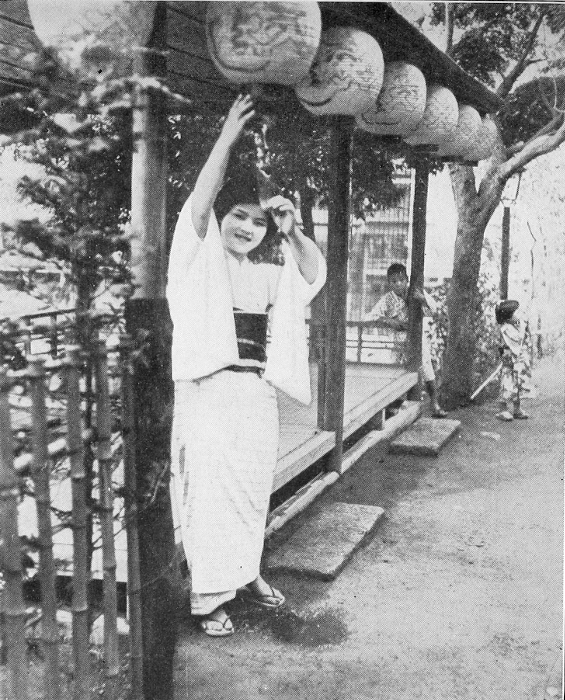
No one without a sweet nature could smile the smile of one of these tea-house maids. They are called nesan—"elder sister"
Those who have visited Japan, yet who do not agree with me as to the exquisite courtesy of the Japanese servant, will be those whose stopping places have been European-style hotels in the large cities. In such hotels the service is often poor and one occasionally encounters a servant who is surly and ill-mannered. I encountered one such in Kobe—said to be the rudest city in Japan. But by the time I ran across him I had seen enough of the real Japan to know what such rudeness signified. It showed merely that in this individual case native courtesy had been worn away by contact with innumerable ill-bred foreigners.
But to return to our luncheon.
As a concession to American custom our host greeted us with a handshake, and his Japanese guests walked in and shook hands instead of dropping to their knees on entering and bowing to the floor according to the old national custom.
The room, which was large, well illustrated the elasticity of the Japanese style of building. Five or six private dining rooms usually occupied this section of the house, but for the requirements of the present occasion the walls forming these rooms had been removed making the entire area into one spacious chamber. It is a simple matter to remove such walls, since they consist only of a series of screens of wood and paper which slide in grooves and can easily be lifted out and put away in closets. And let me add that, though the climate of Japan is very damp, the Japanese use such thoroughly seasoned wood, and work in wood so admirably, that I never once found a sliding screen that stuck in its grooves.
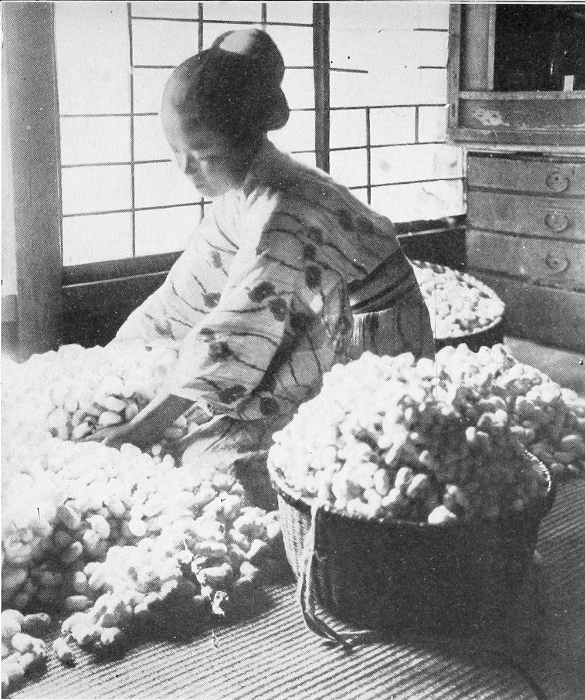
Cocoons—Five thousand silk worms eat 125 lbs. of mulberry leaves and yield eight skeins of silk, which make one kimono
For the meal we knelt upon silk cushions laid two or three feet apart around three walls of the room. As the weather was chilly there stood beside each of us a brazier, or hibachi, consisting of a pot of live charcoal standing in a wooden box. The Japanese love of finish in all things is shown in the careful way they have of banking the ashes in a hibachi, and making neat patterns over the top of them.
In front of each of us was placed a little table of red lacquer about a foot high, with an edge like that of a tray, and on this table were sundry covered bowls of lacquer and of china, and little dishes containing sour pickles and a pungent, watery brown sauce. In front of every one or two guests knelt a nesan, presiding over a covered lacquered tub, containing boiled rice, which is eaten with almost everything, and even mixed with green tea and drunk with it out of the rice-bowl.
Also, in attendance upon each guest, there was a geisha. Some of the geisha were women perhaps twenty years old, wearing handsome dark kimonos which they generally carried with a great deal of style, but others were little maiko, dancing girls, in brilliant-coloured kimonos with the yard-long sleeves of youth. The youngest of these was perhaps twelve years of age, while the oldest may have been sixteen.
As I afterward learned, there is a vast difference between various grades of geisha. Those present at this luncheon were among the most popular in Tokyo. They were truly charming creatures, sweet-faced, soft-eyed and gentle, with beautiful manners and much more poise than is shown by the average Japanese lady. For Japanese ladies are not, as a rule, accustomed to our sort of mixed social life, in which husbands and wives take part together, whereas geisha are in the business of entertaining men and presumably understand men as women seldom do.
Since few geisha speak English, and very few Americans speak Japanese, we travellers from abroad are rather outsiders with the geisha, and our appreciation of them must be largely ocular. But a geisha can come as near to carrying on a wordless conversation as any woman can. Mine smiled at me, filled my shallow little cup with warm saké from time to time, and showed me how to use my chop-sticks. I found the lesson most agreeable, and was presently rewarded by being told, through the Japanese friend at my side, that for a beginner I was doing very well.
If you want to know what it is like to eat with chop-sticks try sitting on the floor and eating from a bowl, placed in front of you, with a pair of pencils or thick knitting needles. It is a dangerous business, and the risk is rendered greater by the fact that the Japanese do not wear napkins in their laps, and that to soil the spotless matting is about the greatest sin the barbarian outlander can commit. The Japanese napkin is a small soft towel which is brought to one warm and damp, in a little basket. It is used on the face and hands as a wash-cloth and is then removed.
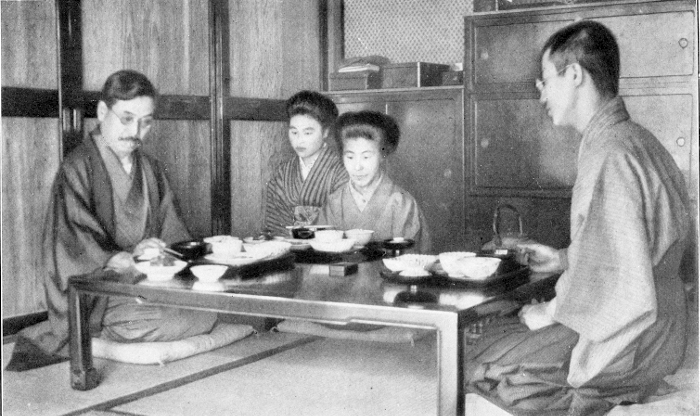
Family luncheon à la Japonaise. The serving maid is kneeling in the corner at the back. If you would essay eating with chopsticks, try it with a pair of heavy knitting needles
Presently my geisha called one of her sisters in the craft to witness my progress with the chop-sticks. The new arrival was named Jitsuko—otherwise "truthful girl"—and she seemed to be quite the most fashionable of them all. Her kimono, with its dyed-out decorations and its five ceremonial crests, was very handsome and was worn with great chic, her obi was a gorgeous thing richly patterned in gold brocade, and I noticed that she wore upon it a pin containing a very fine large diamond—a most unusual sort of trinket in Japan. Also she wore a ring containing a large diamond. Nor was this foreign note purely superficial. For, to my delight, Jitsuko spoke to me in English. She was one of Tokyo's two English-speaking geisha, and as I later learned, had the honour of being nominated as the geisha to entertain the Duke of Connaught at dinners he attended at the time of his visit to the Japanese capital.
Jitsuko and the other geisha talked together about me. Then Jitsuko paid me the compliment of saying that they agreed in thinking that I looked a little bit like a Japanese. I thanked her, and returned the compliment in kind, saying that I thought they also looked like Japanese, and very pretty ones, whereat they both giggled.
By this time we had established an entente so cordial that it seemed fitting that we should drink to each other. Aided by the gentleman at my side and by Jitsuko, I learned the proper formalities of this ceremony. First I rinsed my saké cup in a lacquer bowl provided for the purpose, then passed it to Jitsuko. The preliminary rinsing indicated that she was now to fill the cup and drink. Had I passed it to her without rinsing, it would have meant that she was to refill it for me—for a geisha never "plies" one with saké but waits for the cup to be passed. When she had sipped the saké she in turn rinsed the cup, refilled it, and handed it to me to drink. Thus the friendly rite was completed.
I had heard that saké was extremely intoxicating, but that is not so. It is rice wine, almost white in colour, and is served sometimes at normal temperature and sometimes slightly warm. It is rather more like a pale light sherry than any other Occidental beverage, but it lacks the full flavour of sherry, having a mild and not unpleasant flavour all its own. On the whole I rather liked saké, and I found myself able to detect the difference between ordinary saké and saké that was particularly good. While on this subject I may add that liquor of all sorts flows freely in Japan. Saké is the one alcoholic beverage generally served with meals in the Japanese style, but at the European-style luncheons and dinners I attended two or three kinds of wine were usually served, and there were cocktails before and sometimes liqueurs afterward. The Japanese have also taken up whisky-drinking to some extent. They import Scotch whisky and also make a bad imitation Scotch whisky of their own. But saké still reigns supreme as the national alcoholic drink, and when you see a Japanese intoxicated you may be pretty sure that saké—a lot of saké—did it.
In my evening strolls, particularly in the gay, crowded district of Asakusa Park in Tokyo—a Japanese Coney Island, full of theatres, motion-picture houses, animal shows, conjuring exhibitions, teahouses, bazaars and the like, surrounding a great Buddhist temple—I saw many intoxicated men, but I never came upon one who was ugly or troublesome. Whether because of some quality in the Japanese nature, or in the saké, this drink seems only to make gay, talkative and sometimes boisterous those who have taken too much of it. I should not be surprised if the Japanese need alcoholic stimulants rather more than other races need them. For one thing the climate of Japan, except in the mountains, is enervating; and for another, the Japanese nature is generally repressed, and saké tends to liberate it.
I noticed this at another entertainment in Tokyo—a dinner of newspaper editors. Being the only foreigner there, and being enormously interested in the problems connected with relations between the United States and Japan, I launched forth, telling them my views in the hope of learning theirs. But although I sensed that they did not agree with all I said, their responses exhibited only the sort of polite tolerance that a courteous host will show a somewhat obstreperous guest. For some time I felt that I had acted like a bad boy at a party. But after the geisha had filled our cups with saké more than once, I got what I was looking for—an argument. It was a polite argument, but we had become friendly enough to speak frankly. In saké veritas.
This was a case of just enough saké, but so far as I was able to observe, even too much saké produces no very objectionable results. I shall never forget the young man, brightly illuminated with this beverage, who came up to me one evening on the street, in a small town. He was full of a desire to practise English on me and to help me. He didn't care what he helped me to do. He would help me to buy whatever I wanted to buy, go wherever I wanted to go, or stay wherever I wanted to stay.
I explained to him that I was only strolling about while waiting for a train and that it was now time for me to return to the station.
"Wait!" he cried. "I like you. I am drawn to you. I have been in America. I can talk to you. We are friends. Wait!" He looked about him hurriedly, then darted into a near-by shop.
In a moment he emerged and came running toward me bearing in his extended hand a curious-looking object, resembling, as nearly as I could see in the dim light, a somewhat soiled popcorn ball. This he pressed into my hand with a generous eagerness which could not fail to convey to me the fact his heart went with the gift.
"It is a present. It is for you. You will remember me. Another kind might be better, but you are in a hurry."
My fingers grasped something heavy but yielding and glutinous. As I thanked my new-found friend I examined it. It was a ball of rice somewhat larger than a baseball. Scattered through it were brown objects the precise nature of which I was unable to determine. I might very accurately have told the donor that I was "stuck on" his present, since the mass in my hand was held in form not merely by the cohesiveness of the rice, but also by some substance of the nature of molasses.
We parted. I moved toward the railroad station where my family and friends were waiting with Yuki, our invaluable maid. As I walked along I studied the object. Obviously it was intended to be eaten. Yet there were other purposes to which it might be put. It was a thing that a Sinn Feiner would like to have in his hand as the British Premier passed by in a silk hat. Charley Chaplin would have known what to do with it. It was heavier than a custard pie and fully as dramatic.
My first impulse was to drop it as soon as I could do so unobserved; but the thought occurred to me that it was probably a Japanese delicacy, and that Yuki might like it; wherefor I carried it to the station.
When I offered it to Yuki she looked surprised. Her refusal was courteous but determined.
"Where Mr. Street get that?" she demanded.
"A man gave it to me. Here, you take it."
Yuki giggled and stepped back.
"But what the man give it to Mr. Street for?"
"A present. What's the matter with it? Isn't it good to eat?"
"Yes—good to eat."
"Why don't you take it, then?"
Giggling, she shook her head.
"But Yuki—I don't understand. What's the joke?"
Shaking with merriment she whispered to my wife. It developed that the saké-inspired Japanese had presented me with a tidbit specially prepared for prospective mothers.
All things considered it seemed advisable to get rid of it at once. I threw it on the railroad track.
CHAPTER XI
A Japanese Meal—Other Meals—Smoking and the Duty on Cigars—Japanese Music—Geisha Dancing—What Is a Geisha?—Their Refinement—Autumn Leaves—Filial Piety and Certain Horrors Thereof
As the luncheon at the Maple Club was my first meal in the Japanese style I had not realized the volume of such a repast. I ate too much of the first few courses, and as a result found myself unable to partake of the last two thirds of the feast. The amount of food was simply stupendous. I might have realized this in advance, and governed myself accordingly, had I looked at the menu. But I failed to do so until driven to it by my surprise as course after course was served. This was the bill of fare:
FIRST TABLE
Hors d'œuvres—Vegetables
Soup—terrapin with quail eggs and onions
Baked fish with sea-hedgehog paste
Raw fish with horseradish and eutrema root
Fried prawns and deep-sea eels
Duck, fish-cake and vegetables in egg soup, steamed
Roast duck with relishes
When this much had been served the nesans took up the little tables from in front of us and went trooping out of the room. As I had already eaten what amounted to about three normal dinners, I concluded that the meal was over, but not so. In they came again bearing other little lacquered tables of the same pattern as the first, but slightly smaller; whereupon, as it seemed to me, an entire second luncheon was served. The menu was as follows:
SECOND TABLE
Hors d'œuvres—Vegetables
Fish consommé
Grilled eels
Rice
Pickled vegetables
Fruits
I am told that indigestion is a prevalent ailment of the Japanese, and as regards prosperous persons who do no hard physical work I can readily believe it. The toiling coolie is the only man in Japan who might reasonably be expected to digest an elaborate Japanese meal, and he, of course, never gets one, but subsists almost entirely upon a diet of rice and fish.
Though some Japanese dishes are found palatable by Americans there are many things we miss in the Japanese cuisine. It lacks variety. Breakfast, luncheon, and dinner are composed of about the same dishes. The divers well-cooked vegetables which form such an important part of our diet are entirely absent from theirs, nor do they have stewed fruits, salads, sweets, or the numerous meats to which we are accustomed.
Of their best-known table delicacies it may be said that grilled eels with rice are very good; that the pink fish, the flesh of which is eaten raw, is pleasing to the eye and by no means unpalatable when dipped in the accompanying shoyu, a brown sauce not unlike Worcestershire, made from soy beans; that though they have no cream soups, some of their soups are pleasant to the taste, albeit they have the peculiarity of being either thin and watery on the one hand, or of the consistency of custard on the other; that bamboo shoots are rather tough, lily roots sweet and succulent, and quail eggs delicious. The Japanese, by the way, domesticate the quail for its eggs, regard the cow not as a milch animal but as a beast of burden, and cultivate the cherry tree not for its fruit but for its flower.
The diet of ancient Japan was even less varied than that of to-day, for more than a thousand years ago the Japanese became vegetarians, and for some centuries thereafter adhered scrupulously to the Buddhistic injunction against killing living creatures. For several hundred years they even abjured fish, but by degrees they have fallen away from the strict observance of the vegetarian doctrine, until to-day a Japanese who is at all sophisticated will thoroughly enjoy a dinner in the European style, beef and all. Indeed many of those who have travelled abroad and acquired a taste for foreign cookery make it a point to have at least one of their daily meals prepared in the foreign fashion.
Government officials or wealthy cosmopolitans who entertain on a large scale usually do so in the European manner. A banquet at the Imperial Hotel in Tokyo is much like a banquet in New York, and one at the Bankers' Club is even more so, except that the meal itself is likely to be better than at our banquets. To dine with a large gathering at the Peers' Club is like dining at some great club or official residence in Paris; while as for the cocktail hour at the Tokyo Club, I cannot imagine anything in the world more completely and delightfully international.
An important part of the equipment for a meal in the pure Japanese style is a smoker's outfit, consisting of a tray on which stands a small urn of live charcoal, and a bamboo vase with a little water in it—the former for lighting the tobacco, the latter a receptacle for ashes. The native smoke is a tiny pipe, called a two-and-a-half-puff pipe, with a bowl as small as a child's thimble. Finely shredded Japanese tobacco is smoked in this pipe, which is used by men and women alike, and the constant refilling and relighting of it seem to figure as a part of the pleasure of smoking. The Japanese smoke cigarettes also, and cigars, but the tobacco industry of Japan, like that of France, is a government monopoly, with the result that, as in France, good cigarettes and cigars are difficult to obtain.