Front matter (continued 6)
Reading edition
"Monet ran to the shop whence came his package—a vague little grocery shop where the fat fingers of a fat man were tying up (without being paralyzed by the deed!) two cents' worth of pepper and ten cents' worth of coffee, in paper bearing these glorious images brought from the Far East along with groceries in the bottom of a ship's hold.
"Although he was not rich at that time, Monet was resolved to buy all of these masterpieces that the grocery contained. He saw a pile of them on the counter. His heart bounded. The grocer was waiting upon an old lady. He was about to wrap something up. Monet saw him reach for one of the prints.
'No, no!' he cried. 'I want to buy that! I want to buy all those—all those!'
"The grocer was a good man. He believed that he was dealing with some one who was a little touched. Anyway the coloured papers had cost him nothing. They were thrown in with the goods. Like some one who gives a toy to a crying child to appease it, he gave the pile of prints to Monet, smilingly and a bit mockingly.
"'Take them, take them,' he said. 'You can have them. They aren't worth anything. They aren't solid enough. I prefer regular wrapping-paper.'"
So the grocer enveloped the old lady's cheese in a piece of yellow paper, and Monet went home and spent the rest of the day in adoration of his new-found treasures. The names of the great Japanese wood-engravers were of course unknown in Europe then, but Monet learned later that some of these prints were by Hokusai, Utamaro, and Korin.
"This," continues Mirbeau, "was the beginning of a celebrated collection, but much more important, it was the beginning of such an evolution in French painting that the anecdote has, besides its own savour, a veritable historic value. For it is a story which cannot be overlooked by those who seriously study the important movement in art which is called Impressionism."
CHAPTER XXVIII
Living in a Japanese House—The Priceless Yuki—The Servants in the House—The Red Carpet—Our Trunks Depart—Tokyo's Night-time Sounds—Tipping and Noshi—The Etiquette of Farewells—Sayonara
My last days in Japan were my best days, for I spent them in a Japanese home, standing amid its own lovely gardens in Mita, a residential district some twenty minutes by motor from the central part of Tokyo.
Through the open shoji of my bedroom I could look out in the mornings to where, beyond the velvet lawns, the flowers and the treetops, the inverted fan of Fuji's cone was often to be seen floating white and spectral in the sky, seventy miles away.
After my bath in a majestic family tub I would breakfast in my room, wearing a kimono, recently acquired, and feeling very Japanese.
While I was dressing, Yuki sometimes entered, but I had by this time become accustomed to her matutinal invasions and no longer found them embarrassing. She was so entirely practical, so useful. She knew where everything was. She would go to a curious little cupboard, which was built into the wall and had sliding doors of lacquer and silk, and get me a shirt, or would retrieve from their place of concealment a missing pair of trousers, and bring them to me neatly folded in one of those flat, shallow baskets which, with the Japanese, seem to take the place of bureau drawers.
Thus, besides being my daughter's duenna and my wife's maid, she was in effect, my valet. Nor did her usefulness by any means end there. She was our interpreter, dragoman, purchasing-agent; she was our steward, major domo, seneschal; nay, she was our Prime Minister.
The house had a large staff, and all the servants made us feel that they were our servants, and that they were glad to have us there. With the exception of a butler, an English-speaking Japanese temporarily added to the establishment on our account, all wore the native dress; and there were among them two men so fine of feature, so dignified of bearing, so elegant in their silks, that we took them, at first, for members of the family. One of them was a white-bearded old gentleman who would have made a desirable grandfather for anybody. If he had duties other than to decorate the hall with his presence I never discovered what they were. The other, a young man, was clerk of the household, and enjoyed the distinction of being Saki's husband.
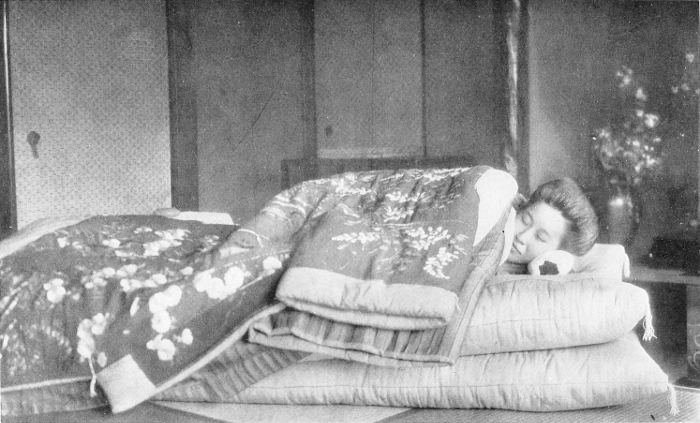
Saki, the housekeeper of some Japanese friends we visited, obligingly posed for me. The mattress is stuffed with floss silk, the pillow is hard and round, and the covering is a sort of quilted kimono
Saki was the housekeeper, young and pretty. She and her husband lived in a cottage near by, and their home was extensively equipped with musical instruments, Saki being proficient on the samisen and koto, and also on an American melodeon which was one of her chief treasures. She was all smiles and sweetness—a most obliging person. Indeed it was she who pretended to be asleep in a Japanese bed, in order that I might make the photograph which is one of the illustrations in this book.
Four or five coolies, excellent fellows, wearing blue cotton coats with the insignia of our host's family upon the backs of them, worked about the house and grounds; and several little maids were continually trotting through the corridors; with that pigeon-toed shuffle in which one comes, when one is used to it, actually to see a curious prettiness.
Sometimes we felt that the servants were showing us too much consideration. We dined out a great deal and were often late in getting home ("Home" was the term we found ourselves using there), yet however advanced the hour, the chauffeur would sound his horn on entering the gate, whereupon lights would flash on beneath the porte-cochère, the shoji at the entrance of the house would slide open, and three or four domestics would come out, dragging a wide strip of red velvet carpet, over which we would walk magnificently up the two steps leading to the hall. But though I urged them to omit this regal detail, because two or three men had to sit up to handle the heavy carpet, and also because the production of it made me feel like a bogus prince, I could never induce them to do so. Always, regardless of the hour, a little group of servants appeared at the door when we came home.
Even on the night when, under the ministrations of the all-wise and all-powerful head porter of the Imperial Hotel, our trunks were spirited away, to be taken to Yokohama and placed aboard the Tenyo Maru, even then we found it difficult to realize that our last night in Japan had come.
The realization did not strike me with full force until I went to bed.
I was not sleepy. I lay there, thinking. And the background of my thoughts was woven out of sounds wafted through the open shoji on the summer wind: the nocturnal sounds of the Tokyo streets.
I recalled how, on my first night in Tokyo, I had listened to these sounds and wondered what they signified.
Now they explained themselves to me, as to a Japanese.
A distant jingling, like that of sleigh-bells, informed me that a newsboy was running with late papers. A plaintive musical phrase suggestive of Debussy, bursting out suddenly and stopping with startling abruptness, told me that the Chinese macaroni man was abroad with his lantern-trimmed cart and his little brass horn. At last I heard a xylophone-like note, resembling somewhat the sound of a New York policeman's club tapping the sidewalk. It was repeated several times; then there would come a silence; then the sound again, a little nearer. It was the night watchman on his rounds, guarding the neighbourhood not against thieves, but against fire, "the Flower of Tokyo." In my mind's eye I could see him hurrying along, knocking his two sticks together now and then, to spread the news that all was well.
Then it was that I reflected: "To-morrow night I shall not hear these sounds. In their place I shall hear the creaking of the ship, the roar of the wind, the hiss of the sea. Possibly I shall never again hear the music of the Tokyo streets."
My heart was sad as I went to sleep.
Fortunately for our peace of mind, we had learned through the experience of American friends, visitors in another Japanese home, how not to tip these well-bred domestics—or rather, how not to try to tip them. On leaving the house in which they had been guests, these friends had offered money to the servants, only to have it politely but positively refused.
Yuki cleared the matter up for us.
"They should put noshi with money," she explained in response to our questions. "That make it all right to take. It mean a present."
Without having previously known noshi by name, we knew immediately what she meant, for we had received during our stay in Japan enough presents to fill a large trunk, and each had been accompanied by a little piece of coloured paper folded in a certain way, signifying a gift.
In the old days these coloured papers always contained small pieces of dried awabi—abelone—but with the years the dried awabi began to be omitted, and the little folded papers by themselves came to be considered adequate.
Fortified with this knowledge I went, on the day before our departure, to the Ginza, where I bought envelopes on which the noshi design was printed. Money placed in these envelopes was graciously accepted by all the servants. Tips they would not have received. But these were not tips. They were gifts from friend to friend, at parting.
The code of Japanese courtesy is very exact and very exacting in the matter of farewells to the departing guest. Callers are invariably escorted to the door by the host, such members of his family as have been present, and a servant or two, all of whom stand in the portal bowing as the visitor drives away.
A house-guest is dispatched with even greater ceremony. The entire personnel of the establishment will gather at with profound bows and cries of "Sayonara!" the door to speed him on his way Members of the family, often the entire family, accompany him to the station, where appear other friends who have carefully inquired in advance as to the time of departure. The traveller is escorted to his car, and his friends remain upon the platform until the train leaves, when the bowing and "Sayonaras" are repeated.
Tokyo people often go to Yokohama with friends who are sailing from Japan, accompanying them to the ship, and remaining on the dock until the vessel moves into the bay. How Tokyo men-of-affairs can manage to go upon these time-consuming seeing-off parties is one of the great mysteries of Mysterious Japan, for such an excursion takes up the greater part of a day.
To the American, accustomed in his friendships to take so much for granted, a Japanese farewell affords a new sensation, and one which can hardly fail to touch the heart.
Departing passengers are given coils of paper ribbon confetti, to throw to their friends ashore, so that each may hold an end until the wall of steel parts from the wall of stone, and the paper strand strains and breaks. There is something poignant and poetic in that breaking, symbolizing the vastness of the world, the littleness of men and ships, the fragility of human contacts.
The last face I recognized, back there across the water, in Japan, was Yuki's. She was standing on the dock with the end of a broken paper ribbon in her hand. The other end trailed down into the water. She was weeping bitterly.
Wishing to be sure that my wife and daughter had not failed to discover her in the crowd, I turned to them. But I did not have to point her out. Their faces told me that they saw her. They too were weeping.
So it is with women. They weep. As for a man, he merely waves his hat. I waved mine.
"Sayonara!"
I turned away. There were things I had to see to in my cabin. Besides, the wind on deck was freshening. It hurt my eyes.
THE END
INDEX
INDEX
Abalone, diving for, 304 Actresses, increase of, 96 Architecture, democracy in, 40 Architecture and sculpture, horrors in, 27 Art, grotesqueries and whimsicalities, 330 Athletic sports, popularity of, 103 Back-end-formost methods and customs, 48 Bathing customs, 52, 65, 289 Beauty, artistic conceptions, 163 Beds, how arranged, 299 Bill of fare, luncheon, 127 Boasting, a cardinal sin, 173 Brides, outfitted for life, 36 Burglars, feared next to fire and earthquake, 42; what to do when visited by, 45 Bushido, doctrine of, 76 Business methods, placidity in, 228 Butokukai—Association for Inculcation of Military Virtues, 195 Calendar, Chinese, adopted by Japanese, 316 California, Japanese issue in, 244 Calligraphy, a fine art, 55 Chafing-dish, cooking in, 149 Cherry Dance of Kyoto, 144 Children, in profusion, 23 China, American engineer among brigands in, 10; compared with Japan, 266 Chinnung, Emperor, discoverer of tea, 69 Chop-sticks, lesson in use of, 120 Class, the distinctions of, 140 Colonization, efforts in, 233 Concubinage, still practised, 85 Cooking, chafing-dish, 149 Costume, regulated by calendar, 33 Courtesans, segregated, 154 Courtesy, the code of, in making farewells, 340 Crest, family, as used on kimono, 34 Customs changed to fit Western ideas, 174 Dancing girls, or maiko, 119, 135, 137, 141 Daruma, mythological creator of tea, 69 Divorce customs, 85 Dress of women, uniformity of, 31; cost of, 35 Earthquakes, influence of, in building construction, 38, 42; frequency and extent, 39; best course to pursue during, 43 Efficiency and non-efficiency of the people, 235 Elder Statesmen, the, 185 Eliot, Sir Charles, on understanding Japan, 75 Ema, efficacy of an, 320 English as she is wrote, 323 Eri, neck piece worn with kimono, 34 European dress not popular with women, 31, 37 Fashions, little variation in, 36 Feudal Era, the, 70 Films, kissing scenes cut, 98 Finley, Dr. John H., on reverential attitude of the Japanese, 280 Flower Arrangement, the study of, 66; origin of, 68; in connection with display of paintings, 72 Folk dances by maiko, 137 Foods and delicacies, 129 Foreign customs adopted, 174 Fortune tellers, well patronized, 318 Fujiyama, as seen from the sea, 13; the "Honourable Mountain," 14 Gardens, history and theory, 167, 177 Gardens, diminutive, 21 Geisha, the best dressers, 37; at a luncheon, 116; various grades in, 119; no rhythm in their dancing, 132; what they really are, 132; in Japanese romances, 146; cost of entertainment, 151 Geisha, male, or comedian, 156 Great Britain's attitude toward Japan, 268. Haori, how worn, 35 Hara-Kiri, privileges associated with, 192 Hearn, Lafcadio, on the Japanese language, 56; on Japanese women, 75, 82; on the Tea Ceremony, 81; Hiratsuka, Mrs. Raicho, efforts to improve marriage laws, 84 Honesty, Japanese and Chinese, 278 Hospitality, New York and Japan compared, 258 House cleaning, under police supervision, 325 Humour, extent of native, 328 Imperial Bureau of Poems, duties of, 165 Inouye, Jakichi, attributes bearing of Japanese ladies to study of Tea Ceremony, 81 International Affairs ignored by Americans, 242 Intoxication, prevalence of, 123 Italy, compared to Japan, 163 Japanese-American relations, letter from President Roosevelt to Baron Kaneko, 223 Jesuits, expulsion of, 201 Jiu-jutsu, in wrestling, 112; taught to samurai, 192; renascence of, 193 Jiudo, development of, 193 Johnson, Senator Hiram, agitator on Japanese question, 256 Kakemono, method of hanging the, 72 Kamogawa, visit to, 288 Kaneko, Viscount Kentaro, preparing history of Meiji Era, 29; interviews with, 212; visits at Roosevelt's home, 213; Roosevelt's letters to, 222, 223, 226, 227 Kano, Jigoro, revives art of jiu-jutsu, 193 Kashima Maru, voyage on, 1 Katsuura, visit to, 284 Kimono, use of, 34 Kipling, Rudyard, on understanding Japan, 75 Kissing, attitude toward, 98 Kodokwan, school of jiu-jutsu, 194 Kokugikwan, the national game building, 104, 107 Korea, conditions under Japanese control, 9 Korean Emperor, anecdotes on, 8 Kyoto, Cherry Dance at, 144 Labor, abundance of, 19; waste of, 236 Landscape gardening, history of, 169 Language, peculiarities of the, 53; difficulties with, 321 Leprosy, extent of, 90 Lunch, the railway, 276 Maple Club, luncheon at, 116 Marquis, Don, on reformers, 151 Marriage customs, 85, 93 Meiji Tenno, "Emperor of Enlightenment,", 29 "Melting Pot," overloading of the, 251 Militarism, slowly waning, 232 Mirbeau, Octave, on discovery of Japanese prints by Claude Monet, 332 Morris, Roland S., address on Japanese issue in California, 244 Mothers-in-law, dutifulness toward, 93 Mourning, costume for, 36 Muko-yoshi, adopted son-husbands, 94 Music, unmelodious to foreign ear, 131 Nabuto, visit to, 302 Naginata, the woman's weapon, 196 Namazu, "cause" of earthquakes, 40 Nara, luncheon party in, 137, 141 Nesan, serving maids, 117 Nitobe, Doctor, on bushido, 76 No drama, masks used in, 49; knowledge of, necessary in study of the people, 75 Nogi, Count, story of his death, 197 Nurses' occupation popular, 96 Obi, chief treasure of woman's costume, 35; how worn, 36 Okuma, Marquis, Japan's "Grand Old Man,", 185 Old age, deference to, 50 Oriental Mind, the, 57 Partitions, removable, 118 Period of transition, beginning of, 184 Perry, Commodore, "knocking at Japan's door,", 28; opens door to progress, 184 Physicians, women as, 96 Picture brides, no longer allowed to come to America, 244 Pipes, diminutive, 130 Placidity in business and home life, 228 Poems, annually submitted to the Imperial Bureau, 165 Politeness, Japanese ideas of, 260 Politics, lack of interest in, 103 Population, excess in, 231, 233; must be balanced by industrial expansion, 234 Prints, Japanese, important collections of, 331; discovery of in Europe by Claude Monet, 332 Privacy, lack of in Japanese homes, 298 Public utilities, inefficiency in, 238 Race, unassimilability of, 253 Race problems of America, 249 Railroads, under government management, 274 Restaurant, cost of food and entertainment, 151 Riddell, Miss H., work with lepers, 90 Roosevelt, Quentin, Baron Kaneko's regard for, 213, 219, 227 Roosevelt, Theodore, on reign of Emperor Meiji, 29; interest in jiu-jutsu, 193; visit of Viscount Shibusawa to, 210; Viscount Kaneko's regard for, 213; letter to Baron Kaneko on our Japanese question, 223; wise attitude toward Japan, 270 Sake, how served, 121 Samurai, strength of the, 70; customs and privileges, 192 Sculpture and architecture. Self-made men, 187. Segregation of vice, 154 Servants, courtesy of and to, 117, 336 Shibusawa, Viscount Eiichi founder of school for actresses, 96; interview with, 188, 201; anecdote of President Roosevelt, 210; visit to grave of Townsend Harris, 280 Shimabara, courtesan district, Kyoto, 160 Suicide, prevalence of, 51; the Oriental view of, 199 Sunday, as a holiday, 114 Superstition, prevalence of, 318 Tails, wild men with, 7 Tai-no-ura, and the Nativity Temple, 287 Tea, significance of, 68; origin, 69 Tea Ceremony, or cha-no-yu, 71, 74, 81. Tea Masters, veneration of the, 73 Teahouse, entertainment expensive, 143, 151 Teaism, as a study, 68 Telephone service, inefficiency of, 238 Tipping, proper procedure in, 339 Tobacco industry, a monopoly, 130 Tokugawa, Prince, interest in wrestling, 105 Tokyo, growth, 26; architecture and sculpture, 27; adopting steel for building construction, 38 Tourists welcomed to Japan, 263 Tray landscapes, art of making, 67 Tuberculosis, extent of, 90 Vandalism at historic places, 280 Vice, commercialized, 154 Waseda University, now open to women, 95; founded by Marquis Okuma, 186 W. C. T. U., activities, 97 Women, costume of, 32; sedate gracefulness of, 81; suffrage, 83 legal status, 84; condition slowly improving, 95; in business and professions, 95; the "new woman," 97; husbands' attitude toward wives, 100; position higher in early times, 100 Wood engraving, era of, 331 World, New York, editorial on Japanese issue in California, 244 Wrestling, the national sport, 103 Yajima, Mrs., leader in W. C. T. U., 97 "Yellow Peril," the true, 246 Yokohama, the landing, 16 Yoritomo, legend of, 303 Yoshinobu, becomes shogun, 202; held prisoner after conflict with Emperor, 205; battle neither sought nor desired, 207 Yoshioka, Dr. G. founder of Tokyo School for Women, 96 Yoshiwara, courtesan district, Tokyo, 154 Yuasa, Commander, heroism at Port Arthur, 195 Zodiac, belief in the signs of the, 317

THE COUNTRY LIFE PRESS GARDEN CITY, N. Y.