Front matter (continued 4)
Reading edition
"The majority of thoughtful men felt as I did. Our trouble with the Jesuits, in the latter part of the sixteenth and early part of the seventeenth century came about through a fear which grew up amongst us that the Jesuits were trying to get political control of Japan. This fear brought about their expulsion from the country, as well as some persecution of themselves and their converts, and it was then that our policy of isolation began. More lately we had seen the Opium War in China, and that had added to our conviction that foreign powers were merely seeking territory, and that they were utterly unscrupulous.
"When I reached the age of twenty-five, I became a retainer of Yoshinobu Tokugawa, a powerful prince, kinsman of Iyemochi Tokugawa, who was then Shogun. Not being of noble family, I did not belong to Prince Yoshinobu's intimate circle, but was a member of what might be termed the middle group at his court.
"He was then acting as intermediary between the Shogun and the Imperial Court at Kyoto—for though the Shogun ruled the land, as shoguns had for centuries, there was maintained a fiction that he did so by imperial consent.
"When Iyemochi died, the powerful daimyos nominated my lord, Prince Yoshinobu, to succeed him. I was opposed to his accepting the office, for the country was then in a very unsettled condition, and I felt sure that the next shogun, whoever he might be, would have serious difficulties to encounter; especially with the important question of foreign relations to the fore, and with such powerful lords as those of Satsuma, Choshu, Tosa, and Hizan becoming increasingly hostile to the shogunate and increasingly favourable to the Imperial House.
"The fact that Prince Yoshinobu had acted as intermediary between his kinsman, the fourteenth Shogun, and the Imperial Court at Kyoto, made it a delicate matter for him later to accept the shogunate. Moreover, though he belonged to the Tokugawa family, his branch of the family, the Mito branch, had continually insisted upon Imperial supremacy in Japan. However, circumstances compelled him to accept the office. I was greatly disappointed when he did so.
"This occurred two years after I became his retainer. I was now vice-minister of his treasury, with the additional duties of keeping track of all modern innovations and supervising the new-style military drill, with rifles, which we were then taking up.
"Shortly after becoming Shogun, Yoshinobu decided to send his brother, Akitaké, to France to be educated, and he appointed me a member of the entourage that was to accompany the young man. I was then twenty-seven years old.
"We sailed in January 1867—a party of twenty-five, among whom were a doctor, an officer who went to study artillery, and various others besides Akitaké's seven personal attendants.
"For international purposes the Shogun was now called Tycoon, for the word 'shogun,' meaning 'generalissimo,' carried with it no connotation of rulership; whereas 'tycoon' means 'great prince'—and of course it seemed proper enough for a great prince to treat with foreign powers. As brother of the Tycoon, Akitaké received, in Europe, the title 'Highness'.
"Matters looked very ominous for the shogunate at the time we left Japan, but I felt that the best thing for me to do was to go abroad and learn all I could, with a view to being better able to serve my country when I should return.
"The members of our party wore the Japanese costume, including topknots and two swords. I, however, devised a special elegance for myself. I heard that the governor of Saigon, where our ship was to stop, intended to welcome our party officially, so I had a dress coat made." The Viscount shook with laughter as he recalled the episode. "It wasn't a dress suit—just the coat. And when we got to Saigon I wore that coat over my Japanese silks, in the daytime.
"Our lack of experience with European ways caused many amusing things to happen. For instance, when we were in the train crossing the Isthmus of Suez—there was no canal then—one member of the party, unaccustomed to window-glass, threw an orange-peel, expecting it to go out of the window. The peel hit the glass and bounced back falling into the lap of an official who had come to escort us across the isthmus. We were much embarrassed.
"Later, in Paris, another absurd thing occurred. You must understand that in Japan it is customary for guests, leaving a house where they have been entertained, to wrap up cakes and such things and take them home. One member of our party, who had never seen ice-cream before, attempted this, wrapping the ice-cream in paper and tucking it in the front of his kimono. Needless to say, the ice-cream was no longer ice-cream when he got back to the hotel, and he himself was not very comfortable.
"The Paris Exposition of 1867 was in progress when we arrived. When it was over we travelled through Switzerland, Holland, Belgium, Italy, and England. Originally it was planned that after our official tour we should settle down to study, and I was eager for this time to come. However, it was not long before we received news that the shogunate had fallen.
"The news was puzzling. I could not gather what was happening in Japan. First I heard that Yoshinobu, as shogun, had publicly returned full authority of the Emperor, but later came word of the battle of Toba-Fushimi, in which troops of the Imperial Party defeated troops of the Shogun. This made it appear that Yoshinobu had played false, first publicly relinquishing the shogun's power and then fighting to maintain it. These seemingly conflicting acts puzzled me, for I knew that Yoshinobu was a man of the highest honour.
"Presently came a messenger from Japan saying that Akitaké had become head of the Mito branch of the Tokugawa family, which made it necessary for us to abandon our plans and return. We sailed from England in December 1867, reaching Japan in November 1868, eleven months later.
"I was dumbfounded by the changes I found. Though I knew that the Shogun Government had fallen I had not visualized what that would mean. My lord, Yoshinobu, was held prisoner in a house in Suruga. Learning that he was allowed to see his intimate friends and retainers, I journeyed to Suruga, where I had audience with him several times. I found him reticent, and was able to get from him little information as to the mysterious course he had pursued.
"After having been held prisoner for a year he was released, but he continued for thirty years to reside in the neighbourhood of Suruga, leading a secluded life. Not until thirty-one years after his resignation of the shogunate did he come to Tokyo. Four years later the Emperor created him a prince of the new régime. This showed pretty clearly that the Emperor had not mistrusted him.
"For twenty years after my return to Japan I was unable to get at the bottom of this matter. I tried to get some explanation from Yoshinobu himself, but he evaded my inquiries. Meanwhile the question was constantly discussed in Japan. Those hostile to Yoshinobu contended that he had not acted with sincerity, having been led by the burdens connected with the opening of foreign relations, to lay down the shogunate, and having later changed his mind and fought to retain it. On the face of it, this seemed true. Yoshinobu was called a coward and a traitor, and was severely criticized for having escaped after the battle of Toba-Fushimi.
"On the other hand, those who supported Yoshinobu asserted that he had acted logically and wisely: that he had seen that his government was going to fall, and had been entirely honest in surrendering the shogunate prior to the battle. These adherents insisted that he had not wanted a battle, but had set out for Kyoto to see the Emperor with a view to arranging details, especially with regard to the future welfare of his retainers. "But when a great lord, travelled, in those times, he travelled with an army, and Yoshinobu's defenders maintained that this was what had brought on the battle—that when the men of Choshu and Satsuma learned that Yoshinobu was moving toward Kyoto with his soldiers, they came out and attacked him, believing, or pretending to believe, that he was on a hostile errand.
"At this time the Emperor was but seventeen years of age, and the Government was in the hands of elder statesmen of the Imperial Party. The Emperor himself probably had no idea on what errand Yoshinobu was approaching Kyoto; and whether the elder statesmen knew or not, they belonged to clans hostile to the shogunate, and preferred to fight.
"Many years passed before the truth began to become clear. At last, when the old wounds were pretty well healed, I undertook the compilation of a history of Yoshinobu's life and times. Finally I asked him point-blank about the events connected with his resignation and the subsequent battle. He told me that he had indeed started to Kyoto on a peaceful errand, but that when the forces sent out by the great clansmen appeared, he could not control his own men. He had neither sought nor desired battle. Feeling that his highest duty was to the Emperor, he withdrew from the battle, taking no part in it, and returned whence he had come, going into retirement. He knew, of course, that the battle would put him in a false light, and he decided that the wisest and most honourable course for him to pursue was to show, by his life in retirement, his absolute submission to the Emperor.
"In order fully to appreciate why Yoshinobu was so ready to lay down his power, the old Japanese doctrine of loyalty to the throne must be fully grasped. This loyalty amounts to a religion, and permeates the whole life of Japan. That is why the shoguns who for so many centuries ruled Japan, never attempted to usurp imperial rank, but were satisfied, while usurping the power, to preserve the form of governing always as vice-regents.
"It is my personal belief that when Yoshinobu Tokugawa accepted the shogunate despite the opposition of his trusted retainers, he did so with the full intention of restoring to the Imperial House its rightful power. I used to ask him about this, and while he never admitted it, he never denied it. That was characteristic of him. He was the most modest and self-effacing of men—the last man who would have claimed for himself the credit for performing a self-sacrificing and heroic act of patriotism. For him the performance of the act was sufficient."
Throughout my talk with Viscount Shibusawa I felt in him the passionate loyalty of the retainer to his lord. Where I had wished for reminiscences of a more personal nature, the Viscount, I could see, thought of himself first of all in his relation to the family of Prince Yoshinobu, the last shogun, whose retainer he was. He was not interested in telling me of his own career, but he was profoundly interested in seeing that I, being a writer, should understand the relationship of Prince Yoshinobu to the Imperial Restoration. His attitude reminded me of that of a noble old Southern gentleman, now dead and gone, who had been the adjutant of Robert E. Lee, and who loved Lee and loved to talk about him. When I talked with him it was the same. I had great difficulty in getting him to tell me about his own experiences.
The loyalty of the retainer to the family of his lord is also to be seen in the relationship between the Viscount and young Prince Keikyu Tokugawa, son of Yoshinobu. After the death of the father the Viscount continued to act as advisor to the son. He became his chief counsellor, and when, a few years since, he resigned from the board of directors of the First Bank of Japan—the bank which he founded five years after the Restoration—it was young Prince Tokugawa who succeeded to his empty chair.
The Prince, who is a member of the House of Peers, is known in the United States, having come here during the war as representative of the Japanese Red Cross.
Viscount Shibusawa is also a figure not unfamiliar to Americans, having visited this country several times. I am indebted to him for an anecdote illustrative of the prodigious memory of President Roosevelt.
"Eighteen years ago," he said, "when Mr. Roosevelt was president, I called upon him at the White House. We had a pleasant talk. He complimented the behaviour of the Japanese troops in the Boxer trouble, saying that they were not only brave but orderly and well disciplined. Then he spoke with admiration of the art of Japan.
"I said to him, 'Mr. President, I am only a banker, and I regret to say that in my country banking is not yet so highly developed as is art.'
"'Perhaps it will be,' he replied, 'by the time we meet again.'
"Thirteen years later, when I called upon him at his home at Oyster Bay, he took up the conversation where we had left off.
"'The last time I saw you,' he said, 'I did not ask you about banking in Japan. Now I want you to tell me all about it.'"
As I was leaving the bungalow in the garden late in the afternoon of the second day spent in interviewing the Viscount, the thought came to me that probably I should never again talk with a man who had lived through such transitions. I wanted a souvenir, and I wished it to be something emblematic of the changes witnessed by those shrewd, humorous old eyes.
Therefore, not without some hesitation, I asked the Viscount if he would be so kind as to put on his two samurai swords and let me take his photograph.
He dispatched a servant who presently returned from the house bearing the weapons. The Viscount tucked them through his sash, and I snapped the shutter, hoping fervently that the late afternoon light would prove to have been adequate.
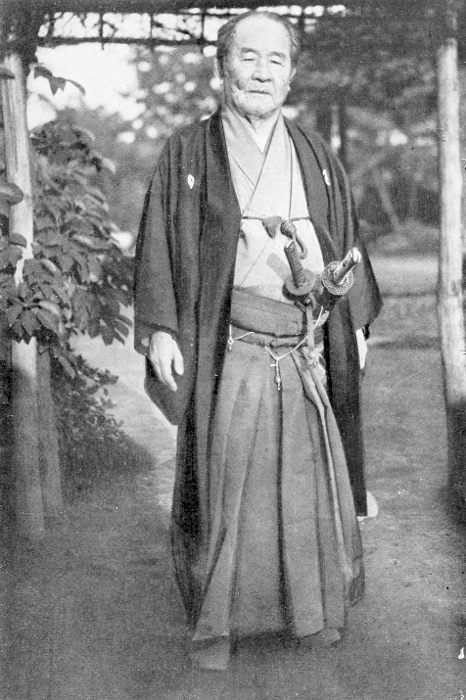
Viscount Shibusawa, one of the Grand Old Men of Japan, consented to pose for me, wearing his samurai swords
As the reader may see for himself, the picture turned out well. Indeed it turned out better than I myself had anticipated, for besides the swords and silken robes of Old Japan, there may be seen in it a very modern note.
It was the Viscount's grandson who, when I showed him the photograph, called attention to that.
"Yes," he said, with a smile, "you have there the swords of Old Japan. But the watch-chain—that is an anachronism."
CHAPTER XVIII
Viscount Kaneko's Home—Some Souvenirs—A Rooseveltian Memory—Doctor Bigelow's Prophecy—A First Meeting with Roosevelt—The Russo-Japanese War—Luncheons at the White House—Roosevelt's Interest in the Samurai Tradition—Sagamore Hill—Mrs. Roosevelt and Quentin—A Simple Home—The President Brings Blankets—A Bear Hunt—The Peace of Portsmouth and a Bearskin for the Emperor—A Letter of Roosevelt's on Relations with Japan—A Letter from Mid-Africa—"American Samurai"
Never while in Japan did I feel quite so close to home as on the several occasions when I sat in the study of Viscount Kentaro Kaneko, in Tokyo, listening to his reminiscences and looking at his souvenirs of Theodore Roosevelt.
No Japanese has been more widely known in the United States, or more familiar with our ways, than Viscount Kaneko (Harvard '78), Privy Councilor to the Emperor, chairman of the commission which is engaged in preparing the history of the reign of the late Emperor Meiji, and president of the America-Japan Society of Tokyo.
I found him living in a good-sized but not ostentatious house, purely Japanese in architecture. But it was not purely Japanese in its equipment. Like the houses of other Tokyo gentlemen accustomed to see much of foreigners, it had carpet over the hall matting, rendering the removal of shoes unnecessary, and certain of its rooms were furnished in the Occidental style.
Such rooms, in Japan, usually are stiff reception-rooms which look as if they were used only when visitors from abroad put in an appearance; but Viscount Kaneko's study held a homelike feeling which made me think the room was frequented by the master of the house when no guests were present.
On the walls were framed photographs of notables, European and American, with the Roosevelt family very much to the fore, and I noticed beneath the photograph of President Roosevelt a cordial inscription in the familiar handwriting, so honest and boyish—writing as unlike that of any other great man as Roosevelt himself was unlike any other great man.
When I had crossed and read the inscription, Viscount Kaneko called my attention to the frame.
"That frame," he said, "is made from a piece of Oregon pine which was brought among other presents to the Shogun by Commodore Perry. The Emperor presented me with a piece of the wood, and I had made from it that frame and a writing box on which the scene of Perry's arrival is depicted in gold lacquer."
There was also a photograph of Mrs. Roosevelt with two of her sons, and one of Quentin Roosevelt as a child, astride a pony, with an inscription to the Viscount's son Takemaro, dated August seventh, 1905. In the corner of the frame was inserted a photograph which the Viscount had caused to be taken of Quentin's grave in France.
Viscount Kaneko was a student at Harvard when Roosevelt entered the university, but they were two years apart and did not know each other there. Their first meeting occurred in Washington in 1889, when Roosevelt was Civil Service Commissioner and Viscount Kaneko was returning to Japan after having visited the principal countries of Europe for the purpose of studying parliamentary forms. The first Japanese Parliament met in the year following, 1890, when Japan adopted a Constitution.
In looking back upon my interviews with the Viscount I find myself marvelling to-day, as I did then, at the detailed accuracy of his memory. He recounted events of fifteen and more years before with a vividness and an attention to trifles that was extraordinary. It was as if he had refreshed his memory by reading from a diary.
"I had two letters of introduction to Roosevelt," he told me, "when I went to Washington in 1889. One had been given to me by James Bryce, later Viscount Bryce, who was then in Gladstone's Cabinet. The other I received from my friend Dr. William Sturges Bigelow.
"When Doctor Bigelow gave me the letter, he said: 'This will introduce you to a man who will some day be President of the United States.' I always remembered that and watched Roosevelt's career with the more interest for that reason.
"On reaching Washington I called on Roosevelt at a private boarding house where he was living, and he returned my call next day. Naturally I perceived at once that he was a man of extraordinarily vigorous mind. I enjoyed him greatly, and was pleased and interested, after my return to Japan, to see him steadily ascending. He became Assistant Secretary of the Navy, Colonel of the Rough Riders, Governor of New York. 'Now,' I said to myself on reading that he had been elected Governor, 'he is on the way to fulfilling Doctor Bigelow's prophecy.' Then he became Vice-President, and I thought: 'That is too bad. They have shelved him. He won't be President after all.' But McKinley was assassinated and Roosevelt came to the White House.
"Early in 1904, at the time of our war with Russia, I was sent to the United States on an unofficial embassy. I went first to New York, where I remained for a week; then to Washington. There I called on my old friend Mr. Justice Holmes of the Supreme Court—'Brother Kaneko' he used to call me—requesting him to take me to the White House to meet the President, who I thought would not remember me. But Justice Holmes had disagreed with Roosevelt over the Northern Securities case, and did not feel that he was persona grata at the White House just then. Therefore I arranged through our Minister, Mr. Takahira, for a meeting.
"One morning in May, 1904, the Minister took me to call upon the President. Our appointment was for half past ten. We were not kept waiting long. I will never forget the picture of Roosevelt as he quickly thrust open the door and rushed into the room. The Minister had no chance to present me. 'I am delighted to see you again Baron!' the President exclaimed in that wonderfully hearty way of his. And as we shook hands he threw his arm over my shoulder, demanding: 'Why did you stay for a week in New York? Why didn't you come and see me right away?'
"During our talk, which lasted an hour, he let me see that he was absolutely neutral in his official attitude toward our war with Russia, but nevertheless made me feel that he had much personal sympathy for Japan. He declared frankly that popular sentiment in the United States was favourable to Japan, and added that the Russian Government had complained that American army and navy officers were openly pro-Japanese. This had made it necessary for him to issue a proclamation of neutrality. But though, as President, he was particular to be scrupulously just to both sides, I was in no doubt as to the friendliness of his private sentiments.
"He advised me not to stay in Washington, but to make my headquarters in New York, coming over to Washington to see him when it was necessary. This I did, and as time went on, and we became closer friends, he often did me the honour of inviting me to luncheon en famille at the White House.
"At one of these luncheons I told him of Doctor Bigelow's prophecy, and of how I had watched him mounting step by step to its fulfilment. That seemed to please him.
"'Edith,' he called across the table to Mrs. Roosevelt, 'do you hear that? Here is a man who has kept a friendly eye on me from away off in Japan.'
"Once at one of these intimate White House luncheons he remarked that as President it was necessary to preserve a certain style. 'Coming to see us here,' he said, 'you don't get an accurate idea of what our family life really is. You must come and pay us a visit at Oyster Bay this summer when we get home. Then you will know more about us.'
"He did not forget the invitation, but early in July 1905, repeated it by telegraph. I went to Oyster Bay and stayed over night. It was in many ways a memorable experience.
"He was always greatly interested in our samurai tradition and in the doctrine we call bushido. I remember his asking me how much money was required for the keeping up of a samurai's position. I explained that there were different classes of samurai—that the shoguns had themselves been samurai, with others of various grades below them.
"'Middle-class samurai,' I said, 'do not need a great deal of money. They require only enough for dress to be worn on social occasions, for the education of their families, and the maintenance of their political position, whatever it may be. They need no money for pleasures or extravagances.'
"'Just the same,' the President replied, 'a man doesn't want to fall behind his ancestors, materially or otherwise. Take my own case: I want to keep my place as my forbears kept theirs. I desire neither more nor less than what my father had. I want my children to be able to grow up in this old home at Oyster Bay just as the children of my generation did.' Then he began to ask me more about the details of samurai life.
"'What about doctor's bills?' he asked. 'You didn't mention that item in estimating the expense of living.'
"I told him of a curious custom we used to have. In each samurai class there were families of doctors who were endowed by the Government, the profession being passed down from father to son. These doctors took care of samurai families of the rank corresponding to their own, and charged nothing for so doing. Twice a year, in January and July, when it is customary to give presents, presents were given to the doctors. They also took care of the poor as a matter of charity.
"That interested him, too. He was always intensely interested in the samurai, because our samurai virtues were virtues of a kind he particularly admired—courage, stoicism, love of duty and of country.
"We sat on the wide verandah, overlooking the lawn sloping down toward Long Island Sound. Mrs. Roosevelt sat with us, knitting. It was July, but she was knitting mittens. Presently a maid came and spoke to her, and she left us.
"When she came back she said to me, 'Baron, I want to ask a favour of you. Quentin has been crying. He took great pains to clean his pony to-day, to show it to you, and we promised that he should be allowed to do so. He has been riding around the lawn hoping you would notice him.'
"Of course I sent for Quentin, and he appeared proudly upon his pony. I asked him to ride around the lawn, which he did.
"'You ride splendidly!' I said, when he drew up again before the porch.
"'Do you think so?' he asked, evidently much pleased.
"'Indeed I do!' I said, and asked him to go around the lawn again.
"When he came back I told him about my son, who was just his age. 'I shall have him learn to ride,' I said, 'and when he can ride as well as you can I shall have his picture taken on a pony and send it to you.'
"That," continued the Viscount, "is how we happen to have this picture of Quentin on his pony. He sent it to my son, and my son sent him a picture. I always like to think of the good-will there was between those two boys—an American boy and a Japanese boy who had never seen each other.
"That night we sat talking in the drawing room which is to the left of the hall as you go into the house. Mrs. Roosevelt was still knitting mittens for the children. It was all wonderfully simple and homelike. I could hardly believe that I was in the home of the head of a great nation. At that time the house was lighted with kerosene lamps, yet in Japan I had been using electric light for fifteen years.
"At about ten o'clock Mrs. Roosevelt said good night to us and retired. Before she went upstairs she moved about, fastening windows and putting out lamps in parts of the house in which they would not be needed any more. Then she brought candles and matches so that we should have them when we were ready to go to bed.
"After an hour's talk about the war, which was still raging, the President rose and lit the candles. Then he put out the remaining lamps, and conducted me upstairs to my room. It was a cool night. He felt of the coverings on my bed, and decided that I might need another blanket. 'I'll get you one,' he said, leaving the room. And in a minute or two he reappeared with a blanket over his shoulder.
"'Come,' he said, as he put it on the bed, 'and I'll show you the bathroom.' I went with him. 'Here's soap,' said he, 'and here are clean towels.' Then he took me back to my room and wished me a good night.
"As for me, I was fascinated, almost dazed. I kept saying to myself, 'This man who has lighted me upstairs with a candle, and carried me a blanket, and shown me where to find soap and towels, is the President of the United States! The President of the United States has done all these things for me. It is the greatest honour a man could have.'
"Earlier in the same year, before the President moved from the White House to Oyster Bay, he went bear hunting. That was just before Admiral Togo's victory over the Russian fleet, in the Sea of Japan.
"Before leaving, the President sent for me and told me, in the presence of Mr. Taft, who was Secretary of War, that if anything of importance should come up during his absence, I was to see Mr. Taft about it, and that in the event of its being anything absolutely vital, Mr. Taft would know how to reach him.
"Mr. Taft showed me a photograph hanging on the wall of the President's office, showing the wild country to which the President was going on his hunting trip.
"I remarked playfully to him that I thought it advisable, at that time, that the President refrain from killing bears, whatever other animals he might see fit to slay.
"Roosevelt, sitting at his desk, overheard me.
"'What's that you are saying?' he asked.
"I repeated what I had said to Mr. Taft.
"'Why do you think I should not kill bears?' demanded the President.
"'Well, Mr. President,' I replied, 'you know that the various nations have their special symbols in the animal kingdom. America has the eagle, Britain the lion, France the cock, and Russia, well——'
"He got up, laughing and came over to me.
"'Nevertheless,' he said, 'I shall go right ahead and kill bears!'
"Before he left on that hunting trip I went to see him and asked as a special favour that he give me the skin of one of the bears he should kill.
"He refused, saying that if he were to start presenting trophies to his friends they would all be after him.
"At that I said to him, 'If I were asking this for myself, Mr. President, I would not pursue the matter further, but I am not asking it for myself. I want that bear skin for our Emperor.'
"'Very well, then,' he said. 'You shall have it.'
"He went off on his hunting trip, and came back. Then followed the negotiations for a cessation of hostilities between Japan and Russia, and the Portsmouth Peace Conference, through which Roosevelt brought about the end of the war.
"In August of the same year, 1905, I received this letter from him."
The Viscount handed me the letter to read. It was as follows:
Oyster Bay, N, Y,. August 30, 1905.
Personal
My dear Baron Kaneko:
I cannot too highly state my appreciation of the wisdom and magnanimity of Japan, which make a fit crown to the prowess of her soldiers. Will you tell the Emperor that I shall take the liberty of sending him by you a bear skin? I want you soon to come out here and take lunch.
Sincerely yours, Theodore Roosevelt.
"Later," the Viscount went on, "I was asked by the President to come to Oyster Bay and select one of the skins. I however did not wish to make the selection, so the President did that, picking out the largest skin of all and giving it to me for the Emperor Meiji.
"His Majesty was greatly pleased with the skin, not only because it was a trophy from the President himself, but because of the emblematic nature of the gift. That bearskin was in his library at the Imperial Palace in Tokyo as long as he lived."
One of the most important Roosevelt letters shown me by Viscount Kaneko was on the subject of Japanese-American relations. As this letter is not included in the two-volume collection of Roosevelt correspondence compiled in such masterly fashion by Joseph Bucklin Bishop, Roosevelt's literary executor, I have asked the permission of Mrs. Roosevelt and of Mr. Bishop to quote it here.
It was as follows:
THE WHITE HOUSE
WASHINGTON
May 23, 1907. Confidential My dear Baron Kaneko:
I much appreciate your thought of Archie. The little fellow was very sick but is now all right. His mother and I have just had him on a short trip in the country.
I was delighted to meet General Kuroki and Admiral Ijuin with their staffs. General Kuroki is, of course, one of the most illustrious men living. Through his interpreter, a very able young staff officer, I spoke to him a little about our troubles on the Pacific Slope.
Nothing during my Presidency has given me more concern than these troubles. History often teaches by example, and I think we can best understand just what the situation is, and how it ought to be met, by taking into account the change in general international relations during the last two or three centuries.
During this period all the civilized nations have made great progress. During the first part of it Japan did not appear in the general progress, but for the last half century she has gone ahead so much faster than any other nation that I think we can fairly say that, taking the last three centuries together, her advance has been on the whole greater than that of any other nation. But all have advanced, and especially in the way in which the people of each treat people of other nationalities. Two centuries ago there was the greatest suspicion and malevolence exhibited by all the people, high and low, of each European country, for all the people, high and low, of every other European country, with but few exceptions. The cultivated people of the different countries, however, had already begun to treat with one another on good terms. But when, for instance, the Huguenots were exiled from France, and great numbers of Huguenot workmen went to England, their presence excited the most violent hostility, manifesting itself even in mob violence, among the English workmen. The men were closely allied by race and religion, they had practically the same type of ancestral culture, and yet they were unable to get on together. Two centuries have passed, the world has moved forward, and now there could be no repetition of such hostilities. In the same way a marvellous progress has been made in the relations of Japan with the Occidental nations. Fifty years ago you and I and those like us could not have travelled in one another's countries. We should have had very unpleasant and possibly very dangerous experiences. But the same progress that has been going on as between nations in Europe and their descendants in America and Australia, has also been going on as between Japan and the Occidental nations. In these times, then, gentlemen, all educated people, members of professions and the like, get on so well together that they not only travel each in the other's country, but associate on the most intimate terms. Among the friends whom I especially value I include a number of Japanese gentlemen. But the half century has been too short a time for the advance to include the labouring classes of the two countries, as between themselves.
Exactly as the educated classes in Europe, among the several nations, grew to be able to associate together generations before it was possible for such association to take place among the men who had no such advantages of education, so it is evident we must not press too fast in bringing the labouring classes of Japan and America together. Already in these fifty years we have completely attained the goal as between the educated and the intellectual classes of the two countries. We must be content to wait another generation before we shall have made progress enough to permit the same close intimacy between the classes who have had less opportunity for cultivation, and whose lives are less easy, so that each has to feel, in earning its daily bread, the pressure of the competition of the other. I have become convinced that to try to move too far forward all at once is to incur jeopardy of trouble. This is just as true of one nation as of the other. If scores of thousands of American miners went to Saghalin, or of American mechanics to Japan or Formosa, trouble would almost certainly ensue. Just in the same way scores of thousands of Japanese labourers, whether agricultural or industrial, are certain, chiefly because of the pressure caused thereby, to be a sources of trouble if they should come here or to Australia. I mention Australia because it is a part of the British Empire, because the Australians have discriminated against continental immigration in favour of immigration from the British Isles, and have in effect discriminated to a certain degree in favour of immigration from England and Scotland as against immigration from Ireland.
My dear Baron, the business of statesmen is to try constantly to keep international relations better, to do away with causes of friction, and secure as nearly ideal justice as actual conditions will permit. I think that with this object in view and facing conditions not as I would like them to be, but as they are, the best thing to do is to prevent the labouring classes of either country from going in any numbers to the other. In a generation I believe all need of such prevention will have passed away; and at any rate this leaves free the opportunity for all those fit to profit by intercourse, to go each to the other's country. I have just appointed a commission on general immigration which will very possibly urge restrictive measures as regards European immigration, and which I am in hopes will be able to bring about a method by which the result we have in view will be obtained with the minimum friction.
With warm regards to the Baroness, believe me,
Sincerely yours, Theodore Roosevelt.
Baron Kentaro Kaneko,
Tokyo, Japan.
The foregoing letter may well be studied at this time when, through lack of the kind of statesmanship shown by Roosevelt, the Californian situation has become worse instead of better.
Another letter shown me by Viscount Kaneko was written in pencil on a large sheet of yellow paper torn from a pad. It came from the African jungle, and ran as follows:
Mid-Africa Sept. 10th, 1909.
My dear Baron, 3
I have no facilities for writing here; but I must just send you a line of thanks for your welcome note. I have had a most interesting trip; my son Kermit has done particularly well. He has the spirit of a samurai! I greatly hope to visit Japan; but when it may be possible I can not say.
With warm regards to the Viscountess, 3 believe me,
Sincerely yours, Theodore Roosevelt.
The last letter of the series was written on the stationery of the Kansas City Star, of which Roosevelt was an associate editor with an office in New York. The letter read:
New York, Aug. 21, 1918.
My dear Viscount Kaneko:
I thank you for your letter; and Mrs. Roosevelt was as much touched by it as I was. Remember to give your son a letter to us when he comes here to go to Harvard. One of our newspapers, the Chicago Tribune, when the news was brought that Quentin was dead and two of his brothers wounded, spoke of my four sons as "American samurai." I was proud of the reference! As you say, all of us who are born are doomed to die. No man is fit to live who is afraid to die for a great cause. My sorrow for Quentin is outweighed by my pride in him.
Faithfully your friend, Theodore Roosevelt.
The foregoing, written less than five months before Colonel Roosevelt's death, was the last letter of the series shown me by Viscount Kaneko.
Reading it I was reminded of what Colonel Roosevelt said to me as he lay on his bed in the hospital the last time I saw him.
Speaking of his four sons in the war he said:
"We have been an exceptionally united family. Come what may, we have many absolutely satisfying years together to look back upon."
CHAPTER XIX
Placidity and Sodans—Talk and Tea—American Business Methods versus Japanese—The American Housekeeper in Nippon—Japan's Problem—Population and Food—The Militarists—Land-Grabbing—Liberalism—Emigration—Industrialism—Examples of Inefficiency—"Public Futilities"—Comedies of the Telephone—The Cables
Elsewhere I have said that the Japanese are generally hard workers; wherefore it may seem paradoxical to add that they are also leisurely workers. But the paradox is not so great as it would seem. The hours of work are longer in Japan than in most other countries, but work is not so vigorously pressed.
Without being in the least lazy, the Japanese take their time to everything. With masters and servants, employers and workmen, it is much the same. They appear placid. They hold sodans, conferring and arranging matters with terrible precision. If you attempt to use the telephone you are prepared for a long struggle and a long wait. The clerks in the cable office act as if the cable had just been laid—as if your cablegram were the first one they had ever been called upon to send, and they didn't quite know how to handle it, or how much to charge. Often they are unable to make change. Sometimes even the railway ticket agents have no change. Business conferences are conducted over successive cups of pale green tea, and I am told that it is customary to begin them with talk on any topic other than the main one. In the lexicon of Japanese trade and commerce there is no such word as "snappy."
The hustling American business man who tries to rush things through often arouses the Japanese business man's suspicion. What is he after? Why is he in such a hurry? There must be something behind it all. It is necessary to be particularly careful in dealing with such a man. Negotiations drag and drag until the American, if he be of nervous disposition, is driven nearly wild. And sometimes this results in his making a bad bargain merely for the sake of getting through.
"I'm sorry I ever came to the Far East!" he will declare bitterly. "I feel that I am getting nothing accomplished over here—nothing!" Then he will tell you what is the trouble with the Japanese:
"They are used to playing only with white chips!"
The American housekeeper in Japan, if she knows what nerves are, may have similar difficulties. Her Japanese servants will conduct her ménage well enough if she lets them do it in their Japanese way, but if she attempts to run her home as she would run it in the United States, she is lost. It can't be done. I know of an American woman who could not get a cook because her efforts to Americanize her household had given her a bad reputation with the Cook's Guild. Another could get no sewing done, for a like reason. For all the servants and working people have their guilds, and news travels. Thus many an American housekeeper in Japan has became a nervous wreck.
Yet on the other hand, numbers of American business men and their wives enjoy Japanese life, and only come home when it is necessary to give their children an American education. The men are successful and their homes are comfortable and well run. But always you will find that they are people of calm disposition: people having sufficient balance to adjust themselves to the customs of the country.
The essential point seems to be that the Japanese view life in longer perspective than we do. Where we see ourselves as individuals having certain things to accomplish in a rather short life, they see themselves as mere links in an endless family chain. We are conscious of our parents and our children but they are conscious of ancestors, reaching back to the mists of antiquity, and of a posterity destined to people the nebulous vaults of the far-distant future.
But while, from a philosophical standpoint, this way of looking at life may be quite as good as ours, or even better, still I believe it tends to handicap the Japanese in meeting the urgent material problems by which they are confronted. And though these problems are not so terrible as those of war-racked Europe, they are, if measured by any other standard, terrible enough.
Japan's fundamental problem—the one out of which grow all other Japanese problems in which the world is interested—is, as I have said before, that of great density of population coupled with an inadequate supply of food and raw materials. Fifty years ago the population of Japan proper was less than 33,000,000. To-day it is more than 57,000,000. There has been an increase in five decades of more than 75 per cent., but there has been no corresponding increase in the country's arable land.
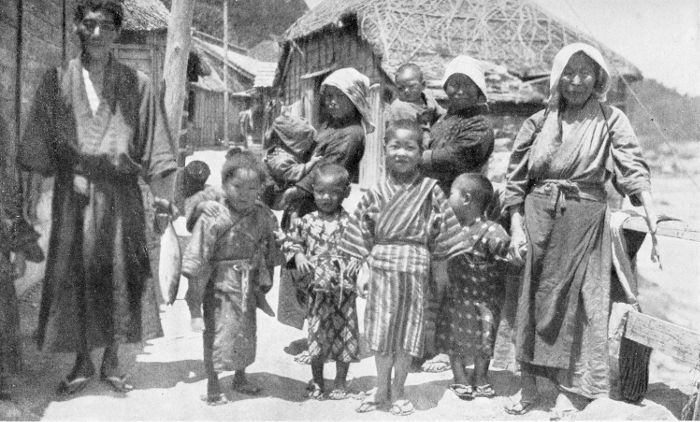
The film was not large enough to hold the family of this youngish fisherman at Nabuto. Nine children! Fifty years ago Japan had a population of 33,000,000. To-day it is nearing 60,000,000.
In Japan itself there have been various theories as to how this problem should be met. The militarists, who are still very powerful, have in the past undoubtedly favoured what we have come lately to call the Prussian system, the grabbing system: the system which has been followed in the Far East not by Japan alone but by England, Russia, France, and Germany—and by the United States (if in a form somewhat more moderate) in the Hawaiian Islands, and the Philippines.
"If the others do it," the Japanese militarists have argued, "why shouldn't we? Why shouldn't we, who need additional territory so much more than they do, grab on the continent of Asia for land to which our surplus population may be sent, and from which we may get food and raw materials?"
To which the other nations answer: "Unfortunately for you, you came along too late. The good old grabbing days are gone. The world is radiant with a new international morality, and woe be unto those who offend against it! Germany tried it—see what happened to her!"
Japan did see what happened to Germany and the lesson was not wasted on her. Nor was the least striking part of the lesson contained in America's exhibition of military might. And truth to tell, Japan needed such a lesson; for her victories over China and Russia had put her militarists in the ascendant, and had made them, and perhaps the bulk of their countrymen also, over-confident, with the result that Japan occasionally rattled the sabre in the Far East somewhat as Germany was wont to do in Europe.
But although it cannot be denied that the Japanese militarists exhibited undue aggressiveness in China and Siberia during the late war, and although their actions since have not been altogether satisfactory to the rest of the world, there is good reason to suppose that their old-time dream of vast territorial aggrandizement has diminished, even though it may not have entirely faded from the minds of some of them.
This new tendency toward moderation is due to the war's lesson and to the marked growth of liberal and anti-militarist sentiment among the Japanese people. The militarists, though they still control the Government, are less aggressive than they used to be, both because the Japanese public protests when too much aggressiveness is shown, and because the more intelligent members of the militaristic group now realize that if Japan were to bring on a great war she would inevitably be ruined. So, while the power and aggressiveness of this dangerous element slowly wane, the liberal element, led by some of the sanest and ablest men in Japan, steadily gains strength.
The outcome of this struggle between the advocates of force and those of fair dealing will, in my judgment, be determined largely by the course pursued by other nations. If, as we all hope, a new order of things is to grow out of the late war, then within a few years I believe we shall see the liberal group running Japan. But if, on the contrary, the world backslides, and the old selfish system is resumed, then the Japanese militarists will say to the people: "Well, you see that we were right after all!"
But however these matters may turn out, I do not believe that Japan will ever fully settle her surplus population problem by means of emigration, whether to annexed territory, or to other countries. The Japanese do not like to leave home. There are only about 300,000 Japanese in China, for example, and they have not colonized to nearly the extent they might have in Siberia. If they do leave home they seek mild climates, but they are now barred from colonizing in the United States, Canada, and Australia and even when they settle in Mexico or South America one sees protests in our press. Yet if Japan's population is to remain static hundreds of thousands of her people must leave the islands every year. All considered, it seems more than improbable that they will ever emigrate in such a wholesale way.
By what means, then, is the problem to be solved?
Apparently the leaders of the small group that governs Japan came, some years ago, to the conclusion that the best means for solving their difficulties lay in turning Japan into an industrial country. They determined to manufacture goods, export them, and with the proceeds pay for imports of raw materials and food—in short, to adopt the plan which England began to follow nearly a century ago, and which Belgium has also followed. England's situation was in many respects like that of Japan, for there were certain essential raw materials which she did not have either at home or in her possessions; and like Japan she is unable to feed herself. With Belgium the situation was even worse than with England. Yet through industrializing themselves both countries have prospered greatly. Is it not then logical to suppose that by following a similar course Japan will likewise prosper? Recent statistics seem, moreover, to indicate that with industrialization the birth-rate tends to decline.
In attempting a great industrial programme Japan has two advantages: she has abundant cheap labour and a short haul to the great markets of Asia. Geographically we are her nearest competitor for Asiatic trade, yet we have at the very least, four thousand miles farther to carry our goods. Obviously this is an immense disadvantage to us, and we are further handicapped by the high cost of our labour.
Having us at so great a disadvantage in the matter of commerce with Asia, it would seem that Japan should have little difficulty in securing for herself the lion's share of the Asiatic trade.
But it must not be supposed that Japan has as yet become sufficiently industrialized to solve her problem. She must become a much greater manufacturing and exporting nation than she now is. And in order to accomplish that she must greatly improve in one particular: she must master much more thoroughly than she has so far mastered them, the horrid arts of "efficiency."
I do not mean to imply that the Japanese are never efficient, but only that they are not always so efficient as they ought to be, and as they must become. I am aware, now, that I expected too much of them in this particular. Reports of their astonishing military efficiency at the time of their war with Russia, caused me to think of them almost as supermen. And they are not that. Nor is any other race.
It may be true that in military matters they are highly efficient. Probably they are. My own observation as a traveller on their ships convinces me that they are efficient on the sea, and this opinion is supported by what American naval officers have told me of their navy and their naval men. I visited a huge cotton mill near Tokyo which was clearly a first-class institution of the kind; also I was much struck, in going through a penitentiary, by the evidences of their understanding of modern and enlightened practice in the conduct of penal establishments; and I might go on with a list of other institutions which impressed me favourably.
But that is not the side I wish here to bring out. On the contrary, I wish to call attention to the fact that the high degree of efficiency shown by the Japanese in certain instances serves but to emphasize their widespread inefficiency in others.
In an earlier chapter I spoke of the fact that in Japan one sees three men instead of two in the cab of a locomotive, that hand-carts are used for watering city streets, and that more servants are required there than here in a house of given size. These are but minor items in the wholesale waste of labour. It is as if Japan said to herself: "I have all these people to look after and I must put as many of them as possible on every job." And that, in my judgment, is not the way Japan should look at it. Instead of putting on every job more people than are actually needed, she should endeavour to develop her industries to such a point that there will be a full, honest day's work for everyone. For, of course, her labour wastage keeps up her manufacturing and operating costs.
An example of the way time is wasted may be seen wherever railroad gangs are at work. They swing their picks to the accompaniment of a song, and the rhythm is taken from the slowest man. Wastage is also exhibited in the way a house is built. They build the framework of the roof upon the ground. Then they take it apart. Then they go up and put it together all over again, in place. A whole house is constructed in this way. The parts are not fashioned on the premises as the building goes up, but are made elsewhere and brought to the actual scene of building to be fitted together. The tiles are fastened to the roof with mud, but instead of carrying this mud up in bulk they toss it up from hand to hand, six men forming a chain for the purpose.
Or again, to cite a very simple example of domestic inefficiency, consider their method of washing a kimono. Instead of laundering the garment all at once, they rip it apart, wash the pieces separately, dry them on a board, and sew them together again.
In factory management also one sometimes finds the most surprising inefficiency. I know of a great manufacturing plant in Japan which, if you were to go through it, you would call thoroughly modern. The buildings are modern, the machinery is modern. But there is one thing missing, and it is a vital thing. The plant stands a good half mile from the railway line; coal and raw materials are transported from car to factory in carts, or in baskets carried on the backs of coolies, and the finished product is removed in like manner.
Though the cost of labour in Japan was trebled after the war, wages are still low as compared with other countries. But this fact, which should be taken advantage of in the struggle for world trade, is too often used only as an excuse for such waste of labour as I have pointed out. And it is because of this and similar inefficiencies that the Japanese now find themselves unable to compete in costs, in certain lines, with other nations, even though the labour of those other nations is much better paid.
Among the things most criticized by visitors are the bad roads, both in the country and in the cities; the hotels, which except in a few places are poor (I am speaking only of the foreign-style hotels); and the miserable conditions of what the Japan Advertiser humorously refers to as "public futilities."
Tokyo, with a transportation problem which ought easily to be solved, has utterly inadequate street-car service. The rush hour there is only saved from being as terrible as the rush hour in New York by the lack of subterranean features.
But it is in all matters having to do with communications that Japanese inefficiency is most strikingly brought to the notice of strangers. The postal service is poor, the cable service is expensive and absurdly slow (when I was in Japan it took about ten days to cable to America and get an answer back), and the telephone service is unbelievably awful. All these, like the railroads, are owned and operated by the Government.
I began to suspect their telephones when I saw the old full-bosomed wall instruments they use, with bell-cranks to be rung; but little did I then guess the full measure of their telephonic backwardness.
It is like opera bouffe. Though the demand for new telephones far exceeds the supply, the Government makes no appreciable effort to remedy the situation. Every year an absurdly small number of lines is added to the existing system. These are assigned by lot among those who have applied for them. Thus, if a man be lucky in the draw, he may get a telephone within two or three years. But I know one gentleman in Tokyo who was not lucky in the draw. At the ripe age of sixty-seven he applied to the Government for an additional office telephone. The instrument was installed shortly after he had celebrated his eightieth birthday. Long may he live to use it!
If one be in a hurry to have a telephone put in, one does not apply to the authorities, but attacks the problem in a manner more direct—either through a telephone broker or through advertising. Thus one can get in contact with a person wishing to sell an installation and a number. The number must, however, be in the exchange serving the district in which the telephone is to be placed.
Though this is a very expensive method, it is the one usually employed in Tokyo and other large cities. A telephone for the business district of the capital may cost as much as twelve hundred dollars, but in a residential district it will be considerably cheaper—five hundred dollars or less.
A curious detail of this business is that low numbers bring the highest price in the open market. This, I was informed, is because green operators, in process of being broken-in, sit at that end of the central switchboard at which the high numbers invariably occur, thus guaranteeing the owners of high numbers a grade of service calculated to drive them to the madhouse.
It must not be imagined that the Japanese are content with their telephone service. They are not. For some time prior to my arrival in Japan the press had been demanding a reform, and at last it was announced that action was about to be taken to improve matters.
But all that happened was this: Instead of increasing the service, the government functionaries started a campaign to discourage the use of telephones. Up to that time, unlimited service had been given. Now, however, a flat charge of two sen (about one cent) per call was announced, the theory being that many persons would think twice before spending two sen on an idle telephonic conversation.
After watching the new plan in operation for a few days the telephone authorities jubilantly announced that it was a great success—the number of calls had appreciably diminished. Apparently it never occurred to them that the result of such a policy, carried to its logical conclusion, would be to eliminate the telephone entirely.
With the Japanese cables the trouble has been largely due to congestion. The use of two important lines was cut off by the war, and as service on these lines has not up to the time of writing been resumed, owing to the disorganization of Russia and Germany, a heavy strain has been placed upon the transpacific cables. I am assured, however, that conditions would not be so bad as they are if the Japanese were entirely efficient in their handling of cable business, and my own experiences with cable messages, while there, would seem to indicate that this is true.
Moreover, at the time when cable congestion was at its worst, the Japanese refused to operate their transpacific wireless for more than seven hours a day; and even then they would take business only for San Francisco and vicinity, for the reason, it was explained, that they did not wish to be bothered with the details of figuring the rates to various parts of the United States. Lately they have increased their service to cover the states of California, Oregon and Washington; but that, at the time of writing, is as far as they have consented to extend it.
CHAPTER XX
The Average American and International Affairs—The Vagueness of the Orient—A Definition by Former Ambassador Morris—"They say"—The "Yellow Peril"—International Insults—Physiognomy—What the Japanese Should Learn About Us—Our Race Problems—Racial Integrity—Assimilation—Californian Methods—The Two Sound Arguments Against Oriental Immigration
If public opinion is fed with distorted facts, unworthy suspicions, or alarming rumours; if every careless utterance by thoughtless and insignificant men is to be given prominence in print; if every casual difference of view is to be magnified into a crisis, sober judgment and deliberate action become impossible.—John W. Davis, former Ambassador to the Court of St. James's.
Concerned with making a living, the Average American has as a rule neither the time nor the inclination to study international affairs. He expects his government to see to such things for him. He has no interest in what his government is doing with regard to other nations unless his personal feelings are in some way involved. Thus if he be a German-American he may take cognizance of our relations with Germany; or if he be a Russian-American he may desire that we recognize the so-called government of Lenine and Trotzky; or again, if he be an Irish-American he may wish the President of the United States to go personally to London and knock the British premier's hat off. But if he be simply an average unhyphenated American the chances are that he is disgusted with the clatter of the hyphenates and bored with the whole business of foreign relations and race problems. His main interest in governmental affairs at the present time has nothing to do with foreign relations but comes much closer to home. He is tired of paying heavy taxes, tired of paying exorbitantly for the necessities of life. He wants his government to remedy those two things. Then, because he is sick of hyphenated citizens and internal race problems, he wants immigration stopped.
The Orient is all vague to him. If he does not live on the Pacific Coast or in some large city where Japanese have settled, he may never have laid eyes upon a Japanese. Or if he has seen Japanese over here he may have seen them in the farming districts of the Pacific slope. Whether he has seen them or not, he has gathered some impression of them through newspaper accounts of the trouble there has been about them in California. He understands that their customs, religion, and food are unlike his—which may be taken as implying a certain lack of merit in them. He understands that Japanese women and children work in the fields. His own women and children do not work in the fields, but wear silk stockings, chew gum, and go to the movies—all of which, of course, counts against the Japanese, since to work in the fields is in these times almost un-American. And of course it is still more un-American to do what the Japanese labourers did in California until the patriotic Californians stopped them; namely to save money and buy farms.
Then there is this business about "picture-brides"—my Average American may have heard vaguely about that, though probably he does not know that the Japanese Government, in deference to our wishes, no longer allows picture-brides to come here. He would not think of such a thing as picking out a wife by photograph. None of his friends would do it, either.
It may be well here to state the actual nature of the issue in California. This can be done briefly in no better way than by quoting an editorial published not long since in the New York World, a newspaper remarkable for the intelligence with which it has generally treated the Japanese question.
The World's editorial was published apropos an address made by Mr. Roland S. Morris, who served under the Wilson Administration as ambassador to Tokyo, and whose admirable work in Tokyo might have borne good fruit but for our unfortunate habit of relieving ambassadors, however able, when the political party to which they belong goes out of power.
Said the World:
In his address at the University Club on the Japanese issue in California, Roland S. Morris, American Ambassador to Tokyo, refrained from discussing the merits of the case and merely defined the question in accordance with the facts. It is only in the light of the facts that a sound decision can be reached where argument and judgment run along the line of fixed prejudices.
As Mr. Morris explained, Japan does not question the right of the United States, subject to its treaty obligations, to legislate on the admission of foreigners. While under the treaty of 1911 Japanese were granted full rights of residence and admission, the Tokyo Government accepted the condition that it would continue limiting emigration from Japan to the United States in compliance with the "Gentleman's Agreement" of 1908. 4
The Japanese Government and people are not seeking the removal of restrictions on immigration. The Japanese are not eligible to American citizenship, but they have enjoyed in this country the same personal and property rights as other aliens. It is here that the friction has been created by the action of California.
In 1913 California deprived those aliens who were ineligible to citizenship of certain property rights. In 1920, in Mr. Morris's words, "this legislation was amplified by an initiative and referendum act." What he does not state is that this measure was intended to discriminate against the Japanese in buying and leasing land.
Hence the protests of the Government at Tokyo. The Japanese object to what they regard as the injustice of being set apart as a separate class, suffering political disabilities and deprived of rights other aliens enjoy.
Mr. Morris leaves the issue open when he says: "The Japanese protest presents to all our people this very definite question: In the larger view of our relations with the Orient, is it wise thus to classify aliens on the basis of their eligibility to citizenship?"
In pursuance of its local ends, California has adopted a provocative position and played into the hands of Japanese jingoes and militarists.
Lamentably, these simple facts have been cast adrift upon a stormy sea of Californian prejudice. That sea, I fear, so fills the eye of the Average American that oftentimes he fails entirely to descry the shipwrecked waifs of Truth out there upon their little raft. Were he to attempt to state his views upon the California question he would in all probability quote as the source of his information that favourite authority, "They say."
"They say Japanese immigrants are flooding into California and buying up the farming land; they say the Japanese have large families; they say they don't make desirable neighbours; they say that if things keep on this way they will ultimately control the state. Certainly we don't want any part of our country dominated by foreigners." The less familiar he is with certain Californian traits the more he is likely to conclude: "I guess it must be true or the Californians wouldn't be making such a row about it."
His tendency to reason thus may be enhanced by the recollection of a phrase he has heard: the "Yellow Peril"—one of the most poisonous phrases ever coined. He does not know that the term was Made in Germany for the very purpose of exciting international suspicion and ill-will. He may not be alive to our real Yellow Peril—that of the yellow press—but may, upon the contrary, actually acquire his views on international affairs from such inflammatory sheets as those published by William Randolph Hearst, himself a son of California and a leader in the anti-Japanese chorus.
My Average American knows little of Californian politics, and nothing of politics in Japan. He does not realize that Californian politicians are largely responsible for the stirring up of anti-Japanese sentiment, precisely as earlier politicians of the state were responsible for anti-Chinese sentiment, and that in both cases vote-getting was a chief motive. It is sometimes very convenient for a demagogue to have a voteless alien race at hand to bully.
My Average American is probably unaware that more than two hundred thousand Californian voters cast their ballots against the discriminatory laws passed in November, 1920, even though the press of California was generally closed to spokesmen representing sentiment opposed to undue harshness toward the Japanese. Still less is he likely to be aware that politicians in Japan know all the tricks familiar to their Californian counterparts; that they, too, know how to gather votes by stirring up race feeling. So, when he sees in his newspaper-headlines that a Japanese whose name he has never before heard, but who, the paper says, is high in politics, has been talking of war with the United States, he begins to wonder whether those people over there are not, perhaps, looking for trouble. And when he reads of Japan's great naval building programme the notion becomes a little more concrete in his mind.
Of course he does not understand that, meanwhile, in Japan there has been going on a process precisely similar: that hostile and insulting things said by American politicians are cabled to Japan and published there, where they carry undue weight; and that while we are reading of Japan's naval programme and wondering what it signifies, Japan is reading of ours, and likewise wondering.
That any one could suspect the United States of aggressive purpose is inconceivable to my Average American. Though the United States has lately shown that she can fight, she has also shown she is loath to do it. The Average American has no feeling of hostility toward Japan, and the idea of war with Japan seems to him absurd to the point of being fantastic. There is, as he conceives it, but one way in which such a war could be started, and that is by Japanese aggression.
Assure him that the exact reverse of this view represents Japanese sentiment and you will stupefy him. "You must be wrong about that," he will tell you. "The Japanese must know that we hate war and that we have no more desire to fight them than to select our wives out of a photograph album." And he may add something about Japanese "inscrutability."
That is another point:
When my Average American meets a stranger of his own race, or of almost any European nationality, he can form, from the stranger's physiognomy, some estimate of his character. It is a type of face he understands. But the Oriented physiognomy baffles him. He cannot read it. To him it is as a book in an unknown tongue—a very symbol for mystery.
That it may be equally difficult for the Japanese to judge of us would not occur to him. Our faces are—well, they are regular faces; there is nothing queer about them. We aren't queer in any way. It is other people who are queer.
If certain simple facts about Japan were understood in the United States, and certain simple facts about the United States were understood in Japan, it might not follow that the two nations would thereafter cordially approve of all each other's policies and acts, but it ought certainly to follow that they could view such policies and acts with eyes more tolerant.
You and I, for instance, might not approve the aggressive methods of some canvasser we had encountered, but if we knew that his wife and family were crowded into a single room wondering where to-morrow's breakfast would come from, we could forgive the man a good deal. Similarly, if he were to see you or me bulldozing a helpless guest in our own house, his disapproval of our action might be mitigated if he understood that the entire neighbourhood had fallen into the habit of using our house as a common camping ground for undesirable members of their families, and that we had been goaded by these unwelcome visitors into a state of desperation.
What are the essential things for the Japanese to learn about us?
They must get a better understanding of our various race problems. They must realize that, important as the problem involving their settlers on the Pacific Coast appears to them, it is to us a minor problem—being one of the least of a number of race-problems with which we are confronted.
They must know that our population is derived from all the countries of Europe. And they must be made aware that though we have in the past viewed this situation with fatuous complacency, we no longer do so. Our old beautiful theory that the United States was properly a refuge for the oppressed of all other lands has lost a wheel and gone into the ditch. Some of us have even begun to suspect that the oppressed of other lands were in certain instances oppressed for what may have been good and sufficient cause. We have found that some of these individuals, on arriving in the United States, become so exhilarated by our free air that from oppressed they turn into oppressors who would fain take our government out of our hands and run it in the interest of the Kaiser, the Soviets, or of Mr. De Valera's interesting Republic.
With these and other hyphenated racial problems we are continually contending. We no sooner meet one than another arises. Now we must needs create an Alien Property Custodian to take a hand. Now we deport a band of the more violent Bolsheviks. Now we summon glaziers to put new windows in the Union Club in New York, where the British flag (flying in commemoration of the landing of the Pilgrim Fathers, three hundred years ago) was hailed with bricks by members of a congregation emerging from St. Patrick's Cathedral, across the way.
We used to speak with loving confidence of something called the "Melting Pot," which was supposed to make newly arrived immigrants into good American citizens. Sometimes it did so, but we have lately learned that its by-product consisted too often of bricks and bombs.
We do not boast about the Melting Pot any more. Having overloaded it and found it could not do the work we put upon it, we want time in which to catch up with back orders, as it were. Meanwhile no new ones must be taken.
But while the problems growing out of European immigration have of recent years troubled us most, they do not constitute our greatest race problem. Always in the background of our consciousness, like a volcano quiescent but very much alive, looms our gigantic negro problem—the problem which for the sins of our slave-importing and slave-holding forefathers we inherit, and from which, according to our characteristic way of "meeting" great quiescent problems, we are always endeavouring to hide. For it is not our way to advance upon a bull and take him by the horns. If a bull seeks to be taken by the horns he must do the advancing. We Americans all know this about ourselves, but it is our way to excuse the failing by boasting of the tussle we will give the bull if he ever gets us in a corner.
There is no need here even to outline the tragedies of the negro problem, but there is one aspect of the matter which should be spoken of. Experience has shown that whereas immigrants from Europe can ultimately be absorbed into what we may term the American race, the negro, wearing the badge of his race in the pigment of his skin, is not to be absorbed. Even the octoroon is clearly distinguishable from the white. The negro race must, so far as the future can be read, remain a race apart.
The case of the Indian affords another example of the failure of two races, separated by colour and other physical markings, to fuse. In the early days of this country's settlement, when the Indians strongly predominated, they did not absorb the then few whites. When the time came that there was an equal number of Indians and whites, still they did not fuse. And now, when but a handful remains of the once mighty Indian nations, that remnant still retains its racial integrity.
Here, however, is involved no question of racial inferiority. Whites and Indians have to some small extent intermarried, and when both parties represent the best of their respective races, not only is there no sense of degradation to either, but the white descendants of such alliances are often proud of their Indian blood.
In this whole matter of the fusibility of races there is, then, no basic principle of inferiority or superiority. Such questions are here as extraneous as in the case of oil and water, which though they will not mix are not therefore designated as a superior and an inferior fluid.
The fact is that some inner consciousness tells us that the characteristic physical markings of the chief races of the world were not given them for nothing; that Nature intended the broad lines of race to be maintained; and we are told that crosses which disregard these natural race divisions are usually penalized by deterioration.
To find in this truth the faintest implication of insult would be absurd. It would be as ridiculous to resent the statement that "like seeks like," as to resent the statement that "honesty is the best policy."
No people insists more firmly than the Japanese upon racial integrity. The most fanatical English horseman could hardly be more finicky about the maintenance of pure thoroughbred stock. Marriages between native Japanese and foreigners are not encouraged and seldom occur. Among the upper classes they almost never occur. A citizen of Japan cannot enter into a legal marriage with a Korean or a Formosan, although Korea and Formosa are Japanese colonies. (I am informed that steps were taken in 1918 to make such marriages legal, but up to the time of writing this has not been accomplished.)
The law regulating the acts of the Japanese Imperial Family does not permit the marriage of members of that family with persons other than those of Japanese Imperial or noble stock. This law had to be amended in order to make possible the marriage, several years ago, of a Japanese Imperial princess, the daughter of Prince Nashimoto, with the heir to the Korean Royal Family—which family, by the way, now ranks as a sort of Japanese nobility. The marriage, it may be added, was unpopular with the Japanese masses, because of their strong feeling that Japanese blood, and especially Japanese Imperial blood, should not be diluted. Had the prince been a European it is not improbable that a louder protest would have been heard, for the Japanese does not, as a rule, look with favour upon Eurasians. There are exceptions, but in the main the man or woman of mixed Oriental and Occidental blood lives socially upon an international boundary line, on neither side of which is exuberant cordiality displayed.
The intelligent and patriotic sentiment of the United States is at present overwhelmingly in favour of the stoppage of all immigration; and even if there comes a time when it is felt that the floodgates may again be opened, they will not, if wisdom prevails, be opened wide, but will admit only such aliens as are susceptible to assimilation.
What does assimilation mean?
It means that the immigrant shall lose his racial identity in ours. It means that he shall be susceptible to absorption into the body of our race through marriage, or at the very least that his children shall be susceptible to such absorption. And this in turn means, among other things, that he shall have no ineradicable physical characteristics which strongly differentiate him from our national physical type.
This is one chief reason why, in my opinion, Orientals should never settle in the United States. Broadly speaking, they are no more suited to become citizens of the United States than are we to become citizens of Japan or China.
Another chief reason why Japanese labour immigration is not acceptable to us is that the Japanese can live on less than we can. They are willing to work longer hours for less pay. Also they are thrifty. These are virtues; but the fact that they are virtues does not make Japanese competition the more welcome to white labour.
This point also should readily be appreciated by the people of Japan, who find it generally necessary to exclude Chinese labour on precisely the same ground—that is, because a Chinaman can live on less than a Japanese, and can consequently work for lower wages.
Had California, in her desire to prevent the further acquirement of land by Japanese settlers, rested her case on these two clean-cut issues: namely, unassimilability and economic necessity; had she refrained from vituperation, taking up the matter purely on its merits; had she recognized her duty as a state to the Nation and coöperated with the Washington Government, instead of ignoring the international bearing of the question and embarrassing the Government by radical and independent state action; and had she, above all, shown any disposition to deal as justly with the Japanese as the circumstances would permit; then, without a doubt, the entire Nation would have been behind California. And what is perhaps as important, the whole matter could then have been presented to Japan in a reasonable and temperate manner, without offence, yet with arguments the force of which Japan could hardly escape.
But it is not apparently in the nature of the average Californian to go at things in a moderate way. Moderation is not one of his traits. His father, or grandfather, was a sturdy pioneer whose habit it was to express resentment with a bowie-knife and answer antagonism with a Colt .45. In the descendant these family traits are modified but not extinguished. If he does not approve of the manner in which an amiable alien wears his eyebrows he is likely to call him something—without a smile.
Antagonism? Why should he mind antagonism? He likes it. He feels the need of it. He must have something to combat—something to neutralize the everlasting sunshine and the cloying sweetness of the orange-blossom and the rose.
And alas, there is Senator Hiram Johnson, of whom the New York Times recently remarked that, "he would lose his proprietary political issue if the differences with Japan were peacefully composed. And we know," the Times continued, "that it is better to meet a bear robbed of her whelps than a politician deprived of his issue." And again, alas, there is ex-Senator Phelan—though the ex-, which has recently been added to his title, may tend, to some extent, to moderate his effectiveness as a baiter of the Japanese. And thrice alas, there is Mr. V. S. McClatchy, the Sacramento apiarist, whose "Bee" is trained to sting the Japanese wherever it will hurt most.
That the difficulties between the two countries must be harmonized, all thoughtful citizens of both will agree. For myself, I do not see how this can be fully accomplished without some modification of the present discriminatory alien land law of California—a law which, aimed at one alien group alone, is not in consonance with the American sense of justice.
The Japanese labourers who are already legally here—many of them originally brought here, by the way, at the instance of Californian employers—should be treated with absolute fairness. They should not be deprived of the just rewards of their industry and thrift. Their racial virtues should be appreciated and might well be emulated.
It should be clear, however, that for our good and the good of the Japanese, no further immigrants of their labouring class should ever enter the United States. And it should be equally clear that in such a statement there is no cause for offence.
The United States does not invariably act wisely. Neither does Japan. But the American heart is in the right place, and so is the Japanese heart.
Let us try, then, on both sides, to look at these problems with honest and disinterested eyes. Let us try to get each other's point of view. Let us even go so far as to make due allowance for the frailty of human nature, as exhibited on both sides of the Pacific.
But let us have no thought of straining good will by attempting to become on any larger scale inmates of the same house, dwellers under the same national roof.
CHAPTER XXI
Some Reflections on New York Hospitality—And on the Hospitality of Japan—Letters of Introduction—Bowing—How Japanese Politeness is Sometimes Misunderstood—Entertaining Foreigners—Showing the Country at its Best—What is the Mysterious "Truth" About Japan?—Japanese versus Chinese—Leadership in the Far East—Will Japan Become a Moral Leader?—A "First-Class Power"—The New "Long Pants"—How to Treat Japan—The Wisdom of Roosevelt and Root.
A vigorous and sustained display of hospitality must always be astonishing to one who calls New York his home; for New York is without doubt the most inhospitable city in the world. In the jaded hotel-clerk, the bored box-office man, and the fish-eyed head waiter, the spirit of its welcome is personified.
There is no dissimulation. The stranger is as welcome in New York as he feels. If there be a hotel room, a theatre seat, or a restaurant table disengaged, he may have it, at a price. If all are occupied he may, so far as New York cares, step outside and, with due regard to the season and the traffic regulations, die of sunstroke or perish in a snowdrift—whereupon his case comes automatically under the supervision of the Street-Cleaning Department—and whatever else that Department may leave lying around the New York streets, it does not leave them littered with defunct strangers. Space in our city is too valuable.
The visitor arriving in New York with a letter of introduction to some gentleman who is important, or who believes he is, may expect a few minutes' talk with the gentleman in his office, and may regard it as a delicate attention if his host refrains from fidgeting.
Should the stranger have some information which the New Yorker desires to possess, he may find himself invited out to lunch. They will lunch at a club in the top of a down-town skyscraper. Or if the letter of introduction has a social flavour, the outlander will presently receive by mail, at his hotel, a guest's card to a club up-town.
Let him make bold to visit this club and he will find there no one to speak to save a rigid doorman and some waiters. The doorman will tell him coldly where to check his hat and coat. He will see a few members in the club, but will not know them, nor will they desire to know him. All New Yorkers know more people than they want to, anyway. The stranger with a guest's card to a New York club is as comfortable there as a cat in a cathedral.
In the West it is different.
And again it is different in Japan.
Those who go well introduced to Japan meet there an experience such as is hardly to be encountered in any other land. Japanese courtesy and hospitality are fairly stupefying to the average Anglo-Saxon. The Occidental mind is staggered by the mere externals.
You see two Japanese meet—two gentlemen, two ladies, or a lady and a gentleman. They face each other at fairly close range. Then, as though at some signal unperceived by the foreigner, they bow deeply from the waist, their heads passing with so small a space between that one half expects them to bump. Three times in succession they bow in this way, simultaneously, their hands slipping up and down their thighs, in front, like pistons attached to the walking-beam of a side-wheeler.
In conjunction with this profound and protracted bowing, especially when the bowers are Japanese of the old school, or are unaccustomed to associate with foreigners, the bystander will oftentimes hear a sibilant sound made by the drawing in of air through the lips. According to the Japanese idea, such sounds denote appreciation as of some delicious spiritual flavour. This ancient form of politeness is, however, being discarded by sophisticated young Japan for the reason that foreigners find it peculiar; and the practice of audibly sucking in food as an expression of gustatory ecstasy is also going out of fashion for the same reason. The old ways are, nevertheless, held to by many an aristocrat of middle age, or older.
The American, accustomed to regard hissing as a sign of disapproval, and noisy eating as ill-bred, is naturally startled on first encountering these manifestations. Japanese bowing, when directed at him, he finds disconcerting. He may wish to be as polite as the politest, but he has in his repertory nothing adequate to offer in return for such an obeisance.
In this country we have never taken to bowing as practised in some other lands. Our men look askance at Latin males when they lift their hats to one another in salutation, and it may be observed that some of us tend to slight the lifting of the hat a little bit even when saluting ladies, clutching furtively at the brim and perhaps loosening the hat upon the head, then hastily jamming it back in place.
The fact is that very few American men have polished manners. We rebel at anything resembling courtliness. It makes us feel "silly." The dancing school bow we were compelled to practise in the days of our otherwise happy youth was a nightmare to us, and now in our maturity we have a sense of doing something utterly inane when, at a formal dinner party, it devolves upon us to present an arm to a lady, as if to assure her of protection through the perils of the voyage from drawing room to table. We much prefer to amble helter-skelter to the dining room.
In these matters, then, as in so many others, we find ourselves at the opposite pole from the Japanese; and though Americans of the class willing to appreciate merits of kinds they themselves do not possess feel nothing but admiration for Japanese courtesy in its perfection, it sometimes happens, lamentably enough, that others, less intelligent, going to the Orient, utterly misread the meaning of Japanese politeness, mistaking it for servility, which it most emphatically is not. Far from being servile it is a proud politeness—a politeness grounded upon custom, sensitiveness of nature, delicacy of feeling, which cause the possessor to expect in others a like sensitiveness and delicacy and to make him wish to outdo them in tact and consideration.
Nor does the failure of certain Americans to appreciate Japanese courtesy and hospitality for what it is, stop here. Our yellow press and organized Japanese-haters, aware that the higher hospitality of Japan has oftentimes an official or semi-official character, are not satisfied to seek a simple explanation for the fact, but prefer to discern in it something artful and sinister.
It is perfectly true that the stranger going to Japan with good letters of introduction meets a group composed almost entirely of government officials, big business men, and their families. It is also true that he is likely to meet a selected group of such men. The reason for this is simple. While English is the second language taught in Japanese schools, and while many Japanese can speak some broken English, there are still relatively few men, and still fewer women, who have been educated abroad and are sufficiently familiar with foreign languages, customs, and ideas to feel easy when entertaining foreigners. This class is, moreover, still further limited by the financial burden of extensive entertaining.
Thus it happens that there exists in Japan a social group which may be likened to a loosely organized entertainment committee, with the result that most Americans who are entertained in that country meet, broadly speaking, the same set of people.
The Japanese are entirely frank in their desire to interest the world in Japan. The Government maintains a bureau for the purpose of encouraging tourists to visit the country and making travel easy for them. The great Japanese steamship companies, the Toyo Kisen Kaisha and Nippon Yusen Kaisha, are energetic in seeking passenger business. Journalists, authors, men of affairs and others likely to have influence at home, are especially encouraged to visit Japan. The feeling of the Japanese is that there exists in the United States a prejudice against them, and that the best way to overcome this is to show Japan to Americans and let them form their own conclusions. They are proud of their country and they believe that those who become acquainted with it will think well of it.
Some Americans charge them with endeavouring to show things at their best, as if to do that were a sly sin.
The attitude of the Japanese in this matter may be likened to that of a man who owns a home in some not very accessible region, the advantages of which are doubted by his friends. Being proud of his place the owner is hospitable. He urges those he knows to come and see it.
When his guests arrive he does not begin by taking them to look at the sick cow, or the corner behind the barn where refuse is dumped, but marches them to the west verandah—the verandah with the wonderful view.
To the average person such a procedure would seem entirely normal. Yet there are critics of Japan who do not see it in that light. Their attitude might be likened to that of someone who, when taken to the verandah to see the view, declares that the view is being shown not on its own merits, but because the host has cut the butler's throat and does not wish his guests to notice the body lying under the parlour table.
Let an American of any influence go to Japan, be cordially received there, form his impressions, and return with a good word to say for the islands and the people, and the professional Japanese-haters have their answer ready. The man has been victimized by "propaganda." He has been flattered by social attentions, fuddled with food and drink, reduced to a state of idiocy, and in that state "personally conducted" through Japan in a manner so crafty as to prevent his stumbling upon the "Truth."
The precise nature of this "Truth" is never revealed. It is merely indicated as some vague awfulness behind a curtain carefully kept drawn.
Having so often heard these rumours I went to Japan in a suspicious frame of mind. Arriving there, I made it my business to dive behind whatever looked like a veil of mystery. As the reader who has followed me thus far will be aware, I found a number of mysteries—the fascinating mysteries of an old and peculiar civilization, out of which an interesting modernism had rapidly grown.