"My Kalulu, Prince, King and Slave" (continued 7)
Reading edition
Kalulu had all this time been listening with wonder to Selim, whom he regarded as talking magic; for the truth was, that Selim’s feelings were so wrought upon by the beauty of the scene and the gratitude he felt for his escape from the tribe whose canoe his companions had taken that his face had assumed a beatified look, which the more practical Kalulu could not comprehend, unless he supposed he was talking magic. Magic powers and gifts Kalulu could understand and appreciate. When he recovered his speech Kalulu said:
“Selim, my brother, thy voice kindles in me a wish that I were born an Arab’s son. Yet for all I have listened to thee, I fail to see the beauty thou sayest thou dost see. I fail also to hear the song or music of the Sky-spirit, or of the brook, or of the trees, or of the waves. But I am not one of the Arabs. I am of Urori, and now a Mtuta and a king. I am the son of Mostana, the Kirori king, whom Kisesa the Arab slew. I have lived in the sunshine of Urori and Ututa. I have seen the forests of both countries, and have roamed over their plains. I have chased the antelope and the buffalo, hunted the quagga and the giraffe. I have searched for honey in the woods, and followed the honey-bird wheresoever he led me. I have trapped wild birds and guinea-fowl in the jungle. I have been in valleys, and bathed in the streams that ran through them. I have climbed steep rocks and high mountains, camped on the hills many and many a night; but I never heard music in any of these things.
“Music!” continued Kalulu. “What tribe loves music better than the Warori and the Watuta. Our mothers, seated under the shade of plantain or tamarind, sing us to sleep while we suck. They sing of corn-fields, of labour, of gliding down rivers, of war, of great kings long since dead, and of festal days. But they never sing of birds, or of the music of the water. We never hear such music as thou dost hear. Before we have barely learned to walk, our little feet keep step to the sounding ‘goma’ (drum) of the village, and our hands begin a-clapping with the chorus. When we are great boys we drum and sing all day under the shade, and at night during the large moon we often continue the dance and song until the morning. Our women, while they hoe in the field, sing; and while they gather the sticks for the evening fire, or pound the grain into flower, and while they cook for their lords, they sing. The warriors sing always before they go out on the hunt, before the battle, at the marriage, at a death, and at a burial, they sing. They are ever singing, and so am I when I may. I love to sing. But none of our warriors ever said that waters sing, or that trees, or leaves, or branches sing. Thou mightst as well have told me that the cattle, when they low, sing; or that kids when they bleat, or that the hyaena when he growls, or that the jackal when he hungrily yelps, or that the lion when he roars. Dost thou call the roar of the mamba, or the bellow of the hippopotamus, or the screaming cry of the quagga, or the shrill neigh of the zebra, singing? Hast thou heard the furious bellow of the buffalo, or the rageful trumpet of the elephant when he charges, or the grunt of the wart-hog, or the warning snort of the eland, or the noise of the rhinoceros when he plunges at his foe? Would the children of the Arabs say any of these sang? If thou sayest that birds when they chirp, the wind when it moans, the leaves when they rustle, or the waters when they splash and roll over the beach, do sing, then why not say that the noises of the animals are their songs?” After a short breathing spell Kalulu continued: “Ah! Selim, my brother, thy Sky-spirit and mine are not the same. Thine teaches thee nothing but lies. Lo! he is afraid to show himself, or perhaps, like the Watuta warriors, he loves to bask in the sun on his throne of gold; perhaps he loves his ‘pombe’ (beer) like our chiefs. If, as thou sayest, he lives above the clouds, it must be very hot above there, and great heat makes people lazy. Why does he not come down and show himself? Our Sky-spirit comes often to visit us. He is one day like a bird, with white wings; the next he is like a big raven. One day he is a roaring lion, another day he is like a leopard. The Mganga calls unto him with his medicine and gourd, and he either makes us strong in war, or gives us abundance of cloth, beads, and elephant teeth. He kills us, if he is angry, with a bad disease; sends strong tribes, and stirs their hearts against us, while he makes our hearts faint and our arms weak; but he never lies. When a good magic doctor asks him he always answers, and his words come to pass.”
After another pause, Kalulu continued once more. “Thou sayest that thy Sky-spirit made thee and me, and all men. Perhaps he did make thee and the Arabs, for thou and they are white; but he did not make the Warori or the Watuta. We are black, born of black mothers, and sired by black fathers. Hast thou seen the kidling by the side of its dam? or the young fawn frisking by the side of its mother? Even as the kidling and the young fawn came to this world, came the children of the Watuta and Warori. Thou didst tell me once that the good Arabs go when they die to a beautiful place called Paradise. Perhaps they do, for they are white, and have been favoured by thy Sky-spirit. But good or bad, Warori and Watuta, when they die, go to the ground, into the deep grave, and there are no more words from them, because they have no breath; they are ended. That is what the magic doctors, and those who know, have told me, and there is no untruth in what I say.”
“Oh! Kalulu, my brother, thou art now like those who cannot see, because there is no light in their eyes, or like those who do not hear, because their ears are stopped. There is no doubt that God, the Sky-spirit, made the sky like a curtain round about us, and that He made the earth like a bed spread out for us to live in, and, though thou art black, He made thee as well as He made me—He made the birds, the trees, the rocks, the valleys, and the hills; He hath caused the rain to fall in its proper season, and all the fruits and corn of the earth to grow for us, each in its own good time. There is no lie in all this, it is truth as clear as yon mountains. Thou art now like a child in the knowledge of these things, but when thou wilt reach Zanzibar, and shall have learnt our language, thou wilt know the truth of what I speak. Thy mind is now like the troubled clouds of the morning, which are yet dark and gloomy, but through them all comes the sun, and the black clouds vanish before his bright glory; so will the darkness which now covers thy mind, and hides the light, for when thou canst talk, and understand what I say, the truth will shine through it all, and the darkness will be no more. Enough for the present; let us rest and sleep, that we may be ready for our journey to-night,” and Selim lay down, and Kalulu, after trying in vain to penetrate the meaning of all his brother’s words, and to see the promised light before the fulfilment of time, finally lay down, and forgot all about the wonderful Sky-spirit in a deep slumber.
They were wakened by Simba’s voice, who stood like a colossal shadow-being of the spirit-land above them, for so his figure appeared to their half-dreamy senses. But a vigorous shake of both by his heavy hand soon dispelled the half-formed dreams, and informed them that it was night, and that their friend Simba was urging them to be up and away.
Lightly they descended the hill and stepped into their dear little canoe, and presently the isle of Mimosas, on which they had rested, was but a dim configuration of a low hill, and, receding still further, it became lost in the general gloom of night.
The canoe was far enough from shore not to be delayed by any fishing-boats; the deep water was all about them, and the lofty, far-upheaving, beaming heaven above them, with its countless myriads of ever-blinking lights, lighting them, poor wanderers, on their way.
Kalulu, to wile away the time and to cheer his companions, struck up, in a low voice, the boat song of the Liemba, with the chorus “We are gliding, Swiftly gliding.”
And, in the quicker, throb-like impulsion of the canoe which followed, Kalulu knew that the song and music had the desired effect on the crew.
Morning came again, and keen eyes searched the shore for habitations, but, assured that there were none, the crew advanced perceptibly nearer; and Simba, perceiving an opening between two low hills, advised that they should row for it, and try their hands on game, as provisions had run very low.
A happier place could not have been chosen, for all around was clear of cane and rank grass, which generally bordered the lake-shore near the river mouths; and instead of this swampy vegetation rose a thin forest, in which there were numbers of fruit-trees, ripe black singwe—an oval fruit of the size of a plum, but which has a more piquant flavour than our plume—and yellow mbembu—a stone fruit, in shape like a small peach; but though I call it the forest peach from this likeness, its flesh breaks off like a pear’s, even when ripest, but its taste is a mixture of the peach and the pear—to which our party rushed, like the half-starved creatures they were.
Having refreshed themselves with handfuls of the delicious fruit, Kalulu proposed that he and Selim should venture out in one direction, while Moto and Abdullah should go in another, to look for game; meantime Simba and Niani to look after the canoe. The proposition was agreeable to all.
Kalulu and Selim chose a north-east direction, Moto and Abdullah selected a south-east route.
The first couple, with whom we have most to deal, struck out boldly, Kalulu armed with his spear, and bow, and arrows, Selim with his English “Joe Manton,” which had often before distinguished itself on many a hunting-field. Thickets were passed by, as well as the thin forest, without meeting with a single head of game; but suddenly the thin forest gave way to a bit of park-land, that is, an open country sprinkled with a few noble trees here and there, with its face slightly rolling, thus forming an agreeable prospect compared to what a flat ground would have furnished. In the distance, say at a hundred yards off from the thin forest they were about leaving, the two boys saw a herd of noble zebra engaged in play, in nibbling each other’s necks, or, with ears drawn back, were playfully kicking at each other. Selim flung his rifle-barrel into the hollow of his left hand, and aimed at a perfectly regal animal, kingly in his pride and beauty, regal in shape and size, who, foremost of the herd, had seen the intruders, and who, with an erect head and noble mien, was engaged in surveying them.
Crack went the rifle, and the magnificent beast rolled on his side, while the herd, uttering their alarm and sorrow in shrill neighs, scampered off to a safer distance to scrutinise the intruders, who with merry laugh and light bounds hastened to secure their game.
The wounded zebra lay still, and Selim, thinking it dead, could not help laying down his rifle, quite forgetful of the Moslem’s duty of severing its throat and letting out the blood, to survey the beautiful beast. It was so beautiful he could not help going to it, and striding the back, taking hold of the mane, and saying to Kalulu:
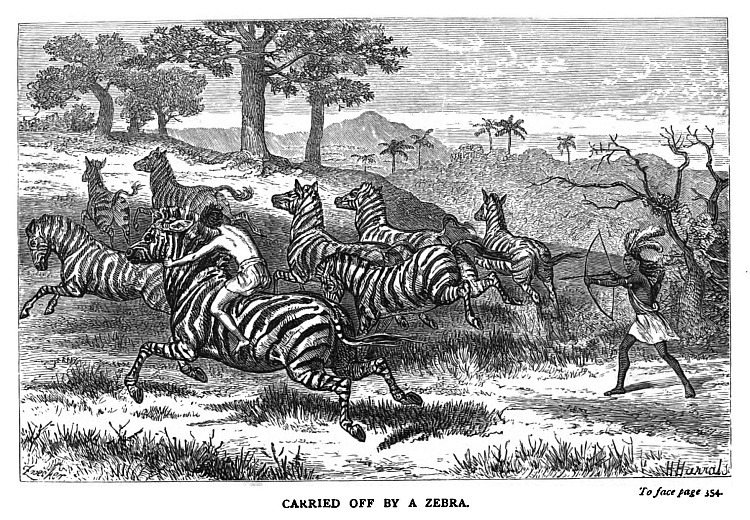
“Ah, what a fine horse he would make! how I wish that such an animal as this would carry me to Zanzibar,” and as he said this, while Selim was on his back imitating the movements of a rider, the zebra rose to his feet so quick that the boy had no time to throw himself off, and bounded after the herd with the swiftness of lightning.
Kalulu uttered a cry of horror; but, recovering quickly, he drew his bow and sent an arrow deep into the flanks of the fleeing animal.
This wound but spurred the furious and frightened beast, with his strange rider, to quicker speed. Kalulu heard the glad neighing of the zebra herd as they greeted the approach of their lord; he saw them surround him, then looking suspiciously at the rider; saw them, while furiously galloping over the park-land, run at the boy with open mouth and drawn ears; saw them frantically kicking their heels about to the right and left; and, while his heart stood still with fear for his white brother’s safety, he saw the herd, still chasing the ridden zebra, vanish in the forest beyond.
Then, waking from the stupor of fear and surprise, Kalulu noted the direction the herd had taken, he hastened back to the bivouac, where Simba and Niani sat waiting the return of the hunters, and breathlessly informed the astounded giant that Selim had galloped away on the back of a zebra into the forest, and urged him to take his gun and follow him; and, without waiting to see the effect of his words, he bounded off again in pursuit of the flying herd.
Niani uttered a cry of sorrow, but Simba, after waiting a second to tell him not to stir from his concealment, ran after Kalulu. Overtaking him, they both stood for a moment under the tree where the zebra had lain apparently dead. Kalulu pointed to the direction the herd had taken, and without more words the two, Simba and Kalulu, braced themselves for a run.
The soft ground showed the pursuers the traces of the hoofs which had been fiercely struck deep into the ground, as the flanking animals outside of the herd had charged at the rider of their lord; at the base being who had audaciously usurped a seat no living man had a right to claim. The pursuers noted these things as they ran, and could well have described the fury of the herd, as they saw their noble king thus ignominiously treated. What! they! free rovers of the virgin forest and plain, the untamed creatures of the wilds, whose gorgeous backs and splendid hides had never been defiled, within the memory of the oldest zebra, by the bestriding limbs of any man, to see their noble lord insulted! No wonder when such thoughts filled them, that their eyes flashed and their crests bristled, and their flowing tails erected, and their hoofs struck deep with frantic energy into the yielding turf. Then they thought of what Selim’s feelings must be, surrounded thus by the indignant creatures, charging, and biting, and kicking at him, eyes kindled with honest rage, as they ranged around their monarch—their open nostrils glowing like fire, and emitting their hot, steamy breath, while he struck right and left, and shouted to fend them off.
On continued the pursuers, with increased speed, as they thought of the great danger their young friend was in, with their heads resting on their shoulders, and their faces cutting the tepid breeze, and their mouths wide open to inhale the air in short, quick draughts, for the lungs that rapidly exhausted it, with their hands fanning the wind, and their chests rising and subsiding with each breath they took, and the hips urging and impelling the lagging feet, which fain would have spurned the ground.
On, on, my brave, faithful friends! take no heed to yourselves; think not of your growing weariness, or of future pain. Let your livers ache, and the overtasked lungs feel exhausted! Let your heads throb, and your limbs be fatigued; your friend is in need! Be not discouraged. See the large clots of blood that stain the sheeny grass; the zebra monarch must yield to fate, despite his royal body-guard. His life wanes fast, as ye may note by the red blood which dyes the ground. On, on, my gallant souls! Speed on, my agile Kalulu! Confess no fatigue; for thou art a son of the forest, and rightly named after the swift-footed fawnling. On, on, my brave Simba! one effort more; let it not be said that a boy shamed thee! Ha! behold! What said I? Yonder lies your prize stretched on the ground! And see, here is Selim himself advancing towards ye! The Arab boy is then safe.
Simba and Kalulu were so tired after their long run, which had lasted an hour, that they were compelled to throw themselves on the ground, while the throbbing hearts heat wildly, and their lungs laboured hard and fast; but finally, though their heads yet ached with pain, they were tranquil enough to hear Selim’s story, which was, in the main, described above, though when the zebra staggered and fell, Selim said that he leaped down, and ran behind a tree, while the herd, neighing shrilly, disappeared in the forest, and left their monarch alone to his fate.
After a short time Simba and Kalulu were so far recovered, as to be able to rise up to cut up some of the zebra that had given them so much trouble and anxiety; then, loaded with meat, they began to retrace their steps along the same road they had ran so fast in pursuit of him whom they now heard laughing as he told some points of the story.
At sunset they arrived at the tree whence the unequal race began, where they found Selim’s rifle, which he had unwisely left on the ground, and proceeding to their bivouac, were all heartily welcomed by Moto and Abdullah, who had killed a young buffalo cow, whose generous meat was already cooking on the wooden platform we have in another chapter described.
They rested that night in the same spot, where they were so secure from molestation, to enjoy the abundance Nature had furnished them, and to relieve themselves from the strain the arduous labour of flight had imposed upon them the last few days.
Continuing their journey at sunrise, they hugged the shore, which they had thus a chance to observe more closely. They could see the waves of the surf break on the rocks at the foot of hills rising above them, or playfully toss themselves in wanton glee on the shingly or the sandy beach, their curling caps becoming white foam as they met resistance in the firm land; and at each hollow between the hills they could note the lazy rillets dribble through the tiny sandy furrows into the lake; or watch how the greater streams that continually discharged themselves by every avenue to the great lake, came sailing round the bends of their course from under the sunless gloom of embracing mangrove bough and cane; or look in wonder at the remarkably lofty matete, which they ever and anon passed, whose each stalk was furnished with many a rapier-like leaf, which rustled gently before the wind, and showed a sheen and glister which the finest silk they had ever seen could not rival; or glance with curious eyes at their stalks below, when they came in contact with the black earth that nourished such profuse vegetation, and see how, one after another, these receded to rayless shadow and all-pervading darkness, in which, however, their ears detected the movements of busy feet, the quick pattering on the earth, the signals and low triumphant cries of the birds, which seek shelter and have their being in such gloomy recesses—from the sleek-looking diver to the active little kingfisher; from the crested crane, or the towering pelican, to the pretty white paddy-birds.
They passed many and many a bold cape and lowland, whereon grew wild plaintains, whose broad fronds offered an impervious protection against the noon-day heat, which nourished scores and scores of wild guinea-palms, and dark green tamarinds, and tall trees, too, from whose stems the natives excavate their canoes, and umbrageous sycamores and wide-spreading mimosa. All these headlands and lowlands, head-capes, and far in-reaching bays and creeks, where sported the hippopotami, and lazily floated the crocodile in his enormous length—yea, all were beautiful.
Then the lake contracted; the two shores came nearer, and a strong current carried them safely towards the north, and to a lake of still greater size and extent. They continued along the right shore of the lake, congratulating themselves that they were now in the sea of Ujiji. Now and then they passed villages, which they took good care to avoid, and at night they rested on the shore in the deepest recesses of a cane-brake, or on some lonely island far removed from any habitation; day after day they continued their journey unmolested; and each person of the party now came to think that Usowa would certainly be reached in safety.
But on the sixth day after they had entered the great lake a storm arose, accompanied by lightning and a great downpour of rain, and the furious waves arched their white crests, and were driven wilder and higher above their heads by the angry wind; while the canoe which had carried them so long became tossed about and pelted by the maddened water, until it seemed as if they must all perish. Simba and Moto manfully laboured at their paddles, and endeavoured to direct her head to the shore, but the strong wind laughed at their efforts, and blew her on before it, and the waves dashed their heads against it, and drove it on—now on their topmost crests, and now into the engulfing troughs which opened to receive it as it was precipitated down to them. The lightning played in all directions, the heavens seemed rent with the deafening thunder-crash, and the rain poured like a deluge; and while the wretched boys were compelled to bale the water with their hands, the wind and wares carried the half-submerged canoe where they listed. Thus through the mist, and fog, and blinding rain, while Simba and Moto continued to keep her before the wind, the canoe was being driven towards an inhabited portion of the shore. The rain ceased for a moment, and the mist cleared away, only to allow the crew in the canoe to see whither they were drifting, and to allow a number of people crowded under a temporary shed on the shore to see them.
“Who were these people?” thought the fear-stricken fugitives. “What would be their reception?” But they had no time to think more before they were in the surf, and a mighty wave came and struck the paddle from Simba’s hand, and spun the canoe round broadside to a second wave which lifted it to an immense height, and dashed it upside down; while a third came on irresistibly, and sent it and its late crew far on the beach, stunned and bruised, where, before they could arise to their feet, they were pounced upon by the shore people, to be enslaved once more. Oh, misery! The shore people turned out to be a nomadic tribe of Wazavila—or Wazavira, as the Arabs pronounce the name—who erect their huts anywhere between southern Unyamwezi and Liemba, from Usowa to the borders of Ututa. Had Simba and his companions been able to travel three days longer they might have reached friendly Usowa easily, but here, almost on the threshold of the friendly region, they had fallen into the power of the disreputable Wazavila freebooters, Simba struggled desperately, but neither he nor any of his companions had the slightest chance against the numbers that surrounded them. They were bound hand and foot, and carried under the roof of the shed, where the white bodies and straight hair of the Arabs elicited many a wondering comment, and provoked as much surprise as they had done amongst the Watuta when they were first captured.
The chief of these rovers was called Casema. His people, including women and children, numbered about three hundred. About four months before the period at which they are introduced to us by this capture of our unfortunate heroes, they had started from their home, Benzani, a district which lay somewhere north of the Bungwa River, and east of Usowa, to which they now intended to return, having secured such prizes.
Simba and Moto heard these remarks, as the chief consulted with his people about the plan of action, and felt convinced they need not despair, that the prospects of an escape eventually from these people were exceedingly bright if they were only prudent in their behaviour. They could govern themselves, but they were not so sure of the fiery young Kituta chief, Kalulu, who would probably before long commit some act of imprudence; nor were they quite sure of the indomitable young Arabs, who would be naturally inclined to despair at so many reverses; for Niani, poor little fellow! who was a slave by birth, they need fear nothing, as he could relapse at will into that state of frigid, stoical apathy a slave with no promising future before him so soon assumes,
The sky soon cleared up, the wind went down, and the wares abated, and the captors became more lively in their behaviour; but fearing that some aid might come to their captives in some shape by the lake, at sunset they broke camp, and started for the interior, but not before their miserable slaves had been tied together by the neck, with stout thongs of green hide.
The general direction they travelled was east, but the caravan filed by bends and curves so numerous, that it was with great difficulty Moto could settle in his mind in which direction they were going.
At midnight they bivouacked in the depth of a forest, and warriors were detailed to watch the captives, but the latter were so fatigued with the exertions of the day, that such precautions were needless. They had soon fallen asleep, despite the unpleasant thongs that encircled their necks, or the more unpleasant bonds which confined their hands behind them.
Chapter Fourteen.
The Slave Hunters meditate another Attack—A True Picture of the Slave Trade—The Inundated Plain—A Terrible Catastrophe—The Joys of Liberty—Simba fights with a Leopard—Kalulu sympathises with wounded Simba—Kalulu shows Abdullah the Art of making a Fire—Niani punishes the Dead Leopard—How a Mtuta Chief fights—Kalulu victorious—Simba thinks Kalulu a Hero—Spearing the Lepidosiren—How a True Son of the Forest acts—What Kalulu found in the Arabs’ Camp—Kalulu is kidnapped!—A Victim of an Atrocious Deed.
The unfortunate captives were wakened rudely at sunrise by smart taps applied to them by the warriors with the butts of their spears. Kalulu felt very much like resenting this rough behaviour; but Moto entreated him, as he saw him raise his flashing eyes, not to urge them to greater violence, as, whether he liked it or not, he was compelled to bear it.
They were soon on the road, for savages and slaves take but little time to make ready for their journey. After they had marched a little while, Moto heard the warriors nearest him talk of an attack Casema had determined to make upon a village some time during that night, as he had found out that most of the fighting men had gone south on a hunting expedition, leaving only a few able men to guard it, while there were numbers of women and children within. The village belonged to an isolated tribe of the Northern Wabemba, sometimes called Bobemba.
Towards the decline of day the Wazavila halted in a thick grove; and as they would not permit the captives or their own people to kindle fires, all were compelled to eat the grains of Indian corn doled out to them unroasted—a task which the stoutest jaws would find excessively hard. In the meantime it was noticed how the warriors sharpened their spears, and critically examined the strings of their hows, and made other preparations for war upon the defenceless village of the Wabemba, which must have been near, else why all their preparations?
About three hours after darkness, after leaving twenty men to guard Kalulu and his companions, the Wazavila, to the number of one hundred and fifty, started to put their murderous purpose into effect.
Though Kalulu, Selim, and their friends listened keenly for the sounds of the strife, they heard nothing; but at the end of a couple of hours they saw a red blaze over the tops of the trees to the south, and they knew that the work of the devil was being enacted, or that it had been consummated, and that fearful glare of fire seen against the sky was only the final completion of the craven and wicked deed. About midnight the fiends returned with about two hundred and fifty women and children, and a few old men, the able-bodied having perished to a man, as they afterwards found out, in the defence of their homes. The order to march was given, and through the pathless jungle and forest the Wazavila urged their slaves with spear, blade, and shaft, so they might be far out of reach before the vengeful Wabemba came on their trail.
The morning rose and found them still tramping on in a direction considerably north of east, and showed the scene with all its horrors to the sympathising Selim and Abdullah, though to Kalulu, Simba, and Moto such scenes were not new.
On this and the following days, for nearly a fortnight, the two Arab boys had this accursed evil of Africa brought vividly before their minds, and they saw to its fullest extent the immeasurable vastness of the sin and crime of which the Wazavila freebooters were guilty. They had wantonly attacked an unoffending village, and reduced to servitude and misery the poor people, whose homes had been fired, the flames of which had made the sombre night lurid with the red glare, and had exhausted themselves among smoking embers and the scorched bodies of the men who had lost their lives in disputing the advance of the Wazavila assassins and midnight robbers, who had stealthily entered this village to make the night hideous and awful with their crimes.
Step by step, through that pathless jungle and forest, which seemed interminable, did the poor people moisten the ground with their bloody sweat; step by step did they vent their miseries in hot tears, in groans, which were answered by vicious blows on their backs from their relentless captors. Each day saw an infant, which had been until then full of promise of lusty life, laid down by the side of the path cold and dead; for the mother, under the load of her miseries and privation, could not sustain the young life with her emptied breasts, and too often for detailed recital, she herself resignedly knelt and died by her starved offspring. Too often, alas! did the wretched mother, lacking proper sustenance, first fall dead in her tracks, with her little baby vainly sucking at the chilled breast, while a blank look of hopelessness stole over his little face as he wonderingly looked after the departing caravan, and trembled with an unexplained horror at the dread silence and loneliness of the forest. No mourner was left behind to bewail the fate of these hapless ones; only the moaning winds sang their monotonous requiems until the voracious hyaena and the hungry jackal came to consume that which had become as a blight and ugly spot on nature.
Nothing was better calculated to cure Selim and Abdullah of the desire of ever making money by buying and selling slaves than these scenes, even if the unutterable wretchedness of their own condition had not taught them the full meaning of the term “slave” before this.
Day by day every good feeling within them was shocked; for day by day new victims to human lust of gain were left cold and stretched in death along the road—old and young seemed to perish alike from the same cause—starvation and fatigue. Neither the patriarch nor the child was absolved from the dire fate.
About the fifteenth day they came to a populated plain, where the Wazavila, by the sale of two slaves, obtained sufficient food to distribute a week’s rations to each man of the caravan; and in order that their human cattle might recuperate somewhat, they rested in the plain two days. The Wazavila had still nearly one hundred and seventy slaves, over eighty having perished since the night of the attack.
When they continued their march the direction which they took was nearly due north, as they were now about a hundred and forty miles due east of the Sea of Ujiji, the great lake in whose troubled waters Kalulu and his companions came so near to an untimely end. During nearly the whole march rain had fallen, and the plain through which they now traversed added by its marshy character to increase the fatigue of marching.
In two days the plain had sensibly declined to a lower level, and the water rushing from the higher ground had inundated the whole of that part of it they now traversed to the depth of about six inches; in some places it was still deeper. This portion of the plain the Wazavila told Moto was called Bikwa; and from general conversation that he heard, he knew that shortly they might expect to see a river called the Bungwa, which every year during the rainy season flooded its banks. It was for the purpose of giving their starved slaves strength to cross this terrible plain that the Wazavila had halted two days, as it required a long day’s march to traverse the inundated part and to cross the river, on the other side of which was higher ground; while, had they been compelled to travel to the eastward, three days would not have sufficed to get over the swampy plain.
Moto communicated his opinions to Simba, declaring that he thought the time to try to make their escape had arrived. It would probably be night, or nearly so, by the time they would reach the river, and, in order to save their slaves from drowning, the Wazavila would be compelled to free them. Simba coincided with Moto, and they passed the word to their friends to hold themselves ready for any contingency that might arise.
What little strength the wearied women and children had gained by their two days’ rest was soon exhausted in the passage of the Bikwa swamp. The quagmiry road, trodden into tenacious paste by the long file of human beings ahead, soon rendered travelling by those behind them a work of unconquerable difficulty, and some unfortunate woman or child was momentarily struggling for life in the muddy waste, never to rise again. And as the day rapidly passed away, and no signs of the river were yet seen, the anxiety of the Wazavila became evident. But a little after sunset, as the dying day was being rapidly exchanged for night, the head of the caravan arrived at the ford of the Bungwa, which river, as was expected, was emptying an immense volume of water to spread out and inundate the plain.
Two or three warriors cautiously ventured into the stream to ascertain its depth and force. As soon as they got in it was evident, by the effort they made to keep their feet, and by its depth, which rose up to the tops of their shoulders at times, that the crossing of the river would be attended with appalling loss of human life.
Our party were close to the bank when this experiment was made, watching it with intense interest, and as soon as the warriors had safely crossed, Moto asked a warrior to cut the bonds which bound his hands behind his back, that he might have a chance to save his life. As this was but fair, the warrior complied with his request, and released his hands, as well as those of his companions, and then generously severed the thongs which bound the party neck to neck.
Simba led the way into the water; and, being tall and strong, he took Selim by one hand, and Abdullah by the other, into the raging flood. Moto took Niani, Kalulu, lightly touching his lee shoulder, was able to avail himself of Moto as a breakwater, and at the same time assist him with Niani. When Simba reached the middle of the river the feet of both Arab boys were swept from under them, and the same happened to little Niani, while Kalulu could with difficulty keep his feet—so strong was the flood.
It was a long and anxious task, even for Simba and Moto; but they finally emerged on the bank in the darkness, and sat down, apparently worn out.
Closely following Simba’s party were about twenty of the warriors, each leading a woman or a child by the hand; but the first of these warriors happened to be unfortunate, for the woman he led, feeling herself unable to resist the flood, uttered a terrible cry of alarm, and sprang forward, and, being swept against the almost submerged head of the warrior, carried him down with the rapid current. The warrior dived to release himself from the woman, and swam bravely for the shore—two of the warriors on the shore alongside of Simba’s party running down the bank to assist their companions.
The cries and screams of the drowning woman threw the women and children then in the stream into a panic, and so confused the men leading and assisting them, that they staggered and allowed themselves to recede downwards, step by step, which soon took them into deep water, and the men themselves had to begin straggling for their lives, while the poor women and children were carried down, far beyond aid, by the impetuous current, uttering their drowning cries, which were heard far above all, until they ceased to struggle, and were silenced by the watery grave they had found.
Casema’s voice was heard commanding that every two warriors should lead a woman between them, and while the shouts and the screams of the terrified females announced that this course had begun to be tried, Simba nudged Moto as a sign to be ready, and to seize the bows and arrows of the two men who had gone down the bank, while he himself would snatch the spear of the warrior who was still standing by as a sentry over them. Moto conveyed the intimation to Kalulu and the other three to hold themselves ready, and hinted back to Simba to begin.
Quick as a lightning’s flash, Simba rose, and snatching the spear on which the warrior leaned, lifted him high in the air, and tossed him head-foremost into the river before he could utter a cry. Meantime, Moto had collected the three bows, and three quivers full of arrows; and each, taking hold of one another by the hand, ran from the bank before a single alarm could be given.
Our friends were far out on the plain before a chorus of shrill cries for help announced that another calamity had taken place at that awful ford; and were it only for being relieved from witnessing the many more calamities that must take place before all those living could reach the hither bank, they conceived that they had just cause to congratulate themselves.
Once clear out of sound of the disastrous ford, Moto suggested that they should strike to the north-west, lest, by going too far to the north, they might fall across more of the predatory Wazavila, a suggestion that Simba thought prudent and thoughtful.
Kalulu breathing free again, after his escape a second time from slavery, felt light as air, and was for the moment as happily disposed as he could well be, while Selim and Abdullah felt in their hearts an overflowing gratitude to Allah for his protection and deliverance from vile bondage, and breathed prayers to him to continue in his care of them.
Long before morning dawned, they felt that the character of the country was changed; for rounded shadows heaving upwards gave them an idea that hills were becoming frequent, and that these they saw were but the vanguard of some range they were approaching. The morning and its welcome light confirmed this opinion; for before them rose a majestic ridge of mountains, clothed from top to base with greenest verdure.
Prudence counselled them to seek the mountains by the most unlikely way, and they accordingly adopted the precaution, and were soon scaling a steep slope, overgrown with the feathery bamboo. From the eminence they attained, they turned their eyes to note the plain they had left, which was now spread out before them in one grand prospect, while it spoke or revealed nothing of the misery and sorrow which they knew existed in some part of it, among the human beings driven to hopeless bondage by the cruel Wazavila. Unable to dwell upon its false and treacherous beauty, they turned towards the mountains, which, so far, had nothing of the ominous or fatal in its features for them.
The sun seemed a long time coming out, they thought, as they looked towards the east; but then it was the rainy season throughout Central Africa, which had been heralded in by that awful storm on the sea of Ujiji, and out of which they had escaped to experience the privations of bondage; and the lowering mist and humid fog hovering over the crag-bound ridges above them was the result of the rains that had lately submerged the Bikwa Plain throughout its length and breadth.
About noon, after they had lost themselves in the deep folds of the mountains, our party rested to recover their strength, and to aid the recovery more rapidly by grinding some of their corn rations between their jaws. Simba thought this very dry eating, since they were free, and expressed a decided objection to remain much longer without meat, which, in his opinion, was the only food fit for a free man. Kalulu agreed with him in all he said, and volunteered to accompany any man in a search for game, which, he said, ought to be plentiful in such solitudes. Whereupon Simba agreed to accompany him; but since he did not know much about a bow, he would take his spear, which he could throw as well as any other man, while Kalulu could take a bow and his quiver of arrows.
Matters being thus arranged, Moto promised to be very good, and look after the boys, and see that they got into no mischief during the absence of Simba and Kalulu, upon which Simba thanked him, and bade him surely expect something within an hour.
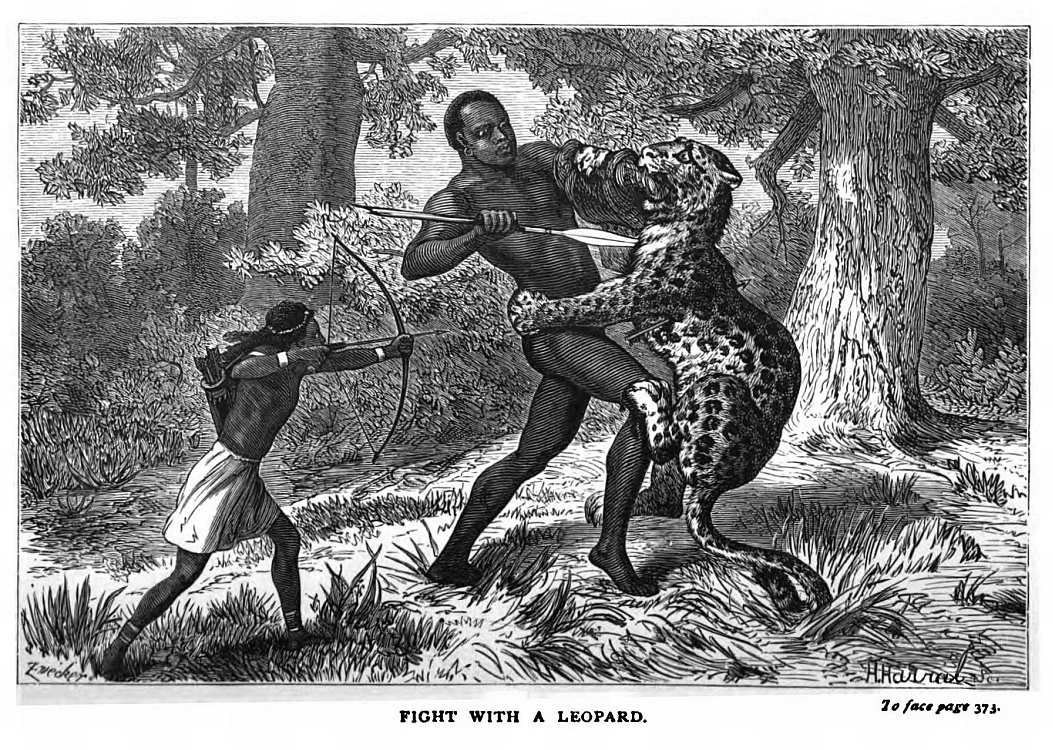
Kalulu held three arrows in his left hand, and his bow in his right, and descending a deep ravine which opened shortly into a mountain valley of exquisite beauty, he was gratified to observe a solitary eland lying under a tree, with a splendid pendulous dew-lap, moving about as it erected its head to chew the cud and to enjoy in that solitude the sweet repast of grass it had lately eaten. Simba stood hid behind a tall tree, while Kalulu, master of the art he was now practising, began to move through the grass towards it with the ease of a snake. For a moment the young chief debated within himself when to send his arrow, but finally arrived at a conclusion; for he drew his bow, and drove an arrow behind the fore-shoulder, which, penetrating through, pierced the heart, and after one or two spasmodic bounds into the air, the eland stretched himself on the ground, dying.
Kalulu turned round to beckon to his companion, when he saw with surprise that Simba had broken his spear short, and, after stripping himself, had rolled his loin-cloth around his left hand, and raising his shortened spear, had put himself into an attitude of defence against something.
He at once bounded forward to assist his friend, when at the first step he took he saw a leopard spring upon Simba with a terrific cry. Uttering a cry of horror—but nothing daunted by the ferocity of the animal—he placed a barbed arrow on the string of his bow, and came up close to the combatants just as he witnessed Simba thrusting his left hand into the leopard’s mouth, and driving his spear repeatedly into his side. The animal’s claws were buried in the left hip and knees of Simba, which he was viciously tearing; but his jaws were rendered useless by thick folds of cloth which Simba had thrust into his mouth at the first onset of the brute. It was well that Simba was such a powerful man, else the shock of the onset would have knocked him down, when it would have become doubtful work to save his throat from the gleaming fangs.
Kalulu stayed only to take in these observations, and then stepped deliberately nearer, and drove an arrow through him; and without waiting to watch the results, drove another, and still another, while Simba drove his spear several times deep into his heart, and exerting his strength when he felt the claws relax, he brought his right leg forward, and turning the animal’s back on it, pressed down his head with his left hand, and drew the sharp spear-blade twice across the throat, almost severing the head. Then the animal, yielding to superior strength and weapons, fell off, shivered once or twice, and lay extended lifeless—dead.
Poor Simba was most grievously wounded; for the claws had penetrated deep into his hip, while the knee-bone was bare.
“Ah!” sighed he, as he heard the expressions of sympathy from his young friend, “if I had only some of that eland thou didst shoot, Kalulu, in me yesterday, to-day I should have bent that beast double, as easily as I would fold a piece of cloth. But grain-food! who can be strong after feeding on grain-food for sixteen days? Give grain to asses, but meat for men!”
“See here, Simba. Do thou rest thyself under this tree, while I go and bring our friends here. It is far easier for them to come here than for us to carry the eland to them. Thou mayest take my cloth to wrap round thy wounds. I don’t need cloth while thou art thus.” So saying, the generous, sympathising youth hastened to inform his friends of the accident that had happened to Simba, which they received with surprise and consternation.
Selim and Abdullah, who had been indebted so often to the power that lay in Simba’s arm, as soon as they heard of the wounds which their champion had received, now hastened to him to offer their services.
“Speak, Simba! Oh! the frightful beast!” said Selim, as his eye caught sight of the mangled and gashed leopard. “Speak! art thou much hurt?”
Simba was reclining under the tree, looked slightly troubled with his pains; the clothe he had taken to staunch the blood were lying on the wounded hip and knee, by no means pleasant to look at. The two boys, seeing these things, judged immediately that Simba’s case was very grave—that he was going to die; and, not knowing what else to do, they began to cry, to sound the praises of their dear friend, and lament his sudden “taking off.”
Simba, however, answered them as quickly as he could subdue a pang of pain, and command language.
“Nay, weep not, young masters. Simba is but slightly wounded—flesh wounds—nothing more. No, no, Simba is not going to die; he must see his wife and children, and Selim in his home again, before he can die. But—Master Abdullah!”
“Yes, Simba, what is it?”
“Dost thou really like big Simba?”
“Oh, Simba, how canst thou ask? Thou hast succeeded my father Mohammed in my affections. Remember the Liemba and the crocodile. I can never forget that awful moment, for the scars on my leg remind me of it daily.”
“I thought thou didst like Simba a little; but wouldst thou be very sorry if Simba died to be left in this valley to be eaten by the hyaena and the jackal, Abdullah?”
“Don’t, don’t, Simba, for Allah’s sake, ask any such thing. Thou hast said thou art not going to die, then why torment me?”
“Yes; but I might die if Master Abdullah did not do me one favour, for—”
“Speak; command me, Simba—anything, everything,” urged Abdullah.
“If Master Abdullah would only make a little fire, and Master Selim cut a little meat from that fine eland that lies dead by that tree yonder, Simba might eat meat and live.”
“Thou shalt have meat, Simba,” cried Abdullah, “before thou canst count one hundred,” and he bustled about, ran here and there; collected bunches of dry grass, leaves, twigs, sticks; brought a good-sized log or two of dead wood, between which a fire should be built; while Selim, after taking the spear which had probed the leopard’s heart, had run towards the dead eland, and was slashing and carving great chunks of meat.
Abdullah had his pile of wood ready, but he now turned with a puzzled expression towards Simba, and said “Here is the wood; but where and how can we get fire? Our guns are in the bottom of the sea!”
Kalulu, Moto, and Niani had come up by this time, and Moto, after examining the wounds of his friend, turned round to Abdullah and said:
“Kalulu will help thee, Abdullah, to get fire; he does not need a musket-pan or powder.”
Abdullah wae curious to know how, for he had always seen a musket-pan used, though he had wondered often when a slave with the Wazavila how the natives obtained a fire; but he had never seen the process.
Kalulu, however, proceeded to show Abdullah how the Watuta obtained fire by other means than a musket-pan. Selecting a piece of stiff, dry bark, he placed it between his feet on the ground, and sprinkled it with a little sand, which he first rubbed dry and warm between the palms of his hands. He now chose the strongest arrow in his quiver, and, cutting off the feathers and the notch, he pared the end until it was level. Then gathering some dry leaves and grass straw on the sanded bark, rested the end of his arrow in the centre, and began to twirl the arrow round with the palms of his hands with a steady downward pressure. In a short time smoke was seen to issue, and, continuing the operation, two or three sparks of fire shot out among the straw and leaves, which, being blown, was soon nursed into flame.
“That is how the Watuta obtain their fire,” said Kalulu to Abdullah, with an air of superiority, which the latter thought was quite pardonable, since Kalulu did really produce a fire on which meat might be cooked for the benefit of his friend Simba.
“O Selim! Selim! O Selim!” cried Kalulu, “haste hither with the meat.”
Abdullah, in his impatience to see Simba’s jaws at work, reiterated the cry, “O Selim! Selim! O Selim! come with the meat, come quick.”
“Coming!” was the answer which that industrious young Arab gave, as he turned his face toward the group with a shoulder of eland meat on his back.
“Now, Niani, haste to get more. Think of poor Simba, thy father, suffering for want of it; there’s a good boy, bring plenty,” said Abdullah; while in the meantime Kalulu had chosen an arrow-blade, and with it was preparing the slender sticks to impale the meat when it would be cut into kabobs for broiling, and Moto had bound Simba’s wounded knee with bandages made out of Kalulu’s loin-cloth, and had staunched the blood that had been pouring from the wounded hips. Moto also set to work at erecting a shed, which might shelter the whole party, and made a luxurious bed of grass and leaves on to which his friend was assisted.
Kalulu then, while the meat was broiling, and the most pressing duties of the camp had been performed, turned to skin the leopard, whose hide, he thought, would make an admirable loin-covering for himself.
Simba, after he had managed to eat as much of the eland as any two ordinary men would have eaten, began to feel his strength returned to him, and said:
“Ah! there is nothing like meat for medicine, after all. It makes a man look kinder towards his fellows, and if he has his stomach full there is nought that he cannot bear. If I had always plenty of meat in me I would as soon fight a leopard every day as not; and if I had a good knife I would be willing to fight a lion rather than run away from him.”
Such sentiments, noble and worthy of the great man who spoke them, met with hearty approbation from his repleted friends, and Moto was of the opinion that after a stomachful of good meat he might also, if hard pressed, do damage to either a leopard or a lion. Selim, following suit, suggested that he, being but a boy, ought to have his English gun in his hand before he could be expected to fight a lion or a leopard; while Abdullah and Niani gravely expressed their fears that if they met either of those beasts of prey they would think of climbing some tall tree before doing anything else.
Kalulu, after skinning the leopard, proceeded to spread the hide out on a piece of spongy sward for the sun to dry it, putting a number of small pegs around to stretch it. The leopard, being denuded of his splendid dress, was not so much an object of fear to little Niani as it had been; it was no more fearful than a skinned dog would have been, though the canine teeth still looked formidable. But knowing the injury it had caused Simba during life, he could not help seizing the broken spear-shaft, and belabouring the dead brute with it in a vicious manner, which no doubt the leopard would have resented, could he have felt the blows showered on him. Having taken his fill of this mild revenge, Niani seized it by the tail and dragged it far out of sight.
The valley wherein these adventures occurred would have been deemed by our friends exceedingly pretty at any other season, but almost every other moment the wind drifted great dense masses of rain-cloud across its face, which completely blurred its beauty, and added more volume to the streams that constantly poured down the slopes from above.
Safe, however, for the time under their shed, they could contemplate their little annoyances with liberal philosophy, and could readily adapt themselves to the circumstances without great sacrifice of comfort.
Simba was too sore to move for two days, but on the third day they broke their miniature encampment, and continued their journey through the mountains in a direction nearly north-west.
Tropical mountains are always grand, but during the rainy season their grandeur is enhanced. Why? Because wherever you turn your eyes you see some pinnacle, or crag, or summit buried in the angry clouds, which are a dirty grey, and ragged at the edges, but are an impenetrable mass behind of inky blackness, as if the night had been gathered and compressed into an enormous black ball ready to be hurled upon the valleys and plains by some vengeful fury. These black balls of clouds, poised upon the topmost mountain, are a feature in Central Africa; they seem to stand a moment in their precarious position, when a furious wind, which flurries everything in its way, tears along with a mighty sound, reaches the monstrous ball, lifts it up a moment above the mountains, and then hurls it upon the quiet sunlit valleys with thunder-crash and lightning, and great floods of rain.
These were of daily, sometimes hourly, occurrence, while our travellers journeyed slowly to where they conceived friends might be found. Owing to Simba’s wounds, their progress was necessarily slow, and this gave them ample opportunities to watch the phenomena we have described.
At the end of a week they were not forty miles from the Rungwa Plain, and at the termination of that period Simba declared he felt as strong and as well as ever, and the eighth day he led the way as formerly, and twenty-five miles were marched.
This day’s journey brought the travellers to a long, straight, narrow valley, which was converted through alluvial deposits and vegetable mould of centuries into a quagmire of extraordinary profundity. On the opposite side of the oozy valley to that on which they stood, there was some cultivation, and in a circular jungle they descried a few huts, probably a village. On their side the ground rose up gradually to an ancient clearing, from which disused roads ramified in all directions, which were a sufficient evidence that at one time the country was well populated.
They were striking up one of these roads leading to the old clearing, called Tongoni in the language of Zanzibar, when an arrow whistled close to Simba’s ear, followed by another and another.
Kalulu’s trained ear detected the sound at once, and casting his eyes hastily around he saw a group of men wearing cloth round their loins, hidden in a thick bush; how many men he could not tell, nor did he wait to count them, but shouted to his friends:
“Up, up! Simba—Moto—up, my brother! up, Niani! run towards that peak beyond the clearing. I will follow you. I shall stop to bring these fellows out, and to show them how a Mtuta and a chief can fight.”
“No,” said Simba, “we will not go up without you. Come with us, Kalulu.”
“Fear not for me, but think of the Arab boys and yourselves. They cannot catch me. Go on to the peak. Go, Selim, Abdullah; Kalulu begs of you.”
“Let him be, Simba,” said Moto; “Kalulu knows what he is about;” and without waiting to see whether Simba followed him, he snatched hold of Selim’s hand and ran with him up the hill. Simba followed with Abdullah and Niani before him.
As soon as he saw his friends start off, Kalulu limped most painfully towards a tall tree that stood near him, and crawled as if he were grievously wounded behind it. But the minute he felt himself safe behind the tree, he fixed an arrow in his bow, while he held three others in his left hand.
Kalulu had not to wait a second before six men came from behind the bush and rushed towards his hiding-place, until they had come within about fifty yards from the tree, when they surrounded it, and one of them seeing him, hurled his spear at him. The spear fell short, about a yard from the feet of Kalulu, but the boy never made any sign of movement. Encouraged by his silence, another spear was hurled at him, which just missed his body, for it fell quivering at his side, not six inches from him. Then an assegai, or a long javelin came, and grazed the bark above his head, and still no answer, from which they surmised that he was wounded too much to make any reply; but immediately one of them, bolder than the rest, made a forward leap to advance towards him, Kalulu drew his bow and sent an arrow through his chest, and before the others could seek shelter again he had shot another through his side. Then, snatching the two spears and assegai which had been thrown at him, the young chief uttered the Kitutu war-cry and bounded, light as an antelope, through the thin jungle.
On seeing the lad run the others rose from their shelter and gave chase. On reaching the top of the rising ground, Kalulu threw himself behind a thick bush of thorn and waited, with eyes and ears on the alert, and fingers on his bow-string, until catching sight of the foremost he took a deliberate aim at him and pierced his throat with an arrow; and, before a sound could have been uttered by the dying man, he had fixed his arrow again and was aiming at a fourth, when the fellow turned about to run, but too late to escape the arrow which, following him, buried itself up to the feathers in his back.
Emerging from his hiding-place, he retraced his steps, deliberately took up the arms, the bows and arrows and spears of the two last he had slain, and seeing the two remaining in full flight, turned round, and sought his companions, who were anxiously waiting for him on the summit of the peak. In a few moments he had come up with them, and they listened in wonder to his tale, how he had slain four of their enemies, to which his trophies bore ample testimony.
Simba began accusing himself of cowardice, and everything else that was bad, when the young chief stopped him, and said:
“Not so, Simba; thou art big and a good target for an arrow; but I am small and thin, and if there had been twenty I could, by being prudent, have escaped easily. None of these people like to come out to the open to fight, and so long as there was but one to fight they would never have chased anybody else; and by dodging through the bushes, shooting the most forward of them, I could have so thinned them that when they reached us on this peak they would not have been able to take us without losing many more men, and perhaps losing all. If we all had been together those fellows might have killed two or three of us, and whom could we have spared?—Selim? Abdullah? Niani? No, Simba; thou seest that I could not have acted otherwise.”
“I saw that when you told us to go,” said Moto. “Who of us knows much about arrows? Master Selim and Master Abdullah know nothing; Niani is too small even if he did know. Simba says he don’t, and I am sure I know but very little compared to a man who all his life has shot with nothing else but his bow. Now, with a gun—”
“Ah, yes; if we had but three or four guns,” sighed Simba, “thou wouldst not have been left alone, Kalulu.”
“If I had only my English gun here now,—two barrels,—always true—not one of those men would have escaped,” remarked Selim.
“But, my brother, surely only two have escaped as it is,” replied Kalulu, laughing; “and they are too scared to trouble us any more, I think, though it is time for us to be off before others from the village on the other side of the valley come after us. Here is a spear for thee, Moto; and a spear also for thee, Simba. I will keep one spear, and Selim and Abdullah may keep the hows and arrows. We shall have something for Niani by-and-by, perhaps.”
“I hope not,” said Simba, “before we get amongst friends.”
This feat of Kalulu’s in killing four men raised him highly in Simba’s estimation, and the consequence of it was that he came to pay great deference to him, far greater than he ever had paid to him before; for thus far, except that he showed himself capable of bearing great fatigue, could run well, was lithe and strong for his age, he had looked upon him as a boy merely. Now, however, as he turned to seek the deep woods, on the ridge leading from the peak to the low range of hills beyond, he furtively eyed him from head to foot, and then shook his head, muttering to himself; “What is the matter, friend Simba,” asked Kalulu, “that thou dost eye me so, and shake thy head?”
“Thou hast a quick eye, Kalulu; and it is as true as thy wrist and arm. I have been thinking,” he said in a low voice, “that when thou art a few years older thou wilt be almost as strong as I am now, and that when thou returnest to thy country, Ferodia will be sorry for what he has done, for he will find thee a very lion in his way.”
“Thou mayst well say that, Simba,” said Moto. “The little boy who pinned my arm to the shield I held when Kisesa attacked his father’s village, is improved wonderfully. Wallahi! if he kills four men now when he is but a boy, how many will he kill when he is a man. Ferodia will wish that he had never thought of being king.”
“Wait, my friends, wait! Wait a few moons only; I will show you what Kalulu can do. Killing four men is nothing. I have killed chiefs and many men in our wars, as Soltali said in his song. Ferodia shall see Kalulu’s face again; but I do not think it will be as his slave.”
“I wonder,” said Moto, “what country this is; and what tribe did that village belong to. Hast thou any idea, Simba?”
“Not I; I never was here before.”
“Dost thou know, I think those were Wazavila too. They are scattered everywhere about this country since they were driven from their own by Simba, son of Mkasiwa, of Unyanyembe. Ah! that chief is such another as thou art, Simba. A lion by name and a lion in war. He has been the only one able to punish these thieves of Wazavila.”
“In what direction is his country? dost thou know?” asked Simba.
“It ought to be north of where we are—two or three days yet. He is chief of a country called Kasera; but we ought to come to the Unyanyembe road, that goes from Usowa and Fipa, before we reach Kasera.”
That night our friends camped near the base of a reddish range of mountains, by the side of a small stream, and in the morning they breasted the most feasible part of the range, and made their way with considerable difficulty through a tangle of bamboo, tiger grass, and thorn-bush.
Emerging out of the depths of a stony ravine, they at last stood upon the topmost height of the red mountain range, the colour of which they perceived came from the vast quantities of haematite of iron, of which the mountains principally consisted.
By using their observation, they were also enabled to ascertain that this range was the watershed of the Rungwa River, for it ran so far east and west that no springs issuing into the plain of the Bungwa could rise further north of this range, for as far as they saw north the country trended north and west, while south of the range on which they stood the country trended west and south. Moto took this as a good sign of their approaching Unyamwezi, and raised the spirits of his friends considerably by delivering this as his opinion. He also advised that they should now bend their steps east of north.
After a very long march that day, they camped near a lengthy but shallow pool in a forest several leagues to the north-east of the red range. Kalulu thought that, from the numbers of birds about—of fish-eagles, cranes, pelicans, hornbills, kingfishers, ducks, and curious geese armed with spurs on their wings, that there must be fish in the pool, and accordingly took his spear and stationed himself near it. In a very short time he saw a movement in the muddy water, and darting the spear straight for it, brought out of the slimy depths a specimen of the Lepidosiren, or a bearded mud-fish, weighing about ten or twelve pounds. His success was hailed with delight by his half-famished comrades, who, though they had bagged a small antelope since the eland, had been much stinted in their meat rations lately. Each member at once constituted himself a harpoonist; but, excepting Simba and Moto, no luck met the efforts of the others, as they could never throw their spears straight downwards, the spear always swerving to one side when near the bottom, owing to the over-firm hold with which they held their spears. But the success of Kalulu, Simba, and Moto proved ample to furnish the entire party with sufficient for a good supper and breakfast.
They found the meat of the mud-fish very good, though very fat; but being half-starved, their stomachs were not over delicate.
Continuing their march next day at sunrise, they came to a park-land, agreeably diversified with noble sycamores, and islets formed by dense growths of aloetic plants and thorn-bush; and about noon they came to a well-tramped road, which, after noticing its direction, Moto declared would take them to the Unyanyembe road.
Inspired by this news, which certainly, after all they had gone through, was well calculated to produce joyous emotions within them, they tramped along this road at a rapid rate, and visions of home, though still far away, came vividly to the minds of the Arab boys, and they unconsciously pictured their mothers looking out of the lattice-windows of their homes, ever-gazing towards the continent and ever-wondering where their absent boys were.
A couple of hours before sunset they arrived in a thin forest. They formed their camp, and surrounded it with brushwood to guard against beasts of prey, and proceeded to warm what fish they had left. It was such a very small morsel for hungry men that Kalulu proposed that he should sally out with his bow and endeavour to pick up something more. He was strongly dissuaded not to go by Simba and Moto; even Selim and Abdullah begged him to remain with them, as they could well afford to be without more food until morning; but Kalulu laughed merrily, and told them not to be alarmed, he could take good care of himself. Seeing that he was determined, they said no more.
As Kalulu left the little camp, he threw out, for a last remark, that they might expect him shortly back with something fit to eat. He chose the road before him—the road that his companions would have to take next morning. He looked keenly to the right and the left, searched every suspicious place, and allowed nothing to escape him. The thin forest thinned once more to a small plain sprinkled with dwarf ebony and a species of blue gum-thorn. Numbers of ant-hills also dotted the plain, whose grey tops presented a strong contrast to the young grass of the plain. Beyond this loomed a forest thickening again; it was but ten or twelve minutes walking; success might meet him there, he thought, and he proceeded towards it, arriving there by smart walking a few minutes earlier than he anticipated.
He still marched on, hoping that something might meet his eye which might be broiled over a comfortable fire, and enliven the little society of wanderers with whom he found himself; and thus arguing with himself, he proceeded still further. Suddenly he saw smoke. There is nothing specially dangerous in smoke, he thought; but what smoke could this be in the forest? There was no cultivation about, therefore it could not be a village. What was it? Kalulu was a true son of the forest—a true hunter; his instincts were on the alert. The curious phenomenon of a smoke in the forest daring the rainy season must be explained. What could it be?
He began to glide from tree to tree, from clump to clump; now crouching behind a wart-hog’s mound, that that beast had raised above its burrow, then wriggling along the grass like a snake, and presently leaping up with the activity of a leopard, until he drew nearer to the smoke, so near that he heard voices.
“Voices!” The very fact of a human voice being heard in the forest, except his own, had something portentous in it; for had not all voices lately been those of enemies? He was ten times more cautious now; and something like a half-regret for venturing hither came into his mind. Why had he come so far at all? Why had he not listened to his brother Selim and his friends, who begged him not to go out?
He watched from behind the tree, and saw people; men wearing cloth round their heads, long cloth clothes leading down to their feet, like those (he heard from Selim often) the Arabs used at Zanzibar. He listened; and while trying to distinguish the language heard words such as Selim, Abdullah, Simba, Moto, and Niani used. The language was not of the interior of Africa around Ututa, nor Uzivila, nor Uwemba, surely; and these people going about the camp in white cloths and long white clothes were not natives. He had never heard of any natives wearing such clothes. They must be Arabs! Did not Moto tell him that they were on the Unyanyembe road, and that they might meet an Arab caravan going to Fipa, or catch up an Arab caravan going to Unyanyembe from Fipa. Of course these were Arabs; people of Simba, and people of Selim, Moto, Abdullah, and Niani! They were his friends, since he was a brother of Selim!
What should he do? Should he go back at once and gladden the hearts of his friends with the good news? Ah! the suggestion came near being acted upon; but it was not, for immediately it was replaced by another, “Why not go to them, make thyself known, and they will be good to thee for Selim’s sake?”
Poor boy! Innocent youth! He judged all Arabs to be good, like Selim and Abdullah, and he stepped out of his hiding-place and walked deliberately to the camp. He was soon seen, addressed, and invited to come up to them.
“Hi, Ndgu! njo.” (“Hello, my brother! come here.”)
This was a fair beginning, to call him “my brother,” the English reader will think. Not at all; it is an ordinary hail to a stranger, in the same way that “Rafiki,” my friend, is. But Kalulu advanced, and many men—probably thirty—hurried to meet him. Three men, apparently chiefs of the party—but they were not white, like Selim or Abdullah—were talking together as he came up to them.
The oldest of them—marked with the small-pox, a man with very small eyes—who had a light bamboo cane in his hand, turned towards him, and asked him who he was, where he came from, what he was doing in the forest all alone, to which Kalulu answered as well as he was able in broken Kisawhili—the coast language—smiling all the time, and wishing he would testify some pleasure at seeing him. The man turned round to his companions, and talked with them rapidly a language he did not understand, but it was horribly guttural. It was Arabic; and as the harsh words were heard Kalulu almost shuddered. The man with the stick pointed to Kalulu often, the others nodded, apparently agreeing with what the pock-marked, small-eyed chief said.
The chief Arab—he was not an Arab, but a half-caste, half-negro, half-Arab—sat down and pointed to Kalulu to seat himself by him. This, thought Kalulu, was friendly; and in pure guilelessness he asked him:
“Are ye Arabs?”
“Certainly. Mashallah! What did you take us for?” replied the chief.
“I don’t know. I thought ye were Arabs, but I was not sure.”
Then Kalulu looked round, more at home. In one corner of the camp he saw a large gang of slaves, chained and padlocked safe. No chance of running for any of those, he thought. Simba could not break that chain, nor any of the strong iron padlocks which confined each collar.
He was about to ask another question, when, without warning, without the least suspicion having been raised in his mind, he was pounced upon by half-a-dozen men from behind and disarmed. The slave-gang was brought up close to him, an iron collar was handed to the chief, who encircled the young neck of Kalulu with it, slipped an iron loop over the folding crescents, introduced a strong padlock into a staple after it, locked it, and then stood up to survey his captive. He nodded to the men who had hold of him. They released him, and the boy stood up, and the captor and captive looked at each other.
“Did ye not tell me ye were Arabs?”
“We are Arabs,” answered the chief, laughing at his simplicity.
“Then if ye are Arabs, what does this violence mean?”
“It means you are my slave.”
“Slave! I a slave?”
“Certainly, and worth over fifty dollars at Zanzibar.”
“I a slave! Do you know Selim?”
“Selim? What Selim? I know plenty of Selims.”
“My Selim. Only my Selim. A white Arab boy, of my size?”
“What of him?”
“He is my brother.”
“Your brother! A white Arab boy your brother. Dog of a pagan!”
“The blood ceremony was entered into between us. I am the King of the Watuta.”
“You a king of the Watuta! Ha! ha! ha! We have plenty of kings with us. Do you see that woman before you? She is a queen in Uwemba. Kings sell well. If you were king of all the devils, and brother to all the Arab Selims, you are my slave now, and the likeliest, best looking I ever had. I will not part with you under one hundred dollars. Wallahi! There, go. Men, take them away. Strike camp. He for the sofari” (journey.)
“But listen, chief, I am not your slave. Let me go. Simba and Selim will be angry with you if you keep me. Let me go, chief. Oh! let me go to the camp; it is right close here.”
“Silence! No words, not one word. You are my slave. Arabs know how to keep slaves. For the bad slaves there is a yoke-tree, besides chains. Be wise, and keep silence. You shall go to Zanzibar with that chain around your neck; if you are bad, you shall go with the yoke-tree around your neck. For those slaves who talk too much we have sticks. Be wise, I tell you. Drive the gang on, men.”
Kalulu was desperate; the blood rushed to his head; he got furious. His senses and feelings were one wild riot. He could not describe how or why he leaped with frantic energy at the villain. He was possessed with fury. He therefore struck at him, caught hold of him, tried to beat his brains out with his chain, and would have done it, no doubt, or so bruised his features that they would have become undistinguishable; but he now had to deal with clever men, who knew what the spasmodic, despairing energy of slaves newly captured was. Before he had given the man more than three blows he was dragged off, kicked, pounded, cuffed, bruised, and almost strangled. Then a systematic flogging took place; such a flogging that a villainous half-caste, enraged, would be likely to give, while he fought with all his might, and gave half-a-dozen of them work enough to hold him. When the punishment was over, he was not left to meditate upon his position, but was marched off in the direction of Unyanyembe, the last of the slave-gang!
The Arabs were about making what they call a “tiri-kesa”—that is, an evening journey—in order to reach water before noon next day, by which time they would probably have made a march of thirty miles. They had camped deep in the woods, about half a mile from the road. Had it not been for the smoke of their fires, Kalulu would never have seen them, probably. When once their fires went out it would be difficult for anybody to know that a slave-gang had been there, or that such a cruel deed as the kidnapping of Kalulu had ever taken place. If the Arabs but continued their journey until noon, and started again at night, and left no trace behind, how would it be possible for those who would seek Kalulu to find a trace of him?
What a change of feeling came over the outraged youth! What a sudden and complete transformation was this! He left a camp of Arabs to enter another. In one, he was beloved, esteemed, idolised; in the other, he was a slave, beaten like a dog, chained! In one camp the Arabs were good, kind, brotherly; in the other, they were robbers, kidnappers, enslavers, villains. In one camp he esteemed, he admired, he loved; in another, he brooded over his injuries, and he hated with all the hate with which one wronged is able to hate.
If he was treated so harshly at the beginning of his slavery; if he was the victim of such damnable atrocity as that which he had suffered, by what rule or system could be measured that which he would have to suffer before he reached Zanzibar; and at Zanzibar, with that iron collar perpetually about his neck, how could he ever advantage himself? Would there ever be an end to the indescribable misery he suffered now? Had he parted for ever from freedom and friendship? Would there ever be hope for him more?
These were the thoughts that filled his mind as he was marched off to slavery with that inflexible iron collar about his neck, and the horrid chain swinging from one side to the other, with that long file of slaves before him, and the long file of flinty kidnappers behind him.
Ah! poor Kalulu! Thou art but one of the thousands upon thousands of wretched men, women, and children who have trodden that road to its present hardness and smoothness; whose wild delirious thoughts have never found speech as thine have; whose hopeless looks have never been portrayed in any book; whose silent prayers have never seen the light, nor have been rehearsed in any hall where kind Christian men and women would hear them and commiserate their sufferings; whose indescribable agonies have never been touched upon by a kindly pen! But go thou on to slavery, as the thousands who have gone before thee, until English readers shall meet with thee again!
Chapter Fifteen.
The alarm of Kalulu’s friends—The search for Kalulu—O Kalulu, Kalulu!—Shall we never more see Kalulu?—Only trees, trees, trees—Kalulu is Lost!—The march to Unyanyembe—Why come ye in this guise, children?—Among friends at last!—Selim and Abdullah in Arab Costume—The Lion Lord’s City—Home again!—Selim embraces his Mother—Kalulu discovered!—The Slave-Market. How much for Kalulu?—Kalulu restored to his Friends—Kalulu introduced to Abdullah’s Mother—My Kalulu!
Returning to the camp of our friends, we find the sun has set, and darkness is settling fast over the earth. Simba stands at the gate of the camp with an anxious face, for his young friend Kalulu has not yet returned. Moto, Selim, and Abdullah are just within waiting, and listening eagerly for the slightest sound of footsteps.
“What can be the matter with the boy? Dost thou think he could get lost, Moto?” asked Simba.
“No; Kalulu could not lose himself if he tried. He has slain something, and is coming with a heavy load of meat, so as not to make two journeys. It takes the like of Kalulu to know how to kill game.”
“I wish he had not gone away,” said Selim, “because it would be a pity if he came to harm when we are so close to friends.”
“What harm can happen to him about here, except from a lion or a leopard? But if he met either beast I would set Kalulu against him. There are plenty of trees about here for him to climb up, and I should like to see the monkey that would excel him in climbing,” said Moto.
Still the night grew deeper and deeper, and the anxiety of the friends increased.
“What road did he take; dost thou know, Moto?” asked Simba.
“I think he took the Unyanyembe road; but he may have gone after something in the forest. If he saw any game he would not be likely to remain in the road. He would go after it, of course,” replied Moto.
“Well, I am going to look for him. Wilt thou come? The boys can keep a good fire up to let us know where the camp is,” said Simba.
“What a soft fellow thou art, Simba! Dost thou not know that in the night we can do nothing to hunt him up, when he may be anywhere but in the place where we are looking for him? If we had a gun we might signal him; but by going out in this darkness we would only tire ourselves to no purpose. If Kalulu has been taken too far away by following an antelope or something else, the boy has a thousand ways of passing the night. He could sleep in a tree-bough, in a hollow tree, or in the burrow of a wild boar, just as well as he could sleep in the camp. I am no hunter like Kalulu, yet I could do it, for I have been lost many times in the woods. What we must do, is to sleep in the camp to-night, and the first thing at daybreak we two shall go different roads, and wake all the country round with our cries.”
“Thou art wiser than I am, Moto, yet it is very hard. If any harm comes to him, I shall always accuse myself for a poor silly fellow who did not know how to take care of a boy. I am sorry I did not stop him, for something tells me harm has come to him. I would I knew where he was. I would soon see whether a good friend at his back could help him or not. We shall rest here until daybreak, and may Allah grant that we find him!”
“Amen, and amen,” responded the Arab boys fervently.
At break of day Simba woke his friends. He had not slept a wink, though he had lain down. With a heart that had palpitated violently at every sound, he had lain listening acutely to every noise that broke the silence. It might have been a light-footed antelope, or the rustling of a fan palm, or the fall of a branch, or the shuffling feet of a hyaena, yet each of these, as he heard it, had inspired a momentary hope that it was the footstep of the returning Kalulu.
Simba was impatient to be off and to use his strong lungs; and when the sun was up, he was brusque in speech to Moto, when he said:
“Come, man, art thou never going to stir? Let us be off. Which way wilt thou take, south or north?”
“Oh, any road will do for me; do thou take the south, I will walk towards the north, and let each of us strike towards the east. We must be back by noon, for if Kalulu is not here by then, and neither of us have found him, then he is—”
“What, Moto?” said Selim, now really alarmed. “Oh, do not say he is lost! We must find him. We cannot give him up. I will go along the Unyanyembe road as far as I can, and return here by noon.”
“Young master,” said Simba, “don’t go away from this camp, I beg of thee. To lose Kalulu is as much as I can bear; but if thou art lost too, then may all the bad things of this earth happen to me, I do not care how soon.”
“But, dear good Simba, it is now day. I cannot be lost, for I will not leave the road. Whilst thou and Moto go north and south, I will take the eastern road, and after going two hours on the road, I shall return along the road to the camp. Who knows what has happened to my brother Kalulu? He may be wounded, and I may find him waiting for us. He has done enough for me; I ought to risk something on my part for him. I shall go, Simba—there. Abdullah and Niani shall stay in the camp to watch.”
“Well, well, as thou wilt. Thou art master here, and wherever I be. Come, Moto, let us be off.”
“Now, Simba,” said Selim, running up to him, “thou art angry with me. Seest thou not it is but my duty to search for him? Is it nothing, what Kalulu has done for me all these months? Be good, Simba, as thou hast always been to me. Let me go without feeling that thou art offended with me.”
“Nay, go, my young master, and Allah go with thee. Simba knows not much about Allah; but Simba, while he looks for Kalulu, will pray to him to be kind to thee, and look after thy safety. Come, Moto, let us go.”
“God be with thee, Simba, and with thee, Moto,” cried Selim, as he turned to depart.
“And with thee also,” replied Simba and Moto, as they strode off in their several directions.
Soon Abdullah and Niani, left alone in the camp, heard the shouts at intervals of each of their friends as they wandered off—
“Kalulu! O Kalu-lu! Ka-luuu-luu!” was the cry they heard repeated until the sounds were lost by distance.
Selim strode on, uttering the name of his lost friend over and over. He made the thin forest ring with its liquid sounds until he fancied that every tree lent its aid to cry out the sweet name.
“O Kalulu—Kalulu—Ka-luu-luu-u!” was uttered on the desolate plain among the dwarf ebony and blue gum. The thick forest beyond was reached, and here again the stunted woods re-echoed to the name of “Kalulu.” There was no reply. There was not the slightest trace of any Kalulu in the grim solitude. The forest was as calm and silent as though no one had ever ventured within its gloom since it grew. He looked down on the road; the road was smooth and compact, though now and then he thought he saw traces of human toes; but there were so many of them, one person could never have made so many marks with the toes of his feet. Was it not the road on which caravans journeyed to Unyanyembe?
After he had gone many miles through the forest, Selim began to retrace his steps towards the camp, but still shouting the beloved name of “Kalulu;” but there was no reply to it, and sorrow, alarm, and gloom settled down on his heart, and in this state he reached the camp, a little before noon, to wait the arrival of Simba and Moto.
His friends soon returned, as unsuccessful as he, without having seen the slightest trace of him whom they now began to lament as a lost friend.
The sorrows of Kalulu’s friends were deep. Selim wept copious tears, and all his imagination could not lighten the gloom he felt over the fate of his friend and adopted brother, who had been so good to him; no fancy could alleviate for one instant the overwhelming misery that the unexplained absence of Kalulu now caused. Continually he asked himself what could have befallen him, but all in vain. He had gone away in the full vigour of his youth; his lithe, slender, but sinewy form seemed so indurated and so protected against all mischances by the clever head to plan, the muscular arm to execute, and the clean-shaped limbs and swift feet to run, that he appeared invulnerable. And he had gone away smiling, but since then there was no clue, and his imagination and fancy were paralysed.
Selim turned to Moto, and asked:
“Oh, if thou canst give me the slightest hope that I shall see Kalulu again, I will bless thee?”
“I can’t think of anything. A lion may have followed him and sprang on him, and carried him away bodily—though it is unlikely. A buffalo may have gored him, and left him dead. Savage men may have found him and made him a captive; though as this is a ‘polini’ (a wilderness) I don’t see how men could be here. Thou knowest what he has done already, how quick and cunning he was with his arm and feet. He was a true son of the forest; and if danger and death overtook him, it must have been very sudden.”
“What dost thou think, Simba?” asked Selim.
“I can’t think of anything, young master, except that he is not here, and we don’t know what has become of the brave young chief without whose aid none of us would have been so far on our way home;” and the generous-hearted man wept aloud, and his weeping had a sad effect on all.
“And shall we see—never more see Kalulu?” sobbed Abdullah; “never more see him who saved me from the jaws of the monster in the Liemba, who freed us from bondage, who was our friend and brother, who has been everything to us, the kindest, best, the noblest Pagan child that ever breathed?”
“He who saved me from death in the forest, who made me his brother, and stood by me through many troubles—who on my account threatened Ferodia, and from that lost his kingdom—with whom I have roamed through plain and forest, and have talked so often with as a brother—the dearest and best brother I can ever have!” cried Selim.
“Stay, young masters, do not give way to such tears. Kalulu may not be lost. He may return to the camp this afternoon. I am going out now to look for him again, and to see if I cannot get something for us to eat,” cried Moto. “Meantime, hope; stranger things than his return have happened.”
The boys and Simba looked their gratitude, as, next to Kalulu, they knew that Moto was the best woodsman of the party. Moto strode off in the direction of the Unyanyembe road.
At night he returned, bringing on his back a fat young antelope, and news which made all start.
Said he, while he and Simba turned to prepare some of the meat: “I went along the same road that master Selim went this morning. I crossed a ‘mbuga’ (small plain), and came to a thick forest. Soon after entering the wood I saw on the left-hand side of the road a yellow heap of earth which a wild boar had made above his burrow. I went up to it, and what do ye think I saw?—the marks of two feet of a boy. They were small and narrow, not broad and large, like a man’s foot—Simba’s or mine—would be. They must have been Kalulu’s. He had jumped on that yellow mound, for the toes had sunk deeper in than the heels. I went on, where the leaves had been disturbed, but all marks were soon lost. However, I went further on in that direction, and in about half an hour I came to a camp, not fenced round, but where fires had been kindled. The ashes below the surface were slightly warm. If Kalulu is anywhere, I feel sure that Kalulu is with those people. But who are those people? Are they Waruga-ruga (bandits)? Are they Wanyamwezi? Are they natives? Are they Arabs? This is a ‘polini’ (wilderness); there is no village near here. Where have those people gone to?”