"My Kalulu, Prince, King and Slave" (continued 3)
Reading edition
“Slave!” shouted Abdullah, recovering quickly firmness of tone in his voice. “Slave! Lying dog! Do you call my brother a slave? Am I a slave?”
“What does he say?” thundered Ferodia.
“He says he is not a slave, and calls me a liar. They are all asses and sons of asses,” replied Tifum. “Verily, though they own hundreds of black slaves at Zanzibar, they don’t seem to know that the chance of war has made them slaves.”
“Tell him, Tifum, that I say he is a slave, he and his brother; that they shall be my slaves; that they shall do whatever I bid them, and if not, that I will punish them until they do. Ferodia speaks.”
“Do you hear and understand, asses and sons of asses?” asked Tifum of Abdullah and Mussoud. “Do ye hear, children of the Arabs? Ferodia the chief tells you that you shall be his slaves to do his bidding, and if you do not, he will punish you. Listen to the chief’s words, and obey him.”
“We are Arabs,” said Abdullah, proudly tossing, his head back, while his chest seemed to dilate with the great thought. “We are Arabs, and children of the Arabs of Muscat. A chief of the free Bedaween was my father Mohammed, and I am his son Abdullah. The desert wind is not freer than our never-conquered race, and every child of that race is free. We, therefore, cannot be slaves. Ferodia has lied.”
“Tell him, Tifum, that I will beat him until he is bleeding on this floor—until he confesses himself my slave.”
“Ferodia says he will beat you, Abdullah, if that be your name, until you bleed on this floor.”
“Tell him from me he may beat me until I die, but he cannot make me a slave. Has he not slain my father, and has he not dishonoured me by causing me to stand naked before him? Can he punish me more? He is a strong man—you call him a chief; he has in his hand a whip; he says he will use it. I am but a child, but he cannot make me a slave. See, I go to him nearer, and turn my back to him. I will not cry, though he tear my flesh;” and the indomitable young Arab walked up nearer to the chief, looked at him in the eye for a second, then slowly turned his bare back to him, and with bended head and folded arms waited for the blow.
Ferodia, though a chief and a Mtuta warrior, was a true savage; he had never heard of that rare quality which belongs to races civilised and semi-civilised, and is called magnanimity, or a generous forbearance to a conquered foe. He beheld the defenceless boy who was fully in his power standing within reach of the lash he held in his hand,—that delicate youth with the fair and faultless skin, on which an angry blow had never descended, which a whip had never dishonoured,—and the savage could not restrain his instincts of cruelty or the delight to torture and rend which is the instinct of wild men as well as of wild animals. So, when Tifum explained to him what Abdullah had said, and what he meant by thus turning his back to him, Ferodia, as though it were an everyday matter in which no principle was involved, lifted his whip, and as he saw the tender flesh shrink and redden, and then bleed and gape, it but kindled the desire to hurt; but a powerful antidote and corrective,—even subjugator, you may say,—was the resolute passiveness and determined silence of his victim; and without being aware himself of what lessened the power of his blows, and weakened his anger, and finally conquered the desire to torture, his arm was stayed, and still the boy stood up, now confronting him, with the same steady gaze and heroic mien, to ask the astonished savage with a curling lip:
“Well, have you made me a slave now? Am I more a slave than before?”
“Stand aside, fool, else I will do thee a greater harm; and thou, Tifum, away with them, treat them as slaves; and when we are on the road, give them loads to carry. Since they think it such a terrible thing to be naked, let their nakedness be seen of men and women, and if they suffer through it, so much the better. Slaves were made to suffer. Are my words nothing? Shall these baby-faces beard me before my own people?” So saying, Ferodia threw his whip from him, and drowned his further reflections in a mighty gourd-bowl full of strong pombe; and as he sighed his content, all traces of anger vanished; and as he observed his friend Olimali had long ago measured his length upon the clay floor of the hut, he laughed heartily; but the fumes of the pombe he had already drunk were rapidly conquering the conqueror—even Ferodia, chief of the Watuta.
The first news Ferodia and Olimali received, when they had recovered in the morning from their drunken stupor, was not calculated to content them. This was the flight of Sultan bin Ali and his men by night from the camp, with but two or three bales of cloth, so that a party flying for their lives, and so lightly laden, were not easily to be overtaken, and could not be done before they would reach a country friendly to the Arabs. Still, when the two chiefs, after venting a few angry expletives, came to reflect, to converse, and turn over coolly, calmly, and deliberately the news, it was found not to be so bad after all—rather the reverse; until, finally, it was settled that the news was the best that could be heard of what might concern them, and they felt accordingly very gratified.
Four hundred bales of cloth and beads, one hundred kegs of powder, a vast number of bullets, rugs, carpets, counterpanes, feather pillows, richly embroidered caps, knives, looking-glasses, despatch-boxes, a few guns, kettles, cups and saucers, sugar, coffee, tea, spices, curry, and numberless little things which go to make the miscellaneous sum-total of the plunder of a large and wealthy caravan—in short, the sum of fifty thousand silver dollars would not have covered the cost price of the articles found in the Arabs’ deserted camp.
In the possession of these articles, what a difference had been made within twenty-four hours in that small area contained within the compass of a square half mile, a spot in Africa that might be covered by a pin’s point on an ordinary school-map of the world! How much noise, confusion, blowing of gunpowder, did the fact of possession comprehend! How many lives had been destroyed! What noble men had died! How much misery had been created! And on such a very small spot in this world, that no one would ever have heard of it, had I not been elected the historian of the battle of Kwikuru! Yet who will dare deny my right and duty to relate truly and clearly how it all happened—what dashing bravery Simba showed; how Khamis bin Abdullah and his lion-hearted son and the noble Amer bin Osman died; how our proud, high-spirited heroes, the Arab youths, Selim, Abdullah, and Mussoud, endured their sad misfortunes—to illustrate the high and noble principles involved in all these things, and to point with bold finger the moral which adorns this chronicle? Happy are ye, my young readers, if your eyes fall upon these few pages; for ye shall be counted as those to whom a new world of human life has been revealed, where exist passions and joys so akin to our own that none may be so blind as not to perceive our relationship to them!
Putting by moralising for the present, let us glance at the incidents which transpired on the news of the desertion of the Arab camp becoming generally known.
Ferodia and Olimali became exceedingly elated when the rich store of plunder was described to them. They rubbed their hands, like two children rejoicing gleefully over a nice Christmas present; they laughed, and giggled, and said so many tender silly things to one another, that the historian of these events finds his patience too exhausted to relate them.
Trusty men were at once despatched to the camp to superintend the removal of the riches to Kwikuru, and when they were all conveyed into the inner inclosure and exhibited to the view of the chiefs, they could barely realise that they were the actual possessors of all this immense wealth until they had peered into every box, and felt over and over again the texture of the gaudy cloths before them. The palisade was lined by men, women, and children, who endeavoured to thrust their over-large heads for such intentions through the narrow spaces between the poles. Their cries of admiration were irrepressible. They hummed, and hawed, and heyed, and coughed their immeasurable satisfaction.
The division of the spoils was made with religious justice. Ferodia retained half of everything, and to Olimali, his friend and ally, was given the other half. But their respective halves were so large, that there was no room for quarrel, and the most ambitious African could never have dreamed of such abundant store as had now fallen into the hands of these fortunate chiefs. When Ferodia, assisted by ten favourite head men, had reckoned up, after much mental calculation, how much cloth he had, he could only express it by saying that there were belonging to him one hundred hundreds of dotis and sixty hundreds of dotis of cloth, including all kinds; or, as we should say, with our expressive terms, there were 16,000 doti, or 64,000 yards.
Ferodia caused his warriors to be drawn up in line. Though a few had been killed, still there were enough men in the line to warrant the statement that there were 900 men where originally there had been 1000 of them. To these warriors the head men delivered six doti each of mixed cloth, which left in Ferodia’s possession 10,600 dotis. The odd 600 were for himself and his head men and doctors of magic—himself, as may be supposed, retaining the lion’s share. The remaining 10,000 dotis, and the beads and other things, were for the king Katalambula and his prospective heir, Prince Kalulu.
The 10,000 dotis of cloth were made into 200 light portable bales containing fifty dotis each, which weighed about forty pounds. The beads were distributed for the like purpose, as well as the fifty barrels of powder, etc. etc.
The distribution having taken place, and each warrior made perfectly satisfied with his share, there remained one more duty to perform—a religious duty—which might not be neglected long, and this was the religious ceremony of making each warrior magically strong in arm and limb, by giving him to drink of the consecrated drink.
This ceremony took place the evening of the day after the battle. First, fires were lighted around a large circle outside the boma, or outer palisade of Kwikuru, with only one entrance left for the passage of the sacrificial bodies of the dead Arabs. The bodies, being all denuded of their clothing, were laid diametrically across the circle. Then earthen, tin, and copper pots full of water, with some millet-flour in each, were placed over the fire, and then small bottle gourds (with numbers of small pebbles in them), two for each magic doctor, were prepared and placed near the heads of the bodies. Everything being thus ready, the magic doctors took their sharp knives in their hands and began their work. To the sound of a low crooning song, or rather chant, the words of which could not be distinguished, the knives were set to work on the bodies of their enemies, first in cutting the tips of each nose, then the lower lip, then the flesh under the chin, then the ears and the eyebrows, which, when ended, they conveyed to the pots over the fires. Continuing their work, the nipples of the breasts were then cut, the muscles of their arms and legs, and, lastly, the whole of the flesh covering the abdomen, which they took and placed in the pots over the fire. Then the hearts were extracted, and, finally, the fat of the entrails of each body. After this mutilation and disfigurement of the dead, the head of each body was cut off and placed on the end of pointed poles, to be borne around the camp during the ceremonial song.
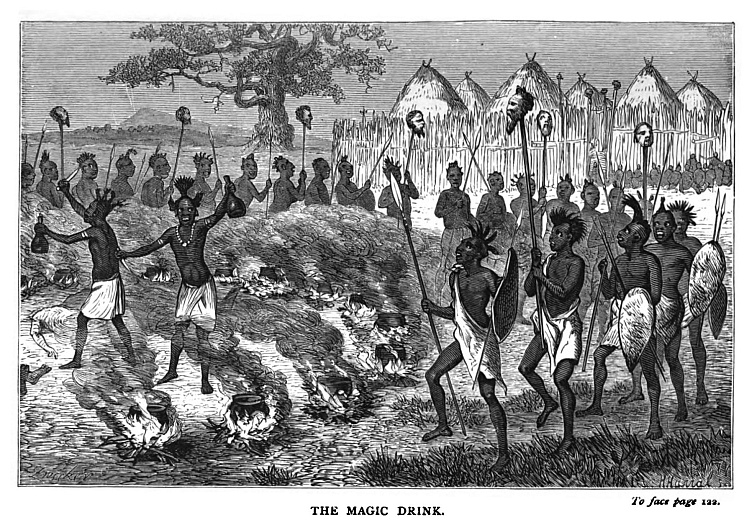
Within half an hour the water had boiled sufficiently, and the magic doctors, taking the wonderful gourds filled with pebbles in their hands, began to shake them to the tune of a monotonous chant, in the chorus of which the warriors, bearing the heads aloft on poles, joined, marching slowly as they sang around the circle. The words ran thus, as well as they may be translated:
Oh, the horrible, fearful battle, Where warriors slew and were slain, Where dead lay unnumbered, and wounds were made, Till the field ran red with blood that was shed In the horrible, fearful battle. Chorus. With the blood that was shed In the horrible, fearful battle. Ferodia the chief, Ferodia the strong, The lion and leopard in war, Tifum Byah, Maro, and Wafanyah, Great chiefs of the unconquer’d Watuta, In the horrible, fearful battle, Chorus. In the horrible, fearful battle. They heard the loud note, the war-horn’s note, Olimali, their friend, was distress’d; They rose from the bush, they rose from the ground, They rush’d to Kwikuru, and hemm’d them round, For a horrible, fearful battle. Chorus. For a horrible, fearful battle. The Arabs and blacks who came from afar. Who came from near the sea, To give the Warori and Watuta, King Olimali and Ferodia, A horrible, fearful battle. Chorus. A horrible, fearful battle. Warori were brave, the Watuta were strong, ’Gainst those who came from afar. The Arabs lie dead by hundreds around; They will hear never more the war-horn’s sound, For a horrible, fearful battle. Chorus. For a horrible, fearful battle. Then, drink, warriors! drink the true magic drink! The strength of your enemies slain! Drink of the blood, of the fat, and the heart, Drink to commemorate before we part, The horrible, fearful battle. Chorus. Before we part The horrible, fearful battle. Then, drink, warriors! drink the true magic drink! The strength of your enemies slain! Be strengthened in heart, in limb, and in arm, Be strong, be swift, be wise, and safe from harm In each horrible, fearful battle. Chorus. And safe from harm In each horrible, fearful battle.
When this chant was over, which has been rendered into English as faithfully as possible, the poles on which the ghastly trophies had been placed were planted in the ground before each gate of the village. But the young Arabs were spared this fearful scene, as they had been sent ahead with the loads, escorted by a strong guard. Then, the ceremony over, the chief Ferodia embraced in a loving manner his friend Olimali, and departed to the sound of booming horns and drums, and a general grateful look from the young women of Kwikuru—he and his warriors.
At sunset they camped in a forest, through which the road led towards the south-west.
Chapter Five.
Simba and Moto’s Midnight Halt in the Forest—Moto’s Plan for saving Selim—Bimba and Moto made Prisoners at Katalambula’s Village—They are brought before the King—Kalulu recognises Moto—The King gives each of them a Wife—Kalulu’s Personal Appearance—The great African Giantess—The Marriage Song—Conclusion of the Marriage Festivities.
Simba and Moto were men as capable of enduring fatigue as the Watuta were, as good runners also; so that even had their enemies pursued them with a greater determination than they showed, the two men might have laughed securely, as night would soon have shrouded them with its friendly mantle.
For a long time, however, the two held on their way, raising their eyes every now and then toward the bright Southern Cross, which shone so clearly, and pointed their future road so plainly. They travelled with their figures half-profile to the Cross, or in a south-westerly direction. But at midnight the two halted in the denser portion of the forest; and there they built two fires and prepared their resting-places with leaves and tender twigs; and having done so, they breathed a long sigh of relief, sat down, and gradually their eyes lost the eager, intelligent look in vacancy.
But after a while Simba said in a deep, low voice, half to himself and half to Moto: “Wallahi! but this has been a sad day for us. That large and costly caravan and the brave men and leaders are gone. It was but last night I stood at their tent-door, looking at my noble master Amer and his friend Khamis, and I was thinking that there never lived finer and nobler-looking men. Ah, Arab sheikhs! where are ye now, chiefs of Zanzibar?” Then, raising his head, he said, “Answer me, thou black, blackest night! Answer me if ye can, oh twinkling stars! Answer me, dark and dread silence! Shall I never see dear master again? Moto, where dost thou think Amer is now?”
To which Moto answered: “Amer, the noblest of his tribe, the worthiest master that ever lived, the man with the kind heart and liberal hand, is not dead—he sleepeth.”
“Sleepeth! Ah, would it were so! then this great heaviness of sorrow within me would vanish. But what meanest thou, Moto?”
“Hast thou forgotten already the words of our noble master, the son of Osman, how that he said to us often, a man cannot die; the body may remain on the ground to moulder, and rot, and become dust, but the life that was in him cannot die? Hast thou never heard him mention the word Soul—that unseen, unfelt thing, which is as light as air, yet is the most important part of a man? For a long time I laughed at Amer’s words in my secret heart, but when I heard all the Arabs say the same thing, and the Nazarenes at Zanzibar say it also, I was obliged to believe, though I could not tell what the soul was like, or who had seen it, or if anybody had ever seen it. But now Amer’s head lies low on the ground and a cruel wound has found his kind heart, I shall keep thinking of his words, and believe in them; and I believe truly that Amer’s soul looks down upon us through this darkness from above.”
“I remember me now much the same thing,” said Simba, “though my sorrow of heart had blinded my memory. Is it not a happy thought, Moto, that master Amer is not quite, quite dead, and that we shall see him again?”
“Yes, very happy. Thou knowest, Simba, that he cannot be dead with us either, for we shall carry him in our memories like a valued treasure, and will never cease talking of him when we are together.”
“Ah! thou hast a good memory, Moto; but who, thinkest thou, is the happiest—master Amer, up above there, or young master Selim, a prisoner?”
“Oh, Simba! while I was beginning to think myself happy, thou hast made my heart black with sorrow, by making me think of what that boy must suffer. If it were not for his future good I would never have left him. Amer is happiest in Paradise, but Selim, his son, living on earth, must be miserable.”
“It is just as I thought also,” said Simba. “Poor child! Do you not remember how pretty he looked when he hinted to his father, that perhaps Simba would like his freedom? How his eyes, always beautiful, seemed filled with softness, and love, and gratitude to me? Ah, Selim, young master of everything that Simba has, it will go hard with some of these savage Watuta if they harm thee!”
“They will not harm Selim or the Arab boys; they will keep them as curiosities, unless some of them have seen Arabs before going about to buy slaves, in which case I pity them all,” said Moto.
“Moto,” shouted Simba, raising himself up, “art thou revenging thyself on me for making thee unhappy with the mention of him? Speak. Selim a slave! That petted, tender Arab boy a slave! Answer me, Moto.”
“It is as I tell thee; if any of the Watuta understand, as we do, what the word Arab is, all the Arab boys will be made slaves, and be beaten like dogs,” answered Moto.
“We are not obeying master Amer by running away from the camp of the Watuta. He told us to save his son Selim. I am going back;” and Simba snatched his spears and gun.
“Fool!” said Moto. “We cannot save him from the Watuta by going into their camp. We can only do it by finishing as we have begun. We must go to Katalambula’s village and see Kalulu. He only can save Selim and ourselves.”
“Well, I believe thou art right,” said Simba. “Let us go to sleep, and at dawn let us be off to see this Kalulu.” Saying which, he lay down between the fires, but sleep did not visit his eyes for some time afterwards.
For fifteen days they marched long and far towards the south-west without any incident worthy of notice. Now and then they left the forest occasionally, to follow a road leading to some village and obtain information as to the whereabouts of the village of Katalambula of those people whom they might meet, with little danger to themselves.
On the sixteenth day of their night they came to a large plain, extremely populous and rich. The dun-coloured tops of huts arose above the tall corn and millet everywhere. At midday they came to a deep river flowing north-west, which the people called Liemba. On the opposite side of the river they were also told was Katalambula’s village.
They were rowed across, for which Simba paid the canoe-man with a couple of arrows, having no other means of paying him. Then, following the right bank of the river for a few minutes, by fields of splendid corn, they came in sight of the village.
It was substantially built; and was constructed in the same manner as the Kwikuru of Olimali, except that the king’s quarters were flat-roofed tembes, surrounding a square of large dimensions, where the king kept his cattle and goats, and two or three donkeys, which were preserved more as curiosities than for any use that were made of them, and where he himself lived with his numerous family of women; for, strange to say, Katalambula, with all his wives, had never been able to obtain a son.
The principal gate was, as usual, decorated with the only trophies savages respect or regard, viz., glistening white skulls of their enemies.
When Simba and Moto arrived near the gate, the former’s gigantic height of body and breadth of shoulders soon attracted attention, and drew crowds towards him of curious gazers.
“Health unto you,” was his greeting to them.
“And unto you, strangers!” they replied. “Whence come you?” they then asked.
“We are travellers,” said Moto, “who have heard of King Katalambula, and have desired much to see Ututa’s king.” This was said in good Kirori, which, excepting a few words, is the same as Kituta.
“Your words are well, strangers. You are Warori?” a chief, who now made his presence known, asked them. “Though your garb is different, and the punctures on the cheek and forehead are wanting.”
“I am a Mrori,” answered Moto, “but my companion is not; he is a stranger from a far land.”
“Then do the Warori carry guns nowadays? And how is it that you wear such fine clothes?” he asked, regarding them suspiciously.
“We were successful in hunting, and shot an elephant, whose teeth we sold for cloth and two guns.”
“And where did you meet elephants?”
“On the frontier, near Urori.”
“And where did you meet the Arabs?”
“In Ututa, two days from Urori.”
“Did you ask them where they were going?”
“They were going to Uwemba.”
“Perhaps you can tell us where they came from?”
“From Ubena.”
“Strangers,” said the chief, “you are liars. No Arabs have been in this country for a long, long time. You are our prisoners, and must come before the King in our company;” and, as he spoke, the men that had gathered near rushed at them and disarmed them.
In a short time they found themselves within the inner square; and under a large sycamore in the centre was seated, on a dried mud platform, raised two feet above the ground, and which ran around the tree like a circular sofa, covered with kid and goatskins, and over these skins of wild beasts, an old white-haired man, whom, by the deference paid to him, the prisoners knew was King Katalambula.
The King had on his head a band of snowy white cloth, and his dress was a long broad robe of crimson blanket cloth. He was a kindly-looking old man, and he was evidently at the time being much amused with something that a tall young lad of sixteen, or thereabouts, was saying; but as the group of warriors guarding Simba and Moto entered the square, the old man looked up curiously, and when they drew nearer he demanded to know what the matter was.
“My sultan, my lord,” said the principal man to whom we were first introduced at the gate, “these men are suspicious characters. To every question I asked them they replied with a he; wherefore we brought them to you to judge.”
“Speak, strangers, the truth. Who and what are ye?”
The quick eye of Moto had seen the young lad standing by Katalambula when he entered, and he suspected that he was the object of his search, the young friend of bygone years.
“Great king,” said Moto, “I did lie; but to you I will give the truth. I am a Mrori, who was taken when a child by the Arabs of Zanzibar. Years after that time, when I was a man, I accompanied an Arab chief, called Kisesa, to Unyanyembe; but soon after arriving, he declared war against the Warori, and—”
“Kisesa!” said the young lad, advancing towards him with the stride of a young lion. “War against the Warori!” he added again, with an angry glitter in his eyes.
“Yes, young chief,” said Moto, humbly; “and I accompanied Kisesa to this war. After a long march we came before a Tillage near Ututa, governed by—”
“By whom?” asked the young chief. “Tell me his name—quick, dog!”
“Mostana,” said Moto, deliberately.
“Mostana!” shrieked the boy, and the word was echoed in a tone of surprise by all.
“Yes, Mostana was his name,” said Moto, unheeding the menacing looks or the angry murmurs which arose from all sides, but hurrying on with his story. “We took the village after a short time, though Mostana’s men fought well, and numbers of our people were killed. Mostana’s men were nearly all killed, and those who were left were made slaves, according to the custom of the Arabs.”
“Yes, that is true,” said Katalambula. “Those cruel people make clean work of it when they fight, but I—”
“Were they all made prisoners?” asked the boy chief, in a curious tone.
“All, except one, and—”
“And his name was—?”
“Kalulu!” replied Moto, in a clear tone.
Again rose a murmur of astonishment from all sides, but, apparently heedless that he had said anything very strange, Moto continued:
“Yes, Kalulu, the son of Mostana, was standing by his father’s side, when Kisesa, observing him, said he would give fifty pieces of cloth to whoever would take him alive. On hearing that, my soul felt a feeling of pity for him, as you must remember I was a Mrori; and, though I liked the Arabs, I could not kill my own people at their bidding, nor did I like to see such a brave boy as Mostana’s son in danger of being made a slave by Kisesa. So, on hearing the offer made by Kisesa, I snatched up a shield and rushed forward to whisper to him to follow me, but the boy thought probably that I was about to kill him, as he put a spear clean through my shield and pinned my arm to it.”
A loud cry of admiration greeted this, while the boy already advanced nearer to Moto and regarded him affectionately; but Moto heeded nothing of this, but continued:
“Seeing me still advance, the boy sprang back just as his father fell dead by a bullet from some gun behind me. I hastened after the boy, saw him look cautiously around, and spring over the palisade; but I was right behind him; and when he was a little distance off in the forest I chased him at my best speed, and soon came up to him. I explained to him who I was, and why I chased him, and told him I was his friend; upon which he told me that he was going to his uncle, a great king in Ututa, and that if ever we met again he would be my friend.”
As Moto finished this part of his story, the boy chief sprang forward and embraced Moto, saying:
“Dost thou not know me? I am Kalulu! And thou art my friend Moto! I shall keep my promise, and the King must thank thee,” said Kalulu, as he drew Moto forward towards Katalambula.
As they heard these words from Kalulu, the chiefs and elders clapped their hands, and saluted Moto, while the King took hold of Moto’s right hand and said:
“Kalulu has told me the story which related how the Kirori slave would not take him when he might have done so; and though I never expected to see the man, I promised him that if any of my people met him and they should bring him to me, I should be his friend; that he should have one of my daughters for wife, and that I would bestow on him anything else he asked, for Kalulu is as dear to me as though he were my son. Speak, Moto, add tell me what I can do for thee.”
Then Moto, after a seat had been given to him, repeated briefly the story which we have already given to the readers, while murmurs of approbation at the wonderful good fortune of Ferodia rose from every side; then, when these had subsided, Moto said:
“Oh, Kalulu, if what I have done for thee deserves kindness at thy hands, and if thou wert sincere when thou didst promise to be my friend, speak to the great King of the Watuta for me, and let him give my young master Selim, the Arab slave, as well as the three other slaves their freedom, and let them depart to their own land, and to the friends who will mourn for them.”
“Kalulu has already given his promise to thee, Moto. Kalulu is the friend of thy friends, and the enemy of thy enemies. Katalambula, the King, hears my words, and will do this kindness for thee for what thou hast done for me. Speak, great King,” said Kalulu, advancing to him as he spoke.
“Ah, Kalulu!” said the King Katalambula, “thou knowest not what thou askest, but I will do for thee what may be done. I can intercede with Ferodia for them, but I may not command him. Those Arab youths are the slaves of Ferodia; but if he is willing to exchange for them, I will give him two female slaves for each of the Arab boy-slaves. Will that content thee, Kalulu?”
“I will wait until he comes here. I will then give thee my answer. But I think thou givest way too much to Ferodia in all things; he likes me not too well, because I stand between him and thy favour. If I were king of the Watuta, I should give Ferodia a lesson.”
“Tush, boy! be not too hasty with thy tongue. Ferodia is chief in his own right of a large tract of country. Dost thou wish me to take that from him which he has won by his spear and his bow?” asked Katalambula, slightly frowning.
“He has not won by himself, with his sword and his spear, the battle against the Arabs. Fight hundred of the ten hundred warriors he has with him are thine, taken from thy country. Wilt thou that he shall choose for himself what he shall please to reserve, or wilt thou choose what he shall have and what thou wilt keep?”
“Boy, boy, Ferodia is the chief warrior of the Watuta; he knows every art of war. He has never been beaten in the battle, either by the Wabena, or the Warungu, or the Wawemba, or any other; and though I have furnished him with men, he has always given me the greater and the most valuable share. Why wilt thou, who art but a boy, tell me these things concerning Ferodia? Be patient; I will ask him when he comes for these slaves for thee. But had it not been for the good deed this man did for thee, I should have ordered Ferodia to roast them all alive. Go thou, rather, and do thy duty towards these travellers; give them food and drink; and when they have rested, give each a house. Then let my daughter Lamoli be given to Moto for wife; and to this tall man give one of my female slaves for wife. Katalambula has spoken.”
While the King was speaking he was evidently getting more peevish, for he was old and soon tired; so Kalulu refrained from taxing his patience further, and beckoning to Moto and Simba, he walked away with his guests, leaving the King to be assisted by his chiefs to his quarters.
When young Kalulu arrived at his own house, or rather room—for the entire square was surrounded but by one house—he again embraced Moto, and promised to leave no stone unturned until he had secured the freedom of the Arab boys. “But,” said Kalulu, “it is well for them that you are my friend, as I do not think I can ever forgive the Arabs for murdering my father; and the King finds it very hard to do this thing for you, because in Mostana he lost a brother; and those of our tribe who have travelled far to hunt and kill elephants always come back with tales of their cruelty. I fear if Ferodia insists on their being slaves my uncle will not resist him; for, but for you, nothing would please him better than to torture them, and I should have liked it too.”
“Oh, Kalulu,” said Moto, “you do not know Selim. He would never have treated a man badly, neither did his father. Simba and I were proud to be slaves of such a man as Amer bin Osman, and we were proud to call Selim our young master. Do you know that Selim is just your age, though you are taller than he is, and you are thinner than he was; though, poor boy! he will be thin enough when he comes here. But how you have grown, Kalulu! yet you cannot be more than sixteen years old!”
“I do not know how old I am,” Kalulu said, laughing. “I wae little when I saw you, or you would never have caught me. But I must do what the King has commanded me to do.” And Kalulu darted out, spear in hand, his ostrich plumes trailing over his head far behind.
Perhaps here would be a fit place to intercalate a description of the native youth whose name forms the title-page to this strange historical romance.
Since ancient Greece displayed the forms of her noblest, finest youth in the Olympian games, and gave her Phidias and Praxiteles models to immortalise in marble, all civilised nations have borrowed their ideas of manly beauty from the statues left to us by Grecian and Roman sculptors, because civilised nations seldom can furnish us with models to compete with the super-excellent types designed by Greece. While American and English sculptors go to Rome to play with marble and plaster, and borrow for their patterns of an athlete or perfect human form, the vulgar, low, and uncouth lazzaroni of Rome, the centre of Africa teems with finer specimens of manhood than may be found in this world; such types as would even cause the marble forms of Phidias to blush, Kalulu was one of the best specimens which the ancient sculptors would have delighted to imitate in stone. His face or head may not, perhaps, have kindled any very great admiration, but the body, arms, and limbs were unmistakably magnificent in shape. He had not an ounce of flesh too much, yet without the tedious training which the modern athlete has to undergo, and following nothing but the wild instinct of his adopted tribe, he was a perfect youthful Apollo in form. The muscles of his arms stood out like balls, and the muscles of his legs were as firm as iron. There was not one of the tribe of his age who could send a spear so far, or draw the bow with so true and steady aim as he, or could shoot the arrow farther. None had such a springy, elastic movement as he, none was so swift of foot, none followed the chase with his ardour, none was so daring in the attack; yet with all that constant exercise, the following of which had given him these advantages, his form lost nothing of that surpassing grace of movement and manly beauty for which he was styled by me, just now, a perfect youthful Apollo.
If I give him such praise for his elegance of form and free graceful carriage, I may not continue in the same strain in the description of his face. Kalulu was a negro, but his colour was not black by any means, it was a deep brown or bronze. His lips were thick, and, according to our ideas, such as would not lend beauty to his face; his nose was not flat, neither was it as correct in shape as we would wish it; but, with the exception of lips and nose, one could find no fault with his features. His eyes were remarkably large, brilliant, sparkling, and black as the blackest ink, while the whites of his eyes were not disfigured by the slightest tinge of unhealthy yellow, nor seamed with the red veins common to negroes of older growth. His ears were small and shapely, and, strange to say, the lobes were not as yet distorted out of all form with the pieces of wood or gourd-necks, which, unhappily, with the Watuta, are too common among their ear ornaments. His ears were simply decorated with two Sungomazzi beads, (these beads are as large as a pigeon’s egg, and are either of coloured porcelain or coloured glass) one to each ear, each bead suspended by a piece of very fine brass wire. His hair, though woolly, hung below his shoulders in a thousand fine braids, adorned with scores of fine red, yellow, and white beads. His ornaments, besides those already mentioned, consisted of three snow-white ostrich plumes, fastened in a band which ran around his head, and which, besides holding the plumes, served to hold his hair; a braided necklace, ivory bands above each elbow, and ivory bracelets, and broad bead-worked anklets.
While the author has been endeavouring to portray Kalulu, that the reader may become acquainted with his excellence, the youthful hero had hastened to bring Lamoli to her husband; and he now appeared on the threshold of the door with his cousin, who at once pleased Moto as much as the King expected she would. We will say this, however, in passing, that though she was not by any means the loveliest of her sex, she was neither ugly, toothless, nor old; nor was she young, pretty, or one calculated to charm our fastidious tastes. But Moto did not refuse her; on the contrary, he thought it a high honour to many the daughter of a king, and became lavish in his praise, with which Lamoli was not at all displeased.
Having performed this marriage according to the customs of the Watuta, Kalulu remembered that he had still another marriage on his hand, and at once asked Simba what kind of a wife he fancied. Simba was not at all displeased with the idea of another wife, though he and Moto had each a wife at Zanzibar, who had borne them children; and he at once replied that Kalulu might choose for him. After an absence of only a few minutes, Kalulu returned with a young woman who might have drawn crowds in London and New York, as the “Great African Giantess.”
As he saw the gigantic couple together, Kalulu clapped his hands in high glee, and danced about them as if he were about to receive a magnificent gift, and laughed as he burst into a mock rhapsody.
“Lo, Kalulu has seen strange things! he has seen two trees drawn together from a great distance! he has seen them walk together arm-in-arm!! Behold how the trees, the sycamore and the mtambu, the great baobab, and the mbiti, how they nod their heads, and are pleased!! For they rejoice that two great trees are married, and a forest of young trees will soon sprout up. As they move, the ground shakes and the huts reel. Verily this is a great day; both the ground and the huts have been guzzling pombe—they are drunk, rejoicing over the marriages Kalulu, the future King of the Watuta, has performed!
“Lamoli, my sweet cousin, daughter of Katalambula—of Katalambula the great King—was sorrowing for a husband. She was thirsting, like a pool in the middle of the plain in a long summer. She, the flower of Katalambula’s household, was sick for a husband. But the day came—ah, happy day! A man from afar—from the island in the sea—he came, he saw me, I knew him. He was my friend; and in him Katalambula—Katalambula the great King—found a husband for his daughter—a mate for Lamoli.
“Ah, Lamoli! Lamoli! Lamoli! weep no more; but laugh until thy mouth reaches from ear to ear, and I, Kalulu, thy cousin, can see the joy welling from thy throat, like living water springing from a rock! Laugh, Lamoli, sweet Lamoli! so that the unmarried women of all Ututa may hear and envy thee; so they may rend their bosoms with rage, or crush themselves to death with the over-weight of their ornaments. Laugh, Lamoli, sweet Lamoli! until every foot of man and woman moves to the sound of thy happy laughter! And thou, tall woman of Ututa! do thou laugh and sing, until all the tall trees of Ututa will become jealous of thee! we then may have rain. And thou, Simba, tall man from afar, well named the Lion! roar for joy, and thou wilt hear the wild lions of the forest roar in concert with thee, and each will be roused to fury, roaring for their loving mates. But enough; be happy, and raise warriors for your tribes. Kalulu is not a singer; he is a young warrior, who is learning how to throw the spear and shoot with the bow. The singers are coming with drums to do you honour, for such are the King’s commands.”
While Kalulu had been thus employing himself, a company of drummers, eight in number, two tumblers,—or, as we should call them, two mountebanks,—and fifty couples of young men and women had formed themselves in a circle; and as Kalulu ceased speaking, the Magic Doctor, or Mganga, as the natives called him, raised his voice and sang the marriage song, while he danced in an ecstatic manner as he sang. I should also say, before giving the song, that the smallest drums only accompanied his voice, while the great drums thundered together when the chorus was given by the dancers. The words were, as near as they can be translated:
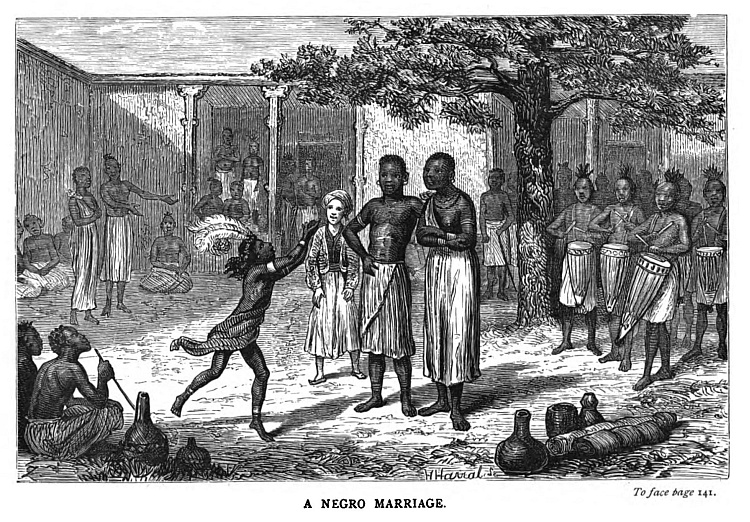
We sing the happy marriage song, We sound the drum, and beat the gong In honour of Lamoli! She is the daughter of a king, Yet she spent her days in weeping, Being left alone and sorrowing. Poor sorrowing Lamoli! Chorus. Oh, Lamoli! Poor Lamoli! Sorrowing Lamoli! A day has come, ah, happy day! That brought a stranger in the way Of sorrowing Lamoli! Long ago the stranger did a deed, A friendly deed, in time of need, Which won for him the lover’s meed. Sweet Lamoli! Chorus. Oh, Lamoli! Sweet Lamoli! Charming Lamoli! This stranger sav’d young Kalulu From cruel bonds at Kwikuru. The good stranger! Kalulu swore to this brave man, As long as life-blood in him ran, To praise the name to every man Of this brave stranger! Chorus. Oh, stranger! Good stranger! Brave stranger! This man has come to Tuta Land, This man who sav’d with friendly hand Our young Kalulu! Shall we deny him our faint praise? Shall we refuse him wedlock lays? Shall we not wish him happiest days? Who sav’d Kalulu? Chorus. Oh, Kalulu! Young Kalulu! Brave Kalulu! Our great King heard the stranger’s name, And nearer to him the stranger came, To Katalambula! He said, “I’ve known this story long, A Mtuta’s memory is strong. I love the good and hate the wrong,” Said Katalambula! Chorus. Oh, Katalambula! Good Katalambula! Great Katalambula! Give him house, give him home. You boy! Give him pombe and food. Give him joy! Give him Lamoli! Brave man! take the pride of our race; Take the dearest girl with the loveliest face. Live in the shade of our kingly mace With good Lamoli! Chorus. Oh, Lamoli! Good Lamoli! Sweet Lamoli! We sing the happy marriage song. We sound the drum and beat the gong For joy with Lamoli. Now a wife, no longer weeping, No more to spend her days in mourning, She will be for ever laughing, Happy Lamoli! Chorus. Oh, Lamoli! Charming Lamoli! Happy Lamoli!
The music accompanying this song was slow and sweet, worthy of the great occasion on which it was given. During the chorus, the dancing became more lively, and each man and woman lifted the voice high, which created a grand and majestic volume of sound, while the drums were beaten with a terrific vigour. The festivities lasted all the day and night, until sunrise next morning; but during the night they were better attended, nearly a thousand souls joining in the song and chorus. Kalulu and many others were hoarse from over-exertion of voice, when they retired next morning to rest.
Having brought Simba and Moto to their temporary home and through their difficulties, let us now withdraw from this scene for a while, and see how it fares with the Arab boy-slaves and Ferodia’s caravan.
Chapter Six.
Sufferings of Selim, Abdullah, and Mussoud—In the Slave-Gang—Isa seized with Small-pox—Isa left behind to die—Selim’s Prayer—Selim proposes to escape—Selim’s Preparation—Selim’s Escape—The Roar of the King of the Forest—Selim shoots a Lion—Selim shoots an Antelope—He suffers from Hunger—He falls fainting to the ground—Selim’s Despair—His Reflections—He gives himself up to die.
Although the caravan started the day after the departure of Simba and Moto, it could not of course travel so fast as two fugitives; so that the journey, which only occupied a few days with our two friends, lasted nearly a month with Ferodia’s caravan.
Ferodia, the chief of the Watuta caravan, had besides four Arab slaves—three of whom were perfectly white—nearly three hundred black slaves, who had been captured in the battle of Kwikuru. If the report was spread abroad that he possessed so many slaves, as would undoubtedly be the case, he would soon be visited by traders from Unyanyembe and from Kilwa, and perhaps, if he waited long enough, from Tette, on the Zambezi river; so it was for his advantage to travel slowly, not only that the rumour might have time to spread, but also to give the human cattle plenty of time to recover from their wounds.
The marches were, therefore, commenced at six o’clock in the morning, and seldom lasted longer than noon, as the first part of the country through which he now travelled was extremely populous and rich, and each chief was friendly to him and his men; but after the tenth day he neared the debatable ground, consisting of extensive tracts of forest and jungle, lying between Urori and Ututa, and inhabited by no living being, except wild beasts. From the farthest westerly point of this debatable tract, there were three long marches, or say ninety miles, to Katalambula’s country.
Having explained so much, let us glean what may be interesting to the general reader of the incidents of this march relating to the slaves.
Besides suffering intensely from the heat, Selim, Abdullah, and Mussoud suffered excessively from the loads which they were compelled to carry, and which chafed their tender shoulders frightfully. For the first three days they went entirely naked, as it must not be supposed that, because the Watuta were rich in clothes, they possessed one yard too much, or that they could have dispensed with a yard for the comfort of slaves.
Slaves are cattle, are supposed too often to be able to live like cattle, and are therefore treated like cattle. So these three hundred slaves were chained—for chains, it must be confessed, were part of the plunder which the Watuta had found in the Arab camp—by twenties; an iron collar ran around the neck of each adult, while the boys, Selim, Abdullah, Mussoud, Isa, and the negro boys, among whom, it must be remembered, was our mischievous Niani, or the monkey, and others, were tied by ropes around the waist, about six feet apart, the tallest first. Of the adult slaves there were fifteen herds, or gangs of twenties, each gang being superintended by a sub-chief or a trustworthy warrior, and there was one gang of boys which were looked after by Tifum Byah.
I have already said that the slaves were cattle. The word cattle must be understood by the reader in its most literal sense. Decency was therefore out of the question. If one needed to wash his face in camp, the whole gang, accompanied by the chief, were obliged to march out for the convenience of this one. If from any cause a man required to fall out of the line, there was a halt and a constant worrying of the unfortunate wretch until the caravan had been overtaken. If one needed a drop of water all had to stop. In all gangs and crews of slaves there is always one calling for something or requiring something more than his fellows; and this to the others is a source of vexation, because the chief who has charge is soon irritated if such a proceeding is carried too far, and he is not slow to avail himself of the rod to quicken the footsteps of the lagging gang.
In the boy’s gang, Isa was one of those who continually required to halt, and all the boys suffered in consequence, especially Selim, whose file-leader was the lagging and unfortunate lea.
Niani saw through the trick of lea in a very short time, and no doubt he would have remained silent about it, had he not seen that his young master Selim suffered through it. For two or three days of the march Niani held his peace, but when Selim received a more than usually severe beating from Tifum Byah, Niani exploded, and told the chief, to his surprise, that he was whipping the wrong boy, that it was Isa who was the cause of the stoppage; whereupon Isa received a severe punishment with the ever-ready kurbash (hippopotamus-hide whip). While Selim had been whipped Isa had never expressed any great sympathy with him, but when he was punished himself his cries and groans were dreadfully long and loud, and in the camp he was constantly bewailing his hard lot, and always threatening that supple-minded and tough-bodied little negro Niani for his expose of him.
On the evening of the fifth day after their arrival at camp, Niani, who knew how to like and how to hate, said aloud to Selim, as soon as he had an opportunity, that he would much prefer if Selim took his waist-cloth. Selim refused it upon the ground that he would have none left for himself.
“Oh, but, Master Selim,” said Niani, “I am but a little nigger; no one will mind me. I wanted to give it to you before, but I did not like to offer my cloth to you, because it is dirty.”
“Anything is better than nothing. I will take it with thanks, since you say you don’t want it; but won’t you keep a little of it for yourself?”
“Not an inch,” said Niani, resolutely. “I don’t want a cloth anyhow—never did want it; besides that is the cloth you gave me that night I tripped Isa, and cruel Isa was going to put me on the fire.”
Selim then rose up to put this filthy piece of torn cotton cloth around his waist; but as he was about to put it on, he saw his friends Abdullah and Mussoud looking wistfully up; and their colour, as well as his own, made them look all too nude for a country where all skins were black. Without saying a word he measured the cloth in three equal pieces, and tore it into three equal strips, one of which he presented to Abdullah, another to Mussoud, and the other he reserved for himself. The two boys rose up, blushing gratefully, and Abdullah said to Selim:
“Thy heart is as soft as fine gold. The cloth is not six inches wide, but I feel more grateful to thee than ever I did when I received fine daoles (rich gold-worked cloth) at the hand of my father, Mohammed, whom may God preserve! A pure heart like thine will not long go unrewarded at the hand of Allah.”
“Thou mightest have given me a piece,” said Isa to Selim, in a complaining tone.
“How can you talk so, Master Isa?” asked Niani. “Your skin is as black as mine; sure, you look as though you were clothed already. You should be happy in having a black skin, instead of wanting a piece out of nothing.”
“A truce to your insolence, Niani, or I will come and break every bone in your body,” said Isa, angrily.
“You had better not, Isa, because I am a slave of Ferodia, the Mtuta chief; and if you kill me, Ferodia will kill you,” answered Niani.
“Well, then, hold your tongue, and don’t torment me. I am sick of life already, and sick in mind and body,” said Isa.
“Dost thou suffer much, lea?” asked Selim.
“Indeed I do. My head aches as if it would split, and all down my back run sharp pains. They are not the pains which that savage dog Tifum made, but something else. I think there is something serious the matter with me,” moaned poor suffering Isa.
“I hope not,” said Selim. “Cheer up, lea, my friend; we have only to reach Katalambula to have rest. This march cannot last for ever.”
“I shall never reach the country of the accursed Watuta,” said Isa. “My illness is too serious.”
“Why, what can the matter be with thee, my friend?”
“Don’t start, Selim, and don’t curse me when I tell you that I have the jederi (the small-pox).”
“The small-pox! What makes thee think that?” Selim asked.
“I have seen it often enough, and have seen the men die on the road from it, and I fear I shall die too,” said Isa, mournfully.
The next morning Isa was very much worse, and it was obvious to every one that the boy had it very badly, but he was not permitted to halt or to be carried. Slaves are not carried: there are no means of carrying sick slaves in Africa, and so he was driven along with the rest; but about ten o’clock, after four hours’ march, as they were approaching a forest, the sick lad became delirious, and he began to reel like a drunken man, and after a short time the load fell from his head, and as Tifum came up raging furiously at this weakness, Isa fell across his bale with his eyes half protruding from their sockets, and his tongue hanging out. But Tifum had no sense of kindness in his heart; so he began to flog the unfortunate wretch with all the force that an unnatural cruelty alone could have impelled, until Selim, unable longer to bear the disgusting sight, hurled the load he carried on his head full at the head of the savage ruffian, and while he was down he snatched the whip from his hand, and began to belabour him with all his might until he was overthrown himself on the ground by the infuriated Tifum, and belaboured in his turn until Tifum was obliged to desist lest he might kill him.
Gutting the rope which joined the prostrate bodies of the boys, the one insensible from violence, the other from a deadly sickness, he called for a gourdful of water, and pouring it on Selim’s head; soon restored him to consciousness. Then the refined cruelty of the slave-traders, and the utter abomination of the inhuman traffic, began to be exhibited. Trembling with rage and merciless hate, he called for the long, heavy, wooden yoke, which, furnished with two prongs a little apart from each other, is used for the most refractory slaves. When green, this yoke-tree weighs about thirty pounds, but dry it generally weighs about twenty pounds. One of these tree-yokes had been prepared but a few days before, so that it could not be much reduced in weight from what it weighed originally. This was the clumsy, heavy instrument of torture with which Tifum designed to encumber Selim’s body.
After the neck of the half-unconscious lad was placed between the prongs, the ends of the prongs were drawn together by means of a strong cord, so that the head remained firmly imprisoned, while the huge unwieldly tree of the yoke sloped behind him about ten feet off from his shoulders.
In order to avoid employing a guard to carry the tree, the end was lifted up and tied to Abdullah’s shoulders and arm.
When things had thus been prepared for the continuance of the march Tifum proceeded to the dying Isa, and seeing it was hopeless to expect further work from him, as the look of death was already on his face, the savage fiend bestowed a kick on the body, and swishing his kurbash warningly, gave the hint to Selim, who was now the file-leader, to proceed. In a short time the caravan was out of sight, while the unfortunate Isa was left in the middle of the road to gasp his last, unseen, unwept, and unhonoured.
On the twentieth day of the march it was found that little Mussoud was attacked with the small-pox. Numbers of the slaves had already perished from this fell disease; for as fast as they fell from the ranks and could not rise again, despite repeated applications of the staff of a spear, or a rod, or a kurbash, they were left to die the miserable death of deserted sick where they fell, and not one thought was ever directed to them again.
Thus when Mussoud became sick, the alarm of his brother Abdullah and his friend Selim was extreme. They requested permission to share the burden of his load by having it tied to the yoke-tree with which Selim’s neck was still furnished, but the slight request was refused, and when the latter’s eyes again flashed a dangerous light, Tifum, who saw that he had a stubborn soul to deal with, replied with another dose of vigorous lashing on the boy’s shoulders until they were one mass of weals and bruises.
Selim uttered not a word nor moan; he was getting to be past all feeling of bodily pain, though his heart was keenly alive and sensitive. While plodding along in this manner under the burning sun, no sound breaking the soft shuffling sound of the tramp of naked feet of the slaves, except a low moan now and then from poor little Mussoud, and Tifum had retired to vent his spite upon those in the rear, it struck him as a sudden idea that he was being punished more cruelly than the others because, despite the fine religious education he had received, he had of late, since he had been in bondage, forgotten the God of his fathers, whom Amer had counselled him so often never to forget. His conscience was not a whit more hardened; the reason of this neglect was the delicacy he felt in approaching his God with unwashed hands and feet; but now he determined to avail himself of the first opportunity of a halt, and prepare himself for prayer.
After repeated prayers from the sick boy Mussoud to Tifum to give him one little halt to rest, it was at last granted; more, however, to give Tifum an opportunity to light his pipe than for the sake of the sick boy.
No sooner had Tifum turned his back, than Selim bent down and began to scrape together the dry, white, sandy dust from the road, and to rub his feet, and hands, and face, and body with it, as if he were washing himself; then turning his face to the north-east, in the direction of Mecca, he began his prayer in a whisper:
“Oh, Thou who art the light of heaven and earth, whom all creatures praise, unto whom all things belongeth, thou bounteous, wise, and compassionate God! be gracious and merciful to one of the true believers, who now standeth before Thy footstool.
“Thou art great, Thou art holy, Thou art almighty, Oh God! and unto those who invoke Thee Thou hast promised, through Thy prophet Mohammed, blessed be his name! to be attentive and to lend assistance.
“Thou all-knowing and gracious God! avert from me the torments of Jehenna, which I suffer at the hands of these infidel savages.
“The unbelievers have laid cruel hands upon me, a true believer, and a son of a true believer. Lo! they have bound me like unto a sheep about to be slaughtered; they have laid their whips upon me, the cruel thongs have cut into my bones, and with their sharp spears have they gashed me.
“Thou Powerful and Self-sufficient God! Thou hast promised to protect the fatherless and the orphan, and to be solicitous for him, and to punish those who oppress him.
“Thou compassionate and loving God! let the orphan’s cries take the form of prayers, and suffer them to ascend unto Thee before Thy footstool, and do Thou bow down Thine head, and let them penetrate Thine ear.
“Thou one, only, and eternal God! hearken compassionately onto my prayers, and rescue me from the unbelievers.
“Thou Lord of men, King of men, and God of men! save me from mine enemies, by the promise Thou hast given unto all true believers through Thy holy apostle Mohammed, and be Thy heart softened toward the orphan, and hear his prayers.”
When Selim had finished this urgent, sincere appeal to his God, he prostrated himself to the earth, and then rose refreshed in body and spirit.
Turning to Abdullah, who had been attending to his brother, he said:
“Abdullah, my friend, I feel refreshed and strong. I have a bright idea in my head.”
“I have seen you pray, Selim, and have wished that I could pray, too; but my heart is too bitter for prayer. I feel as if I could curse all men, and myself, and die. Poor Mussoud’s days are numbered, I fear: and if he dies, I do not care what becomes of me.”
“But, my dear friend, the Küran says: ‘When thou art in distress pray to thy God and He will hear thee; His ear is open to the oppressed.’”
“I know it, Selim, but I cannot pray now. I fear I should curse God for permitting his faithful to be treated as we have been. Listen to the moans of my brother, and think of his being left to die all alone in the road, because, if he cannot march, they will not let me remain with him! But what is thy bright idea, Selim?”
“My idea is to run away to-night, and go to the depths of this forest. Far better to die there than lead this life so wretched. If one of these people can trust himself in the forest, why may I not do so? They have not been able to kill me with all the weight of their cruelties. The forest were far kinder than these inhuman Watuta.”
“And my brother, what of him?”
“We will take him with us; and when we are alone, safe from our pursuers, we will be able to nurse him. We will build ourselves a strong little hut near some nice stream, where we shall be safe and quiet; and while you are watching your sick brother, I will take my spear and go out to gather wild fruit and honey. But, hush! Here comes Tifum. Help Mussoud to his feet, and let him hold up until to-night.”
Just then the stern signal to march was given, and the boys turned industriously and submissively to their bales; and Mussoud feeling relieved by the rest, the caravan set out at its usual pace.
About noon they halted in the forest, and, knowing that no danger from men was to be feared in the forest, the Watuta were heedless of the usual boma or brush fence around the camp.
The boy-gang being tied together, were of course inseparable, and Abdullah, in his usual place, sat next to Selim, as they munched their roasted Indian corn or their half-boiled holcus grains. Mussoud was accustomed to sit next to Selim, but owing to his illness he was placed outside the camp, as all the Watuta knew this disease was contagious, and what danger lay to the whole unvaccinated camp by the dread presence of the small-pox.
At night they were still together, Selim and Abdullah. Inside the circle of the camp were men seated in circles near the fire, discussing various topics. Outside the camp, in the deep, deep night was perfect silence; not a sound broke upon the ear, save now and then the uneasy growl of the hyena.
“Well, Abdullah,” said Selim, “the night has come, and thou must decide what thou wilt do.”
“Dear Selim, I cannot go and leave my brother. Poor Mussoud will not live till to-morrow morning. I am afraid he is very ill to-night. His head was so hot, and he did not seem to know me. If thou goest away I shall be alone of us all. Poor Isa is dead already; Mussoud is dying; and thou wilt be gone; and I shall be alone.”
“Well, Abdullah, if thou dost not go, I shall. I am tired of this life. I wish to die. I am not afraid of death, but it shall never be said that Selim, the son of Amer, died like an ass in the road, to be spurned by the foot of that dog Tifum, like poor Isa was. If I am to die, let me die like an Arab, with none but my God to pity my wretchedness, with none but the birds of the air around my bed. Do me this favour, Abdullah, friend of my heart. If Mussoud still lives in the morning, tell him Selim is gone, and give him one kiss for me; and before thou goest to sleep thou must give me one, for when thou wakest up in the morning, Selim, the son of Amer, will be gone. The lashing of this clumsy yoke around my neck is already loose; it only requires a second to be free.”
“I thank thee, Selim, for this thought of my brother. I wish thee God’s peace and blessing. If I live after this hard march, I shall dream and ever think of thee, and shall sometimes whisper thy name in my prayers, that the angels may carry it to thy ear, and that some memory of Abdullah, thy friend, may be preserved in thy heart. Thou art a true Arab, son of Amer, a true friend; thy soul is a jewel, brighter and purer than the diamond. On the road to thy home look up at night to those seven stars which thou seest together, and say to thyself, ‘Abdullah thinks of me. Poor Abdullah!’ May the holy Mohammed take thee to thy mother, and when thou art welcomed back to thy friends, think of my mother, and bear to her the kindly remembrance of her son. Selim, dear friend, I am about to compel myself to sleep, that I may be ready for my morrow’s work. See! I kiss thee with the kiss of lasting friendship, and, since thou goest, be strong with Abdullah’s faith that Allah will save thee!”
They then both lay down, and, after a few uneasy tossings, Abdullah fell asleep, while Selim also lay down to plan out his march. Suddenly he remembered the parting words of Simba and Moto, and wondered to himself how he had not thought of them before, as they would have enabled him to bear up with a little more patience and fortitude the trials he had undergone. But they came not too late; he felt that with such friends as those he was not alone in the world, and he resolved on leaving the camp to strike south, then wait a day in the woods, and afterwards strike off through the forest until he came near to a village in Ututa, and then lie in wait for some one who would direct him to Katalambula. A cruel thought came across his mind once, to stab Tifum with his own spear, but he instantly rejected it as unworthy of an Arab and the son of Amer bin Osman.
The hours passed by, but not wearily, as Selim’s thoughts had been busy. All slept soundly, and the fires also seemed to have fallen into drowsiness, for nothing but dull red embers marked the places where the fires stood.
He muttered a short prayer to God for courage and strength, and the lashings of the cruel yoke fell apart, and he drew his head through, free. Free! not yet.
He stood up silently, walked straight to a tree deliberately but noiselessly, chose a couple of spears, a gun, a powder horn, and a cartouche box, and began to withdraw as stealthily as he had advanced.
It seemed an age to him, the time before he began to congratulate himself that he was safe; for so precious were the articles in his possession, and so rich seemed the prospect of freedom.
A few long strides brought him from tree to tree, and the more he counted of these trees the more certain was he of safety. Tree after tree was passed, their tall thick columns—taller and thicker by night—formed a denser rampart between him and his enemies, an impenetrable protection against pursuit.
Finally, he was free! Free he felt, freely he walked, freely he thought, and the new idea, as it settled in his mind, seemed to fill him to strangling, it had such power of expansion; the lungs were more inflated, the stride became firmer, the head assumed a prouder air, and the back of him straightened rigid!
He was impelled forward, fatigue seemed to fly from him, an eager urgency of movement seemed to have come upon him; he was walking against time for freedom!
An endless number of dark solemn trees were passed, countless numbers of acres in front, behind, and around him, of this tree-covered upland, and still it remained night. To darkness there seemed no end, nor did he want it to have end; he wished it would ever remain night and his enemies ever sleep.
But though the night was long, and friendlily sheltered him with its kind mantle of impenetrability, through which a fugitive was not visible, it had an end, for all things have an end; but Selim and the Watuta camp were far apart!
Daylight—a dull grey mantle seemingly, which night had put on for a fickle change—appeared, but greyer and greyer it came through the foliage above; it then came pale, and then a steely blue. A streak of silver light shot athwart his path; the foliage was a bright green, and the leaves moved responsively, gently sighing to the morning wind!
How cool, how fresh it was! How newly-born seemed the world, while the hum of busy insect life told him there were other creatures, after their rest, rejoicing in the new light of day!
It became full day, for the sun, a round globe of living fire, or like a fiery balloon, surged upward light and airily. But oh! with what different feelings he gazed upon it now. Yesterday it was hateful with its dry heat and blister, and its thirst-begetting warmth; to-day it was like a huge lamp hoisted up to the sky to light the dim and lengthy aisles of the forest. There was no heat nor thirst in its appearance, nothing but strengthful vigour and cheery light!
At noon, Selim came to a quiet pool in the forest; the lotus flowers rose like yellow cups above its surface, while the leaves lay languidly flat. All around the rim the pool was garnished with these water flowers of Africa; and, so decked, it looked like a great shallow dish adorned with a pictured border! How delicious did the water taste! How cool and tranquil the spot! What deep silence pervaded the forest at noon! How soothing to the fugitive soul!
A little distance off he espied a large baobab, which had a hole in its body. Walking to it and looking in, he saw the hole led to a large hollow in the tree, as large as a small chamber. He crept in, for it was empty, and there he laid down to rest, and finally he slept. He had escaped, and was safe!
It was night when he awoke; he must have slept eight or ten hours; there were no means of knowing how many. It was evidently a hard task to wake up, for after the first movement indicating life, he lay still, and tried to compel the sodden brain to recover its duty, and the eyes to aid it by piercing that thick darkness of the natural chamber in which he found himself. Bit by bit, the senses resumed the old order of things. Mind stirred up, and gave its master to know that he had run away from a most cruel slavery. Ah! yes! and, the keyword touched, all became clear.
“The Watuta!—that torturing yoke-tree, and the sleepless nights it caused me! my galled shoulders, my wealed back, my racking head! that monster Tifum! that fierce man-animal whom pity never touched! that pariah dog-face, repulsive in its animal malignity! those thick lips which uttered such horrible blasphemy! that always-ready whip! Who can forget him? May the foul mother who bore him, and her fouler son, perish like one of those whose fate will be Al Hotamah!
“All is clear to my mind now. I am free! Arise, my soul, for further freedom; the dark night is kinder than day. The wilderness will take more pity on me than man. Shake thyself, son of Amer, thy mother is patiently waiting for thee; thy kinsmen at Zanzibar still look for thee. Courage, my heart, there is nothing to fear.”
He rose to his feet and looked out. “Is that a beast, or is it my timid fancy which creates such a shape? Hush, that was a step! a slow, stealthy step of padded feet; no man alone in the wilds would walk on all fours. Hush, but a moment. Ah! what is it?”
For just then an unearthly laugh—terrible in its satiric wildness of tone—rang through the forest. It was startling for a moment, because it was unexpected, and fearful, because it seemed to challenge all the denizens of the wilds. “What beast can it be?
“Ah! I remember now. Moto has told me of it. It is only a hyaena, and the hungry fellow has scented a prey. Not yet, my friend, can I be thine. Selim is safe from thy jaws. He must see Zanzibar first, before any of thy species can eat him. Oh God!—”
The satiric laugh of the hyaena was succeeded now by a roar which echoed through the forest, and another and another succeeded it, which almost deafened the lad with its volume and power. No animal but the dread king of the forest could have emitted such sounds, and there is nothing more startling than the first sudden bellowing outburst of his lungs—it is so deep, so protracted; but, as if he expends the concentrated power of his lungs in the first roar, the others which succeed it come out in short, gasping, rasping sounds, which seem to chase one another as they peal through the forest in quick succession. Though the first sudden outburst is startling, even appalling, when unexpected, a certain feeling of admiration quickly succeeds the first fear, at the volume and the force of it, and at the echoes which it wakes up.
“It is a lion!” said Selim to himself when he had regained his bewildered senses; “the king of beasts. I have often desired to see thee and to hear thee, but I may not venture too near thee, as I fear thy claws and thy cavernous mouth. Halt where thou art until dawn, my friend, and I will look at thee well, but just now I will remain here. Ah, that is right; thou comest nearer, but I have a gun, and there is a bullet in it, O lion, so thou hadst better keep a respectful distance. The window through which I look at thee is too small for thee to enter; besides, king of beasts, I need no companion like thee in this small chamber with me. How my bones would crack under thy strong jaws, and what a delicious morsel thou wouldst deem me. The hulwah of Muscat (a species, of sweets made in Muscat, Arabia) were as nothing to it; the honey of thy native wilds were bitter compared with my flesh, and bones, and warm blood. Nay, I beseech thee keep thy distance, O lion. If thou art hungry catch that laughing devil of a hyaena; but me, poor me, thou wilt surely not harm me!”
But the lion had advanced nearer to the tree; he had also scented a prey, and while he knew that the prey was contained within the tree, he was doubtful whether he could obtain the wherewithal to satisfy his hunger, and this was why he advanced roaring.
Arriving at the foot of the tree he halted, and stood looking up at the tempting morsel. As if he heard and understood the low-spoken words which the Arab youth addressed to him, he uttered another terrific roar. This caused Selim to draw in instinctively and seize his gun, but at the same instant the lion’s form came bounding in at the hole through which Selim had entered, where he clung tenaciously with his claws, and endeavoured to drag himself in. Then Selim, with his heart in his mouth at the dreadful presence, put the muzzle of the gun against the lion’s head and fired, and the monster fell dead outside.
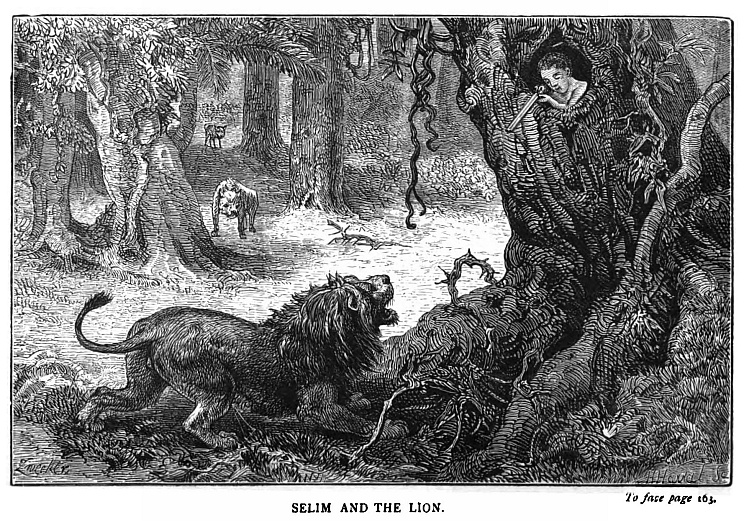
Selim, finding it dangerous to leave his friendly shelter, resolved to remain where he was until morning, and after he had listened, a long time at the aperture of the tree, and became satisfied that the lion was dead, he laid down again on the floor of his natural chamber, and, happily for one in his situation, fell asleep once more.
About two hours after dawn he awoke, and immediately going to the window, he looked down, and when he saw the dead lion stretched stiff at the foot of the tree, he said to himself:
“He would have it; he would not listen to me. Like Tifum he revelled in his strength, and was conscious of his might, and, like him, he wished to rend and tear me, but I have a gun, and I would that Tifum came after me, so that I could give him the same answer I gave this lion.”
As he spoke, he placed his spears outside, then his: gun, then went out himself, and, taking his weapons up, he stood by the body of the lion.
The following thoughts, though unexpressed, ran through his mind:
“Behold! how strong this lion was early last night—how proud his pace as he roamed through the silent forest looking for his prey! All the animals ran from before him, and left him lone in his proud strength. As if they knew his power, the echoes submissively sent his voice pealing through the long colonnades of the forest, like the heralds trumpeting the approach of a king. His eyes pierced the darkness and searched the night, his nostrils scented prey and blood, and he came and stood before me, the relentless tyrant of the wilderness! His great, flaming eyes glowed red with rage, his nostrils dilated wide as he thought of his hunger and the prospective feast; he pawed the ground and whirled his tail in fury, and tossing his mane back impatiently, he sprang at me and met his death.
“Now, how weak! An unarmed infant might play with his mane and pull at his great teeth. There lies no more danger in him; and as he is, so may all my enemies be! Farewell, thou lion! I would have preferred thou were not so unclean. My hunger is now sharp, and woe befall the hoofed animal I meet, but thee I may not eat.”
Then Selim, shouldering his gun and spears, having observed the sun, and found out the direction he intended to go, strode on, looking keenly to the right and left for any game that might promise him relief from the gnawing pangs of hunger he began to feel. He had been now thirty-six hours without food, for he had disdained to steal the rations of his comrades, as he might have done, knowing from experience that the slave who lost his rations or consumed them before the next distribution of food was very apt to suffer, as none of his fellows, having nothing too much for himself, could find charity enough in his own destitution to share with him.
Thirty-six hours is a long period for a growing boy to be without food, and Selim began to feel it. There were none of those wild fruit-trees, so common in Ukonongo, and Kawendi, and Usowa, the mbembu, the singwe (the wild wood-peach and plum); no wild grape nor nux vomica fruit, as in the south-eastern forests of Urori. The long, extensive plain south of the Cow River seems to have made two zones, different from each other, of Southern Unyamwezi and South-western Urori. The trees in this forest were more adapted for building purposes; but had Selim understood the ways of wild life in the forest, had he been anything but the tenderly-nurtured and pampered youth from Zanzibar, even here he might have found plenty of eatable roots. There was no lack of these about him; the roots of those long, slender, primate-leafed plants, on which he trod, he would have found to be as nutritious as the yams of Zanzibar. But the boy was innocent of this knowledge, and so he kept on, seldom looking on the ground, except when he began to feel disheartened.
As it was approaching sunset, however, he espied a small antelope crouching behind the bushes about fifty yards from him. Lifting his gun, with a prayer for success, he fired, and the animal, after making two or three convulsive leaps, fell wounded on its side. Hurrying up, he caught it as it was about to rise to its feet, and using one of his spears as a knife, looked towards the north-east, in the direction of Mecca, and uttering his fervent “Bismillah”—(in the name of God!) the pious youth cut its throat.
Then, proceeding with the work of preparing the meat, he cut off the head, skinned the animal, and extracted the inward parts, which he left for the hyaenas, while the eatable portions he conveyed to the fork of a great tree, where he intended to rest that night.
Hastily collecting some dry leaves, twigs, and sticks, he conveyed these also to the fork of the tree, and with the aid of some powder, he succeeded, after much patient work, in making a fire, over which he placed whole pieces of the antelope to roast, or rather to warm, for his ravenous hunger would not permit him to wait for the roast.
Had Selim understood the art of travelling, he would, of course, have cut the meat into thin strips, and have dried them slowly over the fire, and by this means have furnished himself with sufficient food for two or three days. But not knowing the art, he had placed all the pieces over the fire at once, believing, doubtless, like many other hungry people, that he could eat them all at one meal. Before, however, he had eaten half of one leg, he felt gorged; and feeling tired, put out the fire, raked all the ashes away, and when the fire-place had cooled somewhat, he laid himself down, with his legs coiled, and went to sleep.
In the morning, before starting on his journey again, he ate the other half of the leg, out of which he had formed his supper, and tying the other three legs together, he descended the tree and resumed his march.
During that day he was more bent upon walking than upon anything else; consequently he made a good day’s march. At night, when he began to eat his supper, perched, like the night before, in the fork of a great tree, he perceived the meat was tainted, but as he had no other means of gratifying his hunger, he suppressed the rising nausea, and contentedly ate the ill-smelling meat.
In the morning the meat swarmed with maggots, and he tossed it from him with disgust, and, without breakfast, resumed his journey. During the morning he travelled, at noon he rested; and for a couple of hours in the afternoon he contrived to hold on, until, faint with hunger, he was compelled to halt and go to sleep supperless also.
Another day dawned, and Selim, descending from his perch, resolutely determined upon prosecuting his journey. The forest was unusually silent and deserted; not an animal crossed his path; a few kites alone hovered above. Hour after hour he dragged his weakened legs along till the sun was sinking over the western horizon. He had seen no water on this day, and thirst sharply and severely attacked his frame.
And still another day dawned. Hunger and thirst had made great inroads on his strength, and had begun to sap his resolution. If he had but known that a few hours ahead of him lay the corn-fields of the Watuta villages, or if he had but known that only a mile north of the line he traversed lay the road over which Ferodia’s caravan had travelled two days before! But enveloped round about by the great forest, to which there seemed to be no end, he knew nothing,—tiny mite that he was, alongside of one of those straight-stemmed and towering trees,—beyond the thin line of vision which his low stature permitted him. Could he only have seen one foot above those trees, he had been safe, and could have directed his steps whither he desired. But he could barely see the sky, so dense was the foliage and so closely did each tree’s branches embrace the other. How hard it is to strive to attain the end of the interminable! What a seeming waste of strength is it to ever work and work to span the infinite! How disheartening it is to one to feel that he can never live to see the end of the endless! Interminable, infinite, and endless seemed this forest to the wearied, hungry, and thirsty Selim. He strained his eyes ever in his front, hoping that every low swell of the ground would enable him to see something encouraging; he looked in all directions for anything bearing the semblance of a living creature, of beast, or fowl; he looked upwards, striving to gain a glimpse of the serene face of heaven, which, in his present state of mind and body, would have afforded him momentary relief. Had he been more experienced in African travelling he would have known how to procure water; he would have known that in any one of those hollows a few hours’ excavation with a pointed stick would have procured him water, and that if there were not roots to satisfy a craving stomach, then the land would be poor indeed. Knowing nothing, however, of these things, he wasted the precious hours in resting, and then plunging nervously on his way, until his body was obliged to confess its weakness and his starved legs refused to go. When much time was thus wasted, again he would rise to again fall; and, finally, he fell fainting to the ground. Poor boy! he was paying dearly for the desire of his father to increase his riches by the bartering of cloth and flimsy beads for human creatures!
After a fainting fit, which lasted some minutes, he sat up, but was too weak to remain long even in that condition, and he fell back; and while thus prostrate, with his eyes upward, thought was busy with the pleasures he had been obliged to leave, and the more his body suffered the more his thoughts loved to revel in the luxurious scenes he had known. Groaning from sheer agony of body, he cried aloud:
“Ah, for one sight of the foaming wave of the Zangian Sea, which curled at morn into graceful wreaths like liquid flowers as the monsoon gently kissed it! One glance, if nothing more, of the snowy strand whereon I have sported often with my playmates, little Suleiman, and lea, and Abdullah before we plunged gaily into the foam and spray with which each moment the sea drenched the margin of the island. How oft, as nude I lay stretched on the warm sandy shore, the great sun descending towards the continent, have I watched the great ships idly rocking on that sea which in its deep dissolving bosom of blue depths reflected as a mirror the spotless azure of the sky! Happy days! Memory recalls so much that a thousand years would never obliterate. My dear father’s happy household gathered under the shade of the towering mangoes, whose rich fruit, golden, and purple, and brown, hung so temptingly over my head; the evening zephyr wind gently brushing by the light leaves as it rustled through from one tree to another with its welcome whispers, bending, as it flew, the tops of the kingly cocoa and the fragrant cinnamon, wafting the rich green bough of the orange, whose precious fruit was as a balm to my soul. Now could I but feel one in my fevered hand! What ample wealth does not my mind bring before my sickened eyes! The amber-coloured stalk of the sugar-cane and its luscious juice; dark green leaves of orange and mangoe; great cocoa-nuts, with their nutritious milk; the brilliant pomegranate, with its sweet soothing odour and thirst-assuaging pippins; the soft, rich guava, with its health-giving meat; the lime, with its yellow, golden fruit, at the mere sight of which fever and thirst are forgotten; and melons, whose deep green skins cover such crisp, sweet treasures. Ah! there is no place on earth to me like the beautiful island of Zanzibar. It is blessed by the beneficent God with Eden’s wealth. Streams laugh with gladness and murmur with joy. Fresh, healthy winds blow over it, laden with the fragrance of earth’s dearest and best treasures. God has blessed it with abundance, and has caused its warm bosom to heave with triumph. Lo! its gardens pass by me one after another; happy homes stand in their midst; the pride of my race sit happy under the shade of their orange trees, surrounded by their dependents, whose faces seem kindled with the quiet rapture which fills them. Trees and flowers, houses and gardens, men and women, hills and valleys, the sea and streams,—all of Zanzibar,—come nearer to the unhappy and forsaken son of great Amer bin Osman.
“Come nearer, nearer still, to your kinsman Selim, Let me embrace ye before my destiny is accomplished!
“No! no! Ah, ye are unkind! Gaze in pity upon my abject condition! Look down upon me, ye that are elated with pleasure. Mark my surroundings! This great, silent wilderness of forest, to which there is no end; it stretches from sunset to sunrise, from sea to sea; it excludes light and air; it smothers the earth with its limitless length and breadth. Through its thick, heavy drapery of leafage—I may not breathe, neither be warmed, by ever a single sun-ray.
“Hark to the storm of wind sweeping over the tops of the giant trees! How it expends its might in attempting to open even a slight gap, that one of the true believers might see a glimpse of heaven before he dies! But it may not be. Nature took ages to build this rampart and construct this impregnable palisade, and the baffled tempest retreats, and leaves me hopeless and despairing.
“The air is pregnant with deadly vapours; gigantic trees, fallen from extreme age, lie prone on the ground, infested by myriads upon myriads of creeping things; withered branches strew the ground thickly, and their leaves, long since dead, lie damp and sappy, reeking with every insect abomination. From afar, like the indistinct and distant sound of thunder, is borne to my ears, after traversing aisles upon aisles, the hungry lions’ roar, suggestive of what may happen if relief comes not early to the lonely Arab boy; and my quickened hearing catches strains of a still fiercer meaning, the voice of the leopard calling to his mate, mingled with the growls of the hyaena.
“Ah, cruel chance, that my fresh young life should be thus beset with dangers which menace it. What sin has my infancy committed that my youth must be punished so severely? What wrong have these boy-hands performed, that their owner merits death? What guile has ever my childhood’s heart conceived for which my youth must pay the penalty? What crime has ever my brain meditated, that I must be reft of my life at so early an age? None,—none. I but ever acted as I knew how; not wantonly, not recklessly, but just as instinct and nature, untutored, impelled me to.