"My Kalulu, Prince, King and Slave" (continued 4)
Reading edition
“I would my father had never felt the power of manhood, or met my mother. I would my mother’s womb, with its embryo, had withered up; then had I not been born to encounter such evil days. From the evil day Khamis bin Abdullah kindled in my father’s breast knowledge of his comparative poverty I date the birth of my misfortune; from that time hard and evil days innumerable have I seen; mischance has succeeded mischance, danger succeeded danger, one suffering has produced another.
“I saw my parent die as became the chief of his tribe. The friendly shields, which endeavoured to shelter him from harm, averted not the death which sought his lion heart; his companions in arms fell thickly around him in heaps upon heaps of unnumbered dead; while I stood alone, first to wonder at the strange phase of nature—death, then to mourn for the great loss that had befallen me, then to suffer torture like that to those who visit Eblis, and, finally, to wish that I had never seen the light which animates the earth, or had died upon that fatal field of battle. I, the son of great Amer, was made a slave by those hideous Watuta, who are but monstrous apes, was stripped of my clothing to have my modest youth shocked by the unbelievers’ rude gaze. When, blushing at their impertinence, I resented the rough behaviour, they bound and scourged me, and they laughed and mocked me as the tortured flesh gave way and hung in gory tatters, and the red blood dyed my limbs crimson. Probed and pricked by their spears, they drove me to the journey amongst a herd of other slaves, while the relentless sun streamed its rays upon my naked and defenceless body, and I thought that all the agony of the damned was not to be compared to that which I suffered. Ah, the suffering that followed! The long, long days of marching, which seemed to be interminable, the protracted pains from thirst, the weary, leaden limbs that refused to be moved at my command, the long, long, immeasurable road, the poor victims that fell never to rise again, whom, nevertheless, I envied for their eternal relief from misery and poignant pain. Their stolid faces upturned to heaven, blank and unmeaning; the unwinking eyes, that must have once reflected domestic joys, gaped wide, but were dim and glazed, and nothing more on earth would ever cause them to cover that horrible, steady gaze on emptiness and vacancy; the greedy vulture might peck at them, the kites might satiate themselves on their entrails, the hyaena might gorge himself on their flesh, yet those once sensitive eyes would never wink their discontent. This is death! It is real death. It is the death which threatened me until, rendered desperate by the keen terrors which filled me one night, I deserted that ever-moving caravan, to find myself after a time in this strait, and the terror of death has followed me hither. Every thought, and moan, and cry speaks of it. For ever present is the fearful sight of death; it is in this stagnant, oppressive air which I breathe; and the tomb which God has raised above my head—in these lofty columns, bearing far up their leafy roof—I see.
“Fit tomb for an Arab chief’s son. A sultan of the Arab tribes might envy me mine. But where are the mourners? There should be my kindred weeping hot tears over Selim’s early death. My mother, with her maids, should be present to wash my limbs ere shrouding them with snowy shash (fine bleached domestic, or cotton cloth). There should be my playfellows to chant a dirge over my early departure from this life; and the holy Imam to repeat the prayers for the dead. There should be my kinsmen to dig my grave, and women to weep. But I am alone, to die without bidding farewell to my friends,—to die without taking with me to that other world that last enduring look of love from all who esteemed me, which must ever thrill the souls of those who leave sympathising friends behind. Then come and welcome, cruel, cruel Death; wreak thy will on me; my limbs are already chained to that earth of which they are a portion; thou hast hedged me around with thy terrors and affrighted my soul long enough; thou hast advanced and receded, as though it were child’s play; I have alternately felt strong and faint, felt brave and weak. I may not balk thee longer!
“Farewell, happy island, with thy purling streams, thy orange-groves, thou home of my happy childhood, home of my kindred!
“Farewell, thou solemn earth; ay, bend thine head with shame for the frown with which thou hast regarded thy innocent child!
“Farewell, thou monster Death! Thou tyrant! I am conquered; and I—I must—yield. I come, father, dear fa-ther!”
Chapter Seven.
Ferodia’s Triumphal Approach—His reception by Katalambula—The King praises Ferodia—Abdullah is given to Kalulu—Abdullah meets with Simba and Moto—Kalulu’s plan of search for Selim—A Gun found—Selim found—The senseless form of Selim carried to the Village—Selim recovers—Kalulu fraternises with Selim—Kalulu’s Friendship for Selim.
On the twenty-ninth day after the battle of Kwikuru, Ferodia, the chief of the Watuta, made his triumphant entrance to Katalambula’s village. Messengers had arrived the night before at the King’s house to announce the approach of the victorious chief; and when next morning, near noon, a great cloud of dust was perceived on the left bank of the river, then the women, posted on every advantageous point for a good view, began the glad lu-lu-lu-ing, and the welcome tones, when heard by the Watuta, were answered by them with a shout which might have been heard at the great lake into which the Liemba ran.
Long before Ferodia had emerged from the leafy corn-fields on the left bank of the river, the vicinity of the great gate of Katalambula’s village was thronged by a multitude of men, women, and children gathered from the rich plain around, who were the brothers, cousins, nephews, wives, sisters, and children of the warriors whose return was now so enthusiastically, nay, frantically, welcomed. Two thousand voices sounded the happy “lu-lu-lu;” four thousand hands were clapped together; four thousand legs, brown and black, and black and brown, danced, leaped, moved, and wriggled as the emotions of their owners moved them.
And Ferodia was all this time slowly approaching, while the drums, with tremendous thunderous volume of tone, ushered him into the presence of the assembled multitudes. Note him well as he approaches. What civilised monarch ever acted the triumph he felt so well as Ferodia? What civilised king ever possessed that gait? What actor could have imitated Ferodia? Mark his steps, his lion strides, with his legs encumbered with one hundred rings of fine wire. Watch how negligently he lays his arms, heavy with broad ivory wristlets, on the shoulders of the supple-bodied youngsters, who are jealous of this high honour conferred on them. Note the toss of his head with its wealth of braids! It is the majesty of triumph impersonified. Happy men would those actors be who could but imitate that regal air!
The procession is in the following order, as it appears before the gate and the multitude. Two hundred warriors in front of Ferodia, file after file, each head adorned with feathers in huge, dancing, waving tufts, each man solemnly marching through the gate into the quadrangular square surrounded by the King’s quarters to occupy one side of the square in line. Then Ferodia himself, supported by two stalwart young warriors, one on each side. Then two hundred warriors, each warrior’s face surrounded by the black, stiff hairs of the zebra’s mane, stripped entire with the hide from the zebra’s neck, which gives each warrior a fierce appearance, much fiercer than the black bearskin caps give to English hussars. Then the adult captives in gangs of twenty, bearing the plunder Ferodia had taken from the Arabs. Then the boy captives, at the head of whom was Abdullah, whose white face and body obtained universal notice. Then five hundred warriors bringing up the rear, each head decorated according to the caprice of its owner, with feathers, and red, white, and blue cloth.
The nine hundred warriors were formed around the square, while the captives, after depositing their loads near the great tree in the centre of the square—the cloth bales by themselves, the beads in a separate pile, the boxes by themselves, the kettles, pots, pans, and miscellaneous goods by themselves, the powder barrels and bullets by themselves, and the guns by themselves—formed a circle around the tree.
Katalambula was seated on his mud bench or sofa, which was garnished on this occasion with over a score of lion and leopard skins. In his hand was a short rod, to the end of which was neatly fixed a giraffe’s tail, with which he negligently whisked the flies from his face.
The multitude which we first saw outside the gate had climbed upon the roofs of the square tembes, and looked down now intent upon the warriors, the slaves, the plunder, and the king, seated with Kalulu and the grey-headed elders and councillors of the tribe under the tree.
Ferodia stood with spear in hand alone in the centre of the inner circle formed by the ring of slaves, and close to the great heaps of spoil he had taken from the camp of the Arab traders. His attitude was unmistakeably grand, and spoke the proud chieftain. A broad robe of crimson blanket cloth, which trailed to the ground, was tied in a knot over his left shoulder, leaving his right shoulder free. There was a dead silence; not a word was heard from the warriors or from the multitudes. Then the mild voice of Katalambula was heard, saying:
“Ferodia, we have expected thee. We have heard of thy great success; how thyself and the Watuta warriors have triumphed over the Arab traders. Speak, our ears are open.”
Then Ferodia replied: “O King, and ye elders of our tribe! I was sent by Katalambula to bear presents to his friends, the Warori chiefs; and, as I had concluded, I was thinking of returning to Ututa, when Olimali sent word to my camp that the Arabs—the traders from the sea—had come to his country with an immense store of cloth and beads. He said they were of those who had slain Mostana thy brother, O Katalambula.”
“Eyah! Eyah!” greeted the speaker from the king and his elders, in which Kalulu joined.
Lifting his voice higher, and adopting a more energetic strain, while his spear was used to describe gestures, Ferodia continued:
“When I heard the words of Olimali, the King of the Warori, I became as a hungry lion, even as a roaring lion before his prey. I said aloud, ‘Lo, Malungu (the Sky-spirit, or God) has put the Arabs into my hands, even the slayers of Mostana, thy brother. I will arise and avenge Katalambula and Mostana’s son on them. I will make strong drink from their bodies, and give their entrails to the fowls of the air, and their heads I will raise before Olimali’s gate to the terror of all other Arabs who come, and murder, and steal, and make slaves, from near the sea.’”
“Eyah—eyah!” shouted the multitude.
“When the morning came, the Watuta warriors were in the bush and in the corn. They heard the horn of Olimali, they heard the noise of the Arabs’ guns, they heard the shouting and the battle, and, at my signal, the Watuta warriors rose as one man. They came with the swiftness of arrows, like the flash of a bright spear. We saw the foe in the village of Olimali, we hemmed them round, we closed the gates, and we began to slay. Before our arrows and spears the foe fell in numbers, in heaps, until those that were left cried aloud for mercy, and fell on their knees. Then we made slaves of hundreds of men and boys, and bound them captives for Katalambula. We took guns, and powder, and bullets; we gathered a heap of wealth, of fine cloth and beads. Of the cloth, and beads, the guns, and powder, and lead, I have given half to Olimali, the King of the Warori. Then each Mtuta warrior received his due, six cloths to each man; the Watuta chiefs received their due, and Ferodia took a share. Fifty slaves died on the road to Ututa, two Arab slaves died, and one white Arab ran away to die in the forest. We have two hundred and fifty men-slaves, and seventeen boy-slaves left, one of whom is the son of an Arab chief. The cloth, and the beads, and the other plunder from the Arabs lie before you in these heaps. O King, and ye elders of the tribe, I have spoken.”
“Eyah! eyah!” burst out in applausive accents amid clapping of hands and lu-lu-ing from all the people.
Then Katalambula spoke and said, “O Ferodia, great chief and warrior! thou art like a right arm to me; thou art a very lion in war. Who is stronger than thou in the battle? The Wabena, the Wasowa, the Wakonongo, and even the Wajiji, have felt thy spear. Verily thou hast spread the name of the Watuta and the renown of Katalambula to the ends of the earth.
“Let the people hear, and let the elders open their ears. What king has a warrior like Ferodia? He goeth forth with empty hands, but returneth full. He goeth from the village poor, and returneth rich. His warriors are beggars when they depart from us, but they return with Merikani, and Kaniki, fine Sohari, and Joho cloth, and their nakedness is hidden under heaps of finery. Who is like unto Ferodia? Were not our maidens in tears when he and his warriors left us? Lo, and behold, they are now laughing, and their hearts dance for joy. Were not our children hungry when he departed? Lo, and behold, they cry no more, for their bellies are full. Katalambula—even I—was poor, whereas who is to be compared to me now in wealth? Verily thou art great and good, Ferodia, and Katalambula is pleased with thee. I have spoken.”
Then Katalambula got up and examined the slaves, while Ferodia walked by his side and commented on such as exhibited extraordinary qualities; and in going around the circle, the King came to the boy-gang, and when he came to Abdullah he could barely contain himself for delight and gratified curiosity.
“Verily,” said he, “the Arabs are strange people, and this is one of that race. Strange people; all white!”
Katalambula put out his finger to touch the pale skin of Abdullah, and he instantly drew it back as if the skin had bitten him, laughing at himself for his timidity. But, encouraged by Ferodia, he placed his hand on his shoulders, and marvelled at their softness; and then toyed with the boy’s hair, remarking that it felt like goat’s hair. Then the boy was obliged to open his mouth while Katalambula peered down his throat, as if he were in search of some hidden treasure, or as if he expected something would jump out, since the white boy was such a wonderful creature.
“But what are you going to do with him?” asked Katalambula.
“It is for the King to command,” said Ferodia, in an insinuating tone.
“Well, I will give him to Kalulu; but I thought there were three of them; or were there four?”
“Only three white,” said Ferodia; “one died on the road, a little fellow, and the tallest ran away, about five days from here.”
“Why did he run away?” asked the King.
“Because he was a fool, and the son of a fool,” responded Ferodia. “I never saw such a stubborn ass; his mouth was full of words, but his back had no work in it; therefore he preferred to die in the woods, as he cannot live. Yet had he spirit enough for two warriors, and he would have made a fine slave by-and-bye.”
“Who art thou speaking of, Ferodia?” asked young Kalulu.
“Now, hold thy tongue, boy, and do not thou interfere with the affairs of men; but rather see how good Ferodia, thy uncle, is to thee; he has given thee that white slave for a playmate. Take him, cut loose his bonds, and teach him to be a warrior.”
“Nay, let Ferodia answer me,” persisted Kalulu, “and I will then see about the white slave. Who is he that has run away?”
“If thou must know,” said Ferodia, looking on Kalulu kindly, “’twas a young Arab slave, about thy age, who ran away. He was the son of a chief, and I half suspect he was driven to run away by Tifum’s unkindness.”
“Tifum Byah!” cried Kalulu; “no wonder he ran, Ferodia; Tifum has not a gentle hand; but I will see thee again, uncle. I must look after my white slave now, and teach him to eat first.”
And Kalulu, leaving the King and Ferodia to pursue their examinations into their property, turned to Abdullah with a curious look, and then, taking his spear, he proceeded to cut the rope around his waist; then, beckoning to the astonished Arab boy, he walked away towards his own quarters, followed by him.
When he had Abdullah in his own apartment, all to himself, he again turned to take a look at him, and silently surveyed him from head to foot. Then, walking up to him, he stood with his back to Abdullah’s, and, putting his hand over his head, he seemed desirous of knowing whether he was taller than him; and having satisfied himself, he turned round to him again, and, smiling, said to him in Kituta—the language of Ututa:
“Son of an Arab, canst thou speak Kituta? No? is that what thou meanest by shaking thy head? Canst thou speak Kirori? No, again? Kibena, perhaps? No? Canst thou speak Kinyamwezi? No? Then what language dost thou talk? But, never mind, thy head must think of thy belly now; I will go fetch thee some food. Sit down on this bullock-hide until I return.” And Kalulu vanished, having pointed to the hide on which he desired Abdullah to seat himself.
(Ki placed before Tuta means, the language of Tuta; U, the country of Tuta; Wa, people of Tuta; M, a man of Tuta. This rule is the same with other African names.)
Presently he returned with a female slave bearing some roast kabobs (small pieces of meat), rice, honey pombe, or native beer, and a thick porridge; and pointing to the food and to his mouth, he intimated to him his desire that he should fall to and eat; which Abdullah, casting a grateful look on him, was not slow to understand and to avail himself of.
After watching the Arab boy eat for some moments, he left the hut again, but soon returned with two men, whose faces immediately attracted Abdullah’s attention and made him cease eating from surprise. When he opened his mouth to speak, he ejaculated—
“Simba! Moto! how came you here?”
“Abdullah! poor boy!”
The two men having spoken, Abdullah sprang to his feet, and, throwing his arms first around Simba’s neck, then around Moto’s, he embraced and kissed them both, and shed floods of tears from joy, while Kalulu, looking at them all, smiled with fraternal pleasure.
“I am not alone, then, as I thought; I have still some friends left,” sobbed Abdullah. “I thought all had left me.”
“Nay, weep not, Abdullah,” said Bimba. “Allah is good. Tell me, son of Mohammed, where are Selim, and Mussoud, and Isa?”
“Ah! Simba; evil days have been our fate ever since we came to Urori. Isa died of the small-pox soon after starting for Ututa; then, some days afterwards, Mussoud, my dear little brother, fell ill of the same disease and died; and Selim—”
“Yes, tell us where he is!” said Moto, eagerly.
“The same night that Mussoud was dying, Selim asked me to go with him to the forest; he said he could not live longer, while Tifum was beating him all the time; and to see the men and boys die on the road, and left to be eaten by beasts of prey, sickened his soul. I could not go while the fate of my little brother was uncertain, but I gave Selim my prayers, and after I had fallen asleep he must have gone, for he was not by my side when I awoke, and his yoke-tree was empty. I think he took with him a gun and some spears, for the Watuta who lost those things made a great noise about their loss.”
“Bun away!” said Simba and Moto, looking at one another blankly. “Selim gone! but, Abdullah, did he tell you which way he was going after he would leave you?”
“He said he intended to try to get to Zanzibar, but while I was dropping to sleep, or whether I dreamed it or not I can’t say, I thought I heard him mutter something about you, and Moto, and Katalambula.”
“Ay, that’s it, more likely,” said Moto. “He remembered our warning. The boy, if he is not here now, must be in that forest still. Did he say, Abdullah, whether he would go north or south first?”
“Oh, south, because the camp was on the southern side of the road, and our part of the camp was the most southerly; so it was easy for him to slip away unperceived.”
“And how many days from here, Abdullah, is the spot from whence Selim disappeared?”
“We came here in six or seven days—I forget the exact number,” answered the boy.
All this time, Kalulu looked from one to the other; and seeing the looks of anxiety and uneasiness on the faces of his friends, he asked Moto what the matter was, upon which Moto explained that his young master was missing—he for whose sake he had sought out himself and Katalambula.
Then he asked what Moto purposed doing, and was answered that he did not know, but would consult with Simba; upon which Kalulu promised that, whatever they did, he would assist them.
Simba and Moto, sometimes assisted by Abdullah, consulted together for a few minutes, at the end of which Moto informed Kalulu that they had decided that it was their duty to hunt up their young master, who was by this, perhaps, perishing from hunger, or was captured again by some other tribe of the Watuta.
Young Kalulu had expected this would have been the answer; for, being sharp-witted, and knowing how great was their affection for their young master, he could have divined nothing else. And he replied that, if his assistance was wanting, he was ready with his influence to promote anything necessary for the restoration of Selim to his friends. “For,” said he, “since I have seen what the Arabs are face to face, I begin to like them. At least, I think I shall like this one and Selim; besides, my uncle has already given me this one for a slave, and he will give me the other one, if I can catch him. But, Moto, they both shall be thine when thou wilt demand them from my hands.”
When this was translated into Kisawabili, the language of Simba, by Moto, Simba said to Moto:
“Tell the young chief that if he can get fifty men from Katalambula, on the pretence that he has heard there are elephants in the forests, we can start at once, and by spreading out through the woods, either find him ourselves there, or hear some news of him, or rescue him from those who have already got him.”
After expressing his approval of the scheme, Moto conveyed it by translation to Kalulu, who replied immediately that he would set about it at once; and while saying it, he left the hut.
In half an hour he returned, and informed Simba and Moto that the men were outside the gate waiting for them, though it was unusual to start on a hunting expedition without the ceremony of the magic doctors. “However,” he added, “I have explained that it shall be done at the village nearest the forest, where we shall arrive to-morrow at noon if we travel well. So come on, Moto; I want to do something too, or Ferodia will be on everybody’s tongue, and Kalulu’s name will never be heard; besides, I want to see this young master of thine, and see if he is as good as you say he is.”
While he had been talking, Simba and Moto had snatched up their guns and declared themselves ready, and Kalulu, after giving orders to have Abdullah sleep in his hut, and to be well fed and looked after, accompanied by Simba and Moto, hastily left the hut.
Kalulu was very proud as he showed his friends his warriors, and was sure that with such people the lost Arab boy would be found. Then, putting himself at their head, with his friends next to him, he rapidly led the way along which Ferodia had arrived from Urori.
As it was noon when they started, they could continue their march until late at night, which they did; and a couple of hours before dawn next morning found them en route again.
At noon, as Kalulu had said, they saw the forest darkening the western horizon ahead; but between them and the forest was a village, whose corn-fields were then reached, situated about a mile south of the road, from which Simba supposed it would be best to spread out, and keep a sharp eye for anything that promised to furnish a clue of him for whom they were about to search.
They soon came to the village, and when the inhabitants recognised Katalambula’s adopted son, they manifested great delight, and immediately set about furnishing him and his men with the best they had, consisting of bananas, and porridge, beans, and rice, and pombe.
The chief of the village was very assiduous to please Kalulu, and sat down close to him, imparting local news; and, as he began to impart it, he remembered an incident which had occurred that morning, which was, that one of his men, searching for wild honey, a couple of hours off in the forest, had found a gun.
“A gun!” said Moto.
“A gun!” echoed Kalulu.
“Yes, a gun; and the medicine was in it—the medicine powder and bullet—for when the man who found it was playing with it, boom! it went, almost killing him with fright.”
“Yes, yes, that’s very funny; very funny,” said Moto, trying to curb his impatience; “but did your man find nothing else near it?”
“Nothing else, my brother. What do you mean? Was not the finding of a gun strange enough in a forest which, for aught I know, never saw one before? Can many more miracles happen to us like this?”
“But, my brother,” urged Moto, with anger in his tones, “how could the gun have come there if some one had not left it?”
“The Mienzi Mungu (Good Spirit) placed it there for me. It was not many days ago since my father, the chief, died; and when I had put him in the ground deep, and covered him with earth, I collected all his property in a heap, and thanked the Mienzi Mungu, who had been so kind to me, and prayed to him to make me rich and strong. The good Mienzi Mungu has heard my prayers, and has sent this gun, with its strong medicine, from the skies, for me.”
“Chief, be silent,” said Kalulu, holding up his hand; “the heir of Katalambula commands thee. Knowest thou the spot where thy man found this wonderful gun?”
“My lord, thy slave is silent when Kalulu speaks. I know not the place, but my man must know.”
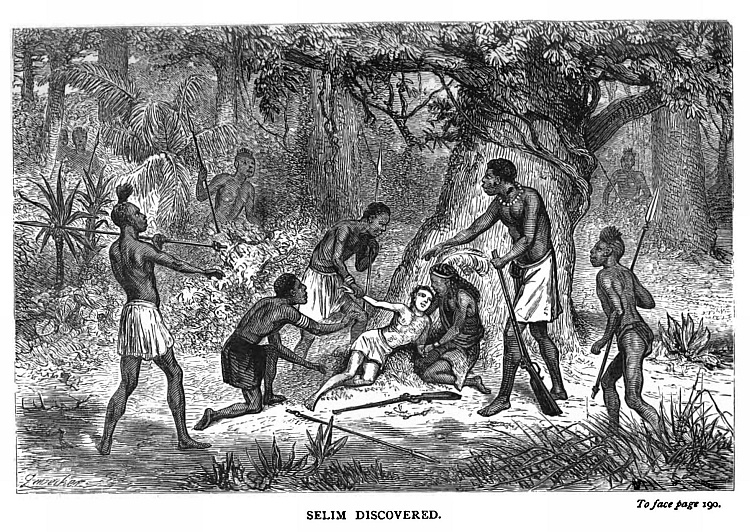
The man was called, and when he was asked if he had searched the vicinity for further treasures, he replied that he had not, as he had hurried away with what he had found to his chief. He was then told to prepare himself to accompany Kalulu and his men to the spot where he had found the marvellous treasure.
Within two hours they had arrived, and stood under a tree in a dense part of the noble forest. The trees grew around thickly, with many towering columns, supporting a mass of leafage, impenetrable to glare of sun or the white light of day.
On the man pointing the exact spot to Kalulu, Moto, and Simba, the warriors of Katalambula were formed in line, and one half was ordered to march northward, each distant from his fellow fifty paces, and the other half was ordered to step out, with their faces to the south, in like manner. The men having thus been posted in skirmishing order, were then ordered to front towards the east and march forward, observing closely everything strange they might see.
The men had not advanced far—not more than two hundred yards—when one of them gave a shout, which instantly attracted the attention of all. He was seen pointing with excited motions at some object lying on the ground. Simba uttered a roar of joy, when, bounding upward to catch one glimpse of the object, he perceived it to be the pale-coloured and apparently inanimate body of his young master. Moto, also, labouring under no less joyful excitement, shot forward with the speed of an arrow, and Kalulu’s light and graceful form was seen cleaving the air as he sped with nimble feet towards Simba. The men soon shared in the excitement, and came running up to know the cause; and, among the first, was seen the peasant who had found the gun in this same forest, little dreaming that its owner lay so near.
But the joy of the leaders was soon turned to sorrow. The giant Simba stood nerveless and speechless at the head of the body, Kalulu looked on with deep sympathy on his face, at the side, while Moto threw himself on his knees with clasped hands, at the feet, keen anguish written in every line of his face. The positions of the others, as they came up one by one to obtain a view of the prostrate form of the boy, indicated sorrow, mixed with curious awe; but that of the man through whose aid the body had been discovered was the most remarkable.
When he had approached the curious object which attracted such attention and elicited such shouts, he stood stock still, as if he had been suddenly petrified; but seeing that the pale object bore the semblance of a man, and that it remained motionless, he advanced slowly on tiptoe, while his face underwent remarkable changes as his emotions moved him.
“What is it?” he asked of the nearest man to him. “Is that the Mienzi Mungu who left the gun?”
“No,” answered the man, shortly, “this is not the Mienzi Mungu, thou fool; ’tis but an Arab boy, who has died from hunger,” he added, proudly, and with the compassionate tone of one who pitied such woeful ignorance.
“An Arab boy!” he uttered. “What is that?”
“He is one of the white people who live in the middle of the sea,” the warrior answered.
“Well, what makes him so white? Is his skin like the shell of an egg? Is he hard or soft to the touch?” he asked again, with a strange curiosity.
“Art thou afraid of a dead boy? Go to the body and feel it, fool.”
The peasant smiled foolishly as he was thus rebuked; but presently he was seen to crawl towards the body and timidly put his hand on the boy’s chest to feel it; but he suddenly removed it with a cry.
“He is not dead! His skin is soft, and I felt it move!”
Moto and Kalulu sprang and knelt down by the boy’s side, and a joyful sparkle was seen in Simba’s eyes as he also bent down and placed one hand within that of the motionless boy, and the other on the chest. Moto felt the head, to see if there was internal warmth in it, and Kalulu seemed desirous of knowing the truth by reading it in the eyes of Simba and Moto with his own.
“He lives! my young master Selim lives! Allah be praised!” cried Simba fervently.
“But he will not live long if we don’t carry him away to put something into him,” said Moto, anxiously and hurriedly. “Dost thou see Simba, how thin he is? he is nothing but skin and bone—and look here, Simba! Wallahi! what sheitan (bad man, fiend) has done this? See the bruises on his shoulders, and—turn him over on his side—there!—look at his back, Simba!”
“Moto,” answered that great and tender-hearted giant, “Tell me, what could have done this? Is it a man? A man?—no! No man could have wounded and striped that back so, because Selim—poor innocent Selim!—could have done nothing to deserve it. This is the work of a pure mshensi (savage), and I will tear out that man’s heart, so help me Allah! But let us bear him quickly but gently to the village—and, Moto, ask Kalulu to send the man back running to tell the people to have some very thin ugali (porridge) boiled in goat’s milk ready by the time we reach there.”
The order was given by Kalulu immediately, and Moto, laying hold of his shoulder-cloth, which he had thrown away from him at the first burst of excitement, began to spread it out on the ground. Simba aided Moto then to lift the wasted form of their young master on the cloth, groaning from sheer sorrow and grief at the thought of what he must have suffered, and murmuring to himself, “Selim will tell me if he lives, and if he dies, little Abdullah will tell me, and then, you sheitan, you mshensi dog! I will treat you in the same way as you treated Selim—sure, sure.”
When the senseless form of Selim had been placed on the cloth, Simba and Moto took hold of each corner of it at the head while two other men were ordered by Kalulu to take hold of each corner at the feet, and in this manner they proceeded on their return to the village.
When the party arrived at the village, they found the inhabitants loudly and excitedly discussing the strange events that had occurred, and the report which Kalulu’s messenger, the peasant, had made concerning the discovery of a white boy, nearly dead from hunger, in the forest. The report that a white boy had been found created an unprecedented surprise and excitement; no stranger news could have been given in a village where white people had never been heard of or dreamed of before; the wildest imagination could not have produced any shape or human figure so wonderful. A boy all white! white skin—as white as the yolk of an egg! They might have imagined black men with horns, or black men with two heads, six arms, and as many legs as a centipede, or any other monstrosity; but a white boy, with skin so soft and smooth that the slightest pressure with the finger produced an impression on it,—this was wonderful and excelled all tradition. No wonder, then, that when the party which bore the white boy was seen advancing, the people made a general rush to see the curiosity.
But Kalulu, warned by Moto, had thought of this; and his warriors had been so skilfully arranged that the excited people found themselves balked; and Moto, Simba, and the other two men bore their burden into an empty hut which the village chief, at Kalulu’s command, showed them.
The ugali, or porridge, which had been prepared, was then taken by Simba, and while Moto gently forced the mouth of the boy open, Simba, with a small wooden paddle, which he had soon scooped out into a shallow spoon, began to drop some of the nourishing gruel into the open month. The effect was almost instantaneous, although to the anxious Simba it appeared a long time; the open lips closed and a slight movement of the throat was observed. Again the lips opened, and the watchful Simba poured a few more drops of the warm and grateful restorative, and soon, as fast as he poured, the thirsty mouth received it, with other agreeable effects which the friends were quick to perceive. Kalulu, who knelt at Selim’s head, pointed Simba to the minute beads of perspiration which had formed on the previously dry forehead, and Moto, placing his hand on the chest, gladdened the ears of all with the news that the heart throbbed quicker and stronger.
Presently, Selim heaved a sigh, and the eyelids, hitherto closed, opened, revealing the lustrous orbs which give light and the sense of seeing to the body.
“Ay, what eyes! so large and beautiful!” ejaculated Kalulu, with wonder.
“Hush-sh,” said Simba, warningly, as he bent his ears to the lips which now were whispering words which brought the tears to Simba’s eyes.
“And sons shall mourn for Arab fathers slain, And Arab wives shall shed their tears like rain.”
“Poor boy!” said Simba; “he repeats the words his mother said before son and mother parted.” And then in a louder tone he said, “Selim, young master, dost thou know me?”
The head turned round, and the eyes of his young master rested on him full, with the light of intelligence in them.
“Ah, Simba! Is it thou?” asked Selim, in a faint but glad voice.
“Yes, I—thy slave Simba. Praised be Allah for his goodness! my master knows his slave.”
“Where am I?” Selim then asked. “I have had such a fearful dream. I thought I was dying from thirst and hunger. But this is not that awful forest I saw. I am in a house, and Simba is at my side. How is this, Simba?”
“Dost thou not know Moto, master?” asked Moto, who had risen to his feet.
“And thou too, Moto, here? Then I am happy. I am not alone, as I dreamed I was.”
“No, master, thou art not alone; but take some more of this,” said Simba, as he industriously stirred the porridge. “It is good for thee, and thou wilt be quite strong by-and-bye.”
And Selim obediently opened his mouth and permitted himself to be fed without demur, though his eyes worked and looked about to aid his mind in resolving the remarkable change of circumstances which had taken place since he fell down in the forest from fatigue, hunger, and thirst.
When the gruel was exhausted and he had eaten his fill, Selim found his strength much recovered, his mind firmer, and he asked Simba to tell him how this change had come about. Simba related briefly all the facts already known to us, to Selim’s infinite surprise and joy; and Selim, in answer to a question from Simba, related what occurred to him, from the time Simba and Moto disappeared at Ewikuru to the time he laid down as he thought to die, Kalulu came round now, and kneeled in front of Selim, and Simba introduced him as the adopted son of the King, who had been so good to Moto, and as the young chief through whose aid they had been enabled to discover him.
Selim lifted his hand, and grasped Kalulu’s fervently, and asked Moto to tell him how grateful he felt to him for his kindness, which was no sooner done than Kalulu said:
“Let the son of the Arab chief eat, and rest, and get strong. Let neither hunger nor thirst approach him. Kalulu is his brother. With Kalulu my white Arab brother may tread the forest glades in safety; for the forest is kind to Kalulu; the trees nod their tall heads to him as a friend, the birds make music for him, and the honey-bird finds sweet treasures for him. The forest is fall of beauty and richness, and Kalulu’s heart is glad when he can roam through it alone. Neither the lion nor the leopard harm him, and the wild boar starts in fear when Kalulu is near him. Get well, my brother, get strong, and fear harm no more.”
To which Selim answered, while grateful tears filled his eyes:
“The voice of Kalulu sounds in my ears as the living waters of a fountain in the ears of a thirsty man. My soul responds to his kind words as the closed petals of the lotus to the warm light of day. Fear and distrust fly from me as the gloom of night and early mist before the sunshine. When the heart is tranquil and sadness does not disturb the mind, a man sees joy in all things; even the sombre forest is reft of its terrors, and becomes beautiful, the ground is found to be clothed with sweet grass and pretty flowers. The waving grain and tasselled corn does not bend more easily to the breeze than a man’s heart does to his emotions; the dark past will be forgotten by me, and with Kalulu as a brother I shall find beauty in all things, music in birds, pleasure in the fields, joy in sunshine and night.”
Kalulu replied: “Thy voice, my white brother, makes Kalulu glad. His heart grows under its pleasant sounds, and is moved like the foliage by the soughing breezes. I will teach thee what the Sky-spirit has taught the children of the Watuta, and thou shalt teach me what the Sky-spirit has taught the pale-faced children of the Arabs. Thou shalt show me what the great sea is like whose waters are salt, and to what it is like when the angry pepo (storm) blows on it; and I will show thee the brown Liemba, where, among the thick matete brake, hides the long-nosed mamba (crocodile), and where the hippopotamus loves to bathe his great body. I will show thee the pretty islands, silent as the night in their loneliness, which are guarded by scores of crocodiles, for me to roam when I like. I will teach thee how to hunt the swift antelope and the leaping springbok; how to pierce the thick hide of the pharo (rhinoceros); how to laugh at the fierce bellow of the wild buffalo; and how a Mtuta boy meets the lion. Eat and get strong. But tell me, my brother, how comes thy back so scarred and wealed?”
“Kalulu, my brother, thy words have made me strong already. Heed not my bruised body; thy words are a medicine for it. The music of thy voice has healed my sores. I feel them no more.”
“Nay, but tell me the name of the man who made them. Was it Ferodia?”
“No. Ferodia has not struck me; it was the man they call Tifum Byah.”
“Tifum Byah! the cruel dog; but never mind, I will stripe his back for him.”
“Nay, please trouble him not, for my sake, Kalulu; the dark days are over.”
“Well, we shall see,” said Kalulu. “But now we will leave thee to sleep and rest. We shall stay two days here, when thou wilt be strong enough to be carried before Katalambula. I marvel at the friendship I bear thee; but Moto was good to me, and when he told me thou wert his master, I loved thee then. Now I love thee for thyself. The Watuta know how to love and hate, how to like and dislike.”
Then, turning to his warriors, who had crowded into the hut, Kalulu said, “Come, let us leave Moto and Simba with the pale-faced boy; they will watch him.”
Chapter Eight.
Ceremony of Brotherhood—Ceremony of Blood-Drinking—Selim brought into Ferodia’s presence—Simba to the Rescue—The Warning to Kalulu—Kalulu speaks for Selim—Where is Paradise?—Selim and Abdullah are clothed—Down the Liembra—The Hippopotamus—Overboard—Fighting the Crocodile—How Kalulu fought the Crocodile—Securing the River-horse.
On the third day after his discovery in the forest by his friends Simba, Moto, and young Kalulu, Selim was sufficiently strong to begin his journey to the village of Katalambula. Had Kalulu not assured him of his friendship, and that he would be a brother to him, it is doubtful that Selim would have looked upon the idea of meeting Ferodia and his obsequious servant Tifum Byah—to whose tyranny he owed so much misery—again with pleasure. But it was agreed between Kalulu and Selim that the ceremony of brotherhood, of which he had heard much before, should take place the evening before they arrived at Katalambula’s village.
The party travelled by easy stages, and on the fifth day of the journey, the day set apart for the ceremony of brotherhood, they found themselves close to the Liemba stream, at a village called Kisari, distant but eight miles from the capital of Katalambula.
Here the author may remark, for the benefit of the younger readers, that a close brotherhood among men or boys, unrelated by blood, birth, or marriage, is in no way singular. I need but mention David and Jonathan, Achilles and Patroclus, Damon and Pythias, as examples among men; and what boy of any nation, in any public school, has not some friend who is as dear to him as a born brother? It arises from a similarity of dispositions generally, from the desire to relieve ourselves from little anxieties, and to have some one in whom we have thorough confidence. There were two things singular about this ceremony of brotherhood about, to be enacted between Selim and Kalulu. First, was the ceremony of blood-drinking connected with it; and, secondly, was the fact that a Moslem boy—a true believer—was about to become a brother with a Pagan boy—an unbeliever—and to drink his blood. For it is expressly prohibited by the Küran that blood shall be drunk by the true believer; next, it is expressly prohibited that a true believer shall make any such close friendship with an infidel. But it may be argued for poor Selim that he was yet but a young boy; that he was driven by necessity to this as the best method of assuring his freedom and safety from recapture, and this the Küran, whose laws are not cruel, permits when there is necessity; and it might be said that Selim was, perhaps, not aware of the Küran’s prohibition in this small matter; otherwise, I doubt that a boy so generally pious would have erred against the law of the Prophet consciously.
On Kalulu’s side, nothing could be said against the ceremony. It was a common custom with his tribe, when any of them met anybody they liked better than another, to go through the ceremony. Sometimes the chiefs did it with neighbouring chiefs, to strengthen their alliance from motives of policy, for the same reason that European monarchs contract—or rather did, for it has lost long ago its former significance—advantageous alliances among themselves for their sons and daughters. Kalulu wished the ceremony to proceed, because he had a strong liking for Selim, born of gratitude to Moto; because Selim was of his own age; because he had pleasant ways with him, and friendship having grown out of the accidental circumstances under which they met, he desired to assure himself, with the ardour of a boy, that real friendship existed between them. Once his brother by this ceremony, no one of his tribe could injure Selim; and Ferodia and Tifum Byah might storm and fret in vain, for the ceremony of brotherhood with Kalulu could not be disregarded. We shall see, however, what came of it.
At sunset, Kalulu was asked to seat himself side by side with Selim on the ground, which he did, taking hold of Selim’s right hand, each with his profile half turned to the other. Simba was the master of the ceremonies on this occasion, who held a knife with all the solemnity of one who was about to offer a sacrifice to some horrid deity who delighted in the blood of youths. Moto stood by as a supernumerary, and to interpret the words of Simba for Kalulu. The people of Kisari had also come to witness the ceremony.
Simba advanced as the sun was setting, knife in hand, while the two boys retained each other’s right hands, and said to Kalulu:
“Art thou willing to be a brother to Selim, to be more than a friend to him, to share what thou hast with him, to defend him against all enemies to the best of thy power, and to stand by him until death?”
Kalulu answered, “I am.”
“With what wilt thou seal thy word?”
“With the blood of my right arm.”
“And what wilt thou give him as a sign?”
“I will give him a sheep.”
“Art thou willing further to drink his blood, that his blood may pass unto thee, that the bond of eternal brotherhood may be made strong and sure?”
“I am.”
Then turning to Selim, Simba asked:
“Art thou, Selim, willing to accept Kalulu as a brother, to be more than a friend to him, to share what thou hast with him, to defend him to the utmost of thy power against all enemies, and to stand by him to the death?”
Selim answered, “I am.”
“With what wilt thou seal thy promise?”
“With the blood of my right arm.”
“And what wilt thou give him as a sign?”
“I will give him my gun.”
“Art thou willing, further, to drink his blood, that his blood may pass unto thee, that the bond of eternal brotherhood may be made strong and euro?”
“I am.”
“Then let it be done!” Simba said; and with that he made a small incision in the arm of each, and as the blood began to flow, he shouted, “Drink!” and immediately the youths seized each other’s right arms, and left their right hands free, and putting their lips to the wounds, sucked a small quantity and swallowed it, and the ceremony was concluded by a fraternal embrace. During the exchange of presents which followed, men, women, and children shouted and clapped their hands; and the youngest of them, in the exuberance of their childish hearts, kicked up their heels and danced, as they do upon most great occasions in Africa.
The next morning, a little before noon, the party arrived at the capital. Selim’s arrival caused a great sensation; but Kalulu immediately took him and his two friends, Simba and Moto, into his own hut, where Selim, to his great joy, met Abdullah, who was quite recovered from the severe punishment he had received and the fatigues he had undergone. The meeting between the two Arab boys was very affecting, as they could understand each other’s feelings and interpret them faithfully one to the other.
After a short time, Simba and Moto left the two boys to themselves and retired to their own hut, while Kalulu, after seeing Selim attended to and supplied with food, started for the King’s house to acquaint the King with the events which we have just detailed.
It was not long after the two Arab boys were left alone that a rustling of many feet was heard at the door, not noisy, but hurried, and somewhat alarming; and immediately there stood before the astonished boys the form and malevolent face of Tifum Byah, his former tyrant, accompanied by other warriors, armed with spears and knob-sticks.
“Oh, ho! hee, hee!” shouted Tifum, with a wicked leer on his face. “This is my runaway slave. Ha, ha! thou art caught like a sneaking jackal in a trap. Come, my pale-faced slave, you must follow me;” and he advanced and laid a rough hand upon his shoulder.
“Why with you?” asked Selim.
“Come, no words. Ferodia, the chief, calls.”
“But I am now Kalulu’s brother,” said Selim, attempting to release himself from his grasp, “and I am no longer a slave.”
“You the brother of Kalulu! Since when came you to be the brother of Kalulu, you son of an ass?”
“Since yesterday; and if you do not let me go, Kalulu will punish you for entering his hut.”
“We’ll see about that. Warriors, bear him to Ferodia!” said Tifum, turning to his companions.
And Selim was borne away, despite his remonstrances, to Ferodia’s presence, who happened to be seated under the tree in the middle of the square.
“Here is the runaway,” said Tifum, laying a heavy hand on Selim’s shoulder, to Ferodia.
“Ha! pale-faced dog!” shouted Ferodia, angrily. “What made you run away? Did you think to better yourself by doing so? Speak.”
“I am not a dog!” retorted Selim in a passion; for he was getting desperate at the prospect of another lease of such cruel bondage as he had experienced. “I am not a dog, but you are a dog.”
“Eyah, eyah! hear him! A slave insults Ferodia the chief!” cried the obsequious Tifum. “Fool, do you know what you say?”
“Silence, pariah!” thundered Selim, more passionately. “I defy you!—I spit on you! You are dirt. Do your worst, great chief—the Arab boy will not bend to you!”
As the boy uttered these words, showing more spirit, and such anger, and bitter contempt as none of the Watutu ever had witnessed before, both Ferodia and Tifum were struck speechless for a moment; but Ferodia broke the silence at last with fiery accents, saying:
“Tifum, dost thou hear me? Lay that stubborn ass down on his face and cut his back for me with thy whip. Beat, beat, and spare not.”
But Selim waited to hear no more. Ferodia had but begun his cruel order when the latent Bedouin spirit of resistance electrified him. His arm felt surcharged with the impulse to strike, and his hand, weighted with hate, was shot full in the face of Tifum, who reeled as if he had been struck with a knob-stick. Then with a light bound he sprang from the circle, sending a mocking laugh into Ferodia’s ears as he flew towards the King’s house, which had been pointed out to him on his first arrival, shouting “Kalulu! Simba, to me! To me, Simba! Kalulu!”
He had reached the threshold of the King’s house when he felt an arm on his shoulder. He turned around; it was Tifum! Rage had given the man a quickened sense and speed to his feet, even superior to the fear which hurried the feet of Selim away. The strong hand crushed the weakened frame of the youth to the ground for the execution of the cruel sentence of Ferodia, and his brain was fast whirling with the terror which possessed him, when he heard a shout—a roar of rage—behind him, and at the same time the force with which he was being compelled to the ground relaxed. Simba was seen bearing down upon the party with irresistible power. He saw for an instant how the gigantic form of his friend and protector dilated, as he had seen it in the battle of Kwikuru; he saw the powerful muscular arms, with their wealth of sinew and muscle, and the eyes glowing with the ferocity of a beast of prey: only an instant, for Simba was before Tifum, face to face with the monster who had striped the son of Amer, and there was no time to think before he saw Tifum’s body in the air, nor time to utter the thought of pardon which he wished to say, before he saw the man dashed with the force of a cannon ball against the body of warriors who had hurried up to lend assistance to Tifum—laying half a dozen of them prostrate on the ground.
Ferodia had seen the giant form of Simba hurrying to the rescue of the white slave, and comprehending at a glance that something would happen, he snatched his spear and started after him. But he had never imagined that such a thing as he saw could have been done by living man; and the wonder of it all paralysed his arm, which tingled but a moment before to send his spear through the man’s body. While Ferodia thus stood, lost in wonder at such human power, three new-comers had appeared on the scene—Moto, who had hurried after Ferodia, and stood behind him, seemingly careless and unconcerned; Kalulu and Katalambula, the King, who appeared on the threshold, the former of whom had dragged Selim behind him.
Katalambula, though old and on the verge of infirmity, could demean himself royally enough upon occasions; and this was one of them evidently; for he advanced and stood before Simba and Ferodia, spear in hand, with a bearing seldom witnessed.
“What means this, Ferodia?” he asked in a cool, quiet tone.
“It means, O King, that I sent Tifum to catch that runaway slave who deserted me in the great forest; that the slave ran towards thy house, and Tifum ran after him, only to meet with this man, who caught up Tifum as if he had been a piece of wood, and sent him flying against those warriors of mine, who are now picking themselves up.”
“Indeed! Who art thou? Oh, I remember, thou art the friend of the stranger who saved Kalulu in Urori! Thou art very strong.”
Then turning toward the group which had been prostrated, he asked if any of them had been hurt. One replied that he felt a pain in the chest, another that he could not breathe; one felt his head swim, another a pain in the abdomen; one felt a lump in his throat, another replied that he had a sore back; while Tifum declared he felt bruised all over, and all looked at Simba with terror.
Ferodia now advanced, and made as if he would lay a hand on Selim; but Kalulu interposed his slight form with a drawn bow and fixed arrow in his hand, and a dangerous glitter in his eyes.
“Keep away, Ferodia; or, by the grave of Mostana my father, I will send this arrow through thy body.”
“What ails thee, boy? Is not one white slave enough for thee, that thou wouldst deprive me of the other? I made him captive with my bow and spear at Olimali’s village. Stand aside.”
“Go away, I tell thee! This ‘slave’ of thine is now my brother. The blood ceremony has been made. Who injures him injures me; and I am Kalulu, adopted son of Katalambula.”
“Well, if he is thy brother, keep him; but give me the other white slave in his place,” replied Ferodia.
“Thou hast given him to my father. My father has given him to me. I am too poor in white slaves to be able to give thee any. I have but one slave, for the other is my brother.”
“Katalambula,” said Ferodia, “this is injustice. White slaves are not caught every day. I must have one of them.”
“We may not disregard the laws of brotherhood, Ferodia,” said the King, mildly. “When Kalulu made the white boy his brother he made him a Mtuta, and all the Watuta are free men. Thou gavest me the other, and I gave him to Kalulu. It is not our custom to return gifts, thou knowest, Ferodia. But take thou three Wabena men at my hand instead, and be friends with Kalulu.”
“No, no, no!” said Ferodia, in a burst of anger. “Thou art unjust, Katalambula, to one who fought for thee with such success, and brought thee so much wealth. I depart at once; and thou,” said he warningly to Kalulu, “do thou beware of me; eagle’s wings have been clipped ere now, and young lions tamed. Ferodia is king over his own tribe.”
“Ferodia,” said Kalulu with a sneer, “I fear thee not. I know thee for a bad man; and were it not for my father thou shouldst not leave this village, for I should garnish the gate with thy skull.”
“Peace, boy!” cried Katalambula, “and do not make bad worse with thy saucy tongue. And thou, Ferodia, heed him not; remember, he is but a young boy. But it is thou who art unjust, not I. Hast thou not received a fourth of all thou didst bring me? Hast thou forgotten the slaves, the cloth, the powder, and guns I gave thee? Whose were the warriors with whom the battle was won at Kwikuru? Who sent thee there but I? Go home if thou must, and peace be with thee.”
Ferodia left the party, but not before he had again menaced Kalulu, which menace that young chief returned with interest. Within an hour he had departed from the village with his warriors, slaves, and property, breathing revenge and hatred, fuming and storming at the slaves, and sarcastically bitter to the bruised and discomfited Tifum Byah.
Katalambula was angry also with Kalulu; but the latter, though forward enough when Ferodia, of whom he was intensely jealous, was concerned, knew the ways of the old man well; and, unmindful of his frowns, he went up and embraced him, and accompanied him towards his house.
“Oh, my uncle, and father!” cried Kalulu, “why dost thou not say a kind word to my white brother? Is he not a handsome brother? Look at his eyes; they are like the young kalulu when it looks at the hunter in fear. Speak to him, ah, do. Think of that horrid Tifum Byah beating him! I am so sorry I did not drive an arrow through him. He is a wicked man, verily, and is properly named Byah. He would cut my head off readily if Ferodia commanded him.”
“And thou art the new brother of my boy Kalulu, art thou, pale-faced boy?” asked Katalambula, stopping in front of Selim.
“Kalulu has been very good to me,” said Selim, looking up gratefully towards that youth. “He has been pleased to call me his brother.”
“Yes,” said Katalambula. “Kalulu is a good boy—a good boy—he loves the old King, too. I believe he has a kind heart for those he loves, but he is hot, hot as fire, when anybody crosses him. Take care he does not kill and eat you,” he added, smiling, and passing on towards his house.
“But, father,” said Kalulu in a whisper, “thou seest he is naked, except that rag. He is the son of an Arab chief, and is not accustomed to our ways. Thou art rich in cloth. Canst thou not give him something to cover his nakedness?”
“What need he cover his nakedness, boy? He looks fair and clean enough without anything. He is not a girl. I am sure if I had a white skin I would rather be naked to show it,” chuckled the old man, looking at Selim.
“But, father, he has told me himself that he feels ashamed of being without cloth. His people never go out unless they are covered from head to foot. It is against their custom, and there is a book written by the Sky-spirit, which tells them not to be without clothes.”
“Well, well, do as thou wilt. Give him four doti (sixteen yards), and let him cover himself from head to foot if he wants to, though I think it all folly, all nonsense.”
“Thou art good, very good, father,” cried the delighted Kalulu, leaping about the old man.
“Ah, yes, I know I am good,” replied Katalambula, “especially when I let thee have thy own way. There, go now. I am sleepy and tired.”
Kalulu left the old man, and, proceeding to the store-room, extracted the four doti he was permitted to take; one of blue cotton, one of white, one coloured barsati, and one fine sohari, which he rolled into a bundle, and covered with a goatskin, and conveyed to his hut, where he found Simba, Moto, Abdullah, and Selim.
When he had seated himself, he asked Selim:
“What book is that thou wert talking of to me yesterday?”
“It is the Küran,” replied Selim, “written by a holy man, sent by the Sky-spirit to tell men how to conduct themselves on earth, so they may enter the good place called Paradise.”
“What is the Sky-spirit like?”
“No man, since that great man, has seen him; he is a spirit, and cannot be seen,” replied Selim.
“Why do the pale-faces obey a thing that cannot be seen?”
“Because the holy man, Mohammed, who wrote his words down, has given us all we want to know. The holy man saw him, and wrote his words faithfully down.”
“Is Mommed alive now?” asked Kalulu.
“Oh no! He has been dead ever so long, many, many years. So many as one hundred sultans of Ututa have lived and died since Mohammed—not Mommed—died,” answered Selim.
“Where is this Paradise to which the good men go? I am good. Shall I go to Paradise?” asked Kalulu, with a smile.
“Paradise is away, up, far, far above the clouds. No man is permitted to go there except he is a true believer, who believes in God, Mohammed, and the Küran.”
“And where shall I go when I die?”
“If thou diest without believing, thou shalt go to the place which is reserved for such as were ignorant, and were not taught the true word. It is far from Paradise.”
“Hum! it is not as good as Paradise, then?” asked Kalulu. “No.”
“The Sky-spirit is wicked,” said Kalulu. “He sends a holy man called Mommed to tell good words to the white peoples, and prepares a nice place for them. For it is easy to believe, when people are taught what to believe. But the black peoples, they see no holy man. Nobody comes to tell them anything; but because they are ignorant they are sent to a bad place. Bah! the Sky-spirit is very wicked; he is unjust; I don’t want to see him, because I shall not die; I won’t die.”
Selim had here a fine chance to deliver a sermon, and make a proselyte, but he was too young to take advantage of the opportunity; besides, he did not want to make his new brother angry or more rebellious than sheer ignorance made him already.
“But, Selim, tell me; why do thy people wear clothes? Why do you not go about without clothes, as we do?”
“Because it is wrong; it is not decent. The good book says ‘Thou shalt restrain thine eyes, and do no immodest action.’ It is immodest to expose the person. Beasts are clothed with fur and hair, fowls with feathers; men cover themselves with clothes. Is man so poor that when he sees all things clothed—the rocks with earth, the earth with trees, the trees with foliage, the beasts of the forest with hair and fur, the birds with feathers, the fish with scales, that he himself who owns all these things shall have nothing?”
“Well, Selim, thou shall; not be immodest any more while thou art with me. I have brought thee and Abdullah cloth. Am I not good now, and shall I not go to Paradise?”
“Thou shalt have all things, Kalulu, when thou wilt become a true believer,” answered Selim, clapping his hands with joy and gratitude at Kalulu’s delicate kindness. “What dost thou say, Simba? and thou, Moto? Abdullah? We shall be sons of Arabs, and true believers now, eh?”
“I shall be so proud of these clothes, I will not know myself,” said Abdullah, as he folded around his body a brand new shukkah (two yards) with the skill of one who knew the art of wearing shukkahs. Another shukkah was thrown over his shoulders, while a piece of snowy cloth, a foot wide and a yard long, was folded around his head, and he stood up to be admired, his pleased and sparkling black eyes mutely inviting his friends to express their pleasure at the transformation.
“Why, Abdullah!” exclaimed Simba. “Wallahi! but thou lookest better in the negro costume of Zanzibar than thou didst in the braided gold jacket and embroidered shirt of Sheikh Mohammed’s son; and thou too, Selim. I think I see my young master once more himself. Fine sohari and fine barsati in Ututa! Who would believe it?”
“Ay,” said Moto, “my young master and Abdullah, having covered themselves, will forget their misery and vexation, and grow fat and happy. After this I shall always look out for young chiefs in danger, to help them, hoping they will all turn out to be as good as Kalulu has been.”
“Now that we are all so happy and good, I propose to my new brother Selim and my white slave Abdullah, who is now no more a slave than I am, that we take a canoe to-morrow, and go down the Liemba to spear hippopotamus and crocodiles; for you must see the Watuta at home in their sports, and we must, by-and-bye, go to the great forest several days south of where thou wert found, Selim, to have a grand elephant hunt. What do ye say, Selim—Abdullah?”
“I shall be delighted,” answered Selim.
“And I too,” responded Abdullah.
“Then it is settled; eh, Simba and Moto?”
“Yes,” those faithfuls replied.
At dawn, the time prescribed, the party set out for the river, two warriors accompanying them, bearing the paddles for the canoe. Simba and Moto carried their guns, Kalulu carried the one given him by Selim at the brotherhood ceremony, besides his spear, while Selim and Abdullah carried guns which Kalulu had procured them from the King’s store-room, with the King’s permission.
Arriving at the river, the party found a large number of idlers there already, who had collected to see their young chief and his white slaves, as Selim and Abdullah were called, set off. Some of them wondered that Kalulu should so soon take his slaves away on a pleasure excursion, but they said nothing, the majority of them thinking that he took them with him as gun-bearers. Several of the Watuta offered to accompany Kalulu in his canoe, but he waived them off peremptorily, saying he had enough with him.
Soon after Kalulu had taken his seat in the stern with Selim and Abdullah, Simba, Moto, and the two warriors, taking each a paddle, shot the canoe into mid-river; then with dexterous strokes they pointed her head down stream, to the music of a boatman’s song. Each man industriously plied his paddle, and Katalambula’s village receded from view.
This mode of journeying the two Arab boys, having nothing to do but to sit down and enjoy the scenery, thought much preferable to the continual march of the caravan; and the contrast was certainly great to that bitter experience they had endured on the journey from Kwikuru in Urori to Katalambula with the heavy-handed and callous-souled Tifum. They looked on with delight at the brown river and the tiny billows of brown foam which the stout canoe made with her broad bow; at the dense sedge and brake of cane which lined the river’s banks, wherein, now and then, was heard a heavy splash, as the drowsy crocodile, alarmed by the approaching crew, leaped into his liquid home; at the great tall trees which now and then were passed, out of which the canoes of the Watuta are made; at the enormous sycamore, with its vast globe of branch and leaf, affording grateful shade to beast and bird; at the brown cones, the habitations of men, encircled by their strong palisades; at the grain-fields, which shimmered and waved gaily before the tepid southern wind; and at lengthy, straight, far-reaching vistas of river and wooded banks which were revealed to them as they glided down the Liemba.
“Happy hour!” thought Selim. “Would it might last ever, or at least until I reached my own home and mother at Zanzibar!”
“Hail, joyous day!” thought Abdullah. “Give joy to all men, as I have joy. Be still joyous, to-morrow and the day after, until mine eyes shall once more rest on the blue wares of the Indian Sea.”
The two boys looked into each other’s eyes; the look was interpreted aright by each, and tears crept into the corners of their eyes, and rolled down their faces in still drops—still as the joy which caused them.
About two hours before noon the canoe touched an island; and, disembarking, the party proceeded to select a nice place to rest for an hour, and to refresh themselves with the lunch, consisting of dried meat, smoked fish, and, a potful of cold porridge they had brought with them.
Just as the hour had transpired, a hoarse, deep bellow woe heard close by, which caused the entire party to start to their feet and glide to the edge of the island, whence they saw a herd of hippopotami quietly enjoying the cool deep waters near a place where the river began a sharp curve at the other end of the island.
“Good!” cried Kalulu; “one—three—fire hippopotami! Now for sport. My white brother, canst thou swim?” he asked Selim.
“Yes; why?”
“Because, if thou cannot, ’twere better that thou shouldst stay here. Can Abdullah swim?”
“Very well,” replied Abdullah for himself.
“Then come on to the canoe at once. But stop; ye both had better doff your shoulder-cloths, and roll the lower clothe far up the hip; ye may have to swim, for a hippopotamus sometimes charges on the canoe, or kicks it viciously, and then down ye go to the bottom. If it should happen this time, dive down to the bottom of the river at once, and make off under the water towards the island. The hippopotamus is very apt to cut a man in two if he catches him. The animals are now coming up the river; we will wait for them, and when they have gone above us a little way we can sally out from our hiding-place, and give it to them. Do ye understand?”
“Perfectly,” both answered; while Simba and Moto, rolling their cloths tight around their hips and loins, nodded their approval of what Kalulu had said.
Having done what the sage young chief had advised, Selim and Abdullah accompanied him to the canoe; Simba and Moto took their paddles in their hands, while the two warriors, who were famous for their harpooning, prepared the instrument which they intended to drive into the first animal nearest to them.
This instrument was similar in shape to the harpoons which whalers use for destroying the whales, except that it was not half as neat or sharp. It had a long, heavy staff, and had once been used to pound corn into flour by some woman, as was evident by its close grain and polish, showing that it was hard and heavy, and had been of frequent use. To its pointed end was a broad, heavy, and barbed spear, well sharpened and polished, around the handle of which was fastened the end of a long rope, of native manufacture, made of the bark of the baobab tree.
While the harpooneers were quietly preparing themselves, Kalulu pointed the two Arab boys through a thin edge of cane which hid the boat from the approaching animals, as they came up slowly and unsuspectingly abreast of the place where they lay.
What magnificent beasts they were! What splendid and powerful necks they had! The best prize-bull ever fattened on English grass might have been ashamed of his breadth of neck had such as these been exhibited side by side with him. Unaware of the danger that lay in wait for them, they came up to breathe quickly and boldly, and by so doing exposed nearly all their heads and necks. On the backs of their powerful necks the colour was that of a bright reddish yellow, which also tinged their heads over the eyes and the ears, and broad patches of this colour were also seen on the cheeks. In appearance the head bore a striking similarity to the head of a large and powerful horse; especially did the bold and prominent eyes, the short pointed ears, and noble curve of neck aid the comparison; but at the nose it was more like that of an ox.
The name of this enormous and apparently unwieldy animal, by which he is known to us, is hippopotamus, from the Greek words—hippos, a horse; potamos, a river. Had the Greek travellers been better acquainted with the appearance of this animal they might have called it river-cow, or river-hog. It is only when his head is half-submerged that we can correctly designate him as a river-horse. Once we see his nose and mouth, we are apt to call him a river-cow; but when he is once well out of the water, and we see his heavy body and short legs, we would say immediately that he was more like an over-fat hog than either cow or horse. The hippopotamus has four equal toes on each foot, inclosed in hoofs.
The unwary beasts rose and sank not many feet from the canoe for the last time while they were abreast of the canoe; and, at the word given by Kalulu, Simba and Moto dipped their paddles, and sent the boat into the stream bow forward, the harpooneer entrusted with the duty of striking standing rigid with uplifted weapon, ready for the blow.
A minute thus he stood, and all eyes were fixed expectant, when at the bow rose the monstrous head and neck of a bull hippopotamus, and at the same moment the harpoon was shot straight and deep into his neck, while the bright blood gushed upward in streams. The stricken animal sounded immediately, while the water was lashed into foam by his struggles, and soon the canoe was moving up the river at terrific speed, while the water rose in high, brown waves at the bow. Presently the speed slackened, and the canoe began to float down the stream.
“Pull back! pull back!” shouted the harpooneer, and at the same time he tossed the buoyant gourd, to which he had fastened the end of the rope hitherto attached to the boat by a round turn around a cleat, into the water. Responsive to the cry, Simba and Moto dashed their paddles into the water; but they were too late, for they felt the boat lifted up bodily out of the water, and the crew, losing their equilibrium, staggered on one side, which completely turned the canoe over, and precipitated them into the water.
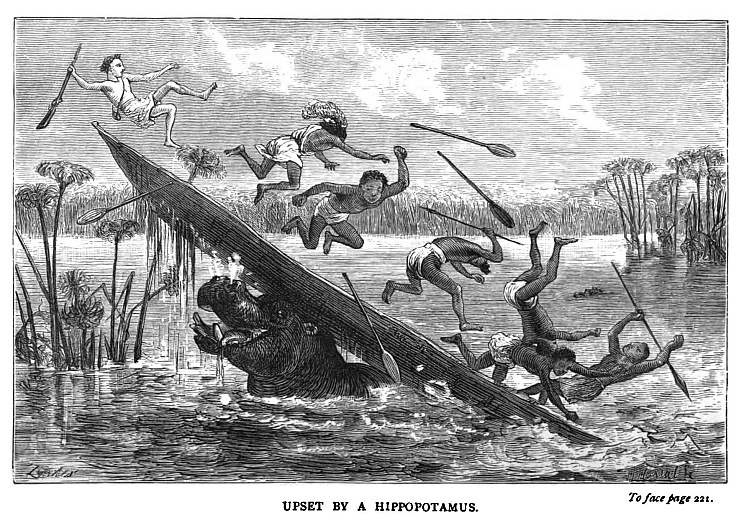
The three boys, Kalulu, Selim, and Abdullah, instinctively, as they felt the canoe lifted out of the water, rose to their feet with their guns in their hands, and when it was assumed beyond doubt that it would turn over, sprang into the water in different directions, and dived to the bottom, dragging themselves toward their island beneath, by clutching the tenacious mud. For some time the wounded hippopotamus remained master of the field, and no enemy appearing in sight, he sank, uttering a horrible bellow as he disappeared out of sight.
Immediately after, Selim appeared above the surface, more than twenty yards from the scene of the disaster, and swimming vigorously towards the island, which he soon gained in safety. Then appeared Abdullah, about ten yards from the bank; Kalulu close to the shore, with Simba, and Moto, and the two warriors close to him. In a second they stood on the shore, Kalulu minus his gun, but having his sharp spear in his hand; the two warriors had also retained their spears, while Simba and Moto had their guns in their hands, and their long broad knives in their waists.
As soon as they had regained the shore, and stood on dry land, the party began to cheer the youthful straggler, Abdullah, and to encourage him to greater exertions. He was within five yards of the bank, and Simba and Moto were already stretching their guns to him to grasp, when suddenly Abdullah’s smiling face assumed a look of terror, and a wild, thrilling shriek was uttered by him, which was silenced instantly by the brown waters closing over his head; and the calm, placid river flowed on, and no swimmer was seen disturbing its surface.
For the shortest possible instant, all hands seemed turned into stone; not a sound nor a breath was heard, until Kalulu was heard uttering the terrible and awful word, “mamba!”—crocodile.
Simba and Moto then breathed, and confused murmurs were heard from all. “Save him!” cried Selim; “oh, save poor Abdullah!”
There was no need to utter the prayer; for young Kalulu had divested himself of his wet loin-cloth, had broken the staff of the spear he held short off, close to the sharp head, and with the latter grasped firmly in his hand, had plunged head-foremost, unconscious, as it were, of the imminent danger of the hazardous undertaking, into the water, where Abdullah was last seen.
Kalulu’s feet had but disappeared beneath the water, when Simba and Moto, dropping their guns, divested themselves of their loin-cloths, and, grasping their long heavy knives, sprang in likewise, and the river, disturbed for but a short second, flowed on as before, with its silent, still flow.
It seemed an age to Selim, who stood on the bank with clasped hands, and cowering form, a prey to the keenest anxiety for the fate of all his friends, who had disappeared beneath the treacherous face of the river.
Yet thirty seconds could not have passed before the deep, brown water was again disturbed, this time in a violent manner, while it began to be slightly discoloured with, blood, and the crocodile’s tail shot suddenly above the surface, lashing the water into foam, and immediately after, Abdullah’s head; then Kalulu, Simba, and Moto simultaneously appeared above, making for the shore with all haste. As they reached the shore, Kalulu was seen supporting, with his hand beneath the hip, the body of Abdullah, who seemed to have lost consciousness. The ready hands of the two warriors dragged the almost lifeless body, as it reached the bank, and laid it carefully a few feet from the river, on the ground, while Kalulu, wringing his long braids clear of water, and drawing the draggled ostrich feathers from his head, uttered a ringing peal of laughter, and then said in a triumphant tone to Selim:
“We were too much for the mamba, Selim. He did not get my slave Abdullah this time!”
“Ah, thou art so brave, so good, Kalulu!” while grateful tears ran down his cheeks, as he sprang forward to embrace the young hero. “I shall never, never forget thee! I would not miss thy friendship for the world! Thou hast twice saved me—once from death, and another time from the hands of the cruel Tifum. Thou hast still more increased my love for thee, my brave brother, by rescuing Abdullah from the jaws of that horrid mamba. How shall I thank thee, my Kalulu? How shall I praise thee? Thou art swifter than an eagle, braver than a lion, comelier than any of the sons of men! Thine eyes are more tender than a gazelle’s to thy friends, fiercer than the greedy leopard’s, when it scents the blood of its prey, to thy enemies. Thou art tall as a palm-tree, straight as the hardened shaft of a spear, grace breathes in every movement of thy limbs. Thou hast saved the life of my playmate—even the life of Abdullah, the Arab boy. The dark grey waters had closed over his young head, his voice had been silenced in the deep, when thou, O Kalulu, didst leap in—a true hero!—to do battle with the scaly monster in behalf of Abdullah, my friend, and playmate of my happy childhood. I saw the waters hiss and foam, as the monster battled with thee for his prey. The victory was given to thee; Allah made thine arm strong, thine heart brave; for Abdullah, my friend, was brought back from death to life, from the dark waters to the sunlight, from the grave to the light of day. O Kalulu! if a fatherless boy is beloved by Allah, my prayer shall go up to God night and day for thee; if a true believer may intercede with Heaven, then wilt thou be blessed, and the soul of Abdullah’s dead father shall cry for thee before the holy footstool of Allah!”
“Ah, Selim!” replied Kalulu, embracing him in return, “has Kalulu, the son of Mostana, pleased thee? then is Kalulu rewarded. Kalulu is thy brother, and his heart is soft towards Selim, and to the Arab boy, for thy sake. Thou art good—there is no guile in thee. Kalulu is also good, but he has seen wicked men; and when a wicked man draws nigh to him, Kalulu’s heart is black, and bitter, and his spear comes quickly to his hand. His eyes search out the good; they found the good in thee, and Kalulu’s heart went to thee as thou didst lie like an antelope stricken to death in the forest. I shall love all Arabs for thy sake for ever. There shall be bad blood no more between us. For as good as thou art am I good, and as I am good, so art thou. Where I shall he, there shalt thou be, and where thou wilt be, there shall I be, until thou canst return in safety to thine own land. And when thou goest, do thou but remember thy brother Kalulu, and but whisper his name, then our Sky-spirit shall send the wind to bear thy whisper to me. Come, let us see how poor Abdullah fares.”
Proceeding to the spot where the still unconscious form of Abdullah lay, they found that the crocodile had snatched the young swimmer by the right leg, just below the knee, where his cruel sharp teeth had pierced to the bone, leaving ugly marks behind him.
“How didst thou find the crocodile, Kalulu?”
“Oh, I sprang to the place where I saw thy friend sink, and by good luck I came upon the crocodile’s back. The crocodile having dragged the boy down, let go of his leg, and laid on top of him. When the crocodile felt me on his back, he turned round savagely, but without leaving his prey. I had no time to stop talking with him, or to ask him to give me Abdullah back, because I knew he wouldn’t; and besides, I didn’t go to ask him, for it is very close down there, and there is no air. So I felt for his foreleg, and while I stabbed him behind, I felt my two friends, Moto and Simba, who perhaps thought that I was the crocodile, though my hide is not quite so rough as the hide of him. When the fellow felt the keen point of my spear in his heart, he rolled off Abdullah, and began to kick and lash with his tail in a dreadful way, and losing my spear, I caught hold of Abdullah by the leg, and came up. That’s how it was.”
“And what didst thou, too, Simba?” asked Selim, turning to his friend.
“When I went down, I caught hold of Moto’s hand, and diving, I touched Kalulu, but I knew at once that he was not the crocodile, for his skin is as soft as a child’s; the next minute I got hold of the crocodile’s leg, though he was kicking and laying about him furiously, and I let go Moto’s hand, who got hold of another leg. I buried my knife in the crocodile’s belly several times, and he swam away, leaving his inside dragging after him, while I came up to find Kalulu, Abdullah, and Moto right close to me. I think the crocodile has got more than he thought he would get, and that he will leave Abdullah alone in future.”
“Do you think Abdullah will come to soon?”
“Oh yes,” replied Simba; “he has swallowed a little too much water, or he has fainted from the pain. See now, Master Selim, he breathes! There, his eyes are open!”
Abdullah had only fainted, as Simba said, and this was the reason why the crocodile had so soon released his hold of his leg, and had lain on him. When he opened his eyes, Abdullah gave a long sigh, and asked where he was, to which a cheery answer was returned; and presently he talked, and discussed the event calmly, but not before he had endeavoured to kiss the feet of his saviour, which Kalulu had too much manliness to accept; but he knelt down by him and embraced him, while Abdullah availed himself of the opportunity, and kissed his forehead.
Abdullah having in a measure recovered, the two warriors were sent to hunt after the canoe, which fortunately was found, stayed in its progress by the reeds, at a point of the island projecting into the current; and, to their great joy, close to the canoe was the gourd to which was fastened the harpoon rope. Giving vent to a loud halloo, Simba, Moto, and Kalulu rushed towards them, and by their united aid they dragged the body of the dead hippopotamus to shallow water, and setting vigorously to work, they soon loaded their canoe with the luscious flesh, it being a food highly prized by the tribes of Central Africa.
By the time this work was despatched, it was night, and the hunters, lifting the wounded Abdullah into the canoe, and having a clear course up the river towards home, they started on their return journey, feeling as proud as men who have been successful in a dangerous exploit only can feel. They sang over and over again exciting hunting and boat songs with vociferous chorus, until midnight, when the fishermen’s fires, near Katalambula’s village, gladdened their eyes and made them rejoice as home-returned wanderers generally do.
Chapter Nine.
Selim—Happy Days—The Lover’s Song—The Magic Doctor Soltali—Kalulu proposes to hunt Elephants—Preparations for a Dance—The Hunting-Song—The Elephant Hunters set out—The Scenes on the March—The Hunters’ damp—Ten Elephants!—Kalulu addresses the King Elephant—The King Elephant dies—Selim’s Conduct in the Field—Kalulu is astonished at Selim’s Prowess.
Selim was now happy; and next to being able to reach his own Zanjian Isle, and revisit the scenes of his childhood, and romp, as of yore, with the playmates of his youth, and enjoy walks through the orange-groves with young Abdullah, he could not have chosen for himself a more tranquil life than that which he now enjoyed with his friend and new brother, Kalulu.
For the bright Liemba River was beautiful, though brown; its crisp little wavelets, where they washed over stone and pebble in the shallower parts, had music for him, though he never forgot that horrible scene near the island, when the smiling face of Abdullah changed into one of horror and sank down into the depths, with his shriek echoing through the woods.
The banks of the Liemba became for him a frequent resort, for Kalulu had made it generally known to all that he was his brother, and no Mtuta under the King Katalambula might molest him. Hence, he wandered where he pleased, finding charms in the wild woods, and in the depths of waving grain, in the peaceful, still life that reigned around, in the music of the birds, and even in the harsh cries of paroquets.
The Selim, the brother of Kalulu, was not the Selim of Zanzibar, but was the product of him, refined and pure from the fiery crucible of the unusual hardships he had endured. It was the same boy, but not the same heart. He, whom we knew at Zanzibar, the gay, light-hearted, sunny youth, playing with the females in the harem and his playmates on the beach, but ever listening in wonder to the great, wise words and sayings of white men, was changed for the dreamy boy with the poet’s heart, who chose solitudes, forests, and the depths of tall corn-stalks to indulge in reverie, which we are too apt to ascribe to melancholy. Perhaps it was melancholy, a tender, soft melancholy, engendered by many reminiscences of a mournful nature, crowding together in the mind of a boy who had suffered much, but who had seen but few years. There was the death of a loving father and loving kinsmen, the tragic fate of Isa and Mussoud, the most narrow escape he had himself from death, and poor Abdullah’s narrow escape from a horrible fate. These were not the best kind of subjects to dwell in the mind of a boy of Selim’s years; but what aided to soften all these, and did much to lighten his burden, was his present position, the tender friendship of Kalulu, the company of the gentle Abdullah, the calm tranquillity of the life he was now enjoying, and the consciousness—which his perfect trust in the goodness of God created—that there was a God above, who was both good and great, and who would bring him in his own good time out of all trouble.
For many days Abdullah suffered from the wounds which the crocodile’s sharp teeth had made in his leg. High fever set in, during which time he was attended by Simba, and Moto, Kalulu, and Selim.
All sport was at an end for Selim and Kalulu while their friend Abdullah was thus suffering. Nothing of enjoyment was thought of, nothing could be thought of but their poor young patient, whose constitution was battling vigorously against the fever which threatened often to terminate his life.
And what a time poor Abdullah had! Instead of the soft, silken counterpane and feathered bolsters, and the fragrance of lime and orange of his own comfortable home at Zanzibar, here were a mud-hut, low roof of straw and mud, a goatskin for his bed, a low door of cane-stalks, through which the white sunlight streamed hot and glaring, voices of a thousand rats for music, and the bad smells caused by the indecent habits of savages, for the perfume of ripe orange and cinnamon. All these aggravated the fever and created hideous dreams at night. For food he had a thin gruel, which Simba made for him to the best of his ability; for drink, the muddy water of the Liemba or some pombe-beer. Despite these, however, his constitution triumphed; the fever left him, and the wounded leg, carefully bathed each morning by Simba, began to heal.
When convalescent, Abdullah would leave his hut at evening, pale and thin as a ghost, leaning on the arm of his true friends, Kalulu and Selim, to enjoy the mild air, and to listen to the songs of the Watuta, and the sonorous music of the drums. The sight of the pale and thin Arab boy touched the heart of many a maternal bosom, and many were the expressions of condolence which he received from them. He often heard these dark-faced women utter expressions which he had never thought at Zanzibar could ever be uttered by black women; and he was rapidly beginning to learn that women are the same all over the world, whether they are white or black, and that human love and kindness belong as much to the black as to the white, and are as often practised. And the outcast, despised negro race were rising daily in his estimation. Neither was Selim indifferent to the tones of sympathy he heard from them; not only did Kalulu win his friendship more and more each day, but the whole negro race was being admitted into his brotherhood.