"My Kalulu, Prince, King and Slave" (continued 6)
Reading edition
As he felt the havoc made in his cheek the man uttered a frightful howl, and seized a spear-staff and began to belabour the unconscious boy. He probably would have beaten him to death had not Ferodia appeared and ordered him to desist, and to reserve his revenge for the morrow, when he might take it in full.
It was difficult to restrain the infuriated man, while his whole head tingled with the most exquisite pain; but then Ferodia was King, and a King’s commands must be obeyed even though his whole body ached, and he at last turned away moaning over his wound.
Soltali, the Mganga, was more feared when dead than when alive, it seemed, for while his body was being rapidly consumed the people had begun to move their camp a few yards off, none daring to erect his hut near the awful ashes of the magician, and as night came, with its sombre shades filling the whole forest with almost palpable darkness, and thick, dark, formless shadows, it was noticeable that they still further retreated from the death tree, and whispered to each other their belief that Soltali’s spirit was in the tree, with great angry eyes of fire, looking down at the camp. Thus the mortal ashes of the old doctor, whom they had so cruelly murdered, were left alone by the superstitious people, and Kalulu, helplessly stretched near by, was the only living being within fifty yards of the dread embers which covered the remains of Soltali.
Tifum the Wicked, too much engrossed with the pain of his wound, had seen nothing of this movement, for he had retired to his hut, with his head close to the door to breathe the cool air of the night. In his hut were the spoils from Katalambula’s village, which his own particular slaves had carried for him. Among these were two bales of cloth, ten fine ivory tusks, a keg of powder, a bag of bullets, three or four guns, and, singular as it might seem, was Selim’s gun, the Joe Manton which Sheikh Amer had purchased for his son, through his Bombay agent. This accident may be attributed to Tifum’s cupidity, who had appropriated this gun as his own, on seeing that it was of a superior class to all others, as well as the belt, which contained a large supply of ammunition. Ferodia would very probably have appropriated such a fine weapon for himself had he not been so occupied with the extent of his success and fortune.
The night grew deeper and more sombre. Melancholy sounds were heard at intervals through the forest, and the superstitious warriors ascribed these to the restlessness of the spirit of Soltali, consequently they huddled into their huts, forgot the cravings of their stomachs, and sought in the cosy warm huts a temporary oblivion from their fears and superstitious troubles, and, as the night got still more aged, even moaning Tifum became tranquil and slept.
When the camp had become as still as though no five hundred warriors with strong lungs and a healthy capacity for noise within them slept in that darkness, Niani’s light, active, boyish form, who hitherto has been unnecessarily neglected, began to move from the neighbourhood of a fire where, along with other slaves, he had curled himself to rest, but not to sleep, in the direction of the slave-gang to which his master, Selim, Abdullah, gigantic Simba, and Moto belonged. The pale-coloured forms of the two Arab boys were clearly discernible, and choosing the tallest, he crept up to him, and gently placing his hand over the mouth of Selim, whom he rightly judged it to be, he bent his head low down to his ear.
“I am Niani, your slave; be still, master. I have come to save you, for I have heard Tifum swear that to-morrow you shall die with Kalulu. Hush! I have my knife. I shall cut your bonds, and those of your friends, and we shall all go away far.” So saying Niani released his hand, and with his knife parted the hark rope that fastened the iron collar, and in a second Selim felt his neck free from the ignominious chain.
Niani crept to Abdullah, and performed the same kindness for him upon the express condition that he should lie still until the hint was given to rise. From Abdullah Niani crept to Simba, and told that wondering giant who he was, and why he was there. Simba understood at once, and slightly turned over that Niani might cut the bonds which confined his hands behind his back, and raised his head that he might be released from the collar. Moto’s turn came next, and in a short time he was also free. Each head was now touched, and they at once rose and followed Niani past the sleeping forms, by the fires, and past the open huts confidently, but still quietly, until they came behind the fatal tree at whose base lay the ashes of poor old Soltali.
“Now, Master Selim, speak, what is to be done?” asked little Niani in a low voice.
“Let Simba and Moto answer; but we must not go without Kalulu, for rather than go without him I will go back and die with him.”
“I don’t intend to go either without him,” said Abdullah. “I would count it a deed worthy of paradise to die with him, and by his side. Here, give me the knife, I will go and cut his bonds.”
“No, no, master,” said Simba, “I want to go back for a particular purpose, besides rescuing Kalulu. Thou, Moto, stay here, and if any alarm is made, then do thou run east, and in the morning turn south. Here, Niani, come with me. Give me that knife.”
They both disappeared on the other side of the tree, and Simba, crawling on his hands and knees, followed by Niani, made towards where Kalulu lay stretched in anguish of body and mind. When he had advanced sufficiently near, Simba whispered the boy’s name with a warning—“Hush!”
Simba was presently close to Kalulu; and, after informing him of his purpose, soon freed him from his painful position, and Kalulu sat up, though feeling almost too sore and cramped to move.
Simba waited patiently for the first feeling of numbness to wear away, then whispered to him:
“Kalulu, dost thou remember Soltali’s words? Soltali said that Tifum’s head should be taken from off his body. I am going to take it now. Wilt thou come?”
The instant these words were suggested all feeling of soreness vanished, and the boy sprang up and was about to shout his gladness, when the big hand of Simba was placed over his mouth, and he whispered:
“Nay, not a word, not a breath, as thou dost value our lives. Our friends are behind that tree; they are waiting for us. Thou must obey me now, if success is what thou dost hope for.”
Kalulu clasped his hand, and understood at once what was necessary, and followed Simba, who was preceded by Niani, without further remark.
When near Tifum Byah’s hut Niani, who was as cunning as the nature of the mammal from whom he derived his name, stopped, and pointed silently to the hut, which stood alone and removed a good distance from any other that was inhabited.
Simba turned to Kalulu, and, handing him the knife which he had received from Niani, whispered to him: “Stay here silent as a dead tree, until thou dost hear my signal,” to which a nod of the head only was given for reply.
“Now, Tifum the Wicked,” whispered the resolute mind of Simba to itself, “it is either I or thou; I think thou. Selim’s stripes have to be paid for with thy blood; if not Selim’s, then Kalulu’s wrongs. But how can I ever pay thee for all? Sheikh Amer, my master; poor Isa; little Mussoud;” and the busy mind fanned itself into a white heat of anger, and churned the deep hate into a white foam of fury; and the Nemesis, in the form of this mighty, big-muscled man, stood over him, Tifum the Wicked. The great form bent, and suddenly drooped, with two great bony, sinewy hands clutching the sleeping man’s throat, crushing, compressing bone, gristle, sinew, and vein into a soft, yielding, pulpy mass, until there was no breath of life nor power of motion left in him.
All had been done so quietly—the deed of stern vengeance so quickly, coolly executed, that Kalulu started with surprise as he heard the signal; he could hardly believe it to have been consummated, yet he advanced determinedly, as if his help was to be needed. Think of Simba needing help for such an ordinary creature as Tifum.
“Cut it off!” said Simba, and Kalulu, nothing loth, bent down and severed the head off without one remorseful pang, and the body of Tifum was headless; and the prediction of Soltali had become thus soon verified.
Simba and Kalulu were about to move off, when Niani stepped up and whispered:
“The guns in his hut!”
“Ah, true,” and Simba turned round and gave Niani a couple of guns, to Kalulu he gave one, he reserved one for himself, then went into the hut, found the powder bag, the load of bullets and ammunition; snatched a bow, a quiver full of arrows, a couple of spears, and a long Arab sword, which Tifum had also appropriated, and with the booty, too valuable to be measured at a money value for such an expedition as he now proposed to himself, he withdrew as silently as he had come.
Once at the tree the guns were distributed, one to Abdullah, one to Moto, the “Joe Manton” to Selim, who hugged it to his heart, while Simba retained another. To Kalulu he gave a spear with the bow, and a quiver full of arrows. Niani got another spear, while he also received the precious powder-keg to carry. Simba carried the bullets and sword. Kalulu still carried the ghastly load, but nothing was said to any of the others of the deed that was done. Simba merely said “Come,” and the five followed him obediently.
“Four hours more of night till dawn,” said Simba, after they had got a little distance off. “We must march south. Come.”
In a hard, dry, trackless forest, when once a fugitive escapes it becomes impossible to find him. Had Kalulu not taken the precaution to strip himself of his cloth, and place the head of Tifum in it, it is probable that the fugitives might have been pursued; but there was no clue to the direction they had taken, for five hundred warriors had trodden the ground all around while hunting for fruit, or sticks, or water for cooking, the day before, even if the hard drouthy ground might have received the impression of a few men’s naked feet. And the natural questions the warriors would ask themselves and each other in the morning would be, “Which way have they gone? Is it north, south, east, or west? or any other of the lesser or intermediate points?” to which, of course, no definite answer could be given; while the more superstitious would say, “Ah! it is Soltali who has taken them away!” and would fear to leave their fellows.
Simba, Moto, and Kalulu knew this, and though they journeyed fast, they journeyed confidently. But, as each of the party was busy with his own thoughts, no words were exchanged until it was grey morning, and day had more power to pierce the gloom of the forest than the old moon, which but faintly showed them their way before morning, when Selim saw some mysterious bundle in Kalulu’s hand, and asked him what it was.
“Don’t ask now, Selim, my brother, we must march,” said Kalulu, and nothing more was said until at nine o’clock they stopped at a swamp to refresh themselves with water, when Kalulu setting down his bundle to drink, the cloth fell off one side, and exposed the head of a man.
“Allah!” ejaculated Selim, profoundly astonished; “what is this?” and Abdullah also cried out in astonishment the same words.
“What should it be, my brothers, but the head of Tifum the Wicked?” asked Kalulu.
“But this is murder, is it not?” asked Selim, aghast at the unsightly and livid head.
“Murder!” echoed Simba; “I think not, young master. It may be with thy people, but with Kalulu cut off his head. Was Tifum not going to cut off Kalulu’s head?—and perhaps thine, for he hated thee enough, Allah knows.”
“Yes,” said Niani, “I heard Tifum swear he would do it.”
“Well, but he did not do it, and I am sorry, Simba, thou hast thus needlessly taken life,” said Selim, with difficulty repressing a shudder.
“Selim, son of Amer, permit Simba, the Mrundi, to ask thee if thou hast already forgotten thy dead father, thy kinsmen, thine own miseries? Say, where is Isa? Where is little Mussoud? How was Abdullah treated? What became of Kalulu, thy friend? Where is Soltali? What has become of the village of Katalambula? I tell thee, young master, that if an Arab boy can so soon forget these, I, a Mrundi, cannot; and were Tifum the Wicked possessed of a thousand lives, I would take a life of his at every opportunity. What sayest thou, Moto, my friend? Have I not said well?”
“Quite right, my brother Simba, I should have done the same; and I am only sorry it fell to thy lot to take his life, because I should like to have taken it myself,” answered Moto promptly.
“What sayest thou, Kalulu?” asked Simba of the young chief.
“Here is my answer,” answered Kalulu, pointing to the head, which he picked up and tossed into the air, smiling as the head fell on its nose.
“What sayest thou, Abdullah? thou who art an Arab, and the son of an Arab?” asked Simba.
“The Küran says: ‘And if thy enemy depart not from thee, and offer thee peace, and restrain his hand from warring against thee, take him and hill him wheresoever thou dost find him, for over him God has granted the true believer a manifest power’ Since the prophet Mohammed (blessed be his name) speaks on thy side, Simba, far be it from Abdullah, son of Sheikh Mohammed, to say thou hast done wrong in this fearful thing. I think thou hast done right,” answered Abdullah gravely.
“Then, if the Küran says so, I, Selim, son of Amer, am convinced thou hast done right,” said Selim, as he hastened up, and, with an apologetic look, begged Simba’s pardon.
“I, Niani, the mtuma (slave) of Selim, the son of Amer, do pronounce that Simba did right,” cried the little negro, with an assurance which made all smile, and for a moment forget their previous mood.
“But what art thou going to do with the head, Keklu?” asked Selim.
“I am going to take medicine from it,” replied Kalulu, “to make my arm strong against Ferodia, when we get to the camp,” folding it up in the cloth again as he spoke.
“Ah, don’t, Kalulu, for my sake,” pleaded Selim with earnest eyes; “don’t, it is bad; only the lowest and most degraded do that. Cast the ugly thing away, and let it be food for the fowls of the air and the beasts of prey.”
“It has been the custom of the Watuta to do such things, and if I do not do it Kalulu will never be king,” replied the young chief, resolutely moving forward.
“It has been the custom of the Warundi too, and of all the tribes around here that I have met,” said Simba. “Let Kalulu do as he will with it, young master.”
“But thou art a Moslem, Simba; thou art not a Mrundi infidel now;” urged Selim, whose feelings revolted at such a degraded idea.
“Ay, I am a Moslem in name, but a Mrundi in heart, master; and when I think of all that Tifum the Wicked has done, and would have done, I myself should like to take medicine from it,” replied Simba, with a vengeful look.
“But Simba,” said Abdullah, “the Küran says we ‘are forbidden to eat that which dieth of itself, and blood, and swine’s flesh, and that on which the name of any beside God hath been invoked, and that which hath been strangled.’”
“Al Forkan” (the Küran) “is a holy book, Simba, that may not be disregarded, and he that turneth his back to it shall surely perish,” added Selim.
“I am not going to eat Tifum’s head; the Warundi do not eat men. They only take medicine from them; but if the good book says it is wicked, I give you my word I shall not do it,” responded Simba. “But let us march, we have no time to talk,” and setting the example, by vigorous strides, he induced the little party to strain themselves to keep up with him; and from this time until sunset there were few words exchanged, except a remark now and then upon some exceptional feature of the forest through which they were travelling.
At sunset the fugitives were obliged to halt, and seeing a dense jungle clump before them, they sought an opening which led to it, which they presently discovered, narrow and a little inconvenient, but it led them into a delicious and secure resting-place. The camp, which they now intended to make, was surrounded by an impenetrable hedge, about fifty feet thick and about twelve feet high, of thorn and cactus, aloetic plants, convolvuli, all-interlacing, embracing, twining round each other, each leaf, or twig, or branch armed at all points with a myriad thorns, through which a boa-constrictor might in vain attempt to pass, a man never, were he armed in triple steel, least of all a rude savage; while inside was soft, green, silken grass, and a small circular depression in its centre like a “buffalo-wallow,” which contained water. Could anything have been more tempting than this? Surely not. Had the most cunning Moto devised the best protection he could, he had never conceived anything more formidable against naked man or beast! And the two Arab boys laughed merrily, and rubbed their hands together, as they thought how secure they were.
Simba, who had assumed the leadership, as though leadership was an everyday thing to him, looking around, said:
“We are safe. No Watuta can find us here, but we are short of food, and boys become hungry soon. In the morning we must look for food, as we journey south. What dost thou think, Moto? is this forest likely to last much longer?”
“I know not, friend Simba. I should think not; but the minute it becomes thinner and more open we shall see game,” replied that clever woodsman, with so much confidence that Selim, Abdullah, and Niani began to smack their lips, as if they already tasted the luscious, juicy meat of fat game.
“Simba, I know this forest well,” cried Kalulu; “but before I say anything about it, I must know where thou dost intend to go.”
“Ah! where?” asked Simba, looking at Moto, and speaking in a tone which was more of a doleful echo than a question.
“Where?” said Moto, in the same tone, looking at Simba.
“I must know,” said Kalulu. “We are far from pursuit now. Ferodia might as well look for the honey-bird, hiding his head in a hole, as look for us. Speak, Simba and Moto, where do ye both intend to go?”
“Answer thou, young chief,” replied Simba and Moto, together.
“I? Well, let it be so,” he answered. “I mean to return towards the east, through the forest, and then turn up north and west, and seek out every man left of my tribe, and make war against Ferodia. Make war on the traitorous thief, until every man that lifted spear in his cause shall be even as this carrion is,” (pointing to the chilled head of Tifum). “War, until all my enemies shall fall, and be utterly destroyed as the dry grass of the summer is destroyed by a fire. That is what I intend beginning to do at sunrise to-morrow;” and as the young chief said the last few words he sprang to his feet, and dashed his spear deep into the now unoffending head of Tifum the Wicked, and his whole body quivered with the fury that animated him.
While he was thus imagining that he had already his enemies low at his feet, he felt a soft touch on his shoulder, and as he turned his head around he saw the gentle, winning face of Selim turned up to him with pleading eyes, and heard him say:
“Kalulu, thou art still the King of the Watuta to us; sit down quiet by my side, like, my brother Abdullah and little Niani here, and listen to what thy brother Selim has to say.”
The friendship he entertained for Selim came to the aid of the Arab boy, and this, together with the kindly tones and sympathising eyes turned towards him, completely subdued him, and he sat down, and for the first time, to our knowledge, Kalulu wept. Selim’s tender heart could not bear the proud young chief’s tears, and he also wept out of sheer sympathy.
“Kalulu,” said Selim, when he had conquered this feeling, and could command firmness of voice, “when I was dying of hunger in the forest thou didst come to my aid, and, pitying me, a friendship grew in thy heart towards me, and when I opened mine eyes, and saw thy large black eyes rest on me with so much pity, so much love in them for me, who until then was as one doomed to die a lingering death, was as an outcast from Nature, I learned to love thee as my brother. The blood ceremony was made, and I gladly became a brother to thee. When I was in the village, and I felt Tifum’s heavy hand on me, with the cruel order of Ferodia ringing in my ears, thou didst again come like a good angel to my aid; and in my heart I blessed God and thee. When Abdullah struggled in the dark waters, and the greedy crocodile snapped him by the leg, and drew him down out of sight, down into the depths, I cried out in my agony, ‘Oh, save him!’ and thou, ever our good angel, didst leap into the depths, and far out of sight thou didst grapple with the monster, and in a short time didst bring him—Abdullah—back to life and to his friend. When thou wert made king, and thou hadst power of life and death over an immense multitude of warriors given unto thee, I did ask thee for permission to go to my own home at Zanzibar, to lift the veil of sorrow from my mother’s eyes, and thou didst promise to give me wealth, and abundance, and men under thine own command to protect me on the way. But evil days came. Ferodia, like a thief in the night, came with a great number of men; they took thy power from thee, made thyself, and ourselves, and thy people prisoners and slaves. They bound thee, and made thee—a king—also a slave; and until last night thou wert in bonds, and yesterday thou wert beaten like the meanest, and to-day’s sun was to rise on thy corpse. But Niani—good Niani, whom I believed to be created only for mischief and fun—rose in the night, and delivered us all from the power of Ferodia; and we are all here safe from our enemies, and free once more. Allah be praised for ever!”
Kalulu was sobbing violently, and Selim, when he heard his sobs, could hardly refrain from joining him, but, conquering the feeling with an effort, he continued:
“Kalulu, my brother, it is but a little thing that I am going to ask of thee, yet if thou wilt but grant it me, thou wilt make Selim happy—ay, happier even than when thou didst whisper the sweet words in my ear—‘Thou art free! Thou art my brother!’ I fear to ask it of thee, lest thou wouldst hurt me with a refusal.”
“Speak, Selim; what can Kalulu do for thee? Have I not told thee long ago thou hast but to command me. Yet what have I to give thee? Was not Kalulu a slave yesterday? Ha! ha! what has a slave to give?” and the young chief laughed bitterly.
“Thou hast more to give me than ever thou didst possess, Kalulu. Wilt thou promise it me what I shall ask.”
“Thou art but mocking me; but I give thee my promise, and a promise is not broken lightly by a Mtuta chief,” Kalulu answered.
“Then listen, O my brother! At Zanzibar I have a beautiful home; and all around it are trees, great trees, like those in the forest, heavy with yellow globes of sweetness, called oranges, others borne down with great fruit larger than the matonga (Nux vomica) of the forest, which are sweeter than honey, and are called mangoes; and there are tall trees, called palms, which bear nuts large as thy head, full of milky wine, so refreshing when thou art thirsty, that thou wilt recall the time when thy mother suckled thee, and laughed at the greediness of her bright, baby boy; and there are numbers of others, which give both fruit to fill a man’s spirit with delight, and others to give perfume, which, when a man inhales it, his senses become suffused with pleasure; and as for the vegetables which my fields and gardens furnish, there is nothing in all ututa, or the lands adjoining, to compare with them. There are squashes, and pumpkins, and melons, blue and purple egg-plants, cucumbers, chick-peas, and beans, yams, sweet potatoes, white and yellow tomatoes, and plaintains, and bananas, and numbers of things thou dost not dream of. And then my house—ah! there is nothing like it in all Negro-land; it is as high as the tallest tree, and as large almost as the great square of thy Tillage, all of white stone; the floors, instead of being of earth or of sand, are of white stone, smooth and shining as the stillest, whitest water thou hast ever seen; and the beds are of down and of finest, whitest cloth, which when thou dost rest thy body upon them will cause thee to sleep and forget all troubles; and from the upper doors, which we call windows in Arab land, thine eyes rest upon the great blue sea, and the laughing wares, which murmur of love, and beauty, and pleasure all the day. It is to this beautiful home I invite thee, my brother. It is to these scenes of holy love, and God’s beauty, which He has given to me, that I wish to take thee; and to my dear mother, who will be to thee as she is to me; who will love thee for what thou hast done for her child, as she loves her own son; to my beautiful mother, whose face is as white as yon white cloud, and as beautiful as the moon, I wish thee to come. Say, Kalulu, wilt thou come, and share my sweet mother’s love with me? Say, wilt thou come, and let me show thee the wonders of Zanzibar?”
Kalulu answered not; he never ceased sobbing while Selim spoke; he seemed loth to give the answer in the affirmative, yet he remembered his promise, and he remembered it was Selim who was asking him a favour. A few seconds, therefore, passed in this silence; but when it was finally broken it was by Simba’s deep voice, who said:
“Those are wise words, young chief, that Master Selim has spoken. Neither Moto nor I could have thought of them; but the boy’s heart has spoken wiser words than Simba and Moto’s heads together could have spoken. Young chief, thou shalt yet be King of Ututa; but it will be better first that thou goest to Zanzibar, where thine eyes may see strange things, and thy head learn wisdom. I, Simba, a servant of Selim, could not have invited thee to Zanzibar, because Simba has but a very little hut, not bigger than a camp-cote, where the hunter has to coil himself up like a serpent. My hut would then have been no place for the King of the Watuta; but Master Selim has got a big house, bigger than any king’s house in Negro-land; he has numbers of servants, cattle, goats, donkeys, gardens, fields, and fruit-trees, and his riches are beyond my knowledge. Oh! I see light and hope now, young chief. I know what is best for all of us. I know how thou, by going to Zanzibar, may come to Ututa a greater king than Loralamba even. I’ll tell thee how. Through the aid of Selim thou wilt become acquainted with numbers of rich Arabs, whom thou wilt like when thou wilt know them better. They are good men at heart, though some are bad, as there are bad men everywhere. This acquaintance will benefit thee and them, for after thou shalt have rested a year or two at Zanzibar, thou wilt be able to induce them to come with thee to thine own country, when for their aid to set thee in thy rights, thou wilt be able to give them back the Arab slaves Ferodia took at Kwikuru, and give them ivory in abundance; and they will make thee rich in cloth and fine things: thou wilt by that time, through the knowledge of such things obtained at Zanzibar, be able to judge of what is good, and what is bad; thou wilt be able to build thy villages strong against every attack of evil men, to conquer Ferodia, and every tribe round about, to make thy country great, so there will be none other like unto it; so that thy name and glory be sung in all the corners of the earth. To be a great king thou must teach thyself and learn many things; and this thou canst do by going to Zanzibar. I have said it.”
Then Kalulu, impulsive youth that he was, sprang up and cried, “Enough, Selim, thou hadst almost persuaded me; but Simba has conquered me. I shall go to Zanzibar, I shall learn how to be a great king, and I shall come back to Ututa a strong, big man like thou, Simba; then let Ferodia look to himself. Let him live upon the fatness of the land. Let him enjoy his gains until Kalulu comes back, then by Soltali’s ashes, by the grave of Mostana, by the black ruins of Katalambula’s village, I shall have fullest revenge. I have spoken.”
“Good—good—good,” cried all at once, and Selim sprang up and embraced him, while Simba and Moto took each a hand and shook it eagerly, while little Niani jumped and hopped about as though he were a real monkey, whereas he was only a monkey in name, and Abdullah, after Selim released him, insisted also upon the same right to embrace him, and promised upon the Küran to come back with him to Watuta and see him righted. There was such joy in the little camp, closed in by that impenetrable jungle hedge, such as we are certain was never seen before, and never will be seen there again.
“There is one other little thing I should like to see Kalulu do,” said Selim, smiling, but looking on the ground nevertheless.
“What? anything else for me to do? Well, I will do it. Speak,” replied Kalulu, lifting Selim’s head up with his hand so that he could see his face.
“Thou art so good, Kalulu, to promise me so many things before thou knowest what it is I am going to ask. Thou knowest that I am very timid and fearful, and I could not sleep to-night quietly with that ugly head so near me, and—”
Kalulu rose immediately, and taking hold of the head by the hair, he tossed it into the middle of the jungle hedge, where, rolling through a little, it remained fixed in the forks of a thorn-bush situated exactly in the middle of the hedge, where it was more effectively buried safer from all living creatures than were it buried ten feet deep in the earth.
“Good—good,” cried Abdullah and Selim, really more rejoiced and feeling safer from Tifum than they liked to confess.
“Now,” said Simba, when each person’s feelings were calmed, “let us talk of other matters. Kalulu, thou knowest this country. How can we get away to Zanzibar?”
“But where is Zanzibar?” asked Kalulu, surprised.
“It ought to be east directly from here, just where the sun rises every morning,” answered Simba.
“I can show the way to Urori; but what lies beyond Urori I do not know,” said Kalulu.
“We are too small a party to be able to go through Uhehe alone,” said Simba. “That won’t do. What do you suggest, Moto?” he asked of his friend.
“If I were anywhere on the track of the traders,” answered that wise and cautions old hunter, “I would soon find out. If I were in Marungu or in Usowa I could soon tell. Did I not hear thee say, Kalulu, that there lay a lake, a large body of water somewhere about here?”
“Yes, Lake Liemba; there is no end to it. It runs towards the north,” replied Kalulu.
“Lake Liemba! Liemba!” said Moto to himself, like one trying to remember whether he had ever heard the name before. “I never heard of Liemba that I know of. I have been on Lake Tanganika several times in going from Ujiji to—”
“Ujiji!” said Kalulu, in a surprised tone. “Ujiji! I never heard the Watuta travellers talk about the Tanganika; but I have always heard that Ujiji was on Liemba, not far from Usowa, but further up.”
“Wallahi!” shouted Moto. “Then Lake Tanganika is only another name for Lake Liemba, for Ujiji is on Lake Tanganika, and Usowa is only a few days south of Ujiji. First after Ujiji there is Kawendi; then we come to Usowa; and after that is Uwemba—no, not Uwemba—Ufipa; and after Ufipa, Uwemba; then we always went straight to Marungu.”
“If thou canst go from Ujiji to Marungu, then,” said Kalulu, “or to Wemba or Usowa, the road is easy, if thou knowest the road from Ujiji to Zanzibar.”
“Ah! don’t I?” answered Moto, in a triumphant tone. “I will find the road from Ujiji to Zanzibar. I have travelled the road five times from Ujiji to Zanzibar, and I ought to know it. I have been guide to Sayd bin Hashid from Unyanyembe to Ujiji; but there is a better and nearer road to Zanzibar from Fipa to Usowa; then to Ukorongo and Unyanyembe.”
“Well, then,” said Simba, “what we have got to do is to reach this lake, whence it is easy to reach Ufipa or Usowa, and from thence to Unyanyembe, after which it will be easy to get to Zanzibar.”
“I know the road to the Lake,” said Kalulu, “for I was on the lake some moons ago. It ought to lie just where you saw the sun set to-night about twenty days’ march from here. But between us and this lake is Ferodia’s country. We should go a week further this way (pointing to the south), then turn round and go up, slowly towards the lake.”
“Ngema—Ngema” (good, good), all cried delighted.
“To-morrow we will continue the journey south, and after a week we will pick our way toward this lake, and Inshallah! we shall see Zanzibar within five moons from now,” said Simba.
“And to-morrow we shall get food—Inshallah!” said Moto.
“Inshallah, Inshallah!” all the Moslems cried.
They now proceeded to divide their ammunition, the powder and the bullets for Simba and Moto and Abdullah; while Selim, on inspecting his cartridge-bag, found a box with a thousand caps and one hundred bullets for his “Joe Manton.” Kalulu employed himself in examining the string of his bow; while Niani, seeing everybody else examine his weapon, thought he might as well follow their example, and began to look at the blade of his spear in a wise manner, and delighted everybody with the news that it was sharp.
Chapter Twelve.
Morning in the African Forest—Buffalo—The successful Stalking—Plenty of Beef—Little Niani’s Story—The end of Nioni’s Story—Simba adopts Niani as his Son—The Torments of a Jungle—Jungle and Plain—The Journey and its Fatigues—The Lion—The Lion despoiled of his mane—A Cornfield—A Chance of Escape.
As the sky began to flush and brighten, and to be suffused with colour as it heralded the uprising sun, our party of travellers, cosily asleep in their camp, began to yawn and to stretch their limbs until they were finally awake, and sat up.
There were no tents to pack, there were no loads to prepare for the journey; there was nothing for them to do but to shake off the grass and soft earth on which they had slept from their bodies, leave the camp, and march. This they did.
Nothing is so delightful as an African forest at break of day, where there is no high grass dripping with dew, no cane with its sword leaves to slash you wet with a showering rain as you pass under, nothing but the soft brown leaf-mould on the ground into which the feet sink as into a thick Persian carpet, thus giving you ample opportunities to observe the beauty of a forest at early morn, without inconvenience or anxiety on the score of your health. The forest, with its countless trees, each loaded with its wealth of leaves and twigs, seems in the first grey opaque light before sunrise to have been planted, full-grown, and decked with light green leaves during the chaos of night, as they stand in their several positions row upon row in numbers untold, all wonderfully silent and still, awaiting the issue of the morning. And while they stand thus apparently labouring under excitement, though outwardly still as death, in the grey light and opacity through which the trees were first seen, there suddenly dart myriads of bright sheets of brilliant whiteness, which soon alternate with some of the hue of pale gold-and-yellow, and unconsciously the brilliant sheets of colour of glory have become indistinguishable in the general light of day which has at last come. Then, in harmony with the advent of the glorious day, the trees seem to recover from their astonishment, and their leaves begin to rustle and whisper to each other their gentle comments on the great change which the sun has wrought; and from afar, borne by the breath of the wind to the human ears bent on listening, comes the low murmur of wakened life, the songs of birds, the fish-eagle’s and paroquet’s discordant cries, the hum of busy termites at work, the murmur of lady-birds, the whir of gadflies and tsetse, the startling “crick” of crickets; and away, almost at your feet, rushes the frightened landrail uttering a piercing cry, and above your head flies the guinea-hens which, unknown to you, had roosted on the tree-bough just above, with an assumed terror, which provokes your smile; and presently the hyaena is heard uttering his last farewell howl as he hies to his den to shun the honest sunlight, and the lion sends his last farewell roar, filling the forest with its awful sound, and the young fawns and horned antelope are seen browsing on the sweet fresh grass, which is decked with many a minute head, and the elands and the kudu, the sable buck and hartebeest, blue-buck and zebra, are beheld munching and chewing in the glades with might and main, as if they had a task to fulfil before the end of some set time, which we may take as a warning that we have also our appointed work, and must be up and doing.
This beautiful transformation from the gloam of the morning to the full burst of day was seen and enjoyed by the most poetical of our travellers, as they marched as rapidly as their waning strength would permit them after the tireless forms of Simba and Moto.
They had marched an hour, and the whole forest, which to them was a world, was all aglow with insect life, when Simba suddenly halted, with his finger pointing towards an open country bounded by hills in the far distance, and said in a whisper, “Mbogo” (buffalo).
The excitement became general, and the question which first came to each lip was, “Where are they?” but following the direction towards which Simba’s finger pointed, they were able to discern with difficulty three or four black specks in a portion of the open country which apparently was the same Ututa plain which had bounded the forest to the right all the time. Simba, Moto, Selim, Abdullah, and Kalulu, at once and instinctively struck for the open plain, followed by Niani, who, with his single spear, looked as important as one could well be, and who seemed to think that all the buffaloes would eventually fall beneath his hand.
Arriving on the edge of the forest, Simba, in order to make sure of one of them, separated his forces, each about forty yards from the other, with instructions to crawl towards the animals and surround them on all but the windward side; to make no noise, and to wait for a low whistle to rise up and fire. After each of them had promised faithfully for the commonweal to obey such injunctions, which were also impressed on their minds emphatically by the hunter Moto, the laborious task of working their way towards the animals began.
Fortunately the wind was from the westward, so they were not compelled to make any détour to avoid tainting the air, and between the buffaloes and themselves rose several low hummocks, ancient ant-hills deserted long ago, and now covered with dense tall yellow grass. The plain was also covered with the same tall grass, but at their base grew the young herbage—signs of the coming spring and rainy season now fast advancing—which probably was that upon which the buffaloes fed.
To our people it was a serious matter to fail, as their hungering stomachs could not sustain their bodies much longer in their march, without replenishment soon; besides, the excitement of the escape from cruel bondage had vanished, so that it became a vital necessity to obtain food. This strong, urgent necessity probably compelled their caution, and taught each person the art of stalking much sooner than they had any idea could be learnt before.
Steadily they advanced, crouching close beneath the grass-heads, hiding behind the numberless hummocks which rose in their front at intervals, behind the tall mysterious palms whose fan-like leaves kept up an unceasing rustle, and waving as the breeze swayed them up and down, and blew them with a startling noise against the tall trunks.
Nearer, step by step, they crawled with bated breath, and crowds of anxious thoughts running through their heads, lest the slightest error or alarm might be made by some awkward companion, every now and then lifting their heads up to note the progress they made, or the position of the massive and fierce brutes whom they intended to attack.
Kalulu, more experienced than any other, had found his task much lighter than either Simba or Moto, least of all the Arab boys, his lithe, sinewy form had penetrated through the grass with the ease of the young antelope, from which he derived his name, and had found it no difficulty whatever to stalk the buffaloes; so that, long before his companions had gained their several positions, he had ventured as near a buffalo bull as prudence would suggest, and one of his arrows was already resting on the string which his practised hand would surely send home into the animal’s flanks on the first sound of the signal.
In a few minutes, Simba having kindly waited for his friends, Kalulu heard the whistle, and as he stood up he took a second’s survey of the field. Moto was far to the right of Simba, Simba was next to Kalulu, Abdullah was a few yards behind him, on his left, with his gun pointed at the same animal he had chosen. Selim was the furthest on the left, about thirty or forty yards from a young bull buffalo. This was taken in at one glance, and probably Simba and Moto had taken the same precaution. The next second Kalulu’s bow twanged. Selim’s rifle and the muskets of Simba and Moto were heard together, and there was confusion and momentary dismay among the animals, as they heard the startling reports of the fire-arms. The lord of the little herd, in whose side Kalulu’s arrow was buried up to the feathers, had already lowered his head, and was preparing for a charge, when Abdullah’s gun rang out sharp and loud, close behind, it seemed to Kalulu, who instinctively bent his head, and the formidable bull reeled under the stroke of the bullet, which was flattened in the centre of his head but only for a moment; for, after uttering a frightful bellow, he lowered his head again, and came down, tearing the earth, towards the active young chief.
Pooh! the brute might as well have charged upon smoke, as upon the young Mtuta; for a single bound took him to one side, clear out of danger, and as the buffalo passed by, exposing his flanks, Kalulu drew his bow until it was almost double, and sent a barbed arrow clean through his heart, which rolled him over and over in the agonies of death. Thus Kalulu won the first prize.
Simba and Moto had been engaged with the same animal, which two bullets well aimed soon settled for ever. Selim, on the other hand, had broken a leg, just at the shoulder, of the buffalo to which he was opposed, and with his second barrel had sent a shot through the body, which so sickened the young bull, that he could do no more than roar painfully, and vomit blood, sure signs of his fast-approaching doom. Before he could reload his gun, the buffalo staggered, fell on his knees, and rolled over, still and dead.
Little Niani had in the meantime been skulking behind a tree, watching with a critical eye the battle, and now as he saw it terminated he advanced from his place of security, and gave a shout of triumph, and made as much noise, as though he, single-handed, had laid the three buffaloes low; but, for the good deed that he had so lately done, nobody cared to dispute his assumption, and all laughed merrily as they saw him dance on the body of Kalulu’s bull. Not for long, however, for human stomachs were calling for food, and spear-blade, and knife were therefore set industriously to work to carve out the finest pieces of beef. Simba and Moto each carved out a hind-leg of rosy, juicy beef, at the sight of which the saliva ran out of their mouths like water, and Niani, as he saw the rich chunks which Kalulu, with the aid of Abdullah, extracted from his game, almost drowned himself with swallowing his saliva.
When each was loaded down with beef, the party returned to the forest again, straight towards the east, for its gloomiest recesses, where they might remain in security, while they cooked and ate, should any enemies have heard the reports of their guns.
In about an hour they reached a secure place, a similar clump of jungle almost to that wherein they had slept so cosily the night before. A fire was soon made with the aid of their muskets, by Simba and Moto, while the boys, under the direction and example of Kalulu, employed themselves in preparing slender rods, pointed, with which they pierced small pieces of beef, to plant around the fire for a speedy broil. In their great hurry to allay their gnawing hunger, too, they threw several thin slices into the hottest part of the fire, which no sooner were warmed than they were extracted again and eaten with a relish and satisfaction which the poor stomachs alone could have properly described had they the same power of speech as they had of digestion.
While they were thus eating, a glance at the fire showed a regular palisade of slender sticks, on which numberless pieces of meat were impaled, and Simba and Moto having thus satisfactorily arranged the cooking of the rations, began to make other preparations for the same purpose on a more extensive scale, while Abdullah and Niani were detailed to procure wood, and keep up a regular scorching fire, as the march was to be resumed after noon. The men selected four sticks with prongs, which they planted at each corner and outside the beefy-palisade, and laying two slender poles lengthwise, with their ends resting in the forks of the upright sticks, and over these poles they laid shorter sticks crosswise, and apart from each other, which structure, when completed, had somewhat the appearance of a gridiron. On this platform were laid long strings of meat, and the object of their preparations was soon explained to Selim, who in this knowledge perceived where he had been at fault, when he escaped from Ferodia on the march to Katalambula’s village.
It was really wonderful how much these heroes of ours managed to eat. The palisade on which the kabobs were roasting, and hissing, and spluttering, was rapidly disappearing before the voracious attacks of the gourmands. Some hand was constantly stretched out to take and uproot the defences round the fire, and fingers were incessantly employed in extracting from the sticks the juicy and luscious pieces, and one mouth or another was continually opened to receive, while the jaws of all were perpetually grinding meat with their lips emitting a chorus of “auch,” “auch,” “tlap,” “tlap.” Though there has been an omission to mention that, over the body of each buffalo, before its throat was cut, the blessing of God was invoked, it must not be taken for granted that such pious sons of Islam as Selim and Abdullah were, could have done such a deed without going through the grateful ceremony which the Küran has enjoined on all true believers. And in the feeling of plenitude which was at last felt, they found their reward. My young readers who have never experienced the pangs of hunger and thirst will have perhaps some difficulty in comprehending the fierceness of appetite and voracity which these children of nature exhibited.
About two o’clock in the afternoon, the meat was taken from the platform, “done brown,” and was bound into a light bale of provisions for each person, with bark rope, and with a perfectly satisfied feeling, the party sallied out, and continued the journey south.
At sunset they encamped near a pool of water, and after surrounding themselves with a stout brush fence, they set to work upon some more meat, with an enjoyment and gusto few can realise outside of those who have gone through similar experiences. Jokes were freely made; Simba uttered his dry, crisp remarks, which set them all laughing. Then, when the supper was over, and Moto had taken out from some extraordinary recess of his loin-cloth a leaf of tobacco, and some lime, and handing a bit to Simba, who received it with joyful gratitude, and placed it in his mouth, with a pleasure which lit his face up. Moto called out to Niani for a story. Little Niani was taken aback by this, and blushed as much as he could blush, for his face seemed to burn, and tingle, as he felt the high honour conferred on him. He answered, he did not know how to tell a story. But Moto having explained to him that he only wished to know what had become of him after he left Katalambula’s village, Niani said:
“Oh, it is soon told. Tifum the Wicked, after we came to Katalambula’s, took me to his own hut, and made me wait on him, fetch water, and light his pipe for him, and when Ferodia left Katalambula’s that night, when he was angry because Simba and Kalulu would not let him take Master Selim with him, I was marched off by Tifum. On the road, Tifum beat me several times, and once threatened to cut my head off, if I did not hurry my steps. I was sorry, and I felt as if I did not care much what he would do to me, since I was parted from Master Selim, who was always so good to me. One of the Arab slaves was caught as he was trying to run away, and Ferodia ordered him to be killed. He was thrown on the ground by six men, and while one man drew his head back by the hair, another with a knife that was not sharp, began to cut his head off. The blood of that poor man spouting up in the faces of the cruel men, while his body was shaking, and moving about as he tried to breathe, I shall never forget; and if only for that savage work of Tifum, who stood by laughing, I think Tifum the Wicked has been served right. Nothing else happened on the road, except that every day some poor slave was badly used, and beaten until he died. I think that more than twenty people died on the road. We got at last to Ferodia’s village, which is not near so big as Katalambula’s was, though he has plenty of cows, and sheep, and goats. Tifum had four wives, all ugly and cruel, and when Tifum told them to make use of me, those bad women treated me worse than he had done; they pulled my hair, pinched my ears and face, slapped me on the back, made me run after water, to tend their goats, and bring them back at night. Indeed, they nearly killed me, while Tifum laughed as if he enjoyed it. I then thought it better to be very good, and do my work quick, which, when Tifum saw, he took me away from them, and made me work for him only; but he was all the time saying he would cut my throat some day, and eat me—and he used to open his mouth so wide! I think I could have jumped down into it, if I tried hard. I heard him say often, too, how sorry he was he did not have one of the white slaves—meaning Master Selim and Master Abdullah—the Pagan dog! for he thought he could have been much more thought of by his people if he had one of them. Then we heard, one day, that Katalambula was dead, and Kalulu was king, which made Ferodia fearfully angry, and say how he would chop up into little bits everybody who helped him; and the next day, after plenty of talk, he took a great number of people with him, and came towards Katalambula’s. Tifum took me with him, and made me carry his spears, and bag of rice, and a gourdful of water. I was thinking all the time I would tell Simba and Moto what Ferodia was going to do, if I could only get in; but at the village of the tribe of Meroeni, Tifum left me behind, by orders of Ferodia, and I knew I could not help you. The night it was all to take place I tried again, but I could not; and in the morning we all left for Katalambula’s, only to find the warriors of Ferodia masters of the village. You know the rest. I saw you all slaves, and I came very near crying when I saw it; but I stopped it, for fear of Tifum. But all the time I was thinking, and thinking how I could help you all, but I was afraid. Then that night in the forest, after Soltali was burnt, I heard Tifum swear that in the morning he would cut Kalulu’s head off, and, whether Ferodia liked it or not, he would then cut off Master Selim’s head. I became angry then. Yes, you may laugh; but my heart was black, and once or twice I looked at Tifum’s knife hungrily, and I thought how I should like to bury it in his black neck; but no; I waited until after Tifum had eaten his supper, and I heard him groan in pain, and I thought he would never stop; but he did at last, and went asleep. Then I got up, with Tifum’s knife in my hand, and came to you, Master Selim. And now you know all that Niani knows.”
“Ngema toto, Toto nwema sana,” (Good child, very good child), cried Moto; but Simba stretched out his long, strong arm, and laid hold of Niani and lifted him up, and hugged the little mite—until he was almost hidden by the great, strong arms—close to his mighty breast, and poured into his ear such endearing terms that poor little Niani had never heard before, that made his eyes water after a singular manner, which he could not very well have explained but that he felt a great big lump in his throat, which seemed as if it would choke him.
Selim, his son, dear young master, who was so very superior to him, and all whom he had ever seen, his Master Selim, who had such a beautiful mamma at Zanzibar—his Master Selim, whom he had seen dressed in gold and silver raiment, in the beautifullest clothes of blue and red silk, and whitest linen, Niani saw looking at him with eyes full of kindness, and a smile on his face,—for which he would have gone through the hottest fire,—with a look which went straight into him, and kindled within him a feeling akin to idolatry, and heard the sweetest words which were ever uttered in his hearing from him. “Come to me, come near Selim, Niani;” and the little black waif, who hitherto had been neglected and allowed to grow wild unnoticed by a single kind human eye, was clasped by his young master and kissed!
“My own mamma shall thank thee, Niani,” said Selim, resting his hand, upon his head. “Thou dost remember her, dost thou not, Niani?”
“Ah, when shall I forget her, master, or you?” said Niani; while from under the half-closed eyes and bowed head rolled the tears in streams down his cheeks.
“Nay, Niani, thou shalt not say ‘you’ to me more; say ‘thou,’ because thou art no longer my slave—thou shalt be more; thou shalt be my friend. Selim has no slaves around this fire. Neither Simba nor Moto are my slaves; they are my friends, and now thou art also one.”
“Yes, but Master Selim, Simba and Moto are big, and I am little and bad, and some day, perhaps, I shall do something wrong, and you will be no longer my friend.”
“And when that day comes,” responded Selim, “I shall remember a little boy who crept through a camp of wicked people in the dead of night, while all others were afraid of Soltali’s ghost, and came and delivered his master Selim from the sharp knife of Tifum, and the memory of that deed shall be sure to make me say, ‘Forgive Niani, for the sake of that he did to thee. Forgive him for the life he gave back to thee.’”
“Niani will always try to be good, because he loves his Master Selim,” the little fellow said.
“So be it,” answered his master.
“And I,” said Abdullah, “want to be Niani’s friend; and he must say ‘thou’ to me, and when we reach Zanzibar, Niani will find how grateful an Arab boy can be.”
Simba said: “Niani must look upon me as his father from this evening, because he has neither father nor mother of his own. Master Selim, Abdullah, and Moto are his friends; and when Niani is big like me, Master Selim will give him a wife and garden, and a home, and he will grow up with plenty of little Nianis around him.”
This set them all laughing, and the idea of little Niani having plenty of other little Nianis, lasted as a good joke until it was time to sleep.
The fire was allowed to die out; but through the gloom of night in the dark forest, with the broad, shadowy boughs swaying softly over the sleepers, the everlasting stars, the southern cross, glittering Orion, and bright, shining Canopus, searched them out, but they never looked down from their exalted heights on a camp in Central Africa, where were purer fellowship, or greater human kindness than that which those sleeping forms contain within them towards one another.
The march of our party was continued the next day and for six days more toward the south without having once emerged from the forest. They saw plenty of game, and almost every day bagged something for the larder; but they always kept a surplus of dried meat by as a provision for exigencies.
On the seventh day after the scenes just detailed above, Kalulu thought they might now turn west, and after going in that direction for three days, might slowly point their faces toward the north-west, or alter their direction towards Lake Liemba, as circumstances permitted. (See note at end of this chapter.)
The genial shade and tranquillity of the primeval forest was soon exchanged after they turned their faces west for the intolerable heat and vexation of a low, thorny jungle. Their nostrils became offended with the fetid rank exhalations of the cactaceous and aloetic plants, and black gummy bushes, armed with many a horrid thorn, which struggled with each other for place and air with the wanton luxuriance and spontaneous growth which belongs to tropical plants. These loaded the air with a pungent, acrimonious odour, which set them all coughing, and when they impatiently rubbed the tormented organs of respiration, they but added to their discomfort, for their hands had unconsciously rubbed against some leaves as they passed through, and communicated a burning sensation to their noses and lips like that which cayenne pepper provokes. Long creepers, armed upon all sides with ridges of thorn, evoked many an impatient word, as at an unlucky moment they stumbled against these, and were held fast to the great and severe wounding of the epidermis, and pendulous arms, overhanging the road which they traversed, caught them fast often with their crooked and sharp thorns by the skin of the throat, causing severe and painful wounds. These pains and penalties, which the jungles of that region impose upon the unlucky travellers who are compelled to travel through them, were but a few of the inconveniences and discomforts which our friends suffered. The whole ground seemed strewn with the opened kernel of a seed thorn, which is armed outside with as many straight, sharp thorns as there are quills in a porcupine’s back. Fancy men with naked feet walking over a ground strewn with miniature porcupines, and you will agree with me that the pain and torment would be as great almost as walking over hot embers. At least such were the opinions of our friends, as they were compelled, while their faces were wrinkled with pain, to stop every other minute to extract the vile thorn kernels which had wounded their feet.
Apart from these miseries of the jungle were those which the heated and cracked earth furnished. The red, drouthy ground was full of wide and unsightly seams, rugged rents, which gaped open to receive the incautious foot, and many a stumble and cry was elicited from the unwary Arab boys, who, instead of watching against these mischances, permitted their eyes to rove over the inhospitable scene.
And over all these shone the sun with a true tropic fervour, where, untempered by the slightest breeze, with no friendly tree intervening with its thick foliage between their heads and the full power of the sun, their nude bodies seemed destined to be baked while they yet had the power of locomotion. These several things, the heat of the sun, the hot vapour from the earth surging upward like steam, the prickly bush and the frequent stumblings, engendered a violent thirst which they all began to feel, while the perspiration streaming from their bodies added more and more to its intensity.
Ah! they may well think with regret of the grateful shade which the luxuriant forest afforded; they may well say that they wished that the forest had lasted for ever, for it furnished many a pool of clear water, the freshness of which the pale yellow lotus flowers, languidly resting on its surface, seemed to enhance. They may well think of the joyous chorus which the gorgeously-feathered birds gave out incessantly from morn until evening; they may well think with regret of all the pleasures which the primeval woods furnished, which they have now exchanged for the steamy plain and acrid jungle. But the road to home and comfort lies through many a jungle yet, and these inconveniences ye have to suffer, my friends, if ye ever think to embrace the friends who await ye at Zanzibar!
At sunset they came to a shallow pool, whose consistence was that of liquid mud of a chalky colour. The vicinity showed that it was a frequent resort for such animals as were benighted in the inhospitable plain on their way to more northern pasture-grounds, and that its colour and unsavoury taste had been caused by the thirsty beasts plunging into its middle in their hurry to assuage the thirst which consumed their vitals. But little recked our thirsty heroes for the colour or the unsavoury taste of the water so long as it relieved in the slightest degree the pangs which tormented them.
Continuing their journey towards the west the next day, one of the annoyances which troubled them the day before abated. The jungle had disappeared, and in its place stretched a treeless plain before them, which was covered with tall and bleached grass of the last summer’s growth. This plain, when they had travelled many hours towards its centre, and took a survey around, they found to be an oval depression, as the jungle which they had left in the morning appeared to be on much higher ground than that on which they now stood, and Kalulu expressed his opinion that they had begun to descend towards the lake-land of southern Liemba, in which opinion Simba and Moto concurred.
As they advanced still further to the west, the country began to heave upward on the horizon, though they seemed to descend into a yet lower level. Presently walking became a task of difficulty. The firm close ground over which they had travelled, and the dense pasture-grass changed into a tall sedge which formed tussocks, separated and isolated from each other, which they had to span with long strides, and which shook beneath their weight, as they sprang from one tussock to another.
After two hours of this fatiguing work they came to a black spongy ooze, which appeared firm enough on the surface, but as soon as it felt their weight it admitted them up to their waists into the depths of the putrid composition of wet grass and sedgy mould, over the surface of which trickled many a miniature stream of oily slime. The sword leaves of the pubescent reed and sedge slashed and cut their bodies as though razors had been lightly drawn across them, and the blood streamed down their chests and limbs. They presented a miserable spectacle as they finally emerged from the swampy fen, and felt the firm ground under their feet once more, for they were spattered all over with clots of black mud, which, under the sun’s heat, were rapidly baked, and formed a filthy grey encrustation.
But heedless of all this they urged their steps until they had reached the ridgy horizon, which, ever since morning, had loomed greyishly blue before them. As it was night when they had reached this elevation, they rested here, completely worn out with the dire march of the day, and so great was their fatigue that they did not pay much heed to the thirst they otherwise would have suffered from.
Long before day on the third morning they were on the way again, looking with dismay at the extensive plain which waved and heaved before them like a sea, and throughout all its prospect promised no amelioration of the fatigue and pain they had endured the day before. Away, as far as the vision could command, the land rose in successive ridges, of a whitish hue, which they knew to be the result of the dry and parched grass which clothed them. It was through such an inhospitable country the march of the third day westward took them.
On the fourth morning Kalulu chose a broad ridge which ran north-westerly, and led the way along its spine, whence they obtained views of all around. Now and then the travellers dipped into hollows, but regained rising ground as oft as they could, and towards night they were gratified by observing dark mountainous masses in the distance, which they were told would be reached in about twelve hours’ march the next day.
The night of the fifth day verified the prediction of Kalulu, for they found themselves at the base of a conical hill, near a stream of pure water, close by a bamboo jungle, whose vivid green leaves afforded a grateful contrast to the bleached grass, through which daily grew into greater importance the noisy but clear rivulet, which brawled over pebbles and gravel bottom to the impetuous stream thundering down rocky slopes, past granite and basaltic pinnacles, in foamy sheets and curved round bends, with moan and wail, until it gained the level lea, where it flowed tranquilly on towards its eternity. They plunged through leafy woods, where the sycamore was in its glory and towered aloft in an enormous globe, acknowledged king of trees; through bamboo jungles, through park-lands of unusual beauty, by conical hills, and along the base of ridges of grey rock, defiling through deep ravines, until they finally came to a verdant champaign dotted here and there with noble trees, where the swards were as soft as velvet. And all these days they had been descending slowly but surely towards the lake they were in search of, and the vigorous young grass which now gladdened their eyes informed them that they were not far from it. They formed their camp, warmed their last morsel of dried meat, and comforted each other, that in such a land they need not be long looking for game.
About midnight they were roused from their slumbers by the roar of a lion, apparently very near them, and Moto said, as soon as he could collect his faculties:
“What did I tell ye? I knew such a country as this must be full of game, and the roar of that beast confirms it, for a lion is never found except where there is food for him, but, Selim, thou must be ready with thy rifle, for if the fellow is very hungry he will try to take one of us.”
“I see him,” whispered Kalulu. “There! look at him; do ye not see that dark form slowly moving past that big tree now? There! he stops and looks towards us!”
“Hush!” whispered Simba, “he is coming. Be ready and sure with thy gun, young master!”
“Shall I fire now?” asked Selim in a low tone.
“No, no, no,” replied Moto. “Wait until I give the word. Pooh, young master, thou must drive thy hall through and through his head. It will never do to wound him.”
The sound of the pulsations in their bodies might almost have been heard, as still as the tree stem under whose leafage they were crouching, they waited the ferocious and powerful thief and prowler who ranges at will, seeking whom he may devour, throughout the long night in the game lands of Africa. Fortunate was it for some of them that he signalled his presence in the forest with that first loud roar, for had he but crept to them, unwarning, as he was now doing, what a terrible confusion he had thrown the panic-stricken people into! Not a sound was heard as he neared them. It was only by the approaching bulk and dark loom of him they knew he was advancing; but presently he again stopped, and they heard the soft brushing of the grass, probably made with his tail, as he twirled and tossed it about wantonly, and through the gloom they saw two specks of luminous light, shine like miniature lanterns, by which Selim was able to take aim. The hand of Moto lightly resting on the Arab boy’s shoulders, warned him and restrained him from firing.
For a moment the lion stood surveying the creatures he knew to be crouched under the tree. He then was seen to move to the left, as if he were about to make a circuit round them, but at every step he took Selim turned his gun, resting on his knee, at him, completely covering him. Suddenly he halted and confronted them, and a loud appalling roar broke on their startled ears, terrible enough in its volume and sound to unnerve the stoutest, and which caused little Niani and Abdullah to shrink behind Simba and Moto, who in the meantime had prepared their guns lest Selim’s nerve might fail him at the critical and trying moment. The form of the lion, now fearfully plain, came to the earth with an almost imperceptible downward movement, and each second as it passed, while he waited for the command, was freighted with keenest anxiety to Selim.
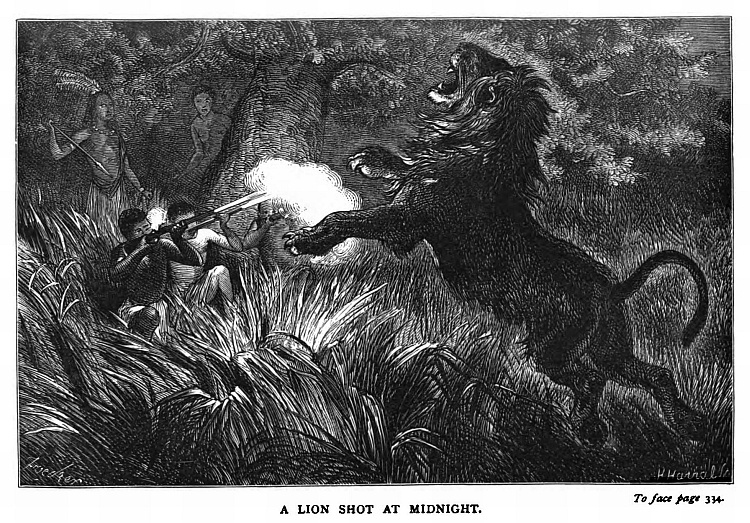
Kalulu warned Moto that the beast was preparing for a spring. Then Moto bade all be ready, and the word “Piga” (fire) was heard, sharp and peremptory, and the three guns simultaneously belched flame and fire, lit up the form of the then uprising lion, and a savage cry and dull heavy thud upon the earth announced to these anxious souls that the lion’s spring was cut short, and that he was either dying or was dead.
They hastily raked the hot embers together, and throwing straw on it, soon blew it into a bright blaze which threw a light over the late scene of terror, and showed the lion’s form stretched on its right side, with its left fore-paw, vainly beating the air, and the opened jaws, the gleaming white teeth, and protruding tongue, and the head almost split asunder, where two bullets had entered home to the brain, and robbed him of the cruel life which only endured to rend and devour prey.
“Ah ha, lion! thou greedy beast,” cried Niani, hopping about as light as a young springbok. “Thou didst think to eat Niani, thou cruel one. Father Simba, rightly called ‘lion,’ and Master Selim, and friend Moto have given thee as good as thou didst intend to have given me. He will roar no more, will he, chief?” he suddenly asked Kalulu.
“No, little one,” responded that more decorous and dignified youth; “he will haunt the forest no more, nor startle the antelopes with his roar during the gloom of night. Thou mayst sleep in peace now, Niani.”
“Ay,” added Selim, “and dream of the sweet and sugared hulwa (sweetmeats) and dates of Muscat, and of the pretty jackets with silver lace on them, he is going to get from me at Zanzibar.”
“Yes, and the red fez with the gold tassel which his friend Abdullah will give him,” said that Arab youth.
“And he must not forget the little wife and lots of Nianis he is going to get by-and-by,” added Simba, as he walked forward closer to the dead Simba, after whom he was named.
“He will do there until morning,” said Moto. “Let us continue our sleep, or do ye all go to sleep while I watch, because this carrion may bring others in search of him,” which good advice was soon adopted, and after some little time had passed all, except Moto, had resumed their slumber.
As the horizon was greying in the east Moto awoke his companions, who set at once to work to make a fire to warm themselves after the chilly night-dew. Kalulu cut off the claws of the lion, which he gave to Simba, Moto, and Selim, while the fourth paw’s claws he offered to Abdullah, and when refused by him he reserved for himself.
Simba also stripped the splendid furry mane from the lion’s neck and cut it into six equal strips, which he divided amongst his companions, and then suggested that the journey be continued, and that each should keep a bright look-out for game.
Within an hour Simba saw a kudu, and leaving his companions alone, he proceeded after it, and in a few moments the crack of his gun was heard, and his friends, with infinite satisfaction, said that his shot was effective, and, running up to him, were just in time to hear him utter his “Bismillah” (in the name of God), and to see him draw his knife to sever the throat of the fine animal.
Moto, while the juicy steaks were broiling over red coals, and the jaws of his companions were already hard at work, proposed that after the long march they should rest that day and strengthen themselves with meat; but Simba and Kalulu were for prosecuting the journey until they should get a sight of the Lake Liemba, and after hearing Kalulu’s reasons Selim concurred in the proposition, though Abdullah and Niani sided with Moto, pleading their fatigue.
They rested until noon, however, and by this time Niani and Abdullah felt so strengthened with the meat they had eaten and digested, that they declared themselves strong enough to march a month longer, which statement was received with pleasure by all.
The same champaign spread out on either side of them as they continued their journey, as beautiful as when it first was revealed to them, and in the far distance they saw herds upon herds of buffalo, giraffe, and antelope feasting on the rich grass.
Here and there, to vary the monotony, rose a clump of mimosa, or a tall tamarind, or a silk-cotton tree, or a group of stately palmyra, adding grace and beauty to the picture, and now and then they passed a low thicket of brush and thorn.
Above, over their heads, soared the kite and the bustard, the vulture and the hawk, searching with keen eyes for prey, while the smaller birds made the groves and the thickets and the lordly trees merry with their chirping song.
There was such repose and tranquillity, and a feeling of perfect security in the scene, that the Arab boys wished it would last until it was replaced by the happier scenes of Zanzibar. Poor youths! well they might wish it, after the disagreeabilities of travel they had encountered in all shapes during their short stay in Africa. But to make even this pleasant view one of horror, to transform its peaceful aspect into one ominous and fatal to them, it needed but fifty warriors of Ferodia to make their appearance before them, and how quickly were it all changed, and to make even the jungle and treeless plain a paradise compared to it!
Kalulu ventured a remark that evening, as they were comfortably collected around the camp-fire, that he did not think such a beautiful and rich country could be without inhabitants somewhere in the neighbourhood. At least, said he, he had always found it so, and he thought that on the morrow, or the next day, they must see signs of cultivation and population, as they must be rapidly nearing the lake.
The next morning, after they had journeyed a few hours, Simba, who was in advance, cried out that he saw a cornfield, which sent a momentary feeling of terror into the minds of his younger companions; but, habituating themselves to the sight of it, they became reassured, as they remembered that Ferodia must be far away, and that possibly the people had never heard of a man who had made himself a bugbear to them by his ferocious disposition and cruel character.
In an hour or so, after skirting the cornfield, they came to a river, brown and deep, and about twenty yards wide, flowing towards the north, and while they were hugging the thick tall spear-grass which grew along the bank, Niani uttered a low cry, and pointed with his finger towards something that was hidden near the bank. Kalulu retraced his steps quickly to observe what had escaped his eyes, and he saw a canoe with four paddles in it!
He was not long in imparting the tidings, and the party drew together for a whispered consultation; but Moto advised strongly that they should not expose themselves, but that they should retreat at once into the first thicket, a piece of prudent counsel which was acted upon as soon as intimated.
They found, about two hundred yards away from the object of their surprise and concern, a suitable place in a dense bush, wherein they crouched down, after they had posted Niani to observe narrowly from the entrance for any suspicious object, for a discussion about their future movements.
“Who do you think these people are, Kalulu?” asked Simba.
The young chief answered that he thought the tribe was that of the Wa-liemba, and that the canoe belonged to a party of hunters from the village, who were out looking for game.
Moto then suggested that they should wait until near midnight and get into the canoe and float down the river. Simba and Kalulu concurred, and thought it would be a good thing, and an easy way of reaching the lake; but Selim and Abdullah strongly demurred to the proposition, as the act would be one of hostility against a tribe that so far had done nothing to them, besides being dishonest. Simba and Moto, however, aided by Kalulu, brought such powerful arguments to bear against the two Arab boys that they were silenced. They were, said they, escaping from a land where every man’s hand was raised against them; where a small party like their own only invited attack from those who felt themselves strongest, against whom, however skilful they managed their movements, they could not expect to be always able to cope successfully. Prudence and safety suggested to them this means to avoid trouble and recapture, and if they did not avail themselves of this happy opportunity, they might, perhaps, in a few hours, be cursing their squeamishness and irresolution, while lamenting their fate in bonds more cruel than any they had undergone while in Ferodia’s power. Before such considerations Selim and Abdullah submitted to the superior judgment and craft of Moto and Simba, and said no more, though to each other they regretted that such a step had to be taken.
Night came, without anything alarming having occurred, and Niani was called from his watch, and whatever they said among themselves until the hour of departure was said so low that no one could have heard their voices even had some straggler by accident been outside the bush.
Notes. The real direction in which our people journeyed may be found by any reader curious enough to wish to know if he will examine the map of Central Africa as published in the book ‘How I Found Livingstone,’ when the reader will be able to locate easily the scenes laid here. He will find that the countries are laid down with a fidelity which generally belongs to standard geographical works, that no liberties are taken with the habits, the customs, or the true ethnology of the great country of Ututa, or with the geography of Central Africa, neither with the probabilities of a life in that far region. The chain of circumstances, as here portrayed, alone belong to the romantic and the fictitious, and this fact the author would fain impress upon the minds of his readers.
Chapter Thirteen.
Down the River—The Lake at Last—Selim describes the Lake’s Beauties—Kalulu answers Selim—Kalulu does not believe in Selim’s Sky-spirit.—The Journey on the Lake—Selim shoots a Zebra—Selim’s furious ride on a Zebra—Selim safe—The Tempest on the Lake—Slaves again.
The time to make a bold stroke towards regaining a country where they might meet friends came about three hours after darkness had fallen upon the earth. No sound had been heard to cause alarm: the bullfrogs growled inharmoniously among the wild spear-grass; the bull-crocodile woke the echoes with his hoarse roar; the black ibis had long ago hushed its harsh screams. It was surely time to be astir, for at this time of night peaceful Africans or weak parties seldom venture out of their villages.
They soon found the canoe, and without exchanging a word the men and boys cautiously got in, and Simba and Moto, each taking a paddle, drove the boat out until it reached the flood, and silently dipping their paddles in the water they guided their boat to the opposite side, and under the lee of the tall grass and mangrove trees impelled her along noiselessly.
They came abreast of the village, and they rested on their paddles; they passed it, and the work was resumed with caution. Once beyond the fields, Kalulu and Selim each took a paddle, and the increased muscle soon sent her swiftly gliding down. They were now passing through an uncultivated tract, and Simba exerted his giant strength, and Moto his sinew and muscle to the work, and the rapid progress they were making was seen by the swift flight of trees and branches and tall cane by them.
The stars, in bright galaxies and shiny myriads, lit their course, the river flow aided them, and the rapid rate at which they went exhilarated them. They were probably going down the river at the rate of five miles an hour, thus paddling with the current; nine hours of such work would put them out of reach of danger by morning, even should they be pursued; and provided they paddled on unseen by the natives no trace would be left behind by them.
This was a happy and expeditious way of travelling towards home, thought our people. The longest day’s march was nothing compared to the number of miles that may be travelled down stream, for even should they rest awhile the friendly current still conveyed them down towards their destination. So, blessing your stars, and your fortune, glide on my heroes, glide down until morning!
The day dawned and revealed their surroundings, prominent hills, all crowned with tall trees, with slopes descending rapidly to the river’s edge, a straight course before them; the current swifter; sometimes racing past the rocks with the speed of a rapid, and not a sign of cultivation about them anywhere. Cheered by the auspicious outlook they bent to their paddles with will and vigour.
Beyond the hill-country the river broadened and became sluggish in its flow; tall matete cane towered above them to the height of bamboo. This also was cheering, for except fishermen no tribe cares to live in such a sickly neighbourhood. After resting a short time and recruiting their strength with a breakfast of dried meat, they continued their course. Low, sandy islands rose in mid-stream, covered with reeds, on which lay, basking in the morning sun, several crocodiles, who rushed to their liquid homes at hearing the sound of the paddles, and on seeing the intruding canoe. On our friends rowed, past mangroves and groups of Eschinomense, which flung their random roots out in all directions; past sandy isles and patches of sandbars; through narrow channels, along which they raced, whither they knew not, whither they cared not, so they took them to the inland sea they were in search of.
At noon our party halted in the depths of a mangrove swamp, and went to sleep in the bottom of the canoe. In the dark night they woke thoroughly refreshed, and tasked their powers of digestion with some more beef, and then paddled out to the stream once more. Another night was passed under the beamy stars and dark-blue sky, while mild breezes bathed their hot brows, and tall cane gently nodded their heads as a token of farewell, and the leaves sighed their regrets at the evanishing canoe. The water broke in wavelets against her side, and formed a foamy wake behind. The bull-crocodile sonorously roared, and the bull hippo, at his banquet of tiger grass, uttered his deep base bellow, which strange noises the startled night caught up and pealed across the swampy fens and morasses, rousing the indignant and protesting frogs. Still silent sat the rowers, uttering no words, speechless as shadows; while the canoe cleft the murky-faced river, glided swiftly under the nodding reeds and sombrous mangrove, and halted not for frog or crocodile.
And morning came; and as the rising sun began to drive the mist of night away—lo! the lake at last! Liemba’s lake! And the hitherto speechless rowers burst into a triumphant shout and an enraptured “Ah!” as they thought the goal was won.
Let each reader fancy to himself the expanding view of the silver grey waters of the lake; its miniature waves lifting their snowy crests as they felt the force of the gentle gale; the sun reflected a thousand times as, rising above the eastern horizon, it slanted over the heads of the joyous rowers and mirrored itself in the tiny waves and troughs. On the left, the lake-shore studded with many a hummock cone and blue hill, and between each the shadowy forest glades; and along the margin of the shore a strip of white sand, laved by whiter foam. And now the canoe is quite out of the river current, and points up the lake, with glorious scenery awaiting it on the right, brown rock mountains receding from the water’s edge to lofty altitudes, while their slopes contiguous are enriched with tier upon tier of luxuriant and green mimosa, and tamarind of darker green. This was the prospect which greeted them after their venturesome flight with a canoe belonging to other people, after rowing over one hundred miles in twenty-five hours, down the river.
But they were not safe yet; their pursuers might be behind them, and it behoved them to row far and long before they could be said to be quite out of danger. Selim and Kalulu were relieved by Abdullah and Niani, Simba and Moto were tireless.
They followed the right shore of the lake for over eight hours; but at the end of that time they drew in shore under the lee of an island situated in the middle of a snug picturesque bay, and hiding their boat deep among the reeds, disembarked at last on the island to shake each other by the hand, to enjoy in full the happy thoughts and the serenity of mind which the knowledge of their secured freedom had created within them.
“Ah, Kalulu, we are safe!” cried Selim in a transport of joy, as he drew the young chief to his side and sat down to rest with him.
“Yes, my brother, we are safe for the present; but Zanzibar is yet far, is it not?”
“Yes, about five months; but I think, after we reach Usowa we need fear nothing more. Moto tells me the people are kind to the Arabs. But say, is not this beautiful?” asked Selim.
“Yes; but let us go to the top of the island, whence we can see all around,” said Kalulu; “and we can sleep in safety, and have the breeze to cool us much better than below here.”
In a few minutes they had gained the highest point of the island, and sitting under the shade of a far-spreading mimosa, Selim, having taken at a glance the unusual beauties of the scene, proceeded to point them out to his companion one after another, saying:
“Follow me, Kalulu, and let me point out to thee what I consider pretty. Look at the water of Liemba, so beautiful, so clear, so deep; and, does it not shame the sky with its blueness where it is deep? And look at the shores dotted with the little hills! They stand apart from each other, as if each was the abode of some spirit. They also image themselves in the deep water, as if they wished to see, as our vain women do, how pretty they look. Are they not pretty? Seest thou not how each hill is like a Kituta hut; but, unlike the straw with which the Watuta thatch their houses, the great Sky-spirit has thatched these with beautiful trees, and sent the lake winds to make music among the leaves and branches. And look between the hills, Kalulu; follow the winding valleys with thine eyes, until they rest where the valleys are lost in those grey mountain folds. If thou wert close to any of those valleys, thou wouldst hear the brooks sing and laugh as they race over rock and pebble towards the deep Liemba.”
After a little while he continued, more seriously: “The music of the trees and the music of the brooks mingling together speak to us children of the Arabs of the goodness of the Sky-spirit. If thine hearing was fine enough, and we two were under those trees of the valley yonder, thou wouldst be able to hear the voice of my mind and heart sing in sympathy with the brook and the trees; and just as my heart sings out of sympathy with their voices, so do the birds sing. Hast thou never thought how pretty and sweet sound the songs of birds, Kalulu? I have often, when in the mangoe grove near my father’s house, seated on a carpet of young and tender grass, watched a little bird coming with a graceful, easy flight, and listened to it singing as it flew. I have watched it turning its little head about so cunningly to see if I was there, and I have seen it looking for a comfortable twig to rest upon, and when it was satisfied I have heard it utter a wondrous melody, and this it seemed to do by simply opening its mouth and erecting its head, and I could not imitate it, try how I might. But though my voice failed, my heart joined with it in song; and if all the little singing birds sang together, my heart could sing as free, as clear as they.
“Hark, Kalulu! dost thou not hear the deep lake sing? No! I hear it, and understand its song. Look at the minute waves the zephyr rolls on the beach. Listen to the sound of them as they gather themselves up like long bales of white cloth, and rush to lave the sand. That is music to me, and while it sings I think of the deeper, sweeter music which the sea of Zanj makes at eve of day, which it made while my father and his kinsman sat near the foamy waves to watch the sun falling towards the sunset land. Wouldst thou believe it, dear Kalulu, the voices of those tiny waves sounding in my ear like the sighs of departing friends make me better and purer, more like a child of great Allah, the pure Sky-spirit, who made both thee and I, and all mankind. They make me better, because the gentle thought of love to all men fills my mind; they make me purer, because they draw me nearer to God. I have at this moment no hateful, unkind feeling towards any man. To even Ferodia I bear no ill-will. I forget—I have a wish to forget—what misery he caused me and mine. For what am I in the presence of Allah, whom I see in yon great mountains of grey rock, in yon boundless forests, in those far-reaching valleys, in those tall hills, in those wavelets, in the deep, deep water below us, and that immense roof of cloud and vapour—so vast, so far above us, above which the golden throne of Allah rests.”