"My Kalulu, Prince, King and Slave" (continued 5)
Reading edition
These were really happy days. Abdullah was improving each day, and Selim was fast becoming as joyous a companion as Kalulu could desire. Inspired by the invigorating sound of the drums, and the lively chorus, he was compelled to leave the side of Abdullah and join in the dance. A favourite song of the Watuta was the boatmen’s song, which seemed interminable; but the chorus was so pretty, and had such a sweet, pathetic melody, that Selim joined with pleasure in it for its pathos.
The first and second verses ran somewhat in this strain:—
Down the brown Liemba, The home of fierce Mamba (crocodiles), We are gliding. With sudden stroke and song The boat is sent along, Swiftly gliding. We fear no fierce mamba In the deep Liemba While we are gliding; Nor bush nor thickest brake, Nor foe that would us take— Swiftly gliding.
The fifth, seventh, and eighth verses are descriptive of the scenery on the Liemba:—
By waving fields of grain. With song and loud refrain, We are gliding; While women hoe the corn Till eve from dewy morn— Swiftly gliding. Lo! Isle of Ihata, Blest Isle of Liemba, By which we are gliding. The isle was long ago Blest by great Moshono— Softly gliding. Near that tree on yon plain Died Moshono in pain— We are gliding— Burnt by dread Warungu, Who fear no Malungu— Softly gliding.
The ninth verse is somewhat superstitious:—
Sole on that lofty rock Lives Moshono’s sacred cock. We are gliding. Now, boatmen, here cease to row, Bad luck, to hear no crow!— Softly gliding.
As I have said, the boat song is almost interminable; it describes every view on that beautiful river, each tradition that surrounds the hills, and memorable sites of battles fought and victories won; for it is thus that our history was kept before writing was known to us.
Another song, which was a favourite with the young men and maidens of Katalambula’s village, describes what love-making is known to the Watuta. For this reason only is it valuable, as illustrative of the mode of marriage. The following verses are sufficient as an example:—
Canst thou love me as I love thee? Wilt thou not come and live with me? My father talked with thine to-day, Thy father did not tell him “Nay.” Said he, “Bring me two score of sheep; Bring me pombe in pots thus deep; Bring me ten goats of the best class, Thy son may take my pretty lass.” I’ve built my hut of sedgy cane, The well-thatched roof keeps out the rain, The floor is spread with river sand, The latch waits lifting by thy hand. Thy husband calls, do not delay: Come to his house ere end of day; Put now thy hand in mine and come, Come to Kiranga’s heart and home.
Selim and Abdullah heard numbers of these during the period of the latter’s convalescence, and were constantly amused by them. To sit under the great tree in the centre of the square, to hear the music of the drums, to hear the songs sung, and to see the people dance, was like going to a theatrical entertainment with us. Kalulu often sat with them, but not for long; the exhilarating influence of the music produced such an effect on his feet and legs, that while listening to it he found himself unable to restrain them.
As Abdullah got better and became able to move about during the day, Kalulu used to take him and Selim to the great Maganga, or magic doctor, to enjoy the conversation of the wise man of the tribe.
This doctor must have been at least eighty years old, for he remembered Katalambula as a child, and knew Mostana, Kalulu’s father, and remembered the “great, great” King Loralamba, father of Katalambula and Mostana. This was very old history to Kalulu, who could not conceive the number of years that had elapsed since Loralamba’s death, though the time could only have been between forty and fifty years. The doctor, whose name was Soltali, knew any amount of things that no other man knew. He remembered the time when the Northern Watuta, who now live north of the Malagarazi River, separated from the Southern Watuta, over whom Katalambula was chief ruler, for some pique that the younger brother had against Loralamba. He remembered many wars that had taken place between the Watuta and Wabena, and remembered well the incident of which the boatmen sang as they travelled down the Liemba, viz., the burning of Moshono, a great doctor, who lived on the island of Ihata. The Warungu came in great numbers, and were conquering wherever they went, until they came opposite Ihata. Then their cattle died, and their warriors died of a horrible disease which Moshono punished them with. Finally, however, they got across the river and landed on the island; the village was taken, and Moshono was carried to the plain opposite the island, and burnt alive near a great tree. But it seemed as if the Sky-spirit heard the words of Moshono, and stirred up the Watuta—all; every man who could bear a sword and spear—against the Warungu, and a few days after, the Watuta, under Loralamba, rushed on their camp at night, and there was an exceeding great slaughter. Only a few Warungu escaped, and since then they had settled quietly in their own country, south of the Lake Liemba, many days’ march from Katalambula’s.
Soltali was rich in this history, which, alas! is never destined to see the light; a history that were a man disposed to write it for the mere love of giving it to the world, and instructing it in the past life of this obscure corner of the world, might enlighten the learned of all countries in much that concerns the great races of Central Africa.
Soltali’s hut was a veritable museum; but it bore a striking resemblance to the rich men’s houses in England and America in this respect. What ducal castle or baronial hall is there, in England, but has its collection of deer, antelope, and buffalo horns; its stuffed lions; its tigers, etc. etc.? What rich man’s house is there in America which has not some trophy of its master’s hunting prowess? Soltali had his trophies, though, owing to his pitiable ignorance of taste, book knowledge, etc, etc, his trophies were not arranged as a Schwartzenberg of Austria or a Duke of Sutherland arrange theirs. There were horns upon horns of antelope, kudu, hartebeest, black buck, springbok, gemsbok, gnu, buffalo, and rhinoceros, and tusks upon tusks of polished ivory. But the great store of curiosities that he set the greatest value upon consisted of tails of elephants, horns of giraffes, eyelids of zebras, tusks of boars, paws of lions, nose-hairs and whiskers of leopards, claws of eagles, beaks of bustards and kites, wings of ostriches, scales of fish, dried eyes of ibis; all wrapped up in pieces of goatskin, each separate the one from the other. He had a great number of little gourds, filled with the calcined heads of the various animals he had ever killed, and smaller gourds, like phials, filled with the burnt brains of men whom he had killed in war. There were so many brains of Warungu, Wabena, Wasowa, Wakawendi, Wawemba, Warori, Wanyamwezi, Wamwite, Wakanyara, Wakokoro, and a number of other smaller tribes; for in his prime, when he fought side by side with Loralamba, the “great, great” King, Soltali’s spear was heavy, sharp, and sure.
Poor, ancient Soltali! who shall sing thy praises? Who shall tell the wide, wide world all the deeds done by thy mighty hands? Where is the Homer who shall arise and sing of thy prowess? Homer, and Virgil, and Tasso, De Ercilla, and Camoens are dead, and we have none left capable of conveying thy name to future generations. But be content, old man; this page, at least, of this little book will tell a few of the growing generation of true-hearted American and British youths, that such a man did once live as thee, oh, Soltali! and, perhaps, in an obscure corner of the British Museum, thyself and wondrous museum of monstrosities shall, embodied as it were in this page, rest a few years until they become a heap of dead, unintelligible dust!
At the end of about two months, Abdullah was so far recovered as to be able to go about alone, without the aid of any of his friends; but he had an unconquerable antipathy to the banks of the Liemba. The brown waters of this river, in which he was so very near being engulphed, inspired him with a nauseous aversion, having something of the effect of tartar emetic on his stomach, and he never dared, as Selim often did, to wander along its banks alone. When he became tired of the village he walked to the fields, or the gardens, where the pot-herbs, the lentils, the pig-nuts, and the beans grew. Neither forest nor solitude charmed Abdullah; the company of the nursing women, or the workers in the field, was far preferable.
One day, Kalulu proposed to Selim, and Simba, and Moto, that they should get up a party to make a grand elephant hunt, and, as an apology, said to Selim:
“I should have asked thee long ago, were it not that I knew thou wouldst not come; but Abdullah is so much better that he travels about the village as if he had never been bitten by a crocodile.”
“To hunt elephants I will surely come with thee. I have got my gun, which I saved from the Liemba, and I should like to try a shot at an elephant. Moto is a great hunter, and he shall teach me how to tickle the tail and hams of one; thou hast never heard him tell the story. Oh, it is such an incredible one! but he never tells a lie to me.”
“Does Moto say he tickled the tail of an elephant? if it is true, he has done more than old Soltali himself. Soltali has done some wonderful things with elephants too, but he never did anything like this. However, we shall see how he acts before a real wild elephant. We shall watch him—eh, Selim?”
“Oh, I shall have my eyes on him, depend on it; but when shall we go, Kalulu?”
“At daybreak to-morrow. To-night Soltali must sing the elephant hunting-song of the hunters, and must give each of the hunters a charm, since he is too old to accompany us. I shall take fifty men with me, so that we can make a strong party. If Ferodia catches us in the woods he would make short work of us, and my head would not remain long on my shoulders if he caught me; for then he knows he would be king.”
“Why, thou art not going near his country, surely! because I would rather stop here, if thou art. I want to see no more of Ferodia,” said Selim in alarm.
“Be at ease, my brother. I go not near him with the best fifty men that the Watuta can count. I go in a different direction, south-east; he lives south-west, south of the Liemba Lake.”
“All right; but really thou didst frighten me. My back fairly tingles at the thought of Tifum, and Tifum is with Ferodia.”
“Yet, my brother, thou didst hit him a blow in the face, and Moto—cunning man—said he saw it, and said it was well done.”
“I wish the blow had gone through his head, then my mind would be at ease, for that man is my bane—my Afrit. (Afrit is a bad spirit with the Moslems.) Even when I am at Zanzibar I shall think of that man.”
“There, enough, my brother; I will put one of my barbed arrows through his throat the first time I see him, for thy sake. Go and prepare thy gun, and bullets, and medicine powder, and to-night thou must attend to the song of the doctor, or thou shalt have bad luck with us in the hunt.” And Kalulu turned away with light hounding steps, which soon carried him away from his Arab brother.
At night—probably at the hour of nine with us, the moon being up—a long, low, rumbling roll of the largest goma brought the destined hunters, together with Kalulu, Selim, Simba, and Moto, running and chasing each other towards the drum stand. There were ten drums, and a boy for each, ascending in height from the smallest to the biggest drum; so that the boy who beat the smallest drum must have been about ten years old, and the boy who beat the largest drum was a sturdy youth of twenty, or thereabouts.
Pots full of pombe and plantain-wine were ranged a little distance off, from which the dancers and the singers could regale themselves when they felt disposed. For the eve of a hunting party’s march is considered a great event, second only to the return of a successful party with plenty of ivory.
The hunters formed a select circle round the drummers and the pombe pots; a larger circle, made by about three hundred people—men, women, boys, and girls—surrounded the hunters.
Each hunter had on a capricious head-dress. One tall fellow was very conspicuous by wearing a pair of buffalo horns; another had a rhinoceros horn on the top of his head; another had his head draped with a piece of zebra skin, which gave him quite a remarkable appearance by moonlight; one had a zebra crest, which made him appear as if he wore a Greek helmet; another had a goatskin over his head. Kalulu wore three magnificent snowy ostrich plumes on his head. Selim wore a turban. Simba and Moto also wore turbans. One fellow, next to Moto, wore an enormous black earthen pot on his head; another had a broad, wooden dish; but it would be wearying to enumerate all the strange things they wore.
The drummer boys struck up an interlude, which was a verse from the boatmen’s song—the chorus,
We are gliding, Softly gliding,
seemingly giving them immeasurable enjoyment as they lingered over the word “gliding.” While they were busy with feet and lungs, moving about in a circle, a sudden silence prevailed;—the great Soltali, the greatest elephant hunter and doctor of magic of the age, arrived upon the scene.
A loud murmur of approbation greeted the extraordinary old man. The most remarkable of all head-dresses was on the head of Soltali, for he had the skin of an elephant’s trunk, the base of the trunk fitting his head, as if it had grown there, while the trunk, filled with grass, was stiff enough to stand perfectly erect, though perhaps it was stiff enough without. The weight of this must have been considerable; but the ridiculous vanity of men causes them to do strange things sometimes, and this act could have been nothing else than absurdest vanity. Hanging around the old man’s neck was a string of giraffe tails, whose hairs were blacker than ink. On his arms he wore wristlets and armlets of pure white ivory. In each hand he carried a gourd half full of pebbles, which he rattled every now and then with a horrible noise.
He first, after he entered the inner circle, walked around three times, staring at each man, rattling his gourds alternately, as he passed round; then walking to the centre, while the bass drum began to hum and murmur its deep sounds, he began to move his body to the right and left, each hunter sighing deeply in sympathy with the now fast rising murmur of all the drums in concert. Loud and louder beat the drums, until the noise was deafening, and the voices of the singers became a demoniac din; then lower and lower descended the voices and the drum-sounds, until nothing was heard but the pacific and low murmur of the bass drum and the low sighs of the dancers.
Then Soltali opened his mouth and sang, in the heroic vein, of his doings in the elephant hunt in the far southern lands, the streamy land of the Wa-marungu, in the hot swampy lands of the Wawemba, and on the broad plains of Ututa; of his mishaps and fortunes, his narrow, hair-breadth escapes, and his wonderful adventures, out of which the author of the present history might make his fame and fortune were he gifted with the power to translate into some kind of verse what Soltali said.
Though demurring somewhat at the necessity of translating at all what the old man said, the author feels compelled to give the gist of the charge he gave the hunters concerning their conduct when they should meet an elephant. He spoke authoritatively and well, and it is a pity that a better translator is not at my side to assist me in the translation of some of the Kituta polysyllables.
“Let the warrior Watuta, and the hunters bold Heed and mark well the words of the Mganga old; Let them behold these charms, these trophies of my might Each of them reminds me of many a hard fight. Should ye meet the elephant alone in a plain, Seek not too hastily to give him the death pain. Singly let none attack him - ’tis an unequal fight; For the elephant is strong, the embodiment of might; But surround him coolly, and carefully all, Be ready to obey your leader’s slightest call; Then charge on him, all shouting, and charge with your spears; Let the stoutest and best of you aim behind his ears. Watch well the unfortunate on whom he turns round! He must run this and that way, and oft change his ground; Ye others must tease him, and invite him your way, Hamstring him, and spear him, and do what ye may. Beware of his front! range on his sides and his rear, Go all together, and let each man heave a sure spear. Fast as he veers round, hasten at right angles away To ’scape the elephant’s first charge is no child’s play, For his stride is so long he swallows the ground: One stride of his is as long as a hunter’s bound. After a while he will get tired - heed well what I say, He is never so dangerous as when standing at bay; For the hunter too often thinks he is dead game, And advances too near him, too eager for fame; But be ye guided by me, and stand off afar, And your good hunt so well done, ye will not mar. Let the elephant bleed, let him fall to the ground, Let him gladden your ears with his fall’s heavy sound! Then think of the Mganga, the words he has said; Be sure that his services to you are well paid! Then will ye succeed in your hunt on the plain, Succeed without loss, and succeed without pain!”
The author may not attempt further translations from the speech, or song rather, of this old Mganga or magic doctor, the Kituta polysyllables having tasked his powers to the utmost; but from his knowledge of hunting in Africa, he feels bound to admit that the old man had a sound head on his shoulders; and the band of hunters having heard his lengthy chant to the end, declared that they felt eternally grateful to him. On the conclusion of his chant, he delivered to each hunter a small portion of whitish powder, which we, who have been in his museum, feel confident consisted of burnt brain, mixed with wood ashes. But this charm, consecrated by the magic doctor, could not fail to render each hunter highly successful in his enterprise.
The pombe, or beer, next attracts the attention of the singers, and each singer incontinently sets to the agreeable task of guzzling, where the author leaves them until the morrow—the Kituta polysyllables and the pombe having fairly upset him for the time.
In the morning, at daybreak, without any of the formalities of muster or calling the roll, Kalulu, Selim, Simba, and Moto, left the village by the principal gate, followed by about fifty strong active young warriors, not one of whom could have been over thirty years old. The horn of the leading hunter sounded merrily as he blew his ringing blasts of adieux, while the party dived into the depths of the gigantic corn-stalks, and their friends at the village listened long and attentively, until the horn could be no longer heard.
Kalulu had a couple of broad-bladed spears, and half-a-dozen assegais, much lighter than spears, with long flexible shafts, besides a bow and a quiver pack-full of arrows, which was slung over his shoulders.
Selim, radiantly happy, walked next to Kalulu, as the path was so narrow that but one could walk at a time on the smooth, hard road, and carried his own gun—the “gun from London,” which Kalulu had found among the plunder, with its own special ammunition. It was probably a fine “Joe Manton” as the barrels were of fine steel, short, of large bore, and a heavy price had been paid for it by Amer bin Osman through his Bombay agent. It was one of those fortunate accidents that occur sometimes. Olimali might have had the gun, had not Ferodia, seeing its great beauty and superiority, specially reserved it for a present to Katalambula; and the king not caring, or not having any use, for it, had placed it among his treasures in his store-room; and Selim, accompanying Kalulu to the store-room, as a privileged brother, to pick out a gun, suddenly saw the beautiful little masterpiece of the English gunmaker, which his father had presented him with, and with which he had shot the greedy crocodile on the Lofu, while his sharp teeth were lacerating his slave Mombo’s leg. Could anything have been more fortunate? “Impossible!” thought Selim, as he had hastened to secure it, with the ammunition and the percussion caps. “Impossible!” thought he now, as he strode on after Kalulu, laughing and chatting gaily, and sometimes turning round to Simba and Moto with a gay remark, which permitted them to see his bright, happy face and sparkling eyes.
Simba had his own bright-barrelled gun, which he had as yet never parted with, besides a ponderous spear, which might have made Goliath of Gath faint with the carrying of it.
Behind Simba strode nimble-footed Moto, who also had his own gun, besides a couple of long keen-pointed spears.
Behind Moto strode the Watuta hunters, one after another, some of them armed with shields, besides their handfuls of spears and quivers fall of arrows.
Merriness is what distinguishes the conduct of all hunting parties, whether white or black, while on the way to the chase or the hunt. Pleasures unlimited are anticipated, and happy sport is expected, and this anticipation and expectation are what produce so many good jokes, and wit, and fun, and raillery, or, as the English call it, “chaff,” when the hunting-field has not yet been reached and all feel bright and fresh. The hours that precede the chase or the hunt form the flower-time which men’s minds love to remember and dwell upon for the unalloyed happiness which it furnished.
It is needless to describe in detail the ground the party traversed. Once out of the corn-fields, the pastoral plains spread before them, where young Watuta boys were seen indulging in the excitement of a mimic battle or hunt while they tended their fathers’ flocks. Here and there were little tracts of cultivation where women were at work hoeing the corn; and as they passed some isolated village, near the gate, under the trees, sat the nursing mothers, lullabying their babes to sleep, or the snowy crisp-haired elders sat on short three-legged stools retailing to each other the experiences of their lives, dwelling with fondness on some particular episode of their generally uneventful lives; while chubby, abdominous little children listened in wonder at what they heard, as chubby, abdominous little boys of white men’s lands do when a particularly interesting tale is told.
Beyond the plains and corn-fields, the cultivated tracts and villages, heaved into view the dark-blue line of forest—that forest which Selim knew, where he suffered, where he fainted, and laid unconscious. Finally, the party entered it, and they were involved in its twilight gloom.
A week’s, marching through the forest brought the party to the elephant hunting-grounds of the Watutu. The broad tracks, pounded and pressed, trodden compact and smooth as an asphalte pavement by the elephants’ broad, heavy feet, indicated too clearly that this was a common resort for the ponderous beasts.
Lengthy sinuous hollows, overgrown with thicket and shrub, tufted grass, and tall cane, spoke of clear but stagnant water being plentiful here, their ridges, clad with dense brush, ran in serpentine directions, and separated these swampy hollows from each other. Overhead were the leafy crowns of gigantic columnar trees, forming as they met close together a thorough shade for the locality, under which, undisturbed by any enemy, the elephant might cool himself during the fervid noon.
Pressing further on out of this swampy region, they came, about sunset, to a thin jungle, where here and there rose a giant baobab, the monarch of all woods. Choosing one of these great trees, whose foliage was denser than ordinary, the party proceeded to cut down the smaller trees and brush, to form a brush fence around their camp, for the centre of which they chose this great baobab. They built the fence solid, secure, and high, as an efficient protection against wild beasts and nomadic freebooters. They then erected their huts—placing four short pronged poles in the ground, one at each corner of a square of six feet; then two taller poles dividing the square into halves; over these two taller poles and the two shorter poles on each side they laid transverse poles, which rested in the forks; and over these again they laid laterally light sticks, sloping down each side, which they covered over with long grass, and in a short time they had a perfect miniature house. There were other kinds of houses or huts being constructed; but the following illustration will best describe the architectural knowledge of the Watutu.
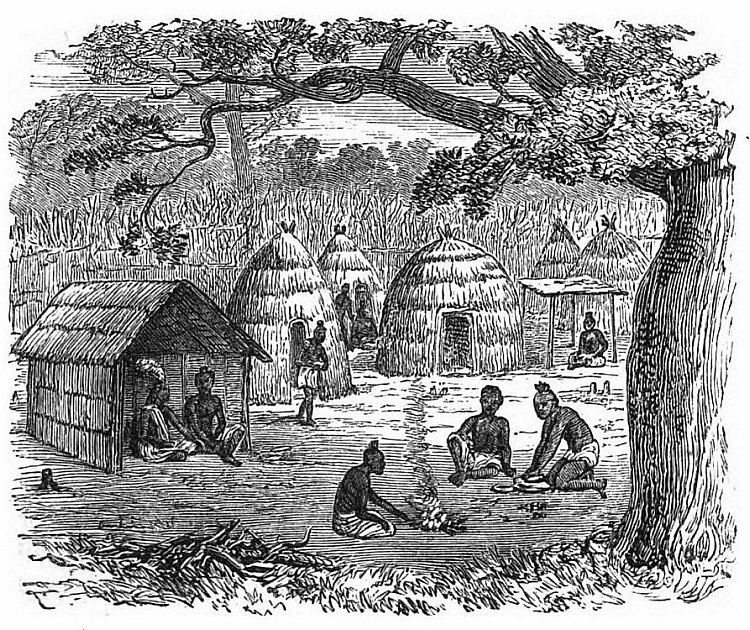
After constructing their huts, some roamed into the woods to hunt for wild fruit, others to look for flat stones to grind their corn upon, others to procure sticks to make their fires with, others to get water; while others, again, scoured and prepared their pots to boil their porridge in. There were about fifteen huts in the encampment, some huts having as many as five for a mess, others only three, while others had but two. It is a noteworthy fact in African camps that, where the mess is large, the more important of the party are together; or that the most popular are those who prefer each other’s society to that of any of the rest; though in each large mess one may be sure that one of the members has been admitted only for the sake of utilising his services; and his folly and ignorance, or cowardice and unworthiness, are forgiven and borne with, so long as he is industrious and not idle.
Thus in Kalulu’s mess were Selim, Simba, Moto, and an ignorant and timid fellow, who was only too glad to be near the great, and who industriously strove to please them for the sake of the patronage which he received for his labour. Kalulu, of course, as chief, could command the services of all if he chose to do so, but none would have worked as well as the timid fellow who voluntarily offered to cook for him.
After the suppers were cooked and eaten, and their limbs were somewhat rested, and earth had drawn its sable mantle, chequered with the diamonds of heaven, over its head, and the dark foliage of the baobab began to be peopled with formless shapes and shadows, and the fires burned bright, and cast their tongued flames with splutter, and hissing, and crackling, the dispositions of each began to be exhibited. They squatted around a blazing pile, listening to an exciting tale of adventure, or a funny story, which makes men’s sides almost explode with laughter. What can be more enjoyable? Nothing. People, for the time, forget everything but the interesting present. Not one in such a position can be left to himself; for his little world is before him, and he must be drawn into its vortex of pleasantry and enjoyment, and forget what he selfishly thinks belongs to himself.
The desire of slumber came on by-and-bye, and each man crept into his hut, and on his own little pile of straw or leaves, drowned in kindly, healthy sleep, forgot not only himself, but his neighbours, his friends, and his tribe.
At dawn, five of the likeliest fellows were sent by Kalulu to reconnoitre the vicinity and the open, swampy ground near which they had camped, and where they had obtained their water for cooking the night before.
They had not been gone fifteen minutes before one of them returned, who, with a warning finger, imposed silence, and whispered the words “Kümi tembo”—ten elephants!
You might have seen then how quickly the looks of indifference were changed into one of exciting interest, how eyes danced gladly, and sparkled at the joyful news; how Kalulu’s hunter-soul kindled into raptures, and how Moto and Simba looked significantly at one another, and how Selim even felt a throb and a warm glow stealing over him.
Moto advanced to Kalulu, and reminded him of the advice given by Soltali to hunt one at a time, and said that while he and his warriors should single out one, it would be better that those armed with guns, viz., he and Simba, and Selim, should engage another, and so kill two. Kalulu at once acceded to the proposal.
The hunters, as soon as they got outside of the boma or camp, deployed in a long line, while Selim, Moto, and Simba stole quietly and quickly away on their own venture, in a direction considerably to the left of the Watuta hunters. All the natives had denuded themselves entirely; Selim and his two friends had but girded their cloths about their loins.
The natives thus deployed, and ready at a signal, moved forward silently, and soon they were joined by the four remaining scouts, who, ensconced behind the bushes, had continued to watch the elephants, who were seen slaking their thirst at a pool, and playfully tossing the water over their backs.
As the hunters emerged from this jungle into the cleared space near the pool, the elephants turned short round to look at the strange intruders, who were thus boldly appearing in their presence.
The hunters stopped also with one accord to survey the ponderous animals they had come to kill. What a sight this was! Ten such noble beasts, clothed with bluish-grey hides, with uplifted trunks, and great ears standing out straight in array before those fifty naked pigmies, who, had they not their sharp spears and their barbed arrows, would no more have dared to approach these magnificent creatures than they would have climbed up to the highest tree and jumped off, expecting to be able to fly.
They stood thus a minute opposed to each other; then Kalulu advanced to the front in the absence of the magic doctor, as the chief hunter, and with uplifted spear in hand, chanted the death-song of the elephant he chose should be killed. This was a picture also worthy of a great artist—the warriors in the foreground, the slight and nude form of the young chief in the centre, with his ostrich plumes waving above his head, as his body oscillated from side to side while he sang; and fronting him, about thirty feet off, a monster elephant, with his herd behind him, all looking astonished at the scene.
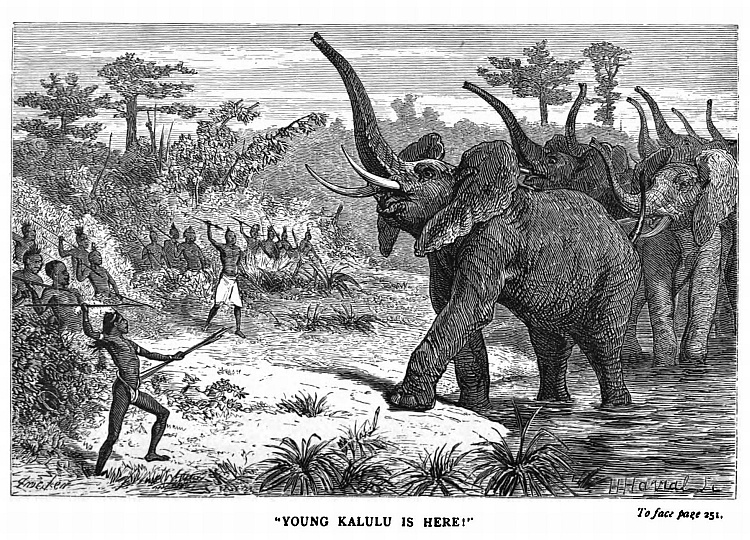
The words ran after this fashion:—
“Thou monarch of beasts, thou king of the woods, Thou dangerous beast in thy angry moods, Thou elephant strong, thou form of great might, Behold Kalulu before thee for fight! I’ve come from the green groves of Liemba, From the country of old Loralamba, With magic from Soltali Mganga (Magic Doctor), The surest and best of his Uganga (Magic Medicine). Then look at that sun, look at the pool In which thou didst revel, and think so cool; Look on that forest, and look on this grass. The sweetest and best of this wide morass; No more shalt thou see the sun or the pool, No more shalt thou revel in waters cool, No more shalt thou walk in the forest’s shade, No more shalt thou delight in forest glade, No more shalt thou daintily feed on the grass Of the plain, or jungle, or this morass! Soltali the Mganga cannot lie: Young Kalulu is here! prepare to die!”
As he finished his song his head was violently thrown back, the right arm was drawn to its length, and the bright spear-head, flashing once, twice, white sun-glints, was buried deep in the elephant’s chest. A loud shout greeted the brave effort; and at the instant the elephant felt the keen sharp iron in him, he uttered a loud trumpet-note of rage, and charged, clearing at one bound several strides of a man.
“Be off, Kalulu, thou brave prince of the Watuta! Hie away young hero! Stay not to count thy steps, thou dusky chief! Spring out, my boy; run as thou didst never run before! Impel thy haunches on—lift thy feet clear from the ground; out with thy chest—set thy head far back! Let thy lungs inhale free the rushing air! Beware of a stumble, else the tale is ended! Ha! well done—at right angles now! So; see the elephant charges the empty air, and runs headlong after vacancy! Now, warriors, is our time, with a whoop, and the shrill cry of the Watuta!”
Such were the words that could be distinguished from the noise and tumult produced by the charge. Twenty spears had been launched into the elephant’s body to distract his attention, and had it not been for Soltali’s good advice to “turn at right angles away,” the elephant would soon have overtaken the daring young chief; but, by his dexterous and easy movement to the right, the monster had charged on far ahead before he became aware that his enemy had escaped him.
When he turned round he found the hunters like a cloud about him; he found himself isolated from his herd; the other elephants having charged in another direction in fury and fright to meet an enemy in another guise, and with different weapons. While the elephant seemed to take this all at a glance, a loud report was heard, which sounded like a volley of fire-arms; but he, unheeding the sound, charged again, with irresistible power, at his nearest foe, only to be foiled once more by the ever-evading, ever-shifting figures of his remorseless enemies. Again and again he charged, only to receive new wounds, an additional shower of spears and barbed arrows, which tormented him cruelly; until, fatigued with the unusual speed, faint from loss of blood, he stood stock still, confronting his enemies, defiant and still dreadful, though the spears and arrows in his body might have been counted by hundreds. Heedful of the prudent counsel of old Soltali, the Watuta drew back, but still surrounding him, awaiting his fall. They had not to wait long, before they saw his body oscillate from side to side, and the left knee bend, as if he were getting weak; then he staggered forward, rose up again, and finally rolled on his side—dead, crushing the spears in his side like straws in his fall.
Leaving the Watuta to indulge in their self-glorification, let us proceed to see how the other three, Selim, Simba, and Moto, fared.
Moto, as the three left the Watuta, drew alongside of Selim, and whispered some words in his ears, how to conduct himself, to reserve his fire, and to fire at the last elephant which would pass him, aiming behind his ears, which, of course, would be standing straight out, giving him an ample opportunity and a good target to fire at. Selim, faithfully promising, was placed behind a tree at the furthest end of the cleared ground in the neighbourhood of the pool. Simba chose one a few yards off, further still to the left, and Moto another tree twenty yards to the left of Simba; and in this position they waited the dénouement.
Selim could see the swaying form and nodding plumes of Kalulu, could hear the death-song, and with his finger on the two triggers of his gun, which was heavily loaded specially for this purpose, stood behind his tree waiting. Soon he saw Kalulu launch his spear, saw the charge and flight, heard the deafening noise, and while his heart palpitated fast, and his pulses throbbed, and his ears tingled, came the affrighted animals of the herd, charging in fear and fury by him. Obediently he waited, according to orders, until the last elephant was passing his position, then, stilling the heart’s palpitation and the wildly beating pulse, full of trust and confidence in the powers of his English gun, he deliberately aimed behind the elephant’s ears, and fired both barrels at once. The concussion knocked him down; but, while falling, he saw his elephant stumble and fall on his head in a motionless heap, stone dead.
Picking himself hastily up, and snatching his gun, he stayed a moment to take in how matters stood; and finding the elephants in full flight, two limping laggards behind, and Simba and Moto following, he began to load his gun again with equally heavy charges as those he had in it previously; and having placed the caps carefully on, and taking a glance of pride at the game he had “bagged,” he ran after Simba and Moto. His two friends he found firing, running, and loading as fast as they could; not a very hard task when the animals were so badly wounded. His nimble feet soon carried him nearer them, and after dodging and running as he had been directed to, as he was pursued by one or the other of the elephants, he had the satisfaction at last of seeing both stand still. Retreating a little distance from view, he took a circuit round, and then returned, taking advantage of every tree, and by great caution succeeded in coming behind a large tree at the distance of twelve paces from one of them. Lifting his gun, already cocked, to his shoulders, he took aim again behind the ears, and fired the two barrels once more, which was met with the same fatal result, for the elephant, after beating the air with his forelegs for a short time, swayed pitifully, and fell over, dead.
But Selim had no time to make these observations, for the other elephant turned short round and charged at the tree. Selim stood his ground until the tree had almost been reached, when, dropping the gun on the ground, he started off for another tree, the elephant in hot pursuit after him. To the right, to the left, forwards and backwards, from tree to tree, Selim ran, until the elephant, to his astonishment, suddenly stopped, the hind-legs doubled under him, the forelegs bent, and his head came to the ground heavily, and in this kneeling position the poor elephant breathed his last.
Selim had his gun brought to him by Simba, who lavished praises, almost fulsome, on his bravery and accuracy of shooting, in which Moto, who now came up, joined with heart and spirit. Simba, while he embraced his young master, would have it that Selim was the best elephant hunter known; there never was such an Arab boy before, who shot two elephants dead one after another. “And thou must consider, Moto,” said he, apologetically, “Selim is but sixteen; if he shoots two elephants, one after another, when he is sixteen, what will he do when he is a grown man?”
“True,” answered Moto, “when he is double his age he will shoot four one after another. Selim is a great hunter truly. I wonder what the Watuta have done. Whisht! hear their cries! Their elephant is dead. We must go to see them. Or do thou stop with Selim to watch these whilst I go to tell them what our young master has done. Say, Simba, how much money would the ivory of these three elephants bring at Zanzibar, dost thou think?”
“I know not. How many frasilah dost thou think there are in the three?” asked Simba.
“Somewhere about twelve, I should say? Twelve frasilah of ivory at 50 dollars the frasilah (35 pounds) would make how much?” asked Moto.
“I don’t know—plenty, I suppose,” said Simba; “but Selim knows.”
“Twelve fifties will make 600—six hundred dollars,” answered Selim.
“Six hundred dollars! What a pity we cannot carry it to Zanzibar!” said Moto. “I shall be back directly.”
Moto bounded away lightly towards the pool, and in a short time in the middle of the plain beyond he saw the Watuta in a group cutting and slashing at the dead elephant, with noise and excitement enough to frighten every elephant for miles around.
When he approached, the Watuta gathered about him, and Kalulu pointed exultantly at the dead beast into which he had driven the first spear, and Kalulu then asked what luck they had had.
Moto answered: “Selim has killed two, and I have killed one.”
“Selim killed two!” echoed Kalulu, with surprise. “What! little Selim my brother?”
“The same,” answered Moto.
“Eyah, eyah!” murmured the group, while Kalulu seemed lost in astonishment, and could not utter a word more.
“Selim stands waiting to shew them to his brother, Kalulu,” said Moto.
“Oh, I shall come. Why Selim is a hero, a lion, an elephant! Is he not, Moto?”
“He is a brave young Arab, and the son of an Arab chief,” answered Moto.
When the young chief started off, all but a few Watuta, who remained to extract the tusks, followed him to see the wonderful three dead elephants.
In the same position in which he had first fallen lay Selim’s first prize, with his tusks half buried in the ground. Kalulu gazed at the wide wound in his head, put his fist into it until it was buried up to the wrist, and then turned to Moto with wondering eyes, and said:
“Kalulu has seen dead men in his father’s village, pierced to the heart with the leaden balls which the rifles of Kisesa threw, but what gun is this that makes such big holes in the elephant’s head?”
Then Moto told him that Selim had fired the two barrels of the gun at once, at such a short distance from the elephant, that the two big bullets went into the head as one, and that this was the reason there was such a big hole, which quite satisfied the young chief.
Leaving ten men to extract the tusks, Kalulu proceeded to where Selim and Simba stood, close to the former’s second prize; and here, again, Kalulu saw the wide rent and savage wound in the same spot as that found in the first elephant.
Kalulu sprang on Selim’s neck, and embraced him warmly, while the Watuta gazed at Selim as on one they had never seen before, with surprise and unlimited admiration.
By evening the tusks had all been extracted from the elephants, and great portions of the meat were carried to camp, especially the feet, the hearts, and livers, and ribs, where, before blazing fire-piles, the meat was set to roasting, while the adventures of the day were rehearsed over and over, with new additions each time, until midnight of that eventful day came and sealed all eyes in deep slumber.
They moved further south, and in less than two weeks the party had killed twenty elephants, which so loaded them with ivory, that they were obliged to return towards home, unable to carry more.
Chapter Ten.
The burial Song—Kalulu becomes King—Long live King Kalulu—Kalulu’s Oration—Selim asks permission to depart—The dissatisfied Minority—Ferodia’s Ambition—Tifum the Wicked, and his Advice—Ferodia visits Kalulu—The treacherous Guests.
After a march of two weeks without a single incident, they arrived at Katalambula’s village, to hear the sad news that the King had died the day before, and that everybody was mourning for him.
This was a great shock for Kalulu, for the King had loved him dearly, and the young chief bore him great affection in return.
When at first the news was conveyed to him, he seemed to be suddenly stricken dumb, his face assumed a livid hue, and he trembled all over. Then, giving vent to his sorrows in a long, sad cry of sorrow, he hastened to the King’s house, where the doctors were found attending the corpse, and at once threw himself on the body, uttering the most doleful lamentations, crying, “Awake, thou King! thou chief of the Watuta, awake! Behold me, thy son, Kalulu, returned from the chase! Open thine ears, O Katalambula! Listen to the voice of thy son! Open thy eyes, O Katalambula! stretch out thine hand, and feel the form of him thou didst so love! Speak, Katalambula! Say, whither hast thou gone, that thy voice may no longer be heard, nor thy ears may longer hear Kalulu’s Voice? Kalulu, the child of thy brother Mostana, calls unto thee! Come out with me, O Katalambula! Come out under the tree! come and tell Kalulu of thy prowess when thou wert young! Ah! Katalambula, I shall die if thou wilt not wake up!” and thus he kept calling on the dead, until he found his cries and tears were of no avail. He rose then, and went to his hut, and closed the door, and on his rugged bed, his tears flowed silently and swiftly, until it seemed as if his soul would melt in tears.
When near sunset, the grave being ready, under a hut erected over it at the corner of the square, and the ceremony of burial was about to begin, Kalulu came out of his hut to do honour to the body of Katalambula. All the Wa-mganga (Wa-mganga—plural of mganga—magic doctors) from the neighbouring villages were gathered together; all the elders, the councillors, and principal men of the tribe were assembled, until the great square of the capital was crowded with warriors, women, and children. In order that the ceremony might be allowed to proceed in due form, they had arranged themselves around a large circle, having the great tree for its centre. In this circle were assembled the doctors of magio and the chief mourners, and near them were the fattest, finest bulls that could be procured, black in colour and without a single blemish, which were to be killed over Katalambula’s grave; near by, also, were enormous earthenware pots of pombe (beer) and plaintain wine, which were to be poured over the grave as a libation to his manes.
The drummers were in their places, the wa-mganga (doctors) were ready, painted and striped with white chalk all over, with the gourds, half-filled with pebbles, in their hands; and the chant began.
The author, in order to do something like justice to the pathetic death-song of the King, finds himself compelled to give as literal a translation as possible. The tune was most mournful, the chorus most pathetic, being drawn out into a long, sweet-toned wail; and the voices of the women and children, mingling with the deeper voices of the warriors, were effectively impressive:
The son of Loralamba, The conqueror of Uwemba, The Sultan of Liemba, Is dead! The brother of Mostana, The wisest Manyapara, The King of the Watuta, Is dead! Chorus. Is dead! Oh, he is dead! He who fought Wa-marungu, The great lord of Kwikuru, The wise son of Malungu, Is dead! He who slew Tamaniro, Chief of the Wukhokoro, By the river Amhenuro, Is dead! Chorus. Is dead! Oh, he is dead! Who triumph’d o’er Kansala, Near the Mount Araboella, In the land of Kinyala, Is dead! Chorus. Is dead! Oh, he is dead! The uncle of Kalulu, The sire of Koranilu And pretty Imamulu, Is dead! He who married Lamoli, The daughter of Soltali, By the woman Zimbili, Is dead! Chorus. Is dead! Oh, he is dead! The lord of Mohilizi, And the land from Bonzi To the River Zambezi, Is dead! The bravest, wisest Mwenni, Of the tribe of Meroeni, The dauntless Simbamwenni, Is dead! Chorus. Is dead! Oh, he is dead! He was fear’d by Wagala, By the fierce Wazavila, Was great Katalambula, Who is dead! But the mighty Mtuta, Bravest of the Watuta, The Sultan of Ututa, Is dead! Chorus. He is dead! Oh, he is dead! Ah! the King we did adore, We shall see his face no more, And our hearts are sad and sore, For he is dead! Kindest, best, and wisest King, On thy head the dust we fling, And in sorrow do we sing. Our lord is dead! Chorus. Our lord is dead! Alas! our lord is dead! O King! why didst thou thus die? Deep in the grave thou must lie, While we will for ever cry, Our chief is dead! O’er him pour libative wine, O’er him slay the fattest kine, O’er him make the magic sign, For our King is dead! Chorus. For our King is dead! Alas! our King is dead!
When the chant was ended, the body was laid on a long, broad piece of stiff bark, and four wa-mganga (doctors) carried it to the grave, where it was laid on the right side, with the King’s shield, spears, bow, and quiver of arrows. A pot, full of millet-flour, mixed with water was placed, closely covered, by the head, and the stiff piece of bark, which served to convey the body to the grave, was placed over the body; then the plaintain wine was poured over this, the black bulls were brought up and slaughtered, the blood pouring into the grave; then the earth was scraped in and stamped close and hard; and, finally, ten potfuls of pombe were poured over the grave, and the ceremony was over.
Then the elders, the councillors, and the doctors gathered together under the great tree, and began to discuss the question who should be King. A large number proposed that Ferodia should be sent for, as he was a relative of the King; but the majority, though small, were for Kalulu, who, not only was nephew of Katalambula, but adopted son, and the choice of the old King. Besides, Kalulu was a brave lad, and would in time be a greater warrior than Ferodia, perhaps greater than Katalambula, and the equal of Loralamba. His youth was full of promise, and he had already won everybody’s regard for his amiability and good heart, said they. Whereupon the discussion grew fierce; those for Ferodia threatened to leave Katalambula’s tribe and go over to him, and would return with spear and sword to cut Kalulu’s head off. Finally, when all this was at its greatest height, and wordy dissension came near ending in bloodshed, Soltali rose, and, by his eloquence, succeeded in calming the turbulent and winning over to Kalulu’s side several of the adherents of Ferodia, until there remained but a email, contumacious minority for the latter.
While the majority waited for the messengers sent to inform Kalulu of the honour conferred on him, the minority rose and departed out of the village, muttering threats, and promising to return with Ferodia, who would punish all with a terrible vengeance.
Kalulu received the deputation, and when told its mission, rose at once and followed them to Soltali. This old man—the principal magic doctor of the tribe—was not only one of the chief councillors, or chief manyapara—to give the technical Kituta term—but had also had the honour of having Katalambula for his son-in-law, as the King had taken his daughter Lamoli for wife, and Moto’s wife, Lamoli, was granddaughter to Soltali. But, aside from this relationship to Kalulu, the old man dearly loved the amiable prince, and rejoiced that he was now permitted to inform Kalulu that he was elected King.
Some of the dowa, or uganga (the millet-flour mixed with water, a most potent medicine or charm), was placed near Soltali, and as Kalulu stood before them in the now bright moonlight, graceful as a dusky Ganymede, the magic doctor rose, while the elders and councillors sat around, and, taking some of the potent medicine in his hand, he touched the boy’s forehead, each cheek, nose, mouth, and chin, crying in a loud voice: “Be thou King! Be thou brave! Be thou strong! Be thou good! And let all thy enemies run before thee!”
In succession each elder rose, dipped his hand in the medicine, and touched Kalulu’s forehead with it, saying, “Be thou King! Be thou brave! Be thou strong! Be thou good! and let all thy enemies run before thee!”
Then the warriors were summoned by the drums to the square, and all the women and children gathered also, and old Soltali, the high priest and magic doctor, sang to them the new King’s good qualities, his birth, his troubles, his arrival at Katalambula’s village, the joy of the old King; how Kalulu became henceforth as his son to him; and how Katalambula had solemnly sworn that Kalulu was his choice for his successor to him, Soltali; what Kalulu had already done towards winning fame; ending with a solemn injunction to all that they should honour and serve Kalulu as they had served his father, so that the glory of the Watuta would become known to all nations, and their bravery be sung in all the corners of the earth.
N.B.—The author extracts such portions of the chant as he deems most interesting; but refuses positively to disfigure any more of his chapters with the uncouth Kituta polysyllables; and refuses, furthermore, to touch upon such ceremonies as have verse or chorus in them, however interesting they may be; for he finds his patience sadly exhausted with being compelled continually to render into barbarous rhyme words which grate on his sensitive ears:
The hero and lion chief, Loralamba, King of Liemba and the streamy Wemba, Lord of all the pasture lands of broad Usango From West Urori to far Ukonongo, Whom the unnumber’d tribes of Tuta and Sowa, From hilly Lobisa to the lake-land Itawa, Obey’d without scruple, him who in each campaign Had slain his foes by hundreds on each hill and plain, When dying, bequeathed his youngest son Mostana The lands of Rori from Wiwa to Kantana, While to his eldest son, our King, Katalambula, He gave all wide Ututa, including Kinyala. Our King died heirless, but in Rori’s Kwikuru His brother Mostana was blest with Kalulu. When, years ago, the Arabs fell ’pon Kantana, Destroyed Kwikuru, and slew brave Mostana, Young Kalulu came, and sought his father’s brother, And in our King, his uncle, he found a father. Ye recall the day when the King this orphan met; How on his head our King’s infirmed hands were set; How fondly he clasp’d the youth to his aged breast. And, in endearing accents, bade him there find rest. Ye know what delight this boy has since to him been, And the King’s paternal love ye have also seen. Oft have ye heard the King make mention of his name, As one born to win a hero’s long-enduring fame. ’Tis needless to rehearse the deeds already done By the stout arm of dead Mostana’s princely son; They are known to all the Watuta tribes around, And all our most ambitious youths his praises sound. Morula, King of Ubena, fell by his hand, So died the false and cruel chief of Bemba land. The rebel Bongo, tribal chief on Chuma plain, Fell by Kalulu’s spear, was by Kalulu slain. When the Arab boy sank in the deep waters brown, Gripped by the greedy crocodile, and sank deep down, Who div’d to rescue him? Who but young Kalulu? Who but the noblest, bravest son of Malungu! The King swore to me, - the Mganga Soltali, I, - who to him wedded my daughter Lamoli, “None shall rule as King over Tuta’s Kwikuru But brave Mostana’s son, my princely Kalulu!” Now in council, your priests and elders do maintain That o’er the Tuta tribes none may aspire to reign Save brave Mostana’s son, and the choice of Malungu. We now proclaim him King. Long live King Kalulu!
The warriors gave a great shout, the drums thundered, and all the warriors, the women, the children, the doctors, the councillors, and elders cried “Long live King Kalulu!”
When silence prevailed, Kalulu stood up before the people, and while the body swayed and the hands made gestures, according as his emotions governed him, the young King might, by a stretch of fancy, have been taken for a demi-god visiting a favoured people, teaching them the ways of the wise, and urging them to abandon savage habits. While all listened intently and admiringly, the elected chief spoke as follows:—
“Warriors of the Watuta, and ye elders and councillors! Ye have elected me King, because I, the son of Mostana, was beloved by Katalambula, and because he, being heirless, said to Soltali, ‘Since I have no son, Kalulu shall reign in my stead, when I am laid in the ground.’ Katalambula has gone to his fathers; he was old, he was weighed down with the burden of years, and loaded with honours; he is no more; the cruel earth covers him. The King is dead, but ye have chosen me to fill his place. I am young, I have not seen many moons, and I am not yet a full warrior. How, then, shall I fill Katalambula’s place? I will tell you. Katalambula was good; he loved the good and hated the wrong. So do I love the good and hate wrong. Katalambula was just. As Katalambula was just, so shall I be. When Katalambula was young, he was strong, he was brave, he was a lion in war. When I shall be a full warrior, I shall be strong, I shall be brave, I shall be a lion in war. Katalambula was wise. Ah! I am young, I am not wise; but I have Soltali, Katalambula’s friend, with me. I have the same elders, the councillors, and the magic doctors; their wisdom they will give me when trouble comes, and by their wisdom shall I be wise. There is peace in the land to-day; the Watuta are rich and prosperous. There is no sickness amongst the people, neither is there disease in the herds, or in the flocks. But the dark days may come, when a strong enemy shall come upon the land; yet not before Kalulu shall know it. Sickness may come; but who can prevent the bad spirits that visit us with baleful disease and thin our warriors, and make us poor in flocks and herds? Yet Kalulu shall be ready with his sacrifices and his potent medicine to soften the hearts of the bad spirits. It is well. The Watuta love Kalulu; they have made him their King. When the time comes, and necessity demands, Kalulu will die for the Watuta. I have spoken.”
Having finished his Oration, Kalulu retired from amongst the people, and went into his own hut, where he found Selim and Abdullah, Simba and Moto, conversing upon the events of the last two days.
The four rose to receive him courteously, and offered him a clean ox-hide to sit upon, and began to condole with him upon the loss of the King who loved him so much.
“Ah! yes, he was a dear, good man. My going out and coming in he watched like a lioness her whelps. He was proud of me, too; for he said I had the eyes of Loralamba, his father, and carried my head like him. He often said that I should make the Watuta a great nation, greater than it was in the time of Loralamba. He told me, a little before I went away after the elephants, how to behave myself when I should become King, and advised me to travel with a great many warriors all around Ututa, and see for myself how great my country is, and who pay the tribute and who do not; because, he said, when Kings forget their people their people forget who is their King, and set up for themselves. Then quarrels begin, and war follows, and tribes rise against one another, and a nation becomes weak. I mean to follow his advice; and when the next moon is full, begin the journey. Say, Selim, how wouldst thou like it?”
“Oh, Kalulu! thou art King now of all this great nation, thou art rich and powerful; there is none like unto thee in all the lands of Africa. Thousands of warriors are ready to do thy bidding; armies of great, strong, fierce men are under thy feet. If thou wilt but more that little tongue of thine, there is war everywhere; men will begin to hate one another and to lust for each other’s blood; Tillages will be destroyed, and whole tribes shall be known no more. Thou, who art but a boy like me, art dreadful in thy sudden power. But a few days ago, under the tree where the dead elephant lay, thou didst embrace me, thou didst say all manner of kind things unto me. Wilt thou do Selim a favour, Kalulu?”
“Will I do thee a favour? Oh, Selim! dost thou think that, because I am King of the Watuta, I can forget our brotherhood? Dost thou think that Kalulu’s friendship changes like the antelope, which roameth about for the sweet grass, now here, now there? No; Kalulu’s friendship is like the water of a river, always flowing in the same direction, true and constant. Ask me anything thou wilt, and I will give it thee! Dost thou want a wife? Take pretty Imamalu, and if she is not enough, take Koranilu; and if thou wouldst like another, ask for her, and thou shalt have her. Dost thou need a gun? Ask for as many as thou wilt. What is it thou wouldst ask?”
“I would ask,” answered Selim, “that, now thou art King, thou wilt permit Abdullah, Simba, and Moto, and myself to depart to our own land.”
“Depart!” echoed Kalulu, “and leave me alone! What has Kalulu done unto thee or thy friends, that thou wouldst leave him?”
“Nay, my brother—if thou wilt permit me to call thee by that name still—thou hast done nothing of wrong unto us,” replied Selim. “Thou hast been too good, if anything. What should we have done without thy friendship? But thou must remember, Kalulu, we left our own land to trade for ivory and slaves. We came as far as Urori, intending to go to Rua, on the other side of Lake Tanganika; but at Ewikuru of Olimali the caravan was destroyed, our fathers and friends were killed, others were made slaves along with ourselves. But we were happy in finding a friend in thee. We were released from slavery, and in my master I found a brother. But, Kalulu, at Zanzibar, Abdullah and I have mothers, who are sorrowing for us. I have a rich estate, and plenty of money waiting for me; Simba and Moto have wives and children. If Kalulu permits us to go, would it be well for us to remain here?”
“Ah! poor Katalambula is dead, he has been but just buried; and now Selim wants to go away, and leave me. What evil spirit is this, that makes me suffer so? What have I done, that all should leave me? Why should I suffer, when all other men are happy? I wish I were in Katalambula’s place, and he in mine. Thou wilt not want to go at once, Selim, wilt thou? Surely, thou wilt have pity upon me, and remain a few moons longer; then I myself—though I know I shall die—will take thee with a thousand warriors to where thou wilt find thyself safe, and among thy friends.”
“Oh, Kalulu, I did not mean to go away at once. I meant after one moon. Wilt thou not let me go after one moon, my brother? Think of my poor mother, what she must suffer all this time! It is this that makes me wish I had the wings of an eagle, to fly to her, and tell her how safe and happy I have been with thee. It is this only which could make me wish to leave thee so soon after thy great loss.”
“Then, Selim, let it be as thou wilt. Kalulu has not the bad heart to keep a son from a mother; sooner would his own heart burst in his own body, than my brother should suffer. Thou hast said thou hadst intended to have gone to Rua for ivory and slaves. No need to go so far. I have here two hundred of the Arabs’ people Ferodia took at Ewikuru. They shall be thine, and each man shall be loaded with ivory, one hundred of which shall be thy portion, and the other hundred for Moto, and Simba, and Abdullah. Art thou satisfied?”
“Satisfied!” said Selim, in a wondering tone.—“Satisfied! I should be worse than dead clay, if I were not. Nay, thy kindness must have some reward; for the same Sky-spirit which has touched thy heart with soft kindness towards me, has now touched mine: I shall stay two moons with thee, and I then shall ask thee to let me go. But thou art so good, Kalulu; I shall never meet thy like again, when I depart from thee,” and Selim wept grateful tears, as he threw himself upon the neck of the noble young savage, while Abdullah, in a transport of joy, kissed the generous chief’s feet; nor was Simba or Moto backward in expressing their admiration of Kalulu’s generosity.
They spent many hours together, until late in the night, consulting about what should be done in the meantime, and how a new amusement should be furnished for almost every day; after which they retired, each to his bed to sleep, with their hearts full of peace and love towards one another.
We will now leave the young King and his friends to their pleasures, while we note what became of the minority who expressed themselves so strongly against the election of Katalambula’s choice for King, and who departed before the ceremony of election and appointment began, muttering threats.
These threats were by no means idle. They were made by men who had accompanied Ferodia to Urori, and fought at Kwikuru, and who were rewarded so handsomely by him during the distribution of cloth. They were warriors who paid respect to courage and success, and to them Ferodia was a hero far more deserving of the chief authority over the tribe than a boy, who, however promising he might be, had not yet distinguished himself more than any other boy would have done, placed in the same position.
Ferodia was a chief, who, were he King, might be able to make each warrior rich in cloth, in ivory, in slaves, and cattle; while with Kalulu as King, many years must elapse before he would think of venturing upon a war unprovoked.
When they left the village, and were safe outside, these feelings found expression, and, consulting and advising with each other, they were not long in coming to the conclusion that their interest lay in proceeding at once to Ferodia’s country, a week’s march south-west, and acquaint him with their hopes and desires, and invite him to proclaim himself King, with the aid of all malcontents, and friends, and to march upon Kalulu’s village and depose the boy-king. This duty of self-interest they at once set about executing, by commencing their march for Ferodia’s country.
Within a week they made their appearance before Ferodia’s village, and when they told their errand, they were at once introduced before the chief, who sat under a tree, similar to the one at Katalambula’s, obsequious and villainous-faced Tifum the Wicked standing by his side.
“Peace be unto ye, my brothers,” said Ferodia, rising, and hurrying to embrace each one in succession, and, as is the custom in Ututa and in all the lands adjoining Lake Tanganika, rubbing their elbows first, then their arms, then their shoulders, and then falling on their necks, slapping them on the back gently with the disengaged right hand, muttering continually as he rubbed each part, “Wake, wake, wake, waky”—Health, health, health, and peace.
Finally, after going through the ceremony of greeting, like an assiduous old diplomat that he was, he asked:
“Whence come ye, my brothers? and what is your purpose?”
The chief of the party of chiefs, who was the spokesman, answered, “Why should we come thus far, O Ferodia, if it were not to greet thee as King of all the Watuta? Katalambula, the great King, is dead. He is no more. There is nothing left of him. He is in the ground. The Watuta tribes have now no leader, no chief, no king; they are like unto the flocks on the plain, bleating for the shepherd that cannot be found. They are going astray after one who is not old enough to be their shepherd. They have elected the boy Kalulu, who is but a child, and is not yet a warrior. He is like unto an infant just weaned, who seeketh the pap refused him. Katalambula being dead, Kalulu is drowned in tears; verily, he has lost his head from sorrow, for he is but a child, and has lost his friend and father, and knoweth not what to do. Wherefore, we came unto thee, O Ferodia, to ask thee to be our shepherd, our leader, our king. Say, what is thy answer?”
Ferodia answered softly: “The words thou hast spoken are words of truth, my brother. Katalambula being dead, the Watuta have lost their leader. Kalulu, in truth, is but a child—but a child completely spoiled. Any of my boy-slaves were fitter to be king of the warlike Watuta than he. Who is Kalulu? He is not a matuta, he is not a warrior, he is not the son of Katalambula, he has not won the right to carry a spear, save as a burden. He is a Mrori, the son of Mostana, one of a stranger tribe. Katalambula being dead, the Watuta have no leader. But who has a better right to fill his place than I, Ferodia? Who won his battles for him, but I, Ferodia? Who conquered the Wabona, the Wumarungu, the Wakonongo, the Wanyamwezi, the Wasowa, the Wakawendi, and the Warimba, but I, Forodia? By my fame I have won the right to succeed him who is dead. By my courage in the field, there is none fitter to take his place. By my victories, I have deserved the honour. Verily, thy words are words of truth, my brother, and thou makest me glad with thy wise remarks.”
“Speak, Ferodia, O chief, when wilt thou that we go and punish Soltali, and those who have chosen another in thy place?” asked the spokesman of his visitors.
Whereupon a council was called, to which all the chiefs and all the great warriors, the doctors, the councillors, even all those who had authority were invited.
The discussion was lively, and had a newspaper reporter who understood Kituta polysyllables been there, I doubt not he would have been as much edified as he would be elsewhere amongst councils. “How is Katalambula’s village to be taken? How is Kalulu to be ousted out of his right? How are the warriors in the village to be brought to submission to Ferodia, if they have made Kalulu king?” were the questions to be answered.
One chief suggested that Ferodia should visit Kalulu, and offer him the hand of friendship, and in the night rise up and slay; another, that Kalulu should be invited for a grand elephant hunt: when in the woods the young King might be easily disposed of; another, that he should be invited to Ferodia’s country, to celebrate his coming to power, when he could be poisoned by the doctors—in short, all things were suggested to aid the daring conspirators to deprive Kalulu of his rights.
“Tifum, what dost thou advise? Thou art cunning as a phizi (hyaena), chary of thy speech as the flying-cat is of its form, wise as a lord of an elephant herd, but cruel as the sable leopard; which letteth not go whatever it seizes upon. Thou art invaluable to me, O Tifum; therefore speak, and give thy chief counsel,” said Ferodia.
Being commanded to speak, Tifum the Wicked rose and said:
“Words, words! Who is like unto Forodia in wisdom? He searches the heart, and penetrates to the hidden and unspoken thoughts. Ferodia knows that Tifum the Wicked can give him counsel, and he forthwith commands him to speak. Who is like unto Ferodia in the battle? He rages about the war-field, seeking the strong arm and the brave with whom he may measure his strength. His feet lift him from point to point, swift as the swiftest quagga in the forest. He springs aloft with his ever-thirsty spear, seeking to drink the blood of the strongest. When his voice is heard his foes stand abashed, as if the roaring lion had come into the fight. I, Tifum the Wicked, have seen him oft in the war, and Tifum knows whereof he speaks. Ferodia the chief commands Tifum to give him counsel. My counsel is this, O chief. Katalambula’s village is strong—the warriors are many—the palisade is lofty and close, and the villages round about are more than can be counted. Ferodia’s tribe is small and weak; it is like a handful of sand compared to the sand of all the plain. Alone, we may not venture on a war with all the Watuta. Let us, then, send messengers to the people of Kinyala, whose chief Katalambula killed, and who are yet resentful. To the chiefs of Marungu, and to those of Itawa by the lake. Let us send good words to Mohilizi and to the band of Wazavila, who live but a few days’ off, and with all these together, and with the aid of these discontented chiefs of the Meroeni tribe, we may hope to make a successful war. The is this: Let Ferodia take with him all the warriors of his own tribe, and with them proceed to Kalulu, and if he asks why we have come, say, ‘We are come to offer thee our congratulations. Art thou not our King? Wherefore we have come to serve thee.’ Then Ferodia, with one hundred of his best warriors, shall go in unto the village and make friends with all, and be assiduous to please Kalulu, while the rest shall remain outside until the tenth night, when the hillmen from Amboella, the men from the soft pasture lands, the leas, and the meadows of the lake-land Itawa, when those of the fierce tribe of the Wazavila, the strong men of Urungu, and the tall men of Mohilizi, shall have been gathered together—then on the tenth night, while the warriors of Ferodia shall seize on Kalulu and some upon Soltali and other elders, some shall come to the gates, and stand there until it is time for those outside to act; then, when all is ready, let all rush in and slaughter and kill. In the morning, when the Watuta shall hear that Ferodia has conquered, they will be afraid, and will come to him in a body, as one man, and be faithful to him, as they were to Katalambula. But Kalulu must die—there can be no peace while he lives; and if it pleases Ferodia, let it be my task to wring off that young cock’s head. O chief, these are the words of Tifum the Wicked.”
“Good, good!” all shouted enthusiastically; and even Ferodia was as loud as any in his approbation. The excellent advice of Tifum was acted upon; and the messengers were at once despatched in all directions, to rouse the subdued tribes and to enlist all the discontented to rally to Ferodia’s standard, and to bid them all march by way of the great forest, and by night through the corn-fields as near as possible to Katalambula’s village, and to be outside the village near the morning after the tenth night.
Ferodia, selecting his warriors, out of which he again selected a chosen hundred—men of mettle and might, unscrupulous, and quick with their spears—proceeded the next morning for Katalambula’s village, the Kwikuru of Ututa, while the discontented of the tribe of Meroeni hastened, by day and by night, to make ready their men for the great and momentous struggle. Tifum had with him as bearers several of the boy-slaves which were captured at Kwikuru of Urori, and who had endured the fatigues of the march with Selim and Abdullah; and among these was found the little negro boy Niani, who had so mysteriously disappeared from our view and our knowledge. These were not in bonds now; they had come to be entrusted by their new masters for their docility and weakness; and Niani had come to be quite a favourite with Tifum, who recognised the little fellow’s shrewdness and deftness of hands.
Ferodia, as he drew near Kwikuru, left the larger number of his warriors, and all the slaves and servants behind; and, taking with him only the choice hundred warriors, advanced upon the capital of the Watuta, and made his appearance before the gates, where, coming in the guise of friendship to congratulate the new King, he was heartily received, and admitted to the great square.
Kalulu was disposed at first, when he was informed of Ferodia’s arrival, to be resentful, and his mind was crowded with suspicious thoughts; but Ferodia’s excessive courtesy and amiability, the warmth of his greeting and congratulations, soon disarmed the mind of the ingenuous youth, and, as well as he was able, he replied kindly, and tendered the hospitalities of the village.
To Tifum’s greeting Kalulu gave a cold and haughty nod; but Tifum was a diplomat of the first water, and, as needs must when needs drive, Tifum excelled Tifum’s self in deceptive cordiality and genuflective graciosities. He was smiling and chatting now with Kalulu, and anon with Selim, who he declared had wonderfully improved; that he was now but a little less handsome and but a little shorter in height than Kalulu the new King, who was sure, by-and-by, to become a greater King than his grandfather Loralamba.
He went up also to Simba, who had so bruised his body some time ago, and so purred and fondled that giant that Simba’s repugnance became so strong that he told him to desist, that Arabs were not accustomed to carry their greetings with strangers in such a familiar way. But nothing could upset Wicked Tifum’s equanimity and plans; he roared with laughter, and slapped his thighs so loudly that Moto began to think Tifum had lost his mind.
Tifum, however, while Moto made the remark, caught sight of the sweet, pale face of Abdullah, and at once darted upon him; and, despite Abdullah’s struggles, embraced the lad as if in him Tifum had found a lost son; but when he released him finally, Abdullah, while his face blushed crimson at this indignity, slapped Tifum full on the cheek; but the heroic Tifum did not mind that in the least; he only laughed louder than ever, though Abdullah thought he detected a fierce blaze of anger in his eyes.
However, Ferodia and Tifum were inside Kwikuru, and the time intervening between their entrance into it and the night appointed for the consummation of their enterprise passed quickly and quietly enough. On the tenth morning Tifum communicated to Ferodia the gratifying intelligence that their friends were in the neighbourhood distributed among the villages of the tribe of Meroeni, three hours’ distance.
The tenth day passed tranquilly, and the night came. Not a single breath of suspicion had been uttered, though among themselves Kalulu and his friends expressed strong misgivings; but this was set down to their dislike to the ambitious Ferodia, and his cunning, intriguing, cruel parasite, Tifum the Wicked. Ah! could Kalulu have but known what devilish plans were lurking unseen in his village—what plot was hatching—what evil hung over him, how quickly had he sounded the cry of alarm, how different would he have acted; how he would have sprung as a leopard into their midst, and torn the conspirators into pieces! But neither Kalulu nor his friends dreamed of anything of all this evil, and drowsiness stole over their bodies, and gentle, unsuspicious slumber pressed their eyelids, and stilled their minds into unconsciousness.
Notes. Loralamba, father of Katalambula and Mostana.
Uwemba, a country bordering Lake Tanganika.
Liemba, the river which sometimes gives its name to a portion of Ututa.
Manyapara is a Kituta term for councillor, wise elder.
Wa-marungu: people of Marungu.
Kwikuru: the capital.
Malungu: sky-spirit.
Wakhokoro: a tribe north of Urori.
Kinyala: a small country south-west of Ututa.
Rufizi: a river.
Zambesi: known as Chambezi.
Mwenni: Lord.
Simbamwenni: Lion lord, or Lion king.
Wagala: people of Ugala.
Wazvila: people of Uzavila—a scattered tribe north of Ututa.
Mtuta: a man of Ututa.
Watuta: the people of Ututa.
Chapter Eleven.
King Kalulu is a Prisoner—Poor Kalulu!—The Magic Doctor is burnt—Kalulu is told to prepare for Death—The night following Soltali’s Execution—The Mouse assists the Lions—The End of Tifum the Wicked—Is this Murder?—Niani calls it “Justice”—Safe! and Free!—Selim pleads to Kalulu—Selim wants Kalulu to go home with him—Simba the Giant pleads—The Head of Tifum the Wicked—They intend going to Ujiji.
About three hours before dawn a body of thirty men, under the leadership of Ferodia, made their appearance in the square outside of their sleeping quarters, the garish moonlight revealing them visibly clear. At the same time an equal number issued from the dark, cavernous doors of the tembe, and, after a whispered consultation with the first party, proceeded stealthily across the square to where Soltali lived; while forty men, dividing themselves into two parties, hastened towards the gates. Ferodia, seeing all at their posts, waited a short time, until he saw numbers of dark forms glide into the square, and until he was told that the warriors were pouring in by the two gates; he then proceeded towards the door of Kalulu’s hut, and, after taking a quiet survey of the sleeping forms of Kalulu, Selim, and Abdullah, beckoned to Tifum and the warriors behind him, and suddenly sprang in with a piercing cry of triumph upon the prostrate and unconscious young King, while Tifum sprang upon Selim, and another warrior upon Abdullah.
Warrior after warrior poured in, and in a short time the three boys found themselves, while yet not quite recovered from their sleep, hound and helpless prisoners. In the meantime the war-cry of the Watuta, sounded first by Ferodia, was caught up by all the warriors in the square, and was immediately echoed by each new comer, while crowds had hastened to the hut occupied by Simba and Moto, but only to find these wary men prepared for a resolute struggle. Neither Simba nor Moto, however, had had time to load their guns; they could only club them and crush each skull as it ventured into the darkened hut; but the roof was too low for Simba to exert the full power of his strong arm, so that, finally, numbers prevailed, and Simba and Moto found themselves at last prisoners, bound hand and foot.
In a short time Ferodia found himself master of the village. The plan had been too well devised, too skilfully carried out, to fail. And each surprised warrior, when that first dreadful cry awoke him from his dreamy sleep, only awoke to find himself in the power of foes relentless and desperate. Every soul in the village was in the power of Ferodia, so that he found himself in the morning with over five thousand slaves—for prisoners of war are always slaves in Central Africa.
The chains found in the store-room of the King, which came formerly from the Arab camp near Kwikuru, in Urori, were of use now, and into the strong iron collars attached to them the necks of Kalulu, the two Arab boys, and the most refractory of the captured warriors, were placed; but as there were no locks, or they could not be found, the eyes of the folding iron crescents, which folding together formed the collars, were simply tied together firmly, while the hands of the captives were tightly hound behind. When all were secured with their hands in inexorable bonds behind their backs, they were marched outside by gangs, under chiefs, of ten and twenty warriors. Then the ivory, the cloth, the guns, the powder and bullets, and everything of value, were brought forth and distributed amongst the warriors and conveyed outside at a safe distance from the village.
After all these things had been done the torch was applied to every tembe, and in an inconceivably short space of time the whole village was wrapped and encircled by the tongues of destroying flames; the straw, and the oil and butter found stored in the huts, and the resinous, gummy substance of the wood which formed the rafters and palisade, adding intensity to the flames, which were speedily devouring all.
While the village—the scene of so much merrymaking, and fun, and innocent frolic, scene of the ceremonies, the rejoicings, which have found place in our history—was thus being ruthlessly destroyed, being rapidly reduced to black ashes, to be as a thing in our memories alone, to become only as a tradition for those unborn, the great sun arose as usual in the east with his usual splendour and grateful benignity to light the second epoch of misery through which Kalulu, Selim, and Abdullah passed, and to guide the footsteps of the enslaved King and Watuta on their way to slavery.
Ah! ye, my young readers, surrounded by a halo of kindness and love, by the bloom, the brightness, and the happiness of a civilised life, with which Heaven has favoured you, can ye imagine the deep, indescribable misery in which the high-spirited young King found himself when he thoroughly realised the vast change in his condition that one short night had made in his existence? Assist me, then, with your imaginations; describe him to your own satisfaction, with his feelings all in one wild riot, with his confused senses struggling to picture himself as not having fallen to this state, endeavouring to draw one ray of brightness out of the dark gloom which environed him, and say for him, “God—the good, beneficent, all-seeing God—pity the poor prince and King!” And the author shall say, “Amen, and Amen!”
Once cleared of the immediate neighbourhood, the captives were divided. The Wa-marungu, with their gangs of slaves, chose one road, towards Ferodia’s village; the tribe of Meroeni chose another, with their slaves; the Wazavila chose another; while Ferodia, with five hundred warriors driving before them the gangs in which were found those in whom we have become interested, struck for the forest where Kalulu discovered Selim. Ferodia did not trouble the young King nor his friends, nor did Tifum venture near them; they both satisfied themselves from the rear that they were safe.
After they had made a wide détour for many days through the forest, and come to a place where there was no road nor any signs of its being inhabited, and having completely baffled pursuit had such been ever made, and when they had made their camp, Ferodia drew near to the gang where Kalulu and his friends were found.
Kalulu, as he saw his hated enemy approach, ground his teeth in rage, and foamed at the mouth like one suddenly stricken with madness, while Ferodia burst into a laugh and teased him to further exhibitions of fury, saying:
“That is right, my little crow-cock, shake thy wings, fan the air with them, and utter a lusty crow, that the fish-eagles, whose screams I hear from yonder swamps, may try and vie with thee. I have wrung a boastful cock’s head ere this, and Tifum has too. Hast thou not, Tifum?”
“That have I done, my King!” answered that servile follower, who was close behind him.
“Thou hearest, Kalulu, what Tifum says;” and, turning to Tifum, he asked, “Dost thou think, Tifum, thou couldst wring Kalulu’s neck for me, and do it deftly and neatly?”
“Try me, O King, nothing could please me better,” answered Tifum, with a significant glance at Kalulu.
“Kalulu’s neck is slender, not much thicker than a grass stalk. Thou canst easily do it, I think, if thou wilt bury thy hand in those long, gay braids of his. Thou shalt try thy hand on him to-morrow.” Advancing closer to him, he struck the boy in the chest with the butt of his spear. “Dost thou hear, boy!” But he did not retreat quickly enough, for the lithe form of Kalulu shot out and flung itself against him, and the boy’s teeth were buried in Ferodia’s neck, and he had surely strangled him had not Tifum, lifting his spear, struck him a mighty blow full on the spinal column, which almost paralysed Kalulu.
“Thou fiend, and leopard’s whelp, thou shalt die by torture to-morrow at break of day; meantime thou shalt see Soltali burning for daring to make thee King of the Watuta, and while he is burning thou shalt be stretched until thy limbs crack;” and thus saying, the angry chief strode away, rubbing his neck and fuming with passion, and gave orders that a fire should be built near a large tree, and that old Soltali should be brought forth.
In a few minutes a great fire was sparkling and roaring at the foot of the central tree in the camp, and old Soltali was brought forth before Ferodia.
“False mganga, seest thou you tree and that fire?” asked Ferodia.
“I see it, Ferodia,” answered the old man.
“There shalt thou burn, and thy accursed ashes shall remain there to blacken and curse that tree, under which perished a false magician. Ho, Tifum! quick. Bring Kalulu here first, stretch him on this ground, with his face turned towards the magician, and let us see if Soltali’s black art will save Kalulu from the pain he suffers, or himself from the fire.”
Kalulu was at once brought forth, and though he bit, and struggled, and kicked, he was pressed to the ground by overwhelming numbers, and four men tied cords to his limbs and began to draw them, until it seemed as if the young body would be torn asunder; after which the cords were fastened round pegs driven deep into the ground.
Then the brutish Ferodia used the staff of his spear on his body, and, taunting him, bade him look up and see the false mganga, who had made him King, burning in the fire.
The gang to which Selim, Abdullah, Simba, and Moto were chained was brought up and huddled together close to Kalulu. Soltali was dragged to the fire, and was tied to the tree; and the fire was pushed close to his feet, and new wood piled on it, and the smoke began to rise, and presently changed into flame.
Then Soltali, finding the flames begin to scorch and burn him, raised his right hand and shouted out with all the strength of his feeble voice, saying:
“Hearken, thou Ferodia, and ye savage Watuta. Ye think to triumph now, and make Ferodia king; but the will of the Sky-spirit must be done. Soltali had not made Kalulu king had it not been his will; Soltali obeyed but the voice of the Sky-spirit. Thou hast triumphed only for a time, Ferodia. Kalulu shall be king, must be king. Thou shalt see a bitter end, O Ferodia, to which my sufferings may not be compared; and thou, Tifum, shalt have thy head taken from off thy body, and the kite and the vulture shall pick out thine eyes. Moshono, who was burnt by the Wa-marungu, calls to Soltali. Soltali goes before thee, Tifum; and thou shalt follow me, O Ferodia. I come, great Moshono, I come. Mosh—”
Before he could utter the last word Soltali’s aged head fell upon his breast, while still the flames leaped up and embraced him with their fiery arms, until, finally, the green bark cords which bound him shrivelled up and snapped beneath the weight of the superincumbent mass, and Soltali’s body fell forward, while the sparks were shot up and the flames blazed anew. The warriors hastened to pile up wood, but Selim and Abdullah turned their faces away, unable to bear the horrid scene.
Ferodia turned to Kalulu and said, “To-morrow thou shalt die, as sure as Soltali has died. To-night lie where thou art, and when the sun rises be thou prepared to follow him. Tifum shall try his hand on thee.”
“Ah, Ferodia, thou hast heard the voice of the good Soltali. The Sky-spirit has said I shall be king. Look to thyself, for I shall kill thee yet. Thou robber, cutthroat, and coward, dost thou hear me?” cried Kalulu.
“Talk away, and crow, my little cockling. Talk as long as thou canst, if it give thee any comfort. Nay, thou mayst burst thyself with talking if thereby thou wilt ease thyself, but to-morrow Tifum shall cut thy head off, and I will get strong medicine out of it. I have said it.”
So saying Ferodia walked away, but Tifum could not refrain from going up to Kalulu. He encircled his neck with his hand, and, giving it a gentle pressure, said:
“Ah, Kalulu, to-morrow my knife shall sever that head of thine from thy body. The pain will soon be over, for Tifum’s knife is sharp, and I will sharpen it still more, Kalulu, to-night, so that thou mayst suffer but little pain. Am I not good, Kalulu? I shall boil those cheeks of thine with my porridge, and think as I eat them how often they were patted by the silly old King Katalambula. Sleep in peace to-night, Kalulu. Sleep well, for it will be thy last night’s sleep. Farewell!”
“Stay, Tifum Byah, stay one moment,” cried Kalulu gently, as if he dearly loved the wretch. “Didst thou hear Soltali’s words?”
“Ay, certainly I did. Am I deaf?” asked Tifum.
“Dost thou not fear the fate Soltali promised thee?” asked Kalulu, with mock earnestness.
“I fear a mad old man’s ravings! Tifum the Wicked fear what Soltali said! Bah, bah; sleep, Kalulu, go to sleep.”
“But stay one moment and hear me. Kalulu shall be King over the Watuta, and he will take thy head off surely, and give it to the Kituta dogs. Come here and bend thy head, closer, I wish to tell thee something,” said Kalulu, as he nodded with his head. “There, so! How dost thou like—” but that moment Kalulu buried his sharp teeth in Tifum’s cheeks, and held on with the tenacity of a bull-dog, while Tifum, uttering a shrill cry of pain, could only release himself by clutching the boy’s neck and strangling him to unconsciousness. Tifum’s face bore a frightful wound, for the teeth, filed into a point in front, according to the customs of the Ututa, had bitten a piece clean out, leaving the cheek-bone exposed, which quite spoiled what beauty he had for ever.