"My Kalulu, Prince, King and Slave" (continued 2)
Reading edition
“Why, what is the matter with you to-night?” asked Selim of Simba.
“The truth is, master, I do not like the course the Arabs have taken. I think they have been too hasty in adopting the southern road. None knows it better than friend Moto, and if the great masters had asked of Moto something about the road, my mind would be more easy concerning you and the great master Amer.”
“What do you know of it, Moto?” asked Selim. “Speak, and tell us all you know.”
“What Simba says is truth,” replied Moto. “The Warori are bad, bad, bad, and the Watuta are worse—very bad—and I think we shall have very serious times of it.”
“How serious?” asked Selim again.
“I mean that we are very likely to have war with them. Ever since Abdullah bin Nasib or Kisesa had that battle with Mostana, the Warori have been wicked. They have Arab slaves now. They formerly used to kill their prisoners or torture them, but now they treat them in the same way that the Arabs treat the Warori chiefs—they make slaves of them.”
“Make slaves of Arabs!” shouted young Khamis, a sinewy youth of sixteen, and brave as the bravest of men. “You lie, cur dog; you lie, slave!” he added furiously.
“Ah, Master Khamis,” said Moto, deprecatingly, “if they are slaves, it was not I who made them slaves; but I speak the truth.”
“A Bedaween!—a free Bedaween, who owns no master—a slave! Moto, you are a liar; it is impossible. A Bedaween cannot live in slavery.”
“But there are slaves with the Warori, and some are Arabs. I swear it,” he added solemnly.
“Then for my part,” said young Khamis, “I am glad that my father has taken this road. The torments of Eblis light on the unbelieving dogs! An Arab a slave! Then let every Mrori look to himself should he fall into my power, for, by Mohammed’s holy name, I will torture the reptile to death.”
“Hold, young master,” said the deep-voiced Simba, halting a moment in his work, and raising himself to his fullest height, which, as the firelight danced on his gigantic form, seemed to add vastness to that which was vast already. “Listen to me, Khamis, young son of Khamis bin Abdullah; the Warori are bad, as you heard Moto say, but the Warori are men, and I have heard a good Nazarene, one of the white men at Zanzibar, say that all men are equal. If the Warori are men, and are lords of their own soil, and if Arabs trouble them, or will not do them justice, what great wrong are the Warori guilty of if they fight; and if they catch Arabs prisoners in war, why should they not treat them as the Arabs would treat the Warori? Answer me that.”
“Why, Simba,” asked the eldest of the sons of Mussoud, “do you know what the sacred Küran says? I remember what the good Imam has told me often: ‘Verily the fruit of the trees of Al Zakkum shall be the food of the unbelievers, as the dregs of oil shall it boil in the bellies of the damned, like the boiling of the hottest water. When ye encounter the unbelievers strike off their heads until ye have made a great slaughter among them, and bind them in bonds, and either give them a free dismission afterwards or exact a ransom, until the war shall have laid down its arms.’ And in another place the Küran says, according to the holy and learned Imam, ‘And as to those who fight in defence of God’s true religion, God will not suffer their works to perish; he will guide them, and will dispose their heart aright; and he will lead them into paradise, of which he hath told them.’”
“There, Simba,” said Isa, triumphantly, “what do you think now of slaves and true believers? Do you not think it right for us to take and capture those who waylay us, and make them slaves for their perfidy and savagery?”
“I think the same as before,” answered Simba. “I do not know the Küran so well as Abdullah, it is true, but I know that the same God who gave you sense and feeling gave the savages of Urori some sense and feeling as well; but I should like to know what my young master Selim’s thoughts are upon these subjects.”
“To tell you the simple truth would be to tell you that I never thought much of these things,” answered Selim, in a mild tone. “My father has slaves, and my relations own a great number. They are all well looked after, and I have never heard that they were much astonished at their condition. I have seen slaves punished and killed; but they had done wrong, and they deserved their punishment. Neither my father nor my relations ever gave me to suppose that by keeping slaves they were committing wrong, and you surely cannot expect me, who am but a boy and the son of my father, to say anything against my elders. Whatever Amer bin Osman does is right; at least, so I have heard men say, and shall I, his son, judge him?”
“Bravely spoken,” said the impetuous Khamis, “Bravely said, my brother Selim; but, instead of speaking to Simba as thou hast done, thou shouldst have taken thy kurbash (whip) to him, and taught the dog to watch the doorstep of his master, and not be teaching the son of Amer.”
“You are over hasty, Khamis,” replied Selim, in a deprecating tone. “Simba is good and true to me and to my father’s household. My father loves him, and I love him, black though he be, as if he were my brother. Simba and Moto are worth their weight in the yellow metal which our women love to adorn their necks with; yet, did it depend on my voice, a thousand times their weight of gold would not purchase them.”
Both Simba and Moto were so affected at this that they both fell on their knees, and crawled up to their young master to embrace his feet, thus testifying the great love they bore him; but Selim would not permit this, and said:
“Nay, my good Simba, and you, Moto, rise. I think you men, not slaves, and you need not kiss my feet to show me how much you love me. You are my friends, and I shall ever esteem you as such.”
“My good young master,” said Simba, in a voice broken with emotion, “we are your servants, and we are proud of it. Are we not, Moto?”
“Indeed, we are,” said Moto.
“What Arab tribe can boast a lad of your years with so much beauty and heart? Your eyes, young master, are blacker than the richest, ripest singwe (a species of wild plume) of Urundi, and as large as those of the sportive kalulu (young antelope); and when they are covered with your eyelids, we have often compared them while you were asleep, and Moto and I watched you, to the lotus which hides its beauty at eve from the fell touch of night. And your flesh, though not white like the bloodless pale children of the white races, is like the warmer colour of ivory, and beautiful and clear as the polished ivory ornaments of my people in Urundi: your limbs, clean and shapely, are firm and hard as ivory tusks. You are like a young palm-tree in beauty and strength. He is a happy man who calls you son, and your mother laughs for joy in her sleep when she dreams of you. Your slaves are proud to call you master.”
“Amen, and amen,” responded Moto, while tears descended his cheeks. “Simba has spoken nothing but the truth; he never utters lies. Master Selim knows what Simba and Moto say they mean. Evil cannot approach him while we are near, nor can danger lurk unseen. Rocks shall not wound his feet, neither shall thorns prick his tender skin. If the journey is long Simba is as strong as a camel, and Moto is fleet of foot as the zebra, and enduring as the wild ass of Unyamwezi. Moto has spoken.”
“Eh, Khamis, and thou, lea, hear and understand,” said Selim, smiling. “Where is the Arab who does not love the Nedjid mare, which partakes of his food, as the wife of his bosom? But in Simba and Moto I have two faithful friends. I have a camel, a zebra, and an ass, and you tell me to beat them, Khamis. Fie, boy!”
“Boy, indeed! I am older than thou, and taller and stronger. Thou art a child, or thou wouldst not believe the fulsome words of these lying knaves. I have seen the world more than thou hast, and I assure thee on my head I never saw the black man yet who could keep his hands from stealing and his evil tongue from lying. I—Khamis, the son of Khamis, the son of Abdullah—know whereof I am speaking.”
“What a dear little child he is, to be sure!” laughed Isa. “Is it Selim, the son of Amer, whose eyes are like the singwe of Urundi, and whose limbs are like ivory? Eh, Khamis, my brother? Is Selim, the son of Amer, turned a girl, that his ears court such music? And if thou art of the complexion of ivory, what are we, I wonder—I, Isa, son of Mohammed, and Khamis, son of Khamis?”
While Selim was blushing crimson from shame at the mocking words of Isa, little Abdullah spoke up, and said, much to everybody’s amusement except Isa’s:
“Why, Isa, dost thou mean to say that Selim is not good-looking? I have often heard my father, Sheikh Mohammed, say he wished I was as good-looking as Selim the son of Amer, though he thought I was every bit as good. And, lea—now—don’t be angry. I—I don’t think thee good-looking at all. Thou art almost as black as Simba, and—”
“Liar!” thundered Isa, directing a blow at Abdullah, which was happily warded by Khamis, who, though ever-ready to lift the whip against stupid slaves, was averse to see an Arab beaten. Isa, however, darting behind Khamis aimed another blow at Abdullah; but Abdullah, probably seeing that he was very angry, and would strike a serious blow, took to his heels running round the fire, chased by the infuriate Isa. As Isa passed near one side of the fire, Niani, the little negro boy called Monkey, who had hitherto been very quiet, seeing a chance to assist Abdullah, who had praised Selim, thrust his foot forward; and Isa, too much occupied in watching the manoeuvres of Abdullah, struck his shins against the obstacle, and came heavily to the ground.
A shout of laughter greeted his fall; but the amusement of Selim was soon changed to real concern as he saw that Isa had quickly recovered himself, and had sprung upon Niani, and catching hold of him by the throat and legs, was carrying him to the great log-fire, to warm him, as he said.
Niani struggled and screamed, but in vain. Isa’s ears were closed against a little slave’s cries, and he would probably have made good his threat had not Selim, Khamis, and Mussoud, aided by Simba and Moto, interfered, and cried out, “Enough, enough, son of Mohammed. Be not wrathful with a little slave.”
As Arabs dislike to see scuffling, or at least always interfere in cases of this kind, it is not to be wondered at Khamis taking the part of Niani, or Simba and Moto exerting their manhood to prevent cruelty; but Niani was not released scot-free; he received several energetic slaps and kicks, which accelerated his departure to a safer distance.
This incident broke up the meeting. Simba and Moto withdrew to their mats on each side of their master Amer’s tent. Khamis, Isa, and Mussoud retired to their respective parents’ tents, and Selim entered the tent of Amer bin Osman.
Sheikh Amer was seated on his mat in the tent, writing by the light of a single tallow candle on a large broad sheet of stiff white paper; but as Selim entered he put his papers by, and bending on his son an earnest and melancholy look, said:
“My son, light of my soul and joy of my heart, come to me, and do thou sit by me that I may feel thy cheery presence. Dost thou know that my soul feels heavy to-night, as if some great affliction was about to visit me?”
“And what, my father,” replied the boy, bending a loving look on him, “couldst thou fear? Art thou not surrounded by kind friends and servants who love thee as their father?”
“Nay, my son, it is not fear that I feel, but a vague foreshadowing of evil which none can feel save those who have much to lose. On whose head the evil will fall I know not, nor do I know from what direction the evil may come; but that evil is nigh in some indistinct shape or another my soul knows, and it is that which has cast this passing cloud over it. But let us speak of other subjects. I have been occupied in writing letters to Zanzibar to my friends, telling them of the new route these wayward companions of ours have adopted, and giving directions about the disposition of my property. Thou knowest, Selim, my child, how I have always loved thee and treated thee, for thou art my hope and joy, and I may not hide it from thee. Should accident happen to me it will be well for me to warn thee now that thou hast an uncle from whom may Allah guard thee. He is a deep, designing man, though he is my brother. Should I die, thy uncle will endeavour to do thee harm, and it is against him I wish to guard thee.”
“But, father Amer, what harm can my uncle do me, and why should he wrong me, who have never done him wrong in word, or thought, or deed?” asked Selim, surprised at the tone of his father’s voice and this revelation.
“Thou art but a child of tender years and but little aware of the amount of wickedness in this world. Thy uncle is an avaricious man, who would rob thee of thy birthright could he do it, and I believe him to be bad enough to injure thee in some covert way if it were possible. My property amounts to about fifty thousand dollars in slaves and land, and if I die, this property, by right of thy birth as eldest son, is thine wholly, and under no condition or restraint. Wert thou and thy mother to die it would become the property of my brother Bashid, who is a cunning and unscrupulous man.”
“Thou dost surprise me, my father; but thou art well, and in good hopes of a long life. I hope thou wilt live a thousand years; I am happy only in being thy son,” answered Selim.
“I know it, my son; and if ever a dutiful child made the years of his father seem light, I have that child in thee, but it is well to be provident for those whom we love. For the rest, the will of God be done. There is another subject I wished to converse with thee upon, and that is thy marriage. Dost thou know Leilah?”
“What! Leilah, the daughter of Khamis bin Abdullah?” asked Selim.
“The same,” answered Amer.
“Surely, I know her. Have we not played together when we were children, and, now I bethink me, she is the loveliest girl at Zanzibar.”
“It is well,” said Amer. “Leilah, the daughter of Khamis bin Abdullah is wedded to thee, and the settlements are made between friend Khamis and myself. Should evil happen to me—which God forefend—on thy return to Zanzibar, if thou art of age, seek thou Khamis or, in Khamis’s absence, his kinsmen, and claim thou thy wife according unto the custom of thy tribe. I have prepared this future for thee that thou mayst not, like the degenerate Arabs at Zanzibar, seek a wife among strangers to thy race and tribe, and bring disgrace upon the name of my father Osman. Thy kinsmen are proud and belong to the pure Arab race, and they would not think well of my memory if I had neglected to warn thee of thy duty to me and the tribe of which Osman was so loved. Bear thou my words in thy mind, write them upon the tablets of thy heart, and obey. Dost thou promise?”
“As God liveth, and as thy soul liveth,” responded Selim earnestly, “to hear is to obey. I shall cherish as a holy thing thy wish.”
“Then do thou retire and rest. These papers are to be committed to the care of two of my servants, who will return to Zanzibar to-morrow, when they will, upon arrival, present them to the Imam. God shield thee from evil, and may He avert it always from all of us,” said Amer, as he resumed his work.
“Amen and amen!” replied Selim; and, after embracing his father, he quietly retired to his carpet to sleep the sleep of the innocent and young.
At early dawn next morning the horns of the several kirangozis, or guides, of the respective caravans blew loud and cheerily, calling on all to prepare for the march.
Before an hour had elapsed, the tents had been struck and folded, and each carrier, bearing his burden of cloth or beads (which were to be used for barter for ivory with the tribes in the far interior, or were, in the meanwhile, to purchase food as the caravan journeyed) or bearing the beds, and carpets, and rugs, cooking utensils, and despatch-boxes, was following his leaders as he stepped out briskly for the march.
The Arab chiefs remained behind to bring up the rear, and then, giving their rifles in charge to their gun-bearers or favourite slaves, followed on the road their caravans had taken.
The country before them broke out into knolls and tall cone-like hills, whose slopes were covered with here and there patches of dense jungle, or nourished young forests whose umbrage formed a most grateful shade during the heat of day.
Soon they had passed the healthy, breezy hills which are but offshoots of the Uruguru range, and the land now eloped before them into the low, flat basin of the Wami river, which during the rainy season becomes one great swamp.
But the season, at the time our travellers passed over the Makata Plain—as the basin is called—was soon after the effects of the violent monsoon had disappeared, in July, when the land presents an unusually bleached appearance; the grass is crispy, ripe, and extremely dry, the ground is seamed with ugly rents and gape, and the rivers, Little Makata and Mbengerenga, are but little better than small rivulets. The caravans were therefore enabled to cross the breadth of the Makata Plain within two days, and arrived at Mbumi in Usagara on the evening of the second day.
From Mbumi, in the same order as before, avoiding the Mukondokwa Yalley, the steep passes of Bubeho, and the desolate, forlorn-looking plains of Ugogo, the lengthy file of men—carriers, soldiers, and slaves—skirted the eastern end of the Mukondokwa range, and on the third day from Simbamwenni, arrived in a country which differed materially in aspect from that which they had just left. Mountains of a loftier altitude, in peak upon peak, in tier upon tier, range upon range, met the eye everywhere. Green trees covered their slopes in an apparently endless expanse of vegetation. The sycamore, the tamarind, the beautiful mimosa and kolqual vied with each other in height and beauty, while a thousand other trees, shrubs, plants, and flowers aided to give verdancy and freshness to the scene.
Down the hard, steep, rocky beds of granite and sandstone, with here and there basalt and porphyry, flint, and quartz, foamed the sparkling streams, which, when encountered on an African journey, give zest to the travel and add something to the pleasures of memory. A deep gaping fissure in a high jutting wall of rock, through which bubbled the clear water in volumes, or a great towering rock, with perpendicular walls, to which clung, despite the apparent impossibility, ferns, and plants, and moss, thick and velvety, or a conical hill, which ambitiously hid its head in clouds, were scenes to be treasured up when the march should hereafter become monotonous through excessive sameness of feature.
When they were in camp and had rested, our young friends went into raptures over the bold beauty of mountain scenery, and Belim, and Abdullah, and Mussoud were constantly heard uttering their exclamations of admiration. Selim especially, imbued as he was with the religious faith of his father, was filled with a loftier feeling than that youthful glow and exhilaration which his companions felt. Had he the power, he would like to have poured out his soul in fervid verse about the grandeur, the indescribable beauty of Nature in her wildest and most prolific mood. But being as yet a boy, in whom the poetic instinct and feeling is strong, he said to his father, one day, as the scenery was unusually picturesque:
“Hast thou ever, my father, during these days of travel over these great mountain-tops, thought that Palestine, the promised land, must be something like this? The land flowing with milk and honey. Why, honey is already plentiful here—we need but the cows to furnish milk; but if milk means the richness of earth, the never-dying fertility of the soil, look but once on this view now before us, and tell me, think you Palestine can be richer than this? Why, I feel—I do not exactly know what—but it is something that if I have never been good or thankful to Allah for his goodness to men, that I could be good for ever in future. Do you understand this feeling, father Amer, or is it singular in me?”
“No, it is not singular, my dear son; but go on, tell me what is in thy mind,” replied Sheikh Amer, himself gazing on the revealed might of Nature.
“I have also a feeling—as if I knew it for the first time—that this earth is large, very large, that it is immense, without limit or boundary, and that, consequently, God, who made all this, must be truly great. With the mountain air which I now inhale I seem to have imbibed something purer, more subtle; yet that thing is capable of giving me more expansion. Why was it that, before coming to these mountains, I never thought upon this subject? Why was it that, before to-day, I had no one thought of what might happen to-morrow, beyond what might happen to our caravan, or beyond what I should see on the road? Yet at this moment, though my eyes seem to rest upon this view of loveliness, I know I do not look upon its details or any particular object, but they seem to drink it all with one look, and more, infinitely more, than is contained in the area before me. I seem to have eyes in my mind which have a keener sight, more extended vision, greater power than the eyes of my head, which can see so far, and no farther. Yet to the sight of the inner eyes, which see not, yet can see a thousand times vaster scene, a thousand times greater prospect is revealed. Hills, dales, mountains, plains, valleys, forests, rivers, lakes, seas, all lovely, and lovelier than what we see now, are comprehended within the scope of my hidden and unseen eyes. What is this new sight or feeling, my father? Canst thou tell me?”
“Ah, my child, it is simply the awakening of the hitherto latent mind; or thought, exercised by but a faint experience, has been touched by Nature, and begins to dawn,” replied Amer. “God had endowed thee with the power of thought and of mind when he gave thee life. It was impossible that it could remain for ever hidden. The hour that a child begins to exercise his mind seeth him advanced a step nearer to manhood. It will kindle and expand as thou growest in years, and in each day’s march thou wilt find fresh food for it. It remains with God and thine own nature to improve it with every breath of air thy lungs inhale. By diligently reading the Küran and studying the precepts of Mohammed—blessed be his name!—thou wilt so protect that thought pure from evil as the tiny germ God implanted in thy breast at thy birth.”
“But tell me, father, one thing—it is different from that which thou hast been just telling me,” asked Selim. “Thou knowest Simba and Moto are thy slaves. Is it right, or is it not, to own slaves?”
“It is right, certainly, my son. The Küran sanctions it, and it has been a custom from of old with our race to own slaves. What has prompted thee to such a question? Is it another sign of the growth of thy mind?” his father asked, with a smile.
“I know not,” replied Selim, bending his head like one who hesitated to speak his mind or was unable to comprehend the drift of his own thought. “But thou knowest Simba and Moto are good; they love thyself and me exceedingly, and as I know better than others that thou art just, and lovest justice for its own sake, wouldst thou think it right to retain thy slaves in bondage if they thought it injustice to them?”
“Ha! where is it possible thou couldst have gained such ideas, child? But, never mind, since thy thoughts run so wild, I will answer thee,” replied Amer. “No, it is not right in me, or any living man, to retain a slave in his possession, if the slave thinks it injustice, or if his slavery galls him; neither is it fair that, after I have purchased him with my money, I should give him his liberty for the mere asking; but strict justice would demand that I set a price of money on his head, or a term of labour equivalent to the money I paid for him; and, on the payment of such money, or on the conclusion of such labour, that he be for ever freed from bondage. So says the Küran, and such is our law, and such has been my practice, and I would advise thee to do likewise when the time shall come.”
“I thank thee, my father; it is all clear to me now. But stop! harken to that sound! What may that be? Can it be the hyaena?”
“Yes, the hyaenas are out early this evening. They are hungry; but, Selim, my son, haste to tell Simba and Moto to set the tent on that flat piece of ground near that great tree, and bid them to be sure to turn the door of the tent to-day towards the east.”
“Yes, my father;” and Selim, the fleet-footed youth, agile as a young leopard, leaped over several bushes, as he ran to do his parent’s bidding.
The camp was situated on a limited terrace or shelf of ground rising above a body of water which more resembled a long narrow lake than a river. Yet it was the river Lofu, or Rufu, as some call it, which in the dry season, like many an African river, loses its current, and becomes a series of long narrow pools, which in some places may be compared to lakes for their length, according to the nature of the ground wherein these depressions are found. If the ground is rocky, or of clayey mud, the water is retained, instead of being absorbed, in which swarm multitudes of the silurus, or bearded mud-fish. Wherever mud-fish are abundant, crocodiles, the great fish-eating reptiles of the African water, are sure to be found; and wherever crocodiles are found one is almost sure to find the hippopotamus, the behemoth of Scripture; not because crocodiles and hippopotami have any affinity with each other, but because the soil, which retains the water during the hot days of the droughty season, is almost sure to produce in the vicinity of the pools abundance of rich grass and tall cane, the food of the hippopotamus.
About two hours before sunset, soon after camping, Selim, accompanied by Simba and two other men, named Baruti and Mombo, sallied out of the camp with his faithful rifle on his shoulder to hunt for game.
The party travelled towards the upper end of the narrow lake the caravan had camped by. Matete cane, spear, and tiger grass, in profusion, grew near this end, and beyond lay a thin jungle, the borders of which touched the water line. It was to this jungle they directed their steps, for Simba had judged that it was a promising place for such sport as Selim desired.
When the party arrived in the jungle they found the place so delightfully cool, that they could not resist the inclination to rest awhile and cool themselves after the labour and toil of going through the long grass.
Simba and Selim sought the deeper shade of a mammoth and far-spreading tamarind tree, while Baruti sought a place about thirty yards from the tamarind, and Mombo, fatigued with the long journey over the mountains that day, reclined under a young mimosa near the water’s edge.
The coolness of the retreat, the silence which prevailed, and the weariness which had come over their tired frames soon induced sleep.
They had not been in this condition long, before the reader, had he or she been there surveying the scene, might have heard the faintest sound of a ripple on the water, and have seen a crocodile’s head stealthily rise above the surface, the eyes, cold and fixed, gazing over the slightly protuberant nose, to the spot where Mombo lay. A few minutes the crocodile thus lay still as a heavy sappy log, more than three-fourths buried in the water, but almost imperceptibly the heavy body became buoyant, until the lengthy form, with great ridgy scales marking the line of its spine, lay half uncovered. Without a movement of the long powerful tail, and with but the faintest motion of his heavy, broad, short legs, he propelled himself towards the shore.
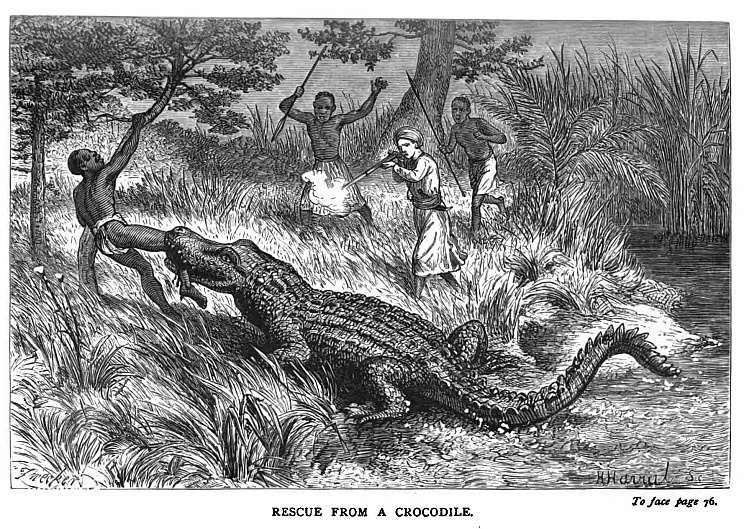
A minute he rested there, still as death. One could not have sworn that it was an animal, though one might have been sure, provided no one suggested a cause for doubt. He then lifted his long head, but with the same cautious movement which always characterises this stealthy, cowardly creature of the African deeps, then his enormously long body, until he resembled a huge log, propped up by four short pins—the legs appeared so out of proportion. Anybody at first glance would have seen that in the great, unwieldy form lay tremendous power. The trunk of the largest elephant that was ever born would not equal in size that long tail, which seemed, on account of its length and weight, slightly bent towards the ground at the tip.
Having again halted, he moved forward silently, with a slightly waddling motion; and as he approached the sleeping form of Mombo, his movements were as slow and cautious as those of a leopard before springing upon its prey; but the monster made one hurried, convulsive movement forward, the lower jaw was run under the sleeping man’s leg, and the upper jaw came down with a sound like a well-oiled and sound steel spring, and the crocodile swung the limp, warm body around, as a man would swing a cat by the tail. But this swinging movement proved to be poor Mombo’s salvation, for he was thus swung against a strong young tree, to which he now clung with the strong tenacity of a man who clings for life, while he gave vent to the full power of his lungs in cries so alarming and shrill that they were heard at the camp of the caravans two miles off. Selim, Simba, and Baruti realised the scene in an instant; they saw the great reptile, horrible and hideous as a nightmare, tugging violently at the leg of the unfortunate man, whose screams pierced their ears, and whose arms almost cracked as he held on with such a fierce grip to the strong young sapling, and they saw that had it not been for its fortunate proximity to him they had never seen Mombo more.
Simba was the first to recover himself, for Selim and Baruti stood as men transfixed.
“Now, master,” said he, “your gun—quick! or he will run away. Aim at once; but be cool, or you will kill Mombo. Aim just at his throat, as you see his head lifted up. There, son of Amer, you have slain the brute! Ah! he is trying to escape. Hyah! on, Baruti; your spear, man! Run! come with me, and catch hold of his tall. Two of us can hold him, I think, or delay him at least until he dies. There—take that, you beast!” he shouted as he hurled his broad-bladed spear full through his side, behind the fore leg, into his vitals, which stretched the monster lifeless after one or two convulsive efforts.
Baruti, encouraged by Simba’s powerful voice, which roared through the wood in accents so cheery, had at first boldly dashed at the crocodile’s tail; but receiving a tremendous thwack on his side from the mighty tail, which was swung about as though it were a well-handled flail—which almost fractured every rib in his body—now stood by, looking fearfully punished and sore.
When the monster had ceased to breathe, Selim and Simba, attracted by the moans of Mombo, hastened to him to examine his condition.
“Poor fellow!” said Selim. “See Simba, the leg is stripped to the bone. What a savage reptile the crocodile is! Do you think Mombo will live, Simba? For after this I should not like to see him die; it would seem as if my big bullet had done no good after all.”
“He will live, Inshallah! Inshallah! (Please God! Please God!) Mombo will live to tell the story to his children on the island when he is an old man and past work. You know the hakim (doctor) with us is wise and learned, and, Inshallah! Mombo, after a few days, will be all right. Sho! Mombo die? No, master; Mombo will live to laugh at this. But we must carry him to the camp that the hakim may dress his wounds. Come, Baruti, man—cease your cries. Take your hatchet and cut young straight trees down while I prepare some rope whereon Mombo may be carried. You, young master, may cut a piece of the crocodile’s tail to show your father Amer, who will be proud of what you have done.”
They all three set to work. Baruti cut two young trees, which he barked. Simba made use of the bark as rope, and in a short time a comfortable bed had been made, on which Mombo was carefully lifted, and, in a few moments, Selim having secured his trophy, the three friends set out briskly on their return to camp.
Young Selim, who had “bagged” his first game, was highly gratified by the praise bestowed on him by his father and his father’s people, and the braggart Isa was the only one of his boy-fellows who refused to say a kind word in commendation of the feat. Noble young Khamis, on the other hand, did not stint his appreciation of it, and youthful Abdullah and Mussoud hung about Selim as though he were some suddenly-discovered hero. The chieftain Khamis bin Abdullah, the noble leader of the united caravans, took from his waist a gold-hafted curved dagger as a token of his esteem, and Sheikh Mohammed presented him with a crimson silk sash to put around his waist. Sultan bin Ali, the patriarch of the expedition, who was the very type of a venerable Arab chief, gave him out of his treasure a red fez-cap with a golden tassel, and Sheikh Mussoud gave him a Muscat turban of a rich cherry pattern, so that Selim, before night, was arrayed in costly garments.
The slaves among themselves did Selim honour by praising him around the camp-fires, and Halimah, the black woman-cook of Amer bin Osman, as she turned her ugali (porridge), declared, by this and by that, that Selim was the noblest, sweetest lad she had ever seen.
Selim would have slept that night the sleep of those who do praiseworthy actions, had he not been awakened at midnight by a loud shriek from one of his father’s slaves, whose right cheek was completely ripped off by a prowling hyaena. The disturbance in the dead hour of night alarmed some of the younger slaves, but they were calmed by the wise and experienced Moto, who said sententiously that “the hyaena is a cowardly brute, who would run away at the sight of a child in the daytime, and who could only fight sleeping or dead men.”
After these incidents, which occurred at the stagnant pools of the Lofu, the caravans continued, their march uninterruptedly until they arrived among the Wahehe, a tribe of predatory people who live south of the great arid plain country of Ugogo.
The first night, before going to sleep after their arrival in Uhehe, the kirangozi of Khamis bin Abdullah rose up at the command of his master—and spoke out in a loud voice to the united caravans:
“Words, words, words! Listen, ye children of the Arabs, sons of the great chiefs, Khamis bin Abdullah, Amer bin Osman, Sultan bin Ali, the Sheikhs Mussoud, Abdullah, Bashid, Hamdan, Thani, and Nasib! Open your ears, ye people of Zanzibar! Ye are among the Wahehe. Ye are in the land of thieves, and night-prowlers. Be wary and alert, my friends; sleep with one eye open; let not your hands forget your guns. When ye meet the prowling Wahehe in your camps at night, shoot and kill all such. Do ye hear?”
“We do,” was answered by six hundred voices.
“Do ye understand?” he again asked.
“Yes,” they all replied.
“It is well; the kirangozi Kingaru, slave of Khamis bin Abdullah, has spoken.”
For two days they travelled through Uhehe without molestation, but on the evening of the third day Sheikh Amer commanded his tent-pitchers to set his tent close against the hedge of brush and thorn (which always surrounds a camp in Africa when it is procurable), for the convenience of his household, the members of which could thus by a slight gap pass in and out freely to the pool to get water or to procure wood for the fire, without being compelled to traverse the length of the camp.
A couple of hours before dawn, when people sleep heaviest, and their slumbers are supposed to be soundest, Simba, who always slept lightly at night, because of the responsible cares which a just and faithful conscience ever imposed on him, was awakened by the crushing of a twig. He never stirred, but continued his regular breathing as before, and compelled his ears to do their duty to the utmost. After a little time his quickened hearing was rewarded by the sound of a human foot pressing softly, yet heavily, the ground near him. The gap, left imprudently open, which fronted the tent-door of Amer bin Osman, was that to which his cautious gaze was directed. By the light of the stars, which shine in Africa with unusual light, he saw the very faintest resemblance to a human figure, which held in one hand something darker than its own body, yet not so long, and in the other a long staff, at one end of which there was a cold glimmer of faint light, or reflection of light, which he supposed at once, and rightly, to be a spear. That human figure was that of an intruder. A friend had never stood so long in that gap, or advanced so stealthily. A wild beast would have advanced with as much circumspection and caution—why not a human enemy? The instincts of both man and beast are the same in the silence of night, when about to act hostilely.
Simba still lay seemingly unconscious of duty—unconscious of the danger which menaced the occupants of his master’s tent; but could that human enemy have seen through the gloomy mist of night those large, watchful eyes of the recumbent form stretched almost within reach of him, he had surely hesitated before advancing another step towards that open tent-door.
All seemed still, and the figure bent down and moved in a crawling posture towards the open door, wherein lay Selim and his father, unconscious of the dangerous presence of an armed intruder. But Simba’s eyes were not idle, though silent. What thing on earth does its work so quietly as the eye? They followed the crawling form unwinkingly, until it had half entered the open door; then Simba raised his head, finally his body, upright to its full gigantic height. The feet of the daring intruder were within tempting reach of those long muscular arms if he but stooped, and Simba knew it. He stood up one short second or so, as if he summoned threefold strength with the lungful of air he but halted to inhale; then quickly stooping, he caught hold of the robber’s feet, and giving utterance to a loud triumphant cry, swung him two or three times around his head, and dashed his head against the great flat stone on which, a few hours before, the woman-cook, Halimah, had ground her master’s corn, and then tossed him lifeless over the hedge of the camp as carrion!!
In an instant, as it were, the camp was awake, and fires burned brightly everywhere. The cause of the disturbance was soon made known all over the camp, and curious men came rushing by the score to the scene of the tragedy, to gaze upon the victim of his own savage lust for plunder or murder. Amer bin Osman, when he heard the explanation of Simba, took a torch, and followed by Selim and others, went to gaze upon the dead man. One look satisfied him that the man was a Mhehe, who had armed himself with a long oval-shaped shield, broad-bladed spear, and battle-axe, for a desperate enterprise.
When Amer raised his head, he seemed to be studying what the intention of the man might have been, and he retraced his steps backwards to the tent-door, and looked in, as if to consider what might have been done, or stolen, had he succeeded in his attempt. Then, looking at Selim’s pale face, who had also arrived at the same opinion as his father, a grateful look stole over his features; he said to his son with a smile:
“Well, boy, thou hast to thank Simba for thy safety, for thy head lay uncomfortably near that door; and hadst thou awakened, thy life had not been worth much. What hast thou to say to Simba, Selim?”
The boy turned his large bright eyes upon Simba’s face, which glowed with honest pride and affection, and then they measured the giant limbs, the tremendous arms, and the broad heaving chest, and to his father’s question propounded another, which rather startled his father:
“Simba is a great strong man, but whom dost thou value more, father—thy son Selim or thy slave Simba?”
“Why, son of mine, what a question! Art thou not the child of my loins, and of my dear Amina? and have I ever failed in my love for thee?”
“Never—no, never, dear father; but Simba has given thy son back again to thee, else had I been dead. Has Simba paid thee full valuation for the purchase-money thou didst pay for him when he was a child?”
“Simba is good; but had I lost thee, I had surely lost all. Thou hast said it, my child. Simba is free, and is no longer a slave of Amer bin Osman.”
“Simba!” cried Selim, “good Simba, do you hear the words of my father? You are a man, and no longer a slave!”
Simba at first did not seem to comprehend the full meaning of the words addressed to him, but as the words of the boy whose life he had saved were repeated to him, a proud smile lit his features, and as he tossed his head back, while his nostrils dilated, he said:
“A slave! It is an ugly word; but Simba, of the Wahuma, of Urundi, was in his own mind never a slave, so the word troubled him. Simba might long ago have been free, had he wished it, but he loved his master, Amer, and Sheikh Amer’s son; so he remained their servant, and while being their servant he never forgot that he was a man. Simba is grateful to Amer and his son Selim, and while he remembers that he is free, Simba will be happy only in remembering also that he is their servant;” saying which, he bent his knee and kissed the right hand of father and son.
“Ah, Simba, my friend!” cried Selim, “I shall call thee friend in future, and thou shalt say ‘thou’ to me, and I ‘thou’ to thee, as my father and I say to each other; and if thou art grateful, Selim has also a heart, and can feel.”
“Then, boys,” said Amer, breaking in upon this interchange of compliments, “to bed, and sleep your sleep out. Let a watch be kept, lest the Wahehe robbers come to avenge the dead dog of a thief, and upon the first appearance of anything suspicious, sound the alarm instantly.”
The night passed without further alarm or disturbance of any kind, and at the usual hour of the morning the signal horns aroused the camp for the fatigue of another day’s march.
As the caravans were about leaving their camp, a group of Wahehe strolled up carelessly, similarly armed to the one who had met his fate so suddenly at the hands of Simba. As they were advancing towards the central gate of the camp, their quick eyes caught sight of the dead body of their comrade, and hastening towards it, they regarded it with wonder depicted on their faces. On stooping down to examine the head, they found it elongated into a hideous, formless shape, and not being able to contain their surprise, they questioned as to why and how it all came about.
Said Moto, who had keenly noted these signs, and had approached the group to answer their expected queries, “Ah, my brothers! some men are bad, very bad, and fools. What could have possessed this man to try and rob a caravan of 600 armed souls, I cannot say, unless it was the evil spirit. Do you see that big man with the great battle-axe in his belt, and a long ivory horn slung to his shoulder? That big man caught this thief in the tent of Amer bin Osman: he seized him by the feet, and whirling him around, he brought his head down flat on that stone.”
“Eyah! eyah!” said the astonished Wahehe. “He must be the evil spirit himself; but all thieves should die, and if, as you say, this man was caught at night in the camp, he has earned his death.”
“Say you so, my brothers?” said Moto; “then it is well. But listen to me; if the wind came to steal in our camp that big man would know it. He seems never to sleep, never to rest; he could smell a Mhehe at night afar off.”
“Eyah, eyah, ey-eyah!! He must be the evil spirit.” Saying which they departed, muttering to themselves and looking very much crestfallen.
The caravans journeyed on for several days after the incidents just related without meeting anything worthy of note in these pages. The western part of Uhehe is very uninteresting; one march follows another through the same triste scenery. A long reach of country to the right and the left, covered with short ripe grass, dotted with a ragged clump of thorn-bush here and there, or a solitary baobab stem, unbending in its vast girth and thickness of twigs, alone met the wearied eyes of the travellers. The Wahehe, the southern Wagogo, mixed with a stray Wakimbu family or two, permitted such a large caravan to pass without molestation, so that the march was getting exceedingly monotonous. But when, after crossing an unusually arid plain of some extent, they saw before them a long line of white rocky bluffs, the people began to whisper among themselves that “beyond those bluffs lay the lands of the populous Warori, who are mostly shepherds, and will not, if in the mood to quarrel, regard our numbers or strength.”
It was the tenth week of the departure of the Arabs from Simbamwenni when the above-mentioned bluffs were crossed, and the pastoral country of the Warori extended far before them in a succession of wooded hollows, bare uplands, and jungle-covered plains.
Those who knew Moto, the slave of Amer bin Osman, were startled at the remarkable physical resemblance he bore to the majority of the shepherds and villagers, who grouped themselves along the road to wonder at the wealth of the Arab caravans, and to make their rustic comments upon what they did not understand.
The Warori, however, did not seem disposed to dispute their advance, but stood contentedly gazing at the strange sight of some of the whiter faces among the Arabs. For instance, Khamis bin Abdullah and his son Khamis, Amer bin Osman and his son Selim, and the boys Abdullah and Mussoud. This paleness of complexion became often a matter of eager speculation, and as those who, fortunately or unfortunately, possessed white faces passed by, the straining of eyes and the narrow scrutiny were amusing to witness, and afforded Selim more especially some discomfort at first. The shepherds and villagers furthermore willingly bartered whatever the Arabs wished for red beads and American domestic. Milk, butter, and eggs were plentiful, which, to the Arab boys, were rare treats after the dry heat and desolate aspect of Western Uhehe. The arms which these shepherds carried were far more formidable than anything they had hitherto seen in the hands of savages. Their bows were longer and heavier, and their arrows longer and more cruelly barbed, and besides a lengthy broad-bladed spear, which resembled a broad Roman sword fastened to a staff, and half a dozen lighter spears—assegais—and a battle-axe, they carried a knife which might be likened to a broadsword for length and breadth.
On the sixth day after their entrance into Urori, the caravans came within sight of a large palisaded village called Kwikuru, or the capital. It contained about eight hundred huts, strongly protected by a lofty fence of hard red wood. This Tillage was protected on one side by a stream of considerable magnitude. On the other side of the village was a grove of fine trees situated from it a distance of about 1000 yards. Into this grove the Arabs marched to encamp.
Kwikuru, or the capital, was a good distinction awarded to the village, or town rather, for its size and importance; for, next to Simbamwenni, it was the most populous place they had found in Africa. Cattle grazed by the thousand a little distance off from the grove, attended by watchful and well-armed herdsmen. The lowing of the cows, and the bleating of the sheep and goats, and the braying of a few large donkeys, were welcome sounds to travellers, to whom such sights in Africa were rare. And the long extent of well-tilled ground, in which grew the Indian corn, the manioc, the holcus sorghum, the sugar-cane, and plantain, with abundance of vegetables and melons, enhanced the pleasure the Arabs’ people naturally felt, unaccustomed as they were, since leaving Zanzibar, to feast their eyes upon such scenes.
Late in the afternoon, after the Arab chiefs had, with commendable caution, constructed a dense hedge of bush and branches around their camp, they called a meeting to discuss the measures they should take to open friendly communication with the formidable citizens of Kwikuru.
When they were all assembled, the leader Khamis said to them:
“My friends, we are at last in Urori, where I suspect we shall have to conduct ourselves differently from what we have been accustomed to. I mean that I fear that tribute may be exacted by the King, and I have called you here to advise prudence, and to ask you to use tact in all your dealings with them. We may have to pay a heavy tribute, for this King is evidently powerful and rich, and a mean present of cloth I expect he will refuse.”
“Khamis,” said Sultan bin Ali, “thou hast done well to advise us upon this beforehand. What amount of cloth dost thou think will suffice this man’s greed? We may be liberal, for we can afford it, but we have not one doti (four yards) of cloth too much.”
The chief answered, “I do not know as yet what amount will suffice, but let us begin prudently, for in that course is wisdom. I suggest that six doti be made up; two doti (eight yards) of Joho cloth for the King, two doti of light checks for his wife, one doti of Muscat check with the red and yellow borders for his eldest son, and one doti of good Kaniki (blue cotton) for the principal elder.”
“That idea seems excellent to me,” said Sultan bin Ali, “and Amer, thou hast a cunning slave called Moto, a Mrori, I believe; let him and another good man take the cloths to the King with words of friendship from us, that we may pass through the country in tranquillity and peace with all men.”
This advice meeting the approbation of all the chiefs, Moto, accompanied by the kirangozi of Khamis bin Abdullah, who was learned in all the languages of Eastern Central Africa, sallied out of the camp in the direction of Kwikuru, while the Arabs sat in the tent of their leader, hospitably entertained with the beet that the larder could furnish.
An hour had barely elapsed before Moto and the kirangozi, or guide, returned to the camp; and going directly to the principal tent, kneeled before the door and said to the Arabs:
“Salaam Aleikum!” (Peace be unto you.) To which greeting the Arabs responded with one voice:
“Aleikum Salaam!” (And unto you be peace.)
“Well, Moto, speak,” said Khamis. “Why, you have brought the present back! You have been unsuccessful?”
“These are the King’s words, which he commanded me to tell you: ‘Why have you come to my country? Know you not that there is enmity between the Warori and the children of the Arabs? Mostana, the great chief whom the cruel traders slew, was my friend; and can I forget his death with such a contemptible present as that which you have brought to me? Go slaves, and tell your masters that, unless they send me fifty bales of cloth, and fifty guns, with twenty barrels of gunpowder, they must return the way they came.’ These, my masters, are the words which Olimali bade us tell you.”
A deep silence followed this declaration of the King of Kwikuru, and the Arabs instinctively looked at one another in surprise and dismay.
Sheikh Mohammed, the black-browed Arab, resolute and determined as he always was, first broke the silence with the question, directed to Moto:
“Have you regarded well this village of Olimali?”
“I have, master,” said Moto.
“Is it strong? Speak, for I respect your opinion, Moto.”
“It is strong, master, much too strong for us to attack it with our people. If the Warori come out of their village they could not take this camp while our men remained within.”
“That is well-spoken, Moto,” replied Mohammed; and turning to Sheikh Khamis, he asked:
“Hast thou decided what to do, son of Abdullah?”
“Mashallah! my friend, can I decide upon so important a subject as giving away thy property to this greedy infidel? May his soul perish in Al Hotamah! Does he think that cloth, and guns, and powder grow in the jungles of Africa? But this is serious, and we must set on our heads the caps of wisdom and understanding to consider the determination of Olimali. Speak, friends, Arabs of Muscat and chiefs of Zanzibar, my ears are open.”
Out spoke Amer bin Osman: “Do you think, Moto, if we offered half he would accept?”
“No, master, I do not. I think Olimali desires war and not peace, and if he thought you would send fifty bales of cloth, he would ask for fifty more. I heard the people talk, as I left the King’s presence, of war. My ears are very sharp.”
“War!” shouted Mohammed, “then war he shall have, and I shall have the pleasure to put light through his body with my good Shiraz sword;” and Sheikh Mohammed looked as fierce as his threat.
“Peace, Mohammed, my friend,” said Sultan bin Ali. “It is not everyone who trusteth in his sword flourisheth. I think there are more ways of tiding over this evil hour than by war, even if we were doubly strong with men and guns. Let us act prudently in the hour of danger.”
“Sultan bin Ali is right,” said Sheikh Thani. “Rather let us try all pacific measures first, and let war be the last resource. We have slaves, and women, and little ones in the camp, besides much property. We must remember this before we act hastily.”
“Thani has spoken well, and with understanding; and I propose that we send forty good cloths and forty ordinary cloths, besides an odd gun or two, with half a keg of powder to Olimali by Moto and the kirangozi, who will speak him fairly and with due respect,” said the leader, Khamis.
“I do not go again,” said Moto. “What I have seen in the village, and what my ears have heard are no light things, and I would ask permission from my master to remain.”
“Well, never mind, any man will do who has a smooth tongue and fair speech,” said Khamis. “Let the kirangozi choose whom he will take, and let him go with the cloth.”
A man was readily found, who, ignorant of the danger, had no reason to refuse to go upon the errand which the always bold Moto had refused.
But even as the guide and his companion were leaving the camp Moto saw he had acted wisely, for the cattle were being driven towards the village with far more expedition than the time of day warranted; but he held his tongue, not wishing to alarm the camp unnecessarily.
He followed the movements of the kirangozi and his companion with exceeding interest until they had arrived at the gate, where they were halted; and after a short pause, he saw the two men returning towards the camp.
Proceeding to the gate of the camp, he there awaited the arrival of the kirangozi, and when he was near enough Moto quietly asked of him:
“Is it peace, or war?”
“War!”
He needed to hear no more, for he had been certain of it, and he went directly to his friend Simba to communicate the news, who received it with surprise.
“War, Moto? Then our fears, my friend, have turned out true, and it is because of the battle which thou wert in with Kisesa against Mostana, eh?”
“Yes, Simba; and wouldst thou believe it? I saw two or three fellows eye me pretty hard, and it was for that I refused to go the second time; for if they had known to a certainty that I was in that battle thou wouldst never have seen Moto again, friend Simba.”
During the greater part of that night the Arabs sat in council, debating how to proceed; but not agreeing, they separated for the night, not, however, without posting sentinels all around the camp under the charge of Sheikh Thani.
Chapter Four.
Khamis’s Address to the Arabs—Proposals for Attack on Kwikuru—Simba splits the Gate from Top to Bottom—The Warori Chief shot—Death of Khamis bin Abdullah—Amer bin Osman pierced by an Arrow—Selim made Prisoner—Selim brutally lashed by Tifum—The three Arab boys brought before Ferodia—Selim refuses to drink or dance—Abdullah refuses to be called a Slave—Flight of Sultan bin Ali—Division of the Spoils—The Magic Drink: Mutilation of the Dead—The Chant of the Magic Doctors.
The young people who have been fortunate in buying this book may not have experience of the battle-field, and therefore may not know what the feelings and thoughts of those who are about to stake their lives against the lives of others for the victory in the bloody contest are. The feeling is the same in all men, whether white or black, though some natures are so constituted that they are enabled to hide feelings which some say partake largely of fear. But I deny that such indicate fear, though, left to themselves, they might create fear. In the Arab camp, as report and rumour had been busy at the camp-fires, a feeling of dread predominated in all minds, but had there been one chief of resolution, with power unlimited over all, a few words of cheer had done wonders in improving the tone of their minds.
Khamis bin Abdullah was a brave man; no man might deny that; but his bravery was undisciplined; it was uncultivated; it was the bravery of a wild but noble heart. He had not seen so many battle-fields that he could afford to smile at the declaration of Olimali; he had not the experience of war which would have satisfied him that, however large and numerous the force of Olimali was, he had resources enough in himself to defeat them all. Khamis bin Abdullah could die himself, but he could not bring others to look upon death with calmness and courage. So that, despite the high-spirited courage of his race, which he eminently possessed, the truth must be told without any disparagement to himself; a feeling of depression, some undefined dread, remained settled in his breast, though his outer aspect, his mien, or behaviour, did not betray this.
As it was with Khamis, so was it with the other chiefs. Amer bin Osman was as brave as a lion, but he could not depend upon his people as he could depend upon himself personally, and this thought created the dread, and doubt, and apprehension of something undefinable, which all the chiefs at this critical moment felt.
Sheikh Mohammed, Sultan bin Ali, and the rest were as brave as any living men. Had there been only one hundred Arabs, a doubtful issue of the war would never have been entertained; but there were only twelve Arabs and six hundred black men; and how long would the black men stand together?
At sunrise, another meeting was called, and the Arab chiefs, with their sons, hastened to the council.
Khamis, the leader, when all had been seated, said:
“My friends, the last words of Olimali, according to my kirangozi, were that the Arabs need not try to tempt him to forego his revenge, but that we must prepare for war. We can easily prepare for war, for we are always ready; but we must endeavour to sustain each other by friendly counsel and cheering words; for in a fatal issue to us of this war we know what the fate of us true believers will be. We can hold out in our camp against four times the number that Olimali may bring against us. We are weak, however, in this country, because we have no friends to supply us with food, and it is not a little that will suffice to feed six hundred souls. The men had no food yesterday, they have none to-day; they cannot hold out long in the camp against hunger. In this case what do you propose?”
Sultan bin Ali spoke and said, “Our answer has been given to us, and there is no longer any doubt of what we have to do. We must fight, but how fight is the question. Shall we await here in the camp the coming of the infidel savages, or shall we sally out of the camp and attack them in their boma (palisade)?”
Sheikh Mohammed answered, “We cannot remain in the camp to starve and eat each other; we must go out and get cattle, while a few of us stop inside here to strengthen the camp with branches. I would suggest also that a trench be dug all around the camp, and the earth thrown against the hedge as a parapet. Wallahi! I have seen such things done in Unyanyembe, and the enemy beaten.”
“Mohammed’s words are well spoken,” said Amer bin Osman. “I would advise eleven of us sally out with our men, and one Arab remain with one hundred men, who will stir themselves to strengthen the defences with our cloth bales and baggage; and if we have to fall back, we shall find a strong place ready for us. We can harry those infidels; though they may be hidden behind triple rows of palisades, some of our bullets will reach them. Thanks to Allah! we have enough ammunition with us.”
“Very good indeed,” said Sheikh Thani, a wiry, cautious old man, who had had much experience in Africa; “but supposing we are beaten in our attack upon the palisades of Kwikuru, we shall not be any better off than we were before, but worse; our men will get disheartened, and starvation will stare us in the face. I propose that five hundred men, divided into two parties, make for the gates as quickly as possible, and break open everything with all the speed we can. It is only in this way that we can succeed.”
“The oldest among ye have spoken,” said the leader Khamis, “and ye have spoken well. But I have been in Urori before, and know the customs of the Warori. If we succeed in taking this village of Kwikuru, we cannot hope to be permitted to march through this country any more; but as soon as we take it we must strike along the road to Unyanyembe. It is useless for me to tell ye that I advised ye at first not to take the Urori road. I shall not quarrel with ye about that now, but will try to do my best for our general safety. If we succeed in destroying Olimali and his people, we must begin our march north to Unyanyembe to-night, for in two days the fugitives will carry the news from one end of the country to another.”
“Excellently spoken, brave Khamis,” said Amer bin Osman. “Thou hast a wise head, and art a worthy leader. Do thou, with thy men and other chiefs, attack one gate, and I, with my men and other chiefs, will attack the other gate, and whosoever takes a gate first, let him blow on his horn once. I advise now that whatsoever we may have we shall eat, and that after we break our fast we sally out.”
“Praised be Allah for his goodness! Let us eat; then fight!” all shouted.
In half an hour breakfast had been despatched, and every chief sallied out with his men under his respective flag, except Sultan bin Ali, who was left with one hundred men to prepare the camp for defence in case of failure.
Simba and Moto had also had their little council together; and as they marched by the side of Amer bin Osman, various signs might have been seen by the observer to pass between them, accompanied by many ominous shakings of the head.
A deep silence prevailed near the village; not a soul was seen, not a dog was heard to bark; but the sun shone as usual with its summer heat, and the sky was perfectly cloudless and beautiful in its azure purity.
But little did the approaching Arabs and their followers heed the beauty of the sky, the brilliancy of the day, or the heat of the sun.
When they had advanced within 300 yards of the village, the force under Amer bin Osman separated from that of Khamis bin Abdullah, and marched at a respectful distance from the village towards the southern gate, and when he had gained his position, at a preconcerted signal both forces began their firing, advancing rapidly as they fired.
The village stirred not; not a sign of life was visible for some time, until the Arabs had approached within fifty yards; then clouds of arrows were seen to issue from the village, and furious yells were heard, which seemed to rend the sky. Numbers of the Arab followers fell pierced to the core by the arrows; but the animated shouts of their chiefs spurred them on towards the palisade.
In a few moments, after repeated discharges of musketry, the Arabs gained the outer defence of the village, and, intruding their guns between the tall posts, were soon firing right in the faces of the astonished but not dismayed people of Olimali. But at this juncture, a long blast on a deep-sounding horn was heard from the interior, simultaneously with a shorter and shriller sound which proceeded from the southern gate. The shriller horn belonged to Amer bin Osman, and was blown by Moto; but what did the bass horn from the interior of the village mean? But there was no time to lose in conjecture.
Amer bin Osman had advanced with resistless impetuosity towards the southern gate, and the gigantic Simba had, with one blow of his heavy axe, split the gate from top to bottom, and, giving it a strong push with his foot, had sent it flying open, through which, accompanied by his master Amer and Selim, who carried his rifle, he had bounded into the interior, firing his musket with the utmost rapidity.
Amer’s followers, animated by the valour of their master and the immense strength of Simba, now became as brave as lions, and vied with each other in noise and bravery. Not being able to make their way rapidly enough by the gate, which was thronged by the besiegers, they climbed over the palisades like monkeys, and little Niani’s agility might have astonished his namesake. Abdullah, Mussoud, and Isa were with their parents, Sheikhs Mohammed and Hamdan, and they crept through the gate much behind Selim and his father Amer, owing to the press of besiegers.
So quickly had Simba gained the gate and destroyed it, that all the fugitives were not able to enter the inner inclosure which surrounded the king’s quarters, and a body of them, numbering about fifty, under the leadership of the king’s eldest son, now stood with their backs to the palisades, resolutely confronting Simba and his companions, with heavy spears in their hands.
Simba, at this time before a foe on whom he could exert the full power of his arm, became transformed into the embodiment of a black Mars, the god of war. He was no longer the humble and obedient servant of Sheikh Amer and the true friend of Selim. He was more; he was their irresistible leader. In his eyes glowed the ardour of fierce battle; the terrible savage spirit of the Warundi, hitherto constrained for faithful, though menial, service, had burst its trammels, and he now stood, with uplifted musket,—confessed—the bronze Achilles of the war. His fierce eye caused the doomed fugitives to quail with cowardly dread; and when aimed at him, the heavy spears of the Warori fell harmless at his feet. Giving vent to the hitherto latent passion of the savage’s soul in a loud bellowing cry, he sprang forward, and the rapidity with which he dealt his blows with his clubbed musket awed even the warrior soul of his Arab chief. But not for long did Amer pause to regard even the prowess of Simba. Calling to his followers, he raised his long two-edged sword, and darted at the enemy, plying the weapon best known to him and his race with a power which elicited as much admiration as Simba’s strength of arm and dexterity of stroke had done.
Rendered desperate by the knowledge of their situation, the remaining Warori, headed by their chief, made a rush towards their enemies and used their heavy spears with frantic energy. In front of the Warori chief stood Selim, firing and loading his rifle with a coolness and method which would have won applause from his father’s people had the combatants not been so busily engaged. He was in the act of re-loading when the desperate rush of the Warori was made, and their chief stood with uplifted spear above him; but well was it for him that the watchful eye of Moto was on him, else had our story been ended here, ere it is hardly begun. When it seemed that Selim could not have been saved, and he stood expectant of the blow which would have ended his young life there and then, he saw the chief’s head fall back with a cruel jagged wound in the temple, through which the bullet of Moto had sped home.
The Warori no longer resisted when they saw their chief fall, and attempted to fly, but the force of Arabs was too numerous; they fell dead to a man.
Khamis bin Abdullah had also been successful. Cheered by the news which the horn of Amer conveyed, he soon effected an entrance, and, accompanied by his followers, he had entered the village, and almost similar scenes awaited him, though not so sanguinary.
When they had succeeded in forcing the outer inclosure, they had still a hard struggle before them to conquer the village; but they, no doubt, would have done so had not a new enemy come upon the field.
Unknown to the Arabs, a few miles west of the village was stationed a large body of Watuta, whose chief had been sent by Katalambula, brother of the dead Mostana, to pay his respects to his brother’s friends, and to renew “assurances of his esteem and consideration” for them, as the old letters used to say.
This body of Watuta was one thousand strong, and as soon as the Arab caravans hove in sight, Olimali had despatched messengers to Ferodia, the Watuta chief, telling him of his intentions, and bidding him hasten to the neighbourhood to watch events, and to be ready for the signal, as he intended to attack the Arab camp. But the attack of the Arabs upon his village had caused him to give the signal earlier than he had at first anticipated, and the easy entrance of the Arabs into the outer village had been partly effected through the connivance of this wily chief, though in the loss of warriors and in the death of his eldest son he had paid dearly for his treachery.
While the Arabs and their followers now devoted their attention to the attack upon the inner inclosure, which was vigorously defended, the major number of the Watuta had risen, in response to the deep-sounding war-horn of the Warori, from among the corn-fields to the west of the village and camp of the Arabs, and had hurried to the rescue.
They came upon the outer inclosure just as the Arabs commenced their attack upon the inner palisade, and the first time the Arabs knew of their presence was when they were first fired upon before and behind.
The followers of the Arabs, before so valiant, now became panic-stricken, and they simultaneously made a rush for the gates, while, the defiant yells of the savages completely drowned their cries; but the cunning Watuta had closed the gates, or had so barricaded them that egress was impossible. They now saw nothing but death staring them in the face—savages in front, savages behind; both parties defended by palisades, while they stood exposed between, to be shot to death in their tracks. It was useless for the Arab leaders to attempt to encourage them, for one after another of these brave men fell and died. Khamis bin Abdullah fell, pierced by a dozen arrows, and his son, the noble young Khamis—the proud-spirited young Arab—fell also across the body of his father at the hands of the people whom he so much despised. Mussoud, and Thani, and Amram died also bravely, and one after another of their followers fell to rise no more, until those who were left threw down their guns crying “Aman, aman!” (Mercy, mercy!) upon seeing which the Watuta and Warori desisted from further murder, to make slaves of those who cried for quarter.
The force under Amer bin Osman, Sheikh Mohammed, and Hamdan, and the other chiefs, fared as badly. They were engaged in vigorously attacking the inner defence in front of them, when they heard a loud gurgling shriek issue from Sheikh Mohammed, who had been pierced in the nape of the neck from an arrow behind, and on turning to see whence it came, they were dismayed to find an enemy of another tribe behind them. Moto, on seeing them, shouted “The Watuta! the Watuta! Olimali has betrayed us into their hands.” Bimba, hearing the words of Moto, desisted from further attack, and came to Amer bin Osman, counselling him to fly with him, and handing him a shield to cover his body, which, from the dress he wore, was a prominent mark. Moto also held a couple of shields before Selim, while Abdullah and Mussoud were ordered to do the same.
“Fly!” said the astonished Amer—“fly! Ah, Simba, my friend, had we wings, we might fly. See you not the gate is closed?”
“The gate is closed, I know, great master, but Simba’s arm is strong, and I will force it open.”
“No, Simba, I cannot fly to be butchered like a bullock outside. I shall meet my fate here. Ha! do you hear that? See! the savages are within. Khamis bin Abdullah is dead! Save my boy Selim, for his mother’s sake! Ho, my son, come to me! One embrace before we part for ever; but, my son, remember, I shall meet thee in Paradise!”
The father and son were united in a fervent embrace when Amer received an arrow in the back from within the inner inclosure, which caused him to fall, with his son in his arms, to the ground. The arrow had been driven by a strong hand, for the point projected in front and slightly wounded Selim in the chest, the blood of father and son commingling in one stream.
“Brave Simba and faithful Moto, where are ye? Save my boy!” cried Amer, looking up with glazed eyes at the two who bent over him, heart-stricken with sorrow. “Save my darling Selim! Save him for the love I bore you! Ah, Selim, my son, kiss thy mother for thy fa—Amina!—Sel—Ah!”—and the great soul of Amer hastened upward to the Judgment Seat.
Simba and Moto, when they saw their master had breathed his last, stretched his form out evenly, and, placing a cloth reverently over his face, caught hold of Selim, and pressing the heart-broken boy to the ground, close by the body of his father, said to him:
“Lie still, young master. Nay, but you must. Your father commanded us to save you, and we will; but you must do what we advise you. Think of your mother, of many happy days yet in store for you. Lie still as death, and they will take you to Katalambula’s village, and there you will meet us. Here, Abdullah! Mussoud! Isa! lie down here, alongside of Selim. What, all the chiefs dead already! Wallahi! but this is a sad day for the Arabs at Zanzibar!”
Having given these instructions to the Arab boys, which had been given in much less time than we have taken to record them, Simba and Moto also fell to the ground, but retaining their spears and shields in their hands.
By this time the Watuta were within the village, crowing triumphantly over their success; but Ferodia, the chief, after giving orders to bind the captives, hastened away with nearly all his force to attack the camp, which, under old Sultan bin Ali, held out still against the force that had been detached to attack it.
While the few remaining Watuta were binding the captives, Simba and Moto rose to their feet, and, using their spears right and left, soon cleared a passage to the gate, before the astonished savages could recover their senses.
Once outside the gate, Simba and Moto exerted their powers to the utmost, and by their extraordinary speed soon left their pursuers far behind.
Finding it useless to pursue the runaways, the Watuta began to examine the wounded, and especially the Arabs, whom they surveyed with astonishment. The group formed by Amer bin Osman, Selim his son, Abdullah, Mussoud, and Isa, attracted them most for their rich dresses. They began to strip the bodies, but their astonishment was very great when they perceived Isa sit up and fold his hands, asking for mercy.
Suspecting that others shammed death, they laid hold of Selim, and he also sat up; then Abdullah and Mussoud, and they also sat up, looking very sheepish, or like guilty people caught doing a mean action. Angry at the cheat, as they imagined, to have been practised upon them, they snatched the cloth from the face of the dead body of Amer bin Osman; but there was no mistaking him—he was dead.
Some were for slaying the boys at once; but the majority interposed, and said in an inquiring tone, “Why slay boys, when you can make slaves of them?” which shortly met general approbation.
Upon agreeing to this, they began to strip Isa, who shortly found himself as naked as when he was born; but being extremely dark of colour, there appeared nothing remarkable about him to attract any special attention, and he was taken at once to the other captives, where he wae firmly bound with strips of green bark.
They then laid violent hands on the others, on Selim, Abdullah, and Mussoud; and despite their struggles and tears, they were soon denuded of their finery and of their rich embroidered dress. When they saw the pale and clean colour of their bodies, the fierce Watuta gathered about them, and wondered what strange beings these were who were all over white, while they themselves were all black. They looked at the wound in Selim’s chest, and on pressing it saw the red blood flow, which only increased their astonishment; for how could people with white skins have red blood? But Selim’s proud heart was rebelling against the indignity of being stared at as a curious specimen of humanity, and he had endeavoured to hide his blushes with his hands; but when they pulled them down, and ordered him to show his tongue and teeth, and began to feel the muscles of his arms and legs, then he could bear no more; and flinging himself across the dead body of his father, he wept aloud, and prayed to God that he might die. Abdullah and Mussoud were as yet too terrified to do more than cry silently; and they were accordingly led away and bound without resistance. They then took hold of Selim to tie him, but he would not rise; and, angered at what they deemed his stubbornness, two warriors brought the shafts of their spears full upon his body, which had well-nigh broken the high courage of the young Arab; for so great was the pain his pride suffered, and so indescribable were his emotions, that he lay like one stunned.
While the boy lay fainting in the hot sun amid the dead and the blood, the chief of the party in charge of the prisoners, casting his eyes around, saw a whip of hippopotamus-hide in the waist-cloth of one of the dead fundis, or overseers, of the Arabs. This pliant and formidable whip the chief—a man of stern and forbidding aspect, whose name was Tifum (pronounced Tee-foom),—Tifum Byah, or the “Wicked Tifum,” and who was evidently a traveller—handled like a man who knew its uses, for he made it fly about his arm in black circles, and made it hiss its menace in the ears of the sorely-tried Selim.
“Proud Arab boy, arise! Tifum Byah speaks but once, else you will feel the pains of this whip, with which your cursed race torture the backs of your slaves. Many days lie between here and Ututa, and you will suffer more than this ere you see our plains. Arise! No? then words are light as air, and seldom go into the ears of the stubborn;” and as he spoke, he lashed the prostrate youth with all his might, while the shrieks which the pain elicited at last from him were responded to by the mocking laughter of the brutal crowd, who pointed at the marks which the whip made in high glee.
When Tifum fancied he had punished him enough, he ordered the boy to be assisted up to his feet and bound; and when this was done Tifum lowered his face to Selim’s, and said, “Mark my words, child of the pale race! You shall be Tifum’s slave, to hoe his field and bring him wood and water. You shall nurse his children, be a herdsman of his cattle, and I will break your heart, and make your ears open to his slightest breath. Do you hear me, white face?”
So strong was the nauseous and hateful repugnance he felt towards this man that Selim could not repress the expression of the loathing that filled him, and almost unconsciously he spat in his face, which was instantly retaliated by Tifum with a tremendous box on the ear, which prostrated the boy once more across the dead body of Amer, where he lay like one deprived of life, and not all the brutal lashing which the almost lifeless form received evoked one groan from him; and it was in this unconscious state that he was carried to where the other prisoners stood huddled together like frightened sheep.
Then, directing his attention to the dead bodies of the Arabs, these were ordered to be denuded of their clothing, and to be laid in a row together, Sheikhs Khamis, Amer, Abdullah, Mussoud, Thani, Hamdan, Mohammed, Amram, and young Khamis, and two others of lesser note—an honourable company truly, even in death!
There seemed to have penetrated into the brain of the unconscious Selim some idea of what was about to occur; for as soon as the dead had been gathered together, he raised his head and sat up, with his eyes fixed upon the dishonoured bodies of his father and his father’s friends, which were laid side by side. He heeded not the taunts of the Warori who had collected to menace and insult the prisoners, and feast their curiosity with a sight of the noble dead; he heeded not the groans of his boy-companions Isa, Abdullah, and Mussoud, nor the wailing of the little slave Niani, who had been born on his father’s estate, and who was now crying his eyes out for the loss of his master Amer, and for the more pitiable condition of his young master Selim; he heeded not the hot sun which was blistering his back with its fierce heat, nor the scores of flies which troubled his numerous wounds; he sat heedless of all, with his great eyes fixed sadly on the remains of his father.
But night was approaching, and Ferodia had not yet returned. Volleys of musketry were heard incessantly all the afternoon; but as the sun set the musketry ceased, and Ferodia returned with all but a few of his people, when it was reported that the camp still held out, but that in the morning all the fighting men of Olimali and Ferodia would take the camp at a rush. Until then he had left a few of his men to watch it, lest they might abscond at night and take away the most part of the great wealth which must be stored within the camp. The losses of the Watuta had been excessively heavy, as, when Ferodia darted out with his victorious men, it was expected that the camp would have surrendered at once; but it seems that Sultan bin Ali had so well fortified it that it was almost impregnable, and that the Watuta had been punished severely.
The Warori of the village of Kwikuru had prepared food in a great quantity for the warriors of Ferodia, who were too much engaged with satisfying their ravenous hunger to display much interest in prisoners whom they knew were secure; and when they had finished, they had so gorged their stomachs with food and pombe, that they were too indolent to stir. But when Tifum, who was obsequious enough to Ferodia, though cruel to his subordinates, had told the latter of the interesting character of the white slaves, as he called the three Arab boys, and how he had found them shamming death, he commanded him to bring them before him and Olimali that they might be amused.
Tifum hastened out obedient to his chief’s mandates, and, arriving before the prisoners, searched for the Arab boys, who had already forgotten their misery in a deep sleep. Finding that they were in a too uninteresting condition to amuse his master, he had several gourds full of water brought to him, which he threw over them to cause them to cast off the disposition to sleep. This being done, he led them to the presence of his chief.
Ferodia was holding forth to Olimali upon the prospects of the great riches they should share with each other on the morrow when the young prisoners were ushered before him. By the dim light which the torches gave out, they appeared much more pallid and strange in a land where white people had never been seen; indeed, one might say they were rather alarming; and it is no wonder that Ferodia started as the three were pushed towards him.
But, quickly recovering himself, as he remembered who they were, he burst out into a laugh, saying, “Ah, I remember, these are the Arab youths thou didst speak to me of, Tifum. This pombe, Olimali, is strong. I think it has made me light-headed,”—speaking these words aside to the Mrori chief.
Then attentively fixing his gaze upon the prisoners, and looking them all over, he said, half to himself, “What strange people these Arabs are—all white! Their hides are as white almost as the yolk of eggs but how came the tallest one, I wonder, to have so many wounds?”
“Tifum,” said Ferodia, aloud, “what ails this tallest lad? These wounds are not the wounds of arrows.”
Tifum, bending his back almost double, said, “My chief, this boy is as stubborn as an ass. When I remembered the cruelties the people of this boy have practised upon those of our colour, my blood boiled within me, and when I told him to arise and be bound like the other prisoners, he spat in my face, and I flogged him.”
“Pah, pah, Tifum! he but acted as the Watuta boys would have done; but lay not thine hand on him again. I take him for my slave. The boy is half dead already. Here,” said he, addressing Selim, “drink this,” handing him a good ladleful of sparkling pombe; “it will put life in thy dull veins.”
Selim shook his head and curled his lips in scorn, and looked at the half-inebriated chief with contemptuous indifference.
The chief regarded him for a moment in silence, with the cup still stretched, and then said, “Thou art right, Tifum; no Mtuta boy would have had the courage to refuse a cup of pombe from a chief, nor regard his future master with such a look. He is a fool, and stubborn as an ass, truly. But I will tame him, or I will kill him. How Kalulu, the nephew of Katalambula, will wonder at him! Why, he must be of the same age as Kalulu; but Kalulu is taller and stronger; but I doubt if he has this lad’s high courage, though he is proud as if he were already king of the Watuta. Kalulu would act differently from this youth if he were in his place; he would have taken the pombe and then killed me as soon as he had the opportunity. Ah! Kalulu is a true Mtuta. But here I am with the cup still in my hand. If this boy will not drink it, perhaps the others will. Here, you!” addressing himself to Abdullah, “drink, young one. No? And you refuse it, too? Well, you smallest one,” to Mussoud. “Not even you? Strange youths! Dost thou speak their language, Tifum?”
“A little, my chief.”
“Ask this tallest one why will he not take this cup of pombe from the hand of Ferodia, chief of the Watuta warriors.”
“Boy,” said Tifum, addressing Selim, “Ferodia, chief of the Watuta warriors, demands to know why you will not accept the drink at his hands.”
“Then tell thy master,” said Selim, without ever, turning his eyes towards the man, “that I may not accept anything in kindness from his hands, since he gives it to me while he believes me to be a slave. Tell him I am not his slave, and never shall do his bidding save under constant compulsion.”
When Tifum had communicated this to his chief, Ferodia burst into another loud laugh; then said:
“This boy is verily proud; but, Tifum, ask him to dance.”
“Dance!” said Selim, when the order was communicated to him—“Dance! when my heart is breaking, when my father lies dead and dishonoured before yonder gates! Sooner would I die than obey!”
“Then tell him to sing,” shouted Ferodia, laughing.
“Sing!” replied Selim. “How long, oh Allah! shall I suffer these tortures? Sing! As well might you ask the dead to sing!”
“What, will he do nothing, then? I will wait until the marts of thy rough hand have been cured, when I will make marks of my own on that hide of his,” said Ferodia, with a wrathful glance in his eye. “But where is that whip of thine, Tifum?”
“Here, my chief, at the door of the house,” said he, rising to fetch it.
“Give it me.” And giving Selim a severe stroke with it across his shoulders, he ordered him to stand back, and Tifum to cut the bonds of the boys Abdullah and Mussoud.
Then, commanding the youths to be brought before him, he told Tifum to tell Abdullah to dance and Mussoud to sing.
For awhile Abdullah hung down his head in confusion, not seeming to understand or to realise that he, the son of Mohammed, was actually required to dance by the slayer of his father; while Mussoud looked from Abdullah to the chief Ferodia’s face in quite a foolish way.
“Ask him, Tifum,” said Abdullah, in a trembling voice, “if Ferodia understands what he requires of me.”
“Why need I ask him? Do I not tell you that he commands you to dance, and the other slave to sing?”