THE AMERICANIZING OF ANDRÉ FRANÇOIS BY STELLA WYNNE HERRON
Reading edition
ILLUSTRATIONS BY ARTHUR G. DOVE
I wonder," said Andrew F. Biron, manager of the White Star Mine, to his sister, as he watched, with drawn brows, André François, immaculate in a white flannel suit, bare-kneed and sailor-hatted, go down the street attended by the ministering Angélique, "what Providence had against me when it picked me for the father of Andrew François?"
"He is certainly the strangest child I have ever known," answered his sister irrelevantly, "and I have had experience with a good many—an old maid always does, you know."
"What he needs is to mix up with the other boys—to become Americanized. There is too much European varnish on him. It needs to be rubbed off so that the real boy underneath will show through."
"He needs something," assented his sister shortly, for she had looked with none too gracious an eye upon the advent of André François and his bonne, the volatile Angélique. "He thinks of nothing except how he is dressed—a miniature fop! He is now ten years old and he is absolutely helpless. He seems never to have learned to do anything for himself. There is no manliness nor independence in him—nothing but a head full of foolish, old-world notions about what is due a gentleman of his standing. As for Angélique, one moment she runs his errands and the next bullies him. Who ever heard of a big boy of ten with a nurse, anyway?" Miss Biron stopped a moment to catch her breath, then continued:
"To be frank with you, Andrew, I think you have been little less than criminal to take so little interest in him as to leave him for eight years in an environment of which you knew nothing. You should have had him home immediately after your wife's death, and not have waited until his grandmother died and the responsibility of your son was literally forced upon you."
"The responsibility of his son." All through a busy morning at the office the phrase remained subconsciously in Mr. Biron's mind. At noon hour, when the work slackened up, he set himself to face and thresh it out, for it was his policy to face and thresh out at the first opportunity any difficulty which confronted him.
For half an hour he paced his office, his hands thrust hard down into his pockets, in his mouth a black, unlighted cigar of the stogie species, upon which he chewed with all the concentrated violence which he would have liked to expend upon the problem in hand. His son—how well he remembered the little two-year-old codger, with his serious blue eyes and his fleece of yellow hair, whom he had taken tight in his arms and told not to forget his daddy, as he bid goodby on the steamer to his pretty, pale French wife going back on a visit to her native land.
After her death, little André François had at once found snug quarters in the home of his aristocratic Parisian grandmother, Madame Fouchette, a grand dame of the old régime. She wrote and begged to keep him. She said he would be placed in a good school—the best, indeed, in France—where, as a rule, none except the sons of noblemen were admitted. Year after year had drifted by, and the busy mine-manager in Colorado, occupied with a thousand and one matters of daily importance, had sent a monthly check of generous figure, together with a quarter-page of hurriedly type-written, kindly words, accompanied at Christmas, and at what he approximately made out to be André François' birthday, by a great miscellaneous box of toys. He religiously selected these as his wife had advised him to select them on that first Christmas—for he instinctively mistrusted his own judgment in such matters—and varied them only in the matter of quantity, which he increased each year in allowance for the boy's growth.
Perhaps it was because he always pictured him as a tyro of two, unsteady on his legs, principally experimental in his speech, that he was so unprepared for the real André François, the above, plus eight formative years of growth in the French capital, an aristocratic grandmother's idolatry, and the training of a school where, "as a rule, only the sons of noblemen were received."
Mr. Biron recalled with a rueful smile that first meeting with his son and heir. André François, self-possessed, slim, and aristocratic, cultivating already the airs and graces of the young boulevardier, greeted the manager of the White Star with a careful—for he was none too sure of where the accent fell in his mother-tongue——
"I am delighted, my father," and kissed him ceremoniously, first on one cheek, then on the other. After which he devoted himself to directing Angélique—who had been his bonne ever since his mother's death and in whose care he had come across the ocean—in the disposal of his four trunks. Madame Fouchette, during her life, had spared neither time nor attention in providing André François with as many new suits and caps as his blue-blooded playmates.
The little raw town of fifteen hundred inhabitants, still half mining-camp, was not prepared for the youthful scion of the Old World, and regarded him as a huge joke. As for Angélique, in her high heels and infinitesimal aprons, with her coquettish airs and her showers of exclamations, nothing like her had ever been seen, except in an overnight show, where the traditional French maid, between a song and dance, whisked imaginary dust off parlor chairs.
At school André François was under a double disadvantage. In the class-room, he not only knew more than any other boy, but frequently and authoritatively corrected the teacher. In the yard his white flannel sailor suit, with its embroidered anchor and immense soft, red silk bow in front, his jaunty round sailor hat and dainty shoes—it had become the mode in Paris at that time to follow the English style in children's dress—were regarded with derisive and hostile looks by the sturdy blue-and- brown-overalled town boys. Indeed, the little transplanted Parisian, as he stood in line with his fellows, looked very much like a lonely orchid in a bunch of dusty field-flowers.
In the yard André François did not shine. His attitude was marked in the eyes of the indigenous youth by a supercilious stupidity. He neither knew nor cared for baseball, football, or any of the lesser sports which excite young America at playtime. He had, indeed, at first extended tentative invitations to a chosen few of his class-mates to engage in a fencing bout, but, finding that art entirely unknown, he contented himself, during recess, with sitting on the bench and reading from a French book, over the top of which he sometimes stared at his hot, excited school-mates with insolent superiority.
They returned his contempt with full measure. One and all looked upon André François as a special brand of "Dago"—under which general head they classified all things Latin—protected from their scorn and patriotism by an arbitrary higher power in the form of a father who was a mine manager.
André François, in turn, confided to his father that nobody but ignorant peasants, with whom no gentleman could associate, attended the school.
So matters stood without a change in either direction two weeks after André François' arrival in town. No change of environment seemed strong enough to move him from his accustomed ways of thought. Every morning he started out for school at a quarter of nine followed by the omnipresent Angélique. Every afternoon he returned at three o'clock, still followed by Angélique.
"Angélique! A nurse! A bonne!" As the manager of the White Star thought of her, he nearly bit the cigar, upon which he was chewing, in half. All the militant Americanism in him rose in revolt. He remembered his own bare-footed, swaggering youth, independent as the wind, insolent as a king. And now his son——. He stopped short in his pacing and stared wrathfully out into the street, which, like all the streets of the town, ended abruptly, without any preliminary slopes, in a sheer wall of rock which went up and up and up into a rugged mountain peak.
It chanced that school had just let out for the noon hour, and down the middle of the street, whistling to the full of his lungs, swinging in a circle around his head a long leather strap with a blue calico-covered book at the end for a weight, swaggered a sturdy specimen of young America. Mr. Biron gazed at him with an envious eye and sighed. Then a thought, sudden and sharp, popped into his head. He hesitated for a moment. But why not? Anything was worth trying.
The manager of the White Star was a man of action, so, without wasting further time in debate with himself, he beat a loud tattoo with his knuckles on the window glass. The whistling stopped.
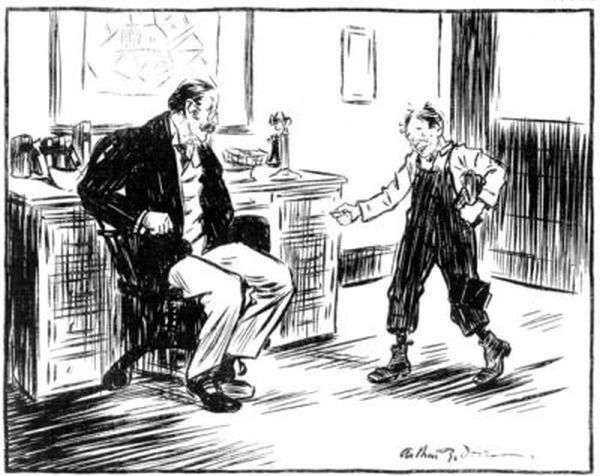
"'I'D BE GLAD TO DO IT AS A FAVOR,' HE SAID"
He crooked his finger and motioned, and the deed was done. A moment later the ground-glass door opened, and a chunky, red-haired boy, with a belligerent eye, stood expectantly before him. The newcomer placed himself so that the big iron office safe furnished a background for him, and as he stood there with his feet wide apart, his hands in his pockets, he seemed as solidly planted as it. A shaft of noonday sunlight, coming through a side window, struck his hair and made a rubescent halo around his freckled face. The manager of the White Star looked him up and down, and the boy eyed him back look for look. At length Mr. Biron cleared his throat.
"What is your name, my lad?" he asked.
"James Joseph McCarthy," answered the boy, in the same quick, phonographic monotone that he had used on his first day at school, when the teacher had asked him the same question.
"Ah, yes—do you know my son, Andrew Francis Biron?"
"Sure. Most everybody knows Andray Franswa."
"And what do you think of—er—André François?"
The boy looked at him searchingly. "You oughter know—he's your kid," he said tersely.
"I know what I think," said Mr. Biron, "but I want to know what you think. That's what I brought you in for. I want to get some data on the subject."
The boy ran his hand through his hair, and his brow puckered, as he struggled to find a phrase by which to sum up his impression of André François. Then he said:
"Ah, gee——" he made an abortive effort, out of regard for parental feelings, to mitigate the vast contempt in his voice, "he's just a darn sissy."
"Um—I see. Are there any more sissies in town?"
"Nope. Not now. There uster be one onest, about a year ago, but he's all right now. We licked him till he got all right."
"And do you intend to lick André François until he gets all right?"
The scion of the McCarthys looked at him suspiciously for a moment, but seeing in his face rather a desire for honest information than the guile of a parent, he answered:
"Nope. Nobody dast to touch him."
"Why?" asked Mr. Biron with a gleam of hope, "would he fight?"
"Who? Him? Him fight? I guess not. It's cause you're his dad. My dad, he said that if I dast to lay a finger on Andray Franswa, he'd skin me alive—an' the rest o' the kids, their dads told 'em the same thing."
"I see," said the manager of the White Star, and he saw also that a certain disadvantage went with being the employer of nearly every man in the town.
He took a thoughtful turn around the office, for his conscience gave him a twinge at the critical moment, then stopped abruptly in front of James Joseph and took from his pocket a bright, new silver dollar.
"See this, Jimmie?" he asked, balancing it seductively on the tip of his index finger, "I will give you this, and further, I will see that no complaint is made to your father—if you lick André François."
Each of Jimmie's eyes grew as big and as round as the dollar.
"Sure? D' yer mean it? Gee, that'd be fine. There's goin' to be a circus next week in Briggs' lot, and us fellows is savin' up. Say—is that what you just said on the dead square?"
"On the dead square," said André François' father solemnly.
Jimmie held out his hand for the dollar. "Sure," he said, "I'll lick Andray Franswa. I'll lay low till that crazy Angélique is out of the way. Burbank, the assayer's assistant, is soft on her, and she stops to talk to him every afternoon, an' Andray Franswa walks as far as from school to the assayer's office alone. I'll get him then. I'm boss o' the gang, an' I kin lick fine. Onest I licked a kid an' he wasn't able to be out fer a week."
"Wait," said Mr. Biron, a little alarmed at the enthusiasm he had invoked. "Remember—you are acting under orders, and your orders are not to hurt him. Just roll him around in the mud good and plenty—and, Jimmie, spoil that white sailor suit."
Jimmie's eyes filled with fellow feeling. For the first time during the interview he and the White Star manager were equals.
"I guess you was a pretty nice kid yourself onest," he said, "an' I know how you must feel 'bout Andray Franswa."
He hesitated a moment, his face twitched with a fierce internal struggle, then he thrust out his arm straight from the shoulder and handed back to Mr. Biron the price of his service.
"I—I'd be glad to do it as a favor," he said.
"Thank you," said André François' father gravely, and he took and pocketed the dollar.
As Jimmie was about to leave the office he put out a detaining hand.
"Oh, by the way," he remarked, with elaborate casuality, "you said something of a circus in Briggs' lot—I can't get away myself, at present, but if you'd take this and go, and let me know if there is anything good, you'd oblige me greatly."
Jimmie McCarthy left the office of the White Star with his ethics and his honor satisfied, and with a dollar in the pocket of his blue overalls.
Thus was enacted the preliminary part of the plot to Americanize André François, fils.
The following afternoon the manager of the White Star sat at his office desk, a file of papers before him. But his attention wavered, and the nearer the clock hands drew to three, the less grew his concentration upon the file. At last the expected happened. The ground-glass door burst open, and in rushed the immaculate Angélique, her entire person in such dishevelment as the Rue St. Honoré had never seen. Her cap hung by one pin from her black hair, her ruffled swiss apron was under one arm. By the hand she dragged after her the panting André François. His hat was gone, his hair wet, his white sailor suit streaked terra cotta from the clayey mud of the street. His red tie, however, still made a brave flare of color under one ear.
"Father," he said in a high, excited voice, "I have been attacked!"
Angélique motioned him to be quiet.
"Oh, Monsieur Bir-on, oh, sair," she burst out, her round eyes becoming perfect spheres in her excitement, "Monsieur André François have been attack'. I have jus' stop to spik to a gentleman for a so leetle moment—when I look a-r-r-ound and zee thees so ter-r-ible boy make the tackle at Monsieur André François' legs. And nex'—O, ciel! I zee Monsieur André François high in the air, and then—splash! Quelle horreur! down in the depths of the mud pud-dle, and thees boy r-r-ool heem r-round an' r-round an' r-r-round. Barbare! Sauvage!" Angélique's voice broke, and she buried her face in her abbreviated apron to shut out the memory of a sight so uncivilized.
"Father," said André François, trembling with passion, "you will have him punished at once—publicly, so that every one may know that the indignity has been wiped out?"
"My boy," said Mr. Biron quietly, placing his hand on his son's shoulder, "I am not lord of a feudal principality. I cannot interfere. You will have to fight your own fights."
"But," said André François, angry tears rushing to his eyes, "I cannot fight this peasant—I am a gentleman." And he drew himself up with a jerk, in his drabbled sailor suit, to his full three feet eight. This assumption of dignity was not without discomfort, for the muddy water from his over-long hair dripped down his neck in the back and into his eyes in the front.
"Of a certainty," affirmed Angélique with finality, "he is a gentleman. Madame Fouchette so raised heem."
"You will have to settle it your own way, Andrew. If you are too good to fight him, and he is not too good to fight you, I do not see what you can do—except run."
"I will not run," cried André François, his voice becoming shrill and childish with impotent rage. "I want him punished."
"I can do nothing for you," said his father shortly. "You had better go home now to your aunt and have your suit changed."
"Allons," said Angélique indignantly, and, catching André François by the hand, she started out. At the door she paused long enough to say devoutly, fixing the so unnatural father with a basilisk glance.
"Dieu vous garde, mon pauvre enfant."
The manager of the White Star even thought he heard a "Bête!" as the door was closed so decisively that one would almost say it was slammed. All of which the so unnatural parent endured with equanimity, and turned to his delayed files with a patient if dubious smile, for he had begun to do his parental duty as he saw it, and anything he began, whether it was a lockout, a new policy, or the training of his son, he saw through to the bitter end.
The next morning, when the White Star manager reached his office—and he got there early, for he began his day's work when his office boy was still comfortably snoring—- he found a small boy leaning against the door in the stiff and resigned position of a guard waiting to be relieved from duty. The only parts of him which moved were the toes of his bare legs, and these nimble members dibbled the clayey earth in front of the door-step.
As soon as this apparition caught sight of Mr. Biron, it straightened up into life.
"Kin I see you, Mr. Biron?" asked the boy eagerly, "on a matter o' business?"
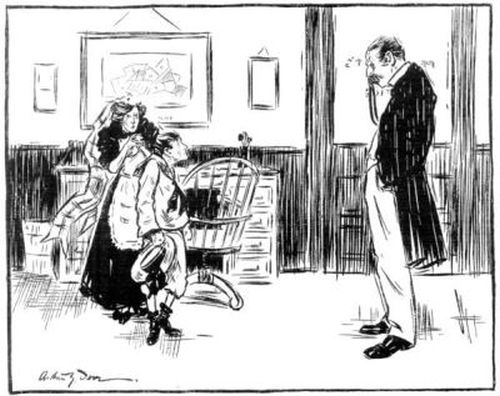
"'I CANNOT FIGHT THIS PEASANT—I AM A GENTLEMAN'"
"Certainly," said the manager of the White Star, "just step into the office."
The boy followed him in through the ground-glass door, shifted from one bare foot to the other, cleared his throat, then without further preliminary said:
"Say—d' you want Andray Franswa licked to-day?" Then, fixing him with a bargaining eye, "I'll do it dandy fer seventy-five cents. I kin fight 'most as good as Jimmie—I uster be the biggest kid here before he come an' licked me," he added, with reminiscent pride in a past glory.
Mr. Biron looked at him thoughtfully a moment, then said:
"I engaged Jimmie for the first job, and he did it satisfactorily. I think there may be a tacit contract existing between us that I give him, at least, the refusal of the rest."
"Nope," said the boy. "Jimmie, he ain't no pig. He told the bunch, 'You fellers go 'round an' see if yer kin git nuf for the circus what's comin'.' I bin waitin' a long time so's to be early nuf."
"I see," said Mr. Biron, "Jimmie does not believe in monopolies. He is a despot, but an enlightened one."
"Kin I have the job, then?"
"Very well," said Mr. Biron, "I engage you to lick André François—but with this reservation—mind you do not hurt him, and I will pay you the standard rate of one dollar for a first-class job."
This was the first but not the last of the manager's visitors. It was Saturday, and that whole morning the office of the White Star was besieged by applicants for a "job." Mr. Biron had his pick of the entire bellicose population of the town between the ages of nine and thirteen, and several more nefarious bargains were secretively struck in the shadow of the big iron safe, behind the discreet ground-glass door of the White Star office.
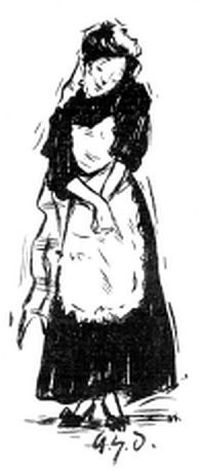
"'IT WAS OF A SUDDENNESS,' SAID ANGÉLIQUE BLUSHING"
That afternoon Mr. Biron found it difficult to concentrate on the work before him, for, reasoning from cause to effect, and having produced the cause, he was subconsciously expectant of another visit from André and Angélique. Nothing, however, occurred to disturb him and, as he closed up his desk and safe, preparatory to leaving, he smiled grimly to himself.
"I never was stumped by a proposition yet," he muttered half aloud, as he walked home in the sunset, "and André François isn't going to be the first. He must have some red blood in his veins—his grandfather fought at Gettysburg, and I could fight my weight in wildcats at his age."
As he ate his dinner, half an hour later, his sister recounted to him the events of the day.
"Andrew Francis was attacked again," she said, casually nodding toward André François, who ate in silence—for she was a woman of sense. "He came home again covered with mud from head to foot. Angélique says he refused to run and she could do nothing——"
"But no," interrupted the bonne eagerly, and her words came like a string of firecrackers exploded by a small boy on the Fourth of July, "he came with a quickness—like zat!" and she clapped her hands. "Before I know, he have come behin' and trip Monsieur André François up from his legs. Zen I try to grab thees boy, but he is of a so great slipperiness as an eel! He have hit Monsieur André François—whack! He have poke heem an' make heem to fall into the mud. Zen he is away with a quickness—zipp! No person is of a similar quickness to catch heem."
During this display of wordy pyrotechnics, the son and heir of the house sat in sullen silence and broke his bread into small pieces. When it ended, he suddenly looked up.
"Father," he said, "I do not want Angélique to take me to school any longer. She is a fool."
"Sank you, sair," said the lady referred to sarcastically, "you have a great gratitude when I protec' your life." Then she turned to the manager of the White Star:
"Sair, I have the pleasure to inform you of somesing. In one month I am about to marry myself to the Mr. Bur-bank—he who makes known what is in the rocks."
"Kind of sudden, wasn't it, Angélique?" asked Mr. Biron.
"It was of a suddenness," said Angélique blushing. "I was greatly of a desire to go back to France, but I could not, an' the nex' bes' zing—zat is to marry myself. I mus' have a protector in thees so savage land where even the children are bloodthirsty. I am not of a nervousness to stan' everysing. Voilà!"
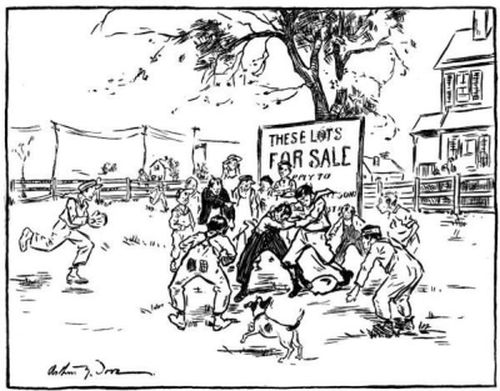
"THAT FIGHT WILL LONG BE REMEMBERED IN THE ANNALS OF THE GANG"
The next morning André François went to school minus his familiar. During the week and a half that followed he was "attacked" with startling frequency and regularity. Almost every afternoon he came home with his clothes muddy and torn.
He was grimly silent about the details of these mishaps.
Angélique was in despair.
"Ah, Madame," she said to Miss Biron, "in one short month he will not have a stitch to wear—out of the largesse of four trunks full. And the las' command of Madame Fouchette, it was 'Angélique, always make Monsieur André François to look like the little prince.' Ciel! how can one make heem to look like the little prince when thees so savage boys tear off his clothes? But I do my ver' bes'—I darn and darn and darn heem."
André François made no one his confidant, but day by day he grew more somber and silent. His early garrulity was quite gone. Instead of the air of hauteur which characterized him on his entrance to the town, he now had a pathetic droop. He even became careless about his clothes.
"He used to be so proud, so debonair," said Angélique sadly, "when he have the clean, white suit on, he is like the peacock, he know he is beautiful—but now—he does not care what he have on. No!"
"What can be the matter?" asked Miss Biron anxiously, for she was really worried by André François' looks; "he has never been seriously hurt in these little school-boy fights."
"Eh, bien! Madame! Is it not of a seriousness to be wound' in the pride? To be insult'? Monsieur André François has been made the gross insult many times. Those insult, they knaw heem in his heart. He zink. He zink all the time now. He zink of those many insult'! Some day he will have his revengement—you see."
About this time the manager of the White Star noticed a falling off in the number of applicants for his peculiar variety of "job." There was a slump in the André François market. One morning he called in a youngster whom he saw going early to school, stated his terms, and made his usual proposal. The boy hesitated a few moments, then said:
"It'll cost yer a dollar an' a quarter now, Mr. Biron. Yer see, 'taint so easy as 'twas at first. 'Course Andray Franswa never runs, an' it's easy t' git him, but he's growin' awful savage. He kicks an' bites somethin' fierce, sir. He nearly chewed Harry Peters' finger offer him day 'fore yesterday."
The manager paid the extra quarter without any demur.
It was about this time also that Mr. Biron made a discovery which gratified him. He found, secreted under a pillow in the window-seat where André François usually sat, a dusty, copiously diagrammed book entitled, "The Manly Art of Self-Defense." It was an edition of twenty years ago, and had been used by Mr. Biron himself during his college days.
He put it back carefully and held his silence.
The following evening he proceeded in an experimental, roundabout way to get into a conversation with his son.
"Andrew," he said, with sociable casualness, to his heir, who now always ensconced himself in the window-seat directly after dinner, and kept a moody silence until Angélique took him off to bed, "you have never told me about your school days in France."
Accepting this remark as the statement of an irrefutable fact, André François merely remained politely silent.
"What do you do for recreation? What sport do you have now, for instance?"
"We fence, father," said André François, listlessly.
"Ah, yes," said the White Star manager, introducing his subject in as elaborately casual a way as a politician about to ask for a favor, "just so. Well, you see we don't do much fencing in America, not very much. Boxing, now, is more in our line."
A gleam of interest, which was not lost upon his father, shot into André François' weary eyes.
"Father," he asked timidly, "are you familiar with the manly art of self-defense?"
"I am, my son," answered the manager of the White Star gravely.
André François gazed at him questioningly a moment, then drew the manual from under the sofa cushion.
"I have been practising some of the things described in this book," he said, slowly opening it and disclosing diagrams of a heavy-muscled individual executing a wonderful curve along a dotted line marked "a—— a—— a," "but I am unable to make out the explanations attached to most of these figures. If you could show me the rudiments——" he finished tentatively.
It was at this point that the manager of the White Star joyously threw diplomacy to the winds.
"You bet I will," he cried enthusiastically, "we will have our first lesson to-night in the attic," and grasping his son's arm he started off.
Miss Biron and Angélique, sedately sewing by the fire in the next room, were electrified to see, a moment later, the manager of the White Star and André François rush madly through, banging a door at either end in their flight, and laughing at the top of their voices. They also stayed awake that night beyond their usual retiring time, for strange noises emanated from the attic long after the hour when a well-conducted father and son should have been in bed.
The next morning the manager of the White Star let the applicant in waiting know that no further business would be transacted, and the word went forth among the members of the gang that he would pay for no more André François lickings, and would tolerate no unpaid-for ones.
So, by the ultimatum of his father, André François went whither he would, unmolested except by word of mouth. But he underwent such martyrdom as only a small boy can receive at the hands of others of his kind.
Not only did the gang remember and resent his former attitude of superiority, but they looked on him as a source of revenue taken from them. His presence irritated them as the presence of a government-owned railroad might irritate a company of magnates shorn of their profits. His first position had been marked at least by a certain uniqueness and dignity. He had never been licked, even if he could have been.
Now, however, he was the lowest of the low. In the democracy of the gang, where might was right, he was a pariah, a proven coward, licked by each and every member, and ought, by the law of the survival of the fittest, to be kicked out. He was only allowed to intrude his presence on suffrance, because a higher power artificially protected him.
At recess, in school, he sat on the well-worn bench that ran around the yard and watched the others play or fight. No one ever spoke to him, except now and then to throw a taunt his way.
"Where's nursie, Annie?"
"Hello, sissy—are yer lost?"
"Where'd yer git that suit?" and similar personalities greeted him when one of the boys chanced to notice his presence. Sometimes, as he walked home, pebbles and bits of hardened mud were sent richochetting after him, but this was the extent of any assault, for the manager of the White Star, sitting behind his ground-glass door, had it within his power to speak a potent word to the father of any boy who disobeyed him.
André François seldom spoke back, but his silence had something grim in it, and there was a portentous light in his eye.
At home he never complained, and Angélique, rejoiced that the régime of physical violence was over, snatched the time between stitches on a wonderful, beruffled trousseau, to make him "look like the little prince." Only his father knew how he spent his time every evening in the attic, and what passionate energy he put into his work. Neither alluded to it, but both knew that the lessons had an ultimate object.
And, one day, three weeks from the time he took his first boxing lesson, this object was unexpectedly accomplished.
It was a Saturday afternoon, and the gang, freed from the tyranny of school and the irritation of Saturday morning chores, were joyously disporting themselves in a vacant lot at the corner of the street. The first inning of a baseball game was just over, and the overalled players were lying on the ground disputing certain fine points of the play with the audience.
André François stopped, leaned on the top rail of the fence, and gazed at them a trifle wistfully. Jimmie McCarthy's roving eye discovered him, and he yelled out:
"You'd better run along, Annie—nursie will be out lookin' fer yer in a minnut."
The gang laughed flatteringly at the subtle wit of their leader. André François' face flushed a vivid crimson and his eyes darkened. Then he electrified the gang by leaping over the fence and rushing straight up to the redoubtable Jimmie.
He thrust out his chin and yelled up into the face of the surprised leader:
"I'll show you if I'm an Annie or not. D'you want to fight?"
Jimmie stood dumb with amazement a moment, then he laughed long and loud, for his sense of humor was Irish; and the whole gang joined in.
"S-a-a-y," he said, "yer wanter git licked again, d'yer? You must'er got inter the habit. I tell yer what—I got a baby brother two years old ter home. I'll go fetch him, and the two o' yez kin have it out."
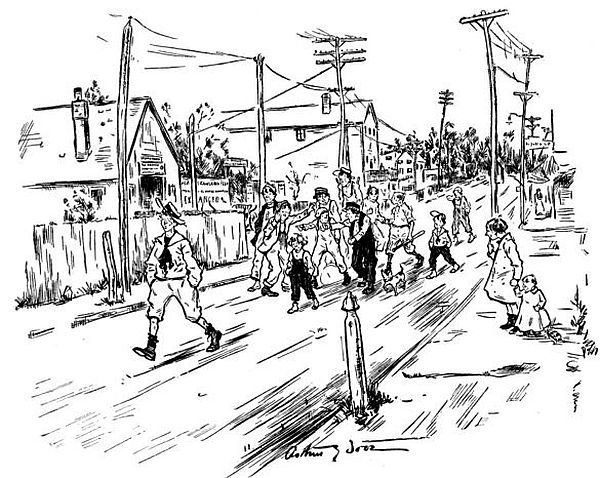
"AN ADMIRING CONCOURSE OF SMALL BOYS FOLLOWED AT A RESPECTFUL DISTANCE"
It was here that André François' early training enabled him to make an impression. He stood up on his toes, as he had once seen the Marquis de Boissé stand up on his toes, and slapped Jimmie McCarthy across the mouth with his open palm, as he had seen that noble marquis slap a count of France.
But what followed was not an exchange of ultra courteous priorities to a duel. It was a good American fight in the middle of a ring of small boys, and what happened is what always happens when natural and scientific force stand up before each other. That fight will be long remembered in the annals of the gang, which, like the records of the great Homeric fights or the sagas of the primitive Northmen, are first handed down by word of mouth.
"I wished yer'd seen it, kid," said Charlie Brown, to his wide-eyed, freckled-faced junior, whom he was trying to bring up in the right way. "It'd bin an eddycation fer yer. Andray Franswa jumped round jest like he was made o' rubber. Every time that Jim grabbed fer him, he was on the other side an' had landed him one on the nose. Gee, yer oughter seen it bleed—it was worse'n the time Jim beat Buck Paxell. Now, Teddy, yer want ter keep yer eye on Andray Franswa, an' do same as yer see him doin'—'cause he's goin' ter be a great man some day like Jim Jeffries—see?"
That afternoon the manager of the White Star chanced to look out of his window, and he saw André François, with his white sailor hat, fashioned after that of Prince Edward, set rakishly over one ear, his hands in his pockets, whistling at the top of his lungs, come down the street. His face was muddy and bleeding, a great scratch cut across it from ear to ear, his hair was wild and tangled, but his swagger was that of a conqueror, and he took the middle of the road. An admiring concourse of small boys followed along at a respectful distance.
Mr. Biron smiled to himself. Then he took down his ledger, for he was a careful man of business, and read over a certain page. On it was written fourteen times:
"To Andrew Francis, licking ... $1.00"
"Um," said the manager of the White Star softly at the end of the addition, "fourteen dollars." Then he took another look out of the window:
"I never made a better bargain in my life."