IN THE SHADOW OF THE SCAFFOLD BY HARRY GRAHAM
Reading edition
ILLUSTRATIONS BY ANDRÉ CASTAIGNE
"C'est le crime qui fait la honte, et non pas l'échafaud."
The clock in the public gardens outside the Conciergerie had just struck the half hour. Richard, the prison warder, a rough old veteran whose patient face wore that air of tolerant kindliness which stamps the features of all whose duty it is to be the daily witness of human suffering, stirred uneasily in his hard wooden chair. Somewhere in the huge building a gate clanged noisily, and the old man opened his eyes with the guilty start of the daydreamer and looked expectantly round towards the door.
The room in which he sat, with its simple wooden bed, its plain deal table in the center, its squalid jug and basin in the corner, was but one of a score or so of similar cells in the old Conciergerie prison. To Richard it had always seemed a dingy apartment enough, but even to his accustomed eye, as it fell upon the little white linen bonnet which hung from a peg beside the bed and looked so singularly out of place amid its surroundings, the gloom had never appeared so deep and joyless as it did upon this warm evening of July, in that time of bloodshed, of passion, and of terror, that sinister summer of 1793. The dazzling light which flooded the stone courtyard outside seemed reluctant to force its way through the high barred window of this dingy cage, as if timid of intruding its brilliance upon a scene whose atmosphere was already clouded by the shadow of death.
"Half-past five," said Richard to himself, with a yawn. "My little captive will soon be back."
He glanced up at the few simple garments that lay neatly folded on a low shelf beneath the window. "Poor little soul!" he murmured. "She was surely created for sunnier scenes than this! But there," he added, after a moment's reflection, "justice can't afford to make distinctions! Young and old, rich and poor, men and women, we all suffer alike—when we get found out!"
Richard's reverie was interrupted by a loud knock at the door, which was immediately flung open, and a short, middle-aged man, dressed almost entirely in faded black, entered the room.
The newcomer closed the door behind him with a swift, sinuous movement and, turning noiselessly, confronted the startled veteran with a malevolent expression in his small, beady eyes.
Richard could not conceal his astonishment.
"The Deputy Chabot!" he exclaimed, with an air of surprise.
"It is indeed the Deputy Chabot," replied the other.
The warder rose awkwardly to his feet.
"I am very sorry," he said apologetically, "but the prison regulations do not allow admittance to the public. It is against the rules." He crossed to the door as though to open it. With a quick gesture the Deputy stopped him.
"I am not of the public," he said in a pompous voice. "I am above regulations." He took a paper from the pocket of his coat. "See here, I have a pass signed by the Police Commissioner." And he handed the paper to Richard.
With great difficulty the old man retrieved a large pair of horn spectacles from his forehead and adjusted them on the very tip of his nose.
"'Admit Citizen Chabot,'" he read, spelling out each word laboriously, "'Deputy of the Department of Loir-et-Cher, member of the Legislative Assembly ... um ... um ...; signed Guellard, Police Commissioner.' That seems correct enough," he added, as he re-folded the document and handed it back to its owner.
The Deputy laughed shortly. "As you see," he said, "your regulations are of no great value where a man of my position is concerned."
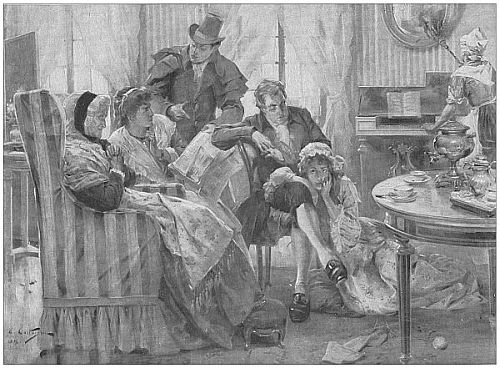
"TERRIBLE TALES OF BLOODSHED AND INJUSTICE REACHED THE LITTLE SUN-KISSED VILLAGE OF CAEN"
Richard still hesitated. "Perhaps you are not aware that this is the cell of the prisoner, Charlotte Corday."
"The criminal, Charlotte Corday?" corrected the other. "Yes, I am perfectly aware. I have just come from her trial, where I spent a very dull afternoon, and wasted much valuable time."
"You were at the trial?" exclaimed the warder, with a fresh note of anxiety in his voice. "Then you can tell me, citizen. What has happened?"
"What has happened?" repeated the Deputy scornfully. "The only thing that could possibly have happened, I am thankful to say. Justice has been done. Marat's, the martyr Marat's death will be avenged. The woman who struck so foul a blow at liberty and the Constitution has been sentenced!" He walked up and down the narrow cell in his excitement. Suddenly, stopping short in front of the old man, "She dies on the scaffold this evening," he ended in a quiet voice of triumph.
Richard sank heavily into a chair. A troubled look came over his face.
"Ah, I am sorry," he said, after a pause. "The wife will be sorry, too," he added thoughtfully, "and my little boy, my little Jean, he will be sorry. The wife has taken a great fancy to this Charlotte Corday," he explained; "and little Jean, he thinks the world of her. But there, she spoils him," he continued apologetically. "Well, well, citizen, I am indeed sorry."
Chabot had not moved during the old man's speech. "You are sorry for a murderess who receives her just deserts?" he asked.
"I am sorry for a lovely woman," replied the warder. "I am an old veteran of the Conciergerie," he went on. "I have had many prisoners pass through my hands; and I judge them by what they are, not by what they may have done; not by what they may be accused of doing.
"I know nothing of this Charlotte Corday," he continued, "nothing beyond what I have seen of her during the last few days. I have never questioned her as to her crime, nor as to her reasons for committing it. That is none of my business," with a shrug of his shoulders. "My duty is to keep her here, to take care that she does not escape, to see that she has whatever is necessary—which is little enough," he added with a smile. "I judge people as I find them; and I have found this girl gentle and well-behaved. The wife likes her, and my little Jean worships the ground she treads on. She gives me no trouble; she is more than grateful for any small kindness; and Heaven knows there is not much that I can do."
The old man was quite out of breath. He crossed over to the window, mopping his brow as he went.
"I see," said the Deputy bitterly; "like the rest of them, you are won over by her beauty!"
"I am too old for that," replied the warder. "I am won over by her charm, if you will; by her sweet nature. And the wife, too, and little Jean; and he is a good judge of character, I can tell you, is little Jean."
Chabot turned away with an expression of disgust.
"She is a devil," he exclaimed, with a tone of intense hatred in his voice, "she is a fiend in human form!"
Richard thought for a moment before replying.
"You may be right, citizen," he said, "but to me, at any rate, she seems a quiet, modest girl enough; and my little Jean, he——"
"Modest!" interrupted Chabot. "Bah! is it modest to force one's way into a man's bedroom? Is murder, cold-blooded murder, a practice that commends itself to modest persons?" He turned round with an angry snarl. "I tell you," he said, "she is a devil!"
The old warder shrugged his shoulders, as he was wont to do when his powers of argument failed him—and argument was not his strong point.
"Well," he stoutly reiterated, "I am sorry for her, nevertheless. She is only a girl; so young, so frail, so delicate——"
"Delicate!" burst in the indignant Deputy. "Why, after she had murdered Marat—and," he smiled sarcastically, "with what delicacy she performed the deed, eh?—when the porter, Laurent Basse, rushed in to seize her, it was only after twice striking her with a chair that he was able to overpower her. Oh, she is a delicate creature, truly!"
For the moment Richard seemed nonplussed.
"Well," he replied with determination, "I would not strike any woman with a chair myself. Ask the wife whether I would! Not—" he added, as though to explain this apparent idiosyncrasy of his—"not while the good God has given me two hands for the purpose."
"Nonsense!"
There was a brief silence, during which Richard's glance fell upon the few pathetic garments so carefully folded upon the narrow bed.
"So my poor little prisoner is to die today," he murmured sadly.
"Yes," answered the Deputy, "and I am glad of it. There is no room in France for such vermin. They must be exterminated, and the sooner the better. I know what I am saying, and I tell you that this woman Corday is a dangerous character. She has others behind her. She is but an accomplice. I am here this evening," he explained, "to try and find out from her the names of her confederates. She would give no satisfactory replies this afternoon, but perhaps, now that the fear of death is upon her, we may be more successful."
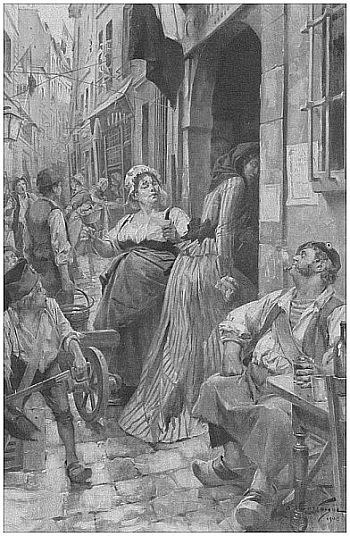
"AT LAST, TOWARD EVENING, SHE FORCED HER WAY IN"
"Well," affirmed the veteran, with the stubbornness of his class, "whatever you may say, I cannot help pitying the girl. How I am to break the news to little Jean, I don't know!" he added pathetically. "Myself, I shall have no appetite for supper. Poor girl! My heart goes out to her in her time of trouble."
"Yes," said Chabot, with a sardonic smile, "and yours is not the only heart, my friend."
Richard looked puzzled.
"There is a young painter," continued the Deputy, "Hauer, by name. He has been sketching her in the court-house; yes, and speaking to her as well. He had better be careful," he added threateningly. "I have my eye on him; and so has the Committee of Public Safety." Chabot was standing by the window; he picked up one of the garments lying folded there on the shelf, examined it for a moment, and threw it down again in disdain.
"Yes, this Citizen Hauer is a fool. Like you," he turned to Richard, "and your little Jean, and the rest. His head has been turned by the woman's looks. He will lose it altogether if he is not careful."
To so simple a mind as that of the old warder, the Deputy's fierce and bitter hatred toward his prisoner seemed difficult to understand until he remembered certain stories connected with her arrest, stories in which his visitor had played an important, if not a very edifying part.
In early life Chabot had been a member of the priesthood, but renounced his vows in order to enter the sphere of politics. After the murder of Marat, when Charlotte Corday had been conveyed to the Abbaye prison, Chabot was among those who had helped to search her, a task in which his zeal had so far outrun his discretion as to induce him to retain a watch which he found upon the prisoner's person, until she somewhat sarcastically reminded him of his early and apparently forgotten vows of priestly poverty.
It was Chabot, too, who, suspecting Charlotte of having important papers concealed about her, had profited by the fact of her hands being tied to search for them. The wretched girl, supposing him to be bent upon some fresh outrage, sprang away with so violent a gesture, in her efforts to elude his touch, that the front of her dress burst open. With a natural and spontaneous movement of shame, she turned quickly away and stood with her face to the wall, begging to be allowed to rearrange her dress. So genuine was her emotion, and so strongly did her innocent modesty appeal to her jailors, that the request was immediately granted, and she was even permitted to draw down and arrange her sleeves in such a manner as to interpose them between her wrists and the cords that bound her none too tenderly.
Richard recalled those incidents, which had been related to him by Lafondée, the dentist, who lived opposite Marat's house, and who had been one of the first to rush to the scene of the murder; and he smiled knowingly to himself as he looked across the narrow space at the passionate, revengeful face of the ex-priest.
He was about to formulate some further arguments in defence of his little protégée, when a movement at the threshold of the cell attracted his attention, and in another moment the object of his thoughts stood framed in the open doorway.
What a child she looked, standing there, with her hands behind her back, wearing a simple country-made frock of some dark material, a white fichu crossed over her breast and fastened behind at the waist. Her auburn hair was tied back by a green ribbon, and a little white cap, the "bonnet" of the period, similar to that worn by Marie Antoinette in David's celebrated picture, rested lightly upon her small, girlish head.
There was nothing of the convicted criminal about her appearance, save the slight shade of pallor which these last few days of captivity had left upon her cheek; there was nothing of the prisoner in her bearing, save that her hands were bound behind her. Her wide gray eyes, fresh from the dazzling sunshine of the street, seemed to open wider still in an endeavor to pierce the prison gloom into which she was returning. But, as she saw the old warder's homely figure, standing there in a kindly attitude of welcome, an expression of relief, almost of happiness, illumined her face.
Two soldiers, who had accompanied her as far as the entrance, withdrew as soon as their prisoner had crossed the threshold, and the door closed upon them.
The old warder advanced to meet his captive.
"So you are back again, citizeness?" he said, with an assumed cheerfulness which he was far from feeling.
"Ah, my good friend," replied the girl, in a low voice, which bore signs of the long and fatiguing cross-examination to which she had just been subjected, "I shall not trouble you much longer."
Richard shrugged his shoulders, as though to deny that any trouble was involved in the care of so well-behaved a prisoner.
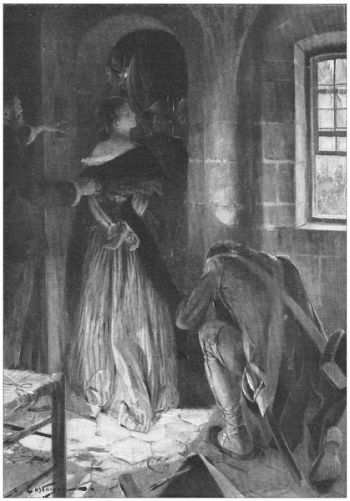
"'I KISS THE TIPS OF YOUR WINGS,' HE SAID"
"I will tell the wife of your return," he said. "You promised to take your supper with us, you remember."
"I fear I must break my promise," said Charlotte, with a sad smile. "There will be no time for supper to-night."
"But my little Jean is so looking forward——"
"Poor little Jean," she interrupted; "I am so sorry to disappoint him. But he will forgive me, I know. And by the by," she continued, "I am expecting a visitor this evening. Will you please see that he is admitted the moment he arrives?"
Chabot, who up to this time had been sitting unperceived in the corner of the cell, gave vent to a low chuckle.
Charlotte looked about at the sound, and as her eye fell upon the sinister figure of the ex-priest, she could not repress a shudder.
"You!" she exclaimed, starting back suddenly.
Chabot advanced toward her, with mock politeness, which the expression on his face belied. "At your service!" he said, with a low bow.
"But why are you here? What do you want with me?" asked the frightened girl.
"I am here to see you, on a little matter of—er—business. I want a few moments' conversation with you."
Charlotte turned an appealing glance upon the old warder. "Surely," she exclaimed, with a tone of passionate entreaty in her voice, "surely I have a right to ask that the short hour of life that is left to me shall be undisturbed?"
Richard made a weak, deprecating movement with his hands. "I am not to blame," he explained. "The Deputy has a pass, signed by the Police Commissioner."
He crossed over behind the prisoner, and was about to untie her hands. Chabot, noticing his intention, stopped him with a peremptory gesture.
"Leave that to me," he said. "I will see to it myself."
"But—citizen—" the old man began.
Chabot pointed sternly toward the door.
"Go!" he said. "Go! For time is short, and I have things to say to the prisoner in private."
Richard hesitated, as though about to refuse, but his natural weakness was no match for the firm attitude of the Deputy, and, after an uneasy glance at Charlotte Corday, he shambled clumsily to the threshold and went out.
Chabot crossed to the door and made sure that it was properly closed. Then he turned quickly and advanced to where Charlotte was still standing.
"And now," he said, "now that we are alone, quite alone together, you and I, let us for the moment forget our mutual—shall I say dislike?—our distrust of one another, eh?"
He approached and laid his hands upon her wrists, stooping to undo the cords with which the prisoner was bound.
At his touch Charlotte, who had been watching his movements with a look of terror on her face, sprang sharply back, as though she had been stung by some poisonous reptile.
"Don't come near me!" she exclaimed passionately. "I could not bear you to touch me!"
She retreated to the farthest end of the cell and stood at bay there with her back to the wall.
"As you will! as you will!" replied the other. "I merely thought that perhaps you would chat more freely if—but no matter."
"Will you not sit down?" he added, motioning her to a chair.
"I will stand!" she answered coldly.
"By all means," said Chabot, in an amused voice, "by all means. But I suppose you have no objection to my sitting?"
The girl made no reply.
Chabot ensconced himself as comfortably as possible in the hard wooden chair which the warder had vacated.
"Let us be sensible," he said, after a pause. "Your little game is over, you know. You have lost."
"I have won!" exclaimed Charlotte, with a touch of triumph in her voice.
"We will not discuss the point," said Chabot. "I do not argue with women. I wish you to tell me what you were unwilling, and very naturally unwilling, to admit at your trial—the true motive of your crime. I want to know the source from which came the inspiration. You have executed the deed alone, but you cannot have planned it alone. Others have helped you. You are to die, remember, alone; to suffer alone; and yet it is not you alone who are guilty. There are, there must be, others who have urged you to commit this crime. The Girondist Barbaroux, for instance," he suggested, "a friend of yours, who has just been arrested——"
"Had nothing whatever to do with it," exclaimed the girl, breaking in upon his unfinished sentence. "What I have done, I have done alone, and I am proud of it! I confided in none; I asked advice of none. The idea was my own; the conception was my own; and I carried it out by myself!"
There was in her voice a note of exultation, of glory, of triumph in the success of her crime; she seemed almost to boast of the solitude of her guilt, as though conscious of the fact that one executes but ill that which another's brain has conceived.
"Oh, it is very loyal of you to try and conceal the identity of your accomplices," said Chabot, with a sneer.
"My loyalty is for my country alone. It was my love of her that inspired me to plan my project; my love of her that helped me to undertake it; my desire for her welfare that gave me strength to carry it out!"
"Indeed," said the Deputy sardonically. "And doubtless it required unusual strength to deal so fatal a blow, straight to the heart!"
The girl looked at him in surprise.
"The indignation in my own heart showed me the way," she said quietly.
"One would think," continued Chabot, "that you had practised with the knife before on some other——" He left the sentence unfinished.
The blood rushed to Charlotte's cheek. A fire of indignation and resentment burned in her usually tender eyes, making them blaze and flame until even the cold-blooded Deputy was moved to admire the beauty of this emotional woman, so fierce in the defence of her honor.
"You know well that I am no ordinary assassin," she exclaimed. "My hands are clean in the eyes of Heaven. My soul is guiltless before God."
The ex-priest took a step forward. "How dare you speak of God? You?"
"I dare speak of Him," replied the girl, in an impassioned voice, "because I believe that it was He who inspired me, as He inspired Judith of old, to make this sacrifice in the cause of liberty. I believe that He chose me to bear this message of His righteous vengeance to a people who have forgotten His name; that He nerved my arm to strike the blow at which you wonder. I have completed my task," she went on, in a quieter tone, "I leave the rest to others. I have avenged much innocent blood. I have prevented the shedding of much more." She turned proudly round and faced the Deputy with flashing eyes.
"I have killed one man," she said, "to save a hundred thousand!"
Chabot smiled grimly.
"Do you then imagine," he asked, "that you have murdered all the Marats?"
"I have destroyed one," she retorted. Her fearless gaze met the crafty eyes of her examiner, and they quailed before it.
"Perhaps the others will be afraid," she added meaningly.
"I must admit," replied the Deputy with a nervous assumption of jocularity, "I am relieved to think that for the moment I am beyond the reach of those pretty hands of yours. For I have no desire, believe me, to be added to the list of your victims!"
Charlotte smiled scornfully. "You need have no fears," she said. "Were my hands as free as yours, or my heart as black, you would still be safe. You surely cannot flatter yourself that the question of the life or death of such as you could be of any importance to the State."
The natural egotism of the man was wounded; his vanity was touched. Confident of Charlotte's helplessness, he approached to within a few feet of her.
"Are you not afraid to speak in such a tone to me?" he asked. "We are alone here—" he looked meaningly round at the empty cell. "The walls are thick. No one can hear us."
Charlotte looked him up and down with a slow, scornful gaze. "Afraid?" she asked. "Of you?" She smiled. "Do you think that one can look at you; at your shifty eyes—at your restless mouth—" involuntarily the Deputy's hand rose to his lips—"without discovering the secret which you conceal so badly behind a mask of insult and of bluster? Do you think I cannot see what a coward you are at heart?"
"Truly polite!" exclaimed the other nervously. "At any rate, I am no murderer!"
"Because you have not the courage!" replied the girl. "But be sure that however great the guilt of those who have shed all this innocent blood, you who have allowed it to be spilt will also have to answer for it."
Her face was transfigured by emotion as she spoke. She seemed to be gazing into the caverns of eternity with the eyes of some inspired prophetess. "I look forward into the future," she continued, "and I see you, and the other brigands who surrounded Marat, whom God only allows to live so as to make their fall the more terrible,—so as to frighten all who would attempt to establish their fortunes on the ruins of a misguided people,—I see you dragged by force up the scaffold steps—the ladder to Eternity which I scale so willingly—till your coward's eyes gaze forth flinching from that blood-stained casement, that is for me the window looking out on immortality!"
Chabot stared in amazement at this young girl, who seemed to speak with the assurance of a seer. He could not subdue his admiration of a woman who was so obviously fearless of death. "Come," he said, "I like your pluck." He inspected her with a critical eye. "You're not a bad-looking girl, either, for an aristocrat." He came very close to her, apparently unconscious of the loathing with which she regarded his approach. "Turn round and let me have a look at you," he ordered. Charlotte did not seem to have heard him, but kept her head high in the air, and the same lofty look of disdain in her eye.
"Proud, are you?" said the deputy, with a snarl. "I suppose I'm not good enough to speak to you, eh?"
Charlotte still remained silent.
"Hoity toity!" continued Chabot, "with your fine airs and graces! You won't be so damned haughty in an hour's time, I know! You won't hold your head so high then, I'll be bound!" He came quite close and leered into her face. "Why do you treat me like this?" he asked. "Aren't I good enough for you?" There was no tremor of fear in the girl's attitude, but almost unconsciously she turned her head away. "Come here!" he said sharply. "Come closer!" Charlotte Corday did not move. Chabot stooped until his face was only a few inches from hers. "I've a good mind to take a kiss from you," he said, with an ugly smile. "What do you say to that, eh?" he asked. The girl moved her head still further away so as to avoid looking upon the hideous features which were now so close to her own pure lips.
"What's the use of making all this fuss?" said Chabot impatiently. Still no reply from the woman, who, beneath her appearance of calm and courage, could feel her heart beating wildly with terror and apprehension. "What?" continued the Deputy. "Look at me!" he commanded. Then, as Charlotte seemed to pay no attention to his orders, "Damn you!" he said, "you shall look at me!" And he placed his hands upon her shoulders and turned her quickly round so as to face him.
Then, and not till then, did her self-reliance give way. With the amorous touch of his hateful fingers upon her neck, she realized the helplessness and horror of her position. With a convulsive movement she tried to free her hands. The face of her enemy came closer and closer to hers, and she read the coarse desires of his vicious soul in the lustful brightness of his eyes. In a perfect agony of disgust and terror she fought desperately to fling herself out of his reach.
"Let me go!" she appealed, "let me go! Ah, God!" she cried, in a strangled voice, "Let me go!"
Her cry must have been loud enough to penetrate the thick prison door, for in a moment it was flung open, and two men, Richard and another, rushed into the room, and Charlotte was aware that the old warder had interposed his burly person between her and the man she loathed.
"I should have known better than to leave you alone with a man of his character," exclaimed the veteran, glowering at the ex-priest. "The wife will never forgive me."
Chabot had recovered his self-possession, and was regarding the old man's perturbation with evident amusement.
The stranger who had entered the cell with Richard was a young man of about thirty, clean-shaven, with dark, almost black hair shading a high, intellectual brow and eyes of unusual brilliance. He was dressed in the uniform, such as it was, of the National Guard, but his appearance was not that of a soldier, and the artist's block and sketching materials which he carried in his hand proclaimed him to be, what indeed he was, a portrait painter.
He had heard the woman's agonized cry. The scene that he had witnessed on entering the room had shown him the cause of her distress, and, with the blind, impetuous rage which the sight of any act of violence or injustice towards the weak or helpless rouses in a young and chivalrous soul, he rushed to where Chabot was standing and seized that worthy violently by the shoulder.
"What the devil are you doing?" he demanded furiously.
"That is no business of yours," retorted Chabot, coolly disengaging himself from the other's grasp. "You evidently do not know who I am, young man."
"I have no wish to. It does not interest me. But I do know that you are not wanted here!"
"I am the Deputy Chabot, of the Department of Loir-et-Cher!"
"Indeed," replied the young man, apparently unabashed by so much distinction. "Well, I am Jean Jacques Hauer! And to the devil with your 'deputy'!"
"So you are the fortunate Citizen Hauer," said Chabot, with a dark smile of comprehension. "I see, I see!"
"What do you mean?" asked the artist threateningly.
Chabot turned to Charlotte Corday with a bow.
"I congratulate you, mademoiselle," he said, with meaning in his voice, "I congratulate you on the possession of so well-bred, so well-mannered a lover!"
Hauer sprang forward with a cry of rage, and would have hurled himself upon the Deputy, had not Charlotte's quiet voice stopped him.
"Leave him alone," she begged. "Let him be, I pray you. He is not worthy of your anger."
Chabot moved toward the entrance slowly.
"Good-by, mademoiselle," he said, "and thank you"—ironically—"thank you for a very pleasant chat, which I shall always remember, when you are—what shall we say?—forgotten!"
Charlotte faced him with quiet dignity.
"I may be forgotten," she replied, "and that soon. But what I have done shall not readily be forgotten."
With a sarcastic laugh the Deputy crossed the threshold and was gone.
Richard watched his departure with evident relief, and then turned to address his prisoner.
"There is a priest without," he said, "who asks whether you desire his services."
Charlotte shook her head. "Will you thank him on my behalf for his kindness. But I do not need the offices of the Church."
She crossed to the table and leaned one hand upon it.
"The blood that I have spilt, and my blood that I am about to shed, are the only sacrifices that I can offer to God," she said. "I have no fears. He knows all, and will forgive."
The warder bowed his head, took a last look round the cell to see that all was well, and left the room.
II
As the door closed Charlotte sank into a chair and buried her face in her hands. The long trial and the incidents that had followed it had been very tiring. She was young and lonely, and her last hour had come. Small wonder then that for a moment she should give way to emotion or that her eyes should brim with the bitter tears of fatigue and disappointment.
Hauer watched her in silence for a little while, and then crossed the narrow room and stood beside her chair.
"Perhaps you would rather be alone?" he said, in a tender voice of pity.
Charlotte raised her shining eyes to his, and a grave smile stole like a shadow to her lips.
"No, no," she exclaimed, holding out a detaining hand, "I have but few moments left to me, and still fewer friends. Stay with me, Monsieur Hauer, if you will, and," she added in a lighter tone, "you may finish the portrait."
He took his painting materials from the table, set up the small portable easel, arranged the palette and brushes in his hand, and commenced his work upon the portrait of the prisoner, which he had begun in the court-house, and which, at her request and by permission of her judges, he was now to be allowed to complete.
And as he painted, they talked together, quietly, sympathetically, with the understanding and the occasional silence of old friends, these two who had but learned to know each other during the last few days, but from whose short acquaintance were destined to spring, for the one, a friendship which did much to lighten the burden of these last hours, for the other, a love which he was to bear in his heart to the end of an adventurous career.
This girl, who had lost her mother at an early age; who had ever since lived a simple, secluded, somewhat lonely existence, first in the convent of L'Abbaye-aux-Dames, and subsequently under the care of an old aunt at Caen; who had never found a friend in whom to confide her troubles; now for the first time discovered a sympathetic listener, who gradually drew from her the sad story of her life and of the sinister events that led up to the tragedy with which it was to close.
As a girl she had been much alone; had played alone, thought alone, lived alone. And in her case, as in that of many others, solitude had been the mother of great thoughts. Hers was not an unhappy childhood, but her happiness had sprung from sources other than those usually open to children. She drew most of her pleasure from books, from Plutarch, from Corneille, the poet, her ancestor, of whom she was justly proud, and who had declared that poetry and heroism were of the same race, the one carrying out what the other conceived.
So had she grown up at Caen, dreaming much of her country's welfare, filled with a romantic ambition to do something for France, something grand, something noble.
And then came all the horrors of the Revolution. Terrible tales of bloodshed and injustice reached the little sun-kissed village of Caen. The name of Marat was on every tongue—Marat, who made the streets run with blood; Marat, the murderer of thousands whose only crime was loyalty; Marat, through whose wanton ferocity the blood-stained Loire was discolored for miles, to whose rage for extermination the gloomy solitude of the towns and the desolation of the country bore ghastly testimony. The very crimson of the autumn woods seemed to reflect the bloodshed of those cruel September massacres.
It was then, no doubt, that the thought first entered the mind of this young girl; the idea that perhaps she, though only a woman, with no knowledge of the world, without experience, might achieve what men seemed frightened to attempt, something that should help to retrieve the lost honor of France. It was ambitious, surely; but then, was not Joan of Arc a girl?
Marat, the murderer of peace, if only he were dead, thought Charlotte Corday, peace would be restored. "It is expedient for one man to die for all."
The shadow of Marat darkened the whole picture, and in the background stood the scaffold, which liberty was mounting in company with the victims of this murderer, at whose name one shuddered, as at the mention of death. Marat, without Danton's courage or the integrity of Robespierre, seemed but a wild beast bent on devouring France.
Charlotte saw her beloved country in its death agony, she saw the victims and the tyrant. She sought to avenge the one, to punish the other, to save all.
Many a long summer night did she lie awake in her little attic room at Caen, wondering what she should do. Suddenly all seemed to clear before her. Her mind was made up.
After a sad parting with her family, who believed that she was going to England with the many other refugees who found a haven there at this time, she started for Paris, arriving there with no friend save a battered copy of her beloved Plutarch. During the two days and nights that she spent at the little Hotel de la Providence in the Rue des Vieux Augustins, but one thought was uppermost in her mind; to seek out Marat and do what she had to do.
The recital of these incidents had brought a tinge of color into the girl's cheeks, and to Hauer, as he sat and gazed at her in admiration, her beauty appealed irresistibly. He could picture the whole scene as she described it. In imagination he accompanied heron that early morning walk, on the fatal Saturday, the eve of the anniversary of the taking of the Bastille, when she went to the Palais Royal to buy the knife with which the murder was committed. He could fancy, as she described it, the sun shining through the trees, the children playing in the public gardens. She told him how she had helped one little curly-headed lad to recover his top which had rolled through the railings out of reach. The little fellow had kissed her, little realizing what she carried so carefully hidden in her bosom. In his heart Hauer blessed that little boy; he was grateful for that childish kiss, the last that Charlotte was to know. He followed her to the house in the Rue des Cordeliers, where Marat lived, and where for so long she strove in vain to gain admission, until, at last, toward evening, she forced her way in.
"You know the rest," continued Charlotte. "How I pretended to be a traitor to my cause.—God will forgive me," she added, "for we owe no truth to tyrants.—How I informed Marat of the names of the refugee deputies at Caen who were organizing the Federalist movement. 'Ah!' he exclaimed, his irresistible thirst for blood rekindled at the thought of these new victims, 'they shall be guillotined within a week!' Guillotined!" repeated Charlotte, rising to her feet. "My friends! The patriots of Caen!"
She turned and saw Hauer's eye fixed upon her as though awaiting the end of the story. "And then?" he asked.
There was silence for a short space, broken only by the quick breathing of the girl.
"I stabbed him to the heart."
"Did you not realize——?"
"I realized nothing," she interrupted, "save that I was carrying out my unalterable purpose. I felt no more remorse than if I were treading on the head of some loathsome snake. The hideousness of Marat's appearance, the squalor of his surroundings, the infamy of his character, all these urged me on to accomplish the deed I had planned. And in my heart a voice kept whispering that the end justified the means."
"Brave little Jesuit!"
"Oh, I am glad I killed him! I have no regrets, none. I was ready, I am ready now, to pay the penalty." She paused, "Ah, I weary you with all this," she said. "But I have had no one to speak to, all these days; nobody seems to understand——"
"I understand," said Hauer with feeling.
"Yes, I believe you do, and I thank you for it." She sat at the table where the artist was putting the finishing touches to his picture.
"I had hoped that an old friend of mine," she added, "one on whose loyalty I relied implicitly, would have appeared to defend me at the trial. I wrote and asked him. But he never came. He did not even trouble to reply. Well," she sighed, "I am no poorer for the loss of such a friend."
Hauer laid down his brushes, rose, and stood before her. His voice was unsteady, and his face had grown pale.
"Others may fail you," he exclaimed, "but you know that I will always stand by you, though the whole world turn against you."
He took both her hands in one of his, and, looking into her eyes, saw down to the very depths of her pure soul. A rush of memories flooded his brain as he gazed at this woman whose life was to close so soon.
He recalled the very first time he had ever seen her—how long ago was it?—in the gardens at Caen, opposite the little Church of St. Antoine. Five years ago; and yet to him it seemed but yesterday. She had been a girl then; a timid, neatly-dressed girl of nineteen she looked, as she walked slowly along, deep in meditation, intent upon her own thoughts. Hauer was sitting sketching beneath a tree as she passed. She dropped one of the books she was carrying; he picked it up for her; she thanked him. That was all—and yet at the sound of that one word something had stirred in the young artist's heart, something that he had not been able to understand at the time, but that he had understood in the court-house today, when he heard once more the music of her voice—something that he understood now, and knew to be love.
"Charlotte," he exclaimed, with a sudden passionate cry, as he flung himself on his knees at her feet, "I love you, I love you!"
The girl gazed tenderly down at him, with a look of innocent affection in those eyes which no hint of any deeper passion had ever illumined. She laid her hand lightly upon his head for a moment and then drew him to his feet.
"Please, monsieur," she said gently, "please; you will not say that. You are my very good friend, and you must think of me as a friend, and nothing more. You know well that I can never be grateful enough for the blessing of your friendship, and for all you have done for me."
Hauer had recovered his self-possession. "Alas! I have done nothing for you—I, who would gladly lay down my life for your happiness."
"You have done much," replied the girl. "You have spoken to me, when all others were afraid and held aloof. You have given me the comfort of your welcome society, while other friends stayed away. Are your words of sympathy nothing?" she asked. "Ah, I could not bear to think that I should cause you any unhappiness. I pray you, let us be friends, and friends only. The parting will be the easier for that."
"Don't speak of parting," he cried, aghast at the picture conjured up in his imagination by her ominous words.
"And yet it is to be so soon. In a little while I shall go out of your life forever. I shall be nothing to you but a memory. It is hard enough to have to die, do not make it harder for me."
"Charlotte!" cried the young man in an agonized voice, "you shall not go out of my life like this! I will kill myself! I will share your fate. I cannot live without you!"
The girl gazed up at him with a look of infinite tenderness and pity. "Do you really love me?" she asked.
"Charlotte——"
"Remember then that the price of love is sacrifice; and do as I ask." She sat down on the edge of the hard bed and drew him down beside her.
"Is it so easy for me to be brave?" she asked, "to leave the sunshine, to say goodby to all the bright and beautiful things of this world, to life and love? Do not make it harder for me; then. Ah, I pray you, forget me; or rather, rejoice at my fate, remembering that the cause for which I lay down my life is indeed a glorious one. Help me to bear the trials of this last scene bravely, with a courage you would wish to see in one you loved."
Hauer seized her hands and kissed them feverishly.
Charlotte smiled sadly at him.
"I have had but little tenderness in my life," she said. "Your kisses are dear to me, believe. I will bear them in my hands to the scaffold, as I shall bear the comfort of your friendship in my heart.
"Do not weep for me," she added, as the tears, which he was unable to control, fell and mingled with his kisses upon her pale hands. "I want all your help, all your courage, if I am to face the end bravely, to meet death with a smile."
There was a loud and peremptory knock at the entrance. With a swift exclamation Hauer crossed the floor and threw open the door.
A tall man, dressed entirely in black, with a thick beard half covering a sallow but not unkindly face, entered the room. He carried a long red smock over his shoulder, a short piece of thick cord in his hand, and to his wide leather belt was suspended a pair of shears. It was Charles Henry Sanson, the public executioner.
A momentary expression of terror flitted across Charlotte Corday's eyes as they gazed upon this sinister figure, whose mission required no explanation. After a brief inward struggle, she regained possession of her wonted calm and faced the unwelcome visitor with an unflinching gaze.
The executioner advanced, holding out the red smock, a roughly made cloak of common scarlet material, which condemned persons wore on their way to the scaffold. Without a word spoken on either side, Charlotte allowed him to throw this garment round her shoulders.
Sanson then drew the shears from his belt. But the prisoner, anticipating his intention, stopped him with a quick gesture and took the instruments from his hand.
"Give them to me," she said quietly, and the man obeyed. Then, throwing off her cap, she unbound the ribbon with which her hair was confined and with a quick, graceful movement of the head, shook down its burden of auburn hair so that it covered her shoulders. With a few swift strokes of the scissors she cut off the waving masses, which fell in a heap in her lap and at her feet, and handed the shears back to Sanson. With her bared head, its aureole of close-cropped hair crowning the small oval face beneath it, Charlotte looked like some beautiful boy, and it was evident that even the impassive executioner was moved by her charm and by the tender grace of her every movement.
One of the many curls which she had severed so ruthlessly had fallen into the bosom of her dress, and Charlotte now held it in her hand and turned toward Hauer, who had been watching the sacrifice with much emotion.
"Will you accept this?" she asked timidly, "I—it is all I have to give. If you would care to have it——"
The young man took it tenderly from her and raised it to his lips.
"I shall hold it dearer than all else in the world," he said; "this lock of your beautiful hair."
"Is it beautiful? I used to be very vain of my hair once." She smiled. "If you will keep it," she continued, "and perhaps look at it sometimes, and, when you do, recall the memory of one to whom you were kind—of one who will never forget—who will offer prayers for your welfare and your happiness at the very throne of God——" She brushed away a tear that had crept out unseen upon her cheek, and for the moment her voice failed her.
Sanson moved forward silently and seized her wrist with one hand, while with the other he shook out the short coil of cord which he held.
The blood flamed in Charlotte's cheek, and she shrank back suddenly, dreading some fresh indignity.
"Ah, no!" she exclaimed passionately. "I beg of you! Not that again! I promise you, I will be good!" she reiterated, standing with her hands behind her, like some frightened child expecting punishment, "I will keep still! I will do whatever you tell me. I will not move. Oh, let me be free, for this last hour of my life!"
Hauer approached the executioner. "Surely she has suffered enough already," he said. "Look at her wrists." For the severity of her former bondage had left cruel marks upon the white skin of her delicate arms.
Sanson spoke for the first time. His voice was low and had a tone of refinement which perhaps reassured his listeners.
"You need not be afraid," he said. "I am not rough. I will not hurt you. It is for the best."
Charlotte looked up into his face and, reading there nothing but the desire of a blunt but honest man to discharge an unpleasant duty with as little pain as possible to all concerned, submitted without further entreaty.
"As you will," she said, holding out her hands to him. He laid one small wrist across the other and with a few quick turns of the rope tied her hands behind her back, fastening them securely but without unnecessary severity.
As he opened the cell-door, a loud tumult rose from the street below. Charlotte drew back in terror.
"What sound is that?" she asked trembling.
"'Tis but the crowd growing impatient. Do not be frightened," said Sanson in a reassuring voice. "You are safe enough with me."
Hauer stepped forward. "I will accompany you," he said, in a determined tone.
"No, no!" entreated the girl. "Please not. 'Farewell' is always a hard word to say. I shall want all my courage on the scaffold." She moved towards the door, then turned again to the artist. "One last request I have to make," she said. "That you will send the portrait to my old father at Argentan. It will comfort his heart, perhaps," she added, "and help him to forgive me for disposing of my life without his permission."
"Now," she continued, "let us say goodby."
With an effort Hauer restrained his tears. He fell on one knee at her feet, as though to kiss her hands once more. But she shook her head sadly, unable to lift them, bound as they were, to his lips. "Ah, no," she said, "you see, it is no longer allowed!"
Hauer raised the edge of her red smock and kissed it passionately. "I kiss the tips of your wings!" he said.
Charlotte turned to the executioner, who was waiting somewhat impatiently at the door. "I am ready," she said. Then, as her eye fell upon the lonely kneeling figure of her lover, "Farewell," she added. "Farewell, for the last time. God bless you for all that you have been to me. You will not forget me, I know. And I shall carry with me the memory of your friendship to the end. Be happy in the knowledge that I am glad to die for France; and remember that it is guilt alone that brings disgrace, and not the scaffold!"
With a resolute step she walked through the open door and out into the tumult of the street.
An hour later, when the warder, Richard, entered the cell, he found the young artist still on his knees, convulsive sobs shaking his whole body, while tears of anguish rained down his cheeks and fell unheeded upon a long lock of hair which he was holding tenderly in his hands and which he now and again raised to his lips.
With a grunt, half scorn, half sympathy, the old warder shook his head and, closing the door quickly behind him, stole away in search of the more cheerful society of his wife and little Jean.