A CAVALRY PEGASUS BY WILL ADAMS
Reading edition
The orderly-room was quiet; only the clicking of the Troop Clerk's type-writer broke the stillness in sharp taps. Captain Campbell and Sergeant Stone were at their desks, absorbed in papers. Presently Stone pushed his work aside, and, hunting in a pigeonhole, brought forth a grimy bundle.
"Are you interested in poetry, sir?" he said. Captain Campbell, alias Shorty, sat up, with a snort, and peered over the piled-up findings of a court-martial case. "Am I a love-sick puppy? Do I look as if I were interested in poetry?" Shorty's hair was mussed and matted, his flannel shirt (he never wore a coat, if he could help it) was open at the throat, and the dust of the early-morning drill still adhered to his countenance, giving it a curiously gray-veiled appearance—he said he hadn't had time to wash. Stone was forced to admit that his appearance was not poetic.
"Well," he said, "I guess this isn't really poetry—just a stab at it. Shall I read——"
"Sergeant Stone," interrupted his captain vehemently, "if you've been such an ass as to try to write poetry, I'll be condemned if I keep you as Top of my troop. No, don't attempt to explain; I know it all! There's a girl at the bottom of it: there always is. Poetry leads to everything and anything. Soon you'll be neglecting your duties, and then, I warn you,—I warn you,—you're busted! 'Member Sergeant Johnson? Good soldier, but very foolish man. Went and got married—what a fool! No good any more. Poetry will do the same for you."
Stone had been trying to stem the torrent. "For the Lord's sake, Captain, what do you take me for? I haven't been writin' any poetry."
"What do you mean, then, insinuating that you have? There's only one man living now who can write poetry, but be hanged if I'd want him in my troop."
"Still," said Stone, with his boyish, dimpling grin, "you've a poet in the troop, in spite of you. It's Teddy Ryan."
"Ryan! That freckled kid? Why, he's a pretty fair soldier. Reckon his poetry must be right rotten. Don't believe he knows enough to spell 'cat,' even. What you got there? Hand 'em over, only hurry up. I got to go to headquarters soon. Oh, this is goin' to be a picnic!" Shorty was chuckling over the soiled scraps.
The first one was ominously entitled "Destinny, by Prvt. T. Ryan 5th Mont. Inf. U. S. V. 1898," and set forth:
I do not like my tacks and bacon, They allus sets my belly aken. I do not like to tote a gun, It seems like I was son of one. And lots of other things they done to me I do not like at all. I wish I never had inlisted My feet is allus gettin' blistered It's allus drillin drillin drillin And eating grub that isent fillin. And that is why I do not wanter stay. And O By jimminy dont i wish my time was up and i could get away.
"You bet he did," laughed Shorty. "You read these?" turning to Stone.
"Sure. Aren't they rich? Read 'Soljer and Moskeeter' an' 'To My Hoss.' There's a horse on you in that last."
"Soldier and Mosquito" proved to be a dialogue.
SOLJER AND MOSKEETER
Soljer says: "When we do go to bed We do try to sleep instead Of lyeing awake. But we cannot for you kno The pesky moskeeto Our blood does take." Moskeeter says: "When that feller goes to bed he covers up his head In the dark, i cannot cannot eat her so I starve says poor moskeeter, Grim and stark."
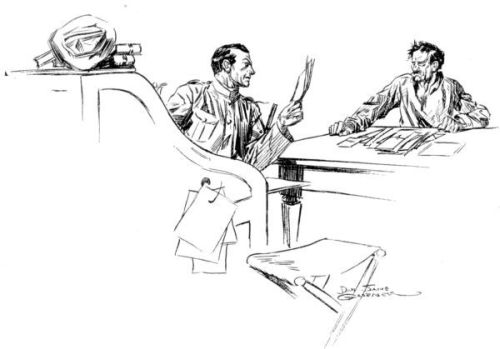
"'ARE YOU INTERESTED IN POETRY, SIR?' HE SAID"
"Soldier seems to be a he an' a she too. An' he is sure impartial," remarked Captain Campbell. "Even a mosquito must have a point of view—darn little nuisances!"
"'Life is one long gorgeous sunset if your head-net works as planned,'" agreed Stone, quoting from the American Mandalay. "Go on an' read 'To My Hoss,' You'll appreciate that."
TO MY HOSS
My hoss is gentle has no fears, And is slow if you dont ticcle his years. He has fore long legs and a drawn out hed, And so is cald a quadruped. Saturday morning enspection time i groom my hoss up clene and fine, But if his saddel aint packed wel, You bet Shorty gives me hel. My hoss must be fed before the men, Wen i dont do it I get hel agen, My hosses tale is very long the end of him and the end of my song.
"I know," chuckled Shorty, "what was the inspiration for that second verse. I jumped all over him one Saturday for havin' his canteen on the near side an' his picket-pin upside-down where it would blame well spit him if he should fall on it. He's right he got all that was coming to him. I only got time for one more now—a short one. What shall it be?"
"Try 'Fiting Joe And Dewey'; that's a bit different—might be classed under 'Poems of Ambition'."
Shorty shuffled the papers and read:
FITTING JOE AND DEWEY
Theres heaps of places in the world men wud lik to been and see But i tell you And I tell you true, That theres only 2 for me. Ide like to have worn my Countrys blu In the calvery riding or holding the tiller With Fiting joe at San Wan Hill or with Dewey at Manilla. And the old man says: "Ive been in slews of battels and ime toting in my shin A bullit from a johnny-rebils killer, With Fiting joe at San Wan Hill or Dewey a t manilla."
"How in Tophet did you come by this stuff, Sergeant?" asked the Captain, as he got up to put on his small coat, and, on tiptoe before a little hanging mirror, tried, ineffectually, to calm his upstanding hair with the ten-toothed comb of nature.
"Why, sir, Ryan gave 'em to me to read. He came into my room two or three nights ago an' asked me if I wouldn't like to see them. Said he'd written that 'Destinny' quite a time ago, but that all the others were just recently finished; that he'd been writing a lot lately, an' felt as if he just had to show 'em to somebody, an' he thought the other fellows would laugh at him. He said I might keep an' read them to anybody I thought would appreciate them. He thinks they're Shaksperean."
"Well," said Shorty, grabbing his hat and preparing to bolt, "I have sure appreciated 'em. But, you mark my words, there's a girl behind this. A fellow like Ryan doesn't go squanderin' rhymes for nothin', hombre. Adios." And off shot Shorty, with hands jammed deep in his pockets.
"He's smart, all right," said Stone to himself; "the girl's there. Where the deuce is that bloomin' ode, 'To my Lady-Frend'?" Finding it, he read:
Heaven meant things to go in 2s Cora, Thats why i am alone unhappy single. There won't be a bird or animal refuse Cora Each with other folks to mingle. So why do you give me the cold sholder Cora Is it becaws youre shi or love another? If youd only speak to your deer soljer Cora, Ide fite a feller if he was my brother. The moone is shining britely in the ski my Cora deer The nite is late the village clock strikes 2. Yes everything says 2 my years can hear Cora, And that is why i think of you.
"Poor kid, he seems to be up against it! Wonder where he got that about the village clock? Must have been doin' some promiscious readin'. He said that was the best 'piece' he'd written. I wonder if he—I wonder if she——" Still wondering, Stone carefully put the precious manuscript away and turned back to work, resolving to corral Private T. Ryan at the first opportunity.
Private T. Ryan proved obliging, however, and came into Stone's room after supper to get his verses and the first sergeant's opinion of them.
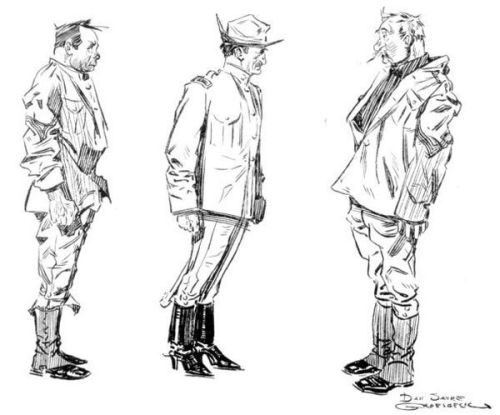
"'he used language to me, sir, and i am hiss sergeant'"
"What do I think about 'em, kid? Why, I think they're mighty interestin'. Take a chair. I didn't know you had it in you. But that one about your lady-friend, now; is that straight goods or is it a poet's pipe-dream?"
"It's true, all right. You know who she is, too. Cora Sheean—father's that retired chief trumpeter; lives over back o' the ridin'-hall."
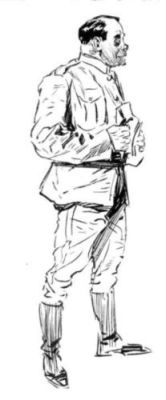
"Cora Sheean! Why, yes, I know who she is." Mrs. Sheean did Stone's washing, and he had often seen red-haired Cora, and heard of her, too; for she was the belle of the post in "enlisted" circles. "She's a mighty pretty girl, Ted,—here's luck to you,—but she's so bloomin' popular it's liable to be heavy goin'. You tell me all about it, an' maybe I can help you some"; and Stone began a rapid-fire broadside of questions, in the midst of which arrived John Whitney.
"Howdy," he remarked. "Say, yo' runnin' a pumpin'-station, Jerry?"
"No, I'm not. Now, either you clear out or come in an' help. I showed you Ryan's poetry—an' you remember that one about his lady-friend? Well, it's true, an' he's tellin' me about it. Do you mind his comin' in, kid? He can probably help you better than I can, as he's had so much more experience with Eliz——"
"Shut up! Yo'-all are mighty fond of refe'in' to that lady. I notice yo' get a letter every day yo'self!"
"Set down," said Ryan. "No, I don't mind, but don't you ever let on. There's Hansen, now. He'd devil me all over the place if he caught on."
And so he continued his recital. Yes, Cora had flirted outrageously with him. "But she says she ain't ever goin' ter marry no private; I got ter be a sergeant anyway, or she won't look at me." He was going to hold her to that; he was going to work hard, and there was a good chance, for there would be two non-coms to get their discharge next week. No, he hadn't always been fond of poetry; only this last winter. Will Carleton was a fine poet. "'Member 'bout that feller who fell through the ceilin' into the butter-tub?—or was it a churn he fell in?" But Ella Wheeler Wilcox was the finest poet who ever wrote a line. "So all-fired hot," she was. He had two books full of her things. He always wrote verses when he felt sort of lonely or Cora had been making him mad. "I write 'em about everything. To-day, at Retreat, now, I thought they'd keep us standin' there till kingdom come; an' when them bugles was blowin' the last part, that goes down an' up an' down again twice, an' then has a little wiggle to it, yer know, why, the words to it just popped into my head. Like this": And he sang:
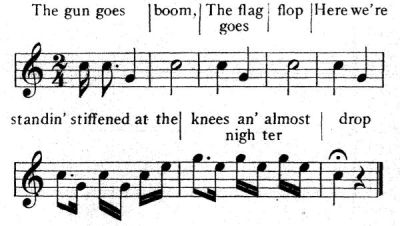
Rhymes came easy when he felt like it. Sometimes he could write 'em when he felt extra good, too. It had to be one way or the other; he couldn't write a bit when things were just common. And he was awfully fond of Cora. He'd give up 'most anything he had if she'd only say she'd marry him. But Hansen was a Q. M. sergeant an' put on dog, an' had reenlisted pay an' all, an' it cut a big figger with her. He wasn't worried about any of the other fellers; he could beat them out easy; but Hansen had him buffaloed. "An' I say, Sergeant, don't you tell Shorty I want ter get married or he won't do a blame thing for me."
"Sure thing," said Stone, "I won't tell him. But look here, kid; if I can work a pull for you,—an' I'll do the best I can,—will the lady have you, after all?"
"I think I can work it. I believe she's got a fondness for me, but she's that proud she wouldn't never marry nothin' but a sergeant; her father was chief trumpeter, yer know. Say, do please give me a recommend ter Shorty, an' I'll try mer very best ter do the work well an' be a good soldier."
"Glad to hear you say that; 'cause, I warn you, if you don't make a good non-com, you get busted. We can't run this troop on sentiment. Yes, I'll tell the captain I think you'll do for a corporal, if that'll ease your mind any; as for your getting a sergeancy, that's your own lookout later. It all depends on what sort you prove yourself to be. If it isn't the right sort, back you go."
"'I was a corporal wanst; I was rejuiced aftherwards,'" murmured Whitney. "Yes, Ted, I'll tell Shorty, too, that you'd make a good non-com. Will yo' leave yo' vuhses? I want to read 'em again. Goodnight. Next time I see Miss Cora, I'll make yo' ears bu'n." And, as Ryan departed with abject thanks, visibly cheered, Whitney stretched out his hand. "Speakin' of Kiplin', hand over that Lady-Friend yonder—want to learn her; she's a gem. Say, do yo' think Hansen's in earnest over that?"
"Ask me an' I say no. I know that Knudt down to the ground. He isn't the marryin' kind."
"Soldier of fortune, pyo' an' simple, he is," said Whitney; "always on the go; an' do yo' think he's goin' to pin himself down anywhere? Not he. He's only in this for the fun of the thing, an' it's a heap better fo' the little Cora girl if he stays out."
"I'm with you. He couldn't tie up to one girl, never in his bloomin' life. Between you an' me an' the lamp-post, he's goin' to the bad in more ways than one. 'Wine, women, an' song,' an' consequent mix-ups in his accounts. He's gettin' too crooked to stay quartermaster. Shorty's about decided to put him back in the line. Why, only yesterday he came over to me an' said, 'Say, make me out a afferdavid, will you? I lost my carbine.' I knew blame well he hadn't lost it, so I said right quick, 'That so? How much you get for it?'
"'Why,' he says, 'the man only gave me three-fif—. Say, Stone, you're darn smart! But help a feller out a bit, won't you? I had to have the money.'
"'No,' I said, 'I won't. You get out of here. I'm not goin' to perjure my soul so's you can have any three-fifteen, or three-fifty, or whatever it was.' The big yap! An', you can bet your life, if it had come down to his carbine, he's been doin' some tall monkeyin' with the accounts an' the troop fund. An' yet, with it all, I can't help liking him; there's so many good things about him. If he's your friend once, he's your friend for always—never knew such a man to stick. He's been awfully good to me when there's no call to be, an' helped me in lots of little ways."
"Yes," said Whitney; "an' the things he's seen, an' the places he's been, an' the messes he's been mixed up in—an' he knows how to tell it, too. That takes with the little Cora girl, of co'se. Better fo' her, though, if he'd keep away. I like him all right fo' myself, but he's liable to be crooked anywheres. Little Teddy Ryan's clean strain, but he wouldn't show up to much advantage beside Knudt. Dixon goes out to-mo'w; I s'pose that's what yo're thinkin' of fo' the kid. Who gets the sergeancy? Decided?"
"Yep. Melody's jumped, an' Sullivan gets it, but I don't think Shorty's thought of who'd be corporal. I'll try an' fix it in the mornin'."
Accordingly, next morning Stone nominated the poet to be Corporal Ryan.
"What the——!" said Shorty. "I've no use for a poet, I was thinkin' of Terry—what?"
"Well, only that Terry drinks an' Ryan never does. I don't think his verse-makin' will interfere with his duties; it hasn't hitherto, an' if he doesn't make good, we can try some one else."
"Have it your own way, then. The way you run this troop is scandalous. There's not another T. C. in the army who gets bossed by his Top the way I do." And off went Shorty chuckling, having decided two days before that Ryan was to be corporal, and well knowing that Stone would defy even the colonel before he would run counter to an order given by his adored captain.
Two nights later Stone and Whitney were again together.
"Well," said Whitney, "I've just seen the new co'poral goin', in all his glory, to the little Cora girl's. He didn't take long to get his stripes an' chevrons."
"To get! What you talkin' about? He had 'em all ready. Stevens saw him take 'em out of his locker already fixed on a new suit."
"That's what I call befo'handed. But the little cuss is so blame happy over it all."
"Yes," said Stone; "happy, an' wooin' the Muse again, too. Hope he don't mix her up with his Cora. Will you look at this? And the length of it? It's an ode to the troop, an' he hasn't left out anybody. Wonder where he got the time to do it all! Read the first three verses an' then the last; they're all you need to waste your time on."
So Whitney read:
ODE TO J TROOP
Come comrads come your carbeans load While neer and far I sing my oad. There never was a troop like owers It does deserve all bueateous flowers. Ower Captain in the army is the best But he doesent give you any rest And sergeants Stone and Whitny is very fine to, The best sergeants who breth ever drew. And now I come with unwiling pennence, To tell you about ower 2 lootennence. Lootenent Burns a Prints could be, But Spurs isent neerly as educated as me. So galopp on my gallent troop, Let no one to a bob-tale stoop, Its prayses sound from East to West For all agree J troop is best. Signed, Corporal T. Ryan Poet Lariat of J troop 18th U. S. Cav.
"Lariat! Gee! Wonder he didn't put 'an' picket-pin.' The second line of that last verse is mighty ambiguous. Do you s'pose he means a hawse or a dishono'able discharge?"
"Don't know," said Stone. "An' look at the last two lines:
Its prayses sound from East to West For all agree J troop is best.
Sounds like a soap advertisement to me. An' up there about the lieutenants. Wonder if an' 'unwiling pennence' meant a reluctant pen 'cause he didn't care to mention Spurs an' had to have a rhyme?"
"It's likely. But look yere, Jerry. Yo' an' I don't breathe. Our breath draws us."
"Pretty strong breath it must be, then."
"Hush, man! Yo' goin' to show these to Shorty?"
"I was thinkin' maybe he wouldn't like to think Ryan was still writin', now that he's a corporal."
"Ah, go on; show it. Shorty won't care."
And Shorty didn't. Only, after a delighted snort over the ode, he sent forth the order: "You tell him I say this has got to be the last. If I catch him writin' any more monkey-doodle verses, I'll bust him quick as a minute. If he wants to be a non-com in my troop, he's got to put his whole mind to it."
Ryan obeyed, and, unsaddling his Pegasus, set himself to work with such a will that as time went on he came to be one of the best non-coms in the troop, particularly where the instruction of recruits was concerned; for he seemed to have a special sympathy with them, and a knack of imparting the correct way to do things; His suit with Cora prospered, too, for she paid more attention to the corporal than she had to the private; but, being past grand mistress of the art of flirtation, she always contrived some little act or remark to chasten her lover's spirit and keep him sufficiently humble, as an offset to any particular favoritism that might have uplifted his spirits; which manoeuver always successfully puzzled Teddy. "First she's all sweet as candy; next minute I get the throw-down." But he never despaired, and came back strongly on the rebound, inquiring periodically, "Say, Cora, you're goin' ter marry me when I get mer sergeancy, ain't yer?" And she would reply, laughing: "Yes, when you get to be a sergeant I'll marry yer; an' that'll be when the river catches fire."
Time wore on, and the summer drew to a close. Hansen was no longer the quartermaster-sergeant, so he was not such an impressive figure as he had been. One payday Captain Campbell instructed Stone to read the men a lecture on the sin of drunkenness. "Not that I mind a man's gettin' drunk so much, but when the whole troop goes on a booze, it's a blame sight too much of a good thing. We're not to have any such time in J barracks as we did last month. You tell 'em that, an' make it red-hot."
So Stone, translating liberally, read them a severe lecture, ending up with: "An' if any of you big yaps comes home drunk, don't care who he is, he gets put under arrest. Savvy? That's straight."
The troop paid honors to an ultimatum when it was paraded before them, and it was a straight-walking, sober crowd that rounded up at J barracks that night. But, shortly before reveille, sounds of song and hilarity disturbed the sleepers, and Stone was obliged to rise and place Sergeant Knudt Hansen under arrest. He had returned from town in an exceedingly talkative frame of mind, and was now tipsily enlightening his squad-room on the disgracefully small quantity of drinks that could be bought on a sergeant's pay.
"I hate to do it, old man," said Stone, "but I'll have to put you under arrest. You know what I said, and now you've gone an' done this deliberately."
"Aw right. 'Sh mer own fault—only 'sh bad exshample to 'resht shergeant before shquad-room o' privatshes; mosht demoralizin'."
"I'm sorry, Hansen, but I must do it. You are confined to quarters for two days." And Stone retired, grieved that Hansen, of all men, should have been the one to suffer for the sake of an example.
"Gee!" said Brown, "I never thought Stone'd do that!"
"Wouldn't he, though?" rejoined Ryan. "You bet your boots, a sergeant looks all same buck to the Top."
"Hansen'll lay it up to him, you see," said Hickey, looking at the big man now sprawled out on his bunk in noisy slumber.
"Not on yer life, Dope," said Brown. "Hansen's too much sense fer that. He'll see the Top's side of it." And so it proved, for, after a few half-laughs, half-apologetic words from his first sergeant, Hansen agreed that there had been no other course to pursue.
"And, anyway," he said, with a grin, "I'll get a goot rest, yess. It iss about time I loafed some. I shall sleep."
Now, sleep was all very well for that day and part of the next, but by the afternoon of the second day Sergeant Knudt Hansen's active mind and body became saturated with rest and extremely bored. He had read everything he could lay his hands on, even including a vagrant copy of "Edgeworth's Moral Tales" that had wandered, Heaven knows how, into the troop library. While affording him food for sarcastically profane comment in the slimy sediment of at least six different languages, this estimable work had, if anything, increased his ennui. His body began actually to ache for action of some sort; almost anything would do at a pinch.
Strolling disconsolately through the hall, whom should he chance to see but Corporal Ryan, who was in charge of quarters for that day, busily cleaning his saber (for the next day was Saturday), and singing cheerfully, "'You're in the army now.'"
"Let up on that musical, you gamin; it iss not to the ear pleasant," growled Hansen. Besides his other grievance that Ryan's cheerfulness flicked on the raw, the little corporal had cut out the big sergeant several times lately with Cora.
"Ah, g'wan an' soak yer swelled head!" retorted Ryan respectfully, and, bending to his work, began to carol forth the delectable ballad of the "Rubber Dolly." Hansen advanced into the room.
"See here, Meester Freshie, that iss no way to speak to your sergeant! Oh, yess; I am knowing what you mean. You t'ank, because Cora go with you a leetle, you can come it ofer me here, too—not?"
"You leave her name out o' that," said Teddy, straightening up and reddening. "She's got nothin' ter do with it, an' you leave her be."
"Oho! The leetle man tank she iss so sweet and innocent a leetle girl, I am not fit to speak of her—yess? Why, she—" And Hansen started in to enumerate in no very choice language certain fabricated insinuations against the character of the popular Miss Cora Sheean. But they were barely out of his mouth before Teddy Ryan's fist was in it. Blindly the big Swede struck back, catching Ryan on the nose and drawing the blood; and then they started in in earnest.
"Hello, hello! What's all this?" demanded Captain Campbell, popping in on the scene like a vibrant little jack-in-the-box. Hansen drew off. "He used language to me, sir, and I am hiss sergeant; it iss him that I am teaching hiss place," he explained sullenly.
"But, Cap'en," cried Ryan, "he said—he said—I can't tell yer what he said," he finished slowly.
"Well, I can tell what I'll say, an' pretty blame quick! Hansen, you're a bully, that's what. Next time tackle some one nearer your size; an' you get three days' confinement. Ryan (for heaven's sake get a handkerchief an' wipe your nose), I'll give you a day, too; for fightin' your sergeant an' for gettin' into a fight when you're left in charge of quarters." Thus it was that the Captain ended the fight, but the consequences stretched far beyond him and were in the hands of Cora.
"You oughter been ter J Troop yesterday," quoth Corporal Brown the next evening, while sitting on Miss Cora Sheean's front step. "Hansen an' Ryan had a fight. Hansen said somepin', an' Ryan went fer him, an' they had it hot. Nobody was by, an' Ryan won't tell, so we don't know what Hansen said."
Cora was staring at him with eyes wide with concern. "My Lord!" she gasped, "is he hurt?"
"Naw, Hansen ain't hurt none. He's a fighter, an' Ryan ain't big enough ter——"
"Stupid! I mean Teddy Ryan. Is he hurt?"
"Naw; only a black eye an' a nose-bleed. Cap'en stopped 'em before Hansen had a chance ter do much."
"Thank Gawd!" sighed Cora, sinking back in relief. "Look here, Mr. Brown, will you do me a favor? Will you tell Mr. Ryan that if he can run over here early to-morrow mornin', I got somethin' I want ter give him?"
When the bearer of tidings had departed, Cora sat up very straight, with tightly clasped hands, repeating vacantly, with an ambiguous mixture of pronouns, "He might er killed him—he might er killed him!" For to her the fight between these men had only one meaning; intuitively she knew herself to be the cause. "He fought for me," she said, "I know he did. An' I want Teddy Ryan. I want him!"
Next morning she peeped out of the window and watched the approach of the sturdy, honest-faced little corporal before she went to open the door for him herself.
"You wanted ter see me?" he said, fingering his hat shyly.
"Yes; I—I heard you'd been in a fight. I—I wanted to read you a lecture. That's an awful eye you got, Mr. Ryan!"
"I'm sorry you don't like it, Miss Cora, but I had to; you'd have wanted me to if you'd known."
"Oh!" cried Cora, and her heart whispered: "Then it was about me, just as I thought, and the dear won't tell me." But aloud she said, "It ain't ever right to fight, an' I didn't think it of you, Mr. Ryan."
"I had to," he repeated awkwardly, and turned away. "Is that all you had ter say ter me? I must go back; but I thought Brown said that you had somethin' ter give me."
"Yes," said Cora in a very scared, small voice. "I have—me!"
"Cora! Do you mean it, girlie? Do you really mean it?" And two short but strong arms went round her. "But I ain't a sergeant yet, nor won't be for ever so long."
"Oh, Teddy!" said Cora, and hid her face right over his second button, "I ain't lovin' yer chevrons; I'm lovin' you."
Shorty received the joyous news in ominous silence. "When's the weddin'?" he demanded abruptly.
"Oh, sometime next month, I guess," said the proud husband-to-be.
"Nothin' of the sort. You get married next week; do you hear? No mañana about this business; get it over as quick as possible. You'll be worthless to me for long enough, as it is. A great poet you are! The whole thing was nothin' but the girl, just as I told Sergeant Stone."
So J Troop had a wedding, and the whole troop turned out in force, brave in full dress, from Shorty down to the latest junior rook—the only member not present being Sergeant Hansen, who had no interest in the proceedings. And the punch flowed so freely and so strongly that every man who tried to enlighten the absent one told a totally different story.
Spring had come again at Fort Hotchkiss, and one soft evening, as Stone and Whitney were sitting on the porch, Sergeant Theodore Ryan, now proudly sporting his three chevrons, came up to them, smiling a wide-mouthed, foolish smile.
"Well, what's up, hombre?"
"Recruits fer J Troop—over to my quarters."
"Recruits! You don't mean to say there's two of 'em?"
Ryan nodded. "Twins," he assented beamingly.
"'Heaven meant things to go in twos, Cora,'" quoted Whitney.

Copyright, 1908, by Ellen Terry (Mrs. Carew)
One of the best "audiences" that actor or actress could wish for was Mr. Gladstone. He used often to come and see the play at the Lyceum from a little seat in the O. P. entrance, and he nearly always arrived five minutes before the curtain went up. One night I thought he would catch cold—it was a bitter night—and I lent him my white scarf.
He could always give his whole great mind to the matter in hand. This made him one of the most comfortable people to talk to that I have ever met.
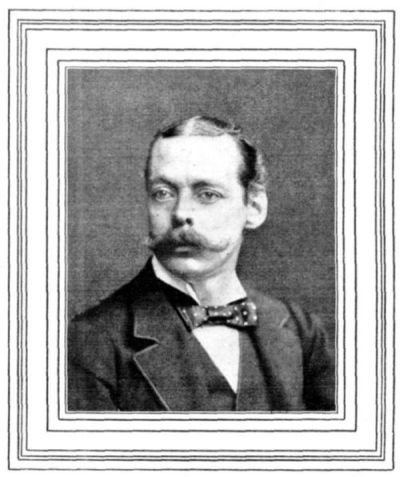
I contrasted his punctuality, when he came to see "King Lear," with the unpunctuality of Lord Randolph Churchill, who came to see the play the very next night with a party of men friends and arrived when the first act was over. Lord Randolph was, all the same, a great admirer of Henry Irving. He confessed to him once that he had never read a play of Shakespeare's in his life, but that after seeing Henry act he thought it was time to begin. A very few days later he astonished us with his complete and masterly knowledge of at least half a dozen of the plays. He was a perfect person to meet at a dinner or supper—brilliantly entertaining, and queerly simple. He struck one as being able to master any subject that interested him, and, once a Shakespeare performance at the Lyceum had fired his interest, there was nothing about that play, or about past performances of it, which he did not know. His beautiful wife, now Mrs. George Cornwallis West, wore a dress at supper one evening which gave me the idea for the Lady Macbeth dress, afterwards painted by Sargent. The bodice of Lady Randolph's gown was trimmed all over with green beetles' wings. I told Mrs. Comyns Carr about it, and she remembered it when she designed my Lady Macbeth dress.
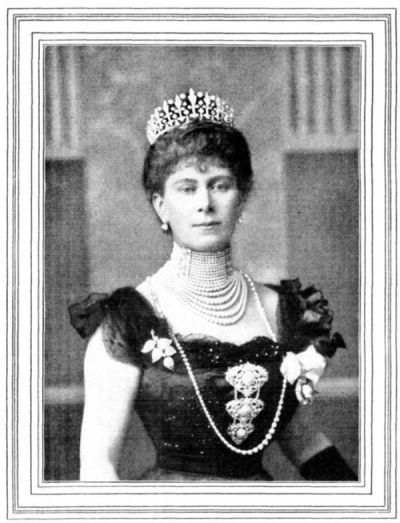
The present Princess of Wales, when she was Princess May of Teck, used often to come to the Lyceum with her mother, Princess Mary, and to supper in the Beefsteak Room. In 1891 she chose to come as her birthday treat, which was very flattering to us.
A record of those Beefsteak Room suppers would be a pleasant thing to possess. I have such a bad memory. I see faces round the table—the face of Liszt among them—but when I try to think when it was, or how it was, the faces vanish. Singers were often among Henry Irving's guests in the Beefsteak Room—Patti, Melba, Calvé, Albani, and many others.
I once watched Patti sing from behind the scenes at the Metropolitan Opera House, New York. My impression from that point of view was that she was actually a bird. She could not help singing. Her head, flattened on top, her nose, tilted downwards like a lovely little beak, her throat, swelling and swelling as it poured out that extraordinary volume of sound, all made me think that she must have been a nightingale before she was transmigrated into a human being. I imagine that Tetrazzini, whom I have not yet heard, must have this bird-like quality.
The dear, kind-hearted Melba has always been a good friend of mine. The first time I met her was in New York at a supper party, and she had a bad cold, and therefore a frightful speaking voice for the moment. I shall never forget the shock it gave me. Thank goodness, I very soon afterwards heard her again when she hadn't a cold, and she spoke as exquisitely as she sang. She was one of the first to offer her services for my Jubilee performance at Drury Lane, but unfortunately she was ill when the day came and could not sing. She had her dresses in "Faust" copied from mine by Mrs. Nettleship, and I came across a note from her the other day, thanking me for having introduced her to "an angel." Another note sent round to me during a performance of "King Arthur" in Boston I shall always prize:
"You are sublime, adorable, ce soir.... I wish I were a millionaire—I would throw all my millions at your feet. If there is another procession, tell the stage-manager to see those imps of Satan don't chew gum. It looks awful.
Love. Melba."
I think at that time it was the solemn procession of mourners following the dead body of Elaine who were chewing gum, but we always had to be prepared for it among our American "supers," whether they were angels or devils or courtiers.
In "Faust" we "carried" about six leading devils for the Brocken scene and recruited the forty others from local talent in the different towns that we visited. Their general instructions were to throw up their arms and look fierce at certain music cues. One night I noticed a girl going through the most terrible contortions with her jaw, and thought I must say something. "That's right, dear. Very good, but don't exaggerate."
"How?" was all the answer that I got; and the girl continued to make faces as before. I was contemplating a second attempt, when Templeton, the lime-light man, who had heard me speak to her, touched me gently on the shoulder. "Beg pardon, miss, she don't mean it. She's only chewing gum."
An "Alice in Wonderland" Letter
One of my earliest friends among literary folk was Mr. Charles Dodgson—or Lewis Carroll—or "Alice in Wonderland." Ah, now you know what I am talking about. I can't remember when I didn't know him. I think he must have seen Kate act as a child, and having given her "Alice"—he always gave his young friends "Alice" at once by way of establishing pleasant relations—he made progress as the years went on through the whole family. Finally he gave "Alice" to my children.
He was a splendid theatre-goer, and took the keenest interest in all the Lyceum productions, frequently writing to me to point out slips in the dramatist's logic which only he would ever have noticed. He did not even spare Shakespeare. I think he wrote these letters for fun, as some people make puzzles, anagrams, or limericks.
Mr. Dodgson's kindness to children was wonderful. He really loved them and put himself out for them. The children he knew who wanted to go on the stage were those who came under my observation, and nothing could have been more touching than his ceaseless industry on their behalf. This letter to my sister Floss is characteristic of his "Wonderland" style when writing to children:
"My dear Florence:
"Ever since that heartless piece of conduct of yours (I allude to the affair of the Moon and the blue silk gown), I have regarded you with a gloomy interest, rather than with any of the affection of former years—so that the above epithet 'dear' must be taken as conventional only, or perhaps may be more fitly taken in the sense in which we talk of a 'dear' bargain, meaning to imply how much it has cost us; and who shall say how many sleepless nights it has cost me to endeavour to unravel (a most appropriate verb) that 'blue silk gown'?
"Will you please explain to Tom about that photograph of the family group which I promised him? Its history is an instructive one, as illustrating my habits of care and deliberation. In 1867 the picture was promised him, and an entry made in my book. In 1869, or thereabouts, I mounted the picture on a large card, and packed it in brown paper. In 1870, or 1871, or thereabouts, I took it with me to Guildford, that it might be handy to take with me when I went up to town. Since then I have taken it two or three times to London, and on each occasion (having forgotten to deliver it to him) I brought it back again.
"This was because I had no convenient place in London to leave it in. But now I have found such a place. Mr. Dubourg has kindly taken charge of it—so that it is now much nearer to its future owner than it has been for seven years. I quite hope, in the course of another year or two, to be able to remember to bring it to your house; or perhaps Mr. Dubourg may be calling even sooner than that and take it with him. You will wonder why I ask you to tell him instead of writing myself. The obvious reason is that you will be able, from sympathy, to put my delay in the most favourable light; to make him see that, as hasty puddings are not the best of puddings, so hasty judgments are not the best of judgments, and that he ought to be content to wait even another seven years for his picture, and to sit 'like patience on a monument, smiling at grief.'
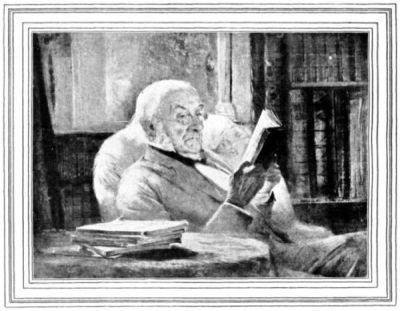
WILLIAM EWART GLADSTONE
FROM THE PAINTING BY J. MCCLURE HAMILTON, DONE AT HAWARDEN CASTLE IN 1890
"This quotation, by the way, is altogether a misprint. Let me explain it to you. The passage originally stood, 'They sit, like patients on the Monument, smiling at Greenwich.' In the next edition 'Greenwich' was printed short, 'Greenh,' and so got gradually altered into 'Grief.' The allusion, of course, is to the celebrated Dr. Jenner, who used to send all his patients to sit on the top of the Monument (near London Bridge) to inhale fresh air, promising them that, when they were well enough, they should go to 'Greenwich Fair.' So, of course, they always looked out towards Greenwich, and sat smiling to think of the treat in store for them. A play was written on the subject of their inhaling the fresh air, and was for some time attributed to him (Shakespeare), but it is certainly not in his style. It was called 'The Wandering Air,' and was lately revived at the Queen's Theatre. The custom of sitting on the Monument was given up when Dr. Jenner went mad,
Copyrighted by the London Stereoscopic Co.
LORD RANDOLPH CHURCHILL
and insisted on it that the air was worse up there, and that the lower you went the more airy it became. Hence he always called those little yards, below the pavement, outside the kitchen windows, 'the kitchen airier,' a name that is still in use.
Copyrighted by W. & D. Downey
THE PRINCESS OF WALES
TO WHOM HENRY IRVING GAVE A BIRTHDAY SUPPER IN THE BEEFSTEAK ROOM OF THE LYCEUM IN 1891
"All this information you are most welcome to use, the next time you are in want of something to talk about. You may say you learned it from 'a distinguished etymologist,' which is perfectly true, since anyone who knows me by sight can easily distinguish me from all other etymologists.
"What parts are you and Polly now playing?
"Believe me to be (conventionally)
"Yours affectionately, C. Dodgson.."
"Sentimental Tommy" Writes Himself
No two men could be more unlike than Mr. Dodgson and Mr. J. M. Barrie, yet there are more points of resemblance than "because there's a 'b' in both!" If "Alice in Wonderland" is the children's classic of the library, and one perhaps even more loved by the grown-up children than by the others, "Peter Pan" is the children's stage classic, and here again elderly children are the most devoted admirers. I am a very old child, nearly old enough to be a "beautiful great-grandmother" (a part that I am sure Mr. Barrie could write for me), and I go and see "Peter" year after year and love him more each time.
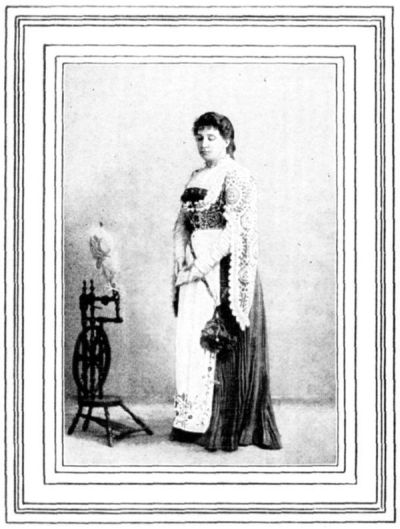
MELBA AS MARGUERITE IN "FAUST"
There is one advantage in being a grown-up child—you are not afraid of the pirates or the crocodile.
I first became an ardent lover of Mr. Barrie through "Sentimental Tommy" and I simply had to write and tell him how hugely I had enjoyed it. In reply I received this letter from Tommy himself:
"Dear Miss Ellen Terry:
"I just wonder at you. I noticed that Mr. Barrie, the author (so-called), and his masterful wife had a letter they wanted to conceal from me, so I got hold of it, and it turned out to be from you, and not a line to me in it! If you like the book, it is me you like, not him, and it is to me you should send your love, not to him. Corp thinks, however, that you did not like to make the first overtures, and if that is the explanation, I beg herewith to send you my warm love (don't mention this to Elspeth), and to say that I wish you would come and have a game with us in the Den (Don't let on to Grizel that I invited you). The first moment I saw you, I said to myself 'This is the kind I like,' and while the people round about me were only thinking of your acting, I was wondering which would be the best way of making you my willing slave, and I beg to say that I believe I have 'found a way,' for most happily the very ones I want most to lord it over are the ones who are least able to resist me.
"We should have ripping fun. You would be Jean MacGregor, captive in the Queen's Bower, but I would climb up at the peril of my neck to rescue you, and you would faint in my strong arms; and wouldn't Grizel get a turn when she came upon you and me whispering sweet nothings in the Lovers' Walk. I think it advisable to say in writing that I would only mean them as nothings (because Grizel is really my one), but so long as they were sweet, what does that matter (at the time)? And, besides, you could love me genuinely, and I would carelessly kiss your burning tears away.
"Corp is a bit fidgetty about it, because he says I have two to love me already, but I feel confident that I can manage more than two.
"Trusting to see you at the Cuttle Well on Saturday when the eight o'clock bell is ringing,
I am, Your Indulgent Commander,
"T. Sandys."
"P. S.—Can you bring some of the Lyceum armour with you, and two hard-boiled eggs?"
Henry Irving once thought of producing Mr. Barrie's play "The Professor's Love Story." He was delighted with the first act, but when he read the rest he did not think the play would do for the Lyceum. It was the same with many plays which were proposed for us. The ideas sounded all right, but as a rule the treatment was too thin, and the play, even if good, on too small a scale for the theatre.
Mrs. Craigie's Great Promise
One of our playwrights from whom I always expected a great play was Mrs. Craigie (John Oliver Hobbes). A little one-act play of hers, "Journeys End in Lovers' Meeting," in which I first acted with Johnston Forbes Robertson and Terriss at a special matinée in 1894, brought about a friendship between us that lasted until her death. Of her it could indeed be said with poignant truth, "She should have died hereafter." Her powers had not nearly reached their limit.
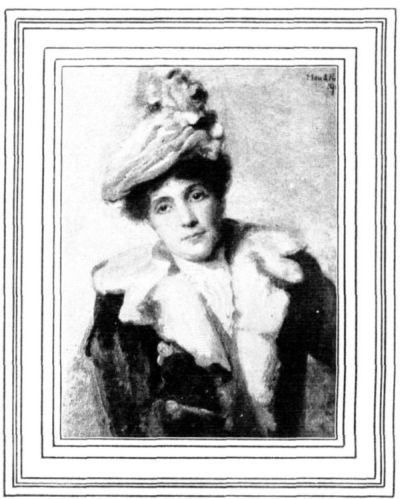
MRS. CRAIGIE (JOHN OLIVER HOBBES)
From the painting by Miss Maud Porter
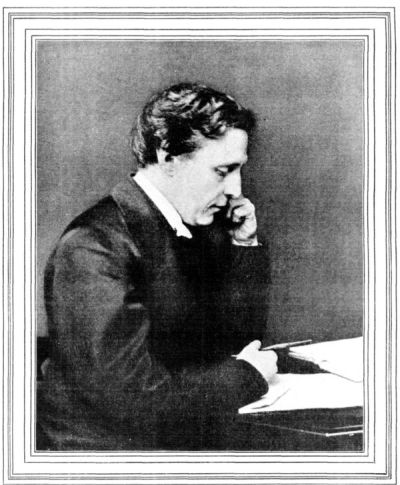
Lent by the Press Picture Agency.
C. L. DODGSON (LEWIS CARROLL)
WHO GAVE "ALICE IN WONDERLAND" TO ALL OF ELLEN TERRY'S FAMILY
Pearl Craigie had a man's intellect, a woman's wit and apprehension. "Bright," as the Americans say, she always managed to be even in the dullest company, and she knew how to be silent at times, to give the "other fellow" a chance. Her executive ability was extraordinary. Wonderfully tolerant, she could at the same time not easily forgive any meanness or injustice that seemed to her deliberate. Hers was a splendid spirit.
I shall always bless that little play of hers which first brought me near to so fine a creature. I rather think that I never met any one who gave out so much as she did. To me, at least, she gave, gave all the time. I hope she was not exhausted after our long "confabs." I was most certainly refreshed and replenished.
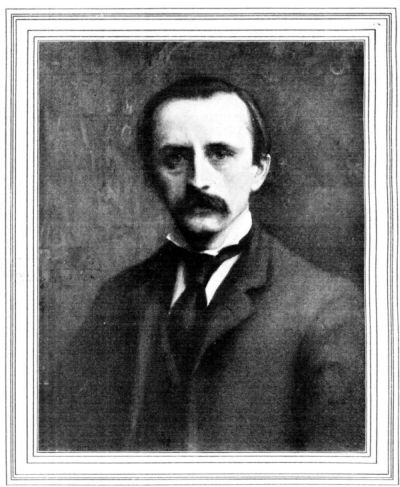
Photograph by the London Autotype Co.
J. M. BARRIE
FROM THE PAINTING BY LESLIE BROOKE. BARRIE'S PLAY, "ALICE-SIT-BY-THE-FIRE," WHICH HE WROTE FOR MISS TERRY, WAS PRODUCED BY HER IN 1905
The first performance of "Journeys End in Lovers' Meeting" she watched from a private box with the Princess of Wales (our present Queen) and Henry Irving. She came round afterwards just burning with enthusiasm and praising me for work which was really not good. She spoiled me for other women.
Her best play was, I think, "The Ambassador," in which Violet Vanbrugh, who is now Mrs. Bouchier, played a pathetic part very beautifully, and made a great advance in her profession. There was some idea of Pearl Craigie writing a play for Henry Irving and me, but it never came to anything. There was a play on the same subject as "The School for Saints," and another about Guizot.
Feb. 11, 1898.
"My very dear Nell:
"I have an idea for a real four-act comedy (in these matters nothing daunts me!), founded on a charming little episode in the private lives of Princess Lieven (the famous Russian ambassadress), and the celebrated Guizot, the French Prime Minister and historian. I should have to veil the identity slightly, and also make the story a husband-and-wife story; it would be more amusing this way. It is comedy from beginning to end. Sir Henry would make a splendid Guizot, and you the ideal Madame de Lieven. Do let me talk it over with you. 'The School for Saints' was, as it were, a born biography. But the Lieven-Guizot idea is a play.
"Yours ever affectionately,
"Pearl Mary Teresa Craigie."
In another letter she writes:
"I am changing all my views about so-called 'literary' dialogue. It means pedantry. The great thing is to be lively."
"Captain Brassbound's Conversion"
It has always been a reproach against Henry Irving in some mouths that he neglected the modern English playwright; and of course the reproach included me to a certain extent. I was glad, then, to show that I could act in the new plays when Mr. Barrie wrote "Alice-Sit-by-the-Fire" for me, and after some years' delay I was able to play in Mr. Bernard Shaw's "Captain Brassbound's Conversion." Of course I could not have played in "little" plays of this school at the Lyceum with Henry Irving, even if I had wanted to; they are essentially plays for small theatres and a single "star."
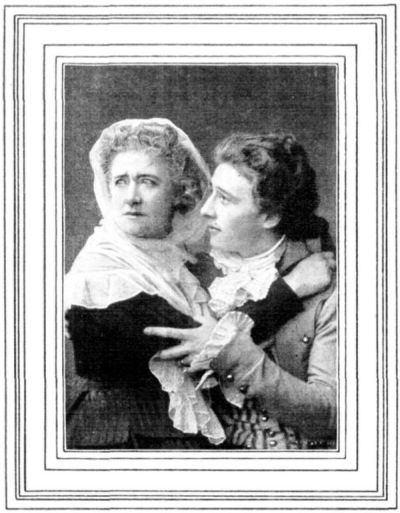
Copyrighted by Window & Grove
ELLEN TERRY AND HER SON, GORDON CRAIG, IN "THE DEAD HEART"
In Mr. Shaw's "A Man of Destiny" there were two good parts, and Henry, at my request, considered it, although it was always difficult to fit a one-act play into the Lyceum bill. For reasons of his own Henry never produced Mr. Shaw's play, and there was a good deal of fuss made about it at the time, 1897. But ten years ago Mr. Shaw was not so well known as he is now, and the so-called "rejection" was probably of use to him as an advertisement. "A Man of Destiny" has been produced since, but without any great success. I wonder if Henry and I could have done more with it?
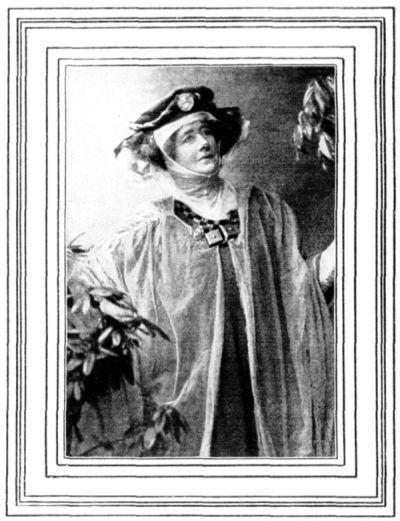
Copyrighted by Window & Grove
ELLEN TERRY AS MISTRESS PAGE IN "MERRY WIVES OF WINDSOR"
At this time Mr. Shaw and I frequently corresponded. It began by my writing to ask him as musical critic of the Saturday Review, to tell me frankly what he thought of the chances of a composer-singer friend of mine. He answered "characteristically," and we developed a perfect fury for writing to each other. Sometimes the letters were on business, sometimes they were not, but always his were entertaining, and mine were, I suppose, "good copy," as he drew the character of Lady Cecily Waynflete in "Brassbound" entirely from my letters. He never met me until after the play was written. In 1902 he sent me this ultimatum:—
"3rd April, 1902.
"Mr. Bernard Shaw's compliments to Miss Ellen Terry.
"Mr. Bernard Shaw has been approached by Mrs. Langtry with a view to the immediate and splendid production of 'Captain Brassbound's Conversion.'
"Mr. Bernard Shaw, with the last flash of a trampled-out love, has repulsed Mrs. Langtry with a petulance bordering on brutality.
"Mr. Bernard Shaw has been actuated in this ungentlemanly and unbusinesslike course by an angry desire to seize Miss Ellen Terry by the hair and make her play Lady Cecily.
"Mr. Bernard Shaw would be glad to know whether Miss Ellen Terry wishes to play Martha at the Lyceum instead.
"Mr. Bernard Shaw will go to the length of keeping a minor part open for Sir Henry Irving when 'Faust' fails, if Miss Ellen Terry desires it.
"Mr. Bernard Shaw lives in daily fear of Mrs. Langtry recovering sufficiently from her natural resentment of his ill manners to re-open the subject.
"Mr. Bernard Shaw begs Miss Ellen Terry to answer this letter.
"Mr. Bernard Shaw is looking for a new cottage or house in the country and wants advice on the subject.
"Mr. Bernard Shaw craves for the sight of Miss Ellen Terry's once familiar handwriting."
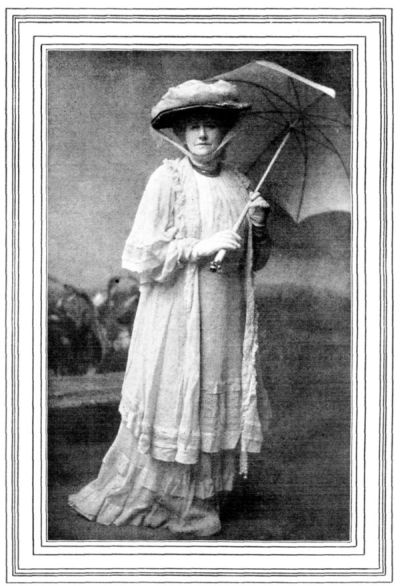
ELLEN TERRY AS LADY CECILY WAYNFLETE IN "CAPTAIN BRASSBOUND'S CONVERSION"
Isn't it Horace who says that there is nothing to prevent the man who laughs from speaking the truth? I think I have heard so, and I always remember it coupled with the name of Bernard Shaw. He laughs, but he speaks the truth.[11] The first time he came to my house I was not present, but a young American lady, who had long adored him from the other side of the Atlantic, took my place as hostess. I had to be at the theatre, as usual, but I took great pains to have everything looking nice; I spent a long time putting out my best blue china, and ordered a splendid dinner, quite forgetting that the honoured guest usually dined off a Plasmon biscuit and a bean.
Mr. Shaw— a Gentle Creature with "Brainstorms"
Mr. Shaw read "Arms and the Man" to my young American friend, Miss Sally Fairchild, without even going into the dining-room where the blue china was spread out to delight his eye. My daughter, Edy, was present at the reading, and appeared so much absorbed in some embroidery and paid the reader so few compliments about his play, that he expressed the opinion that she behaved as if she had been married to him for twenty years.
The first time I ever saw Mr. Shaw in the flesh—I hope he will pardon me such an anti-vegetarian expression—was when he took his call after the first production of "Captain Brassbound's Conversion" by the Stage Society. He was quite unlike what I had imagined from his letters.
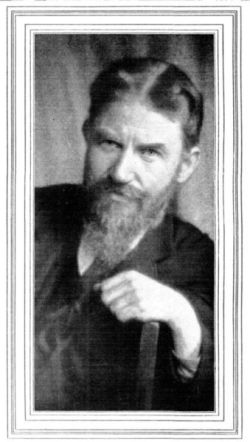
By permission of Frederick H. Evans
GEORGE BERNARD SHAW
WHOSE PLAY, "CAPTAIN BRASSBOUND'S CONVERSION," WRITTEN FOR MISS TERRY, WAS PRODUCED BY HER IN 1906
When at last I was able to play in "Captain Brassbound's Conversion" I found Bernard Shaw wonderfully patient at rehearsal. I look upon him as a good, kind, gentle creature whose "brainstorms" are due to the Irishman's love of a fight; they never spring from malice or anger. It doesn't answer to take Bernard Shaw seriously. He is not a man of convictions; that is one of the charms of his plays, to me, at least. One never knows how the cat is really jumping. But it jumps. Bernard Shaw is alive, with nine lives, like the cat.
Shakespeare's Rabelaisian Mood
On Whit Monday, 1902, I received a telegram from Mr. Tree saying that he was coming down to Winchelsea to see me on "an important matter of business." I was at the time suffering from considerable depression about the future.
The Stratford-on-Avon visit had inspired me with the feeling that there was life in the old 'un yet, and had distracted my mind from the strangeness of no longer being at the Lyceum permanently with Henry Irving. But there seemed to be nothing ahead, except two matinées a week with him at the Lyceum, to be followed by a provincial tour in which I was only to play twice a week, as Henry's chief attraction was to be "Faust." This sort of "dowager" engagement did not tempt me. Besides, I hated the idea of drawing a large salary and doing next to no work. So when Mr. Tree proposed that I should play Mrs. Page (Mrs. Kendal being Mrs. Ford) in "Merry Wives of Windsor" at His Majesty's, it was only natural that I should accept the offer joyfully. I telegraphed to Henry Irving, asking him if he had any objection to my playing at His Majesty's. He answered: "Quite willing if proposed arrangements about matinées are adhered to."
I have thought it worth while to give the facts about this engagement, because so many people seemed at the time and afterwards to think that I had treated Henry Irving badly by going on playing in another theatre, and that theatre one where a certain rivalry with the Lyceum as regards Shakespearian productions had grown up. There was absolutely no foundation for the rumors that my "desertion" caused further estrangement between Henry Irving and me.
"Heaven give you many, many merry days and nights," he telegraphed to me on the first night, and after that first night, the jolliest that I ever saw, he wrote delighting in my success. It was a success, there was no doubt about it. Some people accused the "Merry Wives" of rollicking and "mafficking" overmuch, but these were the people who forgot that we were acting in a farce, and that farce is farce, even when Shakespeare is the author. The audience at first used to seem rather amazed. This thwacking, rough-and-tumble, Rabelaisian horse-play Shakespeare? Impossible! But as the evening went on we used to capture even the most civilized, and force them to return to a simple Jacobian frame of mind.
In my later career I think I have had no success like this. Letters rained on me—yes, even love-letters, as if, to quote Mrs. Page, it were still "the holiday-time of my beauty." As I would always rather make an audience laugh than see them weep, it may be guessed how much I enjoyed the hearty laughter at His Majesty's during the run of the madcap absurdity of "Merry Wives of Windsor."
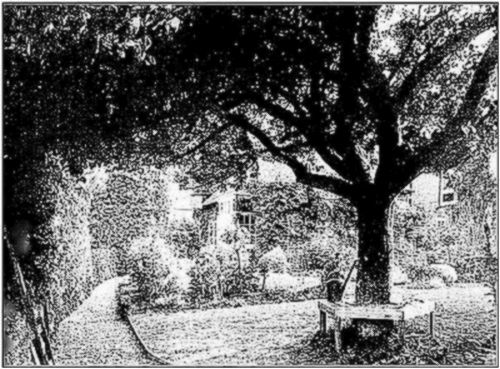
MISS TERRY'S GARDEN AT WINCHELSEA; FROM A PHOTOGRAPH GIVEN BY HER TO MISS EVELYN SMALLEY
On the nineteenth of July, 1902, I acted at the Lyceum for the last time, although I did not know it then. These last Lyceum days were very sad. The reception given by Henry to the Indian princes who were in England for the Coronation was the last flash of the splendid hospitality which had for so many years been one of the glories of the theatre.
During my provincial tour with Henry Irving in the autumn of this year I thought long and anxiously over the proposition that I should play in "Dante." I heard the play read, and saw no possible part for me in it. I refused a large sum of money to go to America with Henry Irving, because I could not consent to play a part even worse than the one that I had played in "Robespierre." As things turned out, although "Dante" did fairly well at Drury Lane, the Americans would have none of it, and Henry had to fall back upon his repertoire.
Ibsen's "Vikings"
Having made the decision against "Dante," I began to wonder what I should do. My partnership with Henry Irving was definitely broken; most inevitably and naturally "dissolved." There were many roads open to me. I chose the one which was, from a financial point of view, madness. Instead of going to America, and earning £12,000, I decided to take a theatre with my son, and produce plays in conjunction with him.
I hope it will be remembered, when I am spoken of by the youngest critics after my death as a "Victorian" actress, lacking in enterprise, an actress belonging to the "old school," that I produced a spectacular play of Ibsen's in a manner which possibly outstripped the scenic ideas of to-day by a century; of which at any rate the orthodox theatre managers of the present age would not have dreamed. At the Imperial Theatre, where I spent my financially unfortunate season in April, 1903, I gave my son a free hand. Naturally I am not inclined to criticise his methods. When I worked with him I found him far from unpractical. It was the modern theatre which was unpractical when he was in it. It was wrongly designed, wrongly built. We had to disembowel the Imperial behind scenes before he could even start, and then the great height of the proscenium made his lighting lose all its value.
When his idea of dramatic significance clashed with Ibsen's, strange things would happen. Mr. Bernard Shaw, though impressed by Ted's work and the beauty that he brought on to the stage of the Imperial, wrote to me that the symbolism of the first act of "Vikings" was Dawn, youth rising with the morning sun, reconciliation, rich gifts, brightness, lightness, pleasant feelings, peace. On to this sunlit scene stalks Hiördis, a figure of gloom, revenge, of feud eternal, of relentless hatred and uncompromising unforgetfulness of wrong.
At the Imperial, said Mr. Shaw, the curtain rose on profound gloom. When you could see anything, you saw eld and severity—old men with white hair personating the gallant young sons of Ormulf; everywhere murky cliffs and shadowy spears, melancholy, darkness. Into this symbolic night enter, in a blaze of limelight, a fair figure robed in complete fluffy white fur, a gay and bright Hiördis, with a timid manner and hesitating utterance! The last items in the topsy-turviness of Ted's practical significance were entirely my fault.
I singed my wings a good deal in the Imperial limelight, which, although our audiences complained of the darkness on the stage, was the most serious strain on my purse. But a few provincial tours did something towards restoring some of the money that I had lost in management.
On one of these tours I produced "The Good Hope," a play by the Dutch dramatist, Heijermans, dealing with life in a fishing village. This was almost as new a departure for me as my season at the Imperial. The play was essentially modern in construction and development—full of action, but the action of incident rather than the action of stage situation. It had no "star" parts, but every part was good, and the gloom of the story was made bearable by the beauty of the atmosphere, of the sea, which played a bigger part in it than any of the visible characters. For the first time I played an old woman, a very homely old peasant woman, too. I flattered myself that I was able to assume a certain roughness and solidity of the peasantry in "The Good Hope," but although I stumped about heavily in large sabots, the critics said that I walked like a fairy instead of like a fisherwoman.
My last Shakespearian part was Hermione in "A Winter's Tale." By some strange coincidence it fell to me to play it exactly fifty years after I had played the little boy Mamilius in the same play. I sometimes think that Fate is the best of stage-managers. Hermione is a gravely beautiful part, well-balanced, difficult to act, but certain in its appeal. If only it were possible to put on the play in a simple way and arrange the scenes to knit up the ravelled interest, I should hope to play Hermione again.