JUNGLE BLOOD BY ELMORE ELLIOTT PEAKE
Reading edition
ILLUSTRATIONS BY WALTER JACK DUNCAN
He was a coal-black, box-headed negro, of a bulk and stature never before admitted to the dining-room of the Bluegrass Hotel. The blacks preferred by the management of that fastidious hostelry were agile, under-sized fellows with round heads and small hands; and Moss Harper would assuredly never have effected an entrance to the dining-room, had it not been for a waiters' strike, which made almost any kind of help welcome.
The lynx-eyed head waiter, prejudiced from the start against his gigantic underling, quickly discovered that salt-cellars and other small objects eluded Moss' clumsy fingers like drops of quicksilver; also, that the channels between the tables were wholly inadequate for the safe navigation of a vessel of this draft. Hence Moss' term of service would doubtless have been a very brief one, had it not been for an unforeseen event. On his way home the very first night, he broke the heads of half a dozen union pickets who had waylaid him in a dark alley, and this feat gave the strike a shock from which it died the next day.
Out of gratitude, and possibly also a desire to give the recalcitrant negroes an object-lesson, the management decided to tolerate Moss for a month. It was clearly a case of toleration. He broke more dishes than any four of the other waiters; he forgot orders; he trod on toes; and, although he was of a singularly peaceful disposition, never taking part in the multitudinous squabbles of the dining-room, the incessant gibes, sneers, and threats of his unionized associates would occasionally prove too much for even his equanimity. Then, like an infuriated gorilla, he would spring upon his tormentors, regardless of their number, and dearly indeed would they pay for their sport.
He was, moreover, a silent fellow; and his silence was not that of the well-bred waiter, but a solemn, profound, brooding, depressing thing, acquired, one could almost believe, in the African jungles where his forefathers had crept like wild beasts or squatted in superstitious terror. People, consequently, were a little afraid of him. It was told that he had once carried a piano up three flights of stairs on his back; and when he would pass down the dining-room with a seventy-pound tray balanced on the tips of three fingers as lightly as if it were a pie-pan, a certain bald-headed, white-waist-coated, pink-faced old bachelor, who made his home at the hotel, never tired of observing to strangers, with his dry little chuckle: "How'd you like to meet that boy on a lonely road, suh, afteh dark, with your gun at home?" And, in truth, Moss' huge black paw, suddenly appearing over their shoulders from behind, as he served a meal, was a trifle disconcerting to ladies with delicate nerves.
There was, however, a force of some kind, a sort of dumb nobility about the fellow, which made itself felt; and, in spite of his manifold shortcomings, he had, when his month was up, made a fairly favorable impression. Still, his fate was hanging in the balance when Fortune once more intervened in his behalf. An imaginative reporter on one of the Louisville papers, being hard pressed for a Sunday story, concocted an article entitled "A Congo King," in which he solemnly averred that the herculean waiter at the Bluegrass was the grandson of an African prince who had been captured by slavers on the upper Congo, after a desperate fight, and landed in Charleston in 1832.
From that hour Moss became a show-piece which the proprietors of the Bluegrass would not willingly have parted with. Guests almost daily asked to be shown the "Congo King." A German ethnologist who was touring the country ran down from Chicago to get some exact measurements of the royal descendant's head. An artist of State reputation painted him in what was alleged to be his grandfather's court costume—a strip of leopard-skin around his loins; and a photograph from this painting made the most popular souvenir post-card which the hotel's news-stand had ever handled.
Curiously enough, his fame did not spoil him. Indeed, for any change in him, he might have been unaware of his fame, and possibly was unaware of it. At all events, he continued to pursue the simple routine of his life. He worked seven days in the week, from six in the morning until nine at night, with a respite from two till six. Most of the hotel negroes spent this recess in shooting craps and guzzling beer in an adjacent dive, but Moss devoted it to the prosecution of an enterprise very near to his heart. He was learning to read! He could already read a bill-of-fare, of course, to any near-sighted guest who had chanced to forget his glasses; but this was merely a mnemonic trick, assisted by the position of the words on the card. He yearned to be able to read "really and truly," out of a newspaper or a book.
One afternoon, after laying off his dining-room livery and getting into his own shabby clothes,—in which few of the Bluegrass guests would have recognized their Congo King!—he set off with unusual alacrity. At the street door he paused to turn up his collar and draw down his hat-brim, and then indifferently stepped out into a pelting shower. A block away he entered a second-hand book-store and bought a greasy, dog-eared Second Reader which he had priced the day before. Stowing his purchase in an inside pocket to keep it dry, he longingly eyed a passing street-car, for he was tired; but he put the temptation aside—five cents would buy a loaf of bread or two quarts of buttermilk—and stepped out into the rain again.
A walk of ten blocks brought him to the head of an ill-smelling, narrow alley, dotted with foul pools of water and bordered with tumble-down shanties. The rain had now ceased, and the sun, beating down more fiercely than ever, was raising a pestilential reek which had brought the black denizens of the alley to their tiny stoops for a breath of comparatively fresh air. Children, the smaller ones quite naked, pattered about like ducks in the black mud.
The number of men present, considering it was midday, would have surprised any one not familiar with the fact that the residents of Goosefoot Lane plied their varied trades mostly by night. Oily-skinned and blear-eyed from heat, drink, and loss of sleep, these gentlemen of color somewhat resembled the animals of an over-traveled menagerie, blinking stupidly, staring morosely into vacancy, slapping viciously at flies, and occasionally exposing their red mouths and gleaming teeth in a wide, fierce, carnivorous yawn. Some few, in a better humor, were drinking pailed beer and shooting craps. The women held their babies and chatted with their neighbors, while now and then some fat old mammy would waddle out into the lane to settle a row among the youngsters.
It was into this atmosphere that the student took his way, nodding at an acquaintance here and there, until he reached the shanty which the payment of four dollars a month in advance entitled him to call home. An old darky sat drowsing on the stoop. There was something ape-like about his long arms, his flat, wide-nostriled nose, and the mat of gray wool which crept down his forehead to within two inches of his eyebrows. Yet, on a closer inspection, his face was human, kindly, and benevolent, and even lit with a shrewd humor.
"This you' Secum Reader, sonny?" asked old Benjy, starting from his doze as Moss thrust the book into his hand. He fumbled in his pocket for his silver-rimmed spectacles,—cherished memento of better days,—pinched the book between his thick, knotted fingers, and opened it about as gracefully as a bear would open an oyster. Then he squinted at the page with an owl-like expression, moving the book now nearer, now farther, and turning it this way and that for a better light. For he was Moss' teacher, and it would be highly injurious to his prestige for him to show any flustration over this new volume. Nevertheless, he was not quite at ease.
"Yass—book-store man di'n' cheat you. He Secum Reader," he observed astutely, after moving his lips inaudibly for a moment. "Says so—right theh—top o' the page—in plain print. An' print don' lie! 'Member that, sonny,—print don' lie. Men lies, women lies, clouds lies—say it's gwine rain when it don' do nothin' but blow up a li'l' dust—but print neveh lies. 'Cause why? 'Cause the Good Book is print. But, sonny, if you gwine git an educashum, you gotter strike out for it—strike out—strike out."
"Ain't I strikin' out?" asked Moss in an aggrieved tone.
"Shuh, sonny, shuh. But this yere vollum make you scratch you' haid. Yass, indeed, sonny,—make you scratch you' haid. Purt' near makes me scratch mine!" The last, however, was accompanied by a low chuckle to indicate that it was only a joke; after which he adjusted his glasses afresh and again fixed his gaze on the book. "Wuds in heah, sonny, you neveh seen befo'. I done seen 'em, of co'se, 'cause ole Mis' tuk me mos' through the Thud Reader befo' the Wah broke out. But, of co'se, my eyesight ain't what it was—no, sonny, 'tain't what it was." He stared harder than ever, shutting first one eye, as though squinting along his old coon-gun, then the other, blinking, and moving his lips. Finally his black face lighted.
"Heah's an ole devil I used to wrastle with!" he exclaimed shrilly. "Lawd, Lawd, how I used to wrastle with that ole devil! Succumstance! Succumstance! That's the ole devil!"
"Lemme see 'im," said Moss curiously, bending nearer.
"Right theh," answered Benjy proudly, pointing with his stub forefinger. "That long, crinkly, twis'ed feller. Looks a good 'eal like a dried fish-wum. Sonny, when you kin read a wud like him, easy-like, same as I do—succumstance—see!—suc-cum-stance—you' educashum mighty neah complete."
Satisfied with this feat, however, the old man turned from the text to the pictures, which were less trying, he declared, to his eyesight. His attention was at once caught by a little girl, in an old-fashioned pinafore, driving a hoop amid a fairly Edenic profusion of butterflies, flowers, and birds, with a squirrel eating a nut overhead. For a moment he stared fixedly through his grimy lenses, and then his hands trembled with excitement.
"Sonny," he almost shouted, "dis the same Secum Reader ole Mis' done learn me out of! Dar's li'l' gull with her hoop, and squ'ull up above. An' dar"—turning a page—"is li'l' boy with pony—spotted pony with a collah 'stid of breas'-strap. An' dar anudder li'l' boy with white rabbits. I 'members 'em all. I 'members what ole Mis' said about 'em all," he ran on eagerly, while Moss' own eyes grew large with wonder at the strange coincidence. "I 'members de day ole Mis' guve me de book. I done driv' her back that day fum the Law'ences', where she spend the day with ole Mis' Lutie. She spend lots of days with ole Mis' Lutie, 'cause ole Mis' Lutie's husband killed in Mexican Wah, same as ole Mistis'. An' as we driv' up the ca'igeway, Miss Pen and Marse Willie Hahpeh, her cousin, come kitin' by us on theh hosses, makin' sich a clatter, my hosses shied in the blackberry-bushes. But Miss Pen juss larf, like she always do when Marse Willie with her, and neveh slowed up a bit. Ole Mis' kind of sighed and sayed: 'Benjy, that gull gwine breck her neck some day on that hoss.' An' I say, 'Mis' Judie, neveh while Marse Willie aroun'. He got better use for her neck than breckin' it.' An' she say, 'Shut up, Benjy; you fohget they fust cousins.' So we kim on up to the po'ch. Then she han' me a book an' say, 'Benjy, that's Secum Reader. You done learn all they is in the Fust.' An', sonny, it's the same book, the same book."
For a moment he was lost in reverie. His faded, age-filmed eyes, lifted to an archipelago of fleecy cloudlets, grew dreamy as his mind wandered back to the shady driveways of the old Harper mansion; the spacious, rose-curtained veranda; the cool, high-ceiled rooms within; Old Marse and Old Mis', Miss Pen and Miss Patty, and the troops of guests who kept the great house ringing with merriment, with few intermissions, from January till December.
"Times is change, sonny," he murmured plaintively. "Ole Mistis been grave-dust fo' thutty yeahs, eenamost, I reckon. Miss Pen done mah'd Marse Willie, spite of bein' fust cousins; de Wah kem on, an' Benjy—fool Benjy—run away with the Linkum sojers. Yass, ole fool Benjy run away with the Linkum sojers, an' been livin' on 'taters and sow-belly eveh since."
The new Second Reader was forgotten, and he rambled on with the tale of the old days—a tale which had neither beginning nor end, whose characters and events grew sharper with each repetition, and of which the old man never grew weary.
It was a tale of which Moss never grew weary, either. In his childhood it had served him in lieu of the fairy-tales which a white child hears at its mother's knees, and throughout his later years it had served him in lieu of books, pictures, music—in short, had been the sole food of his esthetic nature. At Harper Hall, before the War, according to Benjy, it was never too hot or too cold; birds and flowers were present throughout the year; the grass was always green, the streams were always full of water; nobody ever worked very hard; there was always time to fish and hunt, to dance and play the banjo; there was always plenty to eat. Best of all, there was always love. In that Garden of Eden, a broken head or a broken heart was equally sure of healing balm. Old Mis', Miss Pen, and Miss Patty were little lower than the angels.
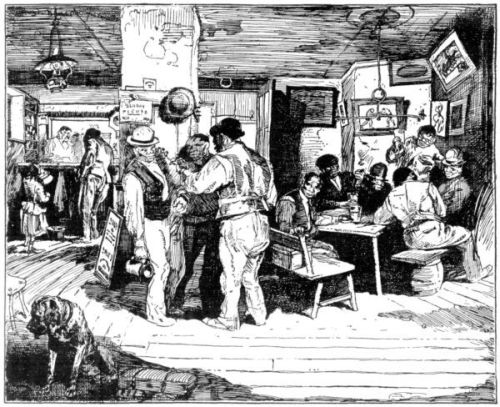
"MOST OF THE HOTEL NEGROES SPENT THIS RECESS IN AN ADJACENT DIVE"
Moss had heard of slavery, of course. He even knew that his father had been a slave. But the word conveyed little meaning to him. The war of which his father so often spoke was equally vague. The only clear thing about it was that it had ended the old times and begun the new. How vastly superior those old times had been to the new! What possible comparison could there be, for instance, between Harper Hall and Goosefoot Lane? What a fallen creature was the landlord at the Bluegrass, compared with Benjy's old master! How miserable a thing was Moss' daily fare beside the feasts to which his father habitually used to sit down!
The old man was still muttering reminiscently, and Moss was still sitting with his chin buried in his hands, when an apparition appeared at the head of the Lane. It was a lady, with a white parasol and broad-brimmed white hat, daintily lifting a fluffy, many-ruffled white skirt, and exposing a pair of white shoes and stockings. She nodded amiably at the blacks on either side as she picked her way along, and halted once for a bit of chat; but at last she bore airily down on Moss Harper's stoop, where she folded her parasol as a dove might fold its wings on reaching its ledge.
It was then, and not till then, that a stranger, unless a Southerner, would have discovered that black blood flowed in her veins—that she was, in the vernacular of the South, a "nigger"—no more so and no less so than her thick-lipped, ebon-hued husband, Moss Harper.
She paused for a last covetous glimpse of the stream of life flowing past the head of the Lane, out there in the white man's world, and then, with a careless nod at her husband, she passed through the squat doorway of the musty den—a butterfly entering a rat-hole.
Moss had not spoken,—with elemental human nature mere words count for little,—but his mind glided from Benjy's broken recital to his wife. He never thought of her as half white, for she had been suckled at a black breast; she had played with black pickaninnies; her present associates were black, like her husband; and she spoke the jargon of the blacks. He preferred, in fact, to think of her as of his own race. Yet her undeniable beauty, her fair skin and her wavy hair, were facts to be reckoned with. And beneath that fair skin and wavy hair were other things to be reckoned with—yearnings and ambitions unknown to an Ethiopian, a taste for fine clothes, a discontent with her present state and a blind groping for something better in the way of life, all handed down in her white father's blood.
It is true that the ladies for whom Estelle formerly acted as maid had pronounced her worthless—vain, frivolous, and dishonest. And they were right. She was a thief. The beautiful skirt which she had this day flaunted in the envious eyes of the wenches of Goosefoot Lane had been stolen from the laundry at which she worked three days in a week, and many a neat job of shoplifting had she done. Yet, after all, these were only mistaken means to a great End—means which, if history speaks true, were not unknown to a far-distant generation of our own race when they were groping their way out of the darkness of barbarism.
Of these means Moss, fortunately, knew nothing; for old Benjy, rigidly drilled in honesty by his mistress, had done the same for his son. But the End he saw, mistily and uncertainly, for Estelle had handed over to him a great deal of that which her father had handed down to her; and it was toward this end that he himself was now making his slow and painful way, with a Second Reader in his hand.
Estelle laid off her scented finery lingeringly and lovingly, put on a calico wrapper, and passed into the diminutive lean-to which they called a kitchen. Five minutes later she appeared at the front door, shot a searching glance up the Lane for anything of interest, and coolly announced supper. Then the man who, for eleven hours of seven days in the week, served other men with every luxury which the four quarters of the globe could supply, sat down to a meal of buttermilk, cold potatoes, and dry bread.
When Moss got home again that night, Estelle was sitting on the stoop alone, old Benjy having gone to bed with the chickens, as usual. His eyes brightened, for very often she was summoned to the laundry at night to take care of "immediate" work from the hotels, she being an expert at ironing women's fine fabrics. He sat down beside her on one of the benches which flanked the stoop, and she rested her head on his arm, as if weary.
"You done paid Fitzpatrick the rent to-day?" he finally asked.
"Yass."
"You show him that hole in the flo'?"
"Yass." She dropped her long dark lashes for an instant, and then added: "I tole him about it. He di'n' come here. I took the money to his saloom. You know, he sayed if he haved to come here again fo' that money, he th'ow us out in the alley."
"He ain' neveh tried to th'ow me yet," observed Moss quietly. "We'll th'ow ourseffs out befo' long. We ain' gwine to live in this hawg-pen all the time." He paused, and added more gently: "I don' want you to go to his saloom no mo', 'Stelle."
"I went in the side do'," she explained. "Nobody di'n' see me. An' I di'n' go no furder than the do'. But I won' go no mo' ef you don' want me to."
"I don' want you to," he repeated definitely. "I don' want him to insult you like he did me when I axed him to fix that hole what you could th'ow a bull thoo."
"Why, Mossie, you neveh tole me about that! What he say?" There was an indescribable undertone—possibly of amusement—in her velvety voice.
"He sayed he'd hoss-whip me ef I eveh come to his saloom again beggin' for repai's."
Estelle's lashes again quivered slightly, and her lips parted in the shadow of a smile—just enough to reveal the straight, faultless joint between her two rows of glistening teeth. She reached for the great black hand which rested on his knee and laid it in her lap, covering it with her own. It was as if she recognized in that member of sledge-hammer size and hardness a sure defense from all harm. Yet the light which played in her eyes, as she lazily turned her face toward his, was still half-ironical. Was it Caucasian fleering at Ethiopian—white blood mocking black?
"Moss, I'd lak to see him try to hoss-whip you." She laughed at the thought.
"You mus'n' want me to fight," he rebuked her quietly. "I don' lak to fight. I want to git where I won' never have to fight. When I gits awdained as preacher, we gwine live in the country, an' have a li'l' house with a gyahden, where dad kin potter roun' and raise us veg'tables. You won' have to wuk in no laundry then, or live in a hawg-pen lak this."
Estelle was quiet for several minutes, with her large eyes fixed reflectively on the stars.
"When you think you gwine be awdained?" she finally asked.
"Pretty soon, now; soon's I learns to read a li'l' better."
But in his heart he was not so sure. Old Benjy was of the opinion that he would at least have to go through the Third Reader to qualify for ordination, and he was only beginning the Second.
"You think you lak the country better as you do the city?" asked Estelle hesitatingly.
"Don' you?" he demanded in astonishment.
"Oh, I do," she hastened to assure him. "But I was juss wunnerin' ef you wou'n' make mo money in a big chu'ch in the city as you would in a li'l' chu'ch in the country."
"Got to take li'l' chu'ch fust," he observed astutely.
That he was still dissatisfied with her question, Estelle seemed to detect by some sixth sense, for she ran on suavely: "You know, I neveh lived in the country, lak you. Tha's why I axed you what I did. I reckon I don' know how sweet the country is. Moss, I wish we gwine the country to-mo'ow to live!" She flung her arms about his neck and let herself settle down upon his broad chest.
Tears filled the giant's eyes. "I wish you was, honey. But I cyarn take you—juss yit. Got to wait a li'l' while—juss a li'l' while."
In that moment Estelle probably meant what she said. In that moment her love for the man whose name she bore was probably uppermost in her foolish heart. In that moment her impulse toward a higher life may have carried her beyond her love of finery, and she may have been willing to give up the city and the very questionable means which it afforded for securing that finery.
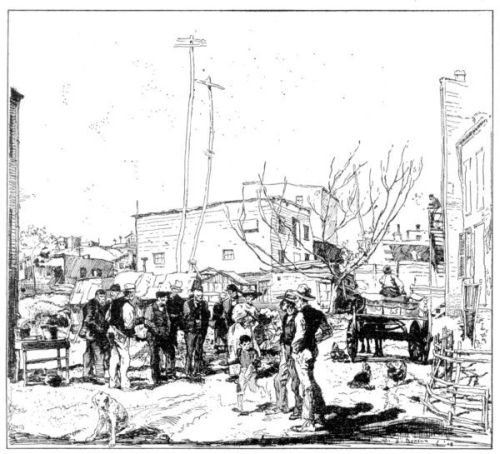
"IT WAS INTO THIS ATMOSPHERE THAT THE STUDENT TOOK HIS WAY"
II
We drift along the placid stream of Time, complaining of the monotony of the voyage, when already the murmur of rapids which are to try every muscle and thrill every nerve might be heard if we but stilled our peevish notes long enough to listen. A week after the above events a party of four ladies from central Kentucky arrived one evening at the Bluegrass. The register showed them to be mother and daughters; and their gentle manners and soft voices, added to the beauty of the girls, had put the clerk on his mettle, spurring him to an exhibition of his choicest Kentucky gallantry. He had just promised them a large, cool room on the second floor, containing two beds, and, in answer to their laughing, half-ironical request that they might be shown the Congo King, he had assured them that they should be seated at that royal scion's table.
"You certainly are entitled to the privilege," he added blandly, "for his real name is the same as yours."
"Harper?" queried the mother of the pretty trio, with some surprise.
"Yes; Moss Harper."
The four ladies exchanged quick glances.
"Why, our carriage-driver, long before the War, was an old negro named Moss. He had a son named Benjy, who ran away during the War. I don't want to impeach the genealogy of your King, but I wonder—" She stopped, as if recalling that her auditor was a stranger, then added, with a smile: "Anyhow, we must be waited on by him, now."
Moss was aware that the ladies at his table were scanning him with more interest than even his size and legendary history usually evoked, and he was not much surprised, therefore, when the eldest of them said: "Excuse me, please, but is your real name Moss Harper?"
"Yassum," he answered, halting instantly in his employment, as old Benjy had taught him to do, and dumbly waiting the lady's further pleasure.
"Do you know your father's name?"
"Yassum. Ole Benjy."
"Is he still living?"
"Yassum; livin' with me."
The lady's small white hand closed rather quickly on the table-cloth.
"Do you know what county he came from?"
"Yassum. Ole Bubbon; he done live at Hahpeh Hall." Then the lady's lighting eyes encouraged him to volunteer a word or two, contrary to his habit. "The Hahpehs all daid and gone now, though. All killed in the Wah."
One of the girls shot her sisters an amused glance, but Penelope Harper's lips quivered. In a voice which struck Moss as the sweetest he had ever heard, she continued: "I think I shall ask you to come to our room—No. 120—as soon as you are through with your duties here. I have something of interest to tell you."
To Moss, with the childish impatience of his race, it seemed as if he would never escape from the dining-room that night; for when he was on the point of leaving, at a little after nine, he was detailed to help take care of a party of a dozen or more that had just come in. It was, therefore, after ten when he gently tapped on the door of No. 120.
He had been too well bred by his father to sit down; and Mrs. Harper, not wishing to disturb his conception of propriety, though some laxity on the present occasion would have been permissible, let him stand just inside the door, with his greasy old hat clutched awkwardly between his hands and the shrunken sleeves of his butternut suit exposing four or five inches of muscular black wrist.
"In the first place, Moss," she began, after ascertaining a little more of his history, "I want to tell you that the Harpers are not all dead. I am a Harper myself. I am the Miss Pen that old Benjy must have often told you about."
"Not Miss Pen!" exclaimed Moss, with starting eyes, as if beholding an apparition. "Not the one that mah'd Marse Willie Hahpeh?"
"The very same," she assured him, smiling. "And these are my daughters. But Marse Willie is dead; he died a long time ago, during the War."
Verily, it was as if some magician had rung up the curtain on the past—that beautiful past of which his father had told him so much. He listened to Mrs. Harper's story in something like a trance, with his blue-black eyes half lost in reverie. And, thus forgetting himself, his awkwardness passed; his hands fell naturally by his side, his chest came out, his head rose, and he stood before the ladies in all the splendor of physique which Nature had invested him with.
"Now, Moss," Mrs. Harper concluded, "no Harper could ever neglect a descendant of our faithful old Moss, even though his son did run away during the War. We want to take care of you and Benjy. We'll give him a cabin by himself, and we'll give you and your wife another cabin. As fast as you learn the plantation work, you shall be advanced. With your strength and intelligence, I am sure that you can soon be earning good wages, and you will be much happier and better off than you are here. To-morrow afternoon, when you are at home, we'll drive out to see old Benjy, as he is probably too feeble to come here, and you can then tell us what you have decided to do. Meanwhile, to relieve any immediate needs, accept this." And she handed him a ten-dollar bill.
Just how he expressed his thanks, or how he got out of the room, Moss never clearly recalled, for his brain was whirling. But when he found himself in the street, with the cool
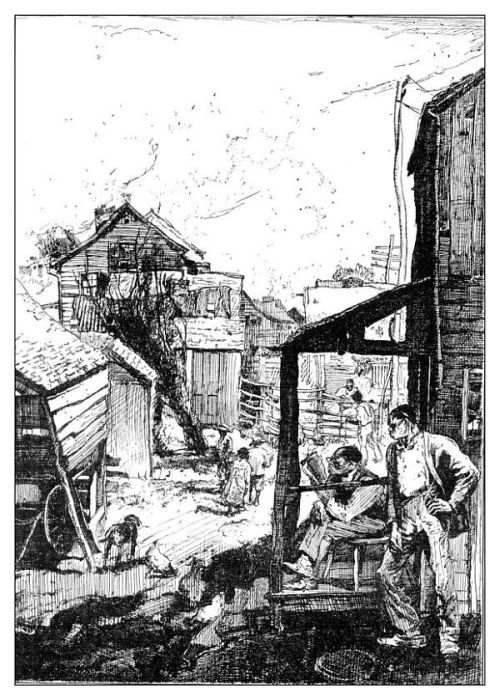
"HEAH'S AN OLE DEVIL I USED TO WRASTLE WITH,' HE EXCLAIMED SHRILLY"
evening air on his heated brow, he started for home on a run. It was a rather dangerous thing for a black man to do, too, at that hour of the night, in a Southern city, since a policeman was likely to stop him with a tap on the head from a "billy."
But the first thing that stopped Moss was the glowing front of a pawnshop, near the head of Goosefoot Lane. In the window was a brooch which Estelle had paused to gaze at, with covetous eyes, every day for weeks. Moss had looked at it himself a good many times, dreaming rather than hoping to carry it home some day as a surprise for Estelle. Now he had the money, and, without a thought of the prodigality of his course, he entered the shop.
His heavy breathing did not escape the sharp eyes of the Hebrew proprietor, who would not have been at all surprised to see a pursuing policeman heave in sight. But when Moss showed his bill and asked for the brooch, the pawnbroker quickly went forward for the article, and, after taking into consideration his customer's evident hurry, he set a price of five dollars on it. Estelle would have got it for half that sum, but Moss paid the price without a murmur, and then sped on down the Lane, leaving the Hebrew well pleased with the transaction and fully convinced that his customer was a thief.
Estelle was not at home, to Moss' keen disappointment, and, though he took it that she was at the laundry, he woke his father to make sure. Old Benjy, as torpid as a woodchuck in January, was not easily roused; but Moss' repeated shouts and by no means gentle thumps finally brought him to his elbow, blinking dazedly.
"Daddy, Miss Pen's alive! She's at the hotel, and she's foun' us out, and gwine to teck us all back to Hahpeh Hall!"
Old Benjy continued to blink silently, and was evidently of the opinion that he had been dreaming. But when Moss had repeated the news twice or thrice, and the facts had finally filtered through Benjy's thick skull, he let out a yelp that would have shamed a coyote.
"Halleluyer! Halleluyer! Glory to Gawd! Bress de Lam'! Bress de Lam'!"
Moss, after confirming his supposition as to Estelle's whereabouts, did not wait for the broadside of questions which his father was sure to fire at him, but ran out to the stoop. Should he wait for her? Should he pin the brooch on her night-dress, and then, when she discovered it, overwhelm her with the good news? That would be fine, but it was far too severe a tax upon his patience. The next moment he was on the wing again.
No negroes were allowed to enter the laundry by the front door, or, indeed, by any door, unless employed about the place. But Moss stole in through the engine-room at the rear, and managed to make his way as far as the ironing-machines without challenge. Estelle was nowhere in sight, however; and, raising his voice above the clatter, he inquired as to where she was of a mulatto girl whom he had often seen with his wife.
"She done gone to git some medicine fur a haidache," answered the girl.
"How long 'go?"
"Juss li'l' while—not ten minutes."
At this, a wrinkled old negress, who had bent her head forward to catch the colloquy, showed her half-dozen yellow teeth in an evil grin.
"Sonny," she volunteered maliciously, "she been gone two hou's by the clock. The medicine that gull gwine arfter don' come fum no drug-sto'."
Moss had no time for further parley, for the threatening voice of the foreman warned him to depart without loss of time, and he glided swiftly out again; but in the starlight outside he paused, with the mist from the exhaust-pipe drifting into his upturned face.
Some of the joy had gone out of his eyes. Did the old woman mean that Estelle drank? Once or twice, recently, he thought he had detected liquor on her breath, but he had immediately dismissed the suspicion. Drinking, of course, was no heinous offense in his eyes; he daily saw too many white women drinking to hold such an opinion as that. Nevertheless, he himself had forgone liquor for years—old Benjy had preached him many a temperance sermon; and Estelle had allowed him to believe that she, too, never drank.
But now that the accursed maggot of doubt was in his brain, he could not cast it out, and its foul progeny multiplied thick and fast. With feverish haste he made the round of all the drug-stores in the vicinity; but Estelle was not to be seen. Twice he returned to the cabin; but the measured snoring of old Benjy, who had swallowed the good news as a child would a sugar-plum, and then calmly fallen asleep again, was the only sound that greeted his ears.
How quiet the cabin was! A chill solitude already seemed brooding over it, and the familiar objects of the room had taken on a strange appearance. With an unnamed, unnamable fear compressing his heart and making breathing difficult, he took his way back to the head of the Lane. After standing there a moment, straining his eyes in either direction, he began to wander slowly and a little wearily up and down the avenue, scrutinizing every woman who came within his range of vision.
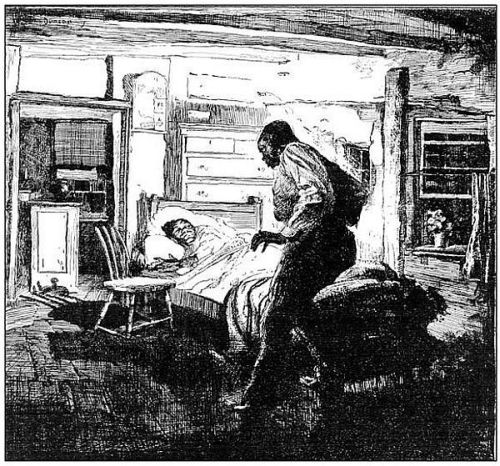
"OLD BENJY CONTINUED TO BLINK SILENTLY"
He finally found himself, by mere chance, in front of his landlord's saloon. A passing thought brought his leaden feet to a stand-still. If Estelle should have gone out for a drink, and had had no money,—as he believed to be the case,—would she not have come to Fitzpatrick's? It would have been the last place to which he would have gone to ask credit for a drink, for, in the first place, no negroes were allowed to drink at Fitzpatrick's bar; in the second place, Fitzpatrick was no friend of his. Yet Estelle had gone there once with the rent! Maybe she had gone more than once; maybe——
A sound in the gloomy hallway along one side of the saloon suddenly made his steady-going heart give one great bound. It was Estelle's voice in silly, tipsy laughter, followed by a profane admonition, in a masculine voice, to keep still. Next came the cautious closing of a door and guarded footsteps. As rigid as iron, with his great fists clenched and his nostrils spread like an angry bull's, Moss waited for the pair to appear. But, instead of coming nearer, their footsteps receded until he heard them ascending the stairs at the other end of the hall; then they ceased.
One—two—three—four—five minutes Moss stood there, seeing nothing, hearing nothing, a film over his eyes, a noise like rushing waters in his ears. His sensations were very similar to those he had felt when a careless carpenter had once dropped an oak two-by-four on his head from the second story of a building; and now, as then, he automatically raised his hand to his scalp.
But at last he came out of the curious obsession; he saw the twinkling arc-lights, heard the humming of the trolley-cars, and was conscious of people passing to and fro. With a strange smile, he took the packet containing the brooch from his pocket, slowly unwrapped it, and dropped the trinket to the sidewalk, after which he ground it under his heel. Then he crossed the street to a negro saloon—that is, a saloon for negroes, run by a white man. He poured himself a big drink. The villainous liquor trickled pleasantly through his interior, and he immediately ordered a second drink—then a third—then a fourth. This time the bartender, after an uneasy glance at the herculean shoulders and muddy eyes of his patron, substituted a weaker mixture for the fiery stuff he had been setting out. He also shifted a revolver beneath the bar into a slightly handier position.
But Moss walked quietly out and recrossed the street, with no hint of unsteadiness in his gait, in spite of his unusual potations. He softly entered Fitzpatrick's hallway, and in the dark recess behind the stairs he took his stand—a silent, grim, fearsome statue of obsidian hue and almost heroic size.
He waited for what seemed hours; but, queerly enough, he was not impatient, nor was he in the least excited. Occasionally a policeman sauntered past the entrance; at intervals a trolley-car thundered by; the bartender of the saloon slammed and locked the back door. Finally, a tower clock began to boom out the hour, and Moss, in the absence of anything else to do, counted the strokes.
Only twelve! He would have guessed that it was at least two o'clock. Then, having counted to twelve without much effort, he began to count his fingers over and over, to see how far he could go. At thirty-nine, being a little uncertain of the next number, he paused. During the pause he heard the swish of a skirt in the hall above. They were coming!
A woman's agonized shriek, a man's curse, a chance shot into the dark from his ever-ready revolver, a scuffle,—a very brief scuffle,—and then all was as still as before. Estelle had told her last lie; Fitzpatrick had dispensed his last drink.
Moss walked forward to the doorway, waited quietly until an officer who had heard the report of the revolver came running up, and then surrendered himself.
"I done kill 'em," he explained laconically.
Ten minutes later, in heavy manacles, he stepped down from the police ambulance at the entrance to the jail—a huge brick building, covering an entire block, with its barred windows rising story on story, a somber architectural jest at Civilization.
Some two months later, the governor of Kentucky was standing with his hands in his pockets at the window of his office, in the quaint capitol building at Frankfort, and gazing idly at the tablet in the sidewalk which marks the spot where William Goebel fell, the victim of an assassin's ball. He turned, at the rustle of a lady's skirts.
"Why, Pen! What angel sent you?" he exclaimed, pushing forward his easiest chair. "Pen, do you know you're just in time to save the gov'neh of Kentucky from a spell of the blues? It's a fact. I read a book last night, by a man named Buckle, about civilization and that sawt of thing, and the pesky thoughts stick to me like a nightmare. I was standin' by that window theh, just reviewin' the events which have taken place in our deah old State in the past quarter of a century, and I was askin' myself which way we were headed—up or down."
"Up, surely," answered Mrs. Harper. She looked at him with that candor and seriousness which is permitted only between old friends, and then continued: "Wilbur, I have a problem, too, and I want you to help me solve it. I want you to pardon a negro who was convicted last June in Louisville of a double murder, and who is now here in the penitentiary. He is the son of that Benjy of ours that ran off during the War, and the grandson of our old Moss. You remember them both. I never knew either of them to be guilty of a vicious act, and this boy—he's only twenty-five—killed his wife and the white man who had debauched her."
The governor sat playing with his pen-knife for some time after she had finished her story.
"I wish this Moss of yours had killed only the man, Pen," he observed. "That's what a white man would have done, and everybody would have applauded. But, then, a niggeh ain't a white man—never will be a white man. Pen, being gov'neh is a terribly responsible job. Now, you, for instance, ask me, one man, to set aside the findings of twelve men appointed by the people to determine this niggeh's guilt. Yet the pahdoning power was certainly given me for a purpose, and I intend to use it when I see fit. I'll take your word for it, Pen, that Moss is a good niggeh; I'll look into his case, and if you are not mistaken as to the facts, and will take him out to the Hall and keep him theh, I'll pahdon him. But I can't do it right away. In the fust place, a little punishment will do him good. In the second place, theh's politics. Politics, Pen! To pahdon that niggeh now, my dear Pen, while the events are still so fresh, would make an awful row. The press would froth at the mouth. But in a year, mind you, or eighteen months at the most, I'll turn him loose."
"Oh, Wilbur, a year is such a long time!" exclaimed Mrs. Harper plaintively.
"Is it, Pen,—to you—at fifty-five?" he asked whimsically.
"Alas, no, not to me! I'm not in a cell. But I understand your position, Wilbur, and I'll submit to the inevitable. It is so much better than it might have been, and I am very, very grateful. But can I not intimate the good news to him, just to keep up his courage?"
"If you do it very diplomatically, Pen, and do not mention me."
Then, after she had left, he sat chuckling in his chair at the idea of asking a woman to be diplomatic under such circumstances.
The warden, after reading the Governor's note, turned to a guard. "Put a coat on 1610 and bring him to the reception-room."
"If you please," interposed Mrs. Harper, "I should like to see him just as he is, at his work."
She followed her conductor through the stifling prison-yard, cut off by the encircling hills from every current of air. On the hill-side, where the convicts were breaking stone, it seemed even hotter, the oven-like breath of the dog-day sun rebounding into one's face in almost palpable pulsations. Moss was one of a gang of fifty. He was naked to the waist, and his broad, sweaty back glistened in the sunlight like the skin of a porpoise; yet, in spite of the heat, his sledge rose and fell with the regularity of machinery.
"Has he given you any trouble?" asked Mrs. Harper of the guard.
"No'm. He ain't that kind. He's the kind that gits gloomy and either dies or goes nutty. But after a year or two we'll probably make a trusty of him, and then he'll be happier. Murderers generally make the best trusties."
When Mrs. Harper, after going forward a few steps alone, with a quickened pulse, spoke his name, Moss' sledge hung in mid-air, and he hearkened without looking up, as if doubting his ears. It was not until she repeated his name that he turned toward her. His face was neither bitter nor vindictive, but dull, oh, unutterably dull, as if he had said farewell forever to hope. He did not speak—to speak was against the rules. He did not even smile, but simply touched the brim of his wool hat.
Mrs. Harper, with a catch in her breath, stepped still nearer.
"Moss, I remain your friend," she began tremulously. "Benjy is with us, and we are taking the best care of him. And, listen, Moss! This is what I came to tell you. I am authorized to say, positively, by a power that is supreme, that, if your behavior is good, your detention here will not be more than eighteen months, and I hope only twelve. You can stand the work that long, can't you, knowing that we are waiting for you, ready to give you a home?"
Still his expression did not change, and still he did not speak.
"Don't you—don't you understand, Moss?" she asked, with quivering lips, fearful that his mind had already been shocked.
His slow words then came:
"Yassum, I kin stan' it. I could stan' it foreveh. But she's daid," he cried hoarsely. "I kill her—I choke her—with that han'!" thrusting out the member. "The same han' she used to put her li'l' han's roun' and hole so tight—same han' I used to pat her cheek with—same han'—" A shudder passed over his huge form until his teeth chattered.
"Oh, I know it's hard!" exclaimed the tender woman, suffering only less than he. "You have sinned, and you must do penance. But we've all sinned, and all done penance, and yet happiness comes again. Believe me, Moss, some day you'll be happy again. Be brave, and one month from to-day I'll be here to see you again. Meanwhile, can I do anything for you—take any word to Benjy?"
His lusterless eyes seemed to brighten a little.
"Mis' Pen, will you sot up a li'l' tombstone on her grave? Juss a li'l' one, so I kin fine it some day, when I gits out?"
And Penelope, with blinding eyes, promised.