AN AMERICAN MASTER OF LANDSCAPE BY T. M. CLELAND
Reading edition
A striking reversal of attitude may be noticed to-day toward innovations in the field of art. Time was, we are told by the biographers of the Old Masters, when the painter who dared to step beyond the pale of conventions current in his day, suffered the neglect and bitter scorn of his contemporaries. From the earliest period of artistic endeavor, the innovator has been on the defensive; whereas the cardinal sin in the modern artist is rather the failure to innovate or to startle us by some new form of disregard for the principles established by tradition. In the place of knowledge and patient scholarship, we find sophistication and a restless, conscious craving to produce an effect sufficiently startling to command the instant attention of a busy world. In the art of landscape painting particularly this desire to be effective at any cost has led many of the younger generation of artists to adopt for themselves hastily formed theories regarding the phenomena of light and air and to devote their lives to these, forgetting all else.
The result of all this is a modern school of landscape, the aims of which seem strangely more allied to scientific investigation than to artistic study, and a class of pictures which expound, frequently with great skill, the theories upon which they are accomplished; but which are rarely intelligible to any one not directly concerned with the study of art.
So it is with some sense of relief that we may turn our attention upon the achievements of an artist like Thomas R. Manley, whose drawings are reproduced here, not that they may be the subject of a written discourse, but that of themselves they may give pleasure to a wider public than it has hitherto been their fortune to command. They are the product of a quiet and orderly development carried on outside the clamor of the modern movement, simple masterpieces of landscape drawing as it has been practised since the days of Claude Lorrain. They present no "theory" upon which we may base a philosophical discussion, and there is nothing "new" about them at all beyond a simple technical invention of the artist's, whereby his line is rendered more soft and pliable than by the ordinary mediums of crayon or pencil.
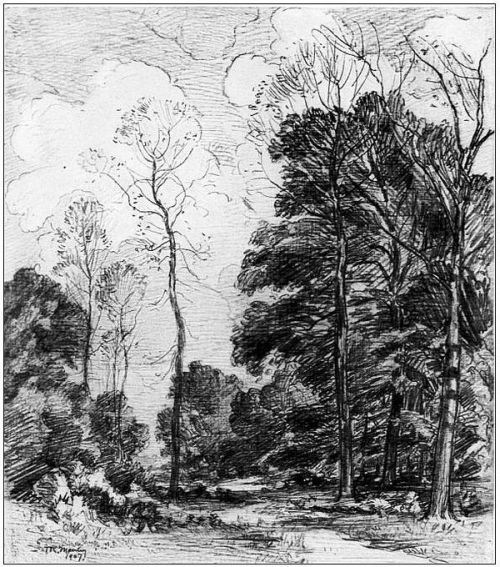
What they do possess, however, and to a high degree, is the evidence of a mastery of the technique of design plus a finely trained intelligence and feeling. This technical mastery of design is perhaps the rarest of accomplishments at the present day, because it is the most difficult to acquire and makes too great a demand upon patience. And yet it is this which should and does satisfy most directly the unconscious esthetic sense in us all; for who cannot experience some inward pleasure in the form and movement of the hills and trees as they are expressed to us in these drawings? It is not essential to our enjoyment of these things that we should ourselves have knowledge of the technical means whereby they are conveyed; but it is these studied accomplishments which we are enjoying nevertheless; because through them our own sense of harmony is aroused. Let us note, for instance, the character of the lines used to represent the foliage in the first drawing reproduced, and see with what beautiful, rhythmic precision they produce at one and the same time the required tone and the movement of the thing represented. And again, in the trunks of the trees how fully the firm lines record the upward growth and the vicissitudes of weather suffered in their struggles to attain the majestic heights to which they rise. This method of drawing, in which light and shade is produced by lines which at the same time follow the form and movement of the objects represented, is perhaps the oldest and most conventional; but in the hands of a master like Mr. Manley it is more fully expressive and beautiful in its results than any other.
If to dwell upon points as technical as this seems a contradiction to the statement already made, to the effect that these reproductions are presented for what pleasure they may give the layman, it should be said that it is for the reason that such technicalities as are pointed out may well be within the understanding of all intelligent persons and that their elucidation may assist greatly toward a fuller appreciation of the more intellectual merits. And if we fail to consider sufficiently here those more poetic qualities and to attempt some description of the meanings and sensations conveyed to us by the pictures themselves, it will be because it seems that these are matters best left to the individual observer.
This is what might be called the "literary" side of pictures, and one upon which art criticism has come too largely to dwell. If, on the other hand, the discussion of pictures were content to confine itself to the pointing out of what constitutes the "art" of the work, might we not derive each for himself a more intimate pleasure in undisturbed enjoyment of those intellectual conceptions, which, though produced by the same picture, are, in no two of us, precisely alike?
There are represented in the four drawings here selected (from a collection so interesting that any selection at all was difficult) several phases of the artist's ability, each so well demonstrated that it is scarcely possible to choose between them. This versatility of mood is a noteworthy evidence in itself of the well grounded mastery of the artist and of his ability to deal with nature at all points. It is, in other words, no mere trick or specialty which he has learned as one might pick out note for note and learn by heart a tune upon the piano; but the work of a hand and eye and mind turned in perfect accord, like a single instrument capable of an infinite range of expression.
In the first of the drawings, that of the piece of woodland through which a path winds off to where it is lost to view among the trees, carrying our imagination with it to the contemplation of scenes still farther on, we find virtues of a more uncommon type than in the others. The large nobility—the monumental quality—is an aspect of nature wholly out of fashion in our day. The firm bed of earth we can feel under our feet with a sense that it is good to stand upon, and the fine pattern of trees and clouds swayed in common movement stirs one with that martial sense of activity, that vitality of impulse which recalls the memory of some high-winded, keen-aired autumn day. We have considered already the spirited and skilful drawing of the trees in this picture; but it is difficult to turn from it without again noting some of those qualities of line which are particularly well displayed in these parts of the composition. To render those long, bare, sinuous stems, growing upward with their roots unmistakably planted in the ground and not so that they have the appearance of hanging down from the clouds, is a feat of no small difficulty, to judge from the frequent instances one meets with of failure in this regard. This well established feeling of the growth from the ground upward of the trunks of the trees and the springing from the branches outward of the foliage, this complete and harmonious development of the whole structure from the seed, as it were, is the product of an exhaustive study, in all of its stages, of the life and characteristics of the tree itself.
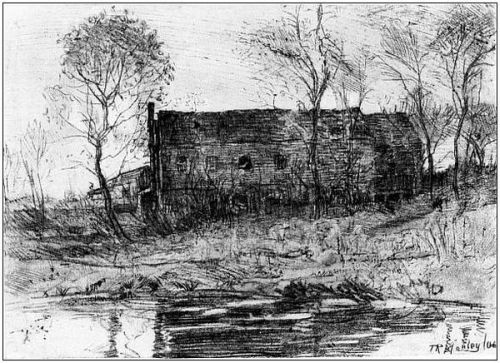
We are confronted in the second drawing with a striking contrast to the first, in that the merits of vigorous and harmoniously balanced line and form are supplanted by the more tender effects of atmosphere, and the vigorous stroke becomes gentle in its handling of the delicate trees worn by the winds and but half seen through the uncertain twilight. Here, perhaps, the man is more in evidence than the draftsman, and the sensitive and sympathetic spirit of the artist seems abstracted for a time from the more tangible qualities which are the chief glory of the former work. But like the first drawing it possesses a carefully built up unity of sentiment and notes no point in the scene not concerned with the impression of loneliness and neglect it seems intended to convey.
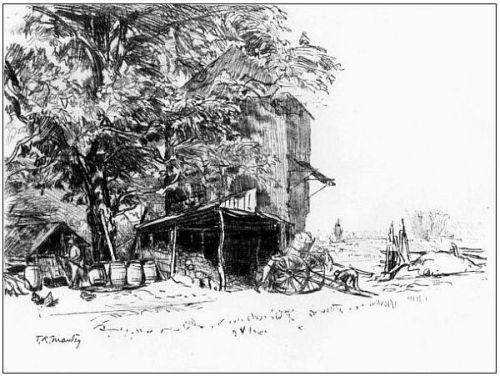
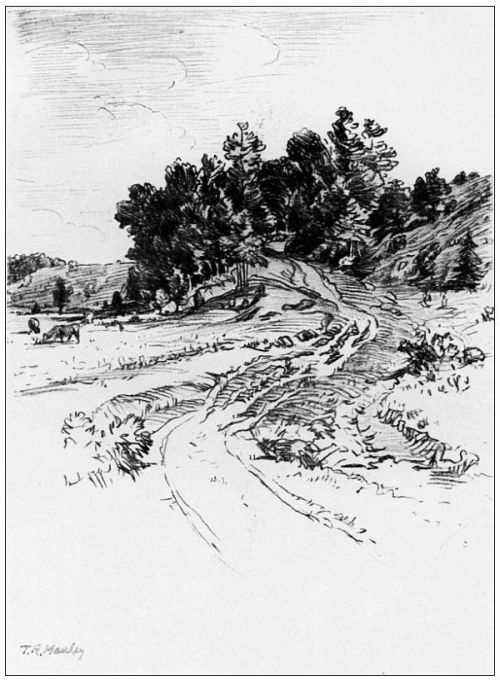
The third and fourth drawings are more remarkable for skilled and accomplished draftsmanship than for the expression of any distinctive feature in the varying moods of nature. Our delight in them comes more from the beautiful precision of aim whereby a single stroke is made to record a number of interesting facts at the same time. In the drawing of the barn and shed over-topped by a rugged tree and with a middle ground filled by lively detail, we are reminded of the great masters of etching in the clever abbreviation of each of those details and the manner in which they are grouped or merged one into the other. And then, in the last one, note the contour of the earth, how well it is rendered by that cleverly foreshortened winding line of half obliterated roadway leading up the hill and into the fresh mass of foliage which crowns it. This ability to draw the solid ground so that it appears solid is a rare gift in any draftsman, and it may well be taken as an evidence of the fullness of his talent and training.
Like Constable, Mr. Manley has been content to draw his inspiration from the small section of the world in which circumstances have placed him, the quiet New Jersey country where Inness worked out for himself the distinguished place his name holds among American landscape painters. These drawings by no means represent the full range of Mr. Manley's activities, for he has won high esteem as a painter and an etcher and holds a position of importance as a miniaturist; but they are, perhaps, the things in which his rarest talents are displayed, as they are also the closest to his own pleasure in his art. They are the pastimes of an uncommonly sincere and scholarly master who shows integrity in play as well as in work, and who has carried on his career with an earnestness and a humility and modesty of character which all but deprived us of any sight of his achievements at all.