SOME PROFESSIONAL ADVENTURES OF KARL HAGENBECK. By Raymond Blathwayt.
Reading edition
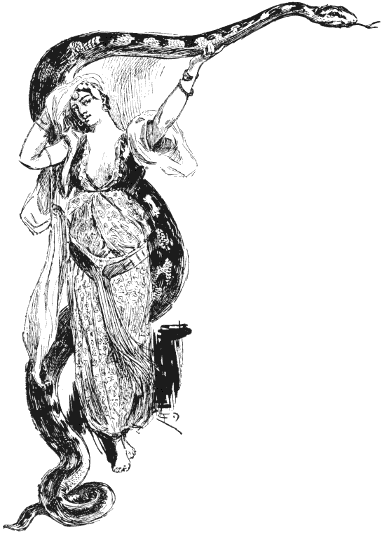
As Karl Hagenbeck stood with me, in his Hamburg Wild Beast Emporium, before the great cage of the boa constrictors and pythons, he naturally fell to relating some of the curious adventures that have befallen him with snakes and other brutes.
There was a great ugly looking boa constrictor coiled up in a corner by itself, a most repulsive looking animal.
“He’s a beauty, isn’t he?” said Mr. Hagenbeck, looking fondly on him. “He swallowed four whole sheep in one day, and only nine days after that he got another, and seemed to enjoy it as much as if he had been fasting for months. Come and look at this cage, where you can see a revengeful member of the species. He once had a companion, but now he’s alone through his own fault. He and his companion were peculiarly fond of rabbits, and we threw one into their cage one day. They both darted for it, and, while the poor little shivering animal crept into a corner in a fright, the snakes quarrelled as to whose ‘bonne bouche’ the rabbit was to be. The smaller one won, and this great wretch retired to a corner and watched his foe devour the rabbit, and then lie down in that state of repleteness which it is the highest ambition of these great snakes to attain. The big fellow then, seeing his rival’s helpless condition, roused himself, and a moment afterwards he vigorously attacked the creature that lay gorged in the corner. We all rushed to see what would happen, and I declare to you, that in a very short time the big snake had swallowed the small snake, rabbit and all.”
“Would you like to see them in action?” said Mr. Hagenbeck to me, and, as he spoke, he opened a cage door and boldly stepped in amongst a number of big sleepy reptiles. He coolly began lifting them up by their enormous coils, just as one would lift up great coils of rope, and there was soon a mighty stirring amongst the previously inert masses. They writhed to and fro, their scales glittering in the pale light of the winter sun, and with a great hissing, an irritated rearing back of their heads and a constant projection of their long forked tongues, they began to move about the cage—a hideous, mixed-up mass of repulsive life, that made one involuntarily step back from their bars.
“You don’t like the look of them,” said Mr. Hagenbeck, with a smile, as he stepped out and rejoined me. “They are queer fellows, certainly, and gave me a big fright once.”
“I should have imagined more than once,” I said, as we turned from the ugly mass of twisted snakes.
“Well, perhaps,” said Mr. Hagenbeck, “but this particular once was something to remember. In one cage I had eight full-grown pythons, which I wanted to put into one huge box to send them off to a menagerie. I handled the first six all right enough, catching them, as is usual, by the back of the neck and dropping them into the box. Then I went for number seven, but as soon as I entered the cage she, the lady of the flock, flew at me with open mouth. Seeing her coming I took off my hat and thrust it at her. She bit her teeth into it. I then seized her with the right hand at the back of her neck, and I dragged her down into the lower partition of the cage. Just when I was going to fetch her out she reared her head to attack me again. I then made a cautious movement forward, and at the same moment she darted her head at me. I met the second attack with my hat in the same way that I had the first. With a quick dart I grabbed her by the back of the neck, only to find, to my horror, that I couldn’t let her go if I wanted to, as she had coiled herself firmly round my legs. One of my assistants, standing near, heard me yell, and he came rushing up to me with all the speed he could, for I fancy my shout told everybody within hearing that I had to do with a matter of life and death. I managed, however, to retain my nerve, and gave the order to the helper to try and uncoil the serpent, which with great difficulty and my assistance he at last managed to do.”
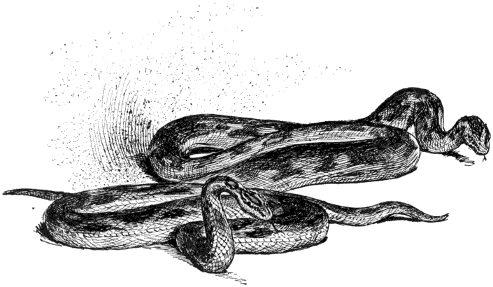
Mr. Hagenbeck laughed a little as he recalled the experience, but I confess I didn’t feel like laughing much. The horror of having those massive coils pressing tightly on your legs and bruising your muscles with irresistible strength seemed very real to me.
“I wasn’t done even then,” Mr. Hagenbeck resumed, “for just as I thought that I could get the big snake safely in the cage, another python, and really an enormous fellow, attacked me. I had just time to shout to my man to throw a blanket over it, and this he luckily managed to do. At the same moment I moved backwards out of the cage and got free of it altogether, and then I had a little rest. My men tried to dissuade me from going back, each of them saying he would do it. I felt very exhausted, but my temper was fairly up, and I determined I wouldn’t be beaten. So, after a few moments, I stepped again into the cage, caught them both round the backs of their necks, dragged them as quickly as I could to the edge of the cage, and then, all helping, we flung them into the box waiting for them. Had not my assistant been near me, nothing could have saved me from being squeezed to death.”
The wild-beast tamer then motioned me away from the serpent cages, and we went to those of their cousins, the crocodiles and alligators. We passed by an aviary of very great size, where parrots and other beautifully plumed birds chattered, laughed, quarrelled, and made love in a long, ear-piercing enjoyment of their captivity; and further on we came to a large tank, in which were slowly paddling round some spiteful-looking alligators—huge-jawed, soulless-eyed, each one a waiting, watching destroyer of life.
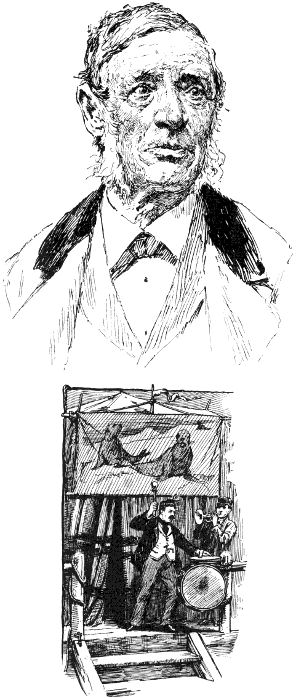
KARL HAGENBECK’S FATHER AND HIS FIRST SHOW IN BERLIN.
We looked at them for a little while, and then Mr. Hagenbeck said: “Once I had to pack sixteen of these fellows up for the Düsseldorf Zoölogical Gardens. I grappled hold of the first one and was pulling him ashore, when he gave me a frightful blow with his tail and knocked me into the tank, where, for a brief moment, I was alone with fifteen alligators. Those who were standing by told me that as soon as I splashed in a number of them made a rush, but I was out again like an India-rubber ball. The swirl of the water and the open jaws of the disappointed beasts told me that I had not been one second too smart. This was a very narrow escape, as, if one of the crocodiles had happened to get hold of me, all the rest would have attacked me, snapping and biting at me at one and the same moment, until there would have been little, if anything, left of me at all. They are the most determined fighters even amongst themselves. Six of them, each about fourteen feet long, had a fight amongst themselves once, and so desperately did they set to, that within fourteen days they were all dead. Three of them had their jaws broken, and in some cases their legs were torn right out of their bodies. This occurred at night, and one of the keepers, happening to hear the frightful noise which was made by the clashing of their jaws, rushed off to tell me what was happening. We lit our lanterns and hurried to the scene of action, but, beyond trying to separate them with long poles, it was little we could do. When we managed to part them for a time they only renewed the fight with greater fierceness than ever, and so terribly were they wounded, that, as I said, they were all dead in a fortnight. Nowadays, when I get a new consignment of alligators I always muzzle them for four days with a rope. They then calm down, and I cut the rope off; otherwise, if I did not do that they would begin fighting as soon as they came out of the box, for the first sight of day-light after the long journey always seems to excite them. A fight amongst the snakes, also, is a terrible thing. I had once five big pythons in one cage. One of the keepers flung a dead rabbit amongst them, and two of them, being very hungry, attacked it at once. At the same moment the other four flew for the prey, and in one moment all the six were in one big writhing lump. The keepers fetched me, and I at once attempted to uncoil them. I succeeded, but hardly had I done so when the fight began again between the first two. The larger one threw his tail round the small one’s neck and squeezed it with such force against the wall that it lost all power. Then the bigger snake got hold of the rabbit and swallowed it, after which it gradually loosened its hold of the smaller snake. The little one then sought revenge, and flew at the big python, which was rendered almost helpless by its huge meal, bit it in the back, coiled round and round it, and squeezed it till it could hardly breathe, although it screamed as I had never heard any living creature scream before. The funny thing was that when I went to see them next morning they were all right and perfectly good friends.
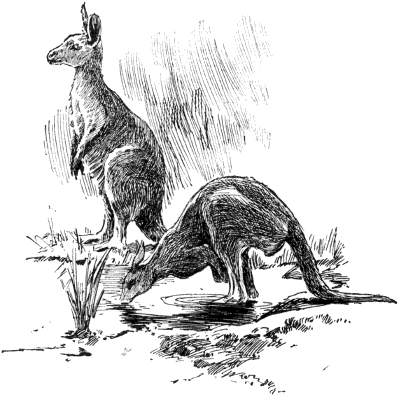
“Talking of fights, I was once turned out of bed at one o’clock in the morning by one of my keepers, who came in with the news that the big kangaroo had jumped a six-foot fence into the next stable, in which there was a large hippopotamus. When I came down there was the queerest kind of a duel going on. The kangaroo stood up to his belly in water, whilst the hippopotamus, with wide-open jaws, snapped at him right and left. However, the kangaroo managed to ‘get in’ a good right and left with his front legs, and scratched the hippopotamus in the face tremendously. When the amphibian came to close quarters, the kangaroo jumped up, gave him a tremendous blow with his hind legs, and then managed to get on to dry land. I caught the kangaroo with a big net, and after all the fighting there wasn’t so very much harm done.”
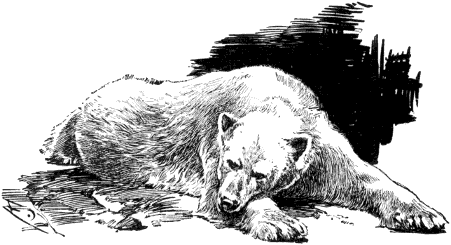
Just as Mr. Hagenbeck finished talking, the Polar bear at our rear began growling. Mr. Hagenbeck went up to soothe and pet him. Then he said:
“I expect I am pretty well the only man in the world who can say that he ever cut the toe nails of a Polar bear. It was this very beast, and I will tell you how it all happened. The poor beast’s nails had grown into its foot, causing it a great deal of pain. We tried to get the feet into a sling and pull them through the bars, but this proved to be too awkward an arrangement. So I got him into a narrow cage which had an iron barred front, and this I turned upside down so that the bear had to stand on the bars of the cage, which we lifted up about four feet above the ground. I went underneath with a sharp pair of pincers, and, as he stood there with his toes pressed through the bars, I managed to pull the nails out. Then I stood him in water to wash and cool his wounds, and in a few days he was all right. On yet another occasion a royal Bengal tiger was suffering very much from toothache, so two of my men held him by the collar and, whilst one of my attendants opened his mouth, my brother-in-law and I took some pincers and pulled out the teeth which had been giving him so much pain, and which, indeed, had grown so badly that they had hindered him from biting his food properly.
“The most risky thing, however, that ever occurred to me happened in Munich during the Centennial Fête in 1888. I was passing in the long procession with eight elephants, and the streets were very much crammed. It chanced that we had to pass a great big iron dragon, which, by some mechanical contrivance, began to spit fire as soon as we got near it. Four of the elephants at once took fright and ran away, which was only natural, and the other four followed suit. The people rushed after them with sticks and loud cries, which of course only made matters worse. I managed to get between two of them, and caught hold of them, but it was of no use, as they ran with me for at least a mile. I was badly hurled from side to side and, indeed, at one moment I was very nearly crushed to death by them against the walls of a house. At last two other elephants came up, and I managed to persuade the lot of them to stand still; just as I had done so the stupid crowd again came rushing up, and away the elephants went again. I was too tired to do anything more. All four of them rushed into a house; the bottom gave way and the excited creatures fell into the cellar. A new house has now been built there which is called to this day ‘The four wild elephants.’ A lot of people were hurt, some indeed were killed, but, as the Police President had seen all that had happened, I was held free of blame. That was, however, the worst trouble with my captive friends I ever have had, and how I escaped being crushed to death then I cannot understand to this day.”
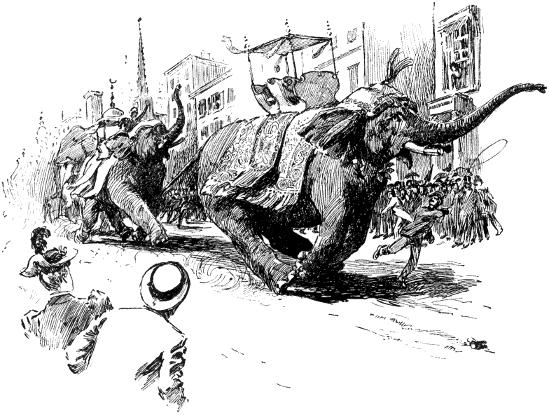
THE SCRAMBLE IN MUNICH.