MRS. GLADSTONE AND HER GOOD WORKS. By Mary G. Burnett.
Reading edition
The mistress of Hawarden Castle is something more than the devoted wife of the great statesman who sways the destinies of Great Britain. She has a notable personality of her own, worthy in its energy and sagacity of him with whom her life is linked. While the husband’s career has always been interwoven with the highest affairs of state, the wife has shown her genius for administration by the charitable enterprises in which she has taken so active a part. Most things come about naturally as the effect of growth; and it is interesting to go back to the childhood of Mrs. Gladstone to trace the influences which directed her mind to deeds of beneficence. Things have changed since Mrs. Gladstone was a little girl, living with her sister and brothers at Hawarden Castle, nearly eighty years ago.
Mrs. Gladstone’s father, Sir Stephen Glynne, died young, when his eldest daughter Catherine (Mrs. Gladstone) was scarcely five years old. Tradition remembers him as a very handsome, lively-minded man, and it is said that Catherine Glynne grew up very like her father. One of Mrs. Gladstone’s first vivid impressions is of the fright she got by seeing the “mutes,” then the fashion at important funerals, standing about the castle while her dead father lay in state. It gave her a life-long horror of elaborate and expensive funerals. Her father was succeeded in the baronetcy and estates by his eldest son, Stephen Richard, then but a little boy of eight. Lady Glynne, a daughter of Lord Brabrooke, was left with the sole charge of the property and the children. She was a beautiful woman of strong character. Fortunately about this time her brother, the Honorable George Neville, came to be rector of Hawarden parish. The castle and rectory were within a quarter hour’s walk of each other, and it was a precious boon for Lady Glynne to have her brother’s judicious help in the management of the large estates, and in the education of her two boys and her two girls.
This was about the year 1813. At that date Hawarden, in common with a village in Cheshire, had the deserved reputation of being the most wicked place in all the country round. Mr. Neville, with Lady Glynne’s consent, closed the worst of the public houses, and inaugurated a system of education for the parish, setting up schools in Hawarden village and in the districts round.
MRS. GLADSTONE’S EARLY TRAINING.
It was a serious problem at the outset to obtain either teachers or scholars. It was necessary to employ bribery to get the mothers to send their children to school, and the aid of Lady Glynne and her young girls was brought to bear, in the first place, to talk the mothers over; and, secondly, to prepare a store of frocks, coats, cloaks, and other useful garments. These were given away as Christmas prizes, to recompense the mothers for remitting the services of their little girls, and the pence which the boys could pick up at scaring crows and such like juvenile occupations.
It was a matter of still greater difficulty to find teachers who knew anything of the art of instruction; this was long before the day of colleges for elementary teachers. An old woman at Hawarden boasted to me that she had received for many years a Christmas prize for regular attendance at school. Naturally the question was asked: “How was it, then, Mrs. Catheral, you never learned either to read or write?”
“Oh, I never wanted to,” said she. “I never tried. But I liked the pretty frock or warm cloak the Miss Glynnes always gave us for prizes at Christmas time, if we went to school regular.” Then she added, “Bless you! you should have seen the prizes in those days! They were worth looking at; none of your books and rubbish, like what children get in these days.” In such an atmosphere did the children of Lady Glynne grow up, systematically trained to assist their mother and uncle in everything they projected for the parish good. Then came the full tide of the Oxford movement, which swept like a wave of light and heat through the sluggish heart of English religious and social reform, though it landed some of its brightest lights afterwards in Romanism. The names of Pusey, Keble, Manning, and Newman were household words at Hawarden Castle. Catherine’s brothers were then at Christ Church, Oxford; and, in the midst of it all, intimate with the leaders of the movement, amongst whom were young Gladstone and many other brilliant young men, destined to be friends through life of those two bright and beautiful young girls at Hawarden.
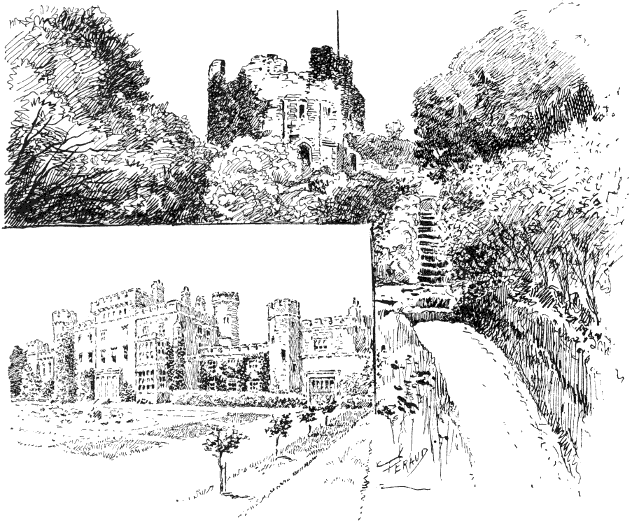
THE OLD AND NEW CASTLE OF HAWARDEN.
Thus a happy childhood matured into womanhood, under revolutionary influences. The breezes of intellectual and spiritual awakening stirred the air. Theirs never was a life of mere social excitement which so often plunges the débutante into a whirl of pleasure without feeding the better life. They entered, it is true, into all the pleasures of London seasons, their beauty and bright minds fitting them to enjoy these to the full. But behind and above it all was the intelligence which kept them in touch with the movement of their day—a movement which, when turned into practical channels, brought about, for example, the great work of Florence Nightingale, who re-created the hospital-nursing service. The same potency inspired the establishment of homes and refuges and many of the philanthropic schemes which have made the last forty years so notable. Certain it is that Catherine Glynne came under the influence of the Oxford movement, and was predisposed by it to take a leading part in the philanthropic work of the day.
MARRIAGE AND PHILANTHROPY.
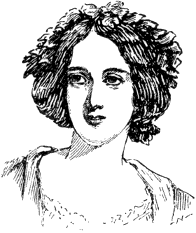
MISS GLYNNE (MRS. GLADSTONE), 1838.
In 1839 she married William Ewart Gladstone, whose great genius already foreshadowed his future eminence. The same day her younger sister married Lord Lyttleton. Those who were eye-witnesses of that double wedding, and all the wonderful festivities in the village, are becoming few, indeed. In her married life Mrs. Gladstone found occupation to the full. She was always the true and careful mother who would not give over her duties to another, even to the best of nurses. She was devoted to her husband in his incessant political toils. She did not need to look around her for work. Still her assistance was from the first prompt to the furtherance of any schemes where a helping hand was needed.
Mrs. Gladstone soon became a centre for philanthropic work of all kinds. She and Mr. Gladstone started Newport Market Refuge, which is now carried on at Westminster, with an industrial school attached. Begun in Soho in 1863, it was Mr. Gladstone’s idea, for he saw many friendless wanderers as he went at night between the House of Commons and his home. Mrs. Gladstone threw herself into his scheme, and the work was started with an efficient committee. From the beginning Mr. Gladstone has been president and his wife a regular visitor. The object of the refuge is to give shelter to persons out of work and in temporary distress, to enable them to tide over their difficulties, and to find fresh employment. It does not take in the practised casual, or loafer, but weary, sore-footed travellers, who have walked far in search of work and found none. Such are always admitted as far as room permits, and have the assurance of a week’s lodging free, with the prospect of an extension of time if the committee see a reasonable chance of their getting work.
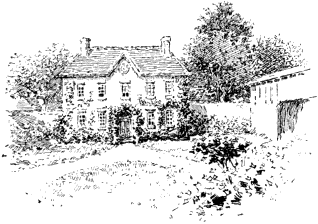
THE ORPHANAGE, HAWARDEN.
In the course of a single year about thirteen thousand nights’ lodgings and thirty thousand rations have been granted, and three hundred and nine men and women have obtained employment, or else have been sent home to their friends.
It need scarcely be said to those who have kept pace with recent events that the most vital feature of General Booth’s great work in London follows closely the model set by the Gladstone institution.
It was soon found advisable to add a Boys’ Industrial School to the work of the Refuge. Many lads in distress were constantly being discovered, who would certainly drift into a life of idleness and dishonesty if not taken in hand. So the managers of the Refuge determined to try this novel combination—refuge and school—which, hazardous as it was at its commencement, has proved an entire success.
In 1866 a sharp epidemic of cholera reached England, and the East End of London was severely attacked. Mrs. Gladstone came in contact with it, in her regular visits to the London hospital. Whole families were brought in together, some to die, others to recover. Parents dying left their children behind them, friendless and helpless. Mrs. Gladstone carried away many of the poor little wretches virtually in her arms. They were naked, for their only clothing had to be burned, but she found cloaks and blankets to wrap them in, and took them with her to her own house or to lodgings which she had provided.
She induced her friends to furnish fresh garments without delay, and she rented an empty house at Clapton, wherein to lodge her orphans. She set about raising money to provide for their needs and those of other cholera patients. She wrote a letter to the “Times,” asking subscriptions for this object, and speedily five thousand pounds rolled in. With this she was able to keep her little cholera orphans in comfort. One who saw the sight, when she accompanied Mrs. Gladstone to Clapton, says she can never forget it. As soon as the door was opened she was surrounded by the little ones, who clung to her and almost overwhelmed her in their eagerness to obtain a caress from the one they loved so dearly.
VARIED ENTERPRISES OF AN ACTIVE LIFE.
Her Free Convalescent Home had its genesis in the necessities of the sick poor, brought to light by this cholera epidemic. It was forced upon her notice that many, who had passed safely through the dangers of acute disease, relapsed into serious, and sometimes fatal, illness for lack of that timely change of air, wholesome food and comfortable lodging which they were unable to find at home. There were convalescent establishments in operation, but it was found that they were already full, or else admission was hampered by such conditions of privileged tickets, weekly payments, and distance, that, before these could be complied with, the evils sought to be averted had actually occurred.
Mrs. Gladstone determined to establish a Convalescent Home, where admission could be quickly arranged, free of cost. She called to her aid a committee of ladies and gentlemen, qualified by business experience, professional knowledge, or familiarity with the needs of the poor, to coöperate with her. Such confidence did she inspire, that a beginning was quickly made in a house at Snaresbrook, the remainder of the lease being made over to Mrs. Gladstone and her committee. When the lease came to an end, the convalescents were transferred for a short time to the houses which Mrs. Gladstone had at Clapton, but in 1868 a freehold property, known as Woodsford Hall, most healthily situated in Essex, was bought by the committee. Here this good work has been carried on ever since. It is a charming house close to the forest, surrounded by lawns and trees and flowers. In fine weather the house is nearly empty all day long. The invalids from the squalid city lanes spend their time in the forest, gathering wild flowers, and drinking in the perfumed air which pours rich draughts of health and strength into their wasted bodies.
When in London, Mrs. Gladstone has for nearly a quarter of a century gone down to the London Hospital every Monday morning, to examine into the circumstances of those who apply to go down to Woodsford. The clergy and ministers of all denominations in the parishes around the London Hospital have a right to send their sick poor with a note of recommendation, but those who are recovering in the London Hospital have the special claim. The business is carefully supervised by Mrs. Gladstone and her assistants, even to the day of going, and the train. Attention is always directed to the express object of the home—as a resort solely for those who have been ill, are slowly recovering, and require, for complete restoration to health, change of air, good food, rest, and kindly treatment.
Every year more than a thousand men, women, and children enjoy the benefit of this retreat. One report gives the numbers at six hundred and thirty-nine men, three hundred and sixty-nine women, seventy boys, and forty girls. The large excess of men and boys over women and girls has revealed the fact that working men are much more liable than are women, not only to accidents, but to disease. This holds good among the children, as more sickness rages among the boys than among the girls. In this great undertaking Mrs. Gladstone has been ably assisted by many friends, among whom may be specially mentioned her niece, Lady Frederick Cavendish, whose terribly imposed sorrow has always found relief in works of love and charity. It is impossible, too, to say good-by to the Free Convalescent Home at Woodsford without mentioning Miss Simmons, the superintendent for many years—an ideal mother for such a home. To see her play games with the patients is something one remembers, for the humor with which it is done and the mirth it creates. Mrs. Gladstone herself delights the patients on her visits by playing dance music to them. Her country dances and Sir Roger de Coverely are special favorites.
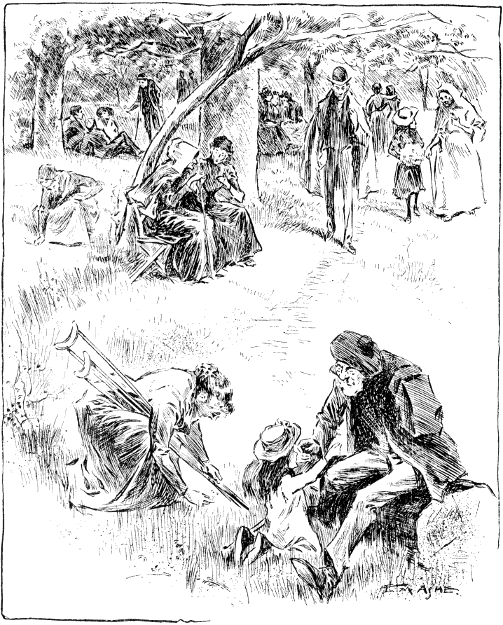
THE INMATES OF WOODSFORD HALL IN THE FOREST.
Another prominent feature of her charities is the orphanage at Hawarden, which arose out of the American war of 1862, and the subsequent cotton famine in Lancashire.
Mrs. Gladstone’s brother, Sir Stephen Glynne, was alive, and Mr. and Mrs. Gladstone lived at Hawarden Castle with him. When the distress was most severe, Mr. Gladstone collected a number of men who were idle in Lancashire, and found them employment in cutting foot-paths through the park and woods of Hawarden—as he could not give them work which would displace any of the permanent laborers on the estates. At the same time Mrs. Gladstone sent for some of their young daughters, and her brother, Sir Stephen, gave her the use of a nice old house which stood in the courtyard, formerly the dower house belonging to the Ravenscrofts, who in time past had owned Hawarden Castle, then called “Broad Lane Hall.” (The heiress of the Ravenscrofts had married Mrs. Gladstone’s great-grandfather, Sir John Glynne.) This dower house Mrs. Gladstone converted into a training home for the girls, under the charge of a very charming nurse of her own children, who had lately married. The experiment proved a great success. The girls had all worked in the mills, but they learned quickly something of domestic work. Then Mrs. Gladstone found them places amongst her own friends in the neighborhood, whereupon she was able to send for more girls to be similarly assisted. Some of them were lovely young women, and most of them married extremely well while in service.
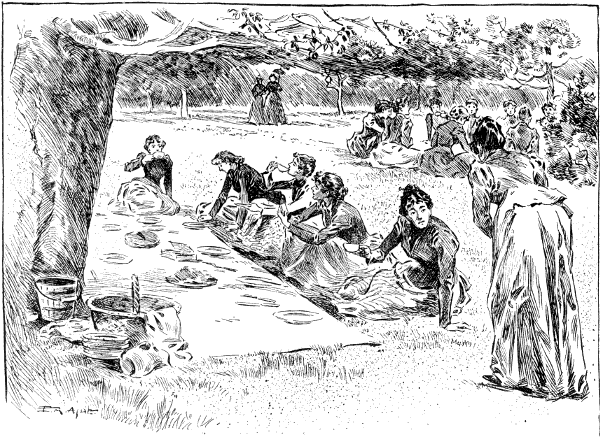
THE ANNUAL LUNCH PARTY OF THE NOTTING HILL SCHOOL GIRLS.
In the autumn of 1867 Mrs. Gladstone brought down about a dozen of her orphans from Clapton and lodged them in another small house, which her brother had lent to her. These she put under the care of a widow with a little boy of her own. There they dwelt happily, going every day up to the village to attend the infant school. When the Lancashire distress was quite over, and all need of the old dower house at an end for the mill girls, Mrs. Gladstone transferred her Clapton orphans there, and added to their number other children whose fathers and mothers had died in the London Hospital. When the orphanage was properly established in the larger house, it accommodated comfortably about thirty children. Experience taught Mrs. Gladstone that poor parents found it more difficult to provide for and manage their boys than their girls. So the Hawarden orphanage has come to be filled by boys. They attend the parish schools till they are old enough to be apprenticed to trades. There is now a whole army of well-doing young men who have been brought up in the Hawarden Castle orphanage. It is still in full tide of the work it has carried on for over twenty-five years.
About 1880 a home for training young women for service was opened at Notting Hill, London, under the management of a committee of ladies. The object of the home was to take girls under its protection who had bad homes, and were therefore likely to be totally neglected and to drift into a life of uselessness and vice. Mrs. Gladstone was asked to become the president, and consented. It is organized on a small scale, a fact much in favor of its purpose. Not more than fifteen girls are there at one time, and a few lady boarders are taken in, as this works well for training the girls in the various branches of domestic service. The proud characteristic of the school is its determination never to despair of any pupil, however discouraging she may be in her first trial of service. The reward seems great when a girl, who has failed in several places, at last finds a mistress who understands her and draws out the best in her, when she receives praise as a good servant instead of the fault-finding hitherto her portion. There are now numbers of respectable, well-doing servants who have been trained here, and the institution has proved a boon to employers as well as the employed.
A CROWN OF HONOR.
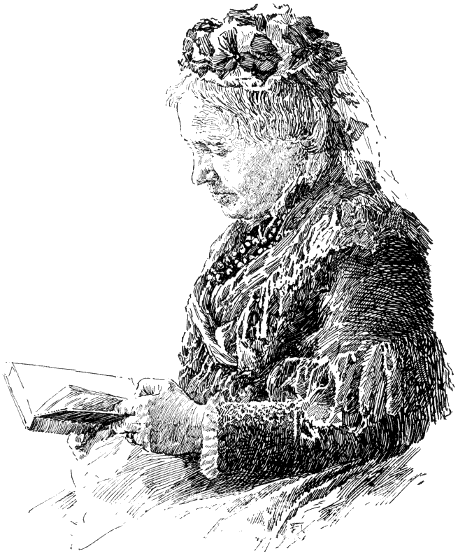
MRS. GLADSTONE TO-DAY.
Mrs. Gladstone gives the girls who are in service an annual treat every summer down at the Convalescent Home at Woodsford. About a year ago a party of them enjoyed luncheon and tea on the lawn there, under the shadow of a rare kind of sycamore which their hostess had brought in a flower-pot, as a little seedling, from an old tree which spreads its ample branches close to her orphanage at Hawarden. Mrs. Gladstone told the girls that, when she planted it, she never thought to live so long as to see it large enough to shelter a party of forty in the shadow of its foliage. Such works of beneficence as have just been sketched are only a few of those forming a crown of honor and glory for the head of the great Premier’s wife. She was in that early band who began penitentiary work at Clewer before it took shape under Mrs. Monsel’s management. That must have been soon after her marriage. To that early time, too, belong the beginnings of the House of Charity for distressed persons in London, which is carried on at Soho, and rejoices in its forty-sixth annual report. This is to help persons a little higher than the working-class, who have fallen into temporary distress from sickness or other vicissitudes.
As for the deeds of private kindness, it can truly be said that Mrs. Gladstone has sown them on all sides, and it is characteristic of that noble woman’s nature that she is loyal to the last to those who need her help, even if it be for a lifetime.