EDWIN BOOTH. ON AND OFF THE STAGE. Personal Recollections. By Adam Badeau.
Reading edition
The Friday before Booth was taken ill, I spent two or three hours with him in his rooms at the Players’ Club, and while there it occurred to me that a picture, not of the actor merely, but of the man whom I had known for more than thirty years, in the glow of youth and the prime of manhood, down to the weary invalid, stricken before his time, in the characters that were not assumed—of husband, father, brother, son, and friend—would have an interest far beyond any critical analysis of his performances or historical account of his engagements. He did not object to my painting him as I had known him in the most intimate relations of his life—an actor is always used to being described and criticised—and he gave me incidents and information, all that I sought. Thus in what I have to say there will be nothing second-hand, nothing that he has not himself told me at one time or another, or that I have not observed in the friendship of a lifetime.
I first met him when he was twenty-three, and I only twenty-five years old, and from that time till his marriage and my own entrance into the army we were as intimate as it is possible for two young men to be. I have the right, therefore, to tell what I shall unfold, for he gave it to me, and I have a further right in the certainty that nothing I can tell will depreciate his fame. If I portray all that I know, no one who reads will fail to think more highly and tenderly of the nature that was cloaked under Richard and Iago, suggested perhaps by points in Othello and Lear, but only really indicated in Hamlet, the melancholy, moody, dreamy, filial, tender Dane.
He was born in 1833, in the night of the historical meteoric display—the “star-shower,” he always called it. His father was a famous actor in the parts which the son so often played. I never saw the elder, but others assured me he possessed a tragic genius perhaps at times even more tremendous than that of the Booth I knew. He was an Englishman, and the rival of Edmund Kean. The family tradition is that he was driven from London by a cabal of Kean’s admirers, and came to America in 1821, almost immediately after his marriage.
Junius Brutus Booth must have been an extraordinary person off the stage; erratic almost to insanity, gloomy, given to fits of passion, but full of warm affections; a man with a temper almost uncontrollable, yet more often morose than violent, who refused to play, even when announced, unless he was in the vein, and walked the streets for hours after acting, and sometimes before. His wife for years accompanied him to the theatre, acting as dresser, and Edwin was taken with them. He thus received his first impressions of the stage when he was three or four years old. The wife remained in the dressing-room during the play, and when the child grew sleepy he was put to bed in a chest of drawers that held his father’s wardrobe. If he wakened he had the theatrical wigs and paint-pots for his toys. A few years later he took his mother’s place and dressed his father for the stage.
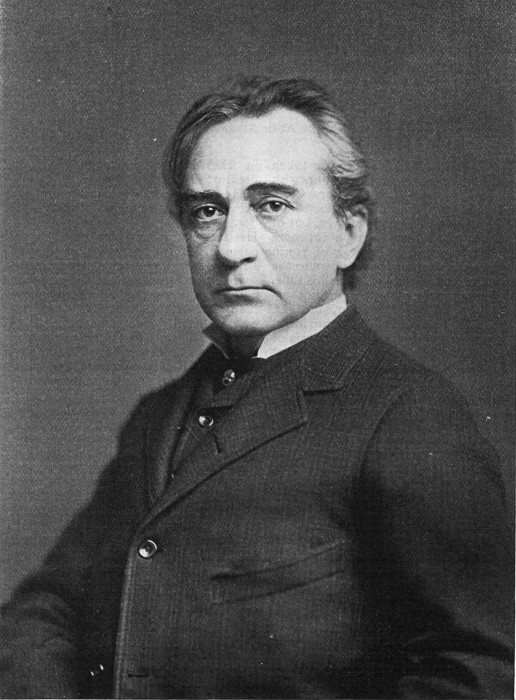
From photo by F. Gutekunst. Copyright by F. Gutekunst, Philadelphia.
There were several children, and three of the sons became actors. I asked him whether he was the favorite, but he said no: his father always preferred John Wilkes. Yet Edwin had the greatest influence with the tragedian when the gloomy fits came on, and followed him many a night through the streets to see that he got no harm. He could prevail on him to act when no other could, and often told me of his attempts to direct their wanderings so that they might reach the stage-door in time. He himself was melancholy and moody, and lived very much in the imagination. It must have been a strange spectacle—this erratic genius and his anxious child, both slightly formed, with the same wonderful piercing eyes, stumbling about the streets at dark, the boy trying to persuade the father, sometimes succeeding, sometimes failing altogether.
The story of Edwin’s first appearance on any stage has often been told. It was as Tressel to his father’s Richard III. He was not yet sixteen and received no encouragement nor sign of approval from his strangely constituted parent, but a little later the two were walking in Broadway, when they met a Mr. Conway, an English actor well known to play-goers of the last generation. Booth stopped to talk, and Conway, who was pompous in speech, inquired rather elaborately:
“Upon which of your sons do you intend to confer your mantle?”
The great player did not reply in words, but laid his hand on Edwin’s head with a sort of solemnity, perhaps suggested by Conway’s tone. The lad attached little significance to the action at the moment, but afterward felt certain that his father meant all that the gesture implied. I asked him how old he was when this occurred. “Only a stripling,” he said, “about as high as the top of that candle,” and he pointed to the mantelpiece.
“Why,” I exclaimed, “you are not as high as that now.”
“Ah! but I wore a hat,” he replied; “and my father had to reach up to put his hand on me. I was taller than he.”
He first played Richard III. at the old Chatham Street Theatre in New York, as a substitute for his father, who either could not be found or refused to act. When the manager learned this fact he said to Edwin: “Then you must play Richard.” The lad, just seventeen, was naturally unwilling, but he knew the text from having heard his father so often in the part, and their figures were not unlike. The assistants dressed him in his father’s clothes, and he made up his face as like as possible to the great actor in Richard III. The audience was surprised when he appeared, but allowed him to go on, and he must have played with a certain degree of power, for he was called out at the end of the first act, and went through the entire exacting tragedy. When the play was over he hastened home and found his father, who offered neither comment nor inquiry. In this way the strange pair went on, leading a life as curious as any of the mimic ones they portrayed on the stage; for Edwin now played at times, even in prominent parts, but made no especial mark, being dwarfed, of course, by his father’s superlative ability.
In 1852 they went to California, but the wayward elder remained only a few months, then suddenly returned to the Atlantic States, leaving Edwin behind with his brother Junius, also an actor of some prominence. The brothers played together occasionally, but the times were rough and their success was small. Edwin was soon reduced to the hard straits of a strolling player’s life: borrowing a few dollars now and then, walking hungry through mountain snows, living sometimes in a ranch, sometimes on the pittance of a stock-actor’s salary, but sometimes making a hit, drawing crowded houses and filling his purse for a while.
In November, 1852, he got word of the death of his father, a terrible blow to him, whose relations with the great actor were so peculiar. Throughout his life he retained the liveliest memories of his father’s character and presence. He liked to talk of him, and spent hours with me describing the peculiarities that left so profound an impression on him. But though he saw their strangeness, the reverent tone in which he told of them was always marked.
Doubtless he inherited the dramatic genius and some of the temperament of his parent. He was not so wildly passionate on the stage, and his temper was never so uncontrollable, but his brooding melancholy, the sensitiveness of his nature, the depth of his affections, the quaint humor so strange in a tragic actor, his vivid imagination—many, indeed, of his especial gifts and faults—were unquestionably transmitted with his blood by him who was at once the author of his physical being and the begetter of his genius. The likeness extended to feature and gesture. I have a picture of the father given me by the son, which might easily be taken for one of Edwin in Richard III.; and older play-goers always declared that in the great tragic scenes the son recalled, in tone and look and power, the peculiar magnetic quality that made the elder so remarkable. I have thought sometimes that the awful bursts of passion of his younger days were more effective even than the elaborate manner of his later art. He told me more than once that his life-long friend and comrade, Joseph Jefferson, often warned him against refining away his power, and thought the classic finish hardly compensated for the natural intensity which it replaced.
His feeling for his father certainly added to the power of his performance of Hamlet. His greatest scenes in this tragedy were those with the ghost, and when Booth addressed the shade, and exclaimed:
“I’ll call thee Hamlet, King, Father, royal Dane,”
there was a pathos in the word “father” which those who ever heard him utter it must recall. He dropped on one knee as he spoke it, and bowed his head, not in terror, but in awe and love, and tender memory of the past; he had a feeling that he was actually in the presence of that weird shade whom he had known on earth, and he was not afraid.
The fatherless son remained in California, playing with varied success, sometimes as leading-man with Miss Heron, Laura Keene, or Mrs. Forrest Sinclair, sometimes as a star, sometimes in the stock company of those days, taking any part to which he was assigned. The experience was doubtless valuable to him, and he acknowledged that he owed to it much of his ease on the stage, his familiarity with the business, his self-possession under all circumstances, and his readiness in emergencies.
During his stay on the Pacific Coast he once visited the Sandwich Islands, and with an impromptu company gave a few performances. He had great trouble in announcing his plays, for the boys who were employed to post the bills ate up all the paste; but the houses were full, and the audience included the king. The court, however, was in mourning, and His Majesty could not be seen in front, so a chair was draped with theatrical robes behind the scenes, and there the real king applauded the mimic one in “Richard III.” The throne was needed for the coronation scene, and Kamehameha kindly abdicated for that occasion. In 1851 young Booth, as he was now called, returned to the Eastern States and played in Baltimore, Richmond, Boston—everywhere with great success. He was at once recognized as the dramatic descendant of his father, and the future head of the American stage.
In May, 1857, he entered upon his first engagement in New York, and on one of the earlier nights I strolled into the theatre while he was playing Richard III. I had seen his name in the bills, but he was heralded as the “Hope of the Living Drama,” and I had no great expectations from such an announcement. But I was struck at once with his dramatic fire, his grace, his expressive eye and mobile mouth, his natural elocution, and the decided genius he displayed. I remember even now, after the lapse of thirty-six years, the prodigious effect in the fourth act, when Richard exclaims:
“What do they in the North When they should serve their sovereign in the West?”
His whole face and form were ablaze with expression—literally transfigured; and his voice embodied a majestic terrible rage that electrified the listeners. Men rose in all parts of the house and shouted with delight. I had seen Rachel and Forrest and Cushman and Grisi then, and I have seen Bernhardt and Irving and Salvini and Ristori since, but I never saw or heard on the stage anything more tremendous than the picture he presented and the passion he portrayed in his youth in Richard III.
I went the next night and the next, and found the fascination increase. I saw him in Petruchio, Brutus, Hamlet, Richelieu, Lear, Iago, Claude Melnotte, Sir Giles Overreach, Romeo, and Pescara. He was uneven and fitful in everything, but in every part he played he did something that no other actor could rival. His youth, too, had a charm; the very crudeness of his acting gave a certain interest—it left room for anticipation. I was very much attracted by the stage at that time, so I called on young Booth and told him what I thought of his acting. He had plenty of admirers, but my enthusiasm seemed to touch him, and we struck up a friendship at once. At the end of a week he consented to spend Sunday with me; and from that time dated a peculiar intimacy. I had a good deal of leisure and could pass my days as well as nights in his company, and I knew no greater pleasure than he gave me, either on or off the stage. He was not then a finished scholar, nor by any means the great artist that he afterward became, and I was anxious that he should be both. I used to hunt up books and pictures about the stage, the finest criticisms, the works that illustrated his scenes, the biographies of great actors, and we studied them together. We visited the Astor Library and the Society Library to verify costumes, and every picture or picture-gallery in New York, public or private, that was accessible. He discussed his parts with me, and with the conceit of youth I often ventured to differ with him on points in his art where he should have been an authority. Often we quarrelled all day about an interpretation or a rendering, and I went to the theatre at night to be convinced that he was right and I was wrong. Sometimes he gave me a private box, and I took notes of the performance, and of the criticisms or changes that occurred to me. Next day we went over them together, and at night he would play Richard or Iago according to my suggestions—perhaps as much to gratify me as because he thought my judgment correct.
Oftener I went to his dressing-room. It was very fascinating to watch the face of the character he was to play grow and vary beneath his hand. The character itself seemed to grow at the same time. When we entered at the stage door he was my friend—“Ned,” I always called him; but as the paint and the cotton eyebrows, the wig and the tights, were put on, the stage personage appeared; and when Hamlet or Romeo was ready his manner assumed all the grace and dignity of the Prince or the Montagu. After he had played a scene or two the transformation was complete, and lasted till the stage clothes were taken off.
How completely he personated the characters that he assumed I can testify from comparison with what may be called his originals, the actual Hotspurs and Hamlets, the soldiers and princes, of the real world. One night in Louisiana before a battle I was with General T. W. Sherman while he was giving orders to his officers and aides-de-camp. It was nearly midnight, and there was to be an attack at dawn. First came in one messenger, then another, next the leader of the advance, last the captain of the reserves. The night was warm and the tent was thrown open; a candle burned on a table within, while the general paced up and down in the darkness outside. There was a hush and a bustle combined, a subdued intensity and a dramatic haste, as the commander gave his different orders and received his successive subordinates, that brought to my mind at the moment the tent scene in “Richard III.” I thought, just then, “How like all this is to what I have seen on the stage.” Yet Booth had never witnessed actual war.
In the same way in Europe: I often thought of him when princes and sovereigns were holding levees or processions, receiving homage or conferring honors; no Guelph or Bourbon of them all went through his part with greater dignity or grace than the young American who had never been at court; and sometimes the magic of genius arrayed him in a majesty which all the reality of their grandeur could not inspire.
There was one character, however, that he could not play—the lover. He was the poorest of Romeos, and he knew it. He looked the part, of course, in his youth; the women always wanted to see him play it, and the actresses all wanted to be Juliet; but there was a lack of tenderness in his eye, and of ardor in his tone; even the gestures were tame. He was not anxious or persuasive enough; he was too confident, or too indifferent. The only point in the play where he rose to his usual level was in the fight with Tybalt; but then there was killing to be done, and this was passion of a different sort—this was tragedy. Then he became inspired, and looked for a moment like one of the demi-gods in Homer’s battles. But in the scenes with the friar and with Juliet, even in the balcony scene, he was comparatively spiritless. Whether he was not actually a good lover, or whether he felt a certain delicacy about love-making in public, the fact remains that he was always more effective in parts that represent harsh or violent emotions than in tender ones with women.
So, too, though he had a keen sense of humor, and was full of jokes and funny stories off the stage, and told them with a genuine comic power, he could not act a comic part. I once saw him in “Little Toddlekins,” in white trousers and a high hat, and I never wanted to see him in farce again. Even in high comedy he was not so interesting as in tragedy. Benedick himself was not to his taste, and his nearest approach to success in comedy was as Don Cæsar de Bazan; but there the fascination was in his superb appearance and irresistible grace quite as much as in dramatic power. His Don Cæsar, however, was a wonderful picture, an embodied romance. He delighted in the caustic speeches of Shylock or Hamlet, or the irony of Iago, but these can hardly be called comedy. His Petruchio was a game of romps; but it was Donatello romping with Miriam, or Bacchus with Ariadne.
Yet, I repeat, he was bubbling over with a grim sort of humor in real life, like that which Shakespeare sprinkles over his tragedies. Behind the scenes he would mock and gibe at himself, had odd remarks to make about his face or his costume, and was alive with waggeries and witticisms. I once pulled aside his robes in Richelieu as he sat smoking between the acts, and he shrank back and screamed, “How dare you, sir?” in a shrill tone, exactly like a woman. The next moment he was the stately cardinal again.
I was very anxious that Booth should receive a social recognition. Thirty years ago actors had not overleaped the barriers which had existed for centuries, to anything like the extent we know at present, and I wanted him to meet people of distinction, to hold the position which Garrick once occupied in England; but he hardly shared my ambition for him. If people wanted him they had to seek him, and even then were not sure of getting him. Social attentions sometimes gratified, but quite as often bored him. But his genius was so positive and so attractive, that the most prominent people all over the country courted his society. I had the pleasure of putting up his name at the Century Club, where he was more than cordially welcomed. The wits, the scholars, artists, authors, all were glad to know the man who had given them so refined a pleasure. Bancroft, Bryant, Curtis, and their families, Sumner, Mrs. Ward Howe, men and women of the first social position, as well as cultivation, were his personal friends, even at that early day. But he seemed indifferent to his fame.
He had no trace of personal vanity. He said to me once he only cared for his good looks as the tools of his trade. Hundreds of women flung themselves at him in those days; they sent him notes in verse and prose, flowers, presents of jewels, shawls, feathers, to wear on the stage; they asked for appointments; they invited him to their houses, they offered to go to his; but he cared nothing for any of them. Sometimes they amused, but more often disgusted him. More than once he saved some foolish child from what might have been disgrace, and sent her home to her family. And he never injured a pure woman in his life. Off the stage he had no care for his looks; even in his youth his dress was more than plain; he was positively indifferent to his appearance.
He always continued to have fits of sadness and silence; a feeling that evil was hanging over him, that he could not come to good. These moods would pass, but would return. Still, when he inclined to talk he was profoundly interesting. He had a wonderful fund of stories, and recollected the most minute and the most salient circumstances, showing the actor’s power of observation. He studied character incessantly; not deliberately, but because he could not help seeing peculiar traits of character or peculiar circumstances. He acted all his stories, comic or tragic, without meaning to do it, and often just as well off as on the stage. I used to get him to make the faces he did on the stage, to look like Richelieu in the “curse of Rome,” or Richard in “What do they in the North?” But it was only when he was in a very good humor that he would do this. Once or twice he painted his face to assume his father’s appearance.
But he hated to act off the stage, and even at rehearsal seldom raised his voice above the conversational tone, or struck an attitude. I often went to rehearsal with him and wondered at the calmness of his tones when he struck down Iago, or smothered Desdemona. One morning in Buffalo I missed him when we started, and followed him to the theatre; I entered at the stage door and went to the wings, looking for him. It was a minute or two before I recognized him, with a high hat and a cane, reciting passages from “Macbeth.” But that night he was more tremendous than ever. His first entrance in the play he made by leaping from the rocks, as he exclaimed, “So foul and fair a day I have not seen”; and it was the very Highland thane that came upon the scene—full of his future dignity and oppressed by the feeling of Fate that fills this tragedy as it does the plays of Euripides. That feeling, indeed, almost illustrates the depression that settled over his nature at intervals, and seemed a premonition of some awful future. It was appalling to witness, and must have been still more appalling to endure. Doubtless he inherited it from his father. It was like a veil that shrouded him from other mortals, and he walked behind it, apart. He strove to describe his emotions at such times to me, for he wanted me to know all he felt; but the effort was like those sad ones of his later days, when he attempted to utter words and gave only inarticulate sounds. I cannot portray him unless I make this sadness apparent; it was so strange and weird.
And yet this introspective, distant man, so old when he was young, so cold though gifted with every personal charm—was a warmly affectionate son, devoted to his mother, and generous to his family; he lived with his mother and sister for years, and provided for them after his marriage; he lent money not only to his brothers, but to hosts of friends, actors and others, for his profession brought him in large sums, and he gave away much in charity, especially to actors. His friendships, though steadfast, were not usually ardent or demonstrative. He who was gifted with such wonderful power to express the emotions of others was often unable or unwilling to give utterance to his own. When he was called out after the play, the man who had just enthralled an audience as Richard or Othello, or hurled the imprecations of Richelieu or Lear, stood modest and shrinking, only able to stammer a few words of thanks in his own person, on the very boards where he was most at home.
He was not a good hater; when he was injured he felt it keenly, and I am not sure that he ever forgave a wrong, but the memory of it was not always keen, and I doubt if he ever revenged himself—he relented when it came to inflicting pain. In his business relations he more than once fell into foul hands, and he had himself little business faculty; but he was slow in making reprisals, even if opportunity offered. For he had a noble, gentle nature; I never knew him do a mean or vulgar thing. He was no backbiter; he refrained, even with me, from hostile criticism of other actors. I sometimes drew out opinions that were not favorable, but he never offered them, and always seemed to utter them unwillingly, as if he would not refuse to tell me what he thought, and yet was loath to speak severely of a brother artist.
No one ever charged him with desertion of a friend or backwardness in time of need; and I have known of sacrifices that he made for others, greater than most men are capable of. He submitted to much from some members of his family, because he deemed it his duty, or from affectionate pity, and endured even cruel wrongs rather than resent them publicly. He was most averse to bringing his private affairs before the world, and disliked to extend the publicity of the stage to his every-day life. His friendships in his youth were almost confined to members of his own profession. Joseph Jefferson, and John Sleeper Clarke, who married his sister, were always very close to him, and in later years, Barrett. In time, however, he had many associates among artists and cultivated men, who naturally sought his company, and some of these he regarded as personal friends.[1]
I once visited with him the place where he was born. It was a farmhouse twenty-five or thirty miles from Baltimore. We drove out in a one-horse vehicle, and he was Phaëton. The house was partly furnished but unoccupied, and an old negro in an outbuilding gave us the keys. His father’s library remained, and a part of his stage wardrobe, and we spent hours ransacking them both, studying old play-bills, even English ones of his father, examining rare copies of Shakespeare, and trying on trappings of Shylock or Lear. I made him put on a wig and act the parts for a single auditor. He was very complaisant that day, or night rather, for we sat up till late into the morning, and then made beds out of Cæsar’s mantle and Macbeth’s robes. He picked out three volumes of Shakespeare which he had used in playing, full of his own stage directions written in, and variations of the text, and gave them to me as a memento of the visit, inscribing some lines from one of the sonnets. It was Verplanck’s illustrated edition, and some of the plates were marked: “Form this picture.” I remember afterward noticing that he made the picture on the stage.
Many a night in those days we sat together till morning, for he had the actor’s habit of turning night into day. Playing till nearly midnight, and supping still later, the excitement of the stage kept him awake afterward, and he never wanted to go to bed. He was never more animated in thought and look and gesture than after acting. Of course, he rose late, and during an engagement his only leisure hours were one or two in the afternoon; for in those early days he went regularly to rehearsal. That was before the era of long runs, and he played a range of parts in each engagement, changing them nearly every night. He sometimes slept after his early dinner, so as to be refreshed and ready for evening.
Then there were the painters and sculptors and photographers, always one or two in every town, who wanted to take him, either in a popular part, or “in his habit as he lived.” He never dined out while he was playing, except on Sundays, and a walk or a drive was almost his only exercise or amusement; there was not time for more; he had to reserve himself for the night. For he had to work when other men played; his work was their amusement. It was a life utterly unlike that of other men, and it is not strange that his character was unlike theirs. He was exposed to the temptations of youth, and he had his peculiar faults, but no gross vices, and he did no harm or wrong to man or woman—ever, that I knew. Of how many can this be said?
In 1860 he married Miss Mary Devlin, a young actress, who retired from the stage as soon as she became engaged to him. She was a sweet gentle woman, of great natural refinement, and every way fit to be his wife. A year before he had told me he meant to marry, and I encouraged this intention. I thought he would be happier, that he needed the constant companionship and solace of a wife’s society, though I knew that marriage must, to a certain extent, disturb the intimacy which I valued and enjoyed so highly. No man could be so intimate with two people at once as he had been with me. They were married at the clergyman’s house on the afternoon of July 7. He and I went together to the simple ceremony; there were no other witnesses except his wife’s sister and her husband and John Wilkes Booth. After it was over, Wilkes threw his arms about Edwin’s neck and kissed him.
In a week Booth wrote to me and wanted me to join them at Niagara. They had a cottage on the Canada side, and there I spent two weeks of his honeymoon with my friend. He was most anxious to show me that his marriage had made no difference in his feeling toward me, and his wife was quite as anxious that I should perceive none. In the autumn Booth played in New York, and I was with him almost as much as ever. We sat up late into the night as of old, and Mrs. Booth was often so good as to leave us together. I had the pleasure of accompanying them to distinguished houses, for Mrs. Booth was much invited, as well as he, and bore herself with quiet grace and modest dignity, as “to the manner born.” We continued our studies, too. Mrs. Booth was as anxious as I for the artistic success of her husband; she and I went to the play together and discussed his performances. Their union was complete and their happiness unalloyed.
But the currents of our lives ran different ways. In 1861 I entered the army and Booth went to England. His success in London at this time was not marked; he could not obtain the theatre he wanted, and English feeling just then was hostile to Americans. He played only a short engagement, and it was not until the second or third week that he made any impression. Then his Richelieu created a sensation, but it was late in the season, and he only acted a few nights afterward. In December his only child, Edwina, was born at Fulham, England.
He returned to America early in 1862, and in September I was passing through New York and went to see them. I found the same dear friend I had known of old, with a sweet tender woman by his side, and a child of nine months playing on the floor. Mrs. Booth made me remark that the little one, creeping in its play, fell instinctively into the attitude of Richard III. in the terrible fight with Richmond; and the likeness was laughable. I left the same day for New Orleans, happy for this glimpse at their domestic happiness.
They took a house in Boston, and the next year, in February, 1863, Booth was playing in New York, having left his wife at home because of her delicate health. During a performance at the Winter Garden a despatch was handed him, summoning him to her side. He left at the close of the play, but before he could reach her the dearest thing on earth to him was gone forever. The shock almost unbalanced his mind. His wife had been all that a perfect wife could be to a man of his peculiar temperament and needs. She sustained him, encouraged him, soothed him when the sad moods came on, and exorcised the evil spirit absolutely. She inspired his work, and comforted him in weariness, trouble, or physical pain. He wrote me, at once, the saddest letter I ever received. He was crushed, and saw no hope, no reason for living. The black cloud that she had lifted was lowered again; not even his child at first could interest or distract him. But he turned to me in his bereavement, for I had known her, and I did what I could to comfort him; at least, I could grieve with him.
The young wife was buried at Mount Auburn, near Boston, at a spot which they had selected together. He built a tomb in which both were to lie; it was lined with brick, and when her remains were transferred, before the coffin was lowered Booth jumped into the grave as Hamlet did into Ophelia’s. He joined her there last June, after thirty years.
In May, 1863, I was seriously wounded, and it was his turn to solace me. I lay in hospital for many weeks, and he wrote me constantly. In July I was taken to New York, and arrived just before the riots of that year. I was carried to Booth’s house. He and his brother Wilkes bore me to Edwin’s bed, which he gave up for me, and there I was left alone with my distracted friend. I may not disclose all that he said in his grief, but, with his unusual nature, it can be imagined. He was inclined to think the spirit near him of her who had been so much to him in life, and I said nothing to disturb the impression. I remained at his house until it was possible to remove me to the country; both he and his brother dressed my wounds, and tended me with the greatest care.
I saw much of him during the months of my convalescence, and early in 1865, when I was again taken to New York after an attack of camp fever; Wilkes Booth was once more at his brother’s house. He was excessively handsome, even physically finer than Edwin, but less intellectual in his manliness. I never saw him on the stage, but under Edwin’s roof I thought him very captivating, though not so thoroughly distinguished as his greater brother.
Two months later came the terrible event which plunged the nation, and especially the Booth family, into such awful sorrow. Edwin was playing in Boston, but at once gave up his engagement and returned to his home in New York. Numbers of the most eminent people hastened to assure him of their sympathy and their belief in his loyalty. He had indeed been stanch for the Union, and the only vote he ever cast was for Lincoln in 1864. But he was overwhelmed by this fresh misfortune, this new cloud that had settled on his house. His brother Junius and his brother-in-law were thrown into prison in Washington, and he felt himself an object of suspicion. I had returned to the field, and was in Richmond when the news reached me. I wrote to him at once, but my letter was withheld. All letters to him for awhile were kept back, and I suppose especially any from Richmond. I could not leave my post immediately, and it was a month or more before I reached New York, where I went, of course, direct to him. The first shock was over, but the old gloom was greater than ever.
He told me he had seen nothing in his brother to excite suspicion, and I have always believed that the awful act was the result of a disturbed brain. It was so theatrical in plan and performance; the conspiracy, the dagger, the selection of a theatre, the brandishing of the weapon, the cry “Sic Semper Tyrannis” to the audience—all was exactly what a madman brought up in a theatre might have been expected to conceive; a man, too, of this peculiar family, the son of Junius Brutus Booth, used all his life to acting tragedies. He had not only nursed me tenderly, a soldier wounded for the cause he should have hated, but in all the exciting period of the riot he said no word that indicated sympathy with the South. He went out daily to inquire the news, and was indignant at the outrages he reported; he even assisted to shield my negro servant who remained hidden in the cellar for nearly a week. Two months before the end of the war he wished me well when I set out to rejoin Grant.
After a few months Booth returned to the stage, and was welcomed back with an enthusiasm which showed that not only his genius but his nobility of character, his elevation of thought, his refinement of manner had all been appreciated. In 1869 he remarried—this time a Miss McVicker, an actress of Chicago, whom I never saw. She left the stage upon her marriage. In the same year he opened Booth’s Theatre. His pecuniary success had been very brilliant, and he had long been ambitious to build and control a theatre where the most elevating influences of the drama should be exemplified. It was a beautiful tribute to his art. Everything was done that taste and study and care and elaborate expenditure could accomplish, to produce the greatest plays in the most admirable manner; but Booth had no business talent, and some of those with whom he was brought into contact had a large share of this talent, and used it to injure or betray his interests. He lost largely, and finally was obliged to declare himself a bankrupt. He gave up all he had in the world, his personal and private property, his theatre, his library and theatrical wardrobe, and many treasures of his profession, and became once more a travelling star. His performances, however, proved more attractive than ever; he was soon able to repay all his creditors, and afterward remained a man of fortune.
Meanwhile the vicissitudes of life had drifted us far apart. I was in Europe officially for many years, but in 1880 had a leave of absence. During the month of June a public breakfast was offered Booth at Delmonico’s by many of the most eminent men in New York, and I then met him for the first time since 1867. After the breakfast I went to his rooms, and he put his arms around me and begged that we should be to each other all we had ever been. Each promised, and each kept his word.
But he started for England a few days afterward, and it was not till the next year that I returned there. Then I saw much of him. He played this time with great success, at Irving’s theatre. The great English actor gave him every facility; relinquished his house to him for a while, and treated him with a distinguished courtesy worthy of his own position as head of the British stage. Irving had been in the stock company that supported Booth during his first English engagement, but now they were equals, and played on alternate nights, and sometimes together, in Othello and Iago. Booth’s houses were crowded with the most cultivated and important people in England; and his acting, despite a certain national jealousy, was by many pronounced superior to that of the Englishman. Invitations came to him from aristocratic quarters, in which his daughter was included; but his wife was in miserable health and unable to go at all into the world, or even to receive any one but her own family. This marred the gratification at his success, and in 1881, after lingering in great suffering, both for herself and those about her, the second wife of Edwin Booth also died. I had returned from Europe and passed the night after her funeral in his rooms at New York. His mother and sister also passed away, and his daughter married, so that he was left, in a great degree, alone.
His profession, however, remained to him. It was about this time that he began those remarkable dramatic tours with Barrett which were more successful from a pecuniary point of view than any other of his enterprises. It is even said, by those competent to pronounce, that the financial results surpassed any known in the history of the stage. Everywhere he was recognized as the head of the American theatre. His acting was ripened and chastened by study and long experience, by the development of his own powers, and the opportunities he had enjoyed of comparison with his greatest foreign rivals. He was accepted as the equal in America of what Garrick had been in his palmiest days—the peer and companion of whatever was best in American society.
It is four or five years since he conceived the idea of founding the Players’ Club, and, having become a man of more than ordinary means, he was able to gratify this ambition. He bought and rebuilt a fine house in a desirable position in New York, and filled it with choice books and pictures and relics of the stage, and then invited men of distinction and culture to meet actors of character and ability on an equal footing. The club has been eminently successful, and for several years Booth, its founder and president, made it his home. He had a suite of rooms, modestly but tastefully furnished, and among his friends and books and pictures passed the last days of his life. When he wrote the extracts from the Shakespearian sonnets in the volume he gave me thirty years ago, I think he felt some consciousness of the ban that the world then put upon his profession, but he could not have retained the feeling, for there was no ban applied to him. Exclusive English aristocrats invited him and his daughter, and visited them in return; and Edwin Booth voted to admit Grover Cleveland to the Century Club, and invited General Sherman to become a member of the Players’.
I was very much struck, on my return from Europe in 1881, with the dignity and composure which years of recognition had given to his bearing. The glowing beauty of his youth, of course, was gone, his features bore traces of his own sorrows and experiences, and besides were worn and hardened by those terrible passions of the stage which were for the time so real to him. I have indeed no doubt that it was the intense strain on brain and nerve which his acting demanded, and not any private grief or anxiety, that broke him down before his time.
Years, however, had enhanced his innate nobility. He was always reverent to religion, and had warm friends among the clergy of various denominations. A Catholic priest and the Protestant Bishop of New York were among the first to call after his paralysis was known. I never heard him speak disrespectfully of sacred themes or of good women. His character in later years took on a softer phase; his irritability was rarer, indeed it almost disappeared, while the range of his friendships was wider.
When he received a foreign actor who came to call on him, as they all did, or welcomed some distinguished visitor to his club, he did it with a calm dignity and gracious courtesy that was very natural and yet imposing, while his more intimate bearing when we were alone was inexpressibly confiding and affectionate, though more subdued than in the earlier days.
In his acting also there was something of the same inevitable change that time brings to all things and all men; but to me he always remained the most powerful and consummate tragedian I have ever seen. Some of the old force may have faded, but it flashed out at intervals in every performance with all its ancient brilliancy.
The last time that I saw him on the stage,
“Last scene of all, That ends this strange eventful history,”
was also the last night that Barrett ever played. The piece was “Richelieu,” and it seemed to me that Booth excelled himself in the finish of the earlier scenes and in the tempest of passion at the climax. During this engagement I went behind the scenes as I had used to go a quarter of a century before, and found all the old fascination still, subdued and softened by his more chastened dignity. But he played only a few times after his friend Barrett was stricken, and then his own ailings increased.
After this I never met him out of his own rooms but once. I called just as he was about to try to walk, and he asked me to go with him. He had to be assisted to the door, and when he reached the street I offered him my arm. He took it and leaned heavily. He stumbled as he walked, and it took us half an hour to move around the block of buildings in which the club-house stands. Then he was tired, and wanted to go in, and I knew that my friend would not recover.
In his rooms at the Players’ Club I saw my last of him. For a year or two he seldom left them except to visit his daughter in town or country, or perhaps to accompany her to a play. But he spent many hours in her society and that of her husband and children—his greatest solace. I fortunately was near him during this period, and we often passed a morning talking of our early manhood or his later career.
But there was something inexpressibly painful in the spectacle of him, whose physical faculties had been so inextricably bound up with the intellectual, whose bodily gifts had been the incarnation of passion and romance and poetry, his corporal charm the fit embodiment of a noble soul—to see him decay, his powers crumble and waste away; to see him decrepit, weary, worn, who had been alive with expression, captivating in bearing, majestic, terrible, tender, by turns. Only his eyes retained their marvellous beauty, like a lamp burning in a deserted temple, or the soul looking out through the windows of that body it was soon to leave.
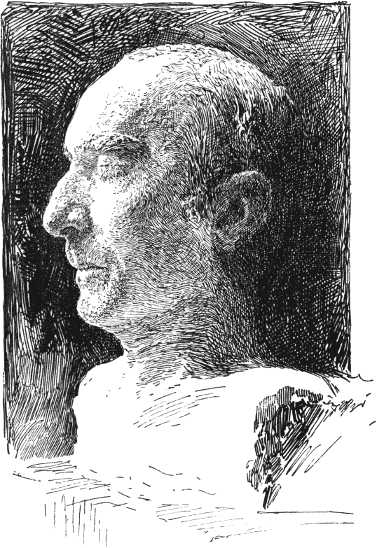
THE DEATH MASK OF EDWIN BOOTH.
Farewell! beloved spirit! Thou hast given tens, nay hundreds of thousands pleasure by thy genius, expressed for them the subtlest and most delicate thoughts and sublimest conceptions of the greatest of poets, elevated their imaginations, refined their fancy, charmed their taste, subdued their moods, and soothed their weary hours; and never once, in all thy art, suggested an impure or vicious thought, never stimulated an evil desire, nor insinuated a wanton or vulgar feeling. Thou hast done much to elevate the profession thou hast adorned; hast assisted the needy, hast stretched out a hand to aid the worthy in arriving at thy own position, and introduced thy brethren to the company which sought and welcomed thee. Thou hast been a loving son, a reverent, filial admirer of him whose mantle fell upon thee, a faithful, devoted husband, a brother worthy of the name, a tender, bountiful father, a loyal, stanch, confiding friend. The world has been happier and better for thy passage across its stage.