BURGLARS THREE. By James Harvey Smith
Reading edition
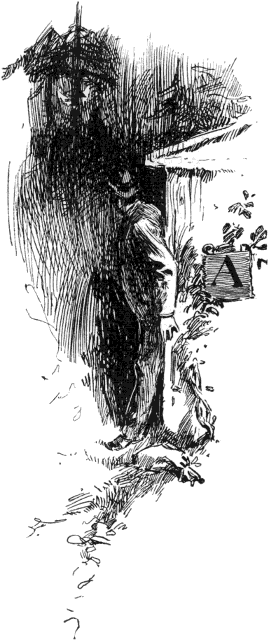
As a usual thing, when they cracked a crib, one of the three remained outside to warn with a whistle, or some other previously concerted signal, his companions inside. But on this occasion, when Jim Baxter opened the simple catch that fastened the woodshed door, and thence gained access to the interior of the house, Wilson Graham and Harry Montgomery followed softly after him. This breach of burglarious custom was probably due to the fact that the Braithwait mansion was in the suburbs, some distance from the road, and several hundred yards from the nearest house.
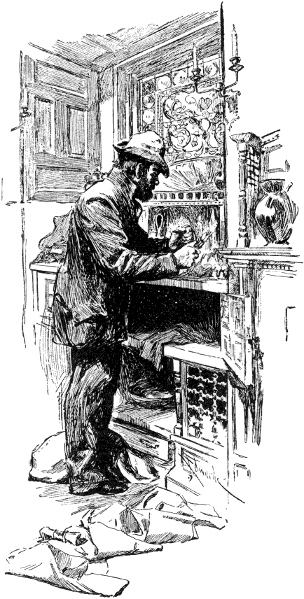
Once inside, Mr. Graham lighted the gas, and it was then the work of a very few minutes to open the sideboard and subtract therefrom the family silver and place it in a bag brought for that purpose. While this operation was taking place, Montgomery made a tour of the upper rooms.
“I don’t exactly like to trust Harry up-stairs,” remarked Baxter, in a surly tone, after he had securely tied the mouth of the bag. “He is too soft. Like as not he’ll go and git sentimental over a picture or somethin’, or maybe git a-thinkin’ of his mother, and leave half the ornyments.”
Graham, who had just opened a pearl inlaid secretaire, and was possessing himself of numerous valuable trinkets, laughed softly, as he replied:
“I don’t think so, Jim. Only yesterday I gave the boy a good talking to, and he promised to attend strictly to business in future. You must remember he is young, and, unless we give him a chance, how is he to learn? Of course, if there was a young girl in the house—but there isn’t,” he added quickly, observing the wrathful frown on his companion’s face. “I made certain that the only people who sleep in the house are Mr. Braithwait and the housekeeper, who is rather old and nearly deaf; the rest of the family are in Florida for their health. If Braithwait makes a disturbance I reckon Harry can settle him without any sentimental nonsense.”
“I’d settle him,” muttered Baxter, surlily.
“You’re a savage, Jim,” said Graham, reproachfully. “How often have I told you that there is no virtue in violence. Haven’t I convinced you that the easy way is the safe way?”
“Yah! Don’t give me no more of that!” said Baxter, contemptuously. “I ain’t no missionary.”
At this juncture, when the argument threatened to develop into a quarrel, peace was restored by the reappearance of the young burglar, carrying a considerable quantity of jewelry, loose and in boxes, while he softly whistled “M’Appari.”
“Not a bad haul,” observed Graham, turning over the plunder as it lay on the table. “Two watches?”
“They’re them little tickers what the girls carry,” said Baxter, scornfully. “We won’t get two dollars apiece for ’em.”
“Won’t we, though!” said Graham, smiling. “They are gold, and there is an inscription on each; that means a fancy reward, or I don’t know human feminine nature. Two brooches, a necklace—h’m—h’m—very good, indeed.”
“There was no money,” remarked Harry, adjusting his necktie before the mirror, and giving his small blonde mustache a curl.
“I expected as much,” commented Graham, storing away the trinkets in his pockets. “Braithwait has a hundred with him, I dare say, but it isn’t worth the risk. If we kill a man in the city it’s soon forgotten, but in the suburbs it creates a regular panic. The neighbors hire detectives and follow a man all over creation, and you can’t buy them off or compromise the matter—money is no object. That’s why I keep telling Jim—”
“Let up, will ye!” exclaimed Baxter, roughly. “I ain’t killin’ nobody, am I?”
“Certainly not; but I only say——”
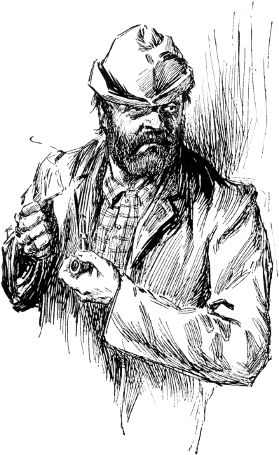
“I AIN’T NO MISSIONARY!”
“Say nothin’! where’s the feed box?”
Mr. Graham groaned, and looked at his young accomplice in comical alarm.
“I knew how it would be! Jim, these luncheons will be the ruin of us all some night.”
“Can’t help it,” retorted Baxter, doggedly. “It’s a good four-mile walk from the city and as much back, and we hadn’t anything but a snack for supper. A man’s got to eat, and when I’m hungry——”
“Well, well,” said the other, with a gesture of impatience, “if it must be, it must. Harry, see to the wine, and we will find the substantials. Now, Jim, do be careful of the dishes, and don’t grunt and puff while you’re eating. It’s vulgar.”
Jim Baxter grunted and puffed at this, but made no other reply as he busied himself spreading the contents of the refrigerator on the dining-room table, while Harry from the sideboard produced a decanter of whiskey and three bottles of claret. There was a nice piece of cold ham, some tongue, cheese and pickles, bread and butter, anchovies and sardines, a bottle of olives, and the remains of an oyster pie.
“Quite a lay-out,” remarked Baxter, with a ravenous chuckle. “D’ye remember the house at Barleytown where there wasn’t nothin’ but graham crackers and winegar in the box?”
“I should say so,” exclaimed Graham, with a look of disgust.
“Some people are too mean to live,” returned Baxter, savagely. “Come, shove over that decanter, and let’s pitch in. Fingers, gents, ’cause there ain’t nothin’ but silver knives and forks in this house, unless I take ’em out of the bag, which I ain’t doin’. Here’s luck!”
“Excellent claret, Wilson,” said the young burglar, holding his glass up to the light.
“Genuine Medoc,” returned Graham, with the air of a connoisseur. “That’s the worst of this business; not one gentleman out of ten is a judge of wine. Now, the whiskey——”
“The whiskey’s all right,” interrupted Baxter, curtly. “All whiskey’s good; some’s better’n others, but it’s all good. Blow claret!”
“No style about Jim,” said Harry, with a smile that was half a sneer.
“No, you bet there ain’t,” said Baxter, stolidly. “You oughter call me ‘Old Business,’ ’cause that’s what I am. Pass them pickles.”
It was a most interesting sight. At the head of the table sat Graham, a smooth-faced, well-fed man of forty, who might have passed for a prosperous banker, or a man living on an annuity; to his right reclined, rather than sat, young Montgomery, a spruce and slender fellow, with soft blue eyes, tremulous lips, and light hair neatly brushed; while opposite Graham sat Baxter, a coarse, shaggy, grimy man of uncertain age, with small, shifty eyes, a heavy beard, and a general air of brutal strength. Had it not been for the fact that each man wore his hat, and that the bag of stolen goods lay on one corner of the table, it might have been taken for a small stag party, Graham personating the host to perfection.
The resemblance was lost, however, a moment later. The door leading to the back stairway, directly behind Jim Baxter, opened and revealed a spare man with long blonde whiskers, wearing gold eye-glasses, and a flowered dressing-gown.
Graham was the first to see the intruder, and his exclamation of astonishment caused Baxter to turn his head. In an instant that worthy was on his feet, with a pistol in his hand. Graham was quicker, however, and before his companion could raise the weapon he seized his arm and pushed him aside.
“No violence, Jim,” he said, sternly.
“I warn’t goin’ to shoot,” growled Jim. “I was only goin’ to give him a crack on the head.”
“I won’t have it,” returned Graham, authoritatively. “Sit down.”
Baxter put up his pistol and sat down. Graham then turned to the spare gentleman, who had not moved from the doorway during this episode.
“Mr. Braithwait, I presume?”
“That is my name,” was the composed reply. “Burglars, I presume?”
“The presumption is correct. Will you take a seat?”
Mr. Braithwait sat down opposite young Montgomery, to whom he bowed gravely. There was then a moment of silence, broken by Graham, who had resumed his place at the head of the table.
“I am sorry,” said he, “you have made your appearance, as we can’t very well apologize for our intrusion.”
“No, I suppose not,” said Mr. Braithwait, smiling. “Yet I am rather pleased that I did come, since I always enjoy an unusual experience.”
“Glad you enjoy it,” muttered Baxter; but no one listened to him.
“I was aroused by the reflection of the gaslight in the upper hall,” explained Mr. Braithwait, “and I supposed that the housekeeper had left it burning—she has done so more than once. I came down to extinguish it. I heard voices in this room, and I entered.”
“At the risk of your life,” observed Graham, with a significant glance at Baxter, who had resumed eating.
“I did not think of that,” said Mr. Braithwait, simply. “My life has been threatened so often—you know I am a railroad man—that I give little thought to the risk of an undertaking. Professionals, I suppose?”
He looked at Montgomery, who nodded nonchalantly and lighted a cigarette.
Mr. Braithwait coughed.
“I wish you wouldn’t,” he said, deprecatingly. “Apart from the looks, I can’t bear cigarette-smoke. There’s a box of very fine Conchas on the sideboard. Thank you”—to Graham—“if you will join me?—thank you again.”
Graham laughed with genuine enjoyment, yet without vulgarity.
“I like you,” he said, frankly, “and I am sorry that, in the line of business——” He waved his cigar at the bag.
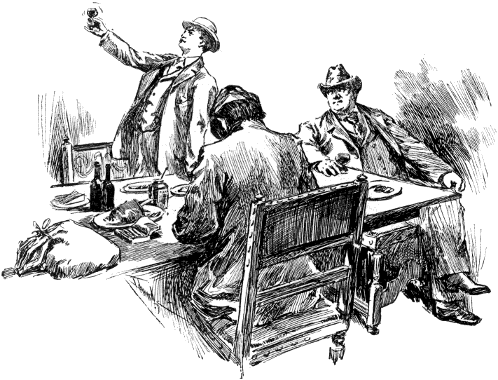
“EXCELLENT CLARET,” SAID HARRY.
“Of course, yes, of course, I know that can’t be helped,” said Mr. Braithwait, smoking away easily, “and that’s another reason why I’m glad I came. I suppose you have in that bag some trinkets belonging to my wife and daughters that have a special value as mementos. I hear that you gentlemen are frequently forced to sell your plunder at a simply ruinous sacrifice, and it occurred to me that if we could come to some arrangement—you understand?”
“Perfectly,” answered Graham. “It can be done, and I will open negotiations at an early date. Provided, of course,” he added, severely, “that you play fair.”
“That is understood. As a business man I accept the situation. My loss is your gain.”
At this the youngest burglar broke silence for the first time.
“You are a philosopher,” he said, in a tone of admiration.
“What sensible man is not?” responded Mr. Braithwait, cheerfully. “I suppose it is capable of proof that the accumulated wisdom of the ancients amounts simply to the homely proverb: ‘What can’t be cured must be endured.’ My business is a sort of war, and I have my defeats as well as my victories. I must bear them both with equanimity.”
“So is ours,” said the youngest burglar. “As Horace says in his ‘Epistles’: ‘Cædimur, et totidem plagis consumimus hostem.’”
“Permit me,” returned Mr. Braithwait, “to reply with Catullus: ‘Nil mihi tam valde placeat, Rhamnusia virgo, quod temere invitis suscipiatur heris.’”
Montgomery flushed slightly, and Baxter growled an incoherent protest against the use of foreign languages.
“Of course, I do not claim that I enjoy being robbed,” continued Mr. Braithwait, “but I realize that it is not as bad as it might be. Last week you would have caught me with two thousand in cash in the house, and last month you would have horribly scared my wife and daughters.”
“Not for worlds,” murmured Mr. Montgomery.
“Well, you might have done so—women have such a detestation of robbers, except when they are in jail. The pleasure of your visit—I hinted that I could extract pleasure from adversity—lies in the fact that it brings me in contact with a profession I have previously known only by hearsay. I suppose I may take it for granted you gentlemen are experts?”
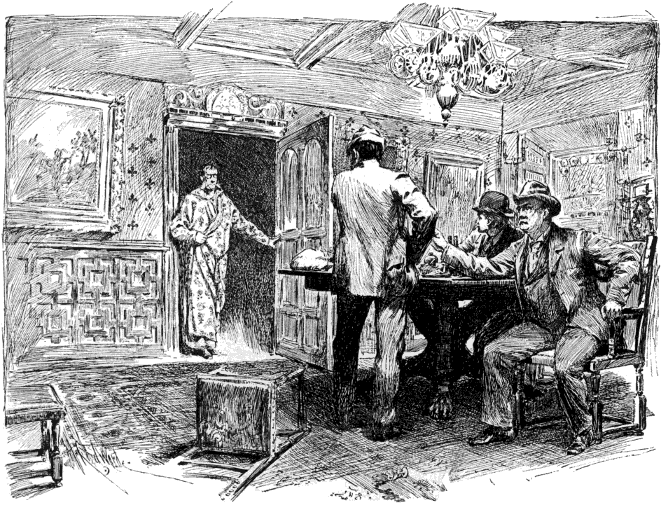
“NO VIOLENCE, JIM!”
“We’ve been there before,” said Baxter, coarsely.
“If an experience of fourteen years is any guaranty, then I am an expert,” said Graham, with a certain air of pride in his tones. “Our friend there,” nodding at Baxter, “has, I believe, been in the profession since childhood; while Mr.”—indicating Montgomery with his cigar—“you’ll excuse my not mentioning names?—is a beginner. A skilled workman, I admit, but this is only his second year.”
“I don’t wonder that he”—and Mr. Braithwait glanced slightly at Baxter,—“remains in the business, but that you should follow the vocation for fourteen years surprises me greatly.”
“Indeed?” queried Graham, with perceptible stiffness. “Why?”
“Because you appear to be a sensible man, and I should not think the business would pay. What is your annual income as a burglar?”
“On an average, I should say three thousand a year.”
“And you are an expert! I receive six thousand a year, and I am only Assistant General Freight Agent, and have been but twelve years in the business. Then I may infer that these two gentlemen make much less than three thousand?”
“I’ve seen the week when I didn’t make hod-carrier’s wages,” growled Baxter, who had now finished eating, and was preparing to smoke a black wooden pipe.
“You’re not so sensible as I thought,” rejoined Mr. Braithwait, frankly. “I can easily imagine a man exposing himself to dreadful dangers and cruel privations when there is a great prize in view. An explorer like Stanley, a pioneer like Pike or Fremont, a conqueror like Cortez, or a revolutionist like Washington, could well brave hardship and peril when success meant wealth as well as the plaudits of their fellow men. The early settlers of this and every other country, the gold hunters of ’49, the pirates who ravaged the seas, all were actuated by the hope of a fortune at one swoop; but to risk prison, to say nothing of life itself, for a day laborer’s wages!——”
“But,” spoke up Montgomery, quickly, “there is fame, if not fortune.”
“Pardon me. In what way?”
“In the usual way. Who has not heard of Hickey, the man who cracked twenty banks before they tripped him up; Peters, the New England cracksman; Bronthers, the Chicago expert?”
“I hope,” said Mr. Braithwait, gently, “I won’t offend you when I say I never heard of those gentlemen.”
“Is it possible!”
“Honestly, I never did.”
“You have surely heard of Red Leary?”
“I can’t recall his name.”
“George Post? Louis Ludlum? Pete McCartney? Miles Ogle?”
“Don’t know them.”
“Perhaps,” sarcastically, “you don’t read the papers?”
“Yes, I do, and I have a good memory. I can say without boasting that I have on my tongue’s end all the professional, literary and artistic names in America, and many in Europe. In my library I have many biographies, but none of which a burglar is the theme, nor do I recall the name of a celebrated criminal, unless,” pleasantly, “he has been hanged.”
“Yet there are famous names in our profession,” persisted the young burglar, somewhat sullenly.
“Oh, yes,” admitted Mr. Braithwait, taking a small drink of claret. “Literature has preserved Claude Duval, Jack Sheppard, Dick Turpin—all hung—Fra Diavolo, who was shot, and even our own James and Younger boys; and I have heard vaguely of one Billy the Kid somewhere out West. In a general sense, literature and the drama are saturated with bandits, brigands and outlaws, sometimes comical, sometimes heroic, but you will excuse me if I maintain that you stand on a different footing. Those fellows always had a poetical backing; somebody or something had driven them to their illegal calling, but you can scarcely make a similar claim.”
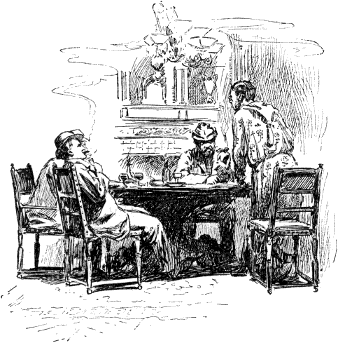
“WHAT IS YOUR ANNUAL INCOME AS A BURGLAR?”
“I don’t know about that,” protested Baxter, doggedly. “Who’d give me a job?”
“Did you ever try?”
“No; nor I ain’t goin’ to!”
“As I supposed. Honest work is plentiful, therefore you are absolutely without excuse. No one has usurped your name and fortune, stolen your ancestral home or intended bride; neither have you been outlawed for your political or religious beliefs, or unjustly accused of crime.”
The big burglar looked extremely blank at this pointed address, and took a grumbling drink of whiskey. Mr. Graham promptly came to his companion’s relief.
“You have made out a prima facie case, as the lawyers say, but the fact remains that there is a fascination in the life we lead, and some romance. There is mystery about it, for one thing, and danger for another. Then we certainly have the sympathy of a certain class of society, when we are prisoners.”
“Is not the sympathy to which you allude confined to murderers, especially those who kill their wives?”
“As a rule, yes,” admitted Graham; “but the people, who have sympathy for murderers, generally have such a superabundance that they can spare some for us. I have known burglars to receive six bouquets in a single day, and from real ladies, too.”
“I am afraid,” said Mr. Braithwait, with a smile, “that the sympathy extended with such small discretion has little market value. But let us pass that by and glance at the disagreeable side of your profession. For instance, this night you have walked from the city, the nearest point of which is three miles.”
“We come four,” growled Baxter.
“Well, four; and four back is eight. It could not have been a pleasant walk, as the night is cloudy and the roads are heavy from recent rains.”
“There warn’t no choice,” said Baxter, savagely. “We had to walk.”
“There it is,” said Mr. Braithwait, triumphantly, “you had to walk. Now, I don’t have to walk; I ride in the train or my carriage at any hour of the day or night. No honest man has to walk, if he has money—and, of course, you have.”
“The point,” admitted Mr. Graham, reluctantly, “is well taken.”
“I feel certain of it. Nor is this the only instance in which your pleasure is marred by fear. The very fame for which you strive is a constant bar to your enjoyment. If you take lodging at a hotel you are ejected; you may be refused admittance to any respectable theatre; in any place of entertainment, except the very lowest, you cannot make a new acquaintance for fear he may be a detective plotting your capture; you are compelled to eat, drink, and sleep among vile associates and vulgar surroundings; and all for a pitiful three thousand a year! By heaven! it is worth thirty!”
“You use strong language, sir,” exclaimed the youngest burglar, rising and pacing the floor in an agitated way.
“I do,” admitted the master of the house, “because my business sense is outraged by your stupidity.”
“Stupidity!” echoed Graham, sharply.
“That is the word,” returned Mr. Braithwait, sternly. “Your profession requires acuteness, courage, skill, caution, and endurance. Gentlemen, these are admirable traits, and with them you might be anything but burglars. The banking institutions, railways, private and civic corporations, are eager for such men; they pay them large wages and grant them great privileges. The governments, State and National, want such men, and are looking for them, while they are skulking through city alleys or walking miry roads at midnight. Gentlemen, with all your qualifications, you lack the one essential to success—common sense.”
“Permit me,” said Graham, leaning over the table and speaking with much force, “to call your attention to the fact that we are bright enough to keep society eternally on the defensive.”
“Granted,” said Mr. Braithwait.
“Small in numbers though we are, we necessitate the employment of a police force in every village, town, and city in the Union, to say nothing of special constables and private watchmen. We force every bank and corporation to sink thousands in costly safes, locks, and other safeguards, and no householder is ever free from apprehension on our account. We are one against many, so to speak, but we make the many tremble! Could we exercise this power without brains?”
“Ay! could we?” supplemented Montgomery, with flashing eyes.
“Granted again,” said Mr. Braithwait, cheerfully, “but quite foreign to the point at issue. Society is terrorized through its inertness, and when society enters on an active warfare you gentlemen cannot make a show of resistance. And even under our present policy of passive resistance there is but one thing that will save a criminal from the eventual clutch of the law, and that is—death.”
The youngest burglar turned white and Baxter cursed softly.
“You cannot, with all your brightness, commit a crime without leaving a trace,” went on Mr. Braithwait, impassively, “and every modern appliance is a stumbling-block in your path. The modern bank safe, equipped with time-locks, is impregnable; the electric light has made our streets as safe by night as day; and the telegraph has lengthened the arm of justice until it encircles the globe.”
“And yet,” retorted Graham, with a slight sneer, “you have been robbed.”
“And yet I have been robbed,” repeated Mr. Braithwait, calmly. “Without interfering sadly with my comfort and ease, I cannot make my house a bank or surround myself with an army of watchmen. And I don’t like dogs. So I have been robbed. Yet”—Mr. Braithwait looked Mr. Graham quietly in the eye—“yet I am not entirely defenceless.”
“Hello!” said Baxter, breathing hard. “Have you been up to somethin’?”
“You shall judge whether I have rightly accused you of lack of common sense. Before attacking this house, did you make yourself acquainted with the surroundings?”
“I did,” answered Graham, confidently.
“Do you know that I am a railroad man?”
“Certainly.”
“Did you notice a wire running through the woods at the rear of my house?”
“No!” cried Graham, violently.
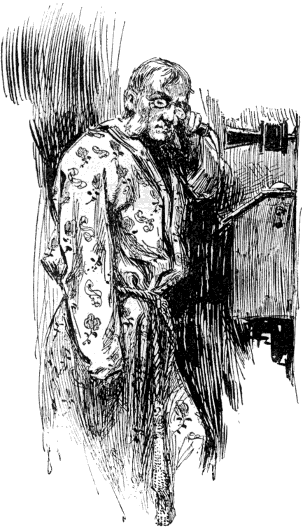
“A strange oversight on your part. Very stupid. It is a telephone wire, and leads from my chamber above to my office in the city. Now for the application of my remarks. From the moment of your entrance I was aware of your movements, and instantly explained the situation to the night operator. He, of course, notified the police——”
“And while you kept us engaged in conversation—” cried Graham, advancing threateningly.
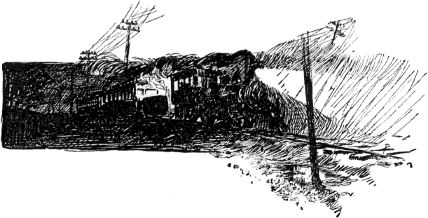
“The police were coming on a special train to my assistance,” said Mr. Braithwait, taking a second cigar.
“Damn you!” exclaimed Baxter, threateningly.
“Stop!” cried Graham, interposing. “We have no time for that. Let us run!”
“Don’t!” said the host, warningly. “The house is surrounded, and you will certainly be shot. Accept the situation, as I did. You gentlemen have been my guests this evening, and I have been highly entertained. May I hope that the pleasure has been mutual?”
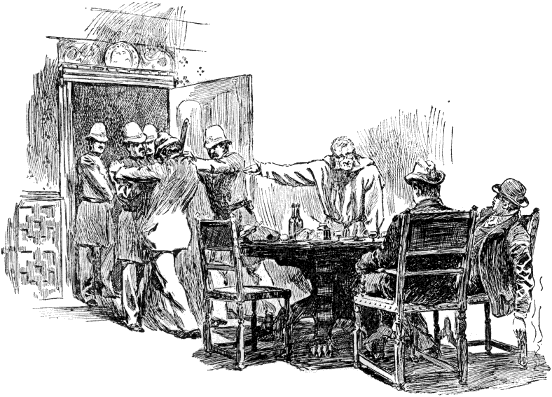
Before anyone could answer, the door leading to the woodshed was thrown open, and four policemen appeared on the threshold. Montgomery sank helplessly into a chair. Baxter made a dash for the door, while Graham remained impassive, but all were alike handcuffed expeditiously.
“Sir,” said Graham, taking a cigar from the box, “our misfortune is directly due to the uncontrollable appetite of our companion, but none the less I congratulate you upon your ingenuity.”
“Thanks,” said Mr. Braithwait. “Did I not tell you that you were stupid?”
Mr. Graham bowed.
“You have taught us a lesson,” he said gravely. “I think it is time to abandon the business.”
“Well, I’ll be——” Baxter gasped, and could say no more.
“We are disgraced!” exclaimed the youngest burglar, bitterly.
Mr. Braithwait waved his hand.
“I am sleepy,” he said, with a yawn. “Gentlemen, good-night; I will see you again—in court.”