A BOYS’ REPUBLIC. THE STORY OF CAMP CHOCORUA. By Alfred Balch.
Reading edition
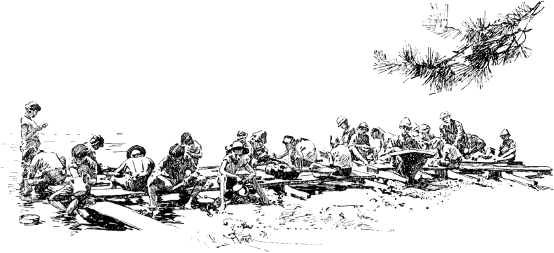
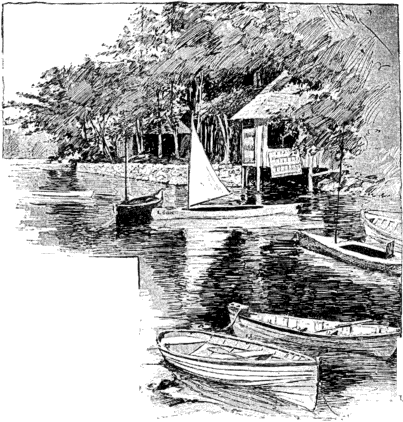
There is an island in Big Asquam Lake, New Hampshire, lying almost under the shadow of Mount Chocorua, and on it there are many buildings, rough but weather-tight; paths which have been carefully built to grade; a boat-yard, with ways leading to the water; a long wharf projecting out toward a swimming raft which is floating where there is depth for diving; a sea wall of heavy stone, against which the ice is powerless. Down by the water’s edge, and squatting on a wooden stage within easy reach, a group of boys are washing dishes. From time to time one of them, who while working as hard as any, keeps his eye on the others, gives a short order which is instantly obeyed. Other boys are sitting on the porch, polishing lantern and lamps, while yet others are sweeping up the litter which disfigures the open space. There are buildings to the right and left, there are canvas canoes and boats floating near the wharf, and a great flat boat—somewhat rudely made—is moored in front of the sea wall. With each group of boys is a young man, busily employed in the same work, but it is noticeable that he gives no orders.
From the island itself the view is exquisitely beautiful. To the north the White Mountains rest like a mighty barrier, walling in the valley at their feet. The lake itself lies smiling under the sunlight of the perfect day, or darkening under the shadow of the drifting cloud. The breeze is barely enough to fill the sails of the white canoe outside there, while the scarlet cap of the boy sailing it makes a patch of color. There are other islands with long vistas of water between them, relieving the vivid green of the trees which cover them with foliage, and coming toward the wharf is a boat filled with girls; in the stillness their gay laughter sounds pleasantly. Everywhere is the beauty of the mountains and the lake, and the voices of the boys at work fill the very air with life.
Big Asquam Lake was more picturesque during the summers from 1881 to 1889, because Camp Chocorua was there, than it has been since. The camp was founded by Mr. Ernest Berkeley Balch as a summer camp for boys, in which they could have plenty of outdoor sport, a reasonable amount of work, and abundant opportunity to enjoy themselves in their own way. Starting with five boys and a small frame shanty in 1881, it grew into one of the oddest institutions that may be imagined. It was different in many ways from anything else of the kind, and its great success was due to the fact that it was modelled on real life as men see it. The motive underlying all of its pleasant features and most quaint customs was twofold: first, responsibility, personally and for others; and, second, work—not only the work which each one must do for himself, but also that extra work which brings with it a tangible reward. The boys were encouraged in everything that would tend to develop them physically, to make them strong and healthy, but they also found themselves members of a little world that had a high standard of honor, a world in which the laws governing the conflicting interests of men were recognized and obeyed. How this was done, how Camp Chocorua was governed and run, and why the boys who were there still look on it so affectionately is not an uninteresting story.
“The Camp,” as it is always called by those who were there, took in all of the space on the island. In 1889, the last year, the buildings included the office; the big dormitory—in the upper story of which was the library, with a large room below, having at one end the great fireplace, where the camp-fire blazed and burned; the dining-house—an open shed; the cook-house, with the ice-house at its back; the store-house and faculty quarters—the upper story of this was the hospital; and the carpenter’s shop, down by the boat-yard. There were many paths built carefully to grade, and one of these led to the grove of silver birches, in the midst of which was the chapel. I think this was one of the prettiest places I ever saw. The walls were the living trees, the seats were rustic benches, and the reading-desk was a rock, oddly fashioned, of the stone of the Granite State, into the form of a lectern. Every Sunday afternoon when it was fair weather the service was held here.
It is not, however, in the buildings, on the island, nor in the trees that one can find the interest of Camp Chocorua. It was in the life led by the boys, in their customs and laws, in their courts and contracts, that this resides.
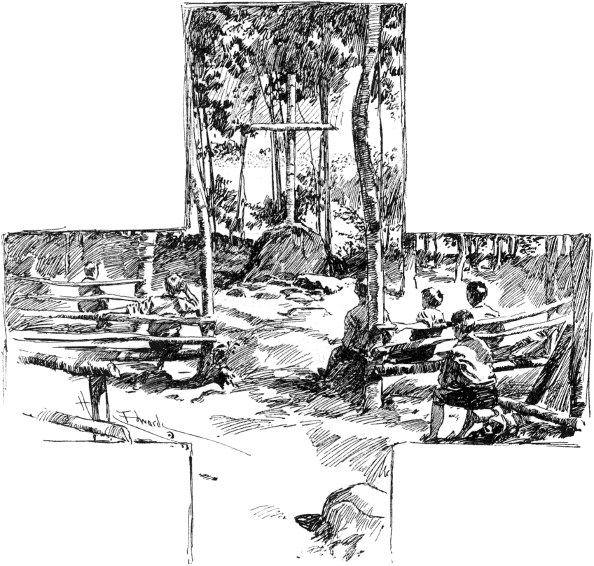
THE CHAPEL.
One of the fundamental rules of the place was that every boy or man there should do his own work and his share of the common work of the camp. Many of the boys who came had never in their lives done anything for themselves, and the first thing demanded of them, that they should make up their own beds and take care of their own clothes, came very hard. The boy was careless, he lost his waterproof, he could not put on his shoes, or could not remember to put away his clothes. There was no punishment for his fault; he was simply ranked as an “Incapable.” An Incapable was a boy who did no work of any kind, who belonged to no crew, who had no part in the busy life of the camp except that of a spectator. More than this, an Incapable was forbidden to refuse assistance from any member of a crew, and as it speedily became the fashion to help an Incapable, he had no lack of such assistance. Any one who can remember the scorn a boy feels for another who, he thinks, is less manly than himself will understand the sort of blistering sore applied to an Incapable. It was not without a pathetic side, the way in which these little chaps would work to learn how to dress themselves and lace their own shoes, and the anxiety they showed to keep their clothes and bed in order; and as an Incapable had the right to an examination, by a member of the faculty, at any time, as to his capability, few there were who were not assigned to a crew within two weeks.
The supreme power in Camp Chocorua resided in the founder, although he could not, except in extreme cases, traverse one of the customs of the camp, for these were, in fact, unwritten laws. Associated with him were the members of the faculty, generally four in number, and it was their duty to oversee and watch the boys. One of the faculty was always with a crew, and he had the right to give general orders and to inspect the work done, as a whole. He had no power, however, over the individual members of that crew, for this resided wholly in the stroke, or, in his absence, in the sub-stroke. To compare one thing with another, the member of the faculty was the general commanding the brigade, and the stroke was the colonel in command of a regiment. The general could give his orders and comment on how they were carried out, but it was the colonel who decided on details. The member of the faculty with a crew worked as they worked, taking such part of the labor as he saw fit, or doing that which the stroke asked him to. The boys in the camp were divided into four crews, and at the beginning of the camp year the strokes were appointed by the faculty. As soon as a stroke was named, he had the power of appointing his sub-stroke, or second in command of the crew, on the principle that as he was responsible for all the sub-stroke did, it was but fair he should have his choice.
The crews did all the routine work of the camp, three being on duty every day and one off. These three were the kitchen crew, which supplied the cook’s boy to prepare vegetables and run errands, and which cleaned all the pots, pans, and kitchen utensils; the police crew, which cleaned the lamps, swept the rooms, and removed all litter from the grounds; and the dish crew, which washed all the larger dishes used on the table, as well as the plate, cup, knife, fork, and spoon of any guest for the first three days of his stay on the island. After that the guest did his own work. The dish crew supplied the inspector of dishes—generally the sub-stroke—and visitors, I remember, got useful lessons on what constituted cleanliness as they stood meekly before him. It was safe to say that any article passing inspection was in a condition to be used again. Each crew in turn became kitchen, police, and dish, during three days, and on the fourth, the off crew. This was expected to do any work outside of the regular duties of the day, such as manning a boat for visitors, handling express matter or supplies, or, in short, anything not done by the others. The milk boat was manned by the kitchen crew, and the mail boat by the police. Practically speaking, each crew worked about five hours a day.
It was a cardinal principle in Camp Chocorua that the boys should govern the boys. The strokes were to all intents and purposes supreme over their crews, and under no circumstances did a member of the faculty give an order to a member of a crew. The order was given to the stroke or sub-stroke in command, and he carried it out as he saw fit. The stroke was expected not only to rule his crew and see they did the work, he must also set them an example by doing as much or more than any one of them. In point of fact, the stroke and sub-stroke were generally the two most efficient boys in a crew. But in such a system as this, that a member of a crew might be disobedient, or a stroke might be tyrannical, was not lost sight of. The stroke had no power to punish, but he could, were his orders disobeyed, direct a boy to report to the faculty. On the other hand, although the presence of a member of the faculty prevented any open bullying, it was within the power of a stroke to “work” a boy, and that boy had an appeal to the faculty. As in Camp Chocorua in proportion to the power was the responsibility, the appeal was a much more serious thing than the report. When the latter was made by order of a stroke, the boy might be reprimanded, given a good talking, or be shifted into another crew. In extreme cases he might be declared an Incapable—than which nothing was more detested. If it were found that a boy could not get along with any stroke he might be sent home, because this meant he refused to submit to the discipline of the camp.
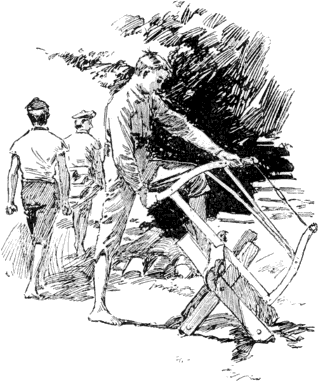
The position of stroke was the most sought for in Camp Chocorua. It was understood the stroke had to get the work done perfectly, rule his crew justly and without friction, and personally be a model of a camp boy. If he failed in either of these, the inference was obvious—he was unfit for the position; the faculty had made a mistake in putting him into it. If a complaint of tyranny was proved, there was but one thing to do—the stroke was reduced in rank. He lost all the privileges of his position, and in the eyes of all, men and boys alike, he was disgraced; he was officially declared to be unfit to govern others. It is difficult to find among the possible experiences of men anything equal in severity, and the boys in the camp dreaded such punishment as they dreaded nothing else. It was bad enough when a sub-stroke was reduced, but to a stroke it was terrible. The system, however, was in itself almost enough to prevent this punishment. A stroke was expected to keep his crew happy and contented, and there were keen eyes watching him all the while, and kindly men ready to give a hint.
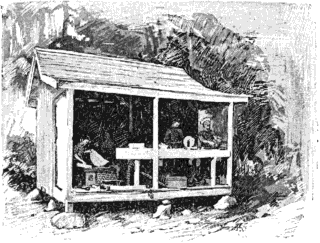
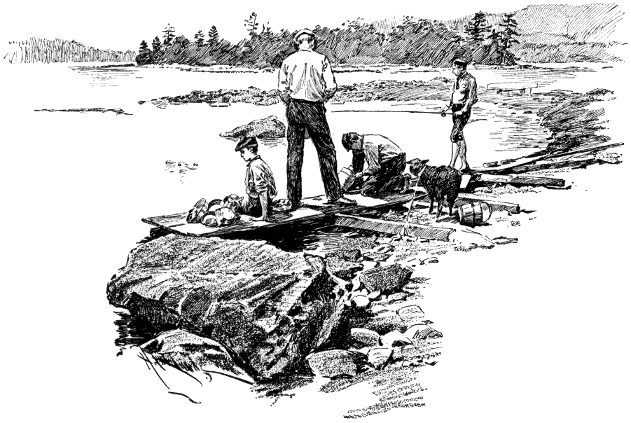
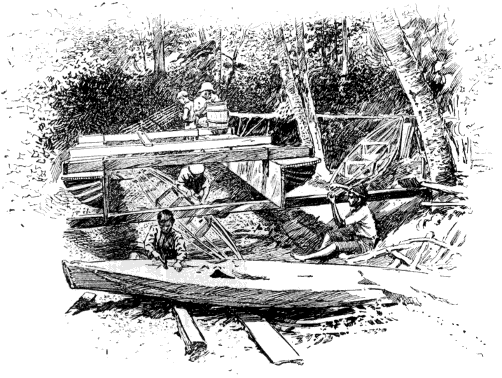
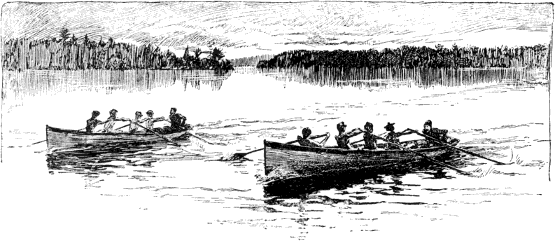
Under its curious double government by faculty and boys, Camp Chocorua prospered and grew. The personal and routine work was done, the boys played baseball or tennis, they swam and dived, and went sailing, rowing and paddling. No ambition was greater in the mind of a camp boy than that of owning a canoe, and as many of them were not rich enough to buy, the boat-yard was established in the cove. Here was the carpenter shop, with a full set of tools and a bench, and outside its open door were the ways on which the canoes were built. At one time the yard was full of the pretty little boats in all stages, from the keel with its newly joined ribs to the completed canoe on whose canvas cover the paint was slowly drying. Exceedingly good canoe builders some of the boys turned out to be, and their models were not only fast but safe. Here, too, was the floor on which they cut their sails, or sat and talked as they stitched in the leach lines or fastened the reef points in place. Many of the canoes were the work of their owners’ hands in every part—hull, paddle, sails, and rigging. When the fleet came in, paddling in open order, I never saw anything prettier in my life than the white hulls gliding so easily over the placid water, the boys singing and keeping stroke, while beyond lay the green islands, casting the long shadows from their trees under the setting sun. It was in this yard that the great flatboat was built in which the whole camp moved about the lake, ten oars on a side, and every boy tugging for all he knew. An unwieldy craft, in which one earned his passage. It was in this yard, too, that the best canoe designers earned much money from their less skilful comrades.
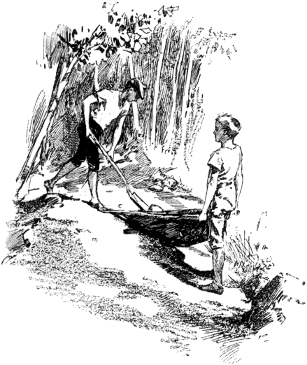
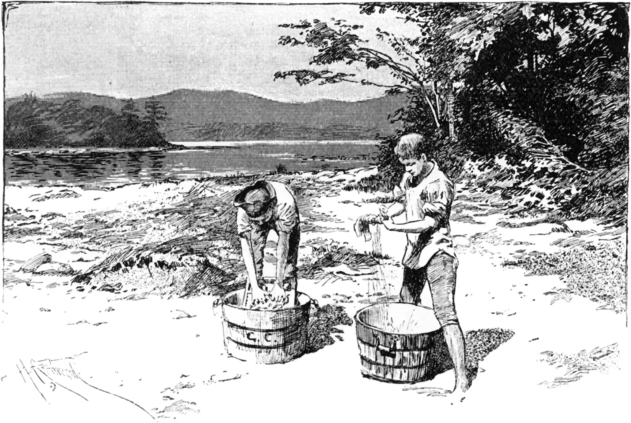
The financial system of Camp Chocorua was as odd, when one thinks of it as applied to boys from eight to fourteen years, as were many other things about the place. Each boy had an allowance of twenty-five cents a week paid by the camp, and no boy, no matter what the wealth of his parents, was allowed to bring money given him to the camp. His outfit might include fishing-tackle, but a canoe was barred. If, as was generally the case, he wanted more money than his allowance, he could get it by working during his own time. While the boys did the routine work of the camp as a part of their duty, they had nothing to do with permanent improvements, yet there were many of these made during the nine years. These were paid for by the camp, and it was a cardinal principle that when work of this kind was to be done, the boys should earn the money if they chose. Out of this rose the system of contracts. The work to be done was announced beforehand, and then sold to the lowest bidder, who was required to sign a contract. This was printed in legal form, with the camp as party of the first part, and the contractor as party of the second, the price to be paid and the time being duly entered. The book of contracts is one of the most curious things to study. One of the pages reads “building one yard on the chapel path to grade,” price five cents, and time one week. “Removing a stump in front of the office and filling the hole,” is another, price twenty-five cents. Some of the contracts were taken by firms and others by companies. “The Goodwill Contract Company” takes a contract to do the washing of the camp, and the president’s signature is affixed. If a contract was performed, the price was credited to the contractor in the bank. It might be that, owing to circumstances, the time was extended, or the contract might be forfeited for non-performance. In the latter case it was sold again to the lowest bidder, and the difference—if any—between the original contract price and the sum charged to finish the work was charged to the contractor. It was very rarely that an old camp boy either underestimated the amount of work necessary or the time required, and the forfeitures were for the most part among the new boys. They learned quickly, however. Under this contract system the paths were made, the wharf built, and, in fact, the majority of the permanent improvements carried out. The contracts were not always with the camp. The boys made them with each other, as in the building of canoes, and as the boys had no power to put up a forfeited contract at auction, the courts became necessary. The camp, the men or the boys were all alike subordinate to the courts; either could sue or be sued, and each was bound by the result.
In the court of first instance one of the faculty presided as judge, and there might or might not be a jury. The parties to the cause could argue their own cases, or they could appear by counsel chosen from the boys or the faculty. In case plaintiff or defendant chose, he could appeal from the decision, providing he deposited a check for the full amount of damages and costs. The Appellate Court consisted of a majority of the members of the faculty—not less than three—and in this there was no jury. It must be acknowledged that in appeal cases the judges took cognizance of the facts as well as the law. But the law of the camp was so well known to every boy there, and it was so simple, that no boy could fail to see the justice of the decision. It must be remembered when these courts are considered that to the boys they were very real. It cost five cents to bring a suit, and fifteen for an appeal, and the sums sued for were lost or won in reality. The costs went to the officers of the court, excluding the judges, who served for honor. If counsel were employed they had to be paid, unless they volunteered, and it came to be naturally understood that a plaintiff or defendant in the wrong could not get volunteer counsel. The verdict—when there was a jury—was that of the boys themselves; they condemned or approved of what other boys had done. As the boys were trusted to rule each other, so they were the guardians of each other’s rights, while the power of appeal made it impossible that any wave of temporary unpopularity should bring injustice to any boy. Camp Chocorua was builded on this idea of the boys managing themselves, but there was ever present the superior authority to prevent wrong being done, and the very existence of this authority made it rarely called on.
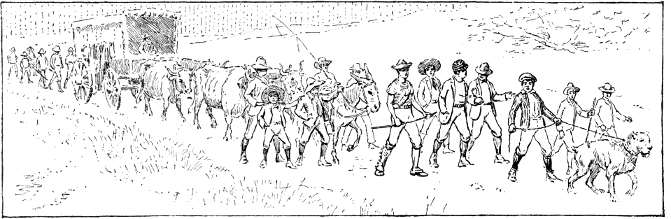
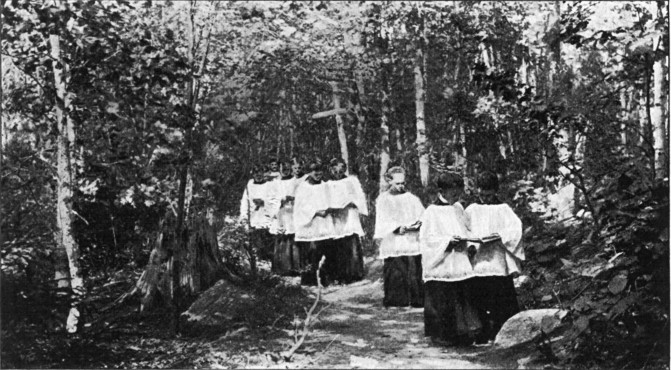
THE CAMP ON MARCH.
The keenness in business of these boys is well illustrated by the story of the Soda-Water Trust. Whenever the boys went to the store in Holderness they generally bought soda-water. This went on until some one suggested the apparatus could be bought and the soda-water made in the camp. Two firms—one of three boys and the other of two—each firm having a bank account large enough to purchase the apparatus and supplies, were formed at once. But the privileges or monopolies in the camp were always sold for the benefit of the Charity Fund, and it was promptly announced the soda-water franchise would be put up at auction. The two firms were rich, but they were not willing to enter a contest of this kind. The members got together and talked matters over at length, finally resolving to form a trust. When the time came the trust bid one cent for the franchise, and there being no other bid it was sold at this price. When their apparatus came the trust did a rushing business.
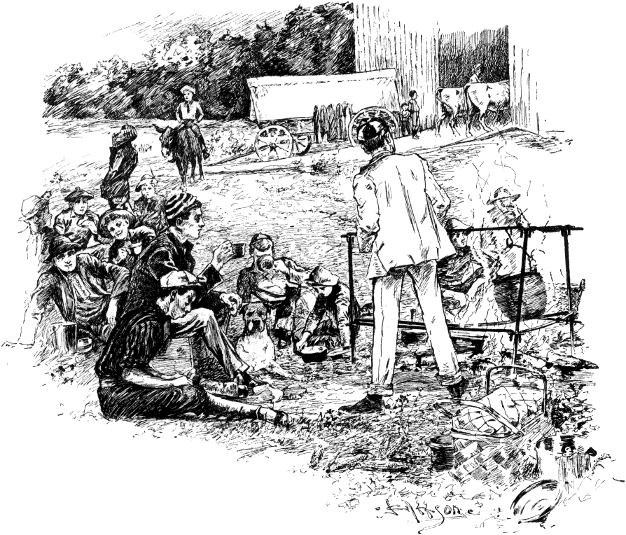
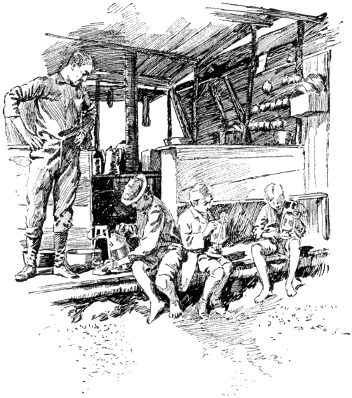
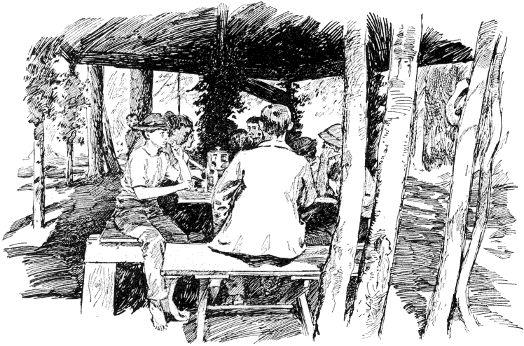
A HALT FOR SUPPER.
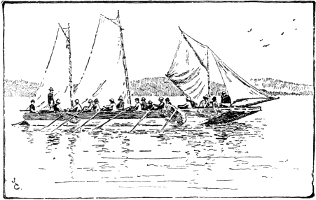
THE BARGE.
In the Camp Chocorua bank, each man and boy had an account. Payments of all kinds were made by check. The allowance was added to the account each week, and as the boys made money the credits grew larger. At the end of the camp season the depositor could either draw out his balance or have it carried over to the next summer. During the winter he was allowed to earn money by work, provided he received no more for it than would have been paid to anyone else, and this money could be added to the bank account. One boy brought nine dollars and seventy-five cents as the result of shovelling snow, but the canoe his father gave him could only be kept when he showed himself able to pay for it. This he could only do by borrowing from the bank the necessary balance; but his credit was good, and the summer was not half over before he had paid back the loan. I have often laughed when I have thought of the feeling with which that father must have looked on his son’s check, and realized what it meant. If the boys in Camp Chocorua learned anything, they learned not to be ashamed of labor in any form. The dignity of work was silently taught them, even as they were taught to expect the tangible rewards.
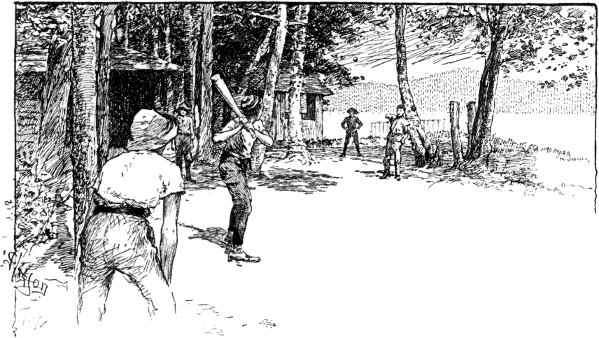
It was towards the middle of the second term of the camp that the sports took place. For days before, the boys were at work cleaning the camp up, and the cooks—two of the boys—were busy getting the lunch ready. To the sports all the friends and relations of the boys were invited, and there were usually many grown people present. There was a game at baseball, some sets at tennis; there were sailing, rowing, and paddling matches, swimming and diving contests, foot races, and the like. The prizes were simple enough, bits of ribbons with the name of the camp, the contest, and the date painted on, yet they were valued very highly. Splendid work the boys did in these sports, and conclusive was the evidence of their thorough training during the summer. Those who attended the sports once were always glad to come again, for long as the days were, they were filled with fun and frolic. In the evening the boys and their visitors gathered around the great fireplace in the dormitory building, and there, in the light of the camp fire, joined in the camp songs. The last song of all was “The Battle Hymn of the Republic,” the verses being sung as a solo, and the chorus by everyone present; and it was with the grand old melody still ringing in their ears that the guests took the boats which carried them home.
There was one prize awarded at the sports which might come to any boy. This was the “C. C.” pin in silver. Those who won it were the boys who had in their own way shown themselves to have got the greatest good out of the camp, and who had done the most good to others. The pins were not common; two or three, perhaps, were given in a summer, and sometimes none at all. It is most difficult to define the conditions under which the pin was given; it came as the result of a unanimous feeling in the faculty that it had been won, rather than as the result of rules obeyed. A conscious effort to win it was enough to prevent success. The boy had to show the manliness, justice, truth, conscientiousness in him, not for reward, but because he had them in him; and then the reward, or rather the recognition, came. Intrinsically these little pins are worth nothing; but those who have them value them as they value few things, and they are right.
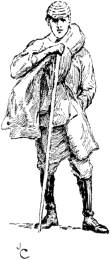
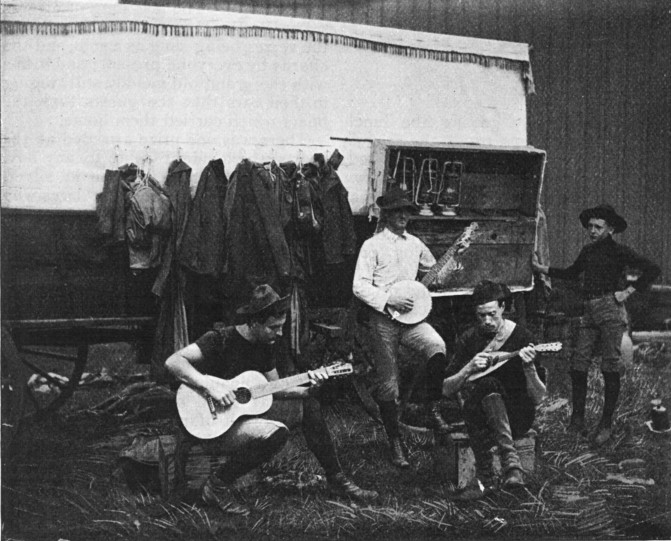
The cruise which marked the end of the summer’s camp life was one of the most picturesque things imaginable. An ox-cart with four oxen carried the blankets, dishes, and stores; Porgus, the great, slobbering bloodhound, was fastened to the rear axle, the Infant—the youngest boy in camp—mounted the donkey, and with faculty and boys on foot, the camp set out. The routes taken during the nine cruises included all the best known roads in the White Mountains. Generally, those boys who wished to made up a separate party, and climbed some one of the great peaks, while the rest confined themselves to lower levels. At night they all slept in some barn. The routine work of the cooks and crews went on as usual, and the whole thing was pick-nicking on a grand scale. Sometimes the ox-cart would stall, or the oxen be unable to haul it up a hill, and then the rope was fastened on, and the whole camp toiled on and pulled. It was an experience to pass them at this time, to listen to the orders of the strokes, to hear the chaff flying back and forward, and to watch the crowd, all clad in gray knickerbockers and jackets, gray stockings and flannel shirts, and wearing the scarlet knit Scotch caps which completed the camp uniform.
There is a story about Porgus, the big bloodhound, which is worth telling. When they first got him everyone supposed he was exceedingly fierce, and, lest he should bite, he was tied up on another island, and his food taken to him twice a day. Suddenly, one day, Porgus was seen swimming towards Chocorua, and, the alarm being given, everyone except the man who knew him took refuge in the house. The dog was taken back and tied up, but as he could gain nothing by howling he broke away once more. The fact of the matter was, that Porgus was lonely, and that so far from being fierce, he was one of the most good-natured beasts in the world. This having been found out, he was added to the list of camp pets. These at various times included a flying squirrel that had a habit of jumping on your shoulder as you passed his tree; a black sheep called Billy, who learned to butt anyone in the neighborhood; the donkey, and the kyuse—the latter a mustang pony. All of these in their time were important members of the camp. Old Captain Cairns, too, a man who lived alone in a most curious house on one of the islands, was one of the greatest friends of the boys, and always came to the sports. The captain was a curiosity in his way, and he never got tired of telling yarns about the places he had been to or the people he had seen.
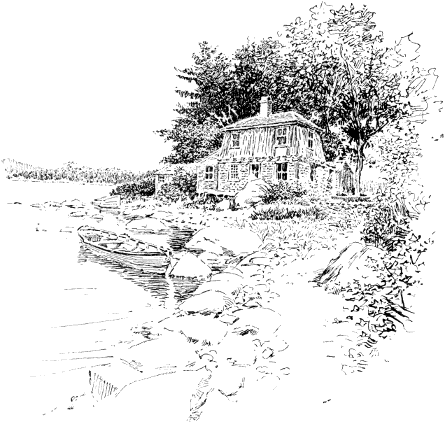
CAPTAIN CAIRN’S HOUSE.
The story of Camp Chocorua, of the healthy, open-air life, of the high standards so rigidly lived up to, of the fun they had, of the work they did, and of the lessons in manliness they so unconsciously learned, is really written in the memories of the boys who, during those nine summers, spent their time on that little island. This article is but a brief account of the methods through which so much was done. The place now belongs to the founder, and a custodian is kept there to look after it. The buildings are open to the old camp boys, and many of them spend their vacation time there. For the most part, they are men in the world now, but none the less do they look back at the camp with pleasant memories, feeling and realizing, as they never did then, all that the camp life meant to them. Everything is ready for them; they have but to hang up the great Chinese gong on which the hours were struck, and the camp is open. They can sail, row, and swim, and at night, sitting before the “camp fire,” they can bring back the days when they were boys; they can tell their stories of the contracts and the trials, the sports and the cruises; they can laugh over half-forgotten jokes, or speak in lower tones of the boys who are now dead. For although Camp Chocorua has ceased to be, Camp Chocorua lives in the memories of the camp boys.