PIERO DI COSIMO DE’ MEDICI (continued 2)
Reading edition
Rainaldus De Ursinus, Apostolice Sedis subdiaconus.[129]
Maddalena Orsini to Lorenzo de’ Medici
Magnifice vir, et mi fili benedicte, salutem,—I have had a letter from you which is most welcome, in which you say that your coming here depends upon the will of the Magnificent Piero and the opinion of his Lordship the Cardinal. I am quite content with whatever pleases them. How glad I should be to see you before sending my daughter I cannot express, but I am sure the Magnificent Piero knows best, and that we shall never err by carrying out his commands. At all events I hope you have the wish to know me and all your relations here. No more. God preserve you ever in good health and happiness. Clarice is well and commends herself to all.—Rome, March 4, 1469.
Maghdalena De Ursinus.[130]
Filippo de’ Medici, Archbishop of Pisa, to Lorenzo de’ Medici
Magnifice vir et frater honorande, &c.,—I hardly know how to express to Your Magnificence with what pleasure and contentment I have this day espoused in your name the Magnificent and noble Madonna Clarice degl’ Orsini, a maiden whose looks, carriage, and manners I conceive merit the bridegroom who was I think destined for her by Heaven. For this Your Magnificence ought devoutly to thank God who in this, as in other matters wherein you have been so well treated by fortune, has protected you; and I, who desire your well-being and honour as ardently as any one, for many reasons have longed for this day and congratulate Your Magnificence ex intimo cordis; may it be productive of all good. I pray our Lord Jesus Christ to grant to both a happy and a long life together and to let you see filios filiorum vestrorum usque in quartam et quintam generationem. I will say no more because from Giovanni [Tornabuoni] you will have heard everything. If I can do aught for your service let me know, and I will do it as willingly as any one alive, as I am sure Your Magnificence knows quam Deas diu felicem conservet.[131]
Lorenzo in his Ricordi writes: “I, Lorenzo, took to wife Clarice, the daughter of Signor Jacopo Orsini, or rather she was given to me (i.e. betrothed), in December 1468 and the marriage was celebrated in our house on the 4th June 1469. Till now I have by her two children, a daughter called Lucrezia ... years old, and a son called Piero ... months old. King Ferrante is the godfather of the girl. She is again with child. God spare her to us for a long time and preserve her from all ill” (see p. 153).
The following description of Lorenzo de’ Medici’s wedding is taken from a contemporary manuscript existing in Codex 574, Class xxv. of the Strozziani MSS. in the National Library of Florence. There is no record of the writer in the manuscript, but his name appears in the catalogue of the Library as Piero di Marco Parenti, and it may be that it was on the cover which is wanting. Born in Florence in January 18, 1450, Parenti died in May 1519, and according to Moreni was the author of several other works which still exist in manuscript in the Library. The name of the person to whom the letter was written does not appear, but from people mentioned, and other indications, he may have been Filippo di Matteo Strozzi, the builder of the fine Palazzo Strozzi in Florence, who was then in Naples.
An Account of the Wedding of Lorenzo di Piero di Cosimo, according to what was told me by Cosimo Bartoli, one of the principal Directors of the Festival, particularly as regards Sweetmeats and Sugar-plums, and also what I saw myself.
On Friday, which was the 2nd of June, the presents offered by the countryside began to arrive from the principal towns, Pisa, Arezzo, and other communes, villas, and castles. All presented eatables, such as calves, fowls, geese, wine, sweetmeats, wax, and fish. I send you the exact list as far as I could get it. The presentations of these went on all day on Saturday with great noise and rejoicings: and on that day pieces of veal of from 10 to 20 lbs. in weight were given to 800 citizens. You and I were among the number.
Calves, 150.
More than 2000 couples of capons, geese, and fowls.
Sea fish and trout in large quantities. I do not yet know how many.
Sweet things in abundance; sugar-plums as big as arbutus berries, almonds, pine-seeds, sweetmeats, also the imitations thereof from there [Naples?]. The number I do not yet know.
Wax I know not how much.
Many hundreds of flasks of wine and several casks of foreign wines, such as malvasy and the like, and of native red wine.
Of corn, oats, and the like, I do not think there was much.
On Sunday morning the bride left the house of Benedetto degl’ Alessandri on the big horse given to Lorenzo by the King [of Naples], preceded by many trumpeters and fifers, and surrounded by the youths usually in attendance on marriage festivities, well clothed. Behind her came two cavaliers, Messer Carlo and Messer Tommaso, on horseback with their retainers, who according to the usage of the city accompanied her to her husband’s house which was most sumptuously adorned, and where a stage had been erected in the street for dancing. As she dismounted the bride’s retinue arrived from the house of the Alessandri: thirty young matrons and maidens most richly dressed, and among them was your Fiammetta, one of the two handsomest there. They were accompanied by another set of youths dressed for dancing and preceded by trumpeters. Thirty other maidens were in Lorenzo’s house to receive the bride and her retinue. After the olive tree, to the sound of much music, had been hauled up to the windows, all went to dinner. The tree was arranged in a vase like those used on the triumphal cars for the feast of S. Giovanni and was almost like a trionfo.
The order of the banquets, of which there were five, was alike on the mornings of Sunday, Monday, and Tuesday.
The bride, with about fifty maidens who were the dancers, ate in the garden under the loggia which you know, and the tables were set at the sides as far as the doors, one of which leads into the house, the other outside. In the loggia which surrounds the courtyard of the house sat the citizens who had been invited. The tables were placed on three sides, beginning from the garden, and following the wall were six tables: here sat from seventy to eighty citizens. In the ground-floor hall the youths who danced, about thirty-two or thirty-six, were seated. Forty or more men of more mature age were occupied in marshalling the banquet, and at every table were two who acted as seneschals. On a balcony in the great room upstairs dined the women of a certain age, among them was your mother-in-law Monna Antonia, and like her were about forty others in the company of Monna Lucrezia. In short, at the principal tables dined about two hundred people.
The order observed in serving was marvellous. For all the dishes were brought in at the door opening into the street, preceded, as is the custom, by trumpets. The bearers turned to the right in the loggia and returned to the foot of the staircase up which some went, while others passed into the hall to the youths, and others to the maidens in the garden, and others again remained under the loggie where were those who had been invited, so that all were served at the same time. The like order was observed in taking away the dishes, and each man knew his service and his place and did nought else. The dishes were according to the tables, and among those who brought them in were the stewards, each of whom directed his own men to the proper table. There were fifty large dishes, the contents of each of which were sufficient to fill two trenchers, and one trencher was placed between every two guests, a carver being in attendance.
The banquets were prepared for a marriage rather than for a magnificent feast, and I think this was done de industria as an example to others not to exceed the modesty and simplicity suitable to marriages, so there was never more than one roast. In the morning a small dish, then some boiled meat, then a roast, after that wafers, marzipan and sugared almonds and pine-seeds, then jars of preserved pine-seeds and sweetmeats. In the evening jelly, a roast, fritters, wafers, almonds, and jars of sweetmeats. On Tuesday morning, instead of the roast were sweet pies of succulent vegetables on trenchers; the wines were excellent malvasy, trebbiano,[132] and red wine. Of silver plate there was little.
No sideboards had been placed for the silver. Only tall tables in the middle of the courtyard, round that handsome column on which stands the David,[133] covered with tablecloths, and at the four corners were four great copper basins for the glasses, and behind the tables stood men to hand wine or water to those who served the guests. The same arrangement was made in the garden round the fountain you know. On the tables were silver vessels in which the glasses were put to be kept cool. The salt-cellars, forks, knife-handles, bowls for the fritters, almonds, sugar-plums, and the jars for preserved pine-seeds were of silver; there was none other for the guests save the basins and jugs for washing of hands. The tablecloths were of the finest white damask linen[134] laid according to our fashion.
About four hundred citizens were invited to these five banquets, and among them the first of your house was your Lorenzo, and then Agnolo and Lodovico; I was also there.
On Monday morning to all who had received veal, jelly was given, and then about 1500 trenchers full were presented to others. Many religious [monks and nuns] also received gifts of fowls, fish, sweetmeats, wine, and similar things.
After the guests at the first tables had finished many hundreds ate. They say that between the house here and that of Messer Carlo[135] more than a thousand people ate, and at Messer Carlo’s every day one hundred barrels of wine were drunk.
In the house here, where the marriage feast was, every respectable person who came in was at once taken to the ground-floor hall, out of the large loggia, to refresh himself with fruit, sweetmeats, and white and red wine. The common folk were not invited.
The feasting began in the morning a little before dinner-time, then every one went away to repose. At about the twentieth hour (4 o’clock) they returned and danced until supper-time on the stage outside, which was decorated with tapestries, benches, and forms, and covered in with large curtains of purple, green, and white cloth, embroidered with the arms of the Medici and the Orsini. Every time a company came on to the stage to dance they took refreshments once or twice, according to the time. First came the trumpeters, then a great silver basin, then many smaller ones full of glasses, then small silver jars full of water, then many flasks of trebbiano and then twenty-three silver bowls full of preserved pine-seeds and sweet conserves. To all was given in abundance and all the dishes were emptied; and the same with the flasks of wine. The account has not been made, but from five to ... thousand pounds of sweetmeats and sugar-plums were consumed.
The bride has received about fifty rings, costing they say from ten to fifty or sixty ducats each; one piece of brocade; a sweetmeat dish of silver, and many other such things; and a small book of the offices of Our Lady, most beautiful, the gift of Messer Gentile,[136] written in letters of gold on blue vellum and covered with crystal and worked silver, which cost about two hundred florins. On Tuesday the bride left (a tournament was held first), and returned to the house of the Alessandri in the same dress in which she came to be married. This was a robe of white and gold brocade and a magnificent hood on her head, as is used here. She rode the same horse and was accompanied by the same youths, whose rich dresses of silver brocade embroidered with large pearls and jewels baffle description. From what they tell of courts of great princes nothing was ever seen like it save certain jewels of great value worn by some great Lords. Of the women I say nothing! Such jackets and robes of silk, all of them embroidered with pearls. I rather blame than praise this height of civilisation. And thus ended this marriage.
One day it rained; on the Monday, just when the feast was at its highest. It seemed as though done on purpose. It enveloped everything and wet the beautiful dresses, for the rain was so sudden and so heavy that many could not get under shelter soon enough. But the youths and the women had not put on the finest clothes which they had reserved for that day, the most important of the feast, so that to many it seemed their money had been spent in vain, not being able to wear them. However, on Tuesday morning when the bride went to hear mass in S. Lorenzo, accompanied by all the youths and maidens who had attended her at the wedding, every one was in their finest clothes. I warrant you that there were about fifty maidens and young girls and as many or more youths, so richly dressed that I do not think that anywhere among so many people could such a splendid and fine spectacle be seen.
I know that though I have written you many things and in much detail there is much still to be said; and although it is not worth your reading or my writing, yet I have done so for your information, as I know you to be curious, and that you like to know exactly how things went. So I have written thus thinking it would please you better than a more serious style.[137]
Rinaldo Orsini to his sister Clarice de’ Medici
Magnificent sister, salutem. From Messer Giovanni [Tornabuoni] we have heard all the excellent news about your family, so that we are most happy and contented, and could have received no better news. We all beg and advise you to conduct yourself in such manner with every one that you will become even dearer to Piero, Lorenzo, Giuliano, Madonna Contessina, and Madonna Lucrezia, and to your sisters-in-law, and generally to all relations and other persons you meet. If we can do anything here for Lorenzo or any of your family offer me to them, for nothing shall be left undone to fulfil any desire of theirs. Also if there is aught you wish done tell me, and I shall show that I hold you as dear as I do Organtino, who, as a male, and careful of the interests of our house, I love as I do my own life. Commend me to the Magnificent Piero and the ladies, and salute Lorenzo and Giuliano from me. Item it is necessary that Messer Baptista da Augubio [Gubbio] should go to Florence, you know how devoted he is to us; if needs be ask Piero and Lorenzo, for love of us, to favour him.—Rome, June 1469.
Rainaldus de Orsini.[138]
Giovanni di Bentivogli from Bologna to Piero de’ Medici at Florence
Magnifice et Prestantissime Pater honorande,—I have not written to Your Magnificence in these last days about the affair at Rimini, because I was sure you would hear of it from diverse sides, and that the Illustrious League would take proper steps. But as I neither see nor hear that the Illustrious League has made any sign of life and considering the great injury to us, to the friends of the League, and to yourself, which will be occasioned in the future, I am moved to note it and to impart my thoughts to Your Magnificence; although I do not esteem myself of sufficient capacity to write such notes. But anxiety, and devotion to the Illustrious League, and the love I bear Your Magnificence induce me to warn you. I have also written this my opinion to H.E. the Duke, and should have done the same to H.M. the King, only the road is long and our messengers pass with difficulty; also I thought Your Magnificence would have sent the news from there. Your Magnificence must have heard that the Signoria of Venice has again made an alliance with our Lord the Pope, et inter alia has promised to send, whenever he demands them, 4000 horse and 3000 foot-soldiers into Romagna. From good authority I hear that the Pope has just asked for them, and that the Signoria is arming them and has ordered His Magnificence Ercole [Duke of Ferrara], the Lords of Carpi and of Mirandola, to hold themselves in readiness to march; and that yesterday they were to receive their pay. Also I hear that bridges are being thrown across the Po near Ravenna, for the passage of the troops of the Signoria of Venice, and that the picked squadrons and Antonello da la Corna were advancing to meet these others. What all these preparations mean I leave to the judgment of Your Magnificence. I can only imagine that the Pope and the Signoria of Venice intend to occupy Arimino and the rest of Romagna and then Bologna. Should Rimini fall this will probably happen, and where Bologna and Imola would be Your Magnificence and the League may, like prudent men, calculate. He who does not put a stop to such beginnings will spend a hundred instead of one, and God grant things may go well. I therefore beg and entreat Your Magnificence to succour little Arimino in order that the wound may not fester and increase in such wise that none can heal it. The Illustrious League must not allow its friends to lose courage and faith, else the end will be our perdition. To me it seems this is not a moment for losing time. Your Magnificence must remember that the Pope and the Signoria of Venice have been preparing this for a long time, otherwise the Pope would not have spent so much money, a thing quite against his nature. Had the move been only against Arimino; but it is more especially against Bologna and the rest of Romagna, and more considerable events may follow. I commend myself to Your Magnificence.—June 17, 1469.
Johannes di Bentivolis.[139]
A few weeks after his wedding Lorenzo had to leave his bride and undertake an embassy to Milan. A son had been born on June 20th to Galeazzo, Duke of Milan, and Piero de’ Medici was asked to stand sponsor to the child. He was too ill to travel, and “somewhat unwillingly,” he confesses, sent Lorenzo to act as his proxy. The embassy went by Prato, Pistoja, Lucca, and Pietrasanta to Sarzana, which town and district had been recently purchased by Pietro and added to the Florentine dominions. Thence the company travelled by Pontremoli to Milan. The preparations for the journey were evidently on too magnificent a scale to please the cautious father, and we find him complaining to his wife Lucrezia in a less affectionate tone than usual. The following three letters refer to the journey. To it also belongs the passage in Lorenzo’s Ricordi or memoranda, in which he states that Sforza proposed that he should stand godfather to all his other children.
Piero de’ Medici at Careggi to Lucrezia his wife in Florence
Thou knowest how unwilling I was for many reasons, particularly in order not to give any importance to this mission, to allow Lorenzo to go. Yesterday we agreed about this, but I have not heard what thou hast done; it has been much talked about, which displeases me. Herewith I repeat that they must be here this evening and start infallanter to-morrow morning. If they do not, I shall arrange in some other way. Meanwhile see that everything is ready, and tell Lorenzo that he is not to exceed his orders, or to make any great show;[140] he is not an ambassador. I am determined that the gosling shall not lead the gander to drink. Make haste, for thou must return here without fail this evening. No more.—Careggi, July 13, 1469.
Piero di Cosimo.[141]
Gentile Becchi to Clarice de’ Medici
Magnifica Domina, &c.
Your Magnificence commanded me to send you news of your Magnificent Lorenzo every eight days. I now begin to recount the first week. As you will have heard from Francesco Nori and Gugliemo de’ Pazzi, after leaving you in the early morning we arrived at Prato during the cool. He dined with the Protonotary of the Medici, together with the Podestà of the place, his own people and Giuliano. There was some wind when we left about the 20th hour [4 P.M.], and he reached Pistoja on Friday evening, being met by several citizens of the town. He dismounted at the Bishop’s palace, as a messenger had said that Monsignore expected him. Having saluted the Bishop he went, while the luggage was being unloaded, to visit the two governors (Rettori), the Captain and the Podestà of the town, who were all invited by the Bishop to keep him company at supper. Four citizens came on behalf of the Priors to excuse themselves in the name of the townspeople, that on account of his unexpected arrival they had not, &c. &c., and begged him with affectionate words that on his return, &c. On Saturday he mounted at nine in the morning, and dined at Pescia with the governor, Baptista Nasi, there being no better inn; the heads of the Commune came to pay their respects, and presented wine, marzipan (cakes made with sweet almonds), and corn, and some private citizens did the same. After resting in the house of the Grand Master of Altopascio, who had accompanied him for dinner, he left at 20 of the clock, and met several chief citizens who had come to do him honour in their houses. Passing through Lucca at 23 of the clock, he dismounted at the inn della Corona,[142] outside the town on the Pisan road, intending to leave the next morning (Sunday). But after supper came six citizens of Lucca, with torches and servants of the Signoria, and finding Lorenzo on the square in the cool receiving visits from private acquaintances Paolo Trenta and Piero Guidiccioni addressed him, complaining that he had not deigned to dismount in a city where he was so welcome and had such influence, but had gone outside, and then in a long oration they prayed him to wait until the Signoria had, &c. &c. Lorenzo replied that to see them, whom he reverenced as fathers, gave him patience to undertake these visits, and perceiving that he was expected to reply in person he would put off his departure until after dinner, and next morning would come and demonstrate his affection towards the Signoria. Messer Niccolò da Noceto, Paolo di Poggio, and many other citizens came on Sunday morning to fetch him, and placing him first in their midst, and then Bernardo Rucellai, and then the Chancellor, they accompanied him to mass in the chapel of the Volto Santo, and then to the Signoria, where he spoke so fluently and so well that he drew to himself the hearts of all the people. When he returned presents began to arrive, torches, large and small, marzipan, boxes of sweetmeats, and wine. He thanked, bestowed gifts, kept a few of the gentlemen to dinner, spread out his silver, and as some showed symptoms of moving the wind having risen, he left before the time fixed; yet many of the citizens rode after him, and insisted on accompanying him and talking much. On the way he rested at Chiesa, Mazzarosa, and Capezzano, all very pretty places. At Pietrasanta he arrived at 23 of the clock, and lodged at the inn of the Campana outside, for it is an untrustworthy town; S. George had not much faith in S. Zita.[143] But the governor, who is a gentleman from Fiesco, sent to offer to pay his respects, and to do anything in his power. He saw him, thanked, and then, accompanied by all those men who could not take their eyes off him, supped with some of the citizens under an arbour; the place is beautiful with the sea in front and fertile plains behind. At 8 of the clock he mounted and rode sixteen miles most gaily. Under Monte Tignoso he met an envoy of the Magnificent Marquess of Fosdinovo, who invited him in the name of his master, and at Lavenza, or a little before reaching Luni, the Marquess Gabriello himself, who conducted him to his house at Sarzana. On dismounting he visited the governor who rules here for the Florentines, then we dined, and after resting a little went to see Sarzanella, which seen from the castle seemed to him a good purchase.[144] When he had supped he went to visit Messer Francesco, ducal Cameriere, who lives out of the town, and finding him ill provided for supper, he supplied him bountifully. To-morrow he goes to dine at Villa Franca, and in the evening will be at Pontremoli. The journey has been so arranged that he will be at Milan on Saturday, and after fulfilling his Magnificent father’s commission he will return at once to you who are the only one he regrets being absent from. He is very well and gay, and so is Bernardo.[145] Tell Nannina this. Our party is as when we left all good friends and obedient; we have had no drawbacks, for not even a nail is wanting. We have had no delays or frauds. All goes well and happily: please God we shall find you the same, to whom we all commend ourselves.—The 18th day of July 1469.[146]
Lorenzo de’ Medici to his wife Clarice
I have arrived here safely and am well. I am sure this will please thee more than any other news save that of my return, judging by my own feelings of longing for thee and for home. Make much of Piero, Mona Contessina, and Mona Lucrezia; I shall hasten to finish here and return to thee, for it seems to me a thousand years since I saw thee. Pray to God for me, and if thou wantest aught from here let me know, so be I have not already left Milan.—July 22, 1469.
Thy Lorenzo de’ Medici.[147]
In Lorenzo’s Ricordi he writes: “In the month of July MCDLXIX I went to Milan at the request of the most illustrious Duke Galeazzo to stand godfather, as proxy for Piero our father, to his first-born child. I was received with much honour, more so than the others who came for the same purpose, although they were persons more worthy than I. We paid our duty to the Duchess by presenting her with a necklace of gold with a large diamond, which cost near 2000 ducats. The consequence was that the said Lord desired that I should stand godfather to all his children.”[148]
Lorenzo de’ Medici, from Monza, to his father Piero in Florence
Being here at Monza with His Excellency, he wishes me to write to you about sending aid to Arimino, and begs you to arrange that Signor Roberto [Malatesta] with his troop should join the Duke of Urbino. As I know that Messer Luigi is writing fully about this I say no more, and all being in his hands I should not have mentioned it but for His Lordship’s orders. You will see what I write to Sagromora about being careful of your own person, so that nothing unforeseen should happen. It is well to give ear to all, though I do not think the danger is as great as it seems. Still it is better to be prudent, and to imagine danger may be greater than it really is.
I have taken leave of His Excellency, and this evening go to Milan, where I shall spend all to-morrow. On Monday, if it pleases God, I leave by way of Genoa, as after talking to His Lordship he thought it a good plan. I expect to stay two or three days in Genoa and to be with you on the 13th or at the latest the 14th of August. Meanwhile I commend myself to you.—Moncia [Monza], July 28, 1469.
Your Lorenzo.[149]
In the autumn of 1469 Piero de’ Medici was very ill, partly no doubt from anxiety about the state of Florence, “grievously troubled by her own citizens.” He summoned the chief burghers to his bedside, reproached them in the bitter words cited by Machiavelli, and threatened that he would cause them to repent. Fair words in plenty they gave him, but never changed their evil courses. “Whereupon,” continues Machiavelli, “Piero called Agnolo Acciaiuoli secretly to Caffagiuolo and conferred at length with him about the condition of the city. There is no doubt that had he not been prevented by death he would have reinstated all those who had been banished in order to put a stop to the robbery of the others. But death put an end to these most praiseworthy intentions. Tormented by increasing infirmity and anguish of mind, he died in the fifty-third year of his age. His country could not fully recognise his worth and his goodness, because until nearly the end of his life he was associated with his father Cosimo, and the few years during which he survived him were passed in civil contests and constant illness.” Piero died at Careggi on December 2, 1469, and was buried in S. Lorenzo, near his father.
FOOTNOTES:
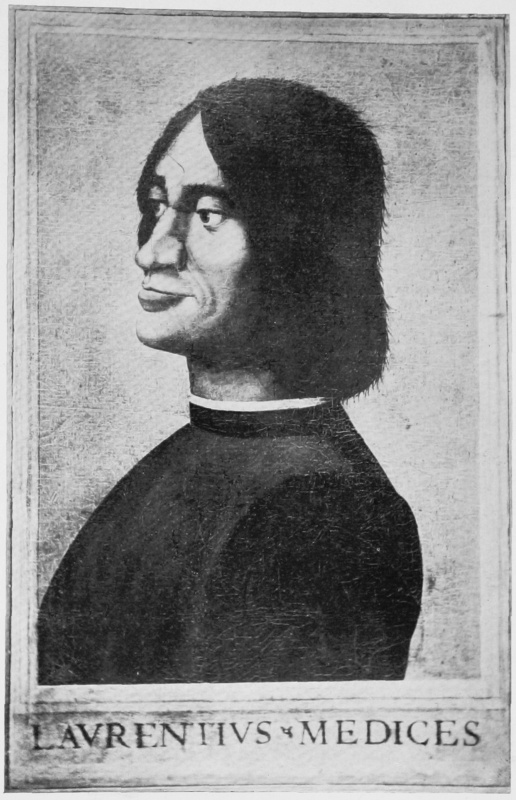
LORENZO DI PIERO DE’ MEDICI.
In the Museo Giovio (Villa Soave, Como).