LORENZO DI PIERO DE’ MEDICI (continued 2)
Reading edition
How the Archbishop of Pisa, the Pazzi, and Jacopo Bracciolini were hung from the windows of the Palace of the Signoria, and how the people hunted their adherents through the streets, shouting, “Palle! Palle! down with the traitors and cut them to pieces,” is a matter of history. Montesecco lay in hiding for some days, and before he was beheaded in the Palazzo del Podestà, dictated and signed the confession which throws full light on the participation of Sixtus IV. and his nephew Girolamo Riario in the plot.
On Ascension Day Giuliano was buried in S. Lorenzo, amid the grief of the people whose darling he was. “He was tall,” writes Poliziano, “broad-shouldered, wide-chested, with well-developed and strong arms, a small waist, powerful thighs, and well-made legs; black, sparkling eyes, a dark complexion, with thick black hair falling on to his shoulders. A fine rider, jouster, and dancer, an excellent wrestler and runner, passionately devoted to the chase, submitting patiently to want of sleep, to hunger, and to thirst, which he often endured for a whole day. Magnanimous, steady, pious, and without vice, he delighted in music, painting, and everything connected with art. He liked poetry, and wrote some good verse in the vulgar tongue. He spoke well, but was reserved and not quick-witted; yet he enjoyed a good joke, and sometimes made one. Liars he hated and those who nursed vengeance. In dress he was not extravagant, but always neat and well-clothed. Serious, handsome, and dignified, he was most courteous and kind-hearted. He adored and revered his brother, while his courage and high spirits endeared him to the people.”
Vasari tells in his Life of Verrocchio of three waxen images of Lorenzo, the size of life, made by order of his friends and relations to commemorate his escape from the dagger of the assassin by Arsino, a celebrated worker in wax, with the help and after the designs of Verrocchio. “The skeleton inside was of wood, as has been said elsewhere, with a framework of split canes covered with waxed cloth in handsome folds, so well arranged that nothing better or more lifelike can be imagined. The heads, hands, and feet were made of thicker wax, hollow inside and copied from life, painted in oils, and ornamented with hair and other necessary things, so natural and so well made, that they seemed living men and not waxen images, as can be seen in any of these three. One of them is in the church of the nuns of Chiarito in Via S. Gallo in front of the miraculous crucifix. This figure is clothed in the very dress Lorenzo wore when, with his neck bandaged, he showed himself at the window of his house to the people, who had rushed there to see whether he was alive, as they hoped, or to avenge him if dead. The second figure of Lorenzo is clothed in the lucco, the ordinary dress of the Florentines, and is in the church of the Servites of the Annunziata above the smaller door, beside which is the table where candles are sold. The third was sent to S. Maria degl’ Angeli at Assisi and placed in front of the Madonna, where, as has been already said, Lorenzo de’ Medici caused the road which goes from S. Maria to the gate of Assisi and leads to S. Francesco to be laid down in bricks, and at the same time restored the fountains built by his grandfather Cosimo at the same place.”[213]
Louis XI., King of France, to the Florentine Republic
Beloved and great Friends,—We have just heard of the great and inhuman outrage, opprobrium and injury, which not long ago has been committed against your Seigneury, against the persons of our most dear and beloved cousins Lorenzo and Giuliano de’ Medici, their friends, relations, servants, and adherents, by those of the Pazzi Bank and their dependants; and of the death of our said cousin Giuliano de’ Medici, whereby we have been and are as much grieved as though it had happened to ourselves. Now as your honour and our own has been so gravely offended, and as the Medici are our relations and allies, and as we regard this outrage and the death of our cousin Giuliano as though it had happened to our own person, and therefore consider the Pazzi guilty of læsæ Majestatis, we cannot permit this deed to go unpunished; we desire with all our heart that adequate punishment should follow as an example to others. We have therefore decided to send to your Excellencies our well-beloved and faithful Councillor and Chamberlain, Messire d’Argenton,[214] Seneschal of our province of Poitou, who is one of the men in whom we have the utmost confidence, to inform you at length of our wishes; he will tell you more about this matter. We beg you to place the same trust in him and the same belief in his words as you would in ours, it is for this that we send him. I pray God, beloved and great friends, to keep and to guard you.—12th May 1478.[215]
Louis XI. to Pope Sixtus IV.
Copy of our Letter sent to the Pope
Most Holy Father,—We have been fully informed that wantonly by the hands of Count Girolamo, of one of your nephews recently promoted to the dignity of the Cardinalate, of the Archbishop of Pisa, and of members of the Pazzi family and their adherents, an outrage, insult, and personal attack has been made on the person of our dear friend Lorenzo de’ Medici and on Giuliano his brother. That the said Giuliano and others, his friends, have been killed, murdered, and assassinated in a church in Florence, in which we have been. We are deeply grieved and still more astonished that such an outrage should have been committed against one of such a House as is that of the Medici; renowned in the whole world, and known as belonging to the Church and filling high offices, such as that of Cardinal and Archbishop, and in the precincts of a Church, a sacred place dedicated to God. Therefore, Holy Father, we are much displeased at so abominable a sin and outrage, which we regard as even more grave than if it had been done to our own person, or to the person of one nearly related to us, and we hold that your and our honour has been most deeply offended. On account of the special love we have always borne, and bear, to the said Lorenzo our cousin and to all of his House, and of the great friendship, cemented by loyalty, oaths, and alliance, which in past times existed, and exists at present, between our predecessors, ourselves, and the city of Florence, we most affectionately supplicate and pray Your Holiness that for love of us as well as for love of our Holy Mother Church, in order that others should not go unpunished, amends shall be made for this crime by punishing the delinquents, and all who have aided and participated, in such way that it may be an example for all men to remember, and that greater ills shall not arise. Otherwise, by virtue of the said alliance and confederation existing between us and the said Florentines, and on account of the love we bear to our said cousin, we have determined to declare against all those who are implicated and not to allow this thing to go unpunished. We pray the Blessed Son of God that Your Holiness may long be spared to rule our Holy Mother Church.[216]
Lorenzo de’ Medici to Tommaso Soderini at Milan[217]
I wrote to you on the 8th. Since then I have received yours of the 6th, to which I now reply. I thought it best to send the last by a special courier, because I have heard that the troops of the King [of Naples] and of the Pope intend making a serious attack, so I think it will be necessary to gather a larger force here than we had asked for, as when the enemy comes he will probably come in force. By yours and Orfeo’s letters we understand that 1000 men have been engaged and are ready for our service. If this is correct I think it will suffice if one half crosses our frontier, the rest being held in readiness for what I mentioned in my last, the assault of Imola. It must be remembered that in defending ourselves we are defending those Illustrious Lords [of Milan], and if we gain anything for ourselves it will be most unexpected, for these Venetian ambassadors declare that if peace is not made with the Turk we can hope for but small aid from them. In ten or twelve days we shall have 450 men under arms. If there is a chance of engaging any condottieri it would be an excellent thing. I think I am sure of Signor Costanzo and do not believe he will fail me. Those Illustrious Lords have written to their ambassador here that they will only subscribe 8000 ducats towards the pay of the Romagna troop. It seems to me they do wrong to state a given sum, as this might put off the Venetians, if they say they will subscribe one third for this troop it can afterwards be settled between ourselves that we should pay whatever sum is needful beyond the 8000 ducats. Those Illustrious Lords also seem not to wish to engage Signor Costanzo, as I heard yesterday. But the negotiation is so far advanced that not only would it be most unjust to him, but also my motive in hindering him from serving with the enemy must be considered. If he only guards and defends his own territory it seems to me it would be a great advantage to us. In short these gentlemen must be prepared to disburse the above-mentioned sum and the troops must be ready to move as I have said. Above all there must be no delay, as our adversaries are hastening their preparations; if they see that we are strong and able to resist they may change their minds. From the Venetians I do not think we shall get other help than those few men on this side of the Po and their contribution towards the pay of the Romagna troop, which they appear to give willingly.
Letters from Rome show that although the Pope knows that Cardinal Riario has been set at liberty, he shows no disposition to raise the excommunication or the interdict.[218] This is a bad sign and makes one believe that he will do all in his power to injure us. We shall see what will happen and are determined to defend ourselves as well as we can.
Girolamo left to-day. He came by way of Pontremoli; I reminded him of your business and he promised me to do all he could. If you pass through Ferrara I need not tell you what to say to the Duke to keep him in the same friendly mood towards us he now displays. I say no more because I know these ambassadors are writing at length.—June 10, 1478.[219]
Lorenzo de’ Medici to Giovanni Lanfredini, Florentine Ambassador at Venice
I received yours of the 6th this morning and should have waited for another letter from you with the answer of the Signoria [of Venice], but from various sources I have heard that the forces of the King and the Pope are marching to attack us, and so I write at once in order that you may hasten any aid we can get from Venice. Our ambassador there will I think send our opinion in scriptis to the Signoria, who will have to consult with him. We have need of more men than those who are on this side of the Po. If the Signoria approve of our plan of attacking Imola in case war is declared against us, we should prefer that the above-mentioned men should be employed there. If they do not approve, then it is imperative that the men be sent with all haste to guard our territory, and we will give orders that they are to be allowed to cross our frontier. We are most anxious about this, not on account of the number of men, but in order to prove to our adversaries that we are united, for they count much on our disunion. Try therefore to settle this one way or the other and reply quickly, for the affair is in fieri, and at any moment some impediment might arise. The Signoria of Venice intimated that they did not believe the Pope and the King intend to advance; now I conceive they understand it is true. We have set the Cardinal at liberty, but the Pope has shown no sign of taking off the excommunications or the interdicts; on the contrary he maintains them and encourages troops to attack us. So this is no time for loitering. It would be most harmful to us if their ambassador left here before his successor was appointed. We wish this also to be seen to at once. I will have a copy of the deliberations of the last council sent to you in order that you may press these matters with all the tact demanded by the customs there and by the questions themselves.
I wrote thus far yesterday evening. Afterwards we of the Pratica met, and it was decided not to send our opinions in scriptis, but to await the reply to those we have sent. More particularly as our opinion is as follows. On all sides we perceive signs of incertitude and hesitation in spite of our solicitations to grant us what they can. If this was cleared up we might hope. If the Venetians will only make a demonstration in our favour, with small cost to themselves they would do us a great service, because, as I have already said, our adversaries believe we are not unanimous in our desire to defend ourselves, and this makes them more enterprising. We thought at least that we should receive help which cost little, as for example in the affair of submission [to the Pope], particularly as these ecclesiastical censures still continue, and so that the Signoria must either incur the same interdict if they help us, or break faith with us, which however would be absolved by the Bull of the interdict. As I said before, discover what we can hope for from there, in order that I may not be again deceived. Present these questions skilfully so as not to cause any friction; rather leave a part unsaid, for our great object is to maintain the union of our League in appearance and in reality.
I am writing to our envoy [Tommaso Soderini], who I do not think can have arrived. If he has, lay everything before him.—June 10, 1478.[220]
Lorenzo de’ Medici to Louis XI., King of France
Most Serene King and especially my Lord,—The letter Your Majesty has deigned to write about our unhappy case, replete with great love and paternal benevolence, shows me how keenly you felt our misfortune, and how kindly disposed you are towards me. Should I even attempt to return adequate thanks to Your Majesty I should deserve to be called utterly unfit to understand so great a benefit, because words so full of love and benevolence coming from Your Majesty to a humble servant cannot be repaid by any act or word. I can therefore only beg Your Majesty specially to accept my heartfelt declaration of loyalty as a token and a pledge of my gratitude, trusting that God will repay to Your Majesty the rest of my debt. As to Your Majesty’s wise counsels to bear this calamity with fortitude, you may rest assured that I do not so much deplore what has happened to myself as the grave affront to the Christian name; because where I hoped, in such bitter trouble, to receive help, I found instead the fountain-head and instigator of all ill. For he, in the presence of many, dared to confess spontaneously that this crime was caused by him, and promulgated against me, my children, successors, intimates, and well-wishers, an iniquitous sentence of excommunication. Not satisfied with that, he is arming against this Republic, has instigated King Ferdinand against us, and has urged the King’s eldest son to march against us with a formidable army in order with violence and arms to destroy him he could not succeed in utterly ruining by deceit and fraud. For I well know, and God is my witness, that I have committed no crime against the Pope, save that I am alive, and having been protected by the grace of Almighty God have not allowed myself to be murdered. This is my sin, for this alone have I been excommunicated and massacred. But I believe that God, scrutiniser of hearts and most just Judge, who knows my innocence, will not permit this and will defend me, whom He saved from those sacrilegious hands in front of His Body, from such unjust calumny. On our side we have Canon Law, on our side laws natural and political, on our side truth and innocence, on our side God and men. He has violated all these at once, and now desires to annihilate us. I write these things to Your Majesty as to a compassionate father, and from you, on account of your goodness, piety, and greatness of soul, I have no doubt I shall receive much help, favour, and military aid, if required. For we cannot believe that any good man can tolerate that he, who wilfully precipitates himself into such an abyss of crime, should drag with him the Christian name. May Your Majesty keep well, to whom I humbly commend myself—Florence, June 19, 1478.[221]
Lorenzo de’ Medici to Sforza de’ Bettini
Sforzie de Bettinis,—I wrote to you this morning. Later I received yours of the 28th, with news of the arrival of the Duke of Calabria and the others at Todi. We wrote at once to all our troops, save to those who are already there, to unite and join those of the Duchess [of Milan] with all speed, part are in the Pisan territory, the others are on the march; to Giovanni Conti [one of the Milanese generals], telling him to advance into the territory of Bologna; to the Venetian contingent to come into that of Faenza. All the others are to march on Todi. We have asked for two hundred additional men-at-arms from Milan besides those that are in readiness, and said that these two hundred are to be placed at once in our pay. With this letter is sent the number of men and the names of the places where they are, so that you can direct them wherever you think best. We have thus done all we can for the moment. You must try and obtain more certain information whether what you have written is true or not. If not, you ought not to lack means to discover the dealings and intentions of the enemy. I think that among them are several who would willingly do us a service. If you can contrive to interview the Cavaliere I think you might learn something. Make every effort, for I cannot believe that you are unable to defend so just a cause.
I understand that the Lord Giovanfrancesco has given orders that the troops he is to send are to be paid, which will be so much more money. I am astonished that the Lord Virginio [Orsini, Clarice’s brother] should give them an escort after replying as he did to that trumpeter, however I do not think, as I said this morning, that we need despair. I have no more to add save that you must send us frequent news, and as true news as you can, and use every means to discover as much as possible of the movements and intentions of our adversaries. If this arrival of the Duke of Calabria is true it will probably alter the plans about which we wrote this morning, and we think it will be necessary to concentrate our forces as you suggested. Farewell—June 25, 1478.[222]
Messer Ceccho, from Milan, to Lorenzo de’ Medici
Magnifice tanquam Pater honorande,—To yours of the 28th of last month in reply to mine of the 22nd, I will only refer by thanking Your Magnificence for accepting my letter in good part.
As to the Lord of Forli it would seem to me wise to make every effort to draw him to our side for the honour, advantage, and reputation of our League; the said Lord is clever, and I think, as Your Magnificence says, he will attempt to get as much money as he can from the Pope, and then cum sua justificatione withdraw: I have lived for many years with these lords of Romagna and know their nature, but one cannot count on this, and we must do all we can to get him on our side.
Monsignore de Chiaromonte (Clermont), ambassador of the King of France,[223] has been here, my Illustrious Masters showed him great honour, and this morning he left: the Illustrious Madonna and we counsellors spoke to him with much openness, and gave him to understand that in favour of that Republic and of Yourself my Illustrious Masters will give all the aid this State can usque ad vitam, and we spoke thus as freely as possible, in order that he might understand that this State was unum velle et unum nolle with yours. He seemed to me a worthy man, and one to be cultivated; this I advise you to do, and to send to meet him without delay at Bologna, and do what my Masters have written to their ambassador there and this quickly, so that you may be in time.
It seems to me useless to enlarge on other things, only I beg Your Magnificence to take heed of your person and to be of good cheer, because I think there is every indication that things are going well, and that the Republic, our League, and Your Magnificence, will gain in reputation; on this side we shall leave nothing undone.
I beg Your Magnificence not to allow the letters my Illustrious Masters have written, or mine about affairs with the King of France, go into any other hands, but to deliver them there to Monsignore d’Argenton,[224] with the circumspection and prudence that I know Your Magnificence possesses, and thus we shall arrive at obtaining, between my Masters and H.M. the King of France, the essence of what is contained in those letters, which will redound to your honour, reputation, and advantage, because our League being strong and united, and helped by the friendship and reputation of France, things cannot but go well.
Yesterday morning I obtained possession of some letters from France written by one Lancilotto of Macedonia to King Ferrante. We find that King Ferrante has at present four of his people at the French court, this same Lancilotto, Zohan Copula of Salerno, Tommaso Tarquino, who resides there, and a Messer Antonio de Alexandro, only just arrived by the route of Catalonia with instructions and mandates of divers intrigues and plots. I have informed Hieronimo Morelli, ambassador of their excellencies the Signoria [of Florence] of all, so that he may write to Your Magnificence, and I am sure he will have done so. I do not enlarge on this point, because I am sure you will understand and form a better judgment than I can. I entreat of you to keep my letters in your own custody and in that of no other man, for I would on no account that our ambassadors or others should see them for certain reasons, which are legitimate, to avoid rancour, envy, and calumny, &c.—Milan, July 3, 1478.[225]
Lorenzo de’ Medici to Messer Giovanni di Bentivoglio at Milan
Magnifice vir,—By your letter of the 1st I see what the Lord of Forlì has answered. I cannot understand how this difficulty has arisen, and it is unreasonable. His stipend at present is 8000 ducats, so he ought to be satisfied with 20,000. Perhaps he does not wish to serve and tries to throw the blame on us. If this is so I do not see what his object is in behaving thus. We will not give more than 20,000 ducats with the title of governor of the camp, and the protection of our League. I have sent again to offer him this, as I had a hint that he would accept. If he does it will be well, if not I shall cut short the negotiation, and we will not mention the matter again.
I understand from letters from the Illustrious Lords of Milan that they encourage Your Magnificence to take steps to obtain the recall of the Legate. This seems to me perfectly justifiable, our League being no longer in any way bound to obey the Pope. His presence can only be harmful and a cause of suspicion. As I am writing I must say that I heartily approve the advice of those Illustrious Princes and think Your Magnificence would do well to get rid of the Legate for your own good and for your reputation, and in order not to appear reluctant in following the advice of those Illustrious Lords and the wishes of our Illustrious League. You will gain in credit and security. I commend myself, &c.—July 4, 1478.[226]
Lorenzo de’ Medici to Girolamo Morelli, Florentine Ambassador at Milan
Magnifice orator tanquam Pater,—Your letter of the 11th tells me many things to which I now reply. First, if you do not receive news day by day the only reason is that I have so much to do that it is difficult for me to be exact, not to speak of my own dilatory nature. But I will make every effort to inform you of essential matters every day. I will do all I can and even a little more.
I understand what the Magnificent Messer Ceccho and Orfeo told you, and with regard to the affair of Messer Ruberto am exceedingly sorry that by no fault of mine they and I have such perpetual annoyance and vexation. Your answer was wise and true. In this business I have never thought or done anything without first referring to them. Whether these ambassadors, who have written what I never charged them to write, have stated the truth I know not. As soon as I heard the news, and that at Bologna they doubted whether Signor Ruberto’s father-in-law would give this money, I wrote to Messer Giovanni and sent you the copy, and I showed these ambassadors the admirable reply made by Signor Giovanni. Thus those Illustrious Lords will see that from that moment, for this and many other reasons, Signor Ruberto was the enemy of those Illustrious Lords, as he was mine. I desire to clear this matter up once for all and to settle it, for added to all my other worries it is too much for me to bear.
As to Signor Taddeo we are quite willing to do as you say, but as yet we have not settled with the Lord of Forlì, as he demands more than we can well give. We were willing to pay him 25,000 ducats and to give him the title of Captain-General of our forces. Now he wants double in time of war, besides making many other dishonest demands. We are willing to grant anything he asks when he is employed in fighting outside of Romagna, but not otherwise, and are expecting his answer. If he does not accept we shall break off negotiations, as we should lose in money and in reputation. Once this is settled we can treat with Signor Taddeo, to whom I will write in the meanwhile and find out what he wants. He is now secretly in Bologna.
We have replied in general terms to King René’s mandate, as he wrote to us. But privately we have given him to understand that events may take a course favourable to his designs. I am sure that if the League decides to undertake anything in that quarter what we have done here concerning his mandate will be of service to him. I think he intends to return by Milan in order to see Messer Ceccho, at least so he wrote to me, and I advised him to do so. From what we hear from the camp the enemy makes no sign of life. If they do not receive strong reinforcements, or hopes of some treaty, I think they will do us little harm. But you had better hurry our contingent there, for whom you have the money, and see that they are ready and fit to march; though we hope even without them soon to be as strong as the enemy is at present. Let us know if our contingent from Brescia has passed through, they ought to arrive soon.
We had told Signor Giovanni Conte to come here; but he probably left this morning for the camp as Giovanni di Sapone and Messer Alberto Visconti are both ill, so he was wanted. His men are following to join the others. When necessary to send all to him we can do it from here ...[227] meanwhile those who are ill may recover. But it is absolutely essential to arrange about a Captain-General who is much needed, although until now there is perfect order and unity in the camp.
You already know from others my desire about Genoese affairs, and that I do not think other matters should be imperilled for them. I know it was unnecessary, but I cannot have done wrong in saying what I thought. I am still of the same opinion that other people should not be placed in a dangerous position unless one is sure of success.
The Office has I believe written to you as to the affairs of the camp and of Montepulciano, as well as about a Brief from the Pope and the answer to it, so I say no more. I commend myself to you.—Florence, July 15, 1478.
Laurentius de Medicis.[228]
Sixtus IV. to the Duke Federigo of Urbino
Carissime fili noster at affinis salutem et Apostolicam benedictionem,—We have received your letter written manu propria and were rejoiced to hear your health was good, which is what I desire above all things and for which I pray to God, for nothing is more desirable to us. The letter written by the Florentines, full of contempt of Christ and of His unworthy Vicar does not alarm us, but causes us to think that God has destroyed their intellect and their judgment as a punishment for their sins. We trust that God, whose honour and glory is at stake, will grant you victory in everything, especially as our intentions are straightforward and just. For we make war on no one save on that ungrateful, excommunicated, and heretical Lorenzo de’ Medici; and we pray to God to punish him for his iniquitous acts, and to you as God’s minister deputed to avenge the wrongs he has iniquitously and without cause committed against God and His Church, with such ingratitude that the fountain of infinite love has been dried up.
To the Venetians we have replied in proper terms that if they act unjustly God is above all, and will requite every one according to his acts.
We have sent many Nuncios with our justification to the King of France and to other princes, such as the Emperor, the Kings of Hungary and Spain, and all the others.
Moreover our Bull which has been printed and published to the whole world will justify us; but allowing that everything goes wrong we shall rejoice in dying as a martyr and hear every persecution for love of the Church of God of which we are the unworthy head. We are sure that when you reflect on what merit you will acquire before God for defending His Church you will act as a true Christian Prince, and that my son the Duke of Calabria, together with yourself, will obtain glory with God and men; the Church will support you who support a just cause, &c. I am told that some, from ignorance or malignity, depict me as of hell; this I do not refute, but only despise their words, confiding in thy fidelity who wilt not abandon God and me, who trust in thee, so I let who will talk.
These French ambassadors are, they say, coming to us, let us hope that God may inspire us with suitable answers, all which shall be notified to you. Salute my illustrious son the Duke of Calabria cordially from me. For him, as for you, we pray continually to God. I wish thee good health, most beloved cousin.—July 25, 1478.
They threaten schism and disobedience. God’s will be done: but it might be desirable that you write to the King of England, and that King Ferdinand should write to his colleagues and to the King of France, as he in his prudence will know how to do in proper terms.[229]
Per avisi ho da Napoli il Re persevera pure in molestare assai le cose mie et in non mi lasciare riscuotere et volere che io paghi dubito ancora che subito che ’l papa intenderà questi cenni di levare la obedienza non faccia qualche novità alle mie cose a Roma nelle quali benchè mi paia avere passato il pericolo maggiore pure havendo grandissima fidanza costì per ogni mio bisogno vorrei che con ogni cautela e buono modo et segretamente che non lo intendessi altri che Messer Cecho intendessi se a qualche mio bisogno mi porrei valere di costì di XXXm o XLm ducati per VI overo VIIj mesi benchè non credo haverne bisogno perchè come dico mi pare in questa parte havere avuto il male ch’io possi et insino a hora ho proveduto francamente pure a mia satisfactione vorrei intendessi questo benche mi pare essere certo non mi habbi a essere dinegato fate d’intenderlo et avisatemene subito governandola con quella cautela et segreto che merita il caso e la fede che ho in voi ho costì Antonio e cotesti portinari et niente di meno non do questo aviso se non a voi solo et ho scritta questa di mia mano per non mi fidare d’altri, vorrei come dico intendessi questa parte da messer Cecho sanza che o voi o lui he conferissi con altri havendo tante diverse persecutioni harò tanto maggiore animo a resistere gagliardamente quando sarò certo questo favore non mi habbi a manchare costì bisognandomi aoperarli farò quelle cautioni et obligationi che saranno di bisogno. In Firenze a dì XXV di luglio 1478.
Vostro Lorenzo de’ Medici.[230]
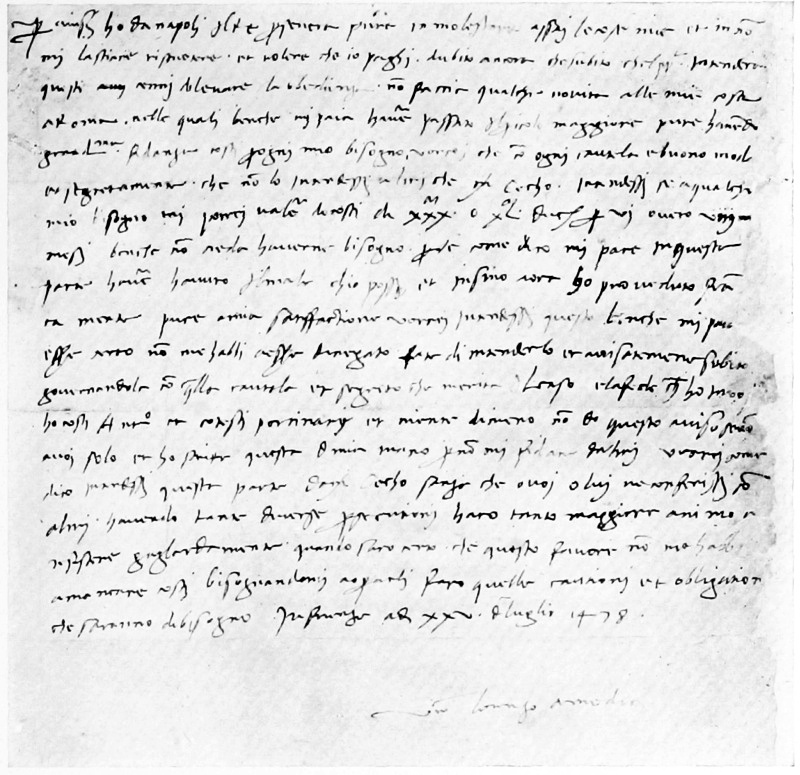
Lorenzo de’ Medici to Girolamo Morelli, Florentine Ambassador at Milan
I hear from Naples that the King continues to molest me and my affairs as much as he can by not allowing me to encash and desiring me to pay. I fear that as soon as the Pope hears of these attempts to provoke disobedience he will make some move against my affairs at Rome. Although I think the imminent peril has passed over as I have very considerable credit there, yet I wish that with the utmost caution and care, and so secretly that none but Messer Ceccho should know, you would find out whether I can count upon 30,000 or 40,000 ducats for six or seven months in case of need. I do not expect they will be wanted because, as I said, I think all the ill that could be done to me there has been done, and till now I have been able to provide for everything. Yet, for my own tranquillity I should like to know this, and I have not the least fear that it will be refused. See that you find out at once and let me know, acting with all the caution and secrecy necessary in such business. I have in Rome Antonio and the Portinari, nevertheless I confide this to you alone, and have written with my own hand in order that none should know. I wish, as I said, that you should arrange this with Messer Ceccho without either he or you conferring with others. I shall be able to face the many troubles I have with much more courage if I know that I can count on this help. If I do need it I will give every obligation and bond.—In Florence on the 25th July 1478.
Your Lorenzo de’ Medici.[231]
In 1478, after the Pazzi conspiracy, when the Pope was stirring up war against the Medici he hated, Lorenzo sent his wife and children to Pistoja, where they were the guests of the Panciaticchi, for safety. With them went Angelo Poliziano as tutor to Piero the eldest boy, then about six years of age. The stiff, proud Roman, Madonna Clarice, had never known how to gain her husband’s love, and did not get on well with his brilliant, sarcastic, rather Bohemian friends. She particularly disliked Poliziano’s growing influence over Piero, and at the end of the year there was an open rupture, when she dismissed him with scant courtesy. One pities them both. Clarice, already far gone in consumption, was irritable and anxious about her husband, whose attitude towards the Holy See she, with her education, could not approve; while Poliziano, used to the brilliant talk in the Medici palace, where he measured his wit with Luigi Pulci, Matteo Franco, Marsilio Ficino, Pico della Mirandola, &c., and Lorenzo himself, was bored to death and always longing to be back in Florence. The letters from the little boy to his father show how simple was the family life of the Magnificent Lorenzo, indeed he is blamed by Machiavelli for joining in childish games with his children and for being seen playing with them.
Agnolo Poliziano at Pistoja to Lorenzo de’ Medici in Florence
Magnifice mi patrone,—I hope and trust Your Magnificence has not been disturbed by my letter written this morning under the influence of anger; the want of patience is my great fault. I hope in bonam partem acceperis rebusque nostris prospectum curabis.
Madonna Clarice sends you three pheasants and a partridge. She says you are to beware as though they came from an enemy because she does not know the man who brought them; he is the father of your Pisan courier who broke his leg.
By the bearer I send you the opinion of Messer Bartolommeo Sozzino. Every hour I have been entreating him to finish it and found a copyist who made all the haste he could, but it was impossible to get it done quicker.[232]
Piero is well and I take every care of him, all the others are also in good health; but I get all the kicks; yet te propter Libyeæ.[233] I am longing for news that the plague has ceased on account of my anxiety for you and in order to return and serve you; for I hoped and I thought to be with you; but as you have, or rather my evil fortune has assigned to me this post in the service of Your Magnificence, I endure it, quamvis durum, nec levius fit patientia. I commend myself to Your Magnificence.—Pistoja, August 24, 1478.[234]
Agnolo Poliziano at Pistoja to Lorenzo de’ Medici
Magnifice mi Domine, &c.,—Madonna Clarice is well and so are all the others. Here we knew nothing of the tumult until the bearer of this gave me Franco’s[235] letter and calmed our fears which were aroused by his former one; Madonna Clarice suspected that things were more serious and that you de industria made light of them. So now she is comforted et acquievit. We want for nothing; only we grieve sorely over your worries, which are of a truth great. God will help us. Spes enim in vivis est, desperatis mortui.
If you have not absolute need of Giovanni Tornabuoni Madonna Clarice wishes you would send him here, she is lonely without him, and for many reasons she thinks it would be well if he came.
I look after Piero and incite him to write; in a few days I think he will write to you in a fashion that will astonish you, we have here a master that teaches writing in fifteen days, he is excellent at his trade. The children play about more than usual and are in splendid health. God help them and you. Piero never leaves me or I him. I wish I had to serve you in some greater thing, but as this has fallen to my lot I do it willingly. Rogo tamen, ut aliquid aut literarum aut nuntii huc perlatum ivi cures, desque operam, ne quidquid est in me auctoritatis, patriaris exolescere, quo et puerum facilius in officio teneam, et meo munere, ut par est defungar. Sed hæc si commodum; fin minus, quod fors feret, feremus æquo animo. Be of good cheer and take courage, for great men are formed by adversity. Durate, et vosmet rebus servate secundis. I commend myself to you.—Pistoja, August 26, 1478. Your servant,
Ang. Pol.[236]
Agnolo Poliziano at Pistoja to Lorenzo de’ Medici
Magnifice mi Domine,—All the family here are well. Piero studies but little, every day we go out enjoying the country. We visit the gardens of which the town is full, and sometimes the library of Maestro Zambino, in which I have found several good things, both in Greek and in Latin. Giovanni is on his pony all the day, and all the people run after him. Mona Clarice is very well; but takes little pleasure in aught save any good news we get from Florence. She rarely goes out. We want for nothing. Presents we refuse, save salad, figs, and a few flasks of wine, some beccafichi or things of that sort. These citizens would bring us water in their ears. From Andrea Panciaticchi we have received so much kindness that we are all indebted to him. We keep good watch and have begun to put a guard at the gates. Be of good cheer and conquer; and when you have time come and see your family who expect you with open arms. I commend myself to Your Magnificence.—Pistoja, August 31, 1478.[237]
Agnolo Poliziano at Pistoja to Lorenzo de’ Medici at Florence
Magnifice Domine mi,—Madonna Clarice has not felt very well since yesterday evening.... Piero went out to meet the Lord[238] this morning, and was the first to greet him. He spoke a few words of the sentence you wrote for him very well, and the Lord set him on his horse before him and thus entered Pistoja. Mona Clarice sent him a fine bunch of partridges, and this evening we all go to visit him at twenty-two of the clock, it being now nineteen. Giovanni Tornabuoni was with Piero and finished his little speech. Judging from what his people say, the Illustrious Lord is most anxious to do himself honour and to satisfy the Most Excellent Signoria and especially Your Magnificence.
Clarice sends you I know not how many partridges of those given to her to present to this Lord. I shall see how things go and as in duty bound shall inform Your Magnificence, whom God preserve. I commend myself to you.—Pistoja, September 7, 1478.
Agnolo Pol.[239]
Agnolo Poliziano at Pistoja to Lorenzo de’ Medici
My letters cannot but be acceptable to you, for I only write to give you news of your family. All, by the grace of God, are well; Piero continues to learn to write and will soon be so good a penman that I hope he will relieve me of the trouble of writing sine argumento as I do now to you, so that I am ashamed of myself. But may it please God that I shall always have to write the same words to you, which are that we are all well. Madonna Clarice is much happier and better in health. We keep good guard and watch here, but we are anxious about you. God keep you, for it seems to me that all depends upon that. Have no fear about us, for we are very careful. As far as I am concerned neither care nor goodwill shall be wanting. I know how much I owe to Your Magnificence, and the love I bear to Piero and to your other children is hardly second to your own. If anything unpleasant and unkind does sometimes happen I shall endeavour to bear it for love of you, cum omnia debeo. I commend myself to you.—Pistoja, September 20, 1478.
Agnolo Poliziano.[240]
Piero de’ Medici (born 1472) to his father Medici
Magnifice Pater mi, &c.,—I write this letter to tell you we are well, and although I do not as yet know how to write well, I will do what I can. I shall try hard to do better in the future. I have already learnt many verses of Virgil, and I know nearly the whole of the first book of Theodoro by heart;[241] I think I understand it. The master makes me decline and examines me every day. Giovanni comes to mass sometimes with the master. Madonna Clarice and the others are well. I commend myself to you.—Pistoja, September 21, 1478.
V. M. filius Petru de Medicis.[242]
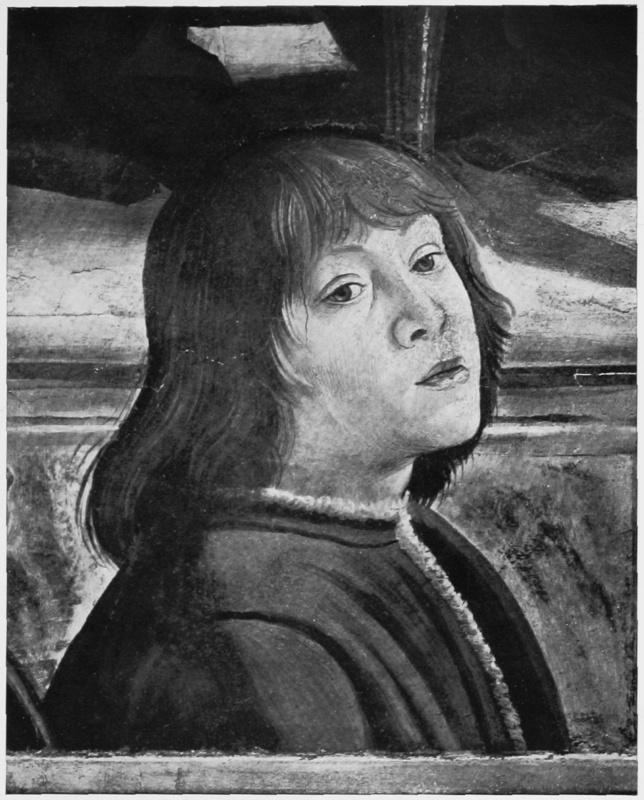
Alinari
PIERO DI LORENZO DE’ MEDICI.
Detail from the fresco by Domenico Ghirlandaio in the Church of S. Trinità, Florence.
In October or November of 1478 Clarice and the children left Pistoja and went to the great fortress-villa Cafaggiuolo in the Mugello, which in winter must have been terribly cold and dreary.
Clarice de’ Medici to Lucrezia
Magnifice Mater honoranda,—On account of the bad roads and the much rain we have not sent in the carrier for three days. Now either he or another will go to you with this: because I wish to know how you and Lorenzo are, and the others. I beg of you to write and tell me. We, by God’s grace, are all quite well but in the water above our heads. We remain all day in the house, and nothing gladdens us so much as letters and news from you all. I commend myself to you.—Cafaggiuolo, December 16, 1478.[243]
Agnolo Poliziano to Lucrezia de’ Medici
Magnifica Domina mea,—The news we can send you from here are these. That the rain is so heavy and so continuous that we cannot leave the house and have exchanged hunting for playing at ball, so that the children should have exercise. Our stakes are generally the soup, the sweet, or the meat; and he who loses goes without; often when one of my scholars loses he pays tribute to Sir Humid.[244] I have no other news to give you. I remain in the house by the fireside in slippers and a greatcoat, were you to see me you would think I was melancholy personified. Perhaps I am but myself after all, for I neither do, nor see, nor hear anything that gives me pleasure so much have I taken our calamities to heart. Sleeping and waking they haunt me. Two days ago we began to spread our wings for we heard the plague had ceased; now we are again depressed on learning that it still lingers. When at Florence we have some sort of satisfaction, if nought else that of seeing Lorenzo come home in safety. Here we are in perpetual anxiety about everything. As for myself I declare to you that I am drowned in weary sloth, such is my solitude. I say solitude because Monsignore[245] shuts himself up in his room with only his thoughts for company, and I always find him so full of sorrow and apprehension that my melancholy is only increased in his company. Ser Alberto di Malerba mumbles prayers with these children all day long, so I remain alone, and when I am tired of study I ring the changes on plague and war, on grief for the past and fear for the future, and have no one with whom to air my phantasies. I do not find my Madonna Lucrezia in her room with whom I can unbosom myself and I am bored to death. Our sole relief is in letters from Florence, from Malerba, who has written these last few days, but I must tell you he generally sends good news which we believe for a little while, such is our desire that they may be true. But these plums usually turn into sloes. However I am trying to arm myself with hope and cling to everything in order not to sink to the bottom. I have nought else to say. I commend myself to Your Magnificence.—Cafaggiuolo, December 18, 1478. Servitor
Angelus.[246]
Lorenzo de’ Medici to the King of Spain
Most Serene and Excellent Lord my King: after humble recommendation, &c.,—I have been informed during the last few days that your Majesty wrote me a letter full Of affection and benevolence at that terrible time when my beloved brother Giuliano was so cruelly torn from me in the centre of the church, and when I was wounded. This letter, I know not why, never reached me; would to God it had, for the emotion evinced by so great a King would have been a great comfort to me when I was oppressed by such a terrible sorrow. Had I only known that the letter had been sent by your Majesty and delayed in the journey, it would have been no small comfort, and I should have at once thanked your Majesty for such a proof of kindly feeling towards me. Even now I send most heartfelt thanks and express my deep obligation. I desire nothing more than that an opportunity may arise for me to show my devotion to your Majesty. It is far beyond my power to repay not alone the letter, but even the slightest sign from so great a King, all I can do is to place myself entirely at your Majesty’s orders. I commend myself ever to your Majesty O my Lord and King, and beg to be taken under the shadow of your wings. Your Majesty is I know fully acquainted with our affairs. We are preparing for war and working hard to be able to resist the forces of the enemy. Resist we shall, as I hope, because we shall not fail to ourselves, and I trust God will aid the good cause. Again I commend myself to your Majesty, whom may God preserve in happiness.—Florence, April 3, 1479. Your Serene Majesty’s most devoted servant,
Lorenzo de’ Medici.[247]
Agnolo Poliziano, from Cafaggiuolo, to Lorenzo de’ Medici at Florence
Agnolo Poliziano to his patron Lorenzo de’ Medici greeting.
Our little friend Piero writes you about what is happening here at Cafaggiuolo; it is my part to explain that his last letter was not, like the previous ones, submitted to me for suggestions while he composed it and then a fair copy made. It was completed in one sitting, as the saying is, and by himself alone. I only suggested in course of conversation what he should write about. The words and the composition are all his own.
I am training him in such a way that I have no fear but that he will fulfil the expectations I have formed of him, although you fear his excessive impetuosity.
As for Giovanni, you will have seen for yourself. His mother has taken it upon herself to change his course of reading to the Psalter, a thing I did not approve of. While she was absent he had made wonderful progress. He was already able to select, without any help from me, all the letters and syllables in his exercise in composition.
My only petition to God is that I may be able to prove to you some day my loyalty, diligence, and patience. This I would willingly purchase even at the expense of death.
I omit much lest I should weary your busy mind.
Farewell and remember me with all the rest.—From Cafaggiuolo, April 6, 1479.[248]
Piero de’ Medici to his father Lorenzo
Magnifice pater mi honorande, &c.,—Till this day I have not written to you because nothing of importance has happened. A few days ago three well-armed boats arrived in the port of Cafaggiuolo from the village of Mozzete to offer us their services, and we made them welcome. We do not know what to do; I wish you would send us the best sporting dog that can be had. Nothing more. We all commend ourselves to you, I above all. I beg you will guard yourself from the plague and that you will remember us because we are little and have need of you. We are all well, thanks be to God, and so is Giuliano. I attend to my studies and the master commends himself to you.—Cafaggiuolo, April 16, 1479.[249]
Agnolo Poliziano to Lorenzo de’ Medici
Magnifice mi Domine,—I am here at Careggi, having left Cafaggiuolo by command of Madonna Clarice. The cause and the manner of my departure I should wish, indeed I beg of you as a grace, to explain by word of mouth, it is too long to write. When you have heard me I think you will admit that all the fault is not mine. Out of respect, and not wishing to come to Florence præter jussa tua, I am here to await the commands of your Magnificence as to what I am to do, because I am yours even if the whole world was against me. If I have had but small success in serving you it was not that I did not serve with all my heart. I commend myself to Your Magnificence, at whose commands I am most entirely.—Careggi, May 6, 1479. Ever Your Magnificence’s servant,
Angelus Pol.[250]
Piero de’ Medici at Cafaggiuolo to his father Lorenzo (in Latin)
Magnificent Father,—Lucrezia and I are trying who can write best. She writes to grandmother Lucrezia, I, my father, to you. The one who obtains what he asks for will win. Till now Lucrezia has had all she wished for. I, who have always written in Latin in order to give a more literary tone to my letters, have not yet had that pony you promised me; so that I am laughed at by all. See to it therefore, Your Magnificence, that she should not always be the winner. The war as far as I understand goes in our favour this year, but we do not quite understand how the sword that wounded us is to be broken if only the sheath is hit. For if the enemy makes war on us even outside his own country, on what does he rely for again attacking us another year when tired out. We only hope for peace through victory. Scipio is to be driven to Carthage in order to get Hannibal out of Italy. We beseech you, we your children, to have the more care for yourself the more you see that the enemy rather lays hidden snares than dares open warfare.
I commend Martino to you, who aids me not to forget my Greek and to improve my Latin.[251] He would have been named chaplain of S. Lorenzo by his patrons, Antonio and Lorenzo Tornabuoni, had not Your Magnificence recommended another. It is but just that they should bestow their patronage on their own people, and not be prevented in so doing by you, who in general give to others what is yours. I hope therefore to have letters recommending my Martino to those to whom he has already recommended himself. God save you.—26th May 1479.
Your son Piero.[252]
Clarice de’ Medici to her husband Lorenzo
Magnifice Conjux, &c.,—I hear the plague is committing more ravages in Florence than usual. Your wife and children pray with all their might that you will take care of yourself, and if you can, with due precaution, come here and see the festival we should be greatly consoled. I should be glad not to be turned into ridicule by Franco, as was Luigi Pulci, and also that Messer Agnolo [Poliziano] should not be able to say that he will live in your house whether I like it or no, and that you have put him into your own room at Fiesole. You know I told you that if you wished him to remain I was perfectly content, and although I have endured a thousand insults if it has been by your permission I will be patient, but this I can hardly believe. I quite understand that Ser Niccolò has entreated me to make peace with him. The children are all well and long to see you, I long even more, for I have no other torment than that you should be at Florence during such times. I commend myself always to you.—Cafaggiuolo, May 28, 1479.[253]
Lorenzo de’ Medici to his mother Lucrezia in Florence
Most beloved Mother,—You will have heard from Ser Niccolò that there has been a case of plague at Cafaggiuolo, I have nothing more to add. For precaution sake we left there at once and came to Trebbio. I enclose a list of things Messer Stefano has prescribed in order to be prepared should anything happen. Please God it may all end in nothing. Do not be at all anxious. No more.—Trebbio, May 31, 1479.
Your Lorenzo.
Send the things here quickly.[254]
Piero de’ Medici at Cafaggiuolo to his father Lorenzo
Magnificent Father mine,—That pony does not come, and I am afraid that it will remain so long with you that Andrea will cause it to change from a beast to a man, instead of curing its hoof.
We are all well and studying. Giovanni is beginning to spell. By this letter you can judge where I am in writing; as for Greek I keep myself rather in exercise by the help of Martino than make any progress. Giuliano laughs and thinks of nothing else; Lucrezia sews, sings, and reads; Maddalena knocks her head against the wall, but without doing herself any harm; Luisa begins to say a few little words; Contessina fills the house with her noise. All the others attend to their duties, and nothing is wanting to us save your presence. We hear that things are better than last year, and hope that you being well there will be nought but victory in the future. Strong and brave men are not good at subterfuges but shine in open warfare. Thus we confide in you, as we well know that besides your goodness and valour you bear in mind the heritage left to us by our ancestors, and the injury and outrages we have endured. God save you—1479.
Your son Piero.[255]
Piero de’ Medici at Cafaggiuolo to his father Lorenzo
Magnificent Father mine,—I fear that some misfortune has happened to that pony, for had it been well I know you would have sent it to me as you promised. I beg of you therefore as a grace that you will take this fear from me; for I think of it night and day, and until the pony comes I shall have no peace. In case that one cannot come be pleased to send me another. For, as I have already written to you, I am here on foot, and sometimes it is necessary for me to go in the company of my friends. See to this therefore, Your Magnificence.
I am studying hard, and all here attend to their duties. It only needs that you should diligently guard yourself from the plague and from every other danger of death, and that you should come here sometimes to see us. God save you.—1479.
Your son Piero.[256]
Piero de’ Medici at Gagliano to his father Lorenzo
Magnifico Patri meo,—I cannot tell you, Magnificent Father, how glad I am to have the pony, and how his arrival incites me to work. If I desire to praise him, Ante diem clause componet vesper Olympo. He is so handsome and so perfect that the trumpet of Maronius would hardly suffice to sing his praises. You may think how I love him; particularly when his joyous neighs resound and rejoice all the neighbourhood. I owe you and I send you many thanks for such a fine gift, and I shall try and repay you by becoming what you wish. Of this be sure. I promise you that I shall try with all my heart. We are all well, and we all long for your arrival. God save you.—1479.[257]
Your son Piero at Gagliano.[258]
Antonio Pucci to Lorenzo de’ Medici at Cafaggiuolo
Magnifice Frater honorande,—That priest from Imola has been interrogated. He says Count Girolamo [Riario] sent him here to offer, on the pretext that he had been badly treated, to poison the Count; thinking that we, desiring the Count’s death, would entrust him with poison. We were then to be accused to the Pope, and in the Consistory, and the Count was to show the poison, saying, “See, Lorenzo de’ Medici has attempted to poison me.” He also offered to consign into our hands one of the gates of Imola in order to accuse us before the Pope and the Cardinals so that they might imagine that we were going to make war on the Pope. He has been tortured and shall be put to the question again in order to get everything out of him. God guard thee.—Florence, June 18, 1479.
Till to-day there have been eighteen deaths and fourteen new cases [of plague]. Benedetto Nori is one.[259]
Lucrezia de’ Medici (daughter of Lorenzo) to her grandmother Lucrezia
Magnificent and loved as a Mother,—I send you news that we are all well; and I hope you are so too, may God keep us so. I long to see you and pray you to come, for it seems to me a thousand years since I last saw you. Mona Lucrezia mine, I wish you would send me a sash of the palio of Sancto Giovanni, or better still that one from Volterra which was given to you when you stood godmother to me. Piero and Maddalena commend themselves to you and Giovanni begs you to send him some sugar-plums, he says that last time you sent very few. I pray you to answer, for reading your letters is a great comfort to me. No more. Christ guard you from all ill.—Written on July 7, 1479.
Your Lucrezia in Cafaggiuolo.[260]
Nannina Rucellai to her mother Lucrezia de’ Medici
To the honoured hands of the Magnificent Lady Lucrezia de’ Medicis at Careggi.
Dearest Mother,—I must tell you that Bernardo has dismissed the tutor to my great sorrow, as I do not know where to send him. At Figline, from whence he comes, the plague is very bad; in his house two of his brothers are dead and his father is ill. Vincenzo has not a farthing, if he had anything he spent it here in clothes, and now we repay him with “Go in peace.” Nothing could be more displeasing to me. Whoso wants to do as they wish should not be born a woman. I should be so glad if you will ask Lorenzo, if not inconvenient, to give him shelter where he would not be in the way for two or three months until the plague has ceased. I do not think he is capable of teaching any save the little ones, whom he might look after and teach. You could not do me a greater pleasure, as it will show that I have some one who is willing to oblige me; there are others who do the reverse. If during this time he should be in need of a little money for his clothes I will provide it from my own pocket, for he seems to me in a bad plight. Here I could give him nothing as I had no money. I should be glad if any small sum comes into your hands or any small living you would help him, for I do not like to repay him with ingratitude. We are all well. I commend myself to you, commend me to Lorenzo and kiss Giulio for me. Christ guard you and see that you guard yourself.—In Casentino, July 12, 1479.
Your Nannina.[261]
Bianca de’ Pazzi to her mother Lucrezia de’ Medici at Careggi
Dearest and most honoured Mother,—I have had a letter from you which has greatly consoled me as I see you are all in good health, particularly you and Lorenzo, I pray God to keep you so for many years. I have not written before as I feared to importune you and also because I have sent often to your house to Marco for malvasy and for the book of St. Margaret, all of which I have received; and from him I heard news of you. I should have sent to you [at Careggi] but thought that on account of the plague you would keep close guard. We have had it near here, but by the grace of God it is now finished. So I did not send as I ought to have done. As I told you in Florence I mean to lie in here for I know you have enough on your hands, and I want for nothing. If I am worse than usual which I do not expect as by the grace of God I am very well, I am in the ninth month now and as I said well, should anything unforeseen happen there is Maestro Giorgio close by who fled here from the plague. So be in no anxiety about me for I feel sure God will assist me as ever, if it so pleases Him. Of the family in the Mugello I hear good news, which rejoices me, and also of Nannina,[262] who they tell me passed along the road going to the Casentino. I am so glad you are all of you well, which is not little to say in such times as these, for I was and I am anxious about you as you said you had to see so many people. I wonder you were not somewhat afraid, but our Lord God will not abandon us entirely. Do persuade Lorenzo to take more care, for I hear he has no fear at all[263] ... on all sides, and also to beware of his enemies. Until this sickness is past he ought to put his pleasures on one side; if he lives he will have more than now, for I trust God will recompense him for the ill he has received. I commend myself to him, as do these children, and Guglielmo commends himself to you and to Lorenzo. By the grace of God we are all well.—Alla Torre, July 15, 1479.
Your Bianca.[264]
Agnolo Poliziano to Lucrezia de’ Medici at Careggi
Magnificent Madonna mine,—By Tommaso I send back your lauds, sonnets, and poems in terza rima, which you lent me when I was with you the other day. All these women were delighted with them and Madonna Lucrezia, or rather Lucrezia, has learnt all the lauds and many sonnets of the Lucrezia by heart.[265] There is also a little white book in manuscript which I beg you to give to your and my good Giovanni Tornabuoni, it contains certain rules his children asked me to give them. I am also writing to Giovanni, to the children, and to their master. I pray you to give him the letters and to commend me to him, for I set great store and count much on the affection he shows me. I have been to see Lorenzo several times and cannot describe how well he received me. Do try and discover what are his intentions with regard to me; it would surprise me if Piero were allowed to lose time, it would be a great pity. I hear that Messer Bernardo, brother of Ser Niccolò, is with him, but I do not know how his teaching will combine with mine.[266] If he is to remain permanently, then of a truth I can assume that the bubble has burst. But I cannot believe it, and therefore beg you to find out what are Lorenzo’s intentions, then I shall know whether I am to arm for a joust only or for war. It will be easy for you and I shall always be at the beck and call of Lorenzo as I am sure he knows better than I, and that he will put me in an honourable position as he always has done and as my fidelity and good services merit. I am working hard. Till now I have not been able to send you the promised book as one copy is at Florence and the other at the binder’s who has kept it a long time. As soon as I have it I will send it. I commend myself to you and I pray you to commend me to Lorenzo.—Fiesole, July 18, 1479. Your Magnificence’s servant,
Angelus Polizianus.[267]
The following extracts from Vespucci’s letters to the “Ten” allude to the one victory gained by the Florentine troops over the Prefect of Rome, nephew of Pope Sixtus IV., near Lake Trasimene during the war between Florence and the Pope with his ally the King of Naples, in 1479. But the fortune of war soon changed. The Florentines were beaten at Poggibonsi, within sixteen miles of Florence, by the Duke of Calabria. Fortunately for her, Duke Alfonso stopped to lay siege to the small walled town of Colle which held out for two months and inflicted considerable loss on his army. Meanwhile the summer, generally considered in the fifteenth century to be the only proper time for fighting, was over; the Duke offered a three months’ truce, withdrew his troops to winter quarters, and Florence was saved.
Guidantonio Vespucci, Legatus in Epistolis at Paris, to the Ten of the Balìa in Florence
When the King of France heard the news he gave signs of great joy, kneeling as is his wont three times and kissing the ground, thanking God. All that day he talked of nought else with his people, saying: “My friends the Florentines and my cousin Lorenzo de’ Medici will have their revenge this year....” You heard how the King’s Majesty had received news of the glorious victory of our troops near Perugia and how delighted he was, so that according to what I hear from court he showed extreme pleasure both by actions and in words, to the great content of the Magnificent Monsignor of Argenton[268] who, as though he had been a born Florentine, continually tamquam tuba exprobando the acts of the Pontiff and of King Ferrante, goes about Paris proclaiming our victory; particularly to those ecclesiastics whom I have met sometimes at supper with his Lordship.
Vespucci adds that Louis XI. refused to receive a certain Raffaello Ballerini sent by the Pope to explain his actions, and that when King Ferrante asked that his galleys might use the ports of Nice and Provence for the purpose of attacking the Florentines, the Duke of Savoy by command of the King of France refused his consent.—1479.[269]
Lorenzo de’ Medici to Girolamo Morelli, Florentine Ambassador at Milan
Yours of the 8th and 9th tell me that everything goes well there. It is useless for me to say much as we must wait to see how affairs shape themselves and try to turn them in our favour. I cannot believe that the Lord Lodovico being all-powerful and an absolute ruler will consent to our undoing, because it would be against his interest. He is by nature kindly and has never received any injury from us either public or private. It is true that he obtained power by the King’s favour, but I think he is even more beholden to the help given him by others and to his own qualities. From the little I know of His Lordship he seems to me capable of understanding what is right and willing to execute what he understands. Therefore as soon as you can it would be well to see His Lordship and demonstrate to him that on account of ancient friendship we expect nothing but good from him, there being no reason for antagonism, and according to my view it will be his interest. Impress upon him that this city desires to go hand in hand with the State of Milan, that is with His Lordship, and for this reason beg and encourage him to inform you in some measure of his intentions so that we may act in conformity with his wishes. Explain our difficulties to him, and how they react upon that State, and the remedy which is in his own hands. This is what I have to say at present. As soon as I received your first intimation I despatched Niccolò d’Antonio Martelli, who is very intimate with His Lordship, it was through him that formerly I transacted all important affairs with His Lordship. I send him to you to whom he will show all his despatches. He will soon be with you, as to-day he must be at Bologna. It appears to me that we must now throw ourselves entirely into the arms of His Lordship and discover as soon as possible what are his ideas and his intentions towards us, and this quickly, for I have had no letter from him. I have thought it better to write to him and enclose the letter, but I rely more on your interview with him, when you can tell him as much as you think fit of what I have written. I commend myself to you.—Florence, September 11, 1479.
I must remind you of what I wrote yesterday about the Marquis of Mantua. If he is deposed that country will immediately be included among our enemies, it would be our ruin.
Laurentius de Medicis.[270]
In November Niccolò Martelli, the trusted friend of Lorenzo, was still in Milan, and on the 12th Lodovico Sforza (il Moro) told him to inform Lorenzo that the King of Naples would be willing to listen to overtures of peace, and that he strongly advised him to strike while the iron was hot. Ten days later he told the same thing to Pier Filippo Pandolfini, the Florentine ambassador, adding that Lorenzo ought not to trust Venice who thought only of her own interests, and would leave Florence in the lurch. He could himself promise little or nothing as Milan was sore pressed, and he wished Lorenzo to know this, in order to avoid future recrimination. He advised immediate action, and was ready to undertake negotiations with Naples. It is clear that Lodovico had been charged by King Ferrante to sound Lorenzo. On November 24th Filippo Strozzi, who had lived long in Naples and knew the King well, left Florence on a secret mission. “I was to tell the King,” he writes in his journal, “that Lorenzo placed himself in the King’s hands, and would willingly do all the King desired if he only gave peace to Florence, and restored to her the towns she had lost. I found H.M. at Arnone [at the mouth of the Volturno] hunting, and when I delivered my message he answered that he had later news; that Lorenzo was coming in person, and so we would wait and see what his visit would bring forth.”[271]
The following letter from Lorenzo to the Signoria was written after he had started for Naples. Many in Florence feared that he might meet the same fate as Piccinino, who had been invited to Naples and foully murdered by the King’s orders.
To the Signoria of Florence, from Lorenzo de’ Medici
Most Illustrious my Lords,—It is not from presumption that I did not notify the reason of my departure to Your Illustrious Excellencies, but because it seemed to me that the agitated and disturbed condition of our city demands acts and not words. I conceive that she desires, and indeed has extreme need of peace. Seeing that all other endeavours have been fruitless, I have determined to run some peril in my own person rather than expose the city to disaster. Therefore, with the permission of Your Excellencies of the Signoria, I have decided to go openly to Naples. Being the one most hated and persecuted by our enemies I may by placing myself in their hands be the means of restoring peace to our city. One of two things is certain, either His Majesty the King loves our city as he has asserted and some have believed, and is attempting to gain our friendship by affronting us rather than by despoiling us of liberty; or His Majesty really desires the ruin of this Republic. If his intentions are good there is no better way of testing them than by placing myself voluntarily in his power, and I make bold to say that this is the only way to make peace and to render the condition of our city stable. If His Majesty the King intends to attack our liberty it seems to me well to know the worst quickly, and that one should be injured rather than the many. I am most glad to be that one, for two reasons: first, because being the principal object of our enemies’ hatred I can more easily and better explain all to the King, as it may be that our enemies only seek to injure me. The other reason is that having a greater position and larger stake in our city, not only than I deserve but probably than any citizen in our days, I am more bound than any other man to give up all to my country, even my life. These are the feelings with which I go, for perchance our Lord God desires that this war, which began with the blood of my brother and my own, should be put an end to by me. My ardent wish is that either my life or my death, my misfortunes or my well-being, should contribute to the good of our city. I shall therefore carry out my idea. If it succeeds according to my wishes and hopes I shall be most glad to benefit my country at the risk of my life and at the same time to save myself. Should evil befall me I shall not complain if it benefits our city, as it certainly must; for if our adversaries only aim at me, they will have me in their hands: if they want aught else it will be patent to all. I am certain that our citizens will unite to protect their liberty, so that by the grace of God it will be defended as was always done by our fathers. I go full of hope, and with no other object than the good of the city, and I pray God to give me grace to perform what is the duty of every man towards his country. I commend myself humbly to Your Excellencies of the Signoria.—From San Miniato on the 7th day of December 1479. Your Excellencies’ Servant,
Laurentius de Medicis.[272]
Lorenzo de’ Medici to Antonio Montecatino, Ambassador to Florence of the Duke of Ferrara
Magnifice tanquam Pater,—From S. Miniato I wrote to tell you the reason of my departure, but as a note from you does not mention my letter, perhaps you will have had it later.
Anyhow I reply briefly to assure you that your affairs and those of your and my Illustrious Lord are most dear to me, and that at present and in the future they are and ever will be more so. I know my obligations towards His Excellency, and know what is my duty, which I shall perform. Wherever Lorenzo de’ Medici intervenes Your Lordship may be sure that there is one of your most faithful servants. His Excellency will know this from the effects if I succeed in doing what I wish. Meanwhile this is to inform Your Magnificence that I hope to leave here to-night and to join the galleys, which arrived this evening, at dawn. On board is Ser Giantommaso Caraffa, son of the Count di Matalone, and Prinzivalle di Gennaro, whose position at the court of the Duke of Calabria I think you are aware of. They have come to bear me company, though a far greater man than I am would be much honoured by their companionship. I pray God may lead me there and bring me back in safety, having accomplished something. I beg you to let Your Illustrious Lords and Madonna know what I have written, and I commend myself to their Excellencies and to you.—Pisa, the 10th day of December 1479.
Filius Laurentius de Medicis.[273]
Bartolommeo Scala, Secretary of the Florentine Republic, to Lorenzo de’ Medici at Naples
Magnifice Pater mi,—I send herewith a duplicate of the mandate in case the first has not reached you, your primary instructions and the letter of credit. I think however that you will have received them as Poccia had a safe-conduct from the Duke.
As you are to use them I hope they are according to your wishes. If anything is wanting I beg you to send me the formula you desire and it shall be sent.
I also send you a cipher if you want to write anything secret.
How things go at Sarzana owing to the return of Ser Alessandro you will see by the letter of the 10th. The Duke of Calabria continues the same line of conduct with letters and mandates drawn up like an agreement for peace. It does not seem to me to promise well. Deal with it as you think best. We have more adversaries in this matter than is pleasant, and maybe he who ought to favour us does not do so, but craftily acts against us in the interests of others. I cannot now write more openly, another time I will explain at greater length in cipher.
Your letter of the 18th rejoiced us all, and peace seemed imminent. That of the 22nd altered the outlook and gave rise to grave thought in those who heard it. The reply was debated on for several days. You will see what was decided. Only to you would such large powers be given in so important a matter. It is the first time a white sheet [unlimited authority] has been given, for it amounts to that. But as it is to you that such a commission is sent no one doubts that good will come of it. I, as your devoted friend, point out that whatever was not carried through here at once has been completed by the authority given to you in the last paragraph of your letter. Peace would be most welcome here, but if the conditions are not honourable you know our nature; we praise or we blame according to which way the wind blows or our feelings move us. We do not trouble to reason. The Milanese appear favourable but there [at Naples] you will know better about this. Venice will I think not be satisfied with anything which would be displeasing to us. But you understand all this better than I can explain it so I will not enter into more particulars, as I know you are kept minutely informed by others. I commend myself to you.—Florence, January 1, 1479 (1480).[274]
Bartolommeo Scala, Secretary to the Florentine Republic, to Lorenzo de’ Medici at Naples
Magnifice Benefactor mi,—I take the keenest delight for many reasons in your letters, both in those you write to me and in those written to the Ten. In primis for the hope you give both in public and in private of good results. God will not frustrate your work et ricordabitut servi sui. You are satisfied with the mandate so I am content. In former times things pertaining to knighthood were much prized there [at Naples]. This is why I acted as I did. I am not at all vexed, how could I be with anything you do with regard to public things or with regard to myself, who owe everything to you and to whom I would give my life?
The affairs of Milan have put new life into some people here, they are well known and much discussed. You will see by the copies the Office sends what has arrived here. But there are those who do not put much faith in words when gainsaid by deeds. Nevertheless the general opinion is that they desire to keep that duck and make it grow, because reason and duty must at last prevail. I tell you this in order that you should insist as much as you can on honourable conditions of peace, so that no one here will be able to say that your going to Naples has made things worse, as a few have already tried to induce others to believe and say: You know how many we are, but boys, &c.
Enclosed is a mandate from the Lord of Faenza. He has talked to me and displays great faith in you, nevertheless I see he is much alarmed, and suspicious of that prince [Duke of Milan?]. A Venetian ambassador is at Faenza with 200 soldiers as a guard. I had the same suspicion, and suspected others as well, as I have told you before, and now it is increased by what has happened at Rimini. Although Pesaro has always followed our lead, yet suspicions and State jealousies have great influence on men’s minds. We must carefully consider what security can be given to pacify them, particularly as lies are told about everything as one knows is always the case in such important affairs.
Your dealings with H.M. the King about the restitution of Sarzana is much commended. If it can be obtained before peace is concluded, for every one here had lost all hope and even doubted that peace would be made, you would gain much honour and all would be attributed to you.
Here everything goes on as when you left, there is still some ill-humour, but it is I think a good sign that it is less apparent than when you were here. Your reputation seems to have increased and if all ends as we desire and you give us hopes—nihil supra. I commend myself to you.—From the Palace [Florence], January 12, 1479 (1480).
News has reached here written from there [Naples] to private individuals in Rome, by, I have been told, persons in your suite, sunt pleni rimarum written by them in Naples. If you think this matters admonish them, but without mentioning me, for as you know we live in glass houses.[275]
Bartolommeo Scala, Secretary of the Florentine Republic, to Lorenzo de’ Medici at Naples
Magnifice Pater benefactor mi,—We are all hoping against hope for the conclusion of this affair which has delayed so long, as you will see by the letter of the Ten. Letters from Rome come often to our merchants which addle our brains, not only do they vary every time, but are contradictory. The Pope will never consent. The Count agrees to everything. The Pope agrees, the Count will not hear of it, &c. The news is crumbled into a thousand bits. Messer Lorenzo da Castello has gone to lay the land waste, also he has gone to set things right, also to clear up matters, in short infinite are the opinions and the whims. For the love of God get us out of this by the good offices of him [King of Naples] on whom we are to depend in future; for his power and authority are such that finally every one will have to do as he pleases. The Ten desire your return either with peace or without, but more with peace. This long delay is grievous to them and to all, especially to your friends. Yet, notwithstanding, hope and faith in H.M. the King grows day by day and affection towards you. And as it appears agat partes nostras in this treaty of peace against our other adversaries, I encourage this opinion as much as I can, because it seems to me beneficial to our public and private needs. Everything here is quiet and in the same condition as when you left, as I told you before. If there is peace you will see how the city will flourish. I commend myself to you.—Florence, January 15, 1479 (1480), quam raptim.[276]
Doctor Oliverio, from Bagno a Morba, to Lucrezia de’ Medici
Magnificent and honoured Domina, humili commendatione premissa, salutem,—In my last I informed Your Magnificence that the spring called Cacio cotto[277] gave about six barrels[278] a day and that we are now searching for an increased supply. Being anxious to meet your wishes and to prevent the said water from escaping from whence it rises as I found had been the case, whereby much of its virtue is lost, I caused the building made for Giovanni di Pace to be demolished, and at the bottom, nearly in the centre of the Bath, I found another spring and several smaller ones which will give much water, and are exactly the same as that of Caccio cotto, which[279] ... give twenty barrels, or more.[280] The ingredients contained in the said water are sulphur and some alum. It is excellent for scabies and for asthma, it is a dissolvent, heals all ills in the body and pains in the joints and the nerves. Many other virtues are contained in it as I will demonstrate to Your Magnificence. Also of the other springs, particularly that of the principal bath, you shall have exact descriptions, for I am analysing the said waters with all diligence, and in three days I hope to finish this work entrusted to me. I commend myself to Your Magnificence.—The 28th April 1480.
Oliverius Medicus.[281]
Ippolita Maria d’Aragona, Duchess of Calabria, to Lorenzo de’ Medici
Magnifice Domine amice specialissime,—If Giovacchino had arrived at Florence without any letter from me Your Magnificence would have had every right to complain. To avoid this therefore I write; and also to satisfy H.M. the King, who often asks how I stand with my confederate, that is with you. This letter however is not that of a confederate, nor is it political, but only to tell Your Magnificence how continually we think of you. But we are not at all sure that you often think of our walk, which is in great beauty with all the flowers out, in truth it does not wish to be visited by a crowd in order to put forth tender shoots. Anyhow the walk and ourselves both bear Your Magnificence in our memories. Giovacchino, the bearer of this, is our very good friend, and we recommend him to Your Magnificence, not only in a general way but etiam in things which touch his honour and reputation, praying that you will grant him, for love of us, every aid and thus give us much pleasure.—Naples, July 3, 1480.
Castello Capuano.[282]
Papinio di Artimino to Lucrezia de’ Medici
Magnifica Domina post humilissima comendamenta vestra,—For some time I have not written to Your Magnificence, now I write to tell you: that this evening news has come from H.M. the King [of Naples] that the Turkish army has arrived in Apulia and has already seized more than twenty towns and castles, and taken prisoners more than fifteen thousand inhabitants, whom they have butchered in most cruel fashion. They are said now to be encamped before a port called Oitontoto [Otranto], where they have disembarked ten thousand men and more than four thousand horses, and have planted many mortars with which they are bombarding the walls. The opinion of those who have been there is that by now the town is lost. This news has made a great sensation here and is held to be very serious. God help us in our need: for I see it will cause the affairs of Italy to be forgotten.[283]
Then there is also a report that H.M. the King has spontaneously ceded all our castles and has ordered M. Giovan Battista Bentivoglio to consign them to the Florentines; this is good news.
I shall have your yarn on the 10th of this month, it has been spun at Naples and Benedetto Salutati writes that you have been well served, so, if you wish, as soon as I get it I can send it on to you. I delayed, if you remember, until my return. Tell me what to do and your commands shall be obeyed. I think we shall be here all September. I have no more to say save that I commend myself to Your Magnificence, and if any friend of yours is at present Vicar of San Giovanni, I beg you to keep me in mind, for I should do you honour. Valete.—In Rome, August 4, 1480. Your servant,
Papinio di Artimino, Cancellarius.[284]
Papinio di Artimino, from Rome, to Lucrezia de’ Medici
Magnifica atque honestissima Domina, post recomandationem &c.,—In my last of the 2nd instant I replied to a letter of Your Magnificence of the 26th of last month, and informed you of what had happened until now.
Now I must tell Your Magnificence that this morning while visiting the ambassador of H.M. the King to hear whether there was any fresh news, he told me that he had heard from the Venetian ambassador that the Turkish camp which was at Rhodes had been broken up, and the army had returned to Constantinople, the Venetian ambassador said he had letters to this effect. If true, this seems to me good news.
On Monday morning a school-building here fell and it was feared that more than twenty boys had been killed. But only the master perished, which is looked upon as a great miracle. The loud screams of the fathers and the mothers cannot be described. God, at that moment, shielded innocence. He continues to work great wonders. Let us pray that He will not look at our great sins.
Messer Antonio Ridolfi, the ambassador of our Republic, bears himself in such guise that all the citizens are much indebted to him, he never ceases day or night to solicit and press forward their affairs. I have hopes in Almighty God and His glorious Mother the Virgin Mary that he may return with great honour and an end be put to so much tribulation. May God be pleased to do this.
By my letter of the 23rd of last month I suggested, in case you and the Magnificent Lorenzo approved, that His Magnificence should write a letter to the Cardinal of Milan and one to the Cardinal of Portugal advising and begging them to accelerate this holy enterprise; for although they are well disposed yet I know it would help matters much. I see their Seigneuries often and they are favourably inclined. Valete.—Ex Roma, die 8 Octobris 1480. Vester servitor fidelissimus.
Papinus de Artiminus, Cancellarius.[285]
Lorenzo de’ Medici to the Doge of Venice
I cannot refrain from thanking Your Serenity for deigning to write to one of your servants, by whom your letters on any subject are so highly valued and esteemed. This is the case now that Your Serenity informs me that the Magnificent Messer Andrea Cappello and his brothers are satisfied. I do not feel that I need trouble Your Serenity with any explanations about this business as I have written to Giovanni Frescobaldi [Florentine ambassador at Venice] to explain some points by which Your Serenity will see that I have fulfilled ad unquem the obligations imposed on me by those known to Your Excellency. I beg humbly that you will deign to listen favourably to the reasons Giovanni will state in my defence and to rest assured that as I have never yet broken faith with any man I shall not be found wanting in far more important affairs than those now under discussion by those Magnificent Citizens. I trust that the friendship that has always existed between us will be preserved by the intervention of those who have concluded this business between us and will enable me to continue to act according to my precepts. I confide in the great goodness and clemency of Your Serenity when you hear my justification, and I desire and hope to retain the good opinion and the friendship of Your Excellency, which has been gained by the long service of my ancestors and myself to that Illustrious State and to Your Serenity.—1480. To whom, &c.[286]