LORENZO DI PIERO DE’ MEDICI (continued 4)
Reading edition
Matteo Franco, from Stigliano, to Ser Piero Dovizi da Bibbiena, Chancellor to Lorenzo de’ Medici, at Florence
O revered, sweet, and good brother mine, where art thou at this moment? what art thou doing? art thou well? Hast thou so soon forgotten thy Franco who eating or sleeping only dreams of his dear soul Ser Piero? This I will never believe, far rather would I imagine that thou art hurt because I have written so seldom; that thou art sorry because I am not near thee, thy companions and affairs; and above all that thou art sorry because thou dost not see the expected fruit of thy kind and loving sowing, of thy many heartfelt letters in my favour, of all the kind things said about me to my lord and of thy expectation founded on the esteem and love thou bearest me. All this gladdens and yet distresses me; gladdens me because I rejoice in possessing so good and true a friend; distresses me when I think that all thy trouble has been in vain by no fault of mine. But, sweet Ser Piero, do not lose faith in me, as I do not lose it in thee, good will come of it all.
Thou must know that till now we have come out of all with honour, id est thy Franco, as Franco, towards his masters, towards thee, and towards himself, has done well despite of malignant, venomous and treacherous, envious, &c. I came, and on the road and whilst in Rome, with all the love and economy I was able to employ was so useful to my masters that they showed their appreciation by words and deeds many times; particularly when I stood aloof and they tried others. Of the money received by me for the expenses, my enemies twice carefully dissected, like anatomists, my accounts, shop by shop, day by day, entry by entry; and everything was in such order that calumny had a fall, and they were laughed at and put to shame. Thus my affection, fidelity, and diligence were established and talked of publicly by them as I heard privately, so that I pardon all. When I made up the final balance only twenty-eight lire were missing, which must have been forgotten by the man who buys retail. This would be of small account if I had not lost so much in brains, soul, and body, instead of only twenty-eight lire, in all these devilries and persecutions, &c., so that I even once cursed both thee and Lorenzo who sent me into this hell. But God has helped us, for of a certain Lorenzo, thou, and my own good intentions, could not have a bad ending.
All this, my Ser Piero, must be a comfort to thee as it is to me. Also I cannot describe the kindness and love shown to me by Madonna Clarice, twice or thrice she even said that the Count showed small discretion in taking me from her, exclaiming: “See how I am left, I will not allow any man to have the spending of my money but Franco; and I will eat nothing but what has passed through his hands; we never intended to give Franco to him in order that he might be buried alive in a wood, he would be far more useful to Madonna Maddalena and to his house if he were here at hand, &c.” She talked of this a hundred times and has already sent for me twice since I have been at these baths, and kept me two or three days until his Lordship drove me back to the baths.
It was rumoured that Maddalena was to go to Florence with Alfonsina and a list was drawn up of things she was going to ask of the Count for her journey; among others she desired:
“As chaplain I wish for Franco.
“And some one to write my letters, for this Franco will be good.
“And I should like Your Excellency’s necklace for the time I am in Florence, and such a dress and such footmen, &c., if it please you, &c.” The list was given to my lord in the evening and after reading it he replied: “All thou askest I give thee willingly, save only Franco and my necklace.” The girl replied: “Madonna Clarice desires that he should come.” “And I desire that he should stay. They have nought more to do with Franco once Lorenzo has given him to thee, and I desire that thou leavest him to look after thy interests for the income of the baths I intend for thee. Thou seest how I am robbed by all. He has done more in the fifteen days he has been there than all my other people since I had Cervetri.”
These words were repeated to me by my angel mistress and lady, who has doubtless wept more than once with Madonna Baccia over my coming to stay here, for Madonna Baccia writes that she talks of me and calls me every hour. Were it not for this and for the thought of him there, who is my soul and my heart, of whom I think in all my tribulations so that by the true God, Ser Piero, melancholy then flies from me and my heart is so consoled that my soul is kept in my body. Otherwise I should have died a hundred times. Enough. I might go on and tell that every day I hear how my lord praises me, and I hope from these baths to get great honour, &c., and a hundred other expectations from friends and models made in Rome. But as I do not want to break thy head I skip: enough that I have let off a little bile; I wanted to tell thee something about my life. I have been here at the baths of Stigliano since March 12th, saving the few days Madonna Clarice sent for me as I said; and have already arranged the baths Tuscan fashion. The rooms are disgusting, Bagno a Morba is a Careggi in comparison; the air is accursed, the men are like Turks; everything as bad as can be. Day and night I have to struggle with bravi, with soldiers, with swindlers, with venomous dogs, with lepers, with Jews, with madmen, with thieves, and with Romans. Now I run to the cook, now to the baker, then to the tavern, then to clients in the inns; then I argue with the discontented, with the sick in the hospital, then with the pedlar, then with the grocer, then with the chemist; then I go to the washerwoman, then to the grooms, then to the courier, then to the doctor, then to the priest. For I have transported all these people here; there were but bare walls and only half of them standing. In short I have had to bring from the smallest to the largest thing which may be needful for perhaps ten thousand people into this forest, so that every man may have, by paying, every convenience he wants. And I am alone to manage all. During this month of May never a day has passed but there have been a hundred or a hundred and fifty persons; rooms, beds, even the courtyard, all are full, and some days there have been more than three hundred. Most of them stay three days and then go; and I have to receive them all, to see to their food, to provide what they want and have not brought with them, grass, oats, hay, in short, everything. For all this they have to pay me, so I hope to glean more than four hundred ducats for Madonna Maddalena if God gives me health. With cooks, innkeepers, bakers and so on, I have about twenty-five men in my pay; and if you could see your Franco in this tempest and purgatory and whirl, host of this great inn of the devil, by God you would pity him. They comfort me by saying that Christ must wish me well if I escape without a beating, a knife in my ribs, a quarrel, or an illness, for no one has ever returned whole from here, God be praised for His mercies. Yet I am of good cheer and have such faith in my fair dealing that I hope to do myself honour, if it pleases God. Till now I have pocketed about a hundred ducats, and all sorts and conditions of men have come. If I have not gained with the bad ones I have not lost; most went away contented. From those of the better sort, couriers, gentlemen, and the like, I think I have gained affection and esteem, for since they returned to Rome they have written to me and sent me presents. Some day I hope to find a great joy, I even hope in the —— of Lucifer the Great, serving for the love of God, of Lorenzo and of what is his. Vale.—May 6, 1488.
Your Franco, fighting at the Baths of Stigliano.[350]
The rejoicings for Piero’s marriage were suddenly turned to mourning. Lorenzo’s second daughter Luisa, betrothed to her cousin Giovanni, of the junior branch of the Medici, died at the age of sixteen, so bride and bridegroom went to Careggi without entering Florence. Early in June, however, a magnificent banquet was given in honour of Alfonsina, to which all the foreign ambassadors and the chief citizens of the city were invited. Soon afterwards arrived Francesco Cibò, and for the first time since the Pazzi conspiracy in 1478 the day of S. Giovanni (24th June) was again celebrated with great magnificence. The peasants flocked into Florence to see the Pope’s son, husband of the gentle Maddalena, and the crowd saluted him with loud cries of “Cibò e Palle.” Serdonati’s account of Lorenzo’s home life, apropos of these festivities, is interesting.
“When in 1488 Francesco went to Florence to celebrate his marriage he took many knights and noble persons with him, the flower of the Roman nobility. He was received with great splendour and lodged with all his people right royally. But soon Lorenzo, taking pleasure in seeing his son-in-law familiarly, or perchance thinking to gain still more the Pope’s benevolence, continually invited him to dine at his house without ceremony, or as we say alla casalinga. Now it appears that the Florentines are generally held to be chary of spending their money, so he thought that those gentlemen who had accompanied him to honour his wedding might be treated in like manner, and was sore troubled, fearing that the city of Florence and his relations would be held up to ridicule afterwards in Rome. Afraid to hear what he did not wish, he dared not ask how they fared. But one day a Roman gentleman who was intimate with him saw how full of thought he was and asked the reason. He answered that although he knew his father-in-law Lorenzo was a man of great reputation and worth, yet he felt mortified, because on account of the usage of the city or for some other reason his friends were treated in too homely a fashion. He was therefore pained, but it might be remedied by a speedy departure, and in Rome he would indemnify them for any discomforts or annoyances they had undergone. The cavalier, astonished, replied that had the Pope himself been lodged as they were he could not have complained, or been more magnificently entertained, cared for, served and honoured, and that no one could desire more. So delighted was Francesco to hear this that he could not contain himself and recounted all to his father-in-law, who with great urbanity replied that children, among whom he now reckoned Francesco, and strangers and noble persons, such as had accompanied him, were to be treated differently; the latter with all magnificence, partly for their own merits, partly out of respect for him and to do him honour; but that between him and his own children he had made no difference. This gave much pleasure and satisfaction to Francesco and greatly pleased the Pope when he heard of it, and all admired the wisdom and prudence of Lorenzo in all things both public and private.”[351]
Messer Aldrovandini, Ambassador from Ferrara to the Florentine Republic, to the Duke Ercole d’Este
I have seen Pier Filippo Pandolfini twice, who is the heart of Lorenzo in the Council and the first citizen of Florence ... to tell him according to your Excellency’s instructions that we will do anything rather than break with Milan. He replied that they would never commit the error of breaking, but etiam that they would never consent to anything that would dishonour or disgrace this city. Florence, he said, is neither Cremona nor Pavia, which are subject to the State of Milan, and he thought Milan wished to treat the Florentines as though they were her subjects ... and that now this Signoria [Florence] had reconquered Piancaldoli[352] they would never give it up.—Florence, May 15, 1488.[353]
... The Illustrious Signori Eight sent for me to-day; with them was the Magnificent Lorenzo and several citizens, and they told me the news from Faenza. The imprisonment of Messer Giovanni [Bentivoglio] and of Madonna, the death of Count Giampiero del Bergamino [Captain of the Milanese troops], and that the people insisted that the son of Messer Galeotto should be installed as their Lord under the protection of Florence. The Eight had already recalled their Commissary who had been sent to Castrocaro and he had arrived at Faenza. This Illustrious Signoria has decided to accept the guardianship and protection of the State of Faenza for the ward, son of Messer Galeotto, and has thus written, and has ordered troops to march towards Faenza, &c.[354] I fear, Illustrious Lord, that this year is the beginning of the thirteen disastrous months. All the condottieri who had been dismissed by this Illustrious Signoria they now show a desire to re-engage, indeed they have already begun to do so. My own feeling is that never was a greater need of attempting a reconciliation between the State of Milan and this Illustrious Signoria, and Your Excellency must strip to your shirt and use all your wisdom. It is a fact that Messer Galeotto was a soldier and a raccomandato (under the protection) of this Signoria, and to them belongs the guardianship of the State and the boy more than to others, particularly as the people themselves demand it.—Florence, June 5, 1488.[355]
... Yesterday I was with the Magnificent Lorenzo in S. Liberata [the cathedral] for full two hours talking about setting the Magnificent Messer Giovanni at liberty. His Magnificence replied that Your Excellency could write to and treat with this Signoria as you pleased, and also with His Magnificence, but that he had warned Madonna Ginevra [wife of Giovanni Bentivoglio] to abstain from begging others to intercede for his liberation; hinting broadly to me that Messer Lodovico [Sforza] should not be asked to interfere ... that until matters were arranged at Faenza Messer Giovanni must take patience, as this Signoria would support the people of Faenza until everything was in order.[356]
This morning the Illustrious Eight sent for me to announce that the citadel of Faenza had been given up by the governor and etiam the departure of Madonna Francesca.—Florence, June 9, 1488.[357]
... After the Magnificent Lorenzo had seen Messer Giovanni [Bentivoglio], who had been set at liberty and was in Florence, I went to hear what had passed between them. His Magnificence told me there had been much talk and that all the linen had been washed clean. It seemed to him that Messer Giovanni was quite satisfied and bore no rancour against this city or against himself, and had promised to represent matters to Milan so that nothing more would be said about Faenza.... At daylight the Magnificent Lorenzo left to take the baths at Villa (Filetta). His wife is very ill,[358] and there is no hope of her recovery.—Florence, July 21, 1488....[359]
Lorenzo de’ Medici to Pope Innocent VIII.
Sanctissime ac Beatissime Pater post Pedum oscula Beatorum Vestrorum,—Too often am I obliged to trouble and worry Your Beatitude with accidents sent by fortune and divine interposition, which as they are not to be resisted must be borne with patience. But the death of Clarice, which has just occurred, my most dear and beloved wife, has been and is so prejudicial, so great a loss, and such a grief to me for many reasons, that it has exhausted my patience and my power of enduring anguish, and the persecution of fortune, which I did not think would have made me suffer thus. The deprivation of such habitual and such sweet company has filled my cup and has made me so miserable that I can find no peace. Nought is left but to pray God that He may give me peace, and I have faith that in His infinite love He will alleviate my sorrow and not overwhelm me with so many disasters as I have endured during these last years. I humbly beg Your Beatitude with all my heart to pray for me as I know how efficacious are such prayers. I commend myself and place myself at Your Holy Feet.—Filetta, July 31, 1488. Your devoted servant,
Laurentius de Medicis.[360]
Messer Aldrovandini, Ambassador to the Republic of Florence, to the Duke Ercole d’Este
... I wrote that Madonna Clarice was ill, she died three days ago, but I did not send the news at once as it did not seem to me of much importance. Now that I am despatching the courier with letters from Naples I inform Your Excellency. She died last Wednesday at 24 of the clock and was buried without pomp that evening. The Magnificent Lorenzo is at Filetta taking the waters and the baths and the doctors advise him strongly not to come to Florence, also his friends have written to persuade him to remain and finish his cure, and this he will do. To-day, according to the custom here, the funeral service will take place at 21 of the clock. The whole city and the ambassadors of H.M., of Milan, and myself, have been invited. But before I received the invitation I went with the Milanese ambassador to the house of the Magnificent Lorenzo, and we condoled with Piero, the Magnificent’s eldest son, in the names of our Lords in such words as seemed fitted to the occasion.—Florence, August 1, 1488.[361]
Lorenzo’s grief for the loss of Clarice, to whom he was sincerely but not passionately attached, was mitigated by the information that his heart’s desire—the nomination of his second son Giovanni, a boy of fourteen, to the cardinalate—would not be long delayed. The lad was already abbot of Font Doulce, in the gift of the King of France, of Passignano in Tuscany bestowed on him by the Pope, of Miramondo given by Lodovico il Moro, and of the great abbey of Monte Cassino in commendam given to him by Ferrante, King of Naples. Innocent VIII. had declared he would make no cardinals under the age of thirty, but in March 1489 he yielded to Lorenzo’s entreaties, on the understanding that the nomination was to be kept secret for three years, and was exceedingly irate when it was divulged.
Messer Aldrovandini, Ambassador of Ferrara to the Republic of Florence, to Duke Ercole d’Este
... Some Corsicans on the pretence of buying wheat from the Castellan of Monte-acute, a castle in the Maremma belonging to Siena, entered in, slew the Castellan and seized the castle. The Sienese have sent a Commissary with troops, and have applied for help to the Signoria of Florence, who have ordered the Count of Pitigliano, their captain, to send his men to the aid of the Sienese—January 10, 1489.[362]
... A courier has just arrived from the Count of Pitigliano to the Magnificent Lorenzo stating that his son has bought the castle of Monte-acuto from the Corsicans who had taken it, and he begs that his son, not being a soldier in the pay of this Illustrious Signoria, may be allowed to keep it, because together with many others in that district it once was the property of his ancestors. Also that when his own engagement ceases at the end of February he intends to recuperate the others which are held by Siena. I wished to know how things really stood from the Magnificent Lorenzo, and he assured me that the engagement of the Count of Pitigliano would be prolonged and that he will give up the castle. And this I believe....—Florence, January 21, 1489.[363]
Stefano, a trusted servant of Piero de’ Medici, to Lorenzo de’ Medici
Magnificent Lorenzo,—In my letter of yesterday evening I described the entry of Madonna the Duchess.[364] Now I tell you of the marriage. This morning we attended the marriage mass in the cathedral, a most beautiful and splendid ceremony as Your Magnificence will understand after reading this. First all the Court and the guests assembled at the castle. At 15 of the clock the Duke, my Lord Lodovico, the Barons and other gentlemen, went to fetch Madonna the Duchess, and they all mounted and left the castle in pairs. At the door was a canopy of white damask emblazoned with the Duke’s arms, borne by forty doctors all dressed in crimson satin with certain fur round their necks, and their caps were also garnished with the same fur. Their Excellencies the Duke and Madonna rode side by side to the Duomo under the canopy. The mass was sung by the Duke’s choristers and celebrated by the Bishop of Piacenza, and at the close the Bishop of Sanseverino gave an appropriate address. Then the Duke gave the ring to the Duchess. When all was finished the Illustrious Lord Duke knighted our Piero Allamanni[365] and the Magnificent Bartolomeo Calcho, and bestowed on Piero a robe of golden brocade as rich and beautiful as can be. Truly a most honourable act. Messer Galeazzo and the Count di Cajaza buckled on the spurs and the swords. Then the whole company mounted and returned to the castle with great rejoicing and pomp. It is calculated there were about five hundred horses. Thirty-five divers Orders of friars and priests preceded the procession to the Duomo; sixty knights clothed in gold brocade with their collars; fifty women, twenty-eight were dressed in gold brocade with pearls, jewels, and fine necklaces; sixty-two trumpeters, and twelve fifers. The distance from the castle to the Duomo is 1200 paces and it was all covered in with white cloth, and the walls on either side were hung with tapestry and festoons of juniper and orange. Nothing finer was ever seen. All the doors and windows were crowded with women and girls splendidly dressed, and to avoid any crush or tumult all the streets leading into this principal one were barred, while at every corner stood ten or twelve guards. In the cathedral square were stationed two hundred Stradiots (Greek troops) and crossbow-men on horseback. Everything was so well managed that there was not the slightest disorder, a marvellous thing considering the innumerable multitude of people in this city. It is true that there was great rigour about bearing arms; no one, save our own people who always went armed, were allowed to carry weapons.
His Excellency the Duke had a vest of raised gold brocade, richer and finer than can be described, in his cap was a diamond ornament with a pearl bigger than a hazelnut, quite round, of great value. On his breast was a pendant with a ruby and a diamond above it, truly a most admirable thing.
Her Excellency the Duchess also wore brocade, and on her head was a garland of pearls with very fine jewels. There were many other women most richly dressed, but I do not write their names because I do not know them.
Messer Annibale had a robe of golden brocade with stripes of black velvet and where it opened on his breast was an eagle in pearls which made a good show, though it was not costly, but rather what one would call pretty.
The Lords Lodovico and Galeotto, the Lord Ridolfo and the rest of the Sforza family were dressed in brocade, and it is calculated that there were some three hundred thus clothed in silver and gold. Of velvet and satin I do not speak because even the cooks wore them.
The robe of our Piero with the bough embroidered on it[366] was much admired and according to my thinking eclipsed all the others. To-day their Excellencies sent for him, being desirous to see and examine it, and indeed every one was loud in their praise. I know I have written confusedly and without any order: by word of mouth if it pleases God, we will enter into detail with more leisure than I now have, as I must ride with Piero to Court. I have no more to say save that I commend myself to Your Magnificence.—Milan, February 2, 1488 (1489).[367]
Petrus Bonus Avogarius, artium et medicinæ doctor, to Lorenzo de’ Medici
Magnifice ac poteus domine domine mi singularissime salutem perpetuam, &c.,—I have received the letter Your Magnificence sent me through the Magnificent Aldovrandini, ambassador of the Duke of Ferrara, and have understood what Your Magnificence writes about the remedy you desire, for in doloribus juncturarum, entering into details, and when and how, &c. To begin with, ante omnium Your Magnificence must be purged before the beginning of spring—that is, before the middle of March. Then if pains are felt the part is to be rubbed with the ointment made according to the recipe I have given to Messer Aldovrandini, which he will send to Your Magnificence. The pains will then cease, but should they return, and even if they do not return, some medicine must be taken to carry off the offending matter. My medicine is a conserve made up in solid form called ellescof, half an ounce is to be taken at sunrise once a month, particularly when Your Magnificence feels any pain. In order to prevent the return of these pains you must get a stone called sapphire, and have it set in gold, so that it should touch the skin. This must be worn on the third finger of the left hand. If this is done the pains in the joints, or gouty pains, will cease, because that stone has occult virtues, and the specific one of preventing evil humours going to the joints: ego autem hoc expertus sum in me. Est enim divina res et miraculosa. Afterwards in the summer, in the month of August, I will find celandine, which is a red stone that grows in the stomach of the swallow. I will send it to Your Magnificence to be tied in a piece of linen and sewn in your shirt under the left breast at the nipple. This will have the same effect as the sapphire afore-mentioned, and thus Deo Duce Your Magnificence will be freed of and secure from every pain in the joints. Messer Aldovrandini will see Your Magnificence, and tell you fully about it. In order that Your Magnificence should be acquainted with the future I send you herein enclosed my forecast for the year 1488, and commend myself a thousand times to Your Excellency whom may God keep in perfect health.—Ferrara, February 11, 1488 (1489).[368]
Lorenzo de’ Medici to Piero Alamanni, Florentine Ambassador at Rome
Thanks be to God for the good news which I received yester morning at nine from our Messer Giovanni [Tornabuoni]. It seems to me all the greater because I expected less, and it is so far more than I deserve, and so difficult of attainment, that it appeared almost impossible. I have, indeed, reason ever gratefully to remember him who has worked so hard, and I shall leave my gratitude recorded for those who come after me, as this is the greatest honour that has ever befallen our house. Let it suffice to you that I know this; most assuredly more than three-fourths are due to your diligence, industry, and affection. But we will speak of this another time. To the Holy Father I have written a letter which is enclosed. I also write to Bala [Cardinal La Balue] and Ascanio [Cardinal Sforza], the only ones from whom as yet I have had letters. From you I expect full details about various things which are mentioned below. I know not if our Holy Father was displeased at the demonstrations of joy which were universal here. Never have I seen more true and general rejoicing. Much more would have been done, only I forbade it, but this I could not prevent. I say this, because Messer Giovanni’s promotion being secret these demonstrations seemed contrary to the intention, but it was a thing of such public notoriety in Rome that people here can hardly be blamed for following the example set there, and I could not refuse to accept the congratulations of all these citizens, down to the very poorest. If it was unseemly it was impossible to prevent, and I should be glad if you can explain this. Also I much wish to know how to order Messer Giovanni’s future life; how he is to dress, and what household he is to have, for I do not desire to repay so great a boon by doing anything against the wishes of our Holy Father. Meanwhile Messer Giovanni is in our house, which has been full of people since yesterday. Let me know therefore what I am to do. Also if he has occasion to write how is he to sign, and what seal is he to use? About the Bull I know you will take all precautions, and send it to me for the satisfaction of our friends. I send you herein his height, but he seems to me to have grown since yesterday, and to have changed. I trust to God that he will do honour to all your labour, and that our Holy Father will every day be better pleased with him. I wait to know whether I am to send Piero as I wrote, for to me it seems this great gift demands that I should come in person. I shall follow your advice in everything.—[March 14, 1489].[369]
Lorenzo de’ Medici to Innocent VIII.
With the greatest reverence I have received a Brief from Your Sanctity of the 9th, in which you deign to acquaint me of the promotion of Messer Giovanni (to the Cardinalate). Having already heard of it through our ambassador I wrote at once with my own hand to Your Holiness, rather to confess my inability to give adequate thanks than to demonstrate my gratitude; our Lord God can do that better than I. For a long time Your Sanctity has had the disposal of myself and of all I possess, so I can only add this great gift to the other benefits bestowed on Messer Giovanni, whom I give to Your Holiness as a thing belonging to Your Holiness. Whatever I have or shall have will always be more Your Holiness’ than mine. As to keeping this affair secret I should be much distressed if the knowledge of it had been made public by me. But Your Holiness may rest assured that it was immediately known in Rome, and then divulged by letters to people here, so that every one came to congratulate me. I can affirm that the news was not published by me, nor did I cause any demonstration of joy to be made. In any case, whether by my fault or not, I am extremely distressed that Your Holiness should have experienced any annoyance, and can only promise in the future to carry out to the letter any commands Your Holiness deigns to give me. I entreat Your Holiness to make Your wishes known to me, of which I shall be the faithful and diligent executor, not only in this, but in all things, for no one is more bound to obey Your Holiness. I commend myself humbly at the Holy Feet of Your Beatitude.—Florence, March 14, 1488 (1489). Humilis Servitor,
Laurentius de Medicis.[370]
Manfredo di Manfredi (a new Ferrarese Ambassador) to Duke Ercole d’Este
... This evening about one of the night, the Magnificent Lorenzo and the Illustrious Eight sent to tell me the good news that that blessed Monte-acuto has been given up....—Florence, April 8, 1489.[371]
... The Count of Pitigliano will be dismissed because this Signoria and the Magnificent Lorenzo are very irate at the obstinacy he has shown about giving up Monte-acuto.... It seems that Jacopo Conti will be named in his stead.... The Magnificent Lorenzo is a man who does not waste many words, and tells his intentions to no one until he is sure of obtaining what he wants. He never says four until he has it safe in a sack....—Florence, April 25, 1489.[372]
Yesterday two men taken at Firenzuola were brought here, one named Raimo da Gaeta, the other Vincenzo Ragonora; the report is that they were going to the baths where the Magnificent Lorenzo now is, in order to poison or murder him. It is said they were sent by H.M. the King of Naples or by the Duke of Calabria, although it is affirmed that they have been some time at Bologna. Some hold the report to be unfounded and that these men came for another purpose. Nevertheless they have been subjected to such a stringent examination that it has raised suspicions among the ambassadors. They were examined by the principal citizens, relations, and intimate friends of the Magnificent Lorenzo.... This evening I hear that a horseman arrived from Messer Giovanni Bentivoglio, and I have found out that he was sent to the King’s ambassador by the said Messer Giovanni, who anxiously begs H.M. to take steps for the release of these prisoners; the King has written to say that about six months ago they were sent to him by the Duke of Calabria with a request that they might be engaged in his army, and he bids the ambassador to see that they are set free, being soldiers of the Duke of Calabria and in his pay.—Florence, May 18, 1489.[373]
... Why these men were imprisoned and the results of their examination have been kept so secret that no one can find out anything. But Raimo da Gaeta has, they say, been tortured, so is in anguish and despair....—Florence, May 29, 1489.[374]
Lorenzo de’ Medici to Pope Innocent VIII.
My ambassador has written to tell me that at last by the kindness of Your Holiness the contract of the alum works has been awarded to me, for this I owe infinite thanks to Your Holiness who has thus added another to the many obligations I already owe, and hope to enjoy in the future from the liberality and kindness of Your Beatitude. I am exceedingly grateful for and pleased by the paternal charity shown to me every day by Your Holiness, and should be yet more happy did I not hear that Your Holiness has been suffering from gout and slight fever. Although the attack is not a severe one, still, depending as I do on Your Holiness, and Your Holiness’ life being of such importance, I cannot but feel uneasy even at a small indisposition, particularly as these attacks come oftener than one could wish. Your Holiness can rest assured that even as S. Francis by reason of his stigmate felt the pain of the wounds of Jesus Christ, thus do I feel every pain and ill suffered by Your Holiness in my own person and am much molested thereby. Among other things the condition of our Ser Francesco[375] touches me deeply, as well as that of other dependants of Your Holiness, who by reason of the uprightness and honesty of Your Beatitude may be said to be still fasting and to have had but a small share of the great good fortune which our Lord God has so worthily bestowed on Your Holiness. Should anything happen to Your Holiness, quod absit, the sepulchre will open also for them. Although I feel compassion for them all I am more moved by what ought to touch Your Holiness more nearly than myself, and that is the sad condition of poor Ser Francesco, who in the five years of the pontificate of Your Holiness has never yet had anything he can call his own. Your Holiness is the best judge of what support he enjoys in the Sacred College and what office, dignity or means, he has to enable him to live, even poorly. If Your Holiness studies the lives of other Popes you will see that there are but few who during five years of pontifical rule, and some in even less time, have not manifested their intention of acting as a Pope, and have not shown the respect for honesty and uprightness displayed by Your Holiness, which is justified before God and man. But speaking as a devoted servant, this honesty might now be imputed and attributed to another motive. Maybe I appear presumptuous, but zeal and the duty I owe to Your Holiness so touch my conscience that I must speak thus openly and remind Your Holiness that all men are mortal, and that a Pope is what he wills to be; he cannot leave the Papacy as a heritage and can only call his own the honours, the glory and the benefits, he gives to his family. The prudence, experience and long acquaintance Your Sanctity has of a court, will I am sure without words from me, recall to Your Holiness what always happens to the fortune and inheritance of popes, and seeing that Ser Francesco and the others of Your Holiness’ family are as yet not to be envied but rather merit compassion, Your Sanctity ought to follow the example of Your Holiness’ predecessors and place them in such a position that they should have no need of others, particularly as whatever is bestowed on them does not diminish the substance of Your Holiness and is not lost or thrown away. Briefly, with all humility, I entreat Your Sanctity at last to begin and act as a Pope with regard to the family of Your Holiness and not to trust so much in posterity and good health, which can only retard the fulfilment of what Your Holiness intends to do for them. Delay might perhaps prevent this being accomplished. Especially do I recommend Your and my Ser Francesco and the Lady Maddalena, who pray that God may grant Your Holiness a long life in order that their affairs may be properly adjusted, and when better arranged they will give thanks to God and to Your Holiness, and have reason to remember and to bless the day when Your Sanctity was called to the honours and dignity of the pontificate. It is time, Holy Father, to liberate these Holy Fathers from limbo, so that it may not happen to them as to the Jews who awaited the Messiah. I beg Your Holiness’ pardon with all humility and reverence for this my presumption only caused by reasons which I am sure Your Holiness will appreciate, and I place myself humbly at Your most holy feet.—1489. Humilis Servitor,
Laurentius de Medicis.[376]
A Manager of the Medici Bank to the Duke Ercole d’Este
To the Illustrious Duke Ercole, &c.
According to the usual custom and rule we advise you that to-day the Magnificent Lorenzo has lent Pope Innocent 100,000 ducats for a year; one-third in cash, one-third in silk goods, and one-third in woollen cloth. As surety he has two-tenths on the stipends of all newly appointed priests, 70,000 ducats, and for the rest he will hold Città di Castello until entirely repaid.
I give you another piece of news: Pope Innocent has given the Magnificent Lorenzo 30,000 cántara of alum at 1 ducat the cántaro as payment of what was owing to him by Pope Sixtus, the 40,000 he received for the war, which is good news.—Florence, 1489. Your servant and particular partisan,
B. Des. of the Medici Bank.[377]
It appears that Lorenzo’s share in the bank was one-half, the other half belonged to various partners. The Duke of Ferrara wrote on the 20th December 1489 to Giuliano Gondi announcing that he had arranged a marriage for his daughter Isabella with the Marquess of Mantua on the 16th February 1490, and begged for a spinel ruby which was in pawn for 4000 ducats with the Magnificent Lorenzo & Co. in order to wear it during the festivities. He also wrote to Lorenzo asking that the ruby might be sent, saying that he could not pay the money at that moment. But Lorenzo answered that he could only promise for the half as the other belonged to various merchants. So the Duke again wrote to Gondi and asked him to go surety for him for 2000 ducats repayable in April 1492, guaranteed on the salt mines of Modena, &c. Lorenzo was also a partner in the bank at Lyons with Francesco Sassetti and others, of which the manager was Leonetto de’ Rossi, husband of Maria de’ Medici, Lorenzo’s sister. Machiavelli’s statement that Lorenzo had nothing to do with the bank is contradicted by the above letter.
Lorenzo de’ Medici to Giovanni Lanfredini, Florentine Ambassador at Rome
The Count della Mirandola is here leading a most saintly life, like a monk. He has been and is now occupied in writing admirable theological works: commentaries and Psalms; and other excellent books on theology. He recites the ordinary priest’s office, observes all fasts and absolute chastity: has but a small retinue and lives quite simply with only what is necessary. To me he appears an example to other men. He is anxious to be absolved from what little contumacy is still attributed to him by the Holy Father and to have a Brief by which His Holiness accepts him as a son and a good Christian, he persevering in a Christian life. I greatly desire that this satisfaction should be given to him, for there are few men I love better or esteem more. I feel certain that he is a devout and faithful Christian, and his conduct is such that the whole city would vouch for him. Do all you can to obtain this Brief in such a form that it may content his conscience. This would be not less agreeable to me than any one of the many services you have rendered, and for which I am most grateful.—June 19, 1489.[378]
Lorenzo de’ Medici, from the Baths of Spedaletto, to his daughter Contessina
My dear little Contessina,—As I hear that every hour thou askest after me, how I am, and when I am coming back, I write to tell thee that thanks be to God I am very well, and have improved ever since my departure. These continued baths suit me excellently. So that I hope, if it pleases God, to return as full of health as ever I was. I shall leave very soon and come back to see thee. Let me find thee well and happy and meanwhile pray to God for me. Be very nice to Alfonsina [Orsini, wife of Piero, Lorenzo’s eldest son] and keep her company; tell her from me to take great care of the baby. I hear that Monsignore [Giovanni] and the other children have gone away, they have done ill to leave thee thus alone, but I shall be back soon and stay with thee, and they can remain at the villa at their pleasure.—Spedaletto on the last day of July, 1489.
Greet thy Piero and Niccolò and all the others from me when thou seest them.[379]
Lorenzo de’ Medici to Giovanni Lanfredini, Florentine Ambassador at Rome
To my great vexation I hear how this work of Mirandola’s is abused, and were I not sure that such persecution is dictated solely by envy and malignity, by my faith, I should not mention it. The book has been examined by all the most learned priests here, well-known men of saintly life, and has been highly approved of by them as a Christian and a marvellous work. I am not so bad a Christian as to remain silent or to encourage him if I thought otherwise. I am certain that if he recited the Credo those spiteful men would say it was rank heresy. If His Holiness had the intelligence to understand this and was not too busy, I am sure these accusations would fall to the ground and truth would prevail; but he is obliged to trust to others. This poor man is unable to defend himself because they say his premises are against His Holiness. If he had to contend with them only without the authority of the Pope to back them I am sure he would soon silence them. It is his misfortune to have to submit to the judgment of ignorant and malicious men who use the Pope as a shield. I have already told you that I believe all this is done with the intent to drive him to despair and cause him to lose his head so that eventually he should turn against the Pope; for believe me, Giovanni, he is one who could commit either great evil or great good. His life and character demonstrate this. If they drive him into another path I shall lose little, as I know that wherever he may be he will always bear me goodwill because of my great affection for him. I have never been able to make you understand this; and without entering into details, which I cannot do, I must tell you he has been sorely tempted by something which might raise a great scandal, and I have always stopped him. Latterly he has been leading a saintly life here, and his mind is at rest. These devils with their persecutions will tempt him. People place far too much faith in them. In short I can only grieve over all this and beg you again to use all your cleverness in order to arrange matters, for you have no idea how it vexes and irritates me. If you knew how much, you would never rest until you have taken it off my mind.—October 1489.[380]
Lorenzo de’ Medici to Monseigneur d’Argenton (Philippe de Comines)
My illustrious Lord,—I have received a letter from Your Seigneury by the same hand that takes this, and am extremely concerned at the displeasure you express about the last account sent in by Cosimo Saxetti [Sassetti, head of the Medici bank at Lyons] to Your Seigneury. It would afflict me still more if I thought that this might cause you to doubt my gratitude towards Your Seigneury, to whom I am so much beholden in infinite ways, that I should indeed deserve to be called a most ungrateful man if I did not repay you the money I owe for the many benefits received from Your Seigneury in adversity and in prosperity. But after a strict examination of my conscience I can assure Your Seigneury that neither I nor any of my house will ever forget this. If therefore anything Cosimo Saxetti has said about Your Seigneury’s participation has given such an impression I should be deeply grieved, as it would be the reverse of the truth and of my intentions. I confess that for some time, as Your Seigneury well knows, the losses of our bank at Lyons have been so considerable that it has been impossible to conceal them, or to avoid lamenting over them with those who, like Your Seigneury, have been and are masters of what is mine. The aforesaid Cosimo has thus perhaps annoyed Your Seigneury, but you may be certain that I would never raise any question as to a statement of yours, either what you now write or at any future time. Your Seigneury can freely dispose not only of the entire sum which you mention as being a matter of dispute between Your Seigneury and Cosimo, but of everything I possess as though it belonged to you. You may therefore rest assured that all will be arranged between Your Seigneury and myself so satisfactorily that no question will ever arise, for I set greater store on the good graces of Your Seigneury than on the largest sum of money in the world.—December 11, 1489.[381]
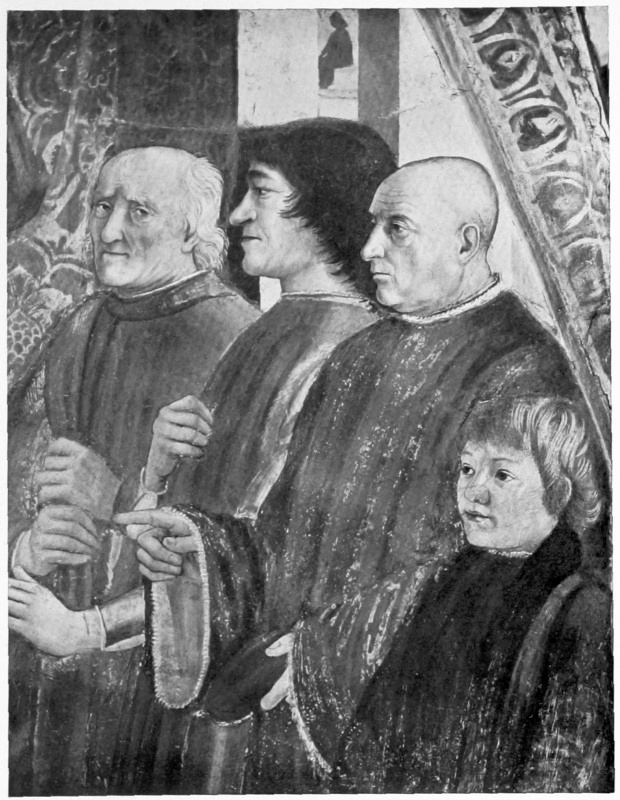
Alinari
LORENZO DI PIERO DE’ MEDICI, AND THREE MEMBERS OF THE SASSETI FAMILY. In the fresco by Domenico Ghirlandaio in the Church of S. Trinità, Florence.
The following letter from Vettori, Florentine ambassador at Naples, and the one from Lorenzo to Lanfredini at Rome (p. 319) show what prudence and patience the Magnificent exercised in mediating between the Pope and the King of Naples. Ferrante broke every obligation of his treaty with Innocent. He exterminated the rebel Barons with ferocity, he murdered the Papal governor and garrison of Aquila, he bestowed the Neapolitan benefices on unworthy men without heeding the remonstrances of the Pope, he repudiated the tribute due to the Holy See. Innocent was very angry. He declared the Kingdom to be forfeited for non-payment of the tribute, he threatened an interdict and, what particularly alarmed and displeased Lorenzo, talked about foreign intervention. Against both Lorenzo warned him, at the same time supporting him in resisting humiliating terms. Had Lodovico Sforza been trustworthy Lorenzo’s task might have been easier, but he significantly remarks, “I have expressed my opinion of the Lord Lodovico and have said what I think of him.” At length, shortly before Lorenzo’s death, peace was concluded, Ferrante consenting to pay the tribute on condition of the investiture of his son and grandson.
Pietro Vettori, Florentine Ambassador at Naples, to Lorenzo de’ Medici
Magnificent Lorenzo,—Since I wrote on the 2nd I have received yours of February 29th, which arrived most opportunely as here they were anxious, and suspected you had some secret understanding with the Pope. As the King was not here I thought it better to communicate your letter to H.E. the Duke [Alfonso of Calabria]. So yesterday I went to Castel Nuovo and took Baccio with me, who had been summoned here by the Duke. When he had read the letter I added that though you knew the King and H.E. were convinced of the loyalty of ourselves and of our city, yet it seemed to me that as these suspicions had arisen you wished to set matters right, and that you were the same Lorenzo you had ever been. H.E. answered he had no doubt of this. That he had summoned Baccio in order to send him to you at Florence to inform you of his feelings, as he liked to speak openly and desired others to do so to him. That it was perfectly known all over Italy what influence you had with the Pope and that the Florentine ambassador quodammodo governed at Rome. On the other hand the Pope showed great animosity towards the Neapolitan State and had only summoned those Spanish ambassadors in order to protest against H.M. the King and then to publish the excommunications which were already ready. H.E. is informed that last year and also two years ago everything was being secretly prepared for this last blow. He appears to have some other source of information than the usual ones. He added that his chief occupation now was contradicting those who by word of mouth or by letters from Rome told him that you are in league with the Pope, and allow these things to happen, and that although neither he nor the King believe this all Italy is convinced of it, to their great detriment. The Pope’s behaviour shows that he is of the same opinion, for if he thought that Milan and ourselves were what we ought to be he would never attempt anything against this State. But one wounds him here, another caresses him there, and between them all we, exclaimed H.E., go to the devil. He said he would like to meet you and the Lord Lodovico in one room and discuss matters, and did not think it would be difficult to convince you that this our League must be united not only in deeds but in demonstrations. That it was evident the Pope did much for you, he had for instance made your son a cardinal at an unheard-of age, and therefore it was thought that if you insisted things would go differently. He then added that neither he nor the King had heard anything about the troop of Jacopo Conti or the Count’s dismissal, though Jacopo had written to him about this a month ago. H.E. said it seemed as if you suspected him, though he would do all to forward your projects. I replied it was true that the Pope showed some regard for you and had acceded to your wishes as to the Cardinalate and one or two other matters, but that it was possible your influence did not extend to the affairs of H.M. the King, because although you could do much you could not do all. Also that Your Magnificence had been informed that H.E. had greatly encouraged the Count not to give up Monte Agutolo, which was a blow aimed at you; so that if he heeded not your honour and interest, he would find others do the same. He had not yet been told of the Count’s dismissal or about Jacopo’s troop, because they were connected together, and it was impossible to write until affairs were settled. Owing to the disgraceful conduct of the Count about Monte Agutolo you and all our citizens had determined to dismiss him, and had not informed H.M. the King or H.E., as they thought pressure might be brought to bear on them to retain him and they did not wish to say no to H.E. I added that as H.E. loved you he ought to be pleased if the Pope showed you any favour, because he might be sure that if you had to choose between them you would leave the Pope and follow H.E. That he was to consult with H.M. the King as to the particular thing they wanted and that I was sure you would always be ready to do anything honourable, but they must not make vague complaints. Lorenzo does nothing because perhaps Their Excellencies do not know exactly what they really want, or he could not do what they desired. But that I was certain that any just and honourable service he could render H.M. and H.E. he would do it. H.E. replied that he would consult with H.M., and give me an answer. I see he wants our ambassador and the ambassador of Milan to tell the Pope that they will not tolerate any measures being taken against the King. Then he added that he had sent a competent man to Barbary to acquire one or two horses fit for racing, in order to send them to you; et alia non occurrunt. I commend myself to you, may God grant you felicity.—Naples, March 9, 1489 (1490).[382]
Lorenzo de’ Medici, from Bagno San Filippo, to his son Piero
Piero,—Enclosed is a letter from Baccio; the bearer is the man of whom he writes, who is passing through Florence. He seems to me clever and one who loves to see antique things. I wish thee to show him all those in the garden, and also what we have in the study; in short, whatever seems best to thee, and thus to give him pleasure.—Bagno San Filippo, May 9, 1490.[383]
Lorenzo de’ Medici to the Commissaries of Pistoja
Magnificent Commissaries,—Two or three days ago I wrote to Your Magnificences about the liberation of Bastiano di Nanni, imprisoned by you and in danger of losing his life. And although I have not had an answer, yet considering the contents of the enclosed letter from Ser Andrea who lives in Siena with regard to our Republic, I have determined to write again to beg you, not in a general way but from my heart, no longer to delay in acceding to the request of the Magnificent Signory Of Siena, to whom I am under such obligations that if they do not obtain their desire great blame and dishonour will fall on me. Your Magnificences are aware that when one embarks on such an undertaking one spares no effort to accomplish it with honour. For the love of God deliver me from this annoyance, which is considerable, and set the aforesaid Bastiano free according to their wish, for their character is such that either good or great evil will result. I do not think you will wait for another communication from me, delay will greatly diminish the trust the Sienese have in me.—San Filippo, May 21, 1490, at midday.
Laurentius de Medicis.[384]
Lorenzo de’ Medici to Ser Andrea at Siena
Early this morning I had your letter telling me about Dormi and the swelling which began in his body and then settled in his right knee, and of the remedies applied by those farriers. You were right to have the horse doctored at once, and to write fully to me. Wait until the day of the race [the Palio at Siena], and if the farrier and the jockey think the horse is not in a fit state to run, we forbid his starting as it might do him harm, and indeed injure him permanently, even if you think he could run. I leave it to you, who being on the spot can judge better than I can here. I am not inclined to send another horse, we are too near the day of the race, he would arrive tired, and do us little honour.—Florence, July 28, 1490.
Laurentius de Medicis.[385]
Lorenzo de’ Medici to Giovanni Lanfredini, Florentine Ambassador at Rome
Two days ago I met by chance the Count della Mirandola riding in the outskirts of Florence. He is living very quietly in a villa near by, immersed in his studies. He desires at last to know what his future is to be, for having obeyed His Holiness hitherto and being decided to obey him implicitly in the future, he wishes to have some indication that His Holiness accepts his obedience in the form of a Brief, whereby the Pope acknowledges him as an obedient son and a good Christian, which I believe him to be. Among other proofs of this he has converted a young Jew who has been translating for him from the Hebrew language, of which he is a perfect master, whom he has persuaded to become a Christian. This is not the act of a heretic. I much desire that for the honour of His Holiness and for my own satisfaction this matter should be finished, and that the virtue and goodness of the said Count Giovanni should have as great a weight as the calumnies and suggestions of others. By nature he is devoted to His Holiness and does not dwell on what is past. Once delivered from this contumacy he will be the partisan and faithful servant of His Holiness, who to my thinking will thereby gain much.—August 11, 1490.[386]
Lorenzo de’ Medici to Giovanni Lanfredini, Florentine Ambassador at Rome
By your letter of the 13th I understand that the Pope has taken umbrage at the note presented by you, so do not proceed further with it. Anything that vexes His Sanctity annoys me, and I should be very sorry if he thought that any act or word of mine was not dictated by a desire for the good of His Holiness. You can assure him that I am always his servant and shall ever be. If I advised moderation in these proceedings against the King [of Naples] I only did so for the aforesaid reasons. As I wrote the other day, it seems to me necessary that His Holiness should decide on following one of three paths: either enforce his will by war against the King, or come to some agreement, or, if an honourable agreement is not possible, to temporise and wait for better times. The first would be the most honourable, but I conceive dangerous and very costly; indeed I do not think it possible unless the Neapolitan dynasty is changed. For this, according to my views, three things are necessary: either Venice or Milan must be a party to the enterprise, or the new ruler must be strong and well supplied with men and money, or the Holy Father must prepare to assert himself without stint of money or other things, to carry the thing through. It is indispensable that the Pope and the new ruler, whoever he may be, should be stronger than the King alone, supposing always that Venice adheres and would prevent Milan from helping the King. If they were understood with the Neapolitan Barons, or other such small folk, so much the better. I may be mistaken as to the first proposition when I dissuaded His Holiness from following it, but the state of things does not seem to me propitious. Perhaps I am not enough versed in all the secrets and therefore see and anticipate wrongly. His Holiness must have some promises or hopes, for the choice lies between Spain and France. Spain does not appear to me strong enough, particularly as regards money. What reliance is to be placed on France, seeing the French nature, I know not. Supposing she changed her nature I should agree with our Holy Father that it would be the best solution, for there would be less danger in augmenting the power of one of the house of Lorraine than of Spain, for the Duke of Lorraine is not King of France and we see by experience that the King of Naples is far more influenced by Spain than the Duke of Lorraine is by France. It is true the Kings of Naples and Spain are not friends, and that whoever is King of Naples would work for his own hand. For all these reasons, although there may be others I do not understand, I cannot advise the Pope to undertake such an enterprise now; and in that case it is unwise to exasperate the King with citations and other threats. Even were His Holiness fully prepared to go forward I think he ought to avoid the slightest sign of ill-will, in order not to incur any danger from what the King might say or do. This danger seems to me to exist, therefore he would do better to dissimulate and make secret preparations, than to show anger before being ready to strike, which would only give an opportunity to others to make ready and to attack. So for every reason in the first proposition I do not think it wise to cite the King. As to the second I may also be mistaken, because conditions may have been proposed of which I am not aware, and which may be rendered feasible by this very citation, if the affair is matured and almost settled. In this case the assumption of superiority may help to decide matters. But if there is nothing more than I know the affair seems embittered and not at all easy of solution; therefore such methods might lead to a scandal or even to an open rupture, instead of to an agreement. The advantages of temporising cannot, I think, be denied. There can be no doubt that it is better to arrange matters, having due regard to the reputation of His Holiness, than to tempt fortune; for you know better than I do that the King can do much harm. But, as I said before, I do not know enough about these matters so cannot say more. If the Pope has good reasons for his fearless attitude let me know them to relieve my mind, for though not of a timid nature I am far more anxious about his affairs than about my own, because of the trust he reposes in me. If His Holiness is satisfied, I have such faith in his prudence and authority that I shall be tranquillised. But until I hear these reasons I confess that I am uneasy. For the love of God let me know, as I do not feel at all well. The Pope must not on any account imagine that I think, do, or act, in any way against his interests, for the benefits I have received from His Holiness, and those I hope for, derive from his power and reputation. My opinion of the Lord Lodovico I have expressed, and have said what I thought of him. My intentions are loyal, and as I depend much on His Holiness I can only repeat that if he can come to an honourable understanding with the King it would be, I consider, better than war. If there is any difficulty about this I would do my utmost to arrange matters to the Pope’s honour and security; supposing always that the above-mentioned conditions, of which I know nothing, and which would make it possible to act against the King, are non-existent. If they do exist I am sure the King would consent to honourable terms because he would understand what evil might befall him otherwise. But all my suppositions are useless if the Pope has secret information unknown to me. I do not think my open speaking can offend His Holiness, for our fortunes are bound up together. I wish to be allowed to say what I think, but will act according to the wishes of our Holy Father. Thank him most heartily for the loving and kindly reply about the Servite Order with regard to Messer Giovanni. For all these things I am deeply indebted to His Holiness. I am very glad you have been to Cervetri and S. Severa, and most pleased that you were satisfied with the way Signor Francesco (Cibò) treats his subjects. God knows his honour and well-being are as dear to me as my own. I beg of you to do all you can to induce our Holy Father to arrange this affair of S. Severa. You see yourself the importance and the necessity of adding this property to that of Cervetri. I should also like to know about the affair of Gallese in order to reply to the friend who is coming here soon. It is urgent that His Holiness should once for all arrange the affairs of Signor Francesco so that I should not be daily worried about them, and that we can live in peace and harmony. To speak plainly, Signor Francesco has not the position the nephew of a Pope ought to have, and yet we are now approaching the seventh year of the Pontificate. More regard should be shown to the increasing family, which is a valid reason for our Holy Father’s aid.—Florence, October 17, 1489.[387]
Lorenzo de’ Medici to the King of England
Serene Majesty,—When this Signory writes to recommend one of their citizens they have such hope and faith in the clemency and kindness of Your Majesty, that neither do they doubt of their gracious reception nor do I consider it necessary to intervene in their behalf. Yet, to satisfy my conscience, being in duty bound to help the citizens of this Republic, I cannot refrain from recommending with all reverence and humility to Your Majesty Filippo del Vigna for the affair he will explain. I assure Your Majesty that no greater token of interest and clemency towards this city can be given than to accept the aforesaid Filippo as a faithful servant, and to aid him to recover his indemnity, and I, for my part, should be everlastingly grateful.
I commend myself humbly to Your Majesty.[388]
Agnolo Poliziano to Lorenzo de’ Medici in Florence
Magnificent Patron,—My last letter was from Ferrara. In Padua I found some good books, i.e. Simplicio, on the Sky; Alessandro, on the Topica; Giovan Grammatico, on the Posteriora and the Syllogism; a David on Aristotle; none of which we have in Florence. I also found a Greek scribe in Padua and arranged with him at a ducat for every fifteen pages.
Maestro Piero Leoni showed me his books: among them I found M. Manlio, an old astronomer and poet, which I have brought with me to Venice to compare with one I have bought; I have never seen a more ancient book. Similiter he possesses certain books of Galieno de dogmate Aristotelis et Hippocratis in Greek, of which he will give us a copy in Padua, so we shall have gained something.
In Venice I have found some books of Archimedes and Eron, mathematicians, which we have not got, and a Frunuto de Deis, and other valuable things. So papa Janni[389] will have writing enough to do for some time.
Niceno’s [Cardinal] library we were not able to see. Messer Aldovrandini, the Duke of Ferrara’s ambassador, in cujus domo habitamus, went to the Prince but was met with a blunt refusal. He asked for Count Giovanni [Pico della Mirandola], not for me, as I thought it better not to mention your name in the affair. Messer Antonio Vinciguerra and Messer Antonio Pizamanno, one of the two philosophers who came incognito to Florence to see the Count, and a brother of Messer Zaccheria Barbaro, are engaged in trying to overcome this obstinacy; everything possible will be tried. This is all I have to say about books.
Messer Piero Leoni has been greatly persecuted in Padua and has no patients either there or in Venice. Yet he is a good doctor and held in high esteem. I have caused him to be sounded by the Count as to coming to Tuscany, but I think it will be difficult. He does not like Padua and the society does not please him, ut ipse ait; negut tamen se elle in Thusciam agere.
Nicoletto would come to Pisa but wants a benefice, hoc est one of those canonries. His name stands high in Padua and his method is good; but, nisi fallor, he is one of these odd fantastical men. He it was who mentioned the benefice to me; so I warn you.
This morning I paid a visit to Messer Zaccheria Barbaro and assured him of your affection &c.; he replied tearfully et ut visum est from his heart: all resolved itself into in te uno spem esse. Ostendit se nosse quantum tibi debeat: so do what you intended, ut favens ad majora. The Legate, who has returned from Rome, et qui tecum locutus est Florentiæ, is not at all of their way of thinking, ut ajunt.
Messer Zaccheria showed me a very beautiful antique earthen vase which was sent to him lately from Greece, and told me that if I thought you would like it he would send it to you with two smaller ones. I said it was just what Your Magnificence would admire et tandem it will be yours. To-morrow morning the box shall be made and I will send it off. I do not think you have so fine a one in eo genere: it is about three spans high and four wide.
The Count [Pico della Mirandola] has bad eyes and has not been out of the house since he came to Venice.
Item yester evening I paid a visit to the learned Cassandra Fidele and greeted her in your name. She is no less wonderful, Lorenzo, in the vulgar tongue than in Latin; most discreet, et meis oculis etiam handsome. I came away astounded. To you she is most partial and talked about you with such understanding quasi te intus et in cute norit. One of these days she intends to go to Florence to see you, so prepare to do her honour.
I have no more to say at present, save that your causing Greek books to be copied and the favour you show to learned men sets you higher in the esteem and honour of the world than any man has enjoyed for many years. Other particulars I reserve for my return. I commend myself to Your Magnificence. I have not yet used the letter of exchange as I have had no need of it.—Venice, June 20, 1491.
The servant of Your Magnificence,
Angelus Politianus.[390]
Pier Filippo Pandolfini, Florentine Ambassador at Rome, to Lorenzo de’ Medici
Monsignor d’Arles told me yesterday morning that the Signoria of Venice and all the Venetian gentlemen are very irate with us for two things. First because, according to them, we tried through the Soldan to prevent that journey of theirs. Secondly on account of the agreement about wool from England, which they have so much at heart that they could not be more angry and are decided to upset it at any cost. They have ordered that all ships carrying wool to Pisa, no matter to whom they belong, are to be prevented from loading in Candia, Cyprus, or any other place where they have ports, and that no ship of theirs is to touch at Porto Pisano. I do not know whether it would be good to inform Tommaso Portinari so that he might tell the King of England and explain to him the harm this decision will do to H.M. and to his subjects, and that the Venetians want to be masters and dictate laws to them.
Maestro Leoni was here this morning and tells me he is engaged at Padua for two years certain and one year optional, at 2000 golden pieces yearly; and he has accepted with the intention, if he is not prevented, of practising medicine at Venice. He has taken this step deliberately and left Pisa with this intent, but has been idle for some time for his own justification. At Pisa he thought he was not well treated by the authorities and told me much about it, and that he was not regarded with the consideration he considers he had a right to expect. You he praises highly and says that he perceives that whatever good he experienced was solely through your influence and not on account of his own merits. He intends to show what learning and capabilities he possesses and to leave a name behind him. Wherever he may be he affirms that he is ever yours.—July 1491.[391]
Piero Leoni of Spoleto to Lorenzo de’ Medici
I have heard what has been ordered to Your Magnificence as to the water and what the effect has been. First I must make an examination and Your Magnificence will cease taking it. It will be better not to wait until winter begins to lay in the usual provision, and Your Magnificence can take first Morba for a week and then Villa for another week. The less interval there is between the two the better. During this time I will make a trial of the said water which has arrived here in safety. I have not been able to do so on account of being occupied with lectures until the first August: then I had to go to Venice to pay my duty to the Doge and the Signoria. As soon as I have settled the Venetian business I shall make a trial at Padua of that water for a purpose of my own, for I need it, and according to the effect obtained I shall see whether we have something different from arzente[392] water; if I find it is different, as I think, when I have tried it, I will see how to make it suit the case of Your Magnificence. If it be arzente water, we shall have unmasked it, which will not be at all unpleasing to me. Your Magnificence can take the Morba water without further advice, except when the wind is northerly, for then it is of little or no use. Let us hope the weather will soon be fine again and then Your Magnificence is to ride fast and far after drinking the water when fasting, morning and evening. Beware of cold and damp feet, of moonlight, and of the air at sunset, and do not eat pears or swallow grape pips. I received Proculus, which has given me the more pleasure that I have long wished to possess it, and finding that it is as excellent as I supposed I shall have it translated. When finished I will do as Your Magnificence says. I have heard that Lascari found in Calabria a commentary by Proculus on the Heraclitus of Plato. I beg Your Magnificence, when you know where this commentary is, to try and get it, or to tell me so that I may try. It must be valuable because the matter in itself is good and the author is the most competent man there is in such things. No more at present. I commend myself to Your Magnificence.—Padua, August 19, 1491.[393]
Matteo Franco at Rome to Ser Piero Dovizi at Florence
Ser Piero, you know how long ago I told you of the want of order in this house and how things went from bad to worse so that I gave up fighting; and how a Florentine was like a Cross among devils. Also I informed you of Madonna’s [Maddalena] tribulations with regard to divers matters. But as I suspect you never read my letters to the end, probably these things will be new to you. With this doubt and also as a satisfaction to myself, I write, for I am bursting with pent-up rage, and know not where to turn for advice or help. When I see such coldness and want of care and affection for persons of far more importance than Franco, I cease to trouble about my own affairs, but about theirs I am in despair. No one, man or woman, ever comes to this house, save once in a blue moon, to ask whether Madonna is alive or dead. Let be that they grant her no authority, but they might ask if she is alive. Ever since our return she has been shut up in the house, save the two days spent at Cervetri, twice that she went to see the Pope, and one evening when she supped at the bank. She is always ailing and there does not seem to be a man living who takes interest in her. Cursed be that milk-cheese, those curds, those pears, that flask of trebbiano, that bundle of fennel and those medlars, that have never, never been sent to her by you or by anybody. These Genoese with the Pope have the most beautiful loggia and all the greatest marvels of the world, let alone other things of more value. While she, poor patient child, the daughter of such a man and so perfect and charming in herself, is less esteemed than would be the daughter of an exile, and as I well know there are always prevarications, excuses and justifications, saying that notice must not be taken of small things and that one day all of a sudden we shall hear the thunder and see the lightning of some important event. We shall see, my Ser Piero, but I have no faith in excuses, and the conclusion is that if you do not help to keep this house things you do not expect will happen, for which you will be sorry.
I have written all this, full of despair and anger, to others besides yourself. The bad health of Madonna Maddalena and the thoughtless behaviour of my Lord in keeping her up, for all this winter he has gambled every night, supping at six or seven and coming to bed at daylight, and she will not, and cannot, eat or sleep without him. Thus she has lost sleep and appetite and has become as thin as a lizard, as I told you. To the ambassador and Noferi and Ser Niccolò and to Christ, I have told this every day and kept them informed. The ambassador replies: “It is your business to write to Lorenzo, what can I do in the matter? Write, and let me act.” And Noferi says: “I fear this girl will not live long, and my Lord says and does &c., and they ought to be warned at Florence, &c.” Ser Niccolò, whom I asked about either summoning Maestro Piero Leoni or describing her symptoms to him and sending him the prescriptions of the doctors here, for the girl has great faith in Maestro Leoni as he treated her mother and herself and knows her constitution, made me copy out all the recipes of the doctors and said it would be well to write and that he would do so. Then he got immersed in grand doings and all has come to nought. Poor Franco runs here and runs there angered inside and out, and his heart is bursting. The worst is that he has not enough authority or brains to set things right.
Madonna’s illness is caused by sitting up too late at night, eating at hours she is not used to, and remaining shut up in the house all day without taking any exercise; then, like her mother, she is melancholy, thin, and pensive, and takes every caprice and folly of her husband’s to heart. She thinks and dreams of nought else, so great is her love of him. She is slowly pining away and this seems to me the most alarming symptom, for nothing she eats or drinks does her any good or gives her any pleasure....
Ser Piero, I beg you as earnestly as I can to excuse me and with clasped hands I entreat you to get me away from here. First because, as I have told you several times, I cannot bear it any longer, and then because I get small honour and less gain. I know what I say. Madonna can do little for me and I can do even less for her in the state to which they have reduced her. I always told you none but a Franco would have endured this life. No more at present. Let us study to find a remedy for what is more important, and see that this girl should be served rather like the daughter of her father than the wife of him she has married. Let the rest go as it will. I commend myself to you.—Rome, January 16, 1492.
Your Franco.[394]
Lorenzo’s end was fast approaching. The following extracts from Manfredi’s letters show how terribly he suffered, and with what fortitude he bore extreme pain. From his last words to Filippo Valori and Andrea Cambini, who accompanied the young Cardinal Giovanni to Rome, “I entrust the youth of my son to you, you will not see me again,” it is evident he knew death was near. But in the long letter to his son at Rome he makes no allusion to his own health, as though he did not wish to cloud the lad’s first entrance into life. It is full of political wisdom, knowledge of the world, and fatherly foresight. After Giovanni’s departure Lorenzo rallied a little, and on March 21st was carried to Careggi, attended by his favourite sister Bianca, his daughter Lucrezia, his eldest son Piero, and the faithful Poliziano.
Manfredo di Manfredi, Ambassador from Ferrara to Florence, to the Duke Ercole d’Este
... The Magnificent Lorenzo has not been able to see any of the ambassadors on account of his gout which gives him great pain....—Florence, January 16, 1492.[395]
... Since several days the Magnificent Lorenzo is very ill and much tormented with pain all over the body save in the head. His agony is such that est res miranda how he can live. It is true the doctors do not think it is an infirmitas ad mortem, but he is very weak from want of rest. May God restore him to his usual health, for it really moves one’s compassion to hear the state he is in....—Florence, February 11, 1492.[396]
... For three days the Magnificent Lorenzo has been in such pain that no one could see him....—Florence, March 5, 1492.[397]
... Since two days the Magnificent Lorenzo is better though he still has attacks of pain. It is thought that this perverse and very cold weather affects him....—Florence, March 8, 1492.[398]
I have nought to report to Your Excellency save that yesterday the Most Rev. Cardinal de’ Medici [Giovanni, Lorenzo’s second son] left for Rome. Last Saturday he received the hat in a certain abbey, called the Abbey of Fiesole, and then in his Cardinal’s robes, accompanied by us ambassadors, many bishops, and a large number of citizens, made a triumphal entry into the city. Dismounting at the palace of the Signoria he paid them a visit. He mounted again and we accompanied him to his father’s house. Next day, with the same following he went to S. Liberata [the cathedral] to hear mass, which was celebrated by eight bishops with great solemnity, and at which the Illustrious Signoria assisted. At the close the Cardinal took leave of the Signoria in the church and accompanied by us went to his father’s house where a magnificent banquet was prepared, at which we ambassadors assisted (having been previously invited) and sixty of the principal citizens of this State. The house was most richly adorned. Before we rose from table a great number of chiselled silver vases were presented to the Cardinal on behalf of the Signoria. A stupendous sight, for the vases were large and well ornamented. They were valued at 10,000 ducats or more, which may well be, as they weighed more than 1000 pounds. We ambassadors then went with His Illustrious Reverence to his room and rich and handsome silver vases were brought by the various Communes, and the Jews of the city, but His Lordship would not accept them and gave them back to the donors with fair words of thanks. Likewise he accepted nothing from any citizen save from his relations, who gave him splendid gifts. The Magnificent Lorenzo, though in pain, came into the hall where we were dining to see the Cardinal and us ambassadors, and has begun to ride again, although often seized with pain....—Florence, March 13, 1492.[399]
Lorenzo de’ Medici to his son, Cardinal Giovanni, at Rome, in March 1492
Messer Giovanni,—You are much beholden to our Lord God, as we all are for your sake, as besides many benefits and honours our house has received from Him it has pleased Him to bestow on you the highest dignity our family has yet enjoyed. Great as this is it is much enhanced by circumstances, particularly your youth and our condition. Therefore my first recommendation is that you endeavour to be grateful to our Lord God, remembering every hour that it is not by your own merits or solicitude that you have attained the Cardinalate, but by the grace of God. Show your gratitude to Him by leading a saintly, exemplary, and honest life. You are the more bound to do this because during your youth you have shown a disposition which gives hope of good fruit. It would be indeed most shameful, contrary to your duty, and to my expectations if at a time when others generally acquire more reason and a better understanding of life, you should forget the good precepts learned as a boy. It is incumbent on you to try and lighten the burden of the dignity you have attained by leading a pure life and persevering in the studies suitable to your profession. I was greatly pleased last year to learn that without being reminded by any one you had been several times to confession and to communion, for I conceive there is no better way of obtaining the grace of God than by habituating oneself to persevere in these duties. This seems to me the best advice I can begin with. I know, as you are now going to Rome, that sink of all iniquities, that you will find some difficulty in following it, as bad examples are always catching, and inciters to vice will not be wanting. Your promotion to the Cardinalate, as you may imagine, at your age and for the other reasons already mentioned, will be viewed with great envy, and those who were not able to prevent your attaining this dignity will endeavour, little by little, to diminish it by lowering you in public estimation and causing you to slide into the same ditch into which they have themselves fallen, counting on success because of your youth. You must be all the firmer in your stand against these difficulties, as at present one sees such a lack of virtue in the College. I recollect however to have known a good many learned and good men in the College, leading exemplary lives. It will be well that you should follow their example, for by so doing you will be the more known and esteemed as being different from the others. It is imperative above all things that you should avoid as you would Scylla and Charybdis the reputation of being a hypocrite and of evil fame. Be not ostentatious, and have a care to avoid anything offensive in conduct and in conversation, without affecting austerity or severity. These are things you will in time understand and practise better, I conceive, than I can write them. You know how important is the position and the example of a Cardinal, and that the world would be far better if the Cardinals were what they ought to be, for then there would always be a good Pope, from whom emanates, one may say, peace for all Christians. Make every effort therefore to be this, if others had done so we might hope for universal good. Nothing is more difficult than to hold converse with men of various characters, and in this I can ill advise you; only recollect when with the Cardinals and other men of rank to try and be charitable and respectful in your conversation, weighing your reasons well without being influenced by the passions of others; for many desiring what they cannot attain turn reason into abuse. Satisfy your conscience therefore by taking care that your conversation with every man should be devoid of offence. This seems to me a general rule most applicable in your case, for should passion by chance make an enemy, as his enmity would have no reasonable cause he may sometimes return with more ease to the old friendship. It will be better I think on this, your first visit to Rome, to use your ears more than your tongue. To-day I have given you entirely to our Lord God and to Holy Church; it is therefore essential that you become a good ecclesiastic, cherishing the honour and the State of Holy Church and of the Apostolic See above aught else in this world, and devoting yourself entirely to their interests. While doing this it will not be difficult for you to aid the city and our house, for the city being united to the Church you will represent the solid chain, and our house is part of the city. Although it is impossible to foresee what may happen I think it is likely that a way will be found to save, as the proverb says, the goat and the cabbages, always keeping steadfastly to your above-mentioned duty of setting the interests of the Church above all else. You are the youngest Cardinal, not only of the College, but the youngest that has hitherto been made, it is therefore most necessary that where you have to compete with the others you should be the most eager and the humblest, and avoid making others wait for you in Chapel, in Consistory, or in Deputation. You will soon learn who has a good or an evil reputation. With the latter avoid any great intimacy, not only on your own account, but for the sake of public opinion; converse in a general way with all. I advise you on feast-days to be rather below than above moderation, and would rather see a well-appointed stable and a well-ordered and cleanly household than magnificence and pomp. Let your life be regular and reduce your expenses gradually in the future, for the retinue and the master being both new at first it will be difficult. Jewels and silken stuffs must be used sparingly by one in your position. Rather have a few good antiques and fine books, and well-bred and learned attendants, than many of them. Ask people to your own house oftener than you accept invitations to theirs, but do both sparingly. Eat plain food and take much exercise, for those who wear your habit, if not careful, easily contract maladies. The rank of Cardinal is as secure as it is great, men therefore often become negligent; they conceive they have done enough and that without exertion they can preserve their position. This is often prejudicial to character and to life, and a thing against which you must guard; rather trust too little than too much in others. One rule I recommend to you above all others, and that is to get up betimes; besides being good for health one can meditate over and arrange all the business of the following day, and in your position, having to say the office, to study, to give audiences &c. you will find it most useful. Another thing absolutely necessary to one in your station is to reflect, particularly at this, the commencement of your career, in the evening on all you have to do next day, so that an unforeseen event may not come upon you unawares. As to speaking in the Consistory, I think it would be more seemly and becoming if you refer all that comes before you to His Holiness, alleging that as you are young and inexperienced you consider it your duty to submit everything to the most learned judgment of His Holiness. You will probably be asked to intercede in various matters with our Holy Father. Be cautious however at the beginning to ask as few favours as possible and not to bother him; the disposition of the Pope is to be grateful to those who do not break his ears. Bear this in mind in order not to annoy him. When you see him, talk about amusing things, and if you have to beg, do it with all humility and modesty. This will please him and be in accordance with his nature. Keep well.—Florence.[400]
Cardinal Giovanni de’ Medici to his father Lorenzo Magnifico Viro Laurentio de Medici Pater optimo
Salvus sis,—In case ...[401] (I) did not tell you of some things. On Friday morning I was given a public reception and went accompanied by all the Cardinals, nearly the whole court, and very heavy rain, from S.M. del Popolo to the palace and from the palace to Campo di Fiore. Our Holy Father received me most graciously: I hardly spoke to him. The following day the ambassadors waited on our Holy Father; their audience was most satisfactory. The Pope desired to hear me the day after, which is to-day. I have been, and His Holiness spoke as lovingly as was possible to me, and reminded me, and advised me, to do something when I visited these Cardinals, and I have begun to do so with those to whom as yet I have paid visits. Another time I will tell you who they are. All professed the greatest goodwill towards you. Of former things I know that you have been told. Of myself I have nought to say save that I will try hard to do you honour. De me proloqui ulterius, nefas. The news that you are so much better has been a great joy to me and I have no other wish than to hear this often. For this I send thanks to Ser Piero [Leoni, the doctor]. I commend myself to you. No more at present.—Rome, March 25, 1492.